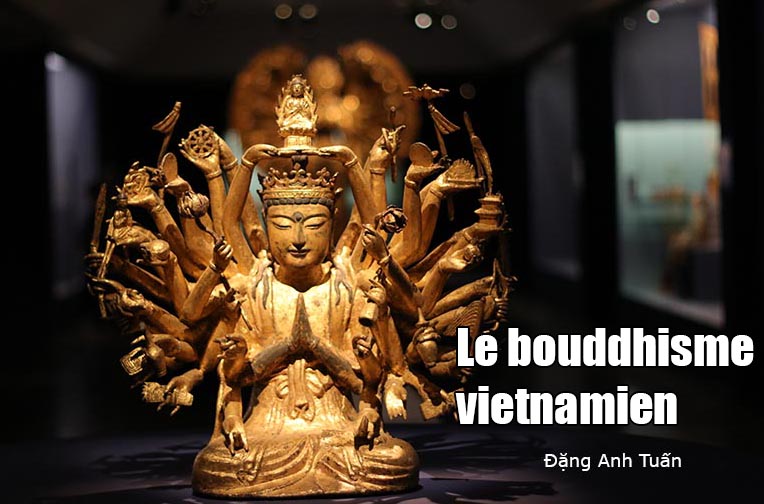
Vietnamese buddhism (Phật giáo Vietnam)

French version

Vietnamese version

The exact date of the introduction of Buddhism to Vietnam is not known. According to the Vietnamese scholar Phan Lạc Tuyên, Indian monks came to Vietnam at the beginning of the Christian era based on the story of Chu Đồng Tử, who was initiated into Buddhism during his encounter with an Indian monk. This was also the period of the Three Kingdoms (Tam Quốc) when Vietnam was a Chinese province called Jiaozhi (Giao Châu) under the governance of Shi Xie (Sĩ Nhiếp). At that time, Vietnam belonged to the kingdom of Wu (Đông Ngô) led by Sun Quan (Tôn Quyền), whose mother, a fervent disciple, brought monks from Luy Lâu to Jianye (the capital of the kingdom of Wu), which corresponds to the current city of Nanjing (Nam Kinh), to ask them to preach and comment on Buddhist sutras.

The Buddhist center Luy Lâu became so prestigious and important that it soon attracted many famous Indian or foreign monks such as Ksudra (Khâu Đà Là), Mahajivaca (Ma Ha Kỳ Vực), Kang-Sen-Houci (Khương Tăng Hội), Dan Tian (Đàm Thiên). Being the senior monk of the Sui dynasty, the latter, upon his return to China, had the opportunity to report to Emperor Sui Wendi (Tùy Văn Đế) on the development of Vietnamese Buddhism: the province of Giao Châu had adopted Buddhism before us because, in addition to the construction of 20 pagodas, it had more than 500 monks and 15 collections of translated sutras.

This undeniably proves that Buddhism was flourishing at that time in Vietnam. It is important to recall that in the Chinese annals, there is mention of the pillaging by the Chinese army under General Lieou Fang (Lưu Phương) of the Sui dynasty (nhà Tùy). This general devastated the capital of Champa, Điển Xung (Kandapurpura), under the reign of King Sambhuvarman (Phạm Phạn Chí in Vietnamese) and took with him 1,350 Buddhist texts compiled in 564 volumes. Champa very early on promoted the establishment of Buddhism, as it was already mentioned by the famous monk Yijing (Nghĩa Tịnh) upon his return from his maritime journey in the Insulinde as one of the Southeast Asian countries that held the Buddha’s doctrine in high esteem at the end of the 7th century under the reign of Wu Ze Tian (Vũ Tắc Thiên) of the Tang dynasty (Nhà Đường).

Although Vietnam was a Chinese protectorate (from 111 BC to 931 AD), it was nevertheless the true relay between China and India. The establishment of Buddhism was very early in this country at the beginning of the Christian era because Vietnam was not only next to countries using Sanskrit for Buddhist texts such as Founan (Phù Nam) and Champa but also the mandatory passage point for Indian merchants. They needed to rest, replenish food supplies, and exchange goods (silk, spices, eaglewood, cinnamon, pepper, ivory, etc.).

At that time, India had established trade relations directly with the Middle East and indirectly with Mediterranean countries such as the Roman Empire. Mahayana Buddhism flourished in India with the centers of Amaravati and Nagarjunakonda in the coastal region of southeastern India (Andhra Pradesh). This encouraged Indian monks to accompany sailors along the coasts of Malaysia, Funan, and Vietnam with the intention of spreading the faith. That is why it can be said that Vietnamese Buddhism came directly from India with Indian monks, but in no way was it brought by the Chinese.

Vietnamese Buddhism, whose current is Mahayana, takes more into account collective salvation than individual salvation, whereas Theravada Buddhism considers salvation as the result of efforts made by the individual to achieve enlightenment and become a bodhisattva. At the beginning of its establishment, Buddhism encountered no resistance from the Vietnamese because it easily accepted their traditional paganism. It only had some simple and modest religious activities such as the veneration of the Buddha, offerings, acts of mercy, etc. Buddha was none other than Quán Thế Âm (Avalokitesvara) and Nhiên Đăng (Dipankara) because these figures protected sailors during sea voyages. The first Vietnamese Buddhist legends, Thích Quang Phật and Man Nương Phật Mẫu, also appeared at this time with the arrival of the monk Ksudra, also known as Kalacarya (the Black Master), in Vietnam.

It is through these legends that Man Nương, upon her death, became an object of worship under the name « Mother Buddha or Phật Mẫu » by the Vietnamese. These legends thus testify to the ease of integrating popular beliefs into Buddhism. Furthermore, this religion, imported early on, was under Indian influence which, according to researcher Hà Văn Tấn, lasted until the 5th century.

The Chinese governor Sĩ Nhiếp (177-266) was often accompanied in the city by religious figures coming from India (người Hồ) or Central Asia (Trung Á) on each outing. The number of foreign monks was so significant that Giao Châu became a few years later the center for translating sutras, among which was the famous Saddharmasamadhi sutra (Pháp Hoa Tam Muội) translated by the monk Chi Cương Lương Tiếp (Kalasivi) in the course of the 3rd century.

It is also important to note that in a short period of six years (542-547), King Lý Nam Đế (Lý Bí) of the early Lý dynasty succeeded in freeing Vietnam from Chinese domination and ordered the construction of the Khai Quốc pagoda (Foundation of the Nation), which today is the famous Trấn Quốc pagoda in Hanoi. According to the Zen monk Thích Nhất Hạnh, it was mistakenly believed in the past that the Indian monk Vinitaruci introduced Vietnamese dhyana Buddhism (Thiền) at the end of the 6th century. During his stay in Lũy Lâu in the year 580, he resided in the Pháp Vân monastery belonging to the dhyana school. It was also at this time that the dhyana monk Quán Duyên was teaching dhyana there. Other Vietnamese monks had gone to China to teach dhyana before the arrival of the famous monk Bodhidharma, recognized as the patriarch of the Chinese dhyana school and the patriarch of Kungfu.From now on, it is known that it was the monk Kang-Sen-Houci of Sogdian origin (Khương Tăng Hội), instead of Vinitaruci (Ti Ni Lưu Đà Chi), who deserves the credit for introducing dhyana Buddhism to Vietnam.

Vietnamese Buddhism began to flourish and reach its golden age when Vietnam succeeded in regaining independence under General Ngô Quyền. Under the Đinh, Early Lê, Lý, and Trần dynasties, Buddhism was recognized as the state religion.

[Buddhism under the Đinh, Tiền Lê, Lý, and Trần dynasties]

[Return RELIGION]

Papyrus vietnamien (Giấy dó)

Imageries populaires Đông H

Version française

English version

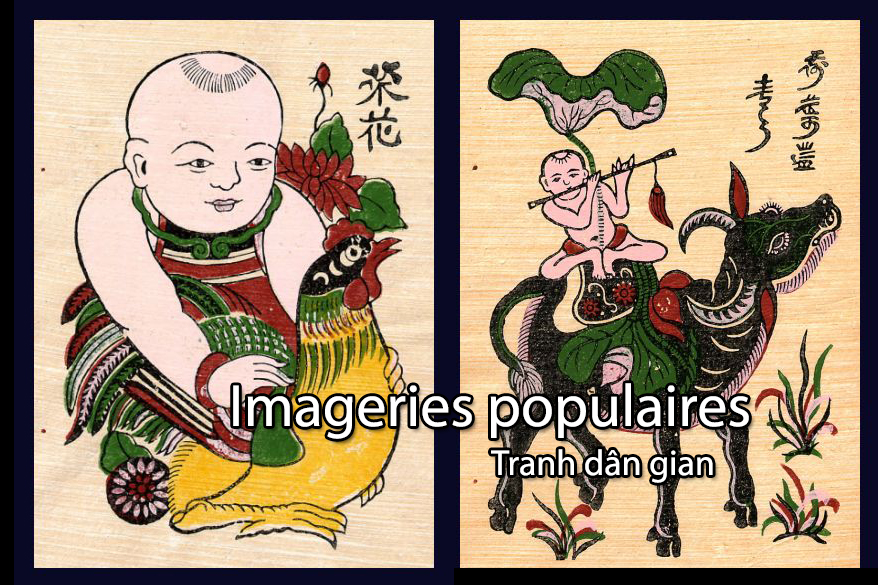
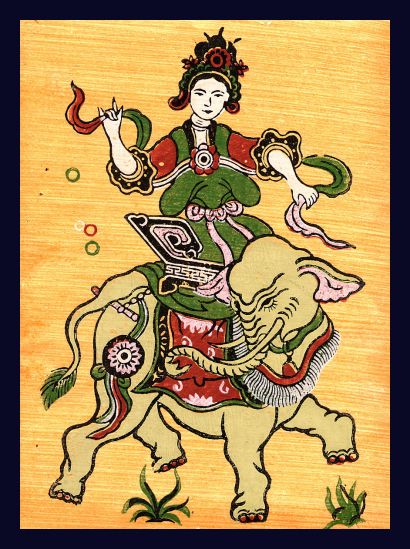
Các  bức tranh dân gian phổ biến nầy  thường được trông thấy trưng bày ở  các ki-ốt dành riêng cho các khách du lịch nước ngoài. Giấy dó (giấy rhamnomeuron) được sử dụng để in những hình ảnh này. Theo một số nhà nghiên cứu Việt Nam,  giấy này được xuất hiện vào khoảng thế kỷ thứ 3 và đạt đến đỉnh cao từ thế kỷ thứ 8 đến thế kỷ 14. Hồ Qúi Ly đã sử dụng nó vào cuối thế kỷ 14 để in các tiền tệ pháp định.

Việc sản xuất giấy này đòi hỏi phải có sự chuẩn bị thật  kỹ lưỡng. Giấy được làm bằng vỏ cây dó. Sau khi thu hoạch vào khoảng tháng 8 đến tháng 10 âm lịch, cần ngâm vỏ cây trong nước một hoặc hai ngày. Sau đó mới  được xử lý bằng cách ngâm nó trong dung dịch vôi cô đặc trong 5 giờ. Sau đó mới  đun sôi nó trong khoảng 20 giờ trước khi đem giã nó trong 5 giờ. Bột thu được bằng cách giã được pha loãng trong một chậu chứa đầy hỗn hợp nước và nhựa từ cây mò (clerodendron). Giấy thu được bằng cách sử dụng khuôn sau khi ép và sấy khô nó.

Cứ một trăm kí lô vỏ cây,  chỉ thu được 5 hoặc 6 kg giấy. Điều này giải thích tại sao thị trường bán giấy nầy rất bị hạn chế. Ngoài ra, giấy dó Việt Nam chỉ mọc ở vùng cao miền Bắc. Nổi tiếng với nghề in vẽ hình trên giấy dó, dân làng Dương Ô và Đông Hồ cũng chịu cùng  chung số phận.

Giá  vốn sản xuất giấy  được tái chế lại cao hơn so với  giá bán giấy dó. Đây chính là lý do khiến ít người tiếp tục quan tâm đến nghề truyền thống nầy  đang bị thất lạc đi qua năm tháng.


Les imageries populaires fréquemment visibles sont proposées dans les kiosques réservés aux touristes étrangers. Le papier dó (papier de rhamnomeuron) est utilisé dans l’impression de ces imageries. Selon certains chercheurs vietnamiens, ce papier fut apparu vers le IIIème siècle et connut son apogée du VIIIème au XIVème siècle. Hồ Qúi Ly s’en servit à la fin du XIVème  siècle pour l’impression des monnaies fiduciaires.

La production de ce papier nécessite une préparation minutieuse. Il est fabriqué avec l’écorce de l’arbre do. Après la récolte de celle-ci entre les 8ème et 10ème mois lunaires, on a besoin de l’immerger dans l’eau pendant un ou deux jours. On la traite ensuite en la macérant dans une solution de chaux condensée durant 5 heures. Puis on la fait bouillir durant une vingtaine d’heures avant de la piler pendant 5 heures. La farine obtenue par le pilage est diluée dans une bassine remplie d’un mélange d’eau et de résine de la plante mò ( clerodendron ). Le papier est obtenu grâce à un moule après avoir été pressé et séché.


Papyrus vietnamien

Galerie des photos

Pour cent kilos d’écorce, on obtient seulement 5 ou 6 kilos de papier. Cela explique la raison pour laquelle le marché est très limité. De plus le papyrus vietnamien dó ne pousse que dans les hautes régions au Nord. Connus pour la fabrication des imageries populaires sur le papier dó, les villageois de Dương Ô et de Ðông Hồ ont subi le même sort.

Le prix de revient  dans  la production du papier recyclé est supérieur à celui de vente  du papier dó. C’est pourquoi peu de gens continuent à s’intéresser encore à ce métier ancestral qui se perd au fil des années.

Version anglaise

Those are often proposed in the kiosks reserved to  foreign tourists. Paper dó (rhamnomeuron paper) is used in the printing of these images. According to certain Vietnamese researchers, this paper had appeared around the 3rd century and knews its apogee from the 8th to the 14th century. Hồ Qúi Ly made use of it at the end of  14th century for the printing of  fiduciary currencies. The production of this paper requires a meticulous preparation.

It is manufactured with the bark of the tree dó. After the harvest of this one between the 8th and 10th lunar months, one needs to immerse it in water during one or two days. After one treats it by macerating it in a lime solution condensed during 5 hours. Then one makes it by boiling  during about twenty hours before crushing it during 5 hours. The flour obtained by crushing is diluted in a basin filled with a mixture of water and resin of the plant mò (clerodendron). Paper is obtained thanks to a mould after being pressed and  dried.

For two hundred kilos of bark, one  gets only 5 or 6 kilos of paper. That explains why the market is very limited. In addition, the Vietnamese papyrus dó grows only in the northern  highlands. Known for making popular imagery on paper dó,  villagers of Dương Ô and Đông Hồ suffered the same fate.

The cost price in the production of recycled paper is higher than the selling  price  of dó paper. That is why a few people still continue to be interesting to this ancient craft that is lost over the years.

Funan kingdom (Vương quốc Phù Nam)

founan

Funan kingdom

Vietnamese version
French version

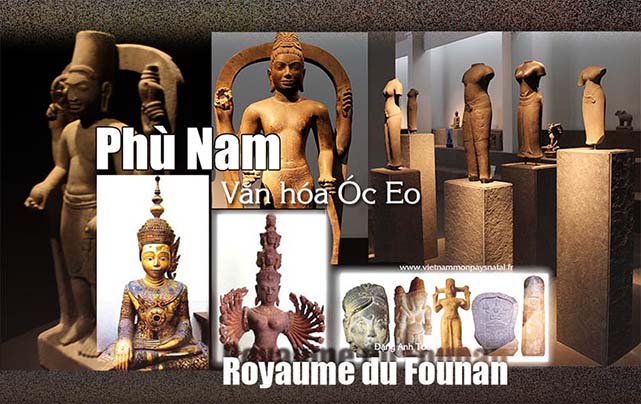
Until the dawn of the 20th century, the information was received about this old Hinduized kingdom in some Chinese texts. It was mentioned during the Three Warring States period of Chinese history (Tam Quốc )(220-265) in Chinese writings since the establisment of diplomatic relations between  the Wu state (Đông Ngô) and foreign countries. In this report, it is noted that the governor of Guandong and Tonkin provinces, Lu-Tai sent representatives (congshi) in the south of his kingdom. The kings, beyond the borders of his kingdom (Funan, LinYi (future Chămpa) and Tang Ming (country identified in the northern Tchenla at the time of Tang dynasty) sent each other an ambassador to pay him their tribute. Then Funan was also quoted in the dynastic annals from the Tsin dynasty (nhà Tấn) until the Tang dynasty (Nhà Ðường).

Even the name of Funan is the phonetic transcription of the old khmer word bhnam (mountain) in Chinese characters. It still gives rise to reservations and reluctances in the interpretation of Funan by « mountain » for some experts. These one find the justification of the name « Funan » in the best sense of « hillock » because, until quite recently, in the ethnographical studies [Martin 1991; Porée-Maspero 1962-69] , the Khmer were used to practising ceremonies around the artificial hillocks. Being affected by this custom that they did not know, the Chinese have made reference to this mode of practice for designating this kingdom. Thanks to archaeological excavations which took place in 1944 at Óc Eo with French Louis Malleret in An Giang province located into the south of present-day Vietnam, the existence and prosperity of this Indianised kingdom have not been in doubt. The results of these excavations had been written in his doctoral thesis, then published in an entitled work « Archaeology of the Mekong delta » representing 6 volumes.

This allows to confirm the Chinese informations and to make them a little more precise in the confinement and localization of this kingdom. Because of the abundance of  tin archaeological finds, French archaeologist Louis Malleret did not hesitate to borrow the name Óc Eo for designating this tin civilization. We begin to have now a deep light on this kingdom as well as its external relations during the resumption of excavations undertaken both by Vietnamese teams (Đào Linh Côn, Võ Sĩ Khải, Lê Xuân Diêm) and French-Vietnamese team led by Pierre-Yves Manguin between 1998 and 2002 in An Giang, Ðồng Tháp and Long An provinces where a large number of sites of Óc Eo culture are located.

We know that Óc Eo was a major port of this kingdom and was a transit hub in trade exhanges between the Malaysian peninsula and India on one hand and between the Mekong and China on other one. As the boats of the region could not cover long distances and had to follow the coast, Óc Eo thus became a mandatory stop and a important strategic step during the 7 centuries of blooming and prosperity for Funan kingdom.
Óc Eo civilization

Pictures gallery 

This one occupied a quadrangle included between the gulf of Thailand and Transbassac (western plains of Mekong delta or miền tây in Vietnamese) in the South of Vietnam. It was bounded in the northwest by the Cambodian border and in the southeast by Trà Vinh and Sóc Trăng cities. Aerial photos taken by the French people in the 1920s revealed that Funan was a maritime empire (or a thalassocracy).

The Chinese authors tell us that immense city states, encircled by successive lines of earthen ramparts and ditches formely filled by crocodiles, were divided into districts by the ramification of canals and arteries. We can imagine houses and stores on piles, bordered by ships as in Venice or in the Hanseatic cities. We discover in this surprising network constituted by stars of rectilinear canals arranged according to the northeast / southwest frame (from Bassac towards the sea) and all communicating with each other, its important role for evacuating Bassac floodwaters towards the sea. This allows to wash the soil with alum, repulse headways of brackish water during Bassac floods, favor the floating rice, ensure especially the provisioning inside the kingdom by cargoes of coastal navigation coming from China, Malaysia, India and even from Mediterranean circumference.

The discovery of gold coins bearing Antonin le Pieux (in 152 A.D.) or Marc Aurèle‘s effigies and low-reliefs carvings of Persian kings testifies to the important role of this kingdom in trade exchanges at the beginning of the Christian era. There is even a grand canal allowing to connect the port city Óc Eo on one hand with the sea and on the other hand with the Mekong and the ancient city of Angkor Borei, located 90 km upstream in the Cambodian territory. This one would be presumably the capital of Funan in its decline.

For French archaeologist Georges Coedès, there is no question that the Angkor Borei site corresponds exactly to that of Na-fou-na, described in Chinese texts as the city where kings of Funan wildrew after their eviction from the ancient capital of Funan, Tö-mu, identified as the city Vyàdhapura located in the Bà Phnom region of the Cambodian territory by Georges Coedès [BEFEO, XXVIII, p. 127]. The wealth of this archeological site and the variety of archeological remains originating from it, confirm his affirmation.

Thanks to archeological finds that have been recovered during all series of excavations on the complex of Óc Eo sites, we can say that this kingdom knew three important periods during its existence:

The first period which extends from the 1st to about 3th century, distinguishes itself by terra-cottas (ceramic potteries, bricks, tiles), glassware (pearls and necklaces), silverware (rings, earrings), stones sculptures (seals, signet rings, cabochons), copper, iron, bronze and especially tin objects.

We attend the first human activity on hillocks in the Óc Eo plain and on low slopes of Ba Thê mountain. The habitat is on piles and wood. The common jar grave in the South-East Asia is still practised. The process of the Indianisation is not yet started by the absence of statuaries and religious relics. But there is, all the same, a regular contact between this kingdom and India.

The commercial exchange is strengthened by local alliances and Indian teachers arrival. These one, retained longer for their stays in this kingdom because of the season of monsoons, continued to practise their religions (Brahmanism, Buddhism). They began to make emulators among the natives and to help the latter in the implementation of a hydraulic network allowing to drain the flooded plain, until now, hostile and to make it « useful » for the habitat, cultivation and development of their kingdom. The Indians were known to realize advisedly the works of agricultural hydraulics and cultivation. It is what we have seen in the country of the Tamils during the Pallava period for example.

The floating rice cultivation is attested by the traces of use of this graminaceous plant as degreasing agent for pottery. For French researcher of CNRS, J.N. Népote, specialist of the Indo-Chinese peninsula, Funan kingdom received most of its revenues from the agricultural sector in the technique of floating rice.

It was not necessary to cultivate the soil nor to sow and even less to plant rice seedlings in this time when the coastal fringe of Funan was an flooded zone of polders. The rice grew alone at the same time as the water level, this one being able to reach three metres in height. The rice was later harvested by boats. For the floating rice, the only constraint to be required was the distribution and regulation of floods by the digging of canals in order to be better able to manage the irrigation water and facilitate the means of communication.

The second period of the Funan history (4th- 7th centuries) is marked by the discovery of a large number of Vishnouist and Buddhist religious monuments on the hillocks of Oc Eo plain and on the slopes of Mount Ba Thê. The emblematic figures of the Indian pantheon (Shiva, Vishnu, Brahma, Nanin, Ganesha and Buddha) were exposed. It is also the period when the piled wooden housing moves from hillocks towards flooded plain and low slopes of Ba Thê mountain.

The indianisation of the kingdom was underway when we saw around 357 an Indian of Chinese name Tchou Tchan-t’an, being perhaps of Scythian origin and Kanishka descent, to reign in Funan kingdom [Founan: Paul Pelliot, p 269], which could explain the success of the Surya cult and its iconography in the Funan art. Another Brahman of Chinese name (Kiao-Tchen-Jou) (or Kaundinga-Jayavarma) will succeed him and will reign in Funan kingdom between 478 and 514. It is the period quite known thanks to local inscriptions in sanskrit.

Even the myth of the kingdom’s foundation comes from India: a Brahman named Kaundinya, guided by a dream, get a magic bow in a temple and navigates towards these banks where he manages to beat the girl named Soma of the native sovereign presented as Naga king (a fabulous snake) then he marries her to govern this country. We can say that during this period, the Funan kingdom knew its peak and maintained close relations with China.

The magnitude of its trade was indisputable by the discovery of a large number of objects other than that of India found on Funan banks: fragments of bronze mirrors dating from the Han anterior period, Buddhist bronze statuettes attributed to Wei dynasty, a group of purely Roman objects, statuettes of Hellenistic style in particular a bronze representation of Poseidon. These objects were probably exchanged for goods because Funan people only knew the barter. For the purchase of valuable products, they used golden and silver ingots, pearls and perfumes. They were known as excellent jewelers. The gold was finely worked with numerous Brahmanic symbols. Jewels (golden earrings with the delicate clasp, admirable golden filigrees, glass pearls, intaglios etc.) exposed in the museums of Đồng Tháp, Long An and An Giang testifies not only of their know-how and their talent but also the admiration of the Chinese in their narratives during their contact with Funan people.

The last period corresponds to the decline and end of Funan kingdom. A important change was indicated during period tcheng-kouan (627-649) to Funan kingdom in the Chinese annals. The kingdom of Tchen-la (Chân Lập) (future Cambodia) situated in the southwest of Lin Yi ( future Champa) and country vassal of Funan took over the latter and subjugated it. This fact was not only reported in the new history of Tang (618-907) of Chinese historian Ouyang Xiu but also on a new inscription of Sambor-Prei Kuk in which king of Tchen La, Içanavarman was congratulated for having increased the territory of his parents. One thus bear witness to the abandonment of habitat and religious sites in the plain Óc Eo because the centre of gravity of the new political formation coming from the North leaves the coast to gradually approach the site of the future capital of Khmer empire, Angkor.

For French researcher J. Népote, the Khmers come from the North by Laos appear as Germanic bands against the Roman empire, try to establish inside lands a unitarian kingdom under the name of Chen La. They have no interest to keep the technique of the floating rice because they live far from the coast. They try to combine their own mastery of water storage with the contributions of Indian hydraulic science (barays) to finalize through multiple experimentations an irrigation better adjusted to the hinterland ecology and local varieties of irrigated rice.

In spite of the recent discoveries confirming the existence of this kingdom, many questions have remained unanswered. We do not know who were the indigenous people populating this kingdom. One thing is for sure: they were not Vietnamese who had arrived only in the Mekong delta in the 17th century. Were they ancestors of the Khmers? Some had this conviction when Louis Malleret began excavations in the 1940s because the toponymy of the region was totally Khmer. At the time of Funan, it was yet not clear what this is. However, thanks to the study of osseous remains of Cent-Rues (in the peninsula of Cà Mau), we are dealing with a population very close to Indonesians (or Austro-Asiatic ) (Nam Á).

A Mon-Khmer contribution in the North of this kingdom can be possible to give to Funan the juxtaposition and the fusion of two strata which are not far away from each other before becoming the race of Funan people. In this hypothesis frequently accepted, the Funan people were the proto-Khmers or the cousins of the Khmers. The absorption of a city of Malaysian peninsula (known under the name Dunsun in the Chinese sources reporting this fact ) in the 3th century by Funan in an area where the Mon-Khmer influence is undeniable, is one of the determining elements in favour of this hypothesis.

In what conditions did Óc Eo disappear? Nevertheless Óc Eo played an economic role in commercial exchanges during seven first ones centuries of the Christian era. The archaeologists continue to look for the causes of the disappearance of this port city: flood, fire, deluge, epidemic etc. …

Is the Funan kingdom a state unified with a strong central power or is it a federation of centers of urbanized and sufficiently autonomous political power on the Indo-Chinese peninsula as on the Malaysian peninsula so that we qualify them as city-states?

P.Y.Manguin has already raised this question during a colloquium organized by Copenhagen Polis centers on the city-states of the coastal South-East Asia in December, 1998. Where is its capital if the central power is strongly emphasized many times by the Chinese in their texts? Angkor Borei, Bà Phnom are they really the former capitals of this kingdom like that has been identified by French Georges Coèdes?

For the moment, what has been found does not bring answers but it only redoubles the envy and desire of archaeologists to find them in the coming years because they know that they have the feeling of dealing with brilliant civilization of the Mekong delta.


Bibliography references

Georges Coedès: Quelques précisions sur la fin du Founan, BEFEO Tome 43, 1943, pp1-8
Bernard Philippe Groslier: Indochine, Editions Albin Michel, Paris 
Lê Xuân Diêm, Ðào Linh Côn,Võ Sĩ Khai: Văn Hoá Oc eo , những khám phá mới (La culture de Óc Eo: Quelques découvertes récentes) , Hànôi: Viện Khoa Học Xã Hội, Hô Chí Minh Ville,1995 
Manguin,P.Y: Les Cités-Etats de l’Asie du Sud-Est Côtière. De l’ancienneté et la permanence des formes urbaines. 
Nepote J., Guillaume X.: Vietnam, Guides Olizane 
Pierre Rossion: le delta du Mékong, berceau de l’art khmer, Archeologia, 2005, no422, pp. 56-65.

Ceramic (Gốm Vietnam)

French version

gom


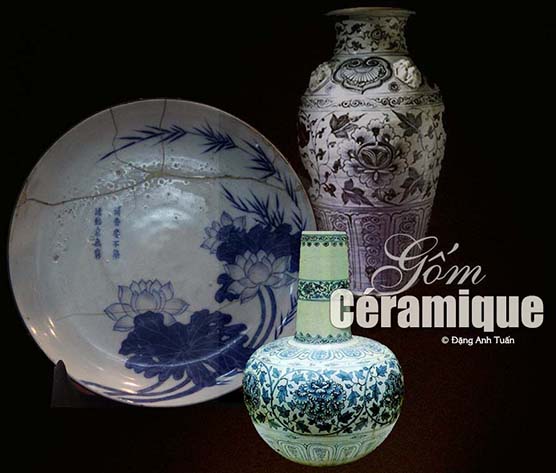
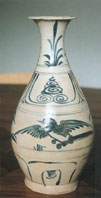
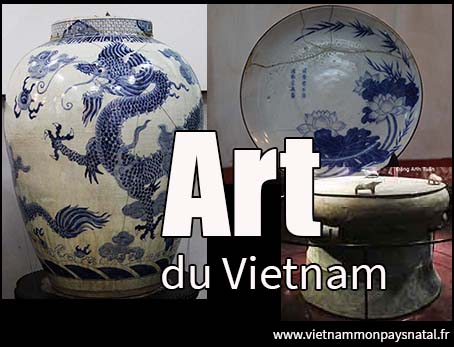
It is greatly surprising to see that, despite the everlasting domination of China on Viet-Nam, the latter was able to distinguish brilliantly starting from 14th century in the domain of ceramics. It became thus an active participant in the flourishing trade of South-East Asia in this domain with its junks and its compass known since 11th century. Tome Pires in his Suma Oriental (1515) summarized all these exchanges and foot-noted even the existence of a Vietnamese ceramic production intended for sale in China. At that time, there was even the counterfeit of Vietnamese blue and white in the Chinese furnaces of Snatow.

Its success was mainly due to the cobalt blue that blew into Vietnamese ceramic art a spirit which will have lasted for two centuries and enabled it to capture a foreign market as far as even the most remote corners of Asia.

It is the case of large a vase-bottle found at the Topkapi palace of Istanbul, carrying an inscription in Chinese characters, in blue under glaze that one can read in Vietnamese: Painted for pleasure by Pei de Nam Sách in the 8th year of Thái Hoà, or of a dish with blue and white floral decoration at the Treasury of Ardebil (Museum of Teheran)

If the cobalt blue was known in Vietnam for a long time even before the Chinese invasion of Ming, it appears that it was used only around the years 1430-1450. It is from this time that the blue and white definitively replace monochromic ceramics. 

Gốm

Vase (Lê dynasty)

It is thanks to the perfect control of manufacturing, decorating and baking techniques that the Vietnamese potter can improve his imagination. Even though constraints of painting under glaze do not prevent any repentance, there appear on the sandstone not only more and more sophisticated drawings but also a variety of pigments, an eruption of form s and original decorations, which made him an artist. If he does borrow a good number of decorative drawings from China ( peonies, lotus, flowers, foliated scrolls etc..), he has on the other hand the idea to create an autonomous style which is less hieratic and more vivacious than his Chinese homologous by the liveliness of his feature and his spontaneity. He can adapt these decorative elements to the Vietnamese style: the Chinese red fish becomes thus the Cá Bông, a Vietnamese freshwater fish.

It is no longer the case of China since China discovers the perspective starting from the reign of Jiajing (1522-1566). On the other hand, the quality of the central motif found on the plates, is definitely higher than that of the surrounding ones. This proves there is an intervention of several craftsmen in the realization of these plates. Because of the war, Viêt-Nam did not set up a systematic program of archaeological excavations. Few sites were exhumed so far. On the other hand one knows that the areas of Tam Tố north of Thanh Hoá, Nam Sách in the province of Hải Dương, Bát Tràng north of Hanoi to name a few sites, are surely witnesses of the manufacture of these Vietnamese ceramic pieces.

Jarres , verseuses et bols en grès à l’époque des dynasties Lý et Trần.

Pictures gallery of Vương Hồn g Sển collection


La céramique vietnamienne (Philippe Colomban CNRS)

Des céramiques vietnamiennes chargées d’histoire  (Philippe Colomban CNRS)


Art vietnamien (Nghệ thuật)

 Photos 


Being Caodaïst (Tôi là người Cao Đài)


French version
Vietnamese version
Pictures gallery

We, the Caodaïsts, we must know to perfect ourselves. It is not essential for us to fast and call upon Buddha by prayers or to enter a pagoda in order to be able to attain perfection. We have the possibility of attaining it if we always have in us the three following qualities: Love, Wisdom and Will.

At birth, we already had kindness. This is why, our Ancestors were accustomed to saying:

Nhân chi sơ, tính bản thiện. Mankind is naturally good at birth.

But because of the hazards of life, the unjustified competitions and the immoderate desires which continue to monopolize us sempiternally, we thus became dishonest people, perfidious, egoistic, which makes us lose the kindness that we acquired at birth. All the Wise ones of Antiquity had had these three qualities evoked above.

To have an idea on what the individual has or not in terms of kindness, it is enough for us to observe his behavior towards his close relations. It is by this observation that we are able to know him, which had said the Chinese philosopher Jou Mencius.

Love is a quality necessary to the perfection but it cannot be complete because we need wisdom to distinguish truth from falsehood, right from wrong, good from evil. There are plenty of generous people who, in spite of their gifts offered to the construction of the pagodas in a considerable way, continue to be entangled in an inauspicious behavior because they do not manage to distinguish right from wrong. It happens that they may be badly considered sometimes compared to those who never have the occasion to take part in this generous contribution.

In Vietnam, the Lý dynasty was famous for its irreproachable enthusiasm towards Buddhism by the bias of a great number of constructions of pagodas. That unrelentingly led the people to misery because of the too high taxes and ineluctably caused the popular discontent which was the principal cause of its fall.

Whatever his educational level, man always has in him Wisdom because when we act badly or not, we will know it thanks to our own conscience. For example, when one tries to lie, one feels ashamed towards oneself although the person to whom one lied does not know it. It is the wisdom which helps us make this distinction. The French philosopher Blaise Pascal had the occasion to stress that man is a thinking reed.

To continue to lie or act badly or not, we need Will. It is easy to evoke this quality but it appears difficult for us to have it because we are obliged to go sometimes against our own interests or to be losers at times also. Sometimes it happens to us not to have a safe life. I refer to some Chinese or Vietnamese historical facts with an aim of enabling us to be together to reflect and respectfully admire the people whom I regard as knowing how to perfect themselves because they had the three qualities evoked above. They became famous characters in the history of China and Vietnam.

Initially, it was the case of Zhuge Liang ( or Gia Cát Lượng in Vietnamese). He was at the same time Prime Minister and adviser to Liu Bei, the last survivor of the Han dynasty ( Lưu Hoài Ðức ) in China. The Barbarians coming from the steppes of the North of China and directed by Manh Hoạch often liked to raid the territory of his kingdom. Zhuge Liang managed to capture Manh Hoạch 7 times but this latter was released immediately on the order of Zhuge Liang at each capture. He was very generous. He was equipped with an extraordinary wisdom because he found that it was necessary to convince Manh Hoach by the means of love and feelings. If Manh Hoạch had been killed, there would be probably another Manh Hoạch. That obliged him to frequently assemble punitive expeditions and did not allow him to have the free hand to restore the Han dynasty and to bring back peace and happiness to its citizens.

It was why he continued to release impassively Manh Hoach at the time of each capture. He had an incommensurable will because he knew that to prevent Manh Hoach from betraying later, he was to waste much time, to forget the personal interests and to give himself many concerns with his rather advanced age. It would be less tiring for him if he decided to kill Manh Hoach because he was not obliged to assemble up to 7 times the punitive expedition. At the time of the last capture, when he was about to usually release Manh Hoach, this latter started to cry and to surrender definitively. Zhuge Liang had these three qualities evoked above. Although he is not a monk, we can affirm that with the three qualities found in him ( Love, Wisdom and Will ), he knew how to perfect himself and he was already regarded as a Wise one at the time of the Three Kingdoms.

In Vietnam, there are also kings whom we can regard as the Wise ones. It is the case of king Lý Thánh Tôn which had these 3 qualities quoted above. This is why he was known in the history of Vietnam as an intelligent king, distinguished, charitable and valiant. The revolt of the king of Champa, Chế Cũ obliged him to assemble a punitive expedition while leaving regency to his concubine Ỷ Lan. Faced with the determination of Chế Cũ, he was not able to capture him after several months of expedition. Disappointed, he was obliged to return to the country. On his return, he learned that his people did not cease praising the talent of his concubine Ỷ Lan in the art of governing the country. He felt ashamed and decided to return to the front. When he succeeded to capture Chế Cũ, he could have killed this one to alleviate his anger but he preferred to let him return to his country.

It was why Viet-Nam knew a period of peace, prosperity and happiness. He was very charitable because he let the one who had humiliated him in front of his people leave. He lost much time in order to be able to capture him. Are we capable of acting as he did if we were in his place? One fine day, during one period when the winter was hard, he addressed his mandarins in the following terms:

By dressing myself in this manner, I continue to be stiff with cold. How do people manage to resist this rigorous cold especially the poor when it is known that they do not have enough money to feed themselves?. It is necessary to give them as of now additional food and clothes.

Another time, while holding company with his daughter, the princess Ðông Thiên, at the time of an audience, he turned to his mandarins in saying to them:

I have a deep love for my people as that which I always have for my daughter. Unfortunately, the people is so little informed that it does not cease to make mistakes. It is for that that I have so much pity for it. I kindly request you to decrease the punishments and the pains inflicted.

His wisdom was incommensurable. To conquer Champa, he knew that it was necessary to convince and calm Chế Cũ although he was humiliated and upset to compare what he had undergone to what his concubine had done, a woman coming from a rural environment, Y? Lan for his people during his absence. He could kill Chế Cũ to alleviate his anger and to wash this momentary insult. But he was a courageous man who could put the interests of his people before his personal interests. He was really the person having the three evoked qualities.

 
Whatever the situation we are in, we, Caodaïsts, we must try to improve ourselves. That sometimes happened to me to want to continue this step. It is necessary to recognize that it is not easy to concretize it. I do not hide either that I had also the daily difficulties but I feel relieved enormously when I succeeded in concretizing it a little. I am delighted because I realize that I start to improve myself even if that appears negligible.

img_9502

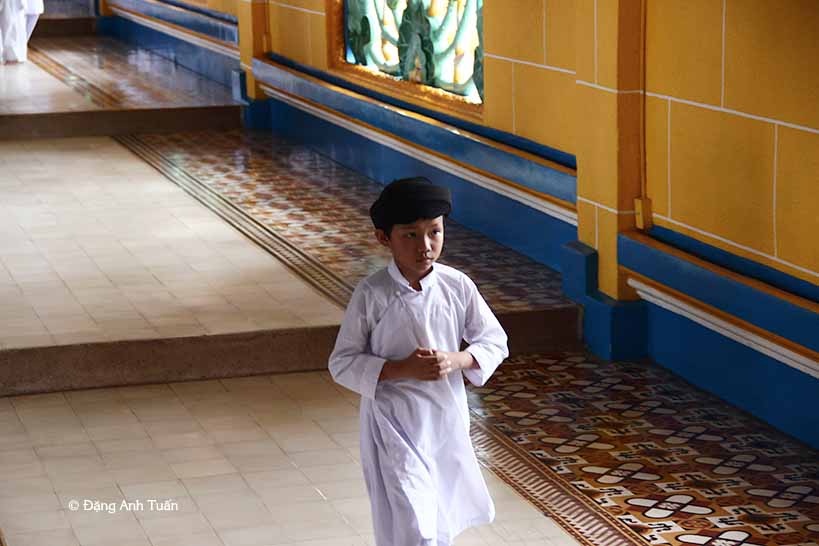
A young Caodaïst

That reminds me of the sentence that Ung Giả Vi wrote in the Conversations of Wise Confucius:

Nhân viên hồ tai! Ngã dục nhân, Tư Nhân chi hỷ!
Nhân có xa đâu! Ta muốn nhân thì nhân đến vậy!

The virtue is not far! One will be able to have it if one really wants it.

that enables me to be convinced that GOOD or EVIL exists well in each one of us. I understand that it is not necessary to go to the pagoda or the church to be able to improve oneself. I am able to do it if I do not forget what God in the bible of the Caodaïsts said that I had the occasion to read:

If you want to be a true Caodaïst, it is necessary that you have Love and the moral principle. It is absolutely necessary for you to improve yourself.

You merit to thus wear this white tunic, symbol of purity. You feel more than ever proud to be a Caodaïst.

Pictures Gallery

The Caodaïsm ( Cao Đài Giáo)

 
titre_caodai
French version
Vietnamese version
Galerie des photos

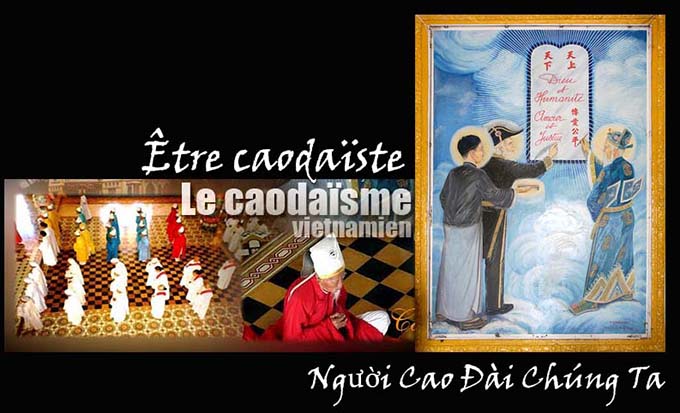
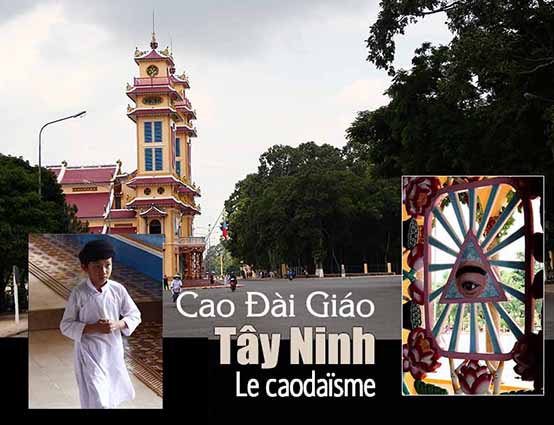
Caodaism is the third important religion in Vietnam after Buddhism and Christianity. Cao means « High » and Ðài means « Palace« . Cao Đài is the supreme palace where reigns God. Caodaism is a religion which encompasses, combines and is in harmony with several elements from other principal religions: Buddhism, Confucianism, Catholicism, Hinduism, Islam, Judaism and Taoism while taking into account Vietnamese traditions. The Holy Seat is located at Tây Ninh, 90km northwest of Saigon. The number of its followers amounts to 7 million in Vietnam and 30,000 abroad, in particular in Asia, Australia, Canada, Europe and the United States.

One finds in the history of this religion three important episodes of revelations. The first and second took place in 6th century before our era. During the first manifestation, God appeared under the three forms of Jewish leader in the Middle East, Buddha in India and Fou-Hi symbolizing the cult of humanity in China. During the second manifestation, Buddhism reappeared in the form of Sakiamuni, Confucianism in that of Confucius, Christianity in that of Jesus-Christ, Taoism in that of Lao-Tseu and Islam in that of MohammedAs for the third manifestation, God has decided to reveal himself. This third manifestation based on Buddhism is often called « Ðại  Ðạo Tam Kỳ Phổ Ðộ« . All the religions that have preceded the revelation of Caodaism are only the different forms of the same reality in different manner according to the period,  habits and traditions,  places of revelations with the view to educating the humanity and leading it on the path of good  according to the God guide.

Pictures gallery


The philosophy and profession of faith found in  Caodaism are of a disconcerting simplicity, closer to morals than to mystical transcendence.

  • Respect of the cult of ancestors.
  • Practice of meditation.
  • Practice of vegetarism.
  • Suppression of violence.
  • Respect of all religious forms.
  • Searching for liberation from reincarnation cycle.
  •  
    Respect of the following five prohibitions:

  • Kill no lives
  • Be not dishonest
  • Drink no alcohol
  • Commit no adultery
  • Use no offensive words
  • Pray at least once a day and practice a vegetarian diet at least 10 days per month. The service is held at the Holy Seat of Tay Ninh everyday and takes place at precise hours:

    6:00 am, 12:00 PM (noon), 6:00 PM and 12:00 AM (midnight)
    [Return RELIGION]

    Being woman in Vietnam

    French version

    etre_femme

    Being woman in Vietnam

    Vietnam is a country where Confucianism exerts its considerable influence on political life as well as on society. Becoming a state philosophy under the Han dynasty, Confucianism was employed on several occasions as a single model of the state organization and of the Vietnamese society.

    This Confucian influence is not foreign to traditional conditions imposed on the Vietnamese woman. She is subjected to the rule of the following three submissions: Tam Tòng

    Tại gia tòng phụ, xuất giá tòng phu, phu tử tòng tử

    • submission to the father before her marriage
    • submission to the husband during her marriage
    • submission to the elder son when widowed

    This rule was reminded in « Family Instructions » (Gia Huấn Ca) by Nguyễn Trãi, the advisor of king Lê Lợi at the beginning of 15th century, and under the Nguyen dynasty. The Gia Long code which was in force in 19th century, was the most retrograde and rigorous that Vietnam has ever known.

    In spite of that, the Vietnamese woman had a dominating role to play in the Vietnamese family and society. This is found through songs, poems, tales, and lullabies. There, the Vietnamese woman is described not only as a tender, submissive, and virtuous but also a hard working person endowed with an incommensurable patience.

    The Trưng Trắc Trưng Nhị sisters are heroines as much quoted and venerated as the heroes Quang Trung, Hưng Ðạo Vương Trần Quốc Tuấn etc…They are also the first women who fought side by side with the men in the struggle for independence. The most illustrious case remains the example of Nguyễn Thị Giang. Faithful to the Vietnamese tradition, she committed suicide in 1930 after the execution of her husband, the nationalist leader Nguyễn Thái Học.

    The Vietnamese woman is viewed as a perfect model to defend the motherland and national honor. One finds it in the story « Hòn Vọng Phu  » ( Waiting Rock ). It is the story of a woman petrified at the top of a hill, her child in her arms, looking out for the return of her husband who had left for the frontiers in the defense of the country. This model woman is found at several points all over the Vietnamese territory (Cao Bằng, Ninh Hoà etc….)

    One also finds this model woman in the story « Thiếu Phụ Nam Xương » (« The Woman of Nam Xương » or  » The Contempt » ). It is the story of a woman who committed suicide because of an erroneous judgment her husband had on her fidelity. A man is allowed to have weaknesses but not a woman. She must be a perfect model. That constitutes for so many years a lot of stirs and discussions. Some women tried to break that Confucian yoke. It was the case of poetess Hồ Xuân Hương who criticized taboos while composing sensual poems at the end of 18th century. She has always been affirmed from the literary point of view as a free woman. Her verses are always filled with erotic evocations.

    One finds this vehement dispute by a woman of a Confucian society through the following poem that describes the cake Bánh Trôi Nước ( a white and round cake, having a sweetened core, immersed in a caramelized juice ) :

    Thân em vừa trắng lại vừa tròn
    Bẩy nỗi ba chìm với nước non
    Rắn nát mặc dầu tay trẻ nặng
    Mà em vẫn giử tấm lòng son

    My body is white, my shape is round,
    I float and sink with water and mound.
    My contour depends on the hand that kneads
    But I always keep my heart pure and sound.

    Hồ Xuân Hương referred to a woman who at that time, in spite of her tainted body and difficulties of life, continued to keep her heart pure and faithful. She was also the only one who dared approach her rights as a woman and talk shamelessly about carnal love. She succeeded in not being censored through her unequaled skill by proceeding with allusions and metaphors. To talk about eroticism, she used a soothing description of landscape and objects, things the most believed in a feudal society.

    There was even an anecdote about her told by the poet Xuân Diệu himself:

    It rained one day. The road became slippery. Hồ Xuân Hương fell suddenly. She spread herself all out on her body, her arms raised behind her head, her legs pulled apart. The boys laughed. She improvised a distich immediately:

    Giơ tay với thử trời cao thấp
    Xoạc cẳng đo xem đất vắn dài

    I raise my arm to measure the vastness of the sky
    I pull my legs apart to have that of the ground.

    It was also the case of the favorite Ỷ Lan of king Lý Thánh Tôn. She took advantage of the campaign conducted by her husband against Champa to assure a brilliant regency. She undertook at that time many social measures to help the poor and women in particular. Only in 1907 for the first time were classes opened for girls in a private school. The feminist movement started to be launched.

    Nowadays when the law recognizes equality of the sexes in all economic, political and social domains, there exists in fact this inequality. It is no longer a question of legality but a question of mentality. It continues to be omnipresent especially in rural environment.

    Hà Tiên (English version)

    French version

    Vietnamese version

    Facing to the Gulf of Siam, Hà Tiên is located about 8 kilometers from the Cambodian border. It is also the city marking the end of the long walk towards the South started by the Vietnamese. Before being known as Hà Tiên, it initially was called  Phương Thành then Mang Kham in the past. Its economic growth has been due to the massive arrival of the Chinese, supporters of the former Ming dynasty (or Minh Hương in Vietnamese) whose most known was Mac Cửu (Mac King Kiou).

    Being hostile to the new dynasty of the Manchus (Qing) and leaving China at the 17 years age, this one,was established with his family in Cambodia in 1671. He was appointed a few years later by the Cambodgian king as provincial chief of Mang Khảm . Thanks to his generosity and business talent, he succeeded to transform Mang Kham into a port city flourishing and animated in the region. For countering against the Siamese’s ambition, he needed the Vietnameses protection, in particular that of the Nguyễn lords to the detriment of the Cambodian ones. They agreed to confer to him the title of commander of troops (tổng binh) in this region. Consequently, Mang Kham belonged to Vietnamese territory and changed name into becoming Hà Tiên. According to the legend, one saw appearing on the river, the ballad of Immortals (Hà river in Vietnamese). It is also the reason for choosing this name. Hà Tiên became a few years later the starting point for the conquest of Cambodian districts: Long Xuyên (Cà Mau today), Kiên Giang (Rạch Giá), Tran Giang (Cần Thơ), Tran Di (Bạc Liêu) with his son Mac Thiên Tứ. This latter was a character out of the ordinary. His fate was tied closely to that of Nguyễn Ánh, future emperor of the Nguyên Dynasty. It became the famous rampart of the Nguyễn against the Tây Sơn. With the years of vicissitudes of Nguyễn Ánh, he had to take refuge in Thailand with all the family and the son of Nguyễn Ánh, Prince Xuân. To sow doubt among the Siamese, the Tây Sơn did not hesitate to falsify documents and make them responsible for a conspiracy against Siamese king Trịnh Tân (Phraya Tak Sin).

    Pictures gallery


    His entire family was executed with the prince Xuân. To preserve his honor and fidelity, he committed suicide in September 1780. Mac Thiên Tứ was also a greatest poet of his time. He made Hà Tiên famous by his volume of poems entitled « Hà Tiên Thâp vịnh » praising the beauty of its natural and marvellous sites.

    This volume continues to grow in the coming years with the addition of 10 poems written by each of 31 poets belonging to the club of the poets « Chiêu Anh Các » created under the initiative of Mac Thiên Tứ. That constituted in all 320 poems to which Nguyễn Cư Trinh added the last ten poems to give a value priceless to this volume that continues to be transmitted to the posterity.

    Ones does not forget his famous poem in Six-Eight to tease an young girl in Quảng Nam (Center of Vietnam), disguised as a young student taking part in the evening of the illumination festival. By seeing this young man, he does not hesitate to send the following four verses:

    Bên kia sen nở nhiều hoa
    Người khen hoa đẹp nõn nà hơn em
    Trên bờ em đứng em xem
    Mọi người sao bỗng không thèm nhìn hoa

    On the other side, the lotus has many flowers
    The person who admires them is more prettier than you.
    On land, you continue to admire them
    Everyone is not be interested to admire your « flower »

    Without hesitation, he replied promptly by the four following verses:

    Mặt ao sen nở khắp
    Trông hoa lẫn bóng người
    Trên bờ ai đứng ngắm
    Sao chẳng thấy hoa tươi?

    The surface of the pond is filled with flowers of lotus
    Ones finds here at the same time these flowers and the people’s shadows
    On land, each one is admiring them
    Why isn’t a beautiful flower found?

    img_8129

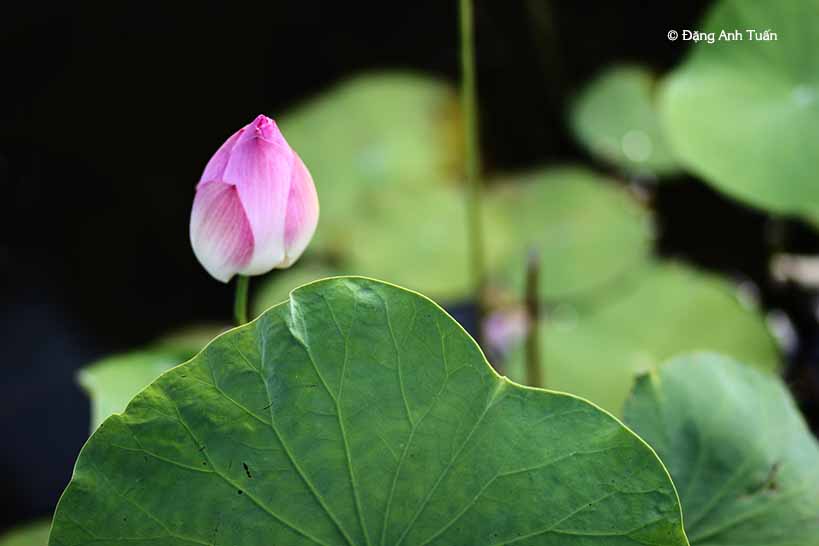
    Lotus

    This poetic exchange enabled him to have sympathy and to discover that this young student was only one girl disguised as a boy to avoid the pirates, coming from the Center of Vietnam, following her father to make the trade and bearing the name Nguyễn Thi Xuân. Mac Thiên Tứ took her later as wife of second rank . But the latter failed to die because of the jealousy of his wife . She was forced to withdraw herself in a pagodon to finish her last remaining days. Before her death, she left a poem showing her purity and nobility in a nauseaous world filled with turpitudes by comparing her with a lotus flower:

    Vươn khỏi bùn nhơ thoát vươn lên
    Phỉ lòng trong trắng giữa thiên nhiên
    Xuân thu đậm nhạt bao hồng tía
    Ðừng sánh thanh cao với đóa sen.

    Leaving mud, the lotus flower continues to open out
    It is glad to be pure in nature
    Its perianth becomes more or less purple in the course of time
    But one should not compare the nobility with this flower.

    hatien_2

    When one evokes Hà Tiên, one does not forget to think of Mac Cửu and his son Mac Thiên Tứ because it is thanks to them that Vietnam succeeded in achieving its long walk towards the South. Nothing is more astonishing than to see the deep attachment and respect which the Vietnamese reserved for Mac Cửu and his family through his temple in Hà Tiên.

    Forbidden city of Huế (Tử Cấm Thành)

    Version française

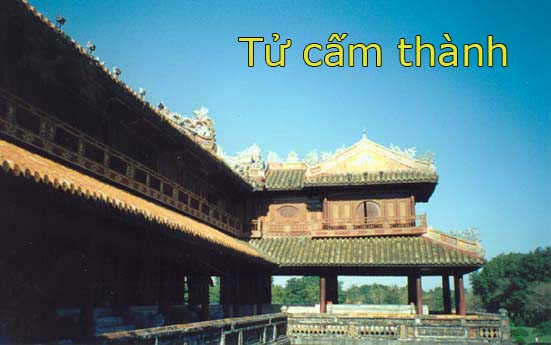
    The forbidden city   is encircled by a 4-metre high  brick wall with a classic coating. This wall also is  surrounded by a ditch filled with water. Each door preceded by one or several bridges gives access on each side. The Ngọ Môn Gate is the main entrance and it is reserved for the King.

    It is a powerful  masonry  foundation drilled with five passages and surmonted by an elegant wooden structure with two levels, the Belvedere of five Phoenixes (Lầu Ngủ Phụng). In the East and West of the Citadel, one finds respectively  the gates  of humanity and virtue which are highly decorated and pierced each by  three passages. The gate of humanity has been completely  restored in 1977.

    World cultural heritage of Vietnam

    Once we have gone precisely through the Ngo Môn Gate, we see appearing on the main axis the sumptuous palace of Supreme Harmony or  Throne palace that can be reached through the Esplanade of the Great Salvation (Sân Ðại Triều Nghi). It is in this Palace that the emperor, seated in a prominent symbolic position, received the salvation of all dignitaries of the empire  hierarchically aligned  on the esplanade at the time of great ceremonies. It is also the only building kept after so many years of war. Behind this palace, it is the imperial residence.

    © Đặng Anh Tuấn

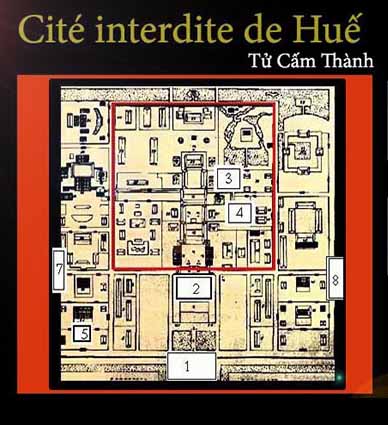
    schema_noithanh1


    • 1 Noon gate (Ngọ Môn)
    • 2 Throne palace (Điện Thái Hoà)
    • 3 Archives pavilion  ( Thái Bình Ngự Lâm Thư Lâu)
    • 4  Royal theatre ( Duyệt Thị Đường)
    • 5 Pavilion of  Splendor (Hiến Lâm Các)
    • 7 Gate of virtue (Hiền Đức Môn)
    • 8 Gate of humanity (Hiển Nhơn Môn)

    Pictures gallery