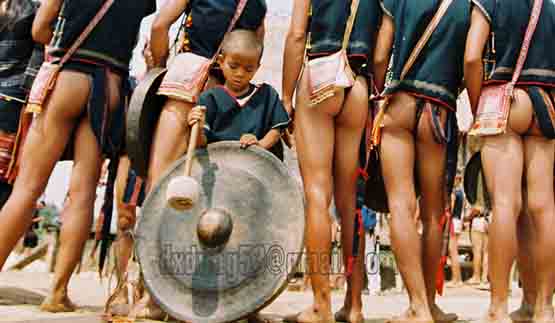
Being young (Thiếu niên)

etre_jeune1

French version

Vietnamese version


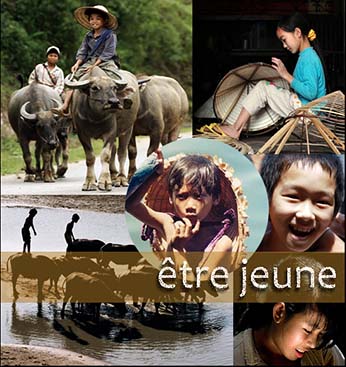
In spite of the war which devastated this country for so many years, the Vietnamese young people continue to crave for life. That amazes enormously those who do not know Vietnam. In this country,  » Being Young » concerns always boldness because the living conditions are extremely hard and nature is also extremely rude and pitiless, in particular for those who live in the North and on the Central highlands. It is necessary to know how to resist bravely the forces of nature but it is also necessary to learn how to live with wild creatures, tricking them and fighting them.


One also starts to work very young in Vietnam. From their youth in rural areas, boys tend buffaloes, make them feed on small floodbanks while girls help in the household chores. Very young, from six or seven years old, they know how to cook rice, carry their little brothers, feed the pigs and ducks, carry drinking water to the familiar animals or taking part in family artisanal work. During the years when the war was at its height, young people were also assigned to dig trenches along the small floodbanks to throw themselves in when airplanes approached, live in undergrounds and tunnels to escape the bombings. Girls have twice as much work as boys. It was they who were the first being proposed and sold like slaves or concubines for a few kilos of rice when one could not manage any more to feed a family of several children in the years 30’s and 40’s. Ngô Tất Tố, in his novel  » When The Lamp Dies Out « , appeared in 1930, reminds us this reality. To pay a corrupt official, a country-woman had to sell her daughter for one piastre.

Nowadays, even this practice is prohibited, one nevertheless notes a great number of young female prostitutes on the streets of big cities. There, in spite of free education, many of young people must work on little jobs such as selling cigarettes or newspapers, collecting plastic bags etc… , to provide for the subsistence of their families. The living conditions are also distressing. Many young people coming from families afflicted by poverty and war continue to always crawl in tangles of badly erected huts that are dark and terribly dirty. There would be 67000 slums in Saigon at the end of 1994. It is the number maintained by the authorities and published by the press. One still finds the scenes described by novelist Khái Hưng in his work entitled  » The Gutters » ( Ðầu Ðường Xó Chợ ) with pavements and drains encumbered permanently with vegetable peelings, sheets of banana tree leaves and scraps of rags in the poor districts of the big cities.
Facing the indifference of society, novelist Duyen Anh did not hesitate to denounce the indigence of these young people in his novels, among which the most known remains the best-seller « The Hill of The Phantoms ». Inspired by this novel, movie maker Rachid Bouchareb recalled the history of the « Amerasians » who pay the price of the madness of the adults and the war in his film  » Dust of Life  » in 1994.

etre_jeune

In spite of the deficiencies of life, one likes to be young in this country because, if there are no mountains of toys and gifts which submerge our children in the west as Christmas approaches, there are on the other hand popular games, unforgettable memories of childhood. In the countryside, one could go fishing in rice fields and placing hoop nets in the streams to catch shrimps and small fish. One could hunt butterflies and dragonflies with traps made with the stems of bamboo. One could climb trees to seek bird’s nests. Hunting the crickets remained the preferred game of the majority of Vietnamese young people.

She did not hesistate to point out her Indochinese childhood in her novel « The places » : My brother and I did not spend whole days in the trees but in the woods and on the rivers, on what is called the racs ( rạch ), these small streams that go down towards the sea. We never put on our shoes, we lived half naked, we bathed in the river.

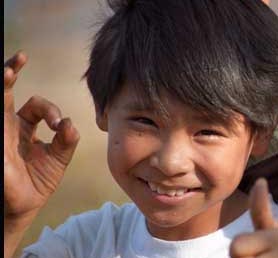
In this country where the war devastated so much and where thirteen million tons of bombs and sixty million liters of defoliants were poured, being young in the years 60-75 was already a favor of destiny. The young people of Vietnam today no longer know the fear and the hatred of their elders but they continue to have an uncertain future. In spite of that, in their look, there is always a gleam of intense life, a glimmer of hope. It is what is often called  » the magic of Vietnamese childhood and youth « .


It is necessary to be young in this country to have  such an attachment, an impression always poignant.

Nguyễn Trãi (Version anglaise)

French version

Vietnamese version

I would like to give to this great Vietnamese politician a great homage by slightly modifying the two verses he composed in his poem « Improvisation » translated into French by Nguyễn Khắc Viện in Anthology of the Vietnamese Literature:

A thousand Autumns have passed, water keeps its face
A thousand generations have watched the moon similar to itself;

by my two following verses:

A thousand Autumns have passed, Vietnam keeps its independence
A thousand generations have venerated Nguyễn Trãi similar to himself.

© Đặng Anh Tuấn


One can sum up the life of this great politician by means of verse 3248 of the Vietnamese literature great classical of Nguyễn Du in 18th century:

Chữ Tài liền với chữ Tai một vần
The word Tài (Talent) rhymes perfectly with the word Tai ( Misfortune ).

to evoke not only his incredible talent but also his tragic end regretted by so many Vietnamese generations. Facing the brutal force that represented emperor Chenzu of the Ming ( Minh Thánh Tổ ) under the command of Tchang Fou ( Trương Phụ ) during his invasion of Đại Việt ( ancient name of Vietnam) in the ninth month of the year Binh Tuất (1406), Nguyễn Trãi knew how to give what Lao Tseu had said in the Book of Life and Virtue:
 

Nothing is more supple and soft in the world than water
However to attack what is hard and strong
Nothing surpass it and nobody can match it.
That the weak surpasses the strong
That the supple surpasses the hard
Everyone knows.
But nobody put this knowledge into practice
 

a tremendous conceptualization and elaborated an ingenious strategy allowing the Vietnamese, weak in number to come out victorious during that confrontation and regain their national independence after 10 years of struggle. With the landowner Lê Lợi, known later as Lê Thái Tổ and 16 comrades-in-arms tied by a pledge at Lung Nhai (1406 ), and 2000 peasants at mount Lam Sơn in the mountainous region West of Thanh Hoá, Nguyễn Trãi arrived at turning the insurrection into a war of liberation and converting a band of ill-armed peasants into a people’s army of 200,000 men strong a few years later.

The strategy known as « guerilla » was shown very effective because Nguyen Trai was successful in putting into practice the doctrine advocated by the Chinese Clausewitz, Sun Zi (Tôn Tữ) in the Spring and Autumn ( Xuân Thu ) era, based on the following variables: Virtue, Time, Land , Leadership, and Discipline in the conduct of the war. Nguyễn Trãi had an opportunity to say he preferred winning the heart of the people to citadels . When there is harmony between the leaders and the people, the latter will accept to fight until their last breath. The cause will be heard and won because Heaven takes side with the people, which Confucius had the opportunity to recall in his Canonical Books: 

Thiên căng vụ dân, dân chi sở dục, thiên tất tòng chí
Trời thương dân, dân muốn điều gì Trời cũng theo
Heaven loves people so much it grants what people ask for.

One can say that with Nguyễn Trai, the humanist inclination of Confucian doctrine has taken its full development. To make sure of the support and adhesion of the people in his war for independence, he did not hesitate to take advantage of his people’s superstition and credulity. He asked his close relations to climb up trees and use toothpicks and honey to carve the following sentence on the leaves. 

Lê Lợi vì dân, Nguyễn Trãi vì thân
Lê Lợi for the people, Nguyễn Trãi for Lê Lợi 

This attracted ants to eat the honey leaving the message marked on the leaves which were blown off by the wind into streams and other bodies of water. When people picked up the leaves as such, they believed that the message came from the will of Heaven and massively joined he war of liberation.

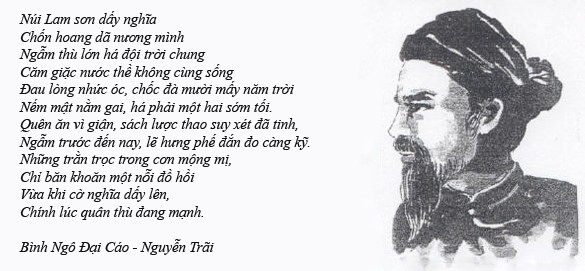
Humanist by conviction, he always thought not only of the sufferings of his people but also that of his enemies. He had the opportunity to emphasize in his letter to Chinese General Wang Toung ( Vương Thông ) that the duty of a commander is to dare make a decision, undo hatred, save human lives and cover the world with good deeds in order to bequeath a great name to posterity ( Quân Trung Từ Mệnh Tập ). He let defeated Chinese generals Wang Toung ( Vương Thông ), Mã Anh, Fang Chen ( Phương Chính ) go back to their country with 13000 captured soldiers, 500 junks and thousands of horses. Concerned about peace and the happiness of his people, in his masterpiece « Proclamation of the Ngô Pacification » ( Bình Ngô Ðại Cáo ) that he wrote after winning the war and driving the Chinese army out of Vietnam, he recalled that it was the time to act with wisdom for the safety of the people.

To make China not to feel humiliated by the bitter defeat and to restore above all a long lasting peace and happiness for his people, he proposed China a vassal pact with a tribute of two real-sized statues in fine metal every three years ( Ðại thần kim nhân ) in compensation for the two Chinese generals Liou Cheng ( Liễu Thăng ) and Leang Minh ( Lương Minh ) who died in combat.

In the first years of the struggle, Nguyễn Trãi knew biting and bleeding defeats many times (the death of Lê Lai, Ðinh Lễ etc… ), which forced him to take refuge at Chi Linh three times with Lê Lợi and his partisans. Despite of that, he never felt discouraged because he knew that the people fully supported him. He often compare the people with the ocean. Nguyễn Trãi had the opportunity to tell his close relations:

Dân như nước có thể chở mà có thể lật thuyền.
The people is like water which can move and sink the ship.

The remark made by his father Nguyễn Phi Khanh, captured and brought to China with other educated Vietnamese including Nguyễn An, the future builder of the forbidden Citadel in Peking, during their separation moment at the Sino-Vietnamese border, continued to be vivid in his mind and made him ever more determined in his unwavering conviction for the his just cause: 

Hữu qui phục Quốc thù, khóc hà vi dã
Hãy trở về mà trả thù cho nước, khóc lóc làm gì
You’d better go back and avenge the country, it doesn’t help crying. 

He spent whole nights in search of a strategy permitting to counter the Chinese army at the zenith of its force and terror. Being updated on the dissensions within the ranks of its adversaries, the difficulty that emperor Xuanzong of the Ming was having at the northern border with the Hungs after the disappearance of Chengzu in 1424 and the damages that the Chinese army suffered during the last military engagements in spite of their territorial success, Nguyễn Trãi did not hesitate to propose a truce to general Ma Ki. The truce was voluntarily accepted by both sides because each side thought they could take advantage of this respite either to consolidate their army in waiting for reinforcements from Kouang Si and Yunnan and a larger scale military engagement ( for the Ming ), or to rebuild an army already suffering important losses of lives and to     change the strategy in the struggle for liberation ( for the Viet ).

Taking advantage of the unfamiliarity of the terrain by the Chinese reinforcing army coming from China, he was fast in his maneuvering putting into work the  » the full and the void  » doctrine advocated by Sun Zi who had said in his work « The Art of War »:

The arm must be similar to water
Since water avoids heights and falls into hollows,
The army avoids the full and attacks the void.

which permitted him to decapitate Liou Cheng and his army in the « void » of Chi Lăng defined by Sun Zi, in the mountainous and quagmire narrow pass near Lang Son. He did not give any respite to Liou Cheng’s successor, Leang Minh to regroup the remainder of his Chinese army by setting a trap around the city of Cần Trạm. Then he took advantage of the success to rout the reinforcing army of the Chinese general ( Mộc Thanh ), which force the latter to drive off and go back alone to Yunnan ( Vân Nam )

Fearing to lose the bulk of his troops in a confrontation and worrying about saving the blood of his people, he chose to implement the policy of isolating big cities such as Nghệ An, Tây Ðô, Đồng Quan ( ancient name of the capital Hànội ) by investing all forts and small cities surrounding them, by incessantly harassing the supply troops and by neutralizing all reinforcing Chinese troops. In order to prevent the eventual return of the invaders and to disorganize their administrative structure, he placed in the liberated cities a new administration led by young and educated recruits. He did not stop sending emissaries to Chinese or Vietnamese governors of these towns to convince them to surrender under penalty of being brought to justice and sentenced to death in case of resistance. This turned out to be fruitful and rewarding because it compelled generalissimo Wang Toung and his lieutenants to surrender unconditionally as he was aware that it was impossible to hang on to Ðồng Quang any longer without reinforcement and supply. It was not only a war of liberation but also a war of nerves that Nguyen Trai has successfully conducted against the Ming.

Independence regained, he was appointed Minister of the Interior and member of the Secret Council. Known for his righteousness, he was fast to become the privileged target of the courtesans of king Lê Thái Tổ who began to take offense at his prestige. Feeling the risk of having the same fate reserved for his comrade in arms Trần Nguyên Hản and imitating the Chinese senior advisor Zhang Liang ( Trương Lương or Trương Tử Phòng ) of Han Emperor Liu Bang ( Lưu Bang or Hán Cao Tổ ), he requested king Lê Lợi to allow him to retire to mount Côn Sơn, a place he had spent his whole youth with his grand father Trần Nguyên Ðán, a former great minister regent of the Tran king, Trần Phế Ðế and the great grand son of general Trần Quang Khải, one of the Vietnamese heroes in the struggle against the Mongols of Kubilai Khan. 

It was here that he wrote a series of composed writings that recalled not only his profound attachment to nature which he made a confidant of, but also his ardent desire to give up honors and glory and to regain serenity. It was also through his poems that one finds in him a profound humanism, an extraordinary simplicity, an exemplary wisdom and an inclination to retreat and solitude. There, he has insisted that a man’s life lasted only one hundred years at the most. Sooner or later one will return to sand and dust. What counts in a man is his dignity and honor such as a blue blanket ( symbol of dignity ) that had been defended energetically by the learned Chinese Vương Hiền Chi of the Tsin dynasty during the intrusion of a burglar to his home, in his poem  » Improvisation on a Summer day » ( Hạ Nhật Mạn Thành ) or his freedom such as that of the two Chinese hermits Sào Phú and Hua Dzo of the Antiquity in his poem  » The Côn Sơn Song » ( Côn Sơn Ca ). 

In spite of his early retirement, he was accused of killing the king a few years later and was tortured in 1442 with all his family members because of the death of he young king Lê Thái Tông, in love with his young concubine Nguyễn Thị Lộ and accompanied by her to the lichee garden. One knows everything except the human heart that stays unfathomable, that was what he said in his poem « Improvisation » ( Mạn Thuật ) but that was what happened to him in spite of his foresight. His memory was restored only a few dozen years later by the great king Lê Thánh Tôn. One can keep in this scholar not only the love he always carried for his people and his country but also the respect he always knew how to keep toward his adversaries and nature. To this talented learned Vietnamese, his memory should be honored by quoting the phrase that Yveline Féray wrote in the foreword of her novel « Ten thousand Springs« : 

The tragedy of Nguyễn Trãi is that of a so great man living in a too little society


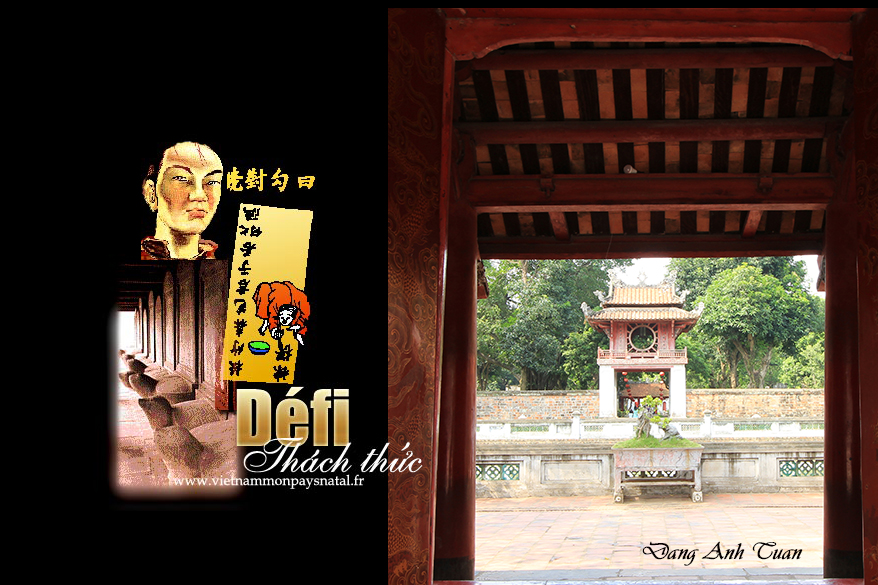
The challenge (Thách Thức)

defi

The challenge

French version
Vietnamese version

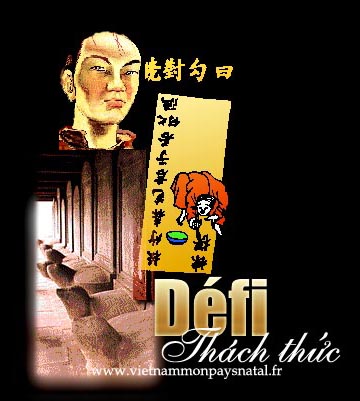
This word is not unfamiliar to the Vietnamese. On the contrary, it is synonymous to perseverance, resistance, ingenuity and confrontation for these frail people whose feet have been burried in the rice fields’ mud since the dawn of time. They never stop at taking up, from generation to generation, the challenge incessantly imposed by the excesses of a harsh and inhospitable nature and by the Midle Empire, their big brother and hereditary enemy at the border. The Vietnamese dedicated to the latter a surprising admiration but at the same time pledged an implacable resistance in the goal of keeping their national independence and cultural traits. China has many times tried to assimilate Vietnam during its millennial domination but it succeeded in blurring the particularities without making them disappear completely. It was quick to be aware of that, because on any favorable occasion, the Vietnamese displayed their resistance and difference. They even tried to confront the Chinese in the field of literature. That has been reported in a great number of accounts that keep on to be plentiful up until now in the history of Vietnamese literature.

According to what was said, after having succeeded in putting down the revolt of the two sisters Trưng Trắc Trưng Nhị and pacifying Giao Chỉ ( ancient country of the Viet ), Chinese General Ma Viện( MaYuan ) of the Han dynasty erected in 43 at the Sino-Vietnamese border a pillar several meters high bearing the following notice:

Ðồng trụ triệt, Giao Chỉ diệt
Ðồng trụ ngã, Giao Chỉ bị diệt.

Vietnam would disappear forever with the fall of this pillar.

To avoid the pillar’s fall, the Vietnamese tried to strengthen it by throwing, as they walked by, a piece of soil around that huge column, and thus progressively helped in building a mound making the mythical pillar disappear.

To be ironic about the Vietnamese’s fear and worry of losing their country, the Ming emperor did not hesitate to use unfriendly terms to arrogantly tell the Vietnamese envoy Giang Văn Minh ( 1582-1639 ) during a reception:

Ðồng trụ chí kim đài dĩ lục

This Bronze pillar is now buried in green moss

to remind Giang Văn Minh of the putting down of the Trung sisters’ revolt and the pacifiaction of his country by the Chinese. Remaining unruffled, Giang Văn Minh responded with a surprising insight and an energetic and courageous determination:

Ðằng giang tự cổ huyết do hồng
That Ðằng river was then blended with red blood.

This was not the first time such a litterary competition took place. Under the reign of king Lê Ðại Hành ( The Great Expediter ), monk Lạc Thuận had an opportunity to catch the admiration of Chinese ambassador Li Jiao ( Lý Giác ) whom he helped cross the river by posing as a boatman.

He was quick to complete the four-versed poem started first by Li Jiao who saw two wild geese playing on the water wave crests:

Ngỗng ngỗng hai con ngỗng
Ngữa mặt nhìn trời xanh
Goose, goose, the two geese
Looking up the blue sky they tease

by the following two verses:

Nước biếc phô lông trắng
Chèo hồng sóng xanh khua

Bluish green water contrasts white feather
Showing pink feet splitting blue waves over.

It is shown not only the rapidity of monk Lac Thuan’s improvisation but also his ingenuity of placing in parallel the ideas and the words to be used in this four-versed poem.
But obviously credits on the confrontation finally go to to the learned Mạc Ðỉnh Chi because he knew how to show during his stay in China his capability of resistance and his talent of knowing how to cleverly answer all questions s and avoid all traps. He was sent to China (1314) by king Trần Anh Tôn after the latter had defeated the army of Kubilai Khan’s Mongols with general Trần Hưng Ðạo. Because of an unexpected delay, he could not show up on time at the gate of the fort at the Sino-Vietnamese border. The mandarin in charge of the supervision of the fort agreed to open the gate if f only Mạc Ðỉinh Chi could appropriately parallel the mandarin’s sentence containing 4 words « quan ».

Quá quan trì, quan quan bế,
nguyện quá khách quá quan
Qua cữa quan chậm, cữa quan đóng,
mời khách qua đường qua cữa quan.

Late at passing the gate, the mandarin gate is closed,
Passing pedestrian please pass the gate.

Unruffled at this litterary challenge, he replied to the mandarin with a surprising ease by the following sentences:

Xuất đối dị, đối đối nan, thỉnh tiên sinh tiên đối.
Ra câu đối dễ, đối câu đối khó
xin tiên sinh đối trước

Easy to pose the sentence, difficult to parallel it.
Parallel sentence poser please pose first.

It is noted that in this reply, there are not only the word « đối » that is repeated 4 times in parallel with the word « quan », but also the virtuosity of respecting the rhymes and the rules in composing parallel sentences by Mạc Ðỉnh Chi in his verses while making it known to the mandarin the situation he was tangled up with. This enormously pleased the Chinese mandarin who was quick to to open the fort gate and greet him with great pomp. This incident was reported to the Peking court and was fast to bring desire to the best Chinese learned mandarins to measure up with him in literary field.

One day, he was riding his mule in the capital city of Peking. The mule did not go fast enough, which annoyed a Chinese mandarin who followed him on his way. Irritated by the disturbing slowliness, the mandarin turn to him saying with an arrogant and contemptuous tone:

Xúc ngã ky mã, đông di chi nhân dã, Tây di chi nhân dã?
Chạm ngựa ta đi là người rợ phương Ðông hay là người rợ phương Tây?

Slowing my horse is the barbarian from the East or from the West?

That mandarin took what he had learned in the book Mencius ( Mạnh Tử )(1) to refer to the barbarians, those who do not possess the same culture of the Midle Empire by using the words « đông di ». Surprised by the hurting remark while he knew that China was at that time governed by by the nomad tribes, the Mongols, Mạc Ðĩnh Chi replied with his black humor:

Át dư thừa lư, Nam Phương chi cường dư, Bắc phương chi cường dư
Ngăn lừa ta cưởi, hỏi người phương Nam mạnh hay người phương Bắc mạnh?

Impeding my mule is the strong people from the North or from the South?

Mạc Ðỉnh Chi also took what he had learned from the book Trung Dung (2) to remind the mandarin that he was not sure that the people from the North were stronger than those from the South. The mandarin turned pale of shame and was so vexed by the spirited and spontaneous reply that he was forced to drive off. Another time, in a discussion with Mạc Ðỉnh Chi and wanting to know his character, the Yuan emperor read him the following phrase:

Nhật hỏa, vân yên, bạch đáng thiêu tàn ngọc thỏ
Mặt trời là lửa, mây là khói, ban ngày đốt cháy vần trăng

Daytime, the sun being fire, the clouds being smoke burn up the moon.

The emperor wanted to show his power by comparing himself with the sun and in making it known to Mạc Ðỉnh Chi that Vietnam is comparable to the moon would soon be wiped out and dominated. Unruffled, Mac Ðỉnh Chi replied in firm and courageous terms:

Nguyệt cung, kim đạn, hoàng hôn xa lạc kim ô
Trăng là cung, sao là đạn, chiều tối bắn rơi mặt trời.

Nightime, the moon being crossbow, the stars being projectiles shoot down the sun.

Thus the Yuan emperor Kubilai Khan ( Nguyên Thê’ Tổ ) had to recognize his talent and granted him the title  » ( Lưỡng Quốc Trạng Nguyên  » ( Doctor of both countries ) for China as well as for Vietnam. this rendered some Chinese mandarins jealous. One of them tried to humiliate him one day by treating him as a bird because of the tone of the monosyllabic language; the Vietnamese give the impression of chirping when they speak:

Quích tập chi đầu đàm Lỗ luận: tri tri vi tri chi, bất tri vi bất tri, thị tri
Chim đậu cành đọc sách Lỗ luận: biết thì báo là biết, chẳng biết thì báo chảng biết, ấy là biết đó.

Birds gather on the branch to study the book Dialogs: What we know we say we know, what we don’t we say we don’t, we know it though.

It was a way to recommend Mac Ðĩnh Chi to show more humility and to behave like a man of Confucian quality ( junzi ). Mac Ðĩnh Chi replied in treating him like a frog because the Chinese have the habit of clicking the tongue when drinking and speaking loudly:

Oa minh trì thượng đọc Châu Thư: lạc dữ đọc lạc nhạc, lạc dữ chúng lạc nhạc, thục lạc.
Châu chuộc trên ao đọc sách Châu Thu: cùng ít người vui nhạc, cùng nhiều người vui nhạc, đằng nào vui hơn.

Frogs assemble in the pond to learn the work Chou Ching : they enjoy blaring alone, they enjoy blaring together, they’re blaring anyhow.
It’s a way to recommend the Chinese mandarin to have a keen mind in order to be able to have the right behavior and a more fair judgment.

In spite of the literary confrontation, Mac Ðĩnh Chi was very much appreciated in China. He was assigned by the Yuan emperor to write the funeral oration in honor of the passing away of a Mongolian princess. Due to the respect that the Chinese traditionally maintained toward talented Vietnamese people, especially the scholars having unprecedented erudition and keen minds, the learned Nguyễn Trãi was saved in extremis by the great steward Houang Fou ( Hoàng Phúc ). He was seen by Chinese generalissimo Tchang Fou ( Trương Phụ ) as a captive to be eliminated, a dangerous and harmful to the Chinese politics of expansion in Vietnam. He was retained by Tchang Fou during his stay at Ðồng Quang ( ancien name of Capital Hà-Nội before he could join the cotton clothed hero Lê Lợi later at Lam Sơn. Without the magnanimous and protective gesture of the eunuch Hoang Fou, Lê Lợi would not have been able to defeat the Ming because it was Nguyễn Trãi, the godsent adviser and eminent strategist that Lê Lợi relied upon to run the guerilla during his ten years struggle against the Chinese.

This literary confrontation began to blurr progressively with the arrival of the French in Vietnam and stopped definitively when emperor Khải Ðịnh decided to put an end to the Vietnamese system of mandarinal contest up until then copied from the Chinese one and based essentially on the Four Classics (3) and the Five Cannons (4) of the wise Confucius (Tứ Thư Ngũ Kinh).

intro1

The last mandarinal contest was organized at Huế in 1918. Another system of recruitment in the French way was proposed at the colonial l period. From then on, Vietnam has no longer the opportunity to measure up literarily with China and to show her its difference, its intellectual resistance and its cultural traits.


(1) : Jou philosophy of first plan of 4th century B.C.
(2) : The Middle-Of-The-Road, one of the basic works of Chinese education.
(3) : The Great Studies, ( Ðại Ho.c ), Middle-Of-The-Road ( Trung Dung ), Dialogs ( Luận Ngữ ) and Mencius’s Book ( ( Sách Mạnh Tử ).
(4):The Book of Odes ( Kinh Thi ), The Historic Documents( Kinh Thư ), The Book of Mutations ( Kinh Dịch ) The Rites( Kinh Lễ ), Springs and Autumn ( Kinh Xuân Thu ).

Le défi (Thách Thức)

English version

Version vietnamienne

Le défi

Ce mot n’est pas étranger aux Vietnamiens. Par contre, il est synonyme de la persévérance, de la résistance, de l’ingéniosité et de la confrontation pour ces gens frêles, les pieds enfouis dans la boue des rizières depuis la nuit des temps. Ceux-ci ne cessaient pas de relever, de génération en génération, le défi imposé incessamment par les intempéries d’une nature ingrate et inhospitalière et par l’Empire du Milieu, leur grand frère limitrophe et leur ennemi héréditaire. Les Vietnamiens vouaient à ce dernier une admiration étonnante en même temps une résistance implacable dans le but de garder leur indépendance nationale et leurs spécificités culturelles. La Chine tenta de siniser à maintes reprises le Viêt-Nam durant sa domination millénaire mais elle réussit à estomper les particularités sans les faire disparaître complètement. Elle ne tarda pas à s’en apercevoir car à chaque occasion favorable, les Vietnamiens affichaient leur résistance et leur différence. Ils cherchaient à affronter même les Chinois dans le domaine littéraire. Cela a été rapporté par un grand nombre de récits continuant à abonder encore jusqu’à nos jours dans l’histoire littéraire vietnamienne.

Selon l’on-dit, après avoir réussi à mater la révolte des deux sœurs Trưng Trắc Trưng Nhị et de pacifier le Giao Chỉ (l’ancien pays des Viets), le général chinois Mã Viện (Ma Yuan) de la dynastie des Han édifia en 43 à la frontière sino – vietnamienne un pilier haut de plusieurs mètres et portant l’écriteau suivant:

Ðồng trụ triệt, Giao Chỉ diệt
Ðồng trụ ngã, Giao Chỉ bị diệt.

Le Vietnam disparaîtrait pour toujours avec la chute de ce pilier.

Pour éviter sa chute, chaque Vietnamien tenta de le consolider en jetant, à chaque passage, un morceau de terre autour de cette colonne colossale, ce qui permit d’édifier progressivement un monticule faisant disparaître ainsi ce pilier mythique.

Pour ironiser sur la peur et l’angoisse des Vietnamiens de perdre leur patrie, l’empereur des Ming n’hésita pas à s’adresser arrogamment au délégué vietnamien Giang Văn Minh (1582-1639) lors d’une réception, avec des termes inamicaux:

Ðồng trụ chí kim đài dĩ lục
Le pilier en bronze continue à être envahi par la mousse verte.

pour rappeler à Giang Văn Minh l’écrasement de la révolte dirigée par les sœurs Trưng Trấc et Trưng Nhị et la pacification de son pays par les Chinois. Imperturbable, Giang Văn Minh lui répondit avec une perspicacité étonnante et une détermination énergique et courageuse :

Ðằng giang tự cổ huyết do hồng
Le fleuve Bạch Ðằng continue à être teinté avec du sang rouge.

pour rappeler à l’empereur des Ming les victoires éclatantes et décisives des Vietnamiens contre les Chinois sur le fleuve Bạch Ðằng.

Ce n’est pas la première fois que cette compétition littéraire avait lieu. A l’époque du règne du roi Lê Ðại Hành ( Le Grand Expéditeur ), le bonze Lạc Thuận eut l’occasion de frapper d’admiration l’ambassadeur chinois Li Jiao ( Lý Giác ) à qui il avait fait passer le fleuve en se déguisant en sampanier. Il n’hésita pas à achever le quatrain entamé d’abord par Li Jiao qui se mit à chanter en voyant les deux oies sauvages jouer sur la crête des vagues:

Ngỗng ngỗng hai con ngỗng
Ngữa mặt nhìn trời xanh

Des oies sauvages, voyez ces deux oies sauvages
Elles dressent la tête et se tournent vers l’horizon

par ses deux vers suivants:

Nước biếc phô lông trắng
Chèo hồng sóng xanh khua

Leurs plumes blanches s’étalent sur les eaux glauques
Leurs pattes roses, telles des rames, fendent les flots bleus.

On constate non seulement la rapidité et l’improvisation du moine Lạc Thuận mais aussi son ingéniosité de mettre en parallèle les idées et les termes à employer dans ce quatrain.

defi

Mais le mérite de la confrontation revient évidemment au lettré Mạc Ðỉnh Chi car ce dernier sut montrer durant son séjour en Chine sa capacité de résistance mais aussi son talent de savoir répliquer savamment à toutes les questions et éviter toutes les embûches. Il fut envoyé en Chine (1314 ) par le roi Trần Anh Tôn après que ce dernier avait défait l’armée des Mongols de Kubilai Khan avec le général Trần Hưng Ðạo. À cause d’un retard inopiné, il ne put pas se présenter à l’heure convenue devant le portail du fort à la frontière sino-vietnamienne. Le mandarin chargé de la surveillance de ce fort accepta d’ouvrir ce portail à condition qu’il réussît de répondre d’une manière appropriée à la question que ce mandarin voulait lui poser et dans laquelle il y avait 4 mots « quan »

Quá quan trì, quan quan bế,
nguyện quá khách quá quan

Qua cữa quan chậm, cữa quan đóng,
mời khách qua đường qua cữa quan

Vous êtes en retard, la porte réservée étant fermée.
Je vous demande de bien vouloir vous présenter devant cette porte.

Imperturbable devant ce défi littéraire, il répondit au mandarin avec une facilité étonnante par la phrase suivante:

Xuất đối dị, đối đối nan, thỉnh tiên sinh tiên đối.
Ra câu đối dễ, đối câu đối khó
xin tiên sinh đối trước

C’est très facile pour vous de poser une question, la réponse n’étant pas évidente.
Je vous demande de bien vouloir poser la question.

On constate que dans cette réplique, il y a non seulement le mot « đối » qui se répète en quatre fois et qui est disposé de la même manière que le mot « quan » mais aussi la virtuosité de savoir respecter les rimes et les règles prosodiques par Mạc Ðỉnh Chi dans son vers tout en faisant connaître au mandarin la situation où il était empêtré avec sa suite. Cela contenta énormément le mandarin chinois. Celui-ci n’hésita pas à ouvrir le portail du fort et à le recevoir en grande pompe. Cet incident fut rapporté à la cour de Pékin et ne tarda pas à porter envie aux meilleurs mandarins lettrés chinois de se mesurer avec lui dans le domaine littéraire.

Un beau jour, dans la capitale de Pékin, il était en train de faire une promenade avec son mulet. Comme ce dernier ne trottinait pas assez vite, cela énerva un mandarin chinois qui le suivait de près sur son chemin. Irrité par cette lenteur gênante, le mandarin se tourna vers lui en lui adressant avec un ton arrogant et méprisant:

Xúc ngã ky mã, đông di chi nhân dã, Tây di chi nhân dã?
Chạm ngựa ta đi là người rợ phương Ðông hay là người rợ phương Tây?
En gênant le passage de mon cheval, est -il un barbare venant de l’Est ou de l’Ouest?

Ce mandarin s’inspira de ce qu’il avait appris dans le livre de Mencius (Mạnh Tử )(1) pour désigner les Barbares, ceux ne possédant pas la même culture que l’empire du Milieu par l’emploi des deux mots « Ðông di ». Surpris par ce propos blessant lorsqu’il savait que la Chine fut gouvernée à cette époque par les tribus nomades, les Mongols, Mạc Ðỉnh Chi lui répliqua avec son humour noir:

Át dư thừa lư, Nam Phương chi cường dư, Bắc phương chi cường dư
Ngăn lừa ta cưởi, hỏi người phương Nam mạnh hay người phương Bắc mạnh?

En empêchant la marche normale de mon mulet, est-il fort, l’homme du Nord ou celui du Sud?

L’empereur des Yuan n’hésita pas à vanter sa puissance en le comparant au soleil et en faisant savoir à Mạc Ðỉnh Chi que le Viêt-Nam, comparable à la lune, serait anéanti et dominé bientôt. Imperturbable, Mạc Ðỉnh Chi lui répondit d’une manière ferme et courageuse:

Nguyệt cung, kim đạn, hoàng hôn xa lạc kim
Trăng là cung, sao là đạn, chiều tối bắn rơi mặt trời.

Etant prise pour l’arbalète, la lune avec les étoiles comme des projectiles, détruit facilement dans la nuitée le soleil.

L’empereur des Yuan Kubilai Khan ( Nguyên Thê’ Tổ ) dut reconnaître son talent et lui accorda ainsi le titre  » Premier docteur » ( Lưỡng Quốc Trạng Nguyên ) aussi bien en Chine qu’au Viêt-Nam, ce qui rendit jaloux quelques mandarins chinois. L’un d’eux tenta de l’humilier un beau matin en le traitant comme un oiseau car à cause de la tonalité monosyllabique de la langue, les Vietnamiens donnent l’impression de gazouiller toujours lorsqu’ils parlent:

Quích tập chi đầu đàm Lỗ luận: tri tri vi tri chi, bất tri vi bất tri, thị tri
Chim đậu cành đọc sách Lỗ luận: biết thì báo là biết, chẳng biết thì báo chảng biết, ấy là biết đó.

L’oiseau s’agrippant sur une branche lit ce qui a été écrit dans le livre Les Entretiens : Si nous savons quelque chose, nous disons que nous la savons. Dans le cas contraire, nous disons que nous ne la savons pas. C’est ainsi que nous disons que nous savons quelque chose.

C’est une façon de recommander Mạc Ðỉnh Chi de se montrer plus humble et de se comporter comme un homme de qualité confucéenne ( junzi ). Mạc Ðỉnh Chi lui répliqua en le traitant comme une grenouille car les Chinois ont l’habitude de clapper à cause de leur manière de boire ou de parler bruyamment:

Oa minh trì thượng đọc Châu Thư: lạc dữ đọc lạc nhạc, lạc dữ chúng lạc nhạc, thục lạc.
Châu chuộc trên ao đọc sách Châu Thu: cùng ít người vui nhạc, cùng nhiều người vui nhạc, đằng nào vui hơn.

La grenouille barbotant dans la mare lit ce qui a été écrit dans le livre Livre des Documents Historiques (Chou Ching): certains jouent seuls de la trompette, d’autres jouent ensemble de la trompette. Lesquels paraissent en jouer mieux.

C’est une façon de dire au mandarin chinois d’avoir un esprit sain pour pouvoir avoir un comportement juste et un discernement équitable.

Malgré la confrontation littéraire, Mạc Ðỉnh Chi fut très apprécié en Chine. Il fut chargé même par l’empereur des Yuan de composer une oraison funèbre en l’honneur de la disparition d’une princesse mongole. Grâce au respect que les Chinois savaient entretenir traditionnellement à l’égard des gens de talent vietnamiens, en particulier des lettrés ayant une érudition inouïe et une vivacité d’esprit, le lettré Nguyễn Trãi fut sauvé in extremis par le grand intendant Houang Fou (Hoàng Phúc). Il était aux yeux du généralissime chinois Tchang Fou (Trương Phụ ) un homme captif à abattre, un personnage dangereux et nuisible à la politique d’expansion de la Chine au Viêtnam . Il fut retenu par Tchang Fou durant son séjour à Ðồng Quang ((ancien nom donné à la capitale Hanoï ) avant de pouvoir rejoindre plus tard le héros à habit de cotonnade Lê Lợi à Lam Sơn. Sans ce geste magnanime et protecteur de l’eunuque Houang Fou, Lê Lợi n’aurait pas pu déboulonner les Ming car c’était Nguyễn Trãi, le conseiller providentiel et le stratège éminent sur lequel Lê Lợi s’appuya pour mener le guérilla durant ses dix années de lutte contre les Chinois.

Cette confrontation littéraire commença à s’estomper progressivement avec l’arrivée des Français au Vietnam et cessa définitivement lorsque l’empereur Khải Ðịnh avait décidé de mettre fin au système de concours mandarinal vietnamien calqué jusqu’alors sur celui des Chinois et basé essentiellement sur les Quatre Livres Classiques (3) et les Cinq Livres Canoniques (4) du sage Confucius.(Tứ Thư Ngũ Kinh).intro1

On nota le dernier concours mandarinal organisé à Huế en 1918. Un autre système de recrutement à la française fut proposé à l’époque coloniale. Dès lors, le Vietnam n’avait plus l’occasion de se mesurer littérairement avec la Chine et de lui montrer sa différence, sa résistance intellectuelle et ses spécificités culturelles.


(1) : Philosophe Jou de premier plan du IV è siècle avant J.C.
(2) : Le Juste Milieu , l’un des ouvrages de base de l’enseignement chinois.
(3) : La Grande Étude, ( Ðại Học), le Juste Milieu ( Trung Dung ), Les Entretiens ( Luận Ngữ ) et le livre de Mencius ( Sách Mạnh Tử).
(4): Le Livre des Odes ( Kinh Thi ), Les Documents Historiques( Kinh Thu ), Le Livre des Mutations ( Kinh Dịch ) Les Rites ( Kinh Lễ ) , Printemps et Automne ).( Kinh Xuân Thu ).

Vietnamese woodcuts (Tranh dân gian)

French version

Without the curiosity and open-mindedness of this young French military man, the Vietnamese popular woodcut would probably have been in oblivion and disappeared forever with the ups and downs of the war. The Vietnamese woodcut has its origin dated back to 15th century, at a time when scholar Lương Như Hộc introduced its fabrication technique on his way back from an official mission to China.

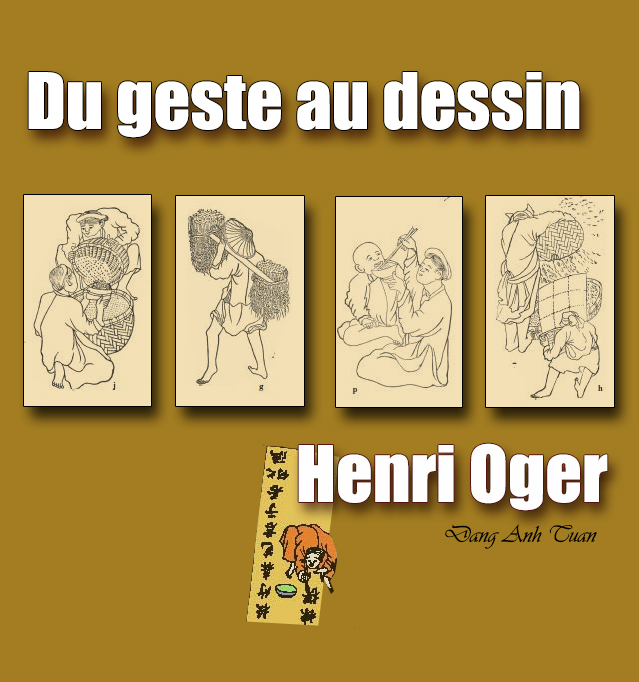
Henri Oger was one of the rare Frenchmen who, at the beginning of the century, was able to discover a millennium of wealth in traditions and customs throughout the Vietnamese society which was then closed to strangers, poor and backward. He took the initiative of creating an encyclopedia consisted of 10 volumes describing all aspects of the Vietnamese society in the old days: craftsman’s works, festivals, farming techniques, ancestral customs etc.. by requesting about 30 wood carvers to engrave designs on wood and then, because of weather conditions, imprint the engraving on the spot using the Vietnamese traditional methods. It should be acknowledged that the love of Vietnam and its people has allowed Henri Oger to overcome at that time all hardship in fund raising and in the realization of this huge work ( more than 4000 designs in all ).estampes_1

He did not get any help from the French government at all. He only got subscriptions from some two dozen persons, in the amount of 200 piasters.

Henri Oger

In spite of that, Henri Oger has succeeded in leaving to the Vietnamese people a priceless treasure. His work was unknown to the French and Vietnamese public for decades. Only in 1978 did an exhibition entitled « Peasant Painters of Vietnam » take place at the Cultural Center of Bourges. Three of his works are presently kept at the National Library of Hanoï and Saïgon City but only in the latter we find his 10 volumes in their entirety.

Bibliography:

Introduction générale à l’étude de la technique du peuple annamite. 2 volumes. Editions: Geuthner-Jouve, Paris.


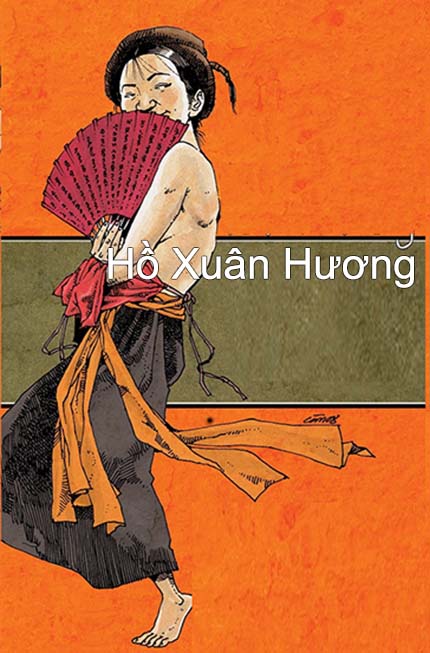
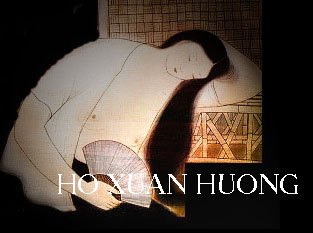
Poet Hồ Xuân Hương

French version

Vietnamese version

Speaking of Hồ Xuân Hương  creates in everyone of us not only an ardent admiration but also food for thought back to the time when Confucianism kept on draining all the vital outbursts of a closed society and literature, the source of social prestige remained in having the exclusive right to sit in the triennal examinations for the recruitment of mandarins. Before occupying a good place in the official history of Vietnamese literature published in 1980 by the Institute of Literature of Vietnam, Hồ Xuân Hương was in the past a source of inexhaustible controversy between those who saw in her a wonderful woman who dared without shame to tackle the rights to her sex and carnal love in the time of feudal darkness, and those who found that her poetry, putting too much accent on the glorification of sexual instinct, was a disappointment for the Vietnamese literature and an attack and an stain to the model Vietnamese woman.

It should be admitted that Hồ Xuân Hương is a woman ahead of her time, a woman who knows how to use her intelligence to denounce hypocrisy and absurdity at a time when society was ruled by unchanging Confucian ethics, a woman who dares revolt against prohibitions and taboos for the liberalization of the woman, physical as well as moral. She loved to confront and beat Messieurs the learned men with their own weapons. She succeeded in evading formal censorship by an uncommon cleverness, proceeding with allusions and metaphores.


Thiếu nữ ngủ ngày

Mùa hè hây hẩy gió nồm đông
Thiếu nữ nằm chơi quá giấc nồng
Lược trúc lỏng cài trên mái tóc
Yếm đào trễ xuống dưới nương long
Ðôi gò Bông đảo sương còn ngậm
Môt lạch đào nguyên suối chưa thông
Quân tử dùng dằng đi chẳng dứt
Ði thì cũng dở ở không xong.

Day Sleeping Girl

Summer breeze is sporadically blowing,
Lying down the young girl slides into sleeping.
Her bamboo comb loosely attached to her hair,
Her pink bra below her waist dropped down fair.
On these two Elysian mounds, the nectar is still remaining,
In that one Fairy rivulet, the current seems to stop flowing.
At such a view, the gentleman hesitated,
Odd to leave, yet inconvenient if he stayed

Hang Cắc Cớ

Trời đất sinh ra đá một chòm
Nứt ra đôi mảnh hỏm hòm hom
Kẽ hầm rêu mốc trơ toen hoẻn
Luồng gió thông reo vỗ phập phồng
Giọt nước hữu tình rơi lõm bõm
Con đường vô ngạn tối om om
Khen ai đẽo đá tài xuyên tạc
Khéo hớ hênh ra lắm kè dòm

Cắc Cớ grotto

Yin and Yang created this chunk of rock;
A deep and dark crack split it into two blocks.
Moss covered openings expose themselves with impudence
Wind enhanced firs produce sound of rhythmic cadence.
Drops of romantic water fall with splash
Roads to nowhere lead in dark labyrinth.
Praise to the scuptor inventing this distortion
Indecent exposure invites lots of observation


Extracted from the book entitled « Egrets on the river  » de Mr Lê Thành Khôi.

sieste

The Fan

Are you seventeen or eighteen?(1)
Let me cherish you by all means.
Thin or thick you display a triangle, and
Large or small I hold you with one hand.
The more it is hot the fresher you will submit,
Not enough love at night, daytime will make it.
Your cheeks are rose pink and give you grace,
Lords and kings love you because of your face.

(1): Seventeen or nineteen branches of the fan could be understood as seventeen or eighteen

Vịnh cái quạt

Mười bảy hay là mười tám đây
họ ta yêu dâ’u chẩng rời tay
Mỏng dày chừng ấy, chành ba góc
Rộng hẹp dường nào, cắm một cây.
Càng nóng bao nhiêu thời càng mát
Yêu đêm không phỉ lại yêu ngày
Hồng hồng má phấn duyên vì cậy
Chúa dấu vua yêu một cái nầy.

The Great poetess of Vietnam

To talk about things the most crude in society, about erotism in particular, she resorted to harmless description of the landscape and familiar objects. The Jack-Fruit, The Floating Cake, The Fan, The Grotto of Cắc Cớ, Weaving at Midnight, The Day Sleeping Girl are the titles the best known and witness her talent and knack of knowing how to create the rhythms comparable to those in popular songs ( ca dao ) and use a surprisingly simple vocabulary in her poetry. A manuscript in « nom » from the Library of Sciences recorded in 1912 counted only 23 poems but it is noted that the number of poems attributed to Hồ Xuân Hương has grown with the time. Therefore even its existence was put to doubt in the past. Hô` Xuân Huong could have been original of Quynh Doi village, Quynh Luu district, Nghe An province. Her father Hô` Phi Điền is issue of the Hồ family of scholars (Hô` Phi). According to the French researcher Maurice Durand, she was not very attractive physiaclly based on the two verses from Hồ Xuân Hương’s Jack-Fruit:

Thân em như quả mít trên cây,
Da nó sù sì, múi nó dày

My body is like the jack-fruit on the tree,
Its skin is rough, its clove is thick.

This deduction seemed less convincing by the fact that even she was not beautiful, she must have been charming because she was married twice then widowed and having many flirts such as Chiêu Hô` (Phạm Đình Hô`). Because of her biting and licentious verve, some people see in her a sex maniac, a genie of lust; that is the case of Nguyễn Văn Hạnh and the French researcher Maurice Durand in « Works of Vietnamese poetess Hồ Xuân Hương », Ecole francaise d’Extreme Orient, Adrien Maisonneuve, Paris 1968. On the other hand, other people do not hesitate to defend her with fanfare, finding her not only a feminist of the first hour but also a woman having the gut to live and defy a society of mummies and ghosts. It is the case of writer Nguyễn Đức  Bình in the monthly review Văn Nghệ. ( Arts and Literature ) No. 62.

Dệt cửi

Thắp ngọn đèn lên thấy trắng phau
Con cò mấp máy suốt đêm thâu
Hai chân đạp xuô’ng năng năng nhắc
Mô.t suốt đâm ngang thích thiích nhau
Rộng hẹp nhỏ to vừa vặn cả
Ngắn dài khuôn khổ cũng như nhau
Cô nào muốn tốt ngâm cho kỹ
Chờ đến ba thu mới dãi màu

Nightime Weaving

Light turned on, it is found such a white,
The stalk moves slightly and repeatedly all night.
Pushing with the feet, but lightly release,
Shuttle passing through brings joy and ease.
Large or narrow, small or big they all fit,
Long and short, size and form so be it.
To make it best, girl needs to soak it with care .
The cloth color won’t fade before three whole years.


If Hồ Xuân Hương is a rose with thorns, a lonely and almost unique voice in the Vietnamese literature, she has nonetheless the courage and the audacity to throw a stone and spread the trouble in a stagnant and rotting pond that became the Vietnamese society at the end of 18th century. Contrary to other great scholars preferring looking for solitude to devote themselves to contemplation of nature and meditation in drunkenness, Hồ Xuân Hương preferred to combat it alone at her time using her verve, her poems to experiment the wrath of a woman revolting and thundering against injustice of the Vietnamese society. She deserves the homage that American writer Henri Miller rendered two centuries later to a female writer of 20th century in his forewords for  » Fear of flying » by Erica Jong, Robert Laffont, 1976:

butvietShe writes like a man. However it is a woman with 100% woman. On many points, she is more direct and more frank than many male authors.

[Return LITERATURE]


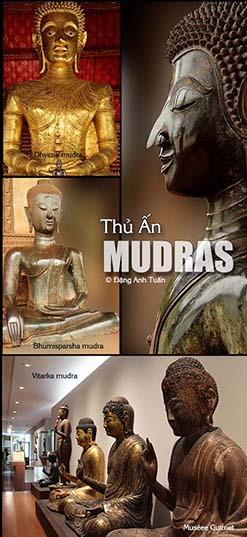
The Mudras of Buddha (Thủ Ấn)


mudra_bouddha
French version
Vietnamese version

The symbolic gestures of Buddha icone_lotus

Depending on the manufacturing country of Buddha statue, the artist can represent it in a different way. By contrast, there is always some immutable ritual characters that he must observe scrupulously in the Buddhist statuary. This is the case of the position and gestures of the Buddha’s hands (mudras). Being limited in number, the latter, complemented by the body posture (asana), allows the faithful to benefit of the teaching and philosophy of Buddhism. One is accustomed to associate these symbolic gestures to the various episodes in the Buddha life (meditation under the Bodhi tree, taking the earth as witness, first predicate at Sarnath etc.).

Instead of Buddhist texts to whom a very few people have acces, these mudras in the iconographic representations of Buddha are genuine tools for religious transmission. The picture is more meaningful because it is based on simple gestures and readable by all in place of Buddhist texts which are sometimes incomprehensible. The mudras that are initially designed by the yogis and priests of the Vedic epoch in India will be retrieved and interpreted by Mahayana sects to become over time, one of the techniques of highly codified representation. They thus constitute a language extremely powerful because through a number of signs and symbols, this allows you to identify the sacred character, to define its rank and to evoke its qualities.


mudras

Thủ Ấn

This is the case of the divinities of Buddhist pantheon (Bodhisattvas, Amithâba etc.). That is what we also find in multiple practices having a religious character (dances, rituals, meditations etc ..) without forget to remind what we have also seen in the Christian iconography with its saints placed at the entrance of the Middle Ages cathedrals. Some important mudras are frequently encountered in the Buddhist iconography.  

Absence of fear mudra

(Ấn xúc địa)

Taking the earth as witness with his right hand

It is the Bhumiparsha-mudra. In this gesture, one sees that his right arm hangs down over the right knee while his left hand is raised in front of his belly on his legs in position of lotus. He took the earth as witness and he called Goddess of the earth Torani to his rescue. To kill the hordes of evil represented by Mara, this godhead provoked the waves by letting down her hair. This mudra announced the imminence of the awakening. At the end of this meditation, he will announce the Four Noble Truths (Tứ Diệu Đế): Dukka (suffering), Samudaya (insatiable hunger), Nirohda (extinction of suffering) and Marga Sacca ( Buddha way towards extinction) to achieve nirvana (final liberation).

Charity mudra  (Varada mudra)

Meditation mudra (Ấn thiền)

Buddha have been sitting with both hands in front of his belly, palms returned, on his legs crossed in lotus. It is the dhyana-mudra that is often found in zen school. This is the meditation period of Buddha under the tree of awakening (Bodhi) in Bihar.

Argument mudra (Ấn giáo hóa)

Sitting in position of lotus, Buddha maintains his right hand to the height of his shoulder, palm facing outward, the thumb and index finger touching and the other fingers being raised. This posture corresponds well to the discussion and argument.

[Return RELIGION]

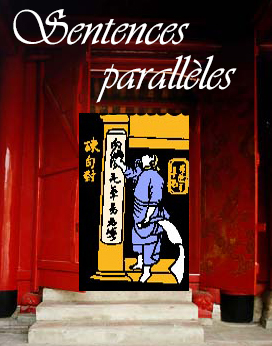
Parallel sentences (Doanh thiếp)


Vietnamese version

French version

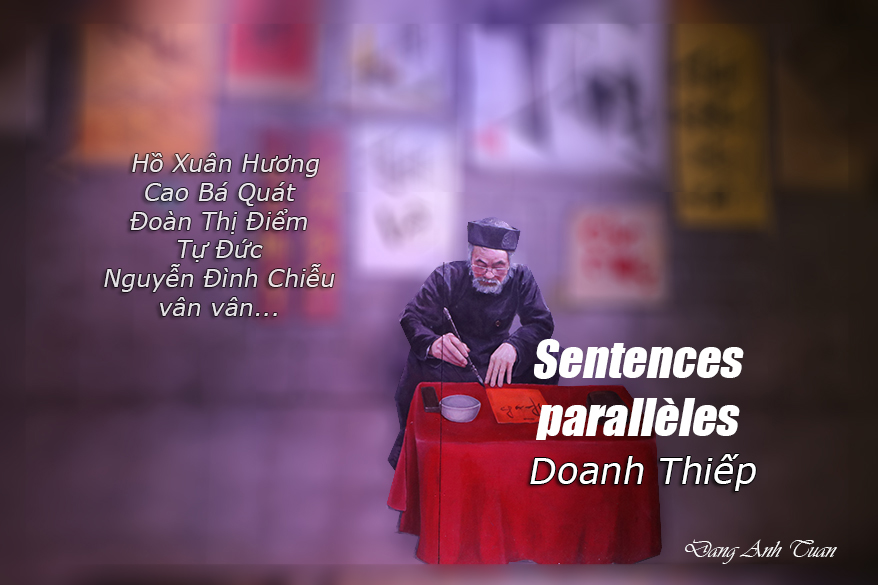
One of the charms of Vietnamese poetry lies in the usage of paralell sentences. Not only is found there the opposite of ideas or words used but also the relevance of the practice of parallelism. That is why parallel sentences constitute one of the major difficulties for novices but nevertheless they become one of the indisputable appeals for known Vietnamese poets such as Hồ Xuân Hương, Tự Ðức, Cao Bá Quát, Ðoàn Thị Ðiểm, Nguyễn Ðỉnh Chiễu etc. who had the opportunity to use them wisely. They have given us sentences showing their unprecedented talent and always serving as reference in the Vietnamese poetry.

Thanks to the contrast of the words or ideas in a verse or from stanza to stanza, the poet succeeded in stressing a reason or a crtitique and reinforcing the vigor of his thought. He composes these sentences based on prosodic rules established essentially on the alternation of equal (or bằng ) and oblique ( or trắc ) tones while leaning on the power of melodious and harmonious combinations of words used that are reinforced by the musicality of the Vietnamese language and the contrast of ideas.


Parallel sentences constitute a kind of intellectual pastime, an art that renowned poets found it hard to do without. They have succeeded in practicing this art with an astonishing ease and a remarkable ingenuity.

Parallel sentences reflect exactly what the poet saw and felt in his daily life. It is not surprising to see the Vietnamese’s infatuation of this subtle prosody for generations. It has become not only the pleasure of the people but also an efficient weapon against oppression, obscurantism and provocation.
Parallel sentences are a part of what every Vietnamese cannot miss on the occasion of Tết. The following two sentences:

Thịt mỡ, dưa hành câu đối đỏ,
Cây nêu, tràng pháo, bánh chưng xanh

Fatty meats, pickled shallots, red parallel sentences.
Tet poles, firecracker strings, green sweet rice cakes.

witness to the familiarity and profound attachment that the Vietnamese love to reserve to this popular prosody during the new year time. Rich or poor, poet or not, everyone try to have these sentences hung at the entrance to their homes. They compose them themselves or have them composed by learned people who would write them to best express their personal aspirations.

Parallel sentences probably found their root in Chinese literature. They are known in Vietnamese as « Doanh Thiếp » ( manuscript hung on the housepost ). They comprise two parts that are called upper part ( vế trên ) and lower part ( vế dưới ). They are also called given statement ( vế ra ) and cross statement ( vế đối ) when one is composed by a person and the other by another. One finds some characteristics common to those two parts:

· The number of words must be the same;
· The content must be suitable at the level of significance when it comes to antithesis or parallelism of ideas.
· The form must be respected when it comes to contrast of words used (respect of placement order of nouns, adjectives and verbs, observance of opposition rules and registered sounds bằng and trắc).
In the example cited below,

Gia bần tri hiếu tử
Quốc loạn thức trung thần.
Poor homes discern their pious children
Troubled nation recognizes its loyal citizens.

It is noted that there is the same number of words used ( 5 in each part, 6 in English ), the parallelism of ideas and the strict observance of registered sounds bằng and trắc used in both parts. At the position of the bang tone (Bần) in the upper verse one finds the trac tone (Loạn) at the same place in the lower verse. Likewise, the remaining trac tones in the upper verse hiếu and tử are respectively crossed by the two bằng tones trung and thần in the lower verse.

Parallel sentences made up of one to three words for each of the parts are called little parallel sentences ( or tiểu đối in Vietnamese ). When they contain four to seven words and follow prosodic rules of poetry, they are called « poetic parallel sentences » ( câu đối thơ ). It is the case cited above. In the case of parallelism of ideas which is called doi xuoi in Vietnamese, no opposition of ideas is detected; on the contrary, the is an intimate relation between the two parts, which we find in the following sentences:

Vũ vô kiềm tỏa năng lưu khách
Sắc bất ba đào dị nịch nhân.
Rain though not restraining, is retaining
Feminine beauty being no big waves, can easily be drowning.

In the opposite case they are called đối ngược in Vietnamese. 

The parallelism of ideas is frequently used by poet Cao Bá Quát. There is an anecdote about him during the passage of emperor Minh Mạng in his village when he was still a young boy. Instead of hiding, he threw himself in a pond to take a bath. His absurd attitude caused him to be tied and brought before Minh Mạng under the exhausting sun. Minh Mang, who was surprised by his boldness and young age offered to free him at the only condition that he succeed in composing the appropiate cross sentence in response to the emperor’s given statement. Seeing a bigger fish chasing a smaller one in the pond, the emperor began to say:

Nước trong leo lẽo, cá đóp cá
In clear water, fish eating fish.
Without hesitation, Cao Bá Quát replied with astonishing ease:

Trời nắng chan chan, người trói người
Under scorching sun, man tying man.

Marveled by his promptness and unprecedented talent, the emperor was obliged to set him free. Cao Bá Quát, known for his independence, presumption and contempt of the mandarinal system, often stood up against challenges launched by his adversaries. One day, while participating in a talk on poetry hosted by a mandarin, he did not stop making fun of the mandarin when this one gave simplistic explanations to questions made by the public. Annoyed by his continuing provocation, the mandarin challenged him with the intention of punishing him immediately by asking him to give a cross sentence appropriate to the statement given by the mandarin himself:

Nhi tiểu sinh hà cứ đác lai, cảm thuyết Trình, Chu sự nghiệp
Mầy là gả học trò ở đâu đến mà dám nói đến sự nghiệp của Trương Công và Chu Công?

You little student coming from nowhere dare to critique the works of Trinh and Chu?
Without hesitation, he replied with impertinence:
Ngã quân tử kiên cơ nhi tác, dục ai Nghiêu Thuấn quân dân
Ta là bậc quân tử, thấy cơ mà dấy, muốn làm vua dân trở nên vua dân đời vua Nghiêu vua Thuấn.

I the gentleman taking opportunity for action want to turn king and subjects to those of Nghiêu and Thuấn.

In the old days parallel sentences constituted a favorite place where Chinese and Vietnamese loved to affront publicly. The cross statement of the learned Giang Văn Minh, anchored in the memory of a whole people and perpetuated for several generations

Ðằng giang tự cồ huyết do hồng.

The Ðằng River is from ancient time still red of blood .
continues to illustrate its infallible determination to the provocation of the Ming emperor with its following given statement:

Ðồng trụ chí kim đài dĩ lục

The Bronze Pole is up until now covered with green of moss

There are also anonymous poets who left us memorable parallel sentences. It is those found on the altar of Nguyễn Biểu at the Bình Hồ commune ( North Vietnam ).

Năng diệm nhơn đầu năng diệm Phụ
Thượng tồn ngô thiệt thượng tôn Trần
Ăn được đầu người thì co’ thể ăn cả Trương Phụ
Còn lưỡi của ta thì còn nhà Trần

Capable of eating a human head is capable of eating Trương Phụ
Having still my tongue is having remain the dynasty of Trần.

Thanks to these two sentences, the anonymous poet wanted to render a vibrant homage to the national hero. He was drowned by the Chinese generalissimo Trương Phụ who had hosted a somptuous banquet in his honor. To intimidate Nguyen Bieu, Truong Phu did not hesitate to present him a plate on which sit the head of a decapitated adversary. Instead of being afraid of this presentation, Nguyen Bieu remained impassible, took the chopsticks, picked out the eyes and ate them savorily.

After the fall of Saigon in 1975, an anonymous composed the following parallel sentences:
Nam Kì Khởi Nghĩa tiêu Công Lý
Ðồng Khởi vùng lên mất Tự Do.

Nam Ki Uprising wiped out Justice
Ðồng Khởi Revolt took away Freedom

because the names of the bouvevards Công Lý and Tự Do were replaced by Nam Ki Khởi Nghĩa and Ðồng Khởi in this teeming city of the South.

By means of parallel sentences, the anonymous poet wanted to stress his caustic criticism with regard to the regime.
Taking advantage of the subtleness found in parallel sentences and of the figurative meaning of the Vietnamese language, Vietnamese politicians, emperor Duy Tân in particular, have often had the opportunity to probe and be ironical of their adversary.
Brooding on the idea of fomenting for a long time an insurrection against the colonial authorities, Duy Tân, taking advantage of a coastal excursion with his prime minister Nguyễn Hữu Bài at the beach of Cửa Tủng ( Quảng Trị ), requested of the latter a cross statement to his given sentence:

Ngồi trên nước không ngăn được nước
Trót buôn câu đã lỡ phải lần.

Sitting on water, but one is incapable of retaining it
Throwing out the fishing line, yet we can only pull it back slowly.

Since Nước also means country in Vietnamese, Duy Tân in his given statement wanted to express the idea that he was on top of the country, yet he could not govern it.

He also wanted to probe Nguyễn Hữu Bài‘s political intention to see if the latter was with his opinion or paid by the French colonialists. Knowing the political conjuncture and being close to the colonial authorities, Nguyễn Hữu Bài preferred immobilism and a politics of dialogue in the following reply:

Ngẫm việc đời mà ngán cho đời
Liệu nhắm mắt đến đâu hay đó

Thinking of life, one becomes fed up with it
Closing our eyes, we will take whatever happens

To be ironical of his adversary, Ðặng Trần Thường, who had judged him wrong for being a partisan of emperor Quang Trung, with the following sentence:

Thế Chiến Quốc, thế Xuân Thu, gặp thời thế, thế thời phải thế
At the time of Chiến Quốc and Xuân Thu, whoever had the opportunity would grab it.

Ngô Thời Nhiệm succeeded in giving a perfect reply to the given statement by his adversary Ðặng Trần Thường, a partisan of emperor Gia Long.
Ai Công hầu, ai Khanh tướng, trên trần ai, ai dễ biết ai
For the titles of Duke and Minister, who is who in society to know them.

He succeeded to show not only his bravery but also his contempt with regards to go-getters such as Ðặng Trần Thường. Annoyed by these vexing words, the latter ordered his subordinates to flog him to death in front of the temple of literature. Ngô Thời Nhiệm was not wrong to recall Ðặng Trần Thường of this remark because he was later condemned to death by emperor Gia Long.
Phú, it is the noun in Vietnamese attributed to parallel sentences having a large number of words or parts. It is the case of sentences used by Ngô Thời Nhiệm and Đặng Trần Thường. When they are made of several parts of sentences, three ( in the example cited above ) or more, in the middle of which is inserted a very short part, one calls them gối hạc ( the kneecap of the crane ) in Vietnamese because it looks like the two parts of the crane’s leg separated by the kneecap.

Parallel sentences become with the flow of time the true popular expression of the whole people in the permanent struggle against obscurantism and oppression. By giving the people the opportunity to show their character, temperament and soul, parallel sentences succeed in justifyingwhat novelist Staël has put:

By learning the prosody of a language, one intimately enters the spirit of the nation that speaks it. It is with parallel sentences that one can understand and feel better about Vietnam. One would

then be closer to its people and culture.

[Return LITERATURE]

Sentences parallèles (Doanh Thiếp)

Doanh thiếp

Version vietnamienne 

L’un des charmes de la poésie vietnamienne réside dans l’utilisation des sentences parallèles. On y trouve non seulement l’antithèse des significations  ou des mots employés mais aussi la pertinence dans  la pratique de ces sentences. C’est pourquoi les sentences parallèles constituent l’une des difficultés majeures pour les novices mais elles deviennent néanmoins l’un des attraits incontestables pour les poètes vietnamiens connus comme Hồ Xuân Hương, Tự Ðức, Cao Bá Quát, Ðoàn Thị Ðiểm, Nguyễn Ðình Chiễu etc …
Ceux-ci ont eu l’occasion de les utiliser savamment. Ils nous ont légué des sentences dignes de leur talent inouï et servant toujours de référence dans la poésie vietnamienne. Grâce à l’antinomie trouvée dans les  mots ou les significations à l’intérieur d’un vers ou de strophe en strophe, le poète réussit à faire ressortir une raison ou une critique et à renforcer la vigueur de sa pensée.  Les sentences sont composées  à partir des règles prosodiques établies essentiellement sur l’alternance des tons bằng et  trắc (1) tout en s’appuyant sur la puissance des combinaisons des mots utilisée  de manière harmonieuse et  accrue par l’extrême musicalité de la langue vietnamienne et sur l’antithèse des significations (ou d’idées) ou la cohérence et la mise en corrélation des significations.

Les sentences parallèles constituent en quelque sorte un passe-temps intellectuel, un art dont les poètes de grand renom ne peuvent pas se passer. Ces derniers ont réussi à l’exercer avec une facilité étonnante et une ingéniosité remarquable. Les sentences parallèles reflètent exactement ce que le poète a vu  et ressenti dans la vie quotidienne.

Rien n’est étonnant de voir l’engouement des Vietnamiens pour cette prosodie subtile  au fil des générations. Elle devient non seulement le plaisir du peuple mais aussi une arme aussi efficace contre l’obscurantisme,  l’oppression et la provocation.

Thịt mỡ, dưa hành câu đối đỏ,
Cây nêu, tràng pháo, bánh chưng xanh
Viande grasse, légumes salés, sentences parallèles rouges,
Mât du Tết, chapelets de pétards, gâteaux de riz du nouvel an.

Les sentences parallèles font partie de ce que chacun des Vietnamiens ne peut pas manquer à l’occasion de la fête du Tết. Elles témoignent de la familiarité et de l’attachement profond que le Vietnamien aime réserver à cette prosodie populaire lors du nouvel an. Riche ou pauvre, poète ou non, chacun tente d’avoir ces sentences pour les déposer devant  l’autel des ancêtres ou pour les accrocher à l’entrée de sa maison. Il les compose lui-même ou se procure auprès des lettrés celles qui formulent le mieux ses aspirations personnelles.

Les sentences parallèles trouvent probablement leur origine dans la littérature chinoise et sont connues en vietnamien sous le nom « Doanh thiếp (2) » . Elles comprennent deux vers: l’un est appelé le vers  supérieur (vế trên) et  l’autre le vers  inférieur (vế dưới). Le vers supérieur est le vers  composé et proposé par une personne souhaitant le commencement des sentences  tandis que le vers inférieur est  celui  qu’une autre personne  veut terminer pour la réplique.

On trouve quelques caractéristiques communes à ces deux vers: 

– Le nombre de mots doit y être le même.
– Le contenu doit y être convenable au niveau de la signification quand il s’agit de l’antithèse ou de la cohérence des idées.
– La forme doit y être respectée quand il s’agit de l’opposition totale des mots employés (respect de l’ordre de l’emplacement des mots, des adjectifs et des verbes, observation des règles d’opposition des registres sonores bằng et trắc).
Dans l’exemple cité ci-dessous,

Gia bần tri hiếu tử
Quốc loạn thức trung thần.

Nhà nghèo mới biết con hiếu thảo
Nước loạn mới biết rõ tôi trung
La famille pauvre discerne des enfants pieux
Le pays en désordre reconnaît des sujets fidèles.

on constate qu’il y a le même nombre de mots (5 mots dans chaque vers), le parallélisme des idées et l’observation stricte des registres sonores bằng et trắc employés dans les deux vers. A la place du ton bằng (nghèo) du vers supérieur on retrouve un ton trắc (loạn) au même emplacement dans le vers inférieur. De même, les tons trắc restants du vers supérieur hiếu et tử sont remplacés respectivement par les deux tons bằng trung et thần dans le vers inférieur.

Les sentences parallèles constituées de un à sept mots pour chacun des vers s’appellent des petites sentences parallèles (ou tiểu đối en vietnamien). Lorsqu’elles contiennent  plus de  sept mots et suivent les règles prosodiques de la poésie, on les désigne sous le nom de « sentences parallèles poétiques » (ou thi đối). C’est le cas de l’exemple cité ci-dessus. En cas du parallélisme d’idées, on les appelle  câu đối xuôi en vietnamien. Dans ce cas, aucune opposition d’idées n’y est décelée. Par contre, il y a une cohérence et une corrélation entre leurs deux vers, c’est ce qu’on trouve dans ces deux sentences suivantes:

Vũ vô kiềm tỏa năng lưu khách
Sắc bất ba đào dị nịch nhân.
Sans avoir la serrure à la porte, la pluie peut retenir celui qui est pressé de partir
Sans la possibilité de faire les vagues de la mer, la beauté d’une fille peut noyer celui qui s’en est épris.

Dans le cas contraire, on les appelle câu đối ngược en vietnamien. Dans ce type de sentences, l’antinomie de significations ou d’idées est visible dans les deux vers. C’est le cas de l’exemple suivant:

Hữu duyên thiên lý năng tương ngộ
Vô duyên đối diện bất tương phùng 
Có duyên dù ở xa ngàn dậm cũng có thể gặp nhau
Còn không có duyên  rồi dù ở có  đối mặt cũng không gặp được nhau.

Malgré plusieurs milliers de kilomètres de distance, on peut se rencontrer lorsqu’on a la chance.
En dépit de la proximité géographique, on ne peut pas se voir lorsqu’on n’a pas la chance.

Les sentences parallèles sont  employées fréquemment par le poète Cao Bá Quát. Il y a eu une anecdote sur lui lors du passage de l’empereur Minh Mạng dans son village quand il était encore un jeune garçon entêté. Au lieu de se cacher, il se jeta dans un étang pour prendre une baignade. Devant son attitude absurde, il fut ligoté et emmené devant Minh Mạng sous un soleil accablant.  Surpris par sa hardiesse et son jeune âge, celui-ci lui proposa de le libérer à condition qu’il réussît à composer une sentence appropriée répondant à celle émise par l’empereur. En voyant la poursuite engagée par le plus gros poisson sur le petit dans l’étang, l’empereur commença à dire:

Nước trong leo lẽo, cá đóp cá
L’eau étant tellement limpide, le grand happe le petit.

Sans hésitation, Cao Bá Quát répliqua avec une facilité étonnante:

Trời nắng chan chan, người trói người
Le soleil étant tellement accablant, le grand  ligote le petit.

Émerveillé par sa promptitude et par son talent inouï, l’empereur fut obligé de lui rendre la liberté. Cao Bá Quát, connu pour son indépendance, sa présomption et son mépris à l’égard du système mandarinal, était obligé de relever souvent le défi lancé par ses adversaires. Un beau jour, profitant de sa participation à un exposé organisé par un mandarin sur la poésie, il ne cessa pas de faire le clown lorsque ce dernier continua à donner des explications simplistes sur les questions posées par le public. Énervé par sa provocation continue, le mandarin fut obligé de le défier dans l’intention de le punir immédiatement en lui demandant de donner une sentence appropriée répondant à celle émise par lui-même :

Nhi tiểu sinh hà cứ đác lai, cảm thuyết Trình, Chu sự nghiệp
Mầy là gả học trò ở đâu đến mà dám nói đến sự nghiệp của Trương Công và Chu Công?

Étant un élève venant de quel coin, oses-tu citer les œuvres de Trương Công et Chu Công?

Sans hésitation, il lui répondit avec impertinence:

Ngã quân tử kiên cơ nhi tác, dục ai Nghiêu Thuấn quân dân
Ta là bậc quân tử, thấy cơ mà dấy, muốn làm vua dân trở nên vua dân đời vua Nghiêu vua Thuấn.

Etant un homme de ren (3), profitant des moments opportuns pour m’élever, puis-je devenir roi à l’image des rois Nghiêu et Thuấn?

Les sentences parallèles constituaient autrefois un lieu de prédilection où les Chinois et les Vietnamiens aimaient s’affronter publiquement. La sentence répondante du lettré Giang Văn Minh, ancrée dans la mémoire de tout un peuple et perpétuée depuis plusieurs générations :

Ðằng giang tự cổ huyết do hồng.
Le fleuve Bạch Ðằng continue à être teinté avec du sang rouge.
illustre bien sa détermination infaillible face à la provocation de l’empereur des Ming avec sa sentence émise suivante:

Ðồng trụ chí kim đài dĩ lục.
Le pilier en bronze continue à être envahi par la mousse verte.

Il y a aussi des poètes anonymes qui nous ont laissé des sentences parallèles mémorables. C’est celles qu’on a trouvées sur l’autel du héros national Nguyễn Biểu dans la commune Bình Hồ au Nord Vietnam.

Năng diệm nhơn đầu năng diệm Phụ
Thượng tồn ngô thiệt thượng tôn Trần
Ăn được đầu người thì có thể ăn cả Trương Phụ
Còn lưỡi của ta thì còn nhà Trần

En mangeant la tête humaine, on peut manger aussi Trương Phụ
En ayant encore la langue, je peux survivre autant que la dynastie des Trần.

Grâce à ses deux sentences, le poète anonyme a voulu rendre un vibrant hommage au héros national. Celui-ci fut noyé par le généralissime chinois Trương Phụ après que ce dernier avait organisé un banquet somptueux en son honneur. Pour intimider Nguyễn Biểu, Trương Phụ n’hésita pas à lui présenter un plat où on trouvait la tête décapitée d’un adversaire. Au lieu d’être effrayé par cette présentation, Nguyễn Biểu restant impassible, se servit des baguettes pour déloger les yeux et les mangea savoureusement.

Lors de la chute de Saigon en 1975, un anonyme a composé les deux sentences parallèles suivantes:

Nam Kì Khởi Nghĩa tiêu Công Lý
Ðồng Khởi vùng lên mất Tự Do.

Le soulèvement du Sud anéantit la justice
La révolte en marche fait périr la liberté

car les noms des boulevards Công Lý et Tự Do ont été remplacés respectivement par Nam Kì Khởi Nghĩa et Ðổng Khởi dans la ville bouillonnante du Sud. C’est par le biais de ces sentences que le poète anonyme a voulu mettre en relief sa critique acerbe à l’égard du régime.

Profitant de la subtilité trouvée dans les sentences parallèles et du sens figuré dans la langue vietnamienne, les hommes politiques vietnamiens, en particulier l’empereur Duy Tân, ont eu l’occasion de s’en servir souvent pour sonder ou ironiser sur l’adversaire. Caressé par l’idée de fomenter depuis longtemps une insurrection contre les autorités coloniales, Duy Tân, profitant de l’excursion maritime qu’il a effectuée avec le premier ministre Nguyễn Hữu Bài à la plage Cửa Tùng (Quảng Trị), proposa à ce dernier de lui donner une réplique appropriée à sa sentence émise:

Ngồi trên nước không ngăn được nước
Trót buôn câu đã lỡ phải lần
Etant assis sur l’eau, on est incapable de la retenir
En commettant l’erreur de jeter l’appât, on n’a plus la possibilité de le retirer.

À travers ces deux sentences, Duy Tân voulut connaître l’intention politique de son ministre Nguyễn Hữu Bài car le mot « nước » en vietnamien désigne à la fois l’eau et le pays. Il aimerait savoir si ce dernier était de son avis ou à la solde des colonialistes français. Connaissant la conjoncture politique et  étant un proche des autorités coloniales, Nguyễn Hữu Bài  préféra l’immobilisme et adopta une politique de concertation en donnant la réplique suivante:

Ngẫm việc đời mà ngán cho đời
Liệu nhắm mắt đến đâu hay đó
En réfléchissant mûrement sur la vie, on en est dégoûté.
En tentant de fermer les yeux, on n’a qu’à attendre le moment propice.

Étant chargé de juger le tort de Ngô Thời Nhiệm d’être le partisan de l’empereur Quang Trung,  Ðặng Trần Thường  l’a défié en émettant la sentence suivante:

Thế Chiến Quốc, thế Xuân Thu, gặp thời thế, thế thời phải thế, 
À l’époque des Royaumes Combattants ou des Printemps Automnes, quiconque rencontrant le moment opportun, en profite pour devenir celui qu’il est.

Ngô Thời Nhiệm a réussi à donner sa sentence répliquante avec ironie  à Ðặng Trần Thường, un  partisan de l’empereur Gia Long:

Ai Công hầu, ai Khanh tướng, trên trần ai, ai dễ biết ai
On est duc et marquis ou mandarin et ministre; quiconque vivant dans cette société, distingue facilement le rôle que chacun assume.

Il réussit à montrer non seulement sa bravoure mais aussi son mépris à l’égard des gens arrivistes comme Ðặng Trần Thường. Irrité par ces propos vexants, ce dernier donna l’ordre à ses subordonnés de le fouetter à mort devant le temple de la littérature. Ngô Thời Nhiệm n’a pas eu tort de rappeler à Ðặng Trần Thường cette remarque car il fut condamné à mort plus tard par l’empereur Gia Long.

Phu’, c’est le nom en vietnamien qu’on attribue aux sentences parallèles ayant un grand nombre  de membres de phrases. C’est le cas de l’exemple de sentences employées par Ngô Thời Nhiêm et Ðặng Trần Thường. Lorsque celles-ci comprennent trois ou plus (dans l’exemple cité ci-dessus) de membres, au milieu desquels on insère un membre très court, on les appelle sous le nom phú gối hạc (la rotule de la grue) en vietnamien car on trouve une ressemblance avec le schéma de la patte de la grue avec les deux membres longs séparés par la rotule.

Ces sentences parallèles deviennent au fil des années l’expression populaire véridique de tout un peuple en lutte permanente contre l’obscurantisme et l’oppression. En donnant à ce dernier l’occasion de montrer son caractère, son tempérament et son âme, elles réussissent à justifier ce que la romancière Staël a l’occasion de dire: En apprenant la prosodie d’une langue, on entre intimement dans l’esprit de la nation qui la parle. C’est avec ces sentences parallèles  qu’on peut comprendre et sentir mieux le Vietnam. On serait alors plus proche de son peuple et de sa culture.

[Return LITTERATURE]


(1) bằng deux accents: accent grave  et sans accents ; trắc: 4 accents: accent retombant, tilde, accent aigu et accent intensif.
(2) Doanh thiếp: manuscrit accroché au poteau de la maison.
(3) Être ren: c’est savoir faire régner bonne foi, tolérance, diligence et générosité. 

The Gongs of Central Highlands (Cồng Chiền Tây Nguyên) Last part

gong_dxdung

Photo Đinh Xuân Dũng ( Nha Trang )

Intangible Heritage of Humanity by Unesco in 2005

Last part

In the ritual ceremonies, the players of gongs move slowly in single file or in half-circle in front of a public admirer. They left from right to left in the counterclockwise direction to go back in time and return to their origins. Their footsteps are slow and rhymed to the beats of gongs, each of which has a well-defined role in the set. Each gong corresponds exactly to a guitar string, each having a note, a particular tone. Whatever the melody played, there is the active participation of all the gongs in the procession. However, an order very precise in the sequence and composition of beats is imposed in order to respond to the melodies and own themes chosen by each ethnic group.

Sometimes, to better listen to the melody, the auditor has the interest to be into a location equidistant from all the players arranged in a half circle otherwise he cannot listen properly because of the weakness and amplification of the resonance of some gongs corresponding respectively to the distance or the excessive closeness of its geographical position relative to one another.

For most of ethnic groups, the set of gongs is reserved only for men. This is the case of the ethnic group Jarai, Edê, Bahnar, Sedang, Co Hu. By contrast, for the ethnic group Eđê Bih, women are allowed to use the gongs. In a general way, the gongs are of variable size. The disk of the major gongs may vary from 60 to 90 cm in diameter with a cylindrical edge from 8 to 10 cm. This does not allow the players to wear them because they are too heavy.

These gongs are suspended often to the beams in house by the ropes. However, there are the gongs more small whose disk varies from 30 to 40 cm with an edge from 6 to 7cm. The latter are frequently encountered in the festive rituals.

For the identification of highland gongs, the Vietnamese musicologist Trần Văn Khê has the opportunity to enumerate a number of characteristics in one of his articles:

  • 1°) They are very varied.
  • 2°) They are linked closely to the spiritual life of highland ethnic minorities. Being regarded as sacred instruments, they promote communication with spirits and geniuses.
  • 3°) They accompany the highland people from its birth until its death. Their presence is visible not only in the important events (weddings, funerals, wars etc. ..) but also in the agricultural feasts (paddy germination, ear intiation, feast of the agricultural close etc. . ).
  • 4°) The manner of playing the highland gong is very particular and reflects the family structure of each ethnic minority. This allows to easily identify the ethnic group in question by the played stamp melodies.
  • 5°) The movement of players is always performed in the counterclockwise direction in the purpose to go back in time and return to the source. It is identical to the approach used by the Zen Buddhist school in its walking meditation (thiền hành) oriented from « the outside to the heart » (từ ngoài vào tim).

The composition of the played melody is based primarily on the sequence of beats settled according to original processes of repetition and answer.

One doesn’t finds elsewhere as many gongs as one had them on the Highlands of Vietnam. That is why, during his visit in Vietnam, the ethnomusicologist Filipino José Maceda, accompagned by Vietnamese musician Tô Vũ, had the opportunity to emphasize that the highland gongs are very original when he was in contact with the gongs. For him, because of the large number of gongs found, it is possible the Highlands may be the gong cradle in Southeast Asia.

Over the years, the risk of seeing the « original » and « sacred » character is real because of the illicit trafficking of gongs, the lack of gong tuner, the disinterestednessof young people and the destruction of natural environment where the gongs have been « educated ».

Highlands Gongs

For a few years, being regarded as cultural goods, the gongs become the object of all desire for Vietnamese antique dealers and foreign collectors, which brings the local authorities to exercise strict control with the aim of stopping the haemorrhage of gongs (chảy máu cồng chiêng)

The governmental effort is also visible at the local level by the establishment of incentive programs for learning with young people. But according to some Vietnamese ethnomusicologists, this allows to make durable the gongs without giving to the latter the means to possess a soul, a sacred character, a ethnic sound color because they need not only the skillful hand and fine hearing of gong tuner but also the environment. This is the latter factor that one forgets to protect effectively during the last years. Because of the intensive deforestation and galloping industrialisation for the coming years, the ethnic minorities don’t have the opportunity to practice slash and burn agriculture. They will not have any occasion to honor the ritual festivals, their genius and their traditions. They no longer know to express sorrows and joys through the gongs. They don’t know their oral epics (sử thi). Their paddy fields are replaced by coffee and rubber plantations. Their children are no longer forest clearers but they are engaged to industrial and tourist activities, which allows them to have comfortable livelyhoods. Few now recall how to tune these gongs.

The character « sacred » of gongs no longer exists. The latter become instruments of entertainment like other music instruments. They can be used anywhere without significant events and very specific and sacred hours (giờ thiêng). They are played according to the tourism demand. They are no longer what they were until now.

It is for this irreparable loss that UNESCO has not hesitated to underline the urgency in the recognition of space of gong culture in the Central Highlands (Tây Nguyên) as the masterpiece of Oral and Intangible Heritage of Humanity on 25 November 2005. The gongs are only one essential element in the achievement of this masterpiece but it must be understood that other elements are as important as these gongs: the environment, the traditions and customs, the ethnic groups etc. ..

The gongs without their environment and their ethnic sound color no longer possess the sacred soul (hồn thiêng) of Central Highlands.They lose the original character for ever. There is always a price to pay in the preservation of the gong culture in Central Highlands but it is to the scope of our collective efforts and our political will. One cannot refute that the culture of the gongs in Highlands is part now of our cultural heritage.

[Back to page « Vietnam, land of 54 ethnies »]