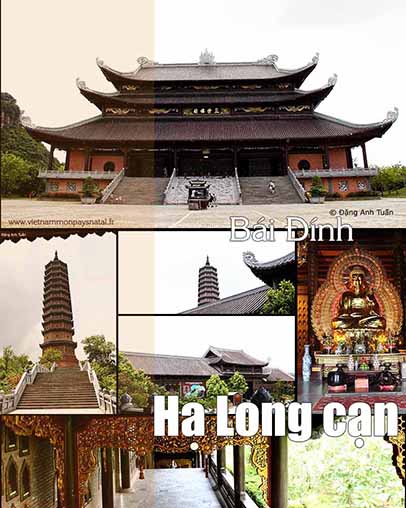
Bái Đính (Ninh Bình)


baidinh

Complexe paysager de Tràng An

English version
Version vietnamienne
 

Pagode Bái Đính

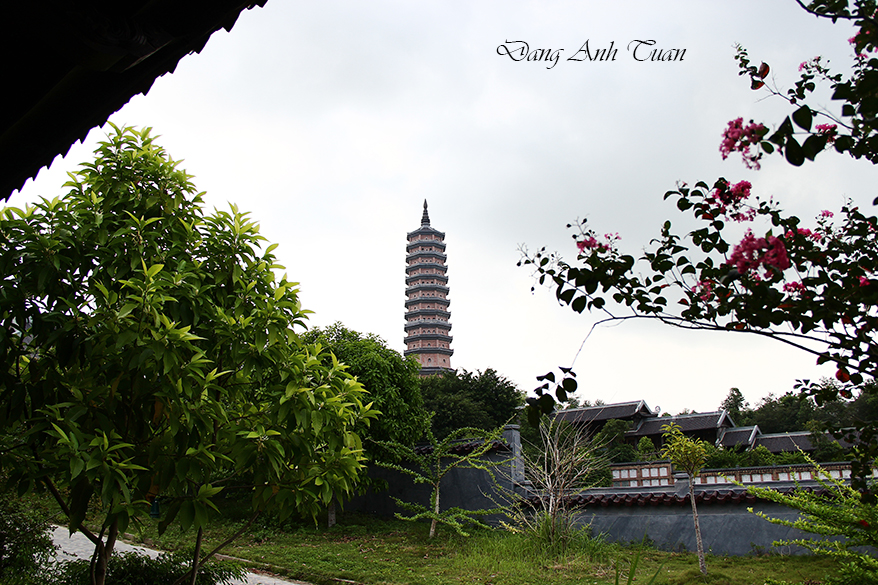
Étant située sur la chaîne de montagnes karstiques Tràng An de Ninh Bình, la pagode Bái Đinh a connu une longue existence datant de plusieurs siècles. Sa renommée est attestée depuis longtemps sous les dynasties successives: Đinh, Lê antérieur et Lý.  Aujourd’hui, elle  devient un complexe religieux où on trouve non seulement le temple ancien mais aussi de nouveaux temples en cours de construction depuis 2003. La pagode Bái Đính est considérée en Asie du Sud Est comme la pagode possédant la statue gigantesque Bouddha coulée en bronze et importée de la Russie.  Celle-ci a une   hauteur  de 16 mètres et un poids de 100 tonnes. Les  500 arhats  en marbre blanche  de la pagode sont répartis à peu près sur 2 kilomètres tout le long d’un couloir. Ce complexe a une superficie totale de 539 ha dont on attribue 27 ha pour l’ancienne pagode, 80 ha pour les nouveaux temples, un centre d’études bouddhiques, des espaces d’accueil et des parkings ainsi qu’un système de lacs. 

Patrimoine culturel  mondial du Vietnam

Chùa Bái Đính

nằm trên sườn núi đá Tràng An của Ninh Bình  là một chùa đã có lâu đời. Chùa được nổi tiếng dưới ba triều đại: Đinh, Tiền Lê và Lý. Ngày nay, chùa Bái là một quần thể tôn giáo gồm có không những ngôi đền cổ mà còn có thêm các ngôi đền khác được xây dựng từ 2003. Chùa Bái Đính được xem ở Đông Nam Á là chùa có tượng Phật bằng đồng dát vàng lớn nhất nhập từ Nga Sô. Tượng nầy có bề cao là 16 thước và nặng 100 tấn. 500 La Hán bằng cẩm thạch trắng được phân phối dộc theo hành lang dài gần 2 cây số. Quân thể nầy có một diện tích tổng cộng là 539 ha mà trong đó 27 ha dành cho chùa cổ, 80 ha cho các đền mới xây cất, một khu học viện Phật giáo,  một khu đón tiếp du khách và các bãi đậu xe chưa kể đến các hồ nước.

Ninh Bình (Hạ Long cạn)

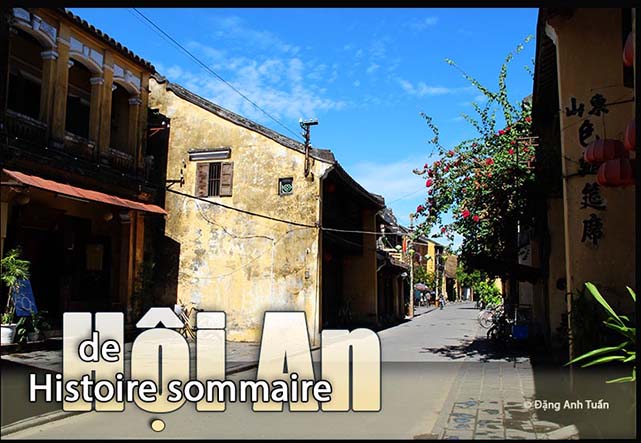
Hội An: un jour comme les autres

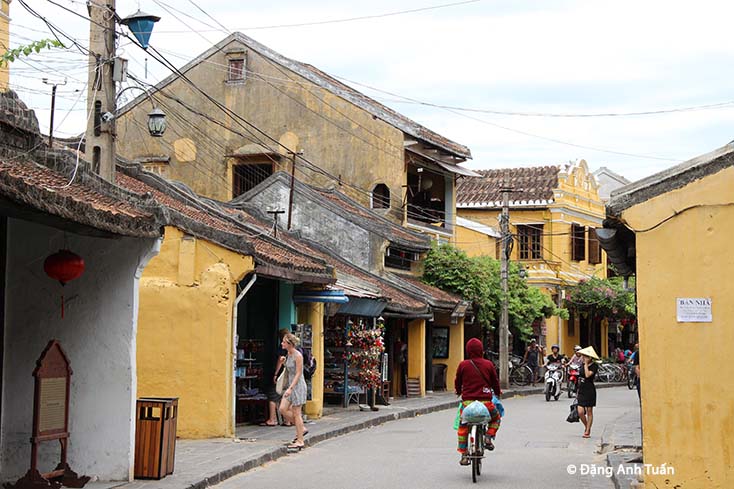
Một ngày như mọi ngày ở phố cổ Hội An

One  day, just like on the other days at Hội An.

Un jour identique à d’autres jours à la vieille ville de Hội An


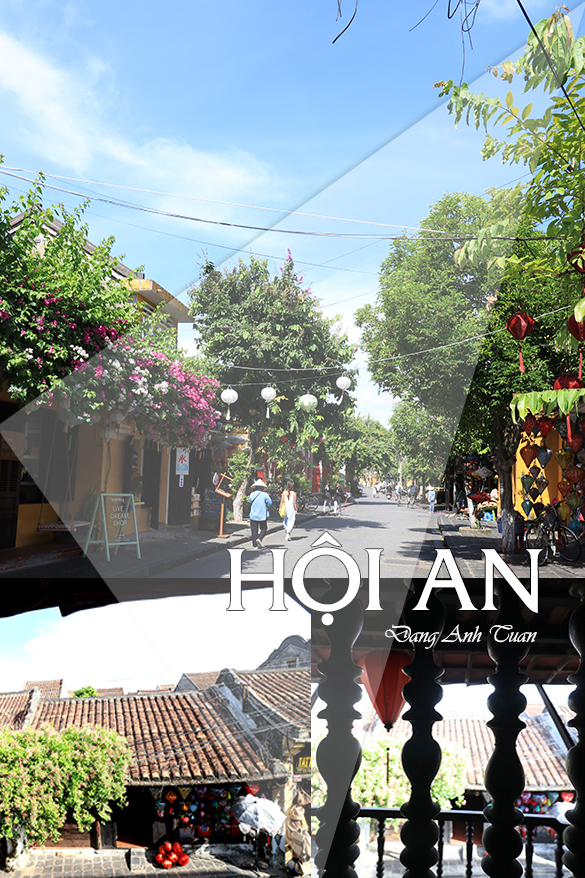
Hôi An


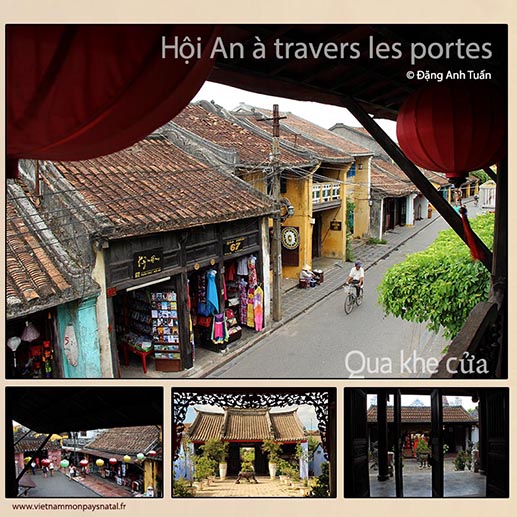
Hội An à travers les fenêtres et les portes

hoian_qua_khe_cua

Hội An qua khe cửa

Version anglaise
Version française
Galerie des photos

Hôi An đã bao lần thay đổi tên trong lich sử. Qua hai chữ «Hội» và «An» tên nầy gợi ý cho chúng ta nghĩ đến một thành phố mà mọi người muốn tựu họp và sống an lành. Trước khi đựơc các chúa Nguyễn cai quản, vùng đất nầy thuộc về Vương quốc Chămpa và được phát triển từ thế kỷ thứ 2 đến thế kỷ 14. Hội An lấy tên “Hai Phố” sau khi Nguyễn Hoàng bổ nhiệm Nguyễn Phúc Nguyên (chúa Sãi) làm tổng trấn ở Quảng Nam vào năm 1570. Chính trong thời kỳ nầy Hội An được phát triển mạnh mẽ nhờ có chính sách cởi mở, nhập cư thích hợp và sáng suốt của các chúa Nguyễn nhất là biết lợi dụng việc nghiêm cấm của triều đại Minh không cho các thuyền bè Nhật được cập bến các bờ biển Trung Hoa. Dưới thời kỳ cai trị của chúa Sãi (Nguyễn Phúc Nguyên), Hội An rất được thịnh vượng và sầm uất với nhiều khu phố (Nhật, Trung Hoa, Hoà Lan vân vân….) Mỗi cộng đồng có một khu phố riêng tư với các tập quán của mình và có được một người đại biểu của chính quyền phụ trách. Hội An trở thành thời đó là một trong những hải cảng thương mại và trung tâm kinh tế của xứ Đàng Trong và Đông Nam Á. Số người Nhật định cư bất đầu tăng lên cùng lúc với Hội An.

Có một người Nhật tên Suharto được chúa Sãi yêu mến nhận làm con nuôi, gọi ông là Đại Lương và phong cho ông một huy hiệu qúi tộc Hiến Hùng. Sau nầy Đại Luơng không những là con rể của chúa Sãi mà còn là người quản lý Hội An. Rất có thể trong thời gian nầy mà chùa cầu được xây cất. Nhưng sau đó vì thông lệnh của Mạc Phủ (Bakufu) cấm người dân Nhật xuất ngoại, Suharto buộc lòng cấp tốc trở về Nhật cùng vợ tức là công chúa Nguyễn Thị Ngọc Khoa mà tên Nhật là Anio. Sau việc cấm truyền bá đạo công giáo ở Nhật và chính sách ngược đãi của Nguyễn Phúc Tần (chúa Hiền) với các người công giáo Nhật và Hoa từ 1664 đến 1665, cộng đồng người Nhật ở Hội An bất đầu giảm dần. Theo thương gia người Anh Thomas Bowyer, chỉ còn ở Hội An 4 hay 5 gia đình vào 1695 so với cộng đồng người Hoa có khoảng chừng 100 gia đình. (BAVH 1920, năm thứ 7, số 2, trang 200). Ngày nay, không còn thấy dấu tích kiến trúc nào của người Nhật ngoài chùa cầu và vài mộ rải rác ở vùng Cẩm Châu.

Hội An không còn ý nghĩa Hai Phố vì phố Nhật không còn nửa. Từ đó, chỉ gọi Hội An là Hải Phố có nghĩa là Phố ở biển hay là Hoa Phố (phố của người Hoa). Có lẽ một trong hai tên nầy mà các cha cố đạo Âu Châu phát âm ra không rỏ mà thành Faifo. Tên nầy được giữ đến thời kỳ Pháp thuộc. Hội An có phần may mắn không bị tàn phá trong thời chiến tranh Vietnam. Nhờ thế Hội An còn giữ được nguyên vẹn một số nhà cổ khiến tạo một niềm vui không ít cho du khách Viêt và ngoại quốc.

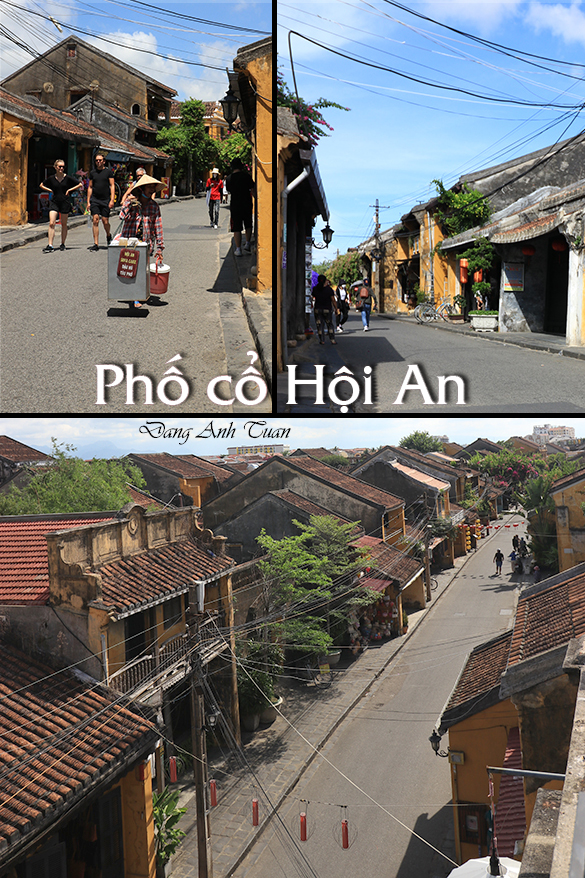
Sức thu hút của nó ở chổ là làm du khách tìm lại được trong những giây phút tham quan, lịch sử qua dòng thời gian.

Version française 

Hội An a changé plusieurs fois de nom durant son histoire. Le nom « Hội An » suggère qu’à travers les mots ( Hội= « Association ») et (An= »en paix ») cette ville devrait être un endroit où on pouvait se réunir en paix. Avant d’être sous le giron des seigneurs Nguyễn, Hội An se trouvait dans une région très développée du royaume du Champa du IIè au XIVè siècle. Puis Hội An a prospéré sous le nom de Hai Phố (Deux petits villages) au moment où le seigneur Nguyễn Hoàng du royaume Đại Việt installa son fils Nguyễn Phúc Nguyên (Seigneur Sãi) en tant que gouverneur de Quảng Nam en 1570. C’est la période brillante où Hội An connut un essor fulgurant dû en grande partie à la politique d’ouverture et d’immigration appropriée et clairvoyante menée par les seigneur. C’est sous le règne du seigneur Nguyễn Phúc Nguyên (Chúa Sãi) que furent créés, à Hội An, les quartiers communautaires (japonais, chinois, hollandais etc.). Chaque communauté avait son quartier où les habitants pouvaient vivre selon les us et coutumes de leur pays. L’administration de chaque quartier fut assumée par un délégué des autorités locales. Hội An devint ainsi l’un des ports commerciaux et centre économique de la Cochinchine, mais aussi, de l’Asie du Sud Est. 

La communauté nippone a commencé à croître en même temps que l’agglomération d’Hội An. Les seigneurs Nguyễn favorisèrent le développement économique avec le Japon. Un Japonais, du nom de Shutaro, qui avait réussi à gagner l’estime et l’affection du seigneur Nguyễn Phước Nguyên fut adopté par ce dernier et autorisé à prendre non seulement son nom de famille Nguyen, ainsi que son prénom, Đại Lương, mais aussi le titre de noblesse Hiển Hùng. Devenu, plus tard, le beau-fils du seigneur Nguyễn, il fut chargé de la gestion de Hội An. Il est probable que le pont-pagode japonais fut construit durant la période où Shutaro administrait cette ville. Mais à la suite d’une circulaire du Bakufu (Mạc Phủ Nhật) interdisant à ses concitoyens de partir à l’étranger, Shutaro dû rentrer subitement au Japon en même temps que sa femme, la princesse Nguyễn Thị Ngọc Khoa, dont le prénom japonais était Anio. Suite à l’interdiction de pratiquer la religion catholique au Japon et à la persécution, par le seigneur Nguyễn Phúc Tần (Chúa Hiền), des catholiques japonais et chinois en 1664-1665 qui s’ensuivit, la communauté nippone commença à décliner rapidement à Hội An. Selon le commerçant britannique Thomas Bowyer, il ne restait plus, en 1695, que 4 ou 5 familles japonaises face à la communauté chinoise constituée d’environ 100 familles chinoises [BAVH, 1920,7ème année, n°2, p 200]. Aujourd’hui, aucun vestige architectural japonais sous forme de maisons et de pagodes ne subsiste à Hội An excepté le célèbre pont-pagode en bois qu’on est habitué à surnommer « le pont japonais » et quelques tombeaux éparpillés dans la région de Cẩm Châu.

À l’époque coloniale, Hội An continua à garder le nom de Faifo. Mais elle commença à prendre un autre visage, celui d’une ville européenne.  Elle fut heureusement épargnée durant la guerre du Vietnam. C’est pour cette raison qu’elle peut conserver intact un grand nombre de vestiges architecturaux de grande valeur qui font aujourd’hui le bonheur des touristes vietnamiens et étrangers.

Une large part de son attrait réside sur le fait de nous laisser revivre le fil de son histoire à travers le temps.

Version anglaise

Hội An has changed its name several times throughout its history. The name « Hội An » suggests that through the words (Hội = « Association ») and (An = « peaceful »), this city should be a place where people could gather in peace. Before coming under the rule of the Nguyễn lords, Hội An was located in a highly developed region of the Champa kingdom from the 2nd to the 14th century. Then Hội An prospered under the name Hai Phố (Two small villages) when Lord Nguyễn Hoàng of the Đại Việt kingdom appointed his son Nguyễn Phúc Nguyên (Lord Sãi) as governor of Quảng Nam in 1570. This was a brilliant period when Hội An experienced rapid growth largely due to the open and farsighted immigration policies carried out by the lords. It was under the reign of Lord Nguyễn Phúc Nguyên (Chúa Sãi) that community quarters (Japanese, Chinese, Dutch, etc.) were established in Hội An. Each community had its own quarter where residents could live according to the customs and traditions of their country. The administration of each quarter was managed by a delegate from the local authorities. Hội An thus became one of the commercial ports and economic centers of Cochinchina, but also of Southeast Asia.

The Japanese community began to grow alongside the Hội An urban area. The Nguyễn lords promoted economic development with Japan. A Japanese man named Shutaro, who had succeeded in earning the esteem and affection of Lord Nguyễn Phước Nguyên, was adopted by him and allowed to take not only his family name Nguyen, as well as the given name Đại Lương, but also the noble title Hiển Hùng. Later becoming the son-in-law of Lord Nguyễn, he was entrusted with the management of Hội An. It is likely that the Japanese bridge-pagoda was built during the period when Shutaro administered this city. However, following a circular from the Bakufu (Mạc Phủ Nhật) forbidding its citizens from traveling abroad, Shutaro had to suddenly return to Japan along with his wife, Princess Nguyễn Thị Ngọc Khoa, whose Japanese name was Anio. Following the prohibition of practicing the Catholic religion in Japan and the persecution by Lord Nguyễn Phúc Tần (Chúa Hiền) of Japanese and Chinese Catholics in 1664-1665 that ensued, the Japanese community began to decline rapidly in Hội An. According to British trader Thomas Bowyer, by 1695, there remained only 4 or 5 Japanese families compared to the Chinese community consisting of about 100 Chinese families [BAVH, 1920, 7th year, no. 2, p. 200]. Today, no Japanese architectural remains in the form of houses and pagodas survive in Hội An except for the famous wooden bridge-pagoda commonly nicknamed « the Japanese bridge » and a few scattered tombs in the Cẩm Châu area.

During the colonial period, Hội An continued to bear the name Faifo. But it began to take on a different appearance, that of a European city. Fortunately, it was spared during the Vietnam War. This is why it can preserve intact a large number of valuable architectural remains that today delight both Vietnamese and foreign tourists.

Much of its appeal lies in allowing us to relive the thread of its history through time.

Galerie des photos

  [Return HOI AN]

Hội An et ses quartiers (Sơ đồ các điểm tham quan ở Hội An)

Version française
English version

Chính ở đây chúng ta  tìm thấy có rất nhiều  các công trình kiến ​​trúc nổi tiếng của thành phố Hội An.  Được gọi là Minh An, khu này có m ột diện tích khoảng hai cây số  vuông. Tương tự như các ô vuông được tìm thấy trên bàn cờ, các đường phố của nó rất ngắn và hẹp. Trong bản đồ này có 3 con đường ngang đó là đường Trần Phú, Nguyễn Thái HọcBạch Đằng. Trong đó quan trọng nhất vẫn là đường Trần Phú kéo dài qua cầu Nhật Bản bằng đường Nguyễn Thị Minh Khai. Còn các phố dọc gồm có  5 phố: Nguyễn Huệ, Lê Lợi, Hoàng văn Thụ, Trần Quý CápHai Bà Trưng. Không có ngôi nhà nào có nhiều hơn một tầng. Việc xây dựng các nhà  nầy được thực hiện bằng vật liệu truyền thống: gỗ và gạch.

Plan du quartier Minh An à Hôi Anhoian_et_ses_quartiers


Version francaise

C’est ici qu’on trouve un grand nombre d’ouvrages architecturaux de renom de la ville Hội An. Etant connu sous le nom de Minh An, ce quartier possède une superficie d’environ deux kilomètres carrés. Analogues à des carrés qu’on trouve sur un échiquier, ses rues sont courtes et étroites. Dans ce plan, il y a trois axes de rues  horizontales: Trần Phú, Nguyễn Thái Học et Bạch Đằng. La plus importante d’entre elles reste la rue Trần Phú prolongée au delà du pont japonais par la rue Nguyễn Thị Minh Khai. Quant aux rues verticales, on relève cinq: Nguyễn Huệ, Lê Lợi, Hoàng văn Thụ, Trần Quý Cáp et Hai Bà Trưng. Aucune maison n’a plus qu’un étage. Sa construction a été effectuée avec des matériaux traditionnels: bois et briques.

Hội An’s neighbourhood plan


Here is where one finds a large number of renown architectural works of Hội An. Being known under the Minh An name, this neighborhood possesses an area of approximatively 2 square kilometers. Similar to squares found on a chess board, its streets are short and narrow. In this map, there are three axis of horizontal streets: Trần Phú, Nguyễn Thái Học and Bạch Đằng. The most important of these remains the Trần Phú street which is extended beyond the Japanese bridge by Nguyễn Thị Minh Khai street . As for vertical streets, there are five: Nguyễn Huệ, Lê Lợi, Hoàng văn Thụ, Hai Bà Trưng. No home has more than one floor. Its construction has been realized with traditional materials: wood and brick.


        Références bibliographiques (Bibliography)

  • Patrimoine mondial du Vietnam. Editions Thế Giới.
  • World Heritage Hội An. Showa Women’s Univeristy Institute of International Culture (Japan).
  • Hội An. Nguyễn văn Xuân. Maison d’édition Danang 2000

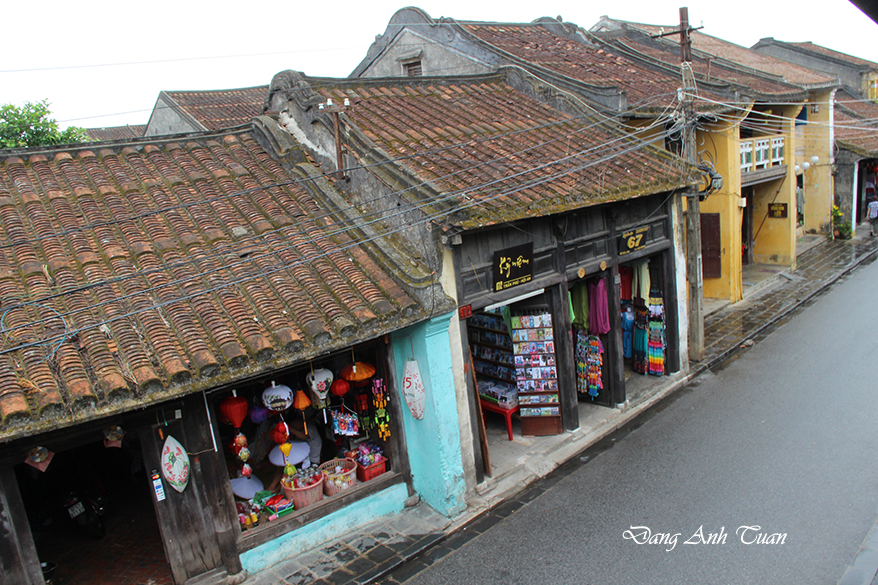
      Quelques photos de ces maisons historiques

[Return HOI AN]

Hôi An sommaire (Première partie)

hoian_summary

Version vietnamienne

English version

Première partie (Phần đầu)

Hội An a changé plusieurs fois de nom durant son histoire. Le nom « Hội An » suggère qu’à travers les mots (Hội= « Association ») et (An= »en paix ») cette ville devrait être un endroit où on pouvait se réunir en paix. Avant d’être sous le giron des seigneurs Nguyễn, Hội An se trouvait dans une région très développée du royaume du Champa du II ème  au XIVème siècle. D’après la topographie, elle était au carrefour des fleuves venant du Nord (Cổ Cò, Vĩnh Điền) et du Sud (Trường Giang) que les bateaux de petite et moyenne taille avaient l’habitude d’emprunter fréquemment à cette époque pour atteindre la mer de l’Est à l’estuaire Cửa Đại (le Grand Estuaire). Elle était en quelque sorte le nœud de circulation favorisé par la nature et par la proximité des trois grands marais Trà Quế, Trà Nhiêu et Thi Lai, de l’ilôt Poulo-Cham ou Pulluciampelle (Cù Lao Chàm) et des estuaires Cửa Đại et Cửa Hàn. Selon certains historiens, la région Hội An servait du lieu d’approvisionnement des cités chames sacrées situées en amont: Mỹ Sơn et Trà Kiệu (Simhapura). Hội An était connue sous le nom de Lâm Ấp Phố. Son estuaire était désigné toujours comme celui du Grand Chămpa. (Cửa Đại Chiêm). En tout cas, elle jouait un rôle important en matière économique durant la période chame.

Les récentes fouilles archéologiques entamées par les chercheurs vietnamiens sur les anciens lieux d’habitation et sur les tombes antiques dans la zone de Hội An (Hậu Xá 1, Hậu Xá 2 (le long de rivière de Hội An), An Bằng, Thành Chiêm (commune Cẩm Hà), Xuân Lâm (Cẩm Phô) ont permis de réveler que cette agglomération fut autrefois une zone économique importante durant la période culturelle de Sa Huỳnh tardif car outre les cercueils en forme de jarre, on y a découvert des objets de fer datant de la dynastie des Han, des outils de travail et des bijoux qui sont autant de témoignages de l’existence d’un commerce florissant. Son nom a été cité maintes fois par les marchands chinois du temps où celle-ci relevait encore du Champa, ces derniers venant s’approvisionner du sel, d’or et de cannelle, marchandises de première nécessité en Chine.

Puis Hội An prospéra sous le nom de Hai Phố (Deux petits villages) au moment où le seigneur Nguyễn Hoàng du royaume Đại Việt installa son fils Nguyễn Phúc Nguyên (Seigneur Sãi) en tant que gouverneur de Quảng Nam en 1570. C’est la période brillante où Hội An connut un essor fulgurant dû en grande partie à la politique d’ouverture et d’immigration appropriée et clairvoyante menée par les seigneurs Nguyễn. Ceux-ci surent profiter de l’interdiction imposée par la Chine des Ming aux bateaux japonais, d’accoster sur ses côtes, pour les faire venir à Hội An où l’embargo chinois était moins efficace, du fait de la contrebande qui régnait en maître dans les provinces orientales de la Chine: Kouang Si, Fou Kien, Tsao Tcheou, Hainan. Dans le but d’accroître le commerce et les échanges avec les navires commerçants chinois, et encourager les grands bateaux de commerce japonais à se rendre en Asie du Sud Est (Thaïlande, Malaisie, Quảng Nam), le shogun Toyotomi mit en place un régime appelé « Permis à sceau royal » (le Shuinsen)(Châu Ấn Thuyền), une sorte d’autorisation tamponnée en rouge. Ces échanges, saisonniers et temporaires dans les premiers temps, se déroulaient habituellement sur des jonques ou sur le lieu de mouillage et de stationnement des bateaux de commerce, autour de la région de Trà Nhiêu. Cette pratique n’arrangea cependant pas certains marchands étrangers.

Tributaires de la période des moussons, du volume d’échange de marchandises vendues ou collectées et des saisons favorables à la navigation, ces derniers étaient contraints d’élire domicile à Hôi An et d’y rester plus longtemps que prévu, soit pour procéder à la réparation de leurs bateaux, soit pour saisir les opportunités d’acheter les marchandises et de les stocker, soit dans l’attente d’un moment favorable pour repartir en mer et éviter les tempêtes. C’est dans ce contexte que la ville Hội An fut fondée. Elle connut un développement galopant grâce aux facilités administratives octroyées aux étrangers par les seigneurs Nguyễn. Toute forme de résidence fut admise. C’est aussi à cette époque que Hội An accueillit les bateaux européens (portugais, hollandais, anglais et français), dont la venue favorisa non seulement l’établissement des comptoirs européens, mais aussi l’arrivée de missionnaires catholiques étrangers, parmi lesquels figurait le célèbre jésuite français Alexandre de Rhodes. Débarqué à Hội An en 1625, celui-ci commença à apprendre le vietnamien. Tellement doué au point de maîtriser rapidement la langue vietnamienne, il fut chargé, plus tard, de mettre au point la première transcription phonétique et romanisée de la langue vietnamienne, le Quốc ngữ (écriture nationale) (4). On ignore cependant si celui-ci eût le temps d’achever son œuvre à Hội An, car il n’y séjourna que trois années.

Par contre, on sait qu’il fut interdit de séjour à Quảng Nam en 1645 et que la parution de son dictionnaire vietnamo-portugais-latin eut lieu cinq ans après son expulsion. C’est sous le règne du seigneur Nguyễn Phúc Nguyên (Chúa Sãi) que furent créés, à Hội An, les quartiers communautaires (japonais, chinois, hollandais etc.). Chaque communauté avait son quartier où les habitants pouvaient vivre selon les us et coutumes de leur pays. L’administration de chaque quartier était assumée par un délégué des autorités locales. Hội An devenait ainsi l’un des ports commerciaux et centre économique de la Cochinchine, mais aussi, de l’Asie du Sud Est. La prospérité de Hội An ne faisait  pas de doute. Dans sa compilation intitulée « Phủ Biên Tạp Lục » (Chroniques diverses de la frontière pacifiée), l’érudit vietnamien Lê Qúi Đôn en faisait état. Il y rapportait, notamment, les propos d’un commerçant chinois: « Les bateaux rentrant de Sơn Nam (1) (du Nord) ne ramènent que des cũ nâu (ignames sauvages ou Dioscorea cirrhosa) (2) et ceux de Thuận Hóa du poivre. Par contre, si on vient à Hội An, on peut  y trouver tout». Le chercheur Trần Kinh Hoà, connu pour ses recherches sur Hội An, attribue à Nguyễn Phúc Nguyên le mérite d’avoir fondé Hội An. Il s’appuie, en cela, sur un passage du rapport du jésuite missionnaire Christoforo Borri sur les religions (en séjour à Nam Hà de 1618 à 1621). Le navigateur anglais William Adams relate également l’existence d’un quartier japonais en 1617.

Dans le passé, on pensait que ce quartier japonais était circonscrit au seul périmètre géographique de l’actuelle rue Trần Phú. Mais les dernières fouilles archéologiques ont mis à jour un grand nombre d’objets de céramique datant du 17è siècle (Chine, Japon et Vietnam) exhumés au- delà du pont-pagode japonais, dans la zone délimitée par le côté est  de la rue Nguyễn Thị Minh Khai et le côté sud de la rue Phan Chu Trinh. Les résultats de ces fouilles permettent de se faire une idée plus précise aujourd’hui de la délimitation de ce quartier japonais, qui semble plus étendu qu’on ne l’imaginait au départ. Le temple Jomyo de Nagoya, au Japon, possède encore aujourd’hui une fresque picturale (Giao Chỉ Mậu Dịch Hải Đồ) datant de 1640, qui fait le récit du départ et de l’arrivée d’un bateau japonais (le Shuinsen) de Nagasaki à Hội An, après une navigation d’une quarantaine de jours en mer. Cette fresque picturale fut commandée à cette époque par la grande famille de commerçants japonais Chaya présente à Hội An durant la période 1615-1624. La communauté nippone commença à croître en même temps que l’agglomération d’Hội An. Les seigneurs Nguyễn favorisèrent le développement économique avec le Japon.

Outre l’argent, denrée très recherchée des Vietnamiens pour le développement de leur économie, le Japon put leur fournir de nombreux armements perfectionnés destinés à faire du Sud du Vietnam (Đàng Trong) un lieu de refuge sécurisé, à l’abri des attaques des Trịnh, sur le versant de la chaîne Hoành Sơn.  On ne connaît pas avec exactitude la raison principale de ce rapprochement, mais on estime qu’au début du 17ème siècle, le nombre de Japonais vivant à Hội An était assez important pour permettre au seigneur Nguyễn de les recruter et former une unité de combat installée à l’estuaire Đại Chiêm, renommée pour ses talents et sa méthode de combat, sa loyauté et sa fidélité, à l’image des samouraïs japonais.
Un Japonais, du nom de Shutaro, qui réussit à gagner l’estime et l’affection du seigneur Nguyễn Phước Nguyên fut adopté par ce dernier et autorisé à prendre non seulement son nom de famille Nguyen, ainsi que son prénom, Đại Lương, mais aussi le titre de noblesse Hiển Hùng. Devenu, plus tard, le beau-fils du seigneur Nguyễn, il fut chargé de la gestion de Hội An. Il est probable que le pont-pagode japonais fut construit durant la période où Shutaro administrait cette ville. Mais à la suite d’une circulaire du Bakufu (Mạc Phủ Nhật) interdisant à ses concitoyens de partir à l’étranger, Shutaro dut rentrer subitement au Japon en même temps que sa femme, la princesse Nguyễn Thị Ngọc Hoa, dont le prénom japonais était Anio.

Suite à l’interdiction de pratiquer la religion catholique au Japon et à la persécution, par le seigneur Nguyễn Phúc Tần (Chúa Hiền), des catholiques japonais et chinois en 1664-1665 qui s’ensuivit, la communauté nippone commença à décliner rapidement à Hội An. Selon le commerçant britannique Thomas Bowyer, il ne restait plus, en 1695, que 4 ou 5 familles japonaises face à la communauté chinoise constituée d’environ 100 familles chinoises [BAVH, 1920,7ème année, n°2, p 200]. Au cours de son voyage dans la seigneurie des Nguyễn au cours de la même année, le célèbre bonze chinois Thích Đại Sán, dans son journal intitulé « Hải ngọai ký sự (Journal de voyage d’Outre-Mer »,1696) ne fait mention que d’un pont japonais terminant une rue chinoise (3) « bordée sans discontinuer de boutiques » et « longeant le fleuve », sans nullement évoquer la présence des Japonais. En dépit du retrait des Japonais à Hội An et de la politique d’isolationnisme menée au Japon, par le shogunat des Tokugawa, le commerce entre le Japon et le Vietnam ne prit pas fin pour autant. Celui-ci continua à fonctionner indirectement par l’intermédiaire des bateaux marchands chinois et hollandais, comme l’attestent les objets de céramique japonaise et vietnamienne datant du 17ème siècle retrouvés dans les sites de reliques vietnamiens, et ceux de Nagasaki, Sakai, Kyoto, qui sont la preuve irréfutable d’une continuité dans les échanges commerciaux entre ces deux pays. Aujourd’hui, aucun vestige architectural japonais sous forme de maisons et de pagodes ne subsiste à Hội An excepté le célèbre pont-pagode en bois qu’on est habitué à surnommer « le pont japonais » et quelques tombeaux éparpillés dans la région de Cẩm Châu.

  Lire_la_suite (Tiếp theo)

Version vietnamienne

Hội An sơ lược

Hôi An đã bao lần thay đổi tên trong lich sử. Qua hai chữ «Hội» và «An», tên nầy gợi ý cho chúng ta nghĩ đến một thành phố mà mọi người thích tựu hợp và sống an lành. Trước khi đựơc các chúa Nguyễn cai quảng, vùng đất nầy thuộc về vương quốc Chămpa và được phát triển từ thế kỷ thứ 2 đến thế kỷ 14. Theo địa hình, nó còn là ngã ba của các con sông đến từ phiá Bắc (Cổ Cò, Vĩnh Điện) và từ phía nam (Trường Giang) mà các thuyền bè nhỏ và trung bình thường hay lấy thời đó để ra biển Đông qua Cửa Đại. Nó còn được xem như là cái nút giao thông mà thiên nhiên ưu đãi vì nó ở gần các khu đầm lầy Trà Quế, Trà Nhiêu, Thị Lai và Cù lao Chàm.Theo các nhà sử gia, Hội An còn là nơi cung cấp lương thực, vật liệu cho các thành phố chàm nằm ở thượng lưu như Mỹ Sơn và Trà Kiệu. Hội An còn được biết dưới cái tên là “Lâm Ấp Phố” mà cửa sông thì vẫn được gọi là “cửa Đại Chiêm” vì Hội An giữ một vai trò rất quan trọng trên phương diện kinh tế trong thời kỳ Hội An còn thuộc về vương quốc Champa.

Chính vì vậy Hội An được bao lần nhắc đến bởi các thương gia Trung Hoa vì họ đến đây để mua muối, vàng, quế, các vật liệu cần thiết. Hội An lấy tên “Hai Phố” sau khi Nguyễn Hoàng bổ nhiệm Nguyễn Phúc Nguyên (chúa Sãi) làm tổng trấn ở Quảng Nam vào năm 1570. Chính trong thời kỳ nầy Hội An được phát triển mạnh mẽ nhờ có chính sách cởi mở, nhập cư thích hợp và sáng suốt của các chúa Nguyễn nhất là biết lợi dụng việc nghiêm cấm của triều đại Minh không cho các thuyền bè Nhật được cập bến các bờ biển Trung Hoa. Vì vậy Hội An trở thành nơi mà cấm vận không có hiệu quả chi cho mấy nhờ có buôn lậu thịnh hành ở các vùng nằm ở phiá đông của Trung Hoa như Hải Nam, Phước Kiến, Quảng Tây vân vân … Để tăng trưởng trao đổi hàng hoá với các thuyền bè người Hoa ở vùng Đông Nam Á (Thái Lan, Mã Lai, Quảng Nam), shogun Toyotomi cấp giấy phép thông hành có dấu triện đỏ (shuinjô) cho các thuyền bè Nhật có quyền mậu dịch, thường được gọi là Châu Ấn thuyền. Lúc đầu, các cuộc trao đổi hàng hóa thường ở trên thuyền hay là ở nơi mà các thuyền có thể cập bến, thông thường ở vùng Trà Nhiêu. Nhưng về sau, vì số lượng hàng hóa càng nhiều, gặp lúc mùa mưa hay là cần sửa chửa cần thiết khiến các thuyền cần phải đậu lại lâu dài ở Hội An hơn dự đoán để chờ những lúc thời tiết thuận lợi mà ra khơi quay về. Trong bối cảnh nầy, mới có sự thành hình của Hội An. Chính nhờ sự dễ dãi và mạnh dạn cho phép “Hoa di ngoại tộc” định cư mà Hội An trở thành nơi qui tụ dân tứ xứ, có cả các thuyền bè của châu Âu (Hoà Lan, Anh, Pháp và Bồ Đào Nha) cùng các tu sĩ công giáo trong đó có cha Đắc Lộ (Alexandre de Rhodes), một nguời đóng góp một phần quan trọng vào việc hình thành chữ quốc ngữ Việt Nam.

Dưới thời kỳ cai trị của chúa Sãi (Nguyễn Phúc Nguyên), Hội An rất được thịnh vượng và sầm uất với nhiều khu phố (Nhật, Trung Hoa, Hoà Lan vân vân….) Mỗi cộng đồng có một khu phố riêng tư với các tập quán của mình và có được một người đại biểu của chính quyền phụ trách. Hội An trở thành thời đó là một trong những hải cảng thương mại và trung tâm kinh tế của xứ Đàng Trong và Đông Nam Á. Trong cuốn Phủ biên tạp lục (1776), nhà học giả Lê Quí Đôn có miêu tả như sau: Thuyền từ Sơn Nam (Đàng Ngoài) về chỉ mua được một thứ củ nâu, thuyền từ Thuận Hóa (Phú Xuân) về cũng chỉ có một thứ là hồ tiêu. Còn từ Quảng Nam (Hội An) thì hàng hóa không thứ gì không có. Được nổi tiếng qua các công trình khảo cứu về Hội An, nhà nghiên cứu Trần Kinh Hoà nhận định rằng chúa Nguyễn Phúc Nguyên là người có công trạng thành lập Hôi An. Ông dựa trên một đọan viết trong tờ báo cáo của tu sĩ jésuite Christoforo Borri về các tôn giáo thời gian ông ở Nam Hà từ 1618 đến 1621. Nhà hàng hải người Anh William Adams có nhắc đến khu của người Nhật vào năm 1617. Trong quá khứ, ai cũng nghĩ rằng khu phố Nhật chỉ nằm vỏn vẹn ở chu vi của đường Trần Phú hiện nay. Nhưng với các khai quật khảo cổ gần đây, người ta tìm thấy một số hiện vật bằng gốm được xác định từ thế kỷ 17 (Trung Hoa, Nhật và Vietnam) thì nó nằm vượt qua khỏi chùa cầu trong khu vực giới hạn bởi phiá đông của đường Nguyễn Thị Minh khai và phiá nam của đường Phan Chu Trinh. Chính nhờ vậy người ta mới ấn định được phạm vi của khu Nhật ở Hội An, nó có phần rộng hơn dự kiến. Đền Jomyo ở Nagoya còn giữ cho đến hôm nay một bức tranh vẽ (Giao Chỉ Mậu Dịch Hải Đồ) từ 1640 kể lại cuộc hành trình của một châu ấn thuyền Nhật từ Nagasaki đến Hội An sau 40 ngày đi trên biển. Bích họa nầy được đặt làm ở thời đó bởi một gia đình Nhật Chaya có mặt ở Hội An từ năm 1615 đến 1624. Số người Nhật định cư bất đầu tăng lên cùng lúc với Hội An. Ngoài bạc ra, một thương phẩm mà người dân Việt rất cần trong việc phát triển kinh tế, Nhật Bản còn cung cấp vũ khí tối tân để biến Đàng Trong thành nơi nương náu an toàn để tránh các cuộc tấn công của chúa Trịnh qua sườn đồi của dãy Hoành Sơn. Không ai biết rỏ lý do của sự giao hảo thân thiện nầy nhưng có một điều là đầu thế kỷ thứ 17 số dân di cư người Nhật rất quan trọng cho đến đổi chúa Nguyễn chiêu mộ một đạo binh người Nhật chiếm đóng ở Cửa Đại vì họ nổi tiếng rất trung thực và giỏi về phương thức chiến đấu như các võ sĩ Nhật.

Có một người Nhật tên Shutaro được chúa Sãi yêu mến nhận làm con nuôi, gọi ông là Đại Lương và phong cho ông một huy hiệu qúi tộc Hiến Hùng. Sau nầy Đại Luơng không những là con rể của chúa Sãi mà còn là người quản lý Hội An. Rất có thể trong thời gian nầy mà chùa cầu được xây cất. Nhưng sau đó vì thông lệnh của Mạc Phủ (Bakufu) cấm người dân Nhật xuất ngoại, Shutaro buộc lòng cấp tốc trở về Nhật cùng vợ tức là công chúa Nguyễn Thị Ngọc Hoa mà tên Nhật là Anio. Sau việc cấm truyền bá đạo công giáo ở Nhật và chính sách ngược đãi của Nguyễn Phúc Tần (chúa Hiền) với các người công giáo Nhật và Hoa từ 1664 đến 1665, cộng đồng người Nhật ở Hội An bất đầu giảm dần. Theo thương gia người Anh Thomas Bowyer, chỉ còn ở Hội An 4 hay 5 gia đình vào 1695 so với cộng đồng người Hoa có khoảng chừng 100 gia đình. (BAVH 1920, năm thứ 7, số 2, trang 200). Cùng năm đó trong thời gian hành trình ở vùng đất chúa Nguyễn, một nhà sư nổi tiếng Thích Đại Sán có nhắc đến trong nhật ký của ông “Hải ngoại ký sự” cái cầu của người Nhật đuợc kết thúc với một con đường của người Hoa tràn đầy các tiệm buôn bán và dọc theo bờ sông mà chẳng nói chi về sự hiện diện của người Nhật. Mặc dầu có sự rút lui của người Nhật với chính sách biệt lập của Mạc phủ Tokugawa ở Nhật Bản, mậu dịch giữa chúa Nguyễn và Nhật Bản vẫn tiếp tục và không có bị gián đoạn nhờ các tàu Trung Hoa và Hòa Lan làm trung gian gián tiếp. Cụ thể còn tìm thấy các hiện vật bằng gốm của Nhật và Vietnam ở thế kỷ thứ 17 ở các nơi thánh tích của Vietnam và Nagasaki, Sakai, Kyoto của Nhật Bản. Ngày nay, không còn thấy dấu tích kiến trúc nào của người Nhật ngoài chùa cầu và vài mộ rải rác ở vùng Cẩm Châu. 

 Lire_la_suite (Tiếp theo)
English version

Hoi An Summary

First part (Phần đầu)

Hội An has changed its name several times throughout its history. The name « Hội An » suggests that through the words (Hội = « Association ») and (An = « peaceful »), this city should be a place where people could gather in peace. Before coming under the rule of the Nguyễn lords, Hội An was located in a highly developed region of the Champa kingdom from the 2nd to the 14th century. According to the topography, it was at the crossroads of rivers coming from the North (Cổ Cò, Vĩnh Điền) and the South (Trường Giang), which small and medium-sized boats frequently used at that time to reach the East Sea at the Cửa Đại estuary (the Great Estuary). It was, in a way, a traffic hub favored by nature and by the proximity of the three large marshes Trà Quế, Trà Nhiêu, and Thi Lai, the islet Poulo-Cham or Pulluciampelle (Cù Lao Chàm), and the estuaries Cửa Đại and Cửa Hàn. According to some historians, the Hội An region served as a supply point for the sacred Cham cities located upstream: Mỹ Sơn and Trà Kiệu (Simhapura). Hội An was known as Lâm Ấp Phố. Its estuary was always referred to as that of Greater Champa (Cửa Đại Chiêm). In any case, it played an important economic role during the Cham period.

Recent archaeological excavations undertaken by Vietnamese researchers at ancient habitation sites and antique tombs in the Hội An area (Hậu Xá 1, Hậu Xá 2 (along the Hội An river), An Bằng, Thành Chiêm (Cẩm Hà commune), Xuân Lâm (Cẩm Phô)) have revealed that this settlement was once an important economic zone during the late Sa Huỳnh cultural period. In addition to jar-shaped coffins, iron objects dating from the Han dynasty, working tools, and jewelry were discovered, all of which testify to the existence of a flourishing trade. Its name was mentioned many times by Chinese merchants when it was still part of Champa; these merchants came to procure salt, gold, and cinnamon, essential goods in China.

Then Hội An prospered under the name Hai Phố (Two small villages) at the time when Lord Nguyễn Hoàng of the Đại Việt kingdom installed his son Nguyễn Phúc Nguyên (Lord Sãi) as governor of Quảng Nam in 1570. This was a brilliant period when Hội An experienced a rapid boom largely due to the open and farsighted immigration policy carried out by the Nguyễn lords. They took advantage of the ban imposed by Ming China on Japanese ships from docking on its coasts, bringing them to Hội An where the Chinese embargo was less effective due to the smuggling that prevailed in the eastern provinces of China: Kouang Si, Fou Kien, Tsao Tcheou, Hainan. In order to increase trade and exchanges with Chinese merchant ships, and encourage large Japanese trading ships to come to Southeast Asia (Thailand, Malaysia, Quảng Nam), the shogun Toyotomi established a system called the « Royal Seal Permit » (the Shuinsen) (Châu Ấn Thuyền), a kind of authorization stamped in red. These exchanges, seasonal and temporary at first, usually took place on junks or at the anchorage and mooring sites of merchant ships around the Trà Nhiêu region. However, this practice did not please some foreign merchants.

Dependent on the monsoon season, the volume of traded goods sold or collected, and the seasons favorable for navigation, these traders were forced to settle in Hội An and stay longer than expected, either to repair their boats, seize opportunities to buy and store goods, or wait for a favorable moment to set sail again and avoid storms. It was in this context that the city of Hội An was founded. It experienced rapid development thanks to the administrative facilities granted to foreigners by the Nguyễn lords. All forms of residence were allowed. It was also during this period that Hội An welcomed European ships (Portuguese, Dutch, English, and French), whose arrival not only promoted the establishment of European trading posts but also the arrival of foreign Catholic missionaries, among whom was the famous French Jesuit Alexandre de Rhodes. Landing in Hội An in 1625, he began to learn Vietnamese. So talented that he quickly mastered the Vietnamese language, he was later tasked with developing the first phonetic and romanized transcription of the Vietnamese language, the Quốc ngữ (national script). However, it is unknown whether he had time to complete his work in Hội An, as he only stayed there for three years.

However, it is known that he was banned from residing in Quảng Nam in 1645 and that the publication of his Vietnamese-Portuguese-Latin dictionary took place five years after his expulsion. It was under the reign of Lord Nguyễn Phúc Nguyên (Chúa Sãi) that community quarters (Japanese, Chinese, Dutch, etc.) were created in Hội An. Each community had its own quarter where the inhabitants could live according to the customs and traditions of their country. The administration of each quarter was managed by a delegate of the local authorities. Hội An thus became one of the commercial ports and economic centers of Cochinchina, but also of Southeast Asia. The prosperity of Hội An was beyond doubt. In his compilation entitled « Phủ Biên Tạp Lục » (Miscellaneous Chronicles of the Pacified Frontier), the Vietnamese scholar Lê Qúi Đôn mentioned it. He notably reported the words of a Chinese merchant: « The boats returning from Sơn Nam (1) (the North) bring back only cũ nâu (wild yams or Dioscorea cirrhosa) (2) and those from Thuận Hóa bring pepper. However, if one comes to Hội An, one can find everything there. » The researcher Trần Kinh Hoà, known for his studies on Hội An, credits Nguyễn Phúc Nguyên with founding Hội An. He bases this on a passage from the report of the Jesuit missionary Christoforo Borri on religions (who stayed in Nam Hà from 1618 to 1621). The English navigator William Adams also mentions the existence of a Japanese quarter in 1617.

In the past, it was believed that this Japanese quarter was confined solely to the geographical perimeter of the current Trần Phú street. But recent archaeological excavations have uncovered a large number of ceramic objects dating from the 17th century (China, Japan, and Vietnam) unearthed beyond the Japanese pagoda bridge, in the area bounded by the east side of Nguyễn Thị Minh Khai street and the south side of Phan Chu Trinh street. The results of these excavations now allow for a more precise understanding of the boundaries of this Japanese quarter, which appears to be more extensive than initially imagined. The Jomyo temple in Nagoya, Japan, still possesses a pictorial fresco (Giao Chỉ Mậu Dịch Hải Đồ) dating from 1640, which narrates the departure and arrival of a Japanese ship (the Shuinsen) from Nagasaki to Hội An, after about forty days of sailing at sea. This pictorial fresco was commissioned at that time by the prominent Japanese merchant family Chaya, present in Hội An during the period 1615-1624. The Japanese community began to grow alongside the development of the Hội An settlement. The Nguyễn lords encouraged economic development with Japan.

Besides money, a highly sought-after commodity by the Vietnamese for the development of their economy, Japan was able to provide them with numerous advanced weapons intended to make South Vietnam (Đàng Trong) a secure refuge, protected from attacks by the Trịnh, on the Hoành Sơn mountain range side. The exact main reason for this alliance is not known, but it is believed that at the beginning of the 17th century, the number of Japanese living in Hội An was significant enough to allow the Nguyễn lord to recruit and train a combat unit stationed at the Đại Chiêm estuary, renowned for its skills and combat methods, loyalty, and fidelity, much like Japanese samurai.

A Japanese man named Shutaro, who succeeded in gaining the esteem and affection of Lord Nguyễn Phước Nguyên, was adopted by him and authorized not only to take his family name Nguyễn and the given name Đại Lương but also the noble title Hiển Hùng. Later becoming the lord Nguyễn’s son-in-law, he was entrusted with the management of Hội An. It is likely that the Japanese covered bridge was built during the period when Shutaro administered this city. However, following a circular from the Bakufu (Japanese Shogunate) prohibiting its citizens from traveling abroad, Shutaro had to abruptly return to Japan along with his wife, Princess Nguyễn Thị Ngọc Hoa, whose Japanese name was Anio.

Following the ban on practicing the Catholic religion in Japan and the persecution by Lord Nguyễn Phúc Tần (Chúa Hiền) of Japanese and Chinese Catholics in 1664-1665 that ensued, the Japanese community began to rapidly decline in Hội An. According to the British merchant Thomas Bowyer, by 1695, only 4 or 5 Japanese families remained compared to the Chinese community consisting of about 100 Chinese families [BAVH, 1920, 7th year, no. 2, p. 200]. During his journey through the Nguyễn lordship in the same year, the famous Chinese monk Thích Đại Sán, in his journal entitled « Hải ngọai ký sự (Overseas Travel Journal, 1696), » only mentions a Japanese bridge ending a Chinese street (3) « lined continuously with shops » and « running along the river, » without any mention of the presence of Japanese people. Despite the withdrawal of the Japanese in Hội An and the isolationist policy carried out in Japan by the Tokugawa shogunate, trade between Japan and Vietnam did not end. It continued to operate indirectly through Chinese and Dutch merchant ships, as evidenced by Japanese and Vietnamese ceramic objects dating from the 17th century found at Vietnamese relic sites, and those from Nagasaki, Sakai, Kyoto, which are irrefutable proof of continuity in commercial exchanges between these two countries.

Today, no Japanese architectural remains in the form of houses and pagodas survive in Hội An except for the famous wooden bridge-pagoda commonly referred to as « the Japanese bridge » and a few tombs scattered in the Cẩm Châu area.

 Reading more (Tiếp theo)


BAVH: Bulletin des Amis du Vieux Huế

(1) Sơn Nam: la région du Nord englobant les provinces Nam Định et Thái Bình actuelles.
(2) très utilisés pour les teintures et les tannages des toiles et des filets de pêche au nord du Vietnam.
(3): Rue Trần Phú actuelle.
(4): Alexandre de Rhodes est l’auteur du Dictionarium Annamiticum Lusitanum et Latinum, dictionnaire trilingue vietnamien-portugais-latin édité à Rome en 1651 par la Congrégation pour l’évangélisation des peuples.

Hội An sommaire (3ème partie)

Version vietnamienne

Version anglaise

Troisième partie

Le paysage de la ville de Hội An commença à changer profondément vers le milieu du XVIIème siècle avec le départ forcé des Japonais et l’arrivée des Chinois. Le nom de la ville Hội An connu jusqu’alors sous le nom « Hai Phố (Deux villages) » n’avait  plus la raison d’être avec la régression du quartier japonais. On donnait désormais à Hội An le nom traditionnel « Phố » (village ou rue) ou Hải Phố (village au bord de la mer) ou Hoa Phố (le village des Chinois). C’est probablement l’un de ces noms que les premiers missionnaires occidentaux ont traduit phonétiquement en Faifo. Mais sur la carte de Pieter Goos dessinée en 1666, on s’aperçoit qu’il y a un nom alternatif « Fayfoo » pour Hội An tandis que sur la carte d’Alexandre de Rhodes se trouve le mot « Haifo ». En tout cas, c’est le mot Faifo employé désormais par les Occidentaux pour désigner la ville Hội An. Le quartier japonais semble disparaître du paysage de la ville de Hội An car dans tous les récits tardifs des voyageurs étrangers (y compris celui du bonze libertin chinois Thích Đại Sán), on ne trouve aucun mot évoquant la présence japonaise.

Malgré cela, à travers l’adage des Hoianais, on sait qu’il existe au début de la fondation de Hội An deux quartiers, l’un japonais et l’autre chinois. Ce proverbe nous indique avec précision la délimitation de la ville : Thựơng chùa cầu, Hạ Âm Bổn. (En amont le pont-pagode, en aval le temple Âm Bổn). Le pont-pagode est situé à l’extrémité ouest de la ville tandis qu’à l’autre extrémité est se trouve le temple Âm Bổn du siège de la congrégation Triều Châu, dédié au grand général pacificateur de la mer, Ma Yuan (Mã Viện). C’est sur cet espace réduit qu’ont été construites les premières maisons traditionnelles chinoises sans étage, avec ou sans grenier (la rue Trần Phú actuelle). Mais aucune maison n’a réussi à résister aux dégradations et aux intempéries de la nature (pluie, inondation etc…) au fil des années. Grâce aux registres cadastraux anciens, on sait que la plus ancienne maison de la ville Hội An datant de 1738 est située actuellement au numéro3 de la rue Nguyễn Thi Minh Khai. La plupart des maisons traditionnelles visibles aujourd’hui à Hội An ont été ré-construites plusieurs fois sur les mêmes emplacements.

À côté de ce type de maison traditionnelle sans étage, on relève un autre type de modèle de maison chinoise très répandu dans la première moitié du XIXème siècle. C’est la maison avec étage dont la façade est en bois ou en brique. Étant de la même culture, ces émigrés chinois n’avaient aucun conflit religieux ou sérieux avec les Vietnamiens depuis leur installation. Par contre, cela leur permet de s’intégrer plus facilement dans la société vietnamienne et de devenir, grâce aux mariages mixtes, des Vietnamiens à part entière au renouvellement de quelques générations. Selon l’auteur Nguyễn Thiệu Lâu [BAVH, La formation et l’évolution du village Minh Hương(Faifo), 1941, Tome 4], la ville de Hội An était au début de son existence un « Minh Hương xã« , une commune habitée par une colonie chinoise. Grâce aux circonstances favorables dues au dot et aux dons des bienfaiteurs et bienfaitrices chinoises (1) et au colmatage de la berge du fleuve Thu Bồn, elle s’était agrandie progressivement pour devenir au fil des siècles un village de métis sino-vietnamien où ces émigrés chinois finissaient par être assimilés à la population locale.

Quant aux Hollandais, ils ne restaient pas inactifs car ils connaissaient très tôt Hội An. Leur Compagnie néerlandaise des Indes Orientales (*) établit au début de 1636 un comptoir à Hội An. Celui-ci cessa ses activités en 1641, l’année où l’exécution d’un voleur vietnamien par cette compagnie provoqua la colère du gouverneur Nguyễn Phước Tần. Celui-ci n’hésita pas prendre des mesures énergiques en brûlant toutes leurs marchandises saisies et en jetant à la mer tout le reste. De plus sept marchands hollandais furent exterminés lors de cet incident. La réaction hollandaise ne tarda pas à venir avec une confrontation armée quelques mois plus tard. Celle-ci dura de 1642 à 1643. Nguyễn Phúc Tần en sortit victorieux en détruisant la flotte hollandaise. L’amiral hollandais Peter Bach se donna la mort sur son bateau. C’est un exploit extraordinaire de combat naval entre les Occidentaux et le royaume du Sud des seigneurs Nguyễn car ces derniers réussirent à défaire pour la première fois la flotte européenne sur leur sol. Mais cela n’émoussa pas l’intention des Occidentaux de revenir plus tard au Vietnam dans le but de chercher des points d’appui militaire facilitant l’accès à la Chine et au commerce convoité depuis les débuts de l’époque moderne.

Entre-temps, Hội An connut à la fin du XVIIIème siècle des troubles provoqués par les révoltes paysannes, en particulier celle menée par les trois frères de Tây Sơn ( Nguyễn Nhạc, Nguyễn Lữ et Nguyễn Huệ) à Bình Định dans le centre du Vietnam. C’est la période où Hội An fut ravagée par l’invasion de l’armée nordiste des Trinh profitant du contexte troublant pour chasser les Nguyễn et combattre les Tây Sơn (Paysans de l’Ouest). En 1778, un commerçant britannique de nom Chapman, de passage à Hội An, fit la description suivante: Malgré l’aménagement réussi des quartiers avec des maisons en brique, il ne restait que des ruines. Malgré cela, Hội An reprit ses activités commerciales qui étaient loin d’être florissantes comme au début de sa fondation car la plupart des Chinois résidant à Hội An préférèrent de la quitter et de s’installer à Saïgon (Cholon). Celle-ci était en quelque sorte le bras allongé de Hội An. Puis vint un siècle plus tard le début de l’intervention militaire française prenant prétexte de la protection des missionnaires persécutés au Vietnam sous le règne de l’empereur Tự Đức (1858). C’était le début de la colonisation française au Vietnam.

À l’époque coloniale, Hội An continua à garder le nom de Faifo. Mais elle commença à prendre un autre visage, celui d’une ville européenne. Outre l’infrastructure moderne (équipement en eau, éclairage, canaux d’évacuation etc…), on y trouva la construction de nouveaux bâtiments publics dans le but de satisfaire les besoins de l’administration coloniale (l’hôtel de ville, le palais de justice, l’église etc…) et des maisons individuelles destinées à apporter le confort et bien-être aux fonctionnaires expatriés. Grâce à cet aménagement urbain, Hội An devint désormais une ville cosmopolite. Malgré cela, selon l’écrivain vietnamien Hữu Ngọc, Hội An fut délaissée très vite par les Français à cause de l’alluvion qui rendit difficile la navigation des bateaux sur le fleuve Thu Bồn. Ceux-ci préférèrent Tourane (ou Đà Nẵng) au détriment de Hội An vers la dernière moitié du XIXème siècle. Hội An tomba ainsi dans l’oubli car elle ne fut plus un centre économique et politique. Elle fut heureusement épargnée durant la guerre du Vietnam. C’est pour cette raison qu’elle peut conserver intact un grand nombre de vestiges architecturaux de grande valeur qui font aujourd’hui le bonheur des touristes vietnamiens et étrangers.

Une large part de son attrait réside sur le fait de nous laisser revivre le fil de son histoire à travers le temps.

Version vietnamienne

Phần III

Cảnh quan Hội An bắt đầu thay đổi sâu sắc vào khoảng giữa thế kỷ 17 khi người Nhật Bản buộc phải rời đi và người Trung Quốc đến đây. Hội An không còn ý nghĩa Hai Phố vì phố Nhật không còn nửa. Từ đó, chỉ gọi Hội An là Hải Phố có nghĩa là Phố ở biển hay là Hoa Phố (phố của người Hoa). Có lẽ một trong hai tên nầy mà các cha cố đạo Âu Châu phát âm ra không rỏ mà thành Faifo. Tên nầy được giữ đến thời kỳ Pháp thuộc. Nhưng trên bản đồ của Pieter Goos vẽ năm 1666, chúng ta thấy Hội An có một tên gọi khác là « Fayfoo« , trong khi trên bản đồ của Alexander xứ Rhodes lại thấy chữ « Haifo« . Dù sao đi nữa, đó chính là chữ « Faifo » mà người phương Tây ngày nay dùng để chỉ Hội An. Khu phố Nhật Bản dường như biến mất khỏi cảnh quan Hội An bởi vì trong tất cả những ghi chép sau này của du khách nước ngoài (bao gồm cả nhà sư Trung Hoa phóng túng Thích Đại Sán), chúng ta không tìm thấy từ nào gợi lên sự hiện diện của người Nhật.

Mặc dù vậy, qua câu tục ngữ Hội An, chúng ta biết rằng khi Hội An mới thành lập, có hai quận, một của người Nhật và một của người Hoa. Câu tục ngữ này chỉ chính xác ranh giới của thành phố: Thượng chùa cầu, Hạ Âm Bổn. (Thượng nguồn cầu chùa, hạ nguồn chùa Âm Bổn). Cầu chùa nằm ở đầu phía tây của thành phố trong khi ở đầu phía đông còn lại là chùa Âm Bổn của trụ sở giáo đoàn Triều Châu, thờ vị tướng vĩ đại trấn an biển cả, Mã Viện. Chính trên không gian nhỏ bé này, những ngôi nhà truyền thống đầu tiên của người Hoa không có sàn, có hoặc không có gác xép (ngày nay là đường Trần Phú) đã được xây dựng. Nhưng không ngôi nhà nào có thể chịu được sự xuống cấp và thời tiết xấu của thiên nhiên (mưa, lũ lụt, v.v.) qua nhiều năm. Nhờ các hồ sơ địa chính cũ, chúng ta biết rằng ngôi nhà cổ nhất ở Thành phố Hội An, có niên đại từ năm 1738, hiện tọa lạc tại số 3 đường Nguyễn Thị Minh Khai. Hầu hết các ngôi nhà truyền thống hiện còn thấy ở Hội An đều đã được xây dựng lại nhiều lần trên cùng một địa điểm.

Bên cạnh kiểu nhà một tầng truyền thống này, còn có một kiểu nhà Trung Hoa khác rất phổ biến vào nửa đầu thế kỷ 19. Đây là kiểu nhà hai tầng với mặt tiền bằng gỗ hoặc gạch. Cùng chung một nền văn hóa, những người Hoa di cư này không có xung đột tôn giáo hay xung đột nghiêm trọng nào với người Việt Nam kể từ khi định cư. Mặt khác, điều này cho phép họ hòa nhập dễ dàng hơn vào xã hội Việt Nam và, nhờ hôn nhân khác chủng tộc, trở thành người Việt Nam chính thức sau vài thế hệ. Theo tác giả Nguyễn Thiệu Lâu [BAVH, Sự hình thành và phát triển của làng Minh Hương (Faifo), 1941, Tập 4], thành phố Hội An ban đầu là một « Minh Hương xã« , một xã có người Hoa sinh sống. Nhờ hoàn cảnh thuận lợi do của hồi môn và tiền quyên góp của các nhà hảo tâm người Hoa (1) và việc lấp bờ sông Thu Bồn, dần dần qua nhiều thế kỷ, nơi đây trở thành một ngôi làng có dòng máu lai Hoa-Việt, nơi những người Hoa di cư này đã hòa nhập vào dân cư địa phương.

Về phần người Hà Lan, họ không hề thụ động vì họ đã biết đến Hội An từ rất sớm. Công ty Đông Ấn Hà Lan (*) của họ đã thành lập một trạm buôn bán tại Hội An vào đầu năm 1636. Trạm này ngừng hoạt động vào năm 1641, năm mà việc công ty này hành quyết một tên trộm người Việt Nam đã khiến thống đốc Nguyễn Phước Tần tức giận. Ông không ngần ngại thực hiện các biện pháp mạnh mẽ bằng cách đốt cháy tất cả hàng hóa bị tịch thu và ném mọi thứ khác xuống biển. Ngoài ra, bảy thương gia Hà Lan đã bị tiêu diệt trong sự việc này. Phản ứng của người Hà Lan không lâu sau đó với một cuộc đối đầu vũ trang diễn ra vài tháng sau đó. Điều này kéo dài từ năm 1642 đến năm 1643. Nguyễn Phúc Tần đã giành chiến thắng bằng cách tiêu diệt hạm đội Hà Lan. Đô đốc người Hà Lan Peter Bach đã tự sát trên tàu của mình. Đây là một chiến công hải chiến phi thường giữa người phương Tây và vương quốc phía nam của các chúa Nguyễn, vì sau này đã thành công trong việc đánh bại hạm đội châu Âu trên lãnh thổ của họ lần đầu tiên. Nhưng điều này không làm giảm ý định quay trở lại Việt Nam sau này của người phương Tây để tìm kiếm chỗ đứng quân sự nhằm tạo điều kiện tiếp cận Trung Quốc và hoạt động thương mại mà họ đã thèm muốn từ đầu thời kỳ hiện đại.

Trong khi đó, Hội An đã trải qua tình trạng bất ổn vào cuối thế kỷ 18 do các cuộc khởi nghĩa nông dân gây ra, đặc biệt là cuộc khởi nghĩa do ba anh em nhà Tây Sơn (Nguyễn Nhạc, Nguyễn Lữ Nguyễn Huệ) lãnh đạo ở Bình Định, miền Trung Việt Nam. Đây là thời kỳ Hội An bị tàn phá bởi cuộc xâm lược của quân đội Trịnh ở miền Bắc, lợi dụng bối cảnh bất ổn để đánh đuổi nhà Nguyễn và chống lại Tây Sơn (Nông dân miền Tây). Năm 1778, một thương nhân người Anh tên là Chapman, đi qua Hội An, đã mô tả như sau: Mặc dù các khu phố có nhà gạch đã phát triển thành công, nhưng chỉ còn lại những tàn tích. Mặc dù vậy, Hội An đã tiếp tục các hoạt động thương mại, vốn không hề thịnh vượng như lúc mới thành lập, vì hầu hết người Hoa sống ở Hội An thích rời khỏi đây và định cư ở Sài Gòn (Chợ Lớn). Theo một số cách, đây là cánh tay nối dài của Hội An. Sau đó, một thế kỷ sau, bắt đầu có sự can thiệp quân sự của Pháp với lý do bảo vệ các nhà truyền giáo bị đàn áp ở Việt Nam dưới thời vua Tự Đức (1858). Đây là sự khởi đầu của quá trình thực dân hóa Việt Nam của Pháp.

Trong thời kỳ thuộc địa, Hội An vẫn giữ tên Faifo. Nhưng nó bắt đầu mang một diện mạo khác, mang dáng dấp của một thành phố châu Âu. Bên cạnh cơ sở hạ tầng hiện đại (cấp nước, chiếu sáng, kênh thoát nước, v.v.), các công trình công cộng mới được xây dựng để đáp ứng nhu cầu của chính quyền thuộc địa (tòa thị chính, tòa án, nhà thờ vân vân) và nhà ở riêng lẻ được xây dựng để mang lại sự thoải mái và tiện nghi cho các quan chức xa xứ. Nhờ sự phát triển đô thị này, Hội An đã trở thành một thành phố quốc tế. Tuy nhiên, theo nhà văn Việt Nam Hữu Ngọc, người Pháp đã nhanh chóng bỏ rơi Hội An do phù sa khiến tàu thuyền khó di chuyển trên sông Thu Bồn. Họ ưa chuộng Tourane (hay Đà Nẵng) hơn là Hội An vào nửa cuối thế kỷ 19. Do đó, Hội An đã rơi vào quên lãng vì không còn là một trung tâm kinh tế và chính trị. May mắn thay, nó đã được bảo tồn trong Chiến tranh Việt Nam. Đây là lý do tại sao nơi đây có thể bảo tồn nguyên vẹn một số lượng lớn di tích kiến ​​trúc có giá trị lớn mà ngày nay làm say mê du khách Việt Nam và nước ngoài.

Một phần lớn sức hấp dẫn của nó nằm ở chỗ cho phép chúng ta sống lại mạch truyện của nó theo thời gian.

English version

Three part

The landscape of the city of Hội An began to change profoundly around the mid-17th century with the forced departure of the Japanese and the arrival of the Chinese. The name of the city Hội An, until then known as « Hai Phố (Two villages), » no longer made sense with the decline of the Japanese quarter. Hội An was now given the traditional name « Phố » (village or street) or Hải Phố (village by the sea) or Hoa Phố (the village of the Chinese). It is probably one of these names that the first Western missionaries phonetically translated as Faifo. But on the map by Pieter Goos drawn in 1666, one notices an alternative name « Fayfoo » for Hội An, while on Alexandre de Rhodes’s map, the word « Haifo » appears. In any case, it is the word Faifo now used by Westerners to designate the city of Hội An. The Japanese quarter seems to disappear from the landscape of the city of Hội An because in all later accounts of foreign travelers (including that of the libertine Chinese monk Thích Đại Sán), there is no mention of the Japanese presence.

Despite this, through the saying of the Hoianese, it is known that at the beginning of Hội An’s foundation there were two neighborhoods, one Japanese and the other Chinese. This proverb precisely indicates the boundaries of the city: Thượng chùa cầu, Hạ Âm Bổn. (Upstream the bridge-pagoda, downstream the Âm Bổn temple). The bridge-pagoda is located at the western end of the city while at the other eastern end is the Âm Bổn temple of the Triều Châu congregation, dedicated to the great general and pacifier of the sea, Ma Yuan (Mã Viện). It is in this small area that the first traditional Chinese houses without floors, with or without attics (the current Trần Phú street), were built. But no house has managed to withstand the damage and the harshness of nature (rain, flooding, etc.) over the years. Thanks to old cadastral records, it is known that the oldest house in Hội An, dating from 1738, is currently located at number 3 Nguyễn Thi Minh Khai street. Most of the traditional houses visible today in Hội An have been rebuilt several times on the same sites.

Next to this type of traditional single-story house, there is another type of Chinese house model that was very common in the first half of the 19th century. It is the house with an upper floor, whose facade is made of wood or brick. Being of the same culture, these Chinese emigrants had no religious or serious conflicts with the Vietnamese since their settlement. On the other hand, this allowed them to integrate more easily into Vietnamese society and, thanks to mixed marriages, to become full-fledged Vietnamese over the renewal of a few generations. According to the author Nguyễn Thiệu Lâu [BAVH, The formation and evolution of the Minh Hương village (Faifo), 1941, Volume 4], the city of Hội An was at the beginning of its existence a « Minh Hương xã, » a commune inhabited by a Chinese colony. Thanks to favorable circumstances due to dowries and donations from Chinese benefactors and benefactresses (1) and the filling in of the Thu Bồn riverbank, it gradually expanded over the centuries to become a Sino-Vietnamese mixed village where these Chinese emigrants eventually became assimilated into the local population.

As for the Dutch, they did not remain inactive because they knew Hội An very early on. Their Dutch East India Company (*) established a trading post in Hội An at the beginning of 1636. This post ceased its activities in 1641, the year when the execution of a Vietnamese thief by this company provoked the anger of Governor Nguyễn Phước Tần. He did not hesitate to take strong measures by burning all their seized goods and throwing the rest into the sea. Moreover, seven Dutch merchants were killed during this incident. The Dutch reaction was not long in coming, with an armed confrontation a few months later. This lasted from 1642 to 1643. Nguyễn Phúc Tần emerged victorious by destroying the Dutch fleet. The Dutch admiral Peter Bach took his own life on his ship. This was an extraordinary naval combat feat between the Westerners and the southern kingdom of the Nguyễn lords, as the latter succeeded in defeating the European fleet on their soil for the first time. But this did not dampen the Westerners’ intention to return later to Vietnam with the aim of seeking military footholds that would facilitate access to China and trade coveted since the beginning of the modern era.

Meanwhile, Hội An experienced troubles at the end of the 18th century caused by peasant revolts, particularly the one led by the three Tây Sơn brothers (Nguyễn Nhạc, Nguyễn Lữ, and Nguyễn Huệ) in Bình Định in central Vietnam. This was the period when Hội An was devastated by the invasion of the northern Trịnh army, taking advantage of the turbulent context to drive out the Nguyễn and fight the Tây Sơn (Western Peasants). In 1778, a British merchant named Chapman, passing through Hội An, made the following description: Despite the successful arrangement of the quarters with brick houses, only ruins remained. Despite this, Hội An resumed its commercial activities, which were far from flourishing as at the beginning of its founding because most of the Chinese residing in Hội An preferred to leave and settle in Saigon (Cholon). The latter was, in a way, the extended arm of Hội An. Then, a century later came the beginning of French military intervention, taking the pretext of protecting persecuted missionaries in Vietnam under the reign of Emperor Tự Đức (1858). This was the beginning of French colonization in Vietnam.

During the colonial era, Hội An continued to keep the name Faifo. But it began to take on another face, that of a European city. In addition to modern infrastructure (water supply, lighting, drainage canals, etc.), new public buildings were constructed to meet the needs of the colonial administration (the town hall, the courthouse, the church, etc.) and individual houses intended to provide comfort and well-being to expatriate officials. Thanks to this urban development, Hội An became a cosmopolitan city. Despite this, according to the Vietnamese writer Hữu Ngọc, Hội An was quickly abandoned by the French due to the alluvium that made navigation difficult for boats on the Thu Bồn River. They preferred Tourane (or Đà Nẵng) over Hội An in the latter half of the 19th century. Hội An thus fell into oblivion as it was no longer an economic and political center. Fortunately, it was spared during the Vietnam War. This is why it can preserve intact a large number of architectural relics of great value, which today delight Vietnamese and foreign tourists.

Much of its appeal lies in the fact that it allows us to relive the thread of its history through time.


(*) VOC: Compagnie néerlandaise des Indes Orientales. Vereenigde Oost-Indische Compagnie.

(1): Ce sont les premiers fondateurs de l’enclave Minh Hương Xã chinoise. Parmi eux, il y a les dix vieillards (Thập Lão), la bienfaitrice Mme Lành, le bonze Lương Huệ Đường. Ces personnes ont le droit d’avoir un autel en leur honneur dans les sièges des congrégations chinoises.

 Đây là những người đầu tiên sáng lập ra cộng đồng Minh Hương Xã của người Hoa. Trong số đó có Thập Lão, thí chủ bà Lành, và sư Lương Huệ Đường. Những người này được quyền có bàn thờ để tưởng nhớ tại các giáo xứ của người Hoa

Mausolée de Khải Định (Lăng của vua Khải Định)


Ứng Lăng (應陵)

English version

Version française

Galerie des photos

Không giống như những lăng mộ khác của triều đại nhà Nguyễn, đặc biệt là lăng mộ của vua Minh Mạng và vua Tự Ðức, lăng mộ của Khải Ðịnh không để ý đến sự hài hòa và sự phù hợp khéo léo và tinh tế đã được tìm thấy từ trước đến nay giữa kiến trúc và môi trường tự nhiên, ở nơi mà lăng mộ của hoàng đế được xây dựng. Chúng ta cũng nhận thấy sự từ bỏ gỗ  coi như là yếu tố chính trong việc xây dựng lăng mộ này.

 Ngược lại  đây là một tòa nhà được xây dựng hoàn toàn bằng bê tông và được trang trí rất đẹp với các  lớp phủ bằng mảnh sứ và kính đầy màu sắc. Mặc dù không có cảnh quan, lăng Khải Đinh vẫn chứng tỏ  được tài năng phi thường của các nghệ nhân  Việt trong việc trang trí  vào đầu thế kỷ 20. Các yếu tố Tây Phương cũng mới được  xâm nhập vào một cách chừng  mực.  Lăng mộ  nó cũng phản ánh tính hoang tưởng tự đại của một vị hoàng đế chỉ nghĩ đến  trụy lạc và không quan tâm nhiều đến số phận của dân tộc.

Version française

Contrairement aux autres mausolées de la dynastie des Nguyễn, en particulier ceux de Minh Mang et Tự Ðức, le mausolée de Khải Ðịnh ne tient pas compte de l’harmonie et de l’accord ingénieux et subtil savamment trouvé jusqu’alors entre l’architecture et l’environnement naturel, sur l’emplacement où le tombeau de l’empereur doit être édifié. On constate aussi l’abandon du bois comme élément principal dans la construction de ce mausolée.

Par contre, il s’agit bien d’un édifice construit entièrement en béton et magnifiquement décoré de revêtements de tessons de porcelaine et de verreries de toutes les couleurs. Malgré l’absence du paysage, le mausolée de Khải Đinh témoigne quand même du talent exceptionnel des artistes décorateurs vietnamiens au début du vingtième siècle. Les éléments occidentaux sont introduits d’une manière modérée. Ce mausolée reflète aussi le caractère mégalomane d’un empereur qui ne pense qu’à la débauche et ne se soucie guère du sort de son peuple.
Version anglaise  

Unlike other mausoleums of the Nguyên Dynasty, especially those of Minh Mang and Tự Ðức, the Khai Dinh  mausoleum  ignores harmony and ingenious and subtle agreement cleverly searched and found so far between architecture and natural environment, on the site  where the Emperor tomb  must be built. There is also the abandonment of wood as a main element in the construction of this mausoleum.

On the other hand, it is a building constructed entirely of concrete and beautifully decorated by coatings of granular porcelain and glass of all colors. Despite the absence of the landscape, the Khải Đinh mausoleum  still reflects the exceptional talent of Vietnamese designers and artists at the beginning of twentieth century. New Western elements are introduced in a moderate way. This mausoleum also reflects the character of a megalomaniac emperor who is interested only in the debauchery and is not worried about the fate of his people. This mausoleum also reflects the character of a megalomaniac emperor who is interested only in the debauchery and is not worried about the fate of his people.
 

Patrimoine culturel mondial du Việt Nam

Galerie des photos du mausolée

Mausolée de Tự Đức (Version française)


Khiêm Lăng (謙陵)

English version
Vietnamese version

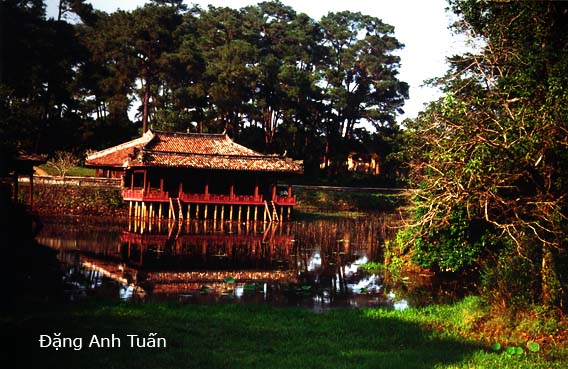
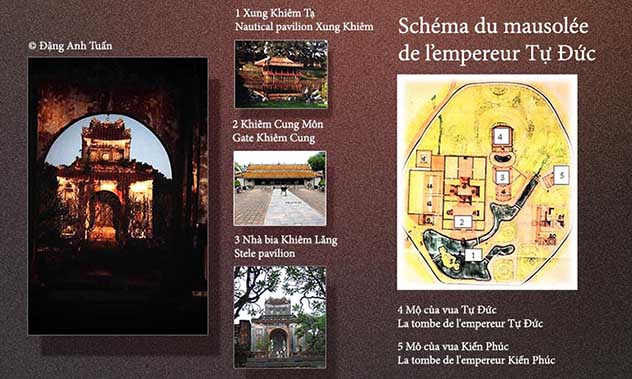
Contrairement aux autres mausolées royaux de la dynastie des Nguyễn, celui de l’empereur Tự Ðức est d’abord un lieu de refuge éventuel durant son règne. C’est pourquoi on y trouve non seulement un palais qui fut transformé plus tard en un lieu de culte après sa disparition mais aussi un théâtre et deux petits jolis pavillons en bois rouge ( Du Khiêm et Xung Khiêm ) où il aimait venir s’asseoir pour se détendre et pour composer ses poèmes. Ce mausolée qui fut construit durant 1864-1867 par les trois mille soldats et ouvriers, possédait à peu près une cinquantaine de bâtiments entourés par une mur en pierre et en brique longue de 1500 mètres sur une surface de 12 ha. Tự Đức fut couronné roi à une époque où il devait faire face non seulement au développement du capitalisme occidental mais aussi aux troubles internes (la guerre des Sauterelles menée par le poète Cao Bá Quát, l’éviction de son frère aîné Hồng Bàng au moment de son intronisation etc ..). Afin de pouvoir se réfugier, il n’hésita pas à ordonner la construction de sa tombe comme un lieu de détente de son vivant et une demeure pour sa vie future éternelle.

Galerie des photos du mausolée Tự Đức

Dans ce mausolée, le pavillon Hoa Khiêm est le bâtiment principal où l’empereur travaillait et le pavillon Lương Khiêm est l’endroit où il vivait et il dormait. On trouve également dans le domaine de son mausolée deux autres tombes. Ce sont celles de sa femme, la reine Lê Thiện Anh et de l’un de ses trois fils adoptés, le roi Kiến Phúc.

L’architecture de ce mausolée reflète non seulement la nature romantique de l’empereur poète Tư Ðức mais aussi la liberté qui fait défaut jusqu’à présent dans les autres mausolées. Rien n’est étonnant de voir ce mausolée devenir l’un des lieux de prédilection pour la plupart des touristes étrangers et vietnamiens.

lang_tu_duc


[Return Hue]

Mausolée de Minh Mạng (Version française)

English version
Vietnamese version
Galerie des photos


lang_minh_mang

Mausolée de l’empereur Minh Mạng

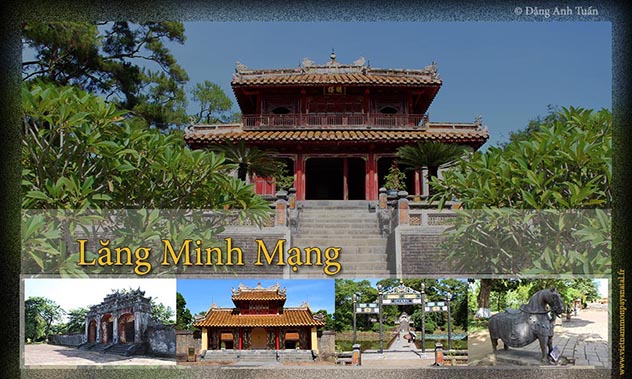
Chaque tombeau royal possède un paysage particulier et un charme qui lui est propre. Celui de Minh Mang est connu pour l’harmonie parfaite entre son architecture et son environnement naturel. Il commença à être construit durant son règne (1820-1841 ) et fut achevé seulement en 1843, deux ans après sa mort, par son successeur Thiệu Tri.

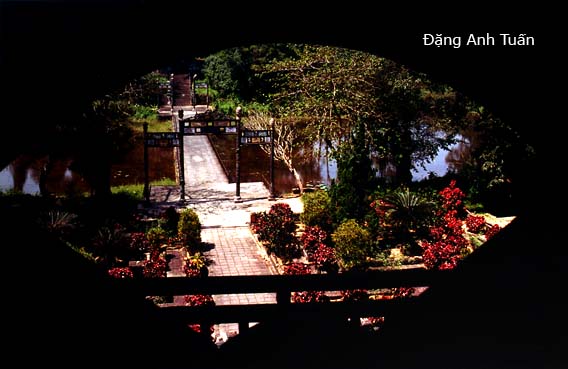
Le temple Sùng Ấn, dédié à Minh Mạng et à sa femme par son successeur, peut être atteint par l’intermédiaire des trois terrasses et de la porte Hiền Ðức. De l’autre côté de ce temple, il y a trois ponts en pierre enjambant le lac de la Pure Clarté. (Hồ Trung Minh). Le pont central connu sous le nom « pont de l’Intelligence et de la Droiture » (Trung Ðạo), construit en marbre, était utilisé seulement par l’empereur. Le pavillon Minh Lâu (pavillon de la Lumière) représente la Triade : le Ciel, l’Etre Humain et la Terre. (Thiên Nhân Ðịa).

Trung đạo kiều

Hiếu Lăng (孝陵)

A partir d’un pont en pierre enjambant le lac Tân Nguyệt (le lac de la Nouvelle Lune ), on peut atteindre, par l’intermédiaire d’une porte d’entrée en bronze, une mur circulaire symbolisant le soleil et au milieu de cette enceinte sacrée se trouve la tombe de l’empereur, un amas de terre entouré par des pins naturels.

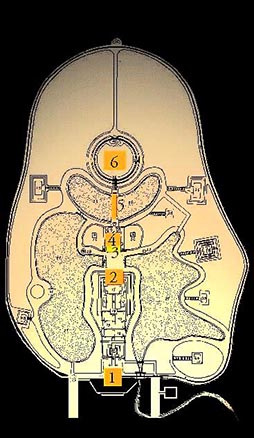
Plan du tombeau de l’empereur Minh Mạng

langminhmang1


  • 1 Ðại Hồng Môn
  •    La grande porte rouge d’entrée
  • 2 Sùng Ấn Ðiện
  •     Le Temple du culte de l’empereur
  • 3  Hoàng Trạch Môn
  •     La porte Hoàng Trạch Môn du pavillon Minh Lâu
  • 4  Minh Lâu
  •     Le pavillon de la Lumière
  • Trung Ðạo Kiều
  •     Le pont de l’intelligence et de la droiture.
  • 6  Mộ của vua Minh Mạng
  •      Le tombeau de l’empereur Minh Mạng


Galerie des photos