
 Vientiane (La capitale du Laos)
Version vietnamienne
Version anglaise
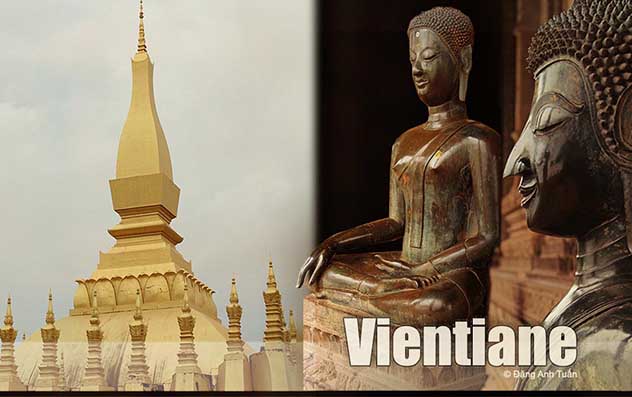
Malgré la naissance du royaume laotien de Fa Ngum au début du 13ème siècle, Vientiane continua à rester un centre administratif important du royaume. Pour éviter la pression venant de l’Ouest (Birmanie et Siam) Vientiane ne devint que la capitale du royaume en 1560 avec le roi laotien Xaysetthathirath. Après l’éclatement du royaume Lang Xang en 1707, Vientiane fut un royaume indépendant annexé plus tard par les Siamois. Il faut attendre l’arrivée des Français en 1893 pour que Le Laos soit incorporé au protectorat français. Aujourd’hui, Vientiane est la capitale du Laos. De passage à Vientiane, il ne faut pas manquer de visiter les sites énumérés ci-dessous: le monument de l’indépendance Patuxai à l’image de l’Arc de Triomphe (Paris), le temple Ho Pra Keo devenant aujourd’hui le musée national gardant tous les vestiges du bouddhisme, la pagode la plus ancienne de la capitale Vat Sisakhet, le stupa quadrangulaire Pha That Luang du bouddhisme édifié sur les ruines d’un temple cambodgien, le centre commercial Ta Lat Sao un centre commercial réputé pour ses produits artisanaux et ses spécialités culinaires et le jardin bouddhique situé à 25 km de la capitale et connu pour ses innombrables statues de Bouddha et de divinités Hindou.
Tuy rằng người dân Lào lập vương quốc Lan Xang từ thế kỷ 13 với Fa Ngum, Viêng Chăn vẫn còn ở thời đó là một trung tâm hành chánh quan trọng của vương quốc mà thôi. Viêng Chăn mới trở thành thủ đô với vua Xaysetthathirath vào năm 1560 để tránh áp lực đến từ phương tây (Miến Điện –Thái Lan). Sau khi vương quốc Lan Xang bi tan rã vào năm 1707 thì Viêng Chăn trở thành một vương quốc độc lập rồi về sau đó bị chinh phục và tàn phái bỡi người Thái. Phải chờ đến năm 1893 Vientiane mới được phục hồi lại nhờ sự bảo hộ của người Pháp. Ngày nay Vientiane là thủ đô của Lào. Đến Viêng Chăn, du khách không nên bỏ qua những điểm tham quan như Patuxai xây dựng mô phỏng theo Khải Hoàn Môn ở Paris, chùa Ho Pra Keo nay trở thành một viện bảo tàng lưu giữ các di tích Phật giáo, chùa cổ nhất ở thủ đô Wat Sisaket, tháp Pha That Luang thờ Phật giáo xây trên phế tích của ngôi đền của người dân Cao Mên, Ta Lat Sao một khu trung trâm buôn bán hàng hóa và ăn uống và vườn tượng Phật cách xa Viêng Chăn 25 cây số . Nơi nầy có hơn 200 bức tượng điêu khắc của Phật giáo và Hindu.
Despite the birth of the Laotian kingdom of Fa Ngum at the beginning of the 13th century, Vientiane continued to remain an important administrative center of the kingdom. To avoid pressure from the West (Burma and Siam), Vientiane only became the capital of the kingdom in 1560 with the Laotian king Xaysetthathirath. After the breakup of the Lang Xang kingdom in 1707, Vientiane became an independent kingdom later annexed by the Siamese. It was not until the arrival of the French in 1893 that Laos was incorporated into the French protectorate. Today, Vientiane is the capital of Laos. When passing through Vientiane, one must not miss visiting the sites listed below: the Patuxai Independence Monument resembling the Arc de Triomphe (Paris), the Ho Pra Keo temple now becoming the national museum preserving all the relics of Buddhism, the oldest pagoda in the capital Vat Sisakhet, the quadrangular stupa Pha That Luang of Buddhism built on the ruins of a Cambodian temple, the Ta Lat Sao shopping center, a commercial center renowned for its handicraft products and culinary specialties, and the Buddhist garden located 25 km from the capital and known for its countless statues of Buddha and Hindu deities.