

Liangzhu civilization
Version vietnamienne
Version française
Chinese culture has developed over many centuries like a mosaic with many cultures. This is one of the prominent characteristics of Chinese culture: the ability to receive and absorb foreign cultures without any signs of transformation or cultural degradation. This is what the famous 20th-century Chinese philosopher Liang Shuming wrote in the introduction to the work « The Main Thoughts of Chinese Culture » (translated by Michel Masson Publishing House). More recently, the Chinese sociologist Zhi Cheng acknowledged this in the book » Lianzhu civilization. A civilization that lasted for 20.000 years » published by Scientific Research Publishing Inc. in December 2024.
He also believes that the development of culture in Central Plains, especially the Yangshao culture, was due to the great migration of the Liangzhu people after the catastrophic flood, which led to the emergence of oracle bone script on turtle plastrons later during the Yin-Shang period. The Liangzhu people had already known this type of pictographic script 2,000 years earlier, with the use of animal bones in divination and rituals.
The Liangzhu culture, to be precise, is the representative culture of the ancient city of Liangzhu, flourishing from 5300 to 4300 BC. This culture is evidenced by abundant archaeological materials. It also represents the peak cultural development period of the ancient city of Liangzhu during the Stone Age. This culture was discovered in the lower reaches of the Yangtze River with a city wall measuring 1,500-1,700 meters in length from east to west. This culture was much more advanced than the Yangshao and Dawenkou cultures.
It is known that the residents of Liangzhu had a stable sedentary lifestyle along with an irrigation system using water stored through canals and a social organization that required many people for production and distribution. According to archaeological documents and legends about Shennong (who lived around 3320-3080 BCE), there is a complete coincidence with this culture because, according to the historical records of Sima Qian, King Shennong was the first king in the south, while in the north, nomadic tribes were ruled by Emperor Huangdi (the Yellow Emperor). Sima Qian also mentioned King Dayu (the first king of the Xia dynasty) who contributed to flood control to stabilize life and develop farming, and was succeeded by King Shun who established the Xia dynasty (2255 BCE – 2207 BCE) at the time when the Liangzhu culture disappeared.
Thanks to the support of modern science and technology, the spread of the Liangzhu civilization has also been confirmed by geoarchaeology. The collapse of the Liangzhu culture and other Neolithic cultures in the lower Yangtze River region was due to climate change and continuous flooding, forcing the inhabitants to flee. Many plateau areas in the interior of mainland China remained, which were very suitable for internal migration of the people when sea levels rose. Therefore, the number of survivors after this disaster was still quite large. Considering the terrain after the sea flooded, a portion of the Liangzhu population moved northward to the Erlitou area. At this time, the Erlitou culture had already reached a certain scale.
This has formed the current mainstream cultural context in China. Another part of the Liangzhu culture may have been introduced into Jiangxi, Hunan, southern Hubei, the Sichuan plain, and other places due to the sea flooding. The main reason for this is that the ancient Liangzhu people migrated to higher land by land, the closest being Jiangxi. The shipbuilding technology of the ancient Liangzhu people was highly developed, so a large number of ancient Liangzhu people could also enter Hunan, southern Hubei (Shijiahé culture), and even the Sichuan plain by traveling by boat along the reverse sea waters.
Among these regions, the Sanxingdui culture in the Chengdu Plain is an important site for the revival of the Liangzhu culture. Jiangxi and other relatively high areas have inherited the Liangzhu agricultural culture. Finally, it was the culture of the Central Plains, represented by Erlitou, that developed writing on turtle shells. Of course, although the powerful Central Plain culture developed and spread rapidly, the transmission of the older part of the Liangzhu culture was never interrupted.
This includes the Central Plains culture, with its core component being the older Liangzhu culture. In the southern region, the more primitive elements of the Liangzhu culture are still preserved. The existence of the Liangzhu culture in the Bai Yue countries belonging to southern China during the pre-Qin period is clearly seen through the Shijiahé culture, the Sanxingdui culture, the Phùng Nguyên culture, or the Đồng Sơn culture, and on the Pacific islands in the form of the Austronesian culture, and it may even have spread to the Americas, promoting the development of the Maya civilization there. Of course, the cultures in different regions of mainland China are closely related to the dominant culture of the Central Plains, thus creating a diverse and unified cultural system of China.
Why did the Lianzhu culture have a brilliant and widespread influence in prehistoric Asia? It is a culture closely associated with agriculture and waterways, linked to the great Bai Yue tribe. This is no longer denied by anyone, with the following six characteristics considered as distinctive features of the Lianzhu culture or the great Bai Yue tribe, whose core is the Vietnamese people today.
The Liangzhu people knew how to use clay and made clay pots for cooking to bring quality through delicious dishes and help them have a better life. This custom quickly spread to neighboring regions (Hunan (Hồ Nam), Zhejiang (Chiết Giang), Japan and so on), while the nomads in the north still ate raw or grilled meat. Of course, this characteristic was not essential in the process of human survival according to sociologist Zhi Cheng (Chí Thành) , but it helped the Liangzhu people know how to boil water and cook rice. In the Neolithic period, the Liangzhu people did not yet know materials and the use of metal tools, so all main constructions such as houses were made of wood, clay, and stone. Therefore, after thousands of years, these materials were eroded by the humid weather, especially the houses, so just a great flood later left no traces except in the core area of the ancient Liangzhu city. It can be said that the Liangzhu culture is a clay pottery culture.This is the first characteristic of the Liangzhu culture.
They also knew how to cultivate rice and related crops. The oldest rice variety in the world was domesticated at the Shangshan cultural site belonging to the Liangzhu civilization area. Rice had also become an important food source for the Liangzhu people, although brown rice is relatively hard and difficult to chew. They boiled all kinds of plant fibers. However, by boiling with water at 100°C, brown rice could be cooked and turned into rice or porridge. They also knew how to process rice and brew sake very skillfully. Archaeologists have found residues remaining from the brewing process in many pottery samples excavated from the Shangshan (Thượng Sơn) culture. A few people engaged in rice farming, while there were very large groups working in other industries outside of agriculture, such as fishing and mining.
The third important feature is the well-established hydraulic transportation system in the city. One of the most prominent features of the ancient Liangzhu city is its canal system. These canals include both natural rivers and a large number of artificial canals. To meet the demand for efficient long-distance transportation of people and materials during the Stone Age, the Liangzhu people often built houses along a large river or an artificial canal. They could freely move on the river or canal using boats or dugout canoes that they invented from massive wooden blocks. The construction of these boats was very precise despite the lack of written records at that time. (Hemudu Culture). In this culture, there is also the application of textile technology on a large scale.
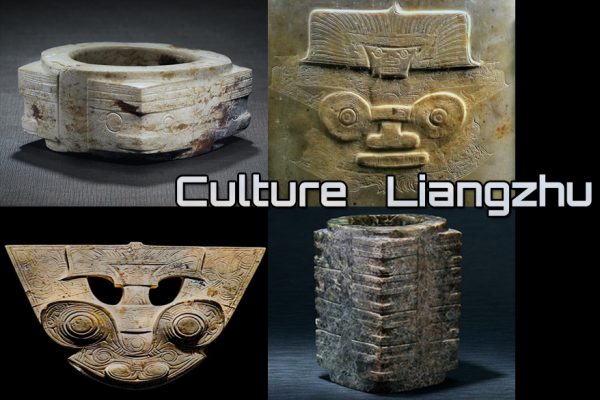
The fourth important feature is the jade culture. This is also a distinguishing point of the Liangzhu culture compared to some other cultures. At first, stone axes were used as a medium of exchange (Majiabang culture) but later the Liangzhu people used jade as currency. At that time, precious metals such as gold were not yet available. Therefore, after accumulating wealth, the Liangzhu people needed to use expensive jade which was relatively harder than stone.
Of course, these precious stone tools were not easily damaged and could be preserved for a long time, naturally becoming an intermediary in the exchange of goods. The monetary function of these jewelry items was quickly reinforced, and they became a symbol of wealth accumulation in ancient Liangzhu society.
Each household would own these jade objects. Therefore, there is a differentiation between rich and poor in the burials depending on the number of jade pieces they have, but the tombs do not have inscriptions, so the names of the tomb owners are unknown, and the construction is not complex. From this, the emergence of power institutions through wealth appears, leading to the separation of cemeteries for the rich and the poor (Songze culture). For jade to circulate in large quantities and widely, jade crafting workshops were also necessary. It was like a modern money-printing factory. When jade ore was transported from farther away, it could be crafted and produced further within the Liangzhu culture and society.
The fifth important characteristic is the use of abstract graphic symbols to convey meaning. This is also a prominent feature of the Liangzhu culture. This culture did not require the use of writing. The absence of writing does not mean that the essence of the Liangzhu culture could not be transmitted. The large number of jade burial objects in Liangzhu tombs shows that the ancient city of Liangzhu had a very open environment, so commerce was very developed and capitalism grew rapidly. This indicates that it was also a very effective tool for conveying messages, a characteristic of the Liangzhu culture through the jade burial objects found during excavations. They are even more complex than modern artworks and are very abstract. Besides its function as a symbol of power, the bronze drum Đồng Sơn of the Vietnamese people also possesses a characteristic whose exact meaning no one has yet been able to explain, particularly with regard to its surface
Another artistic achievement of the ancient Liangzhu people is the carvings and various symbols. These images and symbols reflect the ancient people’s understanding of the world during the Liangzhu period. These carvings also seem to hold very high artistic value in modern times. Such an exquisite carving is similar to the anti-counterfeiting technology on our current banknotes. Therefore, it can be proven that during the Liangzhu period, jade craftsmen invented technology to protect intellectual property rights.
The final characteristic is that the ancient people of the Liangzhu culture liked to eat spicy food and brought these customs to the Americas, later preserving them in Jiangxi, Hunan, Hubei, Sichuan, and other places. According to the ancient Liangzhu people, « eating spicy » food was meant to eliminate excess fat accumulation in the human body. As a result, lifespan was increased. The elderly in Liangzhu had enough time to pass on their rich cultural knowledge to the next generation. This is also an important reason why the Liangzhu culture could continue for tens of thousands of years without interruption.
Bibliography
Liang Shuming: Les idées maîtresses de la culture chinoise. Editeur: Michel Masson. 201Z
Zhi Cheng: Liangzhu civilization. A civilization that lasted for 20.000 years. Ed: Scientific Research Publishing 2024.
Shin’ichi Nakamura: Le riz, le jade et la ville. Évolution des sociétés néolithiques du Yangzi. Éditions de l’EHESS « Annales. Histoire, Sciences Sociales. 2005/5 60e année | pages 1009 à 1034.