
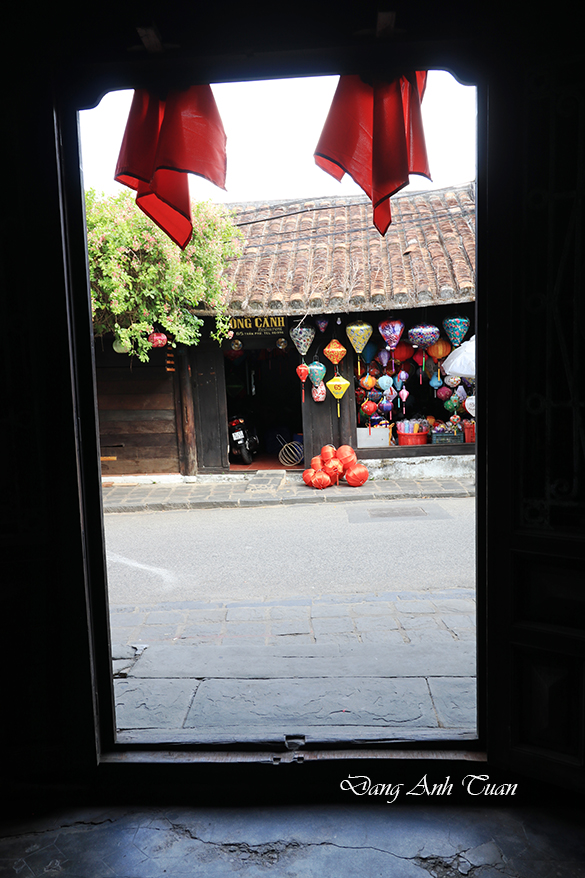
Une autre caractéristique importante de la maison traditionnelle de Hội An est la présence d’une paire des « yeux du dragon » en bois accrochés souvent au-dessus de sa porte d’entrée. Parfois on les retrouve à l’intérieur de la maison. On recense au moins une douzaine de modèles ayant chacun une forme différente: un rond, un octogone etc… mais le modèle le plus commun trouvé reste le chrysanthème à huit pétales correspondant aux 8 caractères trouvés dans le Yi King (Kinh Dịch) et ayant à son centre le symbole du Yin et du Yang (Âm Dương). Ces yeux du dragon sont aussi un détail important que l’architecte polonais Kazimierz Kwiatkowsky (Kazik) ne laissa pas s’échapper au moment où il avait eu l’occasion d’examiner l’architecture de Hội An, en particulier celle de ses maisons traditionnelles. Certains spécialistes trouvent dans ces yeux l’incarnation de l’âme de la ville Hội An tandis que d’autres attribuent à cette paire l’allégorie de la culture et de la tradition orientale. Selon l’écrivain Hữu Ngọc, les chercheurs ont trouvé leur origine à partir des clous en bois dont on est habitué à voir la fixation dans les linteaux des portes d’accès aux temples bouddhistes dans le Sud de la Chine.
Personne ne conteste cette explication relative à leur origine mais on est amené à penser que cette paire d’yeux revêt plutôt une signification très spéciale, un caractère spirituel ou religieux que le propriétaire de la maison aimerait lier à son destin lors de son installation. Pour ce dernier, ces yeux ont la faculté d’entendre les réflexions de chaque membre au sein de la famille et de capter aussi tout ce qui s’est passé autour de la maison et au cœur même de sa propre vie. Il faut se rappeler qu’avant d’être sinisés, les gens de la région du Sud de la Chine faisaient partie du groupe Bai Yue (Cent Yue). Analogues aux Vietnamiens, ils étaient animistes car ils croyaient qu’il existait une force vitale, une âme animant tous les êtres naturels ou non (y compris les objets). (Vạn vật hữu linh). Ce culte perdurait depuis la nuit des temps. Ces yeux du dragon sont en quelque sorte ceux du génie protecteur de la maison.
On retrouve le même culte chez d’autres peuples: dvàrapàla (gardien de la porte) (Hộ pháp) chez les Cham. Les Vietnamiens n’échappent pas non plus à ce culte ainsi que les Thaïlandais et les Cambodgiens. C’est le cas des génies du bien et du mal qu’on trouve souvent à l’entrée de la pagode. On est habitué à voir aussi sur la proue des barques vietnamiennes ces deux yeux censés de se prémunir contre les esprits malfaisants lors de la navigation maritime. Etant utilisée pour protéger les gens contre la pluie et la chaleur, la maison traditionnelle semble être toujours un objet inanimé. Pourtant, en lui offrant ces deux yeux du dragon, le propriétaire réussit à la rendre vivante et à lui donner une âme. Les Vietnamiens ont l’habitude de dire « Đội mắt là cửa sổ của tâm hồn (Les yeux sont la fenêtre de l’âme) ». Puisque elle a une âme, elle ne montre plus son indifférence mais elle devient ainsi plus affective si bien que le visiteur ne peut pas rester insensible à l’atmosphère chaleureuse et à l’hospitalité que le propriétaire aimerait lui réserver lors de sa visite. C’est à travers ces yeux du dragon qu’on découvre le talent inouï de celui qui a pris l’initiative de les créer. Cela permet aux maisons traditionnelles de Hội An d’être imprégnées désormais d’un charme architectural indémodable qu’on ne trouve pas dans le Sud de la Chine ni ailleurs.
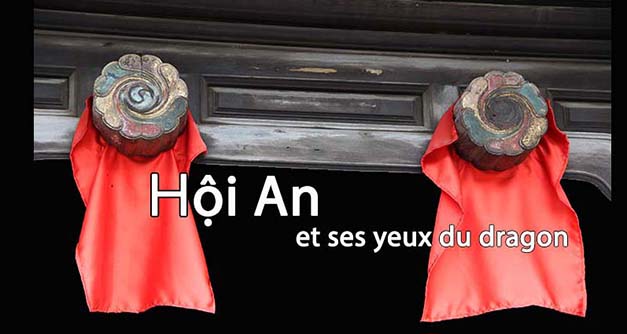
Một đặc điểm quan trọng khác của ngôi nhà truyền thống ở Hội An là sự hiện diện của một đôi “mắt rồng” bằng gỗ thường được treo phía trên trước cửa nhà. Đôi khi chúng ta tìm thấy chúng ở trong nhà. Có ít nhất một chục mô hình, mỗi mô hình có hình dạng khác nhau: hình tròn, hình bát giác vân vân…. Nhưng mô hình được phổ biến nhất tìm thấy vẫn là hoa cúc với tám cánh hoa tương ứng với 8 chữ được tìm thấy trong Kinh Dịch và ở trung tâm của nó là biểu tượng của Âm Dương. Đôi mắt rồng này cũng là một chi tiết quan trọng mà kiến trúc sư người Ba Lan Kazimierz Kwiatkowsky (hay Kazik) đã không để bỏ sót khi ông có dịp khảo sát đến kiến trúc của Hội An, đặc biệt là những ngôi nhà truyền thống ở đây. Một số chuyên gia cho rằng đôi mắt này là hiện thân linh hồn của thành phố Hội An trong khi những người khác lại cho rằng cặp mắt này là ngụ ngôn về văn hóa và truyền thống phương Đông. Theo nhà văn Hữu Ngọc, các nhà nghiên cứu đã tìm ra được nguồn gốc của chúng từ những chiếc đinh bằng gỗ được thấy đóng vào các lanh tô các cửa ra vào của các ngôi chùa Phật giáo ở miền nam Trung Quốc.
Không ai chối cãi sự giải thích này có liên quan đến nguồn gốc của chúng nhưng chúng ta nghĩ rằng đôi mắt này có một ý nghĩa đặc biệt, mang một tính chất tâm linh hoặc tôn giáo mà người chủ nhân ngôi nhà muốn liên kết chúng với số phận của họ khi lúc mới vào ở ngôi nhà. Đối với chủ nhân, đôi mắt này có khả năng nghe thấu những suy tưởng của mỗi thành viên ở trong gia đình và cũng có thể nắm thông hiểu mọi việc đã xảy ra ở xung quanh ngôi nhà và luôn cả trong cuộc sống của họ. Cần nên nhớ lại trước khi bị Hán hóa, người dân ở khu vực phía nam Trung Quốc thuộc về nhóm Bách Việt. Tương tự như người dân Việt, họ là những người theo thuyết vật linh vì họ tin rằng có một sinh lực quan trọng, một linh hồn làm sinh động mọi sinh vật, tự nhiên hay không (kể cả vật thể). (Vạn vật hữu linh). Sự tôn thờ này đã kéo dài từ buổi ban sơ. Đôi mắt rồng nầy nó là phần nào đôi mắt của thần bảo vệ ngôi nhà.
Chúng ta nhận thấy có sự sùng bái tương tự ở các dân tộc khác: dvàrapàla (người gác cổng) (Hộ pháp) của người Chàm. Người Việt Nam tựa như người Thái và người Cao Miên không tránh khỏi việc sùng bái nầy. Đây là trường hợp của những vị thần thiện và ác thường được thấy ở lối vào của chùa. Chúng ta cũng thường nhìn thấy hai con mắt này trên những mũi tàu hay thuyền của người dân Việt dùng để chống lại tà ma trong việc hàng hải.
Được sử dụng để che mưa chống nắng, ngôi nhà truyền thống dường xem như là một vật vô tri vô giác. Tuy nhiên, bằng cách cung cấp cho ngôi nhà đôi mắt rồng này, chủ nhân đã làm cho ngôi nhà nầy sống lại và cho nó có được một linh hồn. Người Việt Nam thường nói « Đội mắt là cửa sổ của tâm hồn« . Từ khi có linh hồn, ngôi nhà không còn tỏ ra hờ hững mà trở nên dễ xúc động hơn khiến du khách không thể vô cảm trước bầu không khí ấm áp và lòng hiếu khách mà chủ nhân dành cho người khách trong chuyến viếng thăm của họ. Chính qua đôi mắt rồng nầy, chúng ta mới phát hiện được tài năng đáng kinh ngạc của người đã có óc sáng kiến tạo ra chúng. Điều này cho phép các ngôi nhà truyền thống của Hội An có được một nét duyên dáng kiến trúc vượt thời gian mà không thể tìm thấy ở miền nam Trung Quốc hay ở các nơi khác.
Another important feature of the traditional Hội An house is the presence of a pair of wooden « dragon eyes » often hung above its entrance door. Sometimes they are found inside the house. At least twenty models have been recorded, each with a different shape: a circle, an octagon, etc., but the most common one found remains the chrysanthemum with eight petals corresponding to the 8 characters found in the Yi King (Kinh Dịch) and having at its center the symbol of Yin and Yang (Âm Dương). These dragon eyes are also an important detail that the Polish architect Kazimierz Kwiatkowsky (Kazik) did not overlook when he had the opportunity to examine the architecture of Hội An, particularly that of its traditional houses. Some specialists see in these eyes the embodiment of the soul of the city of Hội An, while others attribute to this pair the allegory of Eastern culture and tradition. According to the writer Hữu Ngọc, researchers have traced their origin to wooden nails commonly seen fixing the lintels of entrance doors to Buddhist temples in southern China. No one disputes this explanation regarding their origin, but one is led to think that this pair of eyes rather carries a very special meaning, a spiritual or religious character that the owner would like to link to their destiny upon settling in.
For the latter, these eyes have the ability to hear the thoughts of each family member and also to capture everything that has happened around the house and at the very heart of their own life. It should be remembered that before being sinicized, the people of the southern region of China were part of the Bai Yue group (Hundred Yue). Similar to the Vietnamese, they were animists because they believed in a vital force, a soul animating all natural or non-natural beings (including objects). (Vạn vật hữu linh). This cult has lasted since time immemorial. These dragon eyes are in a way those of the protective spirit of the house.
The same cult is found among other peoples: dvàrapàla (guardian of the gate) (Hộ pháp) among the Cham. The Vietnamese are no exception to this cult, as well as the Thais and the Cambodians. This is the case with the spirits of good and evil often found at the entrance of the pagoda. It is also common to see on the prow of Vietnamese boats these two eyes meant to protect against evil spirits during maritime navigation. Being used to protect people from rain and heat, the traditional house seems always to be an inanimate object. Yet, by giving it these two dragon eyes, the owner succeeds in bringing it to life and giving it a soul. The Vietnamese have the habit of saying « Đôi mắt là cửa sổ của tâm hồn (The eyes are the window of the soul). » Since it has a soul, it no longer shows indifference but becomes more affectionate so that the visitor cannot remain indifferent to the warm atmosphere and hospitality that the owner would like to offer during the visit. It is through these dragon eyes that one discovers the extraordinary talent of the one who took the initiative to create them. This allows the traditional houses of Hội An to be imbued with an timeless architectural charm that is not found in southern China or elsewhere.