
Version vietnamienne
Version française
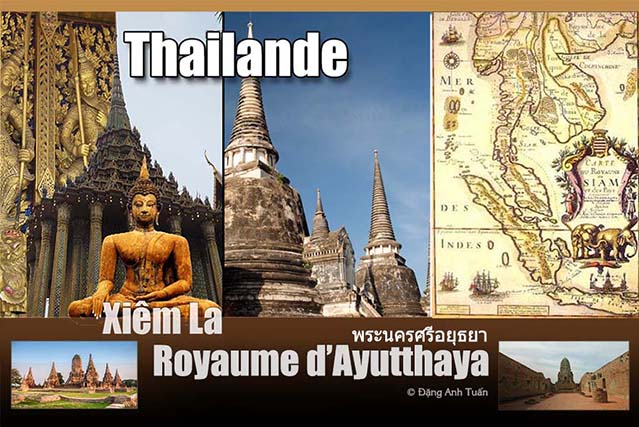
The kingdom of Sukhothai did not survive after the disappearance of the great King Rama Khamheng because his successors Lo Tai (1318-1347) and Lu Tai (1347-1368), preoccupied with religious faith, neglected to watch over their vassals among whom there was a brave and energetic prince from U Thong (*) known for his territorial ambitions. He did not hesitate to subdue Lu Tai of Sukhothai. He thus became the founder of the new dynasty by taking Ayutthaya, located in the lower valley of the Menam Chao Praya, as the capital. He took the title Ramathibodi I (or Rama the Great) (or Ramadhipati). His kingdom was not unified in the strict sense of the term but was in a way a mandala (**). The king was at the center of several concentric circles of the mandala system. The outermost circle consisted of autonomous principalities (or muäng) each governed by a member of the royal family, while the closest circle was in the hands of governors appointed by the king. An edict dating from 1468 or 1469 reported that there were 20 vassal kings paying homage to the king of Ayutthaya.
Phra Nakhon Si Ayutthaya
พระนครศรีอยุธยา
© Đặng Anh Tuấn
(*) U Thong: district located in the province of Suphanburi. It is the kingdom of Dvaravati, which the Chinese often referred to as T’o Lo po ti. It is here that the famous Chinese monk Huan Tsang (Huyền Trang) passed through during his journey to India to bring back original Buddhist texts.
(**) Mandala term used by WOLTERS, O.W. 1999. History, Culture and Religion in Southeast Asian Perspectives. Revised Edition, Ithaca, Cornell University and the Institute of Southeast Asian Studies. pp 16-28.
Despite this, his grip and authority were relative over distant principalities that could at any time assert their independence and claims with their charismatic leaders. His religious role (dharmaraja) served as a counterbalance to the potential rivalry of these vassal kings. This is why the kingdom of Ayutthaya often experienced succession wars and internal struggles during its existence.
At its peak, the kingdom of Ayutthaya occupied roughly the territory of present-day Thailand, minus the buffer kingdom of Lanna (whose capital was Chiangmai) and part of the east in Burma. According to researcher Nguyễn Thế Anh, this type of political configuration was also found for a certain time at the beginning of the 11th century in Vietnam but disappeared in favor of the centralization of power in the capital at the time of its transfer to Thăng Long (Hanoi) under the reign of Lý Thái Tổ (Lý Công Uẩn).
According to the Thai historian Charnvit Kasetsiri, this prince of U Thong came from a Chinese family. Thanks to the marital alliance with the king of Lopburi, he succeeded in imposing himself to succeed the latter. From then on, Ayutthaya became the center of Siamese political power until its destruction by the Burmese of King Hsinbyushin in 1767. Expansionist, Ramathibodi soon took Angkor in 1353. This happened again twice with Ramesuen (the son of King Ramathibodi) in 1393 and with Borommaracha II in 1431. The Khmers were forced to transfer their capital to Phnom Penh with the Khmer king Ponheat Yat. Despite their sacking of Angkor, the kings of Ayutthaya continued to willingly present themselves as heirs of the kings of the Angkorian empire. They took over not only the organization of the court and the titulature of the vanquished but also their dancers and their ornaments. The return to the tradition of the Angkorian monarchy was evident. The king became, in a way, a living god whose public appearance was rare. His subjects could no longer look him in the face except his close family members. They had to address him in a specific language used for royalty. Endowed with divine power, the king could decide the fate of his subjects. It was under the reign of Ramathibodi that a series of reforms was initiated. He brought members of the Sinhalese monastic community with the aim of establishing a new religious order.
In 1360, Theravada Buddhism became the official religion of the kingdom. A legal code incorporating Thai custom and based on the Hindu Dharmashāstra was adopted. As for Ayutthaya art, it initially evolved under the influence of Sukhothai art. Then it continued to find its inspiration in the field of sculpture before returning to Khmer models when King Trailokanatha succeeded his father on the throne in 1448. In short, the Ayutthaya style is a blend of the Sukhothai style and the Khmer style.
Described by the Abbé de Choisy, a member of a French delegation sent in 1685 by King Louis XIV to the Siamese King Narai as a cosmopolitan and marvelous city, Ayutthaya quickly became the prey of Burmese covetousness because of its wealth and grandeur. Despite the meaning of its Sanskrit name (« impregnable fortress »), it was looted and devastated by the Burmese of King Bayinnaung of Toungoo in 1569. Then it was sacked again by the Burmese of King Hsinbyushin in 1767. The Burmese took advantage of this occasion to melt down the gold that covered the Buddha statues, but they neglected another stucco Buddha in one of the capital’s temples. Yet beneath the stucco lies the statue in solid gold.
This is indeed a stratagem employed by the Siamese monks to hide the treasure at the time when the Burmese were besieging the capital. This golden Buddha is currently in the Wat Traimit located in the heart of the Chinatown district in Bangkok.
After the destruction of the Ayutthaya capital, the Burmese withdrew taking not only the loot and prisoners (at least 60,000 Siamese) but also the king of Ayutthaya and his family. From then on, the kingdom of Ayutthaya was completely dismantled with the emergence of several local lords. Its capital was no longer the center of political power. According to the American anthropologist Charles Keyes, Ayutthaya no longer received the cosmic influences necessary for its continuity. Its reason for being was no longer justified. It would soon be replaced by the new capital Thonburi, very close to Bangkok, accessible by sea (in case of Burmese invasion) and founded by the governor of Tak province named Sin. That is why he is commonly called Taksin (or Trịnh Quốc Anh in Vietnamese) or Taksin the Great in the history of Thailand.
Being of Teo Chiu (Chaozhou) Chinese origin, he managed to establish himself as the unifier and liberator of Thailand after eliminating all contenders and defeating the Burmese at Ayutthaya following two days of fierce fighting. His reign lasted only 15 years (1767-1782). Yet it was under his reign that Thailand regained not only independence but also prosperity. It also became one of the powerful states of Southeast Asia by successfully permanently freeing the rival kingdom of Lanna (Chiang Mai) from Burmese yoke in 1774 and by extending its influence and vassalage over Laos and Cambodia through military expeditions. It began to take an interest in the strategic position played at the beginning of the 18th century by the principality of Hà Tiên governed by a Cantonese Chinese Mac King Kiou (or Mạc Cửu in Vietnamese), hostile to the new Qing (Manchu) dynasty in the Gulf of Siam. It always entertained the idea of monopolizing and controlling trade in the Gulf of Siam.
It was in Laos that the Thais, led by General Chakri (future King Rama I), took the Emerald Buddha from the Laotians and brought it back to Thonburi in 1779 before permanently installing it in the royal palace of Bangkok. This Buddha thus became the protector of the Chakri dynasty and the guarantor of Thailand’s prosperity.
Having been divided into three entities: the kingdom of Vientiane, the kingdom of Luang Prabang, and the kingdom of Champassak after the death of a great king of Laos, Surinyavongsa, Laos temporarily fell under Thai rule. However, in Cambodia, taking advantage of internal dissensions related to the succession of the throne and always pursuing an expansionist policy eastward to fully control the Gulf of Siam, the Thais did not hesitate to enter into armed conflict with the Vietnamese lords Nguyễn, who until then had oversight over Cambodia, which had granted the Vietnamese facilities for settlement in its territory (Cochinchina) with King Prea Chey Chetta II in 1618.