
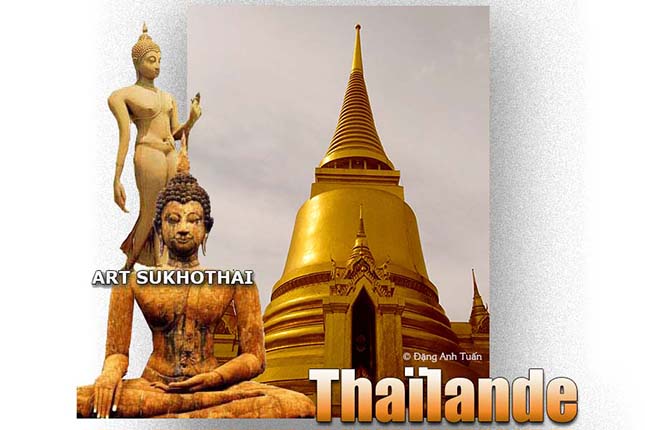
With the first great Thai kingdom of Sukhothai, a new civilization emerged that knew how to take advantage of indigenous culture under the impetus of an exceptional and equally remarkable personality, King Rama Khamheng. For Georges Coedès, the Thais were remarkable assimilators. Instead of destroying everything that belonged to the former masters (Mon-Khmers) as the Vietnamese did during the conquest of Champa, the Thais tried to appropriate it and rediscover themes in the old Mon-Khmer repertoires to create a new, unique style, allowing local traditions to show through in architecture (chedis) and statuary (Buddhas). Mahayana was henceforth abandoned in favor of Theravada Buddhism, to which Thai aesthetics were entirely devoted. This obviously drew its iconographic and plastic formulas from Khmer art and that of Dvaravati (Mon).
The blossoming of Sukhothai art testifies to a will for innovation and remarkable vitality despite certain Sinhalese, Burmese, and Khmer influences. This is seen in the great creation of Buddha iconography. These Buddhas, represented in human form, were sculpted according to very precise rules that Thai artists had to meticulously respect. According to Bernard Groslier, there is a slight exaggeration in the beauty of these works in order to accentuate stylization and show the originality of a new and dynamic society. The excessive elongation found in the arms and ears and the excessive deformation of the upper bun clearly reflect the lack of realism.
Despite this, the Buddhist sculpture of Sukhothai undoubtedly testifies to an entirely original art and a period when the Thai nation needed a cultural and religious identity and a distinct personality illustrated by the example found in the creation of the Walking Buddha. Its graceful form cannot go unnoticed and manages to penetrate the Thai people. A fluidity is found in the movement of this Buddha. Its appearance is both light and serene. Its oval-shaped head, perfectly arched eyebrows in a semicircle extended by a long aquiline nose, its curly hair topped with a long flame (uṇīsa) (Sinhalese tradition), its mouth surrounded by a double line (Khmer tradition), its clothes clinging to the body are the characteristic features of the Buddhist art of Sukhothai.
Despite this, the Buddhist sculpture of Sukhothai undeniably bears witness to an entirely original art and a period when the Thai nation needed a cultural and religious identity and a distinct personality illustrated by the example found in the creation of the Walking Buddha. Its graceful form cannot go unnoticed and manages to penetrate the Thai people. A fluidity is found in the movement of this Buddha. Its appearance is both light and serene. Its oval-shaped head, perfectly arched semicircular eyebrows extended by a long aquiline nose, its curly hair topped with a long flame (unîsa) (Sinhala tradition), its mouth surrounded by a double line (Khmer tradition), its clothes clinging to the body are the characteristic features of the Buddhist art of Sukhothai.
Under the reign of Rama Khamheng (or Rama the Brave), a new society was formed from the Mon-Khmer heritage. This society found its administrative and social model from the Mongols. The Thai script was created and based on the Khmer cursive script, which had its distant origin in southern India. Theravada Buddhism was adopted as the state religion. Despite this, animism continued to persist, as evidenced by the cult of the spirit of the land mentioned by Rama Khamheng. He established on a hill near Sukhothai an altar dedicated to a spirit named Phra Khapung Phi, superior to all other spirits to ensure the prosperity of the kingdom. It was his responsibility to honor this cult every year. This same mindset was also seen at the beginning of the 20th century in Vietnam with the ritual ceremony of Nam Giao (Huế) celebrated by the emperor, as being the Son of Heaven, he was supposed to ask each year for the protection and blessing of Heaven for the country. (Similarly in China with the Temple of Heaven (Thiên Đàn) in Beijing).
It is not surprising to still find nowadays this tradition, this idea of the superior spirit in the Emerald Buddha (or Phra Keo Morakot), the palladium of Thailand and protector of the Chakri dynasty in the chapel of the royal palace in Bangkok. For Bernard Groslier, the parallelism is not gratuitous: the Thais belong to the primitive world of Chinese thought. Questions arise from this comparison because one cannot ignore that, similar to the Vietnamese, the Thais were part of the Cent Yue group, most of whose ethnicities were animists and belonged to the agricultural world. They were accustomed to honoring the cult of the spirits of the land, agriculture, or the village before coming under Chinese influence. Rama Khamheng succeeded in establishing diplomatic relations with Kublai Khan’s China. He encouraged the arrival and settlement of Chinese artisans in the capital. With their expertise, the kingdom of Sukhothai soon became known for its famous Sawankhalok ceramics.