Forbidden city of Beijing (Cố Cung): Part 1

Forbidden city of Pékin

Cố Cung


Version française

Vietnamese version

[The Forbidden City in Beijing: Part 1]

After defeating his nephew Zhu Yunwen (also known as Jianwen Emperor), whose death remains a mystery to historians, the third emperor of the Ming dynasty, Zhu Di (also known as Yongle Emperor), decided to move the capital from Nanjing to Beijing, mainly for strategic reasons. Facing the serious threat of the Mongols to the empire, he thought this was the quickest solution to deal with the raids. He entrusted the chief architect, the eunuch Nguyen An of Vietnamese origin, with the construction of the Forbidden City on the ruins of Khanbaliq, the Yuan dynasty city built by Kubilai Khan in 1267 and described by Marco Polo in his book titled « The Description of the World » in 1406, following a designated protocol. Two hundred thousand workers were recruited for this grand project, which lasted 14 years.

Besides the participation of a large number of provinces in supplying materials: Xuzhou (Jiangsu) marble, Linqing (Shandong) bricks, stone from the Fangshan and Panshan quarries not far from Beijing, nanmu wood for the house frame from Sichuan, columns from Guizhou and Yunnan, and so on, it was also necessary to renovate the Grand Canal dating back to the Sui Dynasty. This canal was essential for transporting materials and food to the capital Beijing. From 1420 to 1911, a total of 24 emperors of the Ming and Qing dynasties resided here. The last emperor to live in this Forbidden City was Emperor Puyi of the Qing Dynasty.

There are many questions about the preservation and conservation of the capital by the Qing army when they seized power in China because, according to Chinese tradition, the victors usually thoroughly destroyed all palaces belonging to previous dynasties. One can look at the example of Zhu Yuanzhang, also known as the Hongwu Emperor. He ordered his soldiers to completely destroy the capital of the Yuan Dynasty in Beijing and move the capital to his hometown in Nanjing. It is unclear what motivated the Qing Dynasty to keep the Ming capital intact.


Cố Cung

cite_pekin


Although the Qing emperors made efforts to renovate the Forbidden City and built many additional palaces, this Forbidden City forever retains the mark of its founder, Emperor Yongle (Zhu Di). One of the three famous emperors alongside Han Wudi and Tang Taizong in Chinese history, Zhu Di appointed Admiral Zheng He to lead the naval expeditions to the « Western Oceans, » which were later recorded by his companion Ma Huan in the book titled Ying-yai Sheng-lan (The Marvels of the Oceans). Taking advantage of the usurpation of the throne by Hồ Quý Ly, Zhu Di annexed Vietnam in 1400. Without the nearly ten years of resistance by the Vietnamese people under Lê Lợi, Vietnam could surely be a province of China today, like Yunnan or Guangdong.


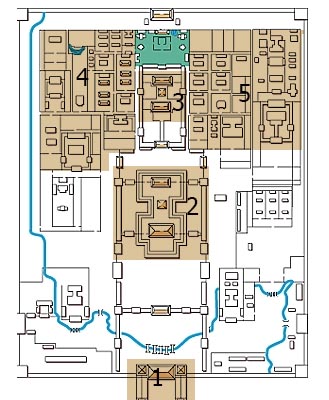
1 Porte du Midi (Ngọ Môn)

2 Tiền Triều (Waichao)

  • Điện Thái Hoà (Taihe)
  • Điện Trung Hoà (Zhonghe) 
  • Điện Bảo Hoà  (Baohe) 

3  Hậu tẩm (Neichao)

  • Cung Càn Thanh (Qianqing)
  • Điên Giao Thái (Jiaotai)
  • Cung Khôn Ninh (Kunning)

4) Six Palais de l’Ouest (Lục viện)

5) Six Palais de l’Est (Luc viện)


The Forbidden City is truly a city within a city and was built on a rectangular piece of land measuring 960 chi in length and 750 chi in width. The Forbidden City is divided into two parts: the front section called the Outer Court (waichao), designated for ceremonial life (such as coronation ceremonies, investiture ceremonies, and royal weddings), and the rear section called the Inner Court, reserved for the emperor and his family. There are three halls in the Outer Court: the Hall of Supreme Harmony, the Hall of Central Harmony, and the Hall of Preserving Harmony, which together form the complex known as the Three Halls of the Outer Court. In the Inner Court, there are the Palace of Heavenly Purity, the Hall of Union, and the Palace of Earthly Tranquility, each surrounded on the east and west sides by six six-yards (residential quarters). This is commonly referred to as the Three Palaces and Six Yards of the Forbidden City.

When visiting the Imperial City, tourists are obliged to pass through Ngo Mon Gate. This is the main gate of the Imperial City. At one time, this gate witnessed many ceremonies related to military departures or the triumphant return of the royal army, as well as the announcement of a new lunar calendar. It is the only gate, or more precisely, a U-shaped structure, 8 meters high, with five buildings on top featuring double roofs and five gates, but the middle gate is reserved only for the king. This architectural complex is often called the Five Phoenix Pavilion because its shape resembles a phoenix. Beyond Ngo Mon Gate, there is a very wide courtyard crossed by an artificial river with shimmering golden water called Neijindhuihe. This river has five beautifully decorated bridges, with the middle bridge reserved for the emperor. Along the riverbanks, there are stone balustrades carved with dragons and phoenixes.

The front court enjoys Yang energy, so the palaces here are usually built higher than the palaces in the rear chambers, thanks to a large common foundation with three steps carved from jade stone, raised to highlight not only the splendor of the front court palaces but also the majestic and magnificent nature of Yang energy. Similarly, the rear chambers enjoy Yin energy, so the palaces here are all low, except for the Kien Thanh Palace, where the king works and discusses state affairs with high-ranking officials, which enjoys Yang energy and is therefore taller than the other palaces.

In this place, one can see a typical metaphor, which is Yang within Yin, often mentioned. Between the Qianqing Palace, where the emperor resides and enjoys Yang energy, and the Kunning Palace, the empress’s resting place receiving Yin energy, there is the Jiaotai Hall. Considered the connecting link between the Qianqing and Kunning Palaces, Jiaotai Hall not only represents the perfect harmony of Yin and Yang but also symbolizes peace within the Forbidden City. All the palaces in the Forbidden City face south to benefit from the advantages of Yang energy.

Based on traditional Chinese feng shui, to the north of the Forbidden City, there is an artificial mountain called Jinshan and the Great Wall to prevent the harmful effects of Yin energy coming from the north (cold winds, nomads, ghosts, and so on). To the south, thanks to water-filled pits and an artificial river with shimmering golden water (Neijindhuihe), the qi buried in the earth can circulate, which is difficult to disperse due to the levels created on the surface. This arrangement is seen in the construction of the three-tiered foundation for the three halls used for rituals in the front court. As a result, qi is guided up and down through the halls to break the monotony of the flat land and reach the summit where the emperor’s throne is in the Hall of Supreme Harmony. As the connection between Heaven and Earth, the emperor usually faces south, with his back to the north, the east on his left, and the west on his right.

Each direction is protected by a guardian creature: the pink swallow in the south, the black turtle in the north, the blue dragon (qinglong) in the east, and the white tiger (baihu) in the west. On the ceiling, at the vertical axis of the throne and above the emperor’s head, there is an exquisitely decorated celestial dome featuring a recessed panel with two golden dragons carved playing with a huge pearl. It is here, when visiting, that tourists wonder how many dragons are used in the decoration of this palace, as this guardian creature appears everywhere. According to some records, there are a total of 13,844 dragons of various types and sizes, giving this place a solemn and majestic appearance never seen in other palaces.

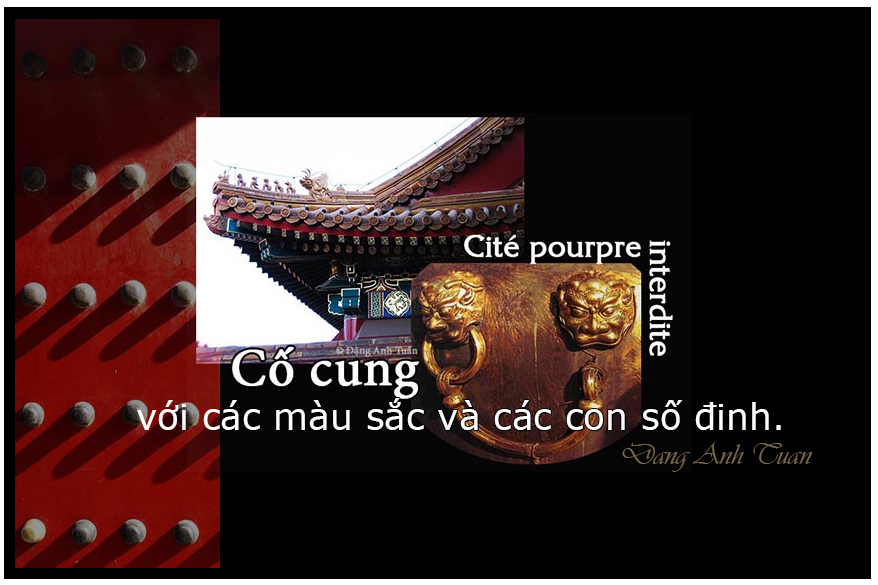
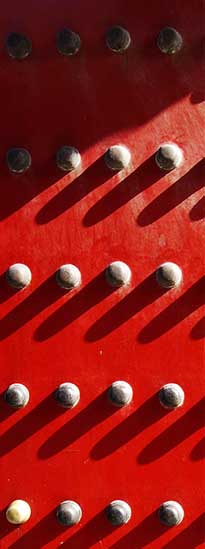
Located along the main north-south axis, the Forbidden City is decorated according to rules of numbers and colors. The choice of Yang numbers (or odd numbers) is commonly seen through the arrangement of mythical creatures on the eaves of the palace roofs or the ornate display on the doors of the Forbidden City with yellow nails, as well as the number of bays the Forbidden City has.


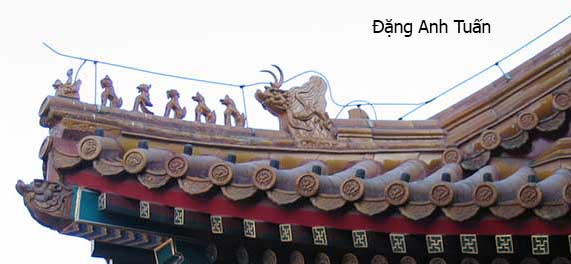
The number of divine beasts on the eaves corners of the palace can range from 1 to 10. Depending on the importance and scale of the palace as well as the rank of the owner in the court, this number can vary. The number of these divine beasts is specified in the book that records all the regulations under the Qing dynasty, known as the Da Qing Hui Dian. These divine beasts are arranged in odd numbers 1-3-5-7-9 on the eaves corners in a clear order as follows: dragon, phœnix, lion, heavenly horse, seahorse, aplustre, fighting bull, suan ni, sea goat, and monkey. Always leading these divine beasts is a figure riding a chicken or phoenix, often called the Prince Min. Nearby is an additional horned beast, the ninth son of the dragon. Each divine beast represents a good omen or virtue and is thus cherished and worshipped. However, there is an exception: the Hall of Supreme Harmony has up to 10 divine beasts on its eaves corners because it is where the emperor holds important ceremonies (such as coronations, weddings, birthdays, year-end celebrations etc.). The use of these divine beasts mainly serves to protect the palaces against evil spirits and to demonstrate the emperor’s power and prestige. Conversely, the Palace of Heavenly Purity, although it is where the emperor works and discusses state affairs with officials, does not have as significant a role as the Hall of Supreme Harmony and therefore only has 9 divine beasts on its eaves corners.

As for the Khôn Ninh palace, seven divine beasts were found on the eaves of the hall because this was the palace of the empress during the Ming dynasty. However, this place was also where the sacrificial rituals to the Tát Mãn religion’s spirits were held, which corresponded to the position of Yin under Yang during the Qing dynasty. It is important to remember that before conquering China, the Qing dynasty was originally Manchu, so they still maintained their own religion.

[The Forbidden City of Beijing (Part 2)]


Maison Loo, centre d’exposition d’art privé

Une somptueuse pagode chinoise au cœur de Paris.

Ngôi chùa Trung Hoa độc đáo giữa lòng Paris.

Vietnamese version

English version

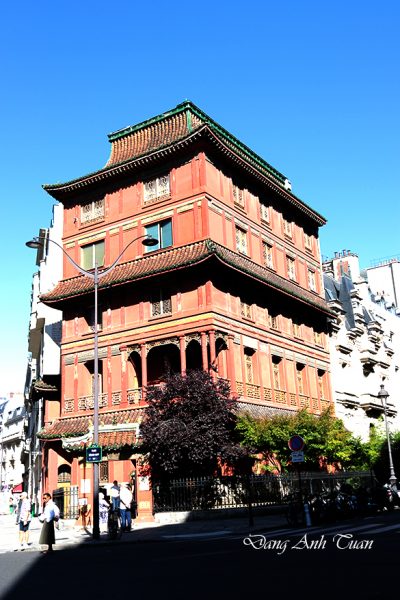
Au début du 19ème siècle, un marchand d’art chinois de nom Ching Tai Loo racheta un hôtel particulier de style français classique  construit en 1880  au cœur du quartier chic, non loin du parc Monceau. Pour l’amour de son pays et le lien qu’il voulait garder avec son pays d’adoption, il  demanda à l’architecte Fernand Bloc de transformer ce bâtiment en une somptueuse pagode d’inspiration chinoise peinte en rouge comme la cité interdite de Pékin  dans sa totalité car à cette époque le permis de construire ne lui fut pas demandé. Malgré les protestations des gens vivant aux alentours, la maison Loo continue à exister jusqu’aujourd’hui et devient un centre d’exposition collective  d’art privé pour les collectionneurs avertis. Etant invité par la galerie d’art Hioco, j’ai l’occasion de le visiter ce matin. Je suis frappé non seulement par le caractère original de cette maison insolite mais aussi la présentation des objets d’art des galeries associées  à cette exposition. Un grand merci à tous les exposants.

Vào đầu thế kỷ 19, một thương gia nghệ thuật người Trung Quốc tên là Ching Tai Loo đã mua lại một biệt thự theo phong cách cổ điển Pháp được xây dựng vào năm 1880 tại trung tâm khu phố sang trọng, không xa công viên Monceau. Vì tình yêu dành cho đất nước Trung Hoa và mong muốn giữ mối liên kết với quê hương thứ hai của mình, ông đã nhờ kiến trúc sư Fernand Bloc biến tòa nhà này thành một ngôi chùa lộng lẫy mang cảm hứng từ Trung Hoa, được sơn đỏ như Tử Cấm Thành ở Bắc Kinh, bởi vì vào thời điểm đó ông không cần xin giấy phép xây dựng. Mặc dù có sự phản đối từ những người sống xung quanh, ngôi nhà Loo vẫn tồn tại đến ngày nay và trở thành trung tâm triển lãm nghệ thuật tư nhân dành cho các nhà sưu tập tinh tường. Được mời bởi phòng tranh Hioco, tôi đã có cơ hội tham quan nơi nầy vào sáng nay. Tôi không chỉ có ấn tượng bởi tính độc đáo của ngôi nhà kỳ lạ này mà còn bởi cách trưng bày các tác phẩm nghệ thuật của các phòng tranh liên kết với cuộc triển lãm nầy. Xin gửi một lời cảm ơn chân thành đến tất cả các nhà triển lãm.

At the beginning of the 19th century, a Chinese art dealer named Ching Tai Loo bought a French classical-style townhouse built in 1880 in the heart of the upscale district, not far from Parc Monceau. For the love of his country and the connection he wanted to maintain with his adopted country, he asked architect Fernand Bloc to transform this building into a sumptuous pagoda inspired by Chinese design, painted red like the Forbidden City of Beijing in its entirety, as at that time no building permit was required. Despite protests from the local residents, the Loo house continues to exist today and has become a private collective art exhibition center for discerning collectors. Invited by the Hioco art gallery, I had the opportunity to visit it this morning. I was struck not only by the original character of this unusual house but also by the presentation of the art objects from the galleries associated with this exhibition. A big thank you to all the exhibitors.


Con đường tơ lụa (Route de la soie)

Con đường tơ lụa

Version française
Version anglaise
Galerie des photos

Chính Trung Quốc là nước  đầu  tiên  biết nuôi loại bướm  tằm Bombyx mori để sản xuất lụa đã có 5000 năm.  Dù bản thân loại chất liệu nầy bị phân hủy với thời gian nhưng các di vật liên quan  đến việc sản xuất  như khung cửi, kim và con thoi giữ sợi vẫn còn. Những mảnh lụa được tìm thấy tại một di chỉ văn hóa Lương Chử ở Thiên Sơn Dương, Hồ Châu, Chiết Giang, có niên đại từ năm 2700 TCN. Những mảnh khác được tìm thấy từ các lăng mộ hoàng gia thời nhà Thương (khoảng 1600–1046 TCN). Nguồn gốc của tơ lụa cổ xưa đến từ một truyền thuyết Trung Hoa kể rằng hoàng hậu Tây Lăng Thị, người vợ trẻ của vua Hiên Viên hoàng đế đã bắt được một cái kén rơi vào tách trà của mình và tháo nó ra để lấy được một sợi tơ cực kỳ mịn. Truyền thuyết nầy nhầm có ý thêu dệt việc sản xuất tơ lụa  đặc biệt ở những vùng lân cận sông Hoàng Hà và Dương Tử.  Các nhà sử học xác định rằng tơ lụa được phát hiện vào khoảng 2.000 hoặc 3.000 năm trước Công nguyên tại Trung Quốc.

Bướm  tằm Bombyx mori phải trải qua 4 giai đoạn trong quá trình này như sau: từ trứng (ovule) đến thành sâu bướm (larve) rồi sau đó thành nhộng (pupe)  trước khi thành bướm (imago). Quá trình này có thể mất đi từ 40 đến 60 ngày. Con bướm này mới nở  có màu trắng nhạt và đầy lông nếu là con cái thì nó đã  có  chứa đầy trứng. Nó tiết ra các pheromone để thu hút các con bướm đực để giao phối. Lúc nó còn nhộng thì nó tìm nơi  thích hợp để làm kén nhả tơ ra từ miệng của nó. Một sợi tơ nó có thể dài  đến 1000 mét và rộng có 30 micron. Nó sẽ bọc sợi tơi  bằng một loại chất keo gọi là sericin để nó làm cứng tổ kén có hình bầu dục.  Người ta ước tính muốn sản xuất một  kílô lụa thì cần đến 220 kilô lá dâu. Lá nầy phải sạch, khô và không được nóng quá.

Lụa là một sản phẩm mà Trung Quốc độc quyền đã có 5000 năm. Trung Quốc dùng nó  làm món quà cho kẻ thù Hung Nô mà cũng là món quà qúi giá được trao đổi về  sau trong giới qúy tộc trên thế giới. Cũng như ngọc bích được khắc thành những hình mang tính biểu tượng, lụa được dệt  hay thêu các hoa văn mang những ý nghĩa nhất định. Hung Nô là một dân tộc du mục hùng mạnh ở phía bắc Trung Quốc thời nhà Tần và Hán. Chính vì sợ họ mà dưới thời Chiến Quốc  các nước chư hầu như Yên, Triệu và Tần bắt đầu xây dựng tường thành riêng lẻ để bảo vệ mình khỏi sự xâm lược của họ. Sử ký Trung Hoa gọi họ là Man di. Họ không có thành trì hay chỗ ở nhất định. Vì thế họ không có canh tác nào cả. Họ sống cướp bóc gia súc, bắt người làm nô lệ rồi biến mất trở về thảo nguyên khiến làm người Hán khó mà đột kích phản công lại họ. Trước sự ranh mảnh nầy, người Hán buộc lòng phải  đổi chiến lược  mang tính cách ngoại giao mà họ tin rằng với thời gian sẻ đem lại chiến thắng cho họ nên họ chấp nhận hệ thống triều cống với 4 bốn nguyên tắc sau đây:

1°) Một công chúa Trung Quốc sẽ kết hôn với thiền vu, người thủ lỉnh của người Hung Nô.

2°) Vạn lý Trường Thành là ranh giới giữa hai bên, không có quyền vượt qua Trường Thành nếu không có phép.

3°) Hai bên được xem như hai nước anh em và bình  đẳng.

4°) Việc trao đổi hàng hoá trong đó có tơ lụa về phiá nhà Hán và phiá Hung Nô thì có lạc đà, ngựa, lừa và vàng bạc bằng cách dựng các khu chợ ở gần Vạn Lý Trường Thành. Nhưng với thời gian nguời Hung Nô càng ngày càng đòi thêm khiến  người Hán tin rằng sẽ làm suy yếu nền kinh tế của người Hung Nô và họ sẽ được những gì mà họ không thành công qua chiến tranh. Chính nguời Hung Nô cũng nhận thức được sự kiện nầy khiến làm họ mất đi nhuệ khí chiến đấu nhất là với chiến lược «năm miếng mồi  cám dỗ» (nhà cửa, âm nhạc, phụ nữ, kho lẫm và quần áo đẹp). Họ cũng như người Hán nhất là trong tầng lớp ưu tú bắt đầu sử dụng lụa làm y phục, ga giường và dùng nó  vào nghi thức an táng như ở nghĩa trang  Noin-Ula, một di chỉ có hơn 2000 ngôi mộ của quý tộc Hung Nô và có vô số những tấm lụa damas qúi giá mà một phần lớn đến từ hệ thống triều cống. Chính lụa cũng làm Thiền Vu củng cố địa vị của mình, phân định giai cấp qua màu sắc và chất lượng. Nhờ  lụa chúng ta  mới có thể nhận thấy ra  rõ ràng  điạ vị của người sử dụng. Các hoàng đế Trung Hoa chỉ dùng màu vàng như màu lòng đỏ trứng gà, một màu mất rất nhiều công sức để thêu dệt nhất là theo luật lệ của triều đình. Bởi vậy hoàng cung mới có các xưởng dệt và nhuộm riêng tư và hoàng hậu đương triều là người cai quản và trách nhiệm  bộ phận nuôi tầm. Khi hoàng đế Kim Chương Tông  (Jin Zhangzong) lên ngôi vào  năm 1190 thi ngài đã thuê 1200 thợ dệt để sản xuất loại lụa damas. (1)

Hung Nô vẫn là một mối quan tâm lớn đối với các hoàng đế ở Trung Hoa nhất là với Hán Vũ Đế  mặc dù chính sách triều cống  được những người tiền nhiệm của ngài  áp dụng cho đến lúc đó. Đây là một kiểu liên hôn chính trị được Lâu Kính đề nghị với Hán Cao Tổ (Lưu Bang).  Sự không phục tùng và xấc xược của  Hung Nô vẫn tiếp tục làm bẽ mặt nhà Hán. Để đánh bại một kẻ thù vô hình như Hung Nô, Hán Vũ Đế có nghĩa vụ tổ chức lại quân đội của mình và làm cho nó phù hợp hơn để di chuyễn mà mục tiêu chính là đánh bật kẻ thù và cướp gia súc  của địch  ở giữa nơi họ cấm trại qua  các cuộc tấn công nhanh chóng bằng một số ít kỵ mã cũng như thói điều hành của Hung Nô. Vì vậy, việc sử dụng chiến xa bị loại bỏ trong các cuộc giao tranh quân sự. Sau đó, còn phải bỏ thoái của quan chức thường hay mặc lễ phục truyền thống để dùng ưu tiên quần dài  tránh đi sự cản trở trong việc cưỡi ngựa với tư thế ngồi xổm mà những người bình thường hay dùng. Chiến thuật này làm choáng váng quân Hung Nô, nhưng nó không thể làm chúng khuất phục được. 

Đây là lý do tại sao Hán Vũ Đế  phải lựa chọn các biện pháp khác bao gồm việc cải thiện mạng lưới đường xá không chỉ nó là xương sống của hệ thống kinh tế mà còn là chìa khóa thành công trong việc vận chuyển quân lính và tiếp tế. Trên các con đường của người Hán hiện nay đều có các trạm thư, chuồng ngựa, nhà trọ cho quan chức, ký túc xá cho du khách bình thường và thậm chí  có cả nhà giam cho tù nhân. Mạng lưới đường bộ do đó qua nhiều thế kỷ trở thành yếu tố then chốt của sự bành trướng quân sự và là công cụ hữu hiệu cho sự thâm nhập văn hóa của người Hán. Nó được xem ngang hàng với mạng lưới đường bộ của người La Mã.

Dọc theo biên giới phía bắc của vùng Cam Túc (Gansu), mạng lưới đường bộ này cũng cần phải bố trí lại  với một số đồn trú, xung quanh có các tháp canh mà một số có độ cao đến  18 thước dùng để theo dõi sự di chuyển của quân Hung Nô và báo hiệu bằng tín hiệu khói, bảo vệ những người sử dụng đường bộ và có các hành động phòng thủ phối hợp với bộ tham mưu. Chiến thắng của nhà Hán còn phụ thuộc vào các yếu tố khác quan trọng cũng như mạng lưới đường bộ này. Cung cấp lương thực cho các đơn vị đồn trú thường là một thách thức hàng ngày chưa kể đến những khó khăn lớn mà quân lính của Hán Vũ Đế gặp khi truy đuổi quân Hung Nô ở ngoài biên giới đến những vùng không xác định được. Điều này đòi hỏi sự tham gia của một số lượng lớn  về ngựa và kiến thức về địa hình rồi tất cả  cũng dần dần được cải thiện bằng cách vẽ lại các  bản đồ để xác định vị trí các điểm nước cũng như sự hợp tác của người dân địa phương.

Đôi khi điều cần thiết là phải nhanh chóng phục hồi kỵ binh trong trường hợp bị tổn thất đáng kể. Chúng ta có thể nói đến chiến dịch Ferghana chống lại Dayuan (Đại Uyển) vào năm 104 TCN. Trong số 60.000 binh lính giao chiến và 3000 con ngựa, tướng của Hán Vũ Đế, Li Guan Li (Lý Quảng Lợi) đã trở về với 10.000 binh lính và 1000 con ngựa. Vì vậy, triều đình nhà Hán đã phải khuyến khích người dân chăn nuôi ngựa, định giá một con ngựa giống với mức giá tiêu chuẩn khá cao, và xúc tiến đến việc đưa các giống ngựa mới từ các vùng đất phương Tây. Việc phục hồi nhanh chóng của kỵ binh rất cần thiết trong các cuộc viễn chinh xa. Không còn xa lạ với số lượng trang trại nuôi giống ngựa không ngừng tăng lên và việc cải thiện thức ăn gia súc bằng cách trồng cỏ linh lăng (Chi linh lăng) mà hạt giống được Zhuang Qian (Trương Khiên) mang về trong chuyến thám hiểm ở Trung Á.

Nhờ đó Trương Khiên đã phát hiện ra ở thung lũng Ferghana (Uzbekistan ngày nay) có những con ngựa  tốt, ngựa hãn huyết (đổ mồ hôi  đỏ như máu) và mang về vào năm 114 trước Công nguyên (TCN) một số mẫu vật được cung cấp bởi  người Wusun (Ô-Tôn), đồng minh của Hán Vũ Đế ở Trung Á. Kích thước, tốc độ và sức mạnh của các con ngựa nầy  làm hài lòng Hán Vũ Đế vô cùng. Nhưng thành tích của các con ngựa nầy  vẫn được cho là kém hiệu quả hơn  các con ngựa của  người Đại Uyên (Ferghana). Nhờ có móng guốc cứng hơn, những con ngựa Đại Uyên có thể  đi đến một nghìn li mỗi ngày. Mong muốn có được những con ngựa này, Hán Vũ Đế  tổ chức một cuộc thám hiểm quân sự chống lại người Đại Uyên. Họ đã sai lầm từ khước cung cấp các con ngựa nầy để đổi lấy quà tặng. Ngài không ngần ngại đặt cho những con ngựa này sau này với cái tên là « thiên mã » (tianma) (thiên mã= ngựa trời).

Những con ngựa nầy trở thành biểu tượng của quyền lực và uy tín vì Hán Vũ Đế cảm thấy bị sĩ nhục và bẽ mặt trước sự từ chối của một  tiểu vương quốc nằm ở trong thung lũng Ferghana. Chi phí dành cho cuộc thám hiểm quân sự rất quá mức không chỉ về trang bị và ngựa mà còn nhân mạng nửa  để có một kết quả không đáng  với khoảng ba mươi con  thiên mã và ba nghìn con ngựa giống và ngựa cái bình thường. Tuy nhiên, quân đội của Hán Vũ Đế  được lựa chọn khéo léo, chủ yếu là những người lính chuyên nghiệp và phạm nhân thực sự cũng như kỵ binh do các chỉ huy của các vùng biên giới cung cấp. Những người lính nhập ngũ này phải có sức bền bỉ về thể chất đáng kể để thực hiện những cuộc hành quân nhiều ngày và tiếp quản một thành phố.

Theo nhà sử học Tư Mã Thiên, không phải cái chết ở chiến trường hay thiếu lương thực là nguyên nhân dẫn đến những tổn thất đáng kể này mà chỉ là nỗi khát khao và sự ám ảnh của các tướng lĩnh muốn giành chiến thắng trong cuộc chiến bằng mọi giá vì mạng sống của họ còn phụ thuộc vào chiến thắng hay thất bại của các tác chiến này. Phần thưởng và hình phạt nghiêm khắc hoặc thậm chí án tử hình là một trong những giải thưởng mà Hán Vũ Đế sẽ dành cho họ mà họ không hề cho là ảo tưởng khi họ trở về Trung Hoa. Các tướng lĩnh uy quyền buộc phải tự sát hoặc đầu hàng kẻ thù (Lý Quảng, Lý Lăng, Lý Quang Lợi  vân vân..). Chiến dịch của Ferghana đã hoàn thành chỉ trong vòng một năm (từ mùa xuân năm 102  đến mùa xuân năm 101 TCN).

Sự ra  đời của con đường tơ lụa

Từ đây, sau chiến dịch Ferghana, tất cả các vương quốc  nằm trên con đường mà quân Hán đi ngang qua (sau này được gọi là « Con đường tơ lụa » ) đã chấp nhận thành chư hầu của Trung Hoa, ngoại trừ người Hung Nô. Để chống lại  những người nầy, Hán Vũ Đế  cố gắng tìm kiếm liên minh với kẻ thù của quân Hung Nô, đấy là người Đại Nguyệt Chi (Yuezhi) bằng cách cử một phái đoàn do Trương Khiên dẫn đầu đến Trung Á vào năm -139. Cuối cùng, Trương Khiên không thành công trong việc hoàn thành nhiệm vụ của mình vì ông ta đã bị quân Hung Nô giam giữ trong 10 năm trước khi trốn thoát để khám phá được Ferghana (Đại Uyển, Uzbékistan), Sogdiana  (vùng Samarkand), Bactriane (Turkmenistan) và phía bắc  Á Phú Hãn (Afghanistan ngày nay). Tuy nhiên, khi trở về Trung Hoa vào năm -126 trước Công nguyên, ông đã báo cáo với Hán Vũ Đế. Điều này cho phép Vũ Đế khám phá các quốc gia mà Trương Khiên đã đến tham quan và  nhắc lại cho Vũ Đế  biết có khả năng gia nhập vương quốc Shendu (Ấn Độ) từ nước Thục (Tứ Xuyên)  mà còn có một đế chế  hùng cường xa xôi có tên là  Daquin (Đế chế La Mã). Thay vi có được đồng minh chống lại Hung Nô, người ta lại có thể thấy giờ đây tìm ra được các đối tác thương mại quan tâm đến các sản phẩm của Trung Hoa như lụa, đồ sơn mài, công cụ bằng sắt vân vân… để đổi lấy ngọc, ngựa và lông thú. Vì thế con đường tơ lụa mới ra đời và trở thành sợi dây liên kết giữa Đông và Tây.

 Chỉ đến năm 115 TCN, Trương Khiên lại được Vũ Đế ủy thác dẫn một phái đoàn ngoại giao đến các vùng ở phía tây. Lần này, ông ấy cố gắng mang về không chỉ nhiều loại thực vật và sản phẩm tự nhiên (cỏ linh lăng, rượu vang, nho, quả hạch, quả lựu, đậu, len, thảm vân vân..) mà còn có cả những người chăn nuôi ngựa, người nước Ô-Tôn (Wusun nay ở Tân Cương). Bị ấn tượng bởi sự tráng lệ và giàu có của triều đình nhà Hán, người Wu Sun đồng ý tham gia trong cuộc liên minh  sau nầy do Hán Vũ Đế  đề xuất và mặc nhiên công nhận quyền bá chủ  của Trung Hoa.

Liên minh này được tiếp  theo sau đó với sự cống hiến một  cô công chúa Trung Hoa tên là Lưu Tế Quân cho nhà vua Côn Mạc của nước Wu Sun (Ô-Tôn). Vua nầy có cơ hội báo cáo hai lần cho Hán Vũ Đế về ý định hung hăng thù địch của quân Hung Nô qua cuộc liên minh nầy. Theo phong tục của Tây Vực, vị vua mới phải lấy tất cả những thê thiếp của vị vua cũ. Bởi vậy Tế Quân phải lấy Sầm Tâu, cháu nội của vua Côn Mạc khi ông nầy từ chức và dù Tế Quân không chịu nhưng với  Vũ Đế chi bảo Tế Quân nàng  đành phải chịu vì nàng là con cờ chính trị. Tế Quân  tuyệt mệnh về sau, không để lại một lời trăn trối nào cả với 30 năm thất vọng  từ thất vọng lấy ông vua già đầu tóc bạc phơ Côn Mạc rồi đến thất vọng khác phài lấy Sâm Tâu một đưá trẻ chưa đầy 15 tuổi. Nhờ nàng và công chúa Giải Ưu, người thay thế nàng về làm vợ Sầm Tâu  thì chẳng bao lâu sau nhà Hán liên minh với Ô -Tôn tiêu diệt uy lực Hung Nô và khiến Hung Nô từ thù địch trở thành chư hầu thần phục của Trung Hoa. Vuơng quốc Ô Tôn trở thành từ nay căn cứ chính trị để Trung Hoa bành trướng thế lực ở vùng Trung Á (Đại Uyển (Fergana), Khương Cư (Sogdiana), Đại Hạ (Irak), An Tức (Parthia, Iran), Sa-xa (Yarland), Lâu Lan (Lopnor)). Chính nhờ đó mới có sự giao lưu thương mại, văn hóa và chính trị giữa Đông và Tây mà Ô-Tôn trở thành trạm quan hệ nếu không nói là trục giao liên thương mại giữa hai nền văn hóa Đông và Tây. Nếu không có sự bền bỉ của Trương Khiên, sự tham vọng bành trướng thế lực của Hán Vũ Đế và sự hy sinh cao cả của Lưu Tế Quân thì chưa biết bao giờ mới có sự tiếp cận giữa Đông và Trung Á. Rồi sau đó  tuyến đường  tiếp tục từ An Tức(Ba Tư) đến thành phố Antioche (Thổ Nhi Kỳ ngày nay) trước khi đển thế giới Địa Trung Hải.

Dài có được 7000 cây số, con đường tơ lụa trở thành một trong những tuyến đường quang trọng nhất về thương mại nhất ở thời kỳ cổ đại và Trung Cổ. Có thể nói đây là sự khởi đầu của toàn cầu hóa thương mại.

Lụa không những là hàng duy nhất mà các thương nhân buôn bán vận chuyển dễ dàng  để  đi qua các bãi  sa mạc như Gobi và các dãy núi trên lưng những đoàn lạc đà lắc lư mà nó còn là một sản phẩm có giá trị cao đến từ Trung Hoa. Các lạc đà của vùng Bactriane  được chọn vì chúng đối phó hoàn hảo với những cơn bão cuốn theo những đám mây cát nghẹt thở  và chúng có khả năng đoán trước sự nguy hiểm bằng cách đứng chụm lại gần nhau và gầm gừ. Nhờ đó các lữ khách sẽ dùng nỉ bọc kính mũi và miệng lại. Lụa được xuất khẩu ra ngoài nước  theo con đường tơ lụa này dưới triều đại nhà Tây Hán khoảng 140-134 TCN. Thời đó ai bị bắt quả tang buôn lậu tằm  dưới dạng trứng hay dạng kén hoặc chỉ buôn lậu hạt hay cây dâu tằm non cũng có thể bị xử tử. Bất chấp nỗ lực bảo tồn của hoàng đế Trung Hoa, việc nuôi tằm cuối cùng  cũng được biết  lan rộng ra ngoài Trung Quốc, đầu tiên là Ấn Độ và Nhật Bản, sau đó đến  Đế chế Ba Tư, và cuối cùng là phương Tây vào thế kỷ thứ 6. Hiện tượng này đã được nhà sử học Procopius mô tả vào thế kỷ thứ 6.

Dựa sự mô tả của nhà văn Lucain về  nữ  hoàng Cléopâtre trong chiếc áo choàng bằng lụa khiếm nhã  kiểu sixdo  để lộ bộ ngực trắng nõn  nà của bà thì người Ai Cập  cũng đã biết đến lụa của Trung Hoa từ thế kỷ 1 TCN. Còn  người ở vùng Tây Á có truyền thống mua lụa trơn cùa Trung Hoa để thêu hoặc tháo ra dệt lại thành loại lụa damas đặc biệt nhưng cũng không bao lâu sau họ thu thập kiến thức và tập quán nuôi tầm. Còn ở Byzance, dưới triều đại của  hoàng đế Justinien Đệ Nhất có  hai nhà tu sĩ  của đạo Phương Đông  đã mang theo trứng giun tơ lụa từ Trung Hoa  về thủ đô  bằng cách giấu trong hai gậy  rỗng ruột. Còn ở Ba Tư thì là quê hương của các dâu tằm đen  nên người ở đây rất lão luyện trong việc nuôi tằm nên đạt đựợc sản lượng hàng năm rất  trọng đại dù tơ lụa làm ở nơi nầy kém mịn hơn lụa của Trung Hoa. Còn La Mã thì thì thời đó còn dùng quần áo bằng vải lanh và len. Với cuộc sống xa hoa, tầng lớp lãnh đạo La Mã bắt đầu biết đến các vải lụa tơ tằm của Hàng Châu  nhờ các thương gia Hy Lạp, Do Thái và  Syrie. Lụa trở thành từ nay một xa xí phẩm  và  được cực kỳ phổ biến nhất là nó vừa mềm mại và  mát mẻ cho mùa hè và ấm áp cho mùa đông  dù giá của nó quá cao. Bởi vậy nó bị các sắc lệnh của hoàng gia ban hành để kiểm soát giá cả của nó  trong  lúc đó ở Trường An trong vuờn Thượng Uyển thì  đã có trái nho giống ở Địa Trung Hải mà được gọi « mã nhủ » trên bàn ăn của Hán Vũ Đế.

Nhờ con đường tơ lụa mà hai đế chế nhà Hán và La Mã  được biết đến nhau. Đến một trăm năm sau Công Nguyên, đế chế nhà Hán có thể sánh ngang hàng  với đế chế  La Mã. Nền kinh tế của Trung Hoa  chủ yếu dựa vào nông dân trong khi nền kinh tế của La Mã dựa trên chế độ nô  lệ. Từ đó về sau có rất nhiều tuyến đường thương mại khác tựa như con đường tơ lụa nầy nhưng chúng  không chỉ vận chuyển hàng hóa và các mặt hàng quý giá mà còn dùng để trao đổi trí tuệ và văn hóa ở các thành phố mà các thương nhân cùng đoàn súc vật  đã được ghé qua và cũng là những  nơi để lại cho họ những ấn tượng sâu sắc  khó phai mờ  như con đường hành hương  cũa thầy Huyền Trang hay con đường của vị thương gia huyền thoại Ý Marco Polo.

Các tuyến đường nầy  không bất biến với thời gian: chúng phồn thịnh một lúc rồi sau đó  suy tàn rồi lại được tái lập lại một cách tương ứng với nhu cầu cũng như sự bất ổn trên toàn khu vực. Chúng là những con đường bộ nhộn nhịp người qua lại tỏa ra khắp ở lục điạ  Á – Âu như rễ cây. Có lẽ di sản cổ xưa nhất của các con đường tơ lụa là vai trò của chúng trong việc kết nối các nền văn hóa và dân tộc, đồng thời tạo điều kiện thuận lợi cho giao thương. Trên thực tế, các thương nhân phải học ngôn ngữ và phong tục của các quốc gia họ đi qua để giao thương thành công.Tương tác gữa các nền văn hóa là một yếu tố quan trọng giao dịch vật chất. Các thương nhân nầy phần đông là người Khương Cư (Sogdiens).Theo sự nhận xét của sử gia Pháp Tristan Gaston-Breton thì nhờ có các tuyến đường đi bộ nầy mà Phương Tây mới phát hiện ra được chiếc la bàn, thuốc súng, tiền giấy và các tôn giáo như Phật Giáo, Thiên Chúa giáo, Do Thái Giáo, Hồi Giáo mới được du nhập vào Trung Hoa.

 Chính vì vậy vào giữa thế kỷ 19, nhà địa chất người Đức, nam tước Ferdinand von Richthofen, đã đặt tên cho mạng lưới của các tuyến đường thương mại và liên lạc này là « Die Seidenstrasse » (Mạng lưới của các con đường tơ lụa).Thuật ngữ này, được sử dụng ở dạng số nhiều, tiếp tục khơi gợi  sự tưởng tượng bởi sự bí ẩn đầy gợi cảm của nó.

(1) Thủ đô của nước Syrie hiện nay

Version française 

La Chine est le premier pays à cultiver le ver à soie Bombyx mori pour la production de la soie, il y a environ 5 000 ans. Bien que la matière elle-même se soit dégradée au fil du temps, des objets liés à sa production, tels que des métiers à tisser, des aiguilles et des navettes retenant les fils continuent à exister. Des morceaux de soie ont été découverts sur un site de la culture Liangzhu à Tianshanyang, Huzhou, dans le Zhejiang, datant de 2 700 av. J.-C. D’autres morceaux ont été retrouvés dans des tombes royales de la dynastie des Shang (vers 1600-1046 av. J.-C.). L’origine de la soie ancienne provient d’une légende chinoise racontant que l’impératrice  Xi Ling-shi, jeune épouse de l’empereur, Xuanyuan  aurait récupéré un cocon tombé dans sa tasse de thé et l’aurait  dévidé pour en extraire un fil extrêmement fin. Cette légende est destinée à embellir la fabrication de la soie, notamment dans les régions riveraines des fleuves Jaune et Yangtze. Les historiens précisent que la soie a été découverte vers 2 000 ou 3 000 av. J.-C. en Chine.

Le cycle biologique du ver à soie Bombyx mori se déroule en quatre étapes: de l’ovule  à la larve, puis à la pupe avant de devenir l’imago. Ce processus peut prendre de 40 à 60 jours. Le papillon nouvellement éclos est de couleur blanc pâle et bien poilu et il a déjà plein d’œufs s’il s’agit d’une femelle. Il sécrète des phéromones pour attirer les mâles dans le but de s’accoupler. Étant encore chrysalide, il cherche un endroit propice à la fabrication d’un cocon et  c’est avec sa bouche qu’il tisse le  fil pouvant mesurer jusqu’à 1 000 mètres de long et 30 microns de large. Il enduit le fil de soie d’une colle appelée séricine pour rendre plus résistant le cocon ayant la forme ovale. On estime qu’il faut 220 kilogrammes de feuilles de mûrier pour produire un kilogramme de soie. Ces feuilles doivent être propres, sèches et pas trop chaudes.

La soie était un produit dont la Chine a eu le monopole durant 5 000 ans. Elle était offerte en cadeau à ses ennemis, les Xiongnu, et constituait également un précieux présent échangé plus tard entre les nobles du monde entier. Analogue au  jade  sculpté  des figures ayant le caractère  symbolique, la soie était tissée ou brodée de motifs porteurs de significations. Les Xiongnu étaient un puissant peuple nomade vivant au nord de la Chine sous les dynasties Qin et Han. C’est par crainte de  leur razzia que, pendant la période des Royaumes combattants, les états vassaux  Yan, Zhao et Qin commençaient à construire leurs propres remparts pour se protéger de leur invasion.  Dans Les livres d’histoire chinois on les appelait  « Barbares » (Man di). Ils n’avaient ni forteresse ni résidence fixe. Par conséquent, ils ne cultivaient rien du tout. Ils vivaient de pillages de bétail et de capture d’esclaves, puis ils disparaissaient dans la steppe. Cela rendait  difficiles ainsi les contre-attaques chinoises. Face à cette ruse, les Han étaient  contraints d’adopter  la  stratégie diplomatique ayant pour but de leur assurer plus tard la victoire. Ils acceptaient  ainsi  le système tributaire basé  sur les quatre principes suivants:

1°) Une princesse chinoise allait épouser le Chanyu, le chef des Xiongnu.
2°) La Grande Muraille constituait la frontière entre les deux camps.  Aucun  n’avait pas  le droit de la franchir sans autorisation.
3°) Les deux camps étaient considérés comme deux pays frères et égaux.
4°) L’échange de marchandises comprenant notamment la soie du côté des  Han et de chameaux, chevaux, ânes, or et argent du côté des Xiongnu, s’effectuait par l’établissement de marchés tout  près de la Grande Muraille. Mais au fil du temps, les Xiongnu les exigeaient de plus en plus. Cela faisait croire aux Han qu’ils réussissaient à affaiblir l’économie des Xiongnu et qu’ils avaient ce qu’ils n’avaient pas réussi à obtenir par la guerre. Les Xiongnu eux-mêmes étaient conscients que ce fait  leur faisait perdre la combativité, notamment grâce à la stratégie des « cinq tentations » (maisons, musique, femmes, greniers et beaux vêtements).

À l’instar des Han, ils commençaient à utiliser la soie, notamment parmi l’élite, pour l’habillement, la literie et les rituels funéraires, comme au cimetière de  Noin-ûla, un site comptant plus de 2 000 tombes de nobles Xiongnu et d’innombrables soies damassées précieuses, dont une grande partie provenait du système de tribut. C’est la soie qui permettait au Chan Yu de consolider sa position et  de se  distinguer dans  la hiérarchie  par la couleur et la qualité. Grâce à la soie, on pouvait clairement reconnaître le statut du propriétaire. Les empereurs chinois n’utilisaient que du jaune d’œuf, une couleur dont la broderie demandait beaucoup d’efforts, surtout selon les règles impériales. Le palais impérial possédait donc ses propres ateliers privés de tissage et de teinture et l’impératrice régnante était responsable du département de la culture de la soie. Lorsque l’empereur Jin Zhangzong monta sur le trône en 1190, il engagea 1 200 tisserands pour produire de la soie damassée. (1)

Les Xiongnu demeuraient une préoccupation majeure pour les empereurs de Chine, en particulier pour l’empereur Han Wu Di, malgré le lourd tribut adopté jusqu’alors par ses prédécesseurs. Il s’agissait d’une forme de mariage politique proposé par le conseiller Lou Jing (Lâu Kính) à l’empereur Gao Zou des Han (Liu Bang). L’insubordination et l’insolence des Xiongnu continuaient à embarrasser les Han. Afin de vaincre un ennemi invisible comme les Xiongnu, l’empereur Han Wu Di était obligé de réorganiser son armée et de la rendre plus mobile. Son objectif principal était de déloger l’ennemi et de piller son bétail au cœur de ses campements grâce à des attaques rapides menées par un petit nombre de cavaliers  à la manière des Xiongnu. Ainsi, l’utilisation des chars était supprimée lors des combats militaires. Plus tard, les militaires devaient renoncer à porter aussi des robes de cérémonie traditionnelles  au profit du pantalon, ce qui leur  permettait d’éviter la gêne provoquée par la posture accroupie que les roturiers avaient l’habitude de prendre. Cette tactique stupéfiait les Xiongnu, mais elle  ne parvenait  pas à les soumettre.

C’était la raison pour laquelle  l’empereur Han Wu Di devait opter d’autres mesures, notamment  dans l’amélioration du réseau routier.  Cela constituait non seulement l’épine dorsale du système économique, mais aussi la clé du succès du transport des troupes et du ravitaillement. Désormais, les routes des Han comportaient des relais de poste, des écuries, des auberges pour les fonctionnaires, des dortoirs pour les voyageurs ordinaires et même des prisons pour les prisonniers. Le réseau routier devenait ainsi, au fil des siècles, un élément clé de l’expansion militaire et un outil efficace de pénétration culturelle des Han. Il était considéré comme comparable à celui des Romains.

Situé le long de la frontière nord de  Gansu, ce réseau routier nécessitait également un réaménagement, avec la présence de plusieurs garnisons entourées de tours de guet dont  certaines atteignaient 18 mètres de haut et étaient utilisées pour surveiller les mouvements des Xiongnu et les signaler par des signaux de fumée. Cela  permettait de protéger  les usagers de la route et coordonner les actions défensives avec l’état-major. La victoire des Han dépendait d’autres facteurs importants comme c’était le cas de ce réseau routier. Le ravitaillement des garnisons était souvent un défi quotidien, sans parler des grandes difficultés rencontrées par les soldats des Han Wu Di dans la poursuite des Xiongnu au-delà des frontières surtout dans des régions inconnues. Cela nécessitait la participation de nombreux chevaux. La connaissance approfondie du terrain s’avérait nécessaire  avec des compétences progressivement améliorées par le retraçage des cartes géographiques  pour la localisation des points d’eau et la coopération des populations locales.

Parfois, il était nécessaire de reconstituer rapidement la cavalerie en cas de pertes importantes. On peut citer la campagne de Ferghana contre Da Yuan en 104 av. J.-C. : sur les 60 000 soldats engagés et les 3 000 chevaux, le général de l’empereur Han Wu Di, Li Guan Li, revint seulement avec 10 000 soldats et 1 000 chevaux. La cour des Han dut donc encourager l’élevage, fixer un prix standard assez élevé pour un étalon et promouvoir l’introduction de nouvelles races de chevaux en provenance des pays occidentaux. La reconstitution rapide de la cavalerie était essentielle pour les expéditions lointaines. Il n’était donc pas étonnant de voir le nombre des centres  d’élevage de chevaux en augmentation constante et l’alimentation du bétail en nette amélioration par la culture de la luzerne, dont les graines avaient été ramenées par Zhuang Qian  lors de son expédition en Asie centrale.

Grâce à cela, Zhang Qian découvrit ainsi dans la vallée de Ferghana (actuel Ouzbékistan) de beaux chevaux qui suaient avec du sang rouge et ramena  en 114 av. J.-C. des spécimens fournis par les Wu Sun, les alliés de l’empereur  Han Wu Di en Asie centrale. La taille, la vitesse et la force de ces chevaux plaisaient beaucoup à l’empereur Han Wu Di. Mais les performances de ces chevaux étaient encore considérées moins performantes que celles des chevaux des Da Yuan (Ferghana). Grâce à leurs sabots plus durs, ces derniers  pouvaient parcourir jusqu’à mille li par jour. Désireux de les acquérir, l’empereur Ha Wu Di organisa une expédition militaire contre le peuple Da Yuan. Ceux-ci refusèrent par erreur de les lui fournir en échange de cadeaux. Il n’hésita pas à les baptiser plus tard « chevaux célestes ». Ces chevaux devinrent un symbole de puissance et de prestige, car l’empereur Wu de Han se sentait humilié par le rejet d’un petit royaume situé dans la vallée de Ferghana. Le coût de l’expédition militaire était excessif, non seulement en équipement et en chevaux, mais aussi en vies humaines, pour un résultat qui ne valait pas avec  les trente chevaux célestes  et les trois mille étalons et juments ordinaires. Cependant, l’armée de l’empereur Wu de Han était savamment sélectionnée, composée principalement de soldats professionnels et de véritables condamnés, ainsi que des cavaliers  fournis par les commandants des régions frontalières. Ces soldats conscrits devaient avoir une endurance physique considérable pour entreprendre des marches de plusieurs jours et prendre le contrôle d’une ville.

Selon l’historien Sima Qian, ce ne sont pas la mort sur le champ de bataille ou le manque de nourriture qui ont causé ces pertes importantes, mais seulement le désir et l’obsession des généraux de gagner la guerre à tout prix car leur vie dépendait de la victoire ou de l’échec de ces opérations. Récompenses et punitions sévères voire condamnations à mort faisaient partie des lots que Wu Di leur réservera sans aucune illusion dès leur retour en Chine. Des généraux valeureux étaient obligés de se suicider ou se rendre à l’ennemi (Li Quan, Li Ling, Li Guan Li etc.). La campagne de Ferghana était bouclée seulement en un an (Printemps de l’année 102 -Printemps de l’année 101 av. J.C.).

 Naissance de la Route de la Soie

Après la campagne de Ferghana, tous les royaumes situés le long de la route empruntée par l’armée Han (connue plus tard sous le nom de « Route de la Soie ») acceptèrent de devenir désormais  les vassaux de la Chine, à l’exception des Xiongnu. Pour contrer ces derniers, l’empereur  Han Wu Di tenta de s’allier aux ennemis des Xiongnu, les Yuezhi, en envoyant une délégation menée par Zhang Qian en Asie centrale en l’an -139 av. J.C.. Finalement, Zhang Qian échoua dans sa mission : il fut retenu captif par les Xiongnu durant  dix ans avant de s’échapper pour explorer Ferghana (Ouzbékistan), la Sogdiane (région de Samarcande), la Bactriane (Turkménistan) et le nord de l’Afghanistan). Cependant, lorsqu’il retourna en Chine en -126 av. J.-C., il fit son rapport à l’empereur Han Wu Di. Cela permit à  ce dernier d’explorer les pays que Zhang Qian avait visités et de lui  rappeler qu’il y avait une possibilité de rejoindre le royaume de Shendu (Inde) depuis la province de Sichuan et aussi un puissant empire lointain appelé Daquin (Empire romain). Au lieu de gagner des alliés contre les Xiongnu, on pouvait désormais trouver des partenaires commerciaux intéressés par les produits chinois tels que la soie, la laque, les outils en fer etc. en échange de jade, de chevaux et de fourrures. Ainsi naquit la nouvelle Route de la Soie qui devint le lien entre l’Orient et l’Occident.

Ce n’est qu’en l’an 115 av. J.C. que Zhang Qian fut chargé de nouveau par l’empereur Han Wu Di de diriger une mission diplomatique dans les régions occidentales. Cette fois, il réussit à ramener non seulement une variété de plantes et de produits naturels (luzerne, vin, raisin, noix, grenades, haricots, laine, tapis, etc.), mais aussi des éleveurs de chevaux, les Wūsūn  (les gens vivant dans l’actuel Xinjiang). Impressionnés par la splendeur et la richesse de la cour des Han, les Wūsūn acceptèrent de participer à l’alliance proposée par l’empereur Han Wu Di et reconnurent tacitement la suzeraineté chinoise.

Cette alliance fut suivie par l’offrande d’une princesse chinoise nommée Liu Jijun (Lưu Tế Quân) au roi  Kunmo (Côn Mạc) des Wūsūn. Ce dernier  eut l’occasion d’informer ainsi l’empereur Wu Di à deux reprises, des intentions agressives et hostiles de l’armée Xiongnu. Selon la coutume des régions occidentales, le nouveau roi devait prendre toutes les concubines de l’ancien roi. Liu Jijun dut donc épouser Sam Tau, le petit-fils du roi Kunmo lors de sa démission. Malgré le refus de Liu Jijun,  sur ordre de l’empereur Wu Di, elle dut l’accepter finalement  car elle n’était qu’un pion politique. Liu Jijun mourut plus tard sans laisser le  dernier mot avec trente années de désillusion: d’abord la déception d’épouser le vieux roi Kun Mo aux cheveux blancs puis celle de prendre ensuite Sam Tau comme mari, un enfant de moins de 15 ans. Grâce à  elle et à la princesse Jieyou (Giai Ưu), qui la remplaça  plus tard comme épouse de Sam Tau, la dynastie des Han s’allia bientôt au royaume des Wūsūn  pour anéantir la puissance des Xiongnu  et faire d’eux des vassaux de la Chine. Le royaume des  Wūsūn devint désormais la base politique de la Chine pour étendre sa puissance en Asie centrale (Ferghana, Sogdiane, Irak), Iran, Yarland, Lopnor). C’est grâce à cela que les échanges commerciaux, culturels et politiques entre l’Orient et l’Occident se sont développés et Wūsūn est devenu ainsi  un point de liaison, voire un axe commercial, entre les deux cultures. Sans la persévérance de Zhang Qian, l’ambition d’étendre le pouvoir de Han Wu Di et le noble sacrifice de Liu Jijun, on ne sait pas quand il y aura un rapprochement entre l’Est et l’Asie centrale. Puis l’itinéraire  se poursuit ensuite d’Anxi (Parthe, Iran) à Antioche (aujourd’hui en Turquie) avant d’atteindre le monde méditerranéen.

Longue de 7 000 kilomètres, la Route de la Soie devient l’une des routes commerciales les plus importantes de l’Antiquité et du Moyen Âge. On peut dire que c’est le début de la mondialisation des échanges.

La soie était non seulement la seule marchandise que les commerçants pouvaient transporter facilement à travers les déserts comme le Gobi et les montagnes à bord de convois de chameaux, mais c’était aussi un produit très prisé en provenance de Chine. Les chameaux de Bactriane étaient choisis car ils résistaient parfaitement aux tempêtes accompagnées d’épais nuages de sable et ils pouvaient anticiper le danger en se tenant tout près les uns des autres et en grognant. Les voyageurs se couvraient alors le nez et la bouche avec le feutre. La soie était exportée à l’étranger le long de cette route de la soie sous la dynastie des Han occidentaux, vers 140-134 av. J.-C. La soie était exportée à l’étranger le long de cette Route de la Soie sous la dynastie des Han occidentaux, entre 140 et 134 av. J.-C. environ. À cette époque, quiconque était surpris en train de faire de la contrebande des vers à soie sous forme d’œufs ou de cocons, ou même simplement des graines ou des jeunes mûriers, pouvait être exécuté. Malgré les efforts des empereurs chinois pour  préserver la sériciculture, celle-ci  finit par se répandre au-delà de la Chine, d’abord en Inde et au Japon, puis dans l’Empire perse, et enfin en Occident au VIème  siècle. Ce phénomène fut décrit par l’historien Procope au VIème  siècle.

En s’appuyant sur la description de la reine Cléopâtre portant une robe de soie impudique qui dévoilait sa poitrine  d’une belle bancheur  par l’écrivain Lucan, on sait que les Égyptiens connurent la soie chinoise depuis le 1er siècle avant J.-C. Les peuples d’Asie occidentale avaient la tradition d’acheter la soie chinoise unie pour la broder ou la défaire pour la retisser en une soie damassée spéciale mais ils ne tardèrent pas à acquérir  entre-temps le savoir-faire et la pratique de la culture des vers à soie. À Byzance, sous le règne de l’empereur Justinien Ier, deux moines d’Orient rapportèrent des œufs de vers à soie de la Chine à la capitale en les cachant dans deux cannes  évidées. Quant à la Perse, patrie du mûrier noir, ses habitants étaient très expérimentés dans l’élevage du ver à soie. Cela  leur permettait d’avoir une production annuelle considérable, bien que leur soie produite  fût moins fine que celle de la Chine. Quant à Rome, on utilisa encore à cette époque des vêtements en lin et en laine. Avec une vie luxueuse, la classe dirigeante romaine commença à connaître les tissus de soie de Hangzhou grâce aux marchands grecs, juifs et syriens. La soie devint un produit de luxe extrêmement populaire, notamment pour sa douceur et sa fraîcheur en été et sa chaleur en hiver, malgré son prix exorbitant. Des décrets royaux furent donc promulgués pour en contrôler les prix. À cette époque, à Chang An, dans le jardin impérial, on a trouvé déjà des raisins méditerranéens appelés « mã nhủ » sur la table de l’empereur Han Wu Di.

La Route de la Soie a permis aux empires chinois et romain de se rencontrer.  Cent ans après Jésus-Christ, l’Empire des Han était sur le même pied d’égalité avec l’Empire romain. L’économie chinoise était basée en grande partie sur l’agriculture, tandis que l’économie romaine reposait sur l’esclavage. Depuis, de nombreuses autres routes commerciales ont suivi la Route de la Soie. Elles ont non seulement transporté des marchandises et des objets précieux, mais elles ont également servi de lieu d’échanges intellectuels et culturels dans les villes où  les marchands et leurs caravanes ont eu l’occasion de s’arrêter en leur laissant de fortes impressions comme le chemin de pèlerinage du moine chinois Xuánzàng ou celui du légendaire marchand italien Marco Polo.

Ces itinéraires n’étaient pas impérissables: ils  prospéraient  pendant un  certain temps, puis ils  étaient en déclin et ils étaient rétablis en fonction des besoins et de  l’instabilité de la région. C’étaient des voies terrestres très fréquentées qui s’étendaient à travers l’Eurasie comme les racines d’un arbre. L’héritage le plus ancien des Routes de la Soie était peut-être leur rôle de lien entre les cultures et les peuples et celui de facilitation du commerce. En effet, les commerçants devaient apprendre les langues et les coutumes des pays traversés pour réussir leurs échanges commerciaux. L’interaction interculturelle était un facteur important dans les transactions matérielles. Ces marchands étaient principalement des Sogdiens. Selon l’historien français Tristan Gaston-Breton, c’est grâce à ces itinéraires de marche que l’Occident a découvert la boussole, la poudre à canon, le papier-monnaie et que des religions comme le bouddhisme, le christianisme, le judaïsme et l’islam ont été introduites en Chine.

C’est pourquoi, au milieu du XIXème  siècle, le géologue allemand, le baron Ferdinand von Richthofen, baptisa ce réseau de voies commerciales et de communication « Die Seidenstrasse » (Le Réseau des Routes de la Soie). Ce terme, utilisé au pluriel, continue de susciter l’imagination par son mystère évocateur.

Version anglaise

China was the first country to cultivate the Bombyx mori silkworm for silk production, around 5,000 years ago. Although the material itself has deteriorated over time, objects related to its production, such as looms, needles, and shuttles for holding threads, still exist. Pieces of silk have been discovered at a Liangzhu culture site in Tianshanyang, Huzhou, Zhejiang, dating back to 2,700 BC. Other pieces have been found in royal tombs from the Shang dynasty (around 1600-1046 BC). The origin of ancient silk comes from a Chinese legend that tells how Empress Xi Ling-shi, the young wife of Emperor Xuanyuan, picked up a cocoon that had fallen into her teacup and unraveled it to extract an extremely fine thread. This legend is intended to embellish the manufacture of silk, particularly in the regions bordering the Yellow and Yangtze rivers. Historians specify that silk was discovered around 2000 or 3000 BC in China.

The life cycle of the silkworm Bombyx mori consists of four stages: from egg to larva, then to pupa, before becoming an imago. This process can take 40 to 60 days. The newly hatched moth is pale white and very hairy, and if it is a female, it already has a full set of eggs. It secretes pheromones to attract males for mating. While still in the chrysalis stage, it looks for a suitable place to spin a cocoon and uses its mouth to weave a thread that can measure up to 1,000 meters long and 30 microns wide. It coats the silk thread with a glue called sericin to make the oval-shaped cocoon more resistant. It is estimated that 220 kilograms of mulberry leaves are needed to produce one kilogram of silk. These leaves must be clean, dry, and not too hot.

Silk was a product over which China had a monopoly for 5,000 years. It was given as a gift to its enemies, the Xiongnu, and was also a precious gift exchanged later between nobles around the world. Similar to jade carved into figures with symbolic meaning, silk was woven or embroidered with patterns that carried meaning. The Xiongnu were a powerful nomadic people living north of China during the Qin and Han dynasties. It was out of fear of their raids that, during the Warring States period, the vassal states of Yan, Zhao, and Qin began to build their own ramparts to protect themselves from invasion. In Chinese history books, they were called “Barbarians” (Man di). They had no fortresses or fixed residences. As a result, they did not cultivate anything at all. They lived by pillaging livestock and capturing slaves, then disappearing into the steppe. This made Chinese counterattacks difficult. Faced with this cunning, the Han were forced to adopt a diplomatic strategy aimed at securing victory later on. They thus accepted the tributary system based on the following four principles:

1) A Chinese princess was to marry the Chanyu, the leader of the Xiongnu.
2) The Great Wall formed the border between the two camps. Neither side was allowed to cross it without permission.
3) The two sides were considered two equal brother countries.
4) The exchange of goods, including silk on the Han side and camels, horses, donkeys, gold, and silver on the Xiongnu side, took place through markets established close to the Great Wall. But over time, the Xiongnu demanded more and more. This led the Han to believe that they were succeeding in weakening the Xiongnu economy and that they had achieved what they had failed to achieve through war. The Xiongnu themselves were aware that this was causing them to lose their fighting spirit, particularly due to the strategy of the “five temptations” (houses, music, women, granaries, and fine clothing).

Like the Han, they began to use silk, especially among the elite, for clothing, bedding, and funeral rituals, as seen at the Noin-ûla cemetery, a site with more than 2,000 tombs of Xiongnu nobles and countless pieces of precious damask silk, much of which came from the tribute system. It was silk that allowed the Chan Yu to consolidate his position and distinguish himself in the hierarchy through color and quality. Thanks to silk, the status of the owner could be clearly recognized. Chinese emperors used only egg yolk yellow, a color that required a great deal of effort to embroider, especially according to imperial rules. The imperial palace therefore had its own private weaving and dyeing workshops, and the reigning empress was responsible for the silk cultivation department. When Emperor Jin Zhangzong ascended the throne in 1190, he hired 1,200 weavers to produce damask silk. (1)

The Xiongnu remained a major concern for the emperors of China, particularly for Emperor Han Wu Di, despite the heavy tribute paid by his predecessors. It was a form of political marriage proposed by the advisor Lou Jing (Lâu Kính) to Emperor Gao Zou of the Han (Liu Bang). The insubordination and insolence of the Xiongnu continued to embarrass the Han. In order to defeat an invisible enemy such as the Xiongnu, Emperor Han Wu Di was forced to reorganize his army and make it more mobile. His main objective was to dislodge the enemy and plunder their livestock in the heart of their camps through rapid attacks carried out by a small number of horsemen in the manner of the Xiongnu. Thus, the use of chariots was eliminated during military combat. Later, the military had to give up wearing traditional ceremonial robes in favor of pants, which allowed them to avoid the discomfort caused by the crouching posture that commoners were accustomed to. This tactic stunned the Xiongnu, but it failed to subdue them.

This was why Emperor Han Wu Di had to take other measures, particularly to improve the road network. This was not only the backbone of the economic system, but also the key to the successful transport of troops and supplies. From then on, the Han roads featured post stations, stables, inns for officials, dormitories for ordinary travelers, and even prisons for prisoners. Over the centuries, the road network became a key element in military expansion and an effective tool for the cultural penetration of the Han. It was considered comparable to that of the Romans.

Located along the northern border of Gansu, this road network also needed to be redesigned, with several garrisons surrounded by watchtowers, some of which were 18 meters high and used to monitor the movements of the Xiongnu and report them by smoke signals. This protected road users and coordinated defensive actions with the general staff. The Han victory depended on other important factors, such as this road network. Supplying the garrisons was often a daily challenge, not to mention the great difficulties encountered by Han Wu Di’s soldiers in pursuing the Xiongnu beyond the borders, especially in unfamiliar regions. This required the use of many horses. In-depth knowledge of the terrain was necessary, with skills gradually improved by retracing maps to locate water sources and cooperating with local populations.

Sometimes it was necessary to quickly rebuild the cavalry in the event of heavy losses. One example is the Ferghana campaign against Da Yuan in 104 BC: of the 60,000 soldiers and 3,000 horses deployed, the general of Emperor Han Wu Di, Li Guan Li, returned with only 10,000 soldiers and 1,000 horses. The Han court therefore had to encourage breeding, set a fairly high standard price for stallions, and promote the introduction of new breeds of horses from Western countries. The rapid rebuilding of the cavalry was essential for distant expeditions. It was therefore not surprising to see the number of horse breeding centers constantly increasing and the feeding of livestock greatly improved by the cultivation of alfalfa, the seeds of which had been brought back by Zhuang Qian during his expedition to Central Asia.

Thanks to this, Zhang Qian discovered beautiful horses that sweated red blood in the Ferghana Valley (now Uzbekistan) and brought back specimens in 114 BC provided by the Wu Sun, allies of Emperor Han Wu Di in Central Asia. The size, speed, and strength of these horses greatly pleased Emperor Han Wu Di. However, the performance of these horses was still considered inferior to that of the Da Yuan (Ferghana) horses. Thanks to their harder hooves, the latter could travel up to a thousand li per day. Eager to acquire them, Emperor Ha Wu Di organized a military expedition against the Da Yuan people. They mistakenly refused to provide them in exchange for gifts. He did not hesitate to later name them “celestial horses.” These horses became a symbol of power and prestige, as Emperor Wu of Han felt humiliated by the rejection of a small kingdom located in the Ferghana Valley. The cost of the military expedition was excessive, not only in terms of equipment and horses, but also in terms of human lives, for a result that was not worth the thirty heavenly horses and three thousand ordinary stallions and mares. However, Emperor Wu of Han’s army was carefully selected, consisting mainly of professional soldiers and actual convicts, as well as horsemen provided by the commanders of the border regions. These conscripted soldiers had to have considerable physical endurance to undertake marches lasting several days and take control of a city.

According to historian Sima Qian, it was not death on the battlefield or lack of food that caused these heavy losses, but only the generals’ desire and obsession to win the war at all costs, as their lives depended on the success or failure of these operations. Severe rewards and punishments, even death sentences, were part of the fate that Wu Di had in store for them upon their return to China. Valiant generals were forced to commit suicide or surrender to the enemy (Li Quan, Li Ling, Li Guan Li, etc.). The Ferghana campaign was completed in just one year (spring of 102 BC to spring of 101 BC).

Birth of the Silk Road

After the Ferghana campaign, all the kingdoms along the route taken by the Han army (later known as the “Silk Road”) agreed to become vassals of China, with the exception of the Xiongnu. To counter the Xiongnu, Emperor Han Wu Di attempted to ally himself with their enemies, the Yuezhi, by sending a delegation led by Zhang Qian to Central Asia in 139 BC. Ultimately, Zhang Qian failed in his mission: he was held captive by the Xiongnu for ten years before escaping to explore Ferghana (Uzbekistan), Sogdiana (the Samarkand region), Bactria (Turkmenistan), and northern Afghanistan. However, when he returned to China in 126 BC, he reported to Emperor Han Wu Di. This allowed the latter to explore the countries Zhang Qian had visited and reminded him that it was possible to reach the kingdom of Shendu (India) from Sichuan province, as well as a powerful distant empire called Daqin (the Roman Empire). Instead of gaining allies against the Xiongnu, it was now possible to find trading partners interested in Chinese products such as silk, lacquer, iron tools, etc. in exchange for jade, horses, and furs. Thus was born the new Silk Road, which became the link between East and West.

It was not until 115 BC that Zhang Qian was again commissioned by Emperor Han Wu Di to lead a diplomatic mission to the western regions. This time, he succeeded in bringing back not only a variety of plants and natural products (alfalfa, wine, grapes, nuts, pomegranates, beans, wool, carpets, etc.), but also horse breeders, the Wūsūn (the people living in present-day Xinjiang). Impressed by the splendor and wealth of the Han court, the Wūsūn agreed to participate in the alliance proposed by Emperor Han Wu Di and tacitly recognized Chinese suzerainty.

This alliance was followed by the offering of a Chinese princess named Liu Jijun (Lưu Tế Quân) to King Kunmo (Côn Mạc) of the Wūsūn. The latter thus had the opportunity to inform Emperor Wu Di twice of the aggressive and hostile intentions of the Xiongnu army. According to the custom of the western regions, the new king had to take all the concubines of the former king. Liu Jijun therefore had to marry Sam Tau, the grandson of King Kunmo, when he resigned. Despite Liu Jijun’s refusal, on the orders of Emperor Wu Di, she finally had to accept because she was only a political pawn. Liu Jijun later died without having the last word, after thirty years of disillusionment: first the disappointment of marrying the old, white-haired King Kun Mo, then that of taking Sam Tau, a child under the age of 15, as her husband. Thanks to her and Princess Jieyou (Giai Ưu), who later replaced her as Sam Tau’s wife, the Han dynasty soon allied itself with the kingdom of Wūsūn to destroy the power of the Xiongnu and make them vassals of China. The kingdom of the Wūsūn thus became China’s political base for extending its power into Central Asia (Ferghana, Sogdiana, Iraq), Iran, Yarland, and Lopnor. It was thanks to this that commercial, cultural, and political exchanges between the East and the West developed, and Wūsūn thus became a link, even a commercial hub, between the two cultures. Without Zhang Qian’s perseverance, Han Wu Di’s ambition to expand his power, and Liu Jijun’s noble sacrifice, it is unclear when the East and Central Asia would have come together. The route then continued from Anxi (Parthia, Iran) to Antioch (now in Turkey) before reaching the Mediterranean world.

Stretching 7,000 kilometers, the Silk Road became one of the most important trade routes of Antiquity and the Middle Ages. It can be said that this marked the beginning of the globalization of trade.

Silk was not only the only commodity that traders could easily transport across deserts such as the Gobi and mountains on camel caravans, but it was also a highly prized product from China. Bactrian camels were chosen because they were highly resistant to storms accompanied by thick clouds of sand and could anticipate danger by staying close together and grunting. Travelers would then cover their noses and mouths with felt. Silk was exported abroad along this Silk Road during the Western Han Dynasty, around 140-134 BC. Silk was exported abroad along this Silk Road during the Western Han Dynasty, between approximately 140 and 134 BC. At that time, anyone caught smuggling silkworms in the form of eggs or cocoons, or even just seeds or young mulberry trees, could be executed. Despite the efforts of Chinese emperors to preserve sericulture, it eventually spread beyond China, first to India and Japan, then to the Persian Empire, and finally to the West in the 6th century. This phenomenon was described by the historian Procopius in the 6th century.

Based on the description by the writer Lucan of Queen Cleopatra wearing an immodest silk dress that revealed her breasts with beautiful white skin, we know that the Egyptians were familiar with Chinese silk as early as the 1st century BC. The peoples of Western Asia had a tradition of buying plain Chinese silk to embroider or unravel it and reweave it into a special damask silk, but they soon acquired the knowledge and practice of silkworm cultivation. In Byzantium, during the reign of Emperor Justinian I, two monks from the East brought silkworm eggs from China to the capital, hiding them in two hollowed-out canes. As for Persia, home of the black mulberry tree, its inhabitants were very experienced in silkworm breeding. This enabled them to achieve considerable annual production, although the silk they produced was less fine than that of China. As for Rome, linen and wool clothing was still in use at that time. Living a life of luxury, the Roman ruling class began to discover the silk fabrics of Hangzhou thanks to Greek, Jewish, and Syrian merchants. Silk became an extremely popular luxury item, particularly for its softness and coolness in summer and warmth in winter, despite its exorbitant price. Royal decrees were therefore issued to control prices. At that time, in Chang An, in the imperial garden, Mediterranean grapes called “mã nhủ” were already found on the table of Emperor Han Wu Di.

The Silk Road enabled the Chinese and Roman empires to meet. One hundred years after Jesus Christ, the Han Empire was on equal footing with the Roman Empire. The Chinese economy was largely based on agriculture, while the Roman economy was based on slavery. Since then, many other trade routes have followed the Silk Road. They not only transported goods and precious objects, but also served as a place for intellectual and cultural exchange in the cities where merchants and their caravans had the opportunity to stop, leaving them with strong impressions, such as the pilgrimage of the Chinese monk Xuánzàng or that of the legendary Italian merchant Marco Polo.

These routes were not permanent: they prospered for a certain period of time, then declined and were reestablished according to the needs and instability of the region. They were busy land routes that stretched across Eurasia like the roots of a tree. Perhaps the most enduring legacy of the Silk Roads was their role in connecting cultures and peoples and facilitating trade. Indeed, merchants had to learn the languages and customs of the countries they traveled through in order to trade successfully. Intercultural interaction was an important factor in material transactions. These merchants were mainly Sogdians. According to French historian Tristan Gaston-Breton, it was thanks to these overland routes that the West discovered the compass, gunpowder, and paper money, and that religions such as Buddhism, Christianity, Judaism, and Islam were introduced to China.

That is why, in the mid-19th century, German geologist Baron Ferdinand von Richthofen named this network of trade and communication routes “Die Seidenstrasse” (The Silk Road Network). This term, used in the plural, continues to capture the imagination with its evocative mystery.

Bibliographie

Kassia ST Clair:  Đời Sợi dệt hình hài thế giới.Người Dịch Nguyên Chính NXB Thanh Niên Năm XB 2024
Huỳnh Văn Lang: Các công chúa sứ giả.2004
Cécile Beurdeley: Sur les routes de la soie. Le grand voyage des objets d’art. 1985 Office du Livre. Fribourg, Suisse.

Galerie des photos

Ngô Quyền (Version anglaise)

Ngô Quyền

Version  vietnamienne

Version française

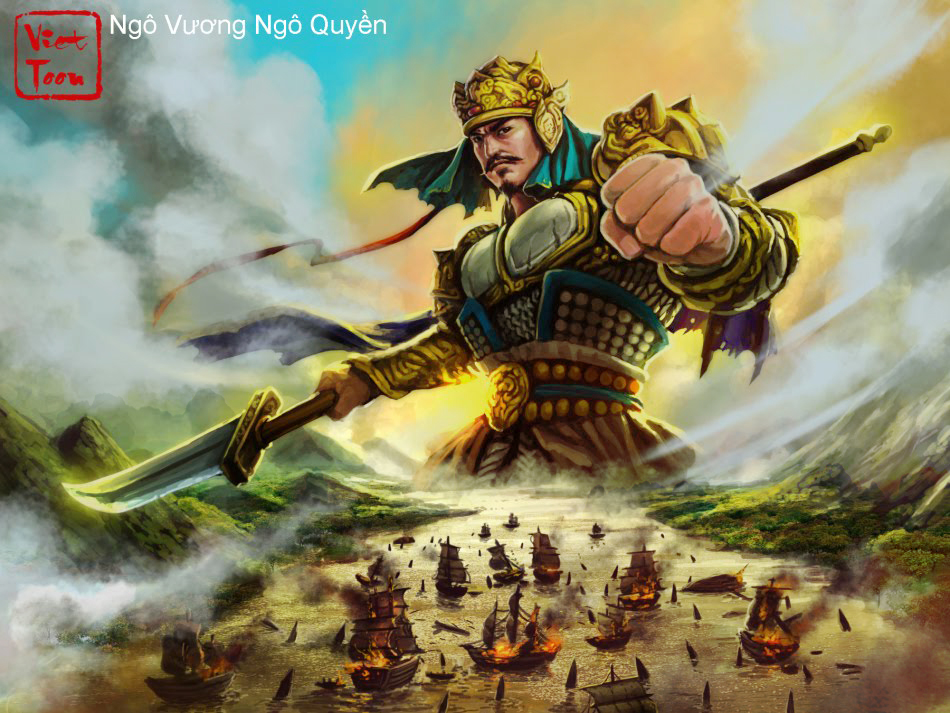
Faced with the Chinese army, which is accustomed to resorting to force and brutality during its conquest and domination of other countries, the Vietnamese must find the ingenuity to emphasize flexible and inventive tactics adapted essentially to the battlefield in order to reduce its momentum and its material superiority in men and numbers. One must never throw oneself headlong into this confrontation, as in this case one seeks to oppose the hardness of egg to that of stone (lấy trứng chọi đá) but one must fight the long with the short, such is the military art employed by the talented generalissimo Ngô Quyền. This is why he had to choose the place of the confrontation at the mouth of the Bạch Đằng River, anticipating the intention of the Southern Han to want to use it with their war fleet led by Crown Prince Liu Hung-Ts’ao (Hoằng Thao) ordered by his father Liu Kung (Lưu Cung) as King of Jiaozhi to quickly facilitate the landing in Vietnamese territory.

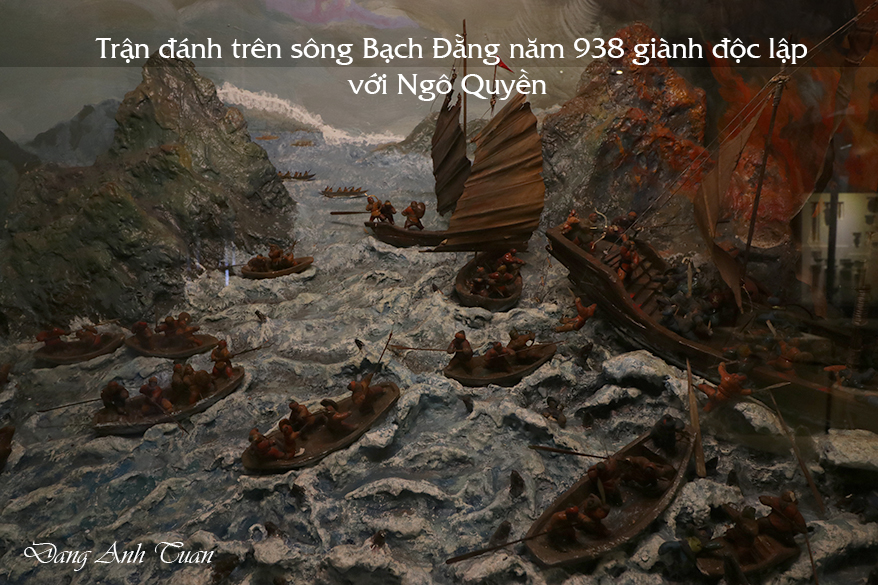
This celestial fleet entered the river mouth as planned. Ngô Quyền had pointed iron-covered stakes planted in the riverbed and invisible during high water prior to this confrontation.  He tried to lure the celestial fleet beyond these iron-covered pointed stakes by incessantly harassing them with flat-bottomed boats. At low tide, the Chinese ships retreated in disarray in the face of attacks from Vietnamese troops, and were besieged on all sides and now hindered by the barrage of emergent piles, resulting not only in the annihilation of Chinese ships and troops, but also the death of Hung-Ts’ao.

 Bạch Đằng river

Ngô Quyền was a fine strategist as he managed to perfectly synchronize the movement of the tides and the appearance of the celestial fleet in a time frame requiring both great precision and knowledge of the place. He knew how to turn the superiority of the opposing force to his advantage, for the army of the Southern Han was known to be excellent in maritime matters, and always made water or the river Bạch Đằng its ally in the fight against its adversaries. Water is the vital principle for the Vietnamese flooded rice civilization, but it is also the lethal principle, as it can become an incomparable force in their battles.  As a high-ranking Chinese mandarin, Bao Chi, later noted in a confidential report to the Song emperor: the Vietnamese are a race well-suited to fighting on water.

If the Vietnamese fled to the sea, how could Song’s soldiers fight them, as the latter were afraid of the wind and the wave (1). Ngô Quyền knew how to refer to the three key factors: Thiên Thời, Địa Lợi, Nhân Hòa (being aware of weather and propitious conditions, knowing the terrain well and having popular support or national concord) to bring victory to his people and to mark a major turning point in Vietnam’s history. This marked the end of Chinese domination for almost 1,000 years, but not the last, as Vietnam continued to be a major obstacle to Chinese expansion to the south.  The leading figure of Vietnamese nationalism in the early 20th century Phan Bội Châu regarded him as the first liberator of the Vietnamese nation (Tổ trùng hưng).

How could he succeed in freeing his people from the Chinese yoke when we knew that at that time our population was about a million inhabitants facing a Chinese behemoth estimated at more than 56 million inhabitants. He must have had courage, inventive spirit and charisma to succeed in freeing himself from this yoke with his supporters. But who is this man that the Vietnamese still consider today as the first in the list of Vietnamese heroes?

Đường Lâm village

Ngo Quyen was born in 897 in Đường Lâm village, located 4 kilometers west of the provincial town of Sơn Tây. He was the son of a local administrator, Ngo Man. When he was young, he had the opportunity to show his character and his willingness to serve the country. In 920, he served Dương Đình Nghệ, a general from the family of Governor Khúc of Ái Châu (Thanh Hóa) province. Dương Đình Nghệ had the merit of defeating the Southern Han by taking the capital Đại La (formerly Hànội) from them in 931 and now declared himself governor of Jiaozhi. He entrusted Ngo Quyen with the task of administering the Ái Châu province. Finding in him great talent and determination to serve the country, he decided to grant him the hand of his daughter. During his 7 years of governance (931-938), he proved to bring peaceful life to this region.

In 937, his father-in-law Dương Đình Nghệ was assassinated by his subordinate Kiều Công Tiễn to take the post of governor of Jiaozhi. This heinous act provoked the anger of all sections of the population. Ngô Quyền decided to eliminate him in the name of his in-laws and the nation because Kiều Công Tiễn asked for help from the Southern Han emperor, Liu Kung. For the latter it was a golden opportunity to reconquer Jiaozhi.

Unfortunately for Liu Kung, this risky military operation ended a long Chinese domination in Vietnam and allowed Ngô Quyền to found the first feudal dynasty in Vietnam. In 939, he proclaimed himself king of Annam and established the capital at Cổ Loa (Phúc Yên). His reign lasted only 5 years. He died in 944. His brother-in-law Dương Tam Kha took advantage of his death to seize power, which provoked the anger of the entire population and led to the breakup of the country with the appearance of 12 local warlords (Thập nhị sứ quân).This political chaos lasted until the year 968 when a brave boy from Ninh Binh, Dinh Boy Linh, succeeded in eliminating them one by one and unifying the country under his banner. He founded the Dinh Dynasty and was known as « Dinh Tien Hoang ». He settled in Hoa Lu in the Red River region and Vietnam at that time was known as « Dai Co Việt (Great Việt) ».

Bibliography

Hoàng Xuân Hãn: Lý Thường Kiệt, Univisersité bouddhique de Vạn Hạnh Saigon 1966 p. 257
Lê Đình Thông: Stratégie et science du combat sur l’eau au Vietnam avant l’arrivée des Français. Institut de stratégie comparée.
Boudarel Georges. Essai sur la pensée militaire vietnamienne. In: L’Homme et la société, N. 7, 1968. numéro spécial. 150° anniversaire de la mort de Karl Marx. pp. 183-199.
 Trần Trọng Kim: Việtnam sử lược, Hànội, Imprimerie Vĩnh Thanh 1928

Dynastie des Tang (Đại Đường)

Version française
English version
Galerie des photos

Người Trung Hoa  tự hào luôn luôn là con cháu  của nhà Hán. Tuy nhiên, thời đại hoàng kim của văn minh Trung Hoa không phải là thời kỳ của  nhà Hán mà chính là thời nhà Đường được  kéo dài  ba thế kỷ sau đó (618-907). Nhờ có nguồn  tài liệu  phong phú và  việc phát giác  ra các minh khí, các vật thu nhỏ nghi lễ được đặt trong các ngôi mộ của giới thượng lưu thời đó, chúng ta biết được  thời kỳ nhà Đường là một thời kỳ có những tiến bộ đáng kể về khoa học và kỹ thuật (thuốc súng, bản in khắc gỗ, kỹ thuật cơ khí, y học, bản đồ, vân vân..). Đây  là một triều đại rất cởi mở với thế giới  bên ngoài bằng cách có chính sách khoan dung chưa từng có đối với các nền văn hóa khác và  các tôn giáo nước ngoài như Giáo hội Phương Đông hay Cảnh Giáo,  đạo thờ lửa , một tôn giáo đa thần đến từ Ba Tư, Phật giáo đang phát triển  nhanh chóng vân vân.

Cũng dưới thời ngự trị  của hoàng đế sáng lập nhà Đường, Đường Thái Tôn (Lỳ Thế Dân)  nhà sư  Huyền Trang mới bắt đầu  cuộc hành hương vào năm 629 mà được gọi là « Tây du Ký » bằng cách  tự nguyện đi một  mình suốt  17 năm từ thủ đô  Trường An theo  lời yêu cầu của hoàng đế hầu mang về  các kinh điển  từ nước Thiên Trúc. Đây cũng là thời kỳ nghệ thuật và văn  học  phát triển đến đỉnh cao với các nhà thơ Đỗ Phủ, Lý Bạch, Bạch Cư Dị, họa sĩ Vương Duy vân vân  và quyền tự do tương đối khả quan  cho  giới phụ nữ. Họ có thể xuất sắc  trong nghệ thuật, đặc biệt là âm nhạc và thi ca, và đôi khi họ có thể có  một địa vị cao hơn trong xã hội. Đây là trường hợp của hoàng hậu Võ Tắc Thiên (Võ Hậu). Phụ nữ thời đó có thể mặc trang phục ít gò bó hơn với áo dài  rộng Hanfu (Hán phục)

Cũng dưới  triều đại này, con đường tơ lụa đã phát triển nhanh chóng cho nhiều mục đích kinh tế, chính trị và tôn giáo bằng cách  áp dụng chính sách hôn nhân chiến lược, các cuộc chinh phục quân sự và viẽc  sử dụng  tơ lụa nhầm  củng cố liên minh, mua chuộc  và chia rẽ các cư dân du mục và bành trướng đế chế  về phía Tây. Nhờ có sự thiết lập này, triều đại nhà Đường đã thành công trong việc thiết lập các mối quan hệ thương mại và văn hóa trên con đường tơ lụa. Đây là con đường mà hai nhà sư của đạo Phương Đông  đã mang theo trứng giun tơ lụa từ Trung Quốc về Byzance bằng cách giấu trong hai gậy bằng tre. Cuối cùng, đây cũng là thời kỳ Việt Nam ta nằm dưới sự đô hộ của nhà Đường sau khi bị sáp nhập trước đó bởi nhà Tùy với tướng Lưu Phương.

Dưới triều đại nhà Đường, Trường An  là một  thành phố quốc tế lớn nhất thế giới vào thời điểm đó. Nó còn  được mệnh danh là « thành phố một triệu dân »  trong  các tài liệu của Trung Hoa. Được biết đến với cái tên « Bình An vĩnh cửu » , nó là thành phố đông dân nhất thế giới trước BaghdadByzance. Tuy nhiên, theo bản ghi chép điều tra dân số năm 742 trong sách Tân Đường Thư,  Trường An  và các vùng lân cận có đến 362.921 gia đình với dân số là 1960188 người trong khi ước tính có hơn 50 triệu người Trung Hoa  sống vào thời điểm đó trên một lãnh thổ từ Biển Đông Trung Quốc đến Trung Á, từ sa mạc Gobi ở phía bắc và vượt qua dãy núi Nanglin (Lĩnh Nam) ở phía nam, nơi có xứ An Nam. Với diện tích gần 87 km2, Trường An không chỉ là một trung tâm quyền lực chính trị và kinh tế mà còn là một  chỗ bình an với những con đường rộng rãi,  các cung điện  xinh đẹp, các đền  Phật giáo, các khu vườn tư nhân và  các chợ rộng lớn. Các đại lộ và các đường xá  được sắp xếp theo một hệ thống hình chữ nhật gồm 114 khối nhà  được  vách tường bao xung quanh riêng lẻ và được bảo vệ chung tất cả  bởi  một bức tường  khác  nằm ở bên ngoài.

Mỗi buổi sáng, sau khi tiếng trống đầu tiên vang lên, người dân từ khắp nơi đế chế cũng như các  thương nhân nước ngoài bị thu hút bởi công việc buôn bán  thủ đô bắt đầu  đi vào thành và lo chuyện kinh doanh. Còn đêm lại, chỉ có thể đi từ con đường lớn nầy  đến con đường khác nếu có giấy phép.  Tất cả các loại hàng hóa, từ đồ nội thất đến các loại gia vị (nghệ của Ba Tư, ớt của Ấn Độ, vân vân) đều  được tìm thấy  ở hai chợ lớn của thành phố, một chợ  nằm ở phía đông và một chợ ở phía tây. Triều đình  quy định kiểm soát giá cả và chất lượng hàng tuần. Sự phát hiện ra một số ngôi mộ của người  Sogdian (Thổ)  ở thủ đô  càng làm rõ  thêm  tại sao  các yếu tố của văn hóa nước ngoài có thể   xâm nhập vào xã hội Trung Quốc ở Trường  An và ngược lại. Thậm chí  còn có cả một khu phố  dành cho người nước ngoài.

Quân lính  của nhà Đường có rất nhiều đơn vị người Thổ cổ  được gọi là Tujue (tiếng Thổ Nhĩ Kỳ nguyên thủy). Nhờ  chính sách tuyển dụng này và kinh nghiệm chiến trường  của các sĩ quan Thổ,  nhà Đường thành công mở rộng đế chế của mình về phía tây. Đó là việc  chinh phục các vương quốc ốc đảo Karakhoja, bởi nhà Đường với tướng Sogdian A Sử Na Xã Nhĩ (Ashina Sheer) vào  năm 648 ở tỉnh Tân Cương ngày nay. Ông được Hoàng đế  Đường Cao Tông  bổ nhiệm làm  Hữu vệ đại tướng quân. Ông qua đời vào năm 655 và được chôn cất bên cạnh Đường Thái Tông (Lý Thế Dân). Ông được đổi tên thụy là  Nguyên (Yuan (元)) sau khi ông qua đời.

Trường An đóng  giữ một vai trò quan trọng trong giao dịch thương mại ở trên con đường tơ lụa với các khu vực xa xôi như Thiên Trúc (Ấn Độ), Trung Đông và châu Âu. Mạng lưới đô thị và kiến trúc tôn giáo của nó (Tháp Đại Nhạn nơi lưu giữ những áng kinh Phật cổ  được dịch bởi  Đường Tăng Huyền Trang) và cung điện (Đại Minh Cung, nơi ở của các hoàng đế nhà Đường) là bằng chứng cho thấy sự  hiểu biết kỹ thuật trong việc coi trọng sự hài hòa và môi trường  và mang lại ảnh hưởng đáng kể về sau  trong việc thiết kế các thủ đô của các  vương quốc  Silla ở Hàn Quốc và Heian ở Japon. Trường  An vẫn là một phần quan trọng trong di sản lịch sử và văn hóa của Trung Quốc.

Dưới triều đại của Hoàng đế Đường Thái Tôn, các thương gia và các người đi buôn  có thể đi lại ở khắp đế chế mà không sợ bị cướp giựt. Các nhà tù  thì trống rỗng và người dân không cảm nhận áy náy phải khóa cửa nhà.  Mùa màng  bội thu: chỉ cần 3 hoặc 4 xu ( qian ) mua được  10 lít gạo. Đây không chỉ là giai đoạn thời kỳ thịnh vượng mà Trung Quốc có được   cho đến thời đại của Hoàng đế Huyền Tông trước cuộc nổi dậy của tướng Sogdian An Lộc  Sơn (An Lu Shan) vào năm 755 mà nó còn là mô hình cai trị thường được nhắc đến trong lịch sử Trung Quốc

Version française

Les Chinois sont fiers d’être toujours les fils des Han.  Pourtant l’âge d’or de la civilisation chinoise n’est pas la période  des Han mais plutôt celle des Tang qui perdure trois siècles plus tard (618-907). Grâce à l’abondance de documentation et la découverte des figurines minqi, des objets rituels déposés dans les tombes des élites de l’époque, on sait que la période des Tang est une période durant laquelle les progrès sont  significatifs en matière des sciences et techniques ( poudre à canon, xylographie, génie mécanique, médecine,  cartographie,  etc.). C’est une dynastie ouverte sur le monde en acceptant la tolérance sans précédent à l’égard des cultures et des religions étrangères (l’église nestorienne, le zoroastrisme, une religion polythéiste venue de Perse,  bouddhisme en plein essor  etc.).

C’est  aussi sous le règne de l’empereur fondateur Tang Tai Zong (Đường Thái Tôn hay Lý Thế Dân) que  le  moine bouddhiste Xuan Zang (Huyền Trang) entama en l’an 629  le pèlerinage sacré   connu sous le nom de «  Pérégrinations vers l’Ouest (Tây Du Ký) » en partant  seul  de la capitale Chang An durant 17 ans,  à la demande  de l’empereur pour ramener les écritures sacrées de l’Inde. C’est aussi la période où l’épanouissement des arts et des lettres était à son comble avec les poètes Du Fu (Đỗ Phủ),  Li Bai (Lý Bạch), Bai Juji (Bạch Cư Dị) , le peintre Wang Wei (Vương Duy) etc.  et celle de la liberté relative pour les femmes. Celles-ci pouvaient exceller dans les arts, en particulier dans la musique et  la poésie.   Elles  pouvaient avoir parfois un statut  plus élevé dans la société. C’est le cas  de l’impératrice Wu Zetian (Võ Tắc Thiên). Les femmes pouvaient porter des vêtements moins contraignants avec la robe ample Hanfu (Hán phục). 

C’est aussi sous cette dynastie que la Route de la Soie connut un grand essor pour de nombreuses fins  à la fois économiques, politiques  et religieuses par la mise en place de la politique de mariage stratégique, les conquêtes militaires et la soie dans le but de consolider les alliances, de soudoyer  et de diviser les nomades et d’agrandir son empire vers l’Ouest. Grâce à cette mise en place, la dynastie réussit à établir des liens commerciaux et culturels tout le long de la route de la soie. C’est par cette route que deux moines nestoriens  ont  ramené à Byzance  les  œufs de vers à soie  de la Chine, en les cachant dans leurs cannes de bambou. Enfin c’est aussi la période où le Vietnam était sous le giron des Tang après avoir été annexé plus tôt par les Sui avec le général Liu Fang (Lưu Phương). 

Sous la dynastie  des Tang, Chang-An est la plus grande ville cosmopolite au monde à cette époque.  Elle  est surnommée « ville d’un million d’habitants » dans les archives chinoises.  Connue sous le nom « Paix Eternelle », elle est la ville la plus densément peuplée du monde devant Bagdad et Byzance. Mais d’après l’enregistrement du recensement en l’an 742 dans le Nouveau Livre des Tang (Tân Đường Thư), Chang ’An et ses environs ont eu 362 921 familles comptant 1960188 personnes tandis qu’on estime plus de 50 millions d’habitants   vivant à cette époque en Chine  sur un territoire allant de la mer de Chine orientale à l’Asie centrale, du désert de Gobi au nord  et au-delà des montagnes Nanglin (Lĩnh Nam) dans le sud où se trouve l’Annam. D’une surface intérieure de presque 87km2, la capitale cosmopolite Chang ’An était non seulement un centre de pouvoir politique et économique  mais  aussi  un havre de paix  doté de larges avenues, de magnifiques palais, de temples bouddhistes, de jardins  privés et de vastes marchés. Ses larges avenues et ses rues étaient disposées selon un damier rectangulaire de 114 blocs de maisons  individuellement murés et  protégés tous par la même muraille externe.

Chaque matin, dès l’annonce de l’ouverture de sa  porte principale par les premiers coups des tambours, les gens venant de tous les coins de l’empire ainsi que  de nombreux marchands  étrangers  attirés par l’important commerce de la capitale  commençaient  à y entrer et à vaquer à leurs affaires. La nuit, on ne pouvait circuler d’un artère qu’à un autre à condition d’avoir un laissez-passer. On y trouvait toutes sortes de marchandises, des meubles jusqu’aux épices (safran de Perse, poivre d’Inde etc.)  dans les deux grands marchés de la ville, l’un à l’est et l’autre à l’ouest. La cour impériale  réglementait le contrôle des prix et de la qualité des produits par semaine. La découverte d’un certain nombre de tombes sogdiennes dans la capitale  a permis de mieux comprendre comment des éléments de la culture étrangère se sont infiltrés dans la société chinoise de Chang’ An et vice-versa. Même on y trouvait un quartier étranger.

L’armée des Tang comptait  beaucoup d’importants contingents de soldats turcs appelés sous le nom Tujue (proto turc). Grâce à cette politique de recrutement et de l’expérience de la steppe que  les officiers turcs ont eue, cela permettait à la dynastie des Tang d’agrandir son empire vers l’Ouest. C’était la conquête des  royaumes-oasis de Karakhoja, par les Tang avec le  général sogdien Ashina She’er  (A Sử Na Xã Nhĩ) en 648 dans l’actuelle province du Xinjiang.  Il était  nommé général de la garde de droite par l’empereur  Tang Gaozong (Đường Cao Tông) . Il mourut en 655 et fut enterré aux côtés de l’empereur  Taizong (Đường Thái Tông). Il fut renommé Yuan () à titre posthume.

Chang An jouait un rôle clé dans l’échange commercial sur la Route de la Soie avec les régions aussi lointaines comme l’Inde, le Moyen Orient et l’Europe. Son maillage urbain et son architecture religieuse (la grande pagode de l’Oie abritant les textes sacrés  rapportés par le moine  Xuan Zang) et palatiale (Palais de la Grande Clarté (Daming Gong  ou la résidence des empereurs) témoignent du savoir-faire technique dans le respect de l’harmonie et de l’environnement et apportent  plus tard une influence non négligeable dans l’aménagement des capitales des Silla en Corée et des Heian au Japon. Chang An  reste une  partie importante dans l’héritage  historique et culturel de la Chine. Sous le règne de l’empereur Tai Zong (Đường Thái Tôn), les commerçants et les marchands pouvaient circuler librement dans tout l’empire sans avoir peur des bandits. Les prisons étaient vides et les gens ne ressentaient pas le besoin de fermer la porte de leurs maisons. Les récoltes étaient abondantes: il suffit d’avoir 3 ou 4 qian pour l’achat de 10 litres de riz. C’est non seulement  la période de prospérité  que la Chine a connue jusqu’au règne de l’empereur Xuan Zong avant la révolte du général sogdien  An Lu Shan (An Lộc Sơn) en 755 mais aussi le bon modèle de gouvernance  souvent évoqué dans l’histoire de la Chine.

Pagode de l’Oie (Tháp Đại Nhạn)


Musée des arts asiatiques Guimet

Dynastie_Tang

[Return MUSEUM]

Art culinaire chinois (Ẩm thực Trung Hoa)

Version vietnamienne
Version française
Version anglaise
Galerie des photos

Theo nhà nghiên cứu người Pháp Françoise Sabban, người Trung Hoa là những người nông dân có khả năng trong việc nấu nướng và tạo ra những món ăn không bị hỏng dù có nấu trong thời gian dài. Họ đạt được sự hài hòa bằng cách kết hợp các hương vị ngọt, chua, đắng, cay và mặn đúng lúc và đúng liều lượng, tạo nên sự cân bằng tinh tế trong quá trình nấu nướng. Vào buổi đầu của nền văn minh, họ là những người ăn sống bất cứ thứ gì họ thu thập và săn bắt ngẫu nhiên, theo tập tục « ru mao yin xue » (茹毛饮血), nghĩa là ăn thịt có lông và uống máu động vật. Nhờ lời chỉ dạy của các vị anh hùng thần thoại Suiren (Toại Nhân)  và Huang Di (Hoàng Đế), người Trung Hoa đã biết lửa và dụng cụ nấu ăn (fu).

Điều này cho phép họ biết đến  ẩm thực cao cấp bằng cách sử dụng vạc ba chân (ding) trong thiên niên kỷ thứ nhất trước Công nguyên dưới triều đại Ân-Thương. Từ đó, nghệ thuật ẩm thực Trung Hoa được ra đời. Chuyển từ đất nung sang đồng, vạc ba chân được thiết kế để đựng thịt, trong khi vạc « gui » dùng để đựng ngũ cốc. Trở thành biểu tượng đích thực của địa vị xã hội, những vạc ba chân này được chôn cùng chủ nhân. Số lượng vạc và « gui »  cho ta biết  địa vị của chủ nhân  trong giới quý tộc. Chỉ có vua chúa mới được chôn cùng chín vạc, mỗi vạc chứa một loại thịt khác nhau: thịt bò, thịt cừu, cá tươi và cá khô, thịt khô, nội tạng, dạ dày và da.

Từ thời nhà Thương (1570-1045 TCN), thịt đã giữ vị trí trang trọng trong ẩm thực Trung Hoa. Thịt có thể được nướng, om, ướp, ninh nhừ và được phục vụ thành từng miếng nhỏ, trên các khay « dou », kế thừa cho dụng cụ nấu ăn vạc ba chân ding trước đây được sử dụng để nấu nướng và phục vụ. Nghệ thuật ẩm thực Trung Hoa tiếp tục phát triển. Nguồn gốc của nó nằm ở phong tục và truyền thống của triều đình, nơi mà các giới luật về y học, chế độ ăn uống và tôn giáo đều đóng một vai trò trong việc thiết kế các bữa ăn. Số lượng và chất lượng các món ăn được phục vụ còn phụ thuộc vào địa vị của người được đề cập trong hệ thống cấp bậc. Một trăm lẻ tám món ăn được dâng lên hoàng đế, trong khi hoàng hậu chỉ có chín mươi sáu món. Hình dạng, chất liệu và màu sắc của các chén đĩa phải hài hòa với các món ăn. Tất cả thông tin phải được ghi chép và lưu trữ, cùng với tên của các món ăn được hoàng đế lựa chọn, lúc ăn trưa và ăn tối một mình. Đây là những gì được ghi lại ở cơ quan lưu trữ dưới triều đại cuối cùng của người Mãn Châu (nhà Thanh).

Mặc dù các ẩm thực địa phương ở Trung Quốc rất đa dạng, nhưng bốn giai đoạn sau đây vẫn được tìm thấy trong nghệ thuật ẩm thực Trung Hoa ngày nay: cắt, chế biến, điều khiển lửa và nêm nếm gia vị.

 Cắt

Trong các sách về nghi lễ, đũa được đề cập đến, nhưng công dụng của chúng không giống như ngày nay. Đũa được dùng để gắp những miếng thịt, cá hoặc rau củ nhỏ ăn kèm với ngũ cốc đã nấu chín, sau đó ăn bằng tay. Để thuận tiện cho việc lấy thức ăn được cắt thành từng miếng nhỏ, việc sử dụng đũa là  điều cần thiết. Việc sử dụng đũa đã được chứng thực ít nhất từ ​​thế kỷ 4-3 trước Công nguyên. Về việc cắt thực phẩm, có ít nhất 200 phương pháp, luôn được thực hiện bằng dao chặt trên thớt. Mỗi phương pháp này có tên kỹ thuật tùy thuộc vào hình dạng thu được. Đây chính là nghệ thuật thực sự của dao « daokou ».

Chế Biến

Người đầu bếp có trách nhiệm tập hợp tất cả các nguyên liệu cần thiết cho món ăn lên đĩa trước khi nấu. Một số nguyên liệu liên quan đến mùa, màu sắc, kết cấu, vân vân. Hơn nữa, một khi đã bước vào giai đoạn sơ chế này, người đầu bếp không được phép rời khỏi bếp.

Chế ngự lửa

Đây là giai đoạn quan trọng nhất trong việc chế biến món ăn Trung Hoa. Chế ngự ngọn lửa đồng nghĩa với việc kiểm soát  được hiệu lực, nhiệt độ, tốc độ (màu sắc của ngọn lửa) và thậm chí cả khoảng thời gian của nó. Sự kiên nhẫn và kinh nghiệm là  những điều cần thiết để tránh sai lầm phổ biến « Bu dao huohou, bu jie guo ». Điều này có nghĩa là không mở nắp nồi cho đến khi đạt được nhiệt độ mong muốn (hỏa hầu). Bí quyết cho một món ăn thành công nằm ở khả năng làm chín nhanh các nguyên liệu trên lửa lớn và tránh nấu quá chín. Chỉ cần chênh lệch nhiệt độ dù chỉ nửa độ cũng có thể làm hỏng món ăn.

Hương vị

Ở giai đoạn này, người đầu bếp có thể sử dụng đầy đủ các loại gia vị: dầu mè, các loại đường, muối, ớt, nước tương, giấm, rượu, nước dùng, bột bắp, vân vân. Việc nêm nếm diễn ra trong quá trình nấu ăn. Chính bên trong chảo là nơi diễn ra quá trình biến đổi, mà người Hoa thường gọi là « ding zhong zhi bian » (biến đổi của vạc). Nhờ những gia vị này, người đầu bếp  có thể đạt được năm vị cơ bản: mặn, ngọt, chua, cayđắng, cho phép tạo ra vô số hương vị. Một số loại gia vị được biết đến ở phương Tây, chẳng hạn như sự kết hợp ngọt và mặn của món Gulao rou, một loại thịt chiên giòn ăn kèm với nước sốt chua ngọt và rau củ muối chua. Trong ẩm thực Tứ Xuyên, có một loại nước sốt có vị lạ (guai wei), được làm từ hỗn hợp mè rang, dầu mè, nước tương, đường và giấm, và được dùng để nêm salad gà, một món ăn lạnh đặc trưng của Tứ Xuyên. Tương tự như món vịt quay Bắc Kinh với lớp da giòn phải ăn kèm với lá hẹ sống và nước sốt Tianmianjang ngọt mặn hoặc là món heo sữa quay nguyên con của Quảng Đông.

Version française

D’après la chercheuse française Françoise Sabban, les Chinois sont devenus des agriculteurs aptes à faire cuire leurs aliments et à faire des plats qui ne sont pas gâtés bien qu’ils l’aient cuit longtemps. Ils réussissaient à obtenir  l’harmonie par la combinaison du doux, de l’acide, de l’amer, du piquant et du salé au moment opportun et en quantité  appropriée dans une subtile alliance lors de la cuisson.  Au début de leur civilisation, ils étaient des gens mangeant cru ce qu’ils cueillaient et tuaient au gré du hasard selon la formule ru mao yin xue 茹毛饮血 (manger la chaire avec les poils et boire le sang des animaux).  Grâce à l’enseignement  des  héros mythiques  Suiren et Huang Di, les Chinois connaissaient le feu et le récipient à cuire (fu).

Cela leur permet de savoir faire la cuisine raffinée  avec le  chaudron  tripode (ding) durant le premier millénaire avant notre ère avec la dynastie des Yin-Shang.  Dès lors, l’art culinaire des Chinois est né. Passés de la terre cuite au bronze, les tripodes ding sont conçus pour les viandes et les vases gui pour les céréales. Etant devenus de véritables emblèmes de statut social, ces tripodes sont enterrés avec leur propriétaire. En fonction du nombre de ding et de gui, on connait son rang au sein de l’aristocratie. Seul le souverain est enterré avec neuf ding, chacun contenant un type de viande : bœuf, mouton, poisson frais et séché, viande séchée, viscères, estomac, peau.

Depuis les Shang [1570-1045], la viande  tient la première place dans la cuisine chinoise. Elle peut être rôtie, braisée, marinée,  mijotée et proposée en menus morceaux sur des présentoirs dou, successeurs des « ding » qui servaient auparavant à la cuisson et au service. L’art culinaire chinois continue  à évoluer.  Il plongeait ses racines dans les us et coutumes de la cour impériale où les préceptes de la médecine,  de la diététique et la religion avaient leur part dans la conception des repas. Le nombre et la qualité des plats servis dépendaient de la position occupée par la personne en question  dans l’hiérarchie. Cent huit mets étaient  proposés  à l’empereur tandis que l’impératrice n’avait que quatre-vingt seize. La forme, la matière et la couleur de la vaisselle devaient s’harmoniser avec les préparations. Toutes les informations devaient être notées et archivées en même temps que le nom des mets choisis par l’empereur qui déjeunait et dinait seul. C’est ce qui a été rapporté  dans les archives sous la dernière dynastie mandchoue.(Qing).

 Malgré la multiplicité de cuisines régionales que connait la Chine, on  trouve toujours jusqu’aujourd’hui les quatre phases suivantes dans l’art culinaire chinois: le taillage, l’assemblage, la maîtrise du feu et l’assaisonnement.

Le taillage

Dans les Traités des rites, on mentionne les baguettes mais leur emploi n’est pas celui qu’on a aujourd’hui.  Les baguettes servaient à saisir de petits morceaux de viande, de poissons ou de légumes accompagnant la céréale cuite, celle-ci étant mangée avec les mains. Pour faciliter la saisie des aliments découpés en petites bouchées, on était obligé de recourir à l’emploi des baguettes. Leur usage est attesté au moins depuis le IVème – IIIème siècle avant J.C.

Quant au découpage des aliments, on dénombre au moins 200 modes de taillage, toujours effectués avec un fendoir sur un billot.  Chacun de ces modes porte un nom technique selon la forme obtenue. C’est le véritable art du couteau «  daokou ».

L’assemblage

Le cuisinier est chargé de regrouper  tous les ingrédients indispensables à la préparation d’un mets  sur une assiette avant le passage par le feu. Certains ingrédients sont liés à la saison, aux couleurs, aux consistances etc. De plus il ne peut plus quitter le fourneau une fois engagé dans cette espèce de préfiguration du plat.

Maîtrise du feu

C’est la phase la plus importante dans la préparation d’un plat chinois. Maîtriser le feu c’est maîtriser à la fois sa puissance, sa température, son allure (couleur des flammes) et sa durée.  Il faut avoir de la patience et de l’expérience pour éviter l’erreur commise  « Bu dao huohou, bu jie guo ». Cela veut dire qu’il ne faut pas soulever le couvercle de la marmite quand le huohou n’est pas atteint.  Le secret de la réussite de ce plat réside dans la capacité à saisir les ingrédients sur un feu vif et à ne pas prolonger la cuisson. Une différence d’un demi-degré de température peut gâcher le plat.

L’assaisonnement

C’est dans cette étape que le cuisinier dispose de toute la  panoplie des condiments: huile de sésame, sucres variés, sel, piment, sauce de soja, vinaigre, vin, bouillon, fécule etc. L’assaisonnement a lieu au cours de la cuisson. C’est au sein de la poêle que s’effectue l’opération de transmutation que les Chinois sont habitués à appeler souvent sous le nom « ding zhong zhi bian (transformations du chaudron) ». Grâce à ces condiments, le cuisinier peut avoir les cinq saveurs de base: le salé, le doux, l’aigre, le piquant et l’amer, ce qui lui donne la possibilité de se construire une infinité de goûts.  Certains sont connus en Occident comme le sucré-salé  du Gulao rou, un plat de viande en beignet servi dans une sauce aigre-douce aux légumes marinés. Pour la cuisine de Sichuan, il y a une sauce ayant un goût étrange (guai wei), obtenue à partir de la combinaison de la purée de sésame torréfié, d’huile de sésame, de sauce de soja, de sucre et de vinaigre et servant à assaisonner une salade de poulet, un plat froid typique de Sichuan. C’est aussi le cas du canard laqué du Pékin à la peau croustillante qu’on doit manger avec la ciboule crue et la sauce sucrée-salée tianmianjang ou bien  des cochons de lait rôtis entiers de Canton.

Version anglaise

According to the French researcher Françoise Sabban, the Chinese became farmers capable of cooking their food and making dishes that are not spoiled even though they cooked them for a long time. They succeeded in achieving harmony by combining sweet, sour, bitter, spicy, and salty flavors at the right moment and in the appropriate quantity in a subtle blend during cooking. At the beginning of their civilization, they were people who ate raw what they gathered and killed by chance according to the formula ru mao yin xue 茹毛饮血 (eating flesh with hair and drinking the blood of animals). Thanks to the teachings of the mythical heroes Suiren and Huang Di, the Chinese knew fire and the cooking vessel (fu).
This allowed them to master refined cooking with the tripod cauldron (ding) during the first millennium BCE with the Yin-Shang dynasty. From then on, Chinese culinary art was born. Transitioning from earthenware to bronze, the tripod dings were designed for meats and gui vessels for grains. Having become true emblems of social status, these tripods are buried with their owners. Depending on the number of ding and gui, one’s rank within the aristocracy is known. Only the sovereign is buried with nine ding, each containing a type of meat: beef, mutton, fresh and dried fish, dried meat, offal, stomach, skin.

Since the Shang [1570-1045], meat has held the foremost place in Chinese cuisine. It can be roasted, braised, marinated, simmered, and served in small pieces on dou stands, successors to the « ding » which were previously used for cooking and serving. Chinese culinary art continues to evolve. It rooted itself in the customs and traditions of the imperial court where the principles of medicine, dietetics, and religion played a role in the conception of meals. The number and quality of dishes served depended on the rank held by the person in the hierarchy. One hundred and eight dishes were offered to the emperor while the empress had only ninety-six. The shape, material, and color of the tableware had to harmonize with the preparations. All information had to be recorded and archived along with the names of the dishes chosen by the emperor, who dined alone. This is what was reported in the archives under the last Manchu dynasty (Qing).

Despite the multiplicity of regional cuisines known in China, the following four phases are still found today in Chinese culinary art: cutting, assembling, mastering the fire, and seasoning.

Cutting

In the Treatises on Rites, chopsticks are mentioned but their use was not the same as it is today. Chopsticks were used to pick up small pieces of meat, fish, or vegetables accompanying cooked grains, which were eaten with the hands. To facilitate picking up food cut into small bites, the use of chopsticks was necessary. Their use is attested at least since the 4th – 3rd century BC.

As for cutting food, there are at least 200 cutting techniques, always carried out with a cleaver on a chopping block. Each of these techniques has a technical name according to the shape obtained. This is the true art of the knife « daokou. »

Assembly

The cook is responsible for gathering all the essential ingredients for preparing a dish on a plate before cooking. Some ingredients are related to the season, colors, textures, etc. Moreover, once engaged in this kind of prefiguration of the dish, the cook can no longer leave the stove.

Cutting

In the Treatises on Rites, chopsticks are mentioned but their use was not the same as it is today. Chopsticks were used to pick up small pieces of meat, fish, or vegetables accompanying cooked grains, which were eaten with the hands. To facilitate picking up food cut into small bites, it was necessary to use chopsticks. Their use is attested at least since the 4th – 3rd century BC.

As for cutting food, there are at least 200 cutting techniques, always performed with a cleaver on a chopping block. Each of these techniques has a technical name according to the shape obtained. This is the true art of the knife « daokou. »

Assembly

The cook is responsible for gathering all the essential ingredients for preparing a dish on a plate before cooking. Some ingredients are linked to the season, colors, textures, etc. Moreover, once engaged in this kind of prefiguration of the dish, the cook cannot leave the stove.

Mastery of Fire

This is the most important phase in preparing a Chinese dish. Mastering the fire means controlling its power, temperature, behavior (color of the flames), and duration. Patience and experience are required to avoid the mistake « Bu dao huohou, bu jie guo. » This means that one must not lift the lid of the pot before the huohou (fire heat) is reached.The secret to the success of this dish lies in the ability to sear the ingredients over high heat and not to prolong the cooking. A difference of half a degree in temperature can ruin the dish.

The seasoning

It is at this stage that the cook has the full range of condiments: sesame oil, various sugars, salt, chili, soy sauce, vinegar, wine, broth, starch, etc. The seasoning takes place during cooking. It is within the pan that the operation of transmutation occurs, which the Chinese are accustomed to often call « ding zhong zhi bian » (transformations of the cauldron). Thanks to these condiments, the cook can have the five basic flavors: salty, sweet, sour, spicy, and bitter, which gives them the possibility to create an infinite variety of tastes. Some are known in the West, such as the sweet and sour flavor of Gulao rou, a meat dish in batter served in a sweet and sour sauce with pickled vegetables. For Sichuan cuisine, there is a sauce with a strange taste (guai wei), obtained from a combination of roasted sesame paste, sesame oil, soy sauce, sugar, and vinegar, used to season a chicken salad, a typical cold dish of Sichuan. This is also the case with Peking roast duck with crispy skin, which must be eaten with raw scallions and the sweet and salty sauce tianmianjiang, or with whole roasted suckling pigs from Canton.

Galerie des photos

Bibliographie

Françoise Sabban: L’histoire. Numéro spécial; N° 300. Juillet-Août 2005
Les Séductions du Palais. Cuisiner et manger en Chine. Connaissances des Arts.  Musée du Quai Branly
Chine. La gloire des empereurs. Connaissance des Arts. Paris musées.

[Return CHINE]

La Muraille de Chine


La Muraille de Chine

Vạn Lý Trường Thành

Version française

English version

Vạn lý trường thành gồm rất nhiều đồn lũy  quân sự và phòng thủ nằm  rải rắc ở các địa điểm khác nhau ở biên giới phía bắc Trung Quốc. Được biết đến với tên tiếng Hoa là “Vạn Lý Trường Thành”, nó bắt đầu ở phía đông tại Sơn Hải Quan, thuộc tỉnh Hà Bắc và kết thúc tại Gia Dục Quan  ở phía đông tỉnh Cam Túc. Với chiều dài hơn 5000 cây số, nó là biểu tượng của Trung Quốc ngày nay. Những phần gần Bắc Kinh đã được khôi phục nhưng ở phía Bắc vẫn còn những đoạn tường dễ bị sụp đổ. Công trình phòng thủ rộng lớn này được xây dựng từ thời nhà Chu vào thế kỷ thứ 9 trước Công nguyên để bảo vệ đất nước tránh sự xâm lăng của dân man rợ ở phương Bắc. Đây là lý do tại sao không chỉ có tường và đường đi cho kỵ sĩ  mà còn có cả các tháp canh.

Vào năm 1987, Vạn Lý Trường Thành đã được UNESCO công nhận là di sản thế giới. Nó còn  được công nhận là công trình kiến ​​trúc nhân tạo duy nhất trên trái đất có thể nhìn thấy từ mặt trăng. Dưới  thời Chiến Quốc, các bức tường khác được các lãnh chúa của các vương quốc này dựng lên nhầm bảo vệ đất nước. Các nhà sử học gọi chúng là “ các bức tường thời tiền Tần”. Sau khi đất nước  được thống nhất, người ta kể rằng trong giấc mơ, Tần Thủy Hoàng đã nhìn thấy sự tan rã đế chế của mình bởi những kẻ man rợ từ phương Bắc. Bị ám ảnh bởi giấc mơ này, ngài mới giao cho tướng Mộng Điềm liên kết  lại các bức tường của sáu nước bị chinh phục này để chống lại bọn man rợ này. Nhà Minh đã thực hiện công việc  tu bổ sửa chửa   hoàn tất lại  kéo dài khoảng 200 năm.

Đây chính là bức tường nhà Minh mà chúng ta thấy ngày nay. Đây cũng là ý  kiến của Arthur Waldron, tác giả cuốn sách có tựa đề “Vạn Lý Trường Thành của Trung Quốc. Từ lịch sử đến thần thoại”. Theo ông, bức tường Trung Quốc không thể  tiến xa hơn vào cuối thế kỷ 15 và nửa đầu thế kỷ 15. Nó đi từ đèo Shanhaiguan về phía đông và Jiayuguan đèo Jiayu (Jiayuguan) ở phía tây trên chiều dài 5660 cây số. Có thể nói, việc xây dựng Vạn Lý Trường Thành chưa bao giờ bị gián đoạn hoàn toàn trong suốt hai ngàn năm, từ thời Chiến Quốc đến thời nhà Thanh. Theo ghi chép lịch sử, việc xây dựng nó có huy động  hàng trăm ngàn nông dân. Hơn nữa, trong suốt   thời gian làm việc ngày đêm , có hơn 1,5 triệu người tham gia, không quên ghi nhận có sự tham gia đông đảo của binh lính. Người Trung Quốc có thói quen nói ai chưa trèo lên Vạn Lý Trường Thành thì không xứng đáng là hảo hán.

Chính vì lý do này mà Vạn Lý Trường Thành là một trong những địa điểm được người Trung Hoa tham quan nhiều nhất. Đây cũng là chiến tuyến ngăn cách người Hung Nô với người Trung Hoa. Nhiều người đã được gửi đến đây  và chết ở mặt trận này. Vạn Lý Trường Thành  đã chứng kiến  nhiều bi kịch của con người và những cuộc chia ly đau đớn và bi thảm. Điều này làm chúng ta nhớ đến bốn câu trong bài thơ hay Lương Châu Từ của nhà thơ nổi tiếng Vương Hàn (Wang Han) ở thời  nhà Đường:

Rượu bồ đào cùng với chén lưu ly
Muốn uống nhưng tỳ bà đã giục lên ngựa
Say khướt nằm ở sa trường, bác chớ cười
Xưa nay chinh chiến mấy ai trở về.


万里

Chúng ta cũng có thể nhớ đến truyền thuyết nổi tiếng nhất của Vạn Lý Trường Thành, đó là truyền thuyết về  Mạnh Khương nữ (Meng Jiangnu). Nàng không ngần ngại đi bộ hơn 10.000 dặm để đi kiếm  chồng mình, một thư sinh  tên là Phạm Hỷ Lương (Fan Qiliang), người được hoàng đế Tần  Thủy Hoàng  gửi  đến đèo Shanhaiguan trong ngày cưới để xây tường thành. Ở đó, nàng  biết tin chồng mình đã chết vì đói lạnh và nàng không thể tìm thấy thi thể của chồng. Tuyệt vọng, cô khóc không ngừng suốt 3 ngày 3 đêm. Nước mắt của nàng  làm xói mòn một phần thành lũy, giúp nàng tìm thấy thi thể chồng mình bị chôn vùi dưới bức tường. Sau khi chôn cất, nàng  tự sát bằng cách lao mình xuống biển.

Ngày nay, ở Sơn Hải Quan  (Hà Bắc, Hà Bắc) đã có dựng bàn thờ để tưởng nhớ bà. Cũng tại Sơn Hải Quan , tướng  nhà Minh Ngô Tam Quế đã từ chối liên minh với Lý Tự Thành, thủ lĩnh nông dân khởi nghĩa vì lý do đơn giản là Lý Tự Thành cướp  vợ thứ của Ngô Tam Quế là Trần Viên Viên nên mở cửa thành  đầu  quân Mãn Châu. Nhờ đó  mới có sự khởi đầu của triều đại nhà Thanh (Mãn Châu).

Sự vững chắc của bức tường thành Vạn Lý này phần lớn là do việc sử dụng gạo nếp và canxi c ủa vôi trong sản xuất  vữa vôi dùng để sửa chữa, phục hồi các công trình bằng đá cổ. Theo nhà nghiên cứu người Trung Quốc Zhang Bingjian của Đại học Chiết Giang, đó là Amylopectin (trong tiếng Việt gọi là vữa vôi), một chất có độ bền cơ học cao, giúp các công trình cổ của Trung Quốc, đặc biệt là Vạn Lý Trường Thành, bền  vững trước thử thách của thời gian và động đất. Ông đã báo cáo phát hiện này trong bài báo đăng trên tạp chí Hoa Kỳ « Journal of the American Chemical Society, 2010, 132 (19), pp 6855–6861« . Điều này giải thích phong trào biểu tình của quần chúng ở  miền nam Trung Quốc, nơi vào thời điểm đó có việc trưng dụng gạo một cách có hệ thống. Mục đích của việc này là dùng để làm vữa nếp và cung cấp thức ăn cho những người chịu có trách nhiệm trùng tu bức tường này vào thời nhà Minh.

Version française

Elle est constituée par un grand nombre de fortifications militaires et défensives  dans  différents endroits  à la frontière nord de la Chine. Etant connue sous le nom chinois de « La longue muraille de dix mille li », elle commence à l’est à Shanhaiguan (Sơn Hải Quan), dans la province du Hebei (Hà Bắc) , et se termine à Jiayuguan (Gia Dục quan)  dans la province orientale du Gansu (Cam Túc). Ayant plus de 5000 km, elle est le symbole de la Chine d’aujourd’hui. Les sections proches de Pékin ont été restaurées mais dans le Nord mais il reste encore des pans de murs chancelants. Ce grand ouvrage défensif fut construit  à l’époque des Zhou au IXème siècle avant J.C. C’est pourquoi on y trouve non seulement  des murs, de pistes cavalières mais aussi des  tours de guet. C’est  en 1987 que  la Grande Muraille est classée au patrimoine mondial de l’UNESCO . Elle est reconnue aussi comme le seul  ouvrage construit par l’homme sur la terre que l’on puisse voir depuis la lune.

À l’époque des Royaumes Combattants, d’autres murs furent construits par les seigneurs de ces royaumes dans le but de défendre leur pays. Les historiens les qualifient de « murs pré-Qin ». Après l’unification du pays, on dit que dans son rêve, l’empereur des Qin Shi Huang Di aurait vu l’occupation de son empire par les barbares du Nord. Hanté par ce songe, il a chargé le général Meng Tian (Mộng Điềm) de relier les murs de ces six états conquis dans le but de contrer ces barbares.  La dynastie des Ming a effectué les travaux de rénovation d’une durée approximative de 200 ans.

C’est la muraille des Ming qu’on voit aujourd’hui. C’est aussi l’avis de Arthur Waldron, auteur du livre intitulé « The Great Wall of China. From history to myth« . Pour ce dernier, la Muraille de Chine ne va pas plus loin au delà de la fin du XVème siècle. Elle va de Shanhaiguan (la passe Shanhai à l’est) et à Jiayuguan  (la passe Jiayu à l’ouest) sur une longueur de 5660km. On peut dire que la construction de la grande muraille n’a jamais été interrompue complètement durant 2000 ans, de l’époque des Royaumes Combattants jusqu’à la dynastie des Qing. D’après les registres historiques, sa construction a mobilisé des centaines de milliers de paysans. De plus, durant les périodes de travaux intensifs, plus de 1,5 millions de personnes y sont engagées également sans oublier de noter aussi la participation massive de soldats. Les Chinois ont l’habitude de dire que celui qui n’est pas monté encore sur la Muraille de Chine ne mérite pas d’être un homme valeureux. »Bất đáo Trường Thành phi hảo hán (Chưa đến Vạn lý trường thành chưa phải là hảo hán« . C’est pour cette raison que la Muraille de Chine est l’un des sites les plus visités par les Chinois. Elle est aussi la ligne de front séparant les Barbares des Chinois. Beaucoup de gens ont été envoyés et péri sur ce front. La Muraille de Chine est témoin de plusieurs drames humains et de séparations douloureuses  et tragiques. Cela nous fait rappeler les quatre vers du beau poème Liangzhu (Lương Châu Từ) du célèbre poète chinois Vương Hàn (Wang Han) à  l’époque de la dynastie des Tang (Nhà Đường):

Bồ đào mỹ tửu dạng quang bôi
Dục ẩm tì bà mã thượng thôi
Túy ngọa sa trường quân mạc tiếu
cổ lai chinh chiến kỉ nhân hồi

Rượu bồ đào cùng với chén lưu ly
Muốn uống nhưng tỳ bà đã giục lên ngựa
Say khướt nằm ở sa trường, bác chớ cười
Xưa nay chinh chiến mấy ai trở về.

Il y a du vin rouge contenu dans ma coupelle étincelante et translucide
Malgré l’envie de le boire, je suis pressé de monter à cheval à cause du son du pipa
Ne ricanez pas si vous me voyez étendu et ivre mort sur le champ de bataille
Depuis toujours et de toutes les guerres, combien de gens en sont-ils revenus?


万里


On peut se remémorer aussi la plus célèbre légende de la Muraille de Chine, celle de la pleureuse Mạnh Khương nữ (Meng Jiangnu). Celle-ci n’hésite à marcher plus de 10.000 li pour aller chercher son mari, un étudiant nommé Fan Qiliang (Phạm Hỷ Lương) que l’empereur de Chine Shi Huang Di a envoyé le jour de son mariage à la passe de Shanhaiguan pour construire la muraille. Sur place, elle apprend le décès de son mari mort de faim et de froid et elle ne réussit pas à retrouver son corps. Désespérée, elle pleure incessamment durant 3 jours et 3 nuits. Ses larmes érodent une portion du rempart, ce qui lui permet de retrouver le corps de son mari enseveli sous la muraille. Après l’enterrement, elle se suicide en se jetant dans la mer.

Aujourd’hui, à Shanhaiguan (Sơn Hải Quan) (Hebei, Hà Bắc), il y a l’autel érigé en l’honneur de cette dame. C’est aussi à Shanhaiguan (Sơn Hải Quan) que le général chinois Wu Sanggui (Ngô Tam Quế) de la dynastie des Ming qui refuse de s’allier à Li Zicheng ( Lý Tự Thành ), le chef des rebelles paysans pour la simple raison que ce dernier s’empare de sa concubine Chen Yuanyuan (Trần Viên Viên), a ouvert la porte aux armées mandchoues. C’est ainsi que débute la dynastie des Qing.

La solidité de cette muraille est due en grande partie à l’utilisation du riz glutineux et du calcium de la chaux (vôi) dans la fabrication du mortier servant à la réparation et à la restauration des anciennes constructions en pierres et en roches. Selon le chercheur chinois Zhang Bingjian de l’université Zhejiang ( Chiết Giang), c’est l’Amylopectine (ou vữa en vietnamien ), une substance à haute résistance mécanique qui permet aux constructions anciennes chinoises, en particulier la Muraille de Chine, de résister à l’épreuve du temps et au séisme. Il a rapporté cette découverte dans son article publié dans le journal américain « Journal of the American Chemical Society, 2010, 132 (19), pp 6855–6861« . Cela donne l’explication au mouvement des protestations populaires ayant lieu au sud de la Chine où il y a en ce temps-là la réquisition systématique du riz. Celle-ci a pour but de servir à fabriquer le mortier glutineux et à nourrir les gens chargés de restaurer cette muraille à l’époque des Ming.

English version

It consists of a large number of military and defensive fortifications in different locations on the northern border of China. Known by the Chinese name « The Ten Thousand Li Long Wall », it begins in the east at Shanhaiguan (Sơn Hải Quan), in Hebei Province (Hà Bắc), and ends at Jiayuguan (Gia Dục quan) in the eastern province of Gansu (Cam Túc). With a length of more than 5,000 km, it is the symbol of today’s China. The sections near Beijing have been restored, but in the north, there are still sections of shaky walls. This great defensive work was built during the Zhou period in the 9th century BC. Therefore, it contains not only walls, bridleways but also watchtowers. The Great Wall was declared a UNESCO World Heritage Site in 1987. It is also recognized as the only man-made structure on Earth that can be seen from the moon.

During the Warring States period, other walls were built by the lords of these kingdoms to defend their countries. Historians refer to these as the « pre-Qin walls. » After the unification of the country, it is said that in his dream, the Qin emperor Shi Huang Di saw the occupation of his empire by the northern barbarians. Haunted by this dream, he commissioned General Meng Tian (Mộng Điềm) to connect the walls of these six conquered states in order to counter these barbarians. The Ming Dynasty carried out the renovation work, which lasted approximately 200 years.

This is the Ming wall that we see today. This is also the opinion of Arthur Waldron, author of the book « The Great Wall of China. From History to Myth. » For him, the Great Wall of China does not extend beyond the end of the 15th century. It runs from Shanhaiguan (the Shanhai Pass in the east) to Jiayuguan (the Jiayu Pass in the west) over a length of 5660 km. It can be said that the construction of the Great Wall was never completely interrupted for 2000 years, from the Warring States period to the Qing Dynasty. According to historical records, its construction mobilized hundreds of thousands of peasants. In addition, during periods of intensive work, more than 1.5 million people were also engaged in it, not to mention the massive participation of soldiers. The Chinese are accustomed to saying that he who has not yet climbed the Great Wall of China does not deserve to be a valiant man. « Bất đáo Trường Thành phi hảo hán (Chưa đến Vạn lý trường thành chưa phải là hảo hán ». This is why the Great Wall of China is one of the most visited sites by the Chinese. It is also the front line separating the Barbarians from the Chinese. Many people were sent and perished on this front. The Great Wall of China is witness to several human dramas and painful and tragic separations. This reminds us of the four lines of the beautiful poem Liangzhu (Lương Châu Từ) by the famous Chinese poet Vương Hàn (Wang Han) at the time of the Tang Dynasty (Nhà Đường):

Bồ đào mỹ tửu dạng quang bôi
Dục ẩm tì bà mã thượng thôi
Túy ngọa sa trường quân mạc tiếu
cổ lai chinh chiến kỉ nhân hồi

Rượu bồ đào cùng với chén lưu ly
Muốn uống nhưng tỳ bà đã giục lên ngựa
Say khướt nằm ở sa trường, bác chớ cười
Xưa nay chinh chiến mấy ai trở về.

There’s red wine in my sparkling, translucent bowl.
Despite the urge to drink it, I’m in a hurry to get on horseback because of the sound of the pipa.
Don’t sneer if you see me lying dead drunk on the battlefield.
Since the dawn of time, and from all the wars, how many people have returned?


万里


We can also recall the most famous legend of the Great Wall of China, that of the mourner Mạnh Khương nữ (Meng Jiangnu). She did not hesitate to walk more than 10,000 li to fetch her husband, a student named Fan Qiliang (Phạm Hỷ Lương) whom the Emperor of China Shi Huang Di sent on the day of his wedding to the Shanhaiguan pass to build the wall. There, she learned of the death of her husband who had died of hunger and cold and she was unable to find his body. Desperate, she cried incessantly for 3 days and 3 nights. Her tears eroded a portion of the rampart, which allowed her to find the body of her husband buried under the wall. After the burial, she committed suicide by throwing herself into the sea.

Today, in Shanhaiguan (Sơn Hải Quan) (Hebei, Hà Bắc), there is the altar erected in honor of this lady. It is also in Shanhaiguan (Sơn Hải Quan) that the Chinese general Wu Sanggui (Ngô Tam Quế) of the Ming dynasty, who refused to ally himself with Li Zicheng (Lý Tự Thành), the leader of the peasant rebels for the simple reason that the latter seized his concubine Chen Yuanyuan (Trần Viên Viên), opened the door to the Manchu armies. This is how the Qing dynasty began.

The strength of this wall is largely due to the use of glutinous rice and lime calcium (vôi) in the manufacture of mortar used for the repair and restoration of ancient stone and rock constructions. According to Chinese researcher Zhang Bingjian of Zhejiang University (Chiết Giang), it is Amylopectin (or vữa in Vietnamese), a substance with high mechanical resistance that allows ancient Chinese constructions, in particular the Great Wall of China, to withstand the test of time and earthquakes. He reported this discovery in his article published in the American journal « Journal of the American Chemical Society, 2010, 132 (19), pp 6855–6861 ». This explains the movement of popular protests taking place in southern China where at that time there was the systematic requisition of rice. This was used to make glutinous mortar and to feed the people responsible for restoring this wall during the Ming era.

[Retour CHINE]


Thập Tam Lăng ( 13 Mausolées des Ming)

Thập Tam  Lăng nhà Minh

Ming Shisan Ling

Version française

 English version

Mười ba lăng mộ nhà Minh nằm trong một thung lũng rộng phía nam núi Thiên Thọ, cách Bắc Kinh khoảng 42 cây số. Thung lũng này được chọn vì đáp ứng được tiêu chí về Phong Thủy. Nó được bao bọc ba mặt ở  phía bắc nhờ có một dãy núi còn về phía nam nhờ sự  hiện diên một khe hở  để  tránh được các thần linh  ma quỷ từ gió bắc mang đến. Tổng cộng có 13 trong số 16 hoàng đế   của nhà Minh, 23 hoàng hậu, một phi tần nhất phẩm cùng một số phi tần được an nghỉ tại nơi thung lũng bình  yên này. Có ba  vị hoàng đế nhà Minh không được chôn cất ở nơi nầy.

Nằm ở trung tâm nghĩa trang, thì có ngôi mộ của Chu Đệ (Trường Lăng) được  xem  là nổi bật với kích thước to lớn so với mười hai lăng mộ khác. Nó cũng là ngôi mộ đầu tiên được xây dựng ở đây với 60 cột gỗ lim cao có 12 mét và có đường kính 1 mét được đưa từ vùng rừng sâu của Vân Nam và Tứ Xuyên mang về Bắc Kinh và cũng là nơi tổ chức mọi hoạt động cúng tế. Còn các ngôi mộ khác của các hoàng đế nhà Minh thì được sắp xếp theo  mô hình cây quạt xung quanh  con đường  chính thiêng liêng được gọi là « Thần Đạo »  (Shendao)

Dọc hai bên của con đường dài này thì  có 36 bức tượng bằng đá, 12 vị quan chức dân sự và quân sự, và 12 cặp động vật (sư tử, lạc đà, kỳ lân, voi, ngựa và con vật tưởng tượng). Ngôi mộ của Chu Đệ (Yong Le)  vẫn còn nguyên vẹn. Nhưng chúng ta  cũng biết rằng khi ông được an táng,  có 16 phi tần cũng bị chôn sống. Phong tục dã man này đã bị bãi bỏ sau đó vào thế kỷ 15 dưới thời vua Minh Thần Tông (Vạn Lịch).

Khi còn sống, Hoàng đế Vạn Lịch  bắt đầu xây dựng Định Lăng vào năm 1584. Điều này khiến nhà nước tốn một khoản tiền đáng kể. Không biết cấu trúc bên trong của ngôi mộ này, giáo sư Xia Nai, giám đốc Viện Khảo cổ học Bắc Kinh phải  thực hiện cuộc khảo sát đầu tiên về Định Lăng vào năm 1956 và phát hiện ra ngôi mộ  nầy chưa bao giờ  bị xâm phạm. Chính nhờ một thẻ  bài mới  biết ra vị trí của cánh cửa ở  trong bức tường với cơ chế bí mật được chôn sâu khoảng chừng  11 thước  dưới lòng đất, ông mới thành công trong việc mở được ngôi mộ này cũng như các căn phòng phụ của nó.

Điều này dẫn đến  sự tìm thấy phòng chôn cất của Vạn Lịch và hai  bà hoàng hậu Tiêu DuẩnTiêu Cảnh. Ngoài ra còn có một số lượng lớn các đồ vật quý giá (trang sức bằng ngọc bích, gốm sứ ba màu, meiping (một lọại bình sứ ) vân vân ) trong 26 chiếc rương sơn mài màu đỏ tía được cất giử  ở phòng phía sau cùng.

Điều này dẫn đến  sự tìm thấy phòng chôn cất của Vạn Lịch và hai  bà hoàng hậu. Ngoài ra còn có một số lượng lớn các đồ vật quý giá (trang sức bằng ngọc bích, gốm sứ ba màu, meiping (một lọại bình sứ ) vân vân ) trong 26 chiếc rương sơn mài màu đỏ tía được cất giử  ở phòng phía sau cùng. Hiện tại, ngôi mộ duy nhất mà có thể du khách được truy cập  đó  lăng của  Wanli (1573-1620) (Vạn Lịch). Bà hoàng hậu (Hiếu Đoan Văn Hoàng hậu) và bà hoàng quí phi (Hiếu Tĩnh Hoàng hậu) được  chôn cất bên cạnh hoàng đế.

Cung điện dưới lòng đất nầy có diện tích 1195 thước vuông, sâu 27 mét. Nó được có 5 phòng: phòng phía trước, phòng trung tâm, phòng phía sau cũng như hai phòng bên. Nó được xây dựng bởi 30.000 công nhân sau sáu năm. Phòng trung tâm và phòng phía trước tạo thành một hành lang dài vuông góc với phòng phía sau. Tất cả các phòng đều được ngăn cách với nhau bằng một cánh cửa lớn bằng đá cẩm thạch màu trắng được trang trí bằng những tác phẩm điêu khắc tinh xảo. Ngoài ra còn có 3 chiếc ngai bằng đá cẩm thạch dành riêng cho người đã khuất ở gian giữa.

Ngoại trừ tấm bia mộ của  Chu Đệ mà người kế vị ông để lại hơn 3000 chữ ca ngợi công đức của cha mình, chúng ta không tìm thấy chữ viết nào trên tấm bia của các ngôi mộ khác. Đây là một bí ẩn  mà các nhà sử học cần phải  giải quyết. Một số người cho rằng các hoàng đế nhà Minh đã bãi bỏ tục lệ này vì sợ bị hậu thế chỉ trích, chế giễu vì hành vi sai trái, trụy lạc. Một số  người khác lại ủng hộ sự chấp nhận thái độ  của Vũ Tắc Thiên  thời nhà Đường bởi  các hoàng đế nhà Minh. Bà nầy  không để lại dấu vết gì  cả để khỏi bị chỉ trích vì bà biết cách cư xử của mình không thể  hoàn hảo.

13 TOMBEAUX DES MING

Version française

Les tombeaux des Ming sont situés dans une large vallée au sud de la montagne Tianshou (Thiên Thọ) loin de Pékin à peu près de 42 kilomètres. Cette vallée a été choisie car elle répond aux critères de Fengshui (Phong Thủy). Elle est encadrée au nord sur ses trois côtés par une chaîne de montagnes et au sud par une ouverture, ce qui lui permet d’être protégée contre les mauvais esprits emmenés par les vents du Nord. Il y a en tout 13 des 16 empereurs des Ming, 23 impératrices, une concubine de premier rang et une douzaine de concubines impériales qui ont reposé dans cette vallée paisible. Trois empereurs des Ming ne sont pas enterrés ici.

Située au centre du cimetière, la sépulture de Yong Le (Trường Lăng) se fait remarquer par sa taille imposante par rapport aux douze autres mausolées  avec 60 colonnes en bois de fer (gỗ lim) ayant 12 mètres de haut et un diamètre d’un  mètre, ramenés de la région forestière de Yunnan et Sichuan  jusqu’à Pékin. Elle est aussi la première à y être construite. Les autres tombeaux des empereurs des Ming sont disposés en éventail autour de la voie  principale sacrée (Shendao). Cette longue allée est bordée de 36 statues de pierre, 12 dignitaires civils et militaires et 12 paires d’animaux (lions, chameaux, licornes, éléphants, chevaux et chimères). Le tombeau de Yong Le est resté inviolé. Mais on sait qu’au moment de son enterrement, 16 concubines furent emmurées vivantes à son côté. Cette coutume fut abolie  après au XVème siècle.

De son vivant, l’empereur Wan Li commença à construire en 1584 son tombeau Dingling (tombeau de la tranquillité)(Định Lăng). Celui-ci coûte une somme considérable à l’état. Ignorant la structure interne de ce tombeau, le professeur Xia Nai, directeur de l’institut d’archéologie de Pékin, effectua le premier sondage sur le Dingling en 1956 et découvrit ce tombeau inviolé. Grâce à une tablette indiquant l’emplacement de la porte du mur au mécanisme secret enfoui à trente cinq pieds sous terre, il réussit à ouvrir ce tombeau ainsi que ses chambres annexes. Cela permet de retrouver la chambre funéraire de Wanli et de ses 2 impératrices Xiao Duan et Xiaojing. On trouve également un grand nombre d’objets précieux (parures de jade, des céramiques à trois couleurs, des meiping etc. ) dans les 26 coffres en laque pourpre rangés dans la salle du fond. Pour le moment, le seul tombeau accessible aux visiteurs est celui de Wanli ( 1573-1620) (Vạn Lịch en vietnamien). L’impératrice et la première concubine impériale (Hoàng Qúi Phi)  furent enterrées à leur mort au côté de l’empereur.

Le palais souterrain d’une superficie de 1195 m2 se trouve à 27 mètres de profondeur. Il est constitué de 5 salles: la salle antérieure, la salle centrale, la salle postérieure ainsi que deux salles latérales. Il a été construit par 30.000 ouvriers au bout de six ans. La salle centrale et la salle antérieure forment un long couloir directement perpendiculaire à la salle de fond. Toutes les salles sont isolées les unes des autres par une grande porte en marbre blanc décorée de fines sculptures. On trouve aussi 3 trônes en marbre réservés pour les défunts dans la chambre centrale.

Excepté le stèle du tombeau de Yong Le sur lequel son successeur a laissé plus de 3000 mots vantant les mérites et les vertus de son père, on ne trouve aucune écriture sur les stèles des autres tombeaux. C’est une énigme à élucider pour les historiens. Certains pensent que les empereurs des Ming abolirent cette tradition par peur d’être critiqués et ridiculisés par la postérité à cause de leur mauvaise conduite et de leur débauche. D’autres penchent en faveur de l’adoption de l’attitude de Wu Ze Tian (Vũ Tắc Thiên) de la dynastie des Tang par les empereurs des Ming. Celle-ci ne laisse aucune trace écrite afin de ne pas être critiquée car elle savait que son comportement n’était pas irréprochable.

English version 

The Ming Tombs are located in a wide valley south of Tianshou Mountain (Thiên Thọ), about 42 kilometers from Beijing. This valley was chosen because it meets the criteria of Fengshui (Phong Thủy). It is framed on three sides by a mountain range to the north and by an opening to the south, which allows it to be protected against evil spirits carried by the north winds. In all, 13 of the 16 Ming emperors, 23 empresses, one first-rank concubine, and a dozen imperial concubines were laid to rest in this peaceful valley. Three Ming emperors are not buried here.

Located in the center of the cemetery, Yong Le’s tomb (Trường Lăng) stands out for its imposing size compared to the twelve other mausoleums, with 60 ironwood columns (gỗ lim) 12 meters high and one meter in diameter, brought from the forest region of Yunnan and Sichuan to Beijing. It was also the first to be built there. The other tombs of the Ming emperors are arranged in a fan shape around the main sacred path (Shendao). This long path is lined with 36 stone statues, 12 civil and military dignitaries and 12 pairs of animals (lions, camels, unicorns, elephants, horses and chimeras). Yong Le’s tomb has remained inviolate. But it is known that at the time of his burial, 16 concubines were walled up alive beside him. This custom was abolished after the 15th century.

During his lifetime, Emperor Wan Li began building his Dingling Tomb (Tomb of Tranquility) (Định Lăng) in 1584. It cost the state a considerable amount of money. Unaware of the internal structure of this tomb, Professor Xia Nai, director of the Beijing Institute of Archaeology, carried out the first survey of the Dingling in 1956 and discovered this inviolate tomb. Thanks to a tablet indicating the location of the door of the wall with the secret mechanism buried 35 feet underground, he succeeded in opening this tomb as well as its annex chambers. This allows us to find the burial chamber of Wanli and his two empresses Xiao Duan and Xiaojing. A large number of precious objects (jade ornaments, three-color ceramics, meiping, etc.) are also found in the 26 purple lacquer chests stored in the back room. Currently, the only tomb open to visitors is Wanli Tomb (1573-1620) (Vạn Lịch in Vietnamese). The empress and the first imperial concubine (Hoàng Qúi Phi) were buried at the emperor’s side upon their death.

The underground palace, covering an area of ​​1,195 square meters, is located 27 meters underground. It consists of five rooms: the front room, the central room, the rear room, and two side rooms. It was built by 30,000 workers over a period of six years. The central room and the front room form a long corridor directly perpendicular to the rear room. All the rooms are separated from each other by a large white marble door decorated with fine carvings. There are also three marble thrones reserved for the deceased in the central chamber.

Apart from the stele of Yong Le’s tomb, on which his successor left more than 3,000 words extolling the merits and virtues of his father, no writings are found on the stelae of the other tombs. This remains a mystery for historians to solve. Some believe that the Ming emperors abolished this tradition out of fear of being criticized and ridiculed by posterity for their misconduct and debauchery. Others believe that the Ming emperors adopted the attitude of Wu Ze Tian (Vũ Tắc Thiên) of the Tang Dynasty. She left no written records so as not to be criticized because she knew her behavior was not beyond reproach.

Văn hóa Điền Quốc và Nam Chiếu (Royaume de Dian et Nanzhao)

Văn hóa Điền Quốc

Version française
English version 

Thời kỳ Bắc thuộc,  nước Giao Châu thường bị quấy nhiểu cướp bóc bởi nước Nam Chiếu 南诏 (Vân Nam)  nhất là cuối đời nhà Đường thời vua Huyền Tôn (Xuanzong). Nước nầy được thống nhất nhờ tù trưởng của chiếu Mông Xá,  Bi La Cáp (Piluoge) và gồm có sáu nước nhỏ  mà mỗi nước nầy được gọi là chiếu (zhao). Chiếu Mông Xá (Meng She) của  Bi La Cáp  nằm  ở  phiá nam vì vậy mới gọi là Nam chiếu. Vương quốc nầy ở gần hồ Nhĩ Hải (Erhai)  nằm ở tỉnh Vân Nam ngày nay và ở phiá tây của bắc bộ Việt Nam. Theo sử gia Trần Trọng Kim thì người Nam Chiếu phần đồng là người nòi thái mà có cả người Bạch và người Lô Lô thuộc về nhóm Tạng-Miến. Nhờ sự thống nhất nầy mà Nam Chiếu càng ngày càng mạnh đem quân đi đánh Thổ phồn (Tây Tạng)  rồi dời đô lên đóng ở thành Thái Hoà (thành Đại Lý ngày nay). Nam Chiếu cũng đã từng xâm chiếm An Nam (tên gọi khi đó của Việt Nam dưới thời nhà Đường ) từ những năm 858 tới năm 866. Hai lần nhà Đường gữi binh sang cứu Giao Châu cũng bị thất bại nên phải đợi đến năm ất dậu (865) vua nhà Đường sai tướng là Cao Biền mới bình được giặc quân Nam Chiếu. Có lần quân Nam Chiếu chiếm đoạt được thành giết dân  Giao Châu hơn 15 vạn. Đất Giao Châu bị Nam Chiếu phá hại gần mười năm trời.

Sở dĩ Nam Chiếu thường liên tục phát động các cuộc chiến tranh xâm lấn An Nam Đô hộ phủ  (Vietnam) hay Tây Xuyên (dải phía Tây Tứ Xuyên) là chủ yếu cướp bóc tài nguyên và nô lê.  Nước nầy thống trị dựa trên ba bộ phận mà mà bộ phận chính là nô lệ. Bậc trên  cao cả là  bậc thống trị gồm có các đại diện của qúy tộc chủ nô (vương thất, tướng tá, quan lớn nhỏ), bậc kế  đó có các bình dân và bậc sau cùng  là tù binh chiến tranh và dân thiểu số bị chinh phục và trở thành nô lệ.  Sau khi bị đuổi  bởi Cao Biền ra khỏi An Nam  thì Nam Chiếu bị suy dần vì chiến tranh triền miên. Năm 873, Nam chiếu bị đẩy ra khỏi Tứ Xuyên và phải lùi sau đó về Vân Nam. Khi Viêt nam được thoát ách thống trị Trung Hoa với Ngô Quyền thì nước Nam Chiếu bị tiêu diệt và được thay thế sau một thời gian ngắn  bởi  vương quốc  của Đoàn Tư Bình. Ông nầy lập ra nhà Đại Lý vào năm 937 và bị thôn tính bởi quân Mông Cổ vào năm 1253.

Sở dĩ Nam Chiếu nhất là Vân Nam được nhắc đến nhiều ở trong sử ta vì nơi nầy có một nền văn hoá Điền Quốc cùng thời với nền văn hoá Đồng Sơn của Việt Nam. Theo sự quan sát của nhà khảo cổ học Việt Nguyễn Việt, có thể nói vào thời đó, văn hóa Đồng Sơn đuợc phát triển trong bối cảnh cởi mở, đã trao đổi lẫn nhau những thông tin và sản phẩm với Điền quốc qua sông Hồng. Lấy nguổn nước ở Vân Nam, sông Hồng được xem thời đó như là đường tơ lụa sông.  Qua các cuộc khai quật khảo cổ, các  dữ liệu tích lũy hơn nửa thế kỷ đã chứng minh rằng các hiện vật kiếm được, từ vùng Đông Sơn và Vân Nam, thuộc hai nền văn hóa có liên quan trong lĩnh vực văn hóa dựa trên nền tảng văn hóa Việt ở tây nam Trung Quốc và bán đảo Đông Dương. Cả hai trung tâm khu vực đều là nơi mà những người tiêu dùng nhiều các trống đồng và các dụng cụ kim loại.  Người Điền thường  sử dụng trống đồng lớn nhằm để liên lạc trong chiến trận.  Cũng trông thấy trong các ngôi mộ của tầng lớp quý tộc người Điền có các trống đồng lớn chứa vỏ sò. Phần trên của trống thường được  thay thế bằng một nắp đúc từ đồng thiếc.  Trên nắp  được thấy nhiều cảnh vật khác nhau trong cuộc sống hằng ngày của người dân Điền qua các tượng hình nhỏ bé: săn bắn, trộng trọt hay dệt vải. Đôi khi còn có các cảnh êm đềm hơn nữa như khiêu vũ, đấu bò tót vân vân…

Người Điền là  những người có đầu óc sáng kiến khiến họ tạo ra nhiều hình dáng phưc tạp và tinh xảo. Họ  dùng  cả hai phương pháp khuôn sáp đã mất và phương pháp khuôn mảnh. Phải làm thế nào để  sáng tỏ  hai nền văn hóa này tương tác với nhau trong bối cảnh luyện kim ở châu Á? Hiển nhiên  là ngoài ra mối quan hệ rõ ràng với văn hoá Đông Sơn, đồ đồng Vân Nam cũng thể hiện những đặc điểm nổi bật ở các khu vực phía bắc và phía tây của hồ Điền quốc  mà  được xem đó là  các nguồn có thể có cho sự  cảm hứng trong việc sáng tạo. (TzeiHuey Chiou-Peng).

Bibliographie:

TzeHuey Chiou-Peng: Dian bronze art : its source and formation.  IPPA 2008, n° 28, pp 34-43.
Trần Trọng Kim: Việt nam sử lược. Imprimerie Vĩnh Thanh, Hànôi 1928.
Chiêm Toàn Hữu: Văn hóa Nam Chiếu Đại Lý. Nhà xuất bản văn hóa thông tin Hànôi 2004.

Version française

La culture de Dian 

Durant la période de domination chinoise, la province Giao Châu était souvent envahie  et pillée par le royaume  de Nanzhao 南诏 (Yunnan), en particulier à la fin de la dynastie  des Tang sous le règne de l’empereur Huyền Tôn (Xuanzong). Ce pays était unifié par le  roi de Meng She, Piluoge (ou Bi La Cáp en vietnamien) et constitué de six petits royaumes, dont chacun était appelé un zhao (ou chi  ).  Le royaume  Meng She de  Piluoge était localisé  dans le sud. C’est pour cette raison qu’il était désigné  sous le nom Nan Zhao (ou pays au sud). Ce royaume était situé  près du lac Erhai dans l’actuelle province de Yunnan et à l’ouest du nord du Vietnam. Selon l’historien vietnamien  Trần Trọng Kim, le royaume de Nan Zhao était occupé en grande partie par la population Thaïe mais les Bai  et les Lo Lo appartenant au groupe tibéto-birman y étaient aussi présents. Grâce à cette unification,  le royaume Nan Zhao se renforça de jour en jour et envoya ses troupes pour combattre Thổ Phồn (ou Tibet) puis déplaça et installa  sa capitale à  la ville  Thái Hòa (capitale Dali d’aujourd’hui). Nan Zhao a également envahi An Nam (le nom donné au  Vietnam à l’époque de la dynastie des Tang) de l’an 858 jusqu’en   866. La dynastie Tang a tenté d’envoyer  deux fois des troupes pour sauver la  province Giao Châu de cette occupation mais  elle a échoué complètement.  Il faut attendre jusqu’en l’an 865, pour que l’empereur des Tang envoyât cette fois le général Kao Ping (Cao Biền) pour chasser définitivement les Nan Zhao et  pacifier la province Giao Châu. Une fois, l’armée de Nan Zhao réussit à occuper la province An Nam et tuer plus de 15 000 habitants. La province  Giao Châu  supporta incessamment le harcèlement des Nan Zhao durant presque dix ans.

La raison pour laquelle le royaume de Nan Zhao a lancé incessamment des guerres pour envahir An Nam (Vietnam) ou la bande occidentale du Sichuan était principalement le pillage des ressources et la capture des esclaves. Ce pays était fortement hiérarchisé  avec une structure à trois niveaux dont le plus important et le plus bas était basé essentiellement au système  d’esclavage. Le niveau le plus élevé revenait à la classe dirigeante  composée de représentants de la noblesse et des maîtres d’esclaves (famille royale, généraux, grands et petits fonctionnaires). Le niveau suivant comprenait les gens ordinaires et le dernier niveau était occupé par  les prisonniers de guerre et la minorité ethnique chargés d’entretenir le système d’esclavage. Après avoir été expulsé par Kao Ping hors d’An Nam,  le royaume de Nanzhao a progressivement décliné en raison de la guerre sempiternelle avec ses voisins. En 873, les Nan Zhao furent expulsés du Sichuan et  refoulés vers la région de Yunnan. Lors de la libération du Viêt Nam de la domination chinoise  avec Ngô Quyền, le royaume de Nan Zhao fut entièrement détruit et  remplacé peu de temps après par le royaume de Duan Siping ( Đoàn Tư Bình). Celui-ci fonda le royaume de Dali en  937 et disparut lors de la conquête mongole en 1253.

Le royaume de Nan Zhao ainsi que la province de Yunnan était mentionné souvent dans notre histoire car elle avait la culture de Dian à la même époque  de celle de  Đồng Sơn au Vietnam. Selon l’archéologue vietnamien Nguyễn Việt, on peut dire qu’à cette époque, la culture Đồng Sơn s’est développée dans un cadre très ouvert, a échangé réciproquement  les informations et les  objets avec  le royaume de Dian  au moyen du fleuve Rouge. Prenant la source au Yunnan, le fleuve Rouge était considéré à l’époque comme la route de la soie. Grâce à des fouilles archéologiques, les données recueillies durant  plus d’un demi-siècle ont prouvé que les artefacts comparables dans les régions de Đồng Sơn et de Yunnan, appartenaient à deux cultures apparentées dans la sphère culturelle des Yue du sud-ouest de la Chine et la péninsule indochinoise. Les deux centres régionaux abritaient de nombreux consommateurs de tambours de bronze et d’instruments métalliques. Les Dian utilisaient souvent de grands tambours en bronze pour faciliter la communication au combat. On voit également dans les tombes de l’aristocratie  de Dian de grands tambours en bronze contenant des coquillages. La partie supérieure du tambour est généralement remplacée par un couvercle en fonte de bronze. Sur le couvercle, on peut voir de nombreuses scènes différentes de la vie quotidienne des Dian à travers des figurines: chasse, agriculture ou tissage. Parfois, il y a des scènes encore plus paisibles  comme la danse, la tauromachie etc.

Les Dian étaient des gens créatifs qui leur permettaient de créer de nombreuses formes très complexes et sophistiquées. Ils utilisaient à la fois la méthode de moulage à la cire perdue et la méthode de moulage en plusieurs fragments. Comment ces deux cultures devraient-elles interagir dans le contexte de la métallurgie en Asie? Il est évident  qu’outre  leurs affinités évidentes avec la culture de Đồng Sơn, les bronzes de Yunnan présentent aussi les caractéristiques des régions nord et ouest du lac de Dian considérées comme les sources  possibles pour leur inspiration. (TzeiHuey Chiou-Peng).

Bibliographie:
TzeHuey Chiou-Peng: Dian bronze art : its source and formation.  IPPA 2008, n° 28, pp 34-43.
Trần Trọng Kim: Việt nam sử lược. Imprimerie Vĩnh Thanh, Hànôi 1928.
Chiêm Toàn Hữu: Văn hóa Nam Chiếu Đại Lý. Nhà xuất bản văn hóa thông tin Hànôi 2004.
 

During the period of Northern domination, the region of Giao Châu was often disturbed and plundered by the Nam Chiếu state 南诏 (Nanzhao, located in Yunnan), especially towards the end of the Tang dynasty during the reign of Emperor Xuanzong. This state was unified by the chieftain of the Mông Xá tribe, Bi La Cáp (Piluoge), and consisted of six small states, each called a « chiếu » (zhao ). The Mông Xá chiếu (Meng She) of Bi La Cáp was located in the south, hence the name Nam Chiếu. This kingdom was near Erhai Lake, situated in present-day Yunnan province and to the west of northern Vietnam. According to historian Trần Trọng Kim, the people of Nam Chiếu were mostly of the Tai ethnicity, including both the White Tai and Lolo people, who belong to the Tibeto-Burman group. Thanks to this unification, Nam Chiếu grew stronger and sent armies to attack the Tubo (Tibet) region, then moved their capital to the city of Thái Hòa (now Dali). Nam Chiếu also invaded An Nam (the name for Vietnam under the Tang dynasty) from 858 to 866. Twice the Tang dynasty sent troops to rescue Giao Châu but were defeated, and it was not until the year Ất Dậu (865) that the Tang emperor dispatched General Cao Biền to suppress the Nam Chiếu forces. On one occasion, the Nam Chiếu army captured a citadel and killed over 150,000 people of Giao Châu. The land of Giao Châu suffered devastation by Nam Chiếu for nearly ten years.

The reason Nam Chiếu frequently launched continuous invasions against the An Nam Protectorate (Vietnam) or Tây Xuyên (the western strip of Sichuan) was mainly to plunder resources and slaves. This country was ruled based on three components, with the main component being slaves. The highest class was the ruling class, including representatives of the slave-owning aristocracy (royalty, generals, officials large and small), followed by commoners, and the lowest class were war captives and conquered ethnic minorities who became slaves. After being driven out of An Nam by Cao Biền, Nam Chiếu gradually declined due to continuous warfare. In 873, Nam Chiếu was pushed out of Sichuan and had to retreat to Yunnan. When Vietnam freed itself from Chinese domination under Ngô Quyền, Nam Chiếu was destroyed and was shortly replaced by the kingdom of Đoàn Tư Bình. He established the Đại Lý kingdom in 937, which was annexed by the Mongol army in 1253.

The reason Nam Chiếu, especially Yunnan, is frequently mentioned in our history is because this place had a Dian Kingdom culture contemporaneous with the Đông Sơn culture of Vietnam. According to the observations of Vietnamese archaeologist Nguyễn Việt, it can be said that at that time, the Đông Sơn culture developed in an open context, exchanging information and products with the Dian Kingdom across the Red River. Originating from the waters of Yunnan, the Red River was considered at that time as a river silk road. Through archaeological excavations, data accumulated over more than half a century has proven that the artifacts found from the Đông Sơn region and Yunnan belong to two related cultures in terms of cultural aspects based on Vietnamese culture in southwestern China and the Indochinese Peninsula. Both regional centers were places where people extensively used bronze drums and metal tools. The Dian people often used large bronze drums for communication during battles. It is also seen in the tombs of the Dian nobility that large bronze drums containing shells were present. The top part of the drum was often replaced by a lid cast from bronze-tin alloy. On the lid, many different scenes of daily life of the Dian people are depicted through small figurines: hunting, farming, or weaving. Sometimes there are even more peaceful scenes such as dancing, bullfighting, and so on.

Dien people

The Dien people are those with innovative minds that lead them to create many complex and exquisite shapes. They use both the lost-wax casting method and the piece-mold casting method. How can we clarify the interaction between these two cultures in the context of metallurgy in Asia? Obviously, besides the clear relationship with the Dong Son culture, the bronze artifacts of Yunnan also exhibit prominent features in the northern and western regions of the Dien kingdom, which are considered possible sources of inspiration for creativity. (TzeiHuey Chiou-Peng).

Bibliographie:

TzeHuey Chiou-Peng: Dian bronze art : its source and formation.  IPPA 2008, n° 28, pp 34-43.
Trần Trọng Kim: Việt nam sử lược. Imprimerie Vĩnh Thanh, Hànôi 1928.
Chiêm Toàn Hữu: Văn hóa Nam Chiếu Đại Lý. Nhà xuất bản văn hóa thông tin Hànôi 2004.

Ngô Quyền (Libérateur de la nation vietnamienne)

Ngô Quyền

Version vietnamienne

Version anglaise 

Face à l’armée chinoise ayant l’habitude de recourir à  la force et la brutalité lors  de sa conquête et  sa domination envers les autres pays, il faut aux Vietnamiens de trouver l’ingéniosité de mettre l’accent sur la tactique souple et inventive adaptée essentiellement au champ de bataille  afin de réduire son élan et sa supériorité matérielle en homme et nombre. Il ne faut jamais se jeter à corps perdu dans cette confrontation car on cherche à opposer  dans ce cas la dureté  de l’œuf à celle de la pierre (lấy trứng chọi đá)  mais on doit combattre le long avec le court, tel est l’art militaire employé par le généralissime talentueux  Ngô Quyền. C’est pour cette raison qu’il dut choisir le lieu de l’affrontement à l’embouchure  du fleuve Bạch Đằng en anticipant l’intention des Han du Sud de vouloir l’emprunter avec leur flotte de guerre dirigée par le prince héritier Liu  Hung-Ts’ao (Hoằng Thao) ordonné par son père Liu Kung (Lưu Cung) comme roi du Jiaozhi  pour faciliter rapidement le débarquement dans le territoire vietnamien. Cette flotte céleste s’engagea dans cette embouchure comme prévu. Ngô Quyền  fit planter des pieux pointus recouverts  de fer dans le lit du fleuve et invisibles pendant les hautes eaux avant cette confrontation.  Il essaya d’attirer la flotte céleste au-delà  de ces  barrages de pieux pointus en la harcelant incessamment avec des bateaux à fonds plats. À marée basse, les navires chinois refluèrent en désordre face à des attaques des troupes vietnamiennes et ils étaient assaillis de tous les côtés et entravés désormais par le barrage des pieux émergés, ce qui provoqua non seulement l’anéantissement des navires et troupes chinoises mais aussi la mort de  Hung-Ts’ao.

Ngô Quyền était un fin stratège car il réussit à synchroniser parfaitement le mouvement des marées et l’apparition de la flotte céleste dans un laps de temps  nécessitant à  la fois la grande précision et la connaissance de ce lieu. Il sut retourner la supériorité de la force adverse à son avantage car l’armée des Han du Sud fut connue excellente en matière maritime et rendre toujours l’eau ou le fleuve Bạch Đằng comme  son allié dans la lutte contre ses adversaires. L’eau est  le principe vital pour la civilisation du riz inondé  des Vietnamiens mais elle est aussi le principe mortel car elle peut devenir une force incomparable dans leurs  combats.  C’est ce qu’a constaté plus tard un haut mandarin chinois Bao Chi dans un rapport confidentiel adressé à l’empereur des Song: les Vietnamiens sont des races bien douées pour le combat sur l’eau.  Si les Vietnamiens fuient vers la mer, comment les soldats de Song peuvent-ils les combattre car ces derniers ont peur du vent et de la vague (1). Ngô Quyền  sut faire référence aux trois facteurs clés: Thiên Thời, Địa Lợi, Nhân Hòa (être au courant des conditions météorologiques et propices, connaître bien le terrain et avoir l’adhésion populaire ou la concorde nationale) pour apporter la victoire à son peuple et pour  marquer un tournant majeur dans l’histoire du Vietnam. C’est ainsi que se termine la fin de la domination chinoise durant presque 1000 ans mais ce n’est pas la dernière domination car le Vietnam continue à rester un obstacle majeur à l’expansion chinoise vers le Sud.  La première figure du nationalisme vietnamien au début du XXème siècle  Phan Bội Châu l’a considéré  comme le premier libérateur de la nation vietnamienne (Tổ trùng hưng).


 Comment peut-il réussir à se  libérer du joug chinois lorsqu’on sut qu’à cette époque notre population s’éleva à peu près à un million d’habitants face à un mastodonte chinois estimé à plus de 56 millions  d’habitants.  Il faut qu’il ait du courage, de l’esprit inventif et du charisme pour arriver à se libérer de ce joug avec ses partisans.  Mais qui est cet homme que les Vietnamiens considèrent toujours aujourd’hui comme le premier dans la liste des héros vietnamiens?

Ngô Quyền est né en l’an 897 à au village Đường Lâm localisé à 4 kilomètres à l’ouest de la ville provinciale Sơn Tây. Il était le fils d’un administrateur local Ngô Mân. Quand il était jeune, il avait l’occasion de montrer  son caractère et sa volonté de servir le pays.  En 920, il fut au service de Dương Đình Nghệ, un général de la famille du gouverneur Khúc de la province Ái Châu (Thanh Hóa). Dương Đình Nghệ avait le mérite de battre les Han du Sud en leur prenant  la capitale Đại La (ancienne Hànội)  en 931 et se déclara désormais gouverneur de Jiaozhi. Il confia à Ngô Quyền le soin d’administrer la province Ái Châu. En trouvant en lui le grand talent et la détermination de servir le pays, il décida de lui accorder la main de sa fille. Durant ses 7 années de gouvernance (931-938), il fit preuve d’apporter la vie paisible à cette  contrée. En 937, son beau père Dương Đình Nghệ fut assassiné par son subalterne Kiều Công Tiễn pour prendre  le poste du gouverneur de Jiaozhi. Cet acte odieux provoqua la colère de toutes les couches de la population. Ngô Quyền décida de l’éliminer au nom de sa belle famille et de la nation car  Kiều Công Tiễn demanda de l’aide à l’empereur des Han du Sud, Liu Kung. Pour ce dernier c’était une occasion  en or de reconquérir le Jiaozhi.

Malheureusement pour Liu Kung,  cette opération militaire hasardeuse mit fin à une longue domination chinoise au Vietnam et permit à Ngô Quyền de fonder la première dynastie féodale au Vietnam.  En 939, il se proclama roi d’Annam et installa la capitale  à Cổ Loa (Phúc Yên). Son règne ne dura que 5 ans. Il mourut en 944. Son beau-frère Dương Tam Kha profita de sa mort pour s’emparer du pouvoir, ce qui provoqua la colère de toute  la population  et conduisit à l’éclatement du pays avec l’apparition de 12 seigneurs de guerre locaux (Thập nhị sứ quân). Ce chaos politique dura jusqu’en l’an 968 où un brave garçon de Ninh Bình, Đinh Bộ Lĩnh réussit à les éliminer un par un et unifier le pays sous sa bannière. Il fonda la dynastie des Đinh et fut connu sous le nom « Đinh Tiên Hoàng ». Il s’installa à Hoa Lư dans la région du fleuve Rouge  et le Vietnam de cette époque devint ainsi « Đại Cồ Việt  (ou le Grand Việt)».

Version vietnamienne 

Làng Đường Lâm

Đối mặt với quân Tàu thông  thường hay dùng vũ lực và hành sự tàn bạo trong các cuộc chinh phạt và thống trị các nước khác, người  dân Việt phải khéo léo tìm ra được  một chiến thuật linh hoạt và sáng tạo thích nghi cốt yếu ở chiến trường để  làm giảm bớt  động lực và tính ưu thế  của họ về số người và số lượng. Chúng ta đừng bao giờ lao đầu vào cuộc đối đầu này bởi vì chúng ta chỉ lấy trứng chọi đá  trong trường hợp này mà chúng ta nên phải  lấy cái ngắn chống cái dài, đấy mới  là nghệ thuật quân sự  của tướng tài ba Ngô Quyền. Chính vì lẽ đó mà ông phải chọn nơi để giao chiến ở cửa sông Bạch Đằng, ông đã đóán được ý đồ của quân Nam Hán. Họ muốn đem thuyền bè theo sông Bạch Đằng mà tiến vào mau để nhanh chóng đổ bộ trên lãnh thổ Việt Nam và được thái tử  Hoằng Thao  chỉ huy theo lệnh của cha là Lưu Cung. Ông được phong làm Giao vương. Thuyền bè của quân Nam Hán này tiến vào cửa miệng sông đúng theo kế hoạch. Ngô Quyền đã cắm cọc nhọn bằng sắt dưới lòng sông và không thể trông thấy khi  thủy triều dâng cao trước cuộc đương đầu này.  Quân ta cố gắng dụ thuyền bè quân Nam Hán vượt qua những cọc nhọn này bọc sắt  bằng cách quấy nhiễu không ngừng với những chiếc thuyền nhỏ. Khi thủy triều xuống, các thuyền bè bị hỗn loạn trước sự tấn công của quân ta và  bị bao vây từ mọi phía nhất là còn bị cản trở bởi hàng loạt cọc nổi lên, điều này không chỉ khiến tàu bè quân Nam Hán  bị tiêu diệt mà luôn  cả cái chết của Hoằng Thao. 

Ngô Quyền là một nhà chiến lược tài ba vì ông đã thành công trong việc kết hợp hoàn hảo sự chuyển động của thủy triều và sự xuất hiện các  tàu bè của quân Nam Hán trong khoảng thời gian đòi hỏi sự chính xác và kiến ​​thức về điạ hình. Ông biết cách trở ngược lại ưu thế lực lượng  của đối phương thành lợi thế cho mình vì quân lính Nam Hán  rất nổi tiếng giỏi về hàng hải và biết dùng sông Bạch Đằng làm thành đồng minh trong cuộc chiến chống lại kẻ thù của mình.

Nước là nguyên tắc sống của nền văn minh lúa nước của người dân Việt nhưng nó cũng là nguyên tắc gây chết người vì nó có thể trở thành một lực lượng vô song trong các cuộc đấu tranh của họ. Bởi thế có một viên quan cao cấp của Trung Quốc là Bảo Chi  gữi một bản báo cáo bí mật trong đó ông có nhận định như sau cho Hoàng đế nhà Tống: Người Việt Nam là một chủng tộc có năng khiếu chiến đấu trên mặt nước. Nếu người Việt chạy ra biển thì làm sao quân Tống đánh được vì họ sợ sóng gió (1). Ngô Quyền đã dựa vào 3 yếu tố then chốt: Thiên thời, địa lợi, nhân hòa để dành lại thắng lợi cho dân tộc mình và đánh dấu một bước ngoặt quan trọng trong lịch sử Việt Nam. Đây là kết thúc sự thống trị của Trung Quốc gần có  một ngàn năm, nhưng nó không phải là sự thống trị cuối cùng khi Việt Nam  vẫn tiếp tục là một trở ngại lớn cho sự bành trướng của Trung Quốc về phía Nam. Là nhân vật đầu tiên của chủ nghĩa dân tộc Việt Nam vào đầu thế kỷ 20, Phan Bội Châu đã coi ông là người khai phóng đầu tiên của dân tộc Việt Nam (Tổ trùng hưng).

Làm sao Ngô Quyền có thể thành công trong việc giải phóng dân tộc ra khỏi ách thống trị của Trung Quốc khi được biết rằng vào thời điểm đó dân số của chúng ta chỉ lên đến khoảng một triệu người  trong khi đó  nước Trung Quốc khổng lồ ước tính có hơn 56 triệu người. Cần phải có lòng can đảm, óc sáng tạo và sức thu hút để có thể mới  thoát khỏi ách thống trị này với những người ủng hộ ông. Nhưng ông là người thể nào mà được người dân Việt vẫn xem là người đứng đầu trong danh sách những nhân vật anh hùng  của đất Việt ?

Ông sinh năm 897 tại làng Đường Lâm, cách tỉnh lỵ Sơn Tây 4 cây số  về phía Tây. Ông là con trai của một hào trưởng địa phương tên là Ngô Mân. Khi còn trẻ, ông có cơ hội thể hiện bản lĩnh và có ý chí phục vụ đất nước. Năm 920, ông phục vụ cho Dương Đình Nghệ, một tướng của dòng họ của tổng đốc Khúc ở tỉnh Ái Châu (Thanh Hóa). Dương Đình Nghệ có công đánh đuổi quân Nam Hán, lấy lại kinh đô Đại La (Hànội cũ) vào năm 931 và từ đó tự xưng là thống đốc Giao Chỉ. Ông giao cho Ngô Quyền việc cai quản tỉnh Ái Châu. Nhận thấy ở Ngô Quyền có  tài năng lớn và lòng quyết tâm phụng sự đất nước, ông quyết định gả đứa con gái của mình. Trong 7 năm cai trị của mình (931-938), Ngô Quyền đã thể hiện được việc mang lại cuộc sống yên bình cho vùng đất này. Năm 937, cha vợ của ông là Dương Đình Nghệ bị thủ hạ là Kiều Công Tiễn ám sát để giành chức Tổng đốc Giao Chỉ. Hành động tàn ác này đã khiến làm quần chúng phẫn nộ. Ngô Quyền nhân danh gia đình bên vợ và đất nước  quyết định trừ diệt Kiều Công Tiễn nhất là Kiều Công Tiễn đã cầu cứu hoàng đế Nam Hán là Lưu Cung. Đây là cơ hội để Lưu Cung tái chiếm lại đất Giao Chỉ.

Làm sao Ngô Quyền có thể thành công trong việc giải phóng dân tộc ra khỏi ách thống trị của Trung Quốc khi được biết rằng vào thời điểm đó dân số của chúng ta chỉ lên đến khoảng một triệu người  trong khi đó  nước Trung Quốc khổng lồ ước tính có hơn 56 triệu người. Cần phải có lòng can đảm, óc sáng tạo và sức thu hút để có thể mới  thoát khỏi ách thống trị này với những người ủng hộ ông. Nhưng ông là người thể nào mà được người dân Việt vẫn xem là người đứng đầu trong danh sách những nhân vật anh hùng  của đất Việt?

Ông sinh năm 897 tại làng Đường Lâm, cách tỉnh lỵ Sơn Tây 4 cây số  về phía Tây. Ông là con trai của một hào trưởng địa phương tên là Ngô Mân. Khi còn trẻ, ông có cơ hội thể hiện bản lĩnh và có ý chí phục vụ đất nước. Năm 920, ông phục vụ cho Dương Đình Nghệ, một tướng của dòng tổng đốc Khúc ở tỉnh Ái Châu (Thanh Hóa). Dương Đình Nghệ có công đánh đuổi quân Nam Hán, lấy lại kinh đô Đại La (Hànội) vào năm 931 và từ đó tự xưng là thống đốc Giao Chỉ. Ông giao cho Ngô Quyền việc cai quản tỉnh Ái Châu. Nhận thấy ở Ngô Quyền có  tài năng lớn và lòng quyết tâm phụng sự đất nước, ông quyết định gả đứa con gái của mình. Trong 7 năm cai trị của mình (931-938), Ngô Quyền đã thể hiện được việc mang lại cuộc sống yên bình cho vùng đất này. Năm 937, cha vợ của ông là Dương Đình Nghệ bị thủ hạ là Kiều Công Tiễn ám sát để giành chức Tổng đốc Giao Chỉ. Hành động tàn ác này đã khiến làm quần chúng phẫn nộ. Ngô Quyền nhân danh gia đình bên vợ và đất nước  quyết định trừ diệt Kiều Công Tiễn nhất là Kiều Công Tiễn đã cầu cứu hoàng đế Nam Hán là Lưu Cung. Đây là cơ hội để Lưu Cung tái chiếm lại đất Giao Chỉ.

Thật không may cho Lưu Cung, sự thất bại của chiến dịch quân sự này chấm dứt sự thống trị lâu dài của Trung Quốc ở Việt Nam và cho phép Ngô Quyền thành lập triều đại phong kiến ​​đầu tiên ở Việt Nam. Năm 939, ông tự xưng làm vua An Nam và đóng đô ở Cổ Loa (Phúc Yên). Triều đại của ông chỉ kéo dài được 5 năm. Ông mất năm 944. Em vợ của ông là Dương Tam Kha lợi dụng cái chết của ông để nắm giữ binh quyền, khiến làm toàn dân phẫn nộ và dẫn đến sự sụp đổ của đất nước với sự xuất hiện của thập nhị sứ quân. Sự hỗn loạn chính trị này kéo dài cho đến năm 968 thì có một chàng trai dũng cảm người Ninh Bình tên là Đinh Bộ Lĩnh thành công đứng lên tiêu diệt từng người một và thống nhất đất nước dưới ngọn cờ của mình. Ông thành lập triều đại nhà Đinh và được gọi là “Đinh Tiên Hoàng. Ông định cư ở Hoa Lư thuộc vùng sông Hồng và Việt Nam thời bấy giờ mới được gọi là “Đại Cồ Việt”.

Bibliographie

Hoàng Xuân Hãn: Lý Thường Kiệt, Univisersité bouddhique de Vạn Hạnh Saigon 1966 p. 257
Lê Đình Thông: Stratégie et science du combat sur l’eau au Vietnam avant l’arrivée des Français. Institut de stratégie comparée.
Boudarel Georges. Essai sur la pensée militaire vietnamienne. In: L’Homme et la société, N. 7, 1968. numéro spécial. 150° anniversaire de la mort de Karl Marx. pp. 183-199.
 Trần Trọng Kim: Việtnam sử lược, Hànội, Imprimerie Vĩnh Thanh 1928