
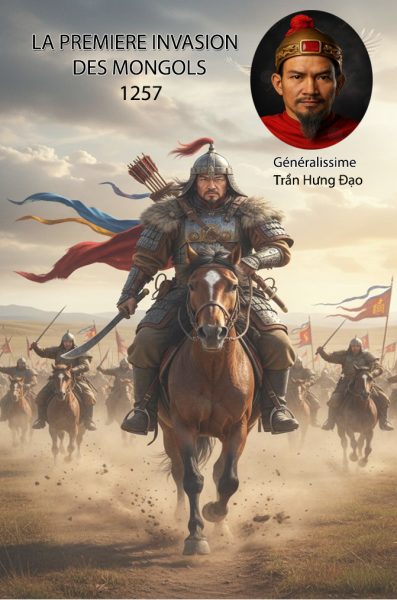
Photo Pinterest
The first Mongol invasion of Dai Viet
Version vietnamienne
Version française
Bibliographie
In 1209, while the imperial capital of Thăng Long was plunged into chaos by General Quách Bốc, who had risen up to avenge his commander Pham Bỉnh Di, King Lý Cao Tông was forced to flee to Quy Hóa. Meanwhile, Crown Prince Lý Sâm reached the region of Hải Ấp to find refuge with the Trần clan, a wealthy and influential local power that possessed a large number of vassals and private troops in the coastal area.
It was in the wake of these events that Lý Cao Tông regained the throne. As for Lý Sâm, in love with Trần Thị Dung, daughter of Trần Lý, he married her. This alliance paved the way for the rise of the Trần clan at the royal court and, ultimately, for the overthrow of the Lý dynasty. A major transfer of political power, orchestrated mainly by Trần Thủ Độ, took place afterwards. Not only did he take advantage of the incapacity of King Lý Huệ Tông (formerly Crown Prince Lý Sâm), who suffered from mental disorders, but he also elevated Trần Thị Dung to the rank of empress. Furthermore, in 1225 he arranged the marriage of Lý Chiêu Hoàng (reigning queen of the Lý dynasty, then six years old) with Trần Cảnh (son of Trần Thừa, eight years old). This political maneuver was a calculated strategy by Trần Thủ Độ, commander of the imperial guard, aimed at transferring power from the Lý dynasty to the Trần dynasty.
His cruelty earned him sharp criticism from historians and by posterity, notably for having forced King Lý Huệ Tông to become a monk before driving him to his death. He usurped the throne by installing the young Trần Cảnh (eight years old) — through the latter’s marriage to Lý Chiêu Hoàng (six years old) — and eliminated all members of the Lý royal family in order to remove any future threat. Anyone bearing the family name Lý was forced to change it to Nguyễn. Only Admiral Lý Long Tường, seventh son of King Lý Anh Tông, escaped this massacre. He and 6,000 members of his kin fled Đại Việt by sea to seek refuge in the kingdom of Goryeo (Korea). There, he became a renowned general in the service of King Gojong during the resistance against the Mongol invasions, and he received from the sovereign the title of Lord of Hwasan (or General Hwasan).
Although Trần Thủ Độ was a remarkable statesman who consolidated the absolute royal authority of the Trần dynasty and rendered immense services to the nation during the first resistance against the Mongol invaders, his cruel and shameful acts earned him the condemnation of public opinion.
In the eyes of Confucian historians of the feudal era such as Lê Văn Hưu and Ngô Sĩ Liên, he appeared as a cunning and ruthless man, disregarding moral principles in his desire to consolidate royal power for the benefit of the Trần dynasty. He went so far as to force Trần Cảnh (Emperor Trần Thái Tông) to marry his own sister-in-law, Lý Ngọc Oanh, the eldest daughter of King Lý Huệ Tông and wife of Prince An Sinh (Trần Liễu), because Empress Lý Chiêu Hoàng (Lý Phật Kim) had not produced an heir. Furious, Prince An Sinh (father of Trần Hưng Đạo) fomented a rebellion on the Cái River in an attempt to reclaim his wife. It was an act for which he was later punished by Trần Thủ Độ. Thanks to the vigorous protection of his younger brother, Emperor Trần Thái Tông, Trần Liễu escaped execution, although he continued to harbor deep resentment until the end of his days.
On the other hand, from the perspective of objective and progressive history today, he is credited with having saved the nation by stabilizing the economy and strengthening the army through the repression of various revolts such as those led by the Mường rebels in Quốc Oai, the Đoàn Thường faction in Đường Hào, and Nguyễn Non’s faction in Bắc Giang. These actions made it possible to establish a new dynasty powerful enough to defend the kingdom against the first Mongol invasion, which occurred thirty years later. Contemporary historians acknowledge that the final phase of the Lý dynasty would certainly have been incapable of achieving this. Without his efforts, the country would probably have suffered the same fate as the kingdom of Dali in Yunnan, annihilated in 1252.
In order to consolidate their political power and preserve the noble lineage of the royal family, the monarchs of the Tran dynasty frequently practiced consanguineous marriages, uniting within the extended family. Although such unions carry a risk of congenital anomalies by modern standards, the era of the Trần nevertheless witnessed the emergence of many illustrious figures such as Trần Hưng Đạo, Trần Nhân Tôn, Trần Quang Khải, Trần Nhật Duật, Trần Bình Trọng, Trần Quốc Toản etc.
This is precisely what enabled our country to defeat the Mongol invaders. According to Professor Lê Thành Khôi (ibid., 180), they were a people who possessed not only skilled mounted archers capable of moving with lightning speed, but also enjoyed an overwhelming military superiority over the inhabitants of the coastal plains. Furthermore, the researcher Trần Trọng Kim (ibid., 106) emphasizes that the Mongols, originally from the upper course of the Amur River, were a warlike people. Their exceptional cavalry and archers conquered Central Asia, Persia, and parts of Eastern Europe as well as the kingdom of Western Xia (in the northwest of China). They annihilated the Jin dynasty and invaded the kingdom of Goryeo (ibid., 107).
In 1257, as part of a plan aimed at encircling the Southern Song dynasty by opening a second front from the south, Möngke Khan entrusted his younger brother, Kubilai Khan, with the mission of invading the Kingdom of Dali, in Yunnan Province, which bordered Vietnam.
Consequently, Đại Việt became a major strategic target for launching an attack on the rear of the Southern Song. It was a state that had successfully resisted every attempt at subjugation for more than two decades. After the conquest of the kingdom of Dali, the Mongol general Uriyangkhadai sent envoys to the Trần court to request permission to pass through their territory in order to attack the Song dynasty (China) from the south. Concerned about the sovereignty of his kingdom and firmly determined not to betray the bonds of vassalage that bound him to the Song, King Trần Thái Tông not only rejected the Mongol request but also had the Mongol envoys arrested and ordered his nephew, Trần Quốc Tuấn (Trần Hưng Đạo), to lead a powerful army to defend the northern border.
For the Mongol Empire, the imprisonment or murder of diplomatic envoys was considered a supreme insult that demanded immediate military retaliation. Möngke Khan authorized Uriyangkhadai to launch the first Mongol invasion of Vietnam at the end of the year 1257. Outnumbered, Trần Quốc Tuấn was forced to retreat and position his troops at Sơn Tây, while the Mongol forces advanced as far as the Thao River. King Thái Tông personally led the defense but was unable to hold his positions. He was forced to abandon the capital and took refuge near the Thien Mạc River (a section of the Red River located in Hưng Yên Province). Upon entering the citadel of Thăng Long (capital of Đại Việt), General Uriyangkhadai found the envoys chained in the prison. One of them died at the moment of his release. This drove him into a mad rage and prompted him to order his troops to pillage the city and massacre all the men, women and children who were there (Trần Trọng Kim, ibid., p. 208).
Faced with this perilous situation, King Thái Tông consulted his younger brother, Grand Marshal Trần Nhật Hiệu, while they were aboard the royal barge. Without saying a word, Hiệu seized a pole and traced the characters “Nhập Tống” (Join the Song) on the surface of the water, thereby suggesting either flight and surrender, or the integration of the kingdom into the Song dynasty in order to preserve their lives and their lineage. Rejecting this proposal, the king turned to Grand Preceptor Trần Thủ Độ. He replied with calm and determination: “As long as my head remains on my shoulders, Your Majesty has nothing to fear.” Reassured by these words, King Thái Tông regained his composure.
This exchange reveals that, although Thủ Độ acted without mercy toward the Lý dynasty, he was a remarkable and eminent statesman of the Trần dynasty. It is, moreover, difficult for us to judge him harshly when we reread the history of that troubled period, because without him, the outcome of events could have been very different.
How did the Trần dynasty manage to defeat the Mongol army in the first confrontation when our forces were overwhelmed by the Mongols on all fronts? Under the command of General Trần Hưng Đạo, the Trần dynasty implemented a comprehensive defensive strategy based on the following three key elements:
1°) The “scorched earth” strategy. When enemy forces advanced toward the citadel, the order was given to the entire population, as well as to those holding food supplies, livestock, and vital resources, to evacuate the area or to conceal their property. This measure deprived the invaders of any source of resupply in the event of delays in their own supply lines.
2°) The climate and diseases. These factors acted as natural allies in the fight against the invaders. While formidable in arid plains, the Mongol forces could not withstand the overwhelming heat, high humidity, and the country’s dense forest terrain. As a result, the troops quickly succumbed to exhaustion and saw their combat effectiveness drop drastically after more than a week of encampment. They suffered from malnutrition and tropical diseases such as malaria. General Uriyangkhadai was forced to position his troops along the Red River (in the Đông Bộ Đầu area) to maintain a defensive posture, while seeking opportunities to plunder and break the encirclement.
This was the “The first Mongol invasion of Dai Viet” strategy adopted by Uriyangkhadai: using the troops of Dali to provide cover and take the blows in place of the Mongol army. Moreover, as fervent Buddhists, the soldiers of Dali lacked the ferocity and bloodlust of their Mongol counterparts. They were forced to serve as the vanguard and enter our territory at the beginning of the year 1258, alongside General Cacakdu. This vanguard was tasked with secretly crossing the river, bypassing our positions to take us from the rear, seizing the landing points, and cutting off all routes of retreat.
3°) Guerrilla warfare and counterattacks. This is a strategy consisting of “using the weak to oppose the strong,” frequently employed in our country. The Yunnan region (Dali) shared a border with the northern part of Dai Viet (the area corresponding to the present Northwestern provinces). The troops of Dali were accustomed to the rugged terrain as well as the harsh and perilous conditions of these wild, mountainous borderlands. Consequently, Uriyangkhadai forced 20,000 Dali soldiers to accompany 10,000 Mongol cavalrymen. They were tasked with scouting the terrain and bearing the brunt of the fighting, thus serving as a shield for the elite Mongol cavalry.
When the Mongol army in the central position launched a direct frontal assault, the Trần forces would have found themselves in a desperate situation, driven back against the riverbank with the imminent risk that the king and his court would be captured. Although the Mongols won a victory on the Bình Lệ Nguyên plain (located in what is now Vĩnh Phúc province) thanks to their eagerness to quickly engage in battle, their strategic intentions were revealed. It was for this reason that King Trần, his court, and tens of thousands of elite soldiers were able to embark calmly and retreat in complete safety. By contrast, the Mongol army subsequently found itself facing a severe shortage of provisions. Its morale collapsed, which allowed the Trần forces to launch, at the opportune moment, a general counteroffensive that culminated in victory at the battle of Đông Bộ Đầu (*).
(*) Đông Bộ Đầu Wharf on the Red River (today, the area extending from Hàng Than Slope to Hòe Nhai Street, in the Ba Đình district of Hanoï.
[The second Mongol invasion of Dai Viet]
Trần Trọng Kim: Việt Nam sử lược . Histoire du Viet Nam. Imprimerie Vĩnh & Thanh 1928.
Lê Thành Khôi: Le Viet-Nam. Histoire et Civilisation. Les Éditions de Minuit. 1955
Thái Văn Kiểm: Việt Nam Quang Hoa. Editeur Xuân Thu
René Grousset: Histoire de lA Chine. Editeur France Loisirs 1997
Bai Shouyi : Précis d’histoire de Chine. Edition en langues étrangères. 1988
Yamamoto T. : La conquête de l’Annam par les Yuan et les Ming. Tokyo. 1950