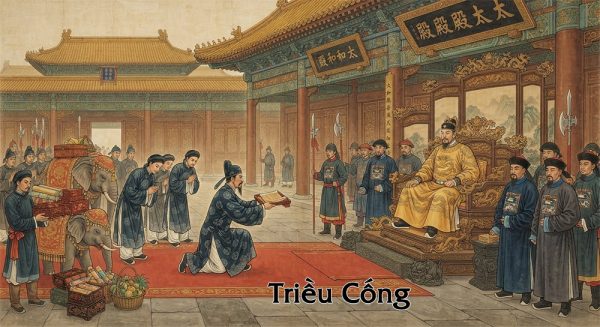
Tribute (Offering from the Vassal State)


Tribute (Offering from the Vassal State)

Vietnamese version
French version
Bibliographie

Following his resounding victory at the Battle of Muye in 1046 B.C. and the overthrow of the last Shang ruler,  Di Xin (Trụ vương), King Wu founded the Zhou Dynasty and established a feudal system based on the subjugation of vassals. This system formalized the political, military, and economic obligations that smaller states (vassal states) owed to the central authority: the Zhou dynasty and its ruler, the “Son of Heaven.” Land, accompanied by hereditary titles ranked in a hierarchy ranging from duke, marquis, count, viscount, to baron, was granted to members of the royal clan as well as to dignitaries who had demonstrated merit. The latter were then tasked with establishing their own vassal states. This was the case for the supreme patriarch Khương Tử Nha (Jiang Ziya), the Zhou dynasty’s chief military strategist.

He was made king of the kingdom of Qi. At that time, our country was located within the territory of the kingdom of Chu (Sở). Chu was ruled by a monarch bearing the royal surname *Mị* (corresponding to the name *Hùng vương* mentioned in our legend) and was located within the territory of the Bai Yue (associated with the Shijiahé culture), along the middle reaches of the Yangtze River. In this regard, the *Lĩnh Nam Chích Quái* (“Strange Tales from the Land South of the Mountains”) reports that, during the reign of King Cheng of the Zhou, King Hùng dispatched an envoy from “Việt Thường” to present a white pheasant to the Zhou court, thereby fostering friendly relations during a time of peace. This indicates that, during the Zhou dynasty, our region—despite its remoteness—participated in the vassal tribute system, thereby assuming specific economic and military obligations toward the Zhou kingdom.

With regard to economic obligations (tribute), vassal states were required to periodically bring rare and distinctive products from their respective territories such as high-quality grains, cast bronze weapons, silk, and precious woods to the Zhou capital to present them to the king. If a vassal failed to pay tribute for three consecutive periods, the “Son of Heaven” had the power to impose sanctions or send an army to depose him.

As for military obligations (the provision of troops), vassals were permitted to maintain their own private armies. However, the size of these forces was strictly limited according to the vassal’s rank (such as *wang* [king], *hou* [marquis], etc.). In the event of a crisis within the central dynasty, or upon receiving a mobilization order, vassals were required to bring their troops, weapons, and war chariots to assist the “Son of Heaven” in military campaigns against external enemies.

Later, after Emperor Qin Shi Huang Di unified the country, and then during the Han Dynasty, our country was annexed following the unsuccessful uprising led by the Trưng sisters and divided into two commanderies: Jiaozhi (Giao Chỉ) and Jiuzhen (Cửu Chân). It was not until Ngô Quyền’s victory over the Southern Han dynasty (led by Liu Gong) on the Bạch Đằng River in 938 A.D. that our nation regained its independence after a millennium of foreign rule. This feat is all the more remarkable given that, at the time, our country was merely a small state with a population of about one million, while the vast Chinese empire had, according to estimates, more than 56 million.

Ngô Quyền founded Vietnam’s first feudal dynasty. In 939, he proclaimed himself king. He adopted the title of sovereign of An Nam and established the capital at Cổ Loa (Phúc Yên). The old system of vassalage came to an end, giving way to formal diplomatic relations between the Chinese Empire and its neighboring countries, among which had been the kingdom of An Nam since the time of the Đinh dynasty.

According to the work of French historian Philippe Papin on the chronology of this country, An Nam established a system of regular tribute to China in 968 (or 972, depending on the exact date of official recognition by the Chinese emperor). Đinh Bộ Lĩnh sent his son Đinh Liễn to Bianjing (the capital of the Song Dynasty). In 973, the Song emperor officially conferred upon Đinh Bộ Lĩnh the title of “Prince of the Giao Chỉ Commandery” (Giao Chỉ quận vương) and appointed Đinh Liễn as “military governor of the Tĩnh Hải district” (Tĩnh Hải tiết độ sứ). This event marked the establishment of a diplomatic model that would serve as a benchmark for Vietnamese dynasties over the following centuries.

The Song Dynasty regarded Đại Việt as a “regular tributary kingdom.” In return, the Vietnamese dynasty secured recognition of its legitimacy by the “Celestial Empire.” The kingdom of An Nam accepted the purely formal status of “vassal” in exchange for a guarantee of peace with the North.

In order to preserve peace along the borders, successive Vietnamese dynasties (from the Đinh, Lê, Lý, Trần, and Later Lê dynasties up to the Nguyễn dynasty) agreed to participate in  the world order established by China according to the following two main protocols:

The Investiture (Royal Authority in the Eyes of Foreign Powers):

Upon ascending the throne, the monarchs of An Nam would send diplomatic missions to the Chinese capital to seek official recognition. The Emperor of China would then issue an edict of investiture and present an official seal. This  thus established the sovereign as the legitimate ruler of the “State of An Nam”  or “State of Vietnam” under the Nguyễn dynasty. In the context of official diplomacy, the Vietnamese sovereign bore the title *Wang* (king), a rank subordinate to that of the Emperor of China. Domestically, however, the Vietnamese monarch referred to himself as *Huangdi* (emperor). He, too, considered himself a “Son of Heaven” and maintained his own system of vassal states—such as Champa, Chenla, and various Laotian tribes—which also paid him tribute. Furthermore, the Vietnamese sovereign established his own era names. This practice shaped the nation’s unique identity: “Emperor at home, king abroad.”

Tribute System (*Houwang Bolai* “Give little, receive much”):

Every three years, Vietnam would send a delegation to the Chinese capital, bringing local products such as ivory, rhinoceros horns, eagle wood, gold, and silver as tribute. During the Ming Dynasty, this practice was exploited even further: the Chinese court demanded the dispatch of skilled artisans and eminent physicians, as well as the creation of two life-size metal statues of Generals Liu Sheng and Liang Ming, who had died during the conflict in which Vietnam regained its independence.

This move served a dual purpose: to weaken Vietnam’s development by taking its talented individuals—among whom were the famous physician Tuệ Tĩnh, the architect Nguyễn An (known as A Liu, of the Forbidden City in Beijing), and Hồ Nguyên Trung (son of Hồ Qúy Ly, an expert in casting *thần cơ* cannons), and  to assert the supremacy of the “Celestial Empire.” In return, the Emperor of China offered gifts of great economic value, such as high-quality porcelain, silk, and books,  in accordance with the principle of “giving little to receive much.” This was  a gesture designed to illustrate the prestige and overwhelming authority of the Celestial Empire.

Following the Patenôtre Treaty, signed in Huế on June 6, 1884, between the court of the Nguyễn dynasty and the French colonial authorities—which recognized Vietnam as a French protectorate—the practice of paying tribute came to an end. However, during the period when the country remained subject to the policy of “vassal tribute” to China, Vietnam adopted a diplomatic approach that skillfully combined flexibility and firmness across successive dynasties. This unique political strategy, rooted in the nation’s geopolitical reality, was based on a sophisticated intellectual framework: through reasoned argumentation, the Vietnamese side asserted that its own civilization—rich in history and tracing its origins to the Liangzhu and Shijiahé cultures along the Yangtze River—was in no way inferior to that of China.

The Vietnamese dynasties fully understood that diplomacy carried weight only when it was backed by military force. Consequently, whenever they succeeded in defending the nation’s independence and sovereignty against the expansionist ambitions and invasion attempts of Chinese dynasties (such as the Song, the Yuan-Mongols, the Ming, and the Qing), Vietnamese monarchs would subsequently take the initiative to seek reconciliation by offering formal apologies and maintaining the practice of sending tribute.

This approach allowed the opposing side to preserve the prestige of a “great power,” while at the same time reaffirming Vietnam’s distinct and independent status.  This idea is reflected in works such as the poem “Nam Quốc Sơn Hà” (The Mountains and Rivers of the Southern Land) by Lý Thường Kiệt, or the “Bình Ngô Đại Cáo” (Proclamation of Victory over the Wu) by Nguyễn Trãi. This was the price to pay to secure true independence—hard-won through struggle—but it was also a testament to the prudent diplomatic wisdom of our ancestors.

During the Nguyễn Dynasty, regulations stipulated that tribute had to be sent every two years, and that a diplomatic mission had to be dispatched to the imperial court every four years. The longest diplomatic mission in our country’s history was that of Ambassador Lê Quang Bí, which took place during the reign of King Mạc Tuyên Tông (in 1548). This mission lasted 18 years because the envoy was detained by the Ming Dynasty in Nanning (Guangxi) and then in Beijing. When he left, he was a man in his forties with black hair, but  by the time he returned, his hair had turned white. He was then 61 years old. He is often compared to Su Wu (Tô Vũ) (*), a legendary figure in Chinese history, for his unwavering loyalty and indomitable spirit, as he succeeded in preserving our nation’s integrity in the face of the Ming Dynasty.

To withstand the pressure and maintain a firm stance in the face of the Chinese imperial dynasties, our nation’s emissaries had to possess a unique combination of qualities: profound erudition, exceptional improvisational skills, unparalleled courage, and a refined mastery of protocol and rituals. Their primary mission was to “defend the honor of the sovereign mandate” by preserving territorial sovereignty and maintaining peaceful relations with the “Celestial Empire.” At times, this mission required the ultimate sacrifice, as was the case for the envoy Giang Văn Minh. In 1637–1638, during the reign of Emperor Chongzhen (Sùng Trinh) of the Ming Dynasty, Giang Văn Minh demonstrated unwavering integrity and candor.

Arrogant and seeking to intimidate the envoy from Đại Việt, Emperor Chongzhen issued this challenge to him with the following verse: “The bronze pillar is still covered with green moss today.” This was an allusion to the curse of the Han general Ma Yuan, who had once declared: “If the bronze pillar should ever break, Giao Chi [Vietnam] will perish.” Giang Van Minh replied with a scathing and incisive retort: “Since time immemorial, the waters of the Bạch Đằng River have remained stained with red blood.” ” This response evoked the three glorious victories won on the Bạch Đằng River against the Southern Han (938), the Song (981), and the Yuan (1288), during which the invaders from the North were defeated, and thus embodied the indomitable spirit of the Vietnamese people.

Exasperated by the envoy’s pride and intransigence, Emperor Chongzhen ordered his execution on the second day of the sixth lunar month of the Year of the Earth Cat (1639). However, his anger eventually subsided. Impressed by the courage of such a loyal official, he ordered that Giang Van Minh’s body be embalmed with tea and mercury,  and  then  placed in a coffin  that  the diplomatic delegation took back to Vietnam. Giang Van Minh is remembered as an envoy who remained  unshaken in the face of danger  and  was willing to die to honor his homeland. He knew how to preserve the nation’s honor and successfully carry out his diplomatic mission. During his journey, he also secured the abolition of the humiliating requirement that had long compelled Vietnam to present miniature metal statuettes to the Ming dynasty.

When his remains arrived in Thăng Long, King Lê Thần Tông and Lord Trịnh Tráng came in person to pay their respects before the coffin. The king, in tears, issued an imperial decree declaring: “An envoy who does not dishonor his sovereign’s mandate is, without a doubt, a hero for posterity.”

Sometimes an envoy receives the highest honors. Such was the case with Mạc Đĩnh Chi, who was conferred the title “Supreme Scholar of the Two Nations” (Lưỡng quốc Trạng nguyên), a recognition of his status as a scholar of the highest order, both in his own country and in China, during the reign of Emperor Wuzong (Külüg Khan) of the Yuan Dynasty. The Chinese were  deeply impressed by his remarkable quick wit. During one of his missions to China, a Mongol princess had just died, and the Yuan emperor tasked him with delivering a eulogy. As he knelt to read the text that had been given to him, Mạc Đĩnh Chi discovered only a blank sheet of paper bearing the word “one” (nhất) in Chinese characters, which he was to repeat four times. Without the slightest hesitation, he began to recite a eulogy, earning the admiration of the entire imperial court.

Trời xanh một đám mây
Lò hồng môt giọt tuyết
Vườn thượng uyển môt cành hoa
Cung Quảng Hàn một vầng nguyệt
Than ôi! Mây tan! Tuyết tiêu!
Hoa tàn! Trăng khuyết !

The azure sky holds a cluster of clouds
A speck of snow on a glowing brazier
The imperial garden holds a flowering branch
The Quảng Hàn Palace holds a lunar disk
What a pity! The clouds are disappearing! The snow is melting!
The flower is wilting! The moon is incomplete!

In feudal times, “being appointed an envoy—just like a general entrusted with command of troops in battle”—was considered a great honor. Although they carried no firearms,

these emissaries were, in reality, frontline warriors, charged with putting their intelligence and courage to work to preserve peace in their country. Above all, it was their duty never to dishonor the mission with which the King had entrusted them. They had to ensure that the “Celestial Empire” recognized the standing of a small nation like ours in asserting its sovereignty and territorial integrity, while being fully aware of the immense difficulty of their task.

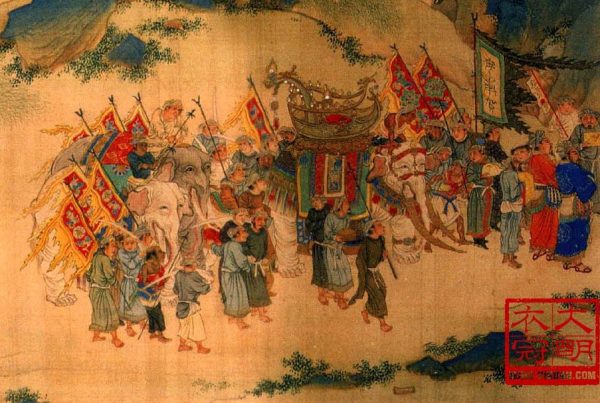
The painting *Mission Entrusted with Bringing Tribute* (職貢圖, *Zhígòng Tú*), created by the Chinese artist Qiu Ying around the early 16th century, depicts a diplomatic mission from Đại Việt (under the Lý dynasty) tasked with bringing a black elephant and two white elephants, intended as tribute to the Song emperor.

(*) Su Wu was an envoy of Emperor Wu Di of the Han Dynasty. He was held captive by the Xiongnu for 19 years, during which time he was forced to tend sheep in the Lake Baikal region (Siberia).

Bibliographie

Phan Kế Bính: Nam Hải Dị Nhân Liệt Truyện. Nhà Xuất Bản Hồng Bàng  2011
Philippe Papin: Les relations historiques du Vietnam avec la Chine jusqu’au début du XIXème siècle: aperçu et hypothèses. Société des amis du musée Cernuschi.
Trần Trọng Kim: Việt Nam sử lược. Histoire du Viet Nam. Imprimerie Vĩnh & Thanh 1928.
Lê Thành Khôi: Le Viet-Nam. Histoire et Civilisation. Les Éditions de Minuit. 1955
Thái Văn Kiểm: Việt Nam Quang Hoa. Editeur Xuân Thu
Lê văn Hưu, Ngô Sĩ Liên: Đại Việt sử ký toàn thư . Nhà Xuất Bản Thời Đại 2013
René Grousset: Histoire de la Chine. Editeur France Loisirs 1997

Tribut des États vassaux (Cống hiến chư hầu)


Version française
Version anglaise
Bibliographie

Sau chiến thắng vang dội tại trận Mục Dã vào năm 1046 trước Công Nguyên và lật đổ vị vua cuối cùng là Trụ Vương (Di Xin), Châu Vũ vương  chính thức thành lập nên triều đại nhà Châu và áp dụng chế độ phong kiến phân phong chư hầu. Từ đây mới có  hình thức thể hiện nghĩa vụ chính trị, quân sự và kinh tế của các nước nhỏ (chư hầu) đối với nước lớn (Thiên triều/Đế quốc trung ương) tức là nhà Châu với Thiên tử, đem đất đai, phong tước vị cho các Công, Hầu, Bá, Tử, Nam, cho những người trong dòng tộc hoặc công thần để họ lập ra các nước chư hầu.

Cũng như Khương Tử Nha (Thượng Phụ), khai quốc công thần được làm vua nước Tề. Nước ta lúc đó nằm trong địa phận của nước Sở. Nước nầy  có một vị vua được phong vương với quốc tính họ Mị (tức là họ Hùng trong truyền thuyết) trên vùng đất Bách Việt (văn hóa Thạch Gia Hà) ở trung lưu sông Dương Tử. Bởi vậy Lĩnh Nam Chích Quái có kể rằng vào đời  Châu Thành Vương (Zhou Chengwang), Hùng Vương sai bề tôi tự xưng là người Việt Thường đem dâng nhà Châu  một con chim trĩ trắng để liên kết  sự giao hảo và thân thiện với nhà Châu trong thời bình. Như vậy cho chúng ta thấy dưới thời nhà Châu nước ta tuy  ở xa cũng thể hiện  hình thức Cống hiến chư hầu. Nó có nghĩa vụ về kinh tế và quân sự  dưới thời nhà Châu.

Trong nghĩa vụ kinh tế (Triều cống), định kỳ các chư hầu phải trực tiếp đem sản vật quý hiếm đặc trưng của vùng đất mình (như lương thực tế tự, đồng đúc vũ khí, tơ lụa, gỗ quý) về kinh đô dâng lên vua Châu. Nếu ba kỳ liên tiếp không triều cống, Thiên tử có quyền phạt hoặc đem quân phế truất.

Còn trong nghĩa vụ quân sự (Hiến binh). Các chư hầu được phép có quân đội riêng nhưng số lượng bị giới hạn theo tước vị (vương, hầu vân vân) Khi vương triều trung ương gặp nguy biến hoặc có lệnh động viên, các chư hầu bắt buộc phải đem quân đội, vũ khí và chiến xa về hỗ trợ Thiên tử chinh phạt ngoại bang.

Nhưng về sau Tần Thủy Hoàng thống nhất được thiên hạ rồi đến nhà Hán thì nước ta bị thôn tính  sau vụ nổi loạn của Hai Bà Trưng và bị chia ra thành hai quận Giao Chỉ và Cửu Chân. Phải đợi đến chiến thắng của Ngô Quyền trên sông Bạch Đằng chống nhà Nam Hán của Lưu Cung vào năm 938, nước ta mới dành lại được nền độc lập sau một ngàn năm đô hộ nhất là thời điểm đó nước ta  còn là một nước nhỏ bé với dân số chỉ lên đến khoảng một triệu người  trong khi đó nước Trung Quốc khổng lồ ước tính có hơn 56 triệu người.  

Ngô Quyền thành lập triều đại phong kiến ​​đầu tiên ở Việt Nam. Năm 939, ông tự xưng làm vua An Nam và đóng đô ở Cổ Loa (Phúc Yên). Việc quan hệ chư hầu không còn nữa mà nó biến chuyển qua mối quan hệ bang giao giữa Đế quốc Trung Hoa và các quốc gia lân bang trong đó có An Nam nước ta từ lúc  thời nhà Đinh.

Theo công trình nghiên cứu của nhà sử học Pháp Philippe Papin về niên đại lịch sử của đất nước này, An Nam bắt đầu thực hiện chế độ cống nạp định kỳ cho Trung Quốc từ năm 968 (hoặc năm 972, tùy thuộc vào thời điểm hoàng đế Trung Hoa chính thức công nhận). Đinh Bộ Lĩnh cử con trai là Đinh Liễn sang Biện Kinh (kinh đô nhà Tống). Đến năm 973, hoàng đế nhà Tống chính thức sắc phong cho Đinh Bộ Lĩnh làm Giao Chỉ quận vương và Đinh Liễn làm Tĩnh Hải quân tiết độ sứ. Đây chính là điểm khởi đầu cho một mô hình ứng xử ngoại giao mẫu mực kéo dài suốt nhiều thế kỷ sau đó của các triều đại Việt Nam.

Nhà Tống coi Đại Cồ Việt (An Nam) là một « vương quốc triều cống định kỳ ». Đổi lại, vương triều Việt Nam có được sự thừa nhận tính chính thống từ thiên triều và An Nam chấp nhận là chư hầu về mặt danh nghĩa để đổi lấy sự thừa nhận hòa bình từ phương Bắc.  Để duy trì nền hòa bình biên giới, các triều đại Việt Nam (từ nhà Đinh, Lê, Lý, Trần, Hậu Lê đến nhà Nguyễn) đều chấp nhận tham gia vào trật tự thế giới do Trung Quốc đứng đầu thiết lập thông qua hai nghi thức chính sau đây: 

Sách phong (Ngoại vương):

Sau khi lên ngôi, các vị vua An Nam sẽ cử sứ bộ sang kinh đô phương Bắc để xin phong vương. Hoàng đế Trung Quốc sẽ ban sắc phong và ấn tín, công nhận vị vua đó là người cai trị hợp pháp của « An Nam quốc » hoặc « Việt Nam quốc » dưới thời nhà Nguyễn. Về mặt danh nghĩa ngoại giao, vua An Nam chỉ xưng là Vương (nhỏ hơn Hoàng đế). Nhưng trong nước, vua ta vẫn xưng Hoàng Đế, cũng con của Trời, vẫn có chư hầu như Chiêm Thành, Chân Lạp, các bộ tộc Ai Lao  và triều cống của các nước nầy và vẫn có niên hiệu riêng. Đây là bản sắc của nước ta «Trong xưng Đế,ngoại xưng Vương»   

Triều cống (Hậu vãng bạc lai):

Định kỳ (thường là 3 năm một lần), Việt Nam sẽ cử phái đoàn mang theo sản vật địa phương (như ngà voi, sừng tê giác, trầm hương, vàng bạc) sang kinh đô Trung Quốc dâng tặng. Chỉ có dưới triều đại nhà Minh thì còn thể hiện đòi thêm các nghệ nhân, các thầy thuốc giỏi luôn cả hai  tượng có kích thước làm bằng kim loại tốt nhằm để bù đắp cái chết của hai tướng Liễu Thăng và Lương Minh ở trận chiến lúc dành lại nền độc lập, nhằm làm yếu đi sự phát triển nước ta như với danh y Tuệ Tĩnh (y học), kiến trúc sư Nguyễn An (A Lưu)(Tử Cấm Thành Bắc Kinh) hay Hồ Nguyên Trừng, con của Hồ Qúi Ly (người đúc được súng thần cơ). Ngược lại, Hoàng đế Trung Quốc luôn ban thưởng lại những triều cống phẩm có giá trị kinh tế rất lớn (gốm sứ cao cấp, tơ lụa, sách vở) theo nguyên tắc « nhận ít ban nhiều » để phô trương uy thế Thiên triều.

Từ khi có hiệp ước Patenôtre mà triều đình nhà Nguyễn ký  vào ngày 6 tháng 6 năm 1884 tại Huế với  thực dân Pháp nhìn nhận hoàn toàn chế độ bảo hộ của Pháp thì việc triều cống không còn nữa. Nhưng trong thời gian còn lệ thuộc  chính sách « cống hiến chư hầu » với Trung Hoa  thì  nước ta thể  hiện một  chính sách ngoại giao nhu cương phối  hợp qua nhiều triều đại. Đây cũng là một đường lối chính trị  độc đáo  dựa trên thế nước ta cùng trò đấu trí  tuệ qua cách lý luận  để biện chứng nước ta có một nền văn hiến lâu đời (văn hóa Lương Chữ và Thạch Gia Hà ở sông Dương Tử)  cũng không kém chi nước Trung Hoa.

Các triều đại Việt Nam  thừa hiểu rõ rằng ngoại giao chỉ có trọng lượng khi đất nước có thực lực quân sự. Bởi vậy mỗi lần thành công trong việc bảo vệ độc lập và  chủ quyền trước các các cuộc bành trướng, xâm lược của các triều đại Trung Quốc (Tống, Nguyên-Mông, Minh, Thanh) thì các vua ta buộc lòng phải  chủ động, sang giảng hòa, dâng sớ tạ lỗi và tiếp tục triều cống để cho đối phương  giữ thể diện của nước lớn mà cũng vừa khẳng định lại nước ta  biệt lập như lời tuyên ngôn « Nam quốc sơn hà»  của Lý Thường Kiệt hay  « Bình Ngô đại cáo » của Nguyễn Trãi. Đây là cái giá phải chịu  để đổi lấy nền độc lập xương máu trên thực tế mà nó còn thể hiện trí tuệ ngoại giao khôn ngoan của ông cha ta.

Sứ thần nước ta hay thường gọi là Chánh sứ hay Phó sứ được có một nhiệm vụ vinh quang vô cùng nhưng nguy hiểm không chỉ đối với Trung Quốc mà luôn cả với nước ta. Lời răn đe dưới đây  của vua Lê Thánh Tông đưa ra khi cử một phái đoàn sứ bộ mà người dẫn đầu là danh thần Lê Cảnh Huy được ghi lại trong sách Đại Việt sử ký toàn thư, thể hiện tư tưởng kiên quyết bảo vệ chủ quyền lãnh thổ quốc gia như sau: »Một thước núi, một tấc sông của ta, không có thể vứt bỏ đi được… Nếu ngươi dám đem một thước một tấc đất của Thái Tổ làm mồi cho giặc, thì tội phải tru di ». Còn chưa nói đến cơn thịnh nộ có thể xuất phát từ phiá Trung Quốc và có thể mất mạng trong tích tắc. Còn gian nan thì kể sao cho hết  vì đi bộ. Cuộc hành trình đi từ Thăng Long đến (Yến Kinh/ Bắc Kinh) có đến khoảng 2800 cây số  với các sản phẩm quý giá để triều cống nhất là phải đề phòng các băng đảng cướp  ở dọc đường và các nơi trạm nghỉ ngơi. Một  chuyến đi sứ (triều cống, cầu phong, báo tang…) đi và trở về, thường kéo dài trung bình từ 1 đến 3 năm.

Dưới thời nhà Nguyễn, định lệ quy định cứ 2 năm một lần gửi đồ tuế cống và cứ 4 năm phải cử một sứ bộ sang chầu. Chuyến đi sứ lâu nhất lịch sử nước ta thuộc về sứ thần Lê Quang Bí  đời vua Mạc Tuyên Tông (năm 1548). Chuyến đi này kéo dài tới 18 năm trời do ông bị nhà Minh giữ lại ở Nam Ninh  (Quảng Tây) và Bắc Kinh. Khi đi còn tóc xanh mới độ chừng 40 tuổi nhưng khi trở về mái tóc bạc. Lúc đó ông đã được 61 tuổi. Ông được ví như Tô Vũ  nước nam (*) vì sự trung trực và bất khuất giữ trọn khí tiết  nước ta khi đối diện với triều đại nhà Minh.

Để tránh áp lực và giữ vững vị thế trước các hoàng triều Trung Quốc, các  sứ thần nước ta phải  hội tụ đủ các yếu tố như sau: học vấn uyên thâm, tài ứng biến xuất sắc, lòng can đảm vô song và sự khôn khéo về mặt phong thủy và lễ nghĩa. Nhiệm vụ tối cao của họ là « không làm nhục mệnh vua« , bảo vệ chủ quyền lãnh thổ nhưng vẫn giữ được hòa khí với thiên triều.

Đôi khi phải chết như sứ thần Giang văn Minh vì ông dám đối đáp thẳng thắn, giữ vững khí tiết trước triều đình nhà Minh dưới thời vua Sùng Trinh vào năm 1637–1638.  Vua nầy rất  ngạo mạn ra câu vế xuất  như  sau nhằm áp bức sứ thần Đại Việt: “Đồng trụ chí kim đài dĩ lục” (Cột đồng đến nay rêu đã xanh), ngầm nhắc lại lời nguyền của tướng Mã Viện rằng « Trụ đồng chiết, Giao Chỉ diệt » để răn đe dân Việt dưới thời nhà Đông Hán.

“Đằng Giang tự cổ huyết do hồng” (Sông Bạch Đằng từ xưa máu vẫn còn loang đỏ), đó là câu vế đối đáp lời sắc bén của Giang Văn Minh nhắc lại ba chiến thắng oanh liệt nhấn chìm quân xâm lược phương Bắc trên sông Bạch Đằng (Nam Hán năm 938, Tống năm 981 và Nguyên năm 1288)  và thể hiện cái chí khí của dân tộc Việt.

Quá giận dữ trước sự kiêu hãnh và bất khuất của vị sứ thần, Sùng Trinh ra lệnh sát hại ông vào ngày mùng 2 tháng 6 năm Kỷ Mão (1639). Nhưng sau đó nguôi cơn giận và  nể phục trước dũng khí của một bậc trung thần, ông  cho lệnh ướp xác  Giang Văn Minh bằng trà và thủy ngân, đặt vào quan tài rồi cho đoàn sứ bộ rước thi hài về nước.  Giang Văn Minh được mệnh danh là vị sứ thần « bất khuất trước uy vũ, chết để vinh danh tổ quốc ». Ông bảo vệ trọn vẹn danh dự quốc gia và thực hiện thắng lợi sứ mệnh ngoại giao (xóa bỏ lệ cống các bức tượng nhỏ bằng kim loại từ đây với nhà Minh).

Khi thi hài ông về đến Thăng Long, vua Lê Thần Tông và Chúa Trịnh Tráng đã đích thân đến bái linh cữu. Vua Lê khóc và ban lời dụ: « Sứ bất nhục quân mệnh, khả vi thiên cổ anh hùng«  (Sứ thần không làm nhục mệnh vua, xứng đáng là bậc anh hùng muôn thuở).

Nhưng đôi khi sứ thần  được ưu đãi tối đa như Mạc Đĩnh Chi được phong làm « Lưỡng quốc Trạng nguyên » tức là trạng nguyên của nước ta và nước Trung Quốc dưới thời ngự trị của vua Nguyên Vũ Tông (Külüg Khan). Người Hoa phục tài ứng biến nhanh nhẹn của ông. Lúc ông sang Tàu thì có một bà công chúa vừa mới qua đời. Vua Nguyên sai ông đọc văn tế nhưng  khi lúc qùi xuống cầm văn bản đọc thì chỉ thấy có một tờ giấy trắng  có  bốn chữ Nhất  mà thôi. Đĩnh Chi không nghĩ ngợi gì nhiều đọc ngay liền khiến  ai cũng nễ  phục.

Trời xanh một đám mây
Lò hồng môt giọt tuyết
Vườn thượng uyển môt cành hoa
Cung quảng hàn một vầng nguyệt
Than ôi! Mây tan! Tuyết tiêu!
Hoa tàn! Trăng khuyết !

Dưới thời phong kiến, được cử đi làm sứ thần và đi triều cống là một danh dự rất lớn cũng như tướng được cầm binh ra trận. Dù  không có mang súng,

sứ thần chính là chiến sĩ trên mặt trận phải dùng trí tuệ và lòng dũng cảm để giữ vững bình yên cho bờ cõi. Vì thế không được làm nhục mệnh vua và cho Thiên triều thấy được  tầm vóc của một quốc gia nhỏ bé như nước ta mà vẫn thể hiện được  chủ quyền và toàn vẹn lãnh thổ dù biết nhiệm vụ vô cùng khó khăn. 

(*) Tô Vũ là sứ thần của Hán Vũ Đế bị Hung Nô giữ lại 19 năm để chăn dê ở Bắc Hải vùng Siberia.


Họa phẩm Cừu Anh chức cống đồ (仇英职贡图) do họa gia Cừu Anh của Trung Quốc vẽ khoảng đầu thế kỷ XVI, mô tả sứ đoàn Đại Việt (triều Lý) đem theo một con voi đen và hai con voi trắng sang triều cống hoàng đế Tống.

La peinture *Mission chargée d’apporter un tribut* (職貢圖, *Zhígòng Tú*), réalisée par l’artiste chinois Qiu Ying vers le début du XVIe siècle, représente une mission diplomatique du Đại Việt (sous la dynastie Lý) chargée d’amener un éléphant noir et deux éléphants blancs, offerts en tribut à l’empereur des Song.

Version française

À la suite de sa victoire éclatante lors de la bataille de Muye en l’an 1046 avant J.-C. et du renversement du dernier souverain Di Xin (Trụ  Vương)  des Shang, le roi Wu fonda la dynastie Zhou et mit en place un système féodal reposant sur l’inféodation de vassaux. Ce système formalisait les obligations politiques, militaires et économiques que les États de moindre envergure (les États vassaux) devaient à l’autorité centrale: la dynastie Zhou et son souverain, le « Fils du Ciel ». Des terres, assorties de titres héréditaires  classés selon une hiérarchie allant de duc, marquis, comte, vicomte jusqu’à baron  furent octroyées à des membres du clan royal ainsi qu’à des dignitaires ayant fait preuve de mérite. Ces derniers furent alors chargés d’établir leurs propres États vassaux. C’est le cas du patriarche suprême Khương Tử Nha (Jiang Ziya), le principal stratège militaire de la dynastie Zhou. Il fut fait roi du royaume de Qi.

À cette époque, notre pays  se trouvait dans le territoire du royaume de Chu (Sở). Celui-ci était dirigé par un monarque portant le nom de famille royal *Mị* (correspondant au nom *Hùng vương* cité dans notre légende) et il était localisé dans le territoire  des  Bai Yue (associé à la culture de Shijiahé), le long du cours moyen du fleuve Yang Tsé. À cet égard, le *Lĩnh Nam Chích Quái* (« Récits étranges du pays au sud des monts ») rapporte que, sous le règne du roi Cheng des Zhou, le roi Hùng dépêcha un émissaire  issu de « Việt Thường » pour offrir un faisan blanc à la cour des Zhou, ce qui permit de favoriser ainsi des relations amicales en une période de paix. Cela indique que, sous la dynastie Zhou, notre contrée,  malgré son éloignement  prit part au système de tribut vassalique impliquant ainsi des obligations économiques et militaires précises envers le royaume  des Zhou.

En ce qui concerne les obligations économiques (le tribut), les États vassaux étaient tenus d’apporter périodiquement à la capitale des Zhou des produits rares et caractéristiques de leurs territoires respectifs  tels que des céréales de haute qualité, des armes en bronze fondu, de la soie ou des bois précieux  afin de les présenter au roi. Si un vassal omettait de verser le tribut durant trois périodes consécutives, le « Fils du Ciel » avait le pouvoir de lui infliger des sanctions ou d’envoyer une armée pour le déposer.

Quant aux obligations militaires (la fourniture de troupes), les vassaux étaient autorisés à entretenir leurs propres armées privées. Toutefois, l’effectif de ces forces était strictement limité en fonction du rang du vassal (tel que *wang* [roi], *hou* [marquis] etc.). En cas de crise au sein de la dynastie centrale, ou sur ordre de mobilisation, les vassaux avaient le devoir d’amener leurs troupes, leurs armes et leurs chars de combat pour prêter main-forte au « Fils du Ciel » lors de campagnes militaires contre des adversaires extérieurs.

Plus tard, après que l’empereur  Qin Shi Huang Di eut unifié le pays, puis durant la dynastie Han, notre pays fut annexé  à la suite de l’insurrection infructueuse des sœurs Trưng et divisé en deux commanderies: Jiaozhi (Giao Chỉ)  et Jiuzhen (Cửu Chân). Il fallut attendre la victoire de Ngô Quyền sur la dynastie des Han méridionaux (dirigée par Liu Gong) sur le fleuve Bạch Đằng, en 938 apr. J.-C., pour que notre nation retrouvât son indépendance après un millénaire de domination étrangère. Cet exploit est d’autant plus remarquable qu’à l’époque, notre pays n’était qu’un petit État comptant environ un million d’habitants, tandis que le vaste empire chinois en comptait, selon les estimations, plus de 56 millions.

Ngô Quyền fonda la première dynastie féodale du Vietnam. En 939, il se proclama roi. Il  adopta le titre de souverain de l’An Nam et il établit la capitale à Cổ Loa (Phúc Yên). L’ancien système de vassalité prit fin en  cédant la place à des relations diplomatiques formelles entre  l’Empire chinois et ses pays voisins parmi lesquels il y avait  le royaume An Nam  depuis l’époque  de la dynastie Đinh.

Selon les travaux de l’historien français Philippe Papin sur la chronologie de ce pays, l’An Nam a instauré un système de tribut régulier envers la Chine en 968 (ou 972, selon la date précise de la reconnaissance officielle par l’empereur chinois). Đinh Bộ Lĩnh envoya son fils Đinh Liễn à Bianjing (capitale de la dynastie Song). En 973, l’empereur Song conféra officiellement à Đinh Bộ Lĩnh le titre de « prince de la commanderie de Giao Chỉ» (Giao Chỉ quận vương) et nomma  Đinh Liễn comme « gouverneur militaire de la circonscription de Tĩnh Hải» (Tĩnh Hải tiết độ sứ). Cet événement marqua l’instauration d’un modèle diplomatique qui allait servir de référence aux dynasties vietnamiennes durant  les siècles suivants.

La dynastie Song considéra désormais le Grand Việt (Đại Việt) comme un « royaume tributaire régulier ». En contrepartie, la dynastie vietnamienne obtint la reconnaissance de sa légitimité par l’« Empire céleste ».  Le royaume An Nam accepta le statut de « vassal » purement formel en échange de la garantie d’une paix avec le Nord.

Afin de préserver la paix le long des frontières, les dynasties vietnamiennes successives (de la dynastie Đinh, Lê, Lý, Trần, Lê postérieurs jusqu’à celle de Nguyễn) ont accepté de participer à  l’ordre mondial établi par la Chine selon deux protocoles principaux suivants:

L’investiture (royauté vis-à-vis de l’extérieur):

Lors de leur accession au trône, les monarques d’An Nam envoyaient des missions diplomatiques à la capitale chinoise pour solliciter une reconnaissance officielle. L’empereur de Chine émettait alors un édit d’investiture et remettait un sceau officiel. Cela  consacra ainsi le souverain comme le dirigeant légitime de l’« État d’An Nam »  ou « État du Vietnam », sous la dynastie des Nguyễn. Dans le cadre de la diplomatie officielle, le souverain vietnamien portait le titre de *Wang* (roi), un rang subordonné à celui de l’empereur de Chine. Sur le plan intérieur, en revanche, le monarque vietnamien se désignait comme *Huangdi* (empereur). Il se considérait, lui aussi, comme un « Fils du Ciel »  et il  maintenait son propre système d’États vassaux, tels que le Champa, le Chenla et diverses tribus laotiennes, qui lui versaient aussi  un tribut. Par ailleurs, le souverain vietnamien définissait ses propres noms d’ère. Cette pratique a façonné l’identité singulière de la nation: « Empereur à l’intérieur, roi à l’extérieur ».

Système du tribut (*Houwang Bolai*« Donner peu, recevoir beaucoup »):

Périodiquement  tous les trois ans, le Vietnam envoyait une délégation à la capitale chinoise en apportant des produits locaux tels que de l’ivoire, des cornes de rhinocéros, du bois d’aigle, de l’or et de l’argent  en guise de tribut. Sous la dynastie Ming, cette pratique fut davantage exploitée: la cour chinoise exigea l’envoi d’artisans qualifiés et de médecins éminents, ainsi que la réalisation de deux statues en métal grandeur nature de deux généraux Liu Sheng et Liang Ming, morts durant le conflit au cours duquel le Vietnam recouvra son indépendance. Cette démarche répondait à un double objectif : affaiblir le développement du Vietnam en prenant ses talents  parmi lesquels figuraient le célèbre médecin Tuệ Tĩnh, l’architecte Nguyễn An (connu sous le nom d’A Liu, la Cité interdite de Pékin) et Hồ Nguyên Trung (fils de Hồ Qúy Ly, expert dans la fonte des canons *thần cơ*) et  affirmer la suprématie de l’« Empire céleste ». En retour, l’empereur de Chine offrait des présents d’une grande valeur économique tels que de la porcelaine de haute qualité, de la soie et des livres  selon le principe du « donner peu pour recevoir beaucoup ». C’était  un geste conçu pour illustrer le prestige et l’autorité écrasante de l’Empire céleste.

À la suite du traité Patenôtre signé à Huế le 6 juin 1884 entre la cour de la dynastie Nguyễn et les autorités coloniales françaises par la reconnaissance du  Vietnam comme le protectorat français, la pratique de l’envoi de tribut prit fin. Toutefois, durant la période où le pays demeura soumis encore à la politique du « tribut de vassalité » envers la Chine, le Vietnam  adopta une approche diplomatique qui  sut conjuguer souplesse et fermeté avec habileté  au fil des dynasties successives. Cette stratégie politique singulière, ancrée dans la réalité géopolitique de la nation, reposait sur une démarche intellectuelle élaborée: par une argumentation raisonnée, la partie vietnamienne affirmait que sa propre civilisation, riche d’une longue histoire et provenant des cultures de Liangzhu et de Shijiahé, situées le long du fleuve Yangtsé,  n’était en rien inférieure à celle de la Chine.

Les dynasties vietnamiennes comprenaient parfaitement que la diplomatie ne pesait que lorsqu’elle avait été  étayée par une force militaire. Par conséquent, chaque fois qu’elles parvenaient à défendre l’indépendance et la souveraineté de la nation face aux ambitions expansionnistes et aux velléités d’invasion des dynasties chinoises (telles que les Song, les Yuan-Mongols, les Ming et les Qing), les monarques vietnamiens prenaient l’initiative de rechercher ensuite la réconciliation, en présentant des excuses formelles et en maintenant la pratique de l’envoi d’un tribut. Cette approche permettait à la partie adverse de préserver le prestige d’une « grande puissance », tout en réaffirmant, dans le même temps, le statut distinct et indépendant du Vietnam.  C’est une idée que l’on retrouve dans des œuvres telles que le poème « Nam Quốc Sơn Hà  » (Les montagnes et les fleuves du pays du Sud) de Lý Thường Kiệt, ou encore le « Bình Ngô Đại Cáo » (Proclamation de la victoire sur les Wu) de Nguyễn Trãi. C’était là le prix à payer pour garantir une indépendance réelle  conquise de haute lutte mais c’était aussi  un témoignage de la sagesse diplomatique avisée de nos ancêtres.

Sous la dynastie Nguyễn, les règlements stipulaient que des tributs devaient être envoyés tous les deux ans, et qu’une mission diplomatique devait être dépêchée auprès de la cour impériale tous les quatre ans. La mission diplomatique la plus longue de l’histoire de notre pays était celle de l’ambassadeur Lê Quang Bí, qui eut lieu sous le règne du roi Mạc Tuyên Tông (en 1548). Cette mission dura 18 ans car l’envoyé a été retenu par la dynastie Ming à Nanning (Guangxi) puis à Pékin. Au moment de son départ, c’était un homme d’une quarantaine d’années aux cheveux noirs mais  lors de son retour, ses cheveux étaient devenus blancs. Il avait alors 61 ans. On le compare souvent à Su Wu (Tô Vũ) (*), une figure légendaire de l’histoire chinoise  pour sa loyauté inébranlable et son esprit indomptable car il a su préserver l’intégrité de notre nation face à la dynastie Ming.

Pour résister à la pression et maintenir une position ferme face aux dynasties impériales chinoises, les émissaires de notre nation devaient posséder une combinaison unique de qualités: une érudition profonde, une capacité d’improvisation exceptionnelle, un courage inégalé ainsi qu’une maîtrise raffinée du protocole et des rituels. Leur mission primordiale consistait à « défendre l’honneur du mandat souverain » en préservant la souveraineté territoriale et en maintenant des relations pacifiques avec l’« Empire céleste ». Parfois, cette mission exigeait le sacrifice ultime, comme c’était le cas pour l’émissaire Giang Văn Minh. En 1637-1638, sous le règne de l’empereur Chongzhen (Sùng Trinh) de la dynastie Ming, Giang Van Minh fit preuve d’une intégrité et d’une franchise inébranlables.

Arrogant et cherchant à intimider l’envoyé du Đại Việt, l’empereur Chongzhen lui lança ce défi  avec le vers suivant: « Le pilier de bronze  encore aujourd’hui, il est couvert de mousse verte ». C’était  une allusion à la malédiction du général des Han, Ma Yuan, qui avait déclaré jadis : « Si le pilier de bronze vient à se briser, le Giao Chi [le Vietnam] périra. » Giang Van Minh répliqua avec une répartie cinglante et incisive: «  Depuis des temps immémoriaux, les eaux  du fleuve Bạch Đằng demeurent tachées de sang rouge. » Cette réponse évoquait les trois glorieuses victoires remportées sur le fleuve  Bạch Đằng  contre les Han du Sud (938), les Song (981) et les Yuan (1288) au cours desquelles les envahisseurs venus du Nord furent vaincus et incarnait ainsi l’esprit indomptable du peuple vietnamien.

Exaspéré par la fierté et l’intransigeance de l’envoyé, l’empereur Chongzhen ordonna son exécution le deuxième jour du sixième mois lunaire de l’année du Chat de Terre (1639). Toutefois, sa colère finit par s’apaiser. Impressionné par le courage d’un fonctionnaire aussi loyal, il ordonna que la dépouille de Giang Van Minh fut embaumée avec du thé et du mercure,  puis  elle fut placée dans un cercueil  que  la délégation diplomatique alla ramener au Vietnam. Giang Van Minh est resté dans nos mémoires comme un émissaire demeurant  inébranlable face à la menace  et  acceptant de mourir pour faire honneur à sa patrie. Il sut préserver l’honneur de la nation et mener à bien sa mission diplomatique. Il obtint aussi durant son voyage  l’abolition de l’exigence humiliante contraignant  le Vietnam à offrir depuis longtemps à la dynastie Ming des statuettes miniatures en métal.

Lorsque sa dépouille arriva à Thăng Long, le roi Lê Thần Tông et le seigneur Trịnh Tráng vinrent en personne pour lui rendre hommage devant le cercueil. Le roi, en larmes, promulgua un décret impérial déclarant : « Un envoyé qui ne déshonore pas le mandat de son souverain est, à n’en pas douter, un héros pour la postérité».

Il arrive parfois qu’un émissaire reçoit les plus hautes distinctions. C’est le cas de Mạc Đĩnh Chi, à qui a été conféré le titre de « Lettré suprême des deux nations » (Lưỡng quốc Trạng nguyên), une reconnaissance de son statut de lettré de premier rang, tant dans son propre pays qu’en Chine, sous le règne de l’empereur Wuzong (Külüg Khan) de la dynastie Yuan. Les Chinois ont été  profondément impressionnés par sa vivacité d’esprit remarquable. Lors de l’une de ses missions en Chine, une princesse mongole vint de mourir et l’empereur Yuan le chargea de prononcer un éloge funèbre. En s’agenouillant pour lire le texte qui lui avait été remis, Mạc Đĩnh Chi ne découvrit qu’une feuille blanche sur laquelle figurait  le mot« un » (nhất) en caractère chinois qu’il devait répéter quatre fois. Sans la moindre hésitation, il se mit à réciter un éloge funèbre, ce qui suscita l’admiration de toute la cour impériale.

Trời xanh một đám mây
Lò hồng môt giọt tuyết
Vườn thượng uyển môt cành hoa
Cung Quảng Hàn một vầng nguyệt
Than ôi! Mây tan! Tuyết tiêu!
Hoa tàn! Trăng khuyết !

Le ciel d’azur a un amas de nuages
Une goutte de neige sur un brasier rougeoyant
Le jardin impérial a une branche de fleur
Le palais Quảng Hàn a un disque lunaire
Dommage ! Les nuages disparaissent ! La neige fond !
La fleur se fane ! La lune est incomplète!


À l’époque féodale, « être nommé émissaire  tout comme un général à qui l’on confie le commandement des troupes au combat » était considéré comme un insigne honneur. Bien qu’ils ne portassent point d’armes à feu,

ces émissaires étaient, en réalité, des guerriers en première ligne, chargés de mettre leur intelligence et leur courage au service de la préservation de la paix dans leur pays. Il leur incombait, par-dessus tout, de ne jamais déshonorer la mission dont le Roi les avait investis. Ils devaient veiller à ce que l’« Empire céleste » reconnut la stature d’une petite nation comme la nôtre  dans l’affirmation de la souveraineté et l’intégrité territoriale, tout en étant pleinement conscients de l’immense difficulté de leur tâche.

(*) Su Wu était un envoyé de l’empereur Wu Di de la dynastie Han.Il fut retenu captif par les Xiongnu pendant 19 ans, période durant laquelle il fut contraint de garder des moutons dans la région du lac Baïkal (Sibérie).

Bibliographie

Phan Kế Bính: Nam Hải Dị Nhân Liệt Truyện. Nhà Xuất Bản Hồng Bàng  2011
Philippe Papin: Les relations historiques du Vietnam avec la Chine jusqu’au début du XIXème siècle: aperçu et hypothèses. Société des amis du musée Cernuschi.
Trần Trọng Kim: Việt Nam sử lược. Histoire du Viet Nam. Imprimerie Vĩnh & Thanh 1928.
Lê Thành Khôi: Le Viet-Nam. Histoire et Civilisation. Les Éditions de Minuit. 1955
Thái Văn Kiểm: Việt Nam Quang Hoa. Editeur Xuân Thu
Lê văn Hưu, Ngô Sĩ Liên: Đại Việt sử ký toàn thư . Nhà Xuất Bản Thời Đại 2013
René Grousset: Histoire de la Chine. Editeur France Loisirs 1997

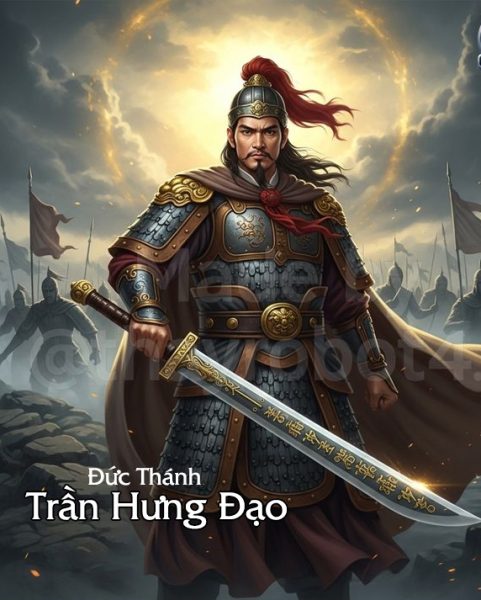
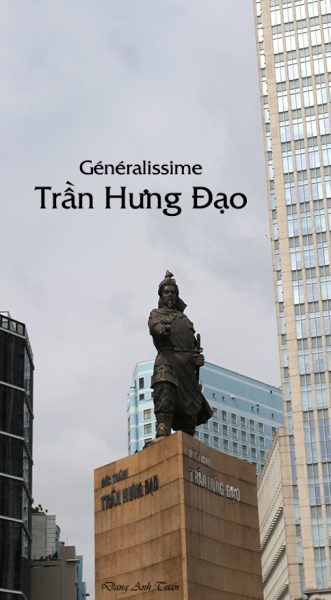
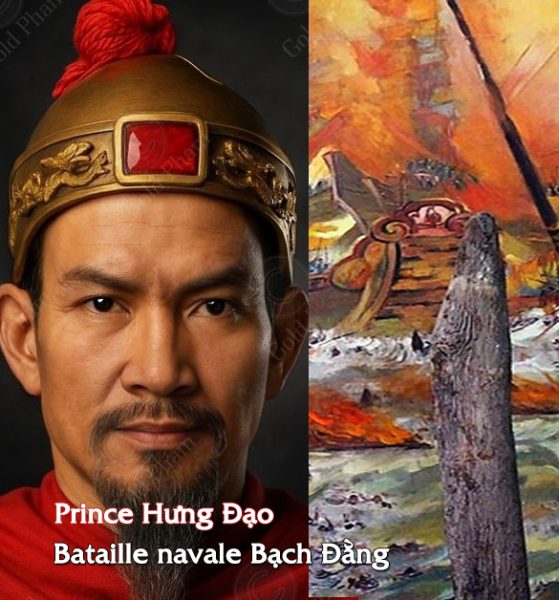
Généralissime Trần Hưng Đạo (Trần Quốc Tuấn)

Hưng Đạo Vương Trần Quốc Tuấn (1228- 1300)
Les grandes entreprises appartiennent à ceux qui possèdent talent et vertu.

Great enterprises belong to those who possess talent and virtue.
Nghiệp lớn thuộc về người tài đức.

Version française
Version anglaise 
Bibliographie

Thật ra ông tên là Trần Quốc Tuấn. Còn Hưng Đạo vương là chức tước cao nhất mà các nhà vua của triều đại nhà Trần phong cho ông với vùng đất ở Vạn Kiếp thuộc về tỉnh Hải Dương ngày nay. Hưng có nghĩa  làm hưng thịnh và Đạo là cách làm tôi trung quân ái quốc. Trong lục lệ nhà Trần ít khi nói tên húy của nhân vật mà hay thường dùng chức tước để nói đến người đó. Bởi vậy ông thường đưọc gọi  là Trần Hưng Đạo trong lịch sử và dân gian.

Trước khi nói về người anh hùng dân tộc  Trần Hưng Đạo  thì phải nhắc đến An Sinh vương Trần Liễu, cha của ông và là anh ruột của Trần Thái Tông (Trần Cảnh) con của Trần Thừa (tức là Trần Thế Tổ), người sáng lập nhà Trần. Câu chuyện bắt đầu là một cuộc ép duyên mưu mô chính trị  tính toán khinh thường đạo lý của tể tướng Trần Thủ Độ, một người chú họ của cha ông để  củng cố vương quyền cho nhà Trần. Ông buộc Trần Thái Tông (Trần Cảnh)  lấy chị dâu của mình là  Lý Ngọc Oanh (con gái trưởng của vua Lý Huệ Tông), vợ của An Sinh vương Trần Liễu, cha của Trần Hưng Đạo bởi vì Lý Chiêu Hoàng (hay Lý Phật Kim) không có con. Lý Ngọc Oanh đang có bầu ba tháng với Trần Liễu.  Chính vì vậy An Sinh vương Trần Liễu mới phẫn uất, phất cờ làm loạn trên sông Cái (sông Hồng) nhằm đòi lại vợ khiến bị Trần Thủ Độ xử tội.

Nhờ có sự che chở của  em ruột Trần Cảnh (Trần Thái Tông)  nên Trần Liễu  mới khỏi bị hành quyết, bị đày từ đó về vùng An Quảng (Vạn Kiếp) và lúc nào cơn giận ấm ức vẫn còn ở nơi ông. Có lần Trần Thủ Độ  còn nhắc khéo ông nên trung thành với nhà vua vì họ Trần ta, người cùng ruột thịt không cần minh thệ làm gì cả như thời nhà Chu. Lời khuyên nhũ càng làm An Sinh vương  khó chịu và càng làm ông nuốt hận cho đến chết. Ông không thể làm gì, trong cậy vào con trưởng của ông là Hưng Đạo vương Trần Quốc Tuấn đề báo thù cho ông. Vậy Hưng Đạo vương có làm những gì  cha dặn không?

Trần Hưng Đạo là con của Trần Liễu với  bà Trần Thị Nguyệt, vợ nguyên phối (người vợ đầu tiên, cưới hỏi trước) nhưng vì Trần Liễu cưới Thuận Thiên công chúa, con gái lớn của vua Lý Huệ Tông nên bà buộc lòng giữ vai thứ phi. Nhưng sau khi Trần Thủ Độ ép gả Thuận Thiên công chúa cho Trần Thái Tông, bà trở thành lại người vợ duy nhất của Trần Liễu, lo chăm sóc gia đình và nuôi dạy Trần Hưng Đạo. Khi ông lên kinh thành thì được người cô ruột tức Thụy Bà Công chúa là chị  của Trần Cảnh và Trần Liễu trực tiếp nuôi dưỡng.

Chính vì vậy mà Trần Hưng Đạo mới quen biết với công chúa Thiên Thành. Từ đó đôi trẻ quen  và thương nhau từ  lúc nhỏ. Vậy công chúa Thiên Thành là ai? Hiện nay có hai giả thuyết (1235–1288) về  cô công chúa nhà Trần được tôn hiệu là Nguyên Từ Quốc mẫu.

Bà có thể là con gái của Trần Thừa (hay Trần Thế Tổ) hay là của vua Trần Thái Tông (Trần Cảnh). Theo Đại Việt sử ký toàn thư của Ngô Sĩ Liên thì bà là con gái trưởng của Trân Cảnh (Trần Thái Tông) vì cuộc hôn nhân nội tộc của nhà Trần hay thường  cùng thế hệ (anh chị em họ kết hôn với nhau). Vả lại độ tuổi kết hôn thời đó của nữ thường là 15 – 16 tuổi. Như vậy bà phải sinh ra trong  khoảng năm 1235– 1236. Rất hiếm  khả năng bà sinh vào năm 1234 lúc mà Thái Thượng Hoàng Trần Thừa qua đờì ở tuổi 50. Hơn nữa qua câu nói mà Ngô Sĩ Liên dùng « Con gái vua  lấy kẻ bề dưới tất phải sai chư hầu cùng họ đứng ra làm chủ hôn theo lễ phải thế » thì rất rõ ràng ám chỉ bà phải là con gái của Trần Thái Tông chớ nếu không thì phải nói con gái  Thượng Hoàng chớ Trần Thừa đâu có một ngày nào làm vua đâu.

Hưng Đạo vương và  Thiên Thành cũng không biết từ lúc nào họ yêu nhau. Nhưng họ không  dám nói cùng ai để thời gian nó trôi qua cho đến lúc Nhân Đao vương thấy con là Trung Thành vương đã lớn, liền  xin vua Thái Tông gả công chúa Thiên thành cho con mình. Vua đồng ý. Bởi vậy ở phủ Nhân Đạo vương mới có treo đèn kết hoa rực rỡ để đón cô  dâu Thiên Thành vào ngày 15 tháng 2 năm Tân Hợi (1251). Lúc nầy Hưng Đạo mới biết và mới nghỉ kế cướp dâu nửa đêm  trước ngày lễ cưới chính thức.  Trước đó, vua đã cho Thiên Thành về ở vương phủ của cha con Trung Thành Vương, chờ làm lễ ăn hỏi.  Ông đã lẻn vào phủ Nhân Đạo Vương. Ông tìm cách trèo tường, vượt qua lính tuần tra, tìm đến chính xác phòng của công chúa. Rồi đem công chúa về nhà và cho mẹ nuôi của mình là Thụy Bà Công chúa biết chuyện nầy.

Nhận được tin, bà hốt hoảng lo sợ và  vội vàng vào cung than khóc với vua. Vua buộc lòng phải ra thánh chỉ gả Thiên Thành công chúa cho Hưng Đạo. Để bù đắp, vua còn phải cắt 2.000 khoảnh ruộng tốt ở huyện Ứng Thiên ban cho Nhân Đạo Vương để xoa dịu sự thất hứa.

Sự táo bạo của ông cho thấy ông là con người có bản lĩnh  dám quyết đoán, dám liều lĩnh mất mạng  sống, dám vượt qua lễ giáo khắc nghiệt và áp lực quyền lực của triều đình lúc bấy giờ để đến với người mình yêu.  Câu chuyện cướp dâu của Hưng Đạo Vương cũng trở thành giai thoại « có một trong hai » trong lịch sử Việt Nam. Chính cuộc  hôn nhân nầy một lần nữa nó làm giảm đi sự hiềm khích của hai chi, giữa dòng chính và dòng thứ  của triều đại nhà Trần. Qua việc nầy, chúng ta mới nhận thấy lúc còn trẻ ông đã có ý chí quật cường khi đối mặt với thử thách chớ không buông xui và không nản chí cũng như bao phen ông thua trận trong các cuộc xâm lăng của giặc Nguyên-Mông. Lúc nào câu binh pháp nầy  « Thắng không kiêu, thua không nản » vẫn nằm ở trong tâm trí của ông  ngày đêm. Ông còn soạn ra một quyển Binh Thư yếu lược để khuyên răng tướng sĩ phải hết lòng luyện tập và quyết chí không  nên nản lòng. Còn Hịch tướng sĩ là áng văn chính luận nổi tiếng của Trần Hưng Đạo viết vào khoảng năm 1284 để khơi dậy lòng yêu nước và cổ động dân tộc ta trước sự sống còn của đất nước.

Nói đến ông thì phải nói đến  lòng trung nghĩa trọn vẹn mà ông có, mặc dù ông vẫn ghi tạc lời cha dặn. Ông không những  đặt lợi ích quốc gia và đại nghĩa dân tộc lên trên hết mà còn giữ phận làm tôi với vua. Có lần Trần Thủ Độ  hỏi  vua với tướng như thế nào?  Ông trả lời vua là oai trùm thiên hạ mà tướng thì là thần hạ của thiên tử.  Đức vua  sáng suốt thì giúp tướng nên công. Còn tướng giỏi thì giúp vua nên nghiệp lớn. Ông còn hòa giải cho hai chi tộc Trần  Liễu và Trần Cảnh  quên đi mối hiềm khích sâu xa mà do Trần Thủ Độ gây ra qua việc tắm rữa  cho Trần Quang Khải, con của Trần Thái Tông (Trần Cảnh) để cùng nhau chung sức chống ngoại xâm. Khi ông làm Quốc công tiết chế, ông có quyền thay thế vua mà phong tước đến tước hầu rồi tâu lên vua sau nhưng ông hết sức giữ gìn làm phận tôi, không lạm dụng và không bao giờ  vượt quyền  cả.

Những lời khuyên mà ông dành cho vua Trần Anh Tôn trước khi ông qua đời vào năm 1300 được xem đây là kim chỉ nam cho đa số  người dân Việt trong  công cuộc đấu tranh giành độc lập:

Khi kẻ thù tiến tới với tiếng vang ầm ĩ như lửa và gió, thì rất dễ dàng đánh bại nó. Nếu nó dùng tính kiên nhẫn như con tằm gặm lá dâu mà không mưu cầu thắng lợi nhanh chóng, không cướp bóc dân chúng thì chúng ta không chỉ cần tướng giỏi mà còn phải biết soạn thảo một chiến thuật tương xứng cũng như ở trong ván cờ.

Dù trong hoàn cảnh nào, quân ta phải đoàn kết, đồng tâm nhất trí như cha con trong một gia đình. Đồng thời, phải đối xử với nhân dân bằng lòng nhân ái, nhờ đó mới tạo dựng được gốc rễ sâu bền và nền tảng vững chắc 

Ông là biểu tượng sáng ngời trong lịch sử  không chỉ ở tài năng, đạo đức mà còn lấy dân làm gốc trong việc cai trị và đoàn kết để thắng giặc ngoại xâm 3 lần. Dân tộc ta muôn đời nhớ đến ông. Ông là vị anh hùng dân tộc kiệt xuất, tài đức hơn người. Ông còn được dân tôn ông lên bậc hiển thánh và thờ phụng ông tại đền Ðức Thánh Trần ở Kiếp Bạc (Bắc Việt) và ở mọi miền nước ta.

Version française

Saïgon

En réalité, il s’appelait Trần Quốc Tuấn. « Hưng Đạo Vương » (Prince Hưng Đạo) était le titre le plus élevé que lui avaient conféré les monarques de la dynastie Trần et qui était  associé au fief de Vạn Kiếp, situé dans l’actuelle province de Hải Dương. Le nom « Hưng » évoque la prospérité, tandis que « Đạo » symbolise la voie choisie par un sujet loyal et patriote. Sous la dynastie Trần, il était d’usage de désigner les individus par leur titre plutôt que par leur prénom. C’est pourquoi il est communément appelé Trần Hưng Đạo, tant dans les documents historiques que dans la tradition populaire.

Avant de parler du héros national Trần Hưng Đạo, il faut mentionner le prince An Sinh (Trần Liễu), son père et frère aîné de l’empereur Trần Thái Tông (Trần Cảnh). Tous deux étaient les fils de Trần Thừa (honoré à titre posthume comme le fondateur de la dynastie Trần). L’histoire commence par un mariage forcé, politiquement calculé et moralement sans scrupules orchestré par le chancelier Trần Thủ Độ,  un grand oncle paternel pour consolider le pouvoir royal du clan Trần. Trần Thủ Độ a contraint l’empereur Trần Thái Tông (Trần Cảnh) à épouser sa propre belle-sœur, Lý Ngọc Oanh (la fille aînée de l’empereur Lý Huệ Tông et épouse du prince An Sinh), parce que l’impératrice Lý Chiêu Hoàng (Lý Phật Kim) a échoué d’avoir un héritier. À cette époque, Lý Ngọc Oanh était enceinte de trois mois de l’enfant du prince An Sinh. Poussé par un profond ressentiment face à cette situation, le prince An Sinh souleva une rébellion sur la rivière Cái (le fleuve Rouge) pour tenter de récupérer sa femme. C’était un acte pour lequel il fut ensuite puni par Trần Thủ Độ.

Grâce à la protection de son jeune frère, Trần Cảnh (l’empereur Trần Thái Tông), Trần Liễu échappa à l’exécution et fut relégué dans la région d’An Quảng (Vạn Kiếp). Toutefois, un profond ressentiment continua de couver en lui. Un jour, Trần Thủ Độ l’exhorta avec tact à demeurer loyal au souverain en arguant qu’en tant que membres de la même lignée des Trần, ils n’avaient nul besoin des serments d’allégeance formels en usage sous la dynastie Zhou avec les vassaux. Ce conseil ne fit qu’irriter le prince An Sinh, qui nourrit son amertume jusqu’à son dernier souffle. Impuissant à agir lui-même, il plaça ses espoirs en son fils aîné, Hưng Đạo Vương Trần Quốc Tuấn, pour prendre sa revanche. Hưng Đạo Vương a-t-il exaucé les vœux de son père?

Trần Hưng Đạo était le fils de Trần Liễu et de sa première épouse, Trần Thị Nguyệt.  Toutefois, comme Trần Liễu épousa par la suite la princesse Thuận Thiên,  fille aînée du roi Lý Huệ Tông, Trần Thị Nguyệt fut reléguée au rang d’épouse secondaire. Cependant, après que  Trần Thủ Độ avait obligé  l’empereur Trần Thánh Tông (Trần Cảnh) d’épouser  sa belle sœur, la princesse Thuận Thiên, Trần Thị Nguyệt redevint ainsi l’unique épouse de Trần Liễu. Elle se consacra désormais à la gestion du foyer et à l’éducation de Trần Hưng Đạo. Lorsque ce dernier se rendit dans la capitale, il fut  élevé par sa tante paternelle, la princesse Thụy Bà, la sœur aînée de Trần Cảnh et de Trần Liễu.

C’est dans ce contexte que Trần Hưng Đạo fit la connaissance de la princesse Thiên Thành. Tous deux grandirent ensemble et tombèrent amoureux dès leur plus jeune âge. Qui était donc la princesse Thiên Thành ? Il existe aujourd’hui deux théories concernant cette princesse de la dynastie Trẩn, honorée du titre de *Nguyên Từ Quốc Mẫu* (Mère de la Nation).

Elle aurait pu être la fille de Trần Thừa (également connu sous le nom de Trần Thế Tổ) ou celle du roi Trần Thái Tông (Trần Cảnh). Selon le *Đại Việt Sử Ký Toàn Thư* (Annales complètes du Đại Việt) rédigé par  l’historien Ngô Sĩ Liên, elle était la fille aînée de Trần Cảnh (Trần Thái Tông). C’est  une conclusion qui concorde avec la pratique des mariages endogames au sein de la dynastie Trần, où des individus d’une même génération (souvent des cousins) s’unissaient entre eux. Par ailleurs, l’âge habituel du mariage pour les femmes à cette époque étant de 15 ou 16 ans, on peut supposer qu’elle est née aux alentours de 1235–1236. Il est fort peu probable qu’elle soit née en 1234, année du décès de l’empereur retiré Trần Thừa, survenu alors qu’il avait 50 ans. De plus, la formulation employée par Ngô Sĩ Liên :« Lorsqu’une fille du roi épouse une personne de rang inférieur, il est d’usage qu’un parent de la même lignée préside la cérémonie de mariage »  suggère fortement qu’elle était la fille de Trần Thái Tông. Si elle avait été la fille de l’empereur retiré (Trần Thừa), le texte aurait sans nul doute précisé « fille de l’empereur retiré ». Après tout, Trần Thừa n’a jamais régné en tant que roi.

On ignore quand exactement Prince Hưng Đạo  et Thiên Thành tombèrent amoureux l’un de l’autre. N’osant en parler à personne, ils laissèrent le temps s’écouler, jusqu’au jour où Nhân Đạo Vương constatant que son fils, Trung Thành Vương, avait atteint l’âge adulte  demanda au roi Thái Tông d’accorder la main de la princesse Thiên Thành pour son fils. Le roi y consentit. En conséquence, la demeure de Nhân Đạo Vương fut parée de lanternes et de fleurs en prévision de l’arrivée de la princesse Thiên Thành, prévue pour le quinzième jour du deuxième mois lunaire de l’année du Cochon (1251). Apprenant la nouvelle, Prince Hưng  Đạo échafauda un plan pour enlever la jeune femme à la veille des noces. À cette époque, le roi avait déjà fait installer Thiên Thành dans la résidence de Nhân Đạo Vương et de Trung Thành Vương, dans l’attente de la cérémonie officielle des fiançailles. Prince Hưng  Đạo parvint à s’introduire dans la demeure en escaladant les murs et déjouant la vigilance des gardes. Il atteignit l’appartement de la princesse. Il l’emmena ainsi avec lui et confia toute l’affaire à sa mère adoptive, la princesse Thùy Bà.

En apprenant la nouvelle, elle fut saisie de panique et d’effroi et se précipita au palais pour se lamenter devant le Roi. Acculé par les circonstances, le Roi promulgua un décret impérial accordant la main de la princesse Thiên Thành au Prince Hưng Đạo. Afin de réparer la rupture de sa promesse initiale, le Roi octroya en outre à Nhân Đạo Vương 2 000 parcelles de terres fertiles dans le district d’Ứng Thiên, en guise de geste de réconciliation pour ne pas avoir tenu parole.

Son audace a révélé un homme d’une trempe exceptionnelle, capable de braver des périls mortels et de défier l’immense pression exercée par la cour impériale pour rester auprès de la femme qu’il aimait. L’épisode où Prince Hưng Đạo enleva  sa promise est devenu une anecdote singulière, unique en son genre, dans l’histoire du Vietnam. Par ailleurs, ce mariage contribua à apaiser l’animosité entre les deux branches de la famille royale des Trần, notamment entre la lignée principale et la branche secondaire. Cet événement témoigne du fait que, dès sa jeunesse, il était doté d’une volonté indomptable. Il ne se rendait jamais et ne se laissait jamais abattre face aux épreuves ; tout comme il resta inébranlable malgré les multiples défaites subies lors des campagnes contre les envahisseurs Sino-Mongols. La maxime militaire « Ne pas s’enorgueillir dans la victoire, ne pas se décourager dans la défaite » était restée, en permanence, au cœur de ses préoccupations. Il a également rédigé un traité intitulé *Binh Thư Yếu Lược* (Essentiel de la stratégie militaire), dans lequel il exhortait ses officiers et ses soldats à s’entraîner avec assiduité et à ne jamais céder au découragement. En outre, son *Hịch Tướng Sĩ* (Proclamation aux officiers et aux soldats), un manifeste politique et militaire célèbre, rédigé vers 1284 a permis d’éveiller un élan patriotique et de rassembler le peuple à une époque où la survie de notre nation même était en jeu.

Évoquer sa personne, c’est souligner sa loyauté profonde et son intégrité, des vertus qu’il a eues malgré les derniers conseils de son père. Non seulement il plaçait l’intérêt national et la cause du peuple au-dessus de tout, mais il demeurait également inébranlable dans ses devoirs de sujet envers le souverain. Lorsque Trần Thủ Độ l’interrogea un jour sur sa conception des relations entre un roi et un général. Il répondit que le roi détient l’autorité suprême sur le royaume, tandis que le général demeure un sujet du Fils du Ciel. Un monarque sage, expliqua-t-il, s’appuie sur ses sujets pour assurer le succès, tandis qu’un général compétent seconde le roi dans la réalisation de grandes entreprises.

Il parvint par ailleurs à réconcilier les deux branches du clan Trần issues de Trần Liễu et de Trần Cảnh (l’empereur Trần Thái Tông)  en les aidant à surmonter l’animosité profonde semée par Trần Thủ Độ  par le biais de l’épisode dit du « bain de soleil » impliquant Trần Quang Khải, fils de Trần Thái Tông)  et à unir leurs efforts face aux envahisseurs étrangers. Même lorsqu’il occupait la fonction de commandant suprême (*Quốc công tiết chế*), un poste qui lui conférait le pouvoir de décerner des titres, allant jusqu’à celui de marquis sous réserve de la ratification ultérieure par l’empereur, il restait toujours fidèle à son statut de sujet. Il ne profita jamais de cette prérogative et ne franchit jamais les limites de ses attributions.

Les conseils qu’il donna au roi Trần Anh Tôn avant sa mort en 1300 sont aujourd’hui considérés comme une référence (ligne directrice) pour le peuple vietnamien dans sa lutte pour l’indépendance :

Quand l’ennemi s’avance à grand fracas comme le feu et le vent, il est facile de le vaincre. S’il use de la patience comme le ver de soie qui ronge la feuille du mûrier sans chercher une victoire rapide et sans dépouiller la population, il nous faut non seulement de bons généraux mais aussi une élaboration d’une tactique adéquate comme au jeu d’échecs.

De toute façon, il faut que l’armée soit unie  et animée d’une même volonté à l’instar du père et du fils d’une même famille, que le peuple soit traité avec humanité pour pouvoir se garantir de profondes racines et d’une base durable.

Il demeure une figure emblématique de l’histoire, non seulement en raison de son talent exceptionnel et de son intégrité morale, mais aussi pour son attachement au principe selon lequel le peuple constitue le fondement du pouvoir, ainsi que pour sa capacité à unir la nation afin de vaincre à trois reprises des envahisseurs étrangers. Notre peuple se souviendra de lui pour toujours. Il est un héros national hors pair, doté à la fois d’un talent extraordinaire et d’une vertu exemplaire. Le peuple l’a même élevé au rang de saint vénéré. Il lui a rendu hommage au temple de Saint Trần à Kiếp Bắc (dans le nord du Vietnam)  ainsi que dans des sanctuaires à travers tout le pays.

Version anglaise

In fact, his name was Trần Quốc Tuấn. “Hưng Đạo Vương” (Prince Hưng Đạo) was the highest title bestowed upon him by the monarchs of the Trần dynasty, and it was associated with the fiefdom of Vạn Kiếp, located in what is now Hải Dương Province. The name “Hưng” evokes prosperity, while “Đạo” symbolizes the path chosen by a loyal and patriotic subject. During the Trần dynasty, it was customary to refer to individuals by their titles rather than their first names. This is why he is commonly known as Trần Hưng Đạo, both in historical documents and in popular tradition.

Before discussing the national hero Trần Hưng Đạo, we must mention Prince An Sinh (Trần Liễu), his father and the older brother of Emperor Trần Thái Tông (Trần Cảnh). Both were sons of Trần Thừa (posthumously honored as the founder of the Trần dynasty). The story begins with a forced marriage, politically calculated and morally unscrupulous, orchestrated by Chancellor Trần Thủ Độ, a paternal great-uncle, to consolidate the royal power of the Trần clan. Trần Thủ Độ forced Emperor Trần Thái Tông (Trần Cảnh) to marry his own sister-in-law, Lý Ngọc Oanh (the eldest daughter of Emperor Lý Huệ Tông and wife of Prince An Sinh), because Empress Lý Chiêu Hoàng (Lý Phật Kim) had failed to produce an heir. At that time, Lý Ngọc Oanh was three months pregnant with Prince An Sinh’s child. Driven by deep resentment over this situation, Prince An Sinh launched a rebellion on the Cái River (the Red River) in an attempt to reclaim his wife. It was an act for which he was subsequently punished by Trần Thủ Độ.

Thanks to the protection of his younger brother, Trần Cảnh (Emperor Trần Thái Tông), Trần Liễu escaped execution and was exiled to the An Quảng region (Vạn Kiếp). However, a deep resentment continued to smolder within him. One day, Trần Thủ Độ tactfully urged him to remain loyal to the sovereign, arguing that, as members of the same Trần lineage, they had no need for the formal oaths of allegiance customary among vassals under the Zhou dynasty (China). This advice only served to irritate Prince An Sinh, who harbored his bitterness until his last breath. Unable to act himself, he placed his hopes in his eldest son, Hưng Đạo Vương Trần Quốc Tuấn, to exact his revenge. Did Hưng Đạo Vương fulfill his father’s wishes?

Trần Hưng Đạo was the son of Trần Liễu and his first wife, Trần Thị Nguyệt.  However, since Trần Liễu later married Princess Thuận Thiên,  the eldest daughter of King Lý Huệ Tông, Trần Thị Nguyệt was relegated to the status of a secondary wife. However, after Trần Thủ Độ forced Emperor Trần Thánh Tông (Trần Cảnh) to marry his sister-in-law, Princess Thuận Thiên, Trần Thị Nguyệt once again became Trần Liễu’s sole wife. She devoted herself from then on to managing the household and raising Trần Hưng Đạo. When Trần Hưng Đạo went to the capital, he was raised by his paternal aunt, Princess Thụy Bà, the older sister of Trần Cảnh and Trần Liễu.

It was in this context that Trần Hưng Đạo met Princess Thiên Thành. The two grew up together and fell in love at a very young age. Who, then, was Princess Thiên Thành? Today, there are two theories regarding this princess of the Trần dynasty, who was honored with the title *Nguyên Từ Quốc Mẫu* (Mother of the Nation).

She may have been the daughter of Trần Thừa (also known as Trần Thế Tổ) or of King Trần Thái Tông (Trần Cảnh). According to the *Đại Việt Sử Ký Toàn Thư* (Complete Annals of Đại Việt) written by the historian Ngô Sĩ Liên, she was the eldest daughter of Trần Cảnh (Trần Thái Tông). This conclusion is consistent with the practice of endogamous marriages within the Trần dynasty, where individuals of the same generation (often cousins) married one another. Furthermore, since the typical age of marriage for women at that time was 15 or 16, it can be assumed that she was born around 1235–1236. It is highly unlikely that she was born in 1234, the year of the death of the retired Emperor Trần Thừa, who was 50 years old at the time. Furthermore, the wording used by Ngô Sĩ Liên: “ ‘When a king’s daughter marries someone of lower rank, it is customary for a relative from the same lineage to preside over the wedding ceremony’  strongly suggests that she was the daughter of Trần Thái Tông. If she had been the daughter of the retired emperor (Trần Thừa), the text would undoubtedly have specified ‘daughter of the retired emperor.’ After all, Trần Thừa never reigned as king.

It is not known exactly when Prince Hưng Đạo and Princess Thiên Thành fell in love. Not daring to tell anyone, they let time pass until the day when Nhân Đạo Vương, realizing that his son, Trung Thành Vương, had come of age, asked King Thái Tông to grant Princess Thiên Thành’s hand in marriage to his son. The king agreed. Consequently, Nhân Đạo Vương’s residence was adorned with lanterns and flowers in anticipation of Princess Thiên Thành’s arrival, scheduled for the fifteenth day of the second lunar month of the Year of the Pig (1251). Upon hearing the news, Prince Hưng Đạo devised a plan to abduct the young woman on the eve of the wedding. By that time, the king had already arranged for Thiên Thành to be housed in the residence shared by Nhân Đạo Vương and Trung Thành Vương, pending the official betrothal ceremony. Prince Hưng Đạo managed to sneak into the residence by scaling the walls and evading the guards’ vigilance. He reached the princess’s quarters. He took her with him and entrusted the entire matter to his adoptive mother, Princess Thùy Bà.

Upon hearing the news, she was seized with panic and dread and rushed to the palace to plead her case before the King. Forced by circumstances, the King issued an imperial decree granting Princess Thiên Thành’s hand in marriage to Prince Hưng Đạo. To make amends for breaking his original promise, the King also granted Nhân Đạo Vương 2,000 plots of fertile land in the district of Ứng Thiên as a gesture of reconciliation for failing to keep his word.

His boldness revealed a man of exceptional character, capable of braving mortal dangers and defying the immense pressure exerted by the imperial court to remain with the woman he loved. The episode in which Prince Hưng Đạo abducted his betrothed has become a singular, one-of-a-kind anecdote in the history of Vietnam. Furthermore, this marriage helped to ease the animosity between the two branches of the Trần royal family, particularly between the main line and the collateral branch. This event attests to the fact that, from his youth, he possessed an indomitable will. He never gave up and never let himself be discouraged in the face of adversity; just as he remained unshaken despite the many defeats suffered during the campaigns against the Sino-Mongol invaders. The military maxim “Do not become arrogant in victory; do not become discouraged in defeat” remained, at all times, at the heart of his concerns. He also wrote a treatise titled *Binh Thư Yếu Lược* (Essentials of Military Strategy), in which he urged his officers and soldiers to train diligently and never give in to discouragement.

Furthermore, his *Hịch Tướng Sĩ* (Proclamation to Officers and Soldiers), a famous political and military manifesto written around 1284, helped stir up a wave of patriotism and rally the people at a time when the very survival of our nation was at stake.

To speak of him is to highlight his profound loyalty and integrity, virtues he upheld despite his father’s final advice. Not only did he place the national interest and the cause of the people above all else, but he also remained unwavering in his duties as a subject to the sovereign. When Trần Thủ Độ once asked him about his view of the relationship between a king and a general, he replied that the king holds supreme authority over the kingdom, while the general remains a subject of the Son of Heaven. A wise monarch, he explained, relies on his subjects to ensure success, while a competent general assists the king in accomplishing great undertakings.

He also succeeded in reconciling the two branches of the Trần clan descended from Trần Liễu and Trần Cảnh (Emperor Trần Thái Tông) by helping them overcome the deep animosity sown by Trần Thủ Độ through the so-called “sunbathing” incident involving Trần Quang Khải, the son of Trần Thái Tông)  and by uniting their efforts against foreign invaders. Even while serving as supreme commander (*Quốc công tiết chế*), a position that granted him the authority to confer titles—up to and including that of marquis, subject to subsequent ratification by the emperor, he always remained true to his status as a subject. He never took advantage of this prerogative and never overstepped the bounds of his authority.

The advice he gave to King Trần Anh Tôn before his death in 1300 is now considered a guiding principle for the Vietnamese people in their struggle for independence:

When the enemy advances with great fanfare, like fire and wind, it is easy to defeat him. If he exercises patience, like the silkworm that gnaws at the mulberry leaf without seeking a quick victory and without plundering the people, we need not only good generals but also the development of appropriate tactics, just as in a game of chess.

In any case, the army must be united and driven by a single will, like a father and son from the same family, and the people must be treated humanely in order to ensure deep roots and a lasting foundation.

He remains an iconic figure in history, not only because of his exceptional talent and moral integrity, but also for his commitment to the principle that the people are the foundation of power, as well as for his ability to unite the nation to defeat foreign invaders on three occasions. Our people will remember him forever. He is an unparalleled national hero, endowed with both extraordinary talent and exemplary virtue. The people have even elevated him to the status of a revered saint. They have honored him at the Temple of Saint Trần in Kiếp Bắc (in northern Vietnam) as well as at shrines throughout the country.


Bibliographie
Trần Trọng Kim: Việt Nam sử lược. Histoire du Viet Nam. Imprimerie Vĩnh & Thanh 1928.
Lê Thành Khôi: Le Viet-Nam. Histoire et Civilisation. Les Éditions de Minuit. 1955
Thái Văn Kiểm: Việt Nam Quang Hoa. Editeur Xuân Thu
René Grousset: Histoire de la Chine. Editeur France Loisirs 1997
Bai Shouyi: Précis d’histoire de Chine. Edition en langues étrangères. 1988
Yamamoto T.: La conquête de l’Annam par les Yuan et les Ming. Tokyo. 1950
Ngô Văn Phú: Trần Quốc Tuấn (Gươm thần Vạn Kiếp)  Nhà Xuất Bản Hội Nhà Văn 2001
Ngô Văn Phú: Trần Thủ Độ và sự nghiệp nhà Trần. Nhà Xuất Bản Văn Học.1995

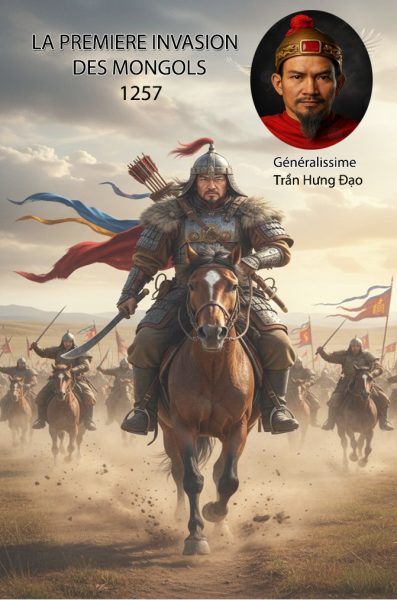
The first Mongol invasion of Dai Viet

Photo Pinterest

The first Mongol invasion of Dai Viet

Version vietnamienne
Version française
Bibliographie

In 1209, while the imperial capital of Thăng Long was plunged into chaos by General Quách Bốc, who had risen up to avenge his commander Pham Bỉnh Di, King Lý Cao Tông was forced to flee to Quy Hóa. Meanwhile, Crown Prince Lý Sâm reached the region of Hải Ấp to find refuge with the Trần clan, a wealthy and influential local power that possessed a large number of vassals and private troops in the coastal area.

It was in the wake of these events that Lý Cao Tông regained the throne. As for Lý Sâm, in love with Trần Thị Dung, daughter of Trần Lý, he married her. This alliance paved the way for the rise of the Trần clan at the royal court and, ultimately, for the overthrow of the Lý dynasty. A major transfer of political power, orchestrated mainly by Trần Thủ Độ, took place afterwards. Not only did he take advantage of the incapacity of King Lý Huệ Tông (formerly Crown Prince Lý Sâm), who suffered from mental disorders, but he also elevated Trần Thị Dung to the rank of empress. Furthermore, in 1225 he arranged the marriage of Lý Chiêu Hoàng (reigning queen of the Lý dynasty, then six years old) with Trần Cảnh (son of Trần Thừa, eight years old). This political maneuver was a calculated strategy by Trần Thủ Độ, commander of the imperial guard, aimed at transferring power from the Lý dynasty to the Trần dynasty.

His cruelty earned him sharp criticism from historians and by posterity, notably for having forced King Lý Huệ Tông to become a monk before driving him to his death. He usurped the throne by installing the young Trần Cảnh (eight years old) — through the latter’s marriage to Lý Chiêu Hoàng (six years old) — and eliminated all members of the Lý royal family in order to remove any future threat. Anyone bearing the family name Lý was forced to change it to Nguyễn. Only Admiral Lý Long Tường, seventh son of King Lý Anh Tông, escaped this massacre. He and 6,000 members of his kin fled Đại Việt by sea to seek refuge in the kingdom of Goryeo (Korea). There, he became a renowned general in the service of King Gojong during the resistance against the Mongol invasions, and he received from the sovereign the title of Lord of Hwasan (or General Hwasan).

Although Trần Thủ Độ was a remarkable statesman who consolidated the absolute royal authority of the Trần dynasty and rendered immense services to the nation during the first resistance against the Mongol invaders, his cruel and shameful acts earned him the condemnation of public opinion.

In the eyes of Confucian historians of the feudal era such as Lê Văn Hưu and Ngô Sĩ Liên, he appeared as a cunning and ruthless man, disregarding moral principles in his desire to consolidate royal power for the benefit of the Trần dynasty. He went so far as to force Trần Cảnh (Emperor Trần Thái Tông) to marry his own sister-in-law, Lý Ngọc Oanh, the eldest daughter of King Lý Huệ Tông and wife of Prince An Sinh (Trần Liễu), because Empress Lý Chiêu Hoàng (Lý Phật Kim) had not produced an heir. Furious, Prince An Sinh (father of Trần Hưng Đạo) fomented a rebellion on the Cái River in an attempt to reclaim his wife. It was an act for which he was later punished by Trần Thủ Độ. Thanks to the vigorous protection of his younger brother, Emperor Trần Thái Tông, Trần Liễu escaped execution, although he continued to harbor deep resentment until the end of his days.

On the other hand, from the perspective of objective and progressive history today, he is credited with having saved the nation by stabilizing the economy and strengthening the army through the repression of various revolts such as those led by the Mường rebels in Quốc Oai, the Đoàn Thường faction in Đường Hào, and Nguyễn Non’s faction in Bắc Giang. These actions made it possible to establish a new dynasty powerful enough to defend the kingdom against the first Mongol invasion, which occurred thirty years later. Contemporary historians acknowledge that the final phase of the Lý dynasty would certainly have been incapable of achieving this. Without his efforts, the country would probably have suffered the same fate as the kingdom of Dali in Yunnan, annihilated in 1252.

In order to consolidate their political power and preserve the noble lineage of the royal family, the monarchs of the Tran dynasty frequently practiced consanguineous marriages, uniting within the extended family. Although such unions carry a risk of congenital anomalies by modern standards, the era of the Trần nevertheless witnessed the emergence of many illustrious figures such as Trần Hưng Đạo, Trần Nhân Tôn, Trần Quang Khải, Trần Nhật Duật, Trần Bình Trọng, Trần Quốc Toản etc.

This is precisely what enabled our country to defeat the Mongol invaders. According to Professor Lê Thành Khôi (ibid., 180), they were a people who possessed not only skilled mounted archers capable of moving with lightning speed, but also enjoyed an overwhelming military superiority over the inhabitants of the coastal plains. Furthermore, the researcher Trần Trọng Kim (ibid., 106) emphasizes that the Mongols, originally from the upper course of the Amur River, were a warlike people. Their exceptional cavalry and archers conquered Central Asia, Persia, and parts of Eastern Europe as well as the kingdom of Western Xia (in the northwest of China). They annihilated the Jin dynasty and invaded the kingdom of Goryeo (ibid., 107).

In 1257, as part of a plan aimed at encircling the Southern Song dynasty by opening a second front from the south, Möngke Khan entrusted his younger brother, Kubilai Khan, with the mission of invading the Kingdom of Dali, in Yunnan Province, which bordered Vietnam.

Consequently, Đại Việt became a major strategic target for launching an attack on the rear of the Southern Song. It was a state that had successfully resisted every attempt at subjugation for more than two decades. After the conquest of the kingdom of Dali, the Mongol general Uriyangkhadai sent envoys to the Trần court to request permission to pass through their territory in order to attack the Song dynasty (China) from the south. Concerned about the sovereignty of his kingdom and firmly determined not to betray the bonds of vassalage that bound him to the Song, King Trần Thái Tông not only rejected the Mongol request but also had the Mongol envoys arrested and ordered his nephew, Trần Quốc Tuấn (Trần Hưng Đạo), to lead a powerful army to defend the northern border.

For the Mongol Empire, the imprisonment or murder of diplomatic envoys was considered a supreme insult that demanded immediate military retaliation. Möngke Khan authorized Uriyangkhadai to launch the first Mongol invasion of Vietnam at the end of the year 1257. Outnumbered, Trần Quốc Tuấn was forced to retreat and position his troops at Sơn Tây, while the Mongol forces advanced as far as the Thao River. King Thái Tông personally led the defense but was unable to hold his positions. He was forced to abandon the capital and took refuge near the Thien Mạc River (a section of the Red River located in Hưng Yên Province). Upon entering the citadel of Thăng Long (capital of Đại Việt), General Uriyangkhadai found the envoys chained in the prison. One of them died at the moment of his release. This drove him into a mad rage and prompted him to order his troops to pillage the city and massacre all the men, women and children who were there (Trần Trọng Kim, ibid., p. 208).

Faced with this perilous situation, King Thái Tông consulted his younger brother, Grand Marshal Trần Nhật Hiệu, while they were aboard the royal barge. Without saying a word, Hiệu seized a pole and traced the characters “Nhập Tống” (Join the Song) on the surface of the water, thereby suggesting either flight and surrender, or the integration of the kingdom into the Song dynasty in order to preserve their lives and their lineage. Rejecting this proposal, the king turned to Grand Preceptor Trần Thủ Độ. He replied with calm and determination: “As long as my head remains on my shoulders, Your Majesty has nothing to fear.” Reassured by these words, King Thái Tông regained his composure.

This exchange reveals that, although Thủ Độ acted without mercy toward the Lý dynasty, he was a remarkable and eminent statesman of the Trần dynasty. It is, moreover, difficult for us to judge him harshly when we reread the history of that troubled period, because without him, the outcome of events could have been very different.
How did the Trần dynasty manage to defeat the Mongol army in the first confrontation when our forces were overwhelmed by the Mongols on all fronts? Under the command of General Trần Hưng Đạo, the Trần dynasty implemented a comprehensive defensive strategy based on the following three key elements:

1°) The “scorched earth” strategy. When enemy forces advanced toward the citadel, the order was given to the entire population, as well as to those holding food supplies, livestock, and vital resources, to evacuate the area or to conceal their property. This measure deprived the invaders of any source of resupply in the event of delays in their own supply lines.

2°) The climate and diseases. These factors acted as natural allies in the fight against the invaders. While formidable in arid plains, the Mongol forces could not withstand the overwhelming heat, high humidity, and the country’s dense forest terrain. As a result, the troops quickly succumbed to exhaustion and saw their combat effectiveness drop drastically after more than a week of encampment. They suffered from malnutrition and tropical diseases such as malaria. General Uriyangkhadai was forced to position his troops along the Red River (in the Đông Bộ Đầu area) to maintain a defensive posture, while seeking opportunities to plunder and break the encirclement.

This was the “The first Mongol invasion of Dai Viet” strategy adopted by Uriyangkhadai: using the troops of Dali to provide cover and take the blows in place of the Mongol army. Moreover, as fervent Buddhists, the soldiers of Dali lacked the ferocity and bloodlust of their Mongol counterparts. They were forced to serve as the vanguard and enter our territory at the beginning of the year 1258, alongside General Cacakdu. This vanguard was tasked with secretly crossing the river, bypassing our positions to take us from the rear, seizing the landing points, and cutting off all routes of retreat.

3°) Guerrilla warfare and counterattacks. This is a strategy consisting of “using the weak to oppose the strong,” frequently employed in our country. The Yunnan region (Dali) shared a border with the northern part of Dai Viet (the area corresponding to the present Northwestern provinces). The troops of Dali were accustomed to the rugged terrain as well as the harsh and perilous conditions of these wild, mountainous borderlands. Consequently, Uriyangkhadai forced 20,000 Dali soldiers to accompany 10,000 Mongol cavalrymen. They were tasked with scouting the terrain and bearing the brunt of the fighting, thus serving as a shield for the elite Mongol cavalry.

When the Mongol army in the central position launched a direct frontal assault, the Trần forces would have found themselves in a desperate situation, driven back against the riverbank with the imminent risk that the king and his court would be captured. Although the Mongols won a victory on the Bình Lệ Nguyên plain (located in what is now Vĩnh Phúc province) thanks to their eagerness to quickly engage in battle, their strategic intentions were revealed. It was for this reason that King Trần, his court, and tens of thousands of elite soldiers were able to embark calmly and retreat in complete safety. By contrast, the Mongol army subsequently found itself facing a severe shortage of provisions. Its morale collapsed, which allowed the Trần forces to launch, at the opportune moment, a general counteroffensive that culminated in victory at the battle of Đông Bộ Đầu (*).

(*) Đông Bộ Đầu Wharf on the Red River (today, the area extending from Hàng Than Slope to Hòe Nhai Street, in the Ba Đình district of Hanoï.

[The second  Mongol invasion  of Dai Viet]

Bibliography

Trần Trọng Kim: Việt Nam sử lược . Histoire du Viet Nam. Imprimerie Vĩnh & Thanh 1928.
Lê Thành Khôi: Le Viet-Nam. Histoire et Civilisation. Les Éditions de Minuit. 1955
Thái Văn Kiểm: Việt Nam Quang Hoa. Editeur Xuân Thu
René Grousset: Histoire de lA Chine. Editeur France Loisirs 1997
Bai Shouyi : Précis d’histoire de Chine. Edition en langues étrangères. 1988
Yamamoto T. : La conquête de l’Annam par les Yuan et les Ming. Tokyo. 1950


Troisième invasion mongole au pays de Dai Viet

Cuộc xâm lăng  lần thứ ba của quân Nguyên-Mông ở Đại Việt.

La troisième invasion mongole au pays Đại Viêt.

The third Mongol invasion of Dai Viet

Version française 
Version anglaise 
Galerie des photos
Bibliographie

Khi Thoát Hoan  cùng quân Nguyên-Mông bại trận chạy về thì Hốt Tất Liệt nổi giận lôi đình muốn bắt chém tất cả nhưng nhờ quần thần can gián nên mới thoát khỏi tội chết.  Lúc bấy giờ Hốt Tất Liệt có ý  định đi đánh Nhật Bản nhưng ông buộc lòng tạm thời gác lại. Ông sai đóng thêm 300 chiếc  thuyền và truyền hịch cho ba tỉnh Giang Hoài, Hồ Quảng và Giang Tây tụ tập binh sĩ để tháng tám noi theo đường châu Khâm, châu Liêm (Quảng Tây) mà đánh nước ta để  rửa nhục báo thù. Nhưng quan tỉnh Hồ Nam Duyến Kha dâng sớ can Hốt Tất Liệt nên để quân sĩ  nghỉ ngơi vài tháng khiến Hốt Tất Liệt nghe theo.(Trần Trọng Kim, ibid 128). Lúc bấy giờ vua Nhân Tông  nghe được nên mới hỏi Hưng Đạo Vương rằng: Khanh có gì để chống trả lại lần nầy nhất là quân thế của Nguyên Mông càng to hơn trước?. Hưng Đao Vương điềm nhiên  trả lời: Lúc trước quân và dân ta không có tập dượt  đến chiến trận nên rất vất vã và gặp nhiều khó khăn. Nhưng giờ đây quân dân ta đã quen việc chinh chiến, ta nhất định đánh phá  quân địch dễ  dàng hơn, xin bệ hạ đừng lo. 

Quân Nguyên-Mông vốn quen sống ở vùng thảo nguyên bao la nên khi sang Đại Việt, họ gặp nhiều trở ngại nghiêm trọng về vấn đề lương thực. Điều nầy được thấy rõ qua hai lần xâm lược khiến  họ không thể áp dụng lối sống và cách đánh truyền thống xưa nay. Họ đi đến đâu  là họ cướp giựt đến đó nên không cần đem lương thực theo nhiều cồng kềnh. Bởi vậy chiến lược của họ không thể áp dụng ở Đại Việt vì ta dùng chiến lược «vườn trống nhà không». Còn họ thì đánh cấp tốc và  dùng chiến lược  «lấy chiến tranh nuôi chiến tranh». Vã lại nước ta lại có địa hình  nhiều sông ngòi, đầm lầy và ruộng lúa nước nên không có cỏ để nuôi hàng vạn con ngựa chiến và gia súc. Ngựa của quân Nguyên suy kiệt và chết dần  vì bị thiếu thức ăn, khiến họ mất đi nguồn thực phẩm dự phòng và cả vũ khí chiến đấu lợi hại nhất của họ là kỵ binh. Chính đây sự khác biệt giữa chinh sách «vườn trống nhà không» và chính sách « lấy chiến tranh nuôi chiến tranh » .

Tài năng quân sự của dân tộc ta  được thể hiện rõ qua chỉ dụ của Đại Hãn Mông Cổ Hốt Tất Liệt gửi cho Thoát Hoan trước khi sang đánh Đại Việt. Trong Nguyên sử (元史)  có chép lại một đọan trích dẫn nằm ở quyển 14 (phần *Bản kỷ*), trang 10: « Chớ bao giờ coi thường Đại Việt, dù nước này nhỏ bé. »(1)

Lần này, mùa xuân năm Đinh Hợi (1287), bên cạnh bộ binh và kỵ binh, nhà Nguyên còn tập hợp một hạm đội hùng hậu cùng đoàn tiếp tế khổng lồ. Một tài liệu có tựa đề « Truyền thống quân sự của chúng ta » (2) của sử  gia Nguyễn Khắc Viện đã giải thích cơ sở của chiến thuật này và trình bày chi tiết việc triển khai lực lượng của quân Nguyên.

Lực lượng nửa triệu quân được chia ra thành ba cánh:

-lực lượng chủ lực của quân xâm lược, do Thoát Hoan chỉ huy, đi theo đường Lạng Sơn và giả  danh đưa Trần Ích Tắc về  nước  lên ngôi và được Hốt Tất Liệt  công nhận là vua nước An Nam.

-một cánh quân khác do tướng Áo Lỗ Xích (Auruyvci) chỉ huy, xuất phát từ Vân Nam, đi theo đường sông.

Hạm đội  do Ô Mã Nhi (Omar Al-Din) và Phàn Tiếp (Fan Ji) chỉ huy, gồm hơn 600 chiến thuyền, đã xuất phát từ Quảng Châu với lệnh đi  ngược dòng sông Đằng để tập kết tại Vạn Kiếp (Chí Linh, Hải Hưng).

Ngoài ra một đoàn thuyền vận tải do Trương Văn Hổ (Zhang Wenhu) chỉ huy theo đường bể  tải hơn 17 vạn thạch lương sang cấp cho quân sĩ.

Theo sư nhận xét của sử  gia Lê Đình Thông (3), thì lần nầy ba trong số bốn cuộc tiến quân của quân Nguyên-Mông được thực hiện bằng đường biển hoặc đường sông. Nói cách khác, hải quân đóng vai trò quyết định trong cuộc chiến này. Chúng ta nên nhớ thời Tống được coi là kỷ nguyên hoàng kim của công nghệ và sức mạnh hàng hải Trung Hoa. Giai đoạn này không chỉ ghi dấu ấn bởi những tiến bộ trong công nghệ hàng hải mà còn bởi sự phát triển trong lĩnh vực chế tạo hỏa khí: « Dưới thời nhà Tống, Trung Quốc là cường quốc hàng đầu thế giới về hỏa khí ». (4). Như vậy nhà Nguyên đã tiếp quản lực lượng hải quân của nhà Tống. Trên nguyên tắc, cán cân quyền lực rõ ràng nghiên về phía quân Nguyên Mông. Để đảm bảo chiến thắng của phe mạnh trước phe yếu, quân Nguyên-Mông còn áp dụng chiến thuật « biển người« .

 Được tin nầy nhờ quan trấn thủ  ở biên giới phi báo, Hưng Đạo Vương nói rằng: Binh cốt giỏi chứ không cốt nhiều. Nếu nhiều mà không giỏi thì cũng không ích lợi gì cả cũng như Bồ Kiên (hay Phù Kiên) thôi. Ông coi trọng  chất lượng, sự tinh nhuệ và tinh thần đoàn kết của dân tộc chớ như Bồ Kiên  vua của  nước Tiền Tần dù có 100 vạn quân nhiều sắc tộc  cũng vẫn thua  quân Đông Tấn chỉ có khoảng 8 vạn quân ở Trận Phì Thủy (năm 383) lúc thời Ngũ Hồ thập lục quốc (Shiliuguo)(từ 304 đến 439 sau Công Nguyên).

Ông lúc nào cũng thể hiện được cái tư duy mà ông có: Cái yếu hoàn toàn có thể thắng cái mạnh nếu biết dùng mưu lược và sự đoàn kết. Theo sử gia Pháp Paul Valery thì cái tư duy nầy  rất  có lý vì ông  đã từng nói rằng trong bài luận của  mình: các đế chế hay những kẻ chinh phạt hùng mạnh (chẳng hạn như người Mông Cổ) thường lầm tưởng rằng họ làm chủ một vùng đất chỉ vì họ đã vẽ được bản đồ về nơi đó.Nhưng thực trạng  của một quốc gia nó nằm ở địa hình, văn hóa bản địa và những nét đặc thù riêng biệt. Chính vì vậy luôn được trường tồn hoặc làm tan rã lực lượng xâm lược

Lúc đầu quân Nguyên-Mông quá đông và dùng chiến thuật biển người  nên quân ta phải thối chạy về Vạn Kiếp dù chống cự rất  mãnh liệt  của hai tướng Trần Nhật Duật và Nguyễn Khoái trên mặt trận Lạng Sơn nhất là Thoát Hoan quen đường nhờ chiến trận 1284. Thoát  Hoan còn sai Ô Mã Nhi (Omar Al-Din) dẫn quân từ Đông Lục Đầu  cùng A Bát Xích (Abaci)  đánh xuống sông Hồng. Hưng Đạo đang  giữ Quảng Yên phải bỏ và  rút về giữ Thăng Long. Còn Nhân Tông và Thái Thượng Hoàng phải dùng nghe đi ra biển về Thanh Hóa tạm trú. Tức giận vì không đuổi kịp nên vể Long Hưng (Thái Bình) mà  Ô Mã  Nhi phá tan mồ mả của nhà Trần. (Thái văn Kiểm, ibid 104) rồi tiến qua Vân Đồn vào cuối tháng 12 năm 1287 với  hàng trăm chiến thuyền.

Lực lượng quá chênh lệch, Trần Khánh Dư  buộc lòng phải  rút lui để địch đi qua. Thượng hoàng Trần Thánh Tông nghe tin Trần Khánh Dư thua và không cản được địch. Nổi giận, ông liền sai sứ ra xiềng xích Trần Khánh Dư để giải về kinh chịu tội. Trần Khánh Dư  là một nhà quân sự xuất chúng chỉ đứng sau Trần Hưng Đạo về nghệ thuật quân sự và mưu lược. Ông đã từng chấp bút  để lời tựa như sau  cho Vạn Kiếp binh thư của Trần Hưng Đạo: Người giỏi cầm quân thì không sợ bày trận, người giỏi bày trận thì không phải đánh,  người đánh giỏi thì không thua. Người khéo thua thì  không chết. Ông biết ông không thể chết dù ông đã thua. Ông bèn nghĩ kế phục binh nơi Lục Thủy Dương để chận đánh đoàn thuyền chở lương thực của Trương Văn Hổ, môt tên cướp biển qui phục Nguyên Triều dưới thời Nam Tống. Chắc chắn đây là nhược điểm của quân Nguyên-Mông mà Trần Khánh Dư thấu biết và cũng có dịp để ông không chỉ lập công chuộc tội mà còn được thưởng gấp bội lần. Bao lần ông bị tội nhưng nhờ tài năng xuất chúng nên được Nhân Tông phục chức và trọng dụng.

Một đêm dày đặc sương mù, quân ta lợi dụng thời cơ, đánh úp cả hai mặt sông, phá tan đoàn thuyền chở lương thực của Trương Văn Hổ với vô số xác chết  của Nguyên-Mông trôi lềnh bềnh ở trên sông.  Còn Trương Văn Hổ (Zhang Wenhu) thì quá khinh địch để  bị  phục kích phải dùng thuyền con chạy trốn về Quỳnh Châu bên Tàu.

Còn Ô Mã Nhi thì ngày đêm trông chờ đoàn thuyền lương thực  nên đâm ra lo lắng. Khi hay tin sự thực thì  Ô  Mã Nhi không chỉ tức giận mà càng lo sợ  vì tinh thần của binh sĩ  càng ngày càng xuống cấp. Ai nấy cũng có ý đồ thoát thân cả qua đường bộ nhưng Hưng Đạo Vương biết ý nên sai  các tướng sĩ lên giữ  chặt chẽ hai núi Kỳ Cấp và Núi Nhị (tức là Vọng Phu) ở phía Lạng Sơn  khiến họ quyết định rút về  nước kỳ nầy  bằng đường thủy qua vịnh Hạ Long. Theo sử gia Lê Đình Thông, tác chiến trên sông vẫn là phương thức giao chiến ưa thích của người Việt, đồng thời cũng là điểm yếu của quân Nguyên. Như vậy trận Bạch Đằng giang là trận quyết định sư thắng bại của cuộc xâm lăng lần thứ ba của quân Nguyên-Mông. Chính Hưng Đạo vương cũng biết chuyện nầy. Khi lúc xuất quân, ông còn trỏ sông Hà Giang (thuộc sông Thái Bình) mà thề rằng: Trận nầy không dẹp xong giặc Nguyên thì thề không về tới sông nầy nữa. Ông cùng quân sĩ kéo một mạch tới sông Bạch Đằng. Ông tận dụng  câu thành ngữ: Thiên Thời Địa Lợi Nhân Hoà để thắng quân xâm lược.

Ta đã có hai thế lợi là địa thế (đất nước nhiều sông ngòi) và nhân hoà (mười người như một đồng lòng chống giặc) chỉ cần thiên thời (tức là chờ thời cơ nữa) là có thể giành được sự thắng lợi. Thời cơ là phải hiểu rõ ở đ ây là chế độ nhật triều điển hình của sông Bạch Đằng. Mỗi ngày triều lên và triều xuống chỉ có một lần. Đối với Trần Hưng Đạo thì  ông phải thông thuộc địa hình. Ông phải biết rõ  trong khoảng thời gian nào nước dâng lên và nước rút kéo dài để  ông dự đoán dụ quân Nguyên-Mông vào cuộc chiến để dành thắng lợi quyết đinh. Mực nước chênh lệch giữa lúc nước lên cao nhất  và lúc xuống thấp nhất có thể lên đến ba bốn thước. Lòng sông rộng nhưng nông. Khi triều lên, mặt sông bao la che lấp toàn bộ các chướng ngại vật ở dưới. Khi triều rút nhanh thì  trơ ra những bãi bồi, những cọc nhọn bịt sắt mà dân ta ẩn giấu từ lâu nay. Chiến thuật « đóng cọc gỗ dưới lòng sông » kết hợp  với việc mai phục để tiêu diệt các chiến thuyền của giặc là  môt nghệ thuật quân sự lợi  hại mà dân tộc ta áp dụng 3 lần  trong lịch sử  để giành chiến thắng. Lần nầy, Hưng Đạo vương   truyền lệnh cho quân sĩ bố trí trận địa cọc quy mô lớn tại các cửa sông phụ lưu như sông Chanh, sông Kênh, sông Rút (*)  trong lúc chờ thủy triều xuống dốc.

Vào rạng sáng ngày 9 tháng 4 năm 1288, hạm đội của Ô Mã Nhi xuôi dòng sông Đá Bạc tiến vào sông Bạch Đằng với đội tiên phong trinh sát do chính tướng Phan Tiếp chỉ huy. Bổng thấy tướng nhà Trần Nguyễn Khoái dẫn thuyền đến kiêu chiến. Ô Mã Nhi tức giận thúc quân rượt theo. Nguyễn Khoái giã vờ thua chạy. Lúc bây giờ là lúc thủy triều lên nên mặt nước bao la. Ô Mã  Nhi truyền lệnh cho thuyền rượt theo.

Đến lúc qua khỏi các nơi đóng cọc thì Nguyễn Khoái quay thuyền nghinh chiến. Lúc nầy lại có thêm đại binh của Hưng Đạo vương tiếp đến khiến Ô Mã Nhi, Phàn Tiếp đâm ra lo sợ bèn quay thuyền trở lại. Khi đến tới khúc sông có đóng nọc thì thủy triều đã rút xuống lúc trưa  khiến thuyền bè của Nguyên-Mông bị mắc bởi các  cọc nên đổ nghiêng ngửa và đắm vỡ mất đi rất nhiều. Ngay lúc đó, những chiếc bè và thuyền nhỏ chở đầy các khúc gỗ đang cháy rừng rực do dân ta thả xuống và bị dòng nước cuốn đi, lại  nhanh về phía những chiếc thuyền buồm của địch đang bị kẹt lại trước các hàng cọc nhọn bịt sắt. Một số chiếc thuyền bốc cháy, thiêu rụi những người trên đó, rồi chìm nghỉm dưới làn sóng nước.

Quân ta thừa thắng xông lên giết hại quân Mông nhiều lắm nhất là các hàng cọc nhọn bịt sắt trong trận Bạch Đằng được bố trí có khoảng cách và quy luật để vừa cản bước và chọc thủng  các đoàn thuyền lớn của địch khi thủy triều rút, vừa cho phép thuyền nhỏ và quen thuộc địa hình của quân ta xen qua dễ dàng qua các khoảng trống hoặc cửa khẩu được định sẵn trong trận địa. Đấy là loại thuyền đuôi én hay thuyền lá tre nó có đặc tính kỹ thuật như sau : Khả năng cơ động cực cao và có trọng lượng nhẹ và mớn nước nông nên dễ dàng di chuyển qua các khu vực rừng ngập mặn hay những khúc sông quanh co và vùng nước nông của Đồng bằng sông Hồng. Hơn nữa nó còn một tốc độ đáng gờm. Chỉ cần đội ngũ từ 30 đến 100 tay chèo thì nó trở thành một lợi thế then chốt trong cuộc tấn công chớp nhoáng trên sông hay rút lui chiến lược.
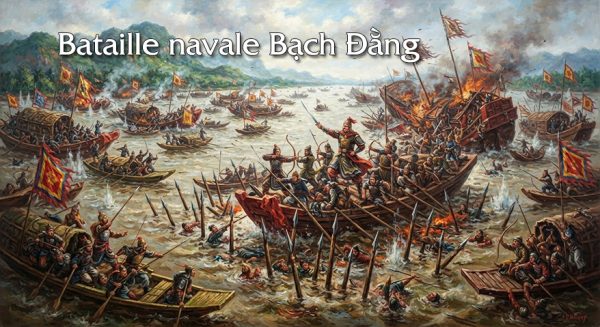
Ngoài hai tướng Ô Mã Nhi và Phàn Tiếp, hoàng tử Mông Cổ Tích Lệ Cơ Ngọc (Shiregi) con trai của Mông Kha Hãn cùng tùy tùng cũng bị bắt làm tù binh. 400 chiến thuyền bị phá hủy và lực lượng rút lui theo đường sông bị tiêu diệt hoàn toàn.

Thoát Hoan nghe tin quân thủy vỡ rồi thì dẫn các tướng còn lại Trịnh Bằng Phi, A Bát Xích, Áo Lỗ Xích, Trương Quân và Trương Ngọc đi đường bộ chạy về Nội Bàng bị Phạm Ngũ Lão chặng đánh. Các tướng vừa đánh vừa chạy để hộ tống Thoát Hoan. Trương Quân cuối cùng bị Phạm Ngũ Lão chém chết vì ông dẫn quân đi đọan hậu. Tóm lại Thoát Hoang chạy thoát ra cửa ải với quân sĩ mười phần tổn hại cũng mất 5, 6 phần.  Trong lúc đó, Hưng Đạo vương rước xa giá Thượng Hoàng cùng Nhân Tông về kinh sư.

Vua Trần Nhân Tông  đem các tướng Nguyên bị bắt làm lễ dâng thắng trận ở Chiêu Lăng. Tại đây vua trông thấy chân mấy con ngựa đá đều lấm bùn vì trước đó quân Nguyên đã phá Chiêu Lăng và định đập bỏ ngựa đi mà chưa kịp. Thấy giang sơn lại được như cũ nên Nhân Tông có làm hai câu thơ tuyệt vời mà sử gia Trần Trọng Kim  dịch ra tiếng nôm như sau:

Xã tắc hai phen bon ngựa đá
Non sông thiên cổ vững âu vàng

Tuy nước ta thắng trận nhưng thế lực nhà Nguyên-Mông vẫn mạnh lắm. Cứ chiến tranh triền miên, dân ta lại khổ sở và nước ta lại là nước nhỏ và cô lập một mình  nên đến tháng mười năm Mậu Tí (1288) Nhân Tông sai quan Đỗ Thiên Thư sang Tàu xin theo lệ cống như xưa. Hốt Tất Liệt buộc lòng chấp nhận giảng hoà và phong  Nhân Tông  làm An Nam Quốc Vương.

Tháng hai năm Kỉ Sửu (1289), Nhân Tông sai quan đưa các tướng nhà Nguyên bị bắt  như Tích Lê Cơ Ngọc về Tàu. Còn Phàn Tiếp bị bệnh mà chết được Nhân Tông sai đem hỏa táng và hài  cốt  được mang về Tàu. Chì có Ô Mã Nhi có tội phá mồ mả tổ  tiên nhà Trần nên vua muốn giết nhưng sợ làm phật lòng Hốt Tất Liệt nên phải dùng kế của Trần Hưng Đạo. Ô Mã Nhi được người hộ tống đi đường biển nhưng thuyền bị đắm giữa đêm nên bị chết đuối vì ông không biết lội. Có lẽ Yết Kiêu được lệnh của Hưng Đạo vương  đục thuyền trước khi thuyền ra khơi.

Version française

Lorsque Toghan et les forces yuan-mongoles prirent la fuite lors de  leur défaite, Kubilai Khan, furieux, voulut les faire tous exécuter, mais il leur laissa la vie sauve après l’intervention de ses hauts fonctionnaires. À cette époque, Kubilai Khan eut l’intention d’envahir le Japon, mais il fut contraint de reporter temporairement ce projet. Il ordonna la construction de 300 navires supplémentaires et promulgua un décret ordonnant aux provinces de Jianghuai, Huguang et Jiangxi de rassembler au cours du huitième mois des troupes pour envahir notre pays  en passant par Qinzhou et Lianzhou (au Guangxi), ce qui lui permit  de  laver ainsi l’affront de la défaite et de  prendre sa revanche. Toutefois, Yuan Ke, un haut fonctionnaire de la province du Hunan, soumit un rapport conseillant à Kubilai Khan de laisser les troupes se reposer pour quelques mois. Kubilai Khan accepta cette suggestion (Trần Trọng Kim, ibid. 128).

En apprenant la nouvelle, le roi Nhân Tông demanda au prince Hưng Đạo : « Comment comptez-vous résister cette fois, alors que les forces yuan-mongoles sont encore plus redoutables qu’auparavant ? » Le prince Hưng Đạo répondit avec calme : « Auparavant, notre armée et notre peuple ne sont pas habitués à la guerre, ce qui nous crée de grandes épreuves et de grosses  difficultés. Aujourd’hui, en revanche, nos troupes et nos citoyens sont aguerris au combat. Nous vaincrons sûrement  l’ennemi avec plus de facilité. Votre Majesté n’a pas  besoin de  s’inquiéter.

Habituées à vivre dans les immenses steppes, les forces mongoles de la dynastie Yuan se heurtèrent à de graves problèmes logistiques d’approvisionnement lors de l’invasion du Dai Viet. Cette difficulté était manifeste au cours de leurs deux campagnes miltaires car elles ne pouvaient ni maintenir leur mode de vie traditionnel ni appliquer leurs tactiques de combat habituelles. D’ordinaire, elles comptaient sur le pillage au fil de leur progression. Cela leur épargna ainsi le transport de lourds convois de ravitaillement. Or cette stratégie s’avéra inefficace au Dai Viet en raison de la mise en œuvre locale de la politique dite des « champs vides et maisons désertes », une tactique de la  terre brûlée  alors même que les envahisseurs comptèrent sur des offensives rapides et sur la stratégie consistant à « nourrir la guerre par la guerre ».

De plus, le relief de notre pays caractérisé par de nombreuses rivières, des marécages et des rizières inondées n’offrait pas assez de pâturages pour subvenir aux besoins de leurs dizaines de milliers de chevaux de guerre et de bétail. Privés de fourrage suffisant, les chevaux des Yuan dépérirent et moururent, ce qui fit perdre aux envahisseurs à la fois la source vitale de nourriture de secours et l’atout militaire le plus redoutable qu’était leur cavalerie. Cela mit en évidence le contraste fondamental entre la stratégie employée des « champs vides et maisons désertes » et la méthode  militaire utilisée par les  Mongols  dans le but « nourrir la guerre par la guerre ». 

La puissance militaire de notre nation a été clairement attestée par l’édit impérial adressé par le Grand Khan mongol Kubilaï à Toghan avant l’invasion du Dai Viet. L’*Histoire des Yuan* (*Yuan Shi*)(元史) a rapporté, au volume 14 (section des *Annales*), page 10, le passage suivant : « Ne sous-estimez jamais le Đại Việt même si c’est un petit pays.»(1)

Au printemps de l’année Đinh Hợi (1287), outre son infanterie et sa cavalerie, la dynastie Yuan rassembla une formidable flotte navale ainsi qu’un immense convoi de ravitaillement. Un document intitulé « Notre tradition militaire » (2), rédigé par l’historien Nguyen Khac Vien, explique la logique de cette stratégie et donne en détail le déploiement des forces Yuan.

Cette armée, forte d’un demi-million d’hommes, était divisée en trois colonnes :

– La force d’invasion principale, commandée par Toghan (Thoát Hoan),  progressa par la route de Lang Son sous le prétexte d’escorter Tran Ich Tac dans le but de l’introniser, après avoir été reconnu par Kubilai Khan comme roi d’Annam.

– Une seconde colonne, commandée par le général Auruyvci (Áo Lỗ Xích), partit de la province de Yunnan et s’avança  en prenant la voie fluviale.

– Une flotte forte de plus de 600 navires de guerre sous le commandement de  Omar Al-Din (Ô Mã Nhi) et Fan Ji (Phàn Tiếp), appareilla de Guangzhou  et reçut l’ordre de remonter la rivière Bạch Đằng et de rejoindre Vạn Kiếp (Chi Linh, Hai Hung).

Par ailleurs, une flotte de transport commandée par Zhang Wenhu (Trương Văn Hổ) fit route par la  mer et achemina plus de 170 000 quintaux de vivres pour ravitailler les troupes.

Selon l’historien Lê Đình Thông (3), trois des quatre colonnes militaires lancées par les forces yuan-mongoles durant cette expédition furent menées par voie maritime ou fluviale.  Autrement dit, la puissance navale joua un rôle décisif dans le conflit. Il convient de noter que la dynastie Song était considérée comme l’âge d’or de la technologie et de la puissance  maritime chinoise. Cette époque se distingua non seulement par des avancées technologiques dans le domaine maritime, mais aussi par des progrès dans la fabrication d’armes à feu : « Sous la dynastie Song, la Chine était la première puissance mondiale en matière d’armes à feu » (4). Par conséquent, la dynastie Yuan hérita des forces navales des Song. En principe, le rapport de force penchait nettement en faveur des troupes yuan-mongoles. Pour assurer la victoire du camp du plus fort, l’armée yuan-mongole eut également recours à des tactiques de « vagues humaines ».

À la réception de ce rapport urgent du commandant de la frontière, Prince Hưng Đạo fit cette remarque: « La force militaire réside dans la qualité, et non dans le simple nombre. Même si une armée est nombreuse mais elle se montre incompétente, cela ne sert à rien à l’instar des troupes de Fu Jian. » Il privilégia la qualité, la combativité des troupes d’élite et l’unité nationale. Il sut que Fu Jian, souverain des Qin antérieurs  avait été vaincu lors de la bataille de la rivière Fei (383 apr. J.-C.), durant la période des Seize Royaumes (Shiliuguo) (304–439 apr. J.-C.) alors qu’il commandait une armée multi-ethnique d’un million d’hommes face aux forces des Jin orientaux ne comptant qu’environ 80 000 soldats.

Il a toujours fait preuve du type de réflexion qui le caractérisait: les faibles peuvent triompher les forts grâce au stratagème et à l’union. Selon l’historien français Paul Valéry ce point de vue est très pertinent car il a déjà  dit dans son essai : les grands empires ou les conquérants (comme les Mongols) croient dominer un territoire parce qu’ils le tracent sur une carte, mais la réalité d’un pays réside dans sa topographie, sa culture locale et ses singularités qui finissent toujours par survivre ou fragmenter l’envahisseur.

Initialement, les forces mongoles de la dynastie Yuan étaient écrasantes par leur nombre et employaient des tactiques de « vagues humaines ». Par conséquent, malgré la résistance acharnée de  la part des généraux Trần Nhật Duật et  Nguyễn Khoái sur le front de Lạng Sơn, les forces vietnamiennes furent contraintes de battre en retraite vers l’embarcadère Vạn Kiếp. Le commandant mongol en chef  Toghan (Thoát Hoan) tira parti de sa connaissance du terrain acquise lors de la campagne de 1284. Il ordonna à Omar Al-Din (Ô Mã Nhi) de mener des troupes depuis Đông Lục Đầu, aux côtés d’Abaci (A Bát Xích), dans une offensive par la descente sur le fleuve Rouge. Prince Hưng Đạo, qui tenait la position de Quảng Yên, fut contraint de l’abandonner et de se replier pour  défendre la citadelle Thăng Long, tandis que l’empereur Nhân Tông et l’empereur retiré durent fuir par la mer pour trouver refuge temporairement à Thanh Hóa. Frustré de ne pas avoir réussi à les capturer, Omar al-Din se dirigea vers Long Hưng (Thái Bình) où il donna l’ordre de profaner les tombes royales de la dynastie  Trần (Thái văn Kiểm,ibid 104), avant de progresser vers l’embarcadère  Vân Đồn à la fin du mois de décembre 1287 avec une flotte de plusieurs centaines de navires de guerre.

Face à des forces ennemies écrasantes, Trần Khánh Dư fut contraint de battre en retraite et de laisser passer l’adversaire. En apprenant l’échec de Trần Khánh Dư dans la mission de  stopper l’ennemi, l’empereur retiré Trần Thánh Tông entra dans une colère noire. Il dépêcha aussitôt un émissaire pour faire enchaîner le général et le conduire à la capitale pour expliquer la raison de son échec. Trần Khánh Dư était un commandant militaire hors pair, devancé uniquement par Trần Hưng Đạo en matière d’art et de stratégie militaires. Il avait eu l’occasion de rédiger la préface suivante pour le *Traité militaire de Vạn Kiếp* de Trần Hưng Đạo: «Ceux qui sont doués pour diriger les troupes n’ont pas peur de planifier les batailles. Ceux qui sont doués pour planifier des batailles n’ont pas besoin d’engager le combat. Ceux qui sont doués pour engager le combat ne perdent pas la bataille. Ceux qui savent gérer la défaite ne meurent pas ». Il sut qu’il ne mourra pas. Il élabora ainsi un plan pour tendre une embuscade à Lục Thủy Dương et intercepter la flotte de transport de vivres de Zhang Wenhu, un pirate de mer soumis à la dynastie Yuan durant la période des Song du Sud. C’était indéniablement le point faible des forces mongoles que Trần Khánh Dư avait parfaitement saisi. C’était  aussi une opportunité lui permettant non seulement de se racheter de ses erreurs commises, mais aussi de recevoir de multiples récompenses. Bien qu’il fût tombé en disgrâce à maintes reprises, son talent exceptionnel amena l’empereur Nhân Tông à le rétablir dans ses fonctions et à garder une grande confiance dans ses capacités.

Par une nuit de brouillard épais, nos forces saisirent l’occasion de lancer une attaque surprise depuis les deux rives du fleuve. Elles anéantirent la flotte de transport de vivres de Zhang Wenhu avec un nombre infini des cadavres flottants des troupes yuan-mongoles jonchés sur le cours d’eau. Ayant gravement sous-estimé l’ennemi et étant tombé dans une embuscade, Zhang Wenhu fut contraint de fuir vers Qiongzhou, en Chine, à bord d’une petite embarcation Pendant ce temps, Omar s’inquiéta de plus en plus en attendant, jour et nuit, la flotte de transport de vivres. Lorsqu’il apprit la vérité, il fut non seulement furieux mais aussi profondément alarmé, car le moral de ses troupes ne cessait de se dégrader. Chacun envisagea une fuite par voie terrestre, mais Prince Hung Dao, prévoyant cette manœuvre, ordonna à ses généraux de verrouiller solidement les monts Kỳ Cấp et  Nhị (également connu sous le nom de Vọng Phu) du côté de Lạng Sơn. L’ennemi décida de battre en retraite ainsi vers son pays  en empruntant les voies navigables de la baie d’Along.

Selon l’historien Lê Đình Thông, le combat fluvial constituait le mode de lutte privilégié des Vietnamiens, alors qu’il représentait le point faible des Yuan. Par conséquent, la bataille de la rivière Bạch Đằng s’est révélée décisive pour l’issue de la troisième invasion yuan-mongole. Le prince Hưng Đạo en était parfaitement conscient. Au moment de lancer la campagne, il désigna la rivière Hà Giang (un affluent du fleuve Thái Bình) et fit ce serment : « Si je ne vaincs pas l’ennemi yuan au cours de cette campagne, je jure de ne jamais revenir sur cette rivière». Il marcha ensuite directement vers la rivière Bạch Đằng avec ses troupes en tirant parti de la triade stratégique « moment opportun, terrain avantageux et unité du peuple » pour vaincre les envahisseurs.

Nous disposions déjà de deux atouts stratégiques: un terrain favorable (une contrée sillonnée de rivières) et une unité d’esprit (un peuple uni comme un seul homme face à l’ennemi). Il ne restait plus qu’à choisir le moment propice,  l’instant décisif  pour remporter la victoire. Pour ce faire, il était crucial de bien comprendre le régime de marée diurne singulier de la rivière Bạch Đằng, caractérisé par une unique alternance de flux et de reflux chaque jour. Prince Hưng Đạo devait connaître le terrain sur le bout des doigts. Il lui fallait savoir précisément quand l’eau monterait et combien de temps durerait la marée descendante, afin de pouvoir attirer les forces yuan-mongoles dans une bataille permettant d’assurer une victoire décisive.

La différence de niveau d’eau entre la marée haute et la marée basse peut atteindre trois ou quatre mètres. Le lit de la rivière est large mais peu profond. À la marée haute, la vaste étendue d’eau dissimule tous les obstacles immergés. Lorsque la marée se retire rapidement, elle met à nu les vasières ainsi que les pieux en bois à pointe de fer que notre peuple avait longtemps dissimulés. La tactique consistant à planter des pieux en bois dans le lit de la rivière, combinée à des embuscades visant à détruire les navires de guerre des ennemis, constituait une stratégie militaire redoutable que notre nation a employée avec succès à trois reprises au cours de son histoire. En cette occasion, Prince Hưng Đạo ordonna à ses troupes d’installer un vaste champ de pieux aux embouchures des affluents  tels que les rivières Chanh, Kênh et Rút (*)  dans l’attente du reflux de la marée.

Aux premières heures du 9 avril 1288, la flotte d’Omar Al Din descendit la rivière Đá Bạc et pénétra dans la rivière Bạch Đằng avec une unité d’avant-garde chargée de la reconnaissance sous le commandement direct du général Phan Tiếp (Fan Ji). Soudain, le général de la dynastie Trần, Nguyễn Khoái surgit avec ses embarcations pour provoquer et défier l’ennemi. Furieux, Omar ordonna à ses troupes de se lancer à sa poursuite. Nguyễn Khoái simula la défaite et prit la fuite. À cet instant, la marée montait en  formant une vaste étendue d’eau mais Omar ordonna néanmoins à ses navires de poursuivre l’ennemi.

Une fois la zone des pieux franchie, Nguyễn Khoái fit faire demi-tour à ses navires pour engager le combat contre l’ennemi. C’était alors que le gros des troupes, sous le commandement du Prince Hưng Đạo arriva en renfort. Saisis d’effroi, Omar et Fan Ji tentèrent de battre en retraite. Toutefois, lorsqu’ils atteignirent le tronçon de la rivière où étaient plantés les pieux, la marée de la mi-journée s’était déjà retirée. Cela  amena les navires yuan-mongols à tomber  dans le piège où les pieux ont fait un grand nombre d’entre eux chavirer ou se briser. Au même moment, des radeaux et de petites embarcations, chargés de bûches enflammées, lancés par la population locale et portés par le courant  foncèrent sur les navires ennemis immobilisés devant les rangées de pieux à pointe de fer. Plusieurs navires prirent feu et  consumèrent ainsi leurs occupants avant de sombrer sous les flots.

Profitant de leur élan, nos forces infligèrent de lourdes pertes aux troupes mongoles. Ce succès était en grande partie dû aux pieux en bois à pointe de fer déployés lors de la bataille de Bạch Đằng. Etant disposés selon un agencement et un espacement précis, les pieux étaient conçus pour stopper et empaler l’imposante flotte ennemie au moment du reflux, tout en permettant à nos propres navires  plus petits et parfaitement adaptés au terrain  de naviguer aisément à travers des passages prévus au sein du dispositif défensif. Ces embarcations, surnommées bateaux à queue d’hirondelle ou bateaux tressés en bambou présentaient des atouts techniques majeurs : une maniabilité exceptionnelle, une grande légèreté et un faible tirant d’eau leur permettant de traverser sans peine les mangroves, les méandres des cours d’eau et les zones peu profondes du delta du fleuve Rouge. Capables d’atteindre des vitesses impressionnantes et manœuvrées par des équipages de 30 à 100 rameurs, elles offraient un avantage décisif pour mener des attaques fluviales fulgurantes ou effectuer des replis stratégiques.

Outre les généraux Omar Al-Din et Fan Ji, le prince mongol Shiregi, fils de Möngke Khan  et sa suite furent également faits prisonniers. Quatre cents navires de guerre furent détruits, et les forces qui battaient en retraite le long du fleuve furent totalement anéanties.

Informé de la déroute de ses forces navales, Toghan mena ses derniers généraux Zheng Pengfei, Abachi, Aoluchi, Zhang Jun et Zhang Yu dans une fuite par voie terrestre vers Nội Bàng, mais ils furent interceptés par Phạm Ngũ Lão. Les généraux ordonnèrent  le retrait au combat pour protéger Toghan. Zhang Jun, qui commandait l’arrière-garde, finit par être abattu par Phạm Ngũ Lão. Finalement, Toghan parvint à s’échapper par le col, bien que son armée eût subi des pertes dévastatrices avec cinq ou six dixièmes de ses troupes anéanties. Pendant ce temps, Prince Hung Dao raccompagna l’Empereur retiré et l’Empereur Nhân Tông à la capitale. Le roi Trần Nhân Tông fit conduire les généraux Yuan capturés à Chiêu Lăng pour la célébration d’une cérémonie de victoire. Là, le roi remarqua que les pieds des chevaux de pierre étaient couverts de boue. Les troupes Yuan avaient en effet vandalisé le mausolée et avaient eu l’intention de briser les statues, mais  elles n’avaient pas pu mener leur entreprise à terme.

En retrouvant le royaume rétabli dans son état antérieur, le roi Nhân Tông composa un magnifique distique, que l’historien Trần Trọng Kim a traduit en langue nôm comme suit:

Xã tắc hai phen bon ngựa đá
Non sông thiên cổ vững âu vàng

La patrie, par deux fois, a surmonté les plus rudes épreuves
La nation, pour l’éternité, préservera l’intégrité de son sol d’or

Bien que notre pays eût remporté la bataille, les forces mongoles de la dynastie Yuan demeuraient redoutables. Une guerre prolongée causait des souffrances à la population. Comme notre  nation était  minuscule et isolée, nous étions confrontés à une situation délicate. C’est pourquoi, au dixième mois de l’année du Rat de terre (1288), le roi Nhân Tông envoya l’ambassadeur Đỗ Thiên Thư en Chine pour solliciter le rétablissement de l’ancien statut de vassalité. Kubilai Khan se vit contraint d’accepter la paix et investit Nhân Tông du titre de roi d’An Nam.

Au deuxième mois de l’année du Buffle de terre (1289), Nhân Tông ordonna à des officiels d’escorter jusqu’en Chine les généraux Yuan capturés, tels que Tích Lê Cơ Ngọc (Shiregi). Quant à Fan Ji, décédé de maladie, Nhân Tông fit incinérer sa dépouille et ordonna son rapatriement en Chine. Seul le cas d’Omar Al Din coupable d’avoir profané les tombes ancestrales de la dynastie Trần  posait un vrai dilemme. Le roi souhaitait le faire exécuter mais il craignait de déplaire à Kubilai Khan. Il adopta alors un stratagème imaginé par Prince Hưng Đạo. Omar Al Din fut escorté par voie maritime, mais son navire sombra en pleine nuit et il se noya car ile ne savait pas nager. Il est fort probable que son subordonné Yết Kiêu, agissant sur ordre du Prince Hưng Đạo, ait saboté l’embarcation avant son départ.


Version anglaise

When Toghan and the Yuan-Mongol forces fled following their defeat,  Kubilai Khan furious intended to have them all executed but spared their lives after his high-ranking officials intervened. At that time, Kubilai Khan planned to invade Japan but was forced to temporarily postpone the project. He ordered the construction of 300 additional ships and issued a decree commanding the provinces of Jianghuai, Huguang, and Jiangxi to muster troops during the eighth month for an invasion of our country via Qinzhou and Lianzhou (in Guangxi), thereby allowing him to wipe away the disgrace of the defeat and exact revenge. However, Yuan Ke, a high-ranking official from Hunan province, submitted a report advising Kubilai Khan to let the troops rest for a few months. Kubilai Khan accepted this suggestion (Trần Trọng Kim, ibid. 128).

Upon hearing the news, King Nhân Tông asked Prince Hưng Đạo: « How do you intend to resist this time, given that the Yuan-Mongol forces are even more formidable than before? » Prince Hưng Đạo calmly replied: « In the past, our army and people were unaccustomed to warfare, which caused us great hardship and difficulty. Today, however, our troops and citizens are battle-hardened. We shall surely defeat the enemy with greater ease. Your Majesty need not worry. »

Accustomed to life on the vast steppes, the Mongol forces of the Yuan Dynasty encountered serious logistical supply problems during their invasion of Dai Viet. This difficulty was evident throughout their two military campaigns, because they could neither maintain their traditional way of life nor employ their usual combat tactics. Typically, they relied on pillaging as they advanced, his spared them from having to transport heavy supply convoys. However, this strategy proved ineffective in Dai Viet due to the local implementation of the « empty fields and deserted houses » policy—a scorched-earth tactic—precisely when the invaders were counting on rapid offensives and a strategy of « feeding the war with war. »

Moreover, the relief of our country, characterized by numerous rivers, marshes, and flooded rice fields, did not offer enough pastures to meet the needs of their tens of thousands of warhorses and livestock. Deprived of sufficient forage, the horses of the Yuan declined and died, causing the invaders to lose both the vital source of emergency food and their most formidable military asset, namely their cavalry. This highlighted the fundamental contrast between the strategy employed of “empty fields and deserted houses” and the military method used by the Mongols with the aim of “feeding war with war.”

The military power of our nation was clearly attested by the imperial edict sent by the great Mongol Khan Kublai to Toghan before the invasion of Dai Viet. The *History of the Yuan* (*Yuan Shi*)(元史) reported, in volume 14 (section of the *Annals*), page 10, the following passage: “Never underestimate Đại Việt even if it is a small country.”(1)

In the spring of the year Đinh Hợi (1287), in addition to its infantry and cavalry, the Yuan dynasty assembled a formidable naval fleet and a massive supply convoy. A document titled « Our Military Tradition » (2), written by historian Nguyen Khac Vien, explains the rationale behind this strategy and details the deployment of Yuan forces.

This army, numbering half a million men, was divided into three columns:

– The main invasion force, commanded by Toghan (Thoát Hoan), advanced via the Lang Son route under the pretext of escorting Tran Ich Tac to enthrone him, following his recognition as King of Annam by Kublai Khan.

– A second column, commanded by General Auruyvci (Áo Lỗ Xích), set out from Yunnan province and advanced along the river route.

– A fleet of over 600 warships under the command of Omar Al-Din (Ô Mã Nhi) and Fan Ji (Phàn Tiếp) set sail from Guangzhou with orders to ascend the Bạch Đằng River and rendezvous at Vạn Kiếp (Chi Linh, Hai Hung).

Additionally, a transport fleet commanded by Zhang Wenhu (Trương Văn Hổ) traveled by sea, carrying over 170,000 quintals of provisions to supply the troops.

According to historian Lê Đình Thông (3), three of the four military columns launched by the Yuan-Mongol forces during this expedition were transported by sea or river. In other words, naval power played a decisive role in the conflict. It should be noted that the Song Dynasty was considered the golden age of Chinese technology and naval power. This era was distinguished not only by technological advances in the maritime field but also by progress in the manufacture of firearms: “During the Song Dynasty, China was the world’s leading power in firearms” (4). Consequently, the Yuan Dynasty inherited the Song Dynasty’s naval forces. In principle, the balance of power leaned heavily in favor of the Yuan-Mongol forces. To ensure victory for the stronger side, the Yuan-Mongol army also resorted to “human wave” tactics.

Upon receiving this urgent report from the border commander, Prince Hưng Đạo remarked: “Military strength lies in quality, not mere numbers. Even if an army is large but proves incompetent, it is of no use—just like Fu Jian’s troops. ” He prioritized quality, the fighting spirit of elite troops, and national unity. He knew that Fu Jian, ruler of the Former Qin, had been defeated at the Battle of the Fei River (383 CE) during the Sixteen Kingdoms period (Shiliuguo) (304–439 AD), while commanding a multi-ethnic army of one million men against the forces of the Eastern Jin, which numbered only about 80,000 soldiers.

He consistently demonstrated the kind of thinking that defined him: the weak can triumph over the strong through strategy and unity. This perspective is highly relevant as the French thinker Paul Valéry noted in an essay—because great empires or conquerors (such as the Mongols) believe they dominate a territory simply by marking it on a map; yet, a country’s true reality lies in its topography, local culture, and unique characteristics—elements that invariably endure or ultimately fragment the invading force.

Initially, the Mongol forces of the Yuan Dynasty were overwhelmingly numerous and employed “human wave” tactics. Consequently, despite fierce resistance from Generals Trần Nhật Duật and Nguyễn Khoái on the Lạng Sơn front, the Vietnamese forces were forced to retreat to the Vạn Kiếp landing stage. The Mongol commander-in-chief Toghan (Thoát Hoan) took advantage of his knowledge of the terrain gained during the 1284 campaign. He ordered Omar Al-Din (Ô Mã Nhi) to lead troops from Đông Lục Đầu, alongside Abaci (A Bát Xích), in an offensive down the Red River. Prince Hưng Đạo, who held the position at Quảng Yên, was forced to abandon it and retreat to defend the Thăng Long citadel, while Emperor Nhân Tông and the retired emperor had to flee by sea to find temporary refuge in Thanh Hóa. Frustrated at having failed to capture them, Omar al-Din headed for Long Hưng (Thái Bình), where he ordered the desecration of the royal tombs of the Trần dynasty (Thái Văn Kiểm, ibid., 104), before advancing toward the Vân Đồn landing stage at the end of December 1287 with a fleet of several hundred warships.

Faced with overwhelming enemy forces, Trần Khánh Dư was forced to retreat and let the enemy pass. Upon learning of Trần Khánh Dư’s failure to stop the enemy, the retired emperor Trần Thánh Tông flew into a rage. He immediately dispatched an envoy to have the general arrested and brought to the capital to explain the reason for his failure. Trần Khánh Dư was an outstanding military commander, second only to Trần Hưng Đạo in the art of war and military strategy. He had written the following preface for Trần Hưng Đạo’s *Vạn Kiếp Military Treatise*: “Those skilled at leading troops are not afraid to plan battles. Those skilled at planning battles do not need to engage in combat. Those skilled at engaging in combat do not lose the battle. Those who know how to handle defeat do not die.” He knew he would not die. He thus devised a plan to ambush Lục Thủy Dương and intercept the supply fleet of Zhang Wenhu, a pirate who had submitted to the Yuan Dynasty during the Southern Song period. This was undeniably the weak point of the Mongol forces, which Trần Khánh Dư had perfectly identified. It was also an opportunity that would allow him not only to atone for his past mistakes but also to receive numerous rewards. Although he had fallen from favor on numerous occasions, his exceptional talent led Emperor Nhân Tông to reinstate him and retain great confidence in his abilities.

On a night of thick fog, our forces seized the opportunity to launch a surprise attack from both banks of the river. They annihilated Zhang Wenhu’s supply fleet, leaving countless floating corpses of Yuan-Mongol troops strewn across the river. Having severely underestimated the enemy and fallen into an ambush, Zhang Wenhu was forced to flee to Qiongzhou, China, aboard a small boat. Meanwhile, Omar grew increasingly anxious as he waited, day and night, for the supply fleet. When he learned the truth, he was not only furious but also deeply alarmed, as the morale of his troops continued to decline. Everyone considered fleeing overland, but Prince Hung Dao, anticipating this move, ordered his generals to securely seal off the Kỳ Cấp and Nhị Mountains (also known as Vọng Phu) on the Lạng Sơn side. The enemy thus decided to retreat toward their homeland via the waterways of Ha Long Bay.

According to historian Lê Đình Thông, river combat was the Vietnamese people’s preferred method of warfare, whereas it was the Yuan’s weak point. Consequently, the Battle of the Bạch Đằng River proved decisive for the outcome of the third Yuan-Mongol invasion. Prince Hưng Đạo was fully aware of this. When launching the campaign, he designated the Hà Giang River (a tributary of the Thái Bình River) and made this oath: “If I do not defeat the Yuan enemy during this campaign, I swear never to return to this river.” He then marched directly toward the Bạch Đằng River with his troops, taking advantage of the strategic triad of “opportune timing, favorable terrain, and unity of the people” to defeat the invaders.

We already possessed two strategic assets: favorable terrain (a region crisscrossed by rivers) and unity of spirit (a people standing as one against the enemy). All that remained was to choose the opportune moment, the decisive instant to win victory. To do this, it was crucial to fully understand the Bạch Đằng River’s unique diurnal tidal pattern, characterized by a single cycle of ebb and flow each day. Prince Hưng Đạo needed to know the terrain like the back of his hand. He had to know precisely when the water would rise and how long the outgoing tide would last, so he could lure the Yuan-Mongol forces into a battle that would ensure a decisive victory.

The difference in water level between high tide and low tide can reach three or four metres. The riverbed is wide but shallow. At high tide, the vast expanse of water conceals all submerged obstacles. When the tide rapidly recedes, it exposes the mudflats as well as the iron-tipped wooden stakes that our people had long kept hidden. The tactic of planting wooden stakes in the riverbed, combined with ambushes aimed at destroying the enemy’s warships, constituted a formidable military strategy that our nation successfully employed three times throughout its history. On this occasion, Prince Hưng Đạo ordered his troops to install a vast field of stakes at the mouths of tributaries such as the Chanh, Kênh and Rút rivers (*) in anticipation of the ebb tide.

In the early hours of April 9, 1288, Omar Al Din’s fleet descended the Đá Bạc River and entered the Bạch Đằng River with an advance unit tasked with reconnaissance under the direct command of General Phan Tiếp (Fan Ji). Suddenly, the Trần dynasty general, Nguyễn Khoái, appeared with his boats to provoke and challenge the enemy. Furious, Omar ordered his troops to pursue him. Nguyễn Khoái feigned defeat and fled. At that moment, the tide was rising, forming a vast expanse of water, but Omar nevertheless ordered his ships to pursue the enemy.

Once the area of the stakes had been crossed, Nguyễn Khoái had his ships turn around to engage the enemy in combat. It was then that the bulk of the troops, under the command of Prince Hưng Đạo, arrived as reinforcements. Struck with terror, Omar and Fan Ji attempted to retreat. However, when they reached the section of the river where the stakes had been planted, the midday tide had already receded. This caused the Yuan-Mongol ships to fall into the trap, where the stakes caused a great number of them to capsize or break apart. At the same time, rafts and small boats, loaded with burning logs, launched by the local population and carried by the current, rushed toward the enemy ships immobilized in front of the rows of iron-tipped stakes. Several ships caught fire and thus consumed their occupants before sinking beneath the waves.

Taking advantage of their momentum, our forces inflicted heavy losses on the Mongol troops. This success was largely due to the iron-tipped wooden stakes deployed during the Battle of Bạch Đằng. Arranged according to a precise layout and spacing, the stakes were designed to stop and impale the imposing enemy fleet at low tide, while allowing our own smaller ships  perfectly suited to the terrain  to navigate easily through passages provided within the defensive system. These vessels, nicknamed swallowtail boats or woven bamboo boats, had major technical advantages: exceptional maneuverability, great lightness and a shallow draft allowing them to cross the mangroves, the meanders of waterways and the shallow areas of the Red River Delta with ease. Capable of reaching impressive speeds and operated by crews of 30 to 100 rowers, they offered a decisive advantage for launching lightning-fast river attacks or carrying out strategic retreats.

Besides the generals Omar Al-Din and Fan Ji, the Mongol prince Shiregi, son of Möngke Khan, and his retinue were also taken prisoner. Four hundred warships were destroyed, and the forces retreating along the river were completely annihilated.

Informed of the rout of his naval forces, Toghan led his remaining generals Zheng Pengfei, Abachi, Aoluchi, Zhang Jun and Zhang Yu in a flight by land towards Nội Bàng, but they were intercepted by Phạm Ngũ Lão. The generals ordered a fighting retreat to protect Toghan. Zhang Jun, who commanded the rearguard, was eventually killed by Phạm Ngũ Lão. Ultimately, Toghan managed to escape through the pass, although his army had suffered devastating losses with five or six tenths of his troops annihilated. Meanwhile, Prince Hung Dao escorted the retired Emperor and Emperor Nhân Tông back to the capital. King Trần Nhân Tông had the captured Yuan generals taken to Chiêu Lăng for the celebration of a victory ceremony. There, the king noticed that the feet of the stone horses were covered in mud. The Yuan troops had indeed vandalized the mausoleum and had intended to break the statues, but  they had been unable to complete their undertaking.

Upon finding the kingdom restored to its former state, King Nhân Tông composed a magnificent couplet, which the historian Trần Trọng Kim translated into the Nôm language as follows:

Xã tắc hai phen bon ngựa đá
Non sông thiên cổ vững âu vàng

The homeland, twice, has overcome the harshest trials
The nation, for eternity, will preserve the integrity of its golden soil.

Although our country had won the battle, the Mongol forces of the Yuan dynasty remained formidable. A prolonged war caused suffering among the population. As our nation was tiny and isolated, we were faced with a delicate situation. That is why, in the tenth month of the Year of the Earth Rat (1288), King Nhân Tông sent the ambassador Đỗ Thiên Thư to China to request the restoration of the former vassal status. Kublai Khan was forced to accept peace and invested Nhân Tông with the title of King of An Nam.

In the second month of the Year of the Earth Ox (1289), Nhân Tông ordered officials to escort the captured Yuan generals, such as Tích Lê Cơ Ngọc (Shiregi), to China. As for Fan Ji, who had died of illness, Nhân Tông had his remains cremated and ordered them repatriated to China. Only the case of Omar Al Din, guilty of desecrating the ancestral tombs of the Trần dynasty, posed a real dilemma. The king wished to have him executed but feared displeasing Kubilai Khan. He then adopted a stratagem devised by Prince Hưng Đạo. Omar Al Din was escorted by sea, but his ship sank in the middle of the night and he drowned because he did not know how to swim. It is highly likely that his subordinate Yết Kiêu, acting on the orders of Prince Hưng Đạo, sabotaged the vessel before its departure.

Bibliographie

Trần Trọng Kim: Việt Nam sử lược. Histoire du Viet Nam. Imprimerie Vĩnh & Thanh 1928.
Lê Thành Khôi: Le Viet-Nam. Histoire et Civilisation. Les Éditions de Minuit. 1955
Thái Văn Kiểm: Việt Nam Quang Hoa. Editeur Xuân Thu
René Grousset: Histoire de la Chine. Editeur France Loisirs 1997
Bai Shouyi: Précis d’histoire de Chine. Edition en langues étrangères. 1988
Yamamoto T.: La conquête de l’Annam par les Yuan et les Ming. Tokyo. 1950

(1) Cuộc kháng chiến chống xâm lược Nguyên-Mông (La résistance contre l’invasion des Yuan-Mongols au XIIIème siècle), Hanoi, Ed. des Sciences sociales, 1972, p. 260.
(2) Nguyễn Khắc Viện: Nos traditions militaires, Etudes vietnamiennes, n° 55 (1978), Hanoï, p. 37.
(3) Lê  Đinh Thông: La marine vietnamienne avant l’arrivée des Français. Paris, ISC
(4) Jung Pang lo, « The Emergence of China as a sea power during the late Song and early Yuan Periods », The Far Eastern Quarterly, n° 4, vol. XIV, 8/1955, p. 503.
(5) Đây là ba hệ thống phân lưu và cửa sông quan trọng nằm tại thị xã Quảng Yên, tỉnh Quảng Ninh, gắn liền với các trận địa cọc lịch sử trong cuộc kháng chiến chống quân Nguyên – Mông trên sông Bạch Đằng năm 1288