
Tribute (Offering from the Vassal State)
Vietnamese version
French version
Bibliographie
Following his resounding victory at the Battle of Muye in 1046 B.C. and the overthrow of the last Shang ruler, Di Xin (Trụ vương), King Wu founded the Zhou Dynasty and established a feudal system based on the subjugation of vassals. This system formalized the political, military, and economic obligations that smaller states (vassal states) owed to the central authority: the Zhou dynasty and its ruler, the “Son of Heaven.” Land, accompanied by hereditary titles ranked in a hierarchy ranging from duke, marquis, count, viscount, to baron, was granted to members of the royal clan as well as to dignitaries who had demonstrated merit. The latter were then tasked with establishing their own vassal states. This was the case for the supreme patriarch Khương Tử Nha (Jiang Ziya), the Zhou dynasty’s chief military strategist.
He was made king of the kingdom of Qi. At that time, our country was located within the territory of the kingdom of Chu (Sở). Chu was ruled by a monarch bearing the royal surname *Mị* (corresponding to the name *Hùng vương* mentioned in our legend) and was located within the territory of the Bai Yue (associated with the Shijiahé culture), along the middle reaches of the Yangtze River. In this regard, the *Lĩnh Nam Chích Quái* (“Strange Tales from the Land South of the Mountains”) reports that, during the reign of King Cheng of the Zhou, King Hùng dispatched an envoy from “Việt Thường” to present a white pheasant to the Zhou court, thereby fostering friendly relations during a time of peace. This indicates that, during the Zhou dynasty, our region—despite its remoteness—participated in the vassal tribute system, thereby assuming specific economic and military obligations toward the Zhou kingdom.
With regard to economic obligations (tribute), vassal states were required to periodically bring rare and distinctive products from their respective territories such as high-quality grains, cast bronze weapons, silk, and precious woods to the Zhou capital to present them to the king. If a vassal failed to pay tribute for three consecutive periods, the “Son of Heaven” had the power to impose sanctions or send an army to depose him.
As for military obligations (the provision of troops), vassals were permitted to maintain their own private armies. However, the size of these forces was strictly limited according to the vassal’s rank (such as *wang* [king], *hou* [marquis], etc.). In the event of a crisis within the central dynasty, or upon receiving a mobilization order, vassals were required to bring their troops, weapons, and war chariots to assist the “Son of Heaven” in military campaigns against external enemies.
Later, after Emperor Qin Shi Huang Di unified the country, and then during the Han Dynasty, our country was annexed following the unsuccessful uprising led by the Trưng sisters and divided into two commanderies: Jiaozhi (Giao Chỉ) and Jiuzhen (Cửu Chân). It was not until Ngô Quyền’s victory over the Southern Han dynasty (led by Liu Gong) on the Bạch Đằng River in 938 A.D. that our nation regained its independence after a millennium of foreign rule. This feat is all the more remarkable given that, at the time, our country was merely a small state with a population of about one million, while the vast Chinese empire had, according to estimates, more than 56 million.
Ngô Quyền founded Vietnam’s first feudal dynasty. In 939, he proclaimed himself king. He adopted the title of sovereign of An Nam and established the capital at Cổ Loa (Phúc Yên). The old system of vassalage came to an end, giving way to formal diplomatic relations between the Chinese Empire and its neighboring countries, among which had been the kingdom of An Nam since the time of the Đinh dynasty.
According to the work of French historian Philippe Papin on the chronology of this country, An Nam established a system of regular tribute to China in 968 (or 972, depending on the exact date of official recognition by the Chinese emperor). Đinh Bộ Lĩnh sent his son Đinh Liễn to Bianjing (the capital of the Song Dynasty). In 973, the Song emperor officially conferred upon Đinh Bộ Lĩnh the title of “Prince of the Giao Chỉ Commandery” (Giao Chỉ quận vương) and appointed Đinh Liễn as “military governor of the Tĩnh Hải district” (Tĩnh Hải tiết độ sứ). This event marked the establishment of a diplomatic model that would serve as a benchmark for Vietnamese dynasties over the following centuries.
The Song Dynasty regarded Đại Việt as a “regular tributary kingdom.” In return, the Vietnamese dynasty secured recognition of its legitimacy by the “Celestial Empire.” The kingdom of An Nam accepted the purely formal status of “vassal” in exchange for a guarantee of peace with the North.
In order to preserve peace along the borders, successive Vietnamese dynasties (from the Đinh, Lê, Lý, Trần, and Later Lê dynasties up to the Nguyễn dynasty) agreed to participate in the world order established by China according to the following two main protocols:
The Investiture (Royal Authority in the Eyes of Foreign Powers):
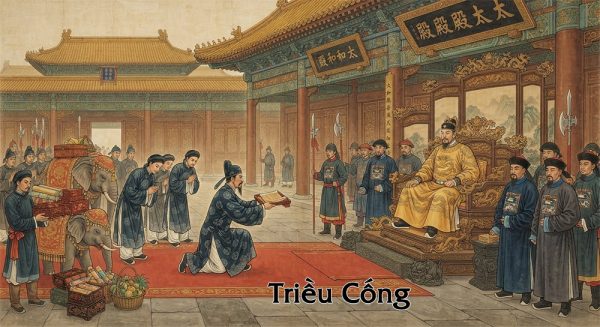
Upon ascending the throne, the monarchs of An Nam would send diplomatic missions to the Chinese capital to seek official recognition. The Emperor of China would then issue an edict of investiture and present an official seal. This thus established the sovereign as the legitimate ruler of the “State of An Nam” or “State of Vietnam” under the Nguyễn dynasty. In the context of official diplomacy, the Vietnamese sovereign bore the title *Wang* (king), a rank subordinate to that of the Emperor of China. Domestically, however, the Vietnamese monarch referred to himself as *Huangdi* (emperor). He, too, considered himself a “Son of Heaven” and maintained his own system of vassal states—such as Champa, Chenla, and various Laotian tribes—which also paid him tribute. Furthermore, the Vietnamese sovereign established his own era names. This practice shaped the nation’s unique identity: “Emperor at home, king abroad.”
Tribute System (*Houwang Bolai* “Give little, receive much”):
Every three years, Vietnam would send a delegation to the Chinese capital, bringing local products such as ivory, rhinoceros horns, eagle wood, gold, and silver as tribute. During the Ming Dynasty, this practice was exploited even further: the Chinese court demanded the dispatch of skilled artisans and eminent physicians, as well as the creation of two life-size metal statues of Generals Liu Sheng and Liang Ming, who had died during the conflict in which Vietnam regained its independence.
This move served a dual purpose: to weaken Vietnam’s development by taking its talented individuals—among whom were the famous physician Tuệ Tĩnh, the architect Nguyễn An (known as A Liu, of the Forbidden City in Beijing), and Hồ Nguyên Trung (son of Hồ Qúy Ly, an expert in casting *thần cơ* cannons), and to assert the supremacy of the “Celestial Empire.” In return, the Emperor of China offered gifts of great economic value, such as high-quality porcelain, silk, and books, in accordance with the principle of “giving little to receive much.” This was a gesture designed to illustrate the prestige and overwhelming authority of the Celestial Empire.
Following the Patenôtre Treaty, signed in Huế on June 6, 1884, between the court of the Nguyễn dynasty and the French colonial authorities—which recognized Vietnam as a French protectorate—the practice of paying tribute came to an end. However, during the period when the country remained subject to the policy of “vassal tribute” to China, Vietnam adopted a diplomatic approach that skillfully combined flexibility and firmness across successive dynasties. This unique political strategy, rooted in the nation’s geopolitical reality, was based on a sophisticated intellectual framework: through reasoned argumentation, the Vietnamese side asserted that its own civilization—rich in history and tracing its origins to the Liangzhu and Shijiahé cultures along the Yangtze River—was in no way inferior to that of China.
The Vietnamese dynasties fully understood that diplomacy carried weight only when it was backed by military force. Consequently, whenever they succeeded in defending the nation’s independence and sovereignty against the expansionist ambitions and invasion attempts of Chinese dynasties (such as the Song, the Yuan-Mongols, the Ming, and the Qing), Vietnamese monarchs would subsequently take the initiative to seek reconciliation by offering formal apologies and maintaining the practice of sending tribute.
This approach allowed the opposing side to preserve the prestige of a “great power,” while at the same time reaffirming Vietnam’s distinct and independent status. This idea is reflected in works such as the poem “Nam Quốc Sơn Hà” (The Mountains and Rivers of the Southern Land) by Lý Thường Kiệt, or the “Bình Ngô Đại Cáo” (Proclamation of Victory over the Wu) by Nguyễn Trãi. This was the price to pay to secure true independence—hard-won through struggle—but it was also a testament to the prudent diplomatic wisdom of our ancestors.
During the Nguyễn Dynasty, regulations stipulated that tribute had to be sent every two years, and that a diplomatic mission had to be dispatched to the imperial court every four years. The longest diplomatic mission in our country’s history was that of Ambassador Lê Quang Bí, which took place during the reign of King Mạc Tuyên Tông (in 1548). This mission lasted 18 years because the envoy was detained by the Ming Dynasty in Nanning (Guangxi) and then in Beijing. When he left, he was a man in his forties with black hair, but by the time he returned, his hair had turned white. He was then 61 years old. He is often compared to Su Wu (Tô Vũ) (*), a legendary figure in Chinese history, for his unwavering loyalty and indomitable spirit, as he succeeded in preserving our nation’s integrity in the face of the Ming Dynasty.
To withstand the pressure and maintain a firm stance in the face of the Chinese imperial dynasties, our nation’s emissaries had to possess a unique combination of qualities: profound erudition, exceptional improvisational skills, unparalleled courage, and a refined mastery of protocol and rituals. Their primary mission was to “defend the honor of the sovereign mandate” by preserving territorial sovereignty and maintaining peaceful relations with the “Celestial Empire.” At times, this mission required the ultimate sacrifice, as was the case for the envoy Giang Văn Minh. In 1637–1638, during the reign of Emperor Chongzhen (Sùng Trinh) of the Ming Dynasty, Giang Văn Minh demonstrated unwavering integrity and candor.
Arrogant and seeking to intimidate the envoy from Đại Việt, Emperor Chongzhen issued this challenge to him with the following verse: “The bronze pillar is still covered with green moss today.” This was an allusion to the curse of the Han general Ma Yuan, who had once declared: “If the bronze pillar should ever break, Giao Chi [Vietnam] will perish.” Giang Van Minh replied with a scathing and incisive retort: “Since time immemorial, the waters of the Bạch Đằng River have remained stained with red blood.” ” This response evoked the three glorious victories won on the Bạch Đằng River against the Southern Han (938), the Song (981), and the Yuan (1288), during which the invaders from the North were defeated, and thus embodied the indomitable spirit of the Vietnamese people.
Exasperated by the envoy’s pride and intransigence, Emperor Chongzhen ordered his execution on the second day of the sixth lunar month of the Year of the Earth Cat (1639). However, his anger eventually subsided. Impressed by the courage of such a loyal official, he ordered that Giang Van Minh’s body be embalmed with tea and mercury, and then placed in a coffin that the diplomatic delegation took back to Vietnam. Giang Van Minh is remembered as an envoy who remained unshaken in the face of danger and was willing to die to honor his homeland. He knew how to preserve the nation’s honor and successfully carry out his diplomatic mission. During his journey, he also secured the abolition of the humiliating requirement that had long compelled Vietnam to present life-size metal statues to the Ming dynasty.
When his remains arrived in Thăng Long, King Lê Thần Tông and Lord Trịnh Tráng came in person to pay their respects before the coffin. The king, in tears, issued an imperial decree declaring: “An envoy who does not dishonor his sovereign’s mandate is, without a doubt, a hero for posterity.”
Sometimes an envoy receives the highest honors. Such was the case with Mạc Đĩnh Chi, who was conferred the title “Supreme Scholar of the Two Nations” (Lưỡng quốc Trạng nguyên), a recognition of his status as a scholar of the highest order, both in his own country and in China, during the reign of Emperor Wuzong (Külüg Khan) of the Yuan Dynasty. The Chinese were deeply impressed by his remarkable quick wit. During one of his missions to China, a Mongol princess had just died, and the Yuan emperor tasked him with delivering a eulogy. As he knelt to read the text that had been given to him, Mạc Đĩnh Chi discovered only a blank sheet of paper bearing the word “one” (nhất) in Chinese characters, which he was to repeat four times. Without the slightest hesitation, he began to recite a eulogy, earning the admiration of the entire imperial court.
Trời xanh một đám mây
Lò hồng môt giọt tuyết
Vườn thượng uyển môt cành hoa
Cung Quảng Hàn một vầng nguyệt
Than ôi! Mây tan! Tuyết tiêu!
Hoa tàn! Trăng khuyết !
The azure sky holds a cluster of clouds
A speck of snow on a glowing brazier
The imperial garden holds a flowering branch
The Quảng Hàn Palace holds a lunar disk
What a pity! The clouds are disappearing! The snow is melting!
The flower is wilting! The moon is incomplete!
In feudal times, “being appointed an envoy—just like a general entrusted with command of troops in battle”—was considered a great honor. Although they carried no firearms,
these emissaries were, in reality, frontline warriors, charged with putting their intelligence and courage to work to preserve peace in their country. Above all, it was their duty never to dishonor the mission with which the King had entrusted them. They had to ensure that the “Celestial Empire” recognized the standing of a small nation like ours in asserting its sovereignty and territorial integrity, while being fully aware of the immense difficulty of their task.
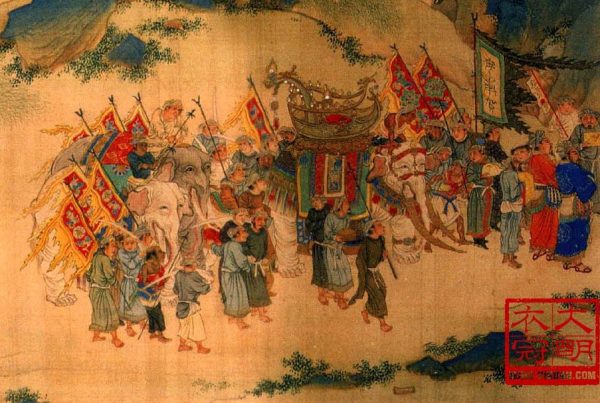
The painting *Mission Entrusted with Bringing Tribute* (職貢圖, *Zhígòng Tú*), created by the Chinese artist Qiu Ying around the early 16th century, depicts a diplomatic mission from Đại Việt (under the Lý dynasty) tasked with bringing a black elephant and two white elephants, intended as tribute to the Song emperor.
(*) Su Wu was an envoy of Emperor Wu Di of the Han Dynasty. He was held captive by the Xiongnu for 19 years, during which time he was forced to tend sheep in the Lake Baikal region (Siberia).
Phan Kế Bính: Nam Hải Dị Nhân Liệt Truyện. Nhà Xuất Bản Hồng Bàng 2011
Philippe Papin: Les relations historiques du Vietnam avec la Chine jusqu’au début du XIXème siècle: aperçu et hypothèses. Société des amis du musée Cernuschi.
Trần Trọng Kim: Việt Nam sử lược. Histoire du Viet Nam. Imprimerie Vĩnh & Thanh 1928.
Lê Thành Khôi: Le Viet-Nam. Histoire et Civilisation. Les Éditions de Minuit. 1955
Thái Văn Kiểm: Việt Nam Quang Hoa. Editeur Xuân Thu
Lê văn Hưu, Ngô Sĩ Liên: Đại Việt sử ký toàn thư . Nhà Xuất Bản Thời Đại 2013
René Grousset: Histoire de la Chine. Editeur France Loisirs 1997