Le Tết du bûcheron
Version vietnamienne
Version anglaise
Jadis, un bûcheron parti dans les bois, voulut ramener quelques bambous. Il s’apprêta à couper un bambou avec sa hache quand il entendit ce dernier lui parler. En fait, ce bambou n’était pas ordinaire: c’était un Génie du Ciel transformé en bambou par un sortilège. Surpris, le bûcheron, accepta de laisser la vie sauve au Génie. Pour le remercier, le Génie exauça son vœu (passer les trois merveilleux jours du Têt comblés de bons mets et de vins délicieux). Sur le conseil du Génie, le bûcheron continua sa route et rencontra l’ermite Za-Xoa qui l’invita à célébrer le Têt dans son temple.
A minuit, assailli par une nuée de démons, le bûcheron et ses compagnons les affrontèrent. Pour les aider, Bouddha venu du Ciel proposa aux démons de leur acheter un lopin de terre en échange de pièces précieuses, d’or et d’argent qu’il déposa devant eux. De quelle superficie ? demandèrent-ils aussitôt les démons. De la taille de ma robe, leur répondit-il. Ceux-ci s’empressèrent de l’accepter, pensant à faire une excellente affaire. Or quand le Bouddha étendit sa robe, cette dernière se révéla aussi grande que le territoire vietnamien. Les démons étaient furieux de se laisser duper, mais le marché était conclu.
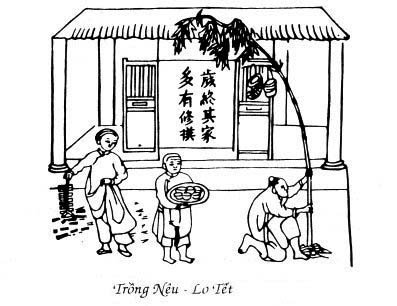
Le Bouddha s’adressa au bûcheron et à ses amis en ces termes: « Lorsque vous inviterez les mânes de vos ancêtres à venir chez vous pour les cérémonies du Têt, des esprits maléfiques peuvent se glisser parmi eux. Vous devrez donc élever une perche de bambou au sommet de laquelle vous ferez flotter un morceau de tissu jaune marqué de mon emblème. Ainsi, tous les mauvais démons ne viendront pas vous importuner».
Au Vietnam, on observe encore cette coutume dans certaines campagnes. Dans le milieu urbain, elle a virtuellement disparu. Cependant, le pétard est rentré dans les mœurs et depuis, le Têt débute dans un concert de pétard qui est censé chasser les démons durant toute l’année.
Sự tích cây nêu
Ngày xưa, có một người tiều phu đi đốn củi muốn mang về một ít tre. Anh định chặt cây tre bằng rìu thì nghe tiếng tre nói với anh. Trên thực tế, cây tre này không phải bình thường: nó là thần linh bị biến thành tre bởi bùa chú. Quá ngạc nhiên, người thợ rừng đồng ý để thần linh được sống. Để cảm ơn người thợ rừng nầy, thần linh chấp thuận ý nguyện của người thợ rừng (có được ba ngày Tết tuyệt vời với các thức ăn và rượu ngon). Theo lời khuyên của thần linh, anh thợ rừng tiếp tục hành trình và gặp ẩn sĩ Za-Xoa, người nầy mời anh về chùa ăn Tết …
Vào lúc nửa đêm, bị tấn công bởi một đám ma quỷ, người thợ rừng và đồng bọn của anh ta phải đối mặt với chúng. Để giúp đỡ họ, Đức Phật đề nghị mua một mảnh đất của ma quỷ để đổi lại cho ma qủy các đồng tiền, vàng bạc quý giá, mà Ngài đặt trước mặt họ. Diện tích nó là bao? các ma qủy hỏi cùng một lúc. Cỡ kích thước chiếc váy của ta, ngài đáp. Họ vội vàng đồng ý vì nghĩ rằng họ đã có được một thỏa thuận tốt. Nhưng khi Đức Phật xoè váy của ngài ra thì váy biến ra quá rộng bằng lãnh thổ Việt Nam. Những con quỷ rất tức giận vì bị lừa, nhưng thỏa thuận đã được thực hiện thôi.
Đức Phật nói với người tiều phu và các người bạn của anh ta như sau: “Khi các ngươi mời tổ tiên về nhà để ăn lễ Tết, các hồn ma quỷ có thể len lỏi vào trong các người đó. Do đó, các ngươi phải dựng một cây nêu lên trên đỉnh treo một mảnh vải màu vàng có biểu tượng của ta. Như vậy, tất cả ma qủi sẽ không đến quấy nhiễu các ngươi.
Ở Việt Nam, phong tục này vẫn còn được duy trì ở một số vùng quê. Còn ở các đô thị, nó hầu như đã biến mất từ lâu. Tuy nhiên, việc đốt pháo đã trở nên phổ biến và kể từ đó Tết bắt đầu bằng các cuộc đốt pháo nhầm để xua đuổi ma quỷ suốt cả năm.
Once, a woodcutter who went into the woods wanted to bring back some bamboo. He was about to cut a bamboo with his axe when he heard it speak to him. In fact, this bamboo was not ordinary: it was a Sky Genie transformed into bamboo by a spell. Surprised, the woodcutter agreed to spare the Genie’s life. To thank him, the Genie granted his wish (to spend the three wonderful days of Têt filled with good food and delicious wines). On the Genie’s advice, the woodcutter continued on his way and met the hermit Za-Xoa, who invited him to celebrate Têt in his temple.
At midnight, attacked by a swarm of demons, the woodcutter and his companions confronted them. To help, Buddha, who came from Heaven, offered to buy a plot of land from the demons in exchange for precious coins, gold, and silver, which he placed before them. How large? the demons immediately asked. As big as my robe, he replied. They hurried to accept, thinking it was a great deal. But when Buddha spread out his robe, it turned out to be as large as the Vietnamese territory. The demons were furious to have been tricked, but the deal was done.
The Buddha addressed the woodcutter and his friends as follows: « When you invite the spirits of your ancestors to come to your home for the Têt ceremonies, evil spirits may slip in among them. You should therefore raise a bamboo pole at the top of which you will hang a piece of yellow cloth marked with my emblem. This way, all the evil demons will not come to bother you. »
In Vietnam, this custom is still observed in some rural areas. In urban settings, it has virtually disappeared. However, firecrackers have become part of the traditions, and since then, Têt begins with a concert of firecrackers that is supposed to drive away demons throughout the year.