
 The Plain of Jars
Version vietnamienne
Version française
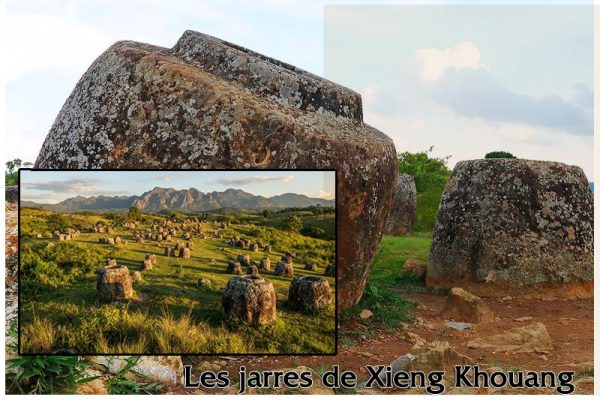
The Plain of Jars is known to Laotians as “Thồng Hảy Hín.” At one time, this region was called “Trấn Ninh” and was under the sovereignty of Đại Việt during the Nguyễn dynasty. It is here that researchers have discovered thousands of stone jars, scattered across approximately 60 sites on the Xieng Khouang Plateau (Muang Phuan). These jars vary in size and number. One colossal, isolated jar is found mainly at Bảng An, standing 3 meters high and weighing 14 tons. This massive stone vessel is nicknamed the « King” jar. These jars date back to the Iron Age, a period extending approximately from 500 BC to 500 AD.
These jars were all carved entirely from natural stone, but most of them were made of sandstone. Thanks to its moderate hardness, this type of stone was the most commonly used, particularly for rudimentary tools. These jars represent more than 70% of the total. Granite is also found, but the fact that the interiors of these stone blocks were hollowed out is quite astonishing, especially since modern tools like those available today did not exist at the time. Limestone is also found in the Plain of Jars, but these jars are very few in number. These jars have been eroded by rain and cracked over time. Their surfaces are now riddled with holes, causing them to lose their original shape.
Why do the Laotians call them Thồng Hảy Hín? This name means “field of stone jars” and is linked to a legend that the Laotians know and pass down from generation to generation. There once was a tyrant named Chao Angka who had conquered and enslaved this region. He thus plunged the local population into misery. It was then that a hero of the Khơ Mú ethnic group, Khun Jeuam, a king of gigantic stature, rose up to raise an army and, in a heroic battle, managed to liberate this region. To treat all the soldiers and villagers to a feast celebrating this victory over several days and nights, the king had thousands of giant stone jars carved into the hillsides and used them to age a huge quantity of rice wine (which the Laotians call “lao-lao”) to treat all the soldiers and villagers. This celebration thus lasted several days and several nights.
According to local legends and from a historical point of view, the Laotians had not yet begun migrating to this region at that time. The region’s earliest inhabitants belonged to an ethnic group in the Mon-Khmer language family. Their ancestors were the Khơ Mú. They were the ones who carved and used these famous jars.
These cannot be more recent than the objects found alongside them. If they had been buried, all the objects, large or small, that were inside them would have been scattered or broken. Are they therefore older than these objects? They are generally called “Neolithic jars.” They are very rudimentary and bear no decorative motifs or inscriptions. However, on closer inspection, it is clear that they must have been fashioned using metal tools.
It seems logical to consider them contemporary with the offering objects surrounding them. We would undoubtedly be right to consider these jars contemporary with the objects placed nearby. These are indeed offerings made in memory of the deceased. We therefore proceed with an analysis by comparison and juxtaposition with funerary offerings documented in other regions and dating from different periods. We can state with certainty that the jar field, with its innumerable funerary blocks and rich system of offerings, was once the center of a closely organized social structure and a well-defined hierarchical system.
The manufacture of these large jars must have served the needs of a sizeable population and required a considerable agricultural workforce. If so, how did these inhabitants live, and what culture did they belong to during this long period in the past?
Examination of the dental remains discovered in the two burial pits reveals that these inhabitants’ diet was undoubtedly based primarily on plants. This is evidenced by the wear observed on the chewing surfaces of the molars. This results from chewing hard, fibrous plant foods, such as roots. It is therefore reasonable to infer that the inhabitants who erected the megalithic monuments of the Plain of Jars (Trấn Ninh) and Hua Phăn consumed salt.
Hua Phan is a site where menhirs stand, with round stone discs resting at their feet.These, with an average diameter of between 1.5 and 2 meters, serve as lids. Beneath them are tombs or underground cavities containing human remains. Located more than 250 kilometers from Trấn Ninh, Hủa Phăn is now considered the “Stonehenge of Laos.” It has been recognized by the Laotian government as a national cultural heritage site.
In the Upper Laos region, no trace of salt deposits has been found. So where did the salt come from? Salt, an essential condiment for people whose diet did not consist solely of meat, came from the west and was most likely transported along mountain trails used by merchant caravans, as well as by boat on the Mekong (Luang Prabang), to exchange various goods. Within the jar burial area, scientists also discovered many funerary objects such as glass beads, iron tools and bronze bells. Chemical analyses revealed that the glass beads came from Mesopotamia and India. This suggests that the Plain of Jars was once an important stop on a busy ancient trade route (like the salt route) linking distant regions.
The inhabitants of the plain were sedentary farmers. They maintained ties with the outside world through a main road network made up of paths crossing the old cemetery and leading south to the stretch of the Mekong flowing from west to east (near Borikane), while another important branch extended toward present-day Luang Prabang.
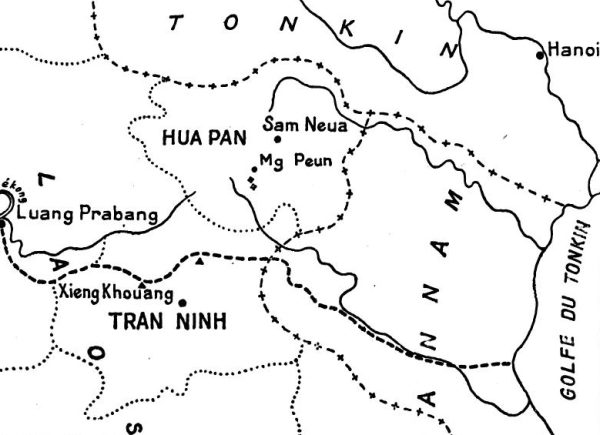
So, how long has the culture of these populations existed? According to archaeologist Madeleine Colani, it does not date back to before the 1st century AD, and it may be no more recent than that—but is this really certain?
Moreover, similar sites exist in other regions, such as North Cachar (Assam, India), where fields of jars have been discovered that differ little from those of Trấn Ninh, with which they have evident connections. The exact identity of the creators of these megalithic works remains a mystery, and at present, no population group in the region claims them as its heritage. However, the striking similarity between these remains and the types of jars discovered at Trấn Ninh (Laos) is remarkable. Archaeological studies indicate that the jars of Assam may date back to before 400 BC, corresponding to the beginnings of the Plain of Jars culture in Laos. They are older than the quadrangular stone axes widely found in the neighboring region, as well as shouldered axes. This may have been a network of cultural exchanges or ancient migrations, perhaps linked to Mon-Khmer-speaking population groups (South Asia) who lived here before the 4th century BC. Moreover, in our country, at Sa Huỳnh (Quảng Ngãi), there are two burial sites consisting of terracotta jars that bear similarities to the remains at Trấn Ninh.
This is the conclusion reached by archaeologist Madeleine Colani after many years spent surveying the terrain in this region of Upper Laos. She recounts what she observed, studied, and collected in her seminal work entitled *Mégalithes du Haut-Laos*. But all archaeological activities at this site were subsequently interrupted by the wars (the Second World War, followed by the Indochina War and the Vietnam War).
Based on the research conducted by French archaeologist Madeleine Colani in the 1930s, we can establish with certainty the following:
1) The funerary function of the megalithic structures in question.
2) The fact that the menhirs date from the Copper Age, while the stone jars belong to the Iron Age.
3) The existence of trade (notably through glass beads and certain bronze objects). The work of French archaeologist Madeleine Colani made a significant contribution to the study of ancient megalithic sites in the Far East, a subject that continues to attract keen interest. Many questions remain about these jars, and no satisfactory explanation has yet been provided, despite the official inscription of the Trấn Ninh (Xieng Khouang) Plain of Jars on the UNESCO World Heritage List on July 6, 2019.
First of all, how were these gigantic jars, weighing anywhere from a few hundred kilograms to 14 tonnes, transported from the sandstone or granite quarries to the Plain of Jars?
This transportation remains a great mystery to archaeologists. However, several major hypotheses have been put forward about how these blocks were carved and transported. First, they must have been carved on site in the quarry before being moved, in order to reduce their weight somewhat. Then, human and animal power was used with the help of levers and very strong plant-fiber ropes, relying on the strength of a large workforce or the pulling power of buffalo, oxen and elephants living in Laos – as well as a system of wooden rollers, combined with earthworks or planks sliding over hilly terrain. But this method proved insufficient when stone blocks weighing up to 14 tonnes had to cross the rugged terrain of the Xiêng Khoang Plateau.
Today, the Plain of Jars contains more than 2,000 jars, large and small, but few still have a lid. So where have these lids gone?
Since these jars were intended to be used in funerary and burial rites, archaeologists and historians believe they served to allow the natural process of decomposition to take place, after which the bones were removed to be cremated or buried elsewhere, or to hold the ashes and funerary objects. The lids, mostly made of wood or woven bamboo, served as temporary covers to keep wild animals away and ensure hygiene. Over time and through wars, all these lids completely decomposed. A small number of round, flat stone discs are also found near the large jars, often engraved with human or animal figures, proving that these important jars once had stone lids and belonged to high-ranking members of the tribe (tribal chiefs, priests). Many jars also have a carved rim all around their openings. This proves that these jars were certainly fitted with lids intended to prevent rain and animals from destroying the bones they contained.
Recently, excavations conducted by archaeologist Nicholas Skopal of James Cook University uncovered a mysterious 1,200-year-old “funerary jar” containing the partially decomposed remains of several generations. This jar was named “Jar No. 1” (Jar 1 / Site 75) at Bảng An. Archaeologists have long suspected that the jars of Xieng Khoang were used for funerary purposes, but until now, no concrete evidence had supported this hypothesis. The findings of this study were published on Tuesday, May 19, 2026, in the journal *Antiquity*. In an email to Live Science, he wrote the following:
“Jar No. 1” is completely different from the other jars discovered in Laos so far. This particular jar measures up to 2.05 meters in diameter, has a wide base, and is shaped like a bowl containing a large quantity of human remains.
He was very surprised by the large quantity of human bones, fragments from different parts of decomposing bodies. In particular, the skulls were arranged along the edge of the jar, while the arm and leg bones were grouped together. This indicates that it was not an original burial site. Multicolored glass beads were also found, many of them originating from India. In addition, radiocarbon dating performed on some teeth yielded an unexpected result: they proved to be much more recent than expected. These human remains, belonging to individuals of all ages, from young children to adults, were dated to a period spanning 890 to 1160 AD.
He added that jar No. 1 may have served as a communal storage place for human remains. The ancients probably gathered the skeletons, bundled them together, then placed them in this immense stone jar at a spot overlooking the plateau. It is also possible that they removed some bones from inside this immense jar to take them elsewhere. This hypothesis was put forward because his research team observed a discrepancy between the number of skulls and long bones, on the one hand, and the number of teeth found, on the other.
Based on the number of teeth, 37 different individuals can be identified in the jar, but the number of skulls and bones recovered corresponds to only about 14 to 19 individuals. He concludes that this pot served as a collective repository for human remains for more than 270 years. The funerary rites uncovered attest to the practice of ancestral worship that continued across generations.
This is the first study to confirm the hypothesis that the jars of the Plain of Jars were used for funerary purposes. According to archaeologist Louise Shewan of the University of Melbourne, who spoke to the website IFLScience,
Located in Xiang Khoang Province (Laos), the Plain of Jars, is a fascinating archaeological site that contains the remains of a unique funerary ritual. It is the witness to an ancient culture that disappeared long ago.