
Version française
Version anglaise
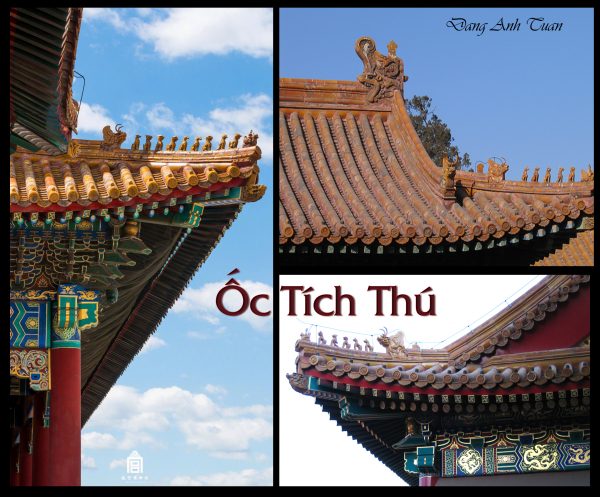
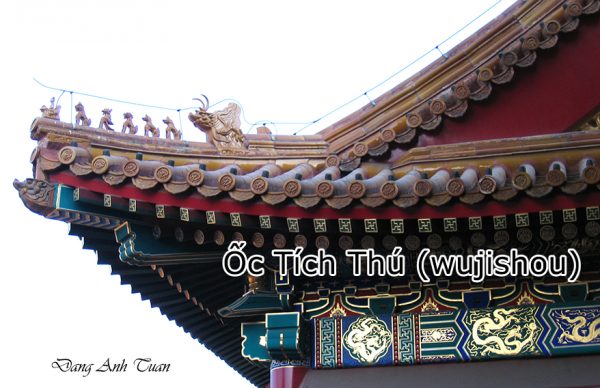
Thông thường khi bạn đi tham quan Tử Cấm Thành (Bắc Kinh) thì bạn hay thường đi theo người hướng dẫn của công ty du lịch. Vì vậy ít khi bạn nhìn lên và để ý đến cung điện nào bạn viếng thăm lắm. Bởi vậy muốn biết rõ nơi nào bạn đến, bạn hãy nhìn lên trên mái cung số lượng các linh vật mà người Hoa họ gọi là Ốc Tích Thú (chữ Hán: 屋脊兽). Nhờ số lượng mà bạn sẽ được biết tầm quan trọng và vị thế của cung điện nầy và cũng nhờ đó mà bạn biết phân biệt chỗ ở của hoàng đế hay của hoàng hậu so với các kiến trúc khác. Bạn không cần chỉ đích danh một cá nhân cụ thể nào cả.
Số lượng thần thú trên góc mái hiên của cung điện có thể gồm từ 1 đến 10. Tùy theo vai trò quan trọng quy mô của cung điện và tùy theo đẳng cấp của chủ nhân trong triều đình mà con số nầy nó có thể thay đổi. Số lượng thần thú nầy được chỉ định trong bộ sách ghi chép lại tất cả những điển pháp dưới nhà Thanh và được biết với cái tên là Đại Thanh Hội Điển (Da Qing Hui Dian). Các thần thú nầy được sắp xếp theo số lẻ (số Dương) 1-3-5-7-9 trên góc mái hiên và theo thứ tự rõ ràng như sau: rồng, phượng, sư tử, thiên mã, hải mã, toan nghê, áp ngữ, giải trãi, đấu ngưu và khỉ.
Con số 9 là con số Dương cao nhất dành cho cho vua như Cung Càn Thanh (Palais de la Pureté Céleste) và cho hoàng hậu như Cung Khôn Ninh (Palais de la Tranquillité Céleste). Cung nầy chỉ còn có 7 linh vât, không có 3 con từ toan nghê tính đi. Số lượng linh vật trên mái nhà của các Quý phi và Phi tần thì phải thấp hơn cũng như nơi ở của Hoàng tử nằm ở trong khu vực Đông Ngũ Sở.
Nơi nầy gồm có năm dãy nhà thì chỉ còn có từ 3 đến 5 con linh vật mà thôi. Chỉ có một điều ngoại lệ dưới triều đại nhà Thanh lúc bà Từ Hi Thái hậu buông rèm nhiếp chính. Cung của bà (Điện Trữ Tú)(Palais des Elégances Accumulées) là nơi bà cư trú lúc còn làm phi tần, được nâng cấp lên đến 9 con để ngang hàng với hoàng đế. Ở Việt Nam chỉ thấy Ốc Tích Thú ở vài chùa trong Chợ Lớn hay ở Hội An với chùa Phúc Kiến, những nơi có ảnh hưởng quan trọng của người Hoa.
Luôn luôn dẩn đầu các thần thú nầy bởi một vị tiên cởi gà hay phượng thường đựơc gọi là hoàng tử Min. Bên cạnh những sinh vật kỳ ảo này, ở gần phần chót nóc mái, luôn có hình đầu một loài vật có sừng với khuôn miệng đang mở (đây là người con thứ chín của rồng).
Có một việc ngoài lệ đó là điện Thái Hoà có đến 10 thần thú trên các góc mái hiên vì ở nơi nầy hoàng đế tổ chức các lễ hội quan trọng (như lễ tấn phong, lễ cưới, lễ sinh nhật, lễ tất niên vân vân….).
Các con linh vật trên mái nhà đều có ý nghĩa sâu sắc về phong thủy. Chúng còn giữ vai trò tựa như các « vị thần » bảo vệ cung điện khỏi hỏa hoạn, thiên tai và tà ma. Chúng được bố trí sắp xếp theo qui tắc chỉ định khó dời chỗ và nhờ đó mà bạn có thể biết địa vị chủ nhân của toà nhà nầy.
Sau đây là ý nghĩa phong thủy của từng thần thú trên mái cung điện:
Tiên nhân cưỡi phượng đi đầu. Theo truyền thuyết kể lại, một vị vua khi bị kẻ địch truy đuổi đến bờ vực thẳm đã được một con chim phượng hoàng bay đến cứu thoát. Biến nguy thành an.
1°) Long (Dragon). Trong phong thủy, rồng là thần mưa, có khả năng phun nước để trấn áp hỏa hoạ. Đây là nỗi sợ lớn nhất ở cố cung vì tất cả cung điện đều xây cất bằng gỗ. Rồng cũng là biểu tượng của thiên tử và hoàng đế.
2°) Phượng (Phénix). Phượng hoàng xuất hiện khi quốc thái dân an, thiên hạ được thái bình. Phượng được xem là vua của các loài chim và biểu tượng của hoàng hậu.
3°) Sư tử (Lion). Trong phong thủy, sư tử có lòng dũng cảm và uy nghiêm nên có tác dụng để trấn an, xua đuổi tà ma và đem lại bình yên ở cung điện.
4°) 5°) Thiên mã (Destrier céleste) & 6. Hải mã (Hippocampe)
Đôi tượng mã nhỏ này tượng trưng cho uy quyền từ trên trời xuống biển sâu. Chúng còn biểu thị cho năng lực thông thiên đạt địa của hoàng quyền và khả năng lướt sóng, ngăn chặn thủy tai.
6°) Toan nghê (Suanni)
Trong phong thủy, nó mang lại sự may mắn, bảo bọc và thu hút năng lượng ôn hòa. Nó còn là một đứa con của rồng, có hình dáng giống sư tử nhưng thích khói lửa và sự tĩnh lặng.
7°) Áp ngữ (Yaju) Trong truyền thuyết, loài cá thần có khả năng gọi mưa dập lửa. Đây là linh vật có trách nhiệm phòng chống hỏa hoạn cho công trình.
8°) Giải trãi (Xiezhi)
Linh thú một sừng có khả năng phân biệt ngay thẳng và tà ác. Khi thấy kẻ gian, nó sẽ dùng sừng húc thẳng vào. Loài này tượng trưng cho sự công lý của pháp luật và sự minh triết của triều đình thể hiện qua chính sách lấy dân làm gốc.
9°) Đấu ngưu (Douniu)
Đây là linh vật chót cuối cùng trong nhóm thần thú có nhiệm vụ khắc chế hỏa hoạn. Đây cũng là loài rồng có sừng bò, có khả năng phun mây nhả khói để tạo mưa.
10°) Háng thú (Hangshi)
Có ngoại hình giống khỉ nhưng có cánh và tay cầm chùy sét, tựa giống Lôi Thần (Thần sấm sét). Sự xuất hiện của Hành thập (Háng thú) có ý nghĩa phong thủy là chống sét đánh để bảo vệ tòa nhà cao nhất Tử Cấm Thành.
Lorsqu’on visite la Cité interdite de Pékin, on est habitué à suivre généralement le guide de l’agence de voyage. C’est pour cela qu’on ne lève même pas les yeux pour observer de près le bâtiment qu’on va visiter. Pourtant, pour saisir la véritable portée d’une construction, il convient d’observer sa toiture et de compter les figurines d’animaux mythiques appelées *wujishou* (屋脊兽) en chinois. Le nombre de ces figurines révèle l’importance et le statut du bâtiment, ce qui permet de distinguer ainsi les palais de l’empereur ou de l’impératrice vis-à-vis des autres édifices. On n’a pas besoin d’identifier une personne en particulier.
Groupées toujours en nombre impair (số Dương) 1-3-5-7-9, les figurines marquent non seulement l’importance de l’édifice impérial mais aussi la fonction occupée par le propriétaire dans la hiérarchie impériale. Le nombre des figurines est fixé par le recueil de lois et de décrets de la dynastie des Qing connu sous le nom « Da Qing Hui Dian » (Đại Thanh hội điển). Le chiffre 9 est le nombre Yang le plus élevé réservé à l’empereur (Palais de la Pureté Céleste). Quant au chiffre 7, il est destiné à l’impératrice (Palais de Kunning)
Les figurines représentant chacune un symbole et une qualité, sont établies dans un ordre très précis: dragon (rồng), phénix (phượng hoàng), lion (sư tử), destrier céleste (thiên mã), hippocampe (hải mã), yaju (áp ngư), suanni (toan nghê), Xiezhi (hải trãi), douniu (đấu ngưu) hangshi (khỉ).
Le nombre 9 est le nombre Yang le plus élevé, réservé à l’empereur comme le palais de la Pureté céleste, et à l’impératrice comme le palais de la Tranquillité terrestre. Ce dernier ne compte plus que 7 figurines, sans compter les 3 autres créatures à partir de la figurine suanni. Le nombre de figurines sur les toits des palais des nobles concubines et des concubines impériales devait être inférieur ainsi que celui de la résidence des princes impériaux située dans la zone orientale nommée « les Cinq Résidences ». Cet endroit comprend cinq rangées de bâtiments et ne compte plus que 3 à 5 créatures. Une seule exception eut lieu sous la dynastie Qing, lorsque l’impératrice douairière Cixi gouverna derrière le rideau. Son palais (le palais des Élégances Accumulées), l’endroit où elle résidait lorsqu’elle était encore concubine, fut élevé à 9 créatures, au même rang que l’empereur. Au Vietnam, on ne trouve que les Ốc Tích Thú (wujishou) dans quelques pagodes à Cholon ou à Hội An où la communauté chinoise est importante.
Elles sont toujours précédées par un immortel taoïste appelé parfois le « prince Min» qui est sur le dos d’un coq ou d’un phénix. À côté de ces animaux chimériques près du sommet du toit, se trouve toujours une tête d’animal cornu à gueule ouverte (neuvième fils du dragon). Il y a une exception à cette règle d’alignement.
C’est le cas du palais de l’Harmonie Suprême Taihe (Ðiện Thái Hòa) où 10 figurines sont toutes présentes sur l’arête de sa toiture car c’est ici que l’empereur a organisé les festivités importantes (intronisation, mariage, anniversaire, nouvel an, solstice d’hiver etc.). L’utilisation de ces figurines est destinée à protéger les édifices contre le feu et les esprits malfaisants et à montrer la puissance et la suprématie de l’empereur
Les créatures mythiques sur les toits ont toutes une profonde signification dans le feng shui. Elles jouent également un rôle semblable à celui de « divinités » protégeant les palais contre les incendies, les catastrophes naturelles et les esprits maléfiques. Elles sont disposées selon des règles précises qui ne permettent guère de les déplacer, ce qui permet de connaître le statut du propriétaire du bâtiment. Voici la signification feng shui de chacune des créatures mythiques situées sur le toit du palais:
L’immortel chevauchant un phénix en tête. Selon la légende, un roi poursuivi par ses ennemis jusqu’au bord d’un précipice fut sauvé par un phénix venu à son secours. Le danger se transforme ainsi en sécurité.
1°) Dragon (Rồng). Dans le feng shui, le dragon est le dieu de la pluie. Il est capable de cracher de l’eau pour maîtriser les incendies. C’est la plus grande crainte dans la cité interdite car tous les palais y étaient construits en bois. Le dragon est également le symbole du Fils du Ciel et de l’empereur.
2°) Phénix (Phượng). Le phénix apparaît lorsque le pays est prospère et lorsque le monde connaît la paix. Le phénix est considéré comme le roi des oiseaux et le symbole de l’impératrice.
3°) Lion. Dans le feng shui, le lion possède le courage et majesté. Il sert donc à rassurer, chasser les esprits maléfiques et apporter la paix au palais.
4°) 5°) Destrier céleste et Hippocampe(Thiên mã và cá ngựa)
Ces deux figurines symbolisent l’autorité descendue du ciel jusqu’aux profondeurs marines. Elles représentent le pouvoir impérial capable de communiquer avec le ciel et de maîtriser la terre, ainsi que la capacité de chevaucher les vagues et de prévenir les catastrophes hydrauliques.
6°) Suanni (Toan nghê)
Dans le feng shui, il apporte la chance et la protection et il attire une énergie paisible. C’est également un enfant du dragon, ayant l’apparence d’un lion et appréciant la fumée, le feu et la tranquillité.
7°) Yaju (Cá ngừ) Dans les légendes, ce poisson divin a le pouvoir d’appeler la pluie pour éteindre les incendies. C’est une créature sacrée chargée de protéger les édifices contre les incendies.
8°) Xiezhi (Giải trãi)
C’est une créature sacrée à une corne capable de distinguer immédiatement le bien du mal. Lorsqu’elle voit un homme malhonnête, elle le charge directement avec sa corne. Cette espèce symbolise la justice de la loi et la sagesse de la cour impériale en prenant le peuple comme la base de sa gouvernance.
9°) Đấu ngưu (Douniu)
Il s’agit de la dernière créature sacrée du groupe des animaux divins chargés de prévenir les incendies. C’est également un dragon doté de cornes de taureau, capable de souffler des nuages et de rejeter de la fumée afin de provoquer la pluie.
10°) Háng thú (Hangshi)
Son apparence ressemble à celle d’un singe, mais il possède des ailes et il tient dans sa main une massue de la foudre, à l’image du Dieu du Tonnerre. Son apparition revêt une signification dans le feng shui: protéger le plus haut bâtiment de la Cité interdite contre la foudre.
When visiting Beijing’s Forbidden City, people are generally accustomed to following the travel agency’s guide. Consequently, they do not even look up to closely observe the building they are about to visit. Yet, to grasp the true significance of a structure, one should examine its roof and count the figurines of mythical animals called *wujishou* (屋脊兽) in Chinese. The number of these figurines reveals the building’s importance and status, thus distinguishing the emperor’s or empress’s palaces from other structures. There is no need to identify any particular person.
Always grouped in odd numbers (số Dương), 1-3-5-7-9, the figurines indicate not only the importance of the imperial building but also the function held by its owner within the imperial hierarchy. The number of figurines was established by the collection of laws and decrees of the Qing dynasty known as the “Da Qing Hui Dian” (Đại Thanh hội điển). The number 9 is the highest Yang number, reserved for the emperor (Palace of Heavenly Purity). As for the number 7, it is designated for the empress (Palace of Kunning).
The figurines, each representing a symbol and a quality, are arranged in a very precise order: dragon (rồng), phoenix (phượng hoàng), lion (sư tử), celestial steed (thiên mã), seahorse (hải mã), yaju (áp ngư), suanni (toan nghê), xiezhi (hải trãi), douniu (đấu ngưu), hangshi (khỉ). The number 9 is the highest Yang number, reserved for the emperor, as in the Palace of Heavenly Purity, and for the empress, as in the Palace of Earthly Tranquility. The latter has only 7 figurines, not counting the 3 other creatures starting with the suanni figurine.
The number of figurines on the roofs of the palaces of noble consorts and imperial concubines had to be lower, as did that of the residence of the imperial princes located in the eastern area called “the Five Residences.” This place comprises five rows of buildings and has only 3 to 5 creatures. A single exception occurred under the Qing dynasty, when Empress Dowager Cixi ruled from behind the curtain. Her palace (the Palace of Accumulated Elegances), where she resided when she was still a concubine, was raised to 9 creatures, equal in rank to the emperor. In Vietnam, Ốc Tích Thú are found only in a few pagodas in Cholon or Hội An, where the Chinese community is significant.
They are always preceded by a Taoist immortal, sometimes called “Prince Min,” who rides on the back of a rooster or phoenix. Next to these mythical animals near the top of the roof, there is always the head of a horned, open-mouthed animal (the dragon’s ninth son). There is one exception to this alignment rule.
This is the case of the Palace of Supreme Harmony Taihe (Điện Thái Hòa), where all 10 figurines are present along the ridge of its roof, because this is where the emperor held important festivities (enthronement, wedding, birthday, New Year, winter solstice, etc.). The use of these figurines is intended to protect the buildings from fire and evil spirits and to demonstrate the emperor’s power and supremacy.
The mythical creatures on the roofs all have profound significance in feng shui. They also play a role similar to that of “deities,” protecting palaces against fires, natural disasters, and evil spirits. They are arranged according to precise rules that allow little room for relocation, making it possible to determine the status of the building’s owner. Here is the feng shui significance of each of the mythical creatures located on the palace roof:
The immortal rides a phoenix at the front. According to legend, a king pursued by his enemies to the edge of a cliff was saved by a phoenix that came to his aid. Danger thus transforms into safety.
1°) Dragon (Rồng). In feng shui, the dragon is the god of rain. It is capable of spitting water to control fires. This is the greatest fear in the Forbidden City because all the palaces there were built of wood. The dragon is also the symbol of the Son of Heaven and the emperor.
2°) Phoenix (Phượng). The phoenix appears when the country is prosperous and when the world is at peace. The phoenix is considered the king of birds and the symbol of the empress.
3°) Lion. In feng shui, the lion possesses courage and majesty. It therefore serves to reassure, drive away evil spirits, and bring peace to the palace.
4°) 5°) Celestial Steed and Hippocampus (Thiên mã và cá ngựa)
These two figurines symbolize authority descended from heaven to the depths of the sea. They represent imperial power capable of communicating with heaven and mastering the earth, as well as the ability to ride the waves and prevent water-related disasters.
6°) Suanni (Toan nghê)
In feng shui, it brings luck and protection and attracts peaceful energy. It is also a child of the dragon, having the appearance of a lion and enjoying smoke, fire, and tranquility.
7°) Yaju (Cá ngừ) In legends, this divine fish has the power to summon rain to extinguish fires. It is a sacred creature tasked with protecting buildings from fires.
8°) Xiezhi (Giải trãi)
It is a sacred one-horned creature capable of immediately distinguishing right from wrong. When it sees a dishonest man, it charges directly at him with its horn. This species symbolizes the justice of the law and the wisdom of the imperial court, which takes the people as the foundation of its governance.
9°) Đấu ngưu (Douniu)
This is the last sacred creature in the group of divine animals tasked with preventing fires. It is also a dragon with bull’s horns, capable of blowing clouds and expelling smoke to bring about rain.
10°) Háng thú (Hangshi)
Its appearance resembles that of a monkey, but it has wings and holds a lightning club in its hand, like the God of Thunder. Its appearance has a meaning in feng shui: protecting the tallest building in the Forbidden City from lightning.