Temple royal des Trần (Phủ Thiên Trường)


Version française

Phủ Thiên Trường

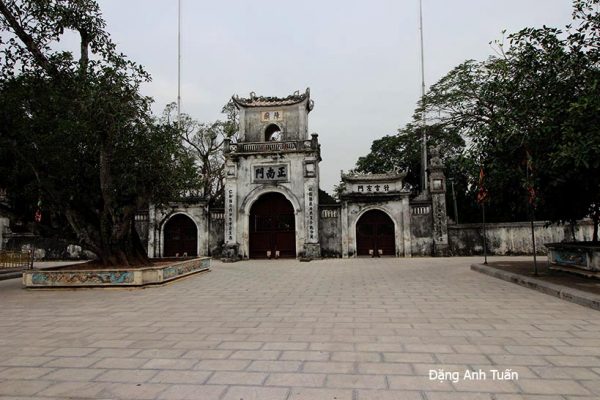
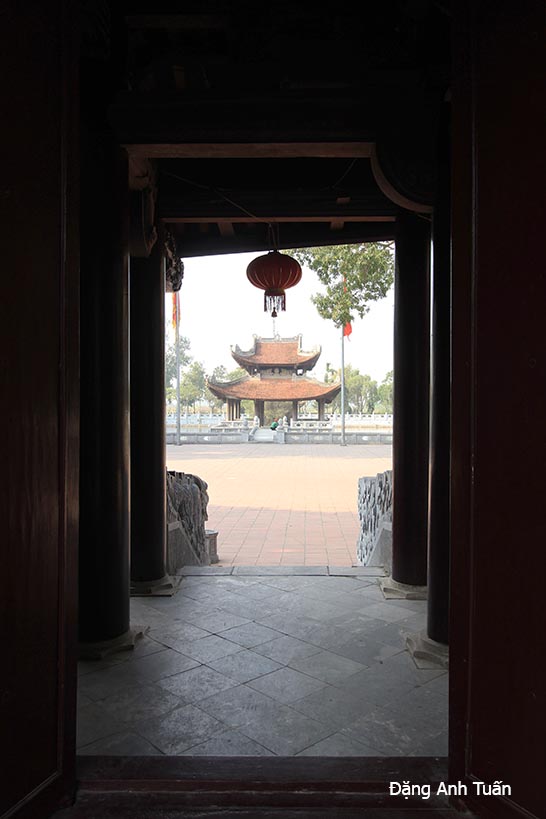
Đây là một quần thể kiến trúc và lịch sử dành để thờ các vua nhà Trần và các quan có công phù tá. Nằm trên quốc lộ số 10 trong tỉnh Nam Định, đền nầy được xây cất lại năm 1695 trên nền thái miếu cũ được gọi là phủ Thiên Trường mà quân xâm lược nhà Minh phá hủy vào thế kỷ 15.  Cũng ở nơi nầy mà phát tích vương triều nhà Trần.  Các vua nhà Trần tạm về nơi nầy để lánh nạn trong thời gian chống giặc Nguyên Mông của Hốt Tất Liệt.

Temple royal  des Trần

C’est un  ensemble architectural et historique remarquable  dédié au culte des  rois de la dynastie des Trần  et de leurs  célèbres  serviteurs.  Situé à la route nationale n°10 dans la province de Nam Định, il fut reconstruit en 1695 sur l’emplacement de l’ancien temple royal  connu sous le nom « Phủ Thiên Trường »  détruit complètement par les envahisseurs chinois (les Ming) au XVème siècle. C’est ici qu’est née la dynastie des Trần. Les rois des Trần  y trouvaient refuge durant la guerre contre les Mongols de Kubilai Khan

Galerie des photos

[Retour Hanoi et ses sites historiques]

Palais Kiến Trung (VA)

Kiến Trung Palace


Version vietnamienne
Version française

Located at the northern end of the sacred axis crossing the center of the Purple Forbidden City, the Kiến Trung Palace is an architectural work built by King Khải Định between 1921 and 1923. It is also the first building where there is a combination of European style, including both French architecture and Italian Renaissance architecture, and traditional Vietnamese architecture. The facade of this palace is richly decorated with colorful ceramic motifs and fragments, thus bearing the imprint of the identity of the royal court of the Nguyễn dynasty. On the advice of several French architects and engineers and the Ministry of Public Works, this palace, responding to the aesthetic taste of the time, was completed in just two years, from 1921 to 1923, on the former site where two other architectural works previously known successively as Minh Viễn Lâu (1827) and Du Cửu Lâu (1913) had stood. According to the Hue Monuments Conservation Center, it has been known as Kiến Trung (Kiến « erected » and Trung « straight, no deformation« ).

This palace was considered the residence of the last two kings of the Nguyễn dynasty: Khải Định and Bảo Đại. It was here that King Khai Dinh passed away on November 6, 1925. During the reign of King Bảo Đại, the palace and its interior were renovated in a Western style, including the bathroom. It was also in this palace that Queen Nam Phương gave birth to the crown prince Bảo Long (January 4, 1936). During the Vietnam War, this palace was completely destroyed along with other residences of the Forbidden City. Since 2013, the Huế Monuments Conservation Center has begun launching the restoration project of the Kiến Trung palace. This project was implemented from February 2019 and completed in August 2023 with a total cost of more than 123 billion đồng.

Today, the Kiến Trung palace has become the favorite place for all tourists when visiting the Forbidden Purple City.

Kiến Trung Palace is visible through the long

Trường Lang Corridor

[Return HUE]

Temple Đô  (Lý Bát Đế)(English version)

Temple  Đô  (Lý Bát Đế)

Vietnamese version

Version française

This Đô Temple was built in the year 1030 during the return of King Lý Thái Tông to celebrate the anniversary of the death of his father Lý Công Uẩn (Lý Thái Tổ). However, this building was completely destroyed during the colonial period. That is why in 1989 the Vietnamese government decided to restore it based on the still preserved historical documents. In front of its entrance gate is a water pavilion erected on a large pond in the shape of a half-moon, which once connected to the Tiêu Tương River that no longer exists today. This historic architectural complex is dedicated to the worship of the 8 kings of the Lý dynasty, which the famous historian Ngô Sĩ Liên described as a dynasty of clemency in the collection entitled « The Complete Historical Records of Đại Việt » (Ðại Việt Sử Ký toàn thư) (1697).

According to the popular saying, in the work « Florilegium of the Thiền Garden (Thiền Uyển Tập Anh) » there is a kệ (or gâtha) alluding to the 8 kings of the Lý dynasty, which is attributed either to the disciple of the patriarch monk Khuôn Việt, Đa Bảo, or to the monk Vạn Hạnh as follows:

The word Bát with the Lý family

Một bát nước công đức
Tùy duyên hóa thế gian
Sáng choang còn soi đuốc
Bóng mất trời lên cao.

A bowl of meritorious water
Flows with causality to transform the world
Brightly shining continues to light the torch
When the shadow disappears, the sun rises behind the mountains.

By implication, this Kệ (or stance) intends to evoke the 8 kings of the Lý dynasty, from the founder Lý Công Uẩn to the last king Lý Huệ Tông, through the word bát which means both bowl and eight in Vietnamese. As for Huệ Tông, his given name is Sảm. Being the combination of two words nhật (sun) andsơn (mountain) in Chinese Han characters, the word Sảm indeed means « the sun hides behind the mountains, » signifying the end or disappearance. This kê proves to be prophetic because Princess Lý Chiêu Hoàng (daughter of King Lý Huệ Tông) ceded the throne to her husband Trần Cảnh, who was none other than King Trần Thái Tông of the Trần dynasty. It can be said that the Lý dynasty had the kingdom by the will of God, but it was also by this will that they lost it.

Lý Bát Đế


[RETURN]

Angkorian empire (Chenla)

Đế Chế Angkor 

Version française
Version vietnamienne
Galerie des photos

At a time when the kingdom of Funan was weakening, a vassal principality of this kingdom, which Chinese historians often referred to as Chenla (Chân Lạp) in their annals, attempted to forge its destiny in the middle Mekong basin near the archaeological site of Vat Phu in the Champassak province (present-day Laos). This is the only name we have to this day. No Sanskrit or Khmer word corresponds to the ancient sound Tsien lap. The existence of this kingdom dates back to the end of the 6th century. Similar to the kings of Funan, those of Chenla also have a dynastic legend: a solar-origin Brahmin priest named Kambu Svayambhuva received from the god Shiva himself a nymph of lunar origin in marriage, the beautiful Mera.

From this union of K(ambu) and Merâ, a line of sovereigns was born, that is, the descendants of Kambujadesha, meaning « land of the descendants of Kambu, » intended to explain the name of the Khmers. This word Kambujadesha, abbreviated as Kambuja, was first discovered in 817 in an inscription of Po Nagar in Champa (or present-day Nha Trang, Vietnam).

During the French colonial period, this name Kambuja was Francized as « Cambodge. » As for the word Chenla, it appeared in the history of the Sui (589-619), where the sending of an embassy from this country was mentioned in 616-617. Located southwest of Lin Yi (future Champa) and a vassal state of Funan, the kingdom of Chenla (Chân Lạp) (future Cambodia), having become powerful, did not hesitate to seize the latter and subjugate it. This fact was reported not only in the New History of the Tang (618-907) by the Chinese historian Ouyang Xiu but also in an unpublished inscription from Sambor-Prei Kuk, which praised the king of Chenla, Içanavarman I, son of King Mahendravarman, for having expanded his parents’ territory with his grand exploits. This monarch established his capital at Sambor-Prei Kuk, renamed Ishanapura.

The fragmentation of Chenla into small states was witnessed again. It was only in 654 that Jayavarman I, a great-grandson of Içanavarman I, succeeded in reunifying his ancestor’s country and established his capital near Angkor. Upon his death, Chenla again broke up into numerous principalities, and soon the principality of Shambupura (today Sambor on the Mekong) managed to impose its authority. Its king, Jayavarman II, settled in Rolûos and proclaimed himself king of the entire Kambuja in 802. Then the settlement and religious sites of the Óc Eo plain began to be abandoned as the center of gravity of the new political formation from the North moved away from the coast to gradually approach the site of the future capital of the Khmer empire, Angkor.

According to researcher J. Népote, the Khmers coming from the North through Laos appear like Germanic tribes in relation to the Roman Empire, attempting to establish a unified kingdom inland known as Chenla. They saw no interest in maintaining the technique of floating rice cultivation because they lived far from the coast. They tried to combine their own mastery of water retention with the contributions of Indian hydraulic science (the baray) to develop, through multiple trials, an irrigation system better adapted to the ecology of the hinterland and to the local varieties of irrigated rice.

It is reported that in Chinese annals, Chenla was divided into a « Land Chenla » and a « Water Chenla » at the beginning of the 8th century. The former was established in the old territories of Chenla, expanded according to its military successes, from the Dangrek range to the middle Mekong valley and westward to Burinam, now part of the Thai province of Korat, while the latter corresponded to a multitude of fiefs of former Funan and was subject to the royal authority of the island of Java (Indonesia). Then, through a stele of Sdok Kak Thom dating from 1052 and found 25 km from Sisophon, we learn that Jayavarman II was crowned king in 802 after freeing his country from the tutelage of Java, and his country regained its unity under the name Chenla.

The latter soon gave way to the birth of the Angkorian empire at the beginning of the 9th century. It first experienced its peak and glory with King Suryavarman II, whom historians have often compared to the Sun King Louis XIV of France. Of a warlike temperament, he did not hesitate to first ally with the Chams to attack the kingdom of Đại Việt under the reign of King Lý Thần Tôn in 1128, but he was repelled in the Nghệ An region. He then tried to maintain his grip on Champa by placing his brother-in-law Harideva as ruler over the capital Vijaya (present-day Bình Định in Vietnam).

But this attempt ended in a crushing failure against one of the greatest Cham kings, Jaya Harivarman I, who recaptured Vijaya in 1149. Yet Chinese chroniclers spoke of him with great deference. Beyond the frenzy of his territorial conquests, Suryavarman II had a large number of splendid monuments built, among which was the famous site of Angkor Wat. According to the Italian researcher Maria Albanese from the I.I.A.O institute, it seems possible that Suryavarman II died following a disastrous military expedition into Vietnamese territory in 1150.

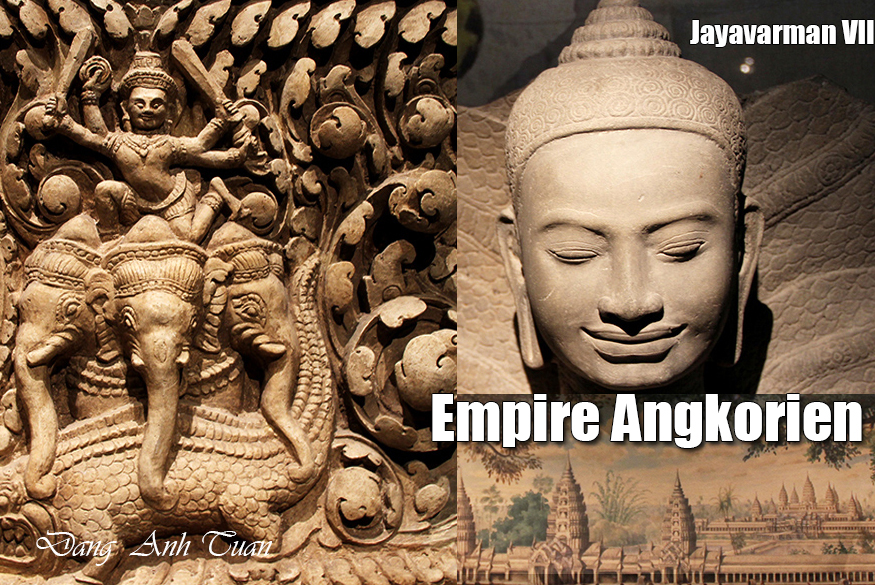
Then the empire of the Khmer kings expanded under Jayavarman VII, one of the fascinating personalities in universal history. During his reign, he managed to push back the limits of his empire by annexing Champa, Lower Burma, Thailand, and Laos. Georges Coedès, former director of the French School of the Far East (EFEO), painted for us a striking portrait of this great king, that of a pharaoh who can boast of having moved so much stone (Angkor Thom, Ta-Prohm, Bantay-Kdei, etc.).
Map of the empire
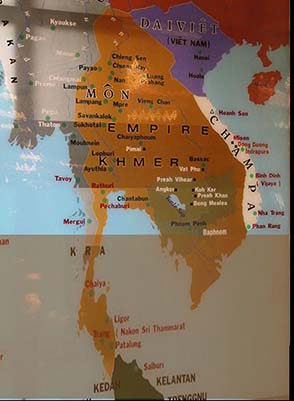
carte_empire_khmer

But after his death, due to the gigantic enterprises and incessant wars against his neighbors (Chams, Vietnamese, and Thais), the Angkorian empire began to experience a rapid decline caused by the multiple capture and sacking of its capital Angkor by the Thais (1353, 1393, and 1431). They were unified by Ramadhipathi to found the kingdom of Ayutthaya.

Faced with the assaults of the Thais, the Khmers had to abandon their capital Angkor and retreat to the geographic heart of their country, the Four Arms of the Mekong (Phnom Penh), with the last king of the Khmer empire and the first king of Cambodia, Ponhea Yat. This strategic and economic retreat is only one of the hypotheses suggested by researchers to hasten the decline of Angkor. But according to recent discoveries reported by National Geographic in its issue 118 of July 2009, the collapse of Angkor is largely due to climatic disasters that managed to destroy the most complex and ingenious hydraulic system, a jewel of Khmer civilization. The imperial city of Angkor had to face severe successive droughts from 1362 to 1392 and from 1415 to 1440, thanks to the analysis of growth rings found in certain long-lived cypresses such as teak or Siam wood.

When the hydraulic system began to malfunction, showing signs of weakness, the power of the Angkorian empire did the same. This is why, being the first to realize the importance of this system, the archaeologist Bernard Philippe Groslier of the French School of the Far East (EFEO) did not hesitate to describe Angkor as a « hydraulic city » when publishing his work in 1979. Designed to support religious rituals and ensure a constant water supply for rice cultivation, the gigantic barays (or water reservoirs) were drained in the event of successive major droughts. This could have dealt a fatal blow to this already faltering empire, weakened by internal divisions and successive Thai invasions, as Angkor was home to no less than 750,000 inhabitants over an area of about 1000 km². This brings to mind the period experienced by the Maya cities of Mexico and Central America, which succumbed to overpopulation and environmental degradation linked to three successive droughts in the 9th century. This disaster also brutally reminds us of the limits of human ingenuity, which can be easily overcome at any time by the forces of nature. Man cannot conquer nature under any circumstances but must become one with nature to live in harmony with it.

Bibliographie.

Thierry Zéphir: L’empire des rois khmers;  Découvertes Gallimard. 1997
Claude Jacques, Michael Freeman : Angkor, cité khmère. Book Guides
Bernard Philippe Groslier: Indochine. Editions Albin Michel 1961
National Geographic: Angkor . Pourquoi la grande cité médiévale du monde s’est effondrée? N° 118.  Juillet 2009
Maria Albanese: Angkor. gloire et splendeur de l’empire khmer. Editions White Star 
Georges Coedès: Cổ sử các quốc gia Ấn Độ Hóa ở Viễn Đông.  Editions Thế Giới. 2011
Chu Đạt Quan: Chân Lạp phong thổ ký. Editions Thế Giới . 2011


Saïgon (Hồ Chí Minh city)

Saïgon  (Hồ Chí Minh city)

Saïgon hai tiếng nhớ nhung
Ra đi luyến tiếc nghìn trùng cách xa

Version vietnamienne
Version française
Galerie des photos

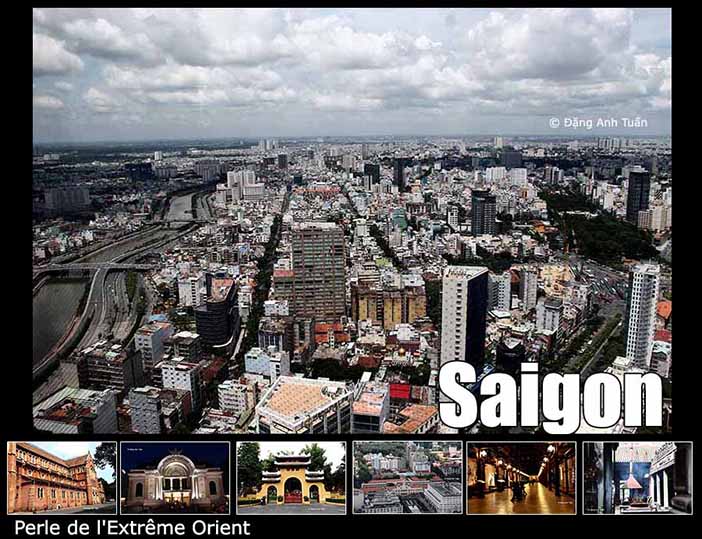
For some Vietnamese, the city will always be Saigon. For others, it is truly Ho Chi Minh City. Whatever name it takes, it will continue to be the economic center for foreign businessmen. It is here that millions of tons of rice and fish from the Mekong Delta are shipped for export. Although renamed in 1975, Saigon continues to maintain its old habits, its vagaries and its paradoxes. The city is always bustling with sleepless nights. It is a common sight on the streets or in large wooden-floored rooms where young girls learn to waltz and tango.

Saigon is still very much alive with its current 10 million inhabitants. Saigon has always had a strong vitality with a wonderful spirit of resourcefulness. The city is still bohemian, adventurous and over-excited. It continues to develop with luxury hotels with thousands of rooms in the middle of poor areas. This is the most populous city in Vietnam with an average population density of more than 4,500 people per square kilometer, even higher than Shanghai (China). It currently has a total area of 2,061 km² and is divided into 19 districts and 5 suburban districts.

Sites to visit

Galerie des photos

It was once, during the colonial era, the Pearl of the Far East and then the capital of South Vietnam from 1956 to 1975. Today, thanks to the urban development project of the Thủ Thiêm peninsula and the recent incorporation of Thủ Đức district, it has managed to expand its urban area and rapidly increase its population while simultaneously beginning the process of metropolitanization. However, according to Vietnamese researcher Trần Khắc Minh from the University of Quebec in Montreal, this does not prevent a growing fragmentation of the urban fabric and an intensification of inequalities, particularly in access to housing.

From the beginning of our era to the 17th century, Saigon successively belonged to the kingdom of Funan, then Chenla, Champa, and Cambodia. Its name is mentioned for the first time in a Vietnamese source in 1776, recounting the conquest of the city by the Nguyễn lords in 1672. For the Khmers (or Cambodians), Saigon is only a distortion of the name Prei Nokor (forest city) that the Khmers gave to this city. Saigon was a swampy region infested with crocodiles and unhealthy at the end of the 17th century. It was not idyllic for the first Vietnamese settlers to choose Saigon as a land of exile. For this reason, there is always a popular song that the Vietnamese know to testify to the unhealthiness of this region.

Chèo ghe sợ sấu cắn chân
Xuống sông sợ đĩa, lên rừng sợ ma.

Rowing the boat, afraid of crocodiles biting the feet
Going down the river, afraid of leeches, going up the forest, afraid of ghosts.

Despite its flaws, it continues to remain the jugular vein of Vietnam. It is the one that teaches Vietnamese people about market socialism or the Renovation policy started in 1996 to promote industrialization and modernization. It is also the one that offers them a taste of capitalism and the adventure of investing in risky capital.

Like many other cities, Saigon had a long history before being colonized, then Americanized, and finally renamed Hồ Chí Minh City during the events of 1975.

For those interested in this city, its history and its evolution, it is recommended to read the following books:

  • Saigon, le chantier des utopies de Didier Lauras, Editions Autrement, Collections Monde, 1997, no 95 HS.
  • Saigon, 1925-1945 , de la belle Colonie à l’éclosion révolutionnaire de Philippe Franchini, Editions Autrement, Collections Monde, no17, 1992.

[Return VILLES]

Maison Loo, centre d’exposition d’art privé

Une somptueuse pagode chinoise au cœur de Paris.

Ngôi chùa Trung Hoa độc đáo giữa lòng Paris.

Vietnamese version

English version

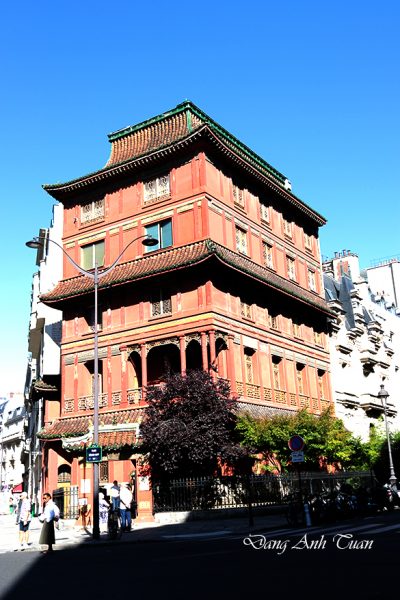
Au début du 19ème siècle, un marchand d’art chinois de nom Ching Tai Loo racheta un hôtel particulier de style français classique  construit en 1880  au cœur du quartier chic, non loin du parc Monceau. Pour l’amour de son pays et le lien qu’il voulait garder avec son pays d’adoption, il  demanda à l’architecte Fernand Bloc de transformer ce bâtiment en une somptueuse pagode d’inspiration chinoise peinte en rouge comme la cité interdite de Pékin  dans sa totalité car à cette époque le permis de construire ne lui fut pas demandé. Malgré les protestations des gens vivant aux alentours, la maison Loo continue à exister jusqu’aujourd’hui et devient un centre d’exposition collective  d’art privé pour les collectionneurs avertis. Etant invité par la galerie d’art Hioco, j’ai l’occasion de le visiter ce matin. Je suis frappé non seulement par le caractère original de cette maison insolite mais aussi la présentation des objets d’art des galeries associées  à cette exposition. Un grand merci à tous les exposants.

Vào đầu thế kỷ 19, một thương gia nghệ thuật người Trung Quốc tên là Ching Tai Loo đã mua lại một biệt thự theo phong cách cổ điển Pháp được xây dựng vào năm 1880 tại trung tâm khu phố sang trọng, không xa công viên Monceau. Vì tình yêu dành cho đất nước Trung Hoa và mong muốn giữ mối liên kết với quê hương thứ hai của mình, ông đã nhờ kiến trúc sư Fernand Bloc biến tòa nhà này thành một ngôi chùa lộng lẫy mang cảm hứng từ Trung Hoa, được sơn đỏ như Tử Cấm Thành ở Bắc Kinh, bởi vì vào thời điểm đó ông không cần xin giấy phép xây dựng. Mặc dù có sự phản đối từ những người sống xung quanh, ngôi nhà Loo vẫn tồn tại đến ngày nay và trở thành trung tâm triển lãm nghệ thuật tư nhân dành cho các nhà sưu tập tinh tường. Được mời bởi phòng tranh Hioco, tôi đã có cơ hội tham quan nơi nầy vào sáng nay. Tôi không chỉ có ấn tượng bởi tính độc đáo của ngôi nhà kỳ lạ này mà còn bởi cách trưng bày các tác phẩm nghệ thuật của các phòng tranh liên kết với cuộc triển lãm nầy. Xin gửi một lời cảm ơn chân thành đến tất cả các nhà triển lãm.

At the beginning of the 19th century, a Chinese art dealer named Ching Tai Loo bought a French classical-style townhouse built in 1880 in the heart of the upscale district, not far from Parc Monceau. For the love of his country and the connection he wanted to maintain with his adopted country, he asked architect Fernand Bloc to transform this building into a sumptuous pagoda inspired by Chinese design, painted red like the Forbidden City of Beijing in its entirety, as at that time no building permit was required. Despite protests from the local residents, the Loo house continues to exist today and has become a private collective art exhibition center for discerning collectors. Invited by the Hioco art gallery, I had the opportunity to visit it this morning. I was struck not only by the original character of this unusual house but also by the presentation of the art objects from the galleries associated with this exhibition. A big thank you to all the exhibitors.


Menton (Côte d’azur)


Thành phố Menton (Côte d’Azur)

Version française
Version anglaise
Galerie des photos

Được gọi là ngọc trai của nước Pháp,  Menton là một thành phố nằm trên bờ biển Địa Trung Hải ở phía đông nam nước Pháp. Nơi đây nổi tiếng với những bãi biển tuyệt đẹp. Nằm trên sườn đồi, khu phố cổ thời trung cổ của thành phố là nơi tọa lạc của vương cung thánh đường Michel-Archange với tháp chuông  có từ thế kỷ 18 và nhà nguyện trắng Penitents với mặt tiền được trang trí lộng lẫy. Nhờ di sản kiến ​​trúc và thực vật, điều này mang lại cho Menton nhãn  hiệu « Thành phố nghệ thuật và lịch sử » vào năm 1991.

Version française

Étant connue comme la perle de la France, Menton  est une ville située sur la rive méditerranéenne (Côte d’Azur), dans le sud-est de la France. Elle est réputée pour ses plages. Située sur les pentes de la colline, sa vieille ville médiévale abrite la basilique Saint-Michel Archange avec son clocher du XVIIIème  siècle, et la chapelle des Pénitents blancs à la façade superbement  décorée. Grâce à son patrimoine architectural et botanique, cela lui donne le label « Ville d’Art et d’Histoire » en 1991.

Version anglaise

Known as the pearl of France, Menton is a town located on the Mediterranean coast (French Riviera), in the southeast of France. It is renowned for its beaches. Situated on the slopes of the hill, its medieval old town houses the Basilica of Saint Michael the Archangel with its 18th-century bell tower, and the Chapel of the White Penitents with its beautifully decorated facade. Thanks to its architectural and botanical heritage, it was awarded the label « City of Art and History » in 1991.

Galerie des photos

[Return VILLES DE FRANCE]

Ngô Quyền (Version anglaise)

Ngô Quyền

Version  vietnamienne

Version française

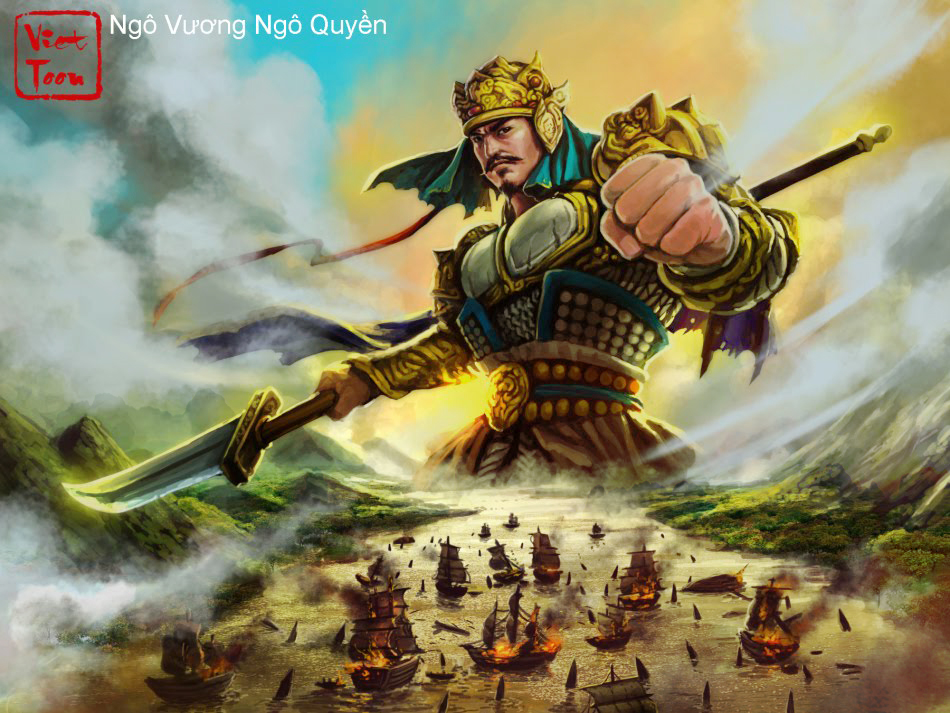
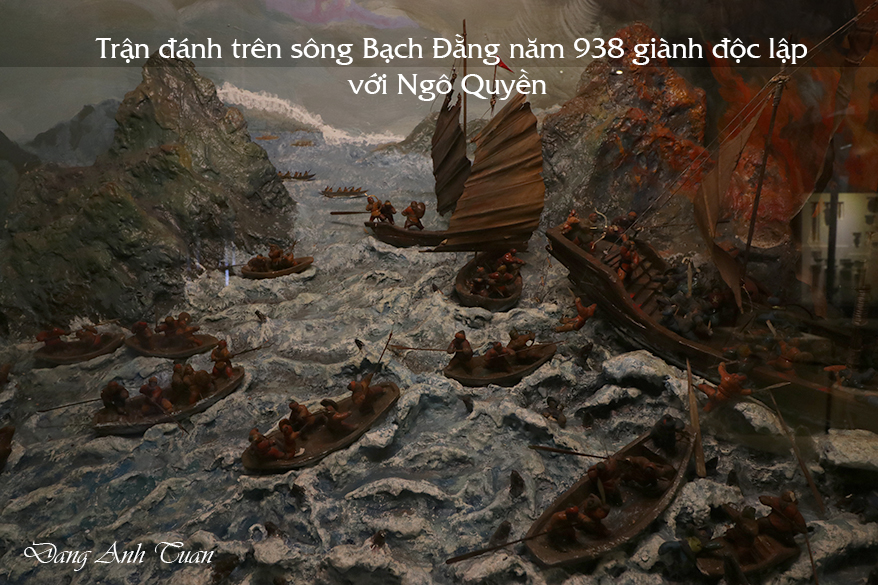
Faced with the Chinese army, which is accustomed to resorting to force and brutality during its conquest and domination of other countries, the Vietnamese must find the ingenuity to emphasize flexible and inventive tactics adapted essentially to the battlefield in order to reduce its momentum and its material superiority in men and numbers. One must never throw oneself headlong into this confrontation, as in this case one seeks to oppose the hardness of egg to that of stone (lấy trứng chọi đá) but one must fight the long with the short, such is the military art employed by the talented generalissimo Ngô Quyền. This is why he had to choose the place of the confrontation at the mouth of the Bạch Đằng River, anticipating the intention of the Southern Han to want to use it with their war fleet led by Crown Prince Liu Hung-Ts’ao (Hoằng Thao) ordered by his father Liu Kung (Lưu Cung) as King of Jiaozhi to quickly facilitate the landing in Vietnamese territory.

This celestial fleet entered the river mouth as planned. Ngô Quyền had pointed iron-covered stakes planted in the riverbed and invisible during high water prior to this confrontation.  He tried to lure the celestial fleet beyond these iron-covered pointed stakes by incessantly harassing them with flat-bottomed boats. At low tide, the Chinese ships retreated in disarray in the face of attacks from Vietnamese troops, and were besieged on all sides and now hindered by the barrage of emergent piles, resulting not only in the annihilation of Chinese ships and troops, but also the death of Hung-Ts’ao.

 Bạch Đằng river

Ngô Quyền was a fine strategist as he managed to perfectly synchronize the movement of the tides and the appearance of the celestial fleet in a time frame requiring both great precision and knowledge of the place. He knew how to turn the superiority of the opposing force to his advantage, for the army of the Southern Han was known to be excellent in maritime matters, and always made water or the river Bạch Đằng its ally in the fight against its adversaries. Water is the vital principle for the Vietnamese flooded rice civilization, but it is also the lethal principle, as it can become an incomparable force in their battles.  As a high-ranking Chinese mandarin, Bao Chi, later noted in a confidential report to the Song emperor: the Vietnamese are a race well-suited to fighting on water.

If the Vietnamese fled to the sea, how could Song’s soldiers fight them, as the latter were afraid of the wind and the wave (1). Ngô Quyền knew how to refer to the three key factors: Thiên Thời, Địa Lợi, Nhân Hòa (being aware of weather and propitious conditions, knowing the terrain well and having popular support or national concord) to bring victory to his people and to mark a major turning point in Vietnam’s history. This marked the end of Chinese domination for almost 1,000 years, but not the last, as Vietnam continued to be a major obstacle to Chinese expansion to the south.  The leading figure of Vietnamese nationalism in the early 20th century Phan Bội Châu regarded him as the first liberator of the Vietnamese nation (Tổ trùng hưng).

How could he succeed in freeing his people from the Chinese yoke when we knew that at that time our population was about a million inhabitants facing a Chinese behemoth estimated at more than 56 million inhabitants. He must have had courage, inventive spirit and charisma to succeed in freeing himself from this yoke with his supporters. But who is this man that the Vietnamese still consider today as the first in the list of Vietnamese heroes?

Đường Lâm village

Ngo Quyen was born in 897 in Đường Lâm village, located 4 kilometers west of the provincial town of Sơn Tây. He was the son of a local administrator, Ngo Man. When he was young, he had the opportunity to show his character and his willingness to serve the country. In 920, he served Dương Đình Nghệ, a general from the family of Governor Khúc of Ái Châu (Thanh Hóa) province. Dương Đình Nghệ had the merit of defeating the Southern Han by taking the capital Đại La (formerly Hànội) from them in 931 and now declared himself governor of Jiaozhi. He entrusted Ngo Quyen with the task of administering the Ái Châu province. Finding in him great talent and determination to serve the country, he decided to grant him the hand of his daughter. During his 7 years of governance (931-938), he proved to bring peaceful life to this region.

In 937, his father-in-law Dương Đình Nghệ was assassinated by his subordinate Kiều Công Tiễn to take the post of governor of Jiaozhi. This heinous act provoked the anger of all sections of the population. Ngô Quyền decided to eliminate him in the name of his in-laws and the nation because Kiều Công Tiễn asked for help from the Southern Han emperor, Liu Kung. For the latter it was a golden opportunity to reconquer Jiaozhi.

Unfortunately for Liu Kung, this risky military operation ended a long Chinese domination in Vietnam and allowed Ngô Quyền to found the first feudal dynasty in Vietnam. In 939, he proclaimed himself king of Annam and established the capital at Cổ Loa (Phúc Yên). His reign lasted only 5 years. He died in 944. His brother-in-law Dương Tam Kha took advantage of his death to seize power, which provoked the anger of the entire population and led to the breakup of the country with the appearance of 12 local warlords (Thập nhị sứ quân).This political chaos lasted until the year 968 when a brave boy from Ninh Binh, Dinh Boy Linh, succeeded in eliminating them one by one and unifying the country under his banner. He founded the Dinh Dynasty and was known as « Dinh Tien Hoang ». He settled in Hoa Lu in the Red River region and Vietnam at that time was known as « Dai Co Việt (Great Việt) ».

Bibliography

Hoàng Xuân Hãn: Lý Thường Kiệt, Univisersité bouddhique de Vạn Hạnh Saigon 1966 p. 257
Lê Đình Thông: Stratégie et science du combat sur l’eau au Vietnam avant l’arrivée des Français. Institut de stratégie comparée.
Boudarel Georges. Essai sur la pensée militaire vietnamienne. In: L’Homme et la société, N. 7, 1968. numéro spécial. 150° anniversaire de la mort de Karl Marx. pp. 183-199.
 Trần Trọng Kim: Việtnam sử lược, Hànội, Imprimerie Vĩnh Thanh 1928

Water bus Saïgon ( Du thuyền trên sông Bạch Đằng)

Version française
English version
Galerie des photos

Dù rất mệt hai ngày liên tiếp khi đến Saïgon, mình rất thích trải nghiệm đi xe bus hôm nay trên sông Saịgon. Đây là một dịch vụ giải trí mới mẻ để mình chiêm ngưỡng các kiến trúc đồ sộ của thành phố Saigon dưới  sông với góc nhìn hoàn toàn khác lạ và cũng có dịp để mình tìm ra những góc chụp mới mẽ. Một thưở nào xa xôi, Saigon là hòn ngọc Viễn Đông, nay nó trưởng thành siêu đô thị với  sự  biến  đổi đáng  kể. Với xe bus trên sông Saigon, bạn có thể dừng chân lại ở các bến tàu như sau: Bạch Đằng, Thủ Thiêm, Bình An, Thanh Đa, Bình Chánh và Linh Đông và bạn có thể  tìm được  những nơi giải trí và các quán ăn. Một trải nghiệm đáng nhớ cho mình với một tô bún riêu.

French version

Malgré la fatigue que j’ai eue successivement durant mes deux premiers jours à Saigon, je suis content de faire l’expérience de prendre aujourd’hui  le bateau-bus sur le fleuve de Saigon.  C’est un nouveau service de divertissement pour permettre au visiteur de découvrir les grandes constructions architecturales de la ville de Saigon visibles d’une manière totalement différente sur l’eau et c’est aussi une occasion pour moi de chercher  les nouveaux angles de prises de vue pour les photos. Étant connue à une époque lointaine  la perle de l’Extrême-Orient, Saïgon devient aujourd’hui la mégapole avec tant de changements notables. En prenant le bateau-bus sur le fleuve Saigon, on peut s’arrêter aux quais suivants : Bạch Đằng, Thủ Thiêm, Bình An, Thanh Đa, Bình Chánh và Linh Đông et on peut y trouver des endroits de distraction et des restaurants. Une expérience mémorable pour moi avec un bol de soupe de vermicelles de riz au crabe.

Galerie des photos


English version

Despite the fatigue I had during my first two days in Saigon, I am happy to experience taking the water bus on the Saigon River today. It is a new entertainment service to allow visitors to discover the great architectural constructions of the city of Saigon visible in a completely different way on the water and it is also an opportunity for me to look for new angles of shots for photos. Known in a distant time as the pearl of the Far East, Saigon today becomes the megacity with so many notable changes. By taking the water bus on the Saigon River, you can stop at the following wharves: Bạch Đằng, Thủ Thiêm, Bình An, Thanh Đa, Bình Chánh và Linh Đông and you can find places of entertainment and restaurants there. A memorable experience for me was a bowl of crab rice vermicelli soup.

[Retour SAIGON]


Why do the Thai have a piece of history with the Vietnamese people?


Tại sao dân tộc Thái có một đoạn đường chung

với dân tộc Việt?

Version française
Version vietnamienne

According to Western scholars such as archaeologist Bernard Groslier, the Thai were grouped with the Vietnamese in the Thai-Vietnamese group, especially as they only founded their country in the 14th century, and there were black and white Thai sub-groups in Vietnam. So, are these the Thais found in Thailand today?

Repulsed by the Tsin of Shi Huang Di, the Thai tried to resist many times. For the Vietnamese writer Bình Nguyên Lôc, the subjects of the Shu and Ba kingdoms (Ba Thục) annexed very early by the Tsin in Sichuan (Tứ Xuyên)(1) were the proto-Thais (or Tay). According to this writer, they belonged to the Austro-Asiatic group of the Âu branch (or Ngu in Mường language or Ngê U in Mandarin Chinese (quan thoại)) to which the Thai and the Tày were attached.

For him, as for other Vietnamese researchers Trần Ngọc Thêm, Nguyễn Đình Khoa, Hà Văn Tấn etc., the Austro-Asiatic group includes 4 distinct subgroups: Môn-Khmer subgroup, Việt Mường subgroup (Lạc branch), Tày-Thái subgroup (Âu branch) and Mèo-Dao subgroup to which must be added the Austronesian subgroup (Chàm, Raglai, Êdê etc.) to define the Indonesian (or proto-Malay) race (2) (Chủng cổ Mã Lai).

The Thai contribution to the founding of the Au Lac Kingdom of the Viet of Thục Phán (An Dương Vương) is no longer in doubt after the latter succeeded in eliminating the last Hùng king of the Văn Lang kingdom because the name « Au Lac » (or Ngeou Lo) obviously evokes the union of two Yue ethnic groups of the Au branch (Proto-Thai) and the Lac branch (Proto-Viet). Moreover, Thục Phán was a Yue of the Au branch, which shows to such an extent the union and the common historical mission of these two ethnic groups in the face of Chinese expansion. According to Đào Duy Anh, Thục Phán was a prince of the Shu kingdom.This is what was reported in Chinese historical writings (Kiao-tcheou wai-yu ki or Kouang-tcheou ki), but it was categorically refuted by some Vietnamese historians because the Shu kingdom was located too far at that time, from the Văn Lang kingdom. It was annexed very early (more than half a century before the foundation of the Âu Lạc kingdom) by the Tsin. But for the Vietnamese writer Bình Nguyên Lôc, Thục Phán having lost his homeland, had to take refuge very young in the company of his faithful at that time in a country having the same ethnic affinity (culture, language) as him, namely the Si Ngeou kingdom (Tây Âu) located next to the Văn Lang kingdom of the Vietnamese. Furthermore, the Chinese have no interest in falsifying history by reporting that it was a prince of Shu ruling the kingdom of Âu Lạc. The asylum of the latter and his followers in the kingdom of Si Ngeou must have taken some time, which explains at least half a century in this exodus before the foundation of his kingdom Âu Lạc. This hypothesis does not seem very convincing because there was a 3000 km walk. In addition, he was at the head of an army of 30,000 soldiers. It is impossible for him to ensure logistics and make his army invisible during the exodus by crossing mountainous areas of Yunnan administered by other ethnic groups who were enemies or loyal to the Chinese. It is likely that he had to find from the Si Ngeou (or the Proto-Thais) everything (armament and military personnel, provisions) that he needed before his conquest.

There is recently another hypothesis that seems more coherent. Thục Phán was the leader of a tribe allied to the Si Ngeou confederation and the son of Thục Chế, king of a Nam Cương kingdom located in the Cao Bằng region and not far from Kouang Si in today’s China. There is a total concordance between everything reported in the legend of the magic crossbow of the Vietnamese and the rites found in the tradition of the Tày (Proto-Thai). This is the case of the golden turtle or the white rooster, each having an important symbolic meaning. An Dương Vương (Ngan-yang wang) was a historical figure. The discovery of the remains of its capital (Cổ Loa, huyện Đông An, Hànội) no longer casts doubt on the existence of this kingdom established around three centuries BC. It was later annexed by Zhao To (Triệu Đà), founder of the kingdom of Nan Yue.

Lac Long Quan-Au Cơ myth cleverly insinuates the union and separation of two Yue ethnic groups: one of the Lac branch (the Proto-Vietnamese) descending into the fertile plains following the streams and rivers, and the other of the Au branch (the Proto-Thai) taking refuge in the mountainous regions. The Muong were among the members of this exodus. Linguistically close to the Vietnamese, the Muong managed to preserve their ancestral customs because they were pushed back and protected in the mountains. They had a social organization similar to that of the Tày and the Thai. Located in the provinces of Kouang Tong (Quãng Đông) and Kouang Si (Quãng Tây), the kingdom of Si Ngeou (Tây Âu) is none other than the country of the proto-Thais (the ancestors of the Thais). It is here that Thục Phán took refuge before the conquest of the Văn Lang kingdom. It should also be remembered that the Chinese emperor Shi Houang Di had to mobilize at that time more than 500,000 soldiers in the conquest of the kingdom of Si Ngeou after having succeeded in defeating the army of the kingdom of Chu (or Sỡ) with 600,000 men. We must think that in addition to the implacable resistance of its warriors, the kingdom of Si Ngeou would have to be of a significant size and populated enough for Shi Houang Di (Tần Thủy Hoàng) to engage a significant military force.

Despite the premature death of a Si Ngeou king named Yi-Hiu-Song (Dịch Hu Tống), the resistance led by the Thai or (Si Ngeou)(Tây Âu) branch of the Yue managed to achieve some expected successes in the southern Kouang Si region with the death of a general T’ou Tsiu (Uất Đồ Thu) at the head of a Chinese army of 500,000 men, which was recorded in the annals of Master Houa-nan (or Houai–nan–tseu in Chinese or Hoài Nam Tử in Vietnamese) written by Liu An (Lưu An), grandson of Emperor Kao-Tsou (or Liu Bang), founder of the Han Dynasty between 164 and 173 BCE.

Si Ngeou was known for the valor of his formidable warriors. This corresponds exactly to the temperament of the Thais of yesteryear described by the French writer and photographer Alfred Raquez:(3)


Being warlike and adventurous, the  Siamese of yesteryear were almost continually at war with their neighbors and often saw their expeditions crowned with success. After each successful campaign, they took prisoners with them and settled them in a part of the territory of Siam, as far as possible from their country of origin.


After the disappearance of Si Ngeou and Âu Lạc, the proto-Thais who remained in Vietnam at that time under the rule of Zhao Tuo (a former Chinese general of the Tsin who later became the first emperor of the kingdom of Nanyue) had their descendants forming today the Thai ethnic minority of Vietnam. The other proto-Thais fled to Yunnan where they united in the 8th century with the kingdom of Nanzhao (Nam Chiếu) and then with that of Dali (Đại Lý) where the Buddhism of the Great Vehicle (Phật Giáo Đại Thừa) began to take root. Unfortunately, their attempt was in vain. The Shu, Ba, Si Ngeou, Âu Lạc (5), Nan Zhao, Dali countries were part of the long list of countries annexed one after the other by the Chinese during their exodus. In these subjugated countries, the presence of the Proto-Thais was quite significant. Faced with this relentless Chinese pressure and the inexorable barrier of the Himalayas, the Proto-Thais were forced to descend into the Indochinese peninsula (4) by slowly infiltrating in a fan-like manner into Laos, the North-West of Vietnam (Tây Bắc), the north of Thailand and upper Burma.

According to Thai historical inscriptions found in Vietnam, there were three major waves of migration by the Yunnan Thais into north-western Vietnam during the 9th and 11th centuries. This corresponds exactly to the period when the kingdom of Nanzhao was annexed by the kingdom of Dali, which was in turn annihilated 3 centuries later by Kubilai Khan’s Mongols in China. During this infiltration, the proto-Thai divided into several groups: the Thai of Vietnam, the Thai in Burma (or Shans), the Thai in Laos (or Ai Lao) and the Thai in northern Thailand. Each of these groups began to adopt the religion of their host country. 


The Thai in Vietnam did not have the same religion as those in other territories. They continued to retain animism (vạn vật hữu linh) or totemism. For this reason, they constituted the ethnic minorities of today’s Viet Nam.