French version
Vietnamese people grant a great importance to the culinary art, in particular to their eating. It is the first necessity in their daily life and culture. Nothing is more amazing to see the use of « an » as the prefix in a great number of words. Among them we find: ăn nói ( to speak ), ăn mặc ( to wear ), ăn ở ( to live ), ăn tiêu ( to consume ), ăn ngủ ( to sleep ), ăn trộm ( to steal ), ăn gian ( to cheat ), ăn hiếp ( to bully ) and so on…It is usually said: Trời đánh tránh bữa ăn to means even God dare not disturb the Vietnamese during their meal.
Their eating is carefully elaborated according to the concept of Yin and Yang and the five elements (Thuyết Âm Dương Ngũ Hành) which serves as the fundamental basis of their Van Lang civilization.
Yin-Yang ( Âm Dương ) is the representation of the two poles of all things, a duality that is at the same time contradictory and complementary. Of the nature Yin is whatever is fluid, cold, humid, passive, somber, interior, female in essence like the sky, the moon, night, water, winter. Of the nature Yang is whatever is solid, hot, luminous, active, exterior, male in essence like the earth, the sun, fire, summer. Human is the hyphen between these two poles or rather between the Earth (Dương) and the Sky ( Âm ). Harmony may only be found in the equilibrium that human brings to its environment, universe and body. Vietnamese food therefore finds all its meticulous preparation and particularity in the dialectic relationship of the theory of Yin and Yang. It also shows the respect of the millennial cultural tradition of a farming country and of a civilization known for its rice farming on flooded rice fields (trồng lúa nước).
Yin-Yang in Vietnamese culinary art
© Đặng Anh Tuấn
That is why rice should not be missed in a Vietnamese meal. It is at the basis of several Vietnamese dishes (bánh cuốn, bánh xèo, phở, bún, bánh tráng, bánh chưng vân vân ) (ravioli, crepe, pho, vermicelli, rice paper, sweet rice cake etc..) Rice can be whole, round, long, crushed, scented, glutinous etc… More than a food, rice is for the Vietnamese people a tangible proof of their Bai Yue culture, a trace of civilization that is not lost under the weight of long Chinese domination.
The manner in Vietnamese eating is not foreign to the search for the middle-of-the-road attitude encouraged in the concept of Yin and Yang. » Eating together » requires in their view a certain respect, a certain level of culture in the art of eating because there exists an undeniable interdependence among the guests in the share of food and space. It is usually said: Ăn trông nồi , ngồi trông hướng.
When eating look for where the rice cooker is and when sitting look for where the direction is. That is the maxim that Vietnamese parents used to tell their children about their table manners. One has to behave oneself when invited to a meal. One should not eat too fast for not to be called impolite but should neither eat too slowly as one should not make other guests wait. Emptying one’s plate or the cook pot is not allowed because it gives the feeling of being greedy. On the contrary, eating too little implies a lack of mannerliness, which may vex the host. This cautious behavior could be summed up by the following statement: Ăn hết bị đòn, ăn còn mất vợ. (Emptying the cook pot deserves spanking, leaving some leftover leads to losing the spouse ). It is in the constant search for equilibrium evoked in the Yin and Yang theory that a Vietnamese must exercise in due course at a meal. It should not be ignored the « varied » nature brought in by Vietnamese food that is characterized by the diversity and visible exuberance in colors of the ingredients in the preparation.
Around a bowl of rice is the creation of a multitude of colors, flavors and dishes. The expression of the 5 senses (ngũ giác) is also found in a Vietnamese meal:
smell: by the release of aromas and flavors of foods served,
sight: by various coloration of the ingredients that go in the preparation of the dishes,
taste: by the flavors of the dishes,
hearing: by the sound made by the sucking of tea or stock with the mouth,
touch: by the nonstop handling of chopsticks.
For some Vietnamese specialties (gà nướng (roasted chicken), gà luộc ( boiled chicken ), gỏi cuốn (spring rolls) ), the use of hand is highly appreciated. Most Westerners used to attribute to the Chinese the holder of chopstick civilization. However it is the product of the cradle of the rice growing civilization of South East Asia. It is what the Chinese historian Ðàm Gia Kiện has written in his book entitled « Cultural History of China » ( Lịch sử văn hóa Trung Quốc ) ( 1993, page 769 ):
At the time prior to the unification of China by Qin Shi Huang Di, the Chinese continued to use their hands to grasp food. It was a tradition found in people growing millet (kê), barley (mạch) and eating bread, hum bao ( bánh bao ) and meat. They only began to use chopsticks during their expansion toward Southern China.
That assertion has been justified by recent scientific discoveries. Chopsticks can only be made in a region where abundance of bamboo is not in doubt. That is the case of Southern China and South East Asia. They are the rudimentary tool shaped to the image of the bird’s bill to efficiently pick up grains of rice and fish without having to soil the hands with the plates containing water (soup, broth, fish cauce etc…). It is found in the Vietnamese use of chopsticks a simple as well as humoristic philosophy. A pair of chopsticks is always compared with a married couple.
That is why one used to say:
Vợ chồng như đôi đũa có đôi
Bây giờ chồng thấp vợ cao như đôi đũa lệch so sao cho bằng.
Husband and wife are like a pair of chopsticks
Now that husband is short and wife is tall
Like mismatched chopsticks can’t be paired at all.
During the Lê dynasty, breaking a pair of chopsticks is like a dissolution of marriage. One prefers having a stupid spouse to having a disastrous pair of crooked chopsticks. This preference is evoked many time in the following statement:
Vợ dại không hại bằng đũa vênh.
Besides the « vivacious » and « lively » characteristics found in the handling of chopsticks, the « collective » characteristics should not be ignored as an attribute to this rudimentary utensil. It is often referred to a bundle of chopsticks to evoke solidarity. The saying: Vơ đũa cả nắm( gather chopsticks in a bunch) reflects that idea when we want to criticize someone and his family in a dispute or debate.
The Vietnamese fierce will to give a big attention to the balance of Yin and Yang is found again in their way of eating. A good meal must meet a certain number of criteria where interdependence cannot be ignored:
- 1) It must be in agreement with the weather. It cannot be defined as good even when it is served with tasty dishes.
- 2) It must occur at a pleasant place and time otherwise it is not deemed good either.
- 3) It must be shared with close friends otherwise the word good cannot be attributed to it.
That is why coming from the criteria mentioned above, a good Vietnamese meal is not necessarily well stuffed. Sometimes meagerness is found in a good meal. It is that of Vietnamese poor peasants where a clever mixture of aromatic herb flavors plays a preponderant role.
The judicious search for balance of Yin and Yang is undeniably shown in the dishes, the human body and between man and the environment. In the Vietnamese culinary art three following important points are turned up:
1) Yin-Yang equilibrium in the makeup of the dishes.
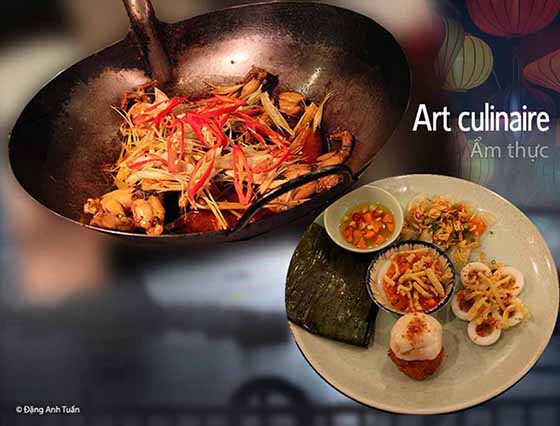
Vietnamese people tend to distinguish dishes according to classification they established in relation to the five elements of Yin-Yang: hàn ( cold ) ( Water ), nhiệt ( hot ) (Fire), ôn ( warm ) ( Wood ), lương ( fresh ) ( Meta l) and bình ( temperate ) (Earth). They take into account the compensation, interaction and combination of ingredients and condiments in the elaboration of a dish. One notices a series of vegetables and condiments in in the makeup of Vietnamese recipes. Known for curing illnesses caused by the « cold » ( coughs, colds etc…), ginger (gung), the condiment of the Yang characteristics, is visible in all the dishes having tendency to bear the cold: Bí đao ( marrow quash ), cải bắp ( cabbage ) rau cải ( lettuce ) and cá ( fish ). Hot pepper is of Yang nature ( hot ) and frequently used in dishes having cold, temperate or foul-smelling characteristics ( seafood, steamed fish for example ). One used to eat fermented chicken’s or duck’s eggs ( trứng gà lộn, trứng vịt lộn ) having the Yin characteristics ( Âm ) along with a very flavorful leaf ( rau răm ) of the Yang ( Dương ) tendency. The Yin (Âm) bearing water melon is always eaten with the Yang ( Dương ) natured salt. The most typical Vietnamese sauce remains the fish sauce. In the preparation of this national sauce, it is noticed there are 5 flavors classified according to the 5 element of Yin and Yang: mặn ( salty ) with the fish juice ( nước mắm ), đắng ( bitter ) with the zest of lemon ( vỏ chanh ), chua ( sour ) with the juice of lemmon ( or vinegar ), cay ( hot ) with powdered or crushed hot pepper and ngọt ( sweet ) with powdered sugar. Those five flavors ( mặn, đắng, chua, cay, ngọt ) combined and found in the national sauce of Vietnamese people correspond respectively to five elements defined in the theory of Yin and Yang( Thủy, Hỏa, Mộc, Kim, Thổ) ( Water, Fire, Wood, Metal, Earth).
2) Yin-Yang equilibrium in the human body.
Vietnamese food is sometimes used as an effective medicine to cure dysfunctions caused by the loss of balance in Yin and Yang in the human body. For the Vietnamese, the scenario seen in nature is also found inside their bodies. When an organ becomes too Yin, it leads to a slowdown in physical metabolism (feeling cold, slow heartbeats, indigestion etc…). On the other side, if it becomes too Yang, it triggers an acceleration of physical metabolism ( feeling hot, fast heartbeats, physical and mental hyperactivity etc…). A well-balanced Yin-Yang maintains life and assure good health. To regain this balance a person whose illness is of Yin nature ( Âm ) must eat dishes bearing Yang (Dương) characteristics. On the contrary a Yang-natured illness must be treated with Yin-natured dishes. To the Vietnamese, eating is taking care of oneself. Constipation (a Yang illness) can only be cured among the Yin dishes (chè đậu đen, chè đậu xanh etc..( meung bean, black bean compote, a Vietnamese dessert). On the other hand, Yin-natured diarrhea or stomach ache can be treated effectively with Yang-natured seasoned dishes (ginger (gừng, galangal (riềng)). The cold (a Yin-natured illness must find its solution in a bowl of rice porridge full of ginger slices
3) Yin-Yang equilibrium with the environment.
One used to say in Vietnamese : Ăn theo mùa ( Eating according to season ). This saying reflects the state of mind of the Vietnamese to be always in phase with nature and the environment in food.
In Summer, the supply of heat favors an abundance of vegetables, seafoods and fish. Therefore the Vietnamese people tend to eat vegetables and fish. They used to boil vegetables, pickle them (dưa) or make salads (gõi). Dishes that contain water are appreciated. It is the case of pho, the national stock of the Vietnamese people. Bitter and sour flavors cannot be absent either in the Vietnamese cuisine. It is the case of a mildly sour soup prepared with fish (or shrimps), tamarind (or pine apple) and tomatoes ( canh chua cá, canh chua tôm ).
On the other hand in Winter, to resist the cold, the Vietnamese prefer to eat meat and fatter dishes (of Yang characteristics). We notice a massive use of oily liquids (vegetable or animal) and condiments (ginger, chilly, garlic, pepper etc…). Slow cooking meat on low heat in fish sauce (rim thit), sauteing (xào) or frying meat (rán) are the cooking methods frequently used and conformed to climatic variations. Known as a tropical country (Yang)(Dương), Vietnam possesses a great number of dishes of cold characteristics ( Âm ). That is what the father of Vietnamese traditional medecine Hải Thượng Lãn Ông ( Lê Hữu Trác ) had an opportunity to emphasize in his work entitled « Nữ Công Thắng Lãm ». Out of 120 foodstuffs, he succeeded in picking about a hundred of Yin characteristics. This remark puts in evidence the unquestionable preference of Vietnamese for Yin dishes in their traditional food structure and the importance they keep granting to the search for a balance with nature and the environment. Vietnamese cuisine finds more and more followers in the West. Unlike other cuisines that play with sauces, it prefers using a lot of aromatic herbs and condiments. It is a cuisine that stands out for its lightness and digestibility. Much less fatty than Chinese cuisine, it does not miss showing its subtlety and originality. No less than 500 dishes are counted among them remains the imperial roll ( chả gìo). In this cuisine one finds not only a harmony of flavors and a multitude of subtle variations around a bowl of rice but also a profound and intimate agreement with nature and the environment.
There, Yin-Yang does not lose its vitality, the Vietnamese people, their soul and their temperament.