Art
Art des pays d’Asie du Sud ou de la France
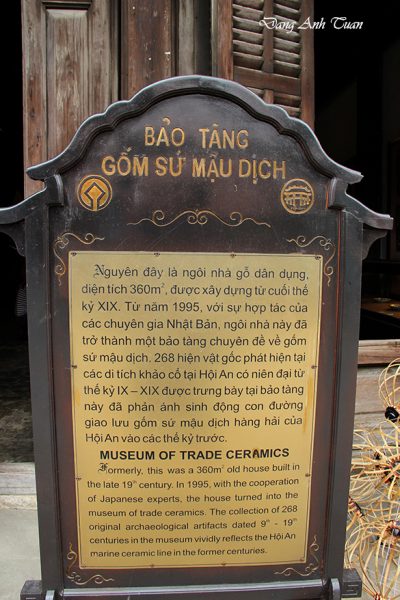
Musée de la porcelaine et de la céramique (Bảo tàng gốm sứ mậu dịch)
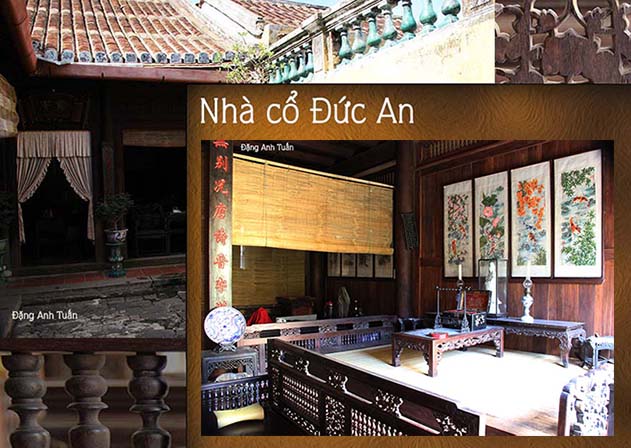
Vieille maison Đức An (Nhà cổ Đức An)
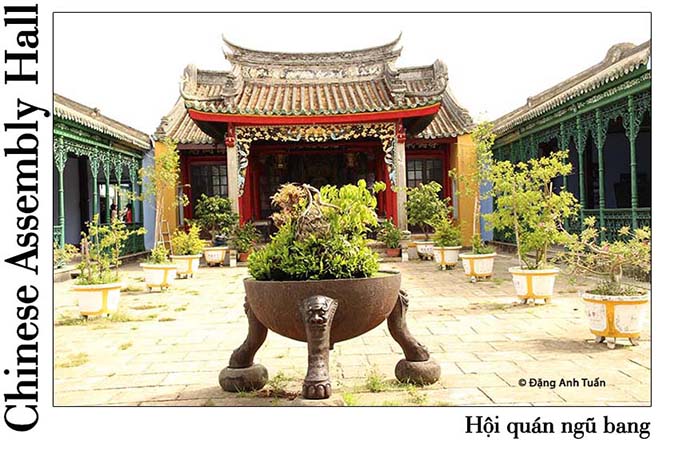
Siège des congrégations chinoises (Hội quán ngũ Bang)
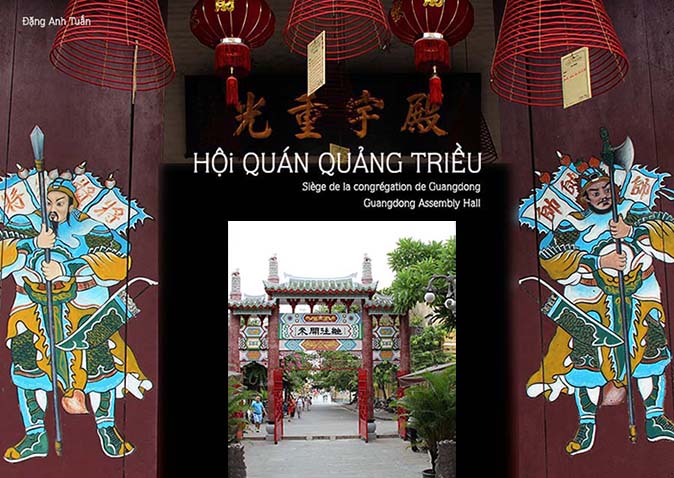
Siège de la congrégation de Guangdong (Hội quán Quảng Đông)
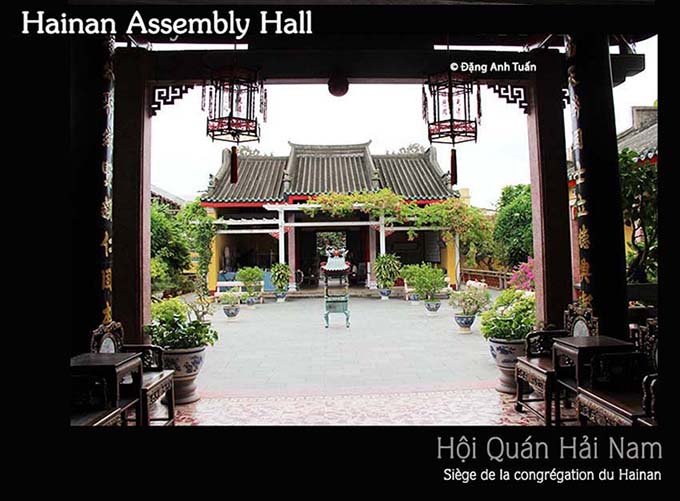
Siège de la congrégation du Hainan (Hội quán Hải Nam)
Vietnamese woodcuts (Tranh dân gian)
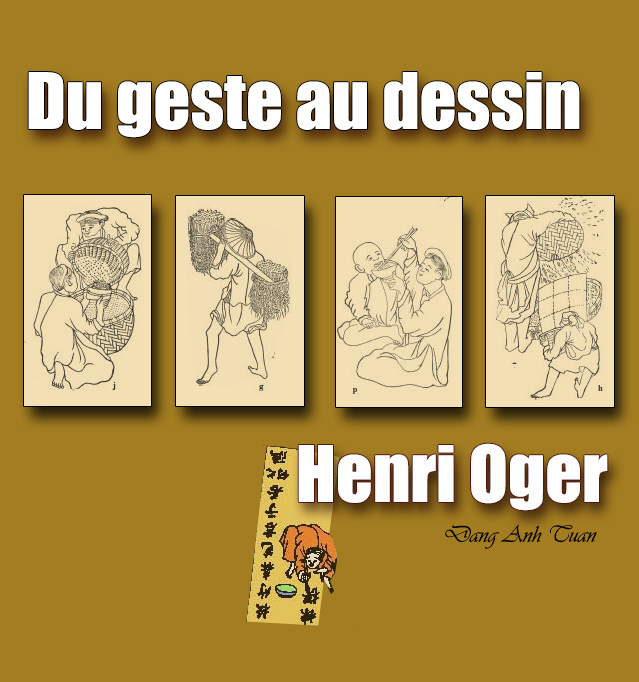
Without the curiosity and open-mindedness of this young French military man, the Vietnamese popular woodcut would probably have been in oblivion and disappeared forever with the ups and downs of the war. The Vietnamese woodcut has its origin dated back to 15th century, at a time when scholar Lương Như Hộc introduced its fabrication technique on his way back from an official mission to China.
Henri Oger was one of the rare Frenchmen who, at the beginning of the century, was able to discover a millennium of wealth in traditions and customs throughout the Vietnamese society which was then closed to strangers, poor and backward. He took the initiative of creating an encyclopedia consisted of 10 volumes describing all aspects of the Vietnamese society in the old days: craftsman’s works, festivals, farming techniques, ancestral customs etc.. by requesting about 30 wood carvers to engrave designs on wood and then, because of weather conditions, imprint the engraving on the spot using the Vietnamese traditional methods. It should be acknowledged that the love of Vietnam and its people has allowed Henri Oger to overcome at that time all hardship in fund raising and in the realization of this huge work ( more than 4000 designs in all ).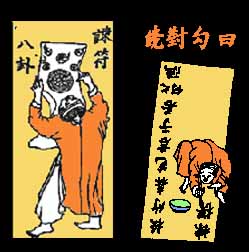
He did not get any help from the French government at all. He only got subscriptions from some two dozen persons, in the amount of 200 piasters.
Henri Oger
In spite of that, Henri Oger has succeeded in leaving to the Vietnamese people a priceless treasure. His work was unknown to the French and Vietnamese public for decades. Only in 1978 did an exhibition entitled « Peasant Painters of Vietnam » take place at the Cultural Center of Bourges. Three of his works are presently kept at the National Library of Hanoï and Saïgon City but only in the latter we find his 10 volumes in their entirety.
Bibliography:
Introduction générale à l’étude de la technique du peuple annamite. 2 volumes. Editions: Geuthner-Jouve, Paris.
The Mudras of Buddha (Thủ Ấn)
French version
Vietnamese version
The symbolic gestures of Buddha 
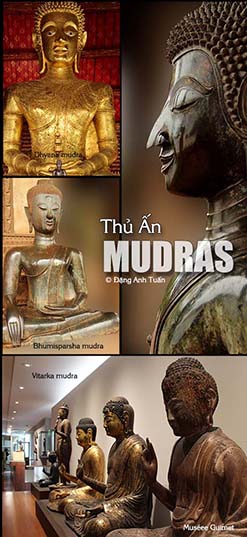
Depending on the manufacturing country of Buddha statue, the artist can represent it in a different way. By contrast, there is always some immutable ritual characters that he must observe scrupulously in the Buddhist statuary. This is the case of the position and gestures of the Buddha’s hands (mudras). Being limited in number, the latter, complemented by the body posture (asana), allows the faithful to benefit of the teaching and philosophy of Buddhism. One is accustomed to associate these symbolic gestures to the various episodes in the Buddha life (meditation under the Bodhi tree, taking the earth as witness, first predicate at Sarnath etc.).
Instead of Buddhist texts to whom a very few people have acces, these mudras in the iconographic representations of Buddha are genuine tools for religious transmission. The picture is more meaningful because it is based on simple gestures and readable by all in place of Buddhist texts which are sometimes incomprehensible. The mudras that are initially designed by the yogis and priests of the Vedic epoch in India will be retrieved and interpreted by Mahayana sects to become over time, one of the techniques of highly codified representation. They thus constitute a language extremely powerful because through a number of signs and symbols, this allows you to identify the sacred character, to define its rank and to evoke its qualities.
Thủ Ấn
This is the case of the divinities of Buddhist pantheon (Bodhisattvas, Amithâba etc.). That is what we also find in multiple practices having a religious character (dances, rituals, meditations etc ..) without forget to remind what we have also seen in the Christian iconography with its saints placed at the entrance of the Middle Ages cathedrals. Some important mudras are frequently encountered in the Buddhist iconography.
Absence of fear mudra
(Ấn xúc địa)
Taking the earth as witness with his right hand
It is the Bhumiparsha-mudra. In this gesture, one sees that his right arm hangs down over the right knee while his left hand is raised in front of his belly on his legs in position of lotus. He took the earth as witness and he called Goddess of the earth Torani to his rescue. To kill the hordes of evil represented by Mara, this godhead provoked the waves by letting down her hair. This mudra announced the imminence of the awakening. At the end of this meditation, he will announce the Four Noble Truths (Tứ Diệu Đế): Dukka (suffering), Samudaya (insatiable hunger), Nirohda (extinction of suffering) and Marga Sacca ( Buddha way towards extinction) to achieve nirvana (final liberation).
Charity mudra (Varada mudra)
Meditation mudra (Ấn thiền)
Buddha have been sitting with both hands in front of his belly, palms returned, on his legs crossed in lotus. It is the dhyana-mudra that is often found in zen school. This is the meditation period of Buddha under the tree of awakening (Bodhi) in Bihar.
Argument mudra (Ấn giáo hóa)
Sitting in position of lotus, Buddha maintains his right hand to the height of his shoulder, palm facing outward, the thumb and index finger touching and the other fingers being raised. This posture corresponds well to the discussion and argument.
The Gongs of Central Highlands (Cồng Chiền Tây Nguyên) Last part
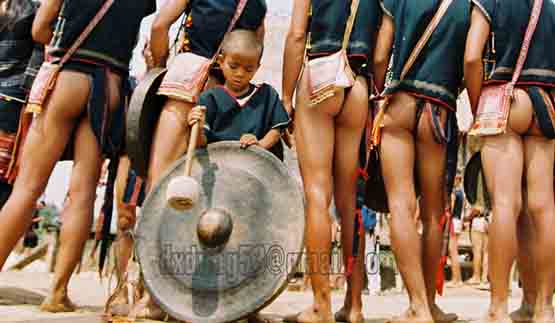
Photo Đinh Xuân Dũng ( Nha Trang )
Intangible Heritage of Humanity by
Unesco in 2005
Last part
In the ritual ceremonies, the players of gongs move slowly in single file or in half-circle in front of a public admirer. They left from right to left in the counterclockwise direction to go back in time and return to their origins. Their footsteps are slow and rhymed to the beats of gongs, each of which has a well-defined role in the set. Each gong corresponds exactly to a guitar string, each having a note, a particular tone. Whatever the melody played, there is the active participation of all the gongs in the procession. However, an order very precise in the sequence and composition of beats is imposed in order to respond to the melodies and own themes chosen by each ethnic group.
Sometimes, to better listen to the melody, the auditor has the interest to be into a location equidistant from all the players arranged in a half circle otherwise he cannot listen properly because of the weakness and amplification of the resonance of some gongs corresponding respectively to the distance or the excessive closeness of its geographical position relative to one another.
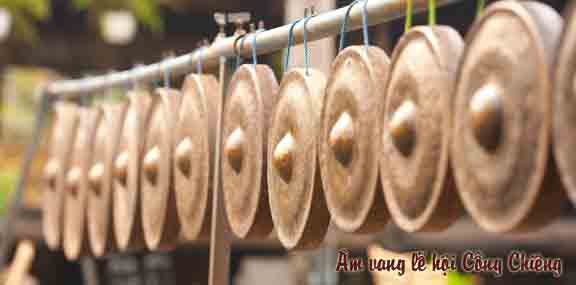
For most of ethnic groups, the set of gongs is reserved only for men. This is the case of the ethnic group Jarai, Edê, Bahnar, Sedang, Co Hu. By contrast, for the ethnic group Eđê Bih, women are allowed to use the gongs. In a general way, the gongs are of variable size. The disk of the major gongs may vary from 60 to 90 cm in diameter with a cylindrical edge from 8 to 10 cm. This does not allow the players to wear them because they are too heavy.
These gongs are suspended often to the beams in house by the ropes. However, there are the gongs more small whose disk varies from 30 to 40 cm with an edge from 6 to 7cm. The latter are frequently encountered in the festive rituals.
For the identification of highland gongs, the Vietnamese musicologist Trần Văn Khê has the opportunity to enumerate a number of characteristics in one of his articles:
- 1°) They are very varied.
- 2°) They are linked closely to the spiritual life of highland ethnic minorities. Being regarded as sacred instruments, they promote communication with spirits and geniuses.
- 3°) They accompany the highland people from its birth until its death. Their presence is visible not only in the important events (weddings, funerals, wars etc.) but also in the agricultural feasts (paddy germination, ear intiation, feast of the agricultural close etc.).
- 4°) The manner of playing the highland gong is very particular and reflects the family structure of each ethnic minority. This allows to easily identify the ethnic group in question by the played stamp melodies.
- 5°) The movement of players is always performed in the counterclockwise direction in the purpose to go back in time and return to the source. It is identical to the approach used by the Zen Buddhist school in its walking meditation (thiền hành) oriented from « the outside to the heart » (từ ngoài vào tim).
The composition of the played melody is based primarily on the sequence of beats settled according to original processes of repetition and answer.
One doesn’t finds elsewhere as many gongs as one had them on the Highlands of Vietnam. That is why, during his visit in Vietnam, the ethnomusicologist Filipino José Maceda, accompagned by Vietnamese musician Tô Vũ, had the opportunity to emphasize that the highland gongs are very original when he was in contact with the gongs. For him, because of the large number of gongs found, it is possible the Highlands may be the gong cradle in Southeast Asia.
Over the years, the risk of seeing the « original » and « sacred » character is real because of the illicit trafficking of gongs, the lack of gong tuner, the disinterestedness of young people and the destruction of natural environment where the gongs have been « educated ».
Highlands Gongs
For a few years, being regarded as cultural goods, the gongs become the object of all desire for Vietnamese antique dealers and foreign collectors, which brings the local authorities to exercise strict control with the aim of stopping the haemorrhage of gongs (chảy máu cồng chiêng)
The governmental effort is also visible at the local level by the establishment of incentive programs for learning with young people. But according to some Vietnamese ethnomusicologists, this allows to make durable the gongs without giving to the latter the means to possess a soul, a sacred character, a ethnic sound color because they need not only the skillful hand and fine hearing of gong tuner but also the environment. This is the latter factor that one forgets to protect effectively during the last years. Because of the intensive deforestation and galloping industrialisation for the coming years, the ethnic minorities don’t have the opportunity to practice slash and burn agriculture. They will not have any occasion to honor the ritual festivals, their genius and their traditions. They no longer know to express sorrows and joys through the gongs. They don’t know their oral epics (sử thi). Their paddy fields are replaced by coffee and rubber plantations. Their children are no longer forest clearers but they are engaged to industrial and tourist activities, which allows them to have comfortable livelyhoods. Few now recall how to tune these gongs.
The character « sacred » of gongs no longer exists. The latter become instruments of entertainment like other music instruments. They can be used anywhere without significant events and very specific and sacred hours (giờ thiêng). They are played according to the tourism demand. They are no longer what they were until now.
It is for this irreparable loss that UNESCO has not hesitated to underline the urgency in the recognition of space of gong culture in the Central Highlands (Tây Nguyên) as the masterpiece of Oral and Intangible Heritage of Humanity on 25 November 2005. The gongs are only one essential element in the achievement of this masterpiece but it must be understood that other elements are as important as these gongs: the environment, the traditions and customs, the ethnic groups etc. ..
The gongs without their environment and their ethnic sound color no longer possess the sacred soul (hồn thiêng) of Central Highlands.They lose the original character for ever. There is always a price to pay in the preservation of the gong culture in Central Highlands but it is to the scope of our collective efforts and our political will. One cannot refute that the culture of the gongs in Highlands is part now of our cultural heritage.
[Back to page « Vietnam, land of 54 ethnies »]
The Gongs of Central Highlands (Cồng Chiền Tây Nguyên) Third part
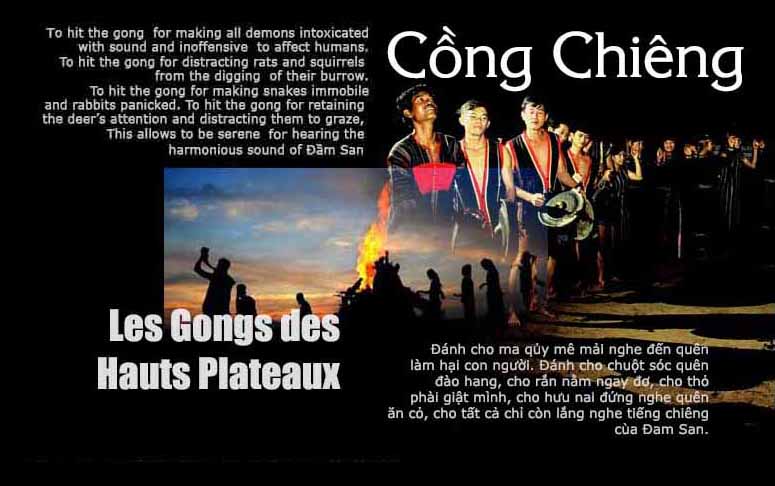
The culture of the gongs is localized in the 5 provinces of central Vietnam (Đắc Lắc, Pleiku, Kontum, Lâm Đồng and Đắk Nong). Some twenty ethnic groups (Bahnar, Sedang (Xơ Đăng), Mnongs, Cơ Ho, Rơ Mam, Êđê, Jarai (Giarai people), Radhes etc ..) are identified in the use of these gongs. According to illustrated Vietnamese musicologist Trần Văn Khê, in the other countries of Southeast Asia, the gong player always remains seated and can play several instruments associated at the same time. This is not the case of the gong players of Highlands in Vietnam. Each player may play a single gong. There are as many gongs than players in a set.
Thanks to a thin string or to a band of cloth that can be more or less tightened by torsion, each player suspends the gong to the left shoulder. He struck the central dome of the gong outer face either with a wooden or leather mallet or with his right fist barren or wrapped up in fabric.
The sound quality of the gong depends not only on the alloy with which the gong has been manufactured but also the tuner quality. Other parameters are involved: the wooden or leather mallet, the position and action of the hand striking the gong, the tension of the strap etc. . In addition, the player can modulate skillfully the effects of the gong sound by varying the pressure and the relaxation on the bent edge of the outer face with his left hand. The muting effect may be caused by this action. Each ethnic group prefer a type of wood in the manufacture of the mallet. By choosing the hard wood, the Êđê often obtain interference noise in the power of the gong resonance. By contrast, in selecting the soft wood, the Bahnar manage to obtain the « clarity » of its fundamental tone despite the weakness of intensity detected in the resonance.
At the time of the purchase, the gong is delivered to the « raw » state, without musical tone, character and soul. Its outer face is almost flat. It is similar to an object producing an audible signal. (Cái kẻng) Thanks to the strokes of wooden mallet and to fine hearing of the tuner, the gong receives small bumps and concentric circles on its border and on its inner and outer faces. The blow of the mallet given on its outer face increase its tone.
By contrast, the decrease of the resonance is visible inversely with its inner face. The gong tuner manages to give it a sound color, a particular musical note, which makes it now a musical instrument in its own right. According to the highland people, analogous to the man, the gong has a face, a character and a soul. It is unlike any other gong.It is said that the gong is educated because from an object that is purchased with the « raw » state from the Kinh (or Vietnamese) (Quảng Nam), it receives an education, a note, an ethnicity, a sacred character. For the gong purchased in Laos, it already has a soul but it is a Laotian soul.
To transform it into a gong of the high plateaus, it must be educated by the blows of wooden mallet so that it knows as well the language Bahnar, Stieng, Edê, Mnong etc. It now has the sacred soul (hồn thiêng) of the high plateaus.
The latter does not disappear as long as there is still the environment where the gong is « educated » (the forest, the ethnic groups, the villages, the sources of water, the animals etc.) The sacred character of the gong can only be found in this natural environment which allows it to find its ethnic identity through the melodies varying from one village to another or from one ethnic group to another and the agrarian rites. The gong can produce a false note over the years of use. One says that it is « sick ».
It must be treated by bringing in a doctor (or a good musician tuner) that it is difficult to find sometimes on-site. It is necessary to travel several kilometers in other regions to succceed in finding him. Once readjusted the sound, it is said that the gong is healed.