Accrochage Hàm Nghi 2026 (Cernuschi)

Phương thuốc cho cuộc sống lưu đày
Nghệ thuật của Hoàng đế Hàm Nghi

Version française
Version anglaise
Galerie des photos

Triều Nguyễn có ba vị vua bị truất phế và bị lưu đày dưới thời Pháp thuộc.  Mỗi vua đều có tư cách tuyệt vời  trong thời gian ngự trị và có khí khái để hậu thế ngày nay vẫn còn ngưỡng mộ. Đó là vua Hàm Nghi, Thành Thái và Duy Tân. Hôm nay, ở bảo tàng Cernuschi  (Paris), có một triển lảm về các tuyệt tác của vua Hàm Nghi  thực hiện trong thời gian ông bị lưu đày ở Alger. Sau cuộc tấn công thất bại ở Mang Cá, nơi mà quân đội Pháp của thống soái De Courcy đóng và sau hai lần xuống chiếu Cần vương, ông trở thành linh hồn còn các quân phiến loạn Cần vương là thân thể. Nếu linh hồn mất thì thân thể cũng phải tiêu tan tự nhiên. Vì vậy chính quyền thực dân Pháp mới nghĩ cách l ưu đày ông qua Alger lúc ông mới có 18 tuổi. Ở đây ông cũng không còn hi vọng trở về Việt Nam nữa. Từ đây ông tìm ra được nguồn an ủi trong một niềm đam mê khác, một cách sống khác thông qua nghệ thuật. Nhờ đó, ông trở thành học trò  của họa sĩ Marius Reynaud và nhà điêu khắc tài hoa Auguste Rodin và cho phép ông vượt qua nỗi đau buồn bất diệt của một vị hoàng đế yêu nước bị lưu đày xa quê hương cho đến khi qua đời. Trong khuôn khổ mùa hè Viêt Nam,  bảo tàng viện Cernuschi  đề nghị một cuộc triển lãm  bất đầu từ 18 Mai đến 6 septembre về các tác phẩm  của vua Hàm Nghi (từ các tranh thủy mạc đến các tạc tượng).

Version française

La dynastie des Nguyễn compta trois rois déposés et exilés durant la période coloniale française. Chacun d’eux, Hàm Nghi, Thành Thái et Duy Tân, se distingua par son caractère exceptionnel et son esprit, toujours admiré jusqu’à aujourd’hui. Le musée Cernuschi (Paris) présente aujourd’hui une exposition consacrée aux chefs-d’œuvre du roi Hàm Nghi, réalisés durant son exil à Alger. Après l’échec de l’attaque de Mang Cá, où était stationnée l’armée française du général De Courcy, et suite à deux décrets royaux appelant à la résistance, Hàm Nghi devint l’âme de la résistance, tandis que les rebelles en étaient le corps. Or, la perte de l’âme entraîne inévitablement celle du corps. C’est pourquoi le gouvernement colonial français l’exila à Alger alors qu’il n’avait que 18 ans. Là, il perdit tout espoir de retourner au Vietnam. Il trouva alors refuge dans une autre passion, un autre mode de vie, à travers l’art. Grâce à cela, il devint l’élève du talentueux peintre Marius Reynaud et du sculpteur Auguste Rodin, ce qui lui permit de surmonter le deuil sempiternel d’un empereur patriote exilé de sa patrie jusqu’à sa mort. Dans le cadre de l’été vietnamien, le musée Cernuschi propose une exposition, du 18 mai au 6 septembre, consacrée aux œuvres du roi Hàm Nghi (des peintures à l’aquarelle jusqu’aux statues).

Version anglaise

The Nguyễn dynasty had three kings who were deposed and exiled during the French colonial period. Each of them, Hàm Nghi, Thành Thái and Duy Tân, stood out for his exceptional character and spirit, still admired to this day. The Cernuschi Museum (Paris) is currently presenting an exhibition devoted to the masterpieces of King Hàm Nghi, created during his exile in Algiers. After the failure of the attack on Mang Cá, where the French army under General De Courcy was stationed, and following two royal decrees calling for resistance, Hàm Nghi became the soul of the resistance, while the rebels were its body. Now, the loss of the soul inevitably entails that of the body. That is why the French colonial government exiled him to Algiers when he was only 18 years old. There, he lost all hope of returning to Vietnam. He then found refuge in another passion, another way of life, through art. Thanks to this, he became the pupil of the talented painter Marius Reynaud and the sculptor Auguste Rodin, which allowed him to overcome the endless mourning of a patriotic emperor exiled from his homeland until his death. As part of the Vietnamese Summer, the Cernuschi Museum is offering an exhibition, from May 18 to September 6, devoted to the works of King Hàm Nghi (from watercolor paintings to statues).

Pictures gallery

[RETURN MUSEUM]

Monument de l’indépendance (Dinh Độc Lập)

Version française
Version anglaise
Galerie des photos

Trước khi trở về chủ quyền của đất nước, dinh nầy đã được xây dựng  và thiết kế bởi thống đốc Pháp De la Grandière vào năm 23 tháng 3 năm 1868.  Dinh nầy được dùng làm nơi cư trú và chỗ làm việc của toàn quyền Đông Dương  dưới thời Pháp thuộc. Bởi vậy nó có tên cũ là dinh Norodom vì nó nằm ở trên đại lộ Norodom, một vị vua của nước Cao Miên ở thời bấy giờ. Đến năm 1954, sau khi hiệp định Genève 8 tháng 5 và sau khi phế truất Quốc trưởng Bảo Đại và thành lập nước  Việt Nam Cộng Hoà, ông Ngô Đình Diệm mới lấy dinh Norodom làm dinh Tổng Thống Việt Nam Cộng Hoà. Dinh nầy mới đổi tên từ đó  thành dinh Độc Lập. Nhưng dinh nầy bị oanh tạc bởi  hai phi công của phe đối lập, Đại Việt Quốc Dân Đảng  vào ngày 27/2/1962 khiến làm sập toàn bộ phần chính cánh trái của dinh nên việc khôi phục lại không thể thực hiện  được. Vì đó ông Ngô Đình Diệm mới  ra lệnh san bằng và nhờ kiến trúc Ngô Viết Thụ, một người Việt Nam đầu tiên đạt giải khôi nguyên La Mã thiết kế và xây lại một dinh thự mới ngay trên nền đất cũ với một diện tích 12 ha.

Sau sự kiện 30 tháng 4 năm 1975,  dinh  nấy mới đỗi tên một lần nữa  và mới lấy tên là dinh Thống Nhất  vào tháng 11 năm 1975 để nói lên sự thống nhất của hai miền Nam Bắc từ nay dưới quyền lãnh đạo của đảng cộng  sản Việt Nam. Dinh nầy  trở thành một trong những địa điểm du lịch không thể thiếu của mỗi người dân nước ngoài hay trong nước  khi tới thành phố Saïgon. So với dinh cũ thời Pháp thuộc, dinh Độc Lập có mang thiết kế hiện đại. Tuy nhiên, ngoài ý nghĩa lịch sử, dinh còn thể hiển được không những một kiến trúc độc đáo dựa trên triết lý phương đông qua các chiết tự chữ Hán và  cá tính của dân tộc (ba gian hai chái)  được nhận thấy ở mặt tiền.

Chẳng hạn chữ Khẩu (口) để chỉ đến cái miệng, ngụ ý là tự do ngôn luận.  Còn chữ TRUNG (中) được thành hình  tử chữ Khẩu với cột cờ xuyên qua  tiêu biểu cho đức tính  trung kiên trong việc xây dựng dân chủ. Còn ba nét dọc ngang được trông thấy từ mái hiên và ban công hợp thành chữ TAM (三) đó là sự nhắc đến dân chủ hửu tam (Nhân, Minh, Võ). Đây là sự mong muốn có được người lãnh đạo có đủ phẩm chất, trí tuệ và bản lĩnh để phát triển đất nước. Còn chữ VƯƠNG (王) được hợp thành từ chữ TAM với  nét sổ dọc. Nó  biến thành chữ CHỦ (主)với lá cờ kỳ đài ở trên chót vót của dinh đến chủ quyền dân tộc.  Sau cùng chữ HƯNG (興)  được tạo thành từ cái nhìn toàn bộ mặt tiền với ban công tầng 2, tầng 3, mái hiên và hai cột gỗ. Đây là ý nguyện có được  một   đất nước Hưng Thịnh. 

Tọa lạc trong một  khuôn viên rộng 12 ha rợp bóng cây và cao có 26 m, dinh gồm 3 tầng chính, 2 gác lửng, tầng nền, 2 tầng hầm và 1 sân thượng cho máy bay trực thăng đáp xuống. Qua các chiết tự chữ  CÁT (吉) ,  KHẨU (口), TRUNG (中), TAM (三), CHỦ (主),  VƯƠNG (王),  HƯNG (興) được thể hiện ở mặt bằng tổng thể đến mặt bằng ngôi nhà đều được bố cục một cách tĩ mĩ, kiến trúc sư  Ngô Viết Thụ muốn  gửi đến một cách thâm thúy một thông điệp  mang ý nghĩa đem lại sự tốt lành và hưng thịnh cho đất nước. Ngoài ra, trong nội thất của dinh thì các gian phòng chính quan trọng được trang trí theo các gam màu chủ đạo.

 Cũng như màu vàng được sử dụng ở phòng Đại Yến và được  kết hợp với các họa tiết thực vật khiến nó tạo ra sự ấm áp trong việc tiếp tân  đãi tiệc. Ở phòng  Đại Yến, có một bức tranh dầu do kiến trúc sư Ngô Viết Thụ vẽ và biếu tặng nhân dịp ngày khánh thành dinh với 2 câu thơ chữ Hán Việt:  «Cẩm tú  sơn hà, thái bình thảo mộc» có nghĩa là «Non sông gấm vóc, cây cỏ thái bình ». Còn màu xanh lá cây  và màu đen thì được sử  dụng  ở thảm, màn và da ghế để tạo ra cảm giác mát mẻ nhất là với các cuộc hợp căng thẳng ở phòng nội các (tầng 1).

Còn màu đỏ thỉ đựơc thấy ở phòng khánh tiết hay các phòng tiếp tân tổng thống và phó tổng ở tầng 2. Cái đặc điểm của Dinh Độc Lập là rèm hoa đá bao quanh tầng 2. Đây là những đốt trúc thanh tao được lấy từ một hình ảnh  được cách điệu từ “cửa bàn khoa” của cung điện ở Cố đô Huế. Ngoài việc thẩm mỹ, rèm hoa đá còn giúp điều hoà ánh sáng tự nhiên và nó trở thành biểu tượng độc đáo của dinh độc lập.

Đã bao lần đổi tên với  sự thăng trầm của đất nước, nó trở thành ngày nay một di tích lịch sử văn hoá quốc gia, một điểm du lịch không thể bỏ qua khi đến Saigon và một công trình kiến trúc để đời của kiến trúc sư tài ba Ngô Viết Thụ.

Version française

Avant le retour à la souveraineté nationale, ce palais a été construit et conçu par le gouverneur français De la Grandière le 23 mars 1868. Ce palais servait de résidence et de lieu de travail pour le gouverneur général de l’Indochine sous l’occupation française. C’est pourquoi il portait l’ancien nom de palais Norodom, car il se trouvait sur l’avenue Norodom, du nom d’un roi du Cambodge à cette époque. En 1954, après les accords de Genève du 8 mai et après la destitution du chef de l’État Bảo Đại et la création de la République du Viêt Nam, Mr Ngô Đình Diệm a choisi le palais Norodom comme palais présidentiel de la République du Viêt Nam. Ce palais a alors été rebaptisé palais de l’Indépendance. Mais il a été bombardé par deux pilotes du parti d’opposition  « Đại Việt Quốc Dân Đảng » le 27 février 1962, ce qui a détruit toute la partie principale de l’aile gauche, rendant ainsi la restauration impossible. C’est pourquoi Mr. Ngô Đình Diệm a ordonné sa démolition et a demandé à l’architecte Ngô Viết Thụ, le premier Vietnamien à avoir remporté le prix de Rome, de concevoir et de construire un nouveau palais sur l’ancien emplacement dont la superficie est de 12ha.

Après les événements du 30 avril 1975, le palais fut rebaptisé Palais de la Réunification en novembre 1975, symbolisant ainsi la réunification du Nord et du Sud-Vietnam sous l’égide du Parti communiste vietnamien. Ce palais est devenu un site touristique incontournable pour les visiteurs vietnamiens et étrangers lors de leur passage à Saïgon. Comparé à l’ancien palais de l’époque française, le Palais de l’Indépendance présente un design moderne. Au-delà de son importance historique, il présente un style architectural unique, inspiré de la philosophie orientale, comme en témoignent ses 7 caractères chinois et son architecture typiquement vietnamienne (trois travées et deux ailes) trouvée sur la façade.  

Par exemple, le caractère *Khẩu* (口) — signifiant « bouche » — symbolise la liberté d’expression. De son côté, le caractère *Trung* (中) — signifiant « loyauté » — est formé par l’association du caractère *Khẩu* et d’un mât de drapeau le traversant, représentant la loyauté inébranlable nécessaire à l’édification de la démocratie. Les lignes horizontales et verticales visibles au niveau des avant-toits et des balcons dessinent le caractère *Tam* (三) — signifiant « trois » — en référence aux trois vertus démocratiques : l’humanité (*Nhân*), la sagesse (*Minh*) et le courage (*Võ*). Cela reflète l’aspiration à voir émerger un dirigeant doté du caractère, de l’intelligence et de la trempe nécessaires au développement de la nation. Le caractère *Vương* (王)– signifiant «roi» — est formé en ajoutant un trait vertical au caractère *Tam* ; il se transforme en caractère *Chủ * (主)— signifiant « souveraineté du pays » — lorsque l’on y intègre le drapeau situé au point culminant du bâtiment. Enfin, le caractère *Hưng* (興) — signifiant « prospérité » — apparaît dans la vue d’ensemble de la façade, englobant les balcons des deuxième et troisième étages, les avant-toits et les deux piliers en bois. Il incarne le vœu d’une nation prospère et florissante.

Situé dans un parc de 12 hectares ombragé et d’une hauteur de 26 m, le palais comprend 3 étages principaux, 2 mezzanines, un rez-de-chaussée, 2 sous-sols et une terrasse pour l’atterrissage des hélicoptères. À travers les caractères CÁT (吉), KHẨU (口), TRUNG (中), TAM (三), CHỦ (主), VƯƠNG (王), HƯNG (興)  représentés d’une manière méticuleuse du plan général au plan du palais, l’architecte Ngô Viết Thụ a voulu transmettre de manière subtile un message porteur de bonheur et de prospérité pour le pays. En outre, à l’intérieur du palais, les principales pièces importantes sont décorées selon des gammes de couleurs dominantes.Par exemple, la couleur jaune est utilisée dans la salle du Grand Banquet et combinée avec des motifs végétaux. Elle crée ainsi une atmosphère chaleureuse pour l’accueil et les réceptions. Dans la salle du Grand Banquet, il y a une peinture à l’huile réalisée et offerte par l’architecte Ngô Viết Thụ à l’occasion de l’inauguration du palais, accompagnée de deux vers en caractères sino-vietnamiens: « Cẩm tú sơn hà, thái bình thảo mộc » qui signifie « Montagnes et rivières somptueuses, herbes et arbres paisibles ». Quant au vert et au noir, ils sont utilisés pour les tapis, les rideaux et le cuir des sièges afin de créer une sensation de fraîcheur, surtout lors des réunions importantes  de tension extrême dans la salle du cabinet (1er étage).

Quant à la couleur rouge, elle est visible dans la salle de réception ou dans les salons de réception du président et du vice-président au deuxième étage. La caractéristique du Palais de l’Indépendance est la frise florale en pierre qui entoure le deuxième étage. Ce sont des tiges de bambou élégantes, inspirées d’une image stylisée de la “Porte Bàn Khoa” du palais de l’ancienne capitale de Huế. En plus de l’aspect esthétique, la frise florale en pierre aide à réguler la lumière naturelle et elle est devenue un symbole unique du Palais de l’Indépendance.

Ayant changé de nom à plusieurs reprises au gré des vicissitudes du pays, il est aujourd’hui un monument historique et culturel national, un site touristique incontournable lors d’une visite à Saigon et une œuvre architecturale mémorable du talentueux architecte Ngô Viết Thụ.

Version anglaise

Before the return to national sovereignty, this palace was built and designed by the French governor De la Grandière on March 23, 1868. This palace served as the residence and workplace for the Governor General of Indochina during the French occupation. That is why it bore the former name Norodom Palace, as it was located on Norodom Avenue, named after a Cambodian king at that time. In 1954, after the Geneva Accords of May 8 and after the removal of Head of State Bảo Đại and the creation of the Republic of Vietnam, Mr. Ngô Đình Diệm chose Norodom Palace as the presidential palace of the Republic of Vietnam. The palace was then renamed Independence Palace. But it was bombed by two pilots from the opposition party « Đại Việt Quốc Dân Đảng » on February 27, 1962, which destroyed the entire main part of the left wing, making restoration impossible. That is why Mr. Ngô Đình Diệm ordered its demolition and asked architect Ngô Viết Thụ, the first Vietnamese to win the Rome Prize, to design and build a new palace on the old site, which covers an area of 12 hectares.

After the events of April 30, 1975, the palace was renamed the Reunification Palace in November 1975, thus symbolizing the reunification of North and South Vietnam under the leadership of the Vietnamese Communist Party. This palace has become a must-see tourist site for both Vietnamese and foreign visitors when passing through Saigon. Compared to the old palace from the French era, the Independence Palace features a modern design. Beyond its historical significance, it displays a unique architectural style, inspired by Eastern philosophy, as evidenced by its 7 Chinese characters and its typically Vietnamese architecture (three sections and two wings) found on the façade.

For example, the character *Khẩu* (口) — meaning « mouth » — symbolizes freedom of expression. Meanwhile, the character *Trung* (中) — meaning « loyalty » — is formed by combining the character *Khẩu* and a flagpole passing through it, representing the unwavering loyalty necessary for the establishment of democracy. The horizontal and vertical lines visible at the eaves and balconies outline the character *Tam* (三) — meaning « three » — in reference to the three democratic virtues: humanity (*Nhân*), wisdom (*Minh*), and courage (*Võ*). This reflects the aspiration to see a leader emerge who possesses the character, intelligence, and resolve necessary for the nation’s development. The character *Vương* (王) — meaning « king » or « sovereign » — is formed by adding a vertical stroke to the character *Tam*; it transforms into the character *Chủ* (主) — meaning « national sovereignty » — when the flag at the building’s highest point is incorporated. Finally, the character *Hưng* (興) — meaning « prosperity » — appears in the overall view of the façade, encompassing the balconies of the second and third floors, the eaves, and the two wooden pillars. It embodies the wish for a prosperous and flourishing nation.

Located in a 12-hectare shaded park and standing 26 meters high, the palace comprises 3 main floors, 2 mezzanines, a ground floor, 2 basements, and a terrace for helicopter landings. Through the characters CÁT (吉), KHẨU (口), TRUNG (中), TAM (三), CHỦ (主), VƯƠNG (王), HƯNG (興) meticulously represented from the general plan to the palace layout, architect Ngô Viết Thụ sought to subtly convey a message of happiness and prosperity for the country. Furthermore, inside the palace, the main important rooms are decorated according to dominant color schemes.
For example, yellow is used in the Grand Banquet Hall and combined with plant motifs. This creates a warm atmosphere for welcoming and receptions. In the Grand Banquet Hall, there is an oil painting created and offered by architect Ngô Viết Thụ on the occasion of the palace’s inauguration, accompanied by two verses in Sino-Vietnamese characters: “Cẩm tú sơn hà, thái bình thảo mộc” which means “Magnificent mountains and rivers, peaceful grasses and trees.” As for green and black, they are used for carpets, curtains, and the leather of the seats to create a sense of freshness, especially during important meetings of extreme tension in the cabinet room (1st floor).

As for the color red, it is visible in the reception hall or in the reception rooms of the president and vice president on the second floor. The characteristic feature of the Independence Palace is the floral stone frieze that surrounds the second floor. These are elegant bamboo stems, inspired by a stylized image of the “Bàn Khoa Gate” of the palace of the former capital of Huế. In addition to its aesthetic aspect, the floral stone frieze helps to regulate natural light and has become a unique symbol of the Independence Palace.

Having changed its name several times according to the vicissitudes of the country, it is today a national historical and cultural monument, an essential tourist site when visiting Saigon, and a memorable architectural work by the talented architect Ngô Viết Thụ.

Galerie des photos

[Return SAIGON]

Zen (Haiku)

Version anglaise
Version française
Galerie des photos

Thiền là một hoạt động được người hành thiền thực hiện bằng cách tập trung tâm trí vào một đối tượng nào để rèn luyện sự chú ý và nhận thức và để tìm kiếm  mỗi ngày, một tâm trí thanh tịnh và trong sáng được thanh lọc vào một khoảnh khắc nào để thời  điểm của sự kết hợp nhất với cuộc sống trở thành việc giảng dạy quan trọng nhất trong Phật giáo. Nó giúp con người trầm tư chiêm nghiệm một vấn đề nào đó của cuộc sống và vũ trụ và dẫn đến giai đọan giác ngộ (thức tỉnh) khi con người thấu triệt được những nguyên lý vận hành sự biến dịch của vạn vật trong tự nhiên. Chữ Thiền (zen) trong tiếng Hán là 禅, phiên âm /chán/ nhưng chữ nầy trong tiếng phạn, một cổ ngữ trong nền văn hóa Ấn Độ là dhyana (thiền na).

Con đường Thiền hiện diện trong cuộc sống thường ngày. Mặc dù Thiền được nhà sư Bồ Đề Đạt Ma (Bodhidharma) mang từ Ấn Độ sang đến Trung Quốc vào năm 520, nhưng ngày nay nó lại nổi bật nhất  ở Nhật Bản so với các nước châu Á khác, luôn kể cả Việt Nam. Con đường Thiền ở Nhật Bản phát triển mạnh mẽ trong các nghệ thuật và các bộ môn thông qua nhiều hình thức thiền định và học tập: trà đạo (chado), hoa đạo (kado), kiếm đạo (kendo) vân vân. Nhưng điều quan trọng nhất  ở dưới những hình thức này là sự cảm nhận khoảnh khắc hiện tại: ở đây và bây giờ. Chỉ có nghệ thuật thơ haiku mới có thể nắm  giữ được khoảnh khắc nầy trong thực tế. Chính sự gặp gỡ chớp nhoáng này đã làm cho haiku trở thành thơ ca của Thiền, và việc đọc thơ  haiku làm tăng thêm cảm giác hạnh phúc và bình yên cho cả nhà thơ lẫn người đọc. 

Theo nhà  văn Lê Tấn Dương, ngôn ngữ dùng trong thơ thiền Haiku có mang tính cách trực tiếp không phải suy luận bằng lý trí (trực cảm). Nếu còn suy nghĩ thì còn gì là cảm quan trực giác. Dù  tính thiền vẫn còn đó nhưng nó không còn ảo diệu nữa. Ngược lại  nó rất quan tâm đến những điều nhỏ bé, những chi tiết, lòng từ bi và niềm đam mê mà nó dành cho khoảnh khắc hiện tại.

Haiku là một thể thơ rất đơn giản chớ nó không bị giới hạn ở việc miêu tả đơn thuần. Nó có thể là sự phát triển của một hình thức thơ cổ của Nhật Bản gọi là katauta, theo cùng một mô hình 5-7-5 âm tiết, tổng cộng là 17 âm tiết và tương ứng chính xác với độ dài của một hơi thở. Haiku không nhất thiết phải có vần.

Tuy nhiên thơ thiền Haiku nó cũng  có  hai quy tắc cần tuân thủ :

  • một kigo, tức là một khái niệm về mùa, để làm bối cảnh;
  • và một gạch nối (césure) hay kireji, sẽ cắt bài thơ thành hai phần.

Haiku  hay thường giữ cái ẩn ý hơn là cái rõ ràng, do đó kigo chỉ nên mang tính gợi mở. Như thường lệ, thơ Haiku không thể tách rời các mùa. Việc viết thơ gợi mùa thì quá dễ dàng, thay vào đó thi gia haiku sẽ thích nhắc nhở  hơn về “tiếng dế” hay “hoa mao lương”. Kireji, ngược lại, cho phép chuyển từ một miêu tả đơn giản của một hình ảnh sang cảm nhận mà nó tạo ra ở tác giả. Nó không chỉ đơn thuần đồng nghĩa với « sự tĩnh lặng » hay « sự an lạc ». Những ham muốn, cảm xúc, thậm chí cả suy nghĩ đều phải được gạt bỏ. Quá trình thanh lọc này có thể bao gồm cả việc quên đi « cái tôi » để dẫn đến giác ngộ và để có cái nhìn trầm tư hơn và tự do hơn về thế giới, thoát khỏi mọi sự tìm kiếm ý nghĩa. Điều đó còn tùy  thuộc sự rung cảm từ tâm thức của người viết và người đọc mà còn luôn cả mức độ giác ngộ của mỗi người  về cảnh quan và cuộc sống. Có nguời đi suốt cuộc đời vẫn chưa giác ngộ, còn có người có duyên thì giác ngộ  đến rất sớm. Con đường lớn (hay con đường Thiền) không có cổng; hàng ngàn con đường dẫn đến đó. Ai đi qua cánh cổng không lối này sẽ tự do đi lại giữa Trời và Đất, đó là lời nhắn nhũ cho những ai học thiền.

Thơ haïku là sự diễn giải của một trải nghiệm chớ không phải môt bình luận. Chính vì vậy haïku hay thường được so sánh với một bức tranh trong đó quan sát và kinh nghiệm là một với ý thức. Thi ca haiku là một bức tranh toàn diện không thừa không thiếu với 17 âm tiết, ngôn dủng trong  thi ca là trực giác. Theo nhà văn nhà văn Manuela Dunn Mascetti,  sự tươi mát là bông hoa của nghệ thuật haïku  vì nó  được tạo ra bởi sự tức thời của cảm giác khiến người đọc có  được niềm vui thật sự và vĩnh cửu. Nhưng muốn có được  tinh thông nghệ thuật haiku thì cần có nhiều năm luyện tập. Chìa khóa thảnh công là đạt được hay là mất đi thì cũng giống như một trãi nghiệm sống. Tuy thơ thiền haiku vuợt qua biên giới ngày nay  với một số tín đồ ngoại quốc nhưng   chỉ có những bậc thầy nổi tiếng  như Matsuo Basho  (1644-1694), Yosi Buson (1718-1783), Kobayashi Isa (1763-1827)  hay Natsume Soseki (1867-1916) vẫn tiếp tục  làm rung chuyển trái tim chúng ta ở mỗi giây phút hiện tại với các bài thơ độc đáo mang đậm chất thiền  và còn giúp đỡ ta trong việc thiền định. Ngoài ra, haiku còn là một thú vui nho nhỏ trong cuộc sống, giúp ta tạm quên đi những lo lắng thường ngày. Cùng nhau thử phân tích  bài thơ nổi tiếng « con ếch »  của thiền nhân Basho dưới đây:

Ao cũ                                  Furu ike ya
Con ếch nhày vào                kawazu tobikomu  
vang tiếng nước xao             mizu no oto  

(Matsuo Basho- Nhât Chiêu dịch)

Cái tên Basho nầy gắn liền với ông  từ khi ông về sống ở cái lều nhỏ mà bên cạnh có trồng cây chuối (ba tiêu). Vì vậy ông tự gọi ông là Basho và nơi ông ở là am ba tiêu. Bài thơ haiku nầy có vẻ  đẹp đơn sơ của ao cũ, lấy động tả tĩnh,nhẹ nhàng, trong sáng mà còn gần với đời sống thường ngày qua việc chú ý quan sát sinh vật nhỏ bé “con ếch”. Kigo ở đây là con ếch tức là mùa xuân. Âm thanh tiếng nước mà con ếch khuấy động còn mãi âm vang vọng trong  tâm hồn lúc Basho đang ngồi tham thiền. Qua cái nhìn trực cảm trước sự việc nầy, Basho  giác ngộ ra cái thâm sâu về bản chất huyền nhiệm cũa sự hiện hữu,  thấu triệt  vận hành sự biến dịch của vạn vật trong tự nhiên và con đường sâu thẳm mà ông xem  như là khúc giao hưởng của một tâm hồn đang hoà nhập với thế giới, là  cuộc hành trình về với thiên nhiên vũ trụ tinh khiết.

Version française

La méditation est une activité exercée par les pratiquants en concentrant l’esprit sur un objet afin de développer l’attention et la conscience, et de trouver chaque jour, à chaque instant, un esprit clair et  purifié afin que le moment de l’union avec l’existence devienne le plus grand enseignement dans le bouddhisme. Elle aide les individus à approfondir un certain problème de la vie et de l’univers et à les conduire à la réalisation de l’éveil lorsque les principes régissant le changement de toutes choses dans la nature sont compris parfaitement. Le mot méditation (zen) en chinois est 禅, translittéré /chán/, mais ce mot en sanskrit, une ancienne langue de la culture indienne, est dhyana (thiền na).

La voie du zen réside dans la vie quotidienne. Malgré que le zen fut rapporté d’Inde en Chine par le moine errant Bodhidharma en 520, il devient plus important aujourd’hui  au Japon que dans les autres pays d’Asie y compris le Vietnam.  La voie du zen japonais  s’épanouit  dans les arts et disciplines  sous diverses formes de méditation et d’apprentissage: chado la voie du thé, kado la voie des fleurs, kendo la voie de l’épée etc. mais ce qui importe le plus dans ces formes, la perception du moment: être ici et maintenant.  C’est  l’art de haïku qui réussit à encadrer  la réalité en un seul instant et  qui fait de haïku la poésie du zen japonais. Sa  lecture  augmente le sentiment de bonheur et de tranquillité au poète et au lecteur.

Le langage utilisé dans la poésie zen Haïku porte le caractère « direct », il ne repose pas sur un raisonnement intellectuel (intuition directe). S’il y a encore la réflexion, il n’y a plus la perception intuitive. Bien que la nature zen soit toujours présente, elle n’est plus magique. Au contraire, elle s’intéresse beaucoup aux petites choses, aux détails, à la compassion et à la passion réservée  pour l’instant présent.

Haiku est une forme de poésie très simple, mais elle ne se limite pas à une simple description. Elle est peut-être le développement d’une ancienne forme de poésie japonaise appelé katauta en suivant le même schéma de ce dernier 5-7-5 syllabes, ce qui donne un total 17 syllabes et qui correspond exactement à la longueur d’une respiration. Le haïku ne doit pas forcément faire de rimes.

Le haïku privilégie souvent le sens caché  plutôt que le sens  clair. Ainsi le kigo ne doit être qu’évoqué. Comme toujours, le haïku est indissociable des saisons. « Écrire des poèmes » évoquant les saisons serait trop facile ; les poètes de haïku préfèrent donc nous rappeler « le chant du grillon» ou « la fleur d’anémone».  En revanche, le kireji permet de passer d’une simple description d’une image à la sensation qu’elle suscite chez l’auteur. Le haïku ne signifie pas simplement « silence » ou « paix ». Les désirs, les émotions, voire les pensées doivent être écartées. Ce processus d’épuration peut inclure l’oubli du « moi » pour atteindre l’éveil et adopter un regard plus méditatif et plus libre sur le monde, affranchi de toute quête de sens.

Cela dépend de l’émotion dans l’esprit de l’écrivain et du lecteur, mais aussi du niveau d’éveil de chacun sur le paysage et la vie. Certaines personnes passent toute leur vie sans être « éveillées », tandis que d’autres sont prédestinées à ce que l’illumination vienne très tôt. La grande voie n’a pas de porte. Des milliers de routes y débouchent. Celui qui franchit cette porte sans porte marche librement entre le Ciel et la Terre, ce qui constitue le message destiné à ceux qui pratiquent le zen.

La poésie  haïku est l’interprétation d’une expérience et non un simple  commentaire. C’est pourquoi le haïku est souvent comparé à un tableau où l’observation et l’expérience ne font qu’un avec la conscience. La poésie Haïku est un tableau complet, ni plus ni moins, avec 17 syllabes, le langage utilisé dans la poésie est l’intuition. Selon l’écrivaine Manuela Dunn Mascetti, la fraîcheur est la fleur de l’art de Haïku car elle est créée par l’instantanéité du sentiment qui procure au lecteur une joie véritable et éternelle. Mais pour maîtriser l’art du Haïku, il faut de nombreuses années de pratique. La clé de réussite est soit atteinte soit perdue tout comme une expérience vécue. La poésie zen haiku a franchi les frontières de nos jours avec un certain nombre de pratiquants étrangers, mais ce sont seulement les maîtres célèbres tels que Matsuo Basho (1644-1694), Yosi Buson (1718-1783), Kobayashi Isa (1763-1827) ou Natsume Soseki (1867-1916) qui continuent à émouvoir nos cœurs à chaque instant présent avec leurs poèmes Haiku et qui nous aident encore dans la pratique de la méditation. En plus, haiku est un petit plaisir de la vie qui éloigne votre esprit des tracas ordinaires. Essayons d’analyser ci-dessous le célèbre poème « La Grenouille » du maître zen Basho :

Trong ao cũ                  Furu ike ya                Dans le vieil étang
Con ếch nhày vào         kawazu tobikomu       Une grenouille saute 
Vang tiếng nước xao     mizu no oto                Un ploc dans l’eau
(Basho)

Le nom de Basho lui fut associé lorsqu’il s’installa dans une petite hutte près d’un bananier. Il se nomma donc Basho et sa demeure le pagodon du bananier. Ce haïku illustre bien la beauté simple d’un vieil étang. Il emploie le mouvement pour dépeindre le calme, la douceur, la pureté et la proximité de la vie quotidienne à travers l’observation d’une petite créature, la « grenouille ». Kigo désigne ici la grenouille, qui fait allusion au printemps. Le bruit de l’eau remuée par le saut de cette rainette résonne dans l’âme de Basho pendant sa méditation. Par cette observation intuitive, le moine Basho s’éveille au profond mystère de l’existence, il comprend le fonctionnement et les transformations de toute chose dans la nature et le chemin profond qu’il perçoit comme la symphonie de l’âme en fusion parfaite  avec le monde, un voyage de retour à la nature pure et à l’univers.

Zen  is an activity practiced by practitioners by focusing the mind on an object in order to develop attention and awareness, and to find every day, at every moment, a clear and purified mind so that the moment of union with existence becomes the greatest teaching in Buddhism. It helps individuals to deepen a certain problem of life and the universe and to lead them to the realization of awakening when the principles governing the change of all things in nature are perfectly understood. The word meditation (zen) in Chinese is 禅, transliterated /chán/, but this word in Sanskrit, an ancient language of Indian culture, is dhyana (thiền na).

The path of Zen lies in daily life. Although Zen was brought from India to China by the wandering monk Bodhidharma in 520, it is more important today in Japan than in other Asian countries including Vietnam. The Japanese Zen path flourishes in arts and disciplines in various forms of meditation and learning: chado the way of tea, kado the way of flowers, kendo the way of the sword, etc. but what matters most in these forms is the perception of the moment: being here and now. It is the art of haiku that manages to frame reality in a single moment and makes haiku the poetry of Japanese Zen. Its reading increases the feeling of happiness and tranquility in both the poet and the reader.

The language used in Zen haiku poetry carries a « direct » character; it does not rely on intellectual reasoning (direct intuition). If there is still reflection, there is no longer intuitive perception. Although the Zen nature is always present, it is no longer magical. On the contrary, it is very interested in small things, details, compassion, and passion reserved for the present moment.

Haiku is a very simple form of poetry, but it is not limited to a mere description. It may be the development of an ancient form of Japanese poetry called katauta, following the same pattern of the latter 5-7-5 syllables, which gives a total of 17 syllables and corresponds exactly to the length of a breath. The haiku does not necessarily have to rhyme.

Haiku often favors hidden meaning rather than clear meaning. Thus, the kigo should only be evoked. As always, haiku is inseparable from the seasons. « Writing poems » evoking the seasons would be too easy; haiku poets therefore prefer to remind us of « the song of the cricket » or « the anemone flower. » On the other hand, the kireji allows one to move from a simple description of an image to the sensation it arouses in the author. Haiku does not simply mean « silence » or « peace. » Desires, emotions, even thoughts must be set aside. This process of purification can include the forgetting of the « self » to reach awakening and adopt a more meditative and freer view of the world, freed from any search for meaning.

Haiku poetry is the interpretation of an experience and not a mere commentary. That is why haiku is often compared to a painting where observation and experience merge with consciousness. Haiku poetry is a complete picture, neither more nor less, with 17 syllables; the language used in the poetry is intuition. According to the writer Manuela Dunn Mascetti, freshness is the flower of the art of Haiku because it is created by the immediacy of the feeling that provides the reader with true and eternal joy. But to master the art of Haiku, many years of practice are required. The key to success is either achieved or lost just like a lived experience. Zen haiku poetry has crossed borders nowadays with a number of foreign practitioners, but it is only the famous masters such as Matsuo Basho (1644-1694), Yosi Buson (1718-1783), Kobayashi Issa (1763-1827), or Natsume Soseki (1867-1916) who continue to move our hearts at every present moment with their Haiku poems and who still help us in the practice of meditation. Moreover, haiku is a small pleasure of life that takes your mind away from ordinary worries. Let us try to analyze below the famous poem « The Frog » by the Zen master Basho:

Dans le vieil étang       
Une grenouille saute      
Un ploc dans l’eau
(Basho)

In the old pond
A frog jumps
A splash in the water
(Basho)

The name Basho was associated with him when he settled in a small hut near a banana tree. He thus named himself Basho and his home the banana tree pagoda. This haiku beautifully illustrates the simple beauty of an old pond. It uses movement to depict calm, gentleness, purity, and the closeness of daily life through the observation of a small creature, the « frog ». Kigo here refers to the frog, which alludes to spring. The sound of the water stirred by the leap of this tree frog resonates in Basho’s soul during his meditation. Through this intuitive observation, the monk Basho awakens to the profound mystery of existence; he understands the functioning and transformations of all things in nature and the deep path he perceives as the symphony of the soul in perfect fusion with the world, a journey back to pure nature and the universe.

Pictures Gallery

Bibliographie.
Manuela Dunn Mascetti: The Little Book of Zen . Evergreen 2007
Lê Tấn Dương: Thiền trong văn hóa Nhật Bản. Đặc san Lâm Viên.

Shangrila (Yunnan)

Tu viện Tùng Tán Lâm 

Version française
Version anglaise

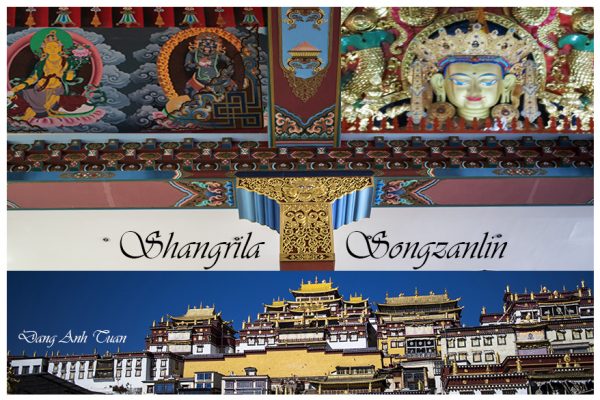
Shangrila nó không những là trung tâm của ba dòng sông lớn Dương Tử, Lan Thương, đoạn đầu của dòng sông huyền thoại Cửu Long (Mékong) và Nộ Giang (sông Thanlwin). Nó còn có  nghĩa là địa điểm của vận mệnh và sự may mắn theo ngôn ngữ của người Tạng.

Đây cũng là một thế giới riêng biệt được mang tên Shangri-La trong chuyến du lịch gần đây của mình ở tỉnh Vân Nam, gần biên giới Trung Quốc-Tây Tạng (cuối tháng 1 năm 2026) với chủ đích tìm hiểu dưới gốc độ tâm linh Phật giáo Mật Tông và khám phá cao nguyên huyền bí. Nó còn là thế giới đã mất được mô tả trong tiểu thuyết của James Hilton. Chính tại đây, mình tìm thấy một bầu không khí độc đáo nhờ sự hiện diện của người dân Tạng với các ngôi làng cổ và phong tục truyền thống của họ nhất là có một công trình kiến trúc  phật giáo Tây Tạng  độc đáo nhất có hơn 300 tuổi đời với tu viện Tùng Tán Lâm  được xem như là Tiểu Potola so sánh với Potola ở Lhassa. Muốn đến nơi nầy, du khách phải vượt 146 bậc thang.

Shangrila n’est pas seulement le centre de trois grands fleuves: le Yangtsé, le Lancang, la source du Mékong et le Nujiang (fleuve Thanlwin). Cela signifie aussi un lieu du destin et de chance selon la langue tibétaine.
C’est aussi un monde à part nommé Shangri-La lors de mon récent voyage dans la province du Yunnan, près de la frontière Chine-Tibet occidental (fin janvier 2026), avec l’intention de  savoir plus sous l’angle spirituel le bouddhisme tantrique et d’explorer le plateau mystérieux. C’est aussi le monde perdu décrit dans le roman de James Hilton. C’est ici que j’ai trouvé une atmosphère unique grâce à la présence des habitants tibétains avec leurs villages anciens et leurs coutumes traditionnelles, notamment un ouvrage architectural  bouddhiste tibétain unique datant de plus de 300 ans avec le monastère de Songzanlin, considéré comme le Petit Potala en comparaison avec celui de Potala à Lhassa. Pour atteindre ce lieu, les visiteurs doivent monter 146 marches.

Shangrila is not only the center of three great rivers: the Yangtze, the Lancang, the source of the Mekong, and the Nujiang (Thanlwin River). It also means a place of destiny and luck according to the Tibetan language.
It is also a world apart named Shangri-La during my recent trip to Yunnan province, near the China-Western Tibet border (end of January 2026), with the intention of learning more about tantric Buddhism from a spiritual perspective and exploring the mysterious plateau. It is also the lost world described in James Hilton‘s novel. It is here that I found a unique atmosphere thanks to the presence of Tibetan inhabitants with their ancient villages and traditional customs, notably a unique Tibetan Buddhist architectural work dating back more than 300 years with the Songzanlin Monastery, considered the Little Potala compared to the Potala in Lhasa. To reach this place, visitors must climb 146 steps.

  1. Tiger leaping gorge. Grottes du saut du tigre (Hổ khiêu hiệp)
  2. Songzanlin Monaster. Little Potola  (Tùng Tán Lâm)(Photos)
  3. Old town Lijiang. (Lệ Giang cổ trấn)
  4. Blue moon valley (Lâm Nguyệt Cốc))
  5. Jade Dragon Mountain (Ngọc Long Tuyết Sơn)

[Return CHINA]

Tết Quê Nhà (Saigon 2026)

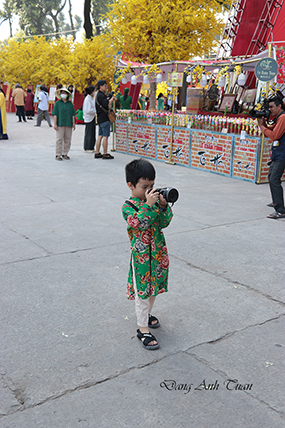
Phó nhòm tí hon

Le jeune photographe

TQNB

[Return New Year Bính Ngọ]

Hồ Thị Kỷ

Version française
Version anglaise
Galerie des photos

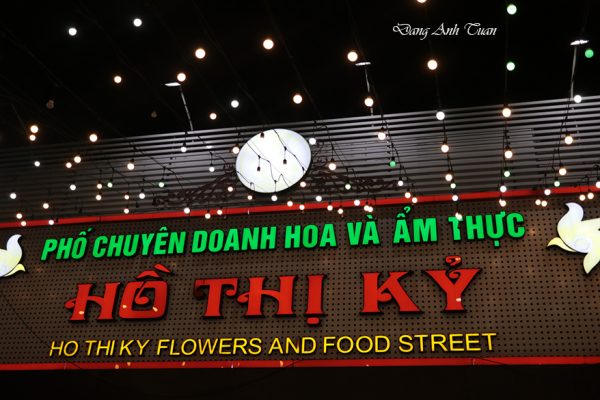
Cái tên Hồ Thị Kỷ ít ai để ý nói đến nhiều như Chợ Lớn của người Hoa nhưng với việt kiều ở Cao Miên thì tên nầy rất quen thuộc vì từ sau năm 1975 thì nơi nầy cùng chợ trở nên địa điểm tựu hợp rất nhiều dân Việt ở Cao Miên hay thường đựợc gọi là khu Pétrus Ký. Nay thì nó được khách du lịch nước ngoài ưa thích vì nó không những là thiên đàng ẩm thực mà còn là vườn hoa Đà Lạt thu nhỏ  giữa lòng  thành phố Saigon. Đến đây bạn có thể lựa chọn nhiều món ăn lắm nhưng bạn có dám ăn hay không ? Từ c ác món ăn vặt đến các món ăn chính, từ các món ăn Cao Miên, Thái Lan  đến các món ăn của người Việt hay người Hoa. Có những món ăn trở thành đặc sản hiếm có  ở Saigon như các loại khô cá Biển Hồ, bún num bo chóc, bánh lọt xào, chè xôi xiêm hay chè bí. Nhiều khách đến đây lúc đầu để ăn trãi nghiệm nhưng sau đó lại thích trở lại ăn trong đó có mình nữa như món xôi xiêm nước dừa hay chè bí của em Có. Những ngày trước Tết chợ bán hoa đông người không  đếm xuể, không có lối đi vào chợ. Giá cả cũng phải chăng so với những nơi khác. Đây là một nơi bạn không thể bỏ qua khi bạn đến thành phố Saïgon.

Le nom Hồ Thị Kỷ est moins souvent mentionné que Cholon des Chinois, mais pour les Vietnamiens vivant au Cambodge, il est très familier car depuis 1975, cet endroit et le marché sont devenus un lieu de rassemblement de nombreux Vietnamiens rentrés du Cambodge, souvent appelé le quartier Pétrus Ký. Aujourd’hui, il est très apprécié par les touristes étrangers car ce n’est pas seulement un paradis culinaire, mais aussi un jardin floral de Đà Lạt en miniature au cœur de la ville de Saïgon. Ici, vous pouvez choisir de nombreux plats, mais osez-vous les manger ou non? Des snacks proposent des plats simples jusqu’aux  plats principaux, des plats cambodgiens,  thaïlandais jusqu’aux plats vietnamiens ou chinois. Certains plats sont devenus des spécialités « rares » à Saïgon, comme les différents types de poisson séché du Grand Lac Tonlé Sap, le bún num bo chóc, le bánh lọt sauté, le chè xôi xiêm ou le chè bí. Beaucoup de visiteurs viennent d’abord ici pour goûter, mais ils aiment  y revenir ensuite. C’est  aussi mon cas pour des plats comme le xôi xiêm au lait de coco ou le chè bí de Madame Có. Les jours précédant le Tết, le marché aux fleurs est bondé de gens. Il est  impossible de trouver un passage pour y entrer. Les prix sont aussi raisonnables comparés à d’autres endroits. C’est un lieu que vous ne pouvez pas manquer lors de votre passage à Saïgon.

The name Hồ Thị Kỷ is mentioned less often than Cholon by the Chinese, but for Vietnamese people living in Cambodia, this name is very familiar because since 1975, this place and the market have become a gathering spot for many Vietnamese returning from Cambodia, often called the Pétrus Ký neighborhood. Today, it is highly appreciated by foreign tourists because it is not only a culinary paradise but also a miniature Đà Lạt flower garden in the heart of Saigon city. Here, you can choose many dishes, but do you dare to eat them? Snacks offer simple dishes up to main courses, Cambodian, Thai dishes up to Vietnamese or Chinese dishes. Some dishes have become rare specialties in Saigon, such as the various types of dried fish from the Great Tonlé Sap lake, bún num bo chóc, sautéed bánh lọt, chè xôi xiêm, or chè bí. Many visitors come here first to taste, but then they like to return, including me, for dishes like xôi xiêm with coconut milk or chè bí of Mrs Có. In the days leading up to Tết, the flower market is crowded with people. It is impossible to find a passage to enter. The prices are also reasonable compared to other places. It is a place you cannot miss when you visit Saigon.

Pictures gallery


Policy of rapprochement with Việtnam


Version vietnamienne

Version française

The hospitality that Rama I extended to Nguyễn Ánh later served as the basis for the development of the future relationship between the two countries. It is not unrelated to Nguyễn Ánh’s careful conduct in seeking an appropriate solution to manage the dual suzerainty over Laos and Cambodia with the Thais. According to the Vietnamese researcher Nguyễn Thế Anh, these countries were considered at that time as children raised together by Siam and Vietnam, the former arrogating the title of father and the latter the title of mother. This dual dependence is known in the Thai language as « song faifa. » According to Siamese sources, Nguyễn Ánh sent six times from Gia Định to Bangkok silver and gold trees, a sign of allegiance between 1788 and 1801. (2). In a letter addressed to Rama I before his return to Gia Định, Nguyễn Ánh agreed to be placed under the protectorate of Siam in case he succeeded in restoring his power. Did Đại Nam (the former name of Vietnam) accept being a mandala state?

There are several reasons to refute this hypothesis. First, Đại Nam was not under the influence of Theravada Buddhism and did not have the Indianized culture as was the case with Cambodia and Laos because the religious role plays an important part in the mandala defined by the researcher O. Wolter. Siam had so far tried to extend its influence and control in regions where the Thais were more or less established and where the Indianized culture was visible.

This is not the case for Vietnam. Chakri and his predecessor Taksin had already failed in this endeavor in Cochinchina, which was nevertheless a new land because there was a significant Vietnamese colony with a different culture. Vassalage seems unlikely. The truth is never known, but one can rely on the fact that to acknowledge the benefits of Ralma I, Nguyễn Ánh could adopt this understandable behavior which was never incompatible with his temperament and especially with his Confucian spirit, in which ingratitude was not a part.

One always finds in him the gratitude and kindness that cannot later be refuted with Pigneau de Béhaine, who devoted much effort to convincing him to convert to Catholicism. During his reign, there was no persecution of Catholics, which can be interpreted as a recognition of Pigneau de Béhaine. From this point of view, one can see in him the principle of humanity (đạo làm người) by honoring both the gratitude towards those who protected him during 25 years of hardships and the revenge against those who killed all his relatives and family. (debt must be repaid, vengeance must be taken)

At the time of his enthronement in 1803 in Huế, Nguyễn Ánh received a crown offered by King Rama I but immediately returned it because he did not accept being treated as a vassal king and receiving the title that the Siamese King Rama I was accustomed to granting to his vassals. This behavior disproves the accusation that has always been made against Nguyễn Ánh.

For some Vietnamese historians, Nguyễn Ánh is a traitor because he brought in foreigners and gave them the opportunity to occupy Vietnam. The Vietnamese expression « Đem rắn cắn gà nhà » (Introducing the snake to bite the home chicken) is often attached to Nguyễn Ánh. It is unfair to label him a traitor because, in the difficult context he was in, there was no reason not to act as he did as a human being when he was at the brink of despair. Probably the following expression « Tương kế tựu kế » (Combining a stratagem of circumstance) suits him better, although there is a risk of playing into the hands of foreigners. It should also be recalled that the Tây Sơn had the opportunity to send an emissary to Rama I in 1789 with the aim of neutralizing Nguyễn Ánh using the stratagem (Điệu hổ ly sơn (Luring the tiger away from the mountain)), but this attempt was in vain due to Rama I’s refusal. (3)

Being intelligent, courageous, and resigned like the king of the Yue Gou Jian (Cẫu Tiển) from the Spring and Autumn period (Xuân Thu), he should have known the consequences of his act. There is not only Gia Long but also thousands of people who accepted to follow him and bear the heavy responsibility of bringing foreigners into the country to counter the Tây Sơn. Are they all traitors? This is a thorny question to which it is difficult to give an affirmative answer and a hasty condemnation without first having a sense of fairness and without being swayed by partisan opinions when one knows that Nguyễn Huệ remains the most adored hero by the Vietnamese for his military genius.

Disappointed by Gia Long’s refusal, Rama I showed no sign of resentment but found justification in the cultural difference. In Rama I, we find not only wisdom but also understanding. He wanted to deal henceforth on an equal footing with him. This equal treatment can be interpreted as a « privileged » bilateral relationship between the elder and the younger in mutual respect. Each of them should know that they needed the other even if it was an alliance of circumstance. Their countries were respectively threatened by formidable enemies, Burma and China.

Their special relationship did not fade over time because Rama I fell in love in the meantime with Nguyễn Ánh’s sister. It is not known what became of her (his wife or his concubine). However, there was a love poem that Rama I dedicated to her and which continued to be sung even in the 1970s during the annual royal boat procession.

As for Nguyễn Ánh (or Gia Long), during his reign, he avoided military confrontation with Thailand over the thorny Cambodian and Laotian issues. Before his death, Gia Long repeatedly reminded his successor Minh Mạng to perpetuate the friendship he had managed to establish with Rama I and to consider Siam as a respectable ally in the Indochinese peninsula (4). This was later justified by Minh Mạng’s refusal to attack Siam at the request of the Burmese.

According to researcher Nguyễn Thế Anh, in continental Southeast Asia, out of about twenty important principalities around 1400, only three kingdoms remained that managed to establish themselves at the beginning of the 19th century as regional powers, among which were Siam and Đại Việt, one advancing eastward and the other southward at the expense of the Hinduized states (Laos, Cambodia, Champa). This conflict of interests intensified increasingly after the death of Rama I and Nguyễn Ánh.

Their successors (Minh Mạng, Thiệu Trị on the Vietnamese side and Rama III on the Siamese side) were entangled in the problem of succession of the Cambodian kings who kept fighting among themselves and seeking their help and protection. They were henceforth guided by a policy of colonialism and annexation which led them to confront each other militarily twice in 1833 and 1841 on Cambodian and Vietnamese territories and to find at the end of each confrontation a compromise agreement in their favor and to the detriment of their respective protégés.

The temporary alliance is no longer taken into account. The rivalry, which was becoming increasingly visible between the two competing countries Đại Nam and Siam, now rules out any rapprochement and any possible alliance. Even their policies are completely different, one aligning with the Chinese model to avoid any contact with Western colonialists and the other with the Japanese model to advocate the opening of borders.

The Khmer capital Phnom Penh was at one time occupied by the Vietnamese army of General Trương Minh Giảng while the regions of Western Cambodia (Siem Reap, Battambang, Sisophon) were in the hands of the Thais. According to the French historian Philippe Conrad, the king of Cambodia was considered a mere governor of the king of Siam. The royal insignia (golden sword, crown seal) were confiscated and held in Bangkok. The arrival of the French in Indochina put an end to their dual suzerainty over Cambodia and Laos. It allowed the Cambodian and Laotian protégés to recover part of their territory in the hands of the Vietnamese and the Thais. Đại Nam under Emperor Tự Đức had to face the French colonial authorities who had annexed the six provinces of Nam Bộ (Cochinchina).

Thanks to the foresight of their kings (particularly that of Chulalongkorn or Rama V), the Thais, relying on the rivalry policy between the English and the French, managed to maintain their independence at the cost of territorial concessions (the Burmese and Malay territories occupied were returned to the English and the Laotian and Khmer territories to the French). They chose a flexible foreign policy (chính sách cây sậy) like the reed that adapts to the wind. It is no coincidence to see the sacred union of the three Thai princes at the dawn of the Thai nation in 1287 and the submission to the Sino-Mongol troops of Kublai Khan.

It is this synthetic policy of adaptation that allows them to stay away from colonial wars, always side with the victors, and exist today as a flourishing nation despite their late emergence (dating from the early 14th century) in mainland Southeast Asia.

Pictures of Venice of the East (Vọng các)

[Return THAILAND]


(1) Bùi Quang Tùng: Professeur, membre scientifique de EFEO. Auteur de plusieurs ouvrages sur le Vietnam.
(2) P.R.R.I, p. 113.
(3) Pool, Peter A.: The Vietnamese in Thailand, p 32, note 3.


Latent conflicts with Vietnam


Vietnamese version
French version

There are victories and defeats on both sides. Leading an army of 20,000 men and a fleet, Taksin succeeded in driving out, after a ten-day siege, Mo Shi-Lin (Mạc Tiên Tứ in Vietnamese), the son of Mạc Cửu, from Hà Tiên. He was a significant Chinese ally of the Nguyễn lords and the protector of the son of the last king of the Ayutthaya dynasty, Chao Chuy (Chiêu Thúy). The latter continued to be one of the potential contenders for the crown and a daily concern for Taksin. Due to his military setbacks at Châu Đốc and in the Sadec region, Taksin was forced to accept the peace treaty offered by Mạc Thiên Tứ and to abandon Hà Tiên in ruins in exchange for the return of Prince Chiêu Thúy, the release of Mạc Thiên Tứ’s daughter who was captured at the fall of Hà Tiên, and the maintenance on the Cambodian throne of a pro-Thai king named Ang Non.

Upon his return, Chiêu Thúy was executed along with his brother who was captured in Cambodia. As for Lord Nguyễn Phúc Thuần (later known as Duệ Tông), troubled by the rebellion of the « Tây Sơn brothers (Western Peasants), » he was forced to endorse this agreement and temporarily allow the Thais free rein in their territorial expansion policy over Laos and Cambodia. But the truce was short-lived for Mạc Thiên Tứ because in the meantime, he was pursued by the Tây Sơn who had succeeded in taking Gia Định (or Saigon) in 1776 and capturing Lord Nguyễn Phúc Thuần in Cà Mau. He had to seek refuge with his family and subordinates with Taksin in Thonburi (Thailand). However, the latter, obsessed and consumed by so much suspicion and distrust, ended up executing his family and subordinates, among whom was Prince Tôn Thất Xuân. To preserve his dignity and honor, Mạc Thiên Tứ committed suicide in September 1780 by swallowing a gold coin. Taksin’s distrust became increasingly overwhelming to the point where it turned into a mental illness accompanied by paranoid and tyrannical behavior.

It is one of the common traits of great politicians (Ts’ao Ts’ao (Tào Tháo) of the Three Kingdoms, Qin Shi Huang Di (Tần Thủy Hoàng) for example). It is this mistrust that later led him to imprison his close associates, particularly the family of his son-in-law Chakri, who was engaged in a military campaign in Cambodia against the Vietnamese of the young prince Nguyễn Ánh. Chakri (the future King Rama I) was forced to make a pact with Nguyễn Ánh’s lieutenants, Nguyễn Hữu Thùy and Hồ văn Lân. They sent him a knife, a sword, and a flag as a sign of their support against Taksin. Having managed to return in time when a coup d’état overthrew the latter, the Siamese general Chaophraya Mahakasatsuk (or Chakri) thus became King Rama I and the founder of the Chakri dynasty.

His advent allowed the closure of the Thonburi dynasty and its replacement by the new dynasty with the transfer of the capital to Bangkok. It was here that King Rama I attempted to restore the Ayutthaya style through his royal palace (Bangkok). The establishment of the new capital did not correspond to a renewal of Siamese art. Rama I was interested in continuing the unfinished work of King Taksin the Great in the march eastward. He did not hesitate to mount a military expedition to assist Crown Prince Nguyễn Ánh in his struggle against the Tây Sơn. Unfortunately, this Vietnamo-Siamese expedition was crushed in 1783 in the Rạch Gầm-Xoài Mút canals of today’s Tiền Giang province by the strategist king Nguyễn Huệ. Of the Siamese army initially composed of at least 50,000 men and 300 junks, only 2,000 men managed to pass through Cambodia to return to Thailand.

Taking advantage of the geographical unfamiliarity of the terrain (địa lợi) and the military underestimation of the enemies, Nguyễn Huệ avoided a frontal engagement at Sadec and quickly succeeded in thwarting the Siamese invasion in the canals near Mỹ Tho. Nguyễn Huệ needed a swift victory because he knew that the Trịnh in Northern Vietnam could take advantage of this opportunity to invade Qui Nhơn in central Vietnam.

Hunted like a wild beast and plunged into the abyss of sadness, Nguyễn Ánh was forced to exile himself to Bangkok, accompanied by about thirty mandarins and approximately 200 soldiers for a short period (from 1785 to 1787). He was later joined by 5,000 soldiers under General Nguyễn Huỳnh Đức. According to Vietnamese professor Bùi Quang Tùng (1), many refugees preferred to stay in Thailand and marry Siamese women.

Policy of rapprochement with Việtnam

[Return THAILAND]

Kingdom of Ayutthaya (Version anglaise)

Version vietnamienne
Version française

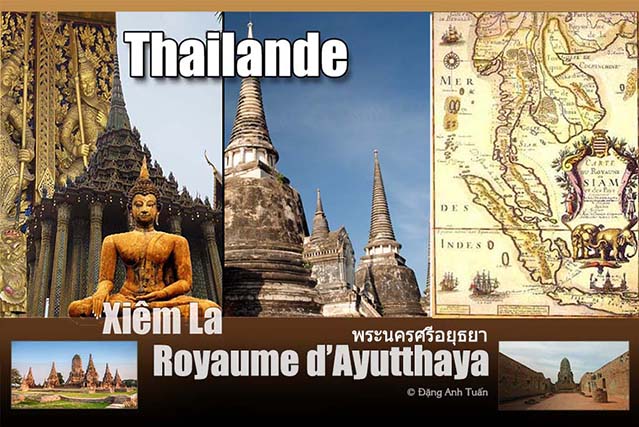
The kingdom of Sukhothai did not survive after the disappearance of the great King Rama Khamheng because his successors Lo Tai (1318-1347) and Lu Tai (1347-1368), preoccupied with religious faith, neglected to watch over their vassals among whom there was a brave and energetic prince from U Thong (*) known for his territorial ambitions. He did not hesitate to subdue Lu Tai of Sukhothai. He thus became the founder of the new dynasty by taking Ayutthaya, located in the lower valley of the Menam Chao Praya, as the capital. He took the title Ramathibodi I (or Rama the Great) (or Ramadhipati). His kingdom was not unified in the strict sense of the term but was in a way a mandala (**). The king was at the center of several concentric circles of the mandala system. The outermost circle consisted of autonomous principalities (or muäng) each governed by a member of the royal family, while the closest circle was in the hands of governors appointed by the king. An edict dating from 1468 or 1469 reported that there were 20 vassal kings paying homage to the king of Ayutthaya.

Phra Nakhon Si Ayutthaya

พระนครศรีอยุธยา


© Đặng Anh Tuấn

(*) U Thong: district located in the province of Suphanburi. It is the kingdom of Dvaravati, which the Chinese often referred to as T’o Lo po ti. It is here that the famous Chinese monk Huan Tsang (Huyền Trang) passed through during his journey to India to bring back original Buddhist texts.

(**) Mandala term used by WOLTERS, O.W. 1999. History, Culture and Religion in Southeast Asian Perspectives. Revised Edition, Ithaca, Cornell University and the Institute of Southeast Asian Studies. pp 16-28.


Despite this, his grip and authority were relative over distant principalities that could at any time assert their independence and claims with their charismatic leaders. His religious role (dharmaraja) served as a counterbalance to the potential rivalry of these vassal kings. This is why the kingdom of Ayutthaya often experienced succession wars and internal struggles during its existence.

At its peak, the kingdom of Ayutthaya occupied roughly the territory of present-day Thailand, minus the buffer kingdom of Lanna (whose capital was Chiangmai) and part of the east in Burma. According to researcher Nguyễn Thế Anh, this type of political configuration was also found for a certain time at the beginning of the 11th century in Vietnam but disappeared in favor of the centralization of power in the capital at the time of its transfer to Thăng Long (Hanoi) under the reign of Lý Thái Tổ (Lý Công Uẩn).

According to the Thai historian Charnvit Kasetsiri, this prince of U Thong came from a Chinese family. Thanks to the marital alliance with the king of Lopburi, he succeeded in imposing himself to succeed the latter. From then on, Ayutthaya became the center of Siamese political power until its destruction by the Burmese of King Hsinbyushin in 1767. Expansionist, Ramathibodi soon took Angkor in 1353. This happened again twice with Ramesuen (the son of King Ramathibodi) in 1393 and with Borommaracha II in 1431. The Khmers were forced to transfer their capital to Phnom Penh with the Khmer king Ponheat Yat. Despite their sacking of Angkor, the kings of Ayutthaya continued to willingly present themselves as heirs of the kings of the Angkorian empire. They took over not only the organization of the court and the titulature of the vanquished but also their dancers and their ornaments. The return to the tradition of the Angkorian monarchy was evident. The king became, in a way, a living god whose public appearance was rare. His subjects could no longer look him in the face except his close family members. They had to address him in a specific language used for royalty. Endowed with divine power, the king could decide the fate of his subjects. It was under the reign of Ramathibodi that a series of reforms was initiated. He brought members of the Sinhalese monastic community with the aim of establishing a new religious order.

In 1360, Theravada Buddhism became the official religion of the kingdom. A legal code incorporating Thai custom and based on the Hindu Dharmashāstra was adopted. As for Ayutthaya art, it initially evolved under the influence of Sukhothai art. Then it continued to find its inspiration in the field of sculpture before returning to Khmer models when King Trailokanatha succeeded his father on the throne in 1448. In short, the Ayutthaya style is a blend of the Sukhothai style and the Khmer style.

Described by the Abbé de Choisy, a member of a French delegation sent in 1685 by King Louis XIV to the Siamese King Narai as a cosmopolitan and marvelous city, Ayutthaya quickly became the prey of Burmese covetousness because of its wealth and grandeur. Despite the meaning of its Sanskrit name (« impregnable fortress »), it was looted and devastated by the Burmese of King Bayinnaung of Toungoo in 1569. Then it was sacked again by the Burmese of King Hsinbyushin in 1767. The Burmese took advantage of this occasion to melt down the gold that covered the Buddha statues, but they neglected another stucco Buddha in one of the capital’s temples. Yet beneath the stucco lies the statue in solid gold.

This is indeed a stratagem employed by the Siamese monks to hide the treasure at the time when the Burmese were besieging the capital. This golden Buddha is currently in the Wat Traimit located in the heart of the Chinatown district in Bangkok.

After the destruction of the Ayutthaya capital, the Burmese withdrew taking not only the loot and prisoners (at least 60,000 Siamese) but also the king of Ayutthaya and his family. From then on, the kingdom of Ayutthaya was completely dismantled with the emergence of several local lords. Its capital was no longer the center of political power. According to the American anthropologist Charles Keyes, Ayutthaya no longer received the cosmic influences necessary for its continuity. Its reason for being was no longer justified. It would soon be replaced by the new capital Thonburi, very close to Bangkok, accessible by sea (in case of Burmese invasion) and founded by the governor of Tak province named Sin. That is why he is commonly called Taksin (or Trịnh Quốc Anh in Vietnamese) or Taksin the Great in the history of Thailand.

Being of Teo Chiu (Chaozhou) Chinese origin, he managed to establish himself as the unifier and liberator of Thailand after eliminating all contenders and defeating the Burmese at Ayutthaya following two days of fierce fighting. His reign lasted only 15 years (1767-1782). Yet it was under his reign that Thailand regained not only independence but also prosperity. It also became one of the powerful states of Southeast Asia by successfully permanently freeing the rival kingdom of Lanna (Chiang Mai) from Burmese yoke in 1774 and by extending its influence and vassalage over Laos and Cambodia through military expeditions. It began to take an interest in the strategic position played at the beginning of the 18th century by the principality of Hà Tiên governed by a Cantonese Chinese Mac King Kiou (or Mạc Cửu in Vietnamese), hostile to the new Qing (Manchu) dynasty in the Gulf of Siam. It always entertained the idea of monopolizing and controlling trade in the Gulf of Siam.

It was in Laos that the Thais, led by General Chakri (future King Rama I), took the Emerald Buddha from the Laotians and brought it back to Thonburi in 1779 before permanently installing it in the royal palace of Bangkok. This Buddha thus became the protector of the Chakri dynasty and the guarantor of Thailand’s prosperity.

Having been divided into three entities: the kingdom of Vientiane, the kingdom of Luang Prabang, and the kingdom of Champassak after the death of a great king of Laos, Surinyavongsa, Laos temporarily fell under Thai rule. However, in Cambodia, taking advantage of internal dissensions related to the succession of the throne and always pursuing an expansionist policy eastward to fully control the Gulf of Siam, the Thais did not hesitate to enter into armed conflict with the Vietnamese lords Nguyễn, who until then had oversight over Cambodia, which had granted the Vietnamese facilities for settlement in its territory (Cochinchina) with King Prea Chey Chetta II in 1618.

Latent conflicts with Vietnam

[Return THAÏLAND]

Art of Sukothai (Version anglaise)


French version

Vietnamese version

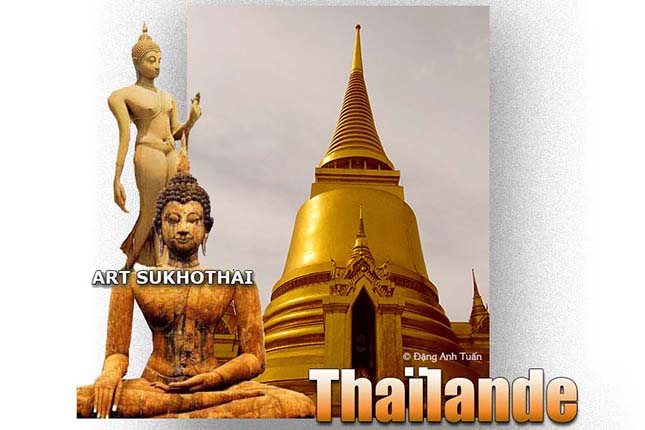
With the first great Thai kingdom of Sukhothai, a new civilization emerged that knew how to take advantage of indigenous culture under the impetus of an exceptional and equally remarkable personality, King Rama Khamheng. For Georges Coedès, the Thais were remarkable assimilators. Instead of destroying everything that belonged to the former masters (Mon-Khmers) as the Vietnamese did during the conquest of Champa, the Thais tried to appropriate it and rediscover themes in the old Mon-Khmer repertoires to create a new, unique style, allowing local traditions to show through in architecture (chedis) and statuary (Buddhas). Mahayana was henceforth abandoned in favor of Theravada Buddhism, to which Thai aesthetics were entirely devoted. This obviously drew its iconographic and plastic formulas from Khmer art and that of Dvaravati (Mon).

The blossoming of Sukhothai art testifies to a will for innovation and remarkable vitality despite certain Sinhalese, Burmese, and Khmer influences. This is seen in the great creation of Buddha iconography. These Buddhas, represented in human form, were sculpted according to very precise rules that Thai artists had to meticulously respect. According to Bernard Groslier, there is a slight exaggeration in the beauty of these works in order to accentuate stylization and show the originality of a new and dynamic society. The excessive elongation found in the arms and ears and the excessive deformation of the upper bun clearly reflect the lack of realism.

Despite this, the Buddhist sculpture of Sukhothai undoubtedly testifies to an entirely original art and a period when the Thai nation needed a cultural and religious identity and a distinct personality illustrated by the example found in the creation of the Walking Buddha. Its graceful form cannot go unnoticed and manages to penetrate the Thai people. A fluidity is found in the movement of this Buddha. Its appearance is both light and serene. Its oval-shaped head, perfectly arched eyebrows in a semicircle extended by a long aquiline nose, its curly hair topped with a long flame (uṇīsa) (Sinhalese tradition), its mouth surrounded by a double line (Khmer tradition), its clothes clinging to the body are the characteristic features of the Buddhist art of Sukhothai.

Despite this, the Buddhist sculpture of Sukhothai undeniably bears witness to an entirely original art and a period when the Thai nation needed a cultural and religious identity and a distinct personality illustrated by the example found in the creation of the Walking Buddha. Its graceful form cannot go unnoticed and manages to penetrate the Thai people. A fluidity is found in the movement of this Buddha. Its appearance is both light and serene. Its oval-shaped head, perfectly arched semicircular eyebrows extended by a long aquiline nose, its curly hair topped with a long flame (unîsa) (Sinhala tradition), its mouth surrounded by a double line (Khmer tradition), its clothes clinging to the body are the characteristic features of the Buddhist art of Sukhothai.

Under the reign of Rama Khamheng (or Rama the Brave), a new society was formed from the Mon-Khmer heritage. This society found its administrative and social model from the Mongols. The Thai script was created and based on the Khmer cursive script, which had its distant origin in southern India. Theravada Buddhism was adopted as the state religion. Despite this, animism continued to persist, as evidenced by the cult of the spirit of the land mentioned by Rama Khamheng. He established on a hill near Sukhothai an altar dedicated to a spirit named Phra Khapung Phi, superior to all other spirits to ensure the prosperity of the kingdom. It was his responsibility to honor this cult every year. This same mindset was also seen at the beginning of the 20th century in Vietnam with the ritual ceremony of Nam Giao (Huế) celebrated by the emperor, as being the Son of Heaven, he was supposed to ask each year for the protection and blessing of Heaven for the country. (Similarly in China with the Temple of Heaven (Thiên Đàn) in Beijing).

It is not surprising to still find nowadays this tradition, this idea of the superior spirit in the Emerald Buddha (or Phra Keo Morakot), the palladium of Thailand and protector of the Chakri dynasty in the chapel of the royal palace in Bangkok. For Bernard Groslier, the parallelism is not gratuitous: the Thais belong to the primitive world of Chinese thought. Questions arise from this comparison because one cannot ignore that, similar to the Vietnamese, the Thais were part of the Cent Yue group, most of whose ethnicities were animists and belonged to the agricultural world. They were accustomed to honoring the cult of the spirits of the land, agriculture, or the village before coming under Chinese influence. Rama Khamheng succeeded in establishing diplomatic relations with Kublai Khan’s China. He encouraged the arrival and settlement of Chinese artisans in the capital. With their expertise, the kingdom of Sukhothai soon became known for its famous Sawankhalok ceramics.

Kingdom of Ayutthaya

[Return THAÏLANDE]