Han Wu Di empire: Art of living (VA)


Version vietnamienne

Version française

Under the Han dynasty, Chinese society was structured in such a way that only the literati and peasants were well respected compared to artisans and merchants, according to the Hanshu by Ban Gu in the 1st century. Yet, it was only the latter who benefited from the empire’s economic system despite a large number of restrictions imposed by the imperial power. The multiplication of private enterprises and the opening of trade routes (such as the Silk Road) allowed them to enrich themselves easily. They sold commodities and luxurious superfluous goods highly prized by the Han aristocracy and landowners. Thanks to funerary art, we are led to draw useful lessons about the art of living as well as entertainment of that era. Silk was reserved for the court, nobility, and officials, while linen was for the people, in their traditional costume adorned with accessories illustrating their social status. Silk experienced remarkable growth because it was the subject of luxury trade but was also used in the tribute system for the Xiongnu and vassal states. In 1 BC, silk gifts reached their maximum with 370 garments, 30,000 rolls of silk fabrics, and 30,000 jin of silk floss. Merchants took advantage of exchanges to launch a lucrative trade with foreigners, particularly with the Parthians and the Romans.
Private workshops competed with imperial workshops.
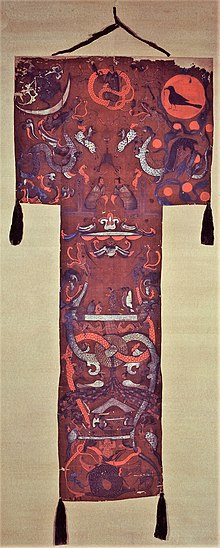
Funerary banner found in Madame Dai’s coffin

This encouraged silk production and increased regional diversity. The weaving demonstrates a high level of technical skill, as a silk shirt measuring 1.28 meters long with a wingspan of 1.90 meters found in the tomb of Marquise Dai weighed only 49 grams. Besides the silk banner covering the deceased’s coffin and decorated with paintings illustrating Taoist cosmology, silk manuscripts were also discovered (Yijing (Di Kinh), two copies of Daodejing (Đạo Đức Kinh), two medical treatises, and two texts on Yin-Yang, as well as three maps in one of the three Mawangdui tombs, some written in a mixture of lishu (scribe script) and xiaozhuan (small seal script) dating from the reign of Gaozu (Hán Cao Tổ), others entirely in lishu dating from the reign of Wendi. Despite its high cost, silk was preferred because it is more manageable, lighter, and easier to transport compared to wooden tablets. Under the Han, lacquerware, whose craftsmanship is still considered refined, began to fill the homes of the wealthy. These, imitating the aristocracy of the Chu kingdom, used lacquered wooden tableware, most often red on the inside and black on the outside with enhanced painted motifs; these colors corresponded well to those of Yin (black) and Yang (red).

The same applies to trays and boxes intended for storing folded clothes, toiletries, manuscripts, etc. For princely families, jade replaces lacquer. As for the common people, ceramics are used along with wood for their tableware. Resembling individual circular or rectangular trays, low tables, generally on legs, are used to serve meals. These are well stocked with dishes, chopsticks (kuaizi), spoons, ear-handled cups (erbei) for drinking water and alcohol. Regarding staple foods, millet and rice are the most appreciated cereals.

Millet is reserved for festive days in northern China, while rice, a product of the ancient kingdom of Chu, is confined to southern China as it is considered a luxury product. For the poor, wheat and soybeans remain dominant in their meals. Chinese cuisine is roughly the same as it was during the Qin era. Geng, a type of stew, remains the traditional Chinese dish where pieces of meat and vegetables are mixed. However, following territorial expansion and the arrival and acclimatization of new products from other parts of the empire, innovations gradually begin to appear in the making of noodles, steamed dishes, and cakes made from wheat flour.

The same applies to trays and boxes intended for storing folded clothes, toiletries, manuscripts, etc. For princely families, jade replaces lacquer. As for common people, ceramics are used along with wood for their tableware. Similar to individual circular or rectangular trays, low tables, generally with legs, are used for serving meals. These are well stocked with dishes, chopsticks (kuaizi), spoons, ear-handled cups (erbei) for drinking water and alcohol. Regarding staple foods, millet and rice are the most appreciated cereals.

Millet is reserved for festive days in northern China, while rice, a product of the ancient kingdom of Chu, is confined to southern China as it is considered a luxury product. For the poor, wheat and soybeans remain dominant in their meals. Chinese cuisine is roughly the same as it was during the Qin era. Geng, a type of stew, remains the traditional Chinese dish where pieces of meat and vegetables are mixed. However, following territorial expansion and the arrival and acclimatization of new products from other parts of the empire, innovations gradually begin to appear in the making of noodles, steamed dishes, as well as cakes made from wheat flour.

Roasting, boiling, frying, stewing, and steaming are among the cooking methods. The mat is used for sitting by all social classes until the end of the dynasty. It is held in place at the four corners by small bronze weights shaped like curled-up animals: tigers, leopards, deer, sheep, etc. To alleviate the discomfort caused by kneeling on the heels, lacquered wooden backrests or armrests are used. The mat is also used in central and southern China by modest people for sleeping. However, in northern China, because of the cold, one must use a kang, a kind of earthen bed covered with bricks and topped with mats and blankets. Beneath this kang, there is a system of pipes that distribute heat maintained from a stove located inside or outside the house.

Leisure and pleasures were not forgotten either during the Han period.

Thanks to texts, we know that the musical tradition of Chu held an important place in the Han court, which continued to appreciate it. According to the French sinologist J.P. Diény, the Han preferred above all other music that which made one cry. The favorite themes in songs revolved around separation, the passage of time, and pleasures.

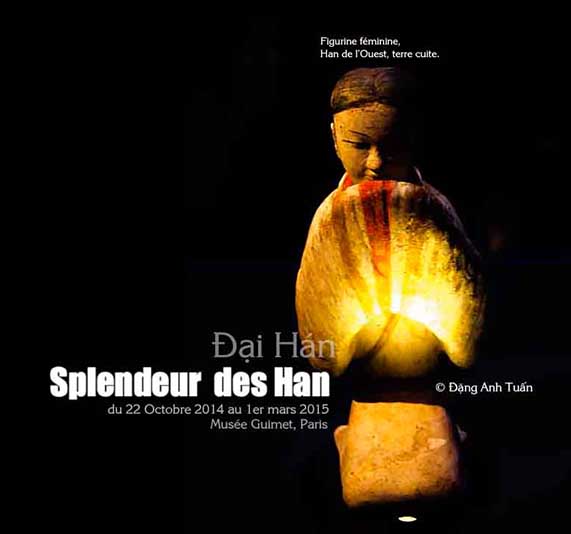
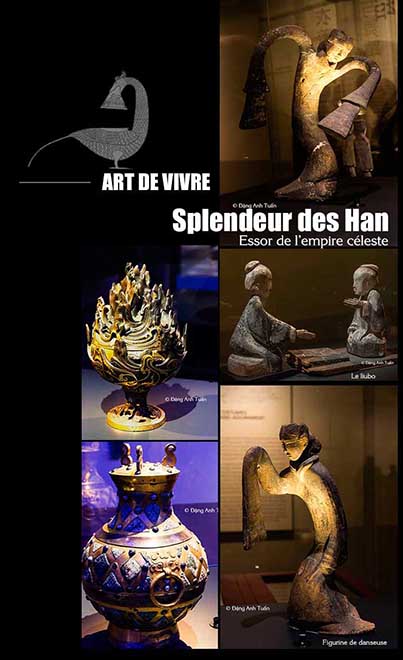
It is in the princely tombs that one discovers the figurines of dancers (mingqi) (minh khí). These reveal, through their gestures, the skill of tracing arabesques in the air with the long sleeves of their robes. The dances, based on the movements of the garments caused by the twisting of the body and the arms, give the dancer, accompanied by sometimes melancholic singing, a vivid portrait of Han choreographic art. For the latter, the family is, in the Confucian conception, the basic unit of the social system around which ancestor worship, rites, banquets, and weddings take place, providing throughout the year many occasions and pretexts for music to accompany them and make life harmonious. Being symbols of authority and power, bronze chimes cannot be absent. They are frequently used in ritual ceremonies but also in court music. Thanks to archaeological excavations, it is known that the life of Han princely courts was punctuated by banquets, games, and concerts accompanied by dances and acrobatics. As for entertainment, it was reserved exclusively for men. Liubo (a kind of chess game) was one of the most popular games of the time, along with dice games that could have up to 18 faces. It is better to play than to remain idle, this is the advice of Confucius given in his « Analects. »

Unlike the archaeology of earlier periods, that of the Han allows us to access the realm of the intimate, such as women’s makeup. They used foundation made from rice powder or white lead to paint their faces. Red spots were applied on the cheekbones, dark circles under the eyes, beauty marks on the cheek, a touch of color on the lips, etc. The education of the young was a priority during the Han period. From childhood, obedience, politeness, and respect for elders were instilled. At ten years old, the boy began receiving lessons from a teacher. He had to study the Analects of Confucius (Lunyu), the Classic of Filial Piety (Xiao jing), etc., before moving on between the ages of fifteen and twenty to reading the Classics. Considered inferior to men, women were obliged from a young age to learn silk work, cooking, and to possess the major qualities taught to them: gentleness, humility, self-control. They had to submit to the three obediences (Tam Tòng): as a child to their father, as a wife to their husband, as a widow to their son. They could be married around 14-15 years old to ensure the continuity of the family lineage. Despite these Confucian constraints, women continued to exercise real power within the family structure, particularly in the relationship between mother and son.The concern to honor the deceased led the Han, particularly those of the West, to create extravagant tombs and true treasures such as jade burial suits in the quest for immortality. This is the case with the tomb of Emperor Wudi’s father, Han Jing Di.

 So far, archaeologists have already extracted more than 40,000 funerary objects around the emperor’s mound. It is expected that this entire funerary complex will yield between 300,000 and 500,000 objects because, besides the mound, there are two distinct pits left to explore: those of the empress and the emperor’s favorite concubine, Li. According to a Chinese archaeologist in charge of this exploration, it is not the number of objects discovered that is important, but rather the significance of each of the findings recovered in this funerary complex. It is believed that the Western Han were accustomed to valuing truly grandiose funerary monuments despite their frugality, revealed through a series of objects that are much smaller than those found in Qin tombs.
[Western Han Timeline (Reading  more)]

[Return Han Dynasty]

Han Princes Tombs

Vietnamese version
French version

Similar to their predecessor Qin Shi Huang Di, the emperors of the Han dynasty sent emissaries during their reign in search of paradisiacal places with the aim of seeking immortality and accessing the divine world. These mythical lands are often associated with Penglai Island (đảo Bồng Lai) located to the east and Mount Kunlun (Côn Lôn) to the west in the beliefs of the Han era. It is the mountain where the Queen Mother of the West (Tây Vương Mẫu) (Xiwangmu) resides, who possessed the elixir of immortality. This is why her presence is recurrently found in the decoration of Han tombs. This testifies not only to her popularity but also to the Taoist conception related to the prolongation of life beyond death. According to some unverified and unjustified rumors, Zhang Qian was initially tasked by Wudi to search for immortality recipes near Mount Kunlun, the western abode of the immortals. Always dressed in a long tunic, they have an elongated and angular face, a wide mouth above a pointed chin, arched eyebrows, and large ears, which gives them a rather strange silhouette and an emaciated appearance. Once the dao is reached, they have wings on their shoulders. In the Taoist conception of the afterlife, to preserve the physical integrity of the deceased and the immortality of their soul, the nine orifices of their body must be sealed with gold and jade pieces (mouth, ears, eyes, nostrils, urethra, rectum).

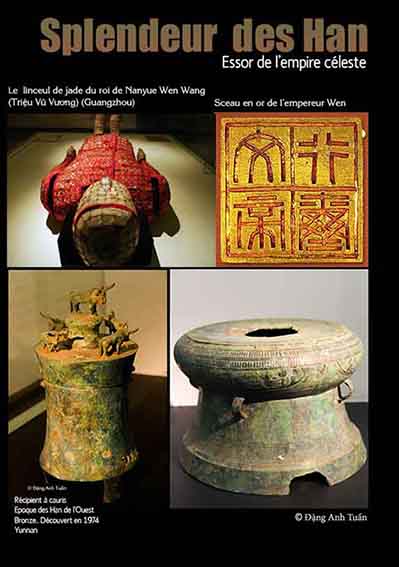
Then the deceased must be made to wear a mask or a jade suit whose use is governed by a very strict hierarchical protocol. For emperors, the jade suit is sewn with gold threads. As for kings and other less important dignitaries, their jade suit only has threads of silver or copper. The use of the suit reflects the Han belief in the soul’s perpetuity in the afterlife because jade is attributed with apotropaic properties that help promote the soul’s immortality.

During the Han period, the dualistic conception of the soul was mentioned in several Chinese texts such as the Huainanzi by Liu An (Hoài Nam Tử). Each individual has two souls: one called hun that goes to heaven and the other called po that physically disappears with the deceased. To prevent the hun soul from escaping through the facial orifices, the mask or suit proves indispensable.

Is this dualistic conception of the soul truly Chinese or borrowed from another civilization, that of the Baiyue? It is found among the Mường, the cousins of the Vietnamese, living in the most remote corners of the mountainous regions of Vietnam. For the Mường, there are several souls in a human being which they call wại. These are divided into two categories: wại kang (the splendid souls) and wại thặng (the hard souls). The former are superior and immortal while the latter, attached to the body, are evil. Death is only the consequence of the escape of these souls.

It is important to recall that the culture of the kingdom of Chu (Sỡ Quốc), conquered by Qin Shi Huang Di during the unification of China, had a particular originality, its own language, that of the Bai Yue. From the Qin-Han period onwards, there existed an imperial institution, the fangshi, who were local scholars considered magicians specialized in star rites and government recipes.

Their role was to collect, each in their own territory, ritual procedures, beliefs, local medicines, systems of representation, cosmologies, myths, legends, as well as local products, and submit them to the political authority so that it could decide whether to retain them or not and incorporate them in the form of regulations with the aim of increasing imperial power in an ethnologically very diverse nation and providing the emperor with the means for his divine vocation. Everything had to be collected and added to the service of the Son of Heaven in order to establish his legitimacy over recently conquered barbarian territories.

___This is one of the characteristic traits of Chinese culture: It knows how to accept and absorb foreign cultures without ever showing signs of wavering or cultural modifications.___

This is what the famous 20th-century Chinese philosopher Liang Shuming wrote in the introduction to his work entitled « The Main Ideas of Chinese Culture » (translation by Michel Masson). This echoes the following remark made by the French ethnologist and sinologist Brigitte Baptandier in her conference text during an APRAS study day on regional ethnologies in Paris in 1993:

Chinese culture thus formed over the centuries as a kind of mosaic of cultures. It requires a slow infusion of barbarian blood into China, adapting this beautiful phrase of the historian F. Braudel for France with the barbarians.


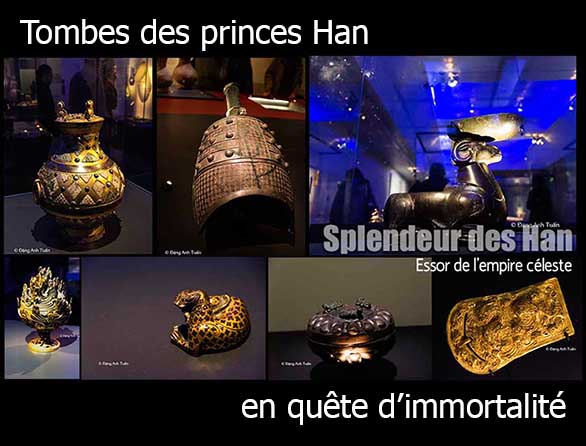
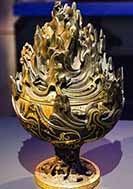
The Boshanlu incense burners (incense burners shaped like Mount Bo) were meant to represent the mythical mountains bathed in clouds and qi vapors (vital cosmic energy). The popularity of these incense burners was largely due to Han thought on immortality and the cult of sacred mountains.

Boshanlu


According to the estimate of the dean of Chinese archaeologists Wang Zhongsu, since 1949 more than 10,000 tombs have been excavated from the Han dynasty alone. Thanks to major archaeological discoveries from the tombs of Lady Dai and her son at Mawangdui (Changsha, Hunan) (168 BC), or the tomb of Emperor Jindi’s son, Prince Han Liu Sheng and his wife Dou Wan (Mancheng, Hebei) (113 BC), as well as the tomb of Zhao Mo, grandson of Zhao Tuo and king of Nanyue (Xianggang, Guangzhou) (120 BC), archaeologists have begun to better understand Han art through thousands of exceptional objects made of jade, iron, and bronze, ceramics, lacquerware, etc. These testify to the opulence and power of the princely courts under the Han. They are sometimes unique specimens revealing not only exquisite technical craftsmanship and the preciousness of the materials but also regional particularities.

During the excavations, archaeologists observed that there is a break in Chinese art, a profound change historically corresponding to the development of the unified empires (Qin and Han) and contact with foreign influences. The presence of secular objects, particularly bronze vessels commonly found during the Zhou period, gave way to the development of figurative art and pictorial representations. There is undoubtedly a notable influence from other cultural spheres in the field of Han art, especially in material culture. From then on, ancestor worship no longer took place in temples as it had during the Bronze Age but occurred within the tombs and in sanctuaries near them. Moreover, like Emperor Qin Shi Huang Di, the Han emperors and their princes tended to make the tomb a replica of their earthly royal residence.

This concept dates back to the Zhou period and was frequently illustrated in the funerary practices of the elites of the Chu kingdom. Similar to the latter, the Han believed in the soul’s continuity in the afterlife. The vision of death was considered a continuation of life. This belief remains alive today in China during the Qingming Festival, with sacrifices offered to ancestors: fake money and funerary objects burned.

It is for this reason that during excavations, everything they owned in their lifetime is found: favorite objects, terracotta figurines representing their household staff, as well as jade shrouds intended to reduce death to nothingness. The imperial tombs of the Han are marked by the presence of a high artificial mound located within a rectangular enclosure where the burials and ancillary pits are also found. The structure of their tombs becomes increasingly complex and often rivals that of their palaces, with separate pits each having a distinct function (storehouse, stable, kitchen, banquet hall, etc.). This is the case of the Liu Qi site, known as Emperor Jindi, and his wife, Empress Wang, in the suburb of Xi’an. It is in these pits that luxury items (vases, basins, incense burners, mirrors, weights for mats, cauldrons, lamps, daggers, etc.) or everyday items (grains, fabrics, meat, etc.) of the deceased are found, leaving archaeologists dumbfounded and silent with admiration, alongside terracotta figurines (or mingqi). These can be either figurines of domestic animals or human statuettes.

Thanks to the Silk Road and Chinese expansion, a large number of regional artistic traditions, foreign fashions, and new products contributed to the artistic flourishing of the Han. Cosmopolitanism certainly played an important role at that time.

The splendor of luxury objects found in tombs reveals not only the grandeur and refinement of princely courts but also a taste for exoticism. The dances and music of Chu, the songs of Dian, and the art of Central Asian minstrels renew the court’s entertainment. Contacts with the arts of the steppe promote the enrichment of the decorative repertoire.

Similar to jade, bronze was one of the materials highly prized by the Chinese. During the Han period, the popularity of bronze began to decline because for ancestor worship, there was no longer a need for complete sets of ritual bronze vessels, and lacquer objects imitating those of the kingdom of Chu were preferred instead. The latter had frequently decorated them with motifs or figures of great imagination according to its own mythology during the Warring States period.

Despite the visible decline in the tombs of Han princes, bronze was still widely used in chariot ornaments and luxury objects found

[Reading Art of living]

[Return Han Dynasty]


Han Wu Di empire: Annexion (VA)

 Chinese conquests: Nan Yue and Ye Lang

Vietnamese version
French version

At the time when Zhang Qian was tasked in the year -126 with seeking alliances to encircle the Xiongnu, they continued to launch increasingly deadly raids, resulting in several thousand Chinese dead or captive living in the frontier commanderies (Dai, Yanmen, or Shang) in northern China. This forced Wudi, now more confident in consolidating his power and his rear positions, to adopt a new policy towards these « barbarians. » From then on, Chinese offensives aimed at preventing the Xiongnu from concentrating on the edge of Chinese territory became more frequent.

The first success occurred in the autumn of -128 in the Yuyang region with Wei Qing, the new hero of the Chinese army. This was followed by other brilliant and decisive conquests in the spring of -121, led by Huo Qubing, the son of Wei Qing‘s elder sister and « champion of the army, » who was exceptionally granted the title of Guanjun by Wudi. He chose a new tactic of striking like lightning at the head of the Xiongnu armies deep within their territory, which allowed the Chinese to reconquer the Ordos, the entire area south of the Yellow River loop (Hoàng Hà), to establish the commanderies of Shuofang and Wuyuan, and to deport people into the conquered zones with the aim of providing significant long-term logistics to the army in pursuing enemies into other distant and unknown regions.

The empire of Wudi had the means to implement this colonization policy with a population of 50 million inhabitants at that time. It is estimated that more than 2 million Chinese were relocated under Wudi’s reign along the northern border. This policy paid off because these agricultural colonies definitively became, a few years later, the reliable bulwark of China against these « barbarians. » This reminds us of the policy of the Vietnamese in the conquest of Champa and the Mekong Delta and that of the Chinese in today’s Tibet. The incessant harassment by the Xiongnu, agitated like wasps disturbed from their nests, forced Wudi to change tactics by now prioritizing the northern front and temporarily abandoning all his territorial ambitions in the southwest of his empire in the Yunnan region and in the kingdom of Nanyue (Nam Việt), which once included northern Vietnam.

Thanks to the following unchanging strategy:

1°) Attack and push back the Xiongnu as far as possible into their territories by surprise.

2°) Deport populations affected by floods or condemned people into the conquered areas of their Xiongnu adversaries and create new commanderies there. This is the case of the commanderies of Jiuquan, Dunhuang, Zhangye, and Wuwei along the Gansu corridor.

3°) Weaken the Xiongnu by playing the division card and attract the new Xiongnu allies with the tribute system. (creation of five independent allied states (or shuguo) serving as a buffer between his empire and the enemy Xiongnu under his reign)

Wudi thus succeeded in slowing down the momentum of the belligerent Xiongnu. They were forced to transfer their headquarters near Lake Baikal (Siberia) and loosen their grip on all of Eastern Turkestan.

This allowed Wudi to have free hands and regain the expansionist desire towards the South and Northeast to secure trade and gain other allies since Zhang Qian had tried to hint at the existence of a direct route to reach the kingdom of Shendu (India) from the kingdom of Shu (conquered by Shi Huang Di during the Spring and Autumn period (or Chunqiu, 722-453 BC). Zhang Qian had this instinctive deduction during his stay in Daxia (Bactria) where he discovered the products of Shu (bamboo, fabrics, etc.) transported via this direct access route. Wudi tried to reuse the same strategy he had chosen for the Xiongnu.

Annexation of the Southern Kingdoms

Taking advantage of the dissent among the Yue and the death of the king of Nanyue Zhao Yingqi (Triệu Anh Tề), Wudi found the opportunity to incorporate the kingdom of Nanyue into his empire. Since the new king Zhao Xing (Triệu Ái Đế) was only 6 years old, the regency fell to his mother, a Chinese woman named Jiu (Cù Thị). She never hid her attraction to her former homeland as she was very unpopular with her Yue subjects. Wudi tried to bribe her by proposing a deal aimed at incorporating the kingdom of Nanyue into his empire in exchange for royal titles. This plan was aborted due to a coup organized by the prime minister Lü Jia, supported largely by the Yue. This treacherous queen, her son, the new king, and the Han officials were massacred by Lü Jia and his Yue supporters. They installed the new king Zhao Jiande (Triệu Dương Đế), whose mother was a Yue. Furious, Wudi could not let such an affront go unpunished when he had the opportunity to definitively appropriate a region known for its natural wealth and for its ports Canton and Hepu facilitating access to the South Sea. According to Chinese merchants, the economy was flourishing in Nanyue because it had not only pearls, rhinoceros horns, and turtle shells but also precious stones and tree essences. These exotic products would thus become fashionable items at the Han court.

The military expedition was led by General Lu Bode (Lộ Bác Đức) with one hundred thousand sailors from tower ships sent to the site to suppress the Nanyue revolt. He was assisted in this mission by Yang Pu (Dương Bộc), known for his cruel and ruthless nature towards his victims like a hawk on its prey. However, magnanimous Lu Bode played on his reputation and invited his enemies to surrender. He managed to gain the allegiance of the Yue at the end of the military confrontation. As for Lü Jia and his young king Zhao Jiande, they were captured in the spring of 111 BC during their escape. Their heads were displayed at the north gate of the Chang An (Trường An) palace. Known for its regional supremacy, the defeat of Nanyue sounded the death knell for Yue hopes and forced others to submit to the Han. This was the case for the Western Ou (Tây Âu) and the king of Cangwu (Guangxi) (Quảng Tây), as well as the Yelang kingdom (Dạ Lang), which at that time straddled the territories of Guizhou (Quí Châu) and Guangxi. Northern Vietnam was also occupied by the Chinese, who attempted to push their advantage as far as Rinan in Annam.

Wudi divided Northern Vietnam into two commanderies: Jiaozhi (Giao Chỉ) and Jiuzhen (Cửu Chân). The administrative capital of Jiaozhi was initially at Miling (Mê Linh), then later transferred to Lũy Lâu in Bắc Ninh province.

Faced with the disintegration of Minyue (Mân Việt) and the resistance of part of its population (Dong Yue) (Đông Việt), which Wudi considered a source of future trouble, he did not hesitate to use drastic measures. He issued a decree allowing the population of this kingdom to be emptied in 111 BC by deporting all the natives to another area located between the Huai River and the Yangtze River.

Thanks to the conquest of the Yue and Yelang territories, Wudi succeeded in making contact for the first time with the kingdom of Dian and understanding its importance. He soon sent envoys there to convince King Changqian of this kingdom to come to Chang’an to pledge allegiance. Faced with Changqian’s reluctance, Wudi ordered the liquidation of all hostile tribes, particularly the Laojin and Mimo, who attempted to block the southern route mentioned by Zhang Qian to reach Daxia and Central Asia. It was reported that more than twenty thousand enemies were killed or captured during this intervention. King Changqian of Dian was forced to surrender with his subjects. Instead of punishing him, Wudi spared him due to his distant Chinese ancestry and, like the king of Yelang, gave him the royal investiture seal to administer the annexed territory. His kingdom was henceforth transformed into the commandery of Yzhou in 109 BC. Thus ended the annexation of southwestern China (Yunnan) by Wudi.

According to the historian Sima Qian, the issue of relations between the Chinese and the Southwestern barbarians arose because someone saw a « ju » sauce in Panyu (Canton) and the people of Daxia possessed bamboo canes from Qiong (a Southwestern tribe) to humorously recall that Wudi was initially interested only in the existence of the southern route to Daxia for trade. The colonization of the South began to gain momentum while allowing the local Yue aristocracy greater autonomy, as had been granted to the king of Dian. Meanwhile, to separate the Xiongnu from their tributaries, the Wuhuan and Donghu horse herders, Wudi’s army was soon established in Manchuria. Between 109 and 106 BC, Wudi’s army occupied the northern half of the Korean peninsula and established four commanderies there: Letun in the northwest, Zhenfan on the west coast, Lintu in the east, and Xuantu in the north.
After a long reign of 54 years, Han Wudi died in 87 BC, leaving China drained and ruined, much like Louis XIV left France eighteen centuries later. While the military campaigns led by Wudi brought the Han dynasty to the height of its glory and power, they exhausted the public finances. The beginning of his reign corresponds to the Yang period during which the people had enough to eat, as Sima Qian wrote in his historical memoirs. The grain stores were well filled, as was the public treasury.

The empire was stable. This was largely due to the effort of its predecessor Jing Di to govern throughout a 17-year reign according to the Taoist precept: Rule with minimum intervention. (Wu wei er zhi). Corvées and taxes were greatly reduced. Unfortunately, the splendors of the court accompanied by expensive diplomacy towards the Xiongnu and vassal countries (tribute system) and annexationist policies swallowed up all the human and economic wealth of the country, which allowed Yang to shift into Yin, where landowners (nobles and officials) monopolized all the irrigated lands by buying them at low prices from impoverished peasants. The situation was catastrophic: the rich got richer, the poor got poorer. The people of the capital Luoyang lived in excess and insolence, wearing fine brocades, pearls, and jade, while the fate of the poor worsened, some preferring to become private or government slaves. Disasters and floods spared the country no more. Meanwhile, intrigues and debauchery multiplied at the Han court at the end of the 1st century. Imperial power was weakened by various factions, rivalries between imperial wives, and the machinations of their relatives, which allowed Wang Mang, an ambitious regent minister, to take advantage by poisoning the young Emperor Pingdi (Han Bingdi) (9 years old) in the year 5 AD and usurp the throne with the help of his aunt, Empress Dowager Wang of the empire.

[Reading: Tomb of the Han princes: on quest of immortality]

[Return Han Dynasty]


Han Wu Di empire: Silk road (VA)

Han Wu Di empire

Version française
Version vietnamienne

Politically, the empire of Wudi began to be more firmly established as the renovation of Confucianism offered ambitious and talented people from the common class the opportunity to access important positions in the administration, which until then had been held by the old guard mainly composed of nobles, Taoists, and followers of Huanglao. Thanks to the examination system, merit now replaced birth privileges. However, his empire was not yet safe from rebellion and rivalries, which continued to run rampant in the Han court. The failure of separatism (in 122 BC) by Lord Liu An, known for his encyclopedic work Huainanzi on the knowledge of the time, testified to the difficulty of bringing the nobility under control, even after about fifteen years of Wudi’s reign.

Like his father, Emperor Jindi (Han Jing Di), who had experienced during his reign the revolt organized by the coalition of seven kingdoms led in 154 BC by Prince Wu, Wudi decided to carry through the systematic dismantling of the fiefs of the lords in order to prevent any attempt at rebellion. From then on, the apanage no longer belonged solely to the eldest son of the deceased vassal king but had to be shared among all his sons.

They played no political role apart from the privilege of wealth that their fief provided them. Through this clever fragmentation, it only takes a few generations of succession to make important principalities disappear and disperse their forces. Moreover, he appointed for each region a traveling inspector (thứ sử) responsible for controlling and supervising not only the powerful families but also the prefects. As for the court rivalries, Wudi skillfully took advantage of them by encouraging confrontation and competition among his advisors in sometimes fruitless debates in order to consolidate a powerful but just and moral central power. By appointing a secretariat responsible for examining the reports and petitions of the ministers, he effectively removed the role of the prime minister. It was with this in mind that he strengthened the autocratic nature of his reign. He pardoned no fault when one of his advisors or generals committed one.This was the case of the extraordinary archer Li Guang (Lý Quảng), nicknamed « the flying general » by the Xiongnu. He was demoted for the fault of having gotten lost in the desert with his soldiers during an engagement against the Xiongnu. But his punishment was commuted to a substitute fine. The redemption of penalties and fines was very common during the Han period. Even the defense’s plea risked endangering the defender’s life as he was accused of deceiving the emperor.

This is the case of the famous historian Sima Qian (Tư Mã Thiên) who was sentenced to castration for defending the family of the officer Li Ling (Lý Lăng), grandson of General Li Guang, accused of joining the Xiongnu. The measures taken by Wudi in many areas testified to the worst legalist methods. His advisors and generals were at the mercy of his judgments. They could be easily dismissed from their positions for minor faults before being promoted elsewhere. Rewards and punishments were part of the course of action that Wudi adopted for his collaborators. Their fear allowed Wudi to develop his art of governing wisely. It is rare to find officials under Wudi’s reign holding their positions for more than five years except for Gongsunhe, his minister of carriages, who could keep his position for more than thirty years. Only the scholar Dong Zhongdhu knew how to withdraw from the court at the right time to avoid disgrace.

On the economic front, on the advice of Sang Hongyang (Công Tôn Hoằng), he abolished the law allowing the rich to mint coins, extract salt by evaporation, and cast iron. From then on, the state monopolized these operations to increase its revenues. To help the peasants, the state bought certain goods in surplus when their prices fell and resold them at better prices in case of shortage.

This measure aimed to control price fluctuations and prevent speculation by large merchants. It was also the state’s responsibility to ensure the control of the circulation of goods through the junshu (or state transport offices). Wudi created a tax on the goods (carts, livestock, boats, etc.) of merchants and moneylenders, who were responsible for declaring their capital. In case of fraud, they risked losing their property and being punished with two years of military service at the border.

According to the documents of the historian Sima Qian, the beginning of his reign was favored by six decades of gradual recovery of productive forces encouraged by his predecessors. The state treasury showed a surplus. The population was well clothed and fed. This early period of his reign was known as the yang period, characterized by political stability along with an abundance of food for a population estimated at over 50 million inhabitants according to the first large-scale census in the year 2 AD mentioned by Sima Qian in his historical memoirs. According to the French sinologist Marcel Granet, the policy adopted by Wudi reflected a revolutionary character.

Wudi only cared about his immediate interest, tried to find case-by-case solutions to urgent problems, abandoned them once resolved, and used collaborators for a short time in order to achieve the desired result. When these collaborators became known for their exploits and became too « dangerous, » he decided to eliminate them. The mistrust of a tyrant surrounded by legalist advisors lacking great depth of mind prevented China at that time from seizing the rare opportunity to become a solid and organized country.

His empire could falter overnight. The Xiongnu remained a major concern for Wudi despite the heqin policy adopted so far by his predecessors. Their insubordination and insolence continued to humiliate the Han. To defeat an enemy as elusive as the Xiongnu, Wudi was forced to reorganize his army and make it more capable of mobility, with the objective of dislodging the adversary and seizing their cattle at the heart of their camp through rapid raids with a small number of horsemen, as was done by the Xiongnu. For this reason, the use of chariots was abandoned in military engagements.

Then it was necessary to abandon the tradition of officials wearing the traditional robe in favor of trousers so as not to be hindered in their riding and to overcome the reluctance of the soldiers to mount horses because their legs-apart position was associated with the squatting position used by ordinary people. This tactic allowed strikes against the Xiongnu but did not succeed in subduing them definitively. That is why Wudi had to opt for other measures, among which were the improvement of the road network, which was not only the backbone of the economic system but also the key to success in transporting troops and supplies. There are now postal stations on the Han roads, stables for horses, inns for officials, lodging houses for ordinary travelers, and even jails for prisoners. Over the centuries, the road network thus became the key factor in military expansion and an effective tool for the cultural penetration of the Han. It is only rivaled by the Roman network.


The reign of Wudi marks the golden age of the Han dynasty. It was under this reign that Vietnam was annexed in 111 BC. This was the first Chinese domination lasting nearly 1000 years. 

Bibliographic references.

  • Précis d’histoire de Chine. Editions de langues étrangères. Beijing
  • Văn Hóa Nam Chiếu-Đại Lý. Nhà xuất bản văn hóa thông tin. Hànội 2004
  • La grande époque de Wudi. Editions You Feng. Dominique Lelièvre. 2001
  • Lịch sử văn minh Trung Hoa. Will Durant. Nguyễn Hiến Lê dịch. NBX Nhà văn hóa thông tin. 2006

This road network also requires, along the entire northern border in the Gansu region, the installation of several garrisons around their watchtowers, some of which are 18 meters high, with the purpose of monitoring the movement of the Xiongnu, signaling it with smoke signals, protecting those who use the road, and engaging in defensive actions in coordination with the general staff. The victory of the Han also depends on other factors as important as this road network. Supplying provisions for the garrisons is often a daily challenge, not to mention the major difficulties encountered by Wudi’s army in pursuing the Xiongnu beyond the border into unknown regions. This requires the deployment of a large number of horses and gradually improved knowledge of the terrain through map drawing and locating water points, as well as collaboration with local populations. Sometimes, it is essential to quickly replenish the cavalry in case of significant losses. An example can be cited from the Ferghana campaign against the Dayuan in 104 BC. Of the 60,000 soldiers engaged and 3,000 horses taken, Wudi’s general, Li Guanli, returned with 10,000 soldiers and 1,000 horses. For this, the Han court had to encourage people to raise horses for remounts, set the price of a stallion at a fairly high standard price, and promote the introduction of new breeds from western regions.

The rapid reconstitution of the cavalry proves essential in distant expeditions. It is not unrelated to the constantly increasing number of stud farms and the improvement of fodder through the planting of alfalfa (Chi linh lăng), whose seeds were brought back by Zhuang Qian (Trương Khiên) during his exploration mission in Central Asia. It was through this mission that Zhuang Qian discovered in the Ferghana Valley (today’s Uzbekistan) the magnificent horses sweating blood (*)(ngựa hãn huyết) and brought back in 114 BC some specimens of the same breed offered by the Wusun, allies of Wudi in Central Asia. Their size, speed, and strength pleased Wudi, a great horse enthusiast. But their performance is supposed to be less impressive than that of the Dayun (Ferghana). Thanks to harder hooves, the horses of the Dayun can travel a thousand li per day. Envious of having the horses of the latter, Wudi organized a military expedition against the Dayuan, who made the mistake of refusing to offer them in exchange for gifts. He later did not hesitate to give these equines the name of « heavenly horses » (tianma) (thiên mã). These thus became symbols of power and prestige because Wudi felt humiliated and vexed by the refusal of a small kingdom lost in the Ferghana Valley.

The cost of the military expedition was exorbitant not only in equipment and horses but also in human lives, resulting in a rather mixed outcome with about thirty celestial horses and three thousand more ordinary stallions and mares. Yet Wudi’s army was carefully selected, largely composed of professional soldiers and convicts, as well as cavalry provided by the commanderies of the border regions. These enlisted soldiers had to be capable of remarkable physical endurance, able to undertake long marches and besiege a city. According to the historian Sima Qian, it was not death in combat or lack of supplies that caused these significant losses, but rather thirst and the generals’ obsession with winning the war at all costs, as their lives depended on the success or failure of these operations. Rewards and severe punishments, including death sentences, were part of what Wudi reserved for them without any illusions upon their return to China. Brave generals were forced to commit suicide or surrender to the enemy (Li Quian, Li Ling, Li Guanli, etc.). The Ferghana campaign was completed in just one year (Spring of the year -102 to Spring of the year -101).

Birth of the Silk Road

From now on, after the Ferghana campaign, all the kingdoms located along the route taken by the Han army (later known as the « Silk Road ») accepted the vassalage of China except the Xiongnu. To fight the latter, Wudi first tried to seek alliances with the enemies of the Xiongnu, the Da Yuezhi (or Great Yuezhi) by sending a delegation led by Zhuang Qian to Central Asia in 139 BC. However, he did not succeed in completing his mission because he was held captive by the Xiongnu for 10 years before managing to escape and during his flight discovered Ferghana (Dayuan), Sogdiana (the region of Samarkand), Bactria (present-day Turkmenistan), and the northern part of present-day Afghanistan. On the other hand, upon his return to China in 126 BC, he reported to Wudi. This allowed him to learn about the countries Zhuang Qian had visited and to mention not only the possibility of reaching the kingdom of Shendu (India) from Shu (Sichuan) but also the power of a distant empire called Daquin (the Roman Empire). In the absence of allies against the Xiongnu, it was now possible to find trading partners interested in Chinese products: silk, lacquerware, iron tools, etc., in exchange for jade, horses, and fur.

The Silk Road was thus born and became the link between the East and the West. It was only in the year 115 BCE that Zhuang Qian was once again entrusted by Wudi with a new diplomatic mission to the western regions. This time, he succeeded in bringing back not only a wide variety of plants and natural products (alfalfa, wine, grapes, nuts, pomegranates, beans, woolens, carpets, etc.) but also horse breeders, the Wusun. Impressed by the splendor and wealth of the Han court, they later agreed to join the enterprise proposed by Wudi and implicitly recognized China’s suzerainty. This alliance was followed by the sending of a Chinese princess of royal blood to the king of the Wusun, who had the opportunity to twice inform Wudi of the warlike intentions of the Xiongnu during this alliance.

TWO WORLDS, TWO EMPIRES:

Around the year 100 AD, the Han Empire was comparable to that of Rome. The economy of the former was essentially based on peasants, while that of the latter relied on slavery.

[Reading Han Wu Di: Annexion]

[Return Han Dynasty]

Han Dynasty (VA)

Han Dynasty

for  four centuries (From 206 BC -220 AD)

Version française
Version vietnamienne

The Chinese are proud to be the sons of the Han. They feel better treated under the Han dynasty because it managed to give them relative freedom and practiced a policy of appeasement and cultural unification, which was missing after years of blind absolutism, wars, and atrocities under the first short-lived Qin dynasty from 221 to 206 BC. This dynasty was founded by Zheng Ying, the ruler of a peripheral kingdom in the northwest of China, descended from the non-Chinese Rong tribe from the steppes. Yet, thanks to the administrative and legislative reforms successively undertaken by the legalists Shang Yang (Thương Ưởng), Han Fei (Hàn Phi), and Li Si (Lý Tư), the latter known as Shi Huang Di, he succeeded in giving them a centralized and unified empire after fierce struggles against the six rival states (Warring States Period) (Chiến Quốc), not to mention the annexation of the Ba and Shu kingdoms in the Sichuan province (Tứ Xuyên) in 316 BC. To prevent any signs of resistance and local particularities, he adopted the policy of population transfer to the north and northwest. More than 100,000 wealthy and influential people belonging to the former states of Chu (Sỡ Quốc) and Qi (Tề Quốc) were relocated in 198 BC to the capital.

To expand his empire, he soon launched military expeditions not only to the North against the Xiongnu (Hung Nô) but also to the south in Fujian (Phúc Kiến), Guangdong (Quảng Đông), Guangxi (Quảng Tây), and Northern Vietnam (Giao Chỉ). It was in these southern regions that, after his death, one of his generals named Zhao To (or Triệu Đà), allied with the Yue, founded the kingdom of Nan Yue (or Nam Việt), which Vietnamese historians still consider their territory because it succeeded in annexing in the meantime the Âu Lạc kingdom of the Vietnamese. Eliminating several rival generals and emerging victorious from the final confrontation with the brilliant descendant of the general Xiang Yang (Hạng Yên) of Chu, Xiang Yu (Hạng Vũ), the former uneducated relay leader turned bandit chief Liu Bang (Lưu Bang), who came from the common class, proclaimed himself emperor in 202, established his capital at Chang’an (not far from present-day Xi’an), and thus founded the Han dynasty. He will go down in history under the name Gaozu (Hán Cao Tổ). His rise was due neither to birth nor family but rather to his talent in managing the abilities of his three companions, each having a decisive role in the conquest of power: governance with Xiao He (Tiêu Hà), strategy with Zhang Liang (Trương Lương), and military tactics with Han Xin (Hàn Tín).

According to the French historian René Grousset, Liu Bang was the beneficiary of the work accomplished by the genius Qin Shi Huang Di, who had created from scratch the imperial centralization and Chinese unity. During sixty years of reign, Gao Zu’s successors had to face problems of intrigue and insubordination due to their laissez-faire and appeasement policies, raised by the empire’s nobility, as well as frequent invasions by the Xiongnu coming from Central Mongolia. These were probably the Protomongols or Proto-Turks. They constituted a formidable threat to the Han dynasty since they were unified under the command of Mao Dun (Mặc Đốn) (209-174 BC). They would later do the same in Europe with Attila.

Hostilities between the Han and the Xiongnu took place in 201 when the latter invaded Shanxi. Gaozu nearly got captured on the Baideng plateau near Pingcheng in northern Shanxi. He owed his salvation only to cunning by having Mao Dun hold the portrait of a Chinese beauty. During this confrontation, he realized that his cavalry remained the Achilles’ heel of his army, which was largely composed of infantry. This was not the case for the Xiongnu (Hung nô) with the astonishing mobility of their cavalry. They were accustomed from a young age to riding sheep and shooting birds with bow and arrows.

They were skilled in handling a bow and serving in the cavalry during wartime. Moreover, these individuals, regardless of their qualities as horsemen, had the small Mongolian horse whose endurance was well established. Gaozu understood the necessity of equipping his army with an equivalent force. Since the number of stud farms remained very limited at that time in the commanderies, his successor, Emperor Wendy, had to resort to a decree stipulating that each family sending a horse to the state would be exempt from conscription for three of its members.

Furthermore, in the Han army, there was no difference between riding horses and draft horses because they belonged to the same breed. Chinese steeds were recognized by their massive bodies, short legs, and broad necks, and they were much less resilient. To consolidate power within his empire and to buy time in strengthening his cavalry, Gaozu was forced to sign a friendship pact known as heqin in 198 with the shanyu Modu (or Maodun). He had to send him an annual tribute consisting of a fixed quantity of silks, liquors, rice, and foodstuffs in exchange for the cessation of hostilities. Additionally, a princess from the royal family was given in marriage to the shanyu (emperor of the Xiongnu).

It is a way for China to buy peace at a high price in the hope of not being attacked by the Xiongnu and to sinicize the barbarians because their emperor thus became the son-in-law of the Han court. Chinese poetry is not lacking in sneers and complaints, comparing the princess to a « Chinese partridge » given in marriage to the « wild bird of the North. » There is Chinese contempt in the designation of these barbarians by the word « Xiongnu, » which means « fierce slave. » The most famous case remains that of the concubine Wang Zhao Jun (Vương Chiêu Quân) during the reign of Emperor Yuandi (Hán nguyên Đế).

This reminds us of the same approach later used by the Vietnamese king Trần Nhân Tôn with Princess Huyền Trân Công Chúa to ally with Champa’s Jaya Sinhavarman III (Chế Mân) in the struggle against Kublai Khan’s Mongols and with the aim of obtaining in exchange the two territories of Châu Ô and Châu Rí. There is also irony about her fate, comparing her to a cinnamon tree growing in the middle of the forest and letting itself be climbed by a « Yao » or a « Mường. »

Beyond the heavy tribute, the Great Wall of China remains an essential barrier to mark the boundary between two worlds: the barbarian and the civilized, the steppe and culture. This tribute policy, which the Chinese called « gifts, » was not very profitable for the Han court but it showed how weak it was compared to the nomads because it always had to be on the defensive. Sometimes their provocation was unbearable and humiliating when the insatiable Modu set his mind on nothing less than marrying the Dowager Empress Lü Hu, the main wife of Emperor Gaozu, through his letter. However, under Chinese influence, the Xiongnu began to develop a taste for luxury in their way of dressing in silk imported from China, stylizing plaques, belt buckles in bronze or gold in their animal art similar to that of the Scythians, building fortified cities while preserving their traditional yurts, etc.

From the reign of Wendi, the Chinese contribution, to which monetary payments must be added, was always increasing significantly. Despite this, the insatiable Xiongnu continued to sporadically launch new raids. They soon had to face a worthy rival Chinese emperor. Wudi (Martial Emperor) is his reign name.

Nothing was initially planned for him to ascend to the highest position of the empire, but thanks to palace intrigues, he was enthroned at the age of 15 upon the death of his father, Emperor Jindi, in 141 BC.
 

Hán Vũ Đế
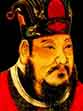
Emperor Wu Di (Hán Vũ Đế)

According to legend, when he was still young, he was tested by Emperor Jindi to determine if he was intelligent or not. His answer pleased him so much that Jindi undertook to educate him and changed his name to Che: the intelligent. At the beginning of his reign, he faced some difficulties with his reforms due to the laxity of his predecessors, advocated by the Daodejing (Đạo Đức Kinh), and the oversight of his relatives, particularly that of his mother Wang (who died in 126 BC) and his grandmother, the great Empress Dowager Dou (Đậu Thái hậu), supported by the court nobility. This nobility was mainly composed of supporters of huanglao (a movement favoring individual fulfillment and legalism in government) and Taoists. Her death in 135 BC allowed him to better consolidate his power and take the reins of government upon the death of his maternal uncle and prime minister Tian Fen (Điền Phần) in 131 BC. From then on, the slightest criticism of his policy was considered a crime of lèse-majesté. He thus became the absolute monarch of the empire.

This did not prevent him from listening to his advisers while respecting laws, rites, and customs. He called upon new men, scholars (or boshis), among whom was a scholar named Dong Zhongshu (Đổng Trọng Thư), a specialist in the Chronicle of Spring and Autumn (Chunqiu). On his advice, Wudi adopted Confucianism adapted to his time with various contributions, particularly borrowings from Legalism and the theory of Yin and Yang and the Five Elements. This was reflected in practice by a new, more coherent doctrine encompassing politics, the individual, and society. The rites were celebrated according to the prescriptions of the texts.

Morality, righteousness (yi), and perfect knowledge of the Classics were criteria for selecting officials in the administration through an examination. In 124 BC, Wudi founded near Chang An the great university (taixue), a kind of imperial academy dedicated to the study of Confucius’s texts. Confucianism began to spread to all layers of society. In 104 BC, Wudi abandoned the Qin calendar in favor of a calendar that took into account the first day of the first lunar month of spring instead of the first day of the tenth lunar month, often in February of the year. This is the calendar that the Chinese continue to use to this day. This did not prevent him from listening to his advisors while respecting laws, rites, and customs. He called upon new men, scholars (or boshis), among whom was the scholar Dong Zhongshu (Đổng Trọng Thư), a specialist in the Spring and Autumn Annals (Chunqiu). On the advice of the latter, Wudi adopted Confucianism adapted to his time with various contributions, particularly borrowings from Legalism and the theory of Yin and Yang and the Five Elements. This was reflected in practice by a new, more coherent doctrine that included politics, the individual, and society. The rites were celebrated in accordance with the prescriptions of the texts.

Morality, righteousness (yi), and perfect knowledge of the Classics were criteria for selecting officials in the administration through an examination. In 124 BC, Wudi founded near Chang An the great university (taixue), a kind of imperial academy dedicated to the study of Confucius’ texts. Confucianism began to permeate all layers of society. In 104 BC, Wudi abandoned the Qin calendar in favor of a calendar that took into account the first day of the first lunar month of spring instead of the first day of the tenth lunar month, often in February of the year. This is the calendar that the Chinese continue to use to this day.

Then, by finding the virtue of the earth from the fact that Liu Bang came from the common people, Wudi henceforth adopted the element « Earth » and chose the color yellow associated with it as the imperial color of the Han because this choice was established according to the teaching of the Five Elements (Wu Xing) (Ngũ Hành). By its color,

white (Metal) (Kim) for the Shang-Yin (Ân–Thương)
red (Fire) (Hỏa) for the Zhou (Châu)
black (Water) (Thủy) for the Qin (Tần)
yellow (Earth) (Thổ) for the Han (Hán),

each element has a particular meaning. Each dynasty established its power under the protection of this element. Wudi chose the element « Earth » to neutralize the « Water » of the Qin. Taking the example of the first emperor of China (Shi Huang Di) of the Qin dynasty, it is observed that he symbolically justified his right to rule because only water, represented by the color black, could destroy the power of the king of the Zhou who was under the sign of the fire element (red color). Similarly, the Zhou dynasty had succeeded in taking power from King Di Xin (in Vietnamese Trụ Vương or Đế Tân) of the Shang dynasty because the fire element of the Zhou dynasty could melt the metal, the protective element of the Shang dynasty. The Xia dynasty would probably be associated with the color green if its existence were confirmed. The succession of Chinese dynasties results in the following pattern corresponding to the cycle of destruction or domination in Wuxing:

Earth—> Water—> Fire —> Metal—> Wood

This new concept of the cosmic order of things now inspires the organization of China’s relations with other countries or the king’s relations with the people. Analogous to the purple North Star around which stars of different sizes revolve, Wudi’s China places itself at the center around which peoples of different importance revolve, each in its place. Being the Son of Heaven, the emperor placed at the center of his empire is the link between heaven and the people. He governs through justice and rites. His power is entrusted by Heaven. That is why when people obey him, they also comply with Heaven’s wishes. He is never accountable to the people but is judged only by Heaven through signs of good or bad omens on earth (natural disasters, earthquakes, good or bad harvests, floods, etc.). The three cardinal guides (the ruler guides the subject, the father guides the son, and the husband guides the wife) (Tam Cương) and the five permanent virtues (benevolence, righteousness, propriety, knowledge, and sincerity) (Ngũ Thường) become effective tools not only to consolidate the absolute power of the emperor but also to maintain order in feudal society.

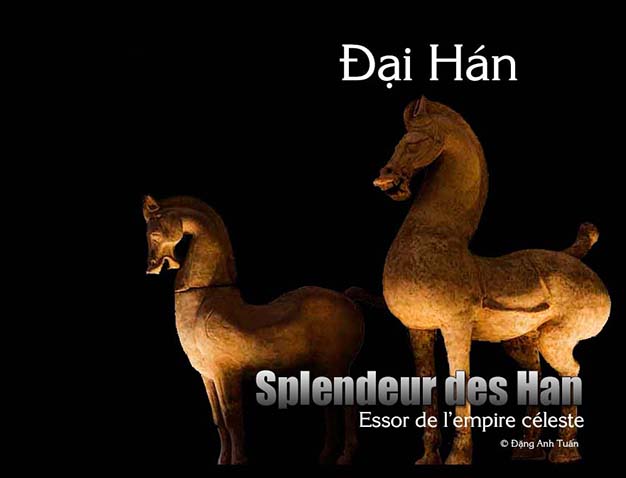
More than 200 works from 27 institutions and museums unveil Chinese society under the Han dynasty.

HANDI

Guimet Museum of Asian Arts

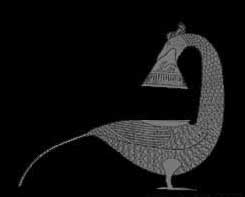
Phoenix-shaped lamp 

[Return CHINE, Empire du Milieu]

Orchard culture (Văn hóa miệt vườn)

Version française
Version vietnamienne
Galerie des photos

Before becoming the Mekong Delta of Vietnam, this territory belonged to the kingdom of Funan for seven centuries at the beginning of the Christian era. Then it was taken back and included in the Angkorian empire at the beginning of the 8th century before being ceded to the lord of the Nguyễn at the beginning of the 17th century by the Khmer kings. It is a region irrigated by a network of canals and rivers that fertilize its plains through alluvial deposits over the centuries, thus promoting orchard cultivation. The Mekong perpetually pits the native of its delta against it, much like the Nile does with its fellah in Egypt. It has succeeded in building a « southern » identity for him and granting him a culture, the one the Vietnamese commonly call « Văn hóa miệt vườn (orchard culture). » Beyond his kindness, courtesy, and hospitality, the native of this delta shows a deep attachment to nature and the environment.

With simplicity and modesty in the way of life, he places great importance on wisdom and virtue in the education of his children. This is the particular character of this son of the Mekong, that of the people of South Vietnam who were born on land steeped in Theravada Buddhism at the beginning of the Christian era and who come from the mixing of several peoples—Vietnamese, Chinese, Khmer, and Cham—over the past two centuries. It is not surprising to hear strange expressions where there is a mixture of Chinese, Khmer, and Vietnamese words.

This is the case with the following expression:

Sáng say, Chiều xỉn, Tối xà quần

to say that one is drunk in the morning, in the afternoon, and in the evening. The Vietnamese, the Chinese, and the Cambodians respectively use say, xỉn, xà quần in their language to signify the same word « drunk. » The same glass of wine can be drunk at all times of the day and shared with pleasure and brotherhood by the three peoples.

The native of the Mekong Delta easily accepts all cultures and ideas with tolerance. Despite this, he must shape this delta over the centuries with sweat, transforming a land that was until then uncultivated and sparsely populated into a land rich in citrus orchards and fruits, and especially into a rice granary. This does not contradict what the French geographer Pierre Gourou, a specialist in the rural world of Indochina, wrote in his work on the peasants of the delta (1936):

It is the most important geographical fact of the delta. They manage to shape the land of their delta through their labor.

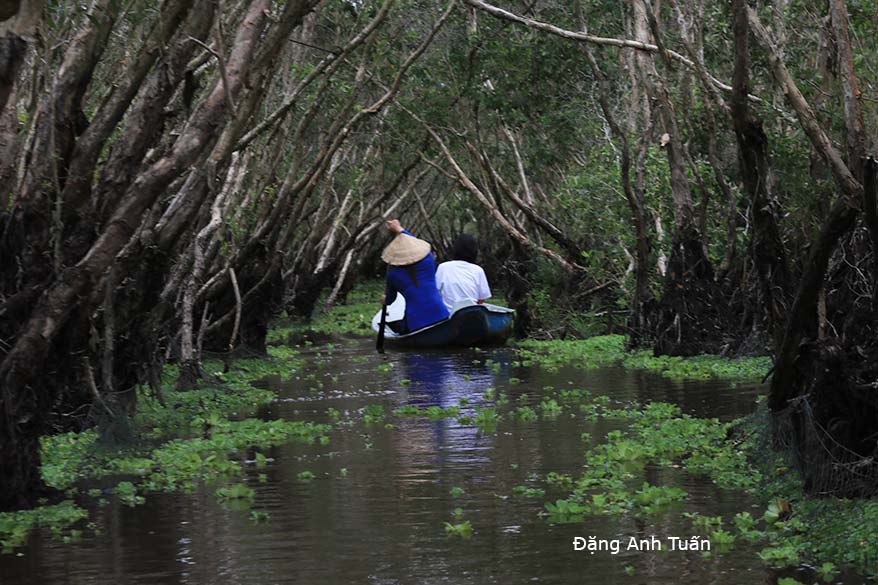
Before becoming the Mesopotamia of Vietnam, the Mekong Delta was a vast expanse of forests, swamps, and islets. It was an apparently inhospitable environment teeming with various forms of life and wild animals (crocodiles, snakes, tigers, etc.). This is the case in the far south of Cà Mau province, where today lies the world’s second-largest mangrove forest. That is why the difficulties faced by the first Vietnamese settlers are still recounted in popular songs.

Muỗi kêu như sáo thổi
Đỉa lội như bánh canh
Cỏ mọc thành tinh
Rắn đồng biết gáy.

The buzzing of mosquitoes resembles the sound of a flute,
leeches swim on the water’s surface like noodles floating in soup,
wild grasses grow like little elves,
field snakes know how to hiss.

or

Lên rừng xỉa răng cọp, xuống bãi hốt trứng sấu

Going up the forest to pick tiger teeth, going down to the shore to collect crocodile eggs

This describes the adventure of people daring to venture perilously into the forest to face tigers and descend into the river to gather crocodile egg clutches. Despite their bravery, danger continues to lurk and sometimes sends shivers down their spines, so much so that the song of a bird or the sound of water caused by the movement of a fish, amplified by the boat’s motion, startles them in an inhospitable environment full of dangers.

During the monsoon season, in some flooded corners of the delta, they do not have the opportunity to set foot on land and must bury their loved ones by hanging the coffins in the trees while waiting for the water to recede or even in the water itself, so that nature can take its course, as recounted in the moving stories reported by the famous novelist Sơn Nam in his bestseller « Hương Rừng Cà Mau. »

Here comes the strange land
Even the bird’s call is fearful, even the fish’s movement is scary.

It is here that, day and night, the swarm of hungry mosquitoes is visible in the sky. That is why it is customary to say in a popular song:

Tới đây xứ sở lạ lùng
Con chim kêu cũng sợ, con cá vùng cũng ghê.

Cà Mau is a rustic land,
mosquitoes as big as hens, tigers as big as buffaloes.

Cà Mau is a rural region. The mosquitoes are as large as hens and the tigers are comparable to buffaloes.

Courage and tenacity are among the qualities of these delta natives as they strive to find a better life in an ungrateful environment. The great Vĩnh Tế canal, more than 100 km long, dating back to the early 19th century, bears witness to a colossal project that the ancestors of these delta natives managed to accomplish over five years (1819-1824) to desalinate the land and connect the Bassac branch of the Mekong (Châu Ðốc) to the Hà Tiên estuary (Gulf of Siam) under the direction of Governor Thoại Ngọc Hầu. More than 70,000 Vietnamese, Cham, and Khmer subjects were mobilized and forcibly enlisted in this endeavor. Many people had to perish there.

On one of the 9 dynastic urns arranged in front of the temple for the worship of the kings of the Nguyễn dynasty (Thế Miếu) in Huế, there is an inscription recounting the excavation work of the Vĩnh Tế canal with gratitude from Emperor Minh Mạng to the ancestors of the natives of the Mekong. Vĩnh Tế is the name of Thoại Ngọc Hầu’s wife, whom Emperor Minh Mạng chose to recognize her merit for courageously helping her husband in the construction of this canal. She passed away two years before the completion of this work.

The delta was at one time the starting point for the exodus of boat people after the fall of the Saigon government (1975). Some perished on the journey without any knowledge of navigation. Others who failed to leave were captured by the communist authorities and sent to re-education camps. The harshness of life does not prevent the natives of the Mekong from being happy in their environment. They continue to maintain their hospitality and hope to one day find a better life. Over the centuries, they have forged an unparalleled determination and community spirit in search of fertile land and a space of freedom. Speaking of these people of the delta, one can recall the phrase of the writer Sơn Nam at the end of his book titled « Tiếp Cận với đồng bằng sông Cửu Long » (In Contact with the Mekong Delta): No one loves this delta more than we do. We accept paying the price for it.

It is in this delta that one finds today all the charming facets of the Mekong (the sun, the smile, the exoticism, the hospitality, the conical hat silhouettes, the sampans, the floating markets, the stilt houses, an abundant variety of tropical fruits, cage fish farming, floating rice, local specialties, etc.). This is reflected in the following proverb:

Ðất cũ đãi người mới
The old land welcomes the newcomers.

At the time of the country’s reunification in 1975, the Vietnamese government settled more than 500,000 farmers from the North and Central Vietnam in the labyrinth of this delta. Fed by rich alluvium, it is highly fertile. Today, it has become the economic lung of the country and a boon for the 18 million people in the region. It is said that it alone could feed all of Vietnam.

Galerie des photos

culture_verger

[Return CIVISATIONS]


Bronze drums (Part 3,VA)

Who are the Dongsonians?

Version française
Version vietnamienne

It is very important to know them because we know they were the owners of these bronze drums. Are they the ancestors of the current Vietnamese? Very little is known about these people and their culture because the research started in the early 20th century by the French was interrupted during the long years of war that Vietnam experienced. However, it is certain that in the 1st century AD, the Dongsonian culture ended with the Chinese annexation.

It was only from 1980 that archaeological excavations resumed. We began to better understand their origin, way of life, and sphere of influence. Thanks to the exceptionally enriched archaeological documentation in recent years, the origin of the Dongsonian culture has been fairly clarified. This culture has its roots among the pre-Dongsonian cultures (those of Phùng Nguyên, Ðồng Dậu, and Gò Mun). There is no need to look so far north or west for the origin of this culture. The Dongsonian culture is actually the result of a succession of stages corresponding to these three cultures mentioned above in a continuous cultural development. The eminent Vietnamese archaeologist Hà Văn Tấn was right to solemnly say: To search for the origins of the Dongsonian culture in the North or West, as several researchers did in the past, is to put forward a hypothesis without scientific basis.

Thanks to the distribution maps of archaeological sites in the Red River basin, it is evident that the pre-Dongson Bronze Age cultures occupied exactly the same region where the sites of the Phùng Nguyên culture were located. It can be said without hesitation that the Đông Sơn culture extends from Hoàng Liên Sơn province in the north to Bình Trị Thiên province in the south.

The Dongsonians were above all skilled rice farmers. They cultivated rice using slash-and-burn methods and flooded fields. They raised buffaloes and pigs. But it was water that was both their wealth and their primary concern because it could be deadly, overflowing from the Red River to engulf crops. They were daring navigators, so close to rivers and coasts that they were accustomed to using dugout canoes for their movements. This custom was so deeply ingrained in their minds that they built their homes as wooden stilt houses with immense roofs curved at both ends, decorated with totemic birds and resembling a dugout canoe.

Even in their death, they designed coffins shaped like canoes. According to Trịnh Cao Tường, a specialist in the study of communal houses (đình) of Vietnamese villages, the architecture of the Vietnamese communal house elevated on stilts reflects the echo of the spirit of the Dongsonians still present in the daily life of the Vietnamese.

The Dongsonians used to tattoo their bodies, chew a preparation made from areca nuts, and blacken their teeth. Tattooing, often described as a « barbaric » practice in Chinese annals, was, according to Vietnamese texts, intended to protect people from attacks by water dragons (con thuồng luồng).

The habit of chewing betel is very ancient in Vietnam. It existed long before the Chinese conquest. When mentioning the blackening of teeth, one cannot forget the famous phrase spoken by Emperor Quang Trung before the liberation of the capital « Thăng Long, » occupied by the Qing: « Đánh để được giữ răng đen. » Fight the Chinese to liberate the city and to keep the teeth blackened. This clearly shows his political will to perpetuate Vietnamese culture, particularly that of the Dongsonians. 

They wore their hair long in a bun and supported by a turban. According to some Vietnamese texts, they had short hair to facilitate their movement in the mountain forests. Their clothing was made from plant fibers. During recent excavations of the Làng Cả necropolis (Việt Trì) in 1977 and 1978, it was observed that differences in wealth were pronounced among the Dongsonians in the analysis of funerary furniture. Opulence is visible in certain individual tombs. Society began to structure itself in a way that revealed the gap between the rich and the poor through funerary furniture. There is no longer any doubt about the increasingly advanced hierarchy in Dongsonian society. It is also found in their military hierarchy: the wearing of metal armor was reserved for the great military chiefs. Lesser chiefs had to make do with leather cuirasses or tree bark coats of armor, similar to those of the Dayak in Borneo, Indonesia.

During recent archaeological excavations, Vietnamese archaeologists are confronted with the burial practices used by the Dongsonians. They employed various modes of burial: interments in pits (mộ huyện đất) with the deceased in a lying or crouching position (Thiệu Dương), burials in dugout coffin boats (mộ thuyền) (Việt Khê, Châu Can, Châu Sơn), burials in bronze jars or inverted drums (mộ vò). ( Đào Thịnh, Vạn Thắng) .

The burial mode in boat-shaped coffins has only been found in certain regions of Northern Vietnam (Hải Phòng, Hải Hưng, Thái Bình, Hà Nam Ninh, and Hà Sơn Bình). The area is very limited compared to the zone of influence of the Đồng Sơn culture. On the other hand, in famous Dong Son sites such as Làng Cả (Vĩnh Phú), Đồng Sơn, Thịệu Dương (Thanh Hoá), Làng Vạc (Nghệ Tĩnh), no burial mode involving boat-shaped coffins has been reported. Some Vietnamese archaeologists like Hà Văn Tấn believe that the coffins had the possibility of being preserved because they were located in a marshy area. This is not the case for other coffins, as they were situated in unfavorable places where water could erase everything over time.

According to Vietnamese archaeologist Hà Văn Tấn, the marsh area could have been, during the Dong Son period, a swampy region where people lived under conditions similar to those who habitually soaked their skin and skeleton in water throughout their lives and in death. (Sống ngâm da, chết ngâm xương). It is not surprising to find in these people their way of thinking and their method of burying the dead in boat-shaped coffins because for them, from birth to death, the means of transport was always the boat.

Other archaeologists question the disappearance of this custom among the Vietnamese. Why does this burial method continue to be practiced by the Mường, close cousins of today’s Vietnamese? Yet they share the same ancestors. The explanation that can be given is as follows: the diversity of burials clearly shows the « disparate » nature among the Dongsonians. Considered as Indonesians (or Austroasians (Nam Á in Vietnamese)), they are in fact populations of the same culture but remain physically heterogeneous. According to Russian researchers Levin and Cheboksarov, the Indonesians would be a mix of Australoids and Mongoloids. They originated from the fusion of the Luo Yue (Lac Việt), (Australo-Melanesian elements, ancient inhabitants of eastern Indochina who still remained on the continent) and Mongoloid elements probably coming via the Blue River from the borders of Tibet and Yunnan during the Spring and Autumn period (Xuân Thu). It does not appear that physical diversity is accompanied by cultural diversity. At each era, the same tools and customs seem common to all. If there is a difference in the burial method, this can be explained by the lack of resources and forced Sinicization among the Vietnamese. This is not the case for the Mường, who, taking refuge in the most remote corners of the mountains, can perpetuate this custom without any difficulty.

According to archaeologist Hà Văn Tấn, it is possible to find oneself in this hypothesis illustrated by the example of the burial method, which is carried out differently today among the Southern Vietnamese (descendants of a mixture of Vietnamese, Chinese, Chams, and Khmers) and those from the North, even though they come from the same people and the same culture.

It is through picturesque traits that we begin to better understand the Dongsonians during archaeological excavations. There is no longer any doubt about their origin. They belonged to the Hundred Yue or Bai Yue because in them we find everything related to the Bai Yue: tattooing, teeth lacquering, betel chewing, worship of totem animals, stilt houses, use of drums, etc., among the 25 characteristic elements found among the Yue and cited by the British sinologist Joseph Needham. They were designated in Chinese annals by different generic names: Man Di during the Spring and Autumn period, Hundred Yue (or Bai Yue) during the Warring States period (Tam Quôc), Kiao Tche (or Giao Chi in Vietnamese) during the Han (or Chinese) domination.

According to Vietnamese scholar Đào Duy Anh, the name Kiao Tche (Giao Chỉ) given to the Yue peoples in northern Vietnam originally designates the territories occupied by the Yue who worship the kiao long (giao long) (crocodile-dragon), kiao and tche meaning respectively dragon and territory.

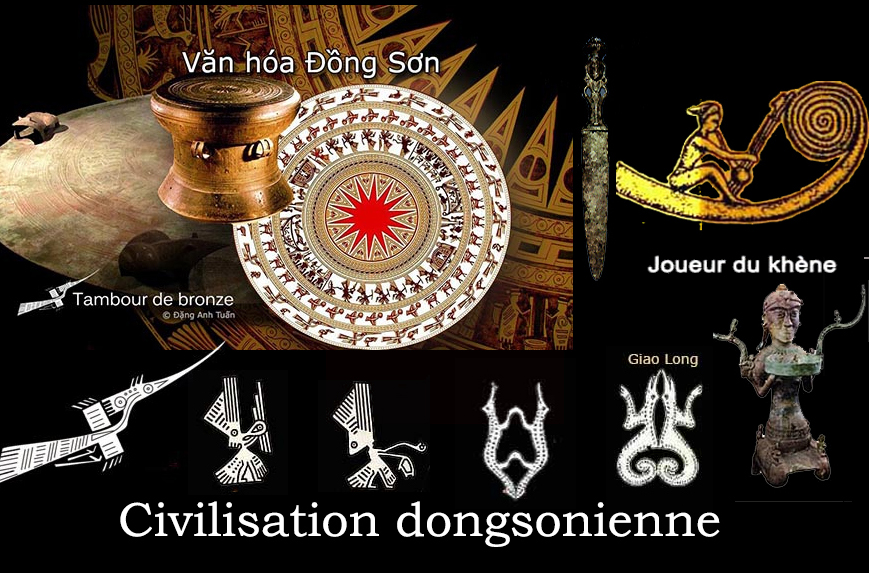
This hypothesis was adopted and supported by Vietnamese archaeologists Hà Văn Tấn and Trần Quốc Vượng. This crocodile-dragon, a totemic animal of the Dongsonians, is found in funerary artifacts: axes, spears, armor plates, and thạp vases (for example, Đào Thịnh). It is from this multiple mixture of Dongsonians with other ethnic groups from Si Ngeou (Tây Âu), ancestors of the Tày, Nùng, Choang, and close relatives of the Thai in the mountainous regions of Kouang Si (Guangxi) and Northern Vietnam at the beginning of the Iron Age (3rd century BC, Âu Lạc period) that today’s Vietnamese originate.

The territory of the Hundred Yue is so vast that it forms an inverted triangle with the Yangtze River (Dương Tử Giang) as the base, Tonkin (Northern Vietnam) as the apex, the regions of Tcho-Kiang (Zhejiang), Fou Kien (Fujian), and Kouang-Tong (Guangdong) on its eastern side, and the regions of Sseu-tchouan (Sichuan), Yunnan (Vân Nam), Kouang Si (Guangxi) on its western side. (Paul Pozner).
Many chiefdoms were established there, and there were no borders hindering the spread and circulation of their traditions, particularly the making and use of bronze drums. This is why it is possible that bronze drums were made at the same time in distinct centers within the territories of the Yue (Vietnam, Yunnan, Guangxi) according to different casting techniques (lost-wax casting in Vietnam, mold sections in Yunnan) and according to the availability of local mining resources.

In the analyses of Ðồng Sơn bronzes, it is observed that the percentage of lead is higher than that of tin, which is an exceptional fact in the technology of Dong Son bronze. But it is surprising to find roughly the same lead and tin content in the analysis of the Kur drum bronze in Indonesia. It would have been impossible for the Indonesians of that time to chemically analyze this drum to know the content of each metal. They must have learned from the Dong Son people either directly or indirectly. This strongly supports the hypothesis of the diffusion of metallurgy from the Red River basin starting in Vietnam, unless Dong Son metallurgists were present on their territory at that time.

Moreover, the Dong Son people knew how to seek an appropriate alloy for each type of object they made. This is the case with the weapons found in the Dong Son burial sites, where the lead content is lower and the tin content quite significant, giving them a remarkable degree of hardness. Furthermore, the percentages of metals in the chemical composition of the bronzes from Jinning (Yunnan) are roughly the same as those of ancient Chinese bronzes. (Nguyễn Phước Long: 107). This is not the case with the Dong Son bronzes.

These were local and original products and belonged to the Red River civilization. Living on the edge of the East Sea or South China Sea (Biển Đông), the Dong Son people were close to major trade routes, which allowed for a wide dissemination of their culture and their bronze drums. It was about 2 km from the Vietnamese coast in the Vũng Áng region (Hà Tĩnh) that a Vietnamese fisherman accidentally caught two objects in his net in 2009 in the East Sea: a bronze axe and a spearhead dating from the Đồng Sơn period.

This proves that the Dongsonian people used maritime routes to establish a network of exchanges with all the states bordering the South China Sea (starting from the north, clockwise). In Zhejiang (Triết Giang), during an archaeological excavation at Thượng Mã Sơn (An Cát, Hồ Châu or Huzhou Shi), Chinese archaeologists found an object that was not native to this region and undoubtedly belonged to the Dongsonian civilization. It is a bronze drum similar to the one found in Lãng Ngâm in Bắc Ninh province in Northern Vietnam. (Trịnh Sinh 1997). Then in Canton, in the tomb of King Zhao Mei (Triệu Muội), identified as the second ruler of Nan Yue and known as Nam Việt Vương in Vietnamese, cylindrical situlas with geometric decoration (thạp) were discovered, frequently found in Dongsonian sites in Vietnam. Finally, along the Vietnamese coast (Champa, Chenla), in territories where the Sa Huỳnh culture was present at that time, bronze drums, daggers, and Dongsonian axes were also found in bronze jar burials (mộ vò).

Further inland, on the island (Hòn Rái) of Kiên Giang province, near Phú Quốc island, in the Gulf of Siam, a Đông Sơn bronze drum was discovered in 1984 during the exhumation of bodies, inside which were found axes, spearheads, as well as human bones. We must also not forget the bronze drums found in Thailand, characterized by the three elements copper, lead, and tin, with lead content reaching up to 20% (U. Gueler 1944), which testifies to one of the characteristics of Đông Sơn bronzes (Trinh Sinh: 1989: 43-50). The Đông Sơn civilization developed in a very open environment. In northern Vietnam, the flow of information and objects was facilitated by the Red River, which originates in Yunnan and was considered the river Silk Road between the Dian kingdom and that of the Đông Sơn people. Benefiting from the abundance of mineral deposits in their territory and the proximity to the coasts of the East Sea, they succeeded in developing a spectacular bronze art and imposing a very original and distinctive style through their bronze drums, situlas, and magnificent objects, which probably explains their leadership role in mastering lost-wax casting and facilitating exchanges not only within the Yue territories but also in territories as distant as those.

For the Dongsonians as for the Yue, the bronze drum was not only a common cult heritage that they were supposed to keep carefully but also an emblem of power and rallying beyond their village and ethnic community. The bronze drum, which guaranteed agrarian rites and social cohesion, was made by talented local metallurgists solely to perpetuate their ancestral tradition, never considering that their artistic work could become an object of dispute between the two peoples, Vietnamese and Chinese, one being considered the legitimate heir of the Hundred Yue and supposed to revive the civilization of its ancestors, that of the Bai Yue, and the other, conqueror of the territories of the Bai Yue and supposed to restore to the descendants of the Yue the place they deserve in today’s China. One cannot remain indifferent to the hypothesis defended by the sinologist Charles Higham in his work entitled « The Bronze Age of Southeast Asia« :

The search for origins and changes occurring in the second half of the 1st millennium BCE in the region leads to the overlooking of an important point. These changes taking place in what have become today the south of China and the Red River Delta basin were accomplished by groups exchanging their ideas and goods in response to strong pressure from the north, from powerful and expansionist states (Chu (Sỡ), the Qin (Tần), and the Han (Hán)) who ultimately managed to crush them.

From a historical and cultural perspective, all those descended from the Yue have the right to claim this heritage. But from a logical standpoint, only the Luo Yue (or the Dongsonians) among the Baiyue succeeded in forming a nation and having an autonomous and independent country (Vietnam). This is not the case for the other Yue, who were all sinicized over the centuries during the imperial expansion initiated by the Qin and the Han. No one has the right to contest the Yue character in present-day Vietnamese. This is also the observation made by the French ethnologist Georges Condominas:

Mentioning the Yue is to go back to the origins of Vietnamese identity. (G. Condominas). It is obvious that the paternity of the bronze drums belongs to the Vietnamese, especially since these sacred instruments could carry a message left to them by their ancestors (the Dongsonian people). The inscription engraved on the bronze column of General Ma Yuan is well known: Let this column fall and Giao Chỉ will disappear (Ðồng trụ triệt, Giao Chỉ diệt). Where is this bronze column when we know that Giao Chi (Vietnam) continues to exist today? By closely observing a bronze drum, one notices that it resembles a cut tree trunk. Its tympanum bearing several concentric circles is analogous to the cross-section of the trunk with rings added over the centuries.

Does the bronze drum evoke Ma Yuan’s bronze column? Some scientists believe that the bronze drum is the « tree of life. » This is the case for the Russian scientist N.J. Nikulin from the Moscow Institute of Culture. Relying on the discoveries and suggestions of Vietnamese researchers (such as Lê Văn Lan) about the idea of a « totality » represented by the bronze drum through its depictions, he arrives at the following conclusion: The bronze drum is a representation of the universe: the tympanum (or the plate), symbolizing the celestial and terrestrial world (thiên giới, trần giới), the trunk representing the marine world (thủy quốc), and the base representing the underground world (âm phủ). According to him, there is an intimate relationship between the bronze drum and the mythical narrative of the Mường, close relatives of the present-day Vietnamese.

In the Mường conception of the creation of the universe, the tree of life symbolizes the notion of universal order, as opposed to the chaotic state found at the moment of the world’s creation. The worship of the tree is a very ancient custom of the Vietnamese. The areca palm found in the betel quid (chuyện trầu cau) testifies to this worship. According to historian and archaeologist Bernet Kempers, the bronze drum illustrates a fundamentally monistic (Oneness) vision of the cosmos.         

It is this bronze drum that the Han wanted to destroy to seal the fate of the Dongsonians because it was the tree of life symbolizing both their strength and their conception of life. Fortunately, over the centuries, the bronze drum did not disappear, but thanks to the picks and shovels of French and Vietnamese archaeologists, it reappeared splendid and radiant, allowing the descendants of the Dongsonians to rediscover their true history, their origin without being seen as cooked barbarians.

Being a sacred instrument, the bronze drum is more than ever involved in the restoration and testimony of the identity of the Vietnamese people, which was nearly erased many times by the Middle Kingdom throughout its history.

[Return CIVILISATIONS]

Bronze drums (Part 2,VA)


soleil_dongsonThe star appears in the center of the drums

Bronze drums debates

Version vietnamienne

Version française

In this important study on bronze drums, he distinguishes 4 main types:

In type I, the bronze drum is of imposing size. It consists of three distinct parts: a conical base, a straight or slightly inclined cylindrical body, and a bulging part (or tang in Vietnamese) that ends at the meeting point of the drumhead with an edge. For Heger type I drums belonging to the last period of the Bronze Age and dating from the 1st and 2nd centuries AD, various motifs (figures, birds, boats, stilt houses) and concentric zones with a raised star in the center with a number of rays appear on the drumhead (Ngọc Lũ, Hoàng Hạ, Sông Ðà, Thựơng Lâm, Quảng Xương, etc.). Its resonating body has 4 pairs of handles.

In type II, the drumhead overhangs its bulging part which, together with its slightly flared straight part towards the bottom, forms the resonating body of the drum. Moreover, it has only two pairs of handles. These drums have been discovered in the habitation area of the Mường ethnic minorities. The drumhead is richly decorated with 4 or 6 toads, even elephants and turtles in relief. These animals are placed counterclockwise. The motifs are so stylized as to become unrecognizable. A large number of drums of this type have been found in Vietnam, in southern China and the Malay Archipelago.

In type III, the drums are always equipped with a plate on which toads are stacked in limited numbers. These amphibians are aligned counterclockwise. There is an elongation of the cylindrical body up to the lower edge without much flaring. The handles are small and elegant. The distribution area of these drums is mainly to the west of the Trường Sơn mountain range, in Thailand, Laos, Myanmar, and Yunnan.

In type IV, these are copies of type I drums. Sometimes there are Chinese characters. They are found in large numbers in Yunnan (China). The plate fits directly onto the body and never overhangs. These drums are generally small in size. The star in the middle of the plate always has twelve rays corresponding to the duodenary cycle (12 earthly branches). They are found in Vietnam in the northern border region among the Lo Lo and Pupe ethnic minorities.

In general, the ornamentation is considered rich in information on the plate (or tympanum), particularly that of type Heger I: warriors armed with crossbows or javelins, humans adorned with bird feathers, musicians playing the khène or handling castanets, women wearing loincloths pounding rice in a mortar, fish, stylized birds, deer, ritual canoe races, funeral rituals, etc.

Regarding the ornamentation found on the drum body, there are significant differences from one drum to another in terms of themes and animal representations. The order of decoration seems arbitrary. It can be observed that many drums have no ornamentation on their bodies. However, this is not the case for the drumheads. The ornamentation with concentric circles presents an identical structure from one drum to another. On the other hand, the figurative character found on the drumheads of the earliest drums (Ngọc Lũ, Hoàng Hạ, Sông Ðà, Cổ Loa, Moulié, etc.) increasingly evolves towards abstraction and geometrization. Despite this, the overall structure, particularly the orientation of the drum, is generally maintained by the presence of a minimal circle of four birds, which gives the drumheads a sacred character and the drums their true raison d’être.

According to Catherine Noppe, curator of the Oriental Collections at the Royal Museum of Mariemont, the Dongson culture was the origin of a number of specific forms recognizable in decoration. In the repertoire of geometric motifs, there are dots, dotted circles, triangles, diamonds, straight lines, and spirals.

The concentric circles and straight lines used to organize the decoration into precise zones (on the drums or vessels) attest to a desire for clarity and readability necessary for the identification of a decoration often abundant, integrating both animals and figures.

In many debates and writings, there is a tendency to focus on dating and ornamentation. Until today, Vietnamese archaeologists believe that Heger’s general classification structure remains valid because, for them, the fundamental criterion to respect is ornamentation. The finer, more complex, and more numerous the motifs visible in the decoration, the easier it is to prove the origin. This is why they concentrate their efforts on details and propose dividing Heger Type I into several subtypes. This is not the case for Chinese archaeologists who find Heger’s classification obsolete since the discovery of a large number of drums in southern China (Yunnan, Guangxi, and Guangdong). Moreover, according to them, originality should be expressed through simplicity in ornamentation and size. Initially divided over Heger’s classification due to regional affinities (between the Chinese supporters from Guangxi and Yunnan), they have managed to unify their viewpoints and now accept Heger’s classification while adding another type which they have called under the name of  » Pre Heger-I » since the discovery of several bronze drums (Wanjiaba (Vạn Gia Bá), Yunnan) believed to belong to the « Pre Heger I » type in 1975 and 1976.

They claim that these were earlier than those of Ðồng Sơn (Ngọc Lũ, Sông Ðà (Moulié), Hoàng Hạ, Sông Hồng (Gillet), etc.) based on the radiocarbon dating of funerary objects found at the same time as these drums. For them, the important criteria to consider in determining the antiquity of the drum are as follows: its large face, its trunk being reduced from three to two parts, and its less complex decoration. There is no doubt that the oldest bronze drums originated from Yunnan. Unfortunately, their beliefs have been endorsed neither by the global scientific community nor by Vietnamese archaeologists. According to the latter, the dating of bronze drums could not be based solely on the radiocarbon dating of funerary objects because the margin of error would be too high, around 235 years, based on their experience with a piece of wood from a coffin. But there are other factors that should be taken into consideration. This is the case with the example of the bronze drum found in a burial at Việt Khê. Radiocarbon dating indicates that the tomb was 2480 ± 100 years old before 1950 CE (Common Era) or around 530 BCE (Before the Common Era). However, based on its decorative style, the bronze drum could have been made only between the 3rd and 6th centuries BCE.

Besides radiocarbon dating, there is a total divergence between Chinese and Vietnamese archaeologists in the interpretation of the decoration. This is important as it can help archaeologists identify the ethnic and geographical affiliations since it reflects the spiritual life of the people who invented this drum. Each side tries to provide its own interpretation regarding the stilt bird, the amphibian, and the boat.

The stilt bird:

This flying bird seen on the bronze drum with a long beak and long legs is very familiar to the Vietnamese because it is indeed the heron. It is obvious to see it depicted on the bronze drum as it symbolizes the labor and diligence of the proto-Vietnamese. It is part of their daily life. It is often seen accompanying Vietnamese farmers in the rice fields. It is mentioned many times in their popular poems. Thanks to recent linguistic research, the term Văn Lang used to designate the kingdom of the Hùng kings during the Đông Sơn period is nothing other than the phonetic transcription in Chinese characters of an ancient Austro-Asiatic word: vlang, meaning a large stilt bird. Similarly, the name of the Hùng clan known as « Hồng Bàng » also refers to a stilt bird related to the heron.

For the Chinese, the heron is considered the accompanying bird, after death, of the soul towards immortality (cỡi hạc qui tiên). It is a long tradition to decorate drums with heron motifs in the central plains of China. The spread of this belief first becomes visible in the area of the Chu principality (Sỡ Quốc) and then among other ethnic groups in southern China. This is undoubtedly Chinese influence.

The amphibian

It can be seen on certain bronze drums, particularly those of the Heger I type belonging to the last period of the Bronze Age and dating from the 1st and 2nd centuries AD (late drums) (or trống muộn Heger I). Chinese archaeologists believe that the small amphibians found on the faces of these drums are frogs used for ornamental purposes without any special meaning. However, for the Vietnamese, the presence of frogs on the drum surface suggests that the drum could be a rain drum because, according to Vietnamese tradition, there is a close kinship between amphibians and Heaven:
Toads and frogs are the uncles of the Lord Heaven
Beware those who mistreat them; they will be punished accordingly.

Their presence can be explained by beliefs common to all peoples of southern Asia: the croaking of amphibians announces the rain essential for the sown fields.

The boat:

For the Chinese, the boat is mentioned to reflect the ancient tradition of the annual ritual race in the Chu kingdom during the Warring States period. This custom aims to honor the memory of the famous poet Qu Yuan (Khuất Nguyên). He committed suicide in 278 BC to denounce the endemic corruption of his time in this kingdom, which was later annexed by the Qin. For the Vietnamese, opinions are divided. Some share the same view as the Chinese, opting for the theme of the « Paddled Boat » because it is more detailed and visible on certain drums (Sông Đà, Miếu Môn, Làng Vạc, etc.), but others continue to think of funerary ceremonies. This is a thesis defended by Goloubew (1929), citing ethnographic examples of the Dayak (Borneo), and has become the dominant thesis today in popular writings.

This custom is still practiced today by the Dayak, who were formerly established on the eastern coast of Indochina. They still believe in the existence, in the middle of the ocean, of a mysterious island where their ancestors enjoy supreme happiness. It is this golden boat (or boat of the dead) that can be seen depicted on the Hoàng Hạ and Ngọc Lữ drums with warriors without paddles, ready to fight the malevolent spirits that threaten them in the afterlife. This mystical theme is essentially based on the funerary cult, an ancient tradition known by the Dayak who, born near the rivers and close to the coasts, should one day return to their distant paradise by taking this ghost boat upon their death.

The Tiwah (lễ chiêu hồn) or the festival of the dead continues to be celebrated to this day by the Dayak of Borneo. The canoe-shaped coffins (mộ thuyền) found in Dong Son burials (Việt Khê for example) are not unrelated to this tradition. It is important to recall that, being dolichocephalic Indonesians (Deniker) (or Austroasiatics), the Dayak Ot-Danom and Olo-ngadju had a hierarchical organization identical to that which still exists among the Mường of the Black River (Sông Ðà), an ethnic minority close to the present-day Vietnamese. The power of their chiefs is considered hereditary.

Besides the Sino-Vietnamese disagreements mentioned above, there remains an important element pitting several theories against each other. It is the star depicted at the center of the drum’s plateau. The number of rays varies from one drum to another. On the Ngọc Lũ drum, there are 14 rays while the Hoàng Hạ drum has two more. As for the Vienna drum, it has only 12 rays. It is unlikely that this central star with multiple rays is a star, as people of that time could not have seen it larger than the one they observed in the sky. There is only one star larger than the others around which scenes of life are arranged in rhythm with the seasons. Could it be anything other than the sun?

In an agrarian society, the sun and rain are needed to fertilize the soil and have good harvests. The French archaeologist M. Colani, who discovered the Hoà Bình culture in 1926, held this view when speaking of a solar cult in Indochina. (7). But this hypothesis was contested by the Australian anthropologist and historian Helmut Loofs-Wissova. He rejects the idea that the inter-radial triangles are passive decorative elements. There is no reason to think of a celestial body, but these triangles should be considered as the product of a differentiation into « quarters. » He went further in his approach by considering that these drums are like regalia (quyền trượng). He explains their dispersion by the desire of local chiefs wishing to have the grace of ritual authority (but not political) located somewhere in northern Vietnam and having the power to give them bronze drums, like the papacy in the West with regalia. This hypothesis cannot be corroborated first by the presence of dotted circles, simple or concentric, found abundantly on the ornaments and weapons of warriors disguised as spirit-men, as these have long been known as heliacal symbols in prehistoric Western art (on Caucasian and Hispanic bronzes).

Moreover, after the annexation of the Giao Chỉ territory by the Chinese, the distribution of bronze drums continued to spread towards Southeast Asia. It seems unthinkable to imagine that there exists in this territory an independent political or religious power without the agreement of the Han (or Chinese). Those who are only the destroyers of bronze drums in the manner of their general Ma Yuan cannot use them as regalia. Although this theory is appealing, it seems less convincing.

According to the beliefs of the Austroasiatic peoples, the drum is not only a sacred instrument but also a living fetish. By designating the drum with the word « trống » in Vietnamese, it is known to be masculine. It is customary to refer to the rooster with the word « gà trống or gà sống. » Similar to the Yue’s knife (Alain Thote), it must be nourished with blood, alcohol, and rice. It is awakened from time to time during ritual ceremonies by strikes of a mallet at the center of its surface, where the sun is depicted symbolizing the driving force of the gift of life. It is also here that its soul and magical power reside.

Being of a yang nature and always accompanied by gongs (of a Yin nature) which the Mường, close cousins of the Vietnamese, consider as a stylized representation of the woman’s chest in ritual festivals, it is charged with protecting not only the village but also the clan or tribe that must demonstrate its legitimacy in possessing it and its ability to maintain it with remarkable regularity. Sometimes its prestige can go beyond its regional sphere, and its capacity for rallying and mobilization is considerable. It can express its wrath through the voice of a female medium (kruu) among the Kantou of the Annamite Range (Trường Sơn), as reported by Yves Goudineau in his article entitled « Bronze Drums and Ceremonial Circumambulations » (BEFEO, Volume 87, no. 2, pp. 553-578).

In northern Vietnam and in Yunnan province, there is a strange custom of getting rid of the bronze drum. Considered a living fetish, the drum is given its birthday (a grand celebration) but it can also be « killed » by piercing the center of its drumhead where the sun is depicted, as this symbolizes the generative force of the gift of life. By destroying it in this way, it is believed that one destroys not only its soul but also the symbol of power of the tribe or clan that owns it and its magical power, in order to prevent later revenge. This also explains the behavior of the Chinese general Ma Yuan during the repression against the Giao Chi. That is why during archaeological excavations in northern Vietnam, drums are sometimes found with the center of the drumhead completely pierced.

[Reading more]

[Bronze drums: Part 3, VA]


Bronze drums (Part 1,VA)

vanhoa_dongson

Version française

Version vietnamienne

Until today, the bronze drums continue to sow discord between the Vietnamese and Chinese scientific communities. For the Vietnamese, the bronze drums are the prodigious and ingenious invention of peasant metallurgists during the time of the Hùng kings, the founding fathers of the Văn Lang kingdom. It was in the Red River delta that the French archaeologist Louis Pajot unearthed several of these drums at Ðồng Sơn (Thanh Hoá province) in 1924, along with other remarkable objects (figurines, ceremonial daggers, axes, ornaments, etc.), thus providing evidence of a highly sophisticated bronze metallurgy and a culture dating back at least 600 years before Christ. The Vietnamese find not only their origin in this re-excavated culture (or Đông Sơn culture) but also the pride of reconnecting with the thread of their history. For the French researcher Jacques Népote, these drums become the national reference of the Vietnamese people. For the Chinese, the bronze drums were invented by the Pu/Liao (Bộc Việt), a Yue ethnic minority from Yunnan (Vân Nam). It is evident that the authorship of this invention belongs to them, aiming to demonstrate the success of the process of mixing and cultural exchange among the ethnic groups of China and to give China the opportunity to create and showcase the fascinating multi-ethnic culture of the Chinese nation.

Despite this bone of contention, the Vietnamese and the Chinese unanimously acknowledge that the area where the first bronze drums were invented encompasses only southern China and northern present-day Vietnam, although a large number of bronze drums have been continuously discovered across a wide geographical area including Thailand, Cambodia, Laos, Myanmar, Indonesia, and the eastern Sunda Islands. Despite their dispersion and distribution over a very vast territory, fundamental cultural affinities are noted among populations that at first glance appear very different, some protohistoric and others almost contemporary. Initially, in the Chinese province of Yunnan where the Red River originates, the bronze drum has been attested since the 6th century BCE and continued to be used until the 1st century, just before the annexation of the Dian kingdom (Điền Quốc) by the Han (or Chinese). The bronze chests intended to contain local currency (or cowries), discovered at Shizhaishan (Jinning) and bearing on their upper part a multitude of figures or animals in sacrificial scenes, clearly testify to the indisputable affinities between the Dian kingdom and the Dongsonian culture.

Then among the populations of the Highlands (the Joraï, the Bahnar, or the Hodrung) in Vietnam, the drum cult is found at a recent date. Kept in the communal house built on stilts, the drum is taken down only to call the men to the buffalo sacrifice and funeral ceremonies. The eminent French anthropologist Yves Goudineau described and reported the sacrificial ceremony during his multiple observations among the Kantou of the Annamite Trường Sơn mountain range, a ceremony involving bronze drums (or Lakham) believed to ensure the circularity and progression of the rounds necessary for a cosmogonic refoundation.

These sacred instruments are perceived by the Kantou villagers as the legacy of a transcendence. The presence of these drums is also visible among the Karen of Burma. Finally, further from Vietnam, on the island of Alor (Eastern Sunda), the drum is used as an emblem of power and rank, as currency, as a wedding gift, etc. Here, the drum is known as the « mokko. » Its role is close to that of the bronze drums of Ðồng Sơn. Its prototype remains the famous « Moon of Pedjeng » (Bali), whose geometric decoration is close to the Dong Son tradition. This one is gigantic and nearly 2 meters high.

More than 65 citadels spread across the territories of the Bai Yue responded favorably to the call of the uprising led by the Vietnamese heroines Trưng Trắc and Trưng Nhị. Perhaps this is why, under Chinese domination, the Yue (which included the proto-Vietnamese or the Giao Chi) hid and buried all the bronze drums in the ground for fear of them being confiscated and destroyed by the radical method of Ma Yuan. This could explain the reason for the burial and location of a large number of bronze drums in the territory of the Bai Yue (Bách Việt) (Guangxi (Quảng Tây), Guangdong (Quảng Đông), Hunan (Hồ Nam), Yunnan (Vân Nam), Northern Vietnam (Bắc Bộ Vietnam)) during the conquest of the Qin and Han dynasties. The issuance of the edict by Empress Kao (Lữ Hậu) in 179 BC, stipulating that it was forbidden to deliver plowing instruments to the Yue, is not unrelated to the Yue’s reluctance towards forced assimilation by the Chinese.

In Chinese annals, bronze drums were mentioned with contempt because they belonged to southern barbarians (the Man Di or the Bai Yue). It was only from the Ming dynasty that the Chinese began to speak of them in a less arrogant tone after the Chinese ambassador Trần Lương Trung of the Yuan dynasty (or Mongols (Nguyên triều)) mentioned the drum in his poem entitled « Cảm sự (Resentment) » during his visit to Vietnam under the reign of King Trần Nhân Tôn (1291).

Bóng lòe gươm sắc lòng thêm đắng
Tiếng rộn trống đồng tóc đốm hoa.

The shimmering shadow of the sharp sword makes us more bitter
The tumultuous sound of the bronze drum makes our hair speckled with white.

He was frightened when he thought about the war started by the Vietnamese against the Mongols to the sound of their drum.

On the other hand, in Chinese poems, it is never recognized that the bronze drums are part of the cultural heritage of the Han. It is considered perfectly normal that they are the product of the people of the South (the Yue or the Man). This fact is not doubted many times in Chinese poems, some lines of which are excerpted below:

Ngõa bôi lưu hải khách
Ðồng cổ trại giang thần

Chén sành lưu khách biển
Trống đồng tế thần sông

The earthenware bowl holds back the traveling sailor,
The bronze drum announces the offering to the river spirit.

in the poem « Tiễn khách về Nam (Accompanying the traveler to the South) » by Hứa Hồn.

Thử dạ khả liên giang thượng nguyệt
Di ca đồng cổ bất thăng sầu !

Ðêm nay trăng sáng trên sông
Trống đồng hát rơ cho lòng buồn thương

or

The moon of this night shimmers on the river
The barbarians’ song to the sound of the drum arouses painful regrets.

in the poem titled « Thành Hà văn dĩ ca » by the famous Chinese poet of the Tang dynasty, Trần Vũ.
In 1924, a villager from Ðồng Sơn (Thanh Hoá) recovered a large number of objects including bronze drums after the soil was eroded by the flow of the Mã river. He sold them to the archaeologist Louis Pajot, who did not hesitate to report this fact to the French School of the Far East (École Française d’Extrême-Orient). They later asked him to be responsible for all excavation work at the Ðồng Sơn site.

But it was in Phủ Lý that the first drum was discovered in 1902. Other identical drums were acquired in 1903 at the Long Ðội Sơn bonzerie and in the village of Ngọc Lữ (Hà Nam province) by the French School of the Far East. During these archaeological excavations begun in 1924 around the Ðồng Sơn hill, it was realized that a strange culture with canoe-tombs was being uncovered.

These are actually boats made from a single piece of wood, sometimes reaching up to 4.5 meters in length, each containing a deceased person surrounded by a whole set of funerary furniture: ornaments, halberds, parade daggers, axes, containers (situlas, vases, tripods), pottery, and musical instruments (bells, small bells). Moreover, in this funerary skiff are objects of quite large dimensions and recognizable: bronze drums, some measuring more than 90 cm in diameter and one meter in height. Their shape is generally very simple: a cylindrical box with a single slightly flared bottom forming the upper part of the drum. On this sounding surface, there is at its center a multi-pointed star which is struck with a mallet. Four double handles are attached to the body and the middle part of the drum to facilitate suspension or transport using metal chains or plant fiber ropes. These drums were cast using a clay mold, into which a bronze and lead alloy was poured.

The Austrian archaeologist Heine-Geldern was the first to propose the name of the Đồng Sơn site for this re-excavated culture. Since then, this culture has been known as « Dongsonian. » However, it is to the Austrian scholar Franz Heger that much credit is due for the classification of these drums. Based on 165 drums obtained through purchases, gifts, or accidental discoveries among bronze workers or ethnic minorities, he managed to accomplish a remarkable classification work that still has a significant influence in the global scientific community today, serving as an essential reference for the study of bronze drums. His work was compiled into two volumes (Alte Metaltrommeln aus Südostasien) published in Leipzig in 1902.

[Reading more]

[Bronze drums: Part 2, VA]
[Bronze drums: Part 3, VA]

Pagoda of Vietnam (VA: Part 1)

Thân là nguồn sinh diệt, Pháp tính vẫn như xưa

We are subject to the laws of birth and death.

But the nature of the Buddha remains the same over time.

Zen monk  Thuần Chân of the  Vinitaruci  sect (1101)

pagoda

Version vietnamienne
Version française

Unlike the word Đền (or temple), which refers to the place where a famous person (hero, king, or deity) is venerated, the word « Chùa » (or pagoda) is used solely to indicate the place where Buddha is honored. Before constructing this building, it is essential to carefully examine its location because it needs to be erected in harmony with the surrounding nature. However, unlike pagodas found in China, India, or Cambodia, monumentality and grandeur are not among the selection criteria for this construction. That is why the basic materials used are primarily wood, brick, and tile. The pagoda does not necessarily dominate the surrounding buildings. It can be found in almost every village. Similar to the communal house (or đình), it revives for most Vietnamese people the image of their village and, by extension, that of their homeland. It continues to exert a captivating appeal on them.

pagode0
It is more visited than the communal house because no hierarchical barrier is visible there. It is absolute equality among humans, the motto preached by Buddha himself for sharing and delivering human suffering. Even in this serious and solemn setting, one sometimes finds classical theater performances (hát bội) in its courtyard. This is not the case with the people’s house (or communal house) where notability must be strictly respected. Hierarchical discrimination is more or less visible. Even the authority of the king (Phép vua thua lệ làng) cannot influence this village custom. That is why the pagoda is closer than ever to the Vietnamese. It is customary to say: Đất vua, Chùa làng, phong cảnh Bụt (The land belongs to the king, the pagoda to the village, the landscape to Buddha) to recall not only the closeness and the privileged and intimate connection of the pagoda with its villagers but also the harmony with nature.

icone_lotus
Its role is predominant in the social life of the village, so much so that the pagoda is often mentioned in popular poems:

Ðầu làng có một cây đa,
Cuối làng cây thị, đàng xa ngôi chùa.

There is a banyan tree at the top of the village,
At the other end, there is a golden apple tree, and further away, a pagoda.

or

Rủ nhau xuống bể mò cua,
Lên non bẻ củi, vào chùa nghe kinh.

Rushing down to the sea to feel for crabs,
Climbing the mountain to gather firewood, entering the pagoda to listen to the sutras.

This shows how deeply attached the Vietnamese are to the sea and the mountain for sustenance and to the pagoda for spiritual nourishment. The pagoda is, in a way, their ideal and spiritual refuge in the face of natural calamities and the uncertainties they often encounter in their daily lives.

Until today, the origin of the word « Chùa » has not yet been clarified. No connection has been found in the etymology of the Chinese word « tự » (pagoda). According to some specialists, its origin should be sought in the Pali word « thupa » or « stupa » written in Sanskrit, because at the beginning of its construction, the Vietnamese pagoda resembled a stupa. Since the Vietnamese are accustomed to shortening the syllabic pronunciation of foreign-imported words, the word « stupa » thus became the word « stu » or « thu, » quickly evolving over the years into the word « chùa. » According to the Vietnamese researcher Hà Văn Tấn, this is only a hypothesis.

As for the word « Chiền » found in the ancient Vietnamese language (tiếng Việt cổ), it is used today in association with the word « Chùa » to refer to pagoda architecture. However, this word « Chiền » was often mentioned alone in the past to designate the pagoda. This is what was found in the poem titled « Chiền vắng âm thanh (deserted pagoda, solitary refuge) » by King Trần Nhân Tôn or that of Nguyễn Trãi « Cảnh ở tự chiền (or Landscape of the pagoda). » For many people, this word « Chiền » originates either from the Pali word « cetiya » or from the Sanskrit word « Caitya » to designate, in any case, the altar of the Buddha.

The construction of the pagoda requires as much time as effort in the preliminary research and exploration of the land. The site must strictly meet a certain number of criteria defined in geomancy because, according to the Vietnamese, this science could exert either a harmful or beneficial influence on the social life of villagers. The monk Khổng Lộ of the Vô Ngôn Thông sect (1016-1094), advisor to the Lý dynasty, had the opportunity to address this subject in one of his poems with the following verse: Tuyển đắc long xà địa khả cư (Choosing the land of dragons and snakes allows for peaceful dwelling) (or the choice of the best land can bring daily comfort in life).

We are used to building the pagoda either on a hill or a mound or on a sufficiently elevated area so that it can overlook the villagers’ homes. That is why the expression « Lên Chùa (or going to the pagoda), » undeniably linked to the topography of the pagoda, is commonly used by Vietnamese people even when the building in question is located on flat ground.

In most pagodas, especially those located in the North of Vietnam, the setting is both serene, mystical, and magnificent. Watercourses, mountains, hills, streams, etc., are always present, sometimes creating breathtaking landscapes due to their harmonious integration with nature. This is the case of the Master’s Pagoda (Chùa Thầy) between mountain and water. It perches on Mount Thầy in Hà Tây province, 20 km from the capital Hanoi.

[READING MORE]