Japanese way of tea

Trà đạo

Vietnamese version
French version

Before talking about the Japanese tea ceremony (or chanoyu), it is desirable to mention the origin of tea. Was tea discovered by the Chinese? Probably not, because no wild tea trees are found in China. However, this primitive plant of the same family as the Chinese one (Camellia Sinensis) was found in the northeastern region of India (Assam). Then it was later detected in the wild in the border regions of China such as Tibet, Burma, Sichuan, Yunnan, Vietnam, etc. It is interesting to recall that Sichuan was the kingdom of Shu and Yunnan that of Dian, having a very intimate link with the Lo Yue tribe (the ancestors of today’s Vietnamese). Later, these regions Sichuan and Yunnan as well as Vietnam were conquered and annexed by the Chinese during the Qin and Han dynasties. One is led to conclude that the tea tree is not a product of the Chinese, but they had the merit of domesticating this tea tree so that it would have its full delicious aroma. At first, tea was used by the Chinese as a medicine but it was not adopted in any case as a beverage. Its spread to a large number of users took place during the Tang dynasty (starting from 618).

Tea later became a classic beverage widespread in Chinese society with the appearance of the book titled « The Classic of Tea » by Lu Yu (733-804), intended to teach the Chinese how to prepare tea. It is Lu Yu himself who specified in his book: « The tea plant is a precious plant found in southern China. »

The sage Confucius had the opportunity to speak about the Bai Yue people in the « Analects » to his disciples: The Bai Yue people living south of the Yangtze River have a lifestyle, language, traditions, customs, and specific food. They dedicate themselves to rice cultivation and differ from us who are accustomed to cultivating millet and wheat. They drink water from a kind of plant gathered in the forest known as « tea. » It is interesting to recall that from the Qin-Han era onwards, there existed an imperial institution composed of local scholars (the fanshi) considered magicians specialized in star rites and government recipes. Their role was to collect, each within their own territory, ritual procedures, beliefs, local medicines, systems of representations, cosmologies, myths, legends as well as local products and submit them to political authority.

It could either retain them or not and incorporate them in the form of regulations with the aim of increasing imperial power within an ethnologically very diverse nation and providing the emperor with the means for his divine vocation. This is why there were baseless Chinese legends about the tea plant, one involving Bodhidharma, the legendary founder of Chinese Zen religion, and the other involving Shen Nong, the divine Chinese farmer. To resist sleepiness during his meditation, the former cut off his eyelids and threw them to the ground. From this piece of flesh, the very first tea plant of humanity immediately sprang forth. It is certain that Zen monks were the first to use tea to resist sleep and maintain a relaxed and serene mind during their meditation. As for Shen Nong, it was by chance that while resting under the shade of a shrub (tea plant), some of its leaves fell into his bowl of hot water. From that day, he knew how to prepare tea (around 3000 BCE) in his very ancient work « Bencao Jing » dedicated to Chinese medicine. However, this book was written during the Han dynasty (25 – 225 CE). Moreover, it is known that he was buried in Changsha in the Bai Yue region. Was he really of Chinese origin? It would have been impossible for him to travel at that time if he were.

He was obviously part of the Bai Yue because his name, although written in Chinese characters, still retains a structure coming from the Yue (normally, Nong Shen should be written in Chinese characters). The Chinese place great importance on the quality of tea.
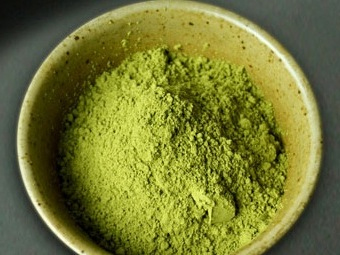
Tencha
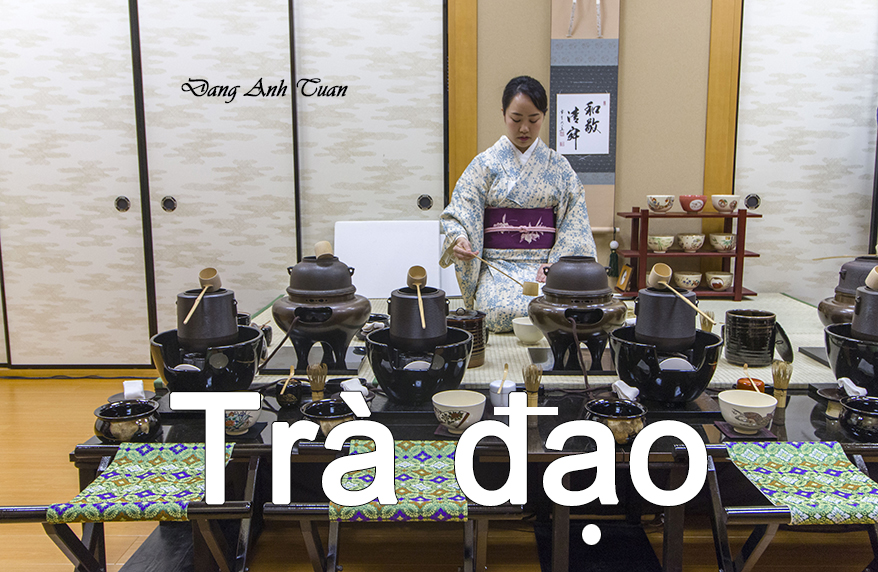
They consider tea preparation as an art. That is why they are interested not only in selecting the highest quality teas but also in the accessories necessary for preparation (teapots, spring water, filtered or potable water, etc.) in order to achieve a specific, delicious, and light taste. As for the Japanese, tea preparation is considered a ritual because they learned about tea and its preparation from Zen monks. They elevate tea preparation as « an art of Zen living » while more or less maintaining Shinto influence. With the four fundamental principles of the way of tea: Harmony (wa), Respect (Kei), Purity (Sei), Tranquility (Jaku), the guest has the opportunity to fully free themselves while maintaining a harmonious sharing not only with nature, the accessories used in tea preparation, the place of the ceremony but also with the host and other guests. Upon crossing the threshold of the ceremony room measuring 4 tatami mats, the guest can speak more easily to anyone (who could be a monk, a noble, or even a deity) without distinguishing social class, in an egalitarian spirit.

The guest recognizes the quiddity of life, in particular the truth of their own person through respect towards everyone and everything (such as the instruments of chanoyu). Their self-love is no longer present within them, but only a kind of feeling of consideration or respect towards others remains. Their state of mind will be serene when their five senses are no longer sullied. This is the case when they contemplate a painting (kakemono) in the alcove of the room (tokonoma) or flowers in a pot (ikebana) with their eyes. They smell the pleasant aromatic scent through their nose. They hear the sound caused by water heated on a charcoal brazier. They handle the chanoyu instruments (tea scoop, chasen, tea bowl (chawan), etc.) in an orderly manner and moisten their mouth with sips of tea. Thus, all their five senses become pure. Tranquility (jaku) is the result that the tea drinker finds at the end of these three fundamental principles mentioned above, once their state of mind has found complete refuge in serenity now, whether they live amidst the crowd or not. Tranquility is interpreted as a virtue that transcends the cycle of life. It allows them to live and contemplate life in an ordinary world where their presence is no longer necessary.

The guest realizes that the way of tea is not so simple because it involves many rules to be able to drink good tea or not, but it is also an effective means of bringing tranquility to the mind to allow one to reach inner illumination in meditation.

Sen no Rikyu
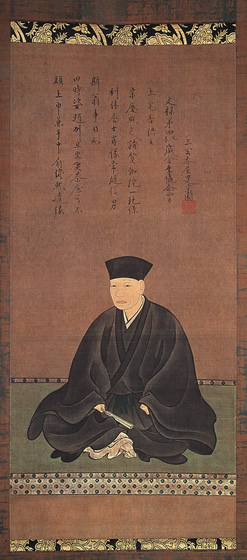

For the tea master Sen no Rikyu, who had the merit of establishing the protocols for preparing tea, the way of drinking tea is very simple: boil water, then make the tea and drink it in the correct manner.

The way of tea is a sequence of events organized in a scrupulous and careful manner. This ceremony has a maximum of 4 guests and one host. They must walk through the garden of the place where the ceremony takes place. They must perform purification (wash their hands, rinse their mouth) before entering a modest cubic room usually located at the corner of the garden through a very low door. All guests must lower their heads to enter with respect and humility. In the past, to cross the threshold of this door, the samurai had to leave his sword outside the door before meeting the host. It is here that all guests can admire the interior of the room as well as the instruments for tea preparation. They can follow the protocol phases of tea preparation.

Each event carries such a particular significance that the guest recognizes at every important moment of the ceremony. It can be said that the way of tea brings harmony between the host and their guests and shortens not only the distance separating man from the sky but also that between the guests. This is why in the world of samurai, there is the following proverb: « Once, a meeting » (Ichigo, ichie) because no encounter is the same. This allows us to be like the samurai of old, in the present moment to savor and slow down each instant with our loved ones and friends.
[Return JAPON]


ukiyo-e japonais (Các bức tranh của thế giới nổi trôi)

Les estampes du monde flottant

Version française
Version anglaise

Nghệ thuật vẽ các  bức hình  của thế giới trôi nổi được sinh ra ở thời Edo, một thời kỳ mà con người luôn tìm kiếm hoan lạc mà cũng là thời kỳ của Mạc chúa Tokugawa đã thành công thống nhất xứ Phù Tang và đóng đô ở Edo nay là thủ đô Tokyo. Các bức hình vẽ nầy đã ảnh hưởng rất nhiều đến những hoạ sĩ nổi tiếng như Matisse, Monet Van Gogh. Các bức hình vẽ nầy phản ảnh một thế giới sôi động và phức tạp với những thú vui phù du và tinh tế mà giới giai cấp tư sản ở thành thị  thường ưa thích trong cuộc sống hằng ngày như ca kịch, thơ hay bên cạnh các kỹ nữ.

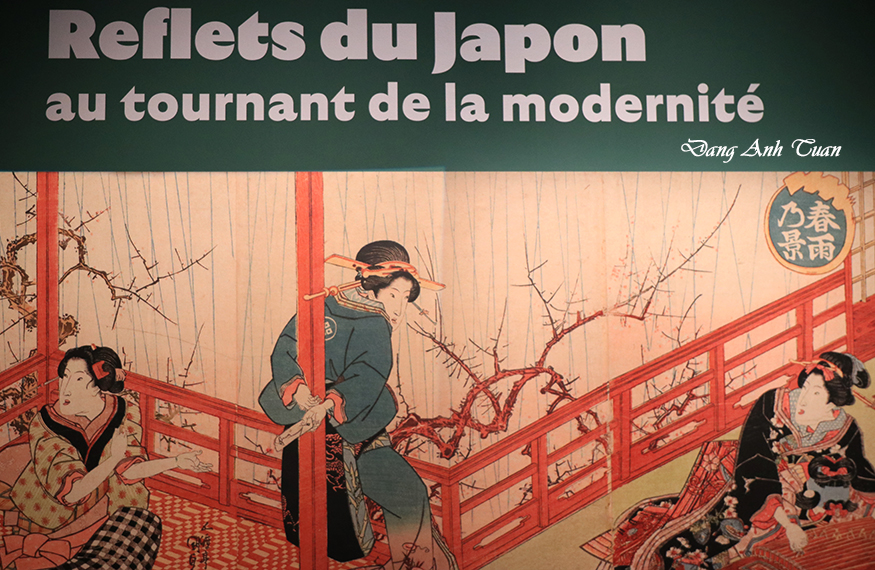
Kỹ thuật in khắc  hình trên  gỗ cho phép sản xuất hàng loạt và phân phối những hình ảnh rẻ tiền và định dạng khác nhau, ban đầu nhằm mục đích quảng cáo. Kỹ thuật nầy bắt đầu được thực hiện vào đầu thế kỷ XIX bởi các nghệ sĩ đến từ trường Utagawa (Kuniyoshi, Kunishada)  mà một số  tác phẩm được chọn và  trưng bày gần đây bởi Bảo tàng Cernuschi ở Paris với tựa đề « Những phản ảnh của Nhật Bản bước vào thời kỳ  tân tiến ».

L’art de peindre des images du monde flottant (ou ukiyo-e)  est né à l’époque d‘Edo, une période où les gens cherchaient toujours le bonheur, mais c’est aussi l’époque où le shogun Tokugawa a réussi à unifier le Japon et à fonder la ville d’Edo qui devient aujourd’hui la capitale de Tokyo. Ces estampes ont beaucoup influencé des peintres célèbres occidentaux comme Matisse, Monet  et Van Gogh. Ces peintures reflètent un monde effervescent et complexe avec des plaisirs subtils et éphémères  que la bourgeoisie urbaine appréciait souvent dans la vie quotidienne comme le théâtre, la poésie ou encore la compagnie des courtisanes. 

La technique de l’estampe sur bois facilitant la production et la diffusion  de masse de ces images peu onéreuses et sous des formats différents a pour but de servir la publicité. Elle  commence à se réaliser au début du XIXème siècle avec des illustres  artistes issus de l’école Utagawa (Kuniyoshi, Kunishada) dont certaines œuvres ont été choisies et exposées  pour le thème intitulé « Reflets du Japon au tournant de la modernité » du musée Cernuschi (Paris).

[RETURN JAPAN]


The art of painting images of the floating world (or ukiyo-e) was born in the Edo period, a time when people were always seeking happiness, but it was also the era when the Tokugawa shogun succeeded in unifying Japan and founding the city of Edo, which today becomes the capital Tokyo. These prints greatly influenced famous Western painters such as Matisse, Monet, and Van Gogh. These paintings reflect an effervescent and complex world with subtle and ephemeral pleasures that the urban bourgeoisie often enjoyed in daily life, such as theater, poetry, or the company of courtesans.

The woodblock printing technique, facilitating the mass production and dissemination of these inexpensive images in various formats, aimed to serve advertising. It began to take shape at the beginning of the 19th century with illustrious artists from the Utagawa school (Kuniyoshi, Kunishada), some of whose works were selected and exhibited for the theme entitled « Reflections of Japan at the Turn of Modernity » at the Cernuschi Museum (Paris).


Kinkaku-ji (Kim Các Tự)

Kinkaku-ji (Kim Các Tự)

Version française
Version anglaise
Galerie des photos

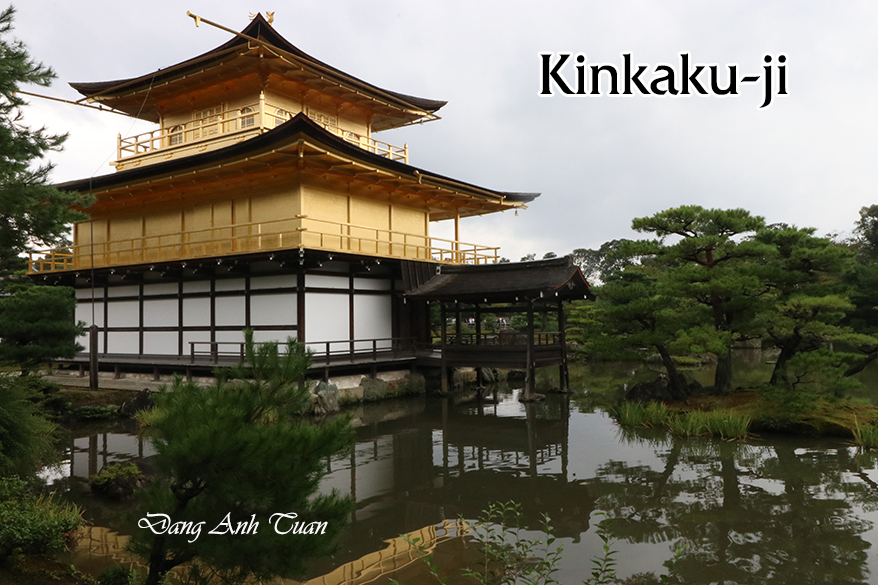
Được biết đến với cái tên quen thuộc là Kinkaku-ji, ngôi chùa Rokuon-ji (Lộc Uyển Tự) này là một trong những viên ngọc quý của cố đô Kyoto. Trái ngược với sự đơn giản mà chúng ta thường thấy trong kiến ​​trúc Phật giáo Nhật Bản, Kinkaku-ji là một tòa nhà ba tầng với những bức tường dát vàng đặt giữa một hồ nước. Điều này cho phép toà nhà  phản chiếu ánh sáng vàng trên mặt nước  hồ quanh năm trong một khung cảnh tráng lệ và thanh tịnh. Trên đỉnh tòa nhà rực rỡ này còn có một con phượng hoàng bằng đồng.

Trong ngôi nhà vàng này, chúng ta tìm thấy ba phong cách kiến ​​trúc, tầng trệt tương ứng với phong cách của các cung điện ở thời Heian (794 – 1185), tầng một là phong cách của các ngôi nhà của các võ sĩ và tầng trên cùng là phong cách của các ngôi chùa thiền. Ban đầu, vị tướng quân thứ ba Yoshimitsu của gia tộc Ashikaga (1358-1408), một đệ tử nhiệt thành của thiền sư Soseki, muốn biến nơi này thành nơi ở riêng trong thời gian ông từ giã cuộc sống công cộng. Khi ông qua đời, con trai ông là Yoshimochi quyết định biến nơi này thành một ngôi chùa Thiền tông cho trường phái Rinzai và đặt tên là « Rokuon-ji« . Sau đó nó bị phá hủy nhiều lần bởi hỏa hoạn. Lần trùng tu cuối cùng có niên đại  năm 1955 là bản sao giống hệt như thưở ban đầu. Đây là di sản thế giới được cơ quan UNESCO công nhận từ năm 1994 và được xem là ngôi chùa Phật giáo săn đón một số lượng lớn du khách mỗi năm  đến từ Nhật Bản.

Etant connu sous son nom usuel de Kinkaku-ji, ce temple  Rokuon-ji (Lộc Uyển Tự)  est l’un des bijoux de l’ancienne capitale de Kyoto. Contrairement à la simplicité qu’on est habitué à voir dans l’architecture bouddhique japonaise, Kinkaku-ji est une bâtisse à trois étages dotée des parois recouvertes de feuilles d’or trônant au milieu d’un étang. Cela lui permet de  refléter tout le long de l’année sur la surface de l’eau  sa lumière dorée dans un cadre magnifique et serein.  Au sommet de cette bâtisse éblouissante se trouve un phénix en cuivre. On retrouve dans ce pavillon d’or trois styles d’architecture, le rez-de-chaussée correspondant au style des palais de l’époque Heian (794 – 1185), le premier étage à celui des maisons des samouraïs et le dernier étage à celui des temples zen. À l’origine, le troisième shogun Yoshimitsu de la famille  Ashikaga (1358-1408), disciple fervent du moine zen Soseki veut faire de ce lieu une demeure privée lors de son retrait de la vie publique. À sa mort, son fils Yoshimochi  décide de transformer l’endroit en temple zen pour l’école Rinzai et le nomme « Rokuon-ji« .  Puis il  est  détruit plusieurs fois par les flammes. La dernière restauration datant  de 1955 est la copie absolument conforme de l’ancien pavillon.  Il  est inscrit au Patrimoine mondial de l’Unesco depuis 1994 et il est considéré comme le temple bouddhiste accueillant  un grand nombre de visiteurs par an du Japon.

Picture gallery

kinkaku_ji

Version anglaise

Known by its common name Kinkaku-ji, this Rokuon-ji temple is one of the jewels of the ancient capital Kyoto. Unlike the simplicity usually seen in Japanese Buddhist architecture, Kinkaku-ji is a three-story building with walls covered in gold leaf, standing in the middle of a pond. This allows it to reflect its golden light on the water’s surface throughout the year in a magnificent and serene setting. At the top of this dazzling building is a copper phoenix. In this golden pavilion, three architectural styles can be found: the ground floor corresponds to the style of palaces from the Heian period (794 – 1185), the first floor to that of samurai houses, and the top floor to that of Zen temples. Originally, the third shogun Yoshimitsu of the Ashikaga family (1358-1408), a fervent disciple of the Zen monk Soseki, wanted to make this place a private residence upon his retirement from public life. Upon his death, his son Yoshimochi decided to transform the place into a Zen temple for the Rinzai school and named it « Rokuon-ji. » It was then destroyed several times by fire. The last restoration, dating from 1955, is an exact replica of the former pavilion. It has been listed as a UNESCO World Heritage site since 1994 and is considered the Buddhist temple in Japan that welcomes a large number of visitors each year.

[RETURN JAPAN]


Thanh Thủy Tự (Kiyomizu-dera)

Kiyomizu-dera (Kyoto)

Version française
Version anglaise
Pictures gallery

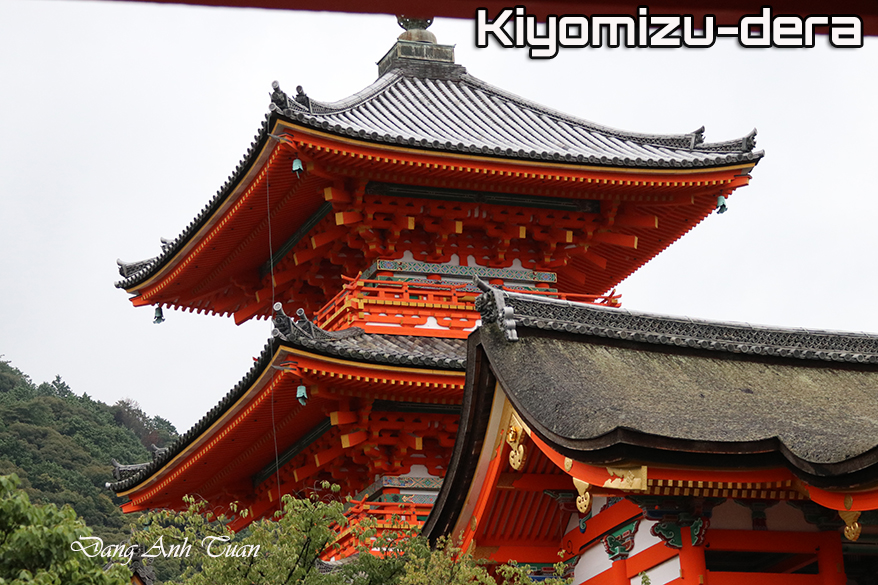
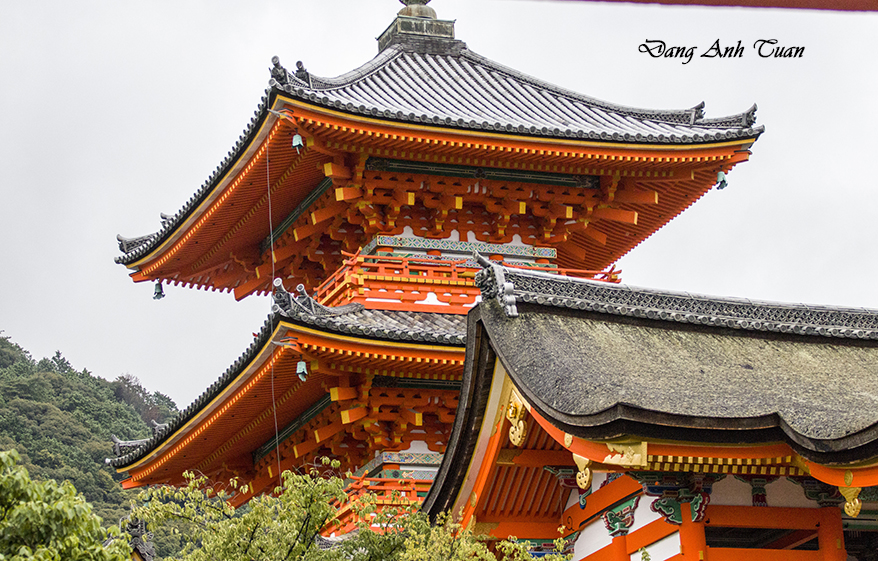
Chùa nầy nằm ở phía Đông của cố đô Kyoto thuộc về tông phái Phật giáo và Thần đạo là một ngôi chùa rất nổi tiếng ở Nhật Bản. Được xây cất vào cuối  thời kỳ Nara (778), tái thiết lại sau trận hỏa họan bởi tướng quân  Tokugawa Iemitsu và được công nhận bởi UNESCO là di sản văn hóa thế giới vào năm 1994. Chùa nầy thật sự  là một quận thể kiến trúc gồm có nhiều đền  còn được mang tên là Thanh Thủy bởi vì nó có nguồn nước thiên chảy từ  núi Otowayama. Theo tiếng Nhật Kiyomizu có nghĩa là dòng suối trong còn dera là chùa.  Đặc điểm của suối nầy là có ba dòng nước nhỏ rất linh nghiệm về   « trường thọ », « tình duyên », « học hành thành đạt ». Nếu du khách nào có tâm nguyện cầu khẩn uống  một ngụm nước ở một trong ba dòng  nước nầy thì sẽ được  toại nguyện. Còn uống  2 ngụm thì sự linh ứng sẽ giảm đi một nữa. Còn uống  ba ngụm nước liên tục thì chỉ còn có một phần ba trong việc linh ứng.  Còn uống cả ba dòng nước thì  việc linh ứng sẽ không  còn nữa. Vô số  người đứng nối đuôi để được uống nước suối nầy. Vì thời giờ quá eo hẹp cho mình (2 tiếng tham quan) nên mình không có nối đuôi chỉ  đi chụp hình mà thôi  và  lại  gần suối mua ở một cửa hàng một cái bùa nho nhỏ linh nghiệm về việc học hành mang về Pháp để  tặng cho đứa bé cháu nội của mình.

Theo cách tương tự như được trông thấy ở nhà thờ  Lourdes, từ  bãi đậu xe du khách  phải đi bộ trèo lên hằng ngày  cái dốc  để  đến cổng chùa Niomon (Cổng Nhị Vương). Ở  dọc hai bên đường các tiệm buôn bán lúc nào  cũng đông đúc du khách và tín đồ  đi hành hương để  làm lễ trước pho tượng Phật Quan Âm (Kannon)  có 11 đầu. Đặc điểm thứ hai của chùa là phần hiên của chính điện là hoàn toàn xây cất không dùng đến một cây đinh. Với kỹ thuật nầy, một chùa Nhật Bản như  Kiyomizu-dera có  ít nhất một ngàn thanh trúc nối với nhau qua các lỗ mộng. Đây cũng là đỉnh cao của kiến trúc gỗ của Nhật Bản.  Đến đây du khách có thể nhìn phía dưới quang cảnh tuyệt vời của cố đô Kyoto. Có một câu thành ngữ  tiếng Nhật  hay thường nghe nói ở  đây đó  là Nhảy từ vũ đài  chùa Kiyomizu. Khi ai có quyết tâm muốn làm điều gì đó thì không chỉ bất chấp hiểm nguy mà còn phải có động lực và nghị lực  mới dám nhảy từ độ cao dưới sự bảo trợ của Phật bà Quan Âm thì lời cầu nguyện  của mình mới thành hiện thực. Dưới thời Edo, có đến 234 lần nhảy được ghi nhận thực hiện và trong số đó có đến 85.4% người còn sống sót. Nay hành động nầy bị nghiêm cấm. Chùa Kiyomizu là một điểm du lịch không thể thiếu sót trong cuộc hành trình ở cố đô Kyoto.
Etant située à l’est de l’ancienne capitale Kyoto, cette pagode  qui appartient aux sectes bouddhiste et shintoïste est  très connue  au Japon. Construite  à la fin de la période Nara (778), reconstruite ensuite en 1633 après l’incendie  par le shogun  Tokugawa Iemitsu  et reconnue par l’UNESCO comme patrimoine culturel mondial en 1994. En fait,  elle  est un complexe architectural composé de plusieurs temples et appelé aussi    en vietnamien  sous le nom Thanh Thủy car elle se distingue par son eau cristalline sacrée  coulant du mont Otowayama. En japonais, Kiyomizu signifie  « eau pure » et Dera « pagode ». La caractéristique de cette  source d’eau  réside dans l’existence de  trois filets d’eau très efficaces en termes de « longévité », « amour » et « réussite dans les  études ». Si le  visiteur a le désir sincère de  prendre une gorgée d’eau dans l’un de ces trois filets d’eau, son vœu  sera exaucé. S’il boit  2 gorgées,  l’efficacité sera réduite de moitié. Par contre  si trois gorgées d’eau sont prises d’une manière continue, il ne lui restera plus qu’un tiers de l’efficacité dans la réalisation de son vœu. S’il prend  en même temps tous les 3 filets d’eau, son vœu ne sera plus exaucé. Une foule immense de visiteurs continue à faire la queue pour tenter cette expérience. À cause du manque de temps limité à deux heures pour cette visite, je ne  suis pas tenté de le faire.

Par contre je continue à faire les photos et je vais chercher dans une boutique proche de cette source d’eau un petit talisman connu pour son efficacité  dans les études. J’aime l’offrir à mon petit-fils lors de mon retour en France. De manière analogue à celle trouvée à  l’église de Lourdes, depuis le parking, les visiteurs doivent gravir  tous les jours la pente de la route  pour arriver à la porte de la pagode Niomon (portail Nhị Vương). Des deux côtés de cette  longue  route, les boutiques sont toujours bondées de touristes et de fidèles venant rendre  hommage  à la statue du Bouddha Guan Yin (Kannon) à 11 têtes. La deuxième caractéristique de ce complexe architectural  est que l’auvent de la partie principale  du temple a été entièrement construit sans recourir à l’utilisation des clous.  Avec cette technique, une pagode japonaise comme  Kiyomizu-dera possède au moins un millier de joints assemblés par mortaises ou tenons. C’est le summum de l’architecture japonaise en bois. C’est ici qu’en contrebas le visiteur a la vue panoramique superbe de l’ancienne capitale Kyoto.  Il y a une expression japonaise qu’on est habitué à entendre souvent ici « Saut à partir de la  plateforme de la pagode ». Quand quelqu’un est déterminé à faire quelque chose, il doit non seulement défier le danger, mais aussi avoir la motivation et la volonté d’oser sauter du haut de la plateforme  sous les auspices du Bouddha Guan Yin (Kannon). C’est ainsi que  son vœu deviendra réalité. À l’époque Edo, on a enregistré 234 sauts effectués mais il y a eu 85,4% de survivants. Cette expérience est désormais  interdite. La pagode Kiyomizu-dera est un site touristique à ne pas manquer lorsqu’on a l’occasion de visiter le Japon.

Version anglaise

Located east of the former capital Kyoto, this pagoda, which belongs to the Buddhist and Shinto sects, is very well known in Japan. Built at the end of the Nara period (778), then rebuilt in 1633 after a fire by the shogun Tokugawa Iemitsu, it was recognized by UNESCO as a World Cultural Heritage site in 1994. In fact, it is an architectural complex composed of several temples and is also called in Vietnamese by the name Thanh Thủy because it is distinguished by its sacred crystalline water flowing from Mount Otowayama. In Japanese, Kiyomizu means « pure water » and Dera means « pagoda. » The characteristic of this water source lies in the existence of three streams of water that are very effective in terms of « longevity, » « love, » and « success in studies. » If the visitor sincerely desires to take a sip of water from one of these three streams, their wish will be granted. If they drink 2 sips, the effectiveness will be reduced by half. However, if three sips of water are taken continuously, only one-third of the effectiveness in fulfilling the wish will remain. If all three streams of water are taken at the same time, the wish will no longer be granted. A huge crowd of visitors continues to queue to try this experience. Due to the limited time of two hours for this visit, I am not tempted to do it.

On the other hand, I continue to take photos and I am going to look in a shop near this water source for a small talisman known for its effectiveness in studies. I like to give it to my grandson when I return to France. Similarly to the one found at the church in Lourdes, from the parking lot, visitors must climb the slope of the road every day to reach the gate of the Niomon pagoda (Nhị Vương gate). On both sides of this long road, the shops are always crowded with tourists and devotees coming to pay homage to the statue of the 11-headed Buddha Guan Yin (Kannon). The second characteristic of this architectural complex is that the canopy of the main part of the temple was entirely built without using nails. With this technique, a Japanese pagoda like Kiyomizu-dera has at least a thousand joints assembled by mortises or tenons. It is the pinnacle of Japanese wooden architecture. It is here, below, that the visitor has a superb panoramic view of the ancient capital Kyoto. There is a Japanese expression that is often heard here: « Jump from the pagoda platform. » When someone is determined to do something, they must not only face danger but also have the motivation and will to dare to jump from the top of the platform under the auspices of Buddha Guan Yin (Kannon). This is how their wish will come true.

During the Edo period, 234 jumps were recorded, but there was an 85.4% survival rate. This practice is now prohibited. The Kiyomizu-dera pagoda is a must-see tourist site when visiting Japan.

Galerie des photos

[RETURN JAPAN]

Kyoto (Cố đô Kyoto, Nhật Bản)

Kyoto (Cố đô Kyoto, Nhật Bản)

Version française
Version anglaise
Pictures gallery

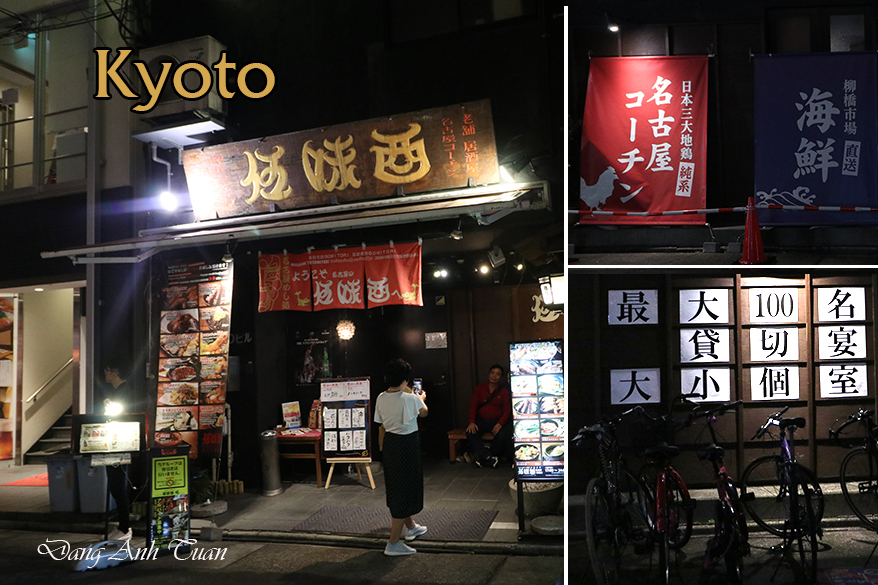
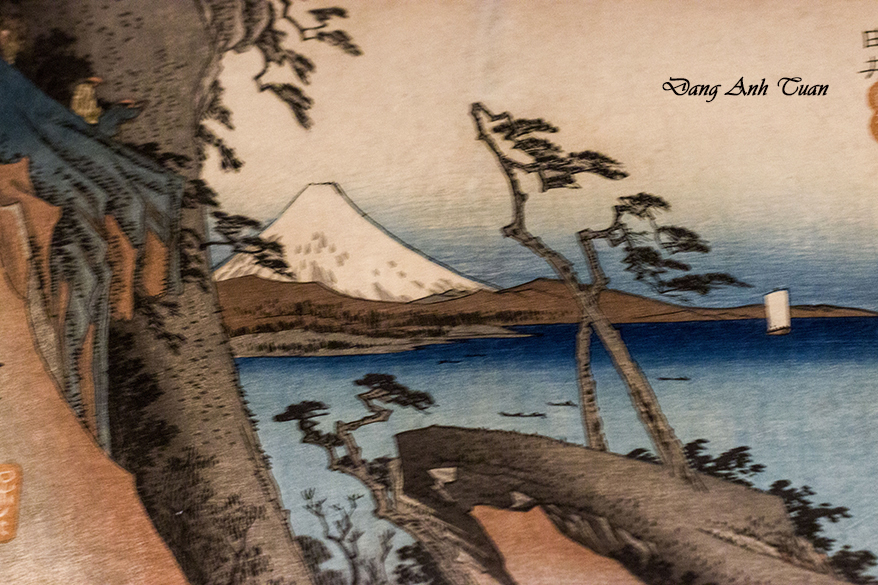
Có một thời  thịnh vượng, Tokyo còn được gọi là Edo.  Muốn đến cố đô Kyoto lữ khách phải  đi  bộ  hay đi ngựa nhiều ngày với con đường ngoạn mục Tokaido  dài có 500 cây số.Tuyến đường nầy  có nhiều  lữ quán, các đền thờ thần đạo hay Phật giáo, các di tích lịch sử sẽ  để lại cho lữ khách những kỷ niệm khó quên  như đèo Nakayama, đền Ise, chùa Thanh Thủy (Kiyomieu-dera), chùa  gác vàng Kinka kuji của tướng quân Yoshimitsu Ashikaga  vân vân …  Chính vì thế tuyến đường nầy trở  nên một nguồn cảm hứng không ít cho nhiều  họa sỹ  mà trong đó có Hiroshige mà chúng ta được biết  qua  bộ  tranh màu của ông được in trên  các mộc bản  của thế giới nổi trôi,  thường gọi là ukiyo-e (phù thế hội).  Thời ki hoàng kim  của ukiyo-e là từ khoảng những năm 1790 cho đến năm 1850. Sáng nay tụi nầy được anh HDV dẫn  đến cố đô  Kyoto. Cũng tuyến đường nầy nhưng  được thay thế bằng con  đường sắt với tàu cao tốc TGV Tokaido Shinkansen và được dừng lại ở nhà ga Kakegawa để lấy  xe bus đi tham quan vườn hoa nổi tiếng của Nhật Hammatsu của tỉnh Shizuoka. Trạm ga nào cũng sạch sẽ luôn ở  trên tàu cao tốc cũng vậy trong một không gian yên lặng.

Rất tiếc trời rất u ám nên chụp ảnh không vừa ý chi cho mấy khi đến tham quan công viên  Hammatsu. Nơi nầy có rất nhiều cây bonsai hình dáng khác nhau trông lạ mắt lắm đấy nhưng cũng không kém  phần lãng mạn như  ở các  công viên Paris. Sau đó tụi này lấy xe  bus đến cố đô Kyoto nơi ở của Nhật hoàng  vào buổi chiều. Ở đây đường xá cũng sạch  sẽ nhưng thời gian có vẻ chậm lại nhịp sống hằng ngày   tựa như ở cố đô Huế  của nước ta  vậy.

Version française

À une  époque florissante, Tokyo était également connue sous le nom d’Edo. Pour se rendre à l’ancienne capitale de Kyoto, les voyageurs devaient marcher  à pied ou à cheval plusieurs jours sur la spectaculaire route du Tokaido, longue de cinq cent  kilomètres. Celle-ci  comptait de nombreuses auberges, temples shintoïstes ou bouddhistes et des sites historiques qui leur ont laissé des souvenirs inoubliables tels que le col Nakayama, le temple Ise, la pagode Kiyomieu-dera ou le pavillon d’or Kinkaku-ji  du shôgun Yoshimitsu Ashikaga  etc. C’était  pourquoi cet itinéraire devenait ainsi  une source d’inspiration pour de nombreux artistes, dont Hiroshige que l’on connaît grâce à ses peintures  en couleurs imprimées sur planches de bois du monde flottant, souvent appelées ukiyo-e. L’âge d’or de l’ukiyo-e s’était déroulé entre 1790 et 1850 environ. Ce matin, le guide nous a emmenés dans l’ancienne capitale de Kyoto. Ce même itinéraire a été remplacé par le  chemin de fer avec le train à grande vitesse TGV Tokaido Shinkansen. Nous devions  descendre  à la gare de Kakegawa pour prendre un bus afin de pouvoir  visiter le célèbre parc floral Hammatsu de la préfecture de Shizuoka. Nous constations la propreté  partout,  y  compris dans le train à grande vitesse dans un espace silencieux.

À  cause du mauvais temps, il était impossible pour moi de faire des photos comme il le fallait  lors ma visite au parc floral. Celui-ci possédait de nombreux bonsaïs de formes différentes. Cela  m’étonna tellement mais il  n’était  pas moins romantique que les jardins  de Paris. Puis nous allions prendre le bus dans l’après-midi pour rendre visite à l’ancienne capitale de Kyoto, où résidait l’empereur du Japon. Ici, les rues sont propres mais  le temps semble ralentir le rythme de vie au quotidien  comme celui trouvé dans l’ancienne capitale Huế de notre pays.

Version anglaise

At a flourishing time, Tokyo was also known as Edo. To reach the former capital Kyoto, travelers had to walk or ride horses for several days along the spectacular Tokaido route, which is five hundred kilometers long. This route included numerous inns, Shinto or Buddhist temples, and historical sites that left them unforgettable memories such as the Nakayama Pass, the Ise Temple, the Kiyomizu-dera Pagoda, or the Kinkaku-ji Golden Pavilion of Shogun Yoshimitsu Ashikaga, etc. This is why this itinerary became a source of inspiration for many artists, including Hiroshige, who is known for his color paintings printed on woodblocks of the floating world, often called ukiyo-e. The golden age of ukiyo-e took place roughly between 1790 and 1850. This morning, the guide took us to the former capital Kyoto. This same route has been replaced by the railway with the high-speed TGV Tokaido Shinkansen train. We had to get off at Kakegawa station to take a bus in order to visit the famous Hamamatsu flower park in Shizuoka Prefecture. We noticed cleanliness everywhere, including on the high-speed train in a quiet space.

Because of the bad weather, it was impossible for me to take photos properly during my visit to the floral park. It had many bonsais of different shapes. This surprised me so much, but it was no less romantic than the gardens of Paris. Then we were going to take the bus in the afternoon to visit the former capital of Kyoto, where the emperor of Japan resided. Here, the streets are clean, but time seems to slow down the daily pace of life, similar to what is found in the former capital Huế of our country.

Pictures gallery

[RETURN JAPAN]


Làng cổ Oshino Hakkai (Nhật Bản)


Oshino Hakkai (Nhật Bản)

Version française
Version anglaise
Galerie des photos

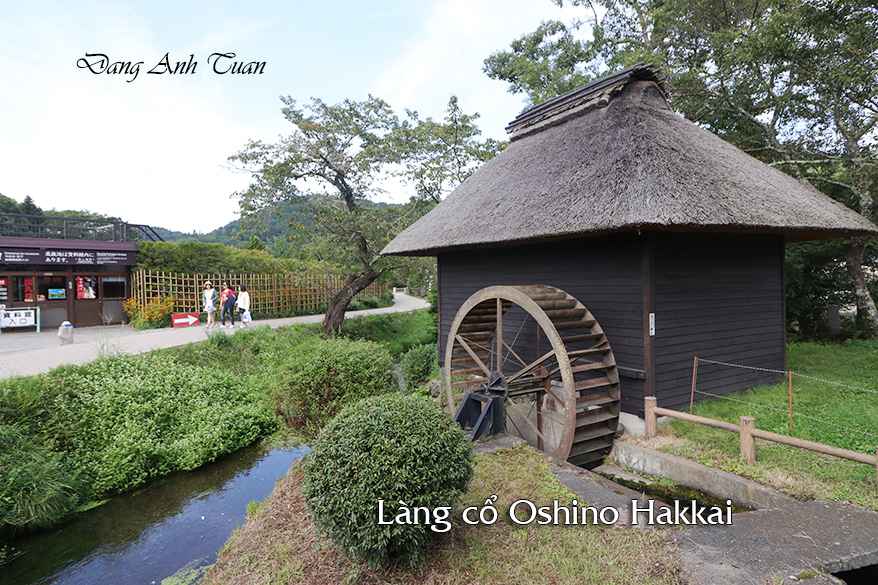
Sáng nay, ngày thứ tư, mình được cùng phái đoàn được viếng thăm một làng cổ trứ danh của nước Phù Tang ở dưới chân núi của núi Phú Sĩ  thuộc về  tỉnh Kanagawa cách xa thủ đô Tokyo 116 cây số trong khu vực ngũ hồ. Cũng như làng cổ Đường Lâm ở miền bắc Viêt Nam, Oshino Hakkai không những là một ngôi làng cổ thuần túy với phong cách kiến trúc ở thời kì Edo mà còn có vẽ đẹp thanh bình hoà hợp với môi trường. Nét đẹp của làng cổ thanh bình nầy đuợc thấy qua các mảnh vườn trồng rau, ngô, chè xanh và các khu vườn cây thông bao quanh các ngôi nhà mái lá cùng các buị bông ven đường. Ở đây còn sót lại 8 hồ nhỏ được  tạo ra ở thời kì núi Phú Sĩ còn phun lửa. Dân cư ở đây phần đông làm ruộng nhưng rất giàu có chỉ nhìn qua các nhà họ xây dựng. Nhờ kiến trúc cá biệt, làng nầy được công nhận là một di sãn thế giới vào năm 2013 bởi UNESCO. Tuy nhiên đến đây khó mà chụp ảnh vì người dân ở đây họ muốn giữ cái yên tĩnh họ đã có từ bao nhiêu năm nay.

Le village antique d’Oshino Hakkai 

Ce matin, au quatrième jour de mon voyage au Japon, j’ai eu l’occasion de visiter avec mon groupe touristique, un village antique très connu au Japon situé au pied du mont Fuji dans la zone de cinq lacs de la province Kanagawa et loin de la capitale Tokyo de 116 kilomètres. Analogue au village ancien Đường Lâm (Sơn Tây) dans le nord du Vietnam, Oshino Hakkai est un village très ancien. Il se distingue non seulement par son caractère authentique avec son style d’architecture de l’époque Edo mais aussi par son charme paisible en harmonie avec l’environnement. On trouve son attrait à travers ses jardins potagers (légumes, maïs, théier etc.) et ses parcs de pins bonsaï autour de ses maisons aux toits de chaume. Ici il reste 8 petits lacs crées au moment de l’éruption du volcan Fuji.  Sa population est constituée essentiellement par les agriculteurs qui sont assez riches. Grâce à son architecture singulière, le village Oshino Hakkai fut reconnu en 2013 par UNESCO comme le patrimoine mondial culturel du Japon. Malgré sa réputation, il est difficile pour un touriste de faire des photos car ses habitants n’apprécient pas le regard des touristes et n’aiment pas à être dérangés non plus dans leur quiétude.

The ancient village of Oshino Hakkai

This morning, on the fourth day of my trip to Japan, I had the opportunity to visit with my tour group a very famous ancient village in Japan located at the foot of Mount Fuji in the Five Lakes area of Kanagawa Prefecture, 116 kilometers away from the capital Tokyo. Similar to the ancient village of Đường Lâm (Sơn Tây) in northern Vietnam, Oshino Hakkai is a very old village. It stands out not only for its authentic character with its Edo period architectural style but also for its peaceful charm in harmony with the environment. Its appeal lies in its vegetable gardens (vegetables, corn, tea plants, etc.) and its bonsai pine parks around houses with thatched roofs. Here remain 8 small lakes created at the time of Mount Fuji’s eruption. Its population mainly consists of farmers who are quite wealthy. Thanks to its unique architecture, the village of Oshino Hakkai was recognized in 2013 by UNESCO as a cultural world heritage site of Japan. Despite its reputation, it is difficult for tourists to take photos because the inhabitants do not appreciate the gaze of tourists and also do not like to be disturbed in their tranquility.

Pictures gallery

[RETURN JAPAN]

Núi Phú Sĩ (Le mont Fuji)

Núi Phú Sĩ (Le mont Fuji)

Version française
Version anglaise
Galerie des photos
Lac Kawaguchi

[Cuộc hành trình Nhật Bản (ngày thứ ba)]

Ngày thứ ba , mình cùng các du khách trong đoàn được đi tham quan núi Phú Sĩ. Trước khi đến tham quan, tụi nầy được  ghé  Gotemba Premium Outlets. Đây là khu mua sắm bao gồm các cửa hàng cao cấp hàng đầu của Nhật. Ở đây du khách có thể nhìn thấy đỉnh núi Phú Sĩ  trong mây.  Núi nầy có độ cao 3776 thước được xem là ngọn núi cao nhất ở Nhật Bản. Đến đất nước Nhật Bản mà không có đến tham quan núi Phú Sĩ thì là một điều đáng tiếc vì nó không những là một biểu tượng của đất nước mặt trời mọc mà còn là một di sản văn hóa thế giới. Hình tượng núi Phú Sĩ rất thanh nhã, thay đổi theo mùa và theo thời điểm trong ngày khiến nó trở thành một chủ đề ưa thích của nhiều họa sĩ trứ danh Nhật ở thế kỉ 19: K. Hosukai (1760-1849) với « 36 cảnh núi Phú Sĩ », A. Hiroshige (1797-1858) với «Năm mươi ba trạm dừng của Tokaido». Núi Phú Sĩ vẫn được xem từ lâu là một đỉnh núi thiêng liêng vì theo Nhật Bản thư kỷ, núi nầy là nơi ở của nữ thần Konohanasakuya-hime, vợ của thần Ninigi-no-Mikoto, cháu nội của nữ thần mặt trời Amaterasu. Bởi vậy phụ nữ không được phép leo lên núi cho tới năm 1868.

Ngày nay số lựợng người leo núi để giải trí nhiều hơn số lượng người leo núi hành hương. Phú Sĩ không phải là một chóp núi nhọn mà nó là miệng núi lửa. Nó vẫn hoạt động và lần cuối cùng nó phun trào vào năm 1707 của thời kỳ Edo. Vì thế khu vực xung quanh núi toàn thấy tro bụi núi lửa và có cả 5 hồ nước do núi lửa tạo ra và được gọi là ngũ hồ: hồ Motosu, hồ Shoji, hồ Kawaguchi, hồ Yamanaka và hồ Sai. Nếu ai không thích leo lên đỉnh thì có thể dừng ở trạm số 5 Fuji Subaru Line. Nơi nầy ngoài khu buôn bán còn có một khu  vực quan sát để có được cái nhìn toàn cảnh tuyệt đẹp trên hồ Yamanaka và thành phố Fujiyoshida.  Chiều hôm đó, tụi nầy được sống  theo lối Nhật ở  một khách sạn gần hồ Kawaguchi bên cạnh rừng thông. Thật tuyệt vời nhất là sáng sớm hôm sau khi lúc  mặt trời mọc mình thả bộ một mình qua đường mòn của rừng thông  để  chụp  quan cảnh xung quanh hồ. 

Galerie des photos

FUJI

Version française

Le mont Fuji
Le troisième jour du voyage au Japon, notre groupe a eu l’occasion de visiter le mont Fuji.   Avant de pouvoir l’admirer, nos  rendons visite à un grand centre commercial de nom Gotemba Premium Outlets où on ne trouve que les grandes marques préférées par les Japonais.  C’est ici que le touriste peut voir le sommet du mont Fuji dans les nuages. Étant haut de 3776 mètres, ce mont Fuji  est considéré comme la montagne la plus élevée au Japon. Il est regrettable de ne pas le visiter car il est non seulement l’emblème célèbre du pays au Soleil-Levant mais aussi le patrimoine mondial culturel de l’UNESCO. Ce mont ne manque pas de charme et ne cesse pas de modifier son image en fonction des saisons et des moments de la journée. C’est pour cela qu’il devient le thème préféré des dessinateurs japonais célèbres du XIXème siècle à l’époque Edo: K. Hosukai (1760-1849) dans la série de « 36 vues du mont Fuji« , A. Hiroshige (1760-1849) dans la série d’estampes intitulée « Les 53 relais de Tokaido ». Depuis longtemps, le mont Fuji revêt un caractère sacré car selon les annales chroniques du Japon (Nihon shoki), le mont Fuji est le lieu de résidence d’une kami japonaise de nom Konohanasakuya-hime, l’épouse du petit-fils Ninigi-no-Mikoto de la déesse du soleil Amaterasu. C’est pour cette raison que l’ascension était interdite aux femmes jusqu’à l’année 1868.

Aujourd’hui le nombre de randonneurs est plus important que celui des pèlerins grimpeurs. Le sommet de Fuji est en fait un cratère volcanique. Il continue à être actif mais sa dernière éruption  eut lieu en 1707 à l’époque Edo. Autour de ce mont, on ne trouve que des poussières volcaniques et 5 lacs que l’éruption a crées: lac Motosu, lac Shoji, lac Kawaguchi, lac Yamanaka et lac Sai. Si on n’aime pas à marcher à pied jusqu’au sommet du mont Fuji, on peut s’arrêter à la station portant le numéro 5 de Fuji Subaru Line. C’ici qu’outre le centre commercial, il y a la zone d’observation où on peut avoir une vue panoramique imprenable  sur le lac Yamanaka et la petite ville Fujiyoshida. Ce soir là, nous passons la nuit dans un hôtel proche de la forêt des pins. C’est superbe pour moi de me promener tout seul,  le  lendemain au lever du soleil,  sur le sentier de la forêt des pins et faire  les photos autour du lac.

Version anglaise

On the third day of the trip to Japan, our group had the opportunity to visit Mount Fuji. Before being able to admire it, we visited a large shopping center called Gotemba Premium Outlets, where only the top brands favored by the Japanese can be found. It is here that tourists can see the summit of Mount Fuji in the clouds. Standing at 3,776 meters high, Mount Fuji is considered the tallest mountain in Japan. It is regrettable not to visit it as it is not only the famous emblem of the Land of the Rising Sun but also a UNESCO World Cultural Heritage site. This mountain is full of charm and constantly changes its appearance depending on the seasons and times of day. That is why it became the favorite theme of famous Japanese artists of the 19th century during the Edo period: K. Hokusai (1760-1849) in the series « 36 Views of Mount Fuji, » A. Hiroshige (1760-1849) in the print series titled « The 53 Stations of the Tokaido. » For a long time, Mount Fuji has held a sacred character because, according to the Japanese chronicles (Nihon Shoki), Mount Fuji is the residence of a Japanese kami named Konohanasakuya-hime, the wife of the grandson Ninigi-no-Mikoto of the sun goddess Amaterasu. For this reason, climbing it was forbidden to women until the year 1868.

Today, the number of hikers is greater than that of pilgrim climbers. The summit of Fuji is actually a volcanic crater. It remains active, but its last eruption occurred in 1707 during the Edo period. Around this mountain, there are only volcanic ashes and five lakes created by the eruption: Lake Motosu, Lake Shoji, Lake Kawaguchi, Lake Yamanaka, and Lake Sai. If you don’t like walking all the way to the summit of Mount Fuji, you can stop at station number 5 on the Fuji Subaru Line. There, besides the shopping center, there is an observation area where you can enjoy an unbeatable panoramic view of Lake Yamanaka and the small town of Fujiyoshida. That evening, we spend the night in a hotel near the pine forest. It is wonderful for me to walk alone the next morning at sunrise along the pine forest trail and take photos around the lake.

Lac Kawaguchi

HOPHUSI

[RETURN JAPAN] Lire la suite

Pourquoi les pagodes japonaises ne s’écroulent pas en cas du séisme?


Tại sao các chùa Nhật Ban không bị sụp đổ khi có động đất?

Version française
Version anglaise
Galerie des photos

Đến xứ Nhật Bản, du khách thường có dịp đi tham quan các chùa Nhật bằng gỗ ở Nara Kyoto.  Qua nhiều trận động đất thường xuyên ở Nhật Bản, các chùa nầy vẫn đứng vững dù đã có trải  qua hơn 1300 năm xây cất. Cũng như chùa Senso-ji 5 tầng ở Tokyo không phải bị phá hủy bởi  động đất mà bị oanh tạc trong thời kỳ  chiến tranh thế giới thứ hai. Như vậy có bí quyết nào khiến các chùa không bị sụp đổ và được bảo vệ trước sự tàn phá của động đất ? Đó là một câu hỏi mà chính mình cũng tự nêu ra khi đến tham quan các chùa như Senso-jiKiyomizu Dera.  Theo kiến trúc sư Nhật Ueda Atsushi thì sự  bảo vệ an toàn nầy được giải thích với chùa Hôryûji, một chùa Nhật có lâu đời nhất dựa trên các lý do như sau trong quyển Nipponia số 33.  Trước hết là việc sử dụng vật liệu. Tất cả phần cấu trúc của chùa đều làm bằng gỗ. Nó có thể cong uốn nhưng không dễ bị gãy, đó là nhờ tính linh hoạt khiến nó có thể  làm tiêu tan và thu hút năng lượng địa chấn. Kế đó là sự lựa chọn thiết kế kiến trúc. Không có một cây đinh nào trọng dụng ở các nơi nối các thanh trúc với nhau (như lỗ mộng, lưỡi gà vân vân..). Các đầu của các thanh trúc nầy được đục mỏng và hẹp hơn vào trong các khe khiến tạo ra một lề di chuyển, cọ xát lẫn nhau và kiềm chế lại được việc truyền năng lượng địa chấn lên đỉnh tháp.

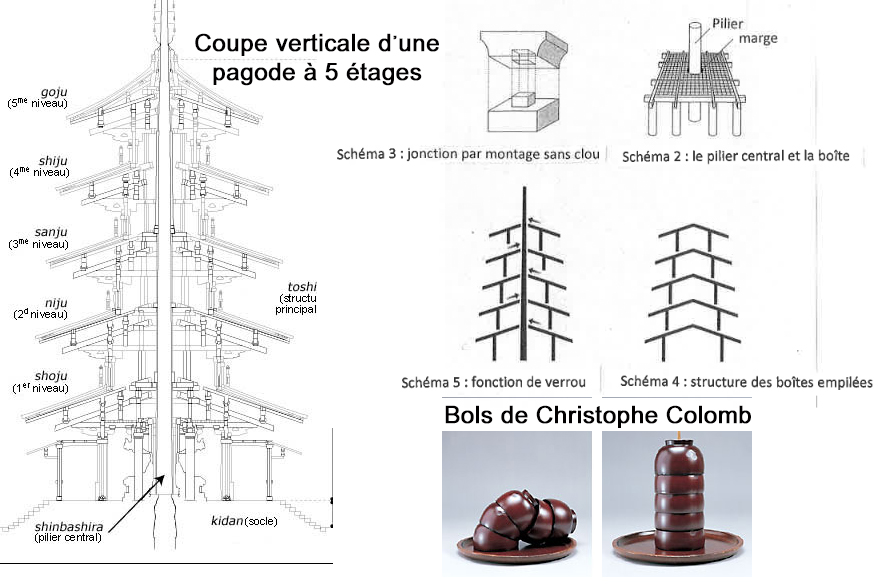
Với kỹ thuật nầy, một chùa Nhật Bản năm tầng như Senso-ji có ít nhất một ngàn thanh trúc nối với nhau qua các lỗ mộng. Hơn nữa, chùa có một cấu trúc có nhiều lớp hay nhiều hình hộp chồng lên, cái to ở dưới chót cái nhỏ ở trên cao mà người Nhật họ gọi là go-ju no to. Khi mặt đất rung chuyển thì các hộp từ từ đu đưa nhưng mỗi lớp của cái hộp hoàn toàn độc lập với các lớp khác khiến cho toàn bộ cấu trúc dễ « uốn nắn », linh hoạt  như một con rắn vặn vẹo và tìm lại được lại sự thăng bằng như  một món đồ chơi con lắc jaijirobe của người Nhật. Khi lớp hộp ở dưới xoay bên trái thì lớp hộp nắp trên xoay bên phải rồi trên nữa xoay bên trái …Nhưng sự thăng bằng nầy có thể bị phá vỡ nếu có một lớp nào tách rời xa quá trung tâm và nếu nó không được kéo về lại vị trí  khiến làm toàn bộ cấu trúc sẽ sụp đổ. Đấy là trong trường hợp có một trận động đất cực kỳ quan trọng. Vì vậy để ngăn ngừa sự sụp đổ nầy mà cần  có cây cột trụ lớn từ  dưới đất lên tới đỉnh nằm ở trung tâm. Nó có nhiệm vụ là đưa về vị trí cũ  một trong những lớp hộp nào muốn trượt ra khỏi ngoài.

Như thế cây cột trụ trung tâm (shinbashira) giữ vai trò chốt then và xem như một chiếc đũa mà được đâm xuyên qua ở dưới đích của 5 cái chén úp chồng lên nhau khiến các chén nầy khó mà bay ra ngoài. Các chén nầy được  kiến trúc sư Nhật Ueda Atsushi gọi là các chén của Christophe Colomb » bằng cách tìm nguôn cảm hứng với quả trứng của Christophe Colomb.  Quả trứng nầy đứng vững trên bàn sau khi một phần nhỏ của vỏ đã bị san phẳng ở một đầu của nó.  Những kỷ thuật truyền thống của các chùa Nhật 5 tầng vẫn còn được trọng dụng và là nguồn cảm ứng không ít  hiện nay cho các toà nhà cao ốc như ngọn tháp Tokyo Skytree.

Version française

De passage au Japon, le touriste a l’occasion de visiter les pagodes japonaises de Nara et Tokyo. Malgré la fréquence des séismes au Japon,  ces  pagodes continuent à tenir bon durant 1300 ans de leur construction. C’est le cas de la pagode Senso-ji à 5 étages.  Celle-ci n’a jamais  été détruite par le séisme mais elle a été anéantie entièrement  par les bombardements  durant la deuxième guerre mondiale. Quel est le secret pour ces pagodes de ne pas s’écrouler face à la dévastation provoquée par le séisme ? C’est aussi la question que je me pose moi-même sans cesse lors de la visite des pagodes Senso-ji  (Tokyo) et  Kiyomizu Dera (Kyoto). Selon l’architecte japonais Ueda Atsushi, l’entière protection trouve son explication avec la très ancienne  pagode Hôryûji.  Celle-ci  est basée essentiellement  sur les raisons suivantes trouvées dans le livre  Nipponia n° 33. D’abord c’est l’utilisation du matériel. Toute la structure de la pagode a été faite avec du bois.  Celui-ci peut être flexible mais il n’est pas cassable. Ce matériau de construction  a la vertu d’être souple, ce qui permet de dissiper et d’absorber l’énergie sismique. Puis c’est le choix de la conception architecturale. Aucun clou n’est utilisé dans les réseaux de joints où les pièces de bois (comme les mortaises, les languettes etc…) peuvent être rabotées de façon mince et rétrécies dans les fentes, ce qui donne une large marge de déplacement et provoque le frottement entre ces pièces jouant ainsi un rôle de frein à la propagation sismique ver la partie haute de la pagode.

Avec cette technique, une pagode japonaise comme Senso-ji possède au moins un millier de joints assemblés par mortaises ou tenons. De plus la pagode a une structure en « couches ou boîtes superposées »  où  l’empilement s’effectue d’une manière progressive de bas en haut, de la plus grande à la plus petite au sommet de la pagode. Les Japonais désignent cette structure sous le nom « go-ju no to ». Quand la surface du sol commence à bouger, chaque boîte oscille indépendamment de ses voisines. La tour effectue une sorte de « danse de serpent » et retrouve son équilibre à l’état intial comme le jouet artisanal japonais jaijirobe. Quand la boîte formant l’étage inférieur a tendance à  tourner vers la gauche, celle au dessus oscille vers la droite et celle au dessus encore vers la gauche … Cette manière à osciller peut provoquer un déséquilibre et aboutit à un écroulement de la structure lorsqu’une boîte s’écarte trop du centre et ne réussit pas à revenir à son état initial. C’est le cas où le tremblement de terre est très violent. Pour cela, il s’avère indispensable d’avoir au centre de la base  de la pagode un gros pilier central (ou  shinbashira) s’élançant du bas jusqu’au sommet pour empêcher le déséquilibre ainsi que l’écroulement de la structure. Ce pilier a pour rôle de ramener  la « boîte empilée » à son état initial lorsque cette dernière s’éloigne trop du centre.

On peut dire que le pilier central ou (shinbashira) assume la fonction de verrou. Il est considéré comme une baguette transperçant au centre  les fonds de cinq bols empilés à l’envers sur un plateau, ce qui les empêche de tout écartement. L’architecte japonais Ueda Atsushi  désigne ces bols sous le nom des « bols de Christophe Colomb » en trouvant l’inspiration dans l’exemple de l’œuf de Christophe Colomb. Celui-ci peut se maintenir sur la table lorsqu’une petite partie de sa coquille est aplatie à l’une de ses extrémités. Les techniques classiques servant la construction des pagodes japonaises  à 5 étages continuent à être employées encore aujourd’hui et constituent au moins une source d’inspiration pour les gratte-ciel. C’est le cas de la tour Tokyo Skytree.

Version anglaise

When visiting Japan, tourists often have the opportunity to tour wooden Japanese temples in Nara and Kyoto. Despite the frequent earthquakes in Japan, these temples have stood firm even after more than 1,300 years of construction. Similarly, the five-story Senso-ji temple in Tokyo was not destroyed by earthquakes but was bombed during World War II. So, is there a secret that prevents these temples from collapsing and protects them from earthquake damage? That is a question I asked myself when visiting temples like Senso-ji and Kiyomizu-dera. According to Japanese architect Ueda Atsushi, this safety protection is explained with Hōryū-ji, one of the oldest Japanese temples, based on the following reasons in Nipponia magazine, issue 33. First is the use of materials. All structural parts of the temple are made of wood. It can bend and flex but is not easily broken; this flexibility allows it to dissipate and absorb seismic energy. Next is the choice of architectural design. Not a single nail is used in the joints connecting the wooden beams (such as mortise and tenon joints, tongue and groove, etc.). The ends of these beams are carved thinner and narrower into the slots, creating a margin for movement, rubbing against each other, and restraining the transmission of seismic energy to the top of the tower.

With this technique, a five-story Japanese temple like Senso-ji has at least one thousand bamboo beams connected to each other through mortise holes. Moreover, the temple has a structure with many layers or several stacked box shapes, the large one at the bottom and the small one at the top, which the Japanese call go-ju no to. When the ground shakes, the boxes sway slowly, but each layer of the box is completely independent of the others, making the entire structure easy to « bend, » flexible like a twisting snake, and regains balance like a Japanese Jaijirobe pendulum toy. When the bottom box layer turns left, the next layer above turns right, then the one above that turns left… However, this balance can be disrupted if any layer moves too far from the center and is not pulled back into position, causing the whole structure to collapse. This is in the case of a very significant earthquake. Therefore, to prevent this collapse, a large pillar from the ground up to the top is needed at the center. Its role is to bring back into place any of the box layers that want to slip out.

The central pillar or (shinbashira) can be said to act as a lock. It is considered a rod piercing the bottoms of five bowls stacked upside down on a tray, preventing them from moving apart. Japanese architect Ueda Atsushi called these bowls « Christopher Columbus bowls, » drawing inspiration from the example of Christopher Columbus’s egg. The egg can stay on the table when a small part of its shell is flattened at one end. Classical techniques used to build five-story Japanese pagodas continue to be used today and are at least one source of inspiration for skyscrapers. This is the case for the Tokyo Skytree tower.

Galerie des photos


jpn_seisme

[RETURN JAPAN]

Art de vivre propre à la japonaise (lối sống sạch của người Nhật)

Version française
Version anglaise
Galerie des photos

Lối sống siêu sạch của người Nhật
L’art de vivre « propre » à la japonaise.

Đến xứ mặt trời mọc, mình rất bỡ ngỡ ngày đầu khi khám phá được lối sống siêu sạch của người Nhật. Mới đến phi trường thì mình đã nhận thấy dọc theo hành lang ra cổng có rất nhiều phòng vệ sinh. Lên xe ca thì mỗi du khách phải quản lí rác của mình cho đến ngày trở ra phi trường chớ tài xế không có dọn cho đâu, đó là lời nói của HDV Ngọc Anh nói với đoàn mình ngày đầu trên đường về khách sạn. Từ phi trường đến khách sạn rồi trong những ngày tiếp đi tham quan mọi nơi thì nhận thẩy ở đâu cũng sạch luôn cả phòng vệ sinh. Đến nơi nào như nhà hàng, chuyện đầu tiên phải làm là cổi giày để trước cửa hay bỏ trong tủ. Họ rất sạch sẻ từ trang phục đến giày. Khi có mưa, họ chuẩn bị túi nylon để bạn gói dù ướt lại và để tránh nước mưa nhỏ trên nền đất. Thùng rác ở công cộng được chia ra nhiều loại chẳng hạn như chai nước vứt đi cũng phải bỏ vào 3 thùng rác khác nhau: nút chai, vỏ chai và nhãn giấy trên chai nước.

Tại sao họ sạch đến thế ? Sỡ dĩ họ được như vậy vì họ có một thói quen từ thưở nhỏ lúc còn là học sinh tiểu học hay cấp hai ở trường. Họ có một môn học gọi là « Kỷ năng lao động » khiến họ có trách nhiệm làm sạch nơi mình dùng. Họ rất nhạy cảm về hình ảnh của họ trong mắt người khác. Họ còn được giáo huẩn để biết tôn trọng tài sản của người khác mà muốn được thế, họ phải có lòng tự trọng ở bản thân họ. Họ không bao giờ ăn xin dù họ nghèo, vô gia cư, nằm ngủ trong hầm điện métro. Mình cho tiền thì họ lấy. Họ không bao giờ đòi hay nhận tiền bo ở nhà hàng vì họ xem đó là nhiệm vụ họ phải hoàn thành mà thôi. Họ rất tự hào về họ, về dân tộc của họ.

Việc cội rửa bụi bẩn ở tinh thần cũng như ở thể chất là những việc hằng ngày mà họ phải làm thôi. Họ xem đây là một thể thức rèn luyện, tu tập mà họ phải cố gắng cũng như thiền định vậy. Cũng nên nhớ là trước khi Phật giáo được truyền bá vào Nhật Bản thì người dân Nhật đã theo Thần đạo mà trong đạo nầy có nghi lễ thanh tẩy trước khi vào đền Thần đạo. Bỡi vậy họ phải cần đảm bảo sạch sẻ và tinh khiết để có được một tâm hồn lẫn tâm trí thanh tịnh. Có vậy mới bày tỏ được lòng thành kính với Thần. Đấy là những lý do khiến lối sống của người dân Nhật quá siêu sạch và quá thanh tao. Đây là một ấn tượng để lại cho mình lúc đầu sự bỡ ngỡ rồi sau đó sự khâm phục trong thời gian ở xứ Phù Tang.

Version française

En débarquant au Japon, je suis un peu déboussolé et étonné le premier jour par le fait de découvrir l’art de vivre « super propre » des Japonais. Je m’aperçois qu’il y a pas mal de toilettes mises à la disposition des touristes tout le long du couloir de l’aéroport. Dans le car qui nous ramène à l’hôtel, chacun de notre groupe doit gérer jusqu’au jour de notre départ, les ordures avec le sac en nylon distribué. C’est ce que le guide vietnamien Ngọc Anh nous dit tout de suite car pour lui, le chauffeur du car ne le fait pas. Ce n’est pas sa mission. Il faut rendre propre le car à son état initial. Du premier jour jusqu’au dernier jour de mon voyage, la propreté est visible partout y comprises les toilettes publiques.(dans la gare du métro par exemple). Arrivé dans n’importe quel restaurant, la première chose à faire est d’enlever les chaussures et de les ranger soit dans un casier à chaussures soit à l’entrée de l’établissement. Les Japonais aiment s’habiller de la manière la plus propre et simple. En cas de pluie, ils distribuent à chacun de leurs clients un sac en nylon pour couvrir son parapluie mouillé et éviter le trempage de l’eau sur le plancher de leur boutique. Les poubelles urbaines publiques sont divisées en plusieurs catégories. En prenant l’exemple de la bouteille en plastique, il faut effectuer le rangement en trois poubelles différentes: la première réservée à son bouchon, la deuxième pour sa marque collée en papier et la dernière pour la bouteille elle-même.

Pour quelle raison sont-ils si propres ? Ils le sont ainsi car ils ont cette habitude dès leur jeune âge à l’école primaire. Ils ont une matière intitulée « la compétence dans le travail » à apprendre, ce qui les oblige à avoir la responsabilité de rendre propre l’endroit où ils travaillent. Ils sont tellement susceptibles d’être mal vus dans le regard des autres. Ils sont éduqués de manière à respecter le bien d’autrui mais pour cela il faut qu’ils s’engagent à se respecter eux-mêmes. Ils ne mendient pas même s’ils sont pauvres, sans domicile et se traînent dans le métro, c’est ce que je constate moi-même. Ils ne sollicitent pas le pourboire dans les restaurants car pour eux, c’est une mission à accomplir, une manière de reconnaître leur valeur et leur compétence dans le travail. Ils sont très fiers d’eux et de leur pays.

Le fait de se purifier l’esprit ou le corps est le travail journalier qu’ils tentent d’assumer tout simplement. Ils le prennent comme une façon importante de se corriger et de se perfectionner avec effort et patience comme la méditation. Il faut rappeler qu’avant l’implantation du bouddhisme au Japon, les Japonais ont eu le shintoïsme. Dans cette religion locale, il y a le rite de purification avant de visiter le jinja (le temple où réside la divinité shintoïste). Le visiteur doit s’assurer qu’il est « propre » et « pur » afin d’avoir une âme et un esprit calme et serein. Cela lui permet de montrer son respect envers la divinité. Ce sont les raisons expliquant leur art de vivre « propre ». Cela me laisse pantois d’étonnement et d’admiration durant mon séjour au Japon.

Version anglaise

Upon arriving in Japan, I am a bit disoriented and surprised on the first day by discovering the « super clean » lifestyle of the Japanese. I notice that there are quite a few toilets available for tourists along the airport corridor. On the bus that takes us back to the hotel, each member of our group must manage the trash with the nylon bag provided until the day we leave. This is what the Vietnamese guide Ngọc Anh tells us right away because, for him, the bus driver does not do it. It is not his job. The bus must be kept clean and returned to its original state. From the first day until the last day of my trip, cleanliness is visible everywhere, including public restrooms (for example, in the subway station). Upon entering any restaurant, the first thing to do is to take off your shoes and store them either in a shoe locker or at the entrance of the establishment. The Japanese like to dress in the cleanest and simplest way possible. In case of rain, they give each of their customers a nylon bag to cover their wet umbrella and prevent water from soaking the floor of their shop. Public urban trash bins are divided into several categories.

Taking the example of the plastic bottle, it is necessary to sort it into three different bins: the first reserved for its cap, the second for its paper label, and the last for the bottle itself. Why are they so clean? They are this way because they have this habit from a young age in primary school. They have a subject called « competence in work » to learn, which obliges them to take responsibility for keeping the place where they work clean. They are very sensitive to being seen poorly by others. They are educated to respect the property of others, but for that, they must commit to respecting themselves. They do not beg even if they are poor, homeless, and dragging themselves through the subway, this is what I observe myself. They do not ask for tips in restaurants because for them, it is a mission to accomplish, a way to recognize their value and competence in work. They are very proud of themselves and their country.

The act of purifying the mind or body is the daily work they simply try to undertake. They see it as an important way to correct and perfect themselves with effort and patience, like meditation. It should be noted that before the introduction of Buddhism in Japan, the Japanese had Shintoism.

In this local religion, there is a purification rite before visiting the jinja (the temple where the Shinto deity resides). The visitor must ensure that he is « clean » and « pure » in order to have a calm and serene soul and mind. This allows him to show his respect to the deity. These are the reasons explaining their « clean » art of living. This leaves me speechless with amazement and admiration during my stay in Japan.
Galerie des photos

[RETURN JAPAN]

Pagode Senso-ji (Chùa Asuka)

Version française
Version anglaise
[Schéma de Senso-ji (Tokyo)]

[Viếng thăm ngôi chùa cổ kính Senso-ji (Tokyo)]
Ngày thứ hai của cuộc hành trình ở Nhật Bản Đến Nhật Bản thường dễ nhận thấy cổng Torii ở trong các thành phố. Cổng nầy là biểu tượng của thần đạo, một tôn giáo bản địa của người dân Nhật. Đây cũng là cổng để phân chia rõ rệt giữa thế giới trần tục và không gian thiêng liêng của Thần đạo. Theo tư tưởng của đạo nầy, vạn vật dù là vật đó sống hay chết ở trong tự nhiên đều có thần (kami) cư ngụ. Có thể vì Nhật Bản là một quốc gia có nhiều thiên tai như các siêu bão, sóng thần, động đất vân vân… khiến người dân ở nơi nầy họ nghĩ rằng có một sức mạnh vô hình nào đến từ những thần linh khiến làm họ lúc nào cũng lo sợ, buộc lòng họ phải kính thờ và thân thiện. Bởi vậy trong mỗi nhà của người dân Nhật thường thấy có một bàn thờ tổ tiên hay là của một vị thần nào quen thuộc. Tổ tiên của vị thiên hoàng Nhật Bản hiện nay cũng cho mình là con cháu của nữ thần mặt trời Amaterasu Omikami. Với tầng lớp nông dân ở xứ Nhật thời đó,vai trò của nhà vua rất quan trọng vì ông là người có khả năng cầu xin nữ thần để được mùa màng. Chính nhờ tư duy thần đạo nầy mà đế chế Nhật Bản vẫn được bảo tồn qua nhiều thế kỷ nhất là vai trò thiêng liêng của thiên hoàng không bao giờ bị tướt đoạt dù quyền lực đã rơi nhiều lần vào các gia đình có thế lực mạnh (Kamakura, MuromachiTokugawa). Nước Nhật có đến hiện nay 80.000 thần xã (jinja) (hay đền của Thần đạo) thường nằm trên đồi hay ven vệ đường.

Rất ít người Nhật hiện nay theo thần đạo nhưng những thói quen như óc thẩm mĩ tối giản, chân phương hay thanh tẩy đều bắt nguồn từ thần đạo. Trước khi nhận Phật gíáo làm quốc giáo vào thế kỷ thứ 6 với hoàng tử Shotoku Taishi của dòng dõi Yamato thì người dân Nhật họ đã có thần đạo. Bởi vậy Phật giáo đột nhập vào Nhật Bản, đã có lúc đầu một cuộc xung đột ít nhiều với thần đạo nhưng về sau nhờ có sự hỗn hợp và hoà đồng của hai đạo khiến Phật giáo đã bắt rễ ăn sâu cho đến hiện nay vào đời sống của người dân Nhật. Phật giáo thể hiện được không những tính liên tục hài hoà với thần đạo qua các lễ hội quan trọng (matsuri) mà còn có những nét đặc điểm trong tôn giáo và văn hóa Nhật Bản nhất là về vũ trụ quan và đạo lí nhân sinh. Khi xâm nhập vào Nhật Bản, Phật giáo được biến hóa theo nhu cầu cần thiết và cứu tế của người dân Nhật. Sự hoà nhập Phật giáo vào tín ngưỡng dân gian Nhật Bản cũng được xem tương tự như ở Vietnam với những người theo đạo Phật thờ cúng tổ tiên. Ở đất nước nầy Thần là Phật mà Phật cũng là Thần. Cụ thể là nữ thần Kannon của Senso-ji (Thiền Thảo Tự) trở đi về sau thành Quan Âm bồ tát khi Phật giáo gia nhập xứ Nhật. Đây cũng là một sự kết hợp tính cứu tế của Quan Âm truyền thống với tính phồn thực thấy ở nữ thần Nhật Bản trong tín ngưỡng dân gian bản đia. Bởi thế Quan Âm Nhật Bản còn là vị thần se duyên và phụ sản nữa.

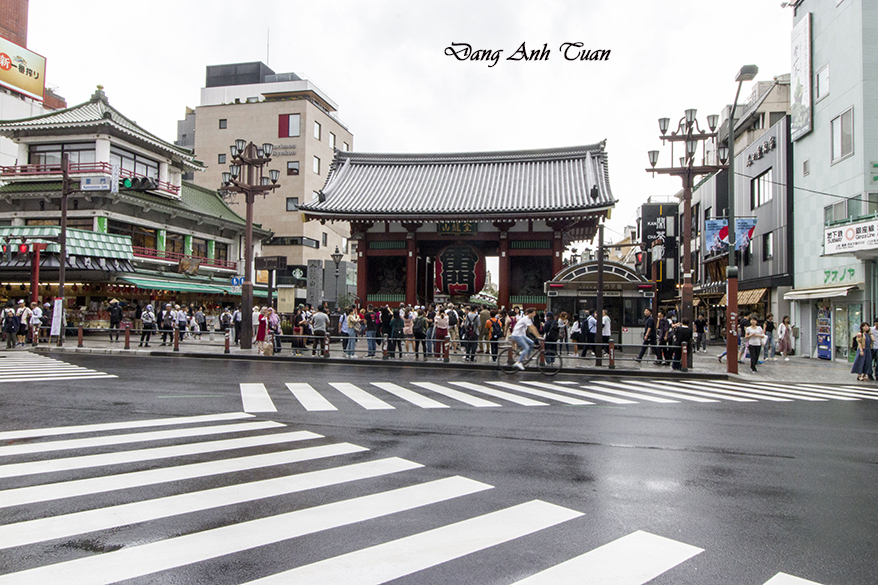
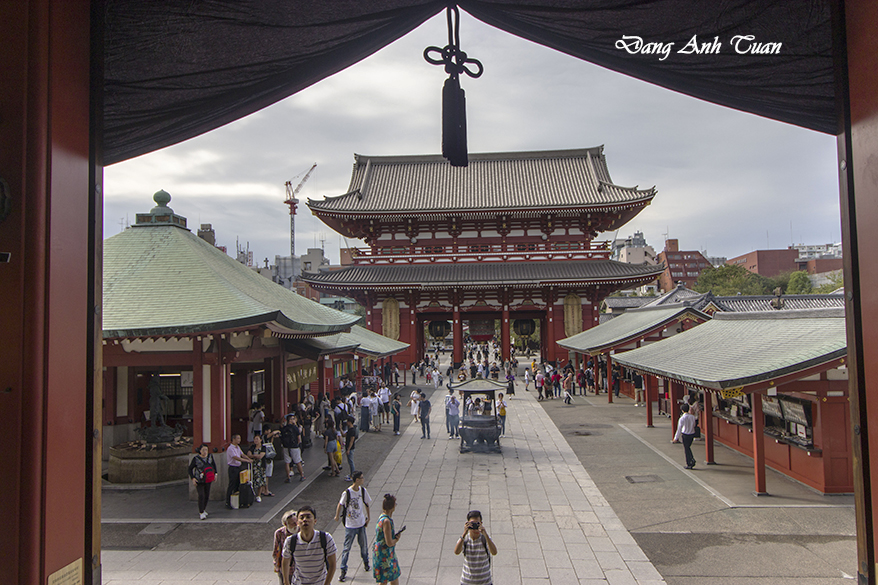
Sáng nay, ngày thứ hai, phái đoàn cùng mình được đi viếng thăm một chủa cổ kính tên là Senso-ji (Thiền Thảo Tự) nằm ở phía bắc của Tokyo. Muốn chỉ chùa chiền, người dân Nhật thường dùng chữ ji hay dera ở cuối tên chủa. Chùa nầy còn có tên là Chùa Quan Âm Asuka vì vào năm 628, có hai người dân chài kéo lưới được một pho tượng của nữ thần Kannon bằng vàng từ sông Sumida. Được biết chuyện nầy, lãnh chúa vùng nầy mới thuyết phục được hai người dân chài và cùng nhau xây một miếu thờ nữ thần Kannon Rồi đến năm 645 có một sư tăng Shokai xây chùa tại đây để thờ phượng. Nhờ sự cúng dường một phần đất lớn cho chùa của Mạc phủ Tokugawa Iaetsu mà diện tích của chùa được tăng thêm. Chùa được nổi tiếng từ đó và trở nên ngày nay là một quần thể chùa đền mà du khách đến tham quan Tokyo không thể bỏ qua vì nó được sùng tu lại và giữ được phong cách kiến trúc cổ kính của thời Edo (Tokyo xưa) dù bị tàn phá trong thế chiến thứ hai. Đến chùa nầy, mọi người phải đi qua cổng chính Kaminarimon thường được gọi là « Cổng sấm »(Lôi Môn). Nơi nầy có hai vị thần gác cổng, một người tên là Fujin (Phong thần bên phải) và Raijin (Lôi thần bên trái). Cổng nầy đựơc du khách chú ý nhất là nhờ có một lồng đèn giấy to tác treo ở giữa cổng nhất là ở dưới đáy có chạm khắc một con rồng rất tinh xảo. Lồng nầy không thay đổi qua bao nhiều thế kỷ theo dòng lịch sử. 

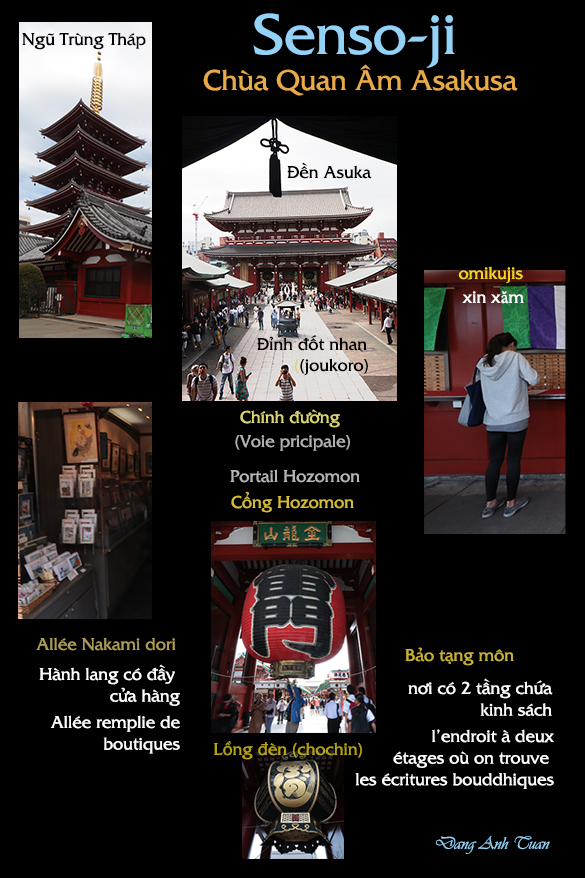
Phiá sau các thần nầy, còn có hai tượng thần Kim LongThiên Long một nữ, một nam, cả hai là thần nước để nhắc đến có sự liên quan mật thiết với sông Sumida, nơi mà tìm ra Phật mẫu. Khó mà chụp hình rõ ràng vì có lẽ người dân Nhật sợ thất lễ phạm thượng nhất đây là các thần (kami) của Thần đạo. Sau cùng, du khách sẻ găp ngay đường Nakamise-dori dài 250 thước. Đường nầy có rất nhiều mặt hàng bán đồ đặc sản và thủ công truyền thống làm rất tinh xảo như đai lưng obi, quạt giấy, lược chải tóc, búp bê Nhật vân vân … Gần cuối đường, du khách sẽ gặp một một đỉnh đốt nhang (joukoro) lúc nào cũng có người đứng xung quanh đốt nhang, khói bốc nghi ngút. Họ cầu nguyện mong đựợc sức khoẻ hay may mắn. Bên phải của đỉnh đốt nhang thì có các máy xin xăm (omikujis) . Đây là một loại giấy tiên đoán tương lai mà du khách bỏ tiền vào máy kéo bắt thăm. Một dạng loto. Còn phiá bên trái của đỉnh nhìn về đằng xa sẽ thấy một ngôi chùa 5 tầng, nơi giữ tro cốt của Đức Phật Thích Ca. Sau đó du khách sẻ đến cổng Hozomon (hay là Bảo Tạng Môn) trước khi vào chùa Sensoji thật sự. Cổng nầy được xây lại vào năm 1964 bằng bê tong cột thép có hai tầng và có một căn nhà chứa rất nhiều kinh Phật chữ Hán ở thế kỷ 14. Nơi nầy, trước cổng có bố trí hai tượng Kim Cương lực sĩ và có một lồng đèn (chochin) nặng 400 kilô kèm theo hai toro ở hai bên với vật liệu bằng thau trông rất xinh đẹp, mỗi toro nặng có một tấn.

Sau cổng Hozomon, du khách sẻ đến điện chính nơi thờ nữ thần Kannon hay Quan Thế Âm Bồ Tát. Điện nầy có hai gian. Gian truớc dành cho tín đồ Phật tử còn gian sau thì dành cho cúng kiến Phật mẫu và không được vào. Một khi vào bên trong của gian ngoài của điện thì sẽ thấy một ngôi miếu mạ vàng hiện ra nơi thờ bức tượng Quan Âm đã có từ thưở xưa. Các tín đồ thể hiện lòng kính có thể đốt nhan và ném tiền xu. Rất ít có thì giờ cho mình để ngắm nghiá, chỉ vỏn vẹn mua vài đôi đũa và chụp hình để lưu niệm (45 phút mà HDV dành cho đoàn trong thời gian tham quan). Một kỷ niệm khó quên, một ngôi chùa quá đẹp của thời Edo, một khu phố náo nhiệt và sầm uất trong một không gian tôn nghiêm và tĩnh lăng ….
Đến xử Phù Tang mới biết thêm một chuyện về các nhà sư « ăn thịt lấy vợ ». Các ông nầy có quyền lập gia đình và có quyền giữ chức vụ cha truyền con nối để trù trì, thật là một chuyện khó tin nhưng thật sự là vậy. Làm sư có rất nhiều tiền lắm vì có nhiều lợi tức trước hết là nhờ có đất chùa từ bao nhiêu thế kỷ nên cho các tiệm buôn bán thuê mướn truớc chùa hay là lo việc buôn bán đất mộ táng. Sỡ dĩ chùa có nhiều đất đó là nhờ các lãnh chúa cúng dường một thuở xa xôi cho chùa xem như đó là một thứ lễ vật để cầu phúc hay sám hối. Vì thế đất trở nên sở hữu của chùa và trở thành một lợi tức không nhỏ cho việc sinh sống của nhà sư. Đất chật ngưòi đông như ở Nhật Bản nên đất làm mộ táng là một loại kinh doanh siêu lợi nhuận. Người Nhật lúc còn sống thì theo đạo thần, công giáo hay vô đạo. Lúc về già gần chết thì muốn theo đạo Phật để về Tây Phương cực lạc.

Vì vậy nhất định theo đạo Phật, tốn cả triệu Yên để mua miếng đất mộ táng ở chùa mà muốn vậy thì phải là Phật tử tức là phải trải qua các nghi thức của chùa để có pháp danh mới có quyền mua đất ở chùa. Bao nhiêu tiền được sư thu thập không có đóng thuế nhất là còn thêm tiền chăm sóc các mộ táng mỗi năm và tiền đi ra ngoài làm Phật sự những lúc có người cần đến. Bởi vậy lấy sư là có một tương lai rực rỡ cùng nghề làm võ sĩ sumo. Đây là hai nghề được các cô yêu chuộng hiện nay nhất ở Nhật Bản. Hướng dẩn viên Ngọc Anh nói đến chuyện các sư Nhật làm mình cười nhớ đến sư trù trì của chùa Ba Vàng ở miền bắc Vietnam. Người dân Nhật họ có một tư cách hành sự vô cùng phức tạp về tôn giáo nhất là họ có đầu óc rất thực tiễn: họ đi lễ của thần đạo vào năm mới, đến chùa chiền của đạo Phật vào lúc mùa xuân và tổ chức tiệc tùng và tặng quà cho nhau theo đạo Kitô lúc Noël.

Version française

La pagode Senso-ji de Tokyo 

En débarquant de l’avion au Japon, le touriste a l’habitude de voir fréquemment les toriis de couleur vermillon dans les villes. Ces portails sont le symbole caractéristique du Shintoïsme, une religion locale des Japonais. Ils reflètent aussi la délimitation de la frontière entre le monde profane et l’espace sacré du sanctuaire shintoïste. Selon la pensée de cette religion, tout être vivant ou mort dans la nature doit être habité par un esprit maléfique ou bénéfique (kami). À cause des calamités fréquentes comme les typhons, tsunamis, séismes etc. au Japon, cela inspire profondément à ses habitants la certitude d’une force interne (ou énergie) invisible venant des esprits (kamis). C’est pour cela qu’ils sont constamment peureux et angoissés face à ces esprits et ils sont obligés de les vénérer dans le but de les apprivoiser et les remercier de leur protection dans une vie éphémère soumise au temps. Dans chaque maison japonaise, il y a toujours un autel réservé pour les ancêtres ou pour un « kami » familier. Les ancêtres de l’actuel empereur japonais ont reconnu d’être les descendants de la déesse du Soleil Amaterasu Omikami. Pour les paysans japonais de cette époque, le rôle de l’empereur est très important car il a la possibilité de demander les faveurs auprès de la déesse pour avoir de bonnes récoltes. C’est grâce au shintoïsme que l’empire japonais est préservé durant des siècles.

Le rôle sacré de l’empereur n’est pas confisqué non plus malgré que le pouvoir de décision était revenu plusieurs fois aux mains des shoguns.(Kamakura, Muromachi et Tokugawa). Le Japon a aujourd’hui 80.000 temples shintoïstes (jinja) situés sur les collines ou au bord des routes. Peu de Japonais sont aujourd’hui shintoïstes mais les habitudes telles que l’esprit esthétique minimaliste, la purification ou la sincérité sont empruntées dans le shintoïsme. Avant de reconnaître le bouddhisme comme la religion d’état au 6ème siècle avec le prince Shotoku Taishi de la lignée Yamato, les Japonais ont déjà eu le shintoïsme. C’est pourquoi une fois implanté au Japon, le bouddhisme est au début, en situation de conflit plus ou moins prononcé avec le shintoïsme mais il y a à la fin une sorte de syncrétisme s’opérant entre les deux religions lorsque le bouddhisme réussit à s’enraciner jusqu’à aujourd’hui dans la vie quotidienne des Japonais. Le bouddhisme montre non seulement sa voie à une intégration harmonieuse avec le shintoïsme à travers les fêtes importantes (matsuris) mais aussi ses traits caractéristiques dans la religion et la culture du Japon, notamment dans le cosmos et la moralité humaine. Lors de son invasion au Japon, le bouddhisme s’est transformé en fonction des besoins d’aide nécessaires apportés aux Japonais. L’intégration du bouddhisme dans les croyances populaires japonaises est similaire à celle du Vietnam où les adeptes du bouddhisme vénèrent leurs ancêtres.

Dans ce pays, la divinité est un Bouddha et inversement. La preuve est que la déesse Kannon du temple Senso-ji est devenue plus tard un Boddhisattva quand le bouddhisme réussit à s’implanter au Japon. Cela montre la combinaison d’un Boddhisattva traditionnel et du caractère de fertilité de la déesse japonaise dans la croyance populaire locale. C’est pourquoi le Boddhisattva japonais est aussi une déesse de mariage et de procréation. Au matin du deuxième jour, le groupe de touristes et moi, nous allons visiter la pagode Senso-ji située dans le nord de la capiale Tokyo. Quand le nom d’un monument est terminé par ji ou dera, il s’agit bien d’une pagode. Cette pagode est connue aussi sous le nom « Asuka » car elle est située dans un quartier très animé Asuka. En 628, il y avait deux pêcheurs réussissant à capturer dans leur filet une statue en or représentant la déesse Kannon dans le fleuve Sumida. Étant au courant de ce fait, un seigneur local réussît à les convaincre et à réaliser ensemble un autel dédié à cette déesse. Puis en 645, un moine de nom Shokai décida de construire à la place de cet autel un temple bouddhiste. C’est la pagode Senso-jì. Grâce aux donations de terrain effectuées par le shogun Tokugawa Iaetsu, la pagode commença à grandir et à changer d’aspect pour devenir jusqu’à aujourd’hui un complexe de pagodes et de temples shintoïstes dont le touriste ne peut pas se passer lorsqu’il a l’occasion de visiter la capitale Tokyo.

C’est aussi une très ancienne pagode connue pour son charme et sa beauté retrouvée de l’époque Edo malgré la destruction provoquée durant la deuxième guerre mondiale. Pour entrer dans cette pagode, tout le monde doit emprunter le porche principal connu sous le nom « Kaminarimon » (ou porte de tonnerre) et protégé par deux divinités Fujin (déesse du vent) et Raijin (dieu de la foudre). L’attention des touristes est retenue par la présence d’une lanterne gigantesque suspendue au milieu du porche et dont le fond contient un beau dragon sculpté en ronde bosse. Cette lanterne ne subit pas des modifications majeures au fil des siècles de l’histoire de la pagode. Derrière ces divinités shintoïstes, il y a encore un couple d’esprits de l’eau ( une déesse Kim Long et un dieu Thiên Long) rappelant le lien intime avec le fleuve Sumida où a été trouvée la statue Bodhisattva en or.. C’est difficile de bien faire les photos car les Japonais ont mis la grille métallique autour de ces kamis dans le but de les protéger et de ne pas les offenser. Puis le touriste se retrouve dans la rue marchande Nakamise-dori longue de 250 mètres. Celle-ci a plusieurs boutiques spécialisées dans la pâtisserie et dans l’artisanat traditionnel avec des produits de qualité comme les peignes, ceintures Obi, éventails, poupées etc.

Cette rue se termine sur un parvis où trône un joukoro (un brûleur d’encens) autour duquel il y a toujours des gens continuant à brûler des encens dans un atmosphère rempli de fumée pour demander la bénédiction de la déesse. Sur la droite de ce parvis, on trouve des machines destinées à imprimer des omikujis. Ceux-ci sont des papiers sacrés que l’on récupère par tirage au sort pour prédire l’avenir du demandeur. C’est une sorte de loterie sacrée.

Sur la droite de ce parvis, on voit apparaître la pagode à cinq étages où les cendres de Siddharta Gautama sont soigneusement conservés. Le deuxième porche monumental est connu sous le nom de Hozomon. Celui-ci a été gardé à son entrée par deux dieux gardiens impressionnants et construit en béton avec les colonnes en acier dans les années 1964. Hozomon a deux étages dont le deuxième est destiné à contenir des sutras écrits en chinois et datant du 14ème siècle. C’est ici qu’on trouve un chochin (une sorte de lanterne) de 400 kilos entouré de chaque côté par un beau toro en laiton, chacun pesant au moins une tonne. Derrière ce porche monumental, c’est le bâtiment principal (Kannon-do) de la déesse Kannon. Il est divisé en deux parties: la partie extérieure est réservée aux fidèles tandis que la partie intérieure est interdite au public car il y a l’autel doré de la déesse Kannon.

Notre groupe dispose seulement de 45 minutes pour visiter Senso-ji car après cette visite, nous devons participer à un cours d’initiation au thé japonais. Un souvenir inoubliable, une belle pagode de l’époque Edo, un quartier très animé dans un espace serein.

Version anglaise
[Senso-ji pagoda in Tokyo]
 

Upon disembarking from the plane in Japan, tourists are accustomed to frequently seeing vermilion-colored torii gates in the cities. These gates are the characteristic symbol of Shintoism, a local religion of the Japanese. They also reflect the boundary between the profane world and the sacred space of the Shinto shrine. According to the beliefs of this religion, every living or dead being in nature must be inhabited by an evil or benevolent spirit (kami). Due to frequent calamities such as typhoons, tsunamis, earthquakes, etc., in Japan, this deeply inspires its inhabitants with the certainty of an internal force (or energy) invisible that comes from the spirits (kamis). This is why they are constantly fearful and anxious in the face of these spirits and are obliged to venerate them in order to tame them and thank them for their protection in an ephemeral life subject to time. In every Japanese home, there is always an altar reserved for ancestors or a familiar « kami. » The ancestors of the current Japanese emperor have recognized themselves as descendants of the Sun goddess Amaterasu Omikami. For the Japanese peasants of that time, the role of the emperor was very important because he had the ability to request favors from the goddess to have good harvests. It is thanks to Shintoism that the Japanese empire has been preserved for centuries.

The sacred role of the emperor has not been confiscated either, despite the fact that decision-making power has several times returned to the hands of the shoguns (Kamakura, Muromachi, and Tokugawa). Today, Japan has 80,000 Shinto shrines (jinja) located on hills or by the roadside. Few Japanese people are Shintoists today, but habits such as the minimalist aesthetic spirit, purification, or sincerity are borrowed from Shintoism. Before recognizing Buddhism as the state religion in the 6th century with Prince Shotoku Taishi of the Yamato lineage, the Japanese already had Shintoism. That is why, once Buddhism was introduced to Japan, it was initially in a situation of more or less pronounced conflict with Shintoism, but in the end, a kind of syncretism occurred between the two religions when Buddhism succeeded in taking root up to the present day in the daily life of the Japanese. Buddhism not only shows its path to harmonious integration with Shintoism through important festivals (matsuris) but also its characteristic traits in the religion and culture of Japan, notably in the cosmos and human morality. During its introduction to Japan, Buddhism transformed according to the necessary aid it provided to the Japanese. The integration of Buddhism into Japanese popular beliefs is similar to that of Vietnam, where Buddhists venerate their ancestors.

In this country, the deity is a Buddha and vice versa. The proof is that the goddess Kannon of the Senso-ji temple later became a Bodhisattva when Buddhism managed to establish itself in Japan. This shows the combination of a traditional Bodhisattva and the fertility character of the Japanese goddess in local popular belief. That is why the Japanese Bodhisattva is also a goddess of marriage and procreation. On the morning of the second day, the group of tourists and I went to visit the Senso-ji pagoda located in the north of the capital Tokyo. When the name of a monument ends with ji or dera, it is indeed a pagoda. This pagoda is also known as « Asuka » because it is located in a very lively district called Asuka. In 628, there were two fishermen who succeeded in catching in their net a golden statue representing the goddess Kannon in the Sumida River. Being aware of this fact, a local lord managed to convince them and together they built an altar dedicated to this goddess. Then in 645, a monk named Shokai decided to build a Buddhist temple in place of this altar. This is the Senso-ji pagoda. Thanks to land donations made by the shogun Tokugawa Ieyasu, the pagoda began to grow and change in appearance to become, up to today, a complex of pagodas and Shinto temples that tourists cannot miss when they have the opportunity to visit the capital Tokyo.

It is also a very ancient pagoda known for its charm and its beauty restored from the Edo period despite the destruction caused during World War II. To enter this pagoda, everyone must pass through the main gate known as « Kaminarimon » (or Thunder Gate), guarded by two deities: Fujin (the wind goddess) and Raijin (the god of thunder). Tourists’ attention is drawn to the presence of a gigantic lantern hanging in the middle of the gate, with a beautiful dragon sculpted in high relief on its base. This lantern has not undergone major modifications over the centuries of the pagoda’s history.

Behind these Shinto deities, there is also a pair of water spirits (a goddess Kim Long and a god Thiên Long) reminding of the close connection with the Sumida River where the golden Bodhisattva statue was found. It is difficult to take good photos because the Japanese have placed a metal grille around these kami to protect them and not to offend them. Then the tourist finds themselves on Nakamise-dori shopping street, 250 meters long. It has several shops specializing in pastries and traditional crafts with quality products such as combs, Obi belts, fans, dolls, etc.

This street ends on a forecourt where a joukoro (an incense burner) stands, around which there are always people continuing to burn incense in an atmosphere filled with smoke to ask for the goddess’s blessing. On the right of this forecourt, there are machines intended to print omikujis. These are sacred papers that are drawn by lot to predict the future of the seeker. It is a kind of sacred lottery.

On the right of this forecourt, the five-story pagoda appears, where the ashes of Siddharta Gautama are carefully preserved. The second monumental gate is known as Hozomon. It has been guarded at its entrance by two impressive guardian gods and was built in concrete with steel columns in the 1960s. Hozomon has two stories, the second of which is intended to contain sutras written in Chinese dating from the 14th century. Here you find a chochin (a kind of lantern) weighing 400 kilos, flanked on each side by a beautiful brass toro, each weighing at least a ton. Behind this monumental gate is the main building (Kannon-do) of the goddess Kannon. It is divided into two parts: the outer part is reserved for worshippers, while the inner part is forbidden to the public because it houses the golden altar of the goddess Kannon.

Our group only has 45 minutes to visit Senso-ji, as afterward we are required to participate in an introductory Japanese tea class. An unforgettable memory, a beautiful Edo-period pagoda, a lively neighborhood in a serene space.

Sơ đồ của chùa Asuka-Kannon

[RETURN JAPAN]