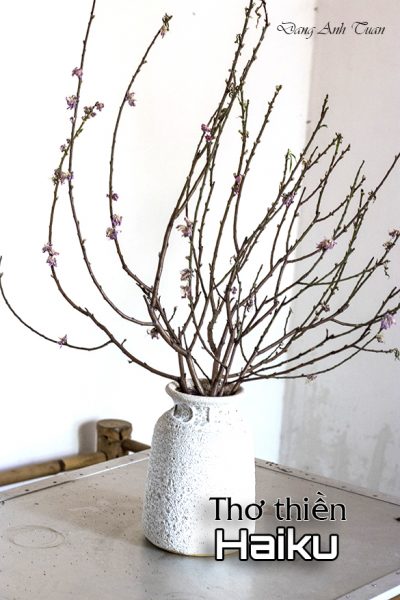
Zen (Haiku)

Version anglaise
Version française
Galerie des photos

Thiền là một hoạt động được người hành thiền thực hiện bằng cách tập trung tâm trí vào một đối tượng nào để rèn luyện sự chú ý và nhận thức và để tìm kiếm  mỗi ngày, một tâm trí thanh tịnh và trong sáng được thanh lọc vào một khoảnh khắc nào để thời  điểm của sự kết hợp nhất với cuộc sống trở thành việc giảng dạy quan trọng nhất trong Phật giáo. Nó giúp con người trầm tư chiêm nghiệm một vấn đề nào đó của cuộc sống và vũ trụ và dẫn đến giai đọan giác ngộ (thức tỉnh) khi con người thấu triệt được những nguyên lý vận hành sự biến dịch của vạn vật trong tự nhiên. Chữ Thiền (zen) trong tiếng Hán là , phiên âm /chán/ nhưng chữ nầy trong tiếng phạn, một cổ ngữ trong nền văn hóa Ấn Độ là dhyana (thiền na).

Con đường Thiền hiện diện trong cuộc sống thường ngày. Mặc dù Thiền được nhà sư Bồ Đề Đạt Ma (Bodhidharma) mang từ Ấn Độ sang đến Trung Quốc vào năm 520, nhưng ngày nay nó lại nổi bật nhất  ở Nhật Bản so với các nước châu Á khác, luôn kể cả Việt Nam. Con đường Thiền ở Nhật Bản phát triển mạnh mẽ trong các nghệ thuật và các bộ môn thông qua nhiều hình thức thiền định và học tập: trà đạo (chado), hoa đạo (kado), kiếm đạo (kendo) vân vân. Nhưng điều quan trọng nhất  ở dưới những hình thức này là sự cảm nhận khoảnh khắc hiện tại: ở đây và bây giờ. Chỉ có nghệ thuật thơ haiku mới có thể nắm  giữ được khoảnh khắc nầy trong thực tế. Chính sự gặp gỡ chớp nhoáng này đã làm cho haiku trở thành thơ ca của Thiền, và việc đọc thơ  haiku làm tăng thêm cảm giác hạnh phúc và bình yên cho cả nhà thơ lẫn người đọc. 

Theo nhà  văn Lê Tấn Dương, ngôn ngữ dùng trong thơ thiền Haiku có mang tính cách trực tiếp không phải suy luận bằng lý trí (trực cảm). Nếu còn suy nghĩ thì còn gì là cảm quan trực giác. Dù  tính thiền vẫn còn đó nhưng nó không còn ảo diệu nữa. Ngược lại  nó rất quan tâm đến những điều nhỏ bé, những chi tiết, lòng từ bi và niềm đam mê mà nó dành cho khoảnh khắc hiện tại.

Haiku là một thể thơ rất đơn giản chớ nó không bị giới hạn ở việc miêu tả đơn thuần. Nó có thể là sự phát triển của một hình thức thơ cổ của Nhật Bản gọi là katauta, theo cùng một mô hình 5-7-5 âm tiết, tổng cộng là 17 âm tiết và tương ứng chính xác với độ dài của một hơi thở. Haiku không nhất thiết phải có vần.

Tuy nhiên thơ thiền Haiku nó cũng  có  hai quy tắc cần tuân thủ :

  • một kigo, tức là một khái niệm về mùa, để làm bối cảnh;
  • và một gạch nối (césure) hay kireji, sẽ cắt bài thơ thành hai phần.

Haiku  hay thường giữ cái ẩn ý hơn là cái rõ ràng, do đó kigo chỉ nên mang tính gợi mở. Như thường lệ, thơ Haiku không thể tách rời các mùa. Việc viết thơ gợi mùa thì quá dễ dàng, thay vào đó thi gia haiku sẽ thích nhắc nhở  hơn về “tiếng dế” hay “hoa mao lương”. Kireji, ngược lại, cho phép chuyển từ một miêu tả đơn giản của một hình ảnh sang cảm nhận mà nó tạo ra ở tác giả. Nó không chỉ đơn thuần đồng nghĩa với « sự tĩnh lặng » hay « sự an lạc ». Những ham muốn, cảm xúc, thậm chí cả suy nghĩ đều phải được gạt bỏ. Quá trình thanh lọc này có thể bao gồm cả việc quên đi « cái tôi » để dẫn đến giác ngộ và để có cái nhìn trầm tư hơn và tự do hơn về thế giới, thoát khỏi mọi sự tìm kiếm ý nghĩa. Điều đó còn tùy  thuộc sự rung cảm từ tâm thức của người viết và người đọc mà còn luôn cả mức độ giác ngộ của mỗi người  về cảnh quan và cuộc sống. Có nguời đi suốt cuộc đời vẫn chưa giác ngộ, còn có người có duyên thì giác ngộ  đến rất sớm. Con đường lớn (hay con đường Thiền) không có cổng; hàng ngàn con đường dẫn đến đó. Ai đi qua cánh cổng không lối này sẽ tự do đi lại giữa Trời và Đất, đó là lời nhắn nhũ cho những ai học thiền.

Thơ haïku là sự diễn giải của một trải nghiệm chớ không phải môt bình luận. Chính vì vậy haïku hay thường được so sánh với một bức tranh trong đó quan sát và kinh nghiệm là một với ý thức. Thi ca haiku là một bức tranh toàn diện không thừa không thiếu với 17 âm tiết, ngôn dủng trong  thi ca là trực giác. Theo nhà văn nhà văn Manuela Dunn Mascetti,  sự tươi mát là bông hoa của nghệ thuật haïku  vì nó  được tạo ra bởi sự tức thời của cảm giác khiến người đọc có  được niềm vui thật sự và vĩnh cửu. Nhưng muốn có được  tinh thông nghệ thuật haiku thì cần có nhiều năm luyện tập. Chìa khóa thảnh công là đạt được hay là mất đi thì cũng giống như một trãi nghiệm sống. Tuy thơ thiền haiku vuợt qua biên giới ngày nay  với một số tín đồ ngoại quốc nhưng   chỉ có những bậc thầy nổi tiếng  như Matsuo Basho  (1644-1694), Yosi Buson (1718-1783), Kobayashi Isa (1763-1827)  hay Natsume Soseki (1867-1916) vẫn tiếp tục  làm rung chuyển trái tim chúng ta ở mỗi giây phút hiện tại với các bài thơ độc đáo mang đậm chất thiền  và còn giúp đỡ ta trong việc thiền định. Ngoài ra, haiku còn là một thú vui nho nhỏ trong cuộc sống, giúp ta tạm quên đi những lo lắng thường ngày. Cùng nhau thử phân tích  bài thơ nổi tiếng « con ếch »  của thiền nhân Basho dưới đây:

Ao cũ                                  Furu ike ya
Con ếch nhày vào                kawazu tobikomu  
vang tiếng nước xao             mizu no oto  

(Matsuo Basho- Nhât Chiêu dịch)

Cái tên Basho nầy gắn liền với ông  từ khi ông về sống ở cái lều nhỏ mà bên cạnh có trồng cây chuối (ba tiêu). Vì vậy ông tự gọi ông là Basho và nơi ông ở là am ba tiêu. Bài thơ haiku nầy có vẻ  đẹp đơn sơ của ao cũ, lấy động tả tĩnh,nhẹ nhàng, trong sáng mà còn gần với đời sống thường ngày qua việc chú ý quan sát sinh vật nhỏ bé “con ếch”. Kigo ở đây là con ếch tức là mùa xuân. Âm thanh tiếng nước mà con ếch khuấy động còn mãi âm vang vọng trong  tâm hồn lúc Basho đang ngồi tham thiền. Qua cái nhìn trực cảm trước sự việc nầy, Basho  giác ngộ ra cái thâm sâu về bản chất huyền nhiệm cũa sự hiện hữu,  thấu triệt  vận hành sự biến dịch của vạn vật trong tự nhiên và con đường sâu thẳm mà ông xem  như là khúc giao hưởng của một tâm hồn đang hoà nhập với thế giới, là  cuộc hành trình về với thiên nhiên vũ trụ tinh khiết.

Version française

La méditation est une activité exercée par les pratiquants en concentrant l’esprit sur un objet afin de développer l’attention et la conscience, et de trouver chaque jour, à chaque instant, un esprit clair et  purifié afin que le moment de l’union avec l’existence devienne le plus grand enseignement dans le bouddhisme. Elle aide les individus à approfondir un certain problème de la vie et de l’univers et à les conduire à la réalisation de l’éveil lorsque les principes régissant le changement de toutes choses dans la nature sont compris parfaitement. Le mot méditation (zen) en chinois est, translittéré /chán/, mais ce mot en sanskrit, une ancienne langue de la culture indienne, est dhyana (thiền na).

La voie du zen réside dans la vie quotidienne. Malgré que le zen fut rapporté d’Inde en Chine par le moine errant Bodhidharma en 520, il devient plus important aujourd’hui  au Japon que dans les autres pays d’Asie y compris le Vietnam.  La voie du zen japonais  s’épanouit  dans les arts et disciplines  sous diverses formes de méditation et d’apprentissage: chado la voie du thé, kado la voie des fleurs, kendo la voie de l’épée etc. mais ce qui importe le plus dans ces formes, la perception du moment: être ici et maintenant.  C’est  l’art de haïku qui réussit à encadrer  la réalité en un seul instant et  qui fait de haïku la poésie du zen japonais. Sa  lecture  augmente le sentiment de bonheur et de tranquillité au poète et au lecteur.

Le langage utilisé dans la poésie zen Haïku porte le caractère « direct », il ne repose pas sur un raisonnement intellectuel (intuition directe). S’il y a encore la réflexion, il n’y a plus la perception intuitive. Bien que la nature zen soit toujours présente, elle n’est plus magique. Au contraire, elle s’intéresse beaucoup aux petites choses, aux détails, à la compassion et à la passion réservée  pour l’instant présent.

Haiku est une forme de poésie très simple, mais elle ne se limite pas à une simple description. Elle est peut-être le développement d’une ancienne forme de poésie japonaise appelé katauta en suivant le même schéma de ce dernier 5-7-5 syllabes, ce qui donne un total 17 syllabes et qui correspond exactement à la longueur d’une respiration. Le haïku ne doit pas forcément faire de rimes.

Le haïku privilégie souvent le sens caché  plutôt que le sens  clair. Ainsi le kigo ne doit être qu’évoqué. Comme toujours, le haïku est indissociable des saisons. « Écrire des poèmes » évoquant les saisons serait trop facile ; les poètes de haïku préfèrent donc nous rappeler « le chant du grillon» ou « la fleur d’anémone».  En revanche, le kireji permet de passer d’une simple description d’une image à la sensation qu’elle suscite chez l’auteur. Le haïku ne signifie pas simplement « silence » ou « paix ». Les désirs, les émotions, voire les pensées doivent être écartées. Ce processus d’épuration peut inclure l’oubli du « moi » pour atteindre l’éveil et adopter un regard plus méditatif et plus libre sur le monde, affranchi de toute quête de sens.

Cela dépend de l’émotion dans l’esprit de l’écrivain et du lecteur, mais aussi du niveau d’éveil de chacun sur le paysage et la vie. Certaines personnes passent toute leur vie sans être « éveillées », tandis que d’autres sont prédestinées à ce que l’illumination vienne très tôt. La grande voie n’a pas de porte. Des milliers de routes y débouchent. Celui qui franchit cette porte sans porte marche librement entre le Ciel et la Terre, ce qui constitue le message destiné à ceux qui pratiquent le zen.

La poésie  haïku est l’interprétation d’une expérience et non un simple  commentaire. C’est pourquoi le haïku est souvent comparé à un tableau où l’observation et l’expérience ne font qu’un avec la conscience. La poésie Haïku est un tableau complet, ni plus ni moins, avec 17 syllabes, le langage utilisé dans la poésie est l’intuition. Selon l’écrivaine Manuela Dunn Mascetti, la fraîcheur est la fleur de l’art de Haïku car elle est créée par l’instantanéité du sentiment qui procure au lecteur une joie véritable et éternelle. Mais pour maîtriser l’art du Haïku, il faut de nombreuses années de pratique. La clé de réussite est soit atteinte soit perdue tout comme une expérience vécue. La poésie zen haiku a franchi les frontières de nos jours avec un certain nombre de pratiquants étrangers, mais ce sont seulement les maîtres célèbres tels que Matsuo Basho (1644-1694), Yosi Buson (1718-1783), Kobayashi Isa (1763-1827) ou Natsume Soseki (1867-1916) qui continuent à émouvoir nos cœurs à chaque instant présent avec leurs poèmes Haiku et qui nous aident encore dans la pratique de la méditation. En plus, haiku est un petit plaisir de la vie qui éloigne votre esprit des tracas ordinaires. Essayons d’analyser ci-dessous le célèbre poème « La Grenouille » du maître zen Basho :

Trong ao cũ                  Furu ike ya                Dans le vieil étang
Con ếch nhày vào         kawazu tobikomu       Une grenouille saute 
Vang tiếng nước xao     mizu no oto                Un ploc dans l’eau
(Basho)

Le nom de Basho lui fut associé lorsqu’il s’installa dans une petite hutte près d’un bananier. Il se nomma donc Basho et sa demeure le pagodon du bananier. Ce haïku illustre bien la beauté simple d’un vieil étang. Il emploie le mouvement pour dépeindre le calme, la douceur, la pureté et la proximité de la vie quotidienne à travers l’observation d’une petite créature, la « grenouille ». Kigo désigne ici la grenouille, qui fait allusion au printemps. Le bruit de l’eau remuée par le saut de cette rainette résonne dans l’âme de Basho pendant sa méditation. Par cette observation intuitive, le moine Basho s’éveille au profond mystère de l’existence, il comprend le fonctionnement et les transformations de toute chose dans la nature et le chemin profond qu’il perçoit comme la symphonie de l’âme en fusion parfaite  avec le monde, un voyage de retour à la nature pure et à l’univers.

Zen  is an activity practiced by practitioners by focusing the mind on an object in order to develop attention and awareness, and to find every day, at every moment, a clear and purified mind so that the moment of union with existence becomes the greatest teaching in Buddhism. It helps individuals to deepen a certain problem of life and the universe and to lead them to the realization of awakening when the principles governing the change of all things in nature are perfectly understood. The word meditation (zen) in Chinese is , transliterated /chán/, but this word in Sanskrit, an ancient language of Indian culture, is dhyana (thiền na).

The path of Zen lies in daily life. Although Zen was brought from India to China by the wandering monk Bodhidharma in 520, it is more important today in Japan than in other Asian countries including Vietnam. The Japanese Zen path flourishes in arts and disciplines in various forms of meditation and learning: chado the way of tea, kado the way of flowers, kendo the way of the sword, etc. but what matters most in these forms is the perception of the moment: being here and now. It is the art of haiku that manages to frame reality in a single moment and makes haiku the poetry of Japanese Zen. Its reading increases the feeling of happiness and tranquility in both the poet and the reader.

The language used in Zen haiku poetry carries a « direct » character; it does not rely on intellectual reasoning (direct intuition). If there is still reflection, there is no longer intuitive perception. Although the Zen nature is always present, it is no longer magical. On the contrary, it is very interested in small things, details, compassion, and passion reserved for the present moment.

Haiku is a very simple form of poetry, but it is not limited to a mere description. It may be the development of an ancient form of Japanese poetry called katauta, following the same pattern of the latter 5-7-5 syllables, which gives a total of 17 syllables and corresponds exactly to the length of a breath. The haiku does not necessarily have to rhyme.

Haiku often favors hidden meaning rather than clear meaning. Thus, the kigo should only be evoked. As always, haiku is inseparable from the seasons. « Writing poems » evoking the seasons would be too easy; haiku poets therefore prefer to remind us of « the song of the cricket » or « the anemone flower. » On the other hand, the kireji allows one to move from a simple description of an image to the sensation it arouses in the author. Haiku does not simply mean « silence » or « peace. » Desires, emotions, even thoughts must be set aside. This process of purification can include the forgetting of the « self » to reach awakening and adopt a more meditative and freer view of the world, freed from any search for meaning.

Haiku poetry is the interpretation of an experience and not a mere commentary. That is why haiku is often compared to a painting where observation and experience merge with consciousness. Haiku poetry is a complete picture, neither more nor less, with 17 syllables; the language used in the poetry is intuition. According to the writer Manuela Dunn Mascetti, freshness is the flower of the art of Haiku because it is created by the immediacy of the feeling that provides the reader with true and eternal joy. But to master the art of Haiku, many years of practice are required. The key to success is either achieved or lost just like a lived experience. Zen haiku poetry has crossed borders nowadays with a number of foreign practitioners, but it is only the famous masters such as Matsuo Basho (1644-1694), Yosi Buson (1718-1783), Kobayashi Issa (1763-1827), or Natsume Soseki (1867-1916) who continue to move our hearts at every present moment with their Haiku poems and who still help us in the practice of meditation. Moreover, haiku is a small pleasure of life that takes your mind away from ordinary worries. Let us try to analyze below the famous poem « The Frog » by the Zen master Basho:

Dans le vieil étang       
Une grenouille saute      
Un ploc dans l’eau
(Basho)

In the old pond
A frog jumps
A splash in the water
(Basho)

The name Basho was associated with him when he settled in a small hut near a banana tree. He thus named himself Basho and his home the banana tree pagoda. This haiku beautifully illustrates the simple beauty of an old pond. It uses movement to depict calm, gentleness, purity, and the closeness of daily life through the observation of a small creature, the « frog ». Kigo here refers to the frog, which alludes to spring. The sound of the water stirred by the leap of this tree frog resonates in Basho’s soul during his meditation. Through this intuitive observation, the monk Basho awakens to the profound mystery of existence; he understands the functioning and transformations of all things in nature and the deep path he perceives as the symphony of the soul in perfect fusion with the world, a journey back to pure nature and the universe.

Pictures Gallery

Bibliographie.
Manuela Dunn Mascetti: The Little Book of Zen . Evergreen 2007
Lê Tấn Dương: Thiền trong văn hóa Nhật Bản. Đặc san Lâm Viên.
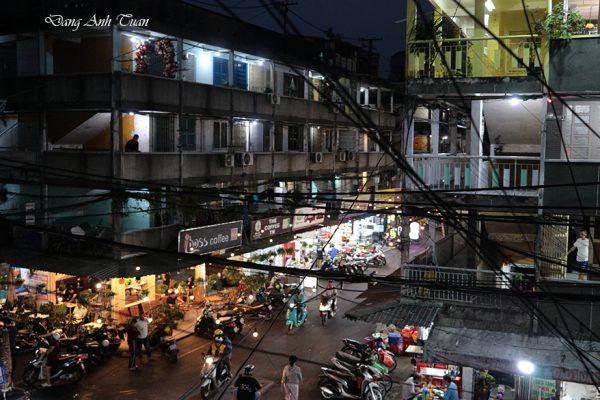
Des histoires en marge au cœur du complexe Nguyễn Thị Thuật.

Những chuyện bên lề ở giữa lòng chung cư 

Version française
Version anglaise
Galerie des photos

Mỗi ngày, sáng hay chiều tối nào, tụi nầy cũng có thói quen từ khi đến Viêt Nam sau khi ăn cơm hay thường  la cà ngồi quán cà phê. Ngày xưa, người Việt  trò chuyện hay thường bắt đầu bằng cách têm trầu nay sự việc nầy không còn mà được thay thế bằng ly cà phê. Có thể nói, gặp nhau muốn nói chuyện gì cũng được, phải có ly cà phê. Giờ phút nầy cà phê nó không thể thiếu ở người Việt, không biết lúc nào nó lại nằm trong văn hóa  của người  Việt. Không thể thiếu nó nhất là các quán nó đua nhau mọc lên như nấm trong khu chung cư nầy. Không biết  các quán bán được bao nhiêu ly cà phê mỗi ngày mà  đi qua xem vựa, nơi mà   họ lưu trử các khối nước đá trông thấy ở chung cư, thấy mà khiếp sợ. Mới đây mùng hai Tết trên đường về bằng xe grab, cháu tài xế hỏi mình như sau: Chú có phiền không, cho cháu ghé uống một ly cà phê có được không ? Mình mới nói: uống đi cháu, chú đơị cháu. Nhưng nghĩ sao, cháu tài xế không uống, đưa thẳng mình về khách sạn. Lúc  trả tiền, mình mới nói với cháu tài xế: Chú biếu cháu 50.000 đồng tiền  lì xì (2 euros) để cháu uống cà phê đi nha. Cháu tài xế  cười toe toét. Mình muốn nói đây cái sung sướng mà mình nhận  được  trên khuôn  mặt của cháu tài xế khi nhắc đến ly cà phê.

Không nhất thiết uống nhiều ly cà phê trong ngày mới có thể ngồi ở quán, chỉ cần một ly cà phê là đủ rồi, bạn có thể ngồi nguyên ngày. Ở quán cà phê trong chung cư, dù không có thức ăn đi nữa  mình có thể kêu ở các quán bán thức ăn  gần đó mang đến cho mình ăn. Đây là một dịch vụ miễn phí chỉ có ở Việt Nam. Ngồi quán cà phê, tụi nầy có thể thư thản đọc sách,  xem điện thọai, người hay xe cộ đi qua lại  mà cũng có thể  quan sát cuộc sống hằng ngày của người dân sống ở trong chung cư.

Vừa ngồi xuống nghế chưa đầy 5 phút thì có các cháu bé  hay các bà mẹ bế con bán giấy số đến lần lượt xin tụi nầy mua giấy số. Nhưng làm sao mua nổi, người nào cũng có cả trăm tờ, mỗi tờ 10.000 đồng họ chỉ được 1000 đồng nếu họ bán được một tờ. Nếu bán không hết trong ngày, chiều lại không được trả lại. Như vậy họ làm sao có lời, chắc chắn họ phải mất tiền. Phải có  mẹo nào đó. Cách buôn bán giấy số nầy làm mình rất phân vân, có cái gì không ổn. Dĩ nhiên làm mình chạnh lòng nhưng mình chỉ cho tiền các em nhỏ bán giấy số  mà thôi chớ không mua còn anh bạn mình thi chỉ mua giấy số của các người khuyến tật, mua rồi đem tặng các bạn già ở Việt Nam. Hai đứa nầy  lúc nào cũng có ở trong đầu  nhiều câu hỏi nhưng chả bao giờ có câu trả lời chính đáng. Ở chung cư vì cuộc sống rất chật vật, không gian thì eo hẹp, gia đình đông con hay  thường thấy họ ngủ la liệt dưới đất  nên việc nấu ăn trong nhà thường ít thấy. Thông thường thấy họ la cà các  quán, ăn tại chỗ hay mua về ăn. Luôn cả cô em bà con của mình ở  chung cư  một mình hay thường mua đồ ăn ở chợ đem về nhà mà ăn.  Đôi khi cũng ngon đáo  để  như món mắm chưng hột vịt mà cô em thết đãi  tụi nầy một hôm, làm tụi nầy nhớ hoài.  Mình hay thường nghe câu nói nầy từ ông bạn mình: Thế hệ ngày nay không phải là thế hệ của má tụi mình. Phụ nữ Việt Nam không còn biết nấu ăn, chỉ biết  phê bút hay sống ảo mà thôi. Cái nhận xét nầy cũng không hoàn toàn sai. Phải cần có adrenaline  để quên đi sự phiền muộn trong cuộc sống  mong manh.

Ở giữa lòng chung cư, có nhiều nghề sống được lắm  như biết may vá, nấu ăn giỏi như cô Mai, cô Lý. Cô Mai thì nổi tiếng các món xào nhất là bà biết làm sao khi mình ăn còn mùi khói  chớ không có mùi cháy của chảo  như cơm chiên gà, mì xào giòn còn cô Lý thì món tầm bì nước dừa, bánh bèo bì, chè chuối  vân vân phải nói quá ngon làm mình vẫn còn thèm đấy. Muốn ăn các món nầy thì phải chịu khó đợi lúc nào cũng đông khách cả. Quá giờ thì không còn nữa đấy. Họ trù liệu bao nhiêu phần để bán chớ hết thì thôi ngày hôm sau trở lại chớ không như ở Paris  nhiều tiệm đỗ nước thêm để bán phở tiếp. Có một lần anh bạn mình muốn ăn thịt heo quay thôi chớ không muốn ăn bánh hỏi vì thích ăn với bánh mì  nhưng họ không bán vì họ trù liệu trước bao nhiêu bánh hỏi để bán với thịt quay rồi.

Chính ở chung cư nầy mình có duyên được gặp một hôm ở quán cà phê  môt họa sỹ nhỏ tuổi đang ngồi chăm chỉ vẽ cảnh vật ở chung cư với bút mực. Cháu nầy có bản năng vẽ không sữa không làm lem bức tranh với mực. Mình thích qu á chừng nên muốn mua bức tranh nhưng cháu rất dễ thương mới thốt lên như sau: Chú muốn, cháu tặng chú. Mình cũng không ngờ. Đây là duyên cháu có  với chú  đấy thôi. Sau đó anh bạn của mình ngỏ ý mua một tấm tranh khác để mang về Paris tặng bạn. Vui cũng có với cháu họa sỹ nầy mà buồn cũng có với em bé tạc chừng 12 tuổi  ngậm xăng phun lửa thường thấy ở chung cư. Bé nầy thường biểu diễn trước đám đông ngậm xăng phun lửa. Tình cờ mình thấy vậy mới kêu em bé lại hỏi chuyện.  Tại sao con làm vậy, con có biết xăng nó độc nay mai con sẽ bi ung thư cuống họng không? Con nhớ chú dặn con không nên làm nghề nầy nữa. Mình chỉ khuyên nó, thấy thương nó nên cho nó một trăm ngàn đồng, chả là bao nhiêu cả.  Mình cảm thấy bất lực vì mình biết mình không thể làm gì hơn.

Ở chung cư nầy biết bao nhiêu người nghèo, mình có làm được gì không?. Cháu nhờ nghề nầy mỗi ngày cháu kiếm được vài trăm ngàn để nuôi em và sống, ba má cháu ly dị?  Câu nói nầy nó vẫn còn ở trong tâm trí của mình khi mình viết về chung cư. Một con chim én đâu có đem lại mùa xuân. Nhưng không vì thế  mà mình quên đi những trẻ em nghèo nầy. Chúng nó là tương lai của đất nước nầy.

Version française

Depuis notre arrivée au Vietnam, nous avons pris l’habitude de nous attarder dans un café après les repas, matin et soir. Autrefois, les Vietnamiens entamaient les conversations en commençant par la chique du bétel. Mais ce n’est plus le cas d’aujourd’hui. Elle est remplacée par une tasse de café. On peut dire sans se tromper que, quel que soit le sujet de conversation, une tasse de café s’avère indispensable. De nos jours, le café est devenu incontournable pour les Vietnamiens. Il est difficile de dire quand il est entré dans la culture vietnamienne. Il l’est d’autant plus depuis lors  avec la poussée des cafés comme celle des champignons dans ce complexe d’appartements. Je me demande combien de tasses de café ces établissements vendent chaque jour, car le stockage des tonnes de glace dans le complexe est assez effarant. Récemment, le deuxième jour du Têt (Nouvel An lunaire), alors que je rentrais chez moi en taxi grab, le chauffeur m’a demandé : « Monsieur, cela vous dérangerait-il si je m’arrêtais pour prendre un café ? » J’ai répondu  sans hésitation: « Allez-y, je vous attends. » Mais pour une raison inconnue, le jeune chauffeur n’en a pas bu et m’a ramené directement à l’hôtel. Au moment du paiement, j’ai dit au jeune chauffeur : « Voici 50 000 dongs ( à peu près 2 euros) en cadeau de  notre Nouvel An pour vous offrir un café. » Il m’a montré un large sourire. Je voulais souligner la joie que j’avais vue sur son visage à l’évocation du café.

Il n’est pas nécessaire de boire plusieurs tasses de café par jour pour s’attabler dans un café; une seule suffit, et on peut y rester toute la journée. Au café de ce complexe d’appartements, même s’il n’y a pas de nourriture, on peut la commander auprès des vendeurs ambulants du quartier et on est servi sur place. C’est un service gratuit, typiquement vietnamien. Installés au café, nous pouvons nous détendre, lire, consulter nos téléphones, regarder le va et vient des passants et des voitures, et observer le quotidien des habitants. À peine cinq minutes après notre installation, des enfants ou des mères avec des bébés se mettaient à la queue leu leu pour nous vendre des billets de loterie. Mais comment pouvons-nous tout acheter? Chacun en avait une centaine, à 10 000 dongs le billet, et ils ne gagnaient que 1 000 dongs par billet vendu. S’ils n’arrivaient pas à tout vendre dans la journée, ils ne pouvaient pas  rendre les billets à l’endroit où ils les avaient pris. Comment pouvaient-ils faire des bénéfices ? Ils allaient forcément perdre de l’argent. Il devait y avoir une astuce.

Cette façon de vendre des billets de loterie me perturbe beaucoup ; j’ai un mauvais pressentiment. Bien sûr, cela me rend un peu triste. Je donne uniquement  de l’argent aux enfants qui vendent les billets mais  je n’en achète pas.  En revanche, mon ami n’achète des billets qu’à des personnes handicapées et les offre ensuite à ses amis âgés au Vietnam. Nous nous  posons toujours des questions, mais nous n’obtenons  jamais des réponses satisfaisantes. « Vivre dans le complexe d’appartements » est très difficile: l’espace est limité et les familles nombreuses sont obligées de  dormir souvent par terre, si bien que « cuisiner à la maison » est une rareté. On les voit généralement traîner au bistrot, y manger ou acheter des plats à emporter. Même ma cousine vivant seule dans son appartement, préfère d’acheter  souvent de quoi manger au marché.

Parfois, la bouffe achetée est incroyablement délicieuse, comme cette pâte de poisson à la vapeur avec des œufs de canard que ma cousine a achetée et  agrémentée avec des légumes, ce qui nous donne un plat insatiable. J’entends souvent mon ami dire : « La génération d’aujourd’hui n’est pas celle de nos mères. Les Vietnamiennes ne savent plus cuisiner ; elles ne connaissent que Facebook ou vivre dans le monde virtuel. » Ce constat n’est pas totalement faux. Il faut bien une dose d’adrénaline pour oublier les tracas de cette vie fragile.

Au cœur de ce complexe d’appartements, on trouve de nombreux emplois lucratifs comme la couture et la cuisine, à l’instar de ceux de Mmes Mai et Lý. Mme Mai est réputée pour ses plats sautés, notamment pour son talent à leur conserver un léger goût fumé, sans les brûler, comme le riz frit au poulet et les nouilles frites croustillantes. Les plats de Mme Ly, tels que le plat de nouilles de riz agrémentées de la couenne de porc  au lait de coco, le  gâteau de riz à la couenne, la soupe sucrée à la banane  etc. sont si délicieux que j’en ai encore l’eau à la bouche

Pour déguster ces plats, il faut s’armer de patience ; les stands de ces dames sont toujours bondés. Si on rate l’heure de fermeture, il n’y en aura plus. Ils ne proposent qu’un nombre limité de portions et, si elles sont épuisées, il faut  revenir le lendemain, contrairement à Paris où de nombreux restaurants continuent à remplir leur soupe de nouilles avec de l’eau pour maintenir leur activité. Un jour, mon ami a voulu manger uniquement le porc laqué, sans les nouilles de riz, car il préférait les déguster avec du pain. Mais on a refusé de lui en vendre, car le restaurant avait déjà prévu la quantité de nouilles à vendre avec celle du porc laqué.

 C’est dans ce complexe que j’ai la chance de rencontrer un jour, un jeune artiste dans un café. Il était en train de dessiner à l’encre  la scène du complexe avec soin. Ce jeune artiste avait un don inné pour le dessin ; l’encre ne bavait pas. J’aimais tellement son tableau que j’aurais voulu l’acheter, mais l’artiste, si gentil, m’a dit sans hésitation: « Si tu le veux, je te le donne. » J’étais surpris. C’était le destin qui avait fait que nous nous rencontrions. Ensuite mon ami a manifesté aussi  son intérêt pour l’achat d’un autre tableau pour le ramener à Paris comme cadeau offert à son ami. Je suis heureux de connaître ce jeune artiste, mais je suis aussi triste de voir souvent le petit garçon d’une douzaine d’années, qui est habitué à faire du spectacle devant la foule en crachant du feu avec de l’essence. Par hasard je l’ai interpellé un jour : « Pourquoi fais-tu ça ? Sais-tu que l’essence est toxique et que tu risques d’avoir un cancer de la gorge ? Je te conseille  d’arrêter ce métier. Pris de pitié,  je lui ai donné 100 000 đồng, une somme vraiment  dérisoire. Je me sens impuissant car je sais  que je ne peux plus rien faire pour lui.

Il y a tant de gens pauvres dans ce complexe, que puis-je faire ? Grâce à ce travail, je gagne quelques centaines de milliers de dongs par jour pour subvenir aux besoins de mon petit frère ou de ma petite sœur et vivre dignement car  mes parents sont divorcés.  Sa parole me hante encore lorsque j’écris encore tout ce qui est en rapport avec ce complexe d’appartements. Une seule hirondelle n’apporte pas le printemps. Mais  malgré cela, je ne peux pas oublier ces enfants défavorisés. Ils sont l’avenir de notre pays.

Galerie des photos

Les bouquinistes le long de la Seine

Les bouquinistes le long des quais de la Seine


Version française
Version anglaise
Galerie de photos

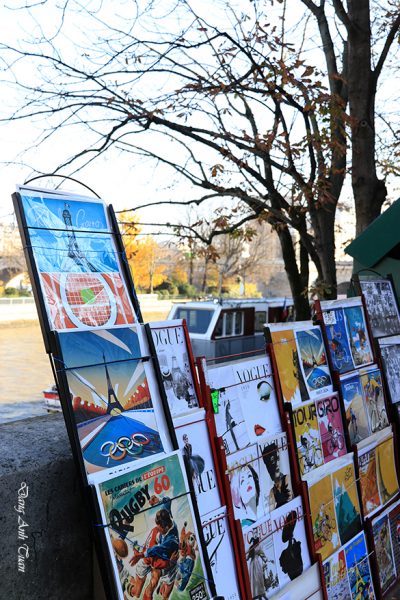
Nằm dọc bờ sông Seine, những quầy sách là một nét đặc trưng của cảnh quan Paris. Tương tự như những người bán hoa ở Phố Cổ Hà Nội, họ bán sách cổ, áp phích, bưu thiếp và đồ sưu tầm. Du khách có cơ hội ngắm nghía hàng hóa của họ khi dạo bước giữa Nhà thờ Đức Bà và Bảo tàng Louvre. Thật thú vị khi được lục lọi những chiếc hộp xanh lớn. Tổng cộng có 900 hộp. Nếu trời mưa, những người bán sách sẽ nhanh chóng đóng quầy. Chỉ trong vài phút, mọi thứ lại biến mất vào chiếc hộp xanh lớn. Paris thật kỳ diệu.

Étant installés le long des quais de la Seine,  les bouquinistes font partie de l’une des caractéristiques du paysage  parisien. Analogues aux marchandes ambulantes des fleurs  du vieux quartier de Hanoï, ils vendent  des livres anciens, des affiches, des cartes postales et des objets de collection.  Les touristes ont l’occasion de jeter un coup d’œil sur leurs produits en flânant entre l’église Notre Dame et le musée du Louvre. Il est intéressant pour les touristes de  les fouiller dans les grandes boites vertes. Il y a 900  boites en tout. En cas de pluie, les bouquinistes vont fermer rapidement leurs boutiques. En quelques minutes, tout disparait à nouveau dans sa grande boite verte. C’est magique, Paris.

Located  along the banks of the Seine, the bouquinistes are part of one of the characteristics of the Parisian landscape. Similar to the flower vendors of the old Hanoi district, they sell old books, posters, postcards, and collectibles. Tourists have the opportunity to take a look at their products while strolling between Notre Dame Church and the Louvre Museum. It is interesting for tourists to rummage through them in the large green boxes. There are 900 boxes in total. In case of rain, the bouquinistes quickly close their shops. In a few minutes, everything disappears again into its large green box. It’s magical, Paris.

Galerie des photos

[Return PARIS]

The Vietnamese spoonerism


Nói lái

French version
Vietnamese version

The exact date of the appearance of spoonerisms in Vietnam is not known, but during the French colonial period, it was discovered by a researcher from the French School of the Far East, M.A. Chéon. He maintains that it is a language formed mechanically and artificially from the mixing or inversion of elements of two or three consecutive monosyllables in a sentence. It is considered a true linguistic gymnastics and is characteristic in conversation. When someone says something, the listener must know how to interpret it in another way according to a tacit convention that only a small group of people in the profession or among friends can understand. Today, it has become popular among the population and is used to joke playfully among close friends, such as « khoái ăn sang » (to enjoy eating abundantly) (sáng ăn khoai « eat sweet potatoes for breakfast »), (chà đồ nhôm « rub aluminum objects ») (chôm đồ nhà « steal things from the house »), (hạ cờ tây « lower the French flag ») (hạ cầy tơ « eat dog meat »).

Words of extreme elegance can become vulgar words in carelessness or with the intention of teasing someone or mocking others, especially the beautiful names that parents have given their children such as Cảnh hu, Thu đạm, Thái Đức, etc. Sometimes in a statement, no meaning is found, but when the words are reversed, it gives it a meaning like « man cái » becoming « cái màn » (curtain) or vice versa like « đơi chi » becoming « đi chơi » (to stroll).

According to the French researcher M.A. Cheon, Vietnamese people often have the habit of easily separating the elements (consonants and vowels) of words. It is on this separation that the whole rule of wordplay is established. The first word lends its final ending to the following word and in return, it takes back the final ending of the following word.

Thus, « đi chơi » (to stroll) is divided into d + i and becomes « đơi chi » by inversion. This is a very simple rule but it also includes very complex rules that are often found in wordplay with the three principles below.

Example: cờ tây (French flag) becomes cầy tơ (a young dog). This method proves harmonious and is more frequently encountered. Cờ and cầy always keep the two tones (bằng) of the two original sounds like tây and.

Second method:

1°) Completely swap syllables.

2°) Keep the two tones (accents) of the two original sounds.

For example: đấu tranh (to fight) becomes tránh đâu (to avoid). This method does not seem pleasant to the ear and is rarely used.

Third method:

1°) Reverse the sound pattern.

2°) Swap the two tones (accents) of the two syllables.

For example: khó đi (difficult to go) becomes khi đó (at that moment). This method is also not pleasant to the ear and its use is also rare.

According to the writer Phụng Nghi, in a word of 3 or 4 syllables, if one wants to say it « backwards, » one must keep the linking sounds (conjunctions) or the sounds with secondary meaning. The syllables with the correct meaning are exchanged in the three ways mentioned above.

Example: khoái ăn sang (to enjoy eating abundantly) -> sáng ăn khoai (« to eat sweet potatoes for breakfast »)

cái trâm em cài (the brooch I wear) -> (cái trài em câm) -> (cái chai em cầm « the bottle I hold »)

làm sương cho sáo (to make dew for the flute: no meaning) -> (làm sao cho sướng « how to make myself happy »)

cầu gia đạo (family prayer) -> (cạo da đầu « scalp shaving »)

This wordplay is often used with the intention of reflecting a social reality such as

Ban lãnh đạo (« leadership team ») -> Bao lãnh đạn (« cartridge case »)

Thủ tục đầu tiên (« the first procedure to take ») -> (thủ tục tiền đâu « monetary procedure (corruption) »)

Chiều 30 Tết thầy giáo tháo giầy đi chợ, mồng một giáo chức (giức cháodứt  cháo  vui Xuân. Trong câu nầy thì có sự châm chước trong lỗi chính tả như hai chữ  giứcdứt.

On the afternoon of the 30th of Tết, teachers take off their shoes to go to the market. On the first day of Tết, teachers finish their soup and celebrate the spring. In this statement, there is some tolerance for spelling mistakes such as the two words « giức » (no meaning) and « dứt » (to cease).

With the characteristic of « transforming the ‘vulgar’ into ‘distinguished’, » the spoonerism is a technique that appears in scholarly literature and popular couplets. It is also satirical and ironic, as in the poem titled « Monastic Life » by Hồ Xuân Hương:

Cái kiếp tu hành nặng đá đeo
Vị gì một chút tẻo tèo teo (quá nhỏ)
Thuyền từ muốn về Tây trúc
Trái gió phải nên phải lộn lèo

The monastic life is burdened with heavy stones,
What taste is there in a little bit so tiny (too small)?
The boat wants to return to India,
The contrary wind forces it to turn around.

Or not strictly adhering to the rising and falling tones in the poem « Summer Awaits the Lover » by Nguyễn Khoa Vy:

Nực cổi chỉ ra nỗi cực lòng
Dòng châu lai láng đĩa dầu chong
Khó đi tìm hiểu nhau khi đó
Công khó chờ ai biết có không

The heat’s relief only reveals deep despair,
Tears flow abundantly on the oil lamp’s plate.
It is difficult to understand each other at that moment,
The effort to wait for someone, does anyone know?

We are used to listening to the following riddles

I do not dislike compotes except chè ghim (chìm nghe « sunken boat »)

Bằng ngón tay trên bàn Phật
Tụng kinh rồi búng cánh bay xa (bánh cúng)

– Just the size of a finger on the Buddha’s altar
Once the prayer is finished, the cake offered to him flies very far (búng cánh « bánh cúng »)

Cái bông trên cành, cái trái cận mây (cây mận)

– The flower is on the branch, the fruit is close to the cloud (cận mây) (prunier tree).

The flower being on the branch, the fruit is very close to the cloud (cận mây), that is, on the « cây mận (prunier) »

Cục đo đỏ bỏ vô giường (Cục đường bỏ vô giỏ)

– The reddish piece is on the bed (Cục đo đỏ bỏ vô giường) (Cục đường bỏ vô giỏ « the piece of sugar is in the basket »)

or to find the spoonerism in the following parallel sentences:

Con mèo cái nằm mãi trên mái kèo
Con cá đối nằm trong cối đá
Con chim mỏ kiến đậu trên miếng cỏ

The female cat rests eternally on the roof framework.
The mule rests in the stone mortar.
The woodpecker perches on a piece of grass.

There are certain puns in spoonerisms that the listener thinks they are dealing with, such as Western or Chinese words during their listening, which first causes confusion and leaves them stunned for a moment before realizing it and bursting out laughing. This is the case with the following example:

Quýt xơ măng bông sên (Quăng xơ mýt (mít) bên sông « throwing jackfruit fibers by the riverbank »).

Chúng mình đập chuông nhé? -> Chúng mình đuông chập nhé? -> Chúng mình đuông chậm nhé? -> ? Chúng mình đâm chuột nhé? -> Chúng mình đâm tí (tý) nhé? -> (Chúng mình đi tắm nhé? « Let’s go swimming »)

[Return LITERATURE]


Tôi ru em ngủ mùa thu

Tôi ru em ngủ mùa thu

Tôi ru em ngủ mùa thu
Em thường nhặt lá phù du vào mùa
Tôi ru em ngủ gió lùa
Qua hàng song cửa chợp đùa hồn tôi
Tôi ru em ngủ trên môi
Nụ cười chớm nở đời tôi thế nào
Tôi ru em ngủ mưa gào
Hồn tôi lạnh buốt em nào có hay
Tôi ru em ngủ tháng ngày
Khi  thu đã chết, tình nầy cũng phai.

Je te bercerai pour t’endormir en automne
Tu est habituée à ramasser les feuilles fugaces en saison
Je te bercerai pour t’endormir avec le vent qui souffle
À travers les barreaux de la fenêtre, taquinant ainsi mon âme
Je te bercerai pour t’endormir sur les lèvres
Un sourire commençant  à naître, ma vie à quoi ressemble-t-elle?
Je te bercerai pour t’endormir avec la pluie « hurlante »
Mon âme est gelée, tu ne le sais pas
Je te bercerai pour t’endormir  au fil des jours
Quand l’automne mourra,  cet amour s’estompera aussi

I lull you to sleep in autumn
You often gather fleeting leaves in season
I lull you to sleep with the wind that sneaks 
Through the bars of the window, teasing my soul
I lull you to sleep on the lips
A smile beginning to emerge, what will my life be like?
I lull you to sleep with the howling rain
My soul is frozen, you don’t know it
I lull you to sleep over the days
When autumn dies, this love fades away too.


[RETURN]

Con Đò (La barque)


Con đò

Tình nào thổn thức đêm dài
Đò nào bến cũ tháng ngày tiếc thương
Bao năm chồng chất tóc sương
Sông nào đãi  hết tỏ tường với ai

La barque

Pour quel amour se tourmente-t-on avec des longues nuits?
Pour quel sampan et son ancien débarcadère, continue-t-on à être accablé d’affections et de regrets ?
Les cheveux blancs s’accumulent sous le poids des années
Le fleuve n’arrive pas à tout effacer, à qui doit-on révéler les confidences ?

The boat

For what love does one torment oneself with long nights?
For what sampan and its old pier does one continue to be overwhelmed with affections and regrets?
White hairs accumulate under the weight of years
The river cannot erase everything, to whom should the confidences be revealed?

Ước gì (J’aimerais)

Ước gì (J’aimerais)

Ước gì đời được có em
Để đời ấm áp, để đêm bớt dài
Ước gì tình có cánh bay
Để tình cao vút như mây giữa trời
Ứớc gì hồn được thảnh thơi
Để hồn mơ mộng tuổi thơ ngày nào
Ước gì biển cả trời cao
Được người tri kỷ cùng nhau kiếp nầy.

J’aimerais t’avoir dans la vie
pour la rendre plus chaleureuse et raccourcir les nuits
J’aimerais l’amour posséder des ailes 
Pour que l’amour s’élève comme les nuages ​​dans le ciel
J’aimerais que mon âme soit en paix
Pour qu’elle rêve de mon enfance
J’aimerais que la mer et le ciel soient élevés
Pour avoir une âme sœur avec qui  je peux partager cette vie.

I would like to have you in life
to make it warmer and shorten the nights
I would like love to have wings
So that love rises like clouds in the sky
I would like my soul to be at peace
So that it dreams of my childhood
I would like the sea and the sky to be high
To have a soulmate with whom I can share this life.

[RETOUR: Trở về]


Tình nào (Quel amour)

  Tình nào

Tình nào thương tiếc nhớ nhung
Tình nào quên lãng muôn trùng xa nhau
Tìn nào ngắn gũi đớn đau
Tình nào ấp ủ khát khao tháng ngày
Tnh nào ray rứt đọa đày
Tìn nào đấm đuối lung lay kiếp người
Tình nào ngao ngán đỗ lười
Tình nào giữ mãi nụ cười yêu đương

Quel amour on a plein de regrets et de nostalgie
Quel amour on oublie la distance
Quel amour on est bref et douloureux
Quel amour on chérit le désir de tous les jours
Quel amour on est tourmenté et douloureux
Quel amour on se noie ébranlé dans la vie humaine
Quel amour on est ennuyé et paresseux
Quel amour on garde le sourire de l’amour pour toujours

Which love is regretful and longing
Which love forgets the distance
Which love is short and painful
Which love cherishes the desire of the days
Which love is tormented and sorrowful
Which love drowns and shakes human life
Which love is bored and lazy
Which love keeps the smile of love forever

[RETOUR]


Ru tình (Bercer mon amour)

Bercer l’amour

Rock love

 
Ru tình nổi nhớ đêm thâu
Tình đâu có biết muôn sầu nào vơi
Ru tình chẳng nói nên lời
Tình đâu còn nữa ngàn đời ru ai
Ru tình thơ thẩn tháng ngày
Tình càng sâu đậm miệi mài vết thương
Ru tình luyến tiếc vấn vương
Tình càng quanh quẩn trăm đường khổ nhau
Ru tinh vất vả đớn dau
Tình nào không tiếc tình nào dễ quên
Ru tình bài hát không tên
Hát cho tình nhớ hát lên tình gần
Hát cho tình chớ bâng khuâng
Cho tình trở lại lân lân với đời
Ru tình yêu nhớ một thời
Ngậm ngùi thương xót một đời xa nhau.
 

Bercer l’amour durant la longue nuit
L’amour ne sait pas apaiser les chagrins
Bercer l’amour sans dire un mot
L’amour ne reste plus pour bercer qui que ce soit durant mille vies
Bercer l’amour pendant les jours errants
Plus l’amour est profond, plus les blessures sont douloureuses
Bercer l’amour avec un regret persistant
L’amour continue de tourner en rond par cent chemins de souffrance
Bercer l’amour d’épreuves et de douleur
Quel amour n’est-il pas regretté, quel amour est-il facile à oublier?
Bercer l’amour est comme une chanson sans nom
Chanter pour que l’amour s’en souvienne, chanter pour que l’amour se rapproche de nous
Chanter pour que l’amour ne s’émeuve pas
Pour que l’amour revienne doucement avec la vie
Bercer l’amour pour se souvenir d’une époque 
Pour plaindre une vie séparée avec tant de regrets.

Rock love during the long night
Love does not know how to ease sorrows
Rock love without saying a word
Love no longer stays to rock anyone through a thousand lives
Rock love during the wandering days
The deeper the love, the sharper the wounds
Rock love with a persistent regret
Love keeps going in circles, a hundred paths of suffering
Rock love with trials and pain
What love is not regretted, what love is easy to forget?
Rocking love is like a song without a name
Sing so that love remembers, sing so that love comes closer to us
Sing so that love does not stir
So that love returns gently with life
Rock love to remember a period
and to pity a life separated with regrets.

[RETURN]

Lang thang giữa rừng thơ (Errer dans la forêt de la poésie)


Rượu nồng ấm áp không lời
Còn tình xa mãi muôn đời tình ơi
Như thuyền lạc bến ra khơi
Để người ở lại  muôn đời nhớ nhung.

Le vin me réchauffe et me  laisse  dans un état sans voix.
L’amour est encore loin pour toujours, mon amour
Comme le bateau est chaviré en mer sans retrouver le débarcadère
Cela me  laisse ainsi  dans un souvenir inoubliable.

The wine warms me and leaves me speechless.
Love is far forever, my love
Like a boat capsized at sea without finding the dock
It leaves me thus in an unforgettable memory.


[RETURN]