Forbidden city of Beijing (Cố Cung): Part 1

Forbidden city of Pékin

Cố Cung


Version française

Vietnamese version

[The Forbidden City in Beijing: Part 1]

After defeating his nephew Zhu Yunwen (also known as Jianwen Emperor), whose death remains a mystery to historians, the third emperor of the Ming dynasty, Zhu Di (also known as Yongle Emperor), decided to move the capital from Nanjing to Beijing, mainly for strategic reasons. Facing the serious threat of the Mongols to the empire, he thought this was the quickest solution to deal with the raids. He entrusted the chief architect, the eunuch Nguyen An of Vietnamese origin, with the construction of the Forbidden City on the ruins of Khanbaliq, the Yuan dynasty city built by Kubilai Khan in 1267 and described by Marco Polo in his book titled « The Description of the World » in 1406, following a designated protocol. Two hundred thousand workers were recruited for this grand project, which lasted 14 years.

Besides the participation of a large number of provinces in supplying materials: Xuzhou (Jiangsu) marble, Linqing (Shandong) bricks, stone from the Fangshan and Panshan quarries not far from Beijing, nanmu wood for the house frame from Sichuan, columns from Guizhou and Yunnan, and so on, it was also necessary to renovate the Grand Canal dating back to the Sui Dynasty. This canal was essential for transporting materials and food to the capital Beijing. From 1420 to 1911, a total of 24 emperors of the Ming and Qing dynasties resided here. The last emperor to live in this Forbidden City was Emperor Puyi of the Qing Dynasty.

There are many questions about the preservation and conservation of the capital by the Qing army when they seized power in China because, according to Chinese tradition, the victors usually thoroughly destroyed all palaces belonging to previous dynasties. One can look at the example of Zhu Yuanzhang, also known as the Hongwu Emperor. He ordered his soldiers to completely destroy the capital of the Yuan Dynasty in Beijing and move the capital to his hometown in Nanjing. It is unclear what motivated the Qing Dynasty to keep the Ming capital intact.


Cố Cung

cite_pekin


Although the Qing emperors made efforts to renovate the Forbidden City and built many additional palaces, this Forbidden City forever retains the mark of its founder, Emperor Yongle (Zhu Di). One of the three famous emperors alongside Han Wudi and Tang Taizong in Chinese history, Zhu Di appointed Admiral Zheng He to lead the naval expeditions to the « Western Oceans, » which were later recorded by his companion Ma Huan in the book titled Ying-yai Sheng-lan (The Marvels of the Oceans). Taking advantage of the usurpation of the throne by Hồ Quý Ly, Zhu Di annexed Vietnam in 1400. Without the nearly ten years of resistance by the Vietnamese people under Lê Lợi, Vietnam could surely be a province of China today, like Yunnan or Guangdong.
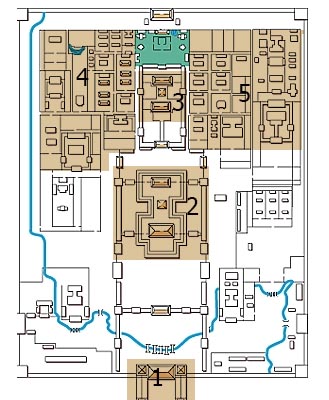

1 Porte du Midi (Ngọ Môn)

2 Tiền Triều (Waichao)

  • Điện Thái Hoà (Taihe)
  • Điện Trung Hoà (Zhonghe) 
  • Điện Bảo Hoà  (Baohe) 

3  Hậu tẩm (Neichao)

  • Cung Càn Thanh (Qianqing)
  • Điên Giao Thái (Jiaotai)
  • Cung Khôn Ninh (Kunning)

4) Six Palais de l’Ouest (Lục viện)

5) Six Palais de l’Est (Luc viện)


The Forbidden City is truly a city within a city and was built on a rectangular piece of land measuring 960 chi in length and 750 chi in width. The Forbidden City is divided into two parts: the front section called the Outer Court (waichao), designated for ceremonial life (such as coronation ceremonies, investiture ceremonies, and royal weddings), and the rear section called the Inner Court, reserved for the emperor and his family. There are three halls in the Outer Court: the Hall of Supreme Harmony, the Hall of Central Harmony, and the Hall of Preserving Harmony, which together form the complex known as the Three Halls of the Outer Court. In the Inner Court, there are the Palace of Heavenly Purity, the Hall of Union, and the Palace of Earthly Tranquility, each surrounded on the east and west sides by six six-yards (residential quarters). This is commonly referred to as the Three Palaces and Six Yards of the Forbidden City.

When visiting the Imperial City, tourists are obliged to pass through Ngo Mon Gate. This is the main gate of the Imperial City. At one time, this gate witnessed many ceremonies related to military departures or the triumphant return of the royal army, as well as the announcement of a new lunar calendar. It is the only gate, or more precisely, a U-shaped structure, 8 meters high, with five buildings on top featuring double roofs and five gates, but the middle gate is reserved only for the king. This architectural complex is often called the Five Phoenix Pavilion because its shape resembles a phoenix. Beyond Ngo Mon Gate, there is a very wide courtyard crossed by an artificial river with shimmering golden water called Neijindhuihe. This river has five beautifully decorated bridges, with the middle bridge reserved for the emperor. Along the riverbanks, there are stone balustrades carved with dragons and phoenixes.

The front court enjoys Yang energy, so the palaces here are usually built higher than the palaces in the rear chambers, thanks to a large common foundation with three steps carved from jade stone, raised to highlight not only the splendor of the front court palaces but also the majestic and magnificent nature of Yang energy. Similarly, the rear chambers enjoy Yin energy, so the palaces here are all low, except for the Kien Thanh Palace, where the king works and discusses state affairs with high-ranking officials, which enjoys Yang energy and is therefore taller than the other palaces.

In this place, one can see a typical metaphor, which is Yang within Yin, often mentioned. Between the Qianqing Palace, where the emperor resides and enjoys Yang energy, and the Kunning Palace, the empress’s resting place receiving Yin energy, there is the Jiaotai Hall. Considered the connecting link between the Qianqing and Kunning Palaces, Jiaotai Hall not only represents the perfect harmony of Yin and Yang but also symbolizes peace within the Forbidden City. All the palaces in the Forbidden City face south to benefit from the advantages of Yang energy.

Based on traditional Chinese feng shui, to the north of the Forbidden City, there is an artificial mountain called Jinshan and the Great Wall to prevent the harmful effects of Yin energy coming from the north (cold winds, nomads, ghosts, and so on). To the south, thanks to water-filled pits and an artificial river with shimmering golden water (Neijindhuihe), the qi buried in the earth can circulate, which is difficult to disperse due to the levels created on the surface. This arrangement is seen in the construction of the three-tiered foundation for the three halls used for rituals in the front court. As a result, qi is guided up and down through the halls to break the monotony of the flat land and reach the summit where the emperor’s throne is in the Hall of Supreme Harmony. As the connection between Heaven and Earth, the emperor usually faces south, with his back to the north, the east on his left, and the west on his right.

Each direction is protected by a guardian creature: the pink swallow in the south, the black turtle in the north, the blue dragon (qinglong) in the east, and the white tiger (baihu) in the west. On the ceiling, at the vertical axis of the throne and above the emperor’s head, there is an exquisitely decorated celestial dome featuring a recessed panel with two golden dragons carved playing with a huge pearl. It is here, when visiting, that tourists wonder how many dragons are used in the decoration of this palace, as this guardian creature appears everywhere. According to some records, there are a total of 13,844 dragons of various types and sizes, giving this place a solemn and majestic appearance never seen in other palaces.

Located along the main north-south axis, the Forbidden City is decorated according to rules of numbers and colors. The choice of Yang numbers (or odd numbers) is commonly seen through the arrangement of mythical creatures on the eaves of the palace roofs or the ornate display on the doors of the Forbidden City with yellow nails, as well as the number of bays the Forbidden City has.
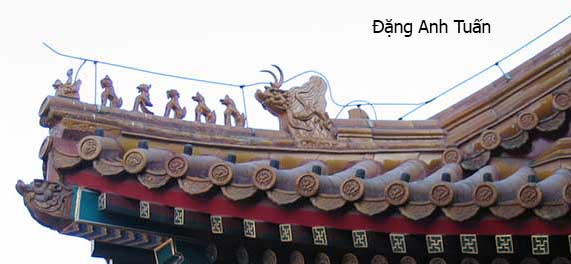


The number of divine beasts on the eaves corners of the palace can range from 1 to 10. Depending on the importance and scale of the palace as well as the rank of the owner in the court, this number can vary. The number of these divine beasts is specified in the book that records all the regulations under the Qing dynasty, known as the Da Qing Hui Dian. These divine beasts are arranged in odd numbers 1-3-5-7-9 on the eaves corners in a clear order as follows: dragon, phœnix, lion, heavenly horse, seahorse, aplustre, fighting bull, suan ni, sea goat, and monkey. Always leading these divine beasts is a figure riding a chicken or phoenix, often called the Prince Min. Nearby is an additional horned beast, the ninth son of the dragon. Each divine beast represents a good omen or virtue and is thus cherished and worshipped. However, there is an exception: the Hall of Supreme Harmony has up to 10 divine beasts on its eaves corners because it is where the emperor holds important ceremonies (such as coronations, weddings, birthdays, year-end celebrations etc.). The use of these divine beasts mainly serves to protect the palaces against evil spirits and to demonstrate the emperor’s power and prestige. Conversely, the Palace of Heavenly Purity, although it is where the emperor works and discusses state affairs with officials, does not have as significant a role as the Hall of Supreme Harmony and therefore only has 9 divine beasts on its eaves corners.

As for the Khôn Ninh palace, seven divine beasts were found on the eaves of the hall because this was the palace of the empress during the Ming dynasty. However, this place was also where the sacrificial rituals to the Tát Mãn religion’s spirits were held, which corresponded to the position of Yin under Yang during the Qing dynasty. It is important to remember that before conquering China, the Qing dynasty was originally Manchu, so they still maintained their own religion.

[The Forbidden City of Beijing (Part 2)]
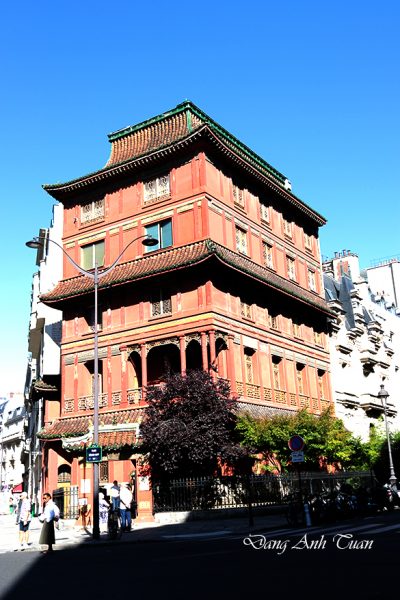
 

Maison Loo, centre d’exposition d’art privé

Une somptueuse pagode chinoise au cœur de Paris.

Ngôi chùa Trung Hoa độc đáo giữa lòng Paris.

Vietnamese version

English version

Au début du 19ème siècle, un marchand d’art chinois de nom Ching Tai Loo racheta un hôtel particulier de style français classique  construit en 1880  au cœur du quartier chic, non loin du parc Monceau. Pour l’amour de son pays et le lien qu’il voulait garder avec son pays d’adoption, il  demanda à l’architecte Fernand Bloc de transformer ce bâtiment en une somptueuse pagode d’inspiration chinoise peinte en rouge comme la cité interdite de Pékin  dans sa totalité car à cette époque le permis de construire ne lui fut pas demandé. Malgré les protestations des gens vivant aux alentours, la maison Loo continue à exister jusqu’aujourd’hui et devient un centre d’exposition collective  d’art privé pour les collectionneurs avertis. Etant invité par la galerie d’art Hioco, j’ai l’occasion de le visiter ce matin. Je suis frappé non seulement par le caractère original de cette maison insolite mais aussi la présentation des objets d’art des galeries associées  à cette exposition. Un grand merci à tous les exposants.

Vào đầu thế kỷ 19, một thương gia nghệ thuật người Trung Quốc tên là Ching Tai Loo đã mua lại một biệt thự theo phong cách cổ điển Pháp được xây dựng vào năm 1880 tại trung tâm khu phố sang trọng, không xa công viên Monceau. Vì tình yêu dành cho đất nước Trung Hoa và mong muốn giữ mối liên kết với quê hương thứ hai của mình, ông đã nhờ kiến trúc sư Fernand Bloc biến tòa nhà này thành một ngôi chùa lộng lẫy mang cảm hứng từ Trung Hoa, được sơn đỏ như Tử Cấm Thành ở Bắc Kinh, bởi vì vào thời điểm đó ông không cần xin giấy phép xây dựng. Mặc dù có sự phản đối từ những người sống xung quanh, ngôi nhà Loo vẫn tồn tại đến ngày nay và trở thành trung tâm triển lãm nghệ thuật tư nhân dành cho các nhà sưu tập tinh tường. Được mời bởi phòng tranh Hioco, tôi đã có cơ hội tham quan nơi nầy vào sáng nay. Tôi không chỉ có ấn tượng bởi tính độc đáo của ngôi nhà kỳ lạ này mà còn bởi cách trưng bày các tác phẩm nghệ thuật của các phòng tranh liên kết với cuộc triển lãm nầy. Xin gửi một lời cảm ơn chân thành đến tất cả các nhà triển lãm.

At the beginning of the 19th century, a Chinese art dealer named Ching Tai Loo bought a French classical-style townhouse built in 1880 in the heart of the upscale district, not far from Parc Monceau. For the love of his country and the connection he wanted to maintain with his adopted country, he asked architect Fernand Bloc to transform this building into a sumptuous pagoda inspired by Chinese design, painted red like the Forbidden City of Beijing in its entirety, as at that time no building permit was required. Despite protests from the local residents, the Loo house continues to exist today and has become a private collective art exhibition center for discerning collectors. Invited by the Hioco art gallery, I had the opportunity to visit it this morning. I was struck not only by the original character of this unusual house but also by the presentation of the art objects from the galleries associated with this exhibition. A big thank you to all the exhibitors.


Cathédrale principale de Bùi Chu (Nam Định)


Nhà thờ chính tòa Bùi Chu (Nam Định)

Version française
Version anglaise
Galerie des photos

Dù nguyên vật liệu lấy tại địa phương là gạch, vôi vữa rất đơn giản, nhà thờ nầy có kiến trúc độc đáo với phong cách chính là  Ba-rốc Tây Ban Nha, kết hợp với cách thức xây dựng truyền thống Việt Nam. Nhà thờ chính tòa Bùi Chu cách thị trấn Xuân Trường 3 km, cách thành phố Nam Định 31 km và cách thủ đô Hà Nội  115 km. Hàng năm vào ngày 8 tháng 8 có rất nhiều giáo dân tập trung về dự lễ kính Thánh Đa Minh quan thầy của giáo phận, quen gọi là lễ đầu dòng.

Malgré l’utilisation des matériaux locaux comme les briques et le mortier, cette église présente une architecture unique, dominée par le baroque espagnol, mêlé aux méthodes de construction traditionnelles vietnamiennes. La cathédrale de Bùi Chu se trouve à 3 km de la ville de Xuân Trường, à 31 km de la ville de Nam Định et à 115 km de la capitale Hanoï. Chaque année, le 8 août, de nombreux paroissiens se rassemblent pour assister à la fête de Saint Dominique, patron du diocèse, communément appelée la première messe.

Despite the use of local materials such as bricks and mortar, this church features a unique architecture dominated by Spanish Baroque, blended with traditional Vietnamese construction methods. Bùi Chu Cathedral is 3 km from the town of Xuân Trường, 31 km from the town of Nam Định and 115 km from the capital Hanoi. Every year, on August 8, many parishioners gather to attend the feast of St. Dominic, patron saint of the diocese, commonly known as the First Mass.

Galerie des photos

BCHU_EGLISE

[Return RELIGION]

Dynastie des Tang (Đại Đường)

Version française
English version
Galerie des photos

Người Trung Hoa  tự hào luôn luôn là con cháu  của nhà Hán. Tuy nhiên, thời đại hoàng kim của văn minh Trung Hoa không phải là thời kỳ của  nhà Hán mà chính là thời nhà Đường được  kéo dài  ba thế kỷ sau đó (618-907). Nhờ có nguồn  tài liệu  phong phú và  việc phát giác  ra các minh khí, các vật thu nhỏ nghi lễ được đặt trong các ngôi mộ của giới thượng lưu thời đó, chúng ta biết được  thời kỳ nhà Đường là một thời kỳ có những tiến bộ đáng kể về khoa học và kỹ thuật (thuốc súng, bản in khắc gỗ, kỹ thuật cơ khí, y học, bản đồ, vân vân..). Đây  là một triều đại rất cởi mở với thế giới  bên ngoài bằng cách có chính sách khoan dung chưa từng có đối với các nền văn hóa khác và  các tôn giáo nước ngoài như Giáo hội Phương Đông hay Cảnh Giáo,  đạo thờ lửa , một tôn giáo đa thần đến từ Ba Tư, Phật giáo đang phát triển  nhanh chóng vân vân.

Cũng dưới thời ngự trị  của hoàng đế sáng lập nhà Đường, Đường Thái Tôn (Lỳ Thế Dân)  nhà sư  Huyền Trang mới bắt đầu  cuộc hành hương vào năm 629 mà được gọi là « Tây du Ký » bằng cách  tự nguyện đi một  mình suốt  17 năm từ thủ đô  Trường An theo  lời yêu cầu của hoàng đế hầu mang về  các kinh điển  từ nước Thiên Trúc. Đây cũng là thời kỳ nghệ thuật và văn  học  phát triển đến đỉnh cao với các nhà thơ Đỗ Phủ, Lý Bạch, Bạch Cư Dị, họa sĩ Vương Duy vân vân  và quyền tự do tương đối khả quan  cho  giới phụ nữ. Họ có thể xuất sắc  trong nghệ thuật, đặc biệt là âm nhạc và thi ca, và đôi khi họ có thể có  một địa vị cao hơn trong xã hội. Đây là trường hợp của hoàng hậu Võ Tắc Thiên (Võ Hậu). Phụ nữ thời đó có thể mặc trang phục ít gò bó hơn với áo dài  rộng Hanfu (Hán phục)

Cũng dưới  triều đại này, con đường tơ lụa đã phát triển nhanh chóng cho nhiều mục đích kinh tế, chính trị và tôn giáo bằng cách  áp dụng chính sách hôn nhân chiến lược, các cuộc chinh phục quân sự và viẽc  sử dụng  tơ lụa nhầm  củng cố liên minh, mua chuộc  và chia rẽ các cư dân du mục và bành trướng đế chế  về phía Tây. Nhờ có sự thiết lập này, triều đại nhà Đường đã thành công trong việc thiết lập các mối quan hệ thương mại và văn hóa trên con đường tơ lụa. Đây là con đường mà hai nhà sư của đạo Phương Đông  đã mang theo trứng giun tơ lụa từ Trung Quốc về Byzance bằng cách giấu trong hai gậy bằng tre. Cuối cùng, đây cũng là thời kỳ Việt Nam ta nằm dưới sự đô hộ của nhà Đường sau khi bị sáp nhập trước đó bởi nhà Tùy với tướng Lưu Phương.

Dưới triều đại nhà Đường, Trường An  là một  thành phố quốc tế lớn nhất thế giới vào thời điểm đó. Nó còn  được mệnh danh là « thành phố một triệu dân »  trong  các tài liệu của Trung Hoa. Được biết đến với cái tên « Bình An vĩnh cửu » , nó là thành phố đông dân nhất thế giới trước BaghdadByzance. Tuy nhiên, theo bản ghi chép điều tra dân số năm 742 trong sách Tân Đường Thư,  Trường An  và các vùng lân cận có đến 362.921 gia đình với dân số là 1960188 người trong khi ước tính có hơn 50 triệu người Trung Hoa  sống vào thời điểm đó trên một lãnh thổ từ Biển Đông Trung Quốc đến Trung Á, từ sa mạc Gobi ở phía bắc và vượt qua dãy núi Nanglin (Lĩnh Nam) ở phía nam, nơi có xứ An Nam. Với diện tích gần 87 km2, Trường An không chỉ là một trung tâm quyền lực chính trị và kinh tế mà còn là một  chỗ bình an với những con đường rộng rãi,  các cung điện  xinh đẹp, các đền  Phật giáo, các khu vườn tư nhân và  các chợ rộng lớn. Các đại lộ và các đường xá  được sắp xếp theo một hệ thống hình chữ nhật gồm 114 khối nhà  được  vách tường bao xung quanh riêng lẻ và được bảo vệ chung tất cả  bởi  một bức tường  khác  nằm ở bên ngoài.

Mỗi buổi sáng, sau khi tiếng trống đầu tiên vang lên, người dân từ khắp nơi đế chế cũng như các  thương nhân nước ngoài bị thu hút bởi công việc buôn bán  thủ đô bắt đầu  đi vào thành và lo chuyện kinh doanh. Còn đêm lại, chỉ có thể đi từ con đường lớn nầy  đến con đường khác nếu có giấy phép.  Tất cả các loại hàng hóa, từ đồ nội thất đến các loại gia vị (nghệ của Ba Tư, ớt của Ấn Độ, vân vân) đều  được tìm thấy  ở hai chợ lớn của thành phố, một chợ  nằm ở phía đông và một chợ ở phía tây. Triều đình  quy định kiểm soát giá cả và chất lượng hàng tuần. Sự phát hiện ra một số ngôi mộ của người  Sogdian (Thổ)  ở thủ đô  càng làm rõ  thêm  tại sao  các yếu tố của văn hóa nước ngoài có thể   xâm nhập vào xã hội Trung Quốc ở Trường  An và ngược lại. Thậm chí  còn có cả một khu phố  dành cho người nước ngoài.

Quân lính  của nhà Đường có rất nhiều đơn vị người Thổ cổ  được gọi là Tujue (tiếng Thổ Nhĩ Kỳ nguyên thủy). Nhờ  chính sách tuyển dụng này và kinh nghiệm chiến trường  của các sĩ quan Thổ,  nhà Đường thành công mở rộng đế chế của mình về phía tây. Đó là việc  chinh phục các vương quốc ốc đảo Karakhoja, bởi nhà Đường với tướng Sogdian A Sử Na Xã Nhĩ (Ashina Sheer) vào  năm 648 ở tỉnh Tân Cương ngày nay. Ông được Hoàng đế  Đường Cao Tông  bổ nhiệm làm  Hữu vệ đại tướng quân. Ông qua đời vào năm 655 và được chôn cất bên cạnh Đường Thái Tông (Lý Thế Dân). Ông được đổi tên thụy là  Nguyên (Yuan (元)) sau khi ông qua đời.

Trường An đóng  giữ một vai trò quan trọng trong giao dịch thương mại ở trên con đường tơ lụa với các khu vực xa xôi như Thiên Trúc (Ấn Độ), Trung Đông và châu Âu. Mạng lưới đô thị và kiến trúc tôn giáo của nó (Tháp Đại Nhạn nơi lưu giữ những áng kinh Phật cổ  được dịch bởi  Đường Tăng Huyền Trang) và cung điện (Đại Minh Cung, nơi ở của các hoàng đế nhà Đường) là bằng chứng cho thấy sự  hiểu biết kỹ thuật trong việc coi trọng sự hài hòa và môi trường  và mang lại ảnh hưởng đáng kể về sau  trong việc thiết kế các thủ đô của các  vương quốc  Silla ở Hàn Quốc và Heian ở Japon. Trường  An vẫn là một phần quan trọng trong di sản lịch sử và văn hóa của Trung Quốc.

Dưới triều đại của Hoàng đế Đường Thái Tôn, các thương gia và các người đi buôn  có thể đi lại ở khắp đế chế mà không sợ bị cướp giựt. Các nhà tù  thì trống rỗng và người dân không cảm nhận áy náy phải khóa cửa nhà.  Mùa màng  bội thu: chỉ cần 3 hoặc 4 xu ( qian ) mua được  10 lít gạo. Đây không chỉ là giai đoạn thời kỳ thịnh vượng mà Trung Quốc có được   cho đến thời đại của Hoàng đế Huyền Tông trước cuộc nổi dậy của tướng Sogdian An Lộc  Sơn (An Lu Shan) vào năm 755 mà nó còn là mô hình cai trị thường được nhắc đến trong lịch sử Trung Quốc

Version française

Les Chinois sont fiers d’être toujours les fils des Han.  Pourtant l’âge d’or de la civilisation chinoise n’est pas la période  des Han mais plutôt celle des Tang qui perdure trois siècles plus tard (618-907). Grâce à l’abondance de documentation et la découverte des figurines minqi, des objets rituels déposés dans les tombes des élites de l’époque, on sait que la période des Tang est une période durant laquelle les progrès sont  significatifs en matière des sciences et techniques ( poudre à canon, xylographie, génie mécanique, médecine,  cartographie,  etc.). C’est une dynastie ouverte sur le monde en acceptant la tolérance sans précédent à l’égard des cultures et des religions étrangères (l’église nestorienne, le zoroastrisme, une religion polythéiste venue de Perse,  bouddhisme en plein essor  etc.).

C’est  aussi sous le règne de l’empereur fondateur Tang Tai Zong (Đường Thái Tôn hay Lý Thế Dân) que  le  moine bouddhiste Xuan Zang (Huyền Trang) entama en l’an 629  le pèlerinage sacré   connu sous le nom de «  Pérégrinations vers l’Ouest (Tây Du Ký) » en partant  seul  de la capitale Chang An durant 17 ans,  à la demande  de l’empereur pour ramener les écritures sacrées de l’Inde. C’est aussi la période où l’épanouissement des arts et des lettres était à son comble avec les poètes Du Fu (Đỗ Phủ),  Li Bai (Lý Bạch), Bai Juji (Bạch Cư Dị) , le peintre Wang Wei (Vương Duy) etc.  et celle de la liberté relative pour les femmes. Celles-ci pouvaient exceller dans les arts, en particulier dans la musique et  la poésie.   Elles  pouvaient avoir parfois un statut  plus élevé dans la société. C’est le cas  de l’impératrice Wu Zetian (Võ Tắc Thiên). Les femmes pouvaient porter des vêtements moins contraignants avec la robe ample Hanfu (Hán phục). 

C’est aussi sous cette dynastie que la Route de la Soie connut un grand essor pour de nombreuses fins  à la fois économiques, politiques  et religieuses par la mise en place de la politique de mariage stratégique, les conquêtes militaires et la soie dans le but de consolider les alliances, de soudoyer  et de diviser les nomades et d’agrandir son empire vers l’Ouest. Grâce à cette mise en place, la dynastie réussit à établir des liens commerciaux et culturels tout le long de la route de la soie. C’est par cette route que deux moines nestoriens  ont  ramené à Byzance  les  œufs de vers à soie  de la Chine, en les cachant dans leurs cannes de bambou. Enfin c’est aussi la période où le Vietnam était sous le giron des Tang après avoir été annexé plus tôt par les Sui avec le général Liu Fang (Lưu Phương). 

Sous la dynastie  des Tang, Chang-An est la plus grande ville cosmopolite au monde à cette époque.  Elle  est surnommée « ville d’un million d’habitants » dans les archives chinoises.  Connue sous le nom « Paix Eternelle », elle est la ville la plus densément peuplée du monde devant Bagdad et Byzance. Mais d’après l’enregistrement du recensement en l’an 742 dans le Nouveau Livre des Tang (Tân Đường Thư), Chang ’An et ses environs ont eu 362 921 familles comptant 1960188 personnes tandis qu’on estime plus de 50 millions d’habitants   vivant à cette époque en Chine  sur un territoire allant de la mer de Chine orientale à l’Asie centrale, du désert de Gobi au nord  et au-delà des montagnes Nanglin (Lĩnh Nam) dans le sud où se trouve l’Annam. D’une surface intérieure de presque 87km2, la capitale cosmopolite Chang ’An était non seulement un centre de pouvoir politique et économique  mais  aussi  un havre de paix  doté de larges avenues, de magnifiques palais, de temples bouddhistes, de jardins  privés et de vastes marchés. Ses larges avenues et ses rues étaient disposées selon un damier rectangulaire de 114 blocs de maisons  individuellement murés et  protégés tous par la même muraille externe.

Chaque matin, dès l’annonce de l’ouverture de sa  porte principale par les premiers coups des tambours, les gens venant de tous les coins de l’empire ainsi que  de nombreux marchands  étrangers  attirés par l’important commerce de la capitale  commençaient  à y entrer et à vaquer à leurs affaires. La nuit, on ne pouvait circuler d’un artère qu’à un autre à condition d’avoir un laissez-passer. On y trouvait toutes sortes de marchandises, des meubles jusqu’aux épices (safran de Perse, poivre d’Inde etc.)  dans les deux grands marchés de la ville, l’un à l’est et l’autre à l’ouest. La cour impériale  réglementait le contrôle des prix et de la qualité des produits par semaine. La découverte d’un certain nombre de tombes sogdiennes dans la capitale  a permis de mieux comprendre comment des éléments de la culture étrangère se sont infiltrés dans la société chinoise de Chang’ An et vice-versa. Même on y trouvait un quartier étranger.

L’armée des Tang comptait  beaucoup d’importants contingents de soldats turcs appelés sous le nom Tujue (proto turc). Grâce à cette politique de recrutement et de l’expérience de la steppe que  les officiers turcs ont eue, cela permettait à la dynastie des Tang d’agrandir son empire vers l’Ouest. C’était la conquête des  royaumes-oasis de Karakhoja, par les Tang avec le  général sogdien Ashina She’er  (A Sử Na Xã Nhĩ) en 648 dans l’actuelle province du Xinjiang.  Il était  nommé général de la garde de droite par l’empereur  Tang Gaozong (Đường Cao Tông) . Il mourut en 655 et fut enterré aux côtés de l’empereur  Taizong (Đường Thái Tông). Il fut renommé Yuan () à titre posthume.

Chang An jouait un rôle clé dans l’échange commercial sur la Route de la Soie avec les régions aussi lointaines comme l’Inde, le Moyen Orient et l’Europe. Son maillage urbain et son architecture religieuse (la grande pagode de l’Oie abritant les textes sacrés  rapportés par le moine  Xuan Zang) et palatiale (Palais de la Grande Clarté (Daming Gong  ou la résidence des empereurs) témoignent du savoir-faire technique dans le respect de l’harmonie et de l’environnement et apportent  plus tard une influence non négligeable dans l’aménagement des capitales des Silla en Corée et des Heian au Japon. Chang An  reste une  partie importante dans l’héritage  historique et culturel de la Chine. Sous le règne de l’empereur Tai Zong (Đường Thái Tôn), les commerçants et les marchands pouvaient circuler librement dans tout l’empire sans avoir peur des bandits. Les prisons étaient vides et les gens ne ressentaient pas le besoin de fermer la porte de leurs maisons. Les récoltes étaient abondantes: il suffit d’avoir 3 ou 4 qian pour l’achat de 10 litres de riz. C’est non seulement  la période de prospérité  que la Chine a connue jusqu’au règne de l’empereur Xuan Zong avant la révolte du général sogdien  An Lu Shan (An Lộc Sơn) en 755 mais aussi le bon modèle de gouvernance  souvent évoqué dans l’histoire de la Chine.

Pagode de l’Oie (Tháp Đại Nhạn)


Musée des arts asiatiques Guimet

Dynastie_Tang

[Return MUSEUM]

Le peintre-sculpteur Vũ Cao Đàm

Version française
Version anglaise

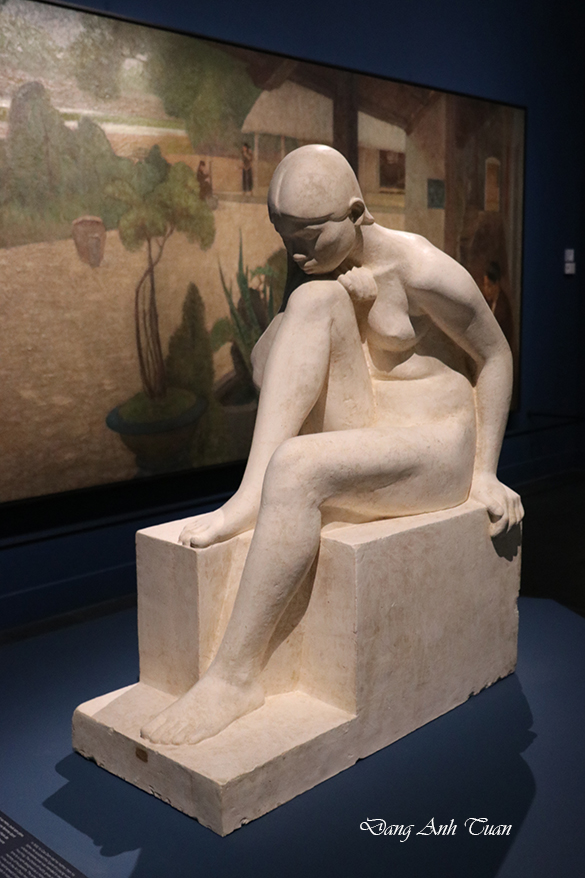
Năm 1930, Vũ Cao Đàm mất mẹ rồi cha. Ông tạc  ra hình tượng một phụ nữ trẻ có thái độ phủ phục thể hiện sự thương tiếc. Việc lựa chọn hình ảnh khoả thân mang lại một giọng điệu ngụ ngôn cho tác phẩm này được xem như  là khoảnh khắc để tưởng nhớ cha mẹ của ông. Các hình dáng đơn giản và đồ sộ trong phong trào Art Deco là sư minh chứng cho việc lan tỏa của các xu hướng nghệ thuật phương Tây đương đại ở Đông Dương.(Văn bản được lấy hoàn toàn từ cuộc triển lãm mang tên “Những người tiên phong  nghệ thuật hiện đại Việt Nam ở Pháp” tại bảo tàng Cernuschi, Paris)

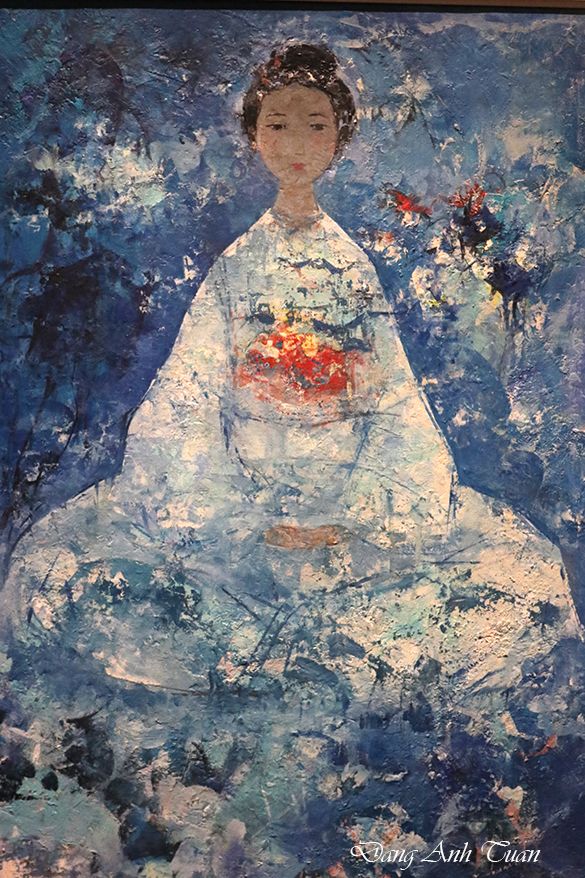
Vào giữa những năm 1950, chủ đề Thần minh xuất hiện, gợi nhớ đến hình tượng Đức Phật nhưng Vũ Cao Đàm muốn mang tính cách phổ quát. Hình ảnh của cô gái đã được cố định vào năm 1960: Thần minh ở phía trước, đôi vai rũ xuống mang lại  sự mềm mại nữ tính. Nhiều biến thể đầy màu sắc, cả về trang phục lẫn phông nền phiá sau , sẽ được thực hiện trong nhiều năm.

En 1930, Vũ Cao Đàm perd sa mère puis son père. Il réalise alors cette figure de jeune femme dont l’attitude prostrée exprime le deuil. Le choix de la nudité donne un ton allégorique à cette œuvre conçue comme un moment en souvenir de ses parents. Les formes simples et massives, dans la mouvance de l’art déco témoignent de lla diffusion, dans l’Indochine, des tendances artistiques occidentales contemporaines. (Texte entièrement repris à l’exposition intitulée « Les pionniers de l’art moderne vietnamiens en France » au musée Cernuschi à Paris).

Au milieu des années 1950 apparaît le thème de la Divinité qui rappelle la figure de Bouddha mais que Vũ Cao Đàm  veut universelle. Son image est fixée en 1960 : la Divinité est frontale, les épaules tombantes lui donnent une douceur féminine. De nombreuses variations colorées, tant dans la robe que dans l’arrière plan, seront réalisées au fil des ans.

Version anglaise

In 1930, Vũ Cao Đàm lost his mother and then his father. He then created this figure of a young woman whose prostrate posture expresses mourning. The choice of nudity gives an allegorical tone to this work conceived as a moment in memory of his parents. The simple and massive forms, in the Art Deco style, reflect the spread of contemporary Western artistic trends in Indochina. (Text entirely taken from the exhibition titled « The pioneers of modern Vietnamese art in France » at the Cernuschi Museum in Paris).

In the mid-1950s, the theme of the Divinity appeared, reminiscent of the figure of Buddha but which Vũ Cao Đàm wanted to be universal. Its image was fixed in 1960: the Divinity is frontal, with drooping shoulders giving it a feminine softness. Numerous color variations, both in the robe and in the background, were created over the years.

                    [Return PIONNIERS]

Mai Thứ


Vieux lettré assis (Mai Thứ)

Ce portrait témoigne de la rupture introduite par l’assimilation de l’art occidental: la pose des trois quarts est naturelle, l’homme s’appuie sur un coussin et la main portée à sa barbiche ajoute à son expression grave, pleine d’introspection. Désormais l’artiste peut transcrire les états d’âme de son sujet et par effet miroir, ses propres sentiments dans ses compositions. C’est à cette époque l’individualité de l’artiste transparait pour la première fois dans l’art vietnamien.

(Texte entièrement repris à l’exposition intitulée « Les pionniers de l’art moderne vietnamiens en France » au musée Cernuschi à Paris).

Old scholar seated (Mai Thứ)

This portrait reflects the break introduced by the assimilation of Western art: the three-quarter pose is natural, the man leans on a cushion, and the hand brought to his goatee adds to his serious expression, full of introspection. From now on, the artist can convey the moods of his subject and, by a mirror effect, his own feelings in his compositions. It is at this time that the individuality of the artist first becomes apparent in Vietnamese art.

(Text entirely taken from the exhibition entitled « The Pioneers of Modern Vietnamese Art in France » at the Cernuschi Museum in Paris).

Sĩ phu già ngồi (Mai Thứ)

Bức chân dung này chứng tỏ sự gián đoạn do việc tiếp thu được nghệ thuật phương Tây: tư thế ngồi ba phần tư rất  tự nhiên, người đàn ông dựa vào một cái gối đệm, bàn tay thì giơ lên ​​vuốt chòm râu để tăng thêm nét mặt nghiêm nghị, tràn đầy  nghi vấn trong lòng. Từ nay, họa sĩ  có thể ghi lại  tâm trạng  chủ đề của mình và nhờ hình ảnh phản chiếu, tất cả  cảm xúc của chính mình vào tác phẩm. Đó là thời điểm cá tính riêng biệt của họa sĩ  được tỏa sáng lần đầu tiên trong nghệ thuật Việt Nam.

 (Văn bản được lấy nguy ên vẹn từ cuộc triển lãm mang tên “Những người tiên phong nghệ thuật hiện đại  Việt Nam ở Pháp” tại bảo tàng Cernuschi, Paris)

[Return PIONNIERS]

Lê Phổ

Hai bức tranh này là đặc trưng của thời kỳ Findlay. Phong cách tân ấn tượng của trường phái nabis đặc biệt thu hút khách hàng người Mỹ. Trong đó, họa sĩ nhắc nhở đến nguồn gốc Việt của mình qua một số dấu hiệu: áo dài và mái tóc đen, một bình sứ Trung Hoa hoặc một hộp sơn mài. Nhưng giai điệu chung của tác phẩm nó đã rời xa những mối quan ngại của những năm 1940 bằng cách tượng trưng một thế giới ảo tưởng, đầy màu sắc và vui vẻ, trở thành từ  nay nơi chú trọng nhiều  đến  ánh sáng.

(Văn bản được lấy nguyên vẹn từ cuộc triển lãm mang tên “Những người tiên phong nghệ thuật hiện đại  Việt Nam ở Pháp” tại bảo tàng Cernuschi, Paris)

Ces deux toiles sont caractéristiques de l’époque Findlay. Le style néo- impressionniste aux accents nabis attire particulièrement la clientèle américaine. Le peintre y rappelle ses origines vietnamiennes par quelques indices: la tunique et la chevelure noire, un vase de Chine ou une boîte laquée. Mais la tonalité générale s’éloigne des préoccupations des  années 1940.Un monde de fantaisie, coloré et joyeux est désormais le théâtre de recherches autour de la lumière.

(Texte repris intégralement à l’exposition du musée Cernuschi, Paris)

These two canvases are characteristic of the Findlay period. The neo-impressionist style with Nabis accents particularly attracts the American clientele. The painter recalls his Vietnamese origins through a few clues: the tunic and black hair, a Chinese vase, or a lacquered box. But the overall tone moves away from the concerns of the 1940s. A world of fantasy, colorful and joyful, is now the stage for explorations around light.

(Text taken in full from the exhibition at the Cernuschi Museum, Paris)

[Return PIONNIERS]


Les pionniers de l’art moderne vietnamien (Mai Thứ, Lê Phổ, Vũ Cao Đàm)


   Lê Phổ

   Mai Thứ

   Vũ Cao Đàm


[Return MUSEUM]

Musée des Beaux-Arts de Saïgon (Bảo tàng mỹ thuật Saïgon)


Version anglaise
Version française
Galerie des photos

Được tọa lạc tại số 97 Phó Đức Chính, Quận 1, bảo tàng mỹ thuật trước đó là  dinh thự  của một thương gia gốc Hoa  giàu có  bậc nhất ở Saigon tên là Hứa Bổn Hòa. Ông nầy có nhờ kiến trúc sư người Pháp Diego Rivera  thiết kế dinh thự nầy vào năm 1929 và hoàn thành vào năm 1934. Toà nhà nầy được xây cất trên một diện tích có hơn 3000m2 với phong cách kiến trúc độc đáo (kiến trúc Art déco)  và thể  hiện được sự hài hoà giữa nét đẹp mỹ thuật của châu  Âu và châu Á khiến nhờ  đó  nó thu hút hiện nay  không ít  những người   yêu chuộng nghệ  thuật và thích sống ảo.  Bảo tàng mỹ thuật lưu giữ hiện nay rất nhiều tác phẩm có giá trị không những về phương diện lịch sử mà còn luôn cả về điêu khắc và hội họa. Bảo tàng nầy lấy màu vàng làm chủ đạo nên bên ngoài  các tường đều sơn màu vàng còn mái nhà  thì ngói âm dương màu đỏ với diễm mái tráng men màu xanh lục trông rất cầu kỳ lạ mắt.

Dinh thư  nầy có 99 cánh cửa lớn nhỏ. Con số nầy  biểu tượng cho sự viên mãn. Mỗi cửa mang phong cách kiến trúc khác nhau. Các ô cửa sổ thì làm bằng kính màu  có trang trí hoa văn. Còn các ban công  thì có cấu trúc  hình vòm  đưa  ra ngoài cùng với hệ thống lan can sắt  trang trí với  nhiều hoa văn độc đáo. Còn bên trong dinh thự  có nhiều gian  được trang trí  như trên trần sảnh với các hoa văn đắp nổi và các đèn chùm theo kiểu Pháp. Cầu thang được lát đá cẩm thạch, sàn nhà được lát gạch bông với hoa văn phong phú. Nhờ có  những cửa lớn của dinh thự  nên lúc nào cũng tràn ngập ánh nắng khiến dễ chụp hình.  Chính ở căn nhà 99 cửa nầy có thang máy đẩu tiên ở  thành phố Saïgon.

Situé au numéro 97 Phó Đức Chính du premier arrondissement, le musée des beaux-arts était auparavant le manoir de l’homme d’affaires chinois le plus riche de Saigon, nommé Hứa Bổn Hòa. Celui-ci  demanda à l’architecte français Diego Rivera de concevoir ce manoir en 1929 et l’acheva en 1934. Ce manoir a été édifié sur une superficie  ayant plus de 3000m2  avec le style architectural unique (Art Déco) et a réussi à montrer l’harmonie entre la beauté artistique de l’Europe et de l’Asie, ce qui permet d’attirer pas mal de gens passionnés de l’art et aimant vivre dans l’illusion. Le Musée des Beaux-Arts conserve actuellement de nombreuses œuvres de grande valeur, non seulement en termes d’histoire mais aussi de sculpture et de peinture. Ce musée utilise le jaune comme couleur principale. Ses murs extérieurs sont peints en jaune et sa toiture est composée de tuiles rouges yin et yang avec des bords en céramique  colorés en vert donnant l’aspect étrange et  fantaisiste.

Ce manoir possède 99 grandes et petites portes. Ce nombre symbolise la perfection. Chaque porte a un style architectural différent. Les fenêtres sont en vitraux avec des motifs décoratifs. Quant aux balcons, ils sont en forme d’arc saillant avec un système de balustrades en fer ornées de motifs singuliers. À l’intérieur du manoir, de nombreuses pièces sont décorées avec des motifs en relief et des lustres de style français sur leur plafond. Les escaliers sont carrelés de marbre tandis que  le sol est pavé de riches motifs. Grâce à ses  grandes portes, le manoir est toujours inondé de lumière, ce qui facilite la prise des photos. C’est aussi ici qu’on trouve le premier ascenseur installé à Saïgon.

Located at 97 Phó Đức Chính Street, District 1, the Fine Arts Museum was previously the mansion of one of the wealthiest Chinese merchants in Saigon named Hứa Bổn Hòa. He commissioned the French architect Diego Rivera to design this mansion in 1929, and it was completed in 1934. The building was constructed on an area of over 3000 square meters with a unique architectural style (Art Deco architecture) that reflects a harmony between the artistic beauty of Europe and Asia, which attracts many art lovers and photography enthusiasts today. The Fine Arts Museum currently preserves many valuable works not only from a historical perspective but also in sculpture and painting. The museum features yellow as its dominant color, so the exterior walls are painted yellow, while the roof has red yin-yang tiles with green glazed ridge tiles, creating a very intricate and striking appearance.

This mansion has 99 large and small doors. This number symbolizes completeness. Each door features a different architectural style. The window panes are made of stained glass decorated with patterns. The balconies have an arched structure extending outward, with iron railings adorned with many unique patterns. Inside the mansion, there are many rooms decorated similarly, with embossed patterns on the ceiling of the hall and chandeliers in the French style. The stairs are paved with marble, and the floors are tiled with richly patterned ceramic tiles. Thanks to the large doors of the mansion, it is always filled with sunlight, making it easy to take photos. It is in this 99-door house that the first elevator in Saigon city was installed.
Galerie des photos

[RETURN MUSEUM]

Kiến An Cung (Sadéc)


Version française

Tọa lạc ở giữa trung tâm thành phố Sa Đéc, chùa nầy còn đựợc bết với cái tên là chùa ông Quách.Chùa nầy được xây dựng vào năm 1927 bởi nhóm người Phúc Kiến đến lập nghiệp ở Sa Đéc nhầm để tôn vinh tổ tiên của họ và để giữ liên lạc mật thiết với cộng động của họ ở Trung Hoa.Chùa nầy có hình chữ Công (工) nên có 3 gian Đông lang, Tây lang và khu chính điện. Chùa được lợp ngói âm dương theo kiểu rồng lượn sóng. Đặc điểm ở chùa nầy là có một kiến trúc độc đáo  không có kèo chỉ dùng các đòn tay  ráp mộng để chịu đựng sức nặng trên những cột gỗ tròn. Ngoài cổng chùa thì có sự hiện diên  hai con kỳ lân còn ở trong nội điện th ì  trang trí với màu sắc rực rỡ và  trên những bức tường của chùa thì thấy được những hình ảnh  ở trong Tây du ký, Tam Quốc Diễn Nghĩa vân vân…

Située au centre de la ville de Sa Đéc, cette pagode est également connue sous le nom de pagode ông Quách. Cette pagode fut édifiée  en 1927 par les gens de Fujian venant s’installer à Sa Déc dans le but d’honorer leurs ancêtres et garder des contacts étroits avec leur communauté en Chine. Ayant la forme du caractère Cong (工), elle comporte donc 3 pièces: Đông lang, Tây lang et le hall principal.  La pagode est couverte de tuiles yin et yang dans un style de dragon ondulé. La caractéristique de cette pagode est qu’elle présente une architecture unique sans arbalétrier, reposant uniquement sur des poutres à bras mortaisées afin de  supporter le poids grâce à  des piliers ronds en bois. À l’extérieur de la pagode, il y a la présence de deux licornes, tandis que  dans le hall intérieur on trouve la décoration avec des couleurs vives et sur les murs des illustrations trouvées dans le pèlerinage vers l’Ouest, les Trois Royaumes  etc.

KAN