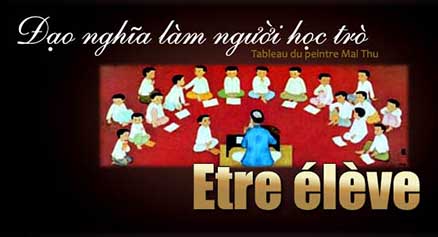
Being student (Đạo nghĩa làm người học trò)

French version

In memory of my teachers,

the Brothers of Jean Baptiste de la Salle.

 
etre_eleve

Being student in Vietnam

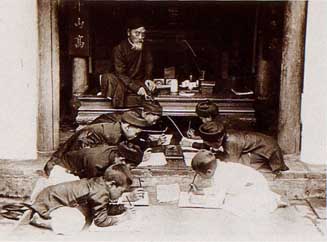
No Vietnamese can remain impassible when it comes to recall the years of study spent at school with their teacher. The image of their school keeps on being intimately carved in their memories. That is the way composer Phạm Trọng Cầu felt in his song Trường Làng Tôi ( My village school ). How could they forget what has contributed in giving them their education, teaching them, and putting them on the road of apprenticeship in life? For them, one word taught by or one day of study with their teacher is enough to justify the obligation toward him.

Trường Làng Tôi ( My village school )

That is why it was repeated time and again when they were young that

Nhất nhật vi sư
Bán tự vi sư

Học một ngày cũng thầy
Học nữa chữ cũng thầy

The one who teaches us for one day or even half a word is worth being our teacher. Without the teacher, they cannot become who they are today. They owe him part of their life, their success and above all their education because it is him that gave them not only knowledge but also taught him the wisdom and apprenticeship of life. The following famous remark : Không thầy đố mầy làm nên ( Without the teacher you cannot succeed ) continues to occupy their mind and justify their behavior, their deep feelings toward their teacher. They give him such a crucial role that they do not hesitate to use the word « teacher » ( or Thầy in Vietnamese ). Thầy is sometimes used to address the father because it is he that gave them the first lesson in education. That is why the teacher remains the second person to be respected in the unchanging following Confucian trilogy: Quân, Sư, Phụ.

Whichever their age, position and level of education, they continue to remain the little pupil, the young disciple of their teacher.

They are not willing to neglect their respect toward their teacher even in moments the most perilous in their life. This was shown by emperor Hàm Nghi toward his teacher before the colonial authorities who were not able to identify Hàm Nghi physically when he was captured. The only person who could identify him was his teacher; therefore the latter was brought by force before the young Hàm Nghi. For the respect of his old teacher, he could not let him kneel down. He was obliged to prevent his teacher from executing this gesture. Because of this inopportune attitude, he was thus identified by the colonial authorities. He preferred to die instead of making an irreparable mistake toward the one who had taught him not only dignity and courage but also the duty toward his people and country. It was also the case of emperor Duy Tân with is tutor Eberhard in charge of supervising and reporting all his activities to the colonial authorities. Instead of being hated, he became one of the people that Duy Tân continued to respect during his reigning years. It was a habit to say in Vietnamese:

Kính thầy mới được làm thầy.
We should respect our teacher before becoming a teacher later.

It is in this Confucian spirit that young Vietnamese students were raised. They always try to listen to their teacher. They sometimes adopt an ambiguous attitude so as not to vex or bother their teacher even though when they are not entirely in agreement with him. It is the respect that emperor Gia Long knew how to maintain toward his tutor and spiritual guide, the bishop of Adran, His Highness Pigneau de Behaine during his reigning years. Age is not a factor in the behavior of a student toward his teacher who in several occasions was younger than him. It is shocking and moving to see sometimes an old student crossing arms in front of a young teacher but that never contradicts the intimate sentiments, the profound and sincere attachment he continues to keep for his teacher the way he does for his mother and his country. He knows what his teacher expects from him. He tries to keep up with this expectation, which sometimes puts him in a delicate and aberrant situation where he is himself in competition with his teacher.

It was the case of Phạm Duy Tri with his teacher Nguyễn Khắc Kínhduring a royal examination that took place in 1562 under the Mac dynasty. Issue of a very poor family and orphan of father at very early age, he was raised by his mother who did not hesitate to offer the teacher the only buffalo she possessed in order for the latter known for his years of experience in teaching in the village, to accept her son as his disciple. Moved by this mother’s sacrifice, teacher Nguyễn Khắc Kính agreed to take him as his student. A few years later, thanks to his assiduity and intelligence, he ended usentiments the latter always reserved for him, he did not want his student, because of the respect he had toward him, to be penalized and wop in surpassing his teacher, which the latter saw during the provincial and general exams where he was himself a candidate. Knowing perfectly well his student’s state of mind and his profound uld not put all his weights and ardor in the royal examination. For that, he told his student:

If you do not want to be brilliant in that exam, I would understand your behavior, your feelings. But you have to remember that this examination is reserved for the one who deserves to be chosen to serve the country. You must take into account the interest of the nation before any personal considerations. You should not betray your ideals and your country.

He reminded him the sentence that any school teacher would repeat to his student:

Bất nhượng ư sư
Không nên nhường thầy.

Do not concede to your teacher what you deserve.

Moved by the advice, Phạm Duy Tri nodded his head and kept what his teacher had told him. He passed the royal exam and acquired the title of Trạng Nguyên ( 1st doctor ). As for his teacher, he was classified second and received the title of Bảng Nhãn ( or 2nd doctor ).

The feelings that a Vietnamese has for his teacher never fade with the time, which was shown by lord Nguyễn Phúc Nguyên toward his spiritual teacher and counselor Ðào Duy Từ. To thank him, lord Nguyễn Phúc Nguyên did not hesitate to grant him a vibrant homage by giving to one of his fortifications located in central Vietnam the name « Lũy Thầy » (fortification of the Teacher ). This fortification was built to counter the Trinh from the north. Thanks to this naming, he was successful in giving gratitude a wide range through history and the entire nation. Today the fortification is still known by this name.

On the other hand those feelings become as the time goes by a kind of cement that link a Vietnamese a little more to his school, his village and his native country. They are also a gift of affection and respect that Vietnamese love to give their teacher in the Confucian spirit.

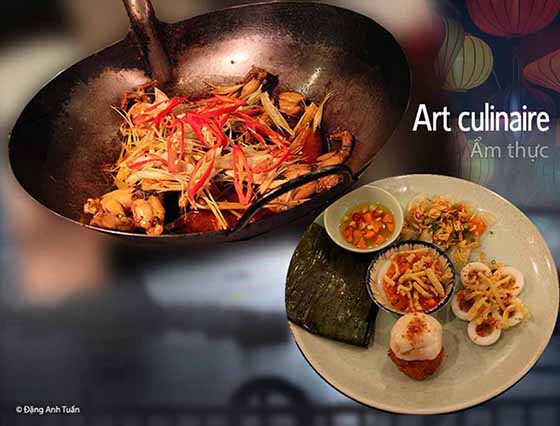
Culinary art ( Nghệ Thuật Ẩm Thực của người Việt)

 
amthucvn

French version

Vietnamese people grant a great importance to the culinary art, in particular to their eating. It is the first necessity in their daily life and culture. Nothing is more amazing to see the use of « an » as the prefix in a great number of words. Among them we find: ăn nói ( to speak ), ăn mặc ( to wear ), ăn ở ( to live ), ăn tiêu ( to consume ), ăn ngủ ( to sleep ), ăn trộm ( to steal ), ăn gian ( to cheat ), ăn hiếp ( to bully ) and so on…It is usually said: Trời đánh tránh bữa ăn to means even God dare not disturb the Vietnamese during their meal.


Their eating is carefully elaborated according to the concept of Yin and Yang and the five elements (Thuyết Âm Dương Ngũ Hành) which serves as the fundamental basis of their Van Lang civilization.
Yin-Yang ( Âm Dương ) is the representation of the two poles of all things, a duality that is at the same time contradictory and complementary. Of the nature Yin is whatever is fluid, cold, humid, passive, somber, interior, female in essence like the sky, the moon, night, water, winter. Of the nature Yang is whatever is solid, hot, luminous, active, exterior, male in essence like the earth, the sun, fire, summer. Human is the hyphen between these two poles or rather between the Earth (Dương) and the Sky ( Âm ). Harmony may only be found in the equilibrium that human brings to its environment, universe and body. Vietnamese food therefore finds all its meticulous preparation and particularity in the dialectic relationship of the theory of Yin and Yang. It also shows the respect of the millennial cultural tradition of a farming country and of a civilization known for its rice farming on flooded rice fields (trồng lúa nước).

Yin-Yang in Vietnamese culinary art

© Đặng Anh Tuấn

That is why rice should not be missed in a Vietnamese meal. It is at the basis of several Vietnamese dishes (bánh cuốn, bánh xèo, phở, bún, bánh tráng, bánh chưng vân vân ) (ravioli, crepe, pho, vermicelli, rice paper, sweet rice cake etc..) Rice can be whole, round, long, crushed, scented, glutinous etc… More than a food, rice is for the Vietnamese people a tangible proof of their Bai Yue culture, a trace of civilization that is not lost under the weight of long Chinese domination.

The manner in Vietnamese eating is not foreign to the search for the middle-of-the-road attitude encouraged in the concept of Yin and Yang.  » Eating together  » requires in their view a certain respect, a certain level of culture in the art of eating because there exists an undeniable interdependence among the guests in the share of food and space. It is usually said: Ăn trông nồi , ngồi trông hướng.

When eating look for where the rice cooker is and when sitting look for where the direction is. That is the maxim that Vietnamese parents used to tell their children about their table manners. One has to behave oneself when invited to a meal. One should not eat too fast for not to be called impolite but should neither eat too slowly as one should not make other guests wait. Emptying one’s plate or the cook pot is not allowed because it gives the feeling of being greedy. On the contrary, eating too little implies a lack of mannerliness, which may vex the host. This cautious behavior could be summed up by the following statement: Ăn hết bị đòn, ăn còn mất vợ. (Emptying the cook pot deserves spanking, leaving some leftover leads to losing the spouse ). It is in the constant search for equilibrium evoked in the Yin and Yang theory that a Vietnamese must exercise in due course at a meal. It should not be ignored the « varied » nature brought in by Vietnamese food that is characterized by the diversity and visible exuberance in colors of the ingredients in the preparation.

Around a bowl of rice is the creation of a multitude of colors, flavors and dishes. The expression of the 5 senses (ngũ giác) is also found in a Vietnamese meal:  

smell: by the release of aromas and flavors of foods served,
sight: by various coloration of the ingredients that go in the preparation of the dishes,
taste: by the flavors of the dishes,
hearing: by the sound made by the sucking of tea or stock with the mouth,
touch: by the nonstop handling of chopsticks.

For some Vietnamese specialties (gà nướng (roasted chicken), gà luộc ( boiled chicken ), gỏi cuốn (spring rolls) ), the use of hand is highly appreciated. Most Westerners used to attribute to the Chinese the holder of chopstick civilization. However it is the product of the cradle of the rice growing civilization of South East Asia. It is what the Chinese historian Ðàm Gia Kiện has written in his book entitled « Cultural History of China » ( Lịch sử văn hóa Trung Quốc ) ( 1993, page 769 ):
At the time prior to the unification of China by Qin Shi Huang Di, the Chinese continued to use their hands to grasp food. It was a tradition found in people growing millet (kê), barley (mạch) and eating bread, hum bao ( bánh bao ) and meat. They only began to use chopsticks during their expansion toward Southern China.
That assertion has been justified by recent scientific discoveries. Chopsticks can only be made in a region where abundance of bamboo is not in doubt. That is the case of Southern China and South East Asia. They are the rudimentary tool shaped to the image of the bird’s bill to efficiently pick up grains of rice and fish without having to soil the hands with the plates containing water (soup, broth, fish cauce etc…). It is found in the Vietnamese use of chopsticks a simple as well as humoristic philosophy. A pair of chopsticks is always compared with a married couple.

That is why one used to say:

Vợ chồng như đôi đũa có đôi
Bây giờ chồng thấp vợ cao như đôi đũa lệch so sao cho bằng.

Husband and wife are like a pair of chopsticks
Now that husband is short and wife is tall
Like mismatched chopsticks can’t be paired at all.

During the Lê dynasty, breaking a pair of chopsticks is like a dissolution of marriage. One prefers having a stupid spouse to having a disastrous pair of crooked chopsticks. This preference is evoked many time in the following statement:

Vợ dại không hại bằng đũa vênh.

Besides the « vivacious » and « lively » characteristics found in the handling of chopsticks, the « collective » characteristics should not be ignored as an attribute to this rudimentary utensil. It is often referred to a bundle of chopsticks to evoke solidarity. The saying: Vơ đũa cả nắm( gather chopsticks in a bunch) reflects that idea when we want to criticize someone and his family in a dispute or debate.

The Vietnamese fierce will to give a big attention to the balance of Yin and Yang is found again in their way of eating. A good meal must meet a certain number of criteria where interdependence cannot be ignored:

  • 1) It must be in agreement with the weather. It cannot be defined as good even when it is served with tasty dishes.
  • 2) It must occur at a pleasant place and time otherwise it is not deemed good either.
  • 3) It must be shared with close friends otherwise the word good cannot be attributed to it.

That is why coming from the criteria mentioned above, a good Vietnamese meal is not necessarily well stuffed. Sometimes meagerness is found in a good meal. It is that of Vietnamese poor peasants where a clever mixture of aromatic herb flavors plays a preponderant role.
The judicious search for balance of Yin and Yang is undeniably shown in the dishes, the human body and between man and the environment. In the Vietnamese culinary art three following important points are turned up: 

1) Yin-Yang equilibrium in the makeup of the dishes.
 
Vietnamese people tend to distinguish dishes according to classification they established in relation to the five elements of Yin-Yang: hàn ( cold ) ( Water ), nhiệt ( hot ) (Fire), ôn ( warm ) ( Wood ), lương ( fresh ) ( Meta l) and bình ( temperate ) (Earth). They take into account the compensation, interaction and combination of ingredients and condiments in the elaboration of a dish. One notices a series of vegetables and condiments in in the makeup of Vietnamese recipes. Known for curing illnesses caused by the « cold » ( coughs, colds etc…), ginger (gung), the condiment of the Yang characteristics, is visible in all the dishes having tendency to bear the cold: Bí đao ( marrow quash ), cải bắp ( cabbage ) rau cải ( lettuce ) and cá ( fish ). Hot pepper is of Yang nature ( hot ) and frequently used in dishes having cold, temperate or foul-smelling characteristics ( seafood, steamed fish for example ). One used to eat fermented chicken’s or duck’s eggs ( trứng gà lộn, trứng vịt lộn ) having the Yin characteristics ( Âm ) along with a very flavorful leaf ( rau răm ) of the Yang ( Dương ) tendency. The Yin (Âm) bearing water melon is always eaten with the Yang ( Dương ) natured salt. The most typical Vietnamese sauce remains the fish sauce. In the preparation of this national sauce, it is noticed there are 5 flavors classified according to the 5 element of Yin and Yang: mặn ( salty ) with the fish juice ( nước mắm ), đắng ( bitter ) with the zest of lemon ( vỏ chanh ), chua ( sour ) with the juice of lemmon ( or vinegar ), cay ( hot ) with powdered or crushed hot pepper and ngọt ( sweet ) with powdered sugar. Those five flavors ( mặn, đắng, chua, cay, ngọt ) combined and found in the national sauce of Vietnamese people correspond respectively to five elements defined in the theory of Yin and Yang( Thủy, Hỏa, Mộc, Kim, Thổ) ( Water, Fire, Wood, Metal, Earth).
 
2) Yin-Yang equilibrium in the human body.

Vietnamese food is sometimes used as an effective medicine to cure dysfunctions caused by the loss of balance in Yin and Yang in the human body. For the Vietnamese, the scenario seen in nature is also found inside their bodies. When an organ becomes too Yin, it leads to a slowdown in physical metabolism (feeling cold, slow heartbeats, indigestion etc…). On the other side, if it becomes too Yang, it triggers an acceleration of physical metabolism ( feeling hot, fast heartbeats, physical and mental hyperactivity etc…). A well-balanced Yin-Yang maintains life and assure good health. To regain this balance a person whose illness is of Yin nature ( Âm ) must eat dishes bearing Yang (Dương) characteristics. On the contrary a Yang-natured illness must be treated with Yin-natured dishes. To the Vietnamese, eating is taking care of oneself. Constipation (a Yang illness) can only be cured among the Yin dishes (chè đậu đen, chè đậu xanh etc..( meung bean, black bean compote, a Vietnamese dessert). On the other hand, Yin-natured diarrhea or stomach ache can be treated effectively with Yang-natured seasoned dishes (ginger (gừng, galangal (riềng)). The cold (a Yin-natured illness must find its solution in a bowl of rice porridge full of ginger slices

3) Yin-Yang equilibrium with the environment.

One used to say in Vietnamese : Ăn theo mùa ( Eating according to season ). This saying reflects the state of mind of the Vietnamese to be always in phase with nature and the environment in food.

In Summer, the supply of heat favors an abundance of vegetables, seafoods and fish. Therefore the Vietnamese people tend to eat vegetables and fish. They used to boil vegetables, pickle them (dưa) or make salads (gõi). Dishes that contain water are appreciated. It is the case of pho, the national stock of the Vietnamese people. Bitter and sour flavors cannot be absent either in the Vietnamese cuisine. It is the case of a mildly sour soup prepared with fish (or shrimps), tamarind (or pine apple) and tomatoes ( canh chua cá, canh chua tôm ).

On the other hand in Winter, to resist the cold, the Vietnamese prefer to eat meat and fatter dishes (of Yang characteristics). We notice a massive use of oily liquids (vegetable or animal) and condiments (ginger, chilly, garlic, pepper etc…). Slow cooking meat on low heat in fish sauce (rim thit), sauteing (xào) or frying meat (rán) are the cooking methods frequently used and conformed to climatic variations. Known as a tropical country (Yang)(Dương), Vietnam possesses a great number of dishes of cold characteristics ( Âm ). That is what the father of Vietnamese traditional medecine Hải Thượng Lãn Ông ( Lê Hữu Trác ) had an opportunity to emphasize in his work entitled « Nữ Công Thắng Lãm ». Out of 120 foodstuffs, he succeeded in picking about a hundred of Yin characteristics. This remark puts in evidence the unquestionable preference of Vietnamese for Yin dishes in their traditional food structure and the importance they keep granting to the search for a balance with nature and the environment. Vietnamese cuisine finds more and more followers in the West. Unlike other cuisines that play with sauces, it prefers using a lot of aromatic herbs and condiments. It is a cuisine that stands out for its lightness and digestibility. Much less fatty than Chinese cuisine, it does not miss showing its subtlety and originality. No less than 500 dishes are counted among them remains the imperial roll ( chả gìo). In this cuisine one finds not only a harmony of flavors and a multitude of subtle variations around a bowl of rice but also a profound and intimate agreement with nature and the environment.

There, Yin-Yang does not lose its vitality, the Vietnamese people, their soul and their temperament.

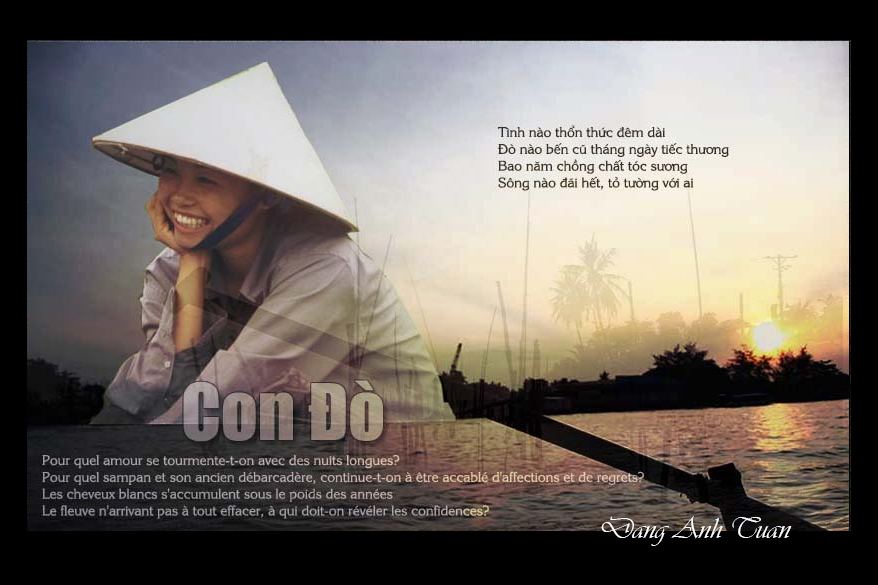
Sampan (Con Đò)

Vietnamese version
French version

As Vietnam is a water country, it is not surprising to see the proliferation and large variety of boats used by the Vietnamese in their transport by water: from the lightest and smallest to the largest ones found until then only in the neighbouring countries like China or Indonesia. One finds in the construction of these vietnamese boats a notable foreign influence, chinese in the North and indonesian or even western indian in the South of Vietnam. This influence is more perceptible in the Center of Vietnam that has been occupied until the XIIIth century by the Vikings of Asia, the Chàms whose civilization has disappeared in the wirlwind of history by the secular march of the>Vietnamese towards the South.

In spite of that, the Vietnamese showing an acute sense of observation and of living experience due to the incessant coming and going of typhoons on the vietnamese coast, know to harmoniously combine the data of these different foreign techniques to construct boats often more handy than the chinese, malayan or indian models, as has noticed P. Paris in his work entitled « Search of relationship to four Indochise boats, BIIEH, 1946 ».

Because of the harshness of nature and of the quasi permanent fight against their chinese neighbors, the Vietnamese centered their efforts in the conquest of the rice plains. Locked up in the isolationism adopted by the Far East and comforted by the quasi permanent presence of the foreign boats in their ports ( Faifo, Tourane, Saigon etc), the Vietnamese do not see any interest to privilege the maritime transport although they are regarded as the most skilful sailors of the Far East. The Chinese recognized their superiority on water. A high chinese mandarin, Bao Chi, noted this in his confidential report submitted to the emperor of Song. The majority of the Vietnamese victories against the chinese neighbors took place on water. The Vietnamese are accustomed to using boats as means of transport for food or troops, as the abbot Prévost revealed in his  » History of the Voyages  » from 1751 while relying upon the description of Samuel Baron published in 1732.

The Vietnamese navy knew its apogee only in the first half of the XIXth century. It is the period when the emperor Gia Long assisted by his French lieutenants Jean-Baptiste Chaigneau ( Nguyễn Văn Thắng ), Philippe Vannier ( Nguyễn Văn Chấn ) etc. succeeds in defeating the army of Tây Sơn at Qui Nhơn with his royal navy made up of a hundred or so large galleys of 50 to 70 oars with guns and stone drains and of three european style vessels ( the Phoenix ( tàu Phụng ), the Eagle and the Flying Dragon ( tàu Long ). These last ones were built with such skill and remained no more than three months on the building site, as has noted father Lelabousse in his report dated at Nha Trang, the 24th of April 1800.

To request his investiture with the chinese emperor, in 1802, Gia Long sent the great poet Trinh Hoài Ðức (1), the first vietnamese delegate to travel by sea to Peking. Unfortunately, this apogee was only of short duration because his successors, surrounded by confuciasnist mandarins and entangled in the obscurantism, continued to adopt a policy of exacerbated isolationism in spite of the memorandum of the modernistic scholar Nguyễn Trường Tộ, which made it possible for the french navy to succeed in dropping anchor a few decades later in the vietnamese waters after having sunk in the port of Tourane ( Danang ) the first five armored junks of the vietnamese fleet on April 15, 1847.

Although the Vietnamese neglect the maritime transport, paradoxically they do not haggle the means of manufacturing a large variety of boats to facilitate their daily displacement because Vietnam has, in addition to the second mangrove of the world (the forest U – Minh 1000km2) after that of Brazil in the peninsula of Cà Mau, thousands of small rivers, affluents and distributaries, streams and rivers (Red River, Mekong River ).

Moreover, the vietnamese road network is quasi non-existent. The vietnamese boats are divided into two categories: those manufactured with bamboo plates coated in lacquer (thuyền nan) and those carved from tree trunks or made with wooden plates ( thuyền gỗ). With regard to the first category, if the boat is of a small size, it is often called in Vietnamese (thuyền câu). It is a small boat where only one person can be placed. If the light boat is of a round shape, it is called  » thuyền thúng  » and is frequently used by the fishermen of the Center of Vietnam.

This tight round basket existed in the Xth century. Dương Vân Nga, a girl from Hoa Lư, was known at that time to excel in the art of rowing with this floating basket. But on the day of competition, Ðinh Bộ Lĩnh, the leader of a rival band of boys, succeeded in immobilizing her floating basket by perforating it with the means of a pole.

This victory enabled him to win not only the admiration but also the love of Duong Vân Nga. This floating basket allowed the fast transport of the troops through the marshes and the rivers and ensured the couple Dương Vân Nga and Đinh Bô. Lĩnh the victory over the Chinese a few years later. As for the second category, the basic constitution is made with wood. There is a multitude of different boats but the most known and the most used by the Vietnamese is the sampan or the boat with three boards (Thuyền tam bản). It is that which is employed to cross the streams or the rivers. The majority of the people who advance the sampans are young girls.

This is why there are many stories of love born of these boats. One continues to tell them, in particular the story of emperor Thành Thái with the oarswoman. If a Vietnamese man was used to crossing the river in his youth, this could probably incite in him intense regrets, memories and emotions when he has the occasion to return to the river bank to take the vat. He feels more or less distressed when he learns that the oarswoman, the girl whom he continues to pity the fate and whom he is not far from falling in love with is no longer there. Probably, she is now the mother of a family or she has joined another world but she is no longer there to welcome him with her charming and ingenuous smile. He is not long to recall that he no longer has the occasion to hear her refrain, or to see the sides of her worn tunic flying in the wind of the river during the crossing. It is in this unusual context that he feels an indescribable affliction. He regrets missing so many occasions to find his dock, his river, his native land and to leave for too long in the lapse of memory the eternal charm of the sampan, that of a Viet-Nam bygone .

The film director Ðặng Nhật Minh, most known currently in Vietnam, does not hesitate to show the opposite case, the discrete love of the young boatwoman living on the River of the Perfumes, to the foreign and vietnamese public through his film.

The girl from the river ( Cô gái trên sông ) 1987

It is the story of its heroine Nguyệt who, to the peril of her life, does not hesitate to save a wounded young man known for his subversive activities by the south vietnamese police during the war. She tries to hide him in her sampan. Once peace is returned, this young man becomes an important communist cadre. The girl tries to find him because she continues to harbor deep feelings for this man. Unfortunately, she feels afflicted and betrayed because this man pretends not to know her and does not like to recollect the troubling periods of his life… She tries to remake her life with her former lover Sơn whom she rejected a few years earlier and who had the occasion to spend a few years in the reeducation camp for having the offence of being enlisted in the south vietnamese army.

In spite of the few things in their constitution, the boats, in particular, the sampans (đò ngang ) continue to charm the Vietnamese. They do not hésitate to integrate them not only in their everyday life but also in the songs and the poems. The songs  » Con Thuyền Không Bến  » ( The sampan without dock ) from the composer Ðặng Thế Phong and Ðò Chiều ( the sampan of the Evening ) from Trúc Phương going back to several decades and several generations continue to be appreciated and show at such point the profound attachment of all the Vietnamese to their rudimentary boats.

As for the poems describing them, there is only the Vietnamese having the occasion to take the vat who manages to appreciate the finesse and the beauty found in the verses because one perhaps rediscovers through these poems a fragment of one’s life so animated and so closely hidden in one’s memory with more emotions and sadness than joy and happiness. By reading the following verses,

Trăm năm đã lỗi hẹn hò
Cây đa bến cũ con đò khác đưa

Our rendezvous did not take place a long time ago
The banian and the dock are always the same but the sampan has changed owner.

The reader could realize that he is also caught up as so many other Vietnamese by memories that he thinks of erasing from his memory with the passing of the years. He cannot continue to sadden himself as that could be made when one was young and in love through the two following verses:

Tương tư thuyền nhớ’ sông dài
Tương tư là có hai người nhớ’ nhau

It is no longer worth seeing each other again
It is best to leave definitively when one loves intensely

But one should have the courage to forget when the sampan is no longer there as that was said in the following four verses:

Vô duyên đã lỗi hẹn hò
Mong làm chi nữa con đò sang sông
Thôi đành chẳng gặp là xong
Nhớ thương bền chặt bền lòng ra đi

One misses the chance to be at the rendezvous
One no longer hopes when the sampan has already left
It is no longer worth seeing each other again
It is best to leave definitively when one loves intensely

What becomes of her at this moment? Is she dead or happy? Does she deserve the life she leads? Is she like the young boatwoman, sister Tham who saved many people from drowning and who died drowning without anybody rescuing her in the story « Chảy đi sông ơi ( Run, my river, 1988 )  » of the talented writer Nguyễn Huy Thiệp? Is she like the young boatwoman Duyên who continues to hum a lullaby for her child:

Nước chảy đôi giòng …
…Con sông Thương …nước chảy đôi giòng …

One can go up or descend the current… of the river Love…
one can go up or descend the current..

and never asking questions about the life that was layed out for her just like the river that follows its course to the sea in the short story  » Nước Chảy Ðôi giòng ( At counter-current, 1932 ) from Nhất Linh?. These are the questions that the reader overcomed by memories continues to ask intimately. It is also the deep sadness, the poignant pain of the one who no longer has the occasion to find the freshness of his youth through the sampan and its dock which he was accustomed to take at a distant time. He had thought that with time this could erase all the memories as the water of the river evoked in the song with a strange sadness which sister Thắm likes to sing on the bank in the story  » Chảy đi sông ơi ( Run, my river, 1988 )  » from Nguyễn Huy Thiệp:

Chảy đi sông ơi
Băn khoăn làm gì ?
Rồi sông đãi hết
Anh hùng còn chi ? …

Run my river
Why be tormented?
The river erases all
Even memories of the heroes…

Chuyện Tình Buồn ( The story of sad love ) of Phạm Duy


(1) Author of two works Bắc sứ Thi Tập ( Collection of poems written during a mission in China ) and Cấn Trai Thi Tập ( Collection of poems from Cấn Trai ).


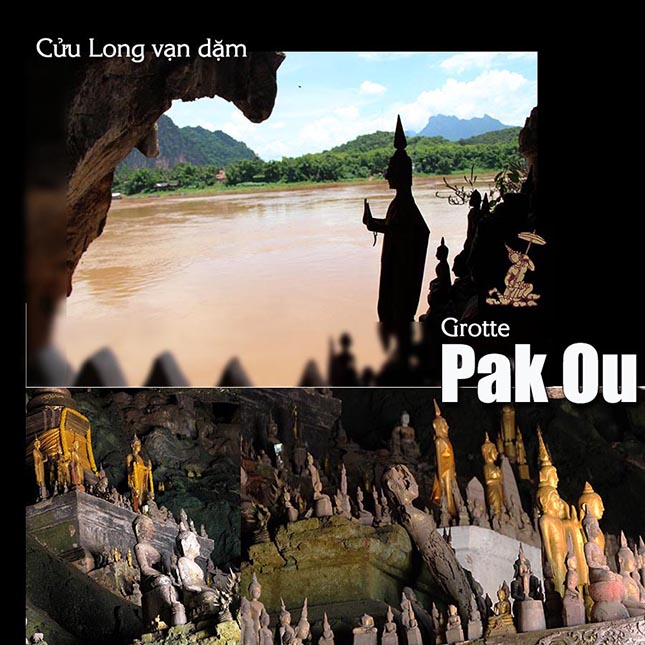
Pak Ou (Luang Pra Bang)


poster_pak_ou


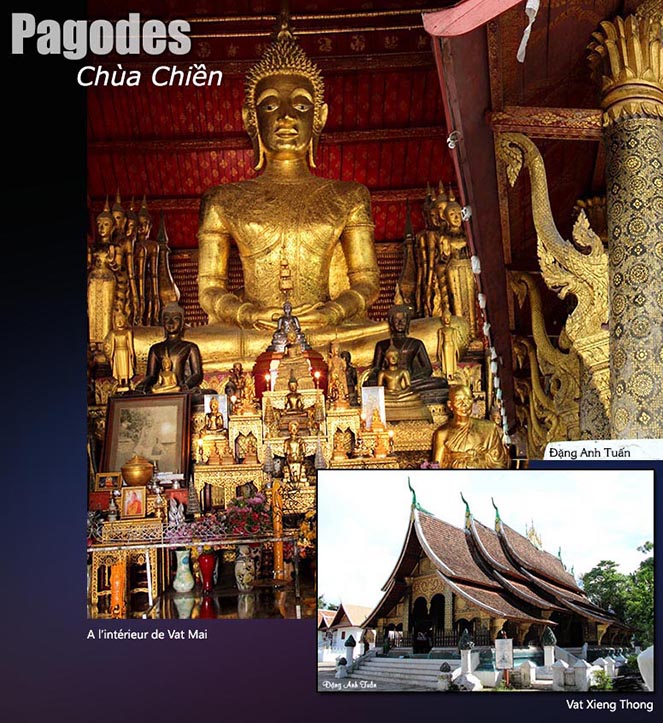
Étant en amont du Mékong, la grotte Pak Ou est située à une trentaine de kilomètres de Luang Pra Bang. Pour la visiter, il faut utiliser soit un touktouk soit un bateau par la voie fluviale. On a l’intérêt de compter au moins 4 heures pour cette visite. (aller-retour). Le prix de ce voyage est de 70.000 kip par personne. Etant un site religieux, la grotte contient au moins 4000 statues de bouddhas déposées au fil des siècles par les fidèles.

Being upstream of Mekong river, the  Pak Ou cave is located  about thirty kilometers from Luang Pra Bang. For visiting this cave, it was necessary to use a touktouk or a boat via the river. It takes more than four hours for this round trip. The price of the trip costs 70000 kip per person.  Being a religious site, the cave contains at least 4000  Buddha statues deposited by the faithful over the years.

[Return MEKONG]


Hammock (Cái võng)


Vietnamese version

French version

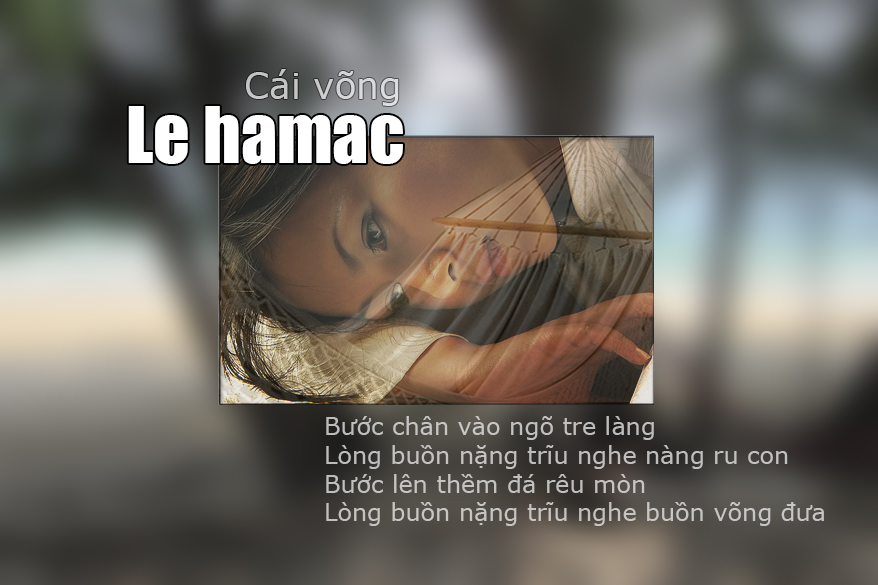
The hammock is an instrument very familiar to the Vietnamese. For many generations, one was used to hearing its resonant creaking with a regular cadence from the South to the North of Vietnam. This strident sound blended with the crying of the little children and lullabies becomes a tune of music eternally rooted in the Vietnamese soul. Poor or rich, each Vietnamese possesses at least one hammock. It is not only the cradle of the little Vietnamese children but also their swing. 

It is used by adults for relaxing. It is also a resting bed for people of old age. It is the only instrument that no Vietnamese could do without. It is a habit to say that in Vietnam one has grown up with the sound of the hammock ( lớn lên trong tiếng võng ) and will grow old in the lullabies ( già trong lời ru ) because the latter are sung tirelessly by the mothers or grand-mothers to pamper their children or grandchildren.

The lullabies stay the same but this time they are sung by a young mother who by a curious coincidence may be the girl he had known at the time he was an adolescent, or an old ferry crossing. It is sure there will be in this case the same resentment felt by a person returning to his or her native village after so many years of absence, proven in this following lullaby:

Bước chân vào ngõ tre làng
Lòng buồn nặng trĩu nghe nàng ru con
Bước lên thềm đá rêu mòn
Lòng buồn nặng trĩu nghe buồn võng đưa

One feels sad, setting foot on the village entrance
Hearing the nursery rhyme lulling her baby in cadence,
One feels sad, stepping on the worn and mossy rock
Hearing the melancholic creaking sound of the hammock.

One cannot stay insensitive when one is the issue of the Mekong delta when listening to the following lullaby:

Ầu ơ .. Bao giờ Chợ Quán hết vôi,
Thủ Thiêm hết giặc em thôi đưa đò,
Bắp non mà nướng lửa lò
Ðố ai ve được con đò Thủ Thiêm.

Âu ơ .. When the Chợ Quán market is out of lime,
The Thủ Thiêm region is out of war, I will stop being a ferrywoman.
Young and tender corn baked in oven,
I bet anyone who could court me, the boat of Thủ Thiêm.

This has without a doubt, made us relive the time of our youth, a time when we were still carefree, we would like very much flirting the girls even the ferrywoman.

 
Even the hammock is simply made of jute or fabrics, the sound provoked by its back and forth motion continue to anchor itself softly in the intimacy of our conscience and in our spiritual lifestyle and become as the years go by, the most talked about in the Vietnamese popular songs.

Ðố ai nằm võng không đưa,
Ru con không hát, đò đưa không chèo

Let’s bet who is sleeping on a hammoc without swinging,
Lulling a child to sleep without saying nursery rhyme, conducting a sampan without rowing.

In the old days, the hammock was also used to transport women or mandarins who did not know how to ride on horseback. The hammock is held up by a big bamboo resting on the shoulder of two men who trotted along with a rhythmical look. To shelter from the sun, a sedge matt is placed astride the bamboo. This assembly is often known as palanquin. This one has to follow certain protocols when it comes to a palanquin used by mandarins. According to their rank, the line that accompanied the palanquin was more or less important. One or several persons preceding the official palanquin bore arms (sabres, sticks etc…). By the sides of the palanquin walked the porters of parasols, betel nut box, spittoon, water pipe etc… This palanquin was replaced only at the appearance of the rickshaw in 1884 in Hànội.
The hammock was also the dream of most of Vietnamese young girls to be married to a mandarin as in our tradition, the young bride was riding in a palanquin preceded by her husband on horseback. ( Ngựa anh đi trước, võng nàng theo sau ).
In the West, one has the Eye of Cain to symbolize the torture of moral conscience. In Vietnam, to talk about this torture, one refers often to the creaking of the hammock of  » Con Tấm » (or Vietnamese Cinderella ) because this creaking brings back the thought the wandering soul of Tấm, victim of a plot hatched by her half-sister Cám and her step mother, trying to take revenge on Cám. The moment this one lay down on the hammock, its creaking became so deafening and menacing that Cam had the feeling her sister Tam’s wandering soul substituted for the hammock.

Nowadays, in the cities, well-to-do people replace the hammock with a bed for their little children. But it is certain that the bed, despite its comfort and attractiveness, cannot be recognizable as a familiar instrument, own and intimate of the Vietnamese people because its use is very limited and it lacks another part, the creaking that comes along with melancholic lullabies to become an eternal and irreplaceable tune of music.

In spite of its rudimentary constitution, the hammock continues to give rhythm to the Vietnamese life and witness as the years go by,the intimacy and cultural specificity of the Vietnamese people.

Independent Literary group (Tự lực văn đoàn)

French version
Vietnamese version

  • Hoàng Đạo
  • Thế Lữ
  • Thạch Lam
  • Xuân Diệu
  • Tú Mỡ
  • Trần Tiêu etc.
    tulucvandoan

Titles of best-known novels

Hồn Bướm Mơ Tiên (1933)
Nữa Chừng Xuân (1934)
Ðoạn Tuyệt (1935)
Trống Mái (1936)
Lạnh Lùng (1937)
Tiêu Sơn Tráng sĩ (1937)
Thoát Ly (1938)
Tắt đèn (1939)
Bướm Trắng (1941)

Articles founded on the Net

Anh phải sống (1937)
Tiểu sử Tự Lực Văn Đoàn 1930-1945

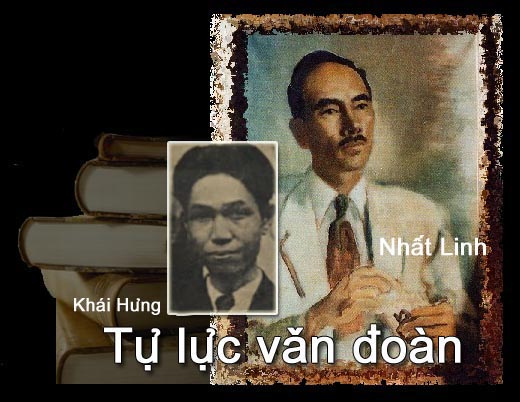
It is regrettable not to see appearing Nhất Linh et Khá’i Hưng’s names in today’s school curriculum or in anthologies published recently in foreign languages in Vietnam. However, they are the two best Vietnamese novelists at the dawn of 20th century.

People continue to look for and tear off rare issues published in South Vietnam before 1975. In spite of their selected topics generally relating to love, sentimental twists, dramas of the middle-class etc. at colonial time, they however continue to gain unanimous admiration of Vietnamese youth today, in particular of young Vietnamese living abroad because their writings are carrying not only a more or less occidentalized culture but also a purely Vietnamese romanticism. They succeeded in bringing to their works an innovative style, in using a simple vocabulary free of Sino-Vietnamese words perceived by Vietnamese young people as erudite words, and in approaching topics capable of adhering the youth: love-sacrifice, impossible love, vagueness in the soul etc…with a Cornelian glance as well as with Alfred de Musset‘s romantic manner.

« Hồn Bướm Mơ Tiên » (or Heart of a Butterfly in a Dream of Immortality),  » Nữa Chừng Xuân » ( or Mid-Spring ), « Ðoạn Tuyệt » ( or Rupture ,), « Anh Phải Sống » ( or You Must Live ) etc… continue to be the best-sellers preferred by Vietnamese youth today. It is not surprising to find that the topic of sacrifice approached about fifty years ago by Khai Hung in his works, is taken again recently by a young talented novelist Nguyễn Huy Thiệp in his novel  « Chảy đi sông ơi » ( or Run! Run! Oh River ) in spite of a completely different political context.

In their writings, one finds not only modern use of clauses, adverbs, tense forms that were until then absent in Vietnamese prose, but also the use of personal pronouns. The « I, me » make their way in, with words like « anh », « em », « mình », « cậu » that had not been used before in a sentence. It is noticed in the construction of their sentences a great economy of means, an unprecedented clarity, and a great effectiveness.

Coming from urban environment, influenced by the French culture since their younger age, they are unsurprisingly found inspired in their works by the models of Musset, Lamartine, Daudet, etc. when it is known that these French writers’ works formed part of the teaching curriculum at French lycee Albert Sarraut ( Hà-Nội ) where Khai Hung took his classes at colonial time. He received his bachelor’s degree in 1927 and taught at Thăng Long high school when Nhất Linh returned to Vietnam in 1930 after four years of scientific studies from France

His encounter with Khái Hưng at Thăng Long high school has overnight made them a famous and inseparable couple. They founded together the writing club Tự Lực Vân Ðoàn ( or Self-Sufficient Literary Group ) in 1933. Khái Hưng, who was nine years older than Nhất Linh, was however regarded as the « second » of this couple and was given the pseudonym of  » Nhị Linh » because Nhất Linh had already been author of two novels in 1926 and 1927. They acquired the merit of having brought clarity, concision, modernity to the Vietnamese literature and especially of knowing how to give to this modernity the soul of Vietnamese romanticism.

Contrary to other novelists of their time ( Vũ Trọng Phụng, Ngô Tất Tố for example), they did not have a critical view on social inequalities, virtues, and rural customs. They did not know how to help in fighting and denouncing these inequalities. But on the other hand, they tried to depict the most disfranchised social layer with much fineness and accuracy without having to defend it with horn and fanfare.

Is it why they are reproached of lacking combativeness and realism, tepidity in their manner of depicting the reality of urban society, and being influenced by western culture? It is certain that the episode of Musset’s Tales could be used as model by Khái Hưng because the heroine in the novel Anh Phải Sống, the young wife of the Vietnamese mason Thuc, let herself drowned in the flood like Madame des Arcis in the tales « Pierre et Camille » of Alfred de Musset in 1844. But Khái Hưng knew how to give his heroine the nobility and grandeur in the Vietnamese tradition.

Neither could be doubful their patriotism, their political involvement in Vietnamese nationalist movements. Because of their nationalist political orientation and especially their simple idealism, both have perished respectively like their heroines in Khái Hưng’s Anh Phải Sống ( You Must Live ) and in Nhất Linh »s « A Silhouette in the Fog« . Khái Hưng has deceased in 1947 under mysterious conditions near the Cửa Gà dock, in the district of Xuân Trường ( Hà Nam Ðịnh provine ) while Nhất Linh, disappointed for being misunderstood, took his life with poison on July 7, 1963 in Saigon. 

butvietBoth of them tried to live their lives the way their heroines did with an exemplary stoicism. The literary heritage they left to the Vietnamese people is priceless.

In a word, they are not only the pioneers of modern literature of Vietnam but also the most romantic novelists that Vietnam has ever known.

[Return LITERATURE]

Being young (Thiếu niên)

etre_jeune1

French version

Vietnamese version


In spite of the war which devastated this country for so many years, the Vietnamese young people continue to crave for life. That amazes enormously those who do not know Vietnam. In this country,  » Being Young » concerns always boldness because the living conditions are extremely hard and nature is also extremely rude and pitiless, in particular for those who live in the North and on the Central highlands. It is necessary to know how to resist bravely the forces of nature but it is also necessary to learn how to live with wild creatures, tricking them and fighting them.


One also starts to work very young in Vietnam. From their youth in rural areas, boys tend buffaloes, make them feed on small floodbanks while girls help in the household chores. Very young, from six or seven years old, they know how to cook rice, carry their little brothers, feed the pigs and ducks, carry drinking water to the familiar animals or taking part in family artisanal work. During the years when the war was at its height, young people were also assigned to dig trenches along the small floodbanks to throw themselves in when airplanes approached, live in undergrounds and tunnels to escape the bombings. Girls have twice as much work as boys. It was they who were the first being proposed and sold like slaves or concubines for a few kilos of rice when one could not manage any more to feed a family of several children in the years 30’s and 40’s. Ngô Tất Tố, in his novel  » When The Lamp Dies Out « , appeared in 1930, reminds us this reality. To pay a corrupt official, a country-woman had to sell her daughter for one piastre.

Nowadays, even this practice is prohibited, one nevertheless notes a great number of young female prostitutes on the streets of big cities. There, in spite of free education, many of young people must work on little jobs such as selling cigarettes or newspapers, collecting plastic bags etc… , to provide for the subsistence of their families. The living conditions are also distressing. Many young people coming from families afflicted by poverty and war continue to always crawl in tangles of badly erected huts that are dark and terribly dirty. There would be 67000 slums in Saigon at the end of 1994. It is the number maintained by the authorities and published by the press. One still finds the scenes described by novelist Khái Hưng in his work entitled  » The Gutters » ( Ðầu Ðường Xó Chợ ) with pavements and drains encumbered permanently with vegetable peelings, sheets of banana tree leaves and scraps of rags in the poor districts of the big cities.
Facing the indifference of society, novelist Duyen Anh did not hesitate to denounce the indigence of these young people in his novels, among which the most known remains the best-seller « The Hill of The Phantoms ». Inspired by this novel, movie maker Rachid Bouchareb recalled the history of the « Amerasians » who pay the price of the madness of the adults and the war in his film  » Dust of Life  » in 1994.

etre_jeune

In spite of the deficiencies of life, one likes to be young in this country because, if there are no mountains of toys and gifts which submerge our children in the west as Christmas approaches, there are on the other hand popular games, unforgettable memories of childhood. In the countryside, one could go fishing in rice fields and placing hoop nets in the streams to catch shrimps and small fish. One could hunt butterflies and dragonflies with traps made with the stems of bamboo. One could climb trees to seek bird’s nests. Hunting the crickets remained the preferred game of the majority of Vietnamese young people.

She did not hesistate to point out her Indochinese childhood in her novel « The places » : My brother and I did not spend whole days in the trees but in the woods and on the rivers, on what is called the racs ( rạch ), these small streams that go down towards the sea. We never put on our shoes, we lived half naked, we bathed in the river.

In this country where the war devastated so much and where thirteen million tons of bombs and sixty million liters of defoliants were poured, being young in the years 60-75 was already a favor of destiny. The young people of Vietnam today no longer know the fear and the hatred of their elders but they continue to have an uncertain future. In spite of that, in their look, there is always a gleam of intense life, a glimmer of hope. It is what is often called  » the magic of Vietnamese childhood and youth « .


It is necessary to be young in this country to have  such an attachment, an impression always poignant.

Être jeune

etre_jeune1Version française

Sống trẻ

Mặc dù  chiến tranh đã tàn phá đất nước này bao nhiêu năm qua, những đứa  trẻ Việt vẫn tiếp tục mong muốn khát khao được sống. Ở đất nước này, «Sống trẻ» luôn luôn  là một kỳ tích bởi vì điều kiện sinh sống rất cực kỳ  khó khăn cũng như  thiên nhiên vô cùng khắc nghiệt nhất là ở các vùng núi miền Bắc và các  vùng đất  Tây Nguyên. Phải biết chịu đưng được thời tiết khắc nghiệt  của thiên nhiên mà còn phải biết tinh ranh và hoà  mình sống chung với những sinh vật hoang dã nhất là phải biết khắc phục được chúng. Các thiếu nhi bắt đầu đi làm việc rất « trẻ » ở Việt Nam.

Ngay từ khi còn lúc nhỏ ở các vùng nông thôn, các đứa trẻ biết chăn trâu, thả trâu ăn cỏ  trên các bờ đê trong khi các thiếu nữ lo giúp việc nhà. Tuy còn nhỏ tuổi, các thiếu  nữ mới sáu, bảy tuổi mà đã biết nấu cơm, bế em trai, cho heo vịt ăn, biết múc nước cho gia súc uống hay là  tham gia vào các nghề thủ công của gia đình.

Trong những năm chiến tranh leo thang, các thiếu niên còn có nhiệm vụ đào các hầm hào  dọc theo bờ đê để  ẩn trốn khi có các máy bay tiến đến gần, sống trong các đường hầm nhầm để tránh khỏi các trận oanh tạc. Các thiếu nữ thì có công việc làm nhiều gấp đôi hơn các thanh niên. Đôi khi  các thiếu nữ  còn  là những nạn nhân  đầu tiên bị  bán làm nô lệ hoặc làm  vợ với giá tiền vài kilô gạo khi chúng không có thể tiếp nuôi gia đình nhiều con vào những năm 1930 và 1940. Cuốn tiểu thuyết “Tắt đèn” của Ngô Tất Tố xuất bản năm 1930 đã nhắc nhở chúng ta về thực tế này. Nếu ngày nay, tuy cái thói quen này bị cấm, chúng ta vẫn còn thấy một số lượng không ít  các cô gái trẻ bán mình  trên vỉa hè ở các thành phố lớn. Ở  các nơi nầy, mặc dù giáo dục được miễn phí ngày nay, nhiều đứa bé trẻ tuổi, phải đi làm những công việc lặt vặt, bán thuốc lá, bán báo, nhặt túi ni lông,  vân vân .. để phụ giúp gia đình. Các điều kiện sinh sống cũng còn tồi tệ. Nhiều thiếu  niên xuất thân từ những gia đình nghèo khó vẫn  tiếp tục sống trong những căn lều tồi tàn, tăm tối và  bẩn thỉu kinh khủng. Có ít  nhất 67.000 nhà  ổ chuột ở Sàigòn vào cuối năm 1994. Đây là con số mà  được chính quyền công bố và báo chí đăng tải. Chúng ta vẫn tìm thấy những cảnh tượng mà được tiểu thuyết gia Khái Hưng miêu tả trong quyển có tựa đề  « Đầu Ðường Xó Chợ » với  các vỉa hè và các rãnh nước ngổn ngang rác rưới  vỏ rau, lá chuối và những mảnh vải vụn trong những xóm nghèo ở các thành phố lớn.

Trước sự thờ ơ của xã hội, tiểu thuyết gia Duyên Anh đã không ngần ngại tố giác sự nghèo khó của những đứa trẻ này trong các tiểu thuyết của ông mà trong đó được nổi tiếng nhất vẫn là quyển có tựa đề « Ngọn đồi của Fanta ». Lấy cảm hứng từ cuốn tiểu thuyết này, đạo diễn Rachid Bouchareb đã  kể  lại câu chuyện về những đứa con lai phải trả giá cho sự điên rồ của các người lớn và chiến tranh trong phim có  tựa đề tên là  « Bụi đời  (hay Poussières de vie)»  vào năm 1994.

Bất chấp những thiếu thốn trong cuộc sống, các đứa trẻ vẫn thích sống ở đất nước này vì nếu chúng không có  được  cả núi đồ chơi và quà tặng mà các trẻ em ở phương Tây được có gần đến lễ Noël thì  chúng lại có những trò chơi phổ biến, những kỷ niệm của tuổi thơ khó mà quên được. Ở nông thôn, chúng có thể đi câu cá trên cánh đồng lúa và đặt bẫy trong các kênh rạch  để bắt tôm cá. Chúng có thể  săn  bướm và bắt chuồn chuồn bằng cách  làm bẫy  từ các thanh tre. Có thể trèo cây để tìm tổ chim. Săn dế vẫn là trò chơi yêu thích của hầu hết các đứa trẻ Việt lúc còn bé.

Chia ra từng  nhóm, đôi tai mở to lắng nghe tiếng kêu của dế, mắt nhìn chăm chú  mọi ngóc ngách, chúng cố gắng xác định vị trí các hang ổ chứa mà từ đó  ra tiếng dế gáy. Chúng hay thường làm cho dế chui ra khỏi lỗ bằng cách cho nước vào  hay nước tiểu, sau đó nhốt nó trong hộp diêm, làm cho nó gáy với những chiếc lông nhỏ hoặc cho nó uống một chút rượu đế  để kích thích nó trong các trận chọi dế.

Ở các thành phố, chúng  chơi đá  bóng bằng chân trần, ở giữa đường phố. Các trận đấu thường bị gián đoạn bởi những chiếc xe đạp vượt qua. Chúng cũng hay chơi đá cầu  trên các đường phố.

Sinh ra trong thời  chiến tranh, các đứa trẻ  Việt không hề coi thường các trò chơi  chiến tranh. Chúng tự làm súng bằng các bìa cứng hoặc gỗ hay  chúng  chiến đấu bằng kiếm với  các nhánh cây. Chúng cũng có thể chơi trò thả diều. Tuổi thơ này, tuổi trẻ này, người Việt nào cũng từng có, kể cả tiểu thuyết gia Marguerite Duras.

Bà không ngần ngại nhớ lại thời thơ ấu ở Đông Dương của mình trong cuốn tiểu thuyết  « C ác nơi (Les lieux) »: Tôi và anh trai, chúng tôi ở cả ngày, không phải ở  trên cây mà ở trong rừng và trên sông, nơi được gọi là rạch. Đấy là những dòng nước nhỏ này được chảy xuống biển. Chúng tôi không bao giờ mang giày cả, chúng tôi sống một nửa khỏa thân, chúng tôi thường  tắm ở sông.

Ở  một đất nước mà chiến tranh đã tàn phá quá nhiều  với  13 triệu tấn bom và sáu mươi triệu lít chất gây rụng lá được trút xuống, « sống  trẻ » trong những năm 60-75 đã là một sự ưu ái của số mệnh. Những đứa  trẻ Việt ngày nay không còn biết sợ hãi và căm thù như những đàn anh của họ, nhưng họ vẫn tiếp tục có một tương lai quá bấp bênh.

Mặc dù vậy, trong cái nhìn của họ, lúc nào vẫn luôn luôn có  một tia sống mãnh liệt, một tia hi vọng tràn trề. Đấy thường được gọi là “kỳ  diệu của tuổi thơ và tuổi trẻ Việt Nam”. Phải sống thời niên thiếu ở đất nước nầy mới có  sự quyến luyến, một  ấn tượng mãi mãi  thấm thía.

Être jeune 

Malgré la guerre qui a ravagé ce pays depuis tant d’années, les jeunes vietnamiens continuent à avoir la rage de vivre. Cela étonne énormément ceux qui ne connaissent pas le Vietnam. Dans ce pays, Etre Jeune relève toujours de l’exploit car les conditions de vie sont extrêmement dures et la nature est aussi extrêmement rude et impitoyable, en particulier pour ceux qui vivent dans le Nord et sur les hautes terres du Centre. Il faut savoir résister vaillamment aux intempéries de la nature mais il faut apprendre à vivre aussi avec les créatures sauvages, à ruser, à les combattre.


On commence à travailler très jeune aussi au Vietnam. Dès leur plus jeune âge dans les zones rurales, les garçons gardent les buffles, les font paître sur les diguettes tandis que les filles aident aux travaux de la maison. Très jeunes, à six ou sept ans, elles savent faire cuire du riz, porter leur petit frère, nourrir les cochons et les canards, porter à boire aux animaux familiers ou participer aux travaux artisanaux familiaux. Dans les années où la guerre a pris de l’ampleur, les jeunes étaient chargés aussi de creuser des tranchées le long des diguettes pour s’y jeter à l’approche des avions, vivant dans des souterrains et des tunnels pour échapper aux bombardements. Les filles ont deux fois plus de travaux que les garçons. Ce sont elles qui étaient les premières à être proposées et vendues comme esclaves ou concubines pour quelques kilos de riz lorsqu’on n’arrivait plus à nourrir une famille de plusieurs enfants dans les années 30-40. Le roman de Ngô Tất Tố  » Quand la lampe qui s’éteint », paru en 1930, nous rappelle cette réalité. Pour payer un fonctionnaire corrompu, une paysanne était obligée de vendre sa fille pour une piastre. Si de nos jours, cette pratique est interdite, on constate quand même un grand nombre de jeunes filles prostituées sur les trottoirs des grandes villes. Dans ces dernières, malgré l’enseignement gratuit, beaucoup de jeunes, pour pourvoir à la subsistance de leur famille, doivent vaquer à leurs petits boulots, vendre des cigarettes ou des journaux, ramasser des sacs plastique etc … Les conditions de vie sont aussi lamentables. Beaucoup de jeunes issus des familles de traîne-misère et de la guerre continuent à grouiller toujours dans des enchevêtrements de baraques mal consolidés, sombres et affreusement sales.

Il y aurait 67000 taudis à Saigon fin 1994. C’est le chiffre retenu par les autorités et diffusé par la presse. On retrouve encore les scènes décrites par le romancier Khái Hưng dans son ouvrage intitulé Les bas-fonds ( Ðầu Ðường Xó Chợ ) avec des trottoirs et des rigoles encombrés en permanence d’épluchures de légumes, de feuilles de bananiers et des lambeaux de chiffons dans les quartiers pauvres des grandes villes.
Face à l’indifférence de la société, le romancier Duyên Anh n’a pas hésité à dénoncer l’indigence de ces jeunes dans ses romans dont le plus connu reste le best-seller « La Colline des fantômes ». En s’inspirant de ce roman, le réalisateur Rachid Bouchareb a retracé l’histoire des amérasiens qui paient le prix de la folie des adultes et de la guerre dans son film « Poussières de vie » en 1994.

Malgré les carences de la vie, on aime à être jeune dans ce pays car si on n’a pas les montagnes de jouets et de cadeaux qui submergent nos enfants en Occident à l’approche de Noël, on a en revanche des jeux populaires, des souvenirs d’enfance inoubliables. Dans les campagnes, on pouvait aller pêcher dans les rizières et poser les nasses dans les arroyos pour attraper les crevettes et les petits poissons. On pouvait chasser les papillons et les libellules avec des pièges faits avec les tiges de bambou. On pouvait grimper dans les arbres pour chercher des nids d’oiseaux. La chasse aux grillons restait le jeu préféré de la plupart des jeunes vietnamiens.

En se promenant en groupe, les oreilles grandes ouvertes au chant des grillons, les yeux scrutant les moindres recoins, on essayait de repérer les tanières d’où sortait le chant. On avait l’habitude de faire sortir l’insecte de son trou en l’inondant de l’eau ou de ses déjections, puis de l’enfermer dans des boîtes d’allumettes, de le faire chanter avec des petites plumes ou de lui faire boire un peu d’alcool de riz pour l’exciter lors des combats des grillons.

etre_jeuneDans les villes, on jouait au foot avec les pieds nus, au milieu de la rue, les poteaux des buts étant constitués par les vêtements entreposés. Les matchs étaient souvent interrompus par le passage des vélos. On jouait aussi au jeu de volant au pied (ou Ðá Cầu) dans la rue. Le volant de la taille d’une balle de ping-pong était fabriqué avec un bout de tissu enveloppant une pièce de monnaie en zinc. 
Nés dans la guerre, les jeunes vietnamiens ne dédaignaient pas les jeux de la guerre. On fabriquait soi-même les fusils en carton ou en bois, on se battait avec des épées en branches. On pouvait jouer aussi aux jeux des cerfs-volants. Cette enfance, cette jeunesse, tous les Vietnamiens l’ont eue même la romancière Marguerite Duras.

Celle-ci n’hésitait pas à rappeler son enfance indochinoise dans son roman Les lieux : Mon frère et moi, on restait partis des journées entières pas dans les arbres mais dans la forêt et sur les rivières, sur ce qu’on appelle les racs (rạch), ces petits torrents qui descendent vers la mer. On ne mettait jamais de souliers, on vivait à moitié nus, on se baignait dans la rivière.

Dans ce pays où la guerre a tant ravagé et où les treize millions de tonnes de bombes et soixante millions de litres de défoliants ont été versés, être jeune dans les années 60-75 était déjà une faveur du destin. Les jeunes du Vietnam actuel ne connaissent plus la peur et la haine de leurs aînés mais ils continuent à avoir un avenir incertain. Malgré cela, dans leur regard, il y a toujours une lueur de la vie intense, une lueur d’espoir. C’est ce qu’on appelle souvent « la magie de l’enfance et de la jeunesse vietnamienne ».


Il faut être jeune dans ce pays pour avoir un tel attachement, une impression toujours poignante.


Being scholar (Sĩ Phu)

mandarin

Vietnamese version

French version

Young or old, a scholar (Sĩ) is always well considered in the Vietnamese society. Much regard is given to him as well as the first place in social hierarchy before the farmer (Nông), the craftman ( Công ), and the merchant ( Thương ). That’s why the latter does not cease to ridicule him in folk songs.

Ai ơi chớ lấy học trò
Dài lưng tốn vải ăn no lại nằm

Never marry a student, His long back costs a lot of fabrics
Once full, he just keeps lying downischol

Equipped with intellectual kowledge, the learned man does not let himself be upset by these remarks and tries to reply with a snicker:

Hay nằm đã có võng đào
Dài lưng đã có, áo trào nhà vua
Hay ăn đã có thóc kho
Việc gì mà chẳng ăn no lại nằm

Lying down, here is the luxury hammock
My long back, this is the gown granted by the King
Eat until full, there is plenty of rice in the warehouse
I don’t have to worry, just eat until full, then lie down and rest

This consideration dated back from the time when Confucianism was implemented as the single model structure of the society. The recruitment of the learned man as a mandarin was essentially based on the literary contests which took place every three years at the great temple of Confucius or the Temple of Literature (Văn Miếu). This temple was built by King Lý Thánh Tôn in 1070 and was changed to The College of the Nation’s Children (Quốc Tự Giám) in 1076. From 1484, the name of the scholar who passed the mandarinal contests was inscribed on a stele including his date of birth and his works. This practice of inscription on the stele was stopped only in 1778. Therefore, the dream of passing the mandarinal contests became an obsession for the majority of the learned men. Some of them passed their tests with an astonishing ease such as Nguyễn Bỉnh Khiêm, Chu văn An and Lê Quí Ðôn. Others failed several times as was the case of the learned man Trân Tế Xương whose poems always convey a caustic irony. His everlasting failure has influenced his works enormously. Besides litterary knowledge, the passing candidate or future mandarin must possess all the concepts of mandate of Heaven, filial piety, loyalty to the king (Nghĩa tôi ) and all the values that provide a cohesion to the confucian vision. Armed with these concepts, the learned man will try to accomplish his mission not only until the end of his days but also to the detriment of his life.

It was the case of the poet laureate Nguyễn Du who prefered retiring to serving the new regime after the fall of the Lê dynasty. It was also the case of the learned man Phan Thanh Giản who decided to take his own life with poison while advising his children to farm the land and not to accept any position during the French occupation of Cochinchina in 1867. As for the learned man Nguyễn Ðình Chiễu, author of the popular poem Lục Vân Tiên and one of the noblest figures of scholars, he never stopped giving moral support to the resistance during the colonial time.

Pictures gallery


In his Confucian vision, the scholar tried to maintain at any costs and strictly apply these principles unless the king becomes no longer worthy of the obedience owed to him. In this case, the learned man being keen on justice, may overthrow the king because the latter has been dispossessed of the mandate of Heaven. It was the case of Cao Bá Quát who participated in the famous Locust uprising ( Giặc Châu Chấu ) in the name of the Le family against king Tự Ðức, and who was captured and executed by the latter in 1854.

Although the Scholar was one of the cornerstones of a society upon which rested so many Vietnamese dynasties to govern the country and the legitimate defender of moral values particularly the five human relations ( Ngũ Luân ), i.e. between the King and his subordinates, the Father and his son, the Husband and his wife, the Brother and his younger siblings, and the Friend and his friend), which enables us to have a social cohesion and a national identity through centuries, He is however the factor of inertia and cultural isolationism which proved to be mortal for the Nguyễn’s Empire since 1840.

While continuing to underestimate the foreign power and by maintaining his conservatism, the Scholar was incapable of adapting to modernizational reforms advocated by the modernistic learned man Nguyễn Trường Tộ. Thus, He became the major obstacle to reforms that Vietnam needed in facing the ambitions of the foreign powers. This compelled Him to disappear at the same time with the Empire during the French conquest.

The Scholar formed part of a population of 40,000 learned men, approximately 20,000 of whom were holders of ranks in 1880. The last learned man known for his patriotism and reformism was Phan Chu Trinh. This one was in favor of reforms and insisted on the priority of total progress of society, of the diffusion of the modern knowledge on simple political independence.

His banishment to Poulo Condor and especially his death in 1926 has brought an end to the dream of all Vietnamese to find an independent Vietnam with a policy of non-violence and gradual decolonization that he advocated and defended with enthusiasm and conviction for so many years.


He tried to reveal his state of mind in his poem entitledphanchutrinh

The candle

He wants the flame to shed light to the bottom of darkness
Because his heart is burned with anxiety of lighting
But the half-opened door lets in the north wind
In the ending night, with whom to share his tears?

Phan Chu Trinh

It was the tears of the last great Vietnamese learned man. But it is also a cry of despair of a great Vietnamese patriot facing the destiny of his country.

cierge