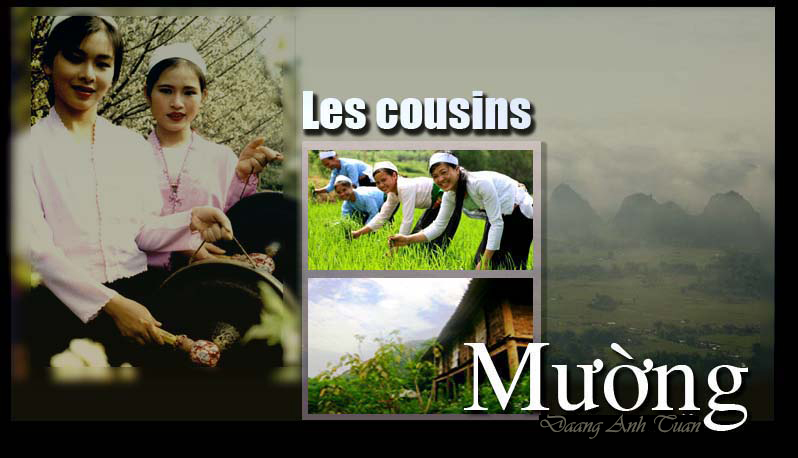
The Mường (Dân tộc Mường)


Version française
Version vietnamienne

Being the third largest minority in today’s Vietnam by number (estimated at 1.4 million people), the Mường have long been established in the provinces of Hoà Bình, Thanh Hoá, Phú Thọ, Sơn La, Ninh Bình, etc.
According to the worthy Vietnamese successor of the French ethnologist Jeanne Cuisinier, Trần Từ (or Nguyễn Đức Từ Chi), the word Mường is used by the Vietnamese (or the Kinh) to designate the region where there are several Mường villages. The Vietnamese take advantage of this usage to name this people. They often refer to themselves by a name related to the region where they live: mol, moan in Hoà Bình, mwanl in Thanh Hoá, or Mol, Monl in Thanh Sơn, and it precisely means « người » (person, individual).

By delving into the narrative of their creation myth (Ngu Kơ and Lương Wong) and that of the Vietnamese (Âu CơLạc Long Quân), one realizes that they might have originated from the same people whom history and geography divided into two groups around the 9th-10th centuries: the first consisting of the Vietnamese who moved down to the plains and underwent strong Chinese influence, and the other composed of the Mường who remained in the most remote corners of the mountainous regions and received strong influence from the Thai who were massively pushed south of Chinese territory. This is why the Mường continue to be closer to the Vietnamese in terms of language. They belong to the same Việt-Mường group of the Austroasiatic language family (Ngữ hệ Nam Á), which also includes the Mon-Khmer subfamily. This is the origin of the tones in Vietnamese (6 tones) that allowed the French scholar A.G. Haudricourt to affirm in his 1954 work the belonging of Vietnamese to the Austroasiatic languages, an opinion now commonly shared by many foreign researchers and Vietnamese linguists. The French ethnologist Christine Hemmet from the Musée de l’Homme (Paris) reiterated this affiliation during a conference on May 18, 2000, on ethnic plurality, multilingualism, and the development of Vietnam.

Then this Việt-Mường group split into two independent languages: Vietnamese and Mường from the 14th to the 16th century. With Chinese and French borrowings, the former managed to experience at the beginning of the 20th century a remarkable development with its quốc ngữ in the field of Vietnamese literature where it succeeded in expressing all the nuances of thought and feeling in all aspects of life (1). As for the latter, it was isolated from foreign influence and remained in the state that it has today. This Mường language is found, that of the Vietnamese of old (or Proto-Vietnamese). For the Mường, the Vietnamese (or Kinh) descend from common ancestors and share the same blood as them. That is why they are accustomed to saying in one of their popular songs the following two lines:

Though you and I are TWO,
You and I, though ONE, become TWO.
Although you and I are TWO beings, we are but ONE.
Being ONE single being, you and I could always be considered as TWO.

It is also in one of the Muong legends (Đức Thánh Tản Viên) that we find the repeated struggles between the water and mountain spirits mentioned by the Vietnamese in their famous legend « Sơn Tinh Thủy Tinh. » This clearly shows how close the Vietnamese and the Muong are, despite their different destinies, to the point that even their legends are not so distinct. Two famous Vietnamese kings came from the Muong (Lê Đại Hành and Lê Lợi). However, in terms of social and cultural organization, the Muong today are closer to the Thái and the Tày.

The territory inhabited by the Muong is divided into regions (or mường) whose chiefs are lords called « lang cun, » each comprising 20 or 30 hamlets. These are led by « lang đạo, » descendants of the heroic founders of these hamlets, and are named according to their topographical situation: Xóm Ðác (hamlet next to a waterfall), Xóm Ðung (hamlet near the forest), Xóm Ðôn (hamlet on a hill), Xóm Thung (hamlet in a valley), or according to the names of familiar fruit trees: Xóm Trạch (bamboo hamlet), Xóm Mít (jackfruit hamlet), etc., or according to the names of animals: Xóm Hò (Turtle hamlet), Xóm Oong (Bee hamlet), etc., or according to the categories of Muong society: Xóm Chiềng (hamlet where the lang cun (or feudal lord) lives), Xóm Roong (hamlet belonging to farmers).

In traditional Mường society, the establishment of an oligarchy can be seen. This system, called NHÀ LANG in Vietnamese, is essentially based on the right of the first occupant to own the land, forests, and rivers, to cultivate them, and to bequeath them always to the eldest descendants of the male lineage from generation to generation, in accordance with the tradition observed in the worship of Mường ancestors. This allows NHÀ LANG to practically control three-quarters of the land, which is cultivated and maintained through periodic rotations of teams of village laborers, granting them the right to exploit the remaining quarter of the land as compensation. Despite these shortcomings, it cannot be denied that there is a fairly democratic relationship between NHÀ LANG and the Mường.

Compared to the feudal land system of Vietnam at that time, NHÀ LANG of the Mường has undeniable progressive factors because it defends not only its own rights but also those of the Mường. It must help the Mường villagers in cases of drought, famine, or poor harvests. It must be held accountable if its lang cun behaves in a manner unworthy of its rank. This is the case, for example, if the son of the latter commits a dishonorable act such as violating a village woman or getting into a fight in the street.

One can go as far as to depose the lang cun if he does not properly assume his authority and duties. In this case, the villagers can appeal to NHÀ LANG for his replacement. This also applies when the lang cun has no male heirs. It is also the responsibility of NHÀ LANG to organize the festivities related to the harvests and the feasts associated with the worship of the spirits. However, there are rules that the Mường villagers cannot ignore. They cannot marry a daughter of NHÀ LANG because she can only choose people of her rank and from NHÀ LANG. Similarly, a village woman who is randomly chosen as a wife by the lang cun and has children with him cannot claim to play an important role in NHÀ LANG. Her children cannot become lang cun because this position is reserved only for the eldest male descendants whose mother must be a daughter from NHÀ LANG. The members of NHÀ LANG are respected even if they are young. Regardless of the child’s age, a villager must respectfully address him as « Chàng » or « Nàng » when he is a boy or a girl from NHÀ LANG.

The hierarchy is so respected that it is possible to know the affiliation of the person in question. Moreover, this system allows the Lang Cun to have a monopoly on certain names (Ðinh, Hà, etc.). It was abolished in the 1950s by the Vietnamese government during the organization of agricultural cooperatives. Despite this, the system remains one of the original features of traditional Muong society and is one of the traditions that cannot be ignored when talking about the Muong. To refer to this system, the Muong habitually say: Mường có lang, làng có tạo. (Regions have lang just as villages have tạo (or Đạo in Vietnamese)). The term LANG ĐẠO is used to designate this system.

The Muong are accustomed to choosing lowlands and rugged terrain to build their houses. These are generally built against the slopes of hills and mountains to benefit from pure air and to facilitate movement for hunting and gathering. Each of these houses has a four-sided roof resembling a turtle shell. Their houses stand on very low stilts and are built on three levels. This corresponds well to the Muong conception of the creation of the universe: a celestial and terrestrial world (thiên giới và trần giới), a marine world (thủy quốc), and an underground world (âm phủ). The first level is reserved for food storage. It is, in a way, the granary.

The second level corresponds exactly to the place where family activities take place and where visitors are received. As for the last level located below the floor, it is intended for raising livestock and storing agricultural tools. The construction of their house must meet both material and spiritual requirements. For the Mường, the window of the room (voong tong) where the ancestor altar is located is very sacred. No one has the right to lean on this window or pass objects through it because, according to the Mường, the ancestors are not so separated from the living. They continue to participate with them in the major occasions of their existence. Furthermore, the two staircases of the house each have an odd number of steps. The main staircase, located very close to the entrance room (voong toong), is reserved exclusively for men. As for the women, they are obliged to take the second staircase, which is not far from their inner room (voong khua). The Mường improvise ingenious hydraulic systems (wheels, channels, etc.) to channel and raise water in order to irrigate the extraordinary terraced rice fields on the slopes of the hills. They also practice slash-and-burn agriculture, which provides them with benzoin, sugarcane, cassava, corn, etc.

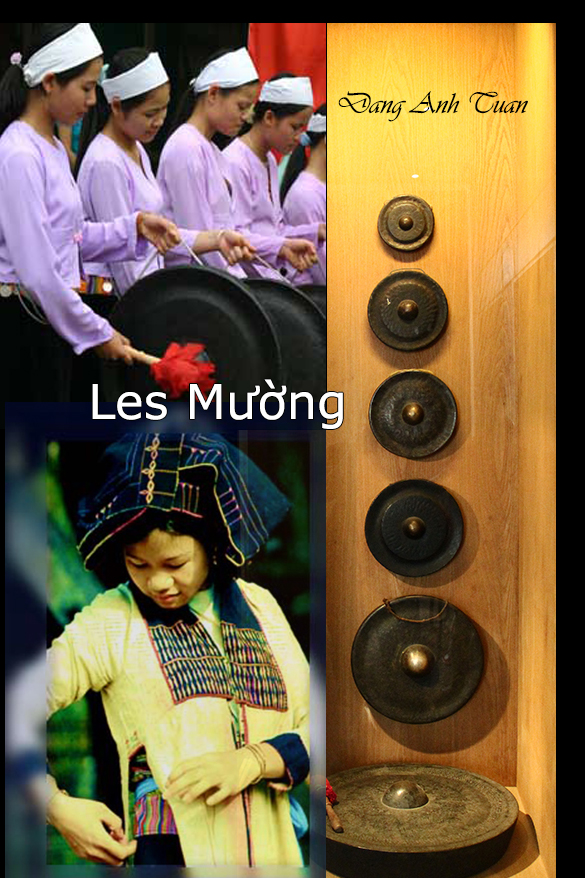
Compared to other ethnic minorities, Mường costumes are quite unique. Men dress very simply. They wear indigo-colored pants. However, the clothing of Mường women is more complicated.

In general, the traditional costume of women includes: a white or blue turban (mu) made from a square piece of fabric measuring 35 cm x 150 cm, tied at the back of the neck; a camisole (yếm or ạo báng); a short shirt (áo cánh or ạo pắn in the Mường language); a long black skirt (váy or kloốc in the Mường language) reaching the ankle; and a wide belt made of silk or fabric.

The short Mường shirt, which is white, pale green, or pink, has four panels, with the two at the back sewn very well and the two at the front each having a long border running from the neck to the hem of the jacket. Similar to Vietnamese women, Mường women wear short shirts with a fairly round neckline measuring about 2.5 cm or 3 cm and two long sleeves. These shirts are open at the front and often unbuttoned; they are intended to cover the camisole, whose lower hem is neatly tucked behind the wide silk or coarse fabric belt of the skirt (cạp váy), vividly illustrating folkloric charm and seduction. This is the main distinctive feature that draws attention in Mường women’s costumes.

In the constitution of this wide belt, there are three rectangular bands with rich ornaments called respectively « dang trên, » « dang cao, » and « dang dưới, » which are sewn firmly together. The « dang dưới » band stands out from the other two by the richness of the motifs representing hieratic animals (dragons, phoenixes, turtles, etc.) or familiar ones (snakes, cranes, fish, etc.). The tunic (ạo chụng) is preferred over the jacket on festive days. The color of the outfit changes according to the status of the Mường woman. For her wedding, she must wear a long green tunic, while the white color is reserved for her maid of honor (dâu phụ). Funeral clothes (đồ tem) are always made inside out with frayed lower hems.

Among these, there is a mourning bonnet, a skirt without the wide multicolored rectangular belt, a short white shirt, and a belt made of rough fabric. In case of mourning for the in-laws, the Mường bride usually wears a black skirt, a camisole, a short shirt, and a red brocade jacket. The Mường have a saying: Diện như nàng dâu đi quạt (1) (Beautify oneself like the bride at the time of funerals). The outfit remains the same except that the short shirt must be white when the bride’s parents are still alive.

To show their differences from the Vietnamese, the Mường have a very well-known proverb:

Cơm đồ, nhà gác, nứớc vác, lợn thui, ngày lùi, tháng tới.

Steamed or simmered rice, stilt houses, water contained in bamboo tubes carried on the shoulder, spit-roasted pork, day behind and month ahead.

These are the characteristic customs of the Mường that are not found among today’s Vietnamese. The Mường prepare most foods and cakes from rice: glutinous rice (lõ kẳm) (2) and ordinary cooked rice (gạo tẻ). There are several types of cakes: rice cake (bánh chưng) during the Tết festivals, bánh bò or bánh trâu cakes in honor of the buffalo spirit (vía trâu), uôi cake for funerals, bắng cake for weddings, ống cake for engagements, etc.

For the calculation of days and months, the Mường rely on the Ðoi calendar, which is different from that of the Vietnamese. Ðoi is a star that moves faster than the moon. Based on the movement of this star, their Ðoi calendar is 4 months ahead of the Vietnamese lunar calendar.

Similar to the Vietnamese, the Mường have a communal house (đình) reserved for the tutelary spirit (or thành hoàng) in each hamlet or village. They believe in the existence of a large number of malevolent spirits that haunt the forests and that they call ma-khũ (or ma qũi in Vietnamese).These are disembodied souls wandering in the world of the dead and the living and can cause troubles for humans.

For the Mường, there are several souls within a human being that they call wại. These are divided into two categories: wại kang (the splendid souls) and wại thặng (the hard souls). The former are superior and immortal, while the latter, attached to the body, are evil. Death is only the consequence of the escape of these souls. Thanks to the funeral rite (ma chay), the superior souls can reside in the sky. They will need to be accompanied by the help and care of the family during their perilous migration. This is reflected in the affection and attachment that the Mường particularly reserve for the deceased through a set of rules regarding clothing, decoration, and accompaniment of the coffin (a split and hollowed-out wooden trunk). By performing the last rite, the souls will rest in peace; otherwise, the hard souls may become harmful and malevolent by turning into floating and dangerous spirits (Ma). This funeral rite (mo tang) can last several days (at least 12 days) and requires the presence of a sorcerer (or mo in the Mường language).
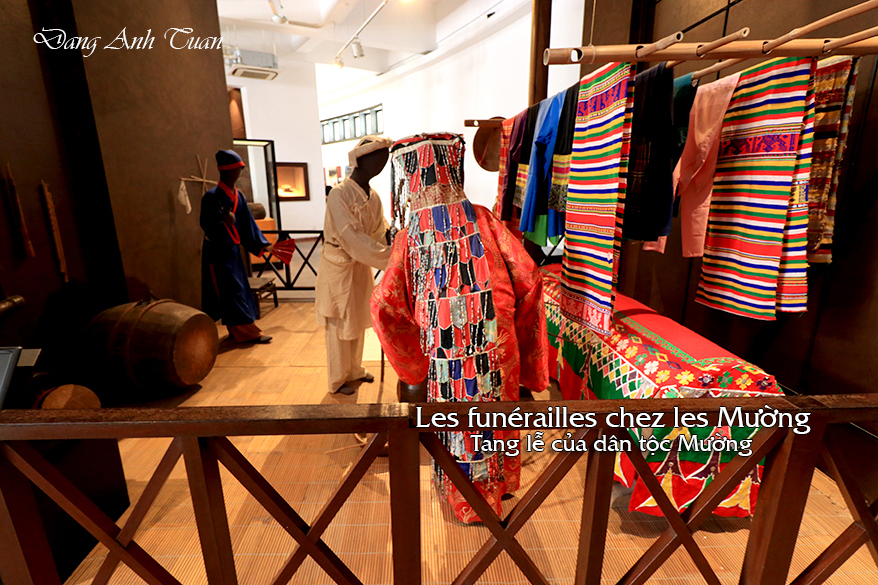

According to the Mường, the deceased possesses a supernatural force that prevents the living from communicating with them and helping them materially or spiritually. Only the thầy mo (or sorcerer) can do this. It is his responsibility to guide, before the burial, the soul of the deceased through all the administrative procedures with the celestial lord (Chạo Hẹ) to obtain a judgment. This will be delivered in a basket of ashes placed at the entrance of the house’s door, at the spot where the deceased is supposed to return home. There is a trial because during his life, the deceased sacrificed many animals for his consumption.

Depending on the verdict of the judgment revealed through the interpretation of signs or traces by the sorcerer, he may be condemned to reincarnate in the body of one of these sacrificed animals or henceforth lead a peaceful life. The sorcerer holds an important place in the Mường funeral rite. He is the one who accompanies the soul of the deceased to go collect money from the paternal grandfather’s house (ta keo heng), then borrow clothes from the house of Thiên mư, register in the ghost register (sổ ma) to facilitate movement, and finally provide essential everyday objects in the world of ghosts. He is also the one who gives the soul of the deceased the last meal and helps move their belongings into the tomb at night. There are a large number of objects: bowls, dishes, water jars, etc., and bronze drums for a lang cung (or feudal lord). Then it is up to the children of the deceased to organize, at the end of the third day of the funeral, a ceremony celebrating the return of his soul home before being able to begin his worship. This allows the deceased to be present from then on at all major occasions and at all feasts enlivening daily life: weddings, New Year celebrations, house inaugurations, etc. Similar to the Vietnamese, the Mường solemnly celebrate the anniversary of the death of the deceased and they wear mourning. The deceased is now part of the ancestors who have been honored on the family altar up to the fifth generation. Ancestor worship is very important in the spiritual life of the Mường.
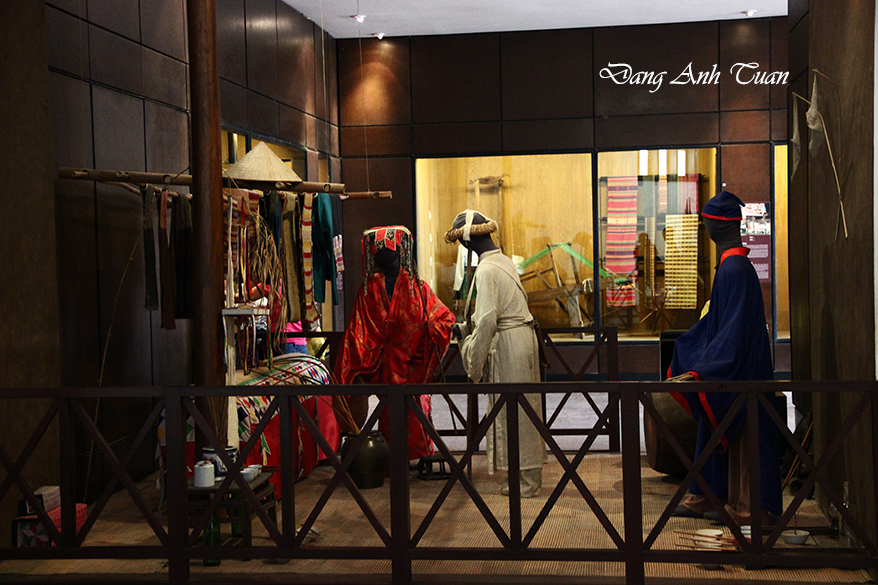
Ma Chay
Similar to other ethnic minorities in Vietnam, the Mường are animists. They believe that everything has a soul. That is why their worship includes a large number of spirits, gods, and malevolent or benevolent spirits. Even in each Mường family, there is a benevolent spirit (or the ancestor demon (ma tổ tiên)) believed to protect the family. This is why there is a tradition that the Mường must observe after announcing the death of a loved one. The eldest son of the deceased must strike the door of the deceased’s house three times in a row with a knife to blame the family demon for not intervening in time during the father’s death. Before cutting down large trees in the forest, the Mường present an offering to the tree spirit (Thần cây) along with the axe that will be used for the work. Even when killing game during a hunt, they are obliged to pay homage to the predator spirit by offering the head and a shoulder once the animal is skinned. This is somewhat an honorable fine to the protector of predators, a custom frequently found among other hunting peoples. The Mường customarily venerate rocks, red pumpkins at the time of moving into a new house (lễ tân gia), the cây si tree, family totems, water sources, earth and kitchen spirits, etc.

Among the Mường, the resurrection and reincarnation of the soul are taboo subjects. For them, the soul is multiple, indestructible, and immortal, whether good or bad. In this Mường conception, the birth of a child is surrounded by mystery. They have asked many questions about its identity: child, spirit, malevolent spirit, or ancestral ghost?

Furthermore, for the Mường, the birth of the first child marks the beginning of maturity for young parents. They also rely on their children to have a peaceful retirement later on. The following Mường saying shows how much this support is desired:

Trẻ cậy cha, gìa cậy con
The young rely on their father just as the old rely on their children.

BIRTH

That is why the birth of a child holds an important place in the life of the Mường. To prepare for any eventuality, the Mường take a great number of usual and ritual precautions related to pregnancy and birth. When the mother is pregnant, she must follow certain immutable rules that have existed since time immemorial: protect herself against malevolent spirits with a leaf when passing in front of cemeteries and temples, avoid funerals (a harmful effect for the mother and her future child’s health), and weddings (a possible divorce for the parents),

refrain from walking on the bark of the tree used in the making of coffins (a possible miscarriage), do not flee in front of the snake to prevent the newborn from having an elongated tongue outside of its mouth, avoid eating « twin » fruits (a possible multiple birth), facilitate childbirth by waking up early in the morning and opening all the doors of the house, always maintain serenity and joy, avoid anger, etc.

Similarly, the husband must observe many prohibitions. He is forbidden to carry the coffin, to replace the roof of the house, and to renovate the house. As her childbirth approaches, the pregnant Muong woman has no interest in visiting her parents’ house because if the event occurs, she will be forced to give birth under the floor where the livestock are kept. According to the Muong, the pregnant woman is no longer part of their family (Con gái là con của người ta) but is the daughter of her husband’s family. The child born does not share the same blood as the family (khác máu tanh lỏng). This could later bring misfortune to the people of the house. For a girl who becomes pregnant without a husband, her delivery cannot take place in the house. It must be held in the garden. The punishment is the same for the girl who commits the fault of becoming pregnant before marriage.

In general, childbirth takes place at home. The happy event of the birth is announced by the presence of a distinctive sign always placed on the left (if it is a boy) and on the right (if it is a girl) at the entrance of the house. This sign will be removed at the end of the seventh day for a boy and the ninth day for a girl. Sometimes, the intervention of the sorcerer (thầy mo) is desirable in case it is believed that malevolent spirits are involved and held responsible for these difficulties.

There are many restrictions for the woman but also for the husband during the pregnancy. Even after birth, the child continues to be the cause of the greatest troubles for the parents during the first years of life. According to the Mường, the soul attached to its body is so fickle and wandering that it can escape from the body at any time. That is why the child, before leaving the house, needs to be protected by attaching a silver bracelet (pwok wai) to their wrists or ankles, which serves to prevent the soul from leaving. In case the soul leaves the body, this bracelet would allow it to return and take possession of the child. Moreover, to ensure that nothing happens to the child during the first years, the Mường parents organize a ritual ceremony known as cak wai to place the child under the protection of the protective spirits Mẹ Mụ.

These are, in a way, the celestial nurses of the child’s soul. The Mu have the right to have in each Mường house their altar, which is inaugurated after the first birth.

One cannot overlook the relationship between husband and wife among the Mường because it is one of the prominent traits that allows them to acquire commendable qualities and to establish a society that is peaceful, humanistic, hospitable, and altruistic.

Essentially based on fidelity, love, and happiness, this relationship helps to cement Mường society and enables it to better withstand the changes in customs that Vietnam has experienced since its reunification.

Despite the ease of being able to talk, meet, and get to know each other before marriage, young people cannot overstep the principles and demands that Mường tradition has established since time immemorial. A man must be serious, strong, upright, and kind. These are the qualities required of a man to be able to marry; otherwise, it is difficult for him to find a wife in Mường society. « Học ăn, học nói, học gói, học mở » (Learn to behave, to speak, to face, and to untie life’s difficulties) is the motto that one would like to apply in the search for a future husband for a Mường girl.

A man must know how to build the house, weave straw roofing panels, raise livestock, etc… It is also common to say in a Mường proverb: Một đàn ông không dựng nổi nhà (a man is incapable of building the house) to show how deeply they are attached to this preconceived notion. This requirement is easy to understand because in a harsh environment and in a society that is both supportive and hierarchical, a Mường man must demonstrate his ability and live up to this expectation. As for the Mường woman, she is not well off either. She is expected to possess certain qualities: to have good conduct, speak softly, be courteous, know how to make her own clothes, etc…

MARRIAGE

Haunted by the following proverb « Một đàn bà không cắt nổi gianh » (A woman is incapable of cutting the thatch), the Mường are led to have a clearer judgment about their future daughter-in-law and to discern her qualities and faults with lucidity. The motto « Lấy vợ xem tông, lấy chồng xem họ » (Marry a woman after observing her lineage, choose a husband after knowing his family) is also not foreign to their behavior and observation in marriage. To succeed in this, they need the help of a matchmaker (bà mờ) (1), who is in a way the central pivot in this difficult matter. She is not only the privileged interface between two families but also the responsible and committed witness of the transactions arising from these two families. She must be close to the future bride’s family. She must have talent in communication to convince people. The following Mường proverb: « Thiếu gì nước trong giếng, thiếu gì tiếng trong mồm mà không nói ra cho vừa lòng nhau » (There is so much water in the well, so many sounds in the mouth. Why can’t we find words to please each other?) shows the Mường’s strong attachment to communication.

His respect is unquestionable in the village. His profile meets many of the criteria required by Mường tradition: having an irreproachable life within his couple and family. It is obvious for her to have both a son and a daughter according to a Mường proverb: có nếp, có tẻ (there is sticky rice and ordinary rice). Before starting her approach with the woman’s family, she must consult the Đoi calendar (2) because, according to calculations, there are certainly harmful months and hours in the day (tháng thướm, giờ thướm) that must be avoided at all costs for the marriage. This is also the case for the Vietnamese with the « Ngâu » month, which they must prohibit for this event. She is supposed to know the birth date of each of the spouses to later avoid problems of incompatibility and discord in the couple. In case of divorce or failure, all grievances and reproaches from both sides will fall on her. Moreover, she will receive the blame from the local lord (quan lang).

After obtaining all the necessary information and the green light from the husband’s family, the matchmaker can begin to set the first meeting (Thoỏng thiếng or ướm tiếng) with the family of the future bride. She must inform all her relatives of this happy event and sometimes ask for their advice. During this visit, she usually gives the girl’s family a bottle of wine, which is immediately hung inside the house on the main pillar. If this bottle of wine is served after the meeting, the matchmaker will be sure of the success of her mission. Otherwise, she will leave with the bottle of wine. Known in Mường as « Tì kháo thiếng, » this step is followed at least 3 or 4 times by the back-and-forth (or nòm in Mường) of the matchmaker who does not immediately obtain agreement the first time. It is in the interest of the future bride’s family to show the matchmaker that this is an important matter requiring a period of reflection and consultation with the girl. This allows the relationship between the two families to deepen and become more intimate through the matchmaker.
Thanks to the back-and-forth exchanges (or nòm), it is ensured that the husband and wife possess all the required qualities. It is at the end of the last nòm that the date to celebrate the « nòm cả » (main nòm) will be chosen. Known as « ăn hỏi or tì nòm, » this ceremony is celebrated with great pomp. Among the gifts from the future husband, there are many symbolic items including a pig, 20 tubes of rice liquor (rượu cần), 2 pairs of sugarcane boots, betel leaves, plain sticky rice cakes (bánh chưng) without filling (không nhân), moral beauty, and a tacit agreement on the virginity of the future bride. All offered gifts must be in even numbers. It is during this ceremony that the future husband is introduced to the bride’s family. This introduction is known as mường: ti cháu (lễ ra mắt chú rể). At the end of this ceremony, the bride’s family will discuss the dowry with the future husband’s parents. Known in mường as « thách cưới (challenging the marriage), » it is easily accepted by the latter to show that they can meet this financial demand and to avoid losing face. It is the matchmaker’s responsibility to negotiate the dowry cost, reduce it, or outright refuse the marriage. Sometimes, the future husband is assured by the promise from the bride’s family of receiving a share of the inheritance in case she has no male heirs.

Known for her studies on the Mường, the French ethnologist Jeanne Cuisinier saw in this bargaining an act of purchase for the bride and groom. Nothing fully justifies this interpretation because on the daughter’s family’s side, there is indeed an act of commitment, a moral guarantee for this marriage with the participation of her entire lineage and a sincerity to want to perpetuate the couple’s life through this demanding financial requirement. In case of divorce, the wife’s family must return in full all the dowry received at the time of the marriage. This is an additional constraint that helps to avoid separation and to carefully consider before any irreversible act. It is also one of the factors that help explain the family and social cohesion of the Mường compared to other ethnic groups, particularly the Kinh. Moreover, for the future husband, there is a promise to grant him a share of the inheritance and a custom of adopting him into a family without male heirs. This is not really the meaning of the term « purchase » as found in its definition because the future husband will still receive a dowry in compensation.

According to Mường tradition, the official ceremony takes place three years after the main nòm. This is the period during which the future spouses should get to know each other, exchange conversations, and smooth out differences in order to facilitate their married life later on. This time, the ceremony starts very early in the morning because the matchmaker, accompanied by the groom’s relatives, must bring a large number of objects and animals that meet the requirements set at the time of the main nòm (a buffalo, two pigs, 5 or 6 baskets of sticky rice, a bunch of areca nuts, about a hundred betel leaves, 20 tubes of rice liquor, etc.). The number of people in the entourage must be even. Being received by the bride’s family and participating with others in a feast organized in their honor, the matchmaker will ask the bride’s parents for permission to bring their daughter to her husband’s house at a time deemed appropriate and lucky for the couple. Before leaving, the bride must pray in front of the ancestral altar and then perform lạy (a traditional Vietnamese gesture of respect) before her grandparents and parents. On the way back, she wears a conical hat and always carries a knife in her hand to ward off evil spirits and protect her « soul. » She is forbidden to turn her head backward. It takes time because, in most cases, the villages are very far from each other. That is why it is customary to say in Mường:Làm rể vào buổi trưa, làm dâu vào buổi tối. (One becomes the son-in-law in the morning, the daughter-in-law in the evening).

Once she arrives, she is welcomed by the husband’s sister, who asks her to wash her feet and step over a bundle of wood before climbing the house stairs. She is required to pray immediately in front of the kitchen spirit altar before performing the same gesture in front of the ancestors’ altar and the husband’s parents. Then a ritual ceremony (lễ tơ hồng) takes place in the middle of the house in the presence of the newlyweds. This will be followed by a feast in honor of the new couple. A few days later, the husband will return to the bride’s house for his first visit (lễ ra mặt). In the past, there was a period of challenge (bù mà ruộng) before they could truly begin their married life.

For the Vietnamese, the Mường are not only a minority ethnic group but also a people who preserve an original common culture. This is why it is in the interest of the Vietnamese to conduct ethnographic studies on the Mường, as through them, they have succeeded in better understanding the way of life of their ancestors as well as their archaic and millenary culture. The Vietnamese ethnologist Nguyễn Từ Chi had the opportunity to recall the characteristic traits of the Mường in Vietnamese culture in his book « The Mường Cosmology (Vũ trụ quan Mường). » Without the Mường, it is believed that Vietnamese culture is that of the Chinese, a widely false and erroneous opinion over the centuries. They deserve to always be the cousins of the Vietnamese or rather twin brothers, as they have often said in one of their popular songs:

Ta với mình tuy hai mà một
Mình với ta tuy một thành hai.
Mặc dù tôi và bạn là HAI bản thể, nhưng chúng ta là MỘT.
Là  MỘT, tôi và bạn, chúng ta luôn có thể được coi là HAI.

Though you and I are TWO, we are ONE
Though I and you are ONE, we become TWO
Although you and I are TWO beings, we are but ONE.
Being ONE single being, you and I could always be considered as TWO.

The Mường are more than ever the survivors of the ancient culture of the Vietnamese. They are here to bear witness and to remind the Vietnamese that they, like them, have their own culture that allows them to distinguish themselves from the Chinese and that deserves to be known and preserved for future generations in the face of the rapid evolution of today’s Vietnamese society.

[Back to page « Vietnam, land of 54 ethnies »]

(1) Quạt: this word is used to refer to funerals (quạt ma).
(2) Glutinous rice is a type of rice whose grain is black.
(3) Sometimes it is a matchmaker (ồng mờ).
(4) Đoi calendar: a unique feature of Mường culture. This calendar consists of twelve bamboo pieces carved with lines to facilitate the indication of phenomena and climatic changes.


Bibliography

Người Mường ở Viet Nam. Editeur : Nhà Xuất Bản Thông Tấn. Hànôi.
Mosaïque culturelle du Vietnam. Nguyễn Văn Huy. Maison d’édition de l’éducation. 1997.
Bàn thêm về chế độ Nhà Lang trong xã hội Mường cổ truyền. Dưong Hà Hiếu.
Đám cưới truyền thống Mường. Phạm Lệ Hoa. Trường sư phạm nghệ thuật trung ương. National University of Art Education.
Rituels de naissance et liens de l’âme chez les Mường du Vietnam. Stéfane Boussat, Marcel Rufo.
À la recherche de l’origine de la langue vietnamienne. Nguyễn Văn Nhàn.  Synergies riverains du Mékong. N° pp 35-44


The Bahnar : Part 3 (English version)

peuple_bana5

Version française

Version vietnamienne

Part 3

Once the marriage is celebrated, the young spouses live alternately in their parental families for a certain period according to the agreement established between the two families. It is only after the birth of their first child that they begin to build their own house. The Bahnar adopt monogamy. Rape, incest, and adultery are strictly condemned. In the event that adultery is committed by the surviving spouse, regardless of their sex, during the tomb maintenance period, it is said that they « jump over the coffin « ko dang boăng« . The survivor is not immediately released from their obligations towards the deceased. They are required to pay compensation not to the heirs of the deceased but to the deceased themselves, which is settled by a number of animals sacrificed bơthi on their tomb. That is why the surviving spouse has an interest in shortening the maintenance period if they wish to start a new life. Even in death, the harm caused to the deceased by the fault of their spouse is entitled to material compensation by the number of animals sacrificed on their tomb. In Bahnar tradition, everyone is « free » provided they do not harm the person or property of others. In cases where a person has been wronged in their honor or materially in their property, they are entitled to compensation in the form of indemnity or reimbursement of expenses incurred.

Figurines de bois
devant les maisons funéraires

bana_figurine

The Bahnar do not impose the death penalty. Sending someone to the penal colony corresponds to banishment. The Bahnar know how to practice mutual aid in times of scarcity. In their house, rice alcohol is never drunk, and meat is never eaten without inviting other families. The first ripe rice does not belong solely to the owner of the field but to the entire village.

The freedom to choose a spouse, the division of tasks within a couple, the right to material or moral compensation, and respect for others clearly illustrate the equality between men and women in the ancestral tradition of the Bahnar. There is no essential difference between the legal status of men and women. Among the Bahnar, the democratic mode of operation has existed long before democracy was discovered and practiced in the West. According to the late French ethnologist Georges Condominas, the « savages » do not wait for Minkowski or Einstein to have the notion of space-time.

By using an expression related to space, they indicate a date. They roughly give someone’s age in relation to a significant event. They do not completely destroy the forest because they know how to let it regenerate years after they had consumed it ten or twenty years earlier, like the Mnong of Georges Condominas.

They do not kill game for the pleasure of killing but kill it only to eat and to know how to share it with their compatriots. They keep only a tiny portion of their hunt for themselves. The spreading and use of defoliants by the Americans during the Vietnam War, the slaughter of animals for traditional medicine, the destruction of vegetation and deforestation linked to rapid population growth, the sterilization of the land through excessive use of chemical fertilizers are the prerogative of so-called « civilized » people. Solidarity and mutual aid are not empty words.

The Bahnar are above all « rơngơi » (or free). They are accustomed to saying: « I am rongơi or kodră (master) » to mean that they are free to choose their activities or masters of their destiny. Are they « savages » as has long been thought? It is up to each of us to delve deeper into this question and to use their way of life and culture as a source of inspiration and reflection to enable us to live better and be together in respect of others and nature.

[Back to page « Vietnam, land of 54 ethnies »]

The Bahnar : Part 2 (English version)

peuple_bana1

Vietnamese version

French version

Part 2

The last stage corresponds to the final day. It is not only the day of the widow or widower’s release but also the day when the pot (xlah go) is emptied and cleaned. A communal meal is held in honor of the guests at the host’s place or in the communal house. This is then followed by a rite in which each guest sprinkles water on the widower or widow as well as on the deceased’s relatives. This ceremony officially marks the definitive severance of the living’s bond with the deceased. From then on, the widower (or widow) is allowed to remarry. The funeral house is now a material shell without a soul. It will naturally decompose over the years. However, it holds great artistic and cultural interest because the palisade of stakes surrounding it features original characteristics with sculptures of animals and birds. Under the small thatched roof, one can see the weapons, clothing, and food offered to the spirit of the dead. Some funeral houses are surrounded by sculptures related to fertility or rebirth: men and women copulating, men and women displaying their exaggerated genitalia, figures in the fetal position, etc.

These crude figurines are not human beings but monkeys because they are as ugly as monkeys in the spirit world where everything is the opposite of the living world. The ridge beam of the funeral house cannot go unnoticed as it is made from a whole tree trunk carved and decorated.
For the Bahnar, the soul of the deceased continues to live as a spirit in the spirit world. Its organization is similar to that of the living world, and its sovereign is both immortal and a female genius named Brôu. The spirit world (or mang lung) is invisible to the living because it is either inside a cave, in a dark forest, or in a very distant sea. The spirits live there grouped in villages. They engage in all human activities. They experience happiness and suffering just like the living and they also die like them. However, they work their lands at night and sleep during the day. Likewise, they use a language completely opposite to that of the living: « ugly » means « beautiful, » « dull » means « sharp, » etc. Mang Lung resembles our world but is entirely reversed. When it is night here, it is day in Mang Lung. The houses there have stilts pointed upwards and the roof pointed downwards.

The lifespan of a spirit is also limited because it ends with death. The spirit then transforms after forty or fifty years into a drop of dew (dak ngop) that dissolves into the earth. This is how a closed life cycle ends: earth-man-spirit-earth. Only the sovereign-genie (Bia Brôu) takes care of overseeing the birth of new creatures by shaping children from the earth and introducing them into the wombs of pregnant women.

For the Bahnar, a life cycle is composed of two existences:

that of the world of the living and that of the world of spirits.

Regarding the hairstyle of the Bahnar, it is becoming more common to see men, influenced by contact with the Kinh and foreigners, cutting their hair shorter and shorter. Normally, the Bahnar man wraps a fabric turban and passes it through his bun. However, a woman does not wear the turban and replaces it with a cord or a beadwork headband. It is an act of declaration of love when a girl unties a young man’s turban in public or when a man offers tobacco or a chew from his pipe to a woman or girl.

The life of the Bahnar is governed by a traditional annual cycle with ten months dedicated to agricultural production and two months devoted to festivals and various village activities: weddings, house repairs or construction, clothing making, etc. In their traditional society, the concept of money holds no significant meaning. Their valuable items such as gongs, jars, buffaloes, elephants, and horses were used as barter objects in the past. Their wealth is measured by the number of gongs, jars, and slaves found in each family. The Bahnar make rice the basis of their food. It is cooked by steaming or braising. Rice and water are placed inside a large bamboo tube which is suspended over the fire. By charring the container, the rice is cooked. They use sticky rice to make a fermented drink (or rice alcohol) (rượu cần in Vietnamese). They consume this liquid using long bamboo straws. They add water when the liquid level drops. It is obvious that the drink becomes less concentrated with this addition.

The Bahnar of both sexes often pierce their earlobes to wear earrings, but they do not stretch them to wear large rings like other ethnic groups in the region. Around the age of fourteen or fifteen, they have their teeth filed down. This custom of filing teeth is declining over the years. However, tattooing is not practiced. For boys, at the age when they begin to help their father in the fields, they are required to sleep at the communal house because it is here that they receive training, weapons handling, and instruction provided by the village elders for learning life skills. They can only return to their parental home to eat or to be cared for in case of illness.dantoc_bana

Among the Bahnar, it is observed that the married couple does not adhere to either patrilocality or matrilocality. It is a matter of convenience linked to the couple’s decision. However, there is a division of labor within the couple: the husband takes care of village affairs while the wife handles all the household chores. Among the Bahnar, one is free to choose their husband or wife. Marriage can be celebrated when each of the future spouses meets the following conditions:

1°) They are of an age to cultivate a field (15 to 16 years old). This is a prerequisite condition to feed their family because no one is willing to provide assistance, not even their parents.

2°) It is mandatory for a young girl to enter into her first marriage even if she is over thirty years old. However, she can be married either as a first-rank wife or a second-rank wife. But for a widower, a single man, or a divorced man, it is not possible to contract a second-rank marriage.

3°) There are no kinship ties between the future spouses. This is the case when parental consent is refused when the relationship is proven. In general, the participation of the parents aims to ensure that traditional principles are respected.

[Reading more: Part 3]

The Mnong (Dân tộc M’nông): Part 2

 
dantoc_mnong

The Mnong: Part 2

version vietnamienne

version française

When one decides to go abroad (i.e., to neighboring villages), one needs to be accompanied by a matchmaker preferably recruited from the kuang of the village. A kuang is actually a powerful and reputed man whose status is not measured by accumulated wealth but by the number of buffalo sacrifices he has organized and carried out. Thanks to the grand expenses he has undertaken in buffalo sacrifices for his relatives, his jôok guests, and his village, he has simultaneously acquired enormous prestige. This has allowed him to gradually expand his network of relationships, to have influence in village deliberations, and to become a rpuh kuang (or a male buffalo) in terms of sexual power.

Even the horns of his « buffalo soul (or hêeng rpuh) » raised by the spirits have lengthened according to the number of sacrifices accomplished. His coffin weighs all the heavier as these horns have reached an imposing size. A great kuang is one who dares to practice the strategy of indebtedness. The more he hoards to spend on buffalo sacrifices and purchases, the more his prestige increases. He always has some debt trailing behind him.

He does not wait to reimburse the full amount of his purchases to make others because this earns him admiration and renown. A Mnong villager becomes a kuang with the first buffalo sacrifice. He thus becomes the « indispensable » man on whom people rely to ensure not only road safety but also success in commercial transactions when traveling outside the village. It is with him that the itinerary will be planned. He is the one who will introduce, thanks to his network of connections, the local jôok of the recipient village who knows all the inhabitants and who knows among them who is interested in the objects involved in the transaction while providing guarantees of solvency.

That is why the call to the deities is not confined to a particular place but is scattered everywhere, whether in the village, in the woods, in the mountains, or in the waters. No corner is spared. It will either be collectively invoked or honored with a special cult in particular circumstances. This is the case of the rice spirit to whom a small altar is dedicated in the middle of the field. During the sowing season, the Mnong will come to place their offerings. The collective harvest cannot begin without a special rite known as « Muat Baa » or (tying of the paddy). Since the paddy has a soul, care must be taken not to anger it or make it flee by observing many precautions: avoiding whistling, crying, singing in the fields, quarreling there, eating cucumbers, pumpkins, eggs, slippery creatures, etc. A chicken will be sacrificed near the miniature hut of the rice soul perched on a bamboo, itself surrounded by bamboos bearing offering nests. To the rain spirit, the Mnong will offer eggs on a tiny platform. To calm the anger of the forest plant spirits before clearing a plot, great ritual care and prayers are performed. A long bamboo stake with a curved tip, from which a caught fish has been hung, is planted in the consecrated spot in the area to be burned for clearing.

Similar to the Bahnar, the Mnong are animists. They believe that everything has a soul, even in ritual utensils (beer jars, for example). The universe is inhabited by spirits (or yaang).

At the moment the fire begins to blaze, two « sacred men » (croo weer) implore the protection of the spirits while a third anoints the fish stake and calls the spirits. There are even deities believed to be the guardians of the individual’s soul. This soul consists of a material body and several souls (or heêng). These take multiple forms: a buffalo soul raised to a level of the heavens by the spirits, a spider soul in the individual’s head, a quartz soul located just behind the forehead. There is even the hawk soul (kuulêel) symbolized by a string made of red and white cotton strands stretched above the deceased’s body between two bamboos to distinguish the kuulêel from the ordinary hawk. This hawk soul takes flight at the death of the human being. Harm suffered by one of these souls affects the others. The spirits can make someone ill by attaching their buffalo soul to their celestial sacrifice pole. Turning to the shaman is essential because only he can establish dialogue with the spirits during the healing session (mhö). He attempts to bargain the price the spirits demand to free the patient’s buffalo soul; otherwise, the patient dies and one of their other souls joins the first level of the underworld. The soul disappears completely when it reaches the seventh underground level after the seventh death.

The afterlife is conceived as underground. The healing rite has no festive aspect. This involves little expense apart from the sacrificed buffalo and the fee paid (equivalent to the number of baskets of paddy) to the shaman, who also receives a thigh of the sacrificed animal. Among the Mnong, the notion of the immortality of the soul does not exist. However, the notion of reincarnation is part of the Mnong tradition. It can happen that the ancestor kept on the first underground level reincarnates in one of his descendants.

The men of the forest

Musée d’ethnologie du Vietnam (Hanoi)


In Mnong tradition, the buffalo is a sacred animal. The Mnong use the buffalo as a currency of valuation. It is also within the Mnong belief system that the buffalo is the equivalent of man, one of whose souls is the buffalo soul (hêeng rput), raised to the sky by the spirits at birth and having a predominant role over the other souls of the individual. Before being buried, the deceased is placed in a coffin roughly shaped like a buffalo. The Mnong do not hold funerals and abandon the tomb after one year of burial. Generally, the funeral house is built on a mound and is decorated with wooden carved figurines or various patterns painted in black, red, or white. The power of an individual is measured by the number of sacrificed sacred buffalo skulls stacked and supported by poles.

According to the Mnong myth, the buffalo replaced man in the sacrifice. That is why this sacrifice is seen as the ultimate culmination of all rites, distinguished by the ritual splendor animated by processions of gongs, drum plays, calls to the spirits, songs, etc., and accompanied by beer libations, making it a major and exceptional event in village life.

No one can escape this event. The village becomes a sacred area where people must have fun collectively, drink well, eat well, and avoid arguing because it could anger the spirits. The Mnong are divided into several sub-groups (Mnông Gar, Mnông Chil, Mnông Nông, Mnông Preh, Mnông Kuênh, Mnông Prâng, Mnông Rlam, Mnông Bu đâng, Mnông Bu Nor, Mnông Din Bri, Mnông Ðíp, Mnông Biat, Mnông Bu Ðêh, Mnông Si Tô, Mnông Káh, Mnông Phê Dâm). Each subgroup has a different dialect, but generally, the Mnong from these different groups manage to communicate with each other without any apparent difficulty.

Wearing a long indigo cotton loincloth whose fringed end of copper and red wool falls to mid-thigh like a small apron (suu troany tiek)(3), the Mnong often present themselves as proud men with long limbs and bare, muscular, tanned torsos despite the hardships of a precarious life. This belt-apron is used to carry all kinds of objects: the knife, the tobacco pouch, the dagger, and individual talismans (or spirit stones). They wear either a short or long jacket or a blanket as a coat during the cold season. On their heads, they wear a black or white turban or a bun in which a pocket knife with a curved handle is often stuck. They are accustomed to carrying an axe to fell tree trunks

The Mnong women with bare breasts wear a short skirt (suu rnoôk) wrapped around the lower abdomen. The Mnongs love adornments. They wear pectorals around their necks, iron necklaces or glass bead necklaces, or dog teeth from an exorcist rite that grant them protective properties.

Ivory coils threaded through the pierced lobes of their ears strike their jaws. Women particularly like glass bead necklaces. Their earlobes are often stretched by large white wooden discs. In most Mnong groups, the abrasion of the front teeth (of the upper jaw) is still found. Both men and women smoke tobacco and consume a lot of rice beer. This is not only an indispensable element in all celebrations and ritual ceremonies but also a drink of hospitality. In honor of their guest, a jar of rice beer is uncorked a few moments before being offered. Its consumption is done collectively using one or several bamboo straws planted in the jar. The number of measures is imposed on the drinker by the tradition of each ethnicity (2 among the Mnongs Gar, 1 among the Edê). To maintain the level of the jar, water must be poured into it, which gradually dilutes the alcohol in the rice beer and transforms it into a harmless drink.

Similar to the Bahnar, the Mnong (or the People of the Forest) are proud to be free people. This was observed by the famous ethnologist G. Condominas among the Mnong Gar. In the village of Sar Luk, where he spent a year in complete immersion with the Mong Gar, there was no village chief but a group of three or four sacred men who serve as ritual guides, especially in agricultural matters. The loss of their freedom can be the catastrophe that the Mnong fear. There are always two particularities in them that differentiate them from other ethnic groups in Vietnam: their spirit of selflessness and solidarity, and their absence of selfish enrichment.

Despite the hardships of their precarious life, the impoverished Mnong still know the concept of sharing that we, so-called civilized people, have long forgotten.

[Back to page « Vietnam, land of 54 ethnies »]

The Mnong (Dân tộc M’nông): Part 1


dantoc_mnong

Dân tộc M’nông: Part 1

Version française

Version vietnamienne
In memory of the ethnologist Georges Condominas.

Condo, you are the last M’nông ethnic person. When you leave forever, our culture will also disappear. This is what the current village chief of Sar Luk said to Georges Condominas when he met him again during his return to the village in 2006. This shows the extent to which the M’nông people agree, seeing him not only as a member of their community but also as the last representative tirelessly protecting their culture and making the world aware of their way of life, which most people were once afraid of at a certain time. Are they really the « wild » people, the swidden farmers, the forest burners that we have continued to think of in the past? From here, they were given the new name « ethnic minority, » and they are one of the 54 ethnic groups in Vietnam. These people are the subject of two specialized books by ethnologist Georges Condominas, « We Eat the Forest » and « The Strange is the Everyday. » Are they worthy of his attention and study when we know that at the age of 27, he paid with his health, trying to immerse himself in their environment, to gradually assimilate and learn their mother tongue to understand them better and describe them in his wonderful works with a clear and fluent writing style that earned him the reputation of being the Proust of ethnology?

Georges Condominas admitted that for the ancient Indochinese people, he had the essential need to learn how to be human. For him, ethnology is unusual in that it is both a way of life and a scientific discipline. According to Vietnamese writer Nguyễn Ngọc, known for his cultural studies, a researcher, regardless of their scientific field, can have two distinct ways of life: one dedicated to scientific research and another reserved for their private life. It is not necessary to link one with the other. This is not the case for an ethnologist like Georges Condominas. He had only one way of life corresponding to both his private life and his scientific field. Ethnology is a form of life in which he was completely assimilated where he lived and also the science to which he devoted his entire life.

Who are these M’nông ethnic people? They were very numerous at the beginning of the 20th century with an estimated population of about 1,200,000 (1), but they were massacred during the Indochina wars by a coercive policy that ethnologist Georges Condominas called « genocide. » According to statistics conducted in 1999, their population was about 120,000 people, with 20,000 in Cambodia’s Mondulkiri province, near the Vietnamese border in the provinces of Đắk Lak and Đắk Nông. The M’nông people live on both banks of the mighty Serepok River (or Daak Kroong in the M’nông language), which flows down from the Central Highlands of Vietnam towards the Mekong River. The M’nông belong to the Mon-Khmer group of the South Asian ethnological family. They often clear bushes by burning or « eat the forest » in their own way. They select a piece of land in the forest, then they clear and burn it before sowing rice through holes in the burnt plot, fertilized by the ashes. But this method does not allow them to harvest more than two years of rice. This is why they are forced to continuously change the location of their fields (miir) every two years to allow the forest to regenerate. They can reuse it only ten or twenty years later. Because of this cultivation method, they are compelled to frequently move their villages. It is precisely in this genuine territorial expansion that there are long houses, each usually housing many households.

Sometimes this movement caused by the epidemic leads to deaths in the village. The choice and rebuilding of a new village at another location (or rngool) often requires ritual ceremonies in which a large number of buffaloes must be sacrificed. In the case of an epidemic, the number of deaths corresponds to the number of buffaloes that must be sacrificed. However, the length of stay at the same location does not exceed seven consecutive years, the maximum period between two major Earth God worship festivals.

The place where they prefer to plant trees is the site of their old village. Here, we find not only food plants (millet, sesame, sweet potatoes, potatoes, cassava, etc.) but also non-food plants (tobacco, cotton, turmeric, etc.). Besides cultivation, gathering continues to hold an important position among the M’nông people. The forest provides them with wild medicinal plants, poisonous plants, edible fruits (bamboo shoots, rattan hearts, cinnamon, etc.), and building materials. The M’nông do not rely on the lunar calendar for land exploitation but remember each exploitation phase with very special vocabulary:

ntôih: clearing the land until burning.

miir: sowing the field until harvesting.

mpôh: miir abandoned in the first year.

mpôh laak: miir abandoned in the second year.

According to ethnologist G. Condominas, the M’nông people did not wait for Minkowski or Einstein to have a concept of space and time. By using a word related to space, they indicated time. This is what we see in their land cultivation with the vocabulary they use. They roughly estimate someone’s age in relation to a significant event.

Their village is a very small social space. The village chief (or rnut) is responsible for managing the village affairs. The size of the village usually has about one hundred people. When crossing the boundary of the village, a resident may become a stranger, an enemy, or a guest whom they commonly refer to as « nec. » Their houses, with thatched roofs low enough to often hide wooden walls, are long rectangular huts (mnong gar) or small ones (mnong rlam). These houses on clay floors belong to the Mnong Gar people, while the Mnong Rlam live in stilt houses. The main center of society is the family. The social organization is matrilineal and exogamous. Children are named after the mother’s clan. Property is passed down from mother to daughter. The husband comes to live with the wife’s parents. Traces of the custom of remarriage with the husband’s brothers or the wife’s sisters can still be seen. On the other hand, violating the exogamy rule is considered the most serious crime and there are also social sanctions. A young man needs to thoroughly learn about the girl’s clan before proceeding to marriage. Exogamy strengthens kinship ties and creates a network of alliances that allows the small social space of the village to breathe easier. This facilitates hospitality when someone leaves the village on trading trips.

villages participate. The concern for equality in trade is evident in the ceremony: the number of cattle sacrificed in one person’s village must equal the number that the other will give back when returning to their own village. Similarly, the gifts received must have equivalent value and be similar to the gifts that he will give back to the other. Even at the feast, the portions of pork provided by the host for the sacrifice must be the same size as the portions provided by his « partner host » during the first exchange ceremony held to honor him in the neighboring village. To reach this stage of relationship, the jooks must use a matchmaker.

In the concept of exchange, the M’nông people always need a matchmaker, whether the exchange is between men or between humans and deities. In this case, the matchmaker is none other than the shaman (or njau mhö). Sometimes a regular healer (njau) is needed for a minor illness.

For the M’nông, the word « exchange (or tam) » is widely used in their daily language. The word « tam » is always followed by another word to specify the type of exchange.

tam töor: exchange of love, being in love.

tam löh: exchange of strikes in combat.

tam boo, tam sae: exchange of spouses, marriage alliance, marriage.

tam boôh: exchange of fire sparks, an important sacrificial ceremony of the alliance.

tam toong: exchange of songs, and so on…

Exchange plays an important role in the daily life of the Mnong ethnic people. We observe that exchange occurs not only at the level of goods but also at the level of labor in the form of mutual support in construction work as well as in agricultural work (clearing, harvesting, etc.). There is always concern for equitable exchange. Each team must spend an equal amount of time working on the fields of each member of the group. If labor exchange is simplified to the same number of hours that each team must provide, it becomes more complicated when it comes to goods because the Mnong do not have a single standard like the euro or the dollar.

In evaluating the exchanged items, they have to use valuable standards commonly used in their society: small neckless jars (yang dam), old jars, suu sreny skirts, pigs, buffaloes, gongs, and so on. These are also means of exchange and payment for the goods obtained. People value the exchanged items based on an agreed price so that all the items received in the exchange also have equivalent value to this price. Sometimes, with an agreed value, we might end up with two medium-sized buffaloes, or one buffalo and an old jar, or even a large blanket and twelve small neckless jars, and so forth. This is very similar to the system we use to price goods with large banknotes or coins. Used as a standard of value and a means of payment, these goods are real currency that ethnologist G. Condominas designated under the name « multiple currencies. » Nevertheless, these assets continue to be used as they were originally intended before considering money. The jars are usually used to hold rice wine and are made and drunk during ceremonies, while gongs are musical instruments used for special occasions. Similarly, skirts, blankets, and metal pots are among the everyday items commonly used in daily life. Although exchanges take many forms, there is still a very clear distinction in the Mnong vocabulary between the concepts of buying (ruat) and selling (tec).

Once the exchange is concluded, there is a brokerage fee that the buyer (croo ruat) must pay to the intermediary. The seller (croo tec) does not give anything to the matchmaker (ndraany); sometimes they receive a modest gift from the seller simply out of kindness and gratitude. There are two jars involved in the brokerage fee: one jar is to pay the matchmaker, and the other, less valuable jar, is for safety during the road journey through a ritual. In the case of selling a set of gongs, the first jar (yang mei) will be large, and the second jar small without a neck. Additionally, the buyer must give a gift to the carrier (or companion) who transports the purchased goods home. There is also a ritual respected for signing the contract. This is demonstrated by sacrificing an animal that is consumed on the spot and immediately opening two jars of rice wine, one jar used to offset the items accounted for in the payment (through a game involving broken branches) and the remaining jar intended to prevent insult. The intermediary is responsible for the contract by receiving a copper bracelet wrapped around the wrist, which is a sign of a firm commitment. The intermediary acts as the broker, guarantor of the buyer, spokesperson for the seller, and witness to the transaction.

In a M’nong company, there are no written documents at all; the role of the intermediary is very important because, thanks to his words and commitment, it ensures the transparency of the contract just signed. All the additional costs mentioned above (two jars, an animal consumed on the spot, a gift for the carrier and the broker ndraany) are not included in the overall assessment of the value of the acquired property. In case of a dispute, each party has an ndraany who acts as a lawyer. In such a lawsuit, the ndraany of both sides need to talk to each other, discuss again, and clarify their words about justice. There is a specific case in which there is an absolute equivalent exchange (caan). The sacrifice of a buffalo is necessary in the dialogue between the shaman and the deity willing to give up the sick victim. Unfortunately, the patient’s family does not have money immediately to promptly honor this sacrifice. They have to buy a buffalo in the caan manner from a local person or from another village and return an animal of the same size within one or two years without any compensation. In this case, the exchange is considered a trade without profit.

[ The Mnông: Part  2] 


(1): Source Encyclopédie Universalis.
(2): a rather ugly neologism used by G. Condominas to designate the Mnongs instead of the pejorative word “Mọi (or Savage)”.


Vestiges of the past (Di tích của một thời)

di_tich_cua_mot_thoi

Vietnamese version
Version française

It is quite surprising to see that modern Vietnam has incorporated the architectural achievements of colonial France into its national heritage. These structures have not become traces to be erased from the painful war but are now a lasting part of the architectural and cultural heritage that Vietnam strives to preserve while respecting the urban environment and building a historical identity. Some of these architectural achievements were constructed based on models from masterpieces of the French motherland’s architecture. This is the case with the Hanoi Opera House, built following the design of the famous Opera Garnier in Paris. Da Lat Station closely resembles the Deauville-Trouville station. Even the red and white painted television tower strongly reflects French beauty, with a small tower similar to the Eiffel Tower in Paris, located in the middle of Da Lat city. There are also other buildings seen erected in a classical architectural style in the center of Hanoi’s capital with massive facades. For example, the residence of the Governor-General of Indochina, built between 1901-1905, which now serves as the Presidential Palace or the Museum of Fine Arts.

Saint Joseph’s Church, often visited by tourists today, draws inspiration from the famous Notre Dame Cathedral in Paris. It was built in a neoclassical style on the site of the old Báo Thiên Pagoda, which was constructed during the Lý dynasty and destroyed in 1883 by the French authorities. Today, the « Long Biên Bridge, » the famous bridge named after Governor-General Paul Doumer, still stands firmly despite being heavily destroyed (14 times in total) during the war years. Today, it symbolizes the unity and resilience of the Vietnamese people.

Vestiges d’une époque.

Remains of an era

In addition, there are buildings designed by architect Ernest Hébrard, who did not hesitate to draw special inspiration from the structural principles of temples and communal houses to choose a hybrid architecture (Indochinese style) that carries influences from both the West and Asia. For the French architect Christian Pédémusore de Loddis, Ernest Hébrard succeeded in synthesizing Eastern and Western influences by combining modern techniques and Western styles with the fundamental skills of the construction industry and the spaces of Asian tradition. By allowing Ernest Hébrard to express his creative and innovative abilities in architecture, Vietnam introduced a movement that returned to the modernity of civilization and traditional architecture through magnificent works.

Among these works, we can mention the Museum of the French School of the Far East (or Louis Finot), which today has become the Museum of History, the general finance building (1925-1928), which has become the current headquarters of the Ministry of Foreign Affairs, or the old Indochina University, now Hanoi National University.

For the Pearl of the Far East (or Saigon) in southern Vietnam, some colonial relics are still visible in the city center. Notre-Dame Cathedral is a neo-Romanesque church designed by architect Jules Bourard, with its exterior walls built from red bricks imported from France. The City Hall, where the Ho Chi Minh City committee is located, illustrates a rational design similar to the public buildings of France under the Third Republic. The Saigon Opera House (Ho Chi Minh City Opera House), located not far from the famous Caravelle Hotel, does not hide its flamboyant style from the French Third Republic.

Only these architectural works show us the presence of France in Vietnam in the distant past because nowadays, few people in Vietnam can still speak French, a language that for the Vietnamese people is a literary language for the local elite and is only known by older generations. According to recent census data, more than 70,000 people speak French out of a total population of over 100 million. France did not know how to exploit its historical, cultural, and economic advantages at the time when Vietnam was unified. In Vietnamese culture, there are still many elements influenced by France.

This is what we observe in the field of language at the dictionary level and in rhetoric. Despite the close attachment of the Vietnamese people to French culture and French still being chosen by Vietnam as the spoken language at the United Nations, France has not regained its dominant role. Today, French is being replaced everywhere by English, an international communication language, and then by Chinese. This observation is no longer an illusion.


Forbidden city of Beijing (Cố Cung): Part 3

Vietnamese version
French version

[Forbidden city of Beijing: Part 3]

Nails on the doors, this tradition has long existed since the Sui and Tang dynasties (581-907). Specifically, in the Forbidden City, all four main gates have nails, but besides this, only the Meridian Gate has five gates, while the other gates have only three gates.

Except for the East Hua Gate, which has 8 rows horizontally and 9 rows vertically of yellow nails (8*9=72) with an even number (Yang number, which is an integer divisible by 2 and multiple of 3), all other gates have 9 rows horizontally and 9 rows vertically, meaning 9*9=81, which is an odd number (Yin number). The Chinese often use Yang numbers, while the Vietnamese tend to prefer odd numbers (Yin numbers). Through the use of nails on the doors, besides their structural and decorative functions, it is also seen to reflect the solemnity and grandeur of the feudal regime of that time.

Door frame

There are many questions about the choice of Yang numbers on the eastern gate (or the East Flower Gate). This is a mystery that historians have not yet found an answer to. Some believe that when Emperor Jiaqing and Emperor Daoguang were buried, they had to borrow this gate to bring the coffin out. Therefore, this gate is often called the Ghost Gate. This explanation may be reasonable because with Yin numbers, the deceased return to the Underworld. The number of nails fixed on the gates was determined according to the rank and class of the owner in the feudal system.

Since the Son of Heaven is the son of the Heavenly Emperor (Heaven), the number of rooms in the Forbidden City must be less than the number of houses that Heaven has in the celestial palace (10,000). This number is a Yang number and represents infinity in China. According to a survey in 1973, there are 8,704 rooms in the Forbidden City (a Yang number).

As for the color yellow, in Yin-Yang and the Five Elements, this color is usually associated with the Earth element and is located at the center in the management of all things and supervision of the four directions. Because it is the color of the midday sun, this brilliant color belongs only to the emperor as it symbolizes the respect and protection of the Heavenly Emperor. There was a custom of not using certain colors during the feudal period: red, yellow, and sky blue.

img_3307

Incense Burner

Conversely, the common people used: black, white, and gray colors. Therefore, it is not surprising to see the prominent use of these two standout colors: purple-red and yellow in the construction of the royal palace in the Forbidden City. The walls are purple-red, while the glazed tiles of the palace are yellow. However, there are exceptions, all related to the theory of Yin-Yang and the Five Elements. That is the Wenyuan Palace, where the royal library is located. This place has a black roof. Fire was a concern in the Forbidden City. Fires were discovered many times in the Forbidden City. The last fire occurred when Emperor Guangxu was about to marry his cousin Longyu in one month. This was an ill omen for the marriage.

Using this as a pretext, Empress Dowager Cixi immediately executed the two eunuchs responsible for arranging the lanterns. Therefore, the color black, symbolizing water, was used in the Wenyuan Palace to prevent fire disasters and to protect the books in the library. Some houses near the East Flower Gate have roofs painted blue because this is where the princes lived. This is also the blue color assigned to the east in the Five Elements theory.

[Return Forbidden City]

[Return CHINE]

Forbidden city of Beijing (Cố Cung): Part 2


Vietnamese version
French version

[Forbidden city of Beijing (Cố Cung): Part 2]

The Càn Thanh Palace has often been the place witnessing intrigues, assassinations, and betrayals during the Ming and Qing dynasties. Moreover, above the throne, on the folding screen, there is always a horizontal plaque inscribed by Emperor Thuận Trị ( Shunzhi ) that reads: « Bright and Upright. » There is also a commendatory comment praising it from his successor, Emperor Kangxi. This is a wonderful structure, transcending ancient and modern times, radiant and eternal, worthy of being a model for future generations. But unfortunately, behind this plaque, there were many underlying conflicts and power struggles within the palace.

During the 500 years of reign of the Ming and Qing dynasties, many incidents occurred in this palace. First of all, there was the story of Emperor Jiajing of the Ming dynasty (1507-1567), who was notoriously licentious and cruel beyond description, nearly suffocated by palace maids. Taking advantage of his deep sleep and avenging his paranoid behavior, the maids conspired to strangle him with a rope on the dragon bed. However, because one maid in the group betrayed them to the empress, the emperor was saved. All the maids, including the favored consort of the emperor, were immediately executed.

Then Emperor Taizong of the Ming dynasty (1582-1620), known as Zhu Changluo, suddenly died one month after ascending the throne. It was suspected that he was either sexually abused or poisoned. This caused the court to fall into a power struggle. This case is known as the Hongyuan Case because before his sudden death, the emperor had taken medicine. Finally, the penultimate emperor of the Ming dynasty, son of Ming Guangzong, Zhu Youxiao (1605-1628), known by the era name Tianqi, became entangled in the Di Gong Case. Taking advantage of the young age of the emperor, a consort of his father (Emperor Wanli), Li Xuanzi, deliberately controlled Zhu Youxiao. She intentionally stayed in the Qianqing Palace and demanded the emperor to confer upon her the title of Empress Dowager so that she could govern the court. Facing strong demands and opposition from the officials, Emperor Tianqi (Zhu Youxiao) issued an edict forcing her to leave the palace and live elsewhere, where she died a few weeks later in a fire. Ultimately, she did not die along with her daughter. Through this event, everyone noticed the emperor’s involvement, despite opposition within him. Historians often collectively refer to these three cases under the name « The Three Late Ming Cases (Vãn Minh Tam Án) »

During the Qing dynasty, there were two important events. Although Kangxi was regarded as a great emperor in Chinese history, he also faced difficulties in appointing a crown prince due to the struggle for the throne among his sons. Initially, he appointed Yinreng as crown prince at the age of two, but later Kangxi changed his mind and chose the 14th prince, Yinzhen, as his successor. He secretly hid behind a plaque with the four characters « Guang Ming Zheng Da » a box containing an edict « Transfer the throne to the 14th son, » meaning to pass the throne to the 14th prince because Yinzhen was the prince he favored. According to legend, when Kangxi was seriously ill, Yinzhen was on a campaign in the Xinjiang region. Prince Yinzhen took advantage of the opportunity to take the box and altered the edict from « Transfer the throne to the 14th son«  to « Transfer the throne to the 4th » son » by removing the character « ten. » Thanks to this, Yongzheng became emperor. According to popular discussion, Yinzhen also fled to the garden to observe Kangxi’s illness after previously giving Kangxi a bowl of ginseng soup. Historians believe Yongzheng bears some responsibility for Kangxi’s sudden death, and this remains a mystery and a topic of speculation among people.

Just after ascending the throne under the name Yongzheng, he immediately eliminated or exiled all those who had the potential to oppose him. After his coronation, to avoid disputes over succession—something he understood well and knew to be difficult in power struggles—he devised a clever method by writing the decree naming the heir in two copies: one sealed and kept in a box behind the plaque inscribed « Guangming Zhengda, » and the other he carried on his person. When he was about to pass away, the decree in the box could be retrieved and compared with the one he carried to identify the rightful successor to the throne. This way, no resistance could arise. This method of appointing the crown prince remained effective until the reign of Emperor Xianfeng, but since Xianfeng had only one child, Tongzhi, with Empress Dowager Cixi, the method lost its effectiveness. To consolidate her regency, Empress Dowager Cixi abolished this method by successively enthroning the « child emperors, » namely Guangxu and Puyi.

[Forbidden city of Beijing (Cố Cung): Part 3]

Forbidden city of Beijing (Cố Cung): Part 1

Forbidden city of Pékin

Cố Cung


Version française

Vietnamese version

[The Forbidden City in Beijing: Part 1]

After defeating his nephew Zhu Yunwen (also known as Jianwen Emperor), whose death remains a mystery to historians, the third emperor of the Ming dynasty, Zhu Di (also known as Yongle Emperor), decided to move the capital from Nanjing to Beijing, mainly for strategic reasons. Facing the serious threat of the Mongols to the empire, he thought this was the quickest solution to deal with the raids. He entrusted the chief architect, the eunuch Nguyen An of Vietnamese origin, with the construction of the Forbidden City on the ruins of Khanbaliq, the Yuan dynasty city built by Kubilai Khan in 1267 and described by Marco Polo in his book titled « The Description of the World » in 1406, following a designated protocol. Two hundred thousand workers were recruited for this grand project, which lasted 14 years.

Besides the participation of a large number of provinces in supplying materials: Xuzhou (Jiangsu) marble, Linqing (Shandong) bricks, stone from the Fangshan and Panshan quarries not far from Beijing, nanmu wood for the house frame from Sichuan, columns from Guizhou and Yunnan, and so on, it was also necessary to renovate the Grand Canal dating back to the Sui Dynasty. This canal was essential for transporting materials and food to the capital Beijing. From 1420 to 1911, a total of 24 emperors of the Ming and Qing dynasties resided here. The last emperor to live in this Forbidden City was Emperor Puyi of the Qing Dynasty.

There are many questions about the preservation and conservation of the capital by the Qing army when they seized power in China because, according to Chinese tradition, the victors usually thoroughly destroyed all palaces belonging to previous dynasties. One can look at the example of Zhu Yuanzhang, also known as the Hongwu Emperor. He ordered his soldiers to completely destroy the capital of the Yuan Dynasty in Beijing and move the capital to his hometown in Nanjing. It is unclear what motivated the Qing Dynasty to keep the Ming capital intact.


Cố Cung

cite_pekin


Although the Qing emperors made efforts to renovate the Forbidden City and built many additional palaces, this Forbidden City forever retains the mark of its founder, Emperor Yongle (Zhu Di). One of the three famous emperors alongside Han Wudi and Tang Taizong in Chinese history, Zhu Di appointed Admiral Zheng He to lead the naval expeditions to the « Western Oceans, » which were later recorded by his companion Ma Huan in the book titled Ying-yai Sheng-lan (The Marvels of the Oceans). Taking advantage of the usurpation of the throne by Hồ Quý Ly, Zhu Di annexed Vietnam in 1400. Without the nearly ten years of resistance by the Vietnamese people under Lê Lợi, Vietnam could surely be a province of China today, like Yunnan or Guangdong.


1 Porte du Midi (Ngọ Môn)

2 Tiền Triều (Waichao)

  • Điện Thái Hoà (Taihe)
  • Điện Trung Hoà (Zhonghe) 
  • Điện Bảo Hoà  (Baohe) 

3  Hậu tẩm (Neichao)

  • Cung Càn Thanh (Qianqing)
  • Điên Giao Thái (Jiaotai)
  • Cung Khôn Ninh (Kunning)

4) Six Palais de l’Ouest (Lục viện)

5) Six Palais de l’Est (Luc viện)


The Forbidden City is truly a city within a city and was built on a rectangular piece of land measuring 960 chi in length and 750 chi in width. The Forbidden City is divided into two parts: the front section called the Outer Court (waichao), designated for ceremonial life (such as coronation ceremonies, investiture ceremonies, and royal weddings), and the rear section called the Inner Court, reserved for the emperor and his family. There are three halls in the Outer Court: the Hall of Supreme Harmony, the Hall of Central Harmony, and the Hall of Preserving Harmony, which together form the complex known as the Three Halls of the Outer Court. In the Inner Court, there are the Palace of Heavenly Purity, the Hall of Union, and the Palace of Earthly Tranquility, each surrounded on the east and west sides by six six-yards (residential quarters). This is commonly referred to as the Three Palaces and Six Yards of the Forbidden City.

When visiting the Imperial City, tourists are obliged to pass through Ngo Mon Gate. This is the main gate of the Imperial City. At one time, this gate witnessed many ceremonies related to military departures or the triumphant return of the royal army, as well as the announcement of a new lunar calendar. It is the only gate, or more precisely, a U-shaped structure, 8 meters high, with five buildings on top featuring double roofs and five gates, but the middle gate is reserved only for the king. This architectural complex is often called the Five Phoenix Pavilion because its shape resembles a phoenix. Beyond Ngo Mon Gate, there is a very wide courtyard crossed by an artificial river with shimmering golden water called Neijindhuihe. This river has five beautifully decorated bridges, with the middle bridge reserved for the emperor. Along the riverbanks, there are stone balustrades carved with dragons and phoenixes.

The front court enjoys Yang energy, so the palaces here are usually built higher than the palaces in the rear chambers, thanks to a large common foundation with three steps carved from jade stone, raised to highlight not only the splendor of the front court palaces but also the majestic and magnificent nature of Yang energy. Similarly, the rear chambers enjoy Yin energy, so the palaces here are all low, except for the Kien Thanh Palace, where the king works and discusses state affairs with high-ranking officials, which enjoys Yang energy and is therefore taller than the other palaces.

In this place, one can see a typical metaphor, which is Yang within Yin, often mentioned. Between the Qianqing Palace, where the emperor resides and enjoys Yang energy, and the Kunning Palace, the empress’s resting place receiving Yin energy, there is the Jiaotai Hall. Considered the connecting link between the Qianqing and Kunning Palaces, Jiaotai Hall not only represents the perfect harmony of Yin and Yang but also symbolizes peace within the Forbidden City. All the palaces in the Forbidden City face south to benefit from the advantages of Yang energy.

Based on traditional Chinese feng shui, to the north of the Forbidden City, there is an artificial mountain called Jinshan and the Great Wall to prevent the harmful effects of Yin energy coming from the north (cold winds, nomads, ghosts, and so on). To the south, thanks to water-filled pits and an artificial river with shimmering golden water (Neijindhuihe), the qi buried in the earth can circulate, which is difficult to disperse due to the levels created on the surface. This arrangement is seen in the construction of the three-tiered foundation for the three halls used for rituals in the front court. As a result, qi is guided up and down through the halls to break the monotony of the flat land and reach the summit where the emperor’s throne is in the Hall of Supreme Harmony. As the connection between Heaven and Earth, the emperor usually faces south, with his back to the north, the east on his left, and the west on his right.

Each direction is protected by a guardian creature: the pink swallow in the south, the black turtle in the north, the blue dragon (qinglong) in the east, and the white tiger (baihu) in the west. On the ceiling, at the vertical axis of the throne and above the emperor’s head, there is an exquisitely decorated celestial dome featuring a recessed panel with two golden dragons carved playing with a huge pearl. It is here, when visiting, that tourists wonder how many dragons are used in the decoration of this palace, as this guardian creature appears everywhere. According to some records, there are a total of 13,844 dragons of various types and sizes, giving this place a solemn and majestic appearance never seen in other palaces.

Located along the main north-south axis, the Forbidden City is decorated according to rules of numbers and colors. The choice of Yang numbers (or odd numbers) is commonly seen through the arrangement of mythical creatures on the eaves of the palace roofs or the ornate display on the doors of the Forbidden City with yellow nails, as well as the number of bays the Forbidden City has.


The number of divine beasts on the eaves corners of the palace can range from 1 to 10. Depending on the importance and scale of the palace as well as the rank of the owner in the court, this number can vary. The number of these divine beasts is specified in the book that records all the regulations under the Qing dynasty, known as the Da Qing Hui Dian. These divine beasts are arranged in odd numbers 1-3-5-7-9 on the eaves corners in a clear order as follows: dragon, phœnix, lion, heavenly horse, seahorse, aplustre, fighting bull, suan ni, sea goat, and monkey. Always leading these divine beasts is a figure riding a chicken or phoenix, often called the Prince Min. Nearby is an additional horned beast, the ninth son of the dragon. Each divine beast represents a good omen or virtue and is thus cherished and worshipped. However, there is an exception: the Hall of Supreme Harmony has up to 10 divine beasts on its eaves corners because it is where the emperor holds important ceremonies (such as coronations, weddings, birthdays, year-end celebrations etc.). The use of these divine beasts mainly serves to protect the palaces against evil spirits and to demonstrate the emperor’s power and prestige. Conversely, the Palace of Heavenly Purity, although it is where the emperor works and discusses state affairs with officials, does not have as significant a role as the Hall of Supreme Harmony and therefore only has 9 divine beasts on its eaves corners.

As for the Khôn Ninh palace, seven divine beasts were found on the eaves of the hall because this was the palace of the empress during the Ming dynasty. However, this place was also where the sacrificial rituals to the Tát Mãn religion’s spirits were held, which corresponded to the position of Yin under Yang during the Qing dynasty. It is important to remember that before conquering China, the Qing dynasty was originally Manchu, so they still maintained their own religion.

[The Forbidden City of Beijing (Part 2)]


Đi tìm nguồn gốc dân tộc Việt (À la recherche de l’origine du peuple vietnamien). Phần 2


Đi tìm nguồn gốc dân tộc Việt (Phần 2)
 

English version

Version française

Điều  nầy  được xác nhận bởi những gì được phát hiện trong các ngôi mộ ở di chỉ Guiqi thuộc Giang Tây: Các vũ khí được tìm thấy có tính chất tượng trưng vì tất cả đều được làm bằng gỗ. Chúng không có vị trí quan trọng trong cuộc sống hoặc thế giới bên kia của họ. Điều này dẫn đến kết luận rằng không giống như xã hội của người dân phương Bắc, xã hội của người Việt khá yên bình. Đây là lý do tại sao điều đó không cho phép họ chống cự lại tốt hơn mỗi lần bị xâm lược bởi những người hàng xóm ở phương Bắc, người Di không ngừng gặm nhấm lãnh thổ của họ và đẩy họ lùi về phía nam một chút sau mỗi cuộc đối đầu. Người Di nổi bật trong nghệ thuật dùng cung tên. Họ là những chiến binh đáng gờm và có năng khiếu về bắn cung và cưỡi ngựa. Được rèn luyện bởi sự khắc nghiệt của thiên nhiên, họ đã quen với việc chiến đấu với thú hoang và các bộ lạc khác. Điều này cho phép họ có trong máu mình ngay từ đầu gen của một kẻ chinh phục và một chiến binh. 

Điều này không đúng với  những người ở miền Nam, những người Bách Việt. Đức Khổng Tử  đã có cơ hội so sánh sức mạnh của người miền Bắc và người miền Nam: lòng dũng cảm và sức mạnh (Dũng) đối với người miền Bắc và lòng nhân từ và sự hào phóng (Nhân từ) đối với người miền Nam. Ngay cả chữ « Yi » , ban đầu là hình vẽ một người đàn ông cầm cung , đã cho chúng ta một ý tưởng chính xác về đặc điểm của người miền Bắc. Những người này, dưới sự lãnh đạo của Houang Di (Hoàng Đế), đã thành công trong việc đánh đuổi các bộ lạc Bách Việt đầu tiên sống trên lãnh thổ được phân định bởi sông Hoàng Hà và sông Dương Tử và do Xi Vưu (hay Đế Lai trong tiếng Việt) lãnh đạo, liên minh với vua Lôc Tục (hay Kinh Dương Vương) trị vì ở phía nam sông Dương Tử trong đất nước rộng lớn của Xích Qủi (Đất của Quỷ Đỏ). Theo truyền thuyết Trung Quốc, cuộc giao tranh này diễn ra tại Trác Lộc thuộc tỉnh Hà Bắc ngày nay, mở đường cho sự  bành trướng của người phương Bắc đến tận sông Lam. Cái chết của Xi Vưu đánh dấu chiến thắng đầu tiên của người phương Bắc trước người Bách Việt vào khoảng năm 3000 TCN. 

Ở thời kỳ nhà Thương, không có tài liệu lịch sử nào của Trung Quốc hoặc Việt Nam đề cập đến mối quan hệ giữa người  Bách Việt và nhà Thương, ngoại trừ truyền thuyết Việt Nam về « Phù Đổng Thiên Vương » (hay thánh Gióng của làng Phù Đổng)  kể về cuộc đối đầu giữa nhà Thương và vương quốc Văn Lang của người Lạc Việt. Mặt khác, mối liên hệ được thiết lập sau này giữa nhà Châu và vua Hùng Vương (Lạc Việt)  đã được ghi nhận. Một con chim trĩ bạc  thậm chí đã được biếu dâng cho vua nhà Châu  theo sách Linh Nam Chích Quái. Trong thời kỳ Xuân Thu, một nước có tên là  Ngô Việt đã được biết đến trong Sử ký của nhà sử học Tư Mã Thiên.  Đây là vương quốc của vị vua nổi tiếng  Câu Tiễn. Sau khi ông qua đời, con cháu ông không duy trì được quyền bá chủ. Ở trung lưu sông Dương Tử, một vương quốc khác cũng do một bộ tộc của Bách Việt (Bộc Lão) lập nên, gọi là nước Sở, đã lên nắm quyền  bá  chủ trong thời Chiến Quốc và trở thành một trong bảy nước đối thủ  (Hàn, Triệu, Ngụy, Yên, Tề, Tần và Sở).

Đội quân đát nung của Tần Thủy Hoàng

Trước khi bị quân Tần đánh bại, nước Sở đã gián tiếp đóng góp khó mà chối cải vào sự hình thành và thống nhất đất nước Trung Hoa sau này bằng cách tiêu diệt nước Ngô Việt của Câu Tiễn vào năm 332 và bắt đầu tạo động lực mới cho sự phát triển của một nước lớn với cuộc cải cách của Ngô Khởi (Wu Qi).

Người Đông Âu  (Tong Ngeou hay thị tộc Việt của Câu Tiễn) bắt đầu lánh nạn ở lãnh thổ phía nam của Bách Việt sau khi lãnh thổ của họ bị nước Sở sáp nhập. Theo Leonard Aurousseau, sau thất bại của họ, người Đông Âu đã tìm nơi tị nạn với số lượng lớn ở các khu vực sau: Phúc Kiến, Quảng Đông, Quảng Tây và Giao Chỉ và do đó trở thành người Mân Việt, người Nam Việt (Giang Tô, Giang Tây) và người Lạc Việt (Quảng Tây, Giao Chỉ). Tất cả đều đã bị Hán hóa qua nhiều thế kỷ ngoại trừ người Lạc Viêt. Những người Lạc Việt nầy là hậu duệ chính đáng của người Đông Âu vì họ như người Đông Âu thuộc nhánh Âu (Ngeou)  và họ thường được biết đến dưới cái tên Tây Âu (Xi Ngeou, thị tộc Việt ở phía Tây).

Học giả người Pháp Leonard Aurousseau đã viết trong tác phẩm « Ghi chép nguồn gốc dân tộc An Nam » (BEFEO, T XXIII, 1923, tr. 254): « Không còn nghi ngờ gì nữa về nguồn gốc của người Lạc Việt ». Những người Việt khác, đặc biệt là những người sống ở vương quốc Sở, đã sớm đi theo họ trong quá trình thống nhất Trung Quốc của Tần Thủy Hoàng. Ông không ngần ngại trục xuất tất cả những ai dám chống lại chính sách đồng hóa của mình, đặc biệt là người Việt và người Miêu bắt họ đi lao động cưỡng bức trong việc xây dựng Vạn Lý Trường Thành của Trung Quốc, hủy đốt không chỉ tất cả các sách vở của các học giả Nho giáo mà còn của các dân tộc nổi loạn khác và duy trì chính sách xâm lược của mình đối với người Bách Việt cho đến tận Lĩnh Nam.

Cuộc chinh phục lãnh thổ  Tây Âu và Lạc Việt của Thục An Dương Vương, đánh dấu cuộc đối đầu thứ hai của người Trung Quốc với dân Bách Việt, được hoàn thành vào năm 207 với việc bổ nhiệm hai vị thái thú nổi tiếng của vùng lãnh thổ bị chinh phục: Nhâm Hiếu (Jen Hiao) và phụ tá của ông là Triệu Đà. Sau khi Nhâm Hiếu qua đời, lợi dụng tình hình rối ren sau sự sụp đổ của nhà Tần năm 207, Triệu Đà liên minh với các nước Việt khác để tuyên bố độc lập cho vương quốc Nam Việt, chiếm các quận cũ là Quế Lâm và Tượng Quận, rồi năm 184 TCN, ông ta tấn công vùng Trường Sa (Hồ Nam).

Vương quốc này vẫn tồn tại trong thời gian ngắn ngủi và rơi trở lại vào tay người Hán phương Bắc vào năm 111 TCN, bất chấp sự kháng cự anh dũng của Tể tướng Lục Gia. Cuộc đối đầu này, lần thứ ba với người Bách Việt, đã khiến họ không chỉ mất lãnh thổ mà còn mất cả bản sắc văn hóa. Quá trình Hán hóa bắt đầu diễn ra mạnh mẽ ở các vùng lãnh thổ bị chinh phục (Phúc Kiến, Quý Châu, Quảng Đông, Quảng Tây, Vân Nam, Giao Chỉ). Nhiều cuộc nổi dậy và khởi nghĩa đã nổ ra trong suốt thời kỳ đô hộ lâu dài của Trung Quốc. Nhưng cuộc nổi dậy nổi bật nhất vẫn là cuộc nổi dậy do hai chị em Trưng TrắcTrưng Nhị lãnh đạo một cách anh dũng. Theo lời kêu gọi của Trưng Nhị vào năm 39 sau Công nguyên, người Việt sống ở miền Nam Trung Quốc và phần lớn ở Bắc Kỳ đã tham gia cùng họ. Điều này cho phép họ đứng lên chống lại quân đội của nhà Hán cho đến năm 43 sau Công nguyên. Nhưng cuối cùng họ đã bị đánh bại bởi một vị thống chế vĩ đại của Trung Quốc thời bấy giờ  là Phục Ba Tướng quân (Mã Viện).

Vị quan nầy được vua Hán Quang Vũ đế ủy thác, lấy quyết định phá hủy tất cả những  trống đồng được  tìm thấy trên đất Lạc Việt vì trong cuộc giao tranh, ông nhận ra rằng những vật này có giá trị như một biểu tượng quyền lực cho người Lạc Việt. Theo truyền thuyết, để đẩy lùi biên giới đến tận ải Nam Quan, ông đã không ngần ngại cho dựng một cây cột cao vài mét, làm bằng đồng lấy từ những chiếc trống đồng này và khắc dòng chữ sau: 

Ðồng trụ triệt , Giao Chỉ diệt
Ðồng trụ ngã, Giao Chỉ bị diệt.

Nhưng điều này không làm giảm ý chí và nhiệt huyết độc lập của người Lạc Việt (người Việt). Họ quyết định củng cố nó bằng cách rải một cục đất xung quanh cột trụ khổng lồ này ở mỗi lối đi, dần dần tạo thành một gò đất, khiến cột trụ huyền thoại này biến mất. Để ngăn chặn mọi khả năng nổi loạn, thậm chí còn có một sắc lệnh của  Lữ hậu nhà Hán vào năm 179 TCN quy định rằng không chỉ cấm giao nộp cho người man di và người Việt các công cụ nông nghiệp và kim loại mà còn cả ngựa, bò và cừu. Sự việc này đã được E. Gaspardone ghi lại trong tác phẩm « Vật liệu phục vụ lịch sử An Nam » (BEFEO, 1929). Chính vì chính sách này, không có gì ngạc nhiên khi gần đây người ta phát hiện ra một số lượng lớn trống đồng được chôn  vùi cất giấu ở Việt Nam và các vùng lân cận (Vân Nam, Hồ Nam). Nền văn minh  Đồng Sơn đã kết thúc trong thời kỳ Trung Quốc đô hộ.

Việc người Việt bị ép buộc nhập ngũ vào quân đội của kẻ chinh phạt và sự tiếp xúc của họ trong nhiều năm với người Trung Quốc đã cho phép họ hiểu rõ hơn về các kỹ thuật chiến tranh (ví dụ như binh pháp của Tôn Tử) và hoàn thiện vũ khí của họ trong cuộc chiến chống lại quân xâm lược trong những năm sau đó. Mặt khác, người Trung Quốc đã chiếm đoạt mọi thứ thuộc về họ trong thời gian dài chiếm đóng. Những người Việt này tiếp tục bị đối xử như những người man rợ mặc dù họ có những đóng góp không thể phủ nhận vào ảnh hưởng của văn hóa Trung Quốc. Những người từ phương Bắc này giờ đây có thể tuyên bố là những người nắm giữ hợp pháp của Lạc Thư, học thuyết Âm Dương ngũ hành  mặc dù có rất nhiều mâu thuẫn trong bịa đặt thần thoại của họ.


Mô hình được phục dựng và tìm thấy tại di chỉ Banpo

Họ đã tạo hình lại con rồng, loài thủy sinh thần thoại yêu thích của người Bách Việt, ban đầu có đầu cá sấu và mình rắn, để phù hợp với khí chất và sở thích chiến binh của họ, tạo cho nó đôi cánh và thân ngựa. Họ chắc chắn đã lấy nó làm biểu tượng, mặc dù họ có hổ trắng trong truyền thống Thổ-Mông của mình. Ngôi nhà tròn của họ, một mô hình được phục dựng và tìm thấy tại di chỉ Banpo, đã được thay thế bằng ngôi nhà rộng rãi với mái dốc rộng và mái hiên nhô ra, ngôi nhà của người Bách Việt. Trong vòng xoáy của lịch sử, không còn chỗ cho người Bách Việt nữa.

Ngoại trừ người Lạc Việt, các dân tộc Bách Việt khác tiếp tục bị Hán hóa, đến cuối thế kỷ thứ 10, trên lãnh thổ của họ chỉ còn lại hai dân tộc đối đầu nhau: một dân tộc chinh phục (người Hán) và một dân tộc không khuất phục (người Lạc Việt hay người Việt) đang tìm kiếm độc lập. Các nước Đông Âu, Nam Việt, Mân Việt vân vân..  giờ đây là một phần đất của Nam Trung Hoa. Lợi dụng sự tan rã của nhà Đường, người Lạc Việt tuyên bố độc lập với Ngô Quyền.

Nước Việt Nam bắt đầu trỗi dậy. Tuy nhiên, điều nầy không có nghĩa là mọi thứ đều diễn ra một cách êm ái và hòa hợp. Người dân miền Bắc đã phải trải qua biết bao hy sinh mới có thể chấp nhận được cái thực tế này. Vì vậy, trang sử của Bách Việt giờ đây đã bị nhầm lẫn với trang sử của Lạc Việt.

Những khám phá khoa học gần đây đã thay đổi hoàn toàn quan điểm của chúng ta về người Bách Việt và đặc biệt là về lịch sử của họ. Chúng đã đặt ra câu hỏi về ý tưởng về sự truyền bá văn hóa có nguồn gốc từ phương Bắc. Những di tích thậm chí còn cổ hơn cả di tích của Hà Mỗ Độ mới được phát hiện gần đây ở giữa sông Lam tại Pentoushan (Hồ Nam). Liệu chúng ta có thể tiếp tục coi người Miêu, người Bách Việt là những người « man rợ » không? Tuy nhiên, chữ Miêu (hay Miêu trong tiếng Việt) ban đầu mang hình vẽ một cánh đồng lúa (Ðiền) phía trên được thêm chữ tượng hình « Thảo » (cỏ) (cỏ) cho thấy rõ cách người Trung Quốc xưng hô với những người biết trồng lúa bằng ngôn ngữ của họ. Liệu chúng ta có thể tiếp tục duy trì một phiên bản truyền thống và lỗi thời do những kẻ chinh phục viết ra, gây bất lợi cho việc tìm kiếm sự thật lịch sử? Điều cần thiết là phải đưa đoàn tàu lịch sử trở lại đúng hướng, biết rằng nền văn minh Trung Quốc không cần những bịa đặt này vì từ lâu nó đã xứng đáng nằm trong số những nền văn minh vĩ đại của nhân loại.

Chính tổ tiên của người Lạc Việt đã dạy người phương Bắc cách trồng lúa, chứ không phải ngược lại, như nhiều sử liệu Trung Quốc và Việt Nam đã ghi chép. Đã đến lúc chúng ta phải tri ân tổ tiên của người Việt, những người, vì tính tình ôn hòa, đã bị buộc phải nhường bước trước sức mạnh vũ lực trong cơn lốc lịch sử. 

 
Kế thừa một quá khứ huy hoàng, lại bị vướng vào những cuộc chiến tranh huynh đệ tương tàn, chiến tranh thực dân, lại chìm đắm trong tham nhũng, Việt Nam của người Lạc Việt cần phải hồi phục lại, bởi vì nó không xứng đáng nằm trong số những quốc gia nghèo nhất thế giới. Đã đến lúc nó phải tiếp bước đi trên con đường mà tổ tiên đã vạch ra và cố làm tốt hơn họ.