Nguyễn Trãi (Version anglaise)

French version

Vietnamese version

I would like to give to this great Vietnamese politician a great homage by slightly modifying the two verses he composed in his poem « Improvisation » translated into French by Nguyễn Khắc Viện in Anthology of the Vietnamese Literature:

A thousand Autumns have passed, water keeps its face
A thousand generations have watched the moon similar to itself;

by my two following verses:

A thousand Autumns have passed, Vietnam keeps its independence
A thousand generations have venerated Nguyễn Trãi similar to himself.

© Đặng Anh Tuấn


One can sum up the life of this great politician by means of verse 3248 of the Vietnamese literature great classical of Nguyễn Du in 18th century:

Chữ Tài liền với chữ Tai một vần
The word Tài (Talent) rhymes perfectly with the word Tai ( Misfortune ).

to evoke not only his incredible talent but also his tragic end regretted by so many Vietnamese generations. Facing the brutal force that represented emperor Chenzu of the Ming ( Minh Thánh Tổ ) under the command of Tchang Fou ( Trương Phụ ) during his invasion of Đại Việt ( ancient name of Vietnam) in the ninth month of the year Binh Tuất (1406), Nguyễn Trãi knew how to give what Lao Tseu had said in the Book of Life and Virtue:
 

Nothing is more supple and soft in the world than water
However to attack what is hard and strong
Nothing surpass it and nobody can match it.
That the weak surpasses the strong
That the supple surpasses the hard
Everyone knows.
But nobody put this knowledge into practice
 

a tremendous conceptualization and elaborated an ingenious strategy allowing the Vietnamese, weak in number to come out victorious during that confrontation and regain their national independence after 10 years of struggle. With the landowner Lê Lợi, known later as Lê Thái Tổ and 16 comrades-in-arms tied by a pledge at Lung Nhai (1406 ), and 2000 peasants at mount Lam Sơn in the mountainous region West of Thanh Hoá, Nguyễn Trãi arrived at turning the insurrection into a war of liberation and converting a band of ill-armed peasants into a people’s army of 200,000 men strong a few years later.

The strategy known as « guerilla » was shown very effective because Nguyen Trai was successful in putting into practice the doctrine advocated by the Chinese Clausewitz, Sun Zi (Tôn Tữ) in the Spring and Autumn ( Xuân Thu ) era, based on the following variables: Virtue, Time, Land , Leadership, and Discipline in the conduct of the war. Nguyễn Trãi had an opportunity to say he preferred winning the heart of the people to citadels . When there is harmony between the leaders and the people, the latter will accept to fight until their last breath. The cause will be heard and won because Heaven takes side with the people, which Confucius had the opportunity to recall in his Canonical Books: 

Thiên căng vụ dân, dân chi sở dục, thiên tất tòng chí
Trời thương dân, dân muốn điều gì Trời cũng theo
Heaven loves people so much it grants what people ask for.

One can say that with Nguyễn Trai, the humanist inclination of Confucian doctrine has taken its full development. To make sure of the support and adhesion of the people in his war for independence, he did not hesitate to take advantage of his people’s superstition and credulity. He asked his close relations to climb up trees and use toothpicks and honey to carve the following sentence on the leaves. 

Lê Lợi vì dân, Nguyễn Trãi vì thân
Lê Lợi for the people, Nguyễn Trãi for Lê Lợi 

This attracted ants to eat the honey leaving the message marked on the leaves which were blown off by the wind into streams and other bodies of water. When people picked up the leaves as such, they believed that the message came from the will of Heaven and massively joined he war of liberation.

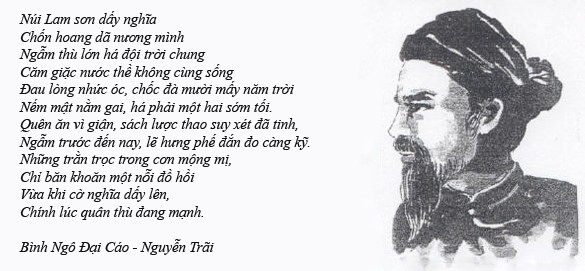
Humanist by conviction, he always thought not only of the sufferings of his people but also that of his enemies. He had the opportunity to emphasize in his letter to Chinese General Wang Toung ( Vương Thông ) that the duty of a commander is to dare make a decision, undo hatred, save human lives and cover the world with good deeds in order to bequeath a great name to posterity ( Quân Trung Từ Mệnh Tập ). He let defeated Chinese generals Wang Toung ( Vương Thông ), Mã Anh, Fang Chen ( Phương Chính ) go back to their country with 13000 captured soldiers, 500 junks and thousands of horses. Concerned about peace and the happiness of his people, in his masterpiece « Proclamation of the Ngô Pacification » ( Bình Ngô Ðại Cáo ) that he wrote after winning the war and driving the Chinese army out of Vietnam, he recalled that it was the time to act with wisdom for the safety of the people.

To make China not to feel humiliated by the bitter defeat and to restore above all a long lasting peace and happiness for his people, he proposed China a vassal pact with a tribute of two real-sized statues in fine metal every three years ( Ðại thần kim nhân ) in compensation for the two Chinese generals Liou Cheng ( Liễu Thăng ) and Leang Minh ( Lương Minh ) who died in combat.

In the first years of the struggle, Nguyễn Trãi knew biting and bleeding defeats many times (the death of Lê Lai, Ðinh Lễ etc… ), which forced him to take refuge at Chi Linh three times with Lê Lợi and his partisans. Despite of that, he never felt discouraged because he knew that the people fully supported him. He often compare the people with the ocean. Nguyễn Trãi had the opportunity to tell his close relations:

Dân như nước có thể chở mà có thể lật thuyền.
The people is like water which can move and sink the ship.

The remark made by his father Nguyễn Phi Khanh, captured and brought to China with other educated Vietnamese including Nguyễn An, the future builder of the forbidden Citadel in Peking, during their separation moment at the Sino-Vietnamese border, continued to be vivid in his mind and made him ever more determined in his unwavering conviction for the his just cause: 

Hữu qui phục Quốc thù, khóc hà vi dã
Hãy trở về mà trả thù cho nước, khóc lóc làm gì
You’d better go back and avenge the country, it doesn’t help crying. 

He spent whole nights in search of a strategy permitting to counter the Chinese army at the zenith of its force and terror. Being updated on the dissensions within the ranks of its adversaries, the difficulty that emperor Xuanzong of the Ming was having at the northern border with the Hungs after the disappearance of Chengzu in 1424 and the damages that the Chinese army suffered during the last military engagements in spite of their territorial success, Nguyễn Trãi did not hesitate to propose a truce to general Ma Ki. The truce was voluntarily accepted by both sides because each side thought they could take advantage of this respite either to consolidate their army in waiting for reinforcements from Kouang Si and Yunnan and a larger scale military engagement ( for the Ming ), or to rebuild an army already suffering important losses of lives and to     change the strategy in the struggle for liberation ( for the Viet ).

Taking advantage of the unfamiliarity of the terrain by the Chinese reinforcing army coming from China, he was fast in his maneuvering putting into work the  » the full and the void  » doctrine advocated by Sun Zi who had said in his work « The Art of War »:

The arm must be similar to water
Since water avoids heights and falls into hollows,
The army avoids the full and attacks the void.

which permitted him to decapitate Liou Cheng and his army in the « void » of Chi Lăng defined by Sun Zi, in the mountainous and quagmire narrow pass near Lang Son. He did not give any respite to Liou Cheng’s successor, Leang Minh to regroup the remainder of his Chinese army by setting a trap around the city of Cần Trạm. Then he took advantage of the success to rout the reinforcing army of the Chinese general ( Mộc Thanh ), which force the latter to drive off and go back alone to Yunnan ( Vân Nam )

Fearing to lose the bulk of his troops in a confrontation and worrying about saving the blood of his people, he chose to implement the policy of isolating big cities such as Nghệ An, Tây Ðô, Đồng Quan ( ancient name of the capital Hànội ) by investing all forts and small cities surrounding them, by incessantly harassing the supply troops and by neutralizing all reinforcing Chinese troops. In order to prevent the eventual return of the invaders and to disorganize their administrative structure, he placed in the liberated cities a new administration led by young and educated recruits. He did not stop sending emissaries to Chinese or Vietnamese governors of these towns to convince them to surrender under penalty of being brought to justice and sentenced to death in case of resistance. This turned out to be fruitful and rewarding because it compelled generalissimo Wang Toung and his lieutenants to surrender unconditionally as he was aware that it was impossible to hang on to Ðồng Quang any longer without reinforcement and supply. It was not only a war of liberation but also a war of nerves that Nguyen Trai has successfully conducted against the Ming.

Independence regained, he was appointed Minister of the Interior and member of the Secret Council. Known for his righteousness, he was fast to become the privileged target of the courtesans of king Lê Thái Tổ who began to take offense at his prestige. Feeling the risk of having the same fate reserved for his comrade in arms Trần Nguyên Hản and imitating the Chinese senior advisor Zhang Liang ( Trương Lương or Trương Tử Phòng ) of Han Emperor Liu Bang ( Lưu Bang or Hán Cao Tổ ), he requested king Lê Lợi to allow him to retire to mount Côn Sơn, a place he had spent his whole youth with his grand father Trần Nguyên Ðán, a former great minister regent of the Tran king, Trần Phế Ðế and the great grand son of general Trần Quang Khải, one of the Vietnamese heroes in the struggle against the Mongols of Kubilai Khan. 

It was here that he wrote a series of composed writings that recalled not only his profound attachment to nature which he made a confidant of, but also his ardent desire to give up honors and glory and to regain serenity. It was also through his poems that one finds in him a profound humanism, an extraordinary simplicity, an exemplary wisdom and an inclination to retreat and solitude. There, he has insisted that a man’s life lasted only one hundred years at the most. Sooner or later one will return to sand and dust. What counts in a man is his dignity and honor such as a blue blanket ( symbol of dignity ) that had been defended energetically by the learned Chinese Vương Hiền Chi of the Tsin dynasty during the intrusion of a burglar to his home, in his poem  » Improvisation on a Summer day » ( Hạ Nhật Mạn Thành ) or his freedom such as that of the two Chinese hermits Sào Phú and Hua Dzo of the Antiquity in his poem  » The Côn Sơn Song » ( Côn Sơn Ca ). 

In spite of his early retirement, he was accused of killing the king a few years later and was tortured in 1442 with all his family members because of the death of he young king Lê Thái Tông, in love with his young concubine Nguyễn Thị Lộ and accompanied by her to the lichee garden. One knows everything except the human heart that stays unfathomable, that was what he said in his poem « Improvisation » ( Mạn Thuật ) but that was what happened to him in spite of his foresight. His memory was restored only a few dozen years later by the great king Lê Thánh Tôn. One can keep in this scholar not only the love he always carried for his people and his country but also the respect he always knew how to keep toward his adversaries and nature. To this talented learned Vietnamese, his memory should be honored by quoting the phrase that Yveline Féray wrote in the foreword of her novel « Ten thousand Springs« : 

The tragedy of Nguyễn Trãi is that of a so great man living in a too little society
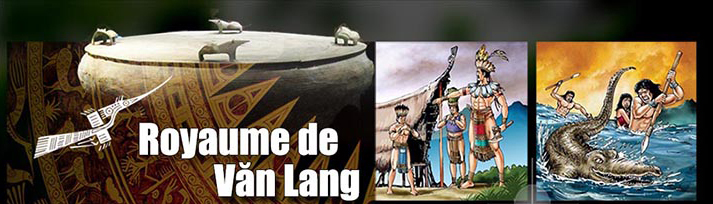
 

Văn Lang kingdom (Văn Lang)

French version
Vietnamese version

 In fact, Văn Lang referres the semi-legendary epoch of the eighteen Hùng kings or Lạc Vương (2879-257 B.C.) or 2622 years. It was the legend and the myth of the Dragon and the Immortal of whom Vietnamese are issue. This kingdom was located in the Yang Tse river basin (Sông Dương Tử) and was placed under the authority of a Hùng king . This one had been elected for his courage and his values. He had divided his kingdom into districts entrusted to his brothers known under the name « Lạc hầu » ( marquis ). His male children have the title of Quan Lang and his daughters that of Mỵ nương. His people was known under the name « Lạc Việt« . His men had a habit of tattooing their body. This « barbarian » practice, often revealed in the Chinese annals, was intended to protect men from the attacks of  water dragons (con thuồng luồng) if one believes the Vietnamese texts. It is perhaps the reason why the Chinese often designated them under the name « Qủi (daemons) ».

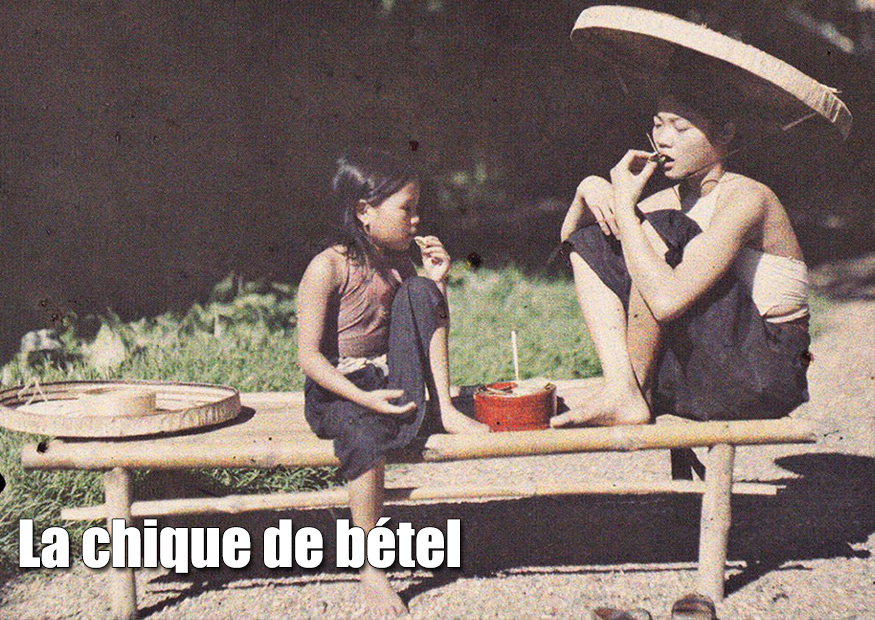
Loincloth and chignon constituted the usual costume of these people to which were added bronze ornaments. The Lac Viet lacquered their teeth in black, chewed betel nuts and crushed rice with their hand. The farmers practiced the cultivation of rice in flooded field. They lived in plains and coastal areas while,  in the mountainous areas of the current Việt Bắc and on part of the territory of the current Chinese province of Kuang Si,  lived the Tây Âu,  ancestors of the ethnic groups Tày, Nùng and Choang currently disseminated in the North Vietnam and in the South of China. At that epoch, the Vietnamese people lived on fishing and cultivation. They already knew how to use tree bark to make clothes, prepare rice alcohol, practice slash and burn agriculture, eat ordinary rice or sweet rice, live in houses on stilts to avoid wild animals etc… Many Vietnamese popular tales (the story of the Sweet Rice Cake, that of the Betel Quid and that of the Mountain and River Gods etc.) came  from these customs.

There is a part of reality in the history of this kingdom. The ruines of the Cổ Loa citadel (Spiral citadel) located  about 18km in the district Đồng Ánh from  Hànội and the temples of Hùng kings testifies to these indisputable vestiges with historians viewpoint.


HUNG_VUONG


Vieille maison Phùng Hưng

img_0415

Nhà cổ Phùng Hưng

[Retour HOI AN et ses quartiers]

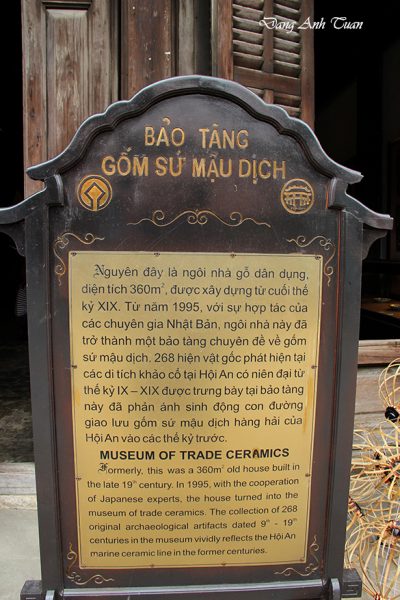
Musée de la porcelaine et de la céramique (Bảo tàng gốm sứ mậu dịch)

Musée du commerce de la céramique

[Retour HOI AN et ses quartiers]

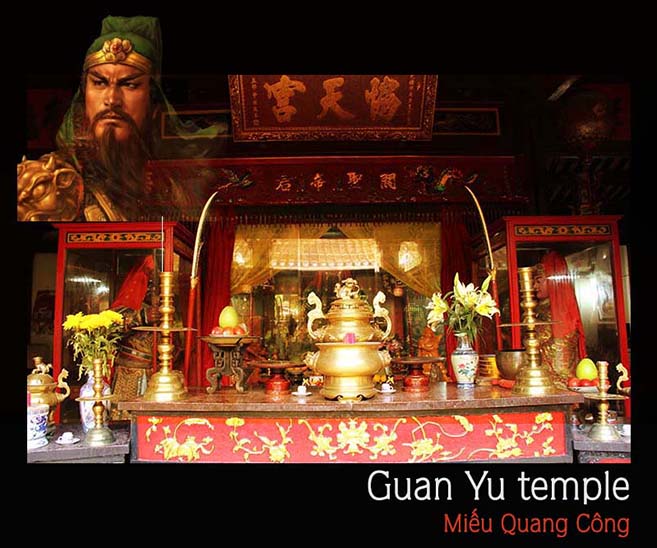
Temple Guan Yu (Miếu Quang Công)

hoian_et_guanyu

[Retour HOI AN et ses quartiers]

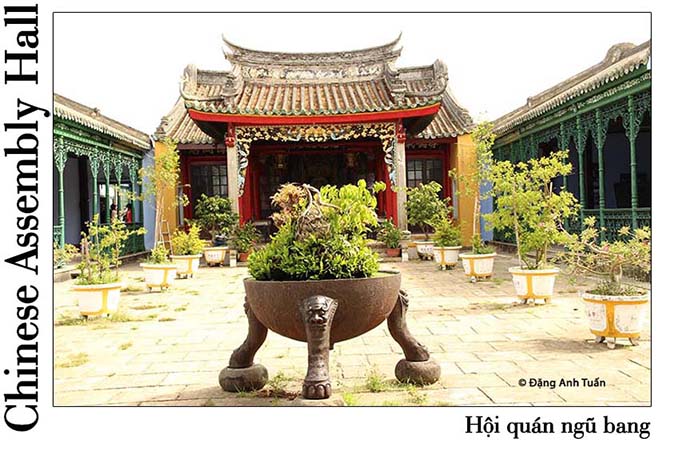
Siège des congrégations chinoises (Hội quán ngũ Bang)


hoian_et_congregations

Galerie des photos

Trung tâm hoa văn lễ nghĩa

[Retour Hôi An et ses quartiers]

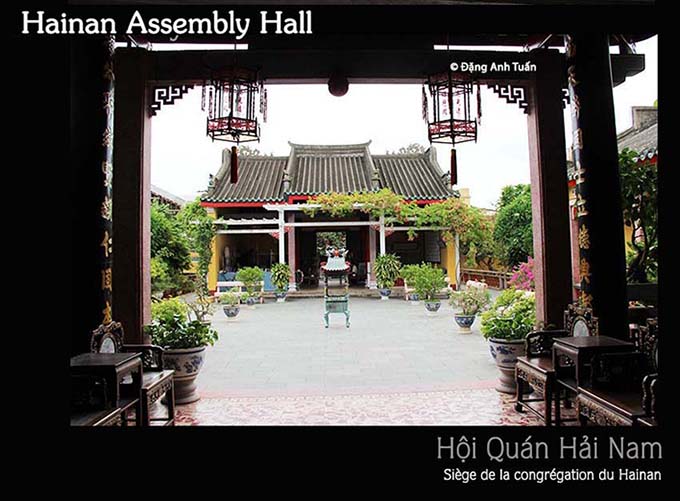
Siège de la congrégation du Hainan (Hội quán Hải Nam)

hoian_et_hainam

No Images found.

[Retour HOI AN et ses quartiers]

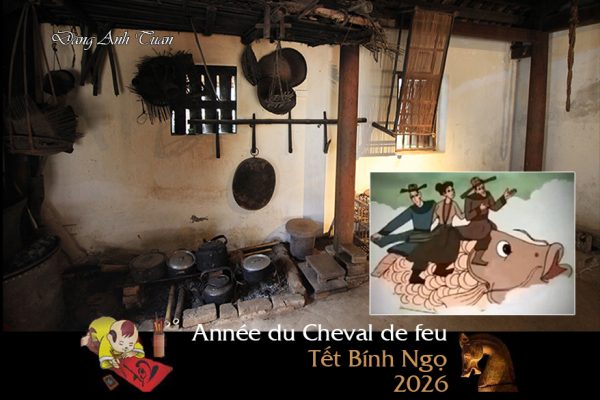
Le mythe de Táo Quân (Chuyện ông Táo)

Le mythe de Táo Quân

English version
Version vietnamienne
Galerie des photos

Le mythe des génies du foyer repose sur la tragique histoire d’un bûcheron et de sa femme. Il prend sa source dans le taoïsme. Ce couple modeste vivait heureux jusqu’au jour où  il découvrit qu’il ne pouvait pas avoir d’enfants. L’infortuné mari se mit à boire et à maltraiter sa femme. Celle-ci ne pouvant en supporter davantage le quitta et épousa un chasseur d’un village voisin. Mais un jour, fou de solitude et plein de remords, le bûcheron décida de rendre visite à sa femme pour lui présenter ses excuses.

Sur ces entrefaites, le chasseur rentra chez lui. Afin d’éviter tout malentendu, la jeune femme cacha son premier mari dans une étable au toit de chaume, située près de la cuisine où le chasseur était en train de fumer son gibier. Par malheur, une braise s’échappa du foyer et mit le feu à l’étable.

Affolée, la jeune femme s’élança vers l’étable en flammes pour sauver son ex-époux. Le chasseur la suivit pour lui porter secours et tous trois périrent dans le brasier. L’empereur de Jade (Ngọc hoàng), du haut de son trône céleste, profondément touché par ce triste sort, divinisa les trois malheureux et les chargea de veiller au bien-être des Vietnamiens  à l’emplacement avantageux de la cuisine. C’est ainsi qu’ils devinrent  dès lors les génies du Foyer.

Pendant la semaine où les génies sont au ciel, les Vietnamiens craignent que leur maison soit sans protection. Afin de prévenir toute incursion des mauvais esprits dans leur maison, ils érigent devant chez eux une  haute perche de bambou (cây nêu) sur laquelle sont suspendues des plaques en argile (ou khánh en vietnamien) vibrant avec sonorité au gré du vent pour éloigner les esprits. Au sommet de cette perche, flotte un morceau de tissu jaune marqué par l’emblème bouddhique.

Cette coutume trouve ses origines dans une légende bouddhique  intitulée « Le Tết du bûcheron » selon laquelle les  Vietnamiens doivent affronter des esprits maléfiques.

C’est toujours le vingt-troisième jour du dernier mois lunaire que chacun des  Vietnamiens organise une cérémonie de départ du génie de foyer  pour le ciel. On trouve non seulement sur son autel des fruits, des mets délicieux, des fleurs mais aussi un équipement de voyage approprié (3 paires de bottes, 3 chapeaux, vêtements, des papiers votifs) et des trois carpes mises dans une petite cuvette. À la fin de la cérémonie, on brûle les papiers votifs et on libère les carpes dans un étang ou dans une rivière afin que le génie puisse s’en servir pour s’envoler au ciel. Celui-ci doit rapporter tout ce qu’il a vu sur terre à l’empereur de jade, en particulier dans le foyer de chaque Vietnamien. Son séjour dure ainsi  six jours au ciel. Il doit retourner au foyer dans la nuit du réveillon jusqu’au moment où  débute la nouvelle année.

(*) cây nêu: C’est un arbre cosmique reliant la terre au ciel  en raison des croyances des peuples anciens adorant le soleil, y compris les Proto-Vietnamiens mais il  est employé également  pour délimiter leur territoire.

Version vietnamienne

Cuisine des Vietnamiens 

Truyền thuyết về các Táo quân được  dựa trên câu chuyện bi thảm của một người thợ rừng và vợ của ông ta. Nó có nguồn gốc từ Lão giáo. Cặp vợ chồng khiêm tốn này được sống hạnh phúc cho đến khi họ phát hiện ra rằng họ không thể có con. Người chồng bất hạnh nầy mới  bắt đầu rượu chè và ngược đãi  bà vợ. Bà nầy không thể chịu đựng được nữa và rời bỏ ông ta và kết hôn với một người thợ săn ở làng bên cạnh. Nhưng một ngày nọ, cô đơn và hối hận, người thợ rừng quyết định đến thăm vợ để xin tạ lỗi.

Giữa lúc đó, người thợ săn trở về nhà. Để tránh mọi sự hiểu lầm, người phụ nữ trẻ buộc lòng giấu người chồng cũ của mình ở trong một chuồng gia súc có mái nhà bằng tranh, nằm gần nhà bếp nơi mà người thợ săn đang hun khói thịt rừng. Thật không may, một đóm lửa  than hồng thoát ra khỏi lò và đốt cháy chuồng.

Cùng quẫn, người phụ nữ trẻ lao mình về phía chuồng  đang bốc cháy để cứu chồng cũ. Người thợ săn chạy theo cô để giúp cô và cả ba đã chết trong ngọn lửa. Ngọc Hoàng, từ trên cao nhìn xuống, cảm động vô cùng trước số phận đau buồn này, phong thần cho ba người  và buộc họ phải trông chừng từ đây hạnh phúc của người dân Việt ở vị trí thuận lợi của nhà bếp. Bởi vậy họ trở thành các thần bếp núc từ đây của các gia đình người Việt.

Trong tuần lễ  các táo quân ở trên trời, người Việt lo sợ ngôi nhà của họ sẽ không được bảo vệ. Để ngăn chặn sự xâm nhập của tà ma vào nhà, họ dựng trước cửa nhà một cây nêu có treo những khánh đất phát tiếng động khi có gió rung. Trên đỉnh cột này  có treo một mảnh vải màu vàng có biểu tượng của Phật giáo.

Phong tục này bắt nguồn từ một truyền thuyết Phật giáo mang tên « Tết của người thợ rừng », theo đó người dân việt phải đối mặt với những linh hồn ma quỷ.

Cứ đến ngày hai mươi ba tháng Giêng âm lịch, mỗi người  dân Việt lại tổ chức lễ tiễn Táo quân  về trời. Không chỉ có  trái cây, thức ăn ngon, các bông hoa trên bàn thờ của Táo quân mà còn có đồ dùng cho cuộc hành trình thích hợp (3 đôi giầy, 3 cái mũ, 3  bộ đồ quần áo, vàng mã) và ba con cá chép được đặt trong một chiếc thau nhỏ. Sau khi kết thúc lễ cúng thì đốt vàng mã và thả cá chép xuống ao hay sông để Táo quân mượn cá chép bay về trời.  Táo quân phải báo cáo lại với Ngọc Hoàng tất cả những gì Táo quân được nhìn thấy ở trần gian, nhất là ở trong nhà của mỗi gia đình của người dân Việt. Thời gian lưu trú của Táo quân được  kéo dài là sáu ngày ở trên trời. Táo quân phải trở về nhà vào đêm giao thừa đúng lúc khi năm mới vừa bắt đầu.

(*) cây nêu:  cây vũ trụ nối liền đất với trời, do tín ngưỡng thờ thần mặt trời của các dân tộc cổ mà trong đó có người Việt cổ mà còn hàm chứa ý thức về lãnh thổ cư trú của họ.

[Return CONTES]

[Return Tết Bính Ngọ]

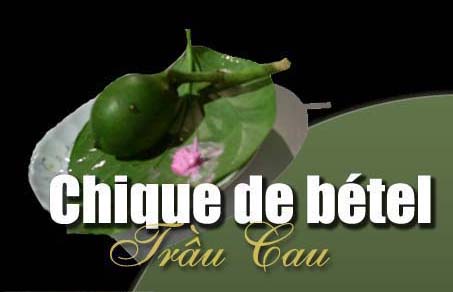
The betel quid (Trầu Cau)

chique_de_betel

The betel quid

French version
Vietnamese version


Long time ago, under the reign of king Hùng Vương the 4th, there were two twin brothers, Cao Tân and Cao Lang. They looked so much alike that it was difficult to distinguish one from the other. They both attended the school of an old teacher in the village who had a sole daughter named  Liên whose beauty attracted all the homage of all the young men in the area.

The old teacher liked both of them. He would grant his daughter’s hand to one of them, preferably the elder because according to Vietnamese customs, the elder brother would get married first. In order to be able to distinguish them, he relied on a little trick by inviting them for dinner. The one who first picked up the chopsticks would be the elder. So Cao Tân got the hand of his daughter without any doubts that his younger brother has devoted an ardent love to her. They went on to live together in a complete harmony and experienced a faultless happiness.
Cao Tân continued no less to love his younger brother like ever before and would do anything to make him happy.

However, in spite of that, the younger brother could not rid of the pain in his heart. He decided to leave them and went out for an adventure. After so many days of walking, he ended up falling exhausted on the road and was transformed into a block of lime stone with an immaculate white.

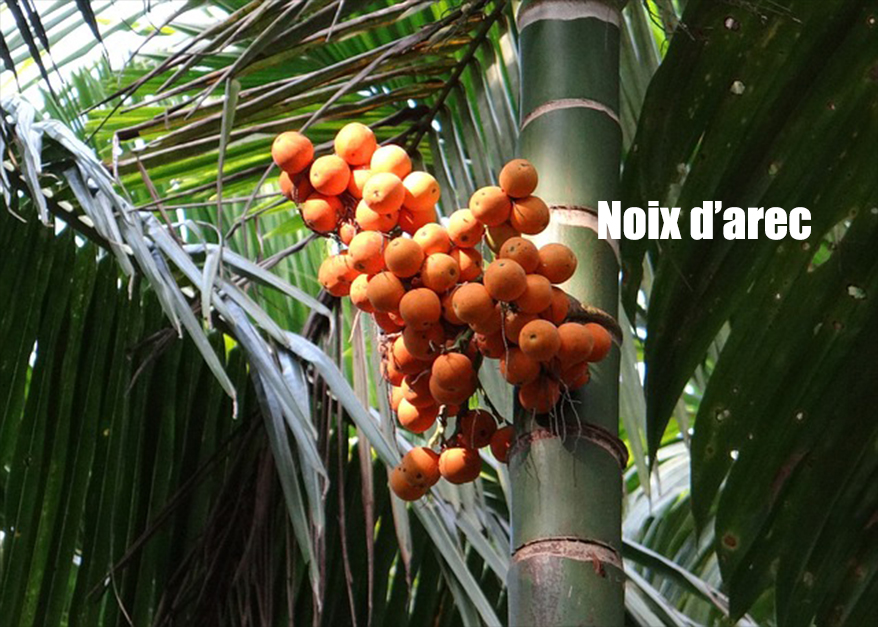
The elder brother, taken by growing worries for his younger brother left in search for him. He followed the same road taken by his younger brother. In a beautiful morning, after so many days of walking, he arrived at the lime stone block, sat on it and succumbed without movement. He was metamorphosed in to a betel nut tree growing tall with its green palms and oblong little fruits. The tree began to extend its branches and its shadow over the lime stone mass as if to protect it from the changes of weather.

Staying at home without any news from her husband, the young wife in turn left the house and went for a search of her spouse. She roamed fields, crossed villages and finally one day, she came real close to the tree. Tired by the long walk, she leaned back at the foot of the tree, took her turn to die and change into a plant whose stems curled around the trunk of the tree with large intensely green leaves in the form of a heart.

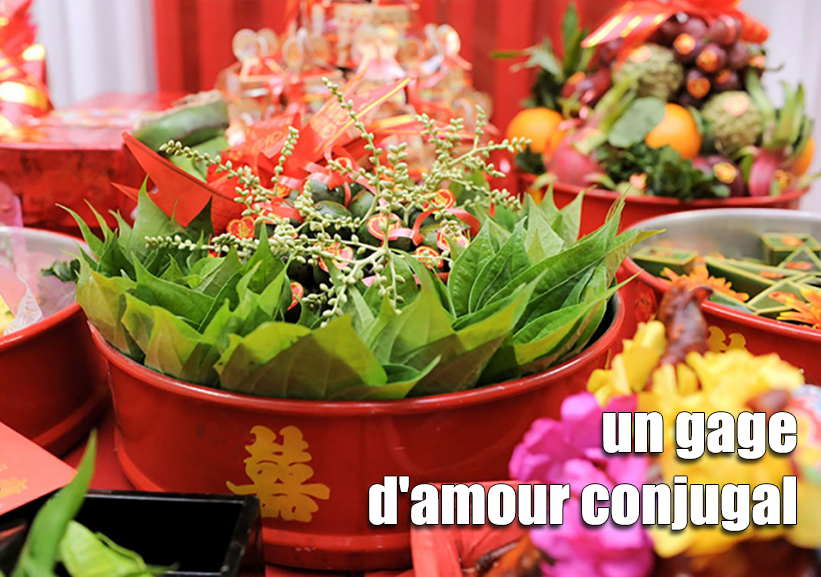
One day, while passing through the area, King Hùng heard this story. He tried chewing betel and areca with a little of the lime from the limestone block. He found that the resulting saliva was as ruddy as blood, with a fresh, tangy and fragrant taste. From then on, he ordered betel and areca to be included in the wedding ceremony as a ritual offering. This is one of the Vietnamese customs that must be observed at the wedding feast. Areca nuts and bright green betel leaves in the shape of a heart are always part of the wedding gifts, symbolizing the pledge of marital love and fidelity.

Similar to a cigarette, betel quid was a conversation starter in old Vietnamese society. That’s why it’s customary to say in Vietnamese “Miếng trầu là đầu câu chuyện”. The betel quid is also used to measure time, because in the absence of clocks in those days, a mouthful of betel corresponds to roughly three or four minutes, giving you an idea of how long a conversation lasted.

 The betel quid

This is one of Vietnamese customs to be observed at a marriage ceremony. There is always betel, with betel nut and intensely green leaves in the form of a heart that is part of wedding gifts that symbolize an eternal union.

[Return CONTES]

The Gongs of Central Highlands (Cồng Chiền Tây Nguyên) Last part

gong_dxdung

Photo Đinh Xuân Dũng ( Nha Trang )

Intangible Heritage of Humanity by

Unesco in 2005

Last part

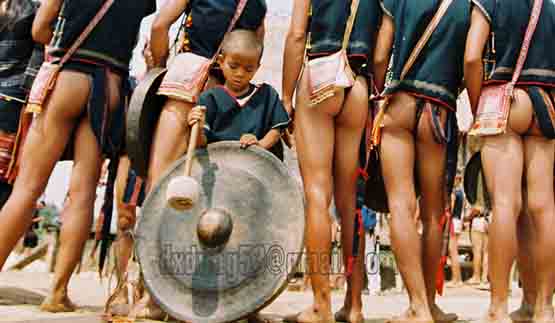
In the ritual ceremonies, the players of gongs move slowly in single file or in half-circle in front of a public admirer. They left from right to left in the counterclockwise direction to go back in time and return to their origins. Their footsteps are slow and rhymed to the beats of gongs, each of which has a well-defined role in the set. Each gong corresponds exactly to a guitar string, each having a note, a particular tone. Whatever the melody played, there is the active participation of all the gongs in the procession. However, an order very precise in the sequence and composition of beats is imposed in order to respond to the melodies and own themes chosen by each ethnic group.

Sometimes, to better listen to the melody, the auditor has the interest to be into a location equidistant from all the players arranged in a half circle otherwise he cannot listen properly because of the weakness and amplification of the resonance of some gongs corresponding respectively to the distance or the excessive closeness of its geographical position relative to one another.

For most of ethnic groups, the set of gongs is reserved only for men. This is the case of the ethnic group Jarai, Edê, Bahnar, Sedang, Co Hu. By contrast, for the ethnic group Eđê Bih, women are allowed to use the gongs. In a general way, the gongs are of variable size. The disk of the major gongs may vary from 60 to 90 cm in diameter with a cylindrical edge from 8 to 10 cm. This does not allow the players to wear them because they are too heavy.

These gongs are suspended often to the beams in house by the ropes. However, there are the gongs more small whose disk varies from 30 to 40 cm with an edge from 6 to 7cm. The latter are frequently encountered in the festive rituals.

For the identification of highland gongs, the Vietnamese musicologist Trần Văn Khê has the opportunity to enumerate a number of characteristics in one of his articles:

  • 1°) They are very varied.
  • 2°) They are linked closely to the spiritual life of highland ethnic minorities. Being regarded as sacred instruments, they promote communication with spirits and geniuses.
  • 3°) They accompany the highland people from its birth until its death. Their presence is visible not only in the important events (weddings, funerals, wars etc.) but also in the agricultural feasts (paddy germination, ear intiation, feast of the agricultural close etc.).
  • 4°) The manner of playing the highland gong is very particular and reflects the family structure of each ethnic minority. This allows to easily identify the ethnic group in question by the played stamp melodies.
  • 5°) The movement of players is always performed in the counterclockwise direction in the purpose to go back in time and return to the source. It is identical to the approach used by the Zen Buddhist school in its walking meditation (thiền hành) oriented from « the outside to the heart » (từ ngoài vào tim).

The composition of the played melody is based primarily on the sequence of beats settled according to original processes of repetition and answer.

One doesn’t finds elsewhere as many gongs as one had them on the Highlands of Vietnam. That is why, during his visit in Vietnam, the ethnomusicologist Filipino José Maceda, accompagned by Vietnamese musician Tô Vũ, had the opportunity to emphasize that the highland gongs are very original when he was in contact with the gongs. For him, because of the large number of gongs found, it is possible the Highlands may be the gong cradle in Southeast Asia.

Over the years, the risk of seeing the « original » and « sacred » character is real because of the illicit trafficking of gongs, the lack of gong tuner, the disinterestedness of young people and the destruction of natural environment where the gongs have been « educated ».

Highlands Gongs

For a few years, being regarded as cultural goods, the gongs become the object of all desire for Vietnamese antique dealers and foreign collectors, which brings the local authorities to exercise strict control with the aim of stopping the haemorrhage of gongs (chảy máu cồng chiêng)

The governmental effort is also visible at the local level by the establishment of incentive programs for learning with young people. But according to some Vietnamese ethnomusicologists, this allows to make durable the gongs without giving to the latter the means to possess a soul, a sacred character, a ethnic sound color because they need not only the skillful hand and fine hearing of gong tuner but also the environment. This is the latter factor that one forgets to protect effectively during the last years. Because of the intensive deforestation and galloping industrialisation for the coming years, the ethnic minorities don’t have the opportunity to practice slash and burn agriculture. They will not have any occasion to honor the ritual festivals, their genius and their traditions. They no longer know to express sorrows and joys through the gongs. They don’t know their oral epics (sử thi). Their paddy fields are replaced by coffee and rubber plantations. Their children are no longer forest clearers but they are engaged to industrial and tourist activities, which allows them to have comfortable livelyhoods. Few now recall how to tune these gongs.

The character « sacred » of gongs no longer exists. The latter become instruments of entertainment like other music instruments. They can be used anywhere without significant events and very specific and sacred hours (giờ thiêng). They are played according to the tourism demand. They are no longer what they were until now.

It is for this irreparable loss that UNESCO has not hesitated to underline the urgency in the recognition of space of gong culture in the Central Highlands (Tây Nguyên) as the masterpiece of Oral and Intangible Heritage of Humanity on 25 November 2005. The gongs are only one essential element in the achievement of this masterpiece but it must be understood that other elements are as important as these gongs: the environment, the traditions and customs, the ethnic groups etc. ..

The gongs without their environment and their ethnic sound color no longer possess the sacred soul (hồn thiêng) of Central Highlands.They lose the original character for ever. There is always a price to pay in the preservation of the gong culture in Central Highlands but it is to the scope of our collective efforts and our political will. One cannot refute that the culture of the gongs in Highlands is part now of our cultural heritage.

[Back to page « Vietnam, land of 54 ethnies »]