Champa buddhism (VA, Part 3)

Vương triều chàm Indrapura
sanctuaire_dongduong
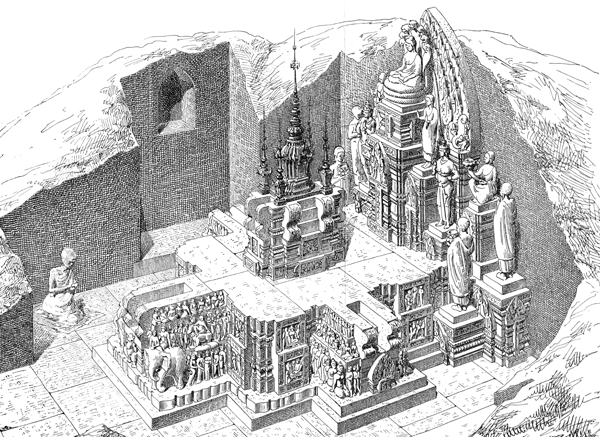
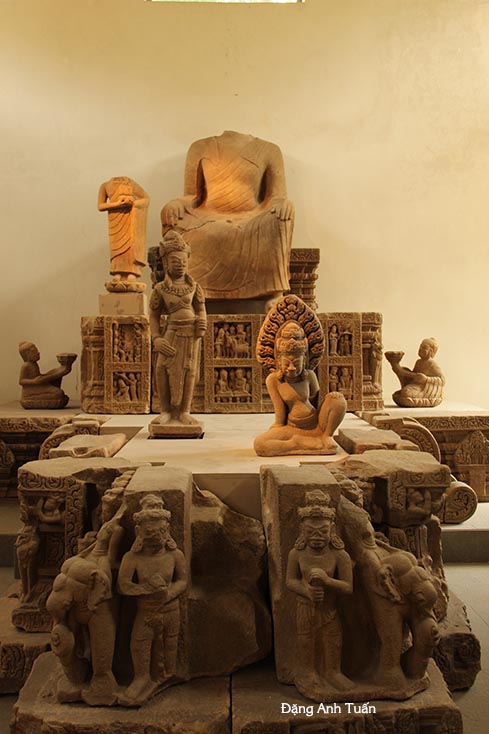
is compared to what we see today at the Champa Sculpture Museum in Da Nang.
img_9731
French version
Vietnamnese version

Unfortunately, for an unknown reason, its distinctive attributes were broken and confiscated by the office of the Bình Định People’s Committee, which currently oversees the Đồng Dương site. They have not been returned to the Cham Museum in Đà Nẵng to this day, despite the piece being exhibited to the public for a long time. This is why the bronze statue continues to be the subject of various iconographic interpretations. Based on the information provided (the photos) at the time he conducted an in-depth study in 1984, Jean Boisselier thought it represented Tara. For this, he tried to rely on the idols of Đại Hữu, the codification of the deity’s gestures (mudra), the rank in the Buddhist pantheon, the ornamentation of the adornments (nànàlankàravati), the importance of the gaze, and the existence of the third eye to successfully identify the deity.

Some Vietnamese researchers see in this statue the wife Lakshmi of Vishnu because one of its two distinctive attributes includes the conch (con ốc). For the Vietnamese researcher Ngô Văn Doanh, there is no doubt about the identity of this deity. It is indeed Laksmindra-Lokesvara because, for him, each distinctive attribute has a particular meaning. The lotus symbolizes beauty and purity. As for the conch, it symbolizes the propagation of Buddha’s teaching and awakening after the sleep of ignorance.

This is also the hypothesis long accepted by Vietnamese researchers. According to the Thai specialist Nanda Chutiwongs, this magnificent bronze is called Prajnàpàramità (Perfection of Wisdom). But this does not diminish the conviction of most specialists who, like Jean Boisselier, continue to see in this exceptional bronze the alluring goddess Tara, whose heavy breasts remain one of the prominent features found in her early youth. She is always the consort of the bodhisattva Avalokitesvara.

Recently, in the report on archaeology that took place in 2019 in Hanoi, researchers Trần Kỳ Phương and Nguyễn Thị Tú Anh had the opportunity to redefine the name of the bronze statue, Tara, based on the decorative image of the Buddha found in the statue’s hair, the distinctive attributes (the lotus and the conch) in her two hands, as well as the hand gesture. According to these Vietnamese researchers, Tara is the female incarnation of the meditation Buddha Amoghasiddhi, heir of the historical Buddha Shakyamuni in tantric Buddhism (Tibet).

He was often seated under the fan spread by the seven-headed cobra Mucalinda, known as « Effective Success. » In iconography, he often held a sword in his left hand and a significant gesture recognizable under the term « Abhayamudra (or absence of fear) » in his right hand during his meditation.

That is why the decorative image of the small Buddha, corresponding exactly to what is described, is found on the hair of the bronze statue. Moreover, this statue is green in color all over the body. This is also the identity of the dhyani Buddha Amoghasiddhi. If the lotus symbolizes purity, the conch and the gesture of his hand under the conch correspond well to the dharmacakra mudra, setting in motion the wheel of the Dharma law.

According to researchers Trần Kỳ Phương and Nguyễn Thị Tú Anh, the Yunnan region was once a relay zone intended to facilitate the spread of Tibetan religion and art throughout Southeast Asia via the route called the « Tea and Horse Road. » It was also the place where tantric Buddhism was revered by everyone, from the people to the king, and where the production of bronze bodhisattvas Lokesvara and Tara destined for Southeast Asia was extremely important from the 7th or 8th century onward.

That is why the veneration of the bodhisattvas Lokesvara or Tara was not unusual in Chămpa. Until now, no statue of Lokesvara has appeared or been discovered at Đồng Dương, particularly at the Buddhist monastery, because it was here that King Indravarman II erected a temple to venerate his protective Buddha Lokesvara. He even associated his own name with that of the bodhisattva Lokesvara to give this Buddhist site the name Laksmindra-Lokesvara.

That is why there is no doubt about the existence of the statue of Lokesvara. It is an enigma without explanation to this day. According to researcher Trần Kỳ Phương, it is possible that this statue was made of bronze and is the same size as that of Tara. It must have been placed on the altar at the same time as Tara’s when the honor was first given at that time. Perhaps after this glorification in its honor, it was moved elsewhere or buried in the ground because of the war.

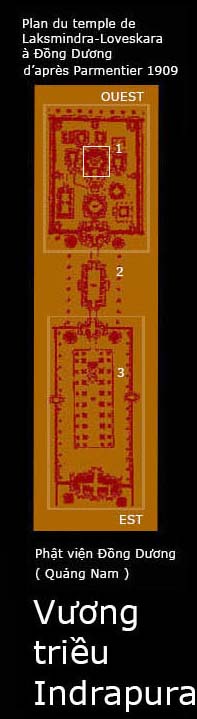
In the second enclosure, there is a long waiting hall (or mandapa) (2) that Henri Parmentier called « the hall with windows » in his description. Then, in the third enclosure (3), there is a large pillared hall, about thirty meters long. It is probably the prayer hall of the monks (vihara) where a majestic imposing statue of Buddha sits, to whom the second altar is dedicated, with a base decorated in relief and surrounded by two haloed attendants. This Buddhist site was recognized by the Vietnamese authorities as a national heritage of the country in May 2001. The blinding destruction caused by American bombing during the war years left only one intact gopura tower at this site, which the local population calls « Tháp sáng » (or tower of light) because it is open to the four directions, letting in the light. Despite this, this site continues to revive a glorious past with its great monastery, which was at one time one of the renowned religious intellectual centers in Southeast Asia. It was here that, after his brilliant victory over Champa in 985, the Vietnamese king Lê Đại Hành (or Lê Hoàn) brought back to Vietnam an Indian monk (Thiên Trúc) who was staying at this monastery. In 1069, the great Vietnamese king Lý Thánh Tôn managed to capture a famous Chinese monk, Thảo Đường, here during his victory over Champa. But it was also here in 1301 that the founding king of the Vietnamese Zen school (Phái Trúc Lâm Yên Tử), Trần Nhân Tôn, accompanied by the Vietnamese monk Đại Việt and received by the talented Cham king Jaya Simhavarman III (Chế Mân in Vietnamese), the future husband of Princess Huyền Trân, spent 9 months meditating in this religious center. 

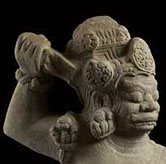
For the French researcher Jean Boisselier, Cham sculpture was always closely linked to history. Notable changes have been observed in the development of Cham sculpture, particularly statuary, in connection with historical events, changes of dynasties, or the relations that Champa had with its neighbors (Vietnam or Cambodia). That is why one cannot ignore that a change of dynasty encourages a creative momentum in the development of Cham sculpture, which is distinguished by a new particular style now known under the name « Đồng Dương. »

icones_dongduong2icones_dongduong1Phong cách  Đồng Dương


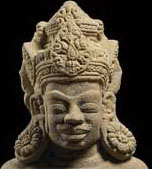
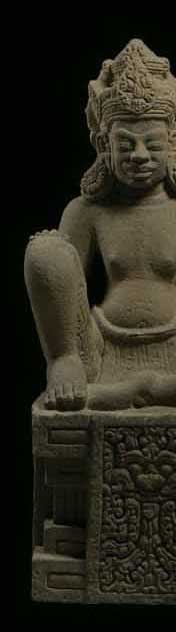
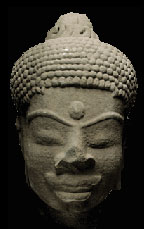
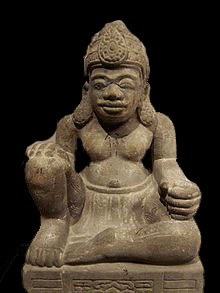
This one cannot go unnoticed due to its following facial features: prominent eyebrows connected in a continuous, sinuous line rising up to the hairline, thick lips with the corners turned up, a mustache sometimes mistaken for the upper lip, and a flat nose, wide from the front and aquiline in profile, a narrow forehead, and a short chin. The absence of a smile is noteworthy. This style continued to develop alongside Mahayana Buddhism in other regions of Champa under the reigns of the immediate successors of the Buddhist king Indravarman II. They continued to particularly venerate Avalokitesvara and to adopt Buddhism as the state religion. This is known from royal inscriptions. This is the case with the Ratna-Lokesvara sanctuary, which King Jaya Simhavarman I, the nephew of King Indravarman II, patronized. This sanctuary has been located at Đại Hữu in the Quảng Bình region. In this sacred place, a large number of Buddhist sculptures have been unearthed. Then around Mỹ Đức in the same province of Quảng Bình, a Buddhist complex was discovered with architectural and decorative similarities to those found at Đại Hữu and Đồng Dương.

Buddhist faith is not absent either in Phong Nha, where some caves used as places of worship still retain their imprint over the years. Finally, a temple dedicated to the deity Mahïndra-Lokesvarà was erected in 1914 in Kon Klor (Kontum) by a chief named Mahïndravarman. There were even two pilgrimages organized by a high dignitary on the orders of King Yàvadvipapura (Java) with the aim of deepening the siddhayatra (or mystical knowledge), as reported by the inscriptions of Nhan Biểu dating from 911 AD.

Cham dynasty of Indrapura


Bouddha statue, Thăng Bình, Quảng Nam
icones_dongduong5

854-898     Indravarman II (Dịch-lợi Nhân-đà-la-bạt-ma)
898-903     Jaya Simharvarman I (Xà-da Tăng-gia-bạt-ma)
905-910     Bhadravarman III (Xà-da Ha-la-bạt-ma)
910-960     Indravarman III (Xà-da Nhân-đức-man)
960-971     Jaya Indravarman I (Dịch-lợi Nhân-di-bàn)
971-982     Paramesvara Varman I (Dịch-lợi Bế- Mĩ Thuế)
982-986     Indravarman IV (Dịch-lợi Nhân-đà-la-bạt-ma)
986-988     Lưu Kế Tông
989-997     Vijaya shri Harivarman II (Dịch-lợi Băng-vương-la)
997-1007   Yan Pu Ku Vijaya Shri (Thất-ly Bì-xà-da-bạt-ma)
1007-1010  Harivarman III (Dịch-lợi Ha-lê-bạt-ma)
1010-1018  Paramesvara Varman II (Thi Nặc Bài Ma Diệp)
1020-1030  Vikranta Varman II (Thi Nặc Bài Ma Diệp)
1030-1044  Jaya Simhavarman II (Sạ Đẩu)


This Buddhist faith began to seriously falter in the face of the invasion of the people from the North (the Vietnamese) who had just been freed from Chinese oppression. These, led by the new king Lê Đại Hành, did not hesitate to sack the capital Indrapura in 982 after the Cham king Parameçvaravarman I (Ba Mĩ Thuế) had clumsily and for an unknown reason detained two Vietnamese emissaries Từ Mục and Ngô Tử Canh and openly supported Ngô Tiên, son of the liberator king of the Vietnamese nation, Ngô Quyền, in the power struggle.

Mahayana Buddhism did not allow the Cham kings to find everything they needed in their struggle against the Vietnamese enemies. They began to doubt the wisdom of this religion when it failed to attract the local population until then. It remained the personal religion of choice for the elites and their Cham kings. They preferred to seek their salvation in the worship of their destructive god Shiva in order to better protect their victories and to enable them to resist, more or less, the foreign invaders (Chinese, Mon, Khmer, and Vietnamese) in the creation, maintenance, and survival of their nation.

Their perpetual belligerence, probably inspired by Shaivism, became a strong argument and a legitimate justification first for the Chinese and then for the Vietnamese to carry out military interventions and gradually annex their territory in the march southward (Nam Tiến).
icones_dongduon4

[Return to CHAMPA]

Bibliographic references


Avalokitesvara: name of a bodhisattva representing the infinite compassion of the Buddha.
Bodhisattva: being destined for enlightenment (Bồ tát)
Dharma: moral law (Đạo pháp)
Lokesvara: lord of the world. Designation of a Buddha or Avalokitesvara.
Mandapa: religious building with columns within the temple enclosure.
Tara: the one who saves. Female counterpart of Avalokitesvara. Highly revered in India and Tibet.
Vishnu: God who maintains the world between its creation by Brahma and its destruction by Shiva.
 

Champa Buddhism (VA: Part 2)

 
phatgiao_champa
Version vietnamienne
Version française

The discovery of a large number of Mahayana elements, particularly statues of the deity Avalokitesvara, the most popular and revered icon of Mahayana Buddhism, undeniably marks the strengthening of its establishment and doctrine in Champa and testifies to the benevolence of the Cham sovereigns. This special royal consideration allowed it to remain a secondary religion, living for several centuries in the shadow of Hinduism, patiently awaiting its time of glory and influence. It was in the 8th and 9th centuries that, after embracing certain countries such as the Khmer Empire and the kingdoms of Srivijaya and Sailendra, Mahayana Buddhism found its full flourishing in accordance with the arrival of the new ruling Bhrgu lineage in the person of Indravarman II. It is also in the Chinese annals (for example, Tân Đường Thư) that the name « Tchan-Tcheng » (or Campapura (Chiêm Thành in Vietnamese)) appeared for the first time, replacing Huanwang (Hoàn Vương), which had until then been linked to the royal lineage of Prathivindravarman of the South (Kauthara) (Nha Trang).
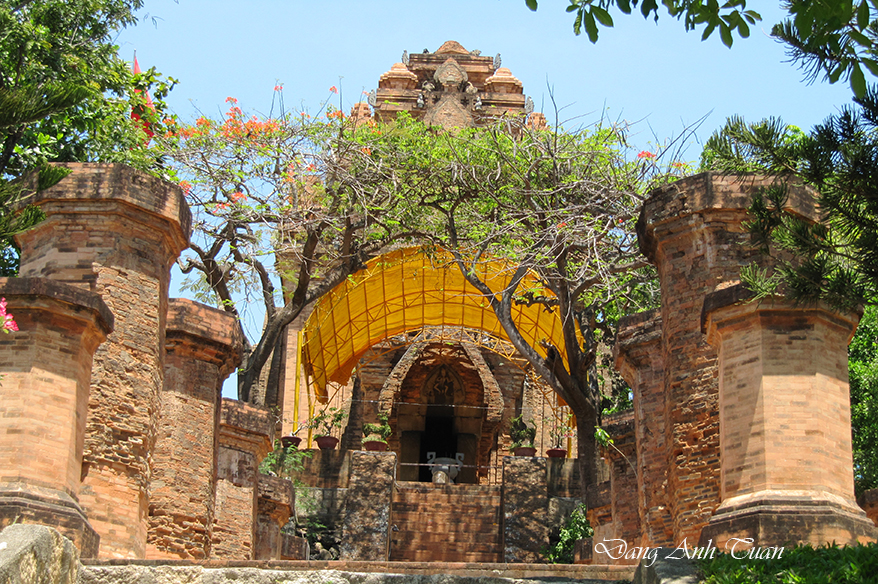
Having transferred the capital to Indrapura (near Hội An) (or Faifo) in the Amaravati region (Quảng Nam and Quảng Ngãi), Indravarman II showed a particular personal inclination towards Mahayana Buddhism despite maintaining Shaivism as the state religion. It cannot be ignored that King Indravarman II had the opportunity to recall in his royal inscriptions that sovereignty over Champa had come to him solely by the favor of destiny and thanks to merits acquired in many previous existences. It seems that through this teaching, he was more or less attached to the doctrine of Buddhism, particularly to the accomplishment of spreading the Dharma, more than any other Cham king who found his salvation in union with Shiva. According to Georges Coedès, he was designated by Vikrântavarman III, who died without offspring, at the request of the great sages of the kingdom. What is remembered about this king is his Buddhist fervor, his extraordinary wisdom, and his unwavering faith in Lokesvara (Lord of the World). In 875, he had an important Buddhist temple erected in his capital Indrapura on the Đồng Dương site, not far from the Mỹ Sơn sanctuary where the national god Shiva Bhadresvara resided, and he entirely dedicated it to his personal god, Laksmindra-Lokesvara.
vuongtrieu_indrapura
We also see in the choice of the name of this temple a practice now used by the Cham sovereigns, always associating the name of the protective deity with that of the donor of the establishment. Despite the primary worship of Shiva for his devastating powers and brilliant victories in protecting the kingdom, the veneration of Lokesvara, representing a Buddha or Avalokitesvara (a bodhisattva), symbolizes not only peace and benevolence but also the protection of this deity over the country and its inhabitants, so much so that Hinduism and Buddhism, although different philosophically and religiously, can now coexist in Champa. According to the French archaeologist Henri Parmentier, the Buddhist site Đồng Dương also seems to encompass the king’s residence located at what is today called « ao vuông » (square-shaped pond). It appears that there is a secret water current that can communicate with a well located one kilometer to the east of the site. The construction of this site demonstrates a desire for innovation in grouping many isolated buildings within an imposing architectural achievement where the presence of Chinese and Indian influences is undeniable.
This is what is discovered in the general plan of this site. In its architecture and sculpture, certain aspects of the borrowing from Chinese art can be seen in terms of monumentality and power, while in the composition of the liturgical scenes and narrative panels there is an impeccable fidelity to the decorative conventions found in the temples of western India.

The construction of this site develops along an east-west axis 1300 meters long, with numerous brick buildings spread across three successive enclosures, each controlled by an entrance pavilion guarded by formidable and terrifying stone guardians (dvarapala). According to Henri Parmentier‘s description, it was in the western half of the first enclosure that he found in 1905 the most important sanctuary (1), probably housing the statue of Laksmindra-Lokesvara to whom the site was dedicated in 875 by King Indravarman II. This main sanctuary is preceded by a tower open to the four cardinal points (thap sang) and surrounded by 9 small temples arranged in a well-ordered layout.
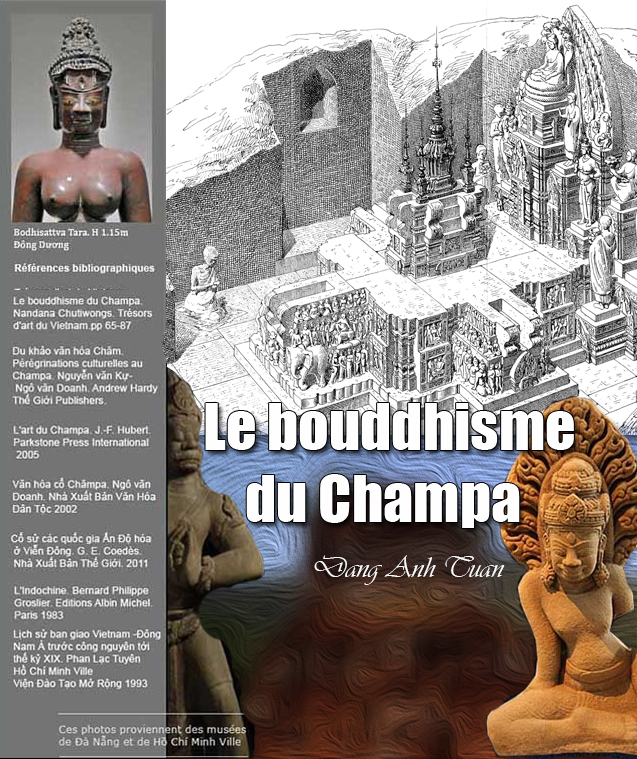
For most Vietnamese researchers, the great masterpiece of bronze art that a peasant found by chance in 1978 while looking to collect some bricks in the ruins near the first enclosure, often referred to as Tara (Phật mẫu Tara), is none other than the statue of Laksmindra-Lokesvara (Quan Âm chuẩn đề). It is indeed Avalokitesvara appearing in a feminine form as a Bodhisattva (Bồ tát Quán Thế Âm) because in both hands, at the time of its discovery, a lotus and a conch were found.[Reading more]

[Champa buddhism: Part 3]

Champa Buddhism (VA: Part 1)


Version vietnamienne
Version française

Despite the adoption of Hinduism as the religion by the Cham at the beginning of the creation of their nation, Buddhism did not fail to demonstrate its notable influence among their local elites and leaders. They found in this religion a great number of advantages that allowed them to strengthen not only their legitimacy and power but also an essential touch of divinity in their governance through the notions of dharmaraja (Virtuous King) and cakravartin (Universal Monarch).

Being supposed to embody the power of dharma, they were invested with the sacred mandate to ensure the maintenance of order and religious faith in their kingdom. They were attached to the divine nature that the mission granted them. Similar to the Khmer kings, they gave particular importance to their deification in such a way that their posthumous name included that of the supreme deity with the aim of being equal to Buddha in the form of a Bodhisattva. This is the case of King Indravarman II with his posthumous name « Paramabuddhaloka » (Buddhist title). They thus became « superhumans » among men even if they were not of divine origin. Buddhism soon seduced them and made them adhere to its fundamental aspects: its tolerant spirit, its liberal character, its integration into local culture, and its emphasis on morality.

They brought in religious missionaries via merchant ships because Champa attracted Indian traders very early on. It had long been renowned for its forest products (eaglewood, ivory, spices, etc.). The exact date of the introduction of Buddhism to Champa is not known, but according to Chinese annals, it prospered in 605 AD, when the Chinese army led by General Lieou Fang (Lưu Phương) of the Sui dynasty (nhà Tùy) plundered the Champa capital Điển Xung during the reign of King Cambhuvarman (Phàn Chí in Vietnamese) and took away 1,350 Buddhist texts compiled in 564 volumes after reconquering Tonkin.

The presence of Buddhism should have been noticeable very early in Champa as well as in Vietnam by sea, because according to the Vietnamese scholar Phan Lạc Tuyên, Indian monks came to Vietnam at the beginning of the Christian era based on the story of Chu Đồng Tử, who was initiated into Buddhism during his encounter with an Indian monk. Religious missionaries had to land in Champa before they could reach Giao Chỉ (or Vietnam) and China.

Indrapura dynasty
gardien
Under the leadership of its rulers, Champa very early on promoted the establishment of Buddhism, as it was already mentioned by the famous monk Yijing (Nghĩa Tịnh) upon his return from his maritime journey in the Insulinde as one of the countries in Southeast Asia that held the Buddha’s doctrine in high esteem at the end of the 7th century during the reign of Wu Ze Tian (Vũ Tắc Thiên) of the Tang dynasty (Nhà Đường).

Thanks to archaeological remains found in central Vietnam, it is now known that Mahayana Buddhism (Phật giáo Đại Thừa) took root during the second half of the 7th century and gave rise to unprecedented models of Bodhisattva combining local tradition and stylistic elements from abroad, which have since served as a reference throughout the country.

[Champa buddhism: Part 2]

[Champa buddhism: Part 3]


Pô Nagar shrine (Sanctuaire Pô Nagar): Part 2

Thánh Mẫu Thiên Y A Na

ponagar2

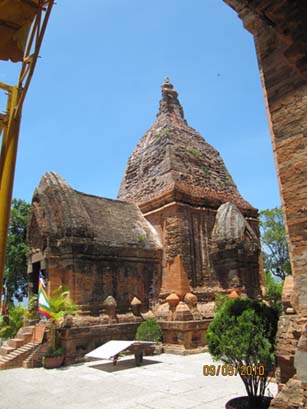
The main  kalan

French version 

With its height of 22.8 meters, this main kalan is one of the tallest towers in Cham architecture. Its style is considered an intermediate style between the Mỹ Sơn A-1 style and that of Bình Định (11th-12th century). It is distinguished by a square base and a tapered three-tiered roof. This roof is so ornate and well-preserved to this day that it is impossible not to appreciate its beauty and splendor despite the visible absence of the crest (kailasa or the residence of Shiva). One of the characteristics of this roof is the presence of stone animals (vahana) (goats on the first tier, geese (hamsa) on the second tier, and elephants on the top tier).

ponagar3

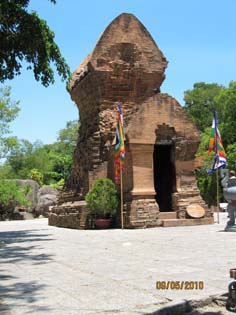
The South temple

Despite the deterioration of its roof over time, it continues to maintain its charm and is a very original and unique model in Cham art. It was built by Senapati (1) Par of King Harivarman with the purpose of creating a temple for the Sandhakalinga (a hermaphrodite linga) and to present together Shiva and Bhagavarti in the form of a mukhalinga, half-god, half-goddess.

To respond to this fusion form of these two masculine and feminine deities, a new architectural adaptation appears through this temple. The building has two parts: the square body attached to the vestibule and the domed roof whose composition recalls those of Hưng Thạnh and Bằng An.

The body of this temple is relatively low and has three false doors adorned with six superimposed spearheads whose size increases towards the back. At the level of its pedestal, there are borders in the shape of lotus flowers. The entire base of this kalan is decorated with lotus petals engraved in squares.

Its vestibule is quite long and has a raised pediment.

Thanks to Cham inscriptions, it is known that the Southeast and Northwest towers were built by the governor of Panduranga and commander-in-chief Senapati Par or Parraun of King Harivarman, one for the deity Sri Maladakuthara (another form of Bhagavati) and the other for Sri Vinayaka (Ganesa)(2). The deity Maladakuthara, called the little goddess (yan pu aneh), was presented as the daughter of the great goddess of Pô Nagar.
Southeast Temple
This is also one of the reasons explaining why the Southeast tower was placed next to Bhagavarti (main kalan) and the Sivalinga (South temple).

To respond to this fusion form of these two masculine and feminine deities, a new architectural adaptation appears through this temple. The building has two parts: the square body attached to the vestibule and the domed roof whose composition recalls those of Hưng Thạnh and Bằng An.

The body of this temple is relatively low and has three false doors adorned with six superimposed spearheads whose size increases towards the back. At the level of its pedestal, there are borders in the shape of lotus flowers. The entire base of this kalan is decorated with lotus petals engraved in squares.

Its vestibule is quite long and has a raised pediment.

Thanks to Cham inscriptions, it is known that the Southeast and Northwest towers were built by the governor of Panduranga and commander-in-chief Senapati Par or Parraun of King Harivarman, one for the deity Sri Maladakuthara (another form of Bhagavati) and the other for Sri Vinayaka (Ganesa)(2). The deity Maladakuthara, called the little goddess (yan pu aneh), was presented as the daughter of the great goddess of Pô Nagar.

     Southeast Temple

ponagar4

This is also one of the reasons explaining why the Southeast tower was placed next to Bhagavarti (main kalan) and the Sivalinga (South temple).

[Return to CHAMPA]

Bibliographic references.danseuse

Les ruines Cham. A la recherche d’une civilisation éteinte. Trần Kỳ Phương. Editeur Thế Giới 1993

Po Nagar de Nha Trang. Anne-Valérie Schweyer. Aséanie 14, Décembre 2004, p. 109-140

Pérégrinations culturelles au Champa. Nguyễn Văn Kự- Ngô Văn Doanh. Editeurs EFEO- Thế Giới Publishers 2005.

Văn Hóa Cổ Chămpa. Ngô Văn Doanh. Editeur Nhà Xuất Bản Văn Hóa Dân Tộc 2002.


Po Nagar Shrine (Sanctuaire Po Nagar): Part 1

Thánh Địa Po Nagar

Version française

Version vietnamienne

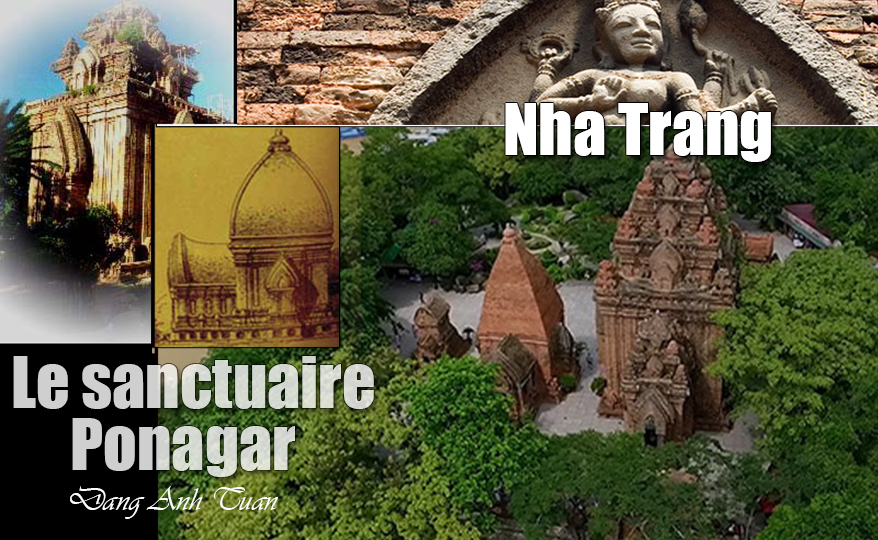
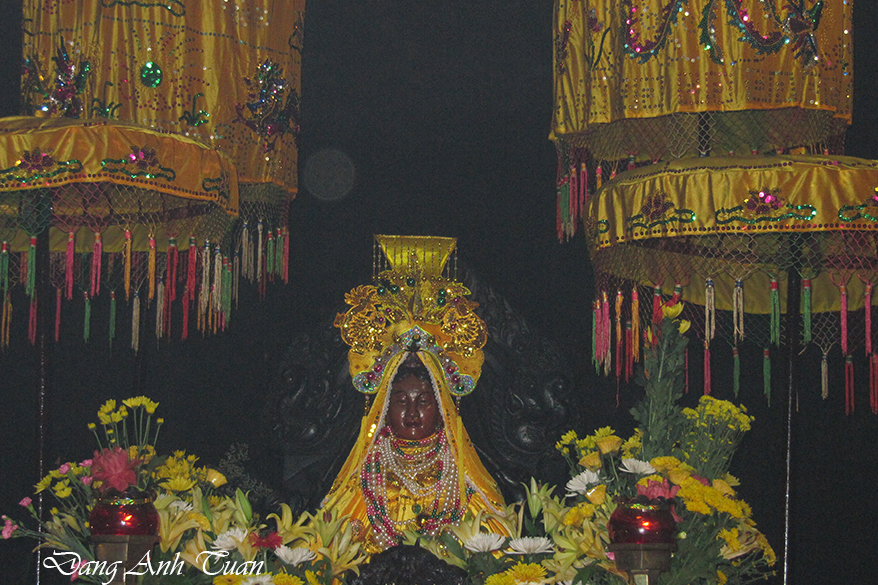
This sanctuary is a must-visit for those who have the opportunity to visit Nha Trang, the most upscale seaside resort in Vietnam. Located on a hill at the mouth of the Cái River, it was built continuously from the 8th to the 13th century according to inscriptions found on site. The appearance of this sanctuary in the Champa kingdom is linked to the turmoil that Champa experienced in the 8th century. The Champa kingdom was actually a federation of several states or rather « city-states, » with the most powerful one playing the role of « leader » (vai trò chủ đạo). Upon the advent of a new dynasty, its pura ascended to the top rank and thus became the capital of the kingdom. Thanks to Chinese historical documents and Cham inscriptions, it is known that until the beginning of the 7th century, the pura (or city-state) of Singhapura (lion citadel) in Trà Kiệu (in the current district of Duy Xuyên, Quảng Nam province) predominated.

At that time, the northern royal lineage was always protected by the male deity Bhadresvara, a linga representing a benevolent form of Shiva honored in the most sacred sanctuary of Mỹ Sơn. A new royal lineage soon made itself recognized in the mid-8th century in the southern part of the Champa kingdom (Kauthara) and needed another deity to protect it.
Po Nagar Shrine

The Trà Kiệu and Mỹ Sơn region, belonging to the current Quảng Nam province (the Cham province of Amaravâti), thus lost its importance in favor of Khánh Hòa (Nha Trang plain) and Ninh Thuận (Phan Rang region). Although its political center of power (Virapura) has not been located to this day, it is claimed to be somewhere around Phan Rang. On the other hand, it is certain that a major political event took place in the south of this kingdom, as this perfectly aligns with the date 758 provided in Chinese annals to mark the beginning of the Huanwang period (or Hoàn Vương in Vietnamese), lasting about 100 years. Lin Yi (or Lâm Ấp in Vietnamese), the former name given to this kingdom, is no longer used and is replaced by Huanwang in Chinese texts. This deity is a one-faced linga and is honored in the sacred Pô Nagar sanctuary located by the sea. She is clearly feminine and presented as the shakti of Shiva, Bhagavati.

Despite the sidelining of the Prathivindravarman lineage of the South reported in Chinese annals in 859 and the seizure of supreme power by the Bhrgu lineage in the northern kingdom at Indrapura (near Hội An) in 875 with the new king Indravarman II, the deity of Nha Trang in Kauthara continued to be honored as the protective goddess of the kingdom.

This shows the willingness of the Bhrgu lineage to integrate it into a coherent religious system which, until then based on the veneration of Bhadresvara (Mỹ Sơn sanctuary), recognizes a complementary position for Bhagavarti. The religious bipolarity around the god Bhadresvara at Mỹ Sơn and the goddess Bhagavati at Nha Trang would henceforth dominate the entire kingdom. The veneration of Bhagavarti aligns not only with the importance given to the matrilineal system adopted by the Chams but also with the unity the Chams needed at that time in the face of their enemies (Vietnamese, Khmers, and Javanese).

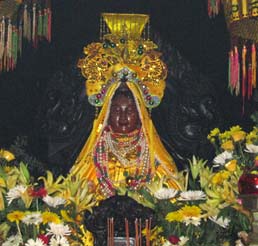
In order to acclimate to an unfamiliar natural environment where the stupas and religious constructions of the Chams, bearing the deep mark of Indian culture, were visibly strange, frightening, and mysterious with statues of Brahma, Shiva, Vishnu, and Pô Nagar, these new Vietnamese arrivals were forced to develop a lifestyle adapted to their new cultural environment. They did not hesitate to use the remnants of Cham culture to transpose them into their own religious universe and places of worship. They attempted to establish harmony between the supernatural and temporal powers of the territories they had managed to conquer. Fearing to disturb local spirits capable of bringing them harm, they sometimes appropriated the places of worship of the defeated or local people. This is the case of the Pô Nagar sanctuary where the Champa goddess Uma was appropriated by the Vietnamese. They did not hesitate to assimilate the legend of Po Nagar into a mythology arranged in their own way without managing to erase the Cham substrate of the myth. The Champa goddess thus became Thiên Y A Na (Thiên Y Thánh Mẫu) of the Vietnamese. This appropriation is renewed in other places in Vietnam during the southward march: the Black Lady in Tây Ninh or the goddess Chúa Xứ on Mount Sam (Châu Đốc).

In his inventory of Cham towers located on the Pô Nagar site, the French archaeologist Henri Parmentier recorded about a dozen worship buildings grouped in an area of 500 m2 at the top of a hill. Due to weathering and war, only 5 buildings remain spread over two construction levels. At the top, there are two rows of towers, the first consisting of three towers from north to south: the main tower dedicated to the goddess Yan Pu Nagara (or Thiên Y A Na in Vietnamese), the southern temple, and the southeastern kalan. As for the second row, only one tower with a curved saddle-shaped roof remains, dedicated to the children of Thiên Y A Na.

Facing the main tower of the first row, at the lower level, stands an open mandapa consisting of two rows of ten octagonal brick columns, each measuring three meters in height and more than one meter in diameter, surrounded by fourteen similar columns of smaller size. These columns were intended to support a roof shaped like an inverted boat hull, whose structure was made of wood.

This mandapa was built by Senapati Par and mentioned in the steles erected by this general of King Harivarman in 817. It was connected to the main tower by a brick staircase. This type of building is found at other Cham sites: Mỹ Sơn (Đà Nẵng), Po Kloong Garai (Phan Rang), or Bánh Ít (Bình Định). According to Henri Parmentier, next to these brick buildings, there was a wooden temple (or bimong in Cham) which was somewhat a resting place for offerings.
Thanks to Cham inscriptions, we learn that in 774, the wooden religious sanctuary of Pô Nagar was pillaged and destroyed by the Javanese (Chà Và in Vietnamese). This term refers to the populations of the South Seas, i.e., the archipelago and the Malay Peninsula. It was rebuilt in 784 in brick and stone by King Satyavarman. Then, around the middle of the 10th century, the site of Nha Trang was sacked by the Khmers, whose inscriptions spoke of the loot (a gold statue) taken from the goddess Bhagavati.

It was reinstalled in 965 by replacing a stone statue by King Indravarman. The 10th-century statue under the reign of King Jaya Paramesvaravarman could be the one still seen today in the main tower, but its head was restored in the Vietnamese style.

[Reading more]

Sculpture du Champa (VA, Part:1)


dieu_khac_champa

Version française
Version vietnamienne
Part 1

Until today, the exact ethnic origin of the Chams is not known. Some believe that they came from continental Asia and were pushed back along with other populations living in southern China (the Bai Yue) by the Chinese, while others (ethnologists, anthropologists, and linguists) highlighted their island origin through their research work.


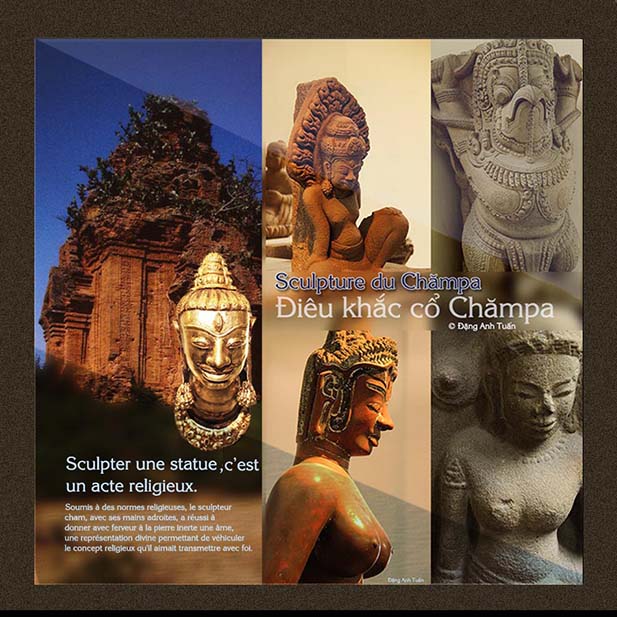
Carving a statue is a religious act.


For the latter, the Chams were probably populations from the South Seas (the countries of the archipelagos or those of the Malay Peninsula). Cham oral traditions mentioning connections linking, in legendary times, Champa and Java support this latter hypothesis.
Nicknamed the Vikings of Southeast Asia, the Chams lived along the coasts of central and southern present-day Vietnam. Their main activities were essentially based on trade. They were in contact very early with China and territories as far away as the Malay Peninsula, possibly the coasts of South India.

Being dedicated to religious purposes, Cham sculpture was thus not immune to political repercussions and influences from outside, particularly those from India, Cambodia, and Java. These became the main forces of creation, development, and evolution of styles in their art. According to the French researcher Jean Boisselier, Cham sculpture was closely linked to history. Significant changes were noted in the development of Cham sculpture, especially statuary, with historical events, changes of dynasties, or the relations that Champa had with its neighbors (Vietnam or Cambodia). According to the Vietnamese researcher Ngô Văn Doanh, whenever there was a significant external impact, a new style in Cham sculpture soon appeared.

To illustrate this, it is enough to cite an example: in the 11th-12th centuries, the intensification of violent contacts especially with Vietnam and Cambodia, and the emergence of new concepts related to the foundations of royal power can explain the originality and richness found in the style of Tháp Mắm.

Hình ảnh điêu khắc cổ Chămpa

Being the expression of the Indian pantheon (Brahmanist but especially Shaivist and Buddhist), Cham sculpture rather resorts to the local interpretation of concepts and norms coming from outside with elegance than to servile imitation. It is above all a support for meditation and a proof of devotion. Sculpting a statue is a religious act. Subject to religious norms, the Cham sculptor, with his skillful hands, succeeded in fervently giving the inert stone a soul, a divine representation allowing the conveyance of the religious concept he wished to transmit with faith. Cham sculpture is peaceful. No scenes of horror are depicted. There are only somewhat fanciful animal creatures (lions, dragons, birds, elephants, etc.). No violent or indecent forms are found in the deities. Despite the evolution of styles over history, Cham sculpture continues to maintain the same divine and animal creatures within a constant theme.

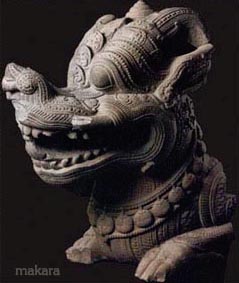
Makara
Cham art has succeeded in maintaining its specificity, its own facial expression, and its particular beauty without it being said that it is a servile copy of external models, thus preserving its uniqueness in Hindu sculpture found in India and Southeast Asia. Despite the lack of animation and realism, Cham works were mostly carved from sandstone and much more rarely from terracotta and other alloys (gold, silver, bronze, etc.).

Generally modest in size, they depict religious beliefs and worldviews. They cannot leave us indifferent because they always give us a strong strange impression. This is one of the characteristics of the beauty of Cham art. In Cham sculpture, one finds free-standing sculptures (round-bosses), high reliefs, and low reliefs. A free-standing sculpture is one that can be viewed from all sides to see the sculptor’s work. A high relief is a sculpture with a very prominent relief that does not detach from the background. As for the low relief, it is a sculpture with slight projection on a uniform background. In Cham sculpture, there is a tendency to emphasize the roundness of creatures in the reliefs. Few scenes are depicted in this sculpture. There is a noted lack of connection or coherence in the assembly when otherwise.


The creatures found in Cham sculpture tend to always emerge brilliantly from the space surrounding them. They have something monumental about them. Even when they are grouped together in the works of Mỹ Sơn, Trà Kiệu depicting the daily life of the Chams, they give us the impression that each one remains independent from the others.

One can say that the Cham sculptor focuses solely on the creature he wants to show and deify without ever thinking about excessively unrealistic details and imperfections (such as the too-large hand or the overly bent arm of the dancer from Trà Kiệu, for example) and without closely imitating the original Indian models, which gives this Cham sculpture the « monumental » character not found in other sculptures. This is another particularity found in this Cham sculpture.

The works are not numerous but they testify to a beautiful plastic quality and the expression of various religions. It is difficult to attribute them to a single style. On the other hand, some traits close to the tradition of Indian art from Amaravati can be noted. It was only in the second half of the 7th century, under the reign of King Prakasadharma Vikrantavarman I, that Cham sculpture began to take shape and reveal its originality.

[Sculpture of Champa (Part 2)]
[ Sculpture of Champa (Part 3)]

Palais Kiến Trung (VA)

Kiến Trung Palace


Version vietnamienne
Version française

Located at the northern end of the sacred axis crossing the center of the Purple Forbidden City, the Kiến Trung Palace is an architectural work built by King Khải Định between 1921 and 1923. It is also the first building where there is a combination of European style, including both French architecture and Italian Renaissance architecture, and traditional Vietnamese architecture. The facade of this palace is richly decorated with colorful ceramic motifs and fragments, thus bearing the imprint of the identity of the royal court of the Nguyễn dynasty. On the advice of several French architects and engineers and the Ministry of Public Works, this palace, responding to the aesthetic taste of the time, was completed in just two years, from 1921 to 1923, on the former site where two other architectural works previously known successively as Minh Viễn Lâu (1827) and Du Cửu Lâu (1913) had stood. According to the Hue Monuments Conservation Center, it has been known as Kiến Trung (Kiến « erected » and Trung « straight, no deformation« ).

This palace was considered the residence of the last two kings of the Nguyễn dynasty: Khải Định and Bảo Đại. It was here that King Khai Dinh passed away on November 6, 1925. During the reign of King Bảo Đại, the palace and its interior were renovated in a Western style, including the bathroom. It was also in this palace that Queen Nam Phương gave birth to the crown prince Bảo Long (January 4, 1936). During the Vietnam War, this palace was completely destroyed along with other residences of the Forbidden City. Since 2013, the Huế Monuments Conservation Center has begun launching the restoration project of the Kiến Trung palace. This project was implemented from February 2019 and completed in August 2023 with a total cost of more than 123 billion đồng.

Today, the Kiến Trung palace has become the favorite place for all tourists when visiting the Forbidden Purple City.

Kiến Trung Palace is visible through the long

Trường Lang Corridor

[Return HUE]

The Temple of Literature (Văn Miếu)


Temple of littérature 

One of the jewels in the heart of Hanoi

 (Một bảo vật giữa lòng thủ đô)

Version française

Hiền tài là nguyên khí của quốc gia.
Nguyên khí thịnh thì thế nước mạnh.
Nguyên khí suy thì nước yếu

Talent is the life source of a nation.
A gushing source is the strength of a country.
A drying source weakens it.

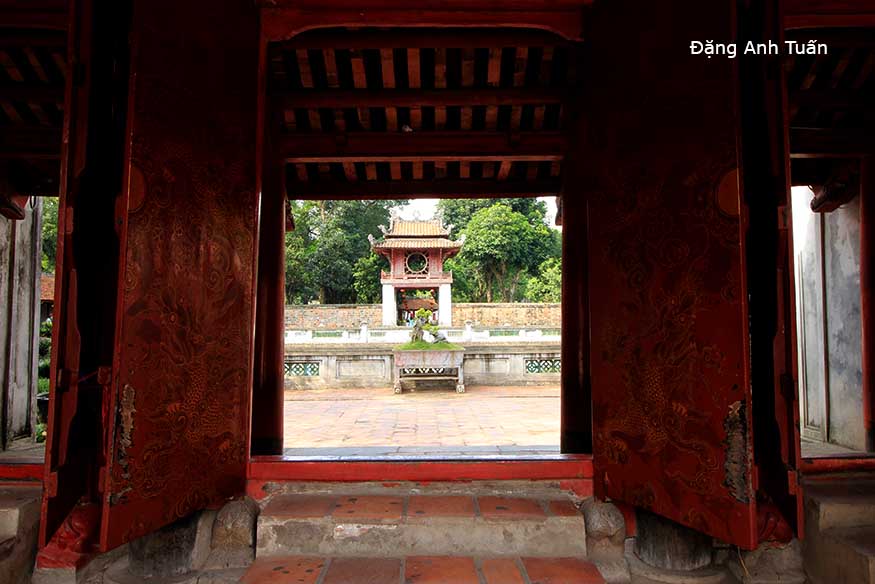
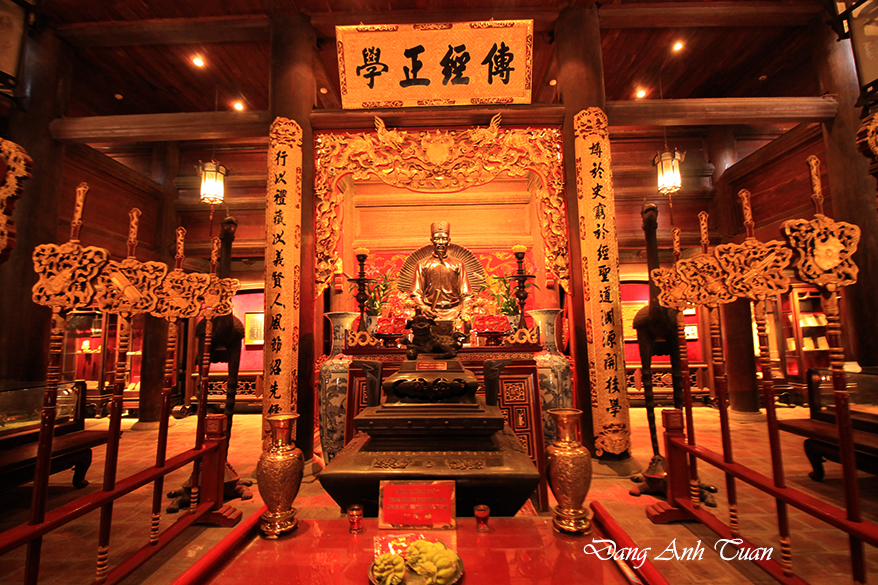
The first National University of Vietnam, Quốc Tử Giám, celebrated its 940th anniversary in 2016. It can boast of having preceded by a good century the ancient and prestigious Western universities of Bologna, Oxford, and Paris. Built six years after the Văn Miếu, the Temple of Literature dedicated to Confucius, within the same enclosure, it is among the monuments of the capital that have survived ten centuries of turmoil, civil wars, and foreign invasions. It is contemporary with the Trấn Quốc, Một Cột, and Kim Lien pagodas. The imposing and well-preserved architectural complex in the heart of Hanoi contains very old parts that bear the color of time and the values of a past as rich as it is little known.

Consolidation of the Vietnamese nation

It was in 1076 that the College of the Sons of the Nation, Quốc Tử Giám, was created by King Lý Nhân Tông, of the great Later Lý dynasty. Since the reconquest of independence in 939, the task facing the Vietnamese sovereigns was immense and arduous. The previous dynasties of Ngô, Ðinh, and Earlier Lê had exhausted themselves in internal divisions and wars of conquest at the beginning of the victorious march southward. At the beginning of the 11th century, Vietnam, then renamed Đại Việt, was a nation of original ancient culture in a young state.

Inside still poorly established borders in the South, it remained necessary to strengthen national unity and to overcome the rivalries of great families that threatened to tear the country apart. Outside, it was necessary to maintain good vassal relations with the powerful Chinese neighbor. The Lý showed themselves capable of meeting these challenges. The construction of dikes to address the flooding of the Red River allowed the population to settle and favored the growth of agriculture.

The buying and selling of land were regulated, which led to the emergence of a class of small landowners alongside the great feudal lords. Crafts developed (weaving, goldsmithing, pottery, porcelain), and consequently, trade. On the advice of competent Confucian administrators, the Lý managed to establish a strong centralized government and were able to give legitimacy to the ruling elite. Inspired by the Chinese administrative model, King Lý Nhân Tông organized in 1075 the first examination to recruit mandarins who would exercise power. The following year, he added to the Văn Miếu a higher school to train senior officials, the Quốc Tử Giám. The educational institution, in this tolerant country, existed peacefully right next to the place of worship. Combining a temple dedicated to Confucius and a place of learning into a single complex, this construction is a unique work that highlights the originality of Vietnam compared to China.

Rise of a National Culture

During almost ten centuries of Chinese colonization, the Vietnamese had preserved their cultural originality and assimilated a large part of Chinese culture. The College of the Sons of the Nation therefore spread Confucian humanities: Confucian classics, philosophy, literature, history, and politics. Brilliant candidates memorized the Four Books of Confucianism, but also the history of Vietnam and China. They also studied the rules of poetic composition, learning to prepare all sorts of documents: royal edicts, speeches, mission reports, analyses, essays. The language in use was certainly Chinese or hán; however, the Vietnamese very early on, probably from the 12th century, used a special iconographic script, nôm, to transcribe the popular national language, kinh.

Under Chinese rule, the Vietnamese had learned just what was necessary to become good servants. Until the tenth century, there is no trace of Vietnamese literature. Only legends may have crystallized the collective memory, prevented from freely expressing itself under the pressure of the occupier. The nôm script, derived from Chinese ideographic writing, represented a national and popular reaction to foreign cultural domination. « The soul of a people lives in its language, » said Goethe.

This is an obvious fact in Vietnam. The language transcribed in nôm experienced vigorous growth whenever the national and popular movement gained momentum. After the great Nguyễn Trãi in the 14th century wrote his poems in nôm, the demotic script gained its nobility and no scholar disdained writing in nôm. Another great Vietnamese figure, Nguyễn Huệ, carried out a true revolution by imposing nôm as the official language in administration and mandarin examinations during his reign at the end of the 18th century.

The royal examinations gave a decisive boost to education throughout the country. The National University became for a long time the keystone of the educational system. Schools were established to prepare candidates for the mandarin examinations.

Alongside the large feudal estates existed a well-organized system of rural communes. In many of them, there was a private school alongside public schools, both at the national, provincial, and local levels. The teachers were educated men who had failed the exams, or holders of a baccalaureate, a license, and doctoral laureates who did not want to become mandarins or who were disillusioned with politics. The prestige of knowledge, the respect for teachers and talent had spread over the centuries even into the poorest peasantry.

Which mother did not dream of seeing her sons one day take the difficult exams? The popular saying was deeply ingrained in people’s minds: « Without a teacher, I challenge you to achieve anything. » Literature and public service were not separate in the traditional Vietnamese educational system. Poets contributed to the economic life of their country. Among the most brilliant statesmen and strategists, many were poets. The most famous among them, revered as heroes by the entire population, were:

Trần Hưng Đạo (1213-1300), who triumphed over the Mongols by defeating Kublai Khan
Nguyễn Trãi (1380–1442), a great poet and statesman who ended a new Chinese occupation by the Ming.
Nguyễn Du, a diplomat under the Lê dynasty, who with his verse novel, the Kiều, brought the nôm script to perfection. The latter two are listed by UNESCO in the Pantheon of the Men of Culture of Humanity.
The obstacle-filled journey of a candidate for the royal exams.

Initially, the national exams were held irregularly, depending on the needs of the imperial administration. From 1434 until 1919, the date of the last session, they took place every three years.

When King Lê Thần Tông redefined the rules in the 14th century, the examination took place in two successive levels: regional, then national, each in four phases that could last several months in total. It was necessary to successfully pass each stage in order to qualify for the next. The final test was held at the imperial palace before the king, who personally examined the last group of future doctors.

Some figures provide an eloquent overview of the demands and importance of the royal competitions:

On average, 70,000 to 80,000 candidates competed in the regional competitions.

Between 450 and 6,000 candidates were selected from these to take part in the national exam in Hanoi. They settled for the duration of the tests on the university campus in the city center with their bamboo beds, brushes, and inkwells. In 1777, the National University and the Doctoral Quarter had become an impressive institution comprising 300 classrooms, a huge library, and a publishing house. This vast complex was destroyed by war in 1946. At the end of the final exam at the imperial palace, only 15 candidates were awarded the title of Doctor (tiến sĩ), with an average age of 32. Between 1076 and 1779, the date of the last session held in Thăng Long (Hanoi), 2,313 candidates received the title of Doctor.

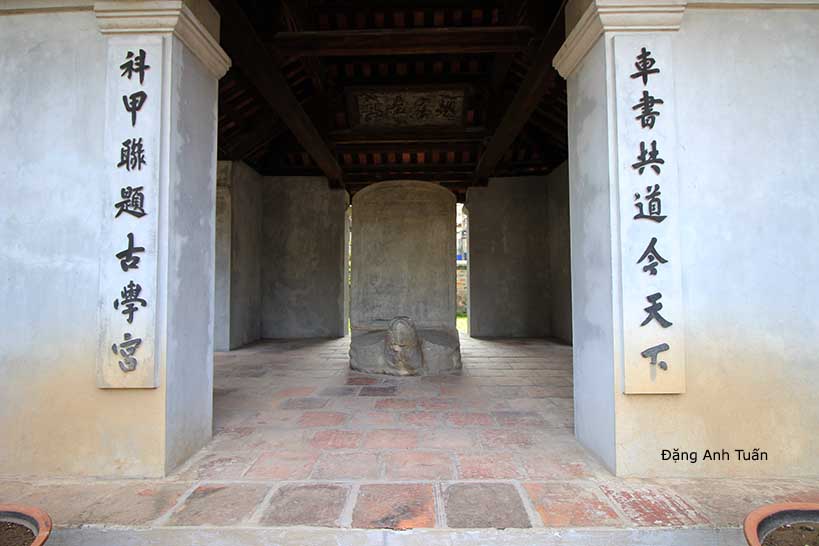
1306 of them have their names and ranks engraved in Chinese characters on the 82 steles (41 on each side) in the third space of the Văn Miếu Quốc Tự Giám in Hanoi. These 82 steles preserve the memory of the laureates admitted between 1442 and 1779. It was King Lê Thánh Tông who took the initiative to pay tribute in this way to the great servants of the country. 116 national exams took place during this period, which means that 34 steles are missing, and the reasons why they were not erected or have disappeared are unknown. From 1802, with the reign of Gia Long, the triennial exams were held in Hué until their abolition in 1919. The Quốc Tự Giám became once again the Văn Miếu, Temple of Literature, but was preserved. The tradition of inscribing the Doctors of the Nation on the honor roll was also maintained.

In the Forbidden City of Hué, on the first floor of the Ngọ Môn Gate, their names are clearly mentioned on a large black marble tablet, along with their village and province of origin. The competency exams were coupled with a formidable physical challenge for those from the provinces. The journey to the capital was fraught with dangers. Coming from a distant province, the future graduates sometimes had to travel up to 300 km or more, bringing with them food, a tent, a narrow bamboo bed, and writing materials.

Along the way, they had to fear both highway bandits and attacks from tigers and snake bites. If they managed to overcome all these obstacles, most of them preferred to stay a few years on site to study, in order to ensure the best chances of success.

Popular imagery often depicted the triumphant return of doctors to their native village, announced by a procession of banners and pennants, palanquins, ceremonial objects, preceded by family and friends. Throughout the journey, drums sounded marking the arrival of the child of the country who brought back, along with the doctoral certificate issued by the king, glory to the entire village. The village was henceforth distinguished as « a land of literature (đất văn chương). »

Then the laureate did not fail to bow before the altar of the ancestors and Confucius, before inviting everyone to a sometimes ruinous banquet. During the second millennium B.C. of Vietnam’s history, the intellectual elite emerging from national competitions produced, alongside brilliant strategists, mathematicians, statesmen, philosophers, men of letters, its share of simple bureaucrats and corrupt mandarins. According to Confucian tradition, no woman had access to official education.

The patients were so numerous that Phú Doãn Hospital (the current German-Vietnamese hospital) was soon overwhelmed. It was set up within the grounds of the Văn Miếu Quốc Tử Giám, whose ramparts served as a barrier against contagion. The disease was brought under control thanks to a vaccine developed by Doctor Yersin and the dedication of the doctors. But the Temple was in such a state that the French authorities decided to transform it into a hospital. They began searching for a new location to build the new building.

Aware that he was attacking the Holy See of Vietnamese culture, the representative of the Governor-General of Indochina, Pasquier, first consulted a prominent scholar, and the latter’s conclusion was unequivocal: « Adverse circumstances have soiled the steles and make the people’s hearts bleed. The Nguyễn, by transferring the capital to Huế, respected the integrity of the Temple. If you want to move it, the population will revolt. » A few days later, the French Government allocated a sum of 20,000 piastres to restore the Temple to its original state.
At other times in its troubled history, the population of Hanoi had shown its attachment to this monument, a symbol of its intellectual curiosity, passion for study, and creativity, notably during the fratricidal wars between the Trịnh and the Nguyễn. Nevertheless, in its current state, the Temple of Literature occupies a smaller space than at its peak.

Toàn cảnh nội văn từ
Thử địa vi thủ, thiên thu cần tạo thương lưu phương

Overview of the literary content
Trying the geographical hand, a thousand years need to create a lasting fragrance

Of all the temples dedicated to literature, this one is the high place;
the scent of culture lingers there beyond millennia.

The Temple of Literature (Văn Miếu)

Chu Văn An

Ông tổ của các nhà nho nước Việt

Erection of the laureates’ steles

[RETURN]

Angkorian empire (Chenla)

Đế Chế Angkor 

Version française
Version vietnamienne
Galerie des photos

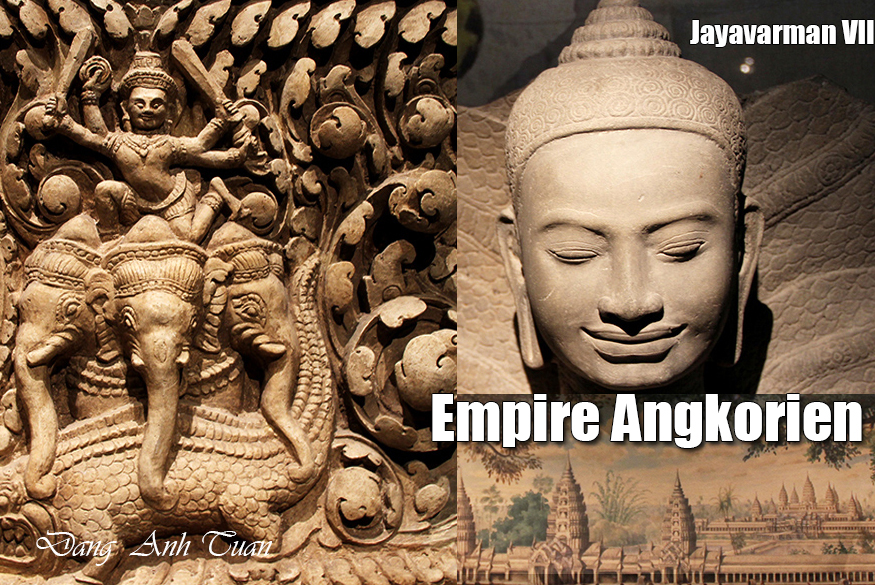
At a time when the kingdom of Funan was weakening, a vassal principality of this kingdom, which Chinese historians often referred to as Chenla (Chân Lạp) in their annals, attempted to forge its destiny in the middle Mekong basin near the archaeological site of Vat Phu in the Champassak province (present-day Laos). This is the only name we have to this day. No Sanskrit or Khmer word corresponds to the ancient sound Tsien lap. The existence of this kingdom dates back to the end of the 6th century. Similar to the kings of Funan, those of Chenla also have a dynastic legend: a solar-origin Brahmin priest named Kambu Svayambhuva received from the god Shiva himself a nymph of lunar origin in marriage, the beautiful Mera.

From this union of K(ambu) and Merâ, a line of sovereigns was born, that is, the descendants of Kambujadesha, meaning « land of the descendants of Kambu, » intended to explain the name of the Khmers. This word Kambujadesha, abbreviated as Kambuja, was first discovered in 817 in an inscription of Po Nagar in Champa (or present-day Nha Trang, Vietnam).

During the French colonial period, this name Kambuja was Francized as « Cambodge. » As for the word Chenla, it appeared in the history of the Sui (589-619), where the sending of an embassy from this country was mentioned in 616-617. Located southwest of Lin Yi (future Champa) and a vassal state of Funan, the kingdom of Chenla (Chân Lạp) (future Cambodia), having become powerful, did not hesitate to seize the latter and subjugate it. This fact was reported not only in the New History of the Tang (618-907) by the Chinese historian Ouyang Xiu but also in an unpublished inscription from Sambor-Prei Kuk, which praised the king of Chenla, Içanavarman I, son of King Mahendravarman, for having expanded his parents’ territory with his grand exploits. This monarch established his capital at Sambor-Prei Kuk, renamed Ishanapura.

The fragmentation of Chenla into small states was witnessed again. It was only in 654 that Jayavarman I, a great-grandson of Içanavarman I, succeeded in reunifying his ancestor’s country and established his capital near Angkor. Upon his death, Chenla again broke up into numerous principalities, and soon the principality of Shambupura (today Sambor on the Mekong) managed to impose its authority. Its king, Jayavarman II, settled in Rolûos and proclaimed himself king of the entire Kambuja in 802. Then the settlement and religious sites of the Óc Eo plain began to be abandoned as the center of gravity of the new political formation from the North moved away from the coast to gradually approach the site of the future capital of the Khmer empire, Angkor.

According to researcher J. Népote, the Khmers coming from the North through Laos appear like Germanic tribes in relation to the Roman Empire, attempting to establish a unified kingdom inland known as Chenla. They saw no interest in maintaining the technique of floating rice cultivation because they lived far from the coast. They tried to combine their own mastery of water retention with the contributions of Indian hydraulic science (the baray) to develop, through multiple trials, an irrigation system better adapted to the ecology of the hinterland and to the local varieties of irrigated rice.

It is reported that in Chinese annals, Chenla was divided into a « Land Chenla » and a « Water Chenla » at the beginning of the 8th century. The former was established in the old territories of Chenla, expanded according to its military successes, from the Dangrek range to the middle Mekong valley and westward to Burinam, now part of the Thai province of Korat, while the latter corresponded to a multitude of fiefs of former Funan and was subject to the royal authority of the island of Java (Indonesia). Then, through a stele of Sdok Kak Thom dating from 1052 and found 25 km from Sisophon, we learn that Jayavarman II was crowned king in 802 after freeing his country from the tutelage of Java, and his country regained its unity under the name Chenla.

The latter soon gave way to the birth of the Angkorian empire at the beginning of the 9th century. It first experienced its peak and glory with King Suryavarman II, whom historians have often compared to the Sun King Louis XIV of France. Of a warlike temperament, he did not hesitate to first ally with the Chams to attack the kingdom of Đại Việt under the reign of King Lý Thần Tôn in 1128, but he was repelled in the Nghệ An region. He then tried to maintain his grip on Champa by placing his brother-in-law Harideva as ruler over the capital Vijaya (present-day Bình Định in Vietnam).

But this attempt ended in a crushing failure against one of the greatest Cham kings, Jaya Harivarman I, who recaptured Vijaya in 1149. Yet Chinese chroniclers spoke of him with great deference. Beyond the frenzy of his territorial conquests, Suryavarman II had a large number of splendid monuments built, among which was the famous site of Angkor Wat. According to the Italian researcher Maria Albanese from the I.I.A.O institute, it seems possible that Suryavarman II died following a disastrous military expedition into Vietnamese territory in 1150.

Then the empire of the Khmer kings expanded under Jayavarman VII, one of the fascinating personalities in universal history. During his reign, he managed to push back the limits of his empire by annexing Champa, Lower Burma, Thailand, and Laos. Georges Coedès, former director of the French School of the Far East (EFEO), painted for us a striking portrait of this great king, that of a pharaoh who can boast of having moved so much stone (Angkor Thom, Ta-Prohm, Bantay-Kdei, etc.).
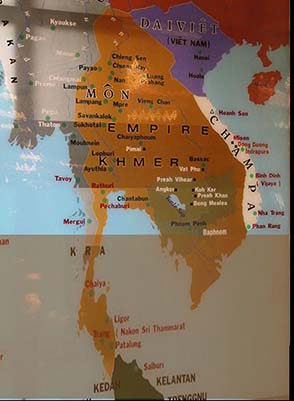
Map of the empire

carte_empire_khmer

But after his death, due to the gigantic enterprises and incessant wars against his neighbors (Chams, Vietnamese, and Thais), the Angkorian empire began to experience a rapid decline caused by the multiple capture and sacking of its capital Angkor by the Thais (1353, 1393, and 1431). They were unified by Ramadhipathi to found the kingdom of Ayutthaya.

Faced with the assaults of the Thais, the Khmers had to abandon their capital Angkor and retreat to the geographic heart of their country, the Four Arms of the Mekong (Phnom Penh), with the last king of the Khmer empire and the first king of Cambodia, Ponhea Yat. This strategic and economic retreat is only one of the hypotheses suggested by researchers to hasten the decline of Angkor. But according to recent discoveries reported by National Geographic in its issue 118 of July 2009, the collapse of Angkor is largely due to climatic disasters that managed to destroy the most complex and ingenious hydraulic system, a jewel of Khmer civilization. The imperial city of Angkor had to face severe successive droughts from 1362 to 1392 and from 1415 to 1440, thanks to the analysis of growth rings found in certain long-lived cypresses such as teak or Siam wood.

When the hydraulic system began to malfunction, showing signs of weakness, the power of the Angkorian empire did the same. This is why, being the first to realize the importance of this system, the archaeologist Bernard Philippe Groslier of the French School of the Far East (EFEO) did not hesitate to describe Angkor as a « hydraulic city » when publishing his work in 1979. Designed to support religious rituals and ensure a constant water supply for rice cultivation, the gigantic barays (or water reservoirs) were drained in the event of successive major droughts. This could have dealt a fatal blow to this already faltering empire, weakened by internal divisions and successive Thai invasions, as Angkor was home to no less than 750,000 inhabitants over an area of about 1000 km². This brings to mind the period experienced by the Maya cities of Mexico and Central America, which succumbed to overpopulation and environmental degradation linked to three successive droughts in the 9th century. This disaster also brutally reminds us of the limits of human ingenuity, which can be easily overcome at any time by the forces of nature. Man cannot conquer nature under any circumstances but must become one with nature to live in harmony with it.

Bibliographie.

Thierry Zéphir: L’empire des rois khmers;  Découvertes Gallimard. 1997
Claude Jacques, Michael Freeman : Angkor, cité khmère. Book Guides
Bernard Philippe Groslier: Indochine. Editions Albin Michel 1961
National Geographic: Angkor . Pourquoi la grande cité médiévale du monde s’est effondrée? N° 118.  Juillet 2009
Maria Albanese: Angkor. gloire et splendeur de l’empire khmer. Editions White Star 
Georges Coedès: Cổ sử các quốc gia Ấn Độ Hóa ở Viễn Đông.  Editions Thế Giới. 2011
Chu Đạt Quan: Chân Lạp phong thổ ký. Editions Thế Giới . 2011


Mausolée Tu Duc (Version vietnamienne)


Khiêm Lăng (謙陵)

Version française

English version

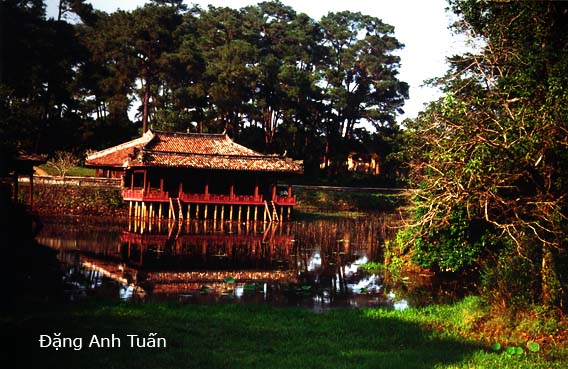
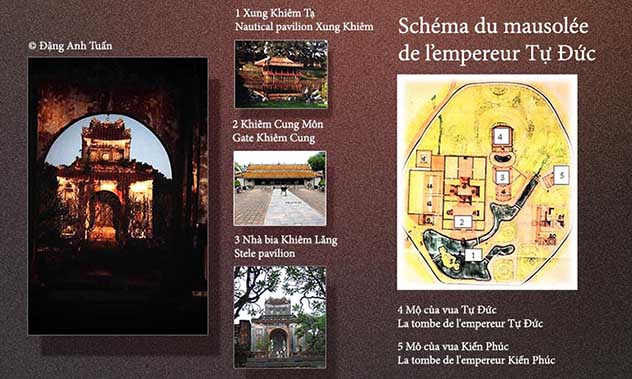
Không giống như các lăng mộ hoàng gia khác của triều Nguyễn, lăng mộ của vua Tự Đức chủ yếu là nơi ẩn náu trong thời gian trị vì của ngài. Đây là lý do tại sao nó không chỉ chứa một cung điện sau này được chuyển đổi thành nơi thờ cúng sau khi ngài qua đời, mà còn có một nhà hát và hai gian nhỏ bằng gỗ đỏ xinh xắn (Du Khiêm Xung Khiêm) nơi ngài thích ngồi để thư giãn và sáng tác thơ. Lăng mộ này, được xây dựng từ năm 1864 đến năm 1867 bởi ba nghìn binh lính và công nhân, có khoảng năm mươi tòa nhà được bao quanh bởi một bức tường đá và gạch dài 1.500 mét bao phủ diện tích 12 ha. Tự Đức lên ngôi vua vào thời điểm ông phải đối mặt không chỉ với sự phát triển của chủ nghĩa tư bản phương Tây mà còn cả tình trạng bất ổn nội bộ (Chiến tranh châu chấu do nhà thơ Cao Bá Quát lãnh đạo, việc anh trai ông là Hồng Bàng bị lật đổ vào thời điểm ông lên ngôi, vân vân). Để có thể nương tựa, ngài không ngần ngại ra lệnh xây dựng lăng mộ làm nơi nghỉ ngơi trong suốt cuộc đời và là nơi ở cho cuộc sống vĩnh hằng sau này của ngài.

Galerie des photos du mausolée Tự Đức

No Images found.

Trong lăng mộ này, đình Hoa Khiêm là công trình chính nơi vua làm việc, đình Lương Khiêm là nơi vua ở và ngủ. Hai ngôi mộ khác cũng nằm trong khuôn viên lăng mộ. Đó là mộ của hoàng hậu Lê Thiện Anh, vợ vua, và một trong ba người con nuôi của vua, vua Kiến Phúc.

Kiến trúc của lăng mộ này không chỉ phản ánh bản chất lãng mạn của nhà thơ-hoàng đế Tư Đức mà còn phản ánh sự tự do vốn còn  thấy thiếu trong các lăng mộ khác cho đến ngày nay. Không có gì ngạc nhiên khi lăng mộ này đã trở thành điểm đến yêu thích của hầu hết du khách nước ngoài và Việt Nam.

lang_tu_duc