Yin and Yang theory (Âm Dương : Phần 1)

yinyangviet

French version 

Vietnamese version

The theory of Yin and Yang continues to be closely linked to the daily life of the Vietnamese and finds its application in all fields. Everything that is fluid, cold, humid, passive, dark, internal, immobile, of feminine essence such as the sky, the moon, the night, water, winter, is of Yin nature. Everything that is solid, warm, bright, active, external, mobile, of masculine essence such as the earth, the sun, fire, summer, is of Yang nature.

This Yin and Yang characteristic is even found in Vietnamese grammar through the use of the words « con » and « cái« . Analogous to the definite articles « le » and « la » in French, these are used to indicate gender in certain restricted cases, but one can also base their use on the « mobile » or « immobile » nature of the object they accompany to indicate its belonging to the corresponding semantic class. The word « cái » is used when the object has the « immobile » character (tĩnh vật): cái nhà (house), cái hang (cave), cái nồi (pot), etc. On the other hand, when the « mobile » state (động vật) is part of the nature of the object, the word « con » is used to precede it. This is the case for the following words: con mắt (eye), con tim (heart), con trăng (snake), con ngươi (pupil), con dao (knife), etc.

The eye moves constantly just as the heart beats. Likewise, the snake moves just like the pupil. The knife is considered by the Vietnamese as a sacred animal. It is nourished with blood, wine, and rice. The same name given to an object can lead to two different interpretations depending on the use of the word « cái » or « con. » The following example translates the mobile (con) or immobile (cái) nature of the object thuyền (or boat in French) used: Con thuyền trôi theo dòng nước (The boat moves along the water). This means that someone is making the boat move with the oar or with the engine. On the other hand, when one says « cái thuyền trôi theo dòng nước » (The boat moves along the water), the emphasis is on the fact that there is no one maneuvering the boat. It is the flow of the water that makes the boat move by itself. This notes the immobile nature of the boat. The influence of Yin and Yang is not unrelated to the way the gender is sometimes attributed to common objects. This is the case with the knife (dao): dao cái (large knife), dao đực or dao rựa (or machete). This observation was noted by Alain Thote, the French archaeologist and sinologist, in his article entitled « Origin and Early Developments of the Sword in China« : The swords of Yue enjoyed great fame in antiquity.

This is the case of the fish entrails sword that the butcher named Zhuan Zhu (Chuyên Chư) used to assassinate the Liao sovereign (Ngô Vương Liêu) of the state of Wu (nước Ngô) during the Spring and Autumn period (Xuân Thu), etc. Some swords bore a name and could be masculine or feminine. The expression « đực rựa, » often heard in conversations to refer to men, comes from the old Vietnamese custom of carrying machetes when going out.

The association of sexes has also been visible for a long time in Vietnam in rice cultivation: the man plows and the woman transplants. The plowshare that pierces the earth (âm) (Yin) symbolizes the male sex (Yang) (dương), while through transplanting, the woman transmits her fertilizing power (âm) (Yin) to the rice plants (dương) (Yang). To denote the perfect harmony in the union of Yin and Yang, it is customary to say in Vietnamese: United, husband and wife can scoop all the water from the Eastern Sea. (thuận vợ thuận chồng tát biển Đông cũng cạn).

Being rice farmers, the Proto-Vietnamese were attached not only to the land but also to the environment because, thanks to natural phenomena (rain, sun, wind, clouds, etc.), they could have good harvests or not. Extensive rice cultivation by slash-and-burn or in naturally flooded fields depended on climate uncertainties. That is why they needed to live in harmony with nature.

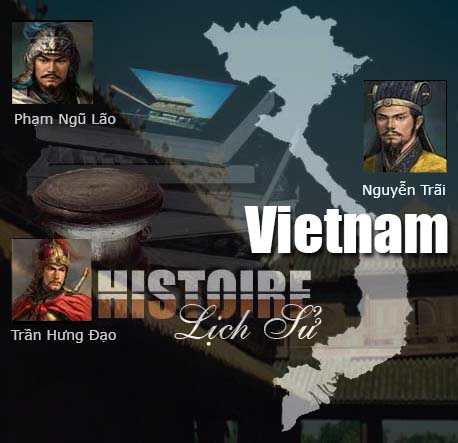
They considered themselves the link between Heaven and Earth (Thiên-Nhân-Địa). Based on this notion, it is common to say in Vietnamese: Thiên Thời, Địa Lợi, Nhân Hòa (being aware of weather conditions, knowing the terrain well, and having popular support or national harmony). These are the three key factors of victory often referenced by Vietnamese strategists (Trần Hưng Đạo, Nguyễn Trãi, Quang Trung) in their struggle against foreign invaders. The Vietnamese take this triad (Tam Tài) into account in their way of thinking and daily life.

For them, there is no doubt that this notion has an undeniable influence on the person themselves: their destiny is dictated by the will of Heaven and depends on their birth date. With the external and internal environment of their dwelling, they can receive the harmful or beneficial breath (qi) generated by the earth. The art of harmonizing the environmental energy of one’s place of residence allows one to minimize troubles and promote well-being and health. A flat terrain without undulations or hills is lifeless and lacks qi breath (Khí). The Vietnamese call hills and mountains Dragons and Tigers. Buildings should have a green dragon to the west and a white tiger to the east. The benevolent Dragon must be more powerful than the Tiger (Hữu Thanh Long, Tã Bạch Hổ) that is to say the Dragon mountain must be higher than the Tiger hill. The notion of harmony takes on its full meaning when a site backed by a mountain and surrounded on two sides by chains of hills that protect it from winds dispersing the Chi (or cosmic energy) gives access to a lake or a river where there is water and food essential for life and the accumulation of cosmic energies (Chi).

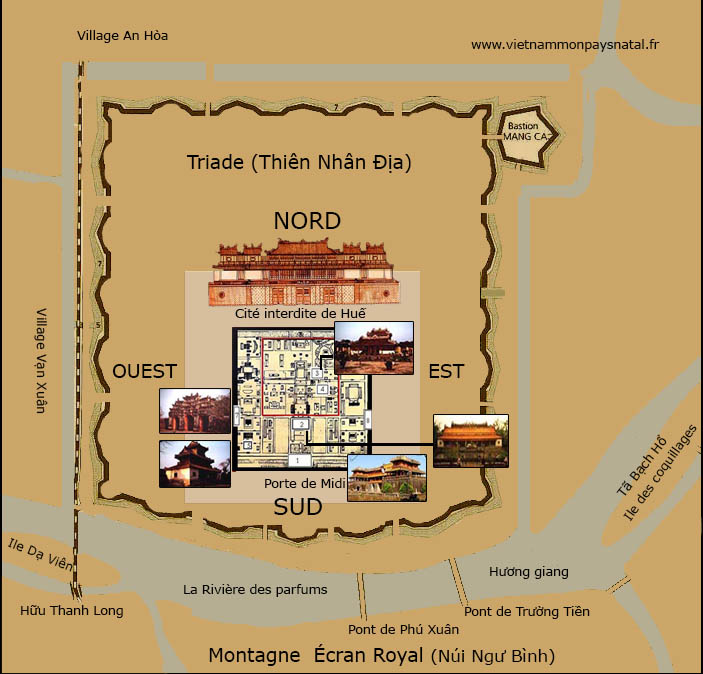
This model can be found in the case of the historic city or citadel of Huế (Kinh thành Huế). It is oriented towards the south because in the Yi King it is written: the one who governs the country must look towards the south « Thánh nhân nam diện nhi thính thiên hạ thí » (the king turns his face to the south to rule the world). The enclosure of this citadel is a defensive construction with a military character based on the fortress technique of the famous engineer Vauban and encompassing near its southern front the imperial city bounded by a second rectangular enclosure measuring 622×606 meters. Inside this is the purple forbidden city forming the symbolic heart of the empire within a third and last almost square enclosure of 330×324 meters. The interlocking of these three enclosures refers to the Triad (Heaven, Man, Earth).

The southern front of the citadel, where the Meridian Gate is located, follows a convex path along the Perfume River. Resembling a dragon lying in the West, it undulates and rises towards the North, weaving through small hills and making a 90° bend to the East. It first reaches the protective islands of Dã Viên and Cồn Hến before joining the sea. This creates an ideal position (Chi Huyền Thủy) in accordance with the scheme described above, with a green dragon to the East and a white tiger to the West represented respectively by the shell islands (Cồn Hến) and Dã Viên, facing a natural screen symbolized by the Royal Screen Mountain (Núi Ngự Bình).
 

Man can act and influence his own life. By performing benevolent acts towards others, he can find happiness and improve his karma. In the past, there was a Nam Giao or Tế Giao ceremony in Vietnam, organized every year by the court of Hué in honor of Heaven and Earth. It is the emperor’s privilege to annually associate his deified ancestors with the homage paid to Heaven and Earth on a monumental esplanade built in 1806 in the southern suburbs of Huế because he is the son of Heaven. There are three levels corresponding to the triad: Heaven, Representative (emperor), Earth (Thiên, Nhân, Địa).

Each level has its own shape and a different color: the sky is spherical and the earth square (trời tròn đất vuông), thiên thanh địa hoàng (the sky is light blue and the earth yellow). Previously subjected to isolation and fasting, the emperor ascended the esplanade of sacrifices and acted on behalf of his people to ask the natural forces of the universe to improve the environment on earth. The emperor is the only figure qualified to be the intermediary between Heaven and Earth. This triad (Thiên, Nhân, Địa) has often been mentioned in Vietnamese legends.

In the legend of the « The God of Mountains and the God of Rivers (Sơn Tinh Thủy Tinh) » there is a girl named Mi Nương who is sought in marriage by these two spirits, or in the legend of the Kitchen genius myth  (Chuyện Táo quân), the woman is torn between the love of her former husband and that of the new one. In the legend of the « Betel Quid, » the triad (wife, husband, younger brother) is represented by the woman, her husband, and her twin brother who, once deceased, respectively become the betel leaf, the areca nut, and the lime stone. The betel quid well reflects the notion of balance and harmony found in the theory of Yin and Yang. To prepare the betel quid, a little slaked lime is spread on a betel leaf.

Then, orange-yellow colored root bark of Artocarpus tonkinese is added, and finally a betel nut finely sliced is incorporated. The whole mixture is placed in the mouth and slowly chewed. After about twenty minutes of chewing, the remaining quid is spit out. The five tastes can be found in the betel quid: sweet from the betel nut, spicy from the betel leaf, bitter from the root, salty from the lime, and sour from the saliva. Through the image of the fresh betel vine emerging from the earth symbolized by the lime stone and entwining the slender areca palm trunk in this legend, one wants to note the character of the perfect balance between Yin (Earth) and Yang (Heaven) in perfect harmony. The betel quid is the prelude to every conversation (Miếng trầu là đầu câu chuyện), as often said in an old Vietnamese proverb. Acceptance carries deep meaning and amounts to a firm commitment, a given word that no one would think to take back. If the exchange occurs between a girl and a boy, it is equivalent to a proposal of marriage or union. In Vietnamese tradition, the betel quid is a symbol of conjugal happiness. It cannot be missing from marriage rites.

In the civilization of wet rice cultivation, there are other trinities as important as the triad (Heaven, Man, Earth). This is the case with the triad (Thủy, Hỏa, Thổ) (or (in French Water-Fire-Earth)) or the triad (Mộc, Kim, Thổ) (or Wood, Metal, Earth). We need the earth for rice cultivation, water, and fertilizers derived from ashes caused by fire to fertilize the soil. Similarly, plants are used for food and metals to make appropriate tools for agriculture. We notice that these triads have a common element, which is earth. That is why it occupies a central place in the management of the four cardinal points. It is the pivot around which the other four elements revolve. In agricultural life, the most important element after earth is water. It is the phrase: Nhất nước nhì phân (First water, second fertilizer) often heard from a Vietnamese farmer. Since water has a Yin nature, it is attributed to the North direction because it is compatible with cold (winter). On the other hand, being Yang in nature, the fire element of the triad (Thủy, Hỏa, Thổ) is better associated with the South direction with heat and radiation (summer). The wood element clearly recalls plants whose birth often takes place in spring. It is associated with occupying the west direction with the growth of Yang. As for the metal element, which is malleable and can take different forms, it is associated with the east direction, which is linked to autumn.

The Vietnamese find in the theory of Yin and Yang an idea of alternation rather than opposition. Yin and its complementary element Yang form an entity that allows for the establishment of a good balance and harmony. For them, the world represents a totality of cyclic orders constituted by the combination of two alternating and complementary manifestations. It is known that in an opposing relationship, both Yin and Yang each carry the seed of the other within themselves. (Nothing is completely Yin or completely Yang; within Yin there is Yang and within Yang there is Yin). Yin and Yang are considered as the wheel of a chariot. Having reached their end, they begin again. Once their limit is reached, they return again.

A set of popular sayings reflecting the law of causality concretely testify to the mutation of Yin and Yang. That is why it is customary to say in Vietnamese « Trong rũi có may » (In misfortune, there will be luck), « Trong dỡ có hay » (In what seems bad, there is also something good), « Trong họa có phúc » (In misfortune, there will always be happiness). « Sướng lắm khổ nhiều » (The more satisfied the desire, the more one will suffer), « Trèo cao ngã đau » (The higher you climb, the more painful the fall). « Yêu nhau nhiều cắn nhau đau » (The more we love each other, the more we hurt each other). Lost possessions are therefore sometimes the ransom of a human life. This is clearly expressed by the Vietnamese proverb: Của đi thay người (possessions go away instead of people). The factors Phúc (happiness) and Họa (misfortune) must vary inversely to each other.

It is thanks to this Yin and Yang bipolarity that the Vietnamese are accustomed to seeking a good balance in daily life. They try to find perfect harmony with everyone and with nature even beyond their death. This was discovered in the Lạch Trương necropolis (Thanh Hóa), dating back to 3 centuries before Christ, with wooden burial objects (Yang) placed in the North (Yin) and those made of terracotta (Yin) in the South (Yang).

This notion of balance can even be found in the pagoda with the spirits of good and evil (Ông Thiện Ông Ác). It is thanks to this philosophy of balance that the Vietnamese have the ability to adapt to all situations, even in extreme cases. It is also this principle of balance that Vietnamese leaders have continued to uphold in the past during confrontations with foreign countries. To avoid the humiliation of the Mongols, who were defeated twice in Vietnam, General Trần Hưng Ðạo proposed paying tribute to Kubilai Khan in exchange for lasting peace. After defeating the Ming Chinese, Nguyễn Trãi, the strategic advisor to King Lê Lợi, did not hesitate to allow Wang Tong (Vương Thông) to return to China with 13,000 captured soldiers and proposed a vassalage pact with a triennial tribute of two medium-sized statues made of fine metal as compensation for two generals who died in battle, Liou Cheng (Liễu Thăng) and Leang Minh (Lương Minh). Similarly, King Quang Trung showed humility and agreed to send an envoy to Emperor Qianlong to seek peace after crushing the Qing army at Hanoi in 1788 within a very short time (6 days).

We must not forget either the conduct and flexibility demonstrated by the communist leaders in diplomacy during the confrontation with the French and the Americans. The Geneva (1954) and Paris (1972) agreements once again testify to the search for balance or the middle way ingeniously found by the Vietnamese in the theory of Yin and Yang.
In Vietnam, spherical objects (tròn) are integrated into Yang, and square-shaped ones (vuông) into Yin. This tendency dates back to a time when it was believed that the sky was spherical and the earth was square because the ancient Vietnamese had to square the land before they could use it for plowing and building houses. It was in this mindset that the Bai Yue (of which the Proto-Vietnamese were a part) used to divide a portion of land into nine lots based on the character 井 tĩnh (giếng nước, meaning water well). The central lot was designated for building a water well, and the remaining eight lots were intended for constructing houses, thus forming the first housing unit in agricultural society.

The following Vietnamese popular saying: trời xanh như tán lọng tròn; đất kia chằn chặn như bàn cờ vuông (The blue sky is like a round parasol; the earth is firm like a square chessboard) reflects this belief well.The Proto-Vietnamese knew that the sky was round and the earth was square to distinguish between the round aspect of the sky at the moment of its existence (thể) and the square aspect of the earth at the moment of its use (dụng).

 NEXT (More reading Part 2)


Bibilography

–Alain Thote: Origine et premiers développements de l’épée en Chine.
–Cung Ðình Thanh: Trống đồng Ðồng Sơn : Sự tranh luận về chủ quyền trống đồng giữa học giã Việt và Hoa.Tập San Tư Tưởng Tháng 3 năm 2002 số 18. 
-Brigitte Baptandier : En guise d’introduction. Chine et anthropologie. Ateliers 24 (2001). Journée d’étude de l’APRAS sur les ethnologies régionales à Paris en 1993.
-Nguyễn Từ Thức : Tãn Mạn về Âm Dương, chẳn lẻ (www.anviettoancau.net) 
-Trần Ngọc Thêm: Tìm về bản sắc văn hóa Việt-Nam. NXB : Tp Hồ Chí Minh Tp HCM 2001. 
-Nguyễn Xuân Quang: Bản sắc văn hóa việt qua ngôn ngữ việt (www.dunglac.org)
-Georges Condominas : La guérilla viêt. Trait culturel majeur et pérenne de l’espace social vietnamien, L’Homme 2002/4, N° 164, p. 17-36. 
-Louis Bezacier: Sur la datation d’une représentation primitive de la charrue. (BEFO, année 1967, volume 53, pages 551-556) …..


Sacrifice (English version)

sacrifice_1f
Version Française
Version vietnamienne

Life is a game of chance. The chance is against us. It’s worth dying now for the country and set an example of sacrifice

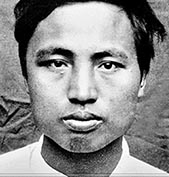
Nguyễn Thái Học

Vietnam is not only a land of legends and learned men but also a land that men have acquired acre by acre in a crual mother nature for more than four thousand years. The cradle of the Vietnamese nation, the delta of Tonkin bordered by mild hills of the Hundred Thousands Mounts of China and squeezed in the South by a quasi impenetrable range, the Annamitic Cordillera, reduced to 15,000 km2 but rich of all the mud pulled out by the Red river, continues to be threathened by the latter with the discharge of 500m3 at low tide up to 3500m3 during the highest crests.

To master the blows of sword of the Red River, the Vietnamese people resort to a method of building dikes, which requires not only an increased watch of dikes but also a perpetual struggle. Facing the never-ending change of nature, the caprice of the Red river and the territorial ambitions of China, the Vietnamese people owe their safety at the cost not only of their labor and courage but also of their sacrifice in the long march filled of pitfalls towards the South.

This sacrifice is not foreign to the majority of Vietnamese in particular the men and women of character. It also becomes a cult that one likes to maintain and ceaselessly praise for Vietnam to excite the whole people before the threat of foreigners.

The sacrifice is the surest way to maintain the perfection of the homeland but it is also the synonym of loyalty and dignity. A great person is the one who dares take the responsibilities in moments of difficulty in his or her life but it is also the one who knows how to sacrifice himself or herself for a good cause, in particular for his or her country. The sacrifice is indispensable to the word « honor » in Vietnam.

Because of this moral dignity, many military people prefered suicide to surrender (Trưng Trắc, Trưng Nhị, Trần Bình Trọng, Võ Tánh etc..). That is why it is the habit to say:

Hùm chết để da, người chết để tiếng.
A dead tiger leaves its hide, a deceased person his reputation. 

The history of Vietnam is also that of sacrifices. The duty of a Vietnamese is to serve his or her country with all his heart. The greater the danger, the better his or her loyalty seems to be.


Heroes sacrifice for their fatherland. No matter what happens, his honor is never tainted. It is the case of the scholar Phan Thanh Giản, signatory of the Franco-Vietnamese treaty of 1868. After having failed to put up with the French in the defense of the three western provinces of the Mekong delta (Vĩnh Long, An Giang and Hà Tiên) he chose to surrender and decided to poison himself in 1967 because he thought it was the only way to save the people and to show his fidelity to emperor Tự Ðức. The same, Nguyễn Tri Phương (1873), adversary of Francis Garnier and Hoàng Diệu (1882), adversary of Henri Rivière preferred suicide after having failed to defend Hànội city.

During the French occupation, sacrifice became the flame of hope lit by unknown people such as Nguyễn Trung Trực, Phạm Hồng Thái. The former accepted to die in the stead of his mother captured after having succeeded in blowing up the French « Espérance » on its passage on the « Nhựt Tảo » river in Long An while the latter, chased by the Chinese police in his escape, preferred to throw himself in the river after having failed to assassinate the French governor Merlin during his passage by Canton in 1924. Admiror of his courage and sacrifice for his fatherland, the governor of Canton later buried his remains in a cemetery solely reserved for the 72 Chinese heroes and known as « Hoàng Hoa Cương » in Vietnamese. 

If this sacrifice is not a vain word for men, it carries a particular meaning for the Vietnamese women. Princess Huyền Trân of the Trần dynasty was proposed to become in 1306 the wife of king Chế Mẫn (Jaya Simhavarman)  in exchange of the two territories of Champa Chau Ô and Châu Rí. She had to sacrifice her life, her love for reason of State.

The same, three centuries later, a princess of the Nguyễn dynasty, of the name Ngọc Vạn to whom the word « Cochinchina » or (Cô chín xin) was attributed, was not late in following Huyen Tran’s footsteps in becoming the concubine of Cambodian king Prea Chey Chetta II in 1618 in exchange of the facilities granted to Vietnamese in their settlement in the region Ðồng Nai Mô Xoài which is no other than the Saigon-Cholon region today.

Her presence on the Cham soil served as a pretext for lord Nguyễn Phúc Tần to launch an expedition and annex the last territory of Champa in 1651. One cannot blame the Cham for hating princess Ngoc Khoa at that time because of her, they have lost their homeland. But Ngọc Khoa illustrates for us, the Vietnamese the sublime sacrifice she consented for her country and her people.


Po Klong Garai (PhanThiết)

Con rồng cháu Tiên (English version)

French version

Vietnamese version

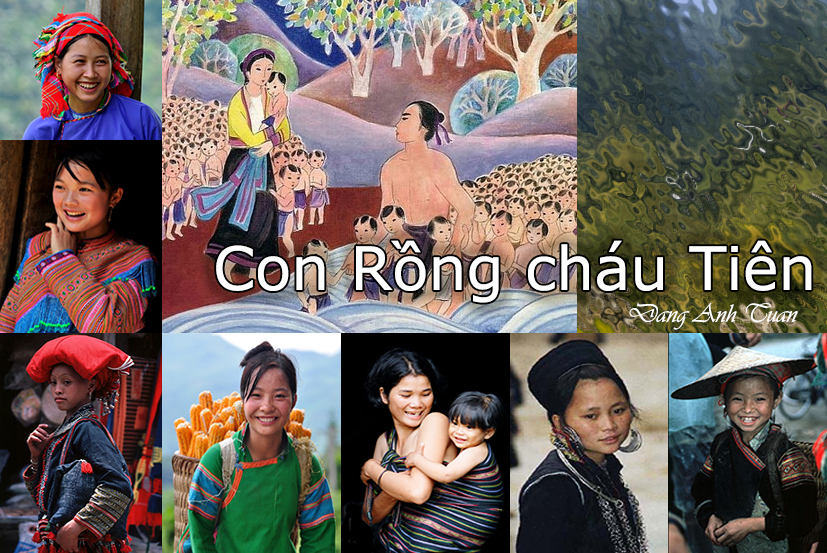
 Long time ago, Vietnam was a country half-wild, half-cultured, infested with wild beasts that cohabitated with men in deep caves in the forest. Lived then a young man named Lạc Long Quân intelligent and endowed with extraordinary powers. In his vein flowed a bloodstream mixed with the blood of the Dragons form Bách Việt country. During his travels through mountains and valleys, he arrived at a maritime region of southeast Lac Việt. Seeing the population decimated by a marine monster, he took a spear that he got red hot in fire and threw in the mouth of the monster killing it. He cut its body in three pieces which he threw into three different places that received three geographical names: the head was in a mountain named Cầu Dầu Sơn, the body in another mountain Cầu Dầu Thủy and the tail in the islet called Bạch Long Vỹ.

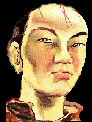
Lạc Long Quân and Âu Cơ


Once the people of Lac Viet in peace, the hero headed for the Long Bien region where its inhabitants were terrorized by a fox which became a monster. The latter often turned itself into a young man to enter villages taking away women and young girls. Lac Long Quan had to fight for three days and three nights before beating the monster and entering its cave to free his survivors. Arriving at the Phong Châu area, he confronted the monster of trees so ferocious he had to turn to his father Kinh Dương Vương to chase it to the South. After having brought peace to the three countries, he was so moved by compassion for such an unfortunate and simple people. He decided to stay to protect and teach them how to grow rice, cook it, cut trees to build homes that sheltered them from rain, wind and savage beasts. He educated them in the family virtues of parents and spouses. The people revered him and considered him as their Chief. They also considered him as their father, the one who gave them their lives.

Before he joined his mother in the Palace of Waters, he recommended to his people, in case of misfortune, to call him aloud: Father. And he would come back right away. Some time later, the Lord of the High Regions of the North, Ðế Lai, leading his troops, invaded Lac Viet while bringing with him his delightful daughter Âu Cơ. De Lai oppressed and fleeced the people who had to supply his army with meat and rice. In distress people called: Father, come back and save us. Lạc Long Quân was on the spot, but did not find De Lai. Au Cơ was there alone, out for a walk amid her servants. Dazzled by her beauty, he took Au Cơ to his palace. Au Cơ herself, charmed by the young man, consented to live with him. Ðế Lai, coming back in rage, sent his troops out to besiege the town.

But Lac Long Quan commanded savage beasts to push him back. Incapable of struggling against such a strong son-in-law, Ðế Lai withdrew from Lạc Việt, leaving his daughter on the strange land.

Lac Long Quân with the monster

Amid their happiness, Au Cơ brought to the world a big pouch from which got out one hundred eggs that gave birth to one hundred sons as robust as their father. When came the time to separate and return to his mother, Lạc Long Quân told his wife Au Cơ : « You are of the race of Immortals. I am of that of the Dragons. We cannot stay together for the rest of our lives. You need to live up high. I need to live down by the sea. So you stay here with fifty children. I will bring the other fifty to the maritime region, we settle on the same land ». From then on, Au Cơ stayed in the mountains with her fifty children. Those became the ancestors of all the peoples living nowadays on high plateaus and mountains (these are the montagnards and minorities ). As for Lạc Long Quân, he descended on the plain, by the sea, with his children that he taught how to clear the land to establish a kingdom there. His eldest son became thus the first king of Vietnam and took the dynastic name of Hùng Vương and called his country Văn Lang.

That’s why Vietnamese are proud of being  » Children of the Dragon, Grandchildren of the Immortal »
(Con Rồng Cháu Tiên).

Vietnam history (Lịch Sữ Việt Nam)


Vietnamese version

French version

The word Vietnam was first known only in the 19th century when Emperor Gia Long decided to rename the country from Nam-Viêt. Marco Polo evoked it in the account of his voyage entitled The Book of Marvels under the name of Caugigui ( Giao Chỉ Quán ). Vietnam’s history can be summarized in a few words: struggle for independence, conquest of new land, and reunification of the country. The Vietnamese appear for the first time at the Bronze age ( Ðồng-Sơn civilization ). The Vietnamese tribes who lived scattered south of China and north of Vietnam were undoubtedly wandering hunters kind of people who, because of hunting, liked to move constanly beyond the borders. The Chinese character « nam » ( or « nan » in Mandarin ), meaning « southern », was used to indicate these Vietnamese of the South as to differentiate from the Vietnamese of the North who remained in China. As for the word Viet (or Yuê in mandarin ), it was used by the Zhou dynasty ( 1050-249 B.C ) to indicate the territories located south of China. These Vietnamese of the south, or Southern Vietnam had, by the end of the second millenium ( two thousand years ) formed kingdoms.

The first kingdoms of the legendary dynasties were located north in Tonkin. By the 10th century they had, as a name kingdom Văn Lang, then kingdom Âu Lạc, started from the Red River delta, the cradle of the Vietnamese nation, a movement characterized as Nam Tiến (Advancement toward the South)

This nation relentlessly pushed new cells in each parcel of land favorable to its mode of growth. It was based on a multitude of small, politically independent hearths consisted of soldier-peasants reeinforced sometimes by troops from the central authority and behaved like a gigantic madrepore forming its atoll littlle by little, ending up with enclircling and assimilating the new country and thus enlarge Vietnam. It constituted an undeniable advantage for a policy of expansion but would on the other hand always require a strong central authority. The Wise  Confucius had already talked about these Vietnamese in his Book of Rites ( Kinh Lễ ). Thanks to the prehensile capability of their well detached big toes from the others, these Viets could cross rice fields and climb mountains without ever being tired. The history of Vietnam is not that of dynasties or great movements of thoughts. But it is the history of a people of stubborn peasants who work hard in their rice fields and leave their marks in the landscape.


phongcanh

At the least relaxation of the latter, the country crumbles easily. This is one of the main reasons of why the history of Vietnam is filled with disorders and eternal wars. It had the advantage of a triple coherent national structure: a bureacratic state built on the Confucian model around an imperial function having the mandate of Heaven, the family, and the village. This helped in preserving the country’s civilization lived by each and every Vietnamese like a total attachment to the forces of the land and the ancestors. This policy of nibbling silkworms allowed the slow absorption of the space occupied by the Khmer and the Chàm people. Their vestiges currently found in central Vietnam ( Phan Thiết, Ðà Nẫng etc.) and in the delta of the Mekong River illustrate very well this conquest.

The attachment to independence has been proven many times in the past and in the war in Vietnam. It requires long centuries of struggle, wars, pains and jolts for Vietnam to finally become the size of a dragon today. One finds in the history of Vietnam a succession of small stories that the draftmen and storytellers Vink and Sơn succeeded in telling through theircomic strips. They know how to give to each a resonance of grandeur of a people who witness the dignity and the nobility in their poverty and sufferings. One finds in this history two thousand years of constant fight against the  nature and water, which translates into not only a close attachment to the land but also an intimate and profound agreement between these peasants and this nature. Paul Mus did not hesitate in underscoring it in his work entitled « Vietnam, Sociologie d’une guerre, Paris, le Seuil 1952 ». This agreement proved to be so intimate that, everywhere where these circumstances were realized no people has resisted the thrust of the Vietnamese, nor any foreign force then came to the end of their engagement on the ground.

In spite of the Chinese occupation for one millenium, the Vietnamese ingrained of their culture, have preserved their language although it was transcribed in Chinese characters and later romanized after the arrival of Alexandre de Rhodes. If the Vietnamese have not refused any contribution from abroad, it is because they have succeeded with the « Vietnamization » in keeping what is dear to any people in the world, and that is the traditions. It is those that have been transmitted from one generation to the next by the frail men whose feet are buried in the mud of the rice field.

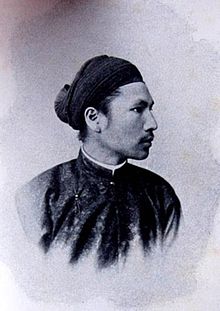
How not to stick to this Vietnam, this lost country where sacrifice is not a vain word? This sacrifice is found time and again in the Annals of the history of Vietnam. I would rather be a ghost in the South than a prince in the North, declared General Trần Bình Trọng before being executed by the Mongols in 1257. Life is a game of chance. The chance is against us. It’s worth dying now for the country and set an example of sacrifice, said the nationalist leader Nguyễn Thái Học before being guillotined on June 17, 1930 in Yên Bái. How to erase in the collective memory the innocent face of the young captive emperor Hàm Nghi, exiled to Algeria at the age of 18 with tears in the eyes? How to forget the tragic death of the exiled emperor Duy Tân ( an aircrash in OuBangui-Chari, Africa ) whose announced return could probably change in 1945 the regrettable events of the history of Vietnam during the last decades?

How not to regret this native country that was however not tender ?. It was the feeling expressed by writer Huỳnh Quang Nhường in his best-seller « The land I lost », published by Castor Poche Flammarion.

Is a country that I like to exist still in the course of its history?.

In Search of the Origin of the Vietnamese People: Part 2 (Đi tìm nguồn gốc dân tộc Việt)


Đi tìm nguồn gốc dân tộc Việt (Phần 2)

French version

Vietnamese version

In search of the Origin of the Vietnamese people

This remark has been confirmed by what was discovered in the tombs at the Guigi site of Jiangxi: The weapons found bore a symbolic characteristic because they were all made of wood. They did not have an important place in people’s life or after-live. This led to the conclusion that contrary to the society of the folks from the North, that of the Yue was rather more peaceful. That is why they were not able to resist better every time there was an encroachment by the neighbors from the North, the Yi  did not stop at nibbling away their territory and pushing them a little farther south at each confrontation. The Yi  themselves by their art of making bows and arrows. They were formidable warriors talented in arching and horse riding. Hardened by the roughness of nature, they were used to wrestling with wild animals and other tribes. That gave them at the start a gene of a conqueror and a fighter in their blood.

It was not the case of the folks from the South, the Bai Yue. The wise Confucius had the occasion to compare the forces that the folks from the North and from the South possessed respectively: Courage and power ( Dũng ) for the former and kindness and generosity ( Nhân từ ) for the latter. Again, the word Yi  夷 for origin the picture of a man 人 holding a bow  弓 gives us a pretty good idea on the particularity of the folks from the North. Under the direction of , Houang Di ( Hoàng Ðế ) they have succeeded in pushing back the first tribes of Bai Yue in the territory delimited by the yellow river Huang He and the YangTse river led by Chiyou ( Xi Vưu ) ( or Ðế Lai in Vietnamese ) in alliance with king Lôc Tục ( ou Kinh Dương Vương ) who reigned south of the blue River on a vast country of Xích Qủi ( Country of red demons ). According to a Chinese legend, this confrontation took place at Trác Lộc ( Zhuolu ) in the presently province of Hebei and has permitted the folks from the North to start progressively their expansion to the Blue River. The death of Chiyou marked the first victory of the folks from the North over the Bai Yue people some 3000 years B.C.

At the Shang period, none of the Chinese or Vietnamese historic documents talked about the relationship between the Bai Yue and the Shang besides the Vietnamese legend about « Phù Ðổng Thiên Vương » ( or the heavenly hero of Phù Ðổng village ) which reported a confrontation between the Shang and the Văn Lang kingdom of the Luo Yue. However it was noted that contact was established later between the Zhou dynasty and the king of the Luo Yue ( Hùng Vương ). A silver pheasant ( bach trĩ ) was offered by the latter to the king of Zhou according to the book Linh Nam Chích Quái. At the time of Spring and Autumn, a state of East Yue was known in the Mémoires Historiques by the historiographer of Han empire Si Ma Qian ( Tư Mã Thiên ) . It was the kingdom of the famous lord Gou Jian (Câu Tiễn). At the death of this one, his descendants did not succeed in maintaining hegemony. At the middle course of the Blue River, another kingdom, founded also by one of the Bai Yue tribes ( Bộc Lão ) and known as Chu ( Sở Quốc), took over at the time of Fighting Kingdoms and became one of the seven rival principalities ( Han, Zhao, Wei, Yan, Qi, Qin and Chu ).(Hàn, Triệu, Ngụy, Yên, Tề, Tần và Sỡ).

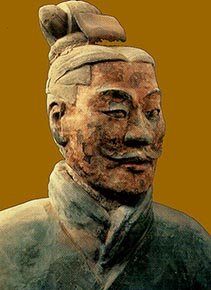
Terracotta warrior of Qin Shi Huang Di

Before being defeated by the army of Qin, the Chu kingdom has indirectly brought its undeniable contribution in favor of the future formation and unity of the Chinese nation  by eliminating in 332 the state of East Yue of Goujian and starting to give a new impulsion to the development of a large state with the reforms of Wu Qi (Ngô Khởi).

The Tong Yue (or the Yue of Gou Jian) began to take refuge in the southern territory of Bai Yue after the annexation of their land by the Chu kingdom. According to Léonnard Aurousseau, after their defeat, the Yue of Gou Jian  (or Tong Yue ) found asylum in large number in the following regions: Foujian  (Phúc Kiến ), Guangdon ( Quảng Ðông ), Guangxi ( Quảng Tây ) and Jiaozhi ( Giao Chỉ ) and thus became the Man Yue ( Foujian ), Nan Yue (Jiangsu, Jiangxi) and Luo Yue (Quangxi, Jiaozhi). All were « sinisized » as centuries went by except the Luo Yue who were the legitime descendants of  the Yue belonging to the Ngeou branch and were known often as Tây Âu (Xi Ngeou).

« There was no doubts on the origin of the Luo Yue », wrote the French scholar Leonard Aurousseau in his work « Notes sur les origines du peuple annamite ( Ghi chép nguồn gốc dân tộc An Nam ) » ( BEFEO, T XXIII, 1923, p.254 ). The other Yue peoples, particularly those living in the Chu kingdom were fast to follow them at the unification of China by Qin Shi Huang Di. This one did not hesitate to banish whoever dare resist his policy of assimilation, particularly the Yue and the Miao to forced labor on the construction of the Great Wall, to burn not only all the works of learned confucianists but also those of other unsubdued people and to maintain his policy of aggression against the Bai Yue as far as Ling Nan ( Linh Nam ). The conquest of the Xi Ou and Luo Yue (Tay Au) territory of Thục An Dương Vương that marked the second confrontation between the Chinese and the Bai Yue, was achieved in 207 with the nomination of two famous governors to the conquered territory: Nhâm Hiếu  (Jen Hiao) and his assistant Triệu Ðà (Zhao Tuo).

In spite of the policy of terror and pacification, the Yue continued to run their resistance heroically. They hid in the bush and lived with the animals. No one agreed to become slave of the Chinese. The Yue picked their chiefs among their men of value. Then they attacked the Chinese at night and inflicted them with a great defeat…, that was reported in the translation of Huainan zi (Hoài nam tử) of L. Aurousseau, B.E.F.E.O. XXIII, 1923, p. 176.

At the death of Nhâm Hiếu, taking advantage of consecutive troubles following the fall of the Qin empire in 207, Triệu Ðà. ( Zhao Tuo ) became allied with other Yue to declare independence fo the Nan Yue kingdom for which he took control of Guilin and Xiang then in 184 B.C., he attacked the Chang Sha region ( Hunan ( Hồ Nam )) . This kingdom was short-lived and fell back in the hands of the folks from the North, the Han in 111 B.C. despite the heroic resistance of Prime Minister Lục Gia. This confrontation, the third one with the people of Bai Yue took away not only their land but also their cultural identity. The sinization began its full steam on the conquered territory ( Foujian (Phuc Kien), Guizhou ( Qui Chau ), Guangdong ( Quảng Ðông ), Guangxi ( Quảng Tây ), Yunnan ( Vân Nam ), Tonkin ( Giao Chỉ ). Many revolts and insurrections broke out during this long period of Chinese domination. But the most dazzling revolt remained the one run heroically by the sisters Trưng Trắc, Trưng Nhị. On appeal of the sisters in 39 A.D., the Yue living in the South of China and a large part of Tonkin joined them. That helped them to stand up with the Han army until 43 A.D. But they were finally defeated by Ma Yuan ( Mã Viện ) a great Chinese marshal at the time. Ma Yuan ( Mã Viện ) assigned by the Han emperor, Guang Wu (Quang Võ) decided to destroy all bronze drums found on the land of the Luo Yue because he knew at the confrontation that those objects had the value as an emblem of power for them. According to what people said, to move back the frontier down to the Nam Quan border gate, he did not hesitate to erect a pillar several meters high made of bronze collected from the drums and bearing this sign:

Ðồng trụ triệt , Giao Chỉ diệt
Ðồng trụ ngã, Giao Chỉ bị diệt.
Bronze pillar falls, Giao Chi disappears

But that did not upset the will and ardor for independence of the Luo Yue ( the Viet ). They decided to consolidate the pillar by throwing a piece of earth around it when they went by, which progressively helped in building up a mound and made disappear the mythical pillar. To deal with any eventuality of revolt, there was also an order from empress Kao (Lữ Hậu) in 179 B.C. providing a ban on delivery of not only plowing and metal instruments but also horses, oxen and sheep to the Barbarians and the Yue. This has been reported by E. Gaspardone in his work titled  » Matériaux pour servir à l’histoire de l’Annam » ( BEFEO, 1929 ). Because of this policy, it is not surprising to discover recently a large number of bronze drums burried in Vietnam and in neighboring areas ( Yunnan, Hunan ). The Ðồng Sơn civilization came to an end during the Chinese occupation.

Forced enlistment of the Yue into the army of the conquerors and the contacts they had with the Chinese as the years went by allowed them to know more about warfare technique (Sunzi (Tôn Tử) for example) and to improve their weapons in the struggle against the invaders in the years to come. On the other hand, the Chinese appropriated what belonged to the Yue during their long occupation. The Yue continued to be treated as barbarians despite their undeniable contribution to the radiance of Chinese culture. Those folks from the North could pretend from then on to be the legitimate holders of the Writing of Luo, the theory of Ying and Yang and the 5 elements, even though there exists a large number of incoherence in their mythical made up stories.

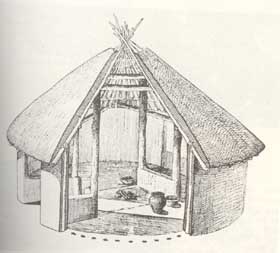
 Reconstructed model found at the Banpo site

They modified the dragon, the preferred mythical animal of the Bai Yue, which had a start with an alligator’s head and a snake’s body, to fit their temperament of a warrior and their taste by giving it the wings and a horse’s trunk and definitely adopted it as their own symbolic animal even though they had the white tiger in their Turco – Mongol traditions. Their round form house whose model has been reconstructed and found at the Banpo site has been replaced by a spacious house with a roof largely « hollow-back » and overflowing in canopy, that of the Bai Yue. In the turmoil of history, there was no more room for the Bai Yue.

Except the Luo Yue, other peoples of Bai Yue continued to be « sinized » in a way that at the end of 10th century, on their land there were only two peoples face to face, a conquering people (the Han) and the rebellious people ( the Viet ) looking for independence. The states of Gou Yue, Nan Yue, Man Yue etc…thereafter took part in Southern China. Taking advantage of the breaking up of the Tang empire, the Luo Yue declared independence with Ngô Quyền. The Vietnamese nation began to see the day. One should not believe that everything went really smoothly and harmoniously. It cost such sacrifices in order for the folks from the North to accept the reality. That is how the history page of the Bai Yue was mixed up with that of the Luo Yue.

Have recent scientific discoveries radically changed the view about the Bai Yue and particularly their history? They have called into question he idea of cultural diffusionism originated from the North. More ancient vestiges than those at Hemudu have been discovered recently in the middle Blue river at Pentoushan ( Hunan ) . Could one continue to consider the Miao 苖, the Bai Yue as « barbarian » folks? Nevertheless the word Miao (or Miêu in Vietnamese) which is made of a ricefield picture ( Ðiền 田) added on its top the pictogram « Thảo » (cỏ) 艹( herb ) provides evidence how the Chinese depict in their language people knowing how to grow rice. Could we continue to maintain a traditional and obsolete version written by the conquerors to the detriment of the search for historic truth? It turns out indispensable to put the train back on the tracks knowing for sure that the Chinese civilization does not need made up stories because it deserved to appear for a long time among the great civilizations of humanity. It is the ancestors of the Luo Yue that taught the folks from the North the culture of rice and not the other way around as has been written in a large number of Chinese and Vietnamese historic documents. The time has come to give the homage to our ancestors, the Yue, who because of their peaceful nature were forced to be wiped off in front of the use of force in the turmoil of history.

Inheriting a glorious past, embroiled in successive fratricidal and colonial wars and mired in corruption, Luo Yue’s Vietnam needs to pull itself together because it does not deserve to be one of the poorest countries in the world. It is time for it to follow in the footsteps of its ancestors and do better than them.

À la recherche de l’origine du peuple vietnamien (Đi tìm nguồn gốc dân tộc Việt)


English version
Vietnamese version

La découverte du site Hemudu (Zhejiang) en 1973 fut un grand évènement pour les archéologues chinois car ce site datant plus de 5000 ans témoigne de la trace de la plus ancienne civilisation du riz trouvée jusque là dans le monde. On y a trouvé aussi les restes d’un habitat lacustre en bois monté sur pilotis, un type de construction bien différent des maisons en terre de la Chine du Nord. La population qui vivait là était caractérisée par des traits à la fois mongoloïdes et australo-négroïdes. Comme Zhejiang fait partie des plus belles provinces de la Chine du Sud depuis longtemps, on ne cesse pas d’attribuer aux Chinois cette fameuse civilisation bien qu’on sache que le berceau de leur civilisation est lié étroitement au bassin du fleuve Jaune (ou Huang He) (Hoàng Hà) dont Anyang est le cœur antique. On ne peut pas nier que leur civilisation a trouvé toute sa quintessence dans les cultures néolithiques de Yang-Shao (province de Henan) (5000 ans av J.C.) et Longshan ( province de Shandong ) ( 2500 ans av J.C. ) identifiées respectivement par le Suédois Johan G. Andersson en 1921 et par le père de l’archéologie chinoise Li Ji quelques années plus tard. Grâce aux travaux d’analyse phylogénétique de l’équipe américaine dirigée par le professeur J.Y. Chu de l’université de Texas publiés en Juillet 1998 dans la Revue de l’Académie des Sciences américaine et groupés sous le titre «  Genetic Relationship of Population in China » (1) , on a commencé à avoir une idée précise sur l’origine du peuple chinois. 

On a relevé deux points importants dans ces travaux:

  • 1°) Il est clair que l’évidence génétique ne peut pas soutenir une indépendance originale des Homo -sapiens en Chine. Les ancêtres des populations vivant actuellement dans l’Est de la Chine venaient de l’Asie du Sud Est.
  • 2°) Désormais, il est probablement sûr de conclure que les gens « modernes » originaires d’Afrique constituent en grande partie le capital génétique trouvé couramment dans l’Asie de l’Est.

Dans sa conclusion, le professeur J.Y. Chu a reconnu qu’il est probable que les ancêtres des populations parlant des langues altaïques ( ou des Han ) étaient issus de la population de l’Asie du Sud Est et des peuplades venant de l’Asie centrale et de l’Europe.

Cette découverte n’a pas remis en cause ce qu’a proposé il y a quelques années auparavant le professeur d’anthropologie Wilhelm G. Solheim II de l’université Hawaii dans son ouvrage intitulé Une nouvelle lumière dans un passé oublié.(2) Pour cet anthropologue, il n’y avait pas de doute que la culture de Hòa Bình ( 15000 ans avant J.C. ) découverte en 1922 par l’archéologue français Madeleine Colani dans un village proche de la province Hòa Bình du Vietnam avait été la base de la naissance et de l’évolution future des cultures néolithiques de Yang-Shao (Ngưỡng Thiều)  et de Longshan (Long Sơn)  trouvées dans le Nord de la Chine. Le physicien britannique Stephen Oppenheimer était allé au delà de ce qui n’était pas pensé jusque-là en démontrant dans sa démarche logique et scientifique que le berceau de la civilisation de l’humanité était en Asie du Sud Est dans son ouvrage intitulé  Eden dans l’Est: le continent noyé de l’Asie du Sud Est.

Il y a conclu qu’en se basant sur les preuves géologiques trouvées au fond de la mer de l’Est (Biển Đông)  et sur les méthodes de datation effectuées avec C-14 sur la nourriture ( patate douce, taro, riz, céréales etc. ) retrouvée en Asie du Sud Est ( Non Nok Tha, Sa Kai ( Thailande ), Phùng Nguyên, Ðồng Ðậu (Vietnam), Indonésie ), un grand déluge avait eu lieu et avait obligé les gens de cette région qui, contrairement à ce que les archéologues occidentaux avaient décrit comme des gens vivant de pêche, de chasse et de cueillette, étaient les premiers sachant maîtriser parfaitement la riziculture et l’agriculture, à émigrer dans tous les azimuts ( soit vers le Sud en Océanie, soit vers l’Est dans le Pacifique , soit vers l’Ouest en Inde ou soit vers le Nord en Chine ) pour leur subsistance. Ces gens étaient devenus les semences des grandes et brillantes civilisations trouvées plus tard en Inde, en Mésopotamie, en Egypte et en Méditerranée.

De cette constatation archéologique et scientifique, on est amené à poser des questions sur tout ce qui a été rapporté et falsifié par l’histoire dans cette région du monde et enseigné jusque-là aux Vietnamiens. Peut-on ignorer encore longtemps ces découvertes scientifiques ? Peut-on continuer à croire encore aux écrits chinois (Hậu Hán Thư par exemple ) dans lesquels on a imputé aux préfets chinois Tích Quang (Si Kouang) et Nhâm Diên (Ren Yan) le soin d’apprendre aux ancêtres des Vietnamiens la façon de s’habiller et l’usage de la charrue qu’ils ne connaissent pas au premier siècle de notre ère? Comment ne connaissent-ils pas la riziculture, les descendants légitimes du roi Shennong (Thần Nông) (3), lorsqu’on sait que ce dernier était un spécialiste dans le domaine agraire? Personne n’ose relever cette contradiction.

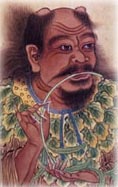
Shennong (Thần Nông)

On ne se pose même pas des questions sur ce que les gens du Nord ont donné à ce héros divin comme surnom Yandi (Viêm Ðế) ( roi du pays chaud des Bai Yue ) (3). S’agit -il de leur façon de se référer au roi de la région du Sud car à l’époque des Zhou, le territoire des Yue était connu sous le nom Viêm Bang? Est-il possible aux gens nomades du Nord d’origine turco-mongole, les ancêtres des Han et aux gens du Sud, les Yue d’avoir les mêmes ancêtres? S’agit-il encore d’une pure affabulation édifiée à la gloire des conquérants et destinée à légitimer leur politique d’assimilation? 

Toutes les traces des autres peuples, les « Barbares », ont été effacées lors de leur passage. La conquête du continent chinois a commencé aux confins du lœss et de la Grande Plaine et a existé près de quatre millénaires. C’est ce qu’a noté l’érudit français René Grousset dans son ouvrage « Histoire de la Chine » en parlant de l’expansion d’une race de rudes pionniers chinois de la Grande Plaine .

Face à leur brillante civilisation, peu de gens y compris les Européens lors de leur arrivée en Asie ont osé mettre en doute ce qui a été dit jusque-là dans les annales chinoises et vietnamiennes et penser à l’existence même d’une autre civilisation que les dominateurs ont réussi à accaparer et à effacer sur le territoire soumis du peuple Bai Yue. Le nom de l’Indochine a déjà reflété en grande partie cette attitude car pour un grand nombre de gens, il n’y a que deux civilisations méritant d’être citées en Asie: celles de l’Inde et de la Chine. Il est regrettable de constater aussi la même méprise commise par certains historiens vietnamiens imprégnés par la culture chinoise dans leur ouvrage historique. A force d’être endoctrinés par la politique de colonisation des gens du Nord, un certain nombre de Vietnamiens continuent à oublier notre origine et à penser aujourd’hui que nous sommes issus des Chinois. Ceux-ci n’hésitaient pas à mettre en marche leur politique d’assimilation et d’annexion dans les territoires qu’ils avaient réussi à conquérir depuis la création de leur nation. Le succès de la sinisation des Han était visible au fil des siècles lors de leur contact avec d’autres peuples « barbares » . Le processus ne dut pas être différent de celui qui a marqué leur empiétement au XIXème siècle sur la « terre des herbes mongole » et au XXème sur la forêt mandchourienne. 

On ne réfute pas à leur brillante civilisation d’avoir un impact indéniable sur le développement de la culture vietnamienne durant leur longue domination mais on ne peut pas oublier de reconnaître que les ancêtres des Vietnamiens, les Luo Yue (ou Lạc Việt) ont eu leur propre culture, celle de Bai Yue. Ils étaient les seuls survivants de ce peuple à ne pas être sinisés dans les tourmentes de l’histoire. Ils étaient les héritiers légitimes du peuple Bai Yue et de sa civilisation agricole. Les tambours en bronze de Ðồng Sơn ont témoigné de leur légitimité car on a trouvé sur ces objets les motifs de décoration retraçant leurs activités agricoles et maritimes de cette brillante époque avant l’arrivée des Chinois sur leur territoire ( Kiao Tche ou Giao Chỉ en vietnamien ).

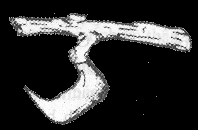
On sait maintenant que la civilisation agricole de Hemudu a donné naissance à la culture de Bai Yue (ou Bách Việt en vietnamien). Le terme Bai Yue signifiant littéralement les Cent Yue, a été employé par les Chinois pour désigner toutes les tribus croyant appartenir à un groupe, les Yue. Selon l’écrivain talentueux vietnamien Bình Nguyên Lộc, l’outil employé fréquemment par les Yue est la hache (cái rìu en vietnamien) trouvée sous diverses formes et fabriquée avec des matériaux différents (pierre, fer ou bronze). C’est pour cette raison qu’au moment du contact avec les gens nomades du Nord d’origine turco-mongole, les ancêtres des Han (ou Chinois), ils étaient appelés par ces derniers, sous le nom « les Yue », les gens ayant l’habitude de se servir de la hache. Celle-ci prit à cette époque la forme suivante:

et servit de modèle de représentation dans l’écriture chinoise par le pictogramme. Celui-ci continua à figurer intégralement dans le mot Yue  auquel on ajoute aussi le radical mễ  (米) riz ou gạo en vietnamien) pour désigner les  riziculteurs à l’époque de Confucius. De nos jours, dans le mot Yue 越, outre le radical « Tẩu (走) outrepasser ou en vietnamien vượt ) »,  la hache continue à être représentée par le pictogramme  戉 modifié incessamment au fil des années. Le mot Yue provient peut-être phonétiquement du phonème Yit employé par la tribu Mường pour désigner la hache. Il est important de rappeler que la tribu Mường est celle ayant les mêmes origines que la tribu Luo Yue (ou Lạc Việt) dont les Vietnamiens sont issus. (Les rois illustres vietnamiens Lê Ðại Hành , Lê Lợi étant des Mường). Récemment, l’archéologue et chercheuse du CNRS, Corinne Debaine-Francfort a parlé de l’utilisation des haches cérémonielles yue par les Chinois dans le sacrifice d’humains ou d’animaux, dans son ouvrage intitulé « La redécouverte de la Chine ancienne » (Editeur Gallimard, 1998). Le sage Confucius avait l’occasion de parler du peuple Bai Yue dans les entretiens qu’il a eus avec ses disciples. 

Le peuple Bai Yue vivant dans le sud du fleuve Yang Tsé (Dương Tử Giang) a un mode de vie, un langage, des traditions, des mœurs et une nourriture spécifique … Ils se consacrent à la riziculture et se distinguent des nôtres habitués à cultiver le millet et le blé. Ils boivent de l’eau provenant d’une sorte de plante cueillie dans la forêt et connue sous le nom « thé ». Ils aiment danser, travailler tout en chantant et alterner des répliques dans les chants. Ils se déguisent souvent dans la danse avec les feuilles des plantes. Il faut éviter de les imiter . (Xướng ca vô loại). 

L’influence confucianiste n’est pas étrangère au préjugé que les parents vietnamiens continuent à entretenir encore aujourd’hui lorsque leurs enfants s’adonnent un peu trop aux activités musicales ou théâtrales. C’est dans cet esprit confucéen qu’on les voit d’un mauvais œil. Mais c’est aussi l’attitude adoptée par les gouverneurs chinois en interdisant aux Vietnamiens d’avoir des manifestations musicales dans les cérémonies et les festivités durant la période de leur longue domination.

L’historien chinois Si Ma Qian (Tư Mã Thiên) avait l’occasion de parler de ces Yue dans ses Mémoires historiques (Sử Ký Tư Mã Thiên) lorsqu’il a retracé la vie du seigneur illustre Gou Jian (Câu Tiễn), prince des Yue pour sa patience incommensurable face au seigneur ennemi Fu Chai (Phù Sai), roi de la principauté de Wu (Ngô) à l’époque des Printemps et Automnes. Après sa mort, son royaume fut absorbé complètement en 332 avant J.C. par le royaume de Chu (Sở Quốc) qui fut annexé à son tour plus tard par Qin Shi Huang Di (Tần Thủy Hoàng) lors de l’unification de la Chine. Il est important de souligner que le site de Hemudu se trouve dans le royaume Yue de Gou Jian.(Zhejiang).

Parmi les  groupes partageant la même culture de Bai Yue , on trouve les Yang Yue, les Nan Yue (Nam Việt), les Lu Yue, Les Xi Ou, Les Ou Yue, les Luo Yue (Lạc Việt , les Gan Yue, les Min Yue (Mân Việt), les Yi Yue, les Yue Shang etc. Ils vivaient au sud du bassin du fleuve bleu , de Zhejiang (Chiết Giang) jusqu’au Jiaozhi (Giao Chỉ)(le Nord du Vietnam d’aujourd’hui). On retrouve dans cette aire de répartition les provinces actuelles de la Chine du Sud: Foujian (Phúc Kiến), Hunan (Hồ Nam), Guizhou (Qúi Châu), Guangdong (Quảng Ðông), Jiangxi, Guangxi (Quảng Tây) et Yunnan (Vân Nam).

Les Bai Yue étaient probablement les héritiers de la culture Hoà Bình . Ils étaient un peuple d’agriculteurs avertis: ils cultivaient le riz en brûlis et en champ inondé et élevaient buffles et porcs. Ils vivaient aussi de la chasse et de la pêche. Ils avaient coutume de se tatouer le corps pour se protéger contre les attaques des dragons d’eau (con thuồng luồng). En s’appuyant sur les Mémoires Historiques de Si Ma Qian, l’érudit français Léonard Aurousseau a évoqué la coutume des ancêtres de Goujian ( roi des Yue de l’Est) de peindre leurs corps de dragons ou d’autres bêtes aquatiques comme celle trouvée chez les Yue du Sud.

Ils portaient les cheveux longs en chignon et soutenus par un turban. D’après certains textes vietnamiens, ils avaient des cheveux courts pour faciliter leur marche dans les forêts des montagnes. Leurs vêtements étaient confectionnés avec les fibres végétales. Leurs maisons étaient surélevées pour éviter les attaques des bêtes sauvages. Ils se servaient de tambours en bronze comme d’objets rituels utilisés pour les cérémonies d’invocation à la pluie ou comme un emblème de pouvoir utilisé en cas de besoins pour appeler les guerriers au combat. « Les Giao Chỉ ont possédé un sacré instrument : le tambour en bronze. En écoutant la voix du tambour, ils étaient tellement enthousiastes au moment de la guerre etc. », c’est ce qu’on a trouvé dans le premier volume de l’écrit chinois « Hậu Hán Thư (L’écrit de Hán postérieur) . Leurs guerriers étaient vêtus d’un simple pagne et armés de longues lances ornées de plumes. Ils étaient aussi des hardis navigateurs qui, sur leurs longues pirogues, sillonnèrent toute la Mer de l’Est (Biển Đông)  et au delà une partie des mers australes. Malgré leur haute technicité et leur maîtrise parfaite en matière d’agriculture et de riziculture, ils étaient un peuple très pacifique. Lire la suite (2ème partie)


(1) Volume 95, issue 20, 1763-1768, 29 July , 1998
(2) National Geographic, Vol 139, no 3
(3) Kinh Dương Vương, étant le père de l’ancêtre des Vietnamiens, Lạc Long Quân et l’arrière petit-fils du roi Shen Nong.


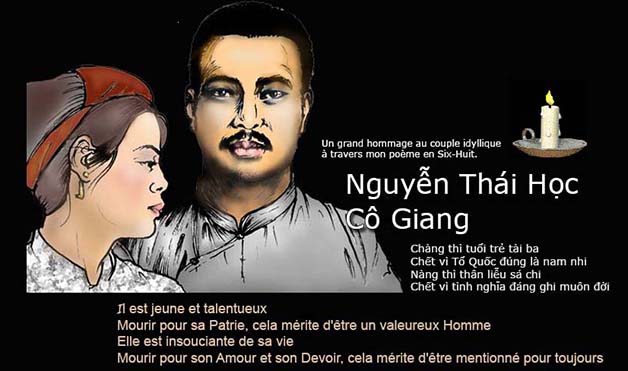
Yên Bái (Nguyễn Thái Học- Cô Giang)


Thaihoc

A great homage to the idyllic couple through my poem in Six-Eight:

He is young and talented;
Dying for his Father Land, he deserves being a valorous man.
She does not worry about her own life;
Dying for her love and duty, she is unforgettable forever.

Version française

Version vietnamienne

Contrary to other Vietnamese towns, Yên Bái has no tourist attractions. It is only the provincial capital, a riverside town located in the valley of the Red river half way on the road going from Hànội to the Chinese border Lào Cai. In spite of that, it continues to be famous in the past by its armed resistance driven by Vietnamese nationalists in the struggle for independence. It incarnates not only the hope of the Vietnamese people to regain their freedom by force but also the dauntlessness of the nationalists before death after the failure of their revolt in 1930. It should be looked at in the political context of that time to understand not only the causes of that revolt but also the Vietnamese people’s profound aspiration for independence after Phan Chu Trinh ‘s failure in advocating priority of overall progress of society over political independence followed by his death, and the house arrest of Phan Bội Châu, another important figure, by the colonial authorities at the capital of Huế.

Despite the warning of colonel Parfait-Louis Monteil in 1924, few reforms were made in favor of the native people. On the contrary, the exploitation of cheap labor in rubber tree plantations was at the top of its efficiency and horror. Writer Roland Dorgelès talked about it in his work « The Mandarin Road« . This virgin land, when it opens on impact, releases a mortal breath. As many as traced paths, as many as open tombs. The rubber trees coming out of the ground, spindly, and well in lines, look like the rows of cross. The dead numbered in the tens of thousand because of diseases and malnutrition. That is why through the following poem, this complaint is heard:

Kiếp phu đỗ lắm máu đào
Máu loang mặt đất máu trào mủ cây
Trần gian địa ngục là đây
Ðồn điền đất đỏ nơi Tây giết người

The coolies’ blood has much shed,
It shed on the ground, it shed through the sap.
This is the hell on earth,
The rubber tree plantation is where the French colonists commit murder.

For half of a century, the colonists harvested latex they converted into gold. It was in the plantations that sprouted the revolt. Someone like Nguyễn Văn Viên arrived at getting out of this hell and joining the Vietnamese nationalist party ( Việt Nam Quốc Dân Ðảng ) led by Nguyễn Thái Học. To show this fervor and find a favorable echo among the deprived, especially the plantation coolies, Nguyễn Văn Viên took the initiative, in spite of Nguyễn Thái Học’s reluctance, to assassinate Bazin known for his opulence in recruiting coolies and shipping them to rubber tree plantations in South Vietnam. The death of this man gave the colonial authorities an opportunity to launch the policy of repression all over the place.

Thus the nationalist party became the favored target in this crusade. It could no longer move easily. If it did not react, it would be a slow death because its members would be captured sooner or later by the colonial authorities. If it did react by the revolt, it knew that it would be a collective, hazardous, and exemplary suicide. That is why Nguyễn Thái Học had the habit of saying to his party companions:

Ðại hà chi thanh, nhân thọ kỷ hà?
Ðợi sông Hoàng Hà trong trở lại, đời người thọ là bao?

Waiting for the Yellow River water to be clear, how many live spans can we count?

The real photo of Nguyễn Thái Học

According to the Chinese, the Yellow River water only regains its clearness every three hundred years. Nguyen Thai Hoc knew for sure he was going to lead his party companions to a definite death. He could not wait any longer. But this death seemed useful because it recalled to the Vietnamese people that there was no other choice but the struggle. It also marked the beginning of   an   awareness and awakening of the whole people facing its destiny that was, up until then, led by the unworthy heirs of the Nguyễn dynasty (Khải Ðịnh, Bảo Ðại). The revolt of  Yên Bái was an indisputable failure because most of the nationalists leaders were captured.

On the other hand, it threw in a sound and long lasting basis upon which the communist party laid its authority and popularity among the people in the following years in the conquest of independence. It also tolled the death knell for a colonial empire that had vainly lost so many opportunities to reestablish the dialogue and cooperation with the native people. This was translated by the death sentence imposed on all the nationalist leaders. Nguyễn Thái Học was the last one to be guillotined. Before his execution, he was impassible. In spite of his weakness, he tried to shout out loud in French:

Dying for one’s country
Is the most beautiful fate
The most envied lot….

Then he lay down on his back facing the blade of the guillotine. « Long live Vietnam » was the last words heard before the fall of the guillotine’s blade. His blood spurted everywhere under a covered sky. His head fell in a bucket containing saw dust (June 17 1930). He was only 27. Faithful to her Vietnamese tradition, his wife Nguyễn Thị Giang did not take long to follow him to commit suicide on June 18, 1930 at the inn where they had met often before their marriage. She left a letter whose sentences illustrated well the indefectible love she had for her husband and her country:

Sống nhục sao bằng sự thoát vinh
Nước non vẹn kiếp chung tình
………
Cuộc đời xá kể chi thành bại
Trai trung thì gái phải trinh

Dying in pride rather than living in humiliation
I make it whole the love for you and the nation
……..
Success and failure do not matter in life
As long as man is faithful and woman has fidelity.

The remains of the thirteen Vietnamese nationalists were buried the following day on a hill near the Yên Bái railway station.

If this town is not as well known as most of Vietnamese cities, it incarnates on the contrary something the other towns cannot have. It is the symbol of maturity and dignity rediscovered in a people facing its own fate. It grew valiantly in the past along with the Vietnamese people in its struggle for independence.

(Việt Nam Quốc Dân Ðảng)

Nguyễn An Ninh (Version anglaise)

Version vietnamienne
Version française

Sống sao không thẹn với đời
Chết sao để tránh ngàn lời mĩa mai
Sống vỉ thế hệ tương lai
Chết vì đất nước tù đày không than

A great homage to Nguyễn An Ninh

through my  Six-Eight verses:

To live in such a way one has no shame of living
To die in such a way to avoid thousands of ironies
Is to live for future generations
And to die for one’s country without complaining days in imprisonment.

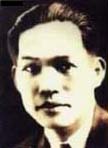
Facing Nguyễn An Ninh’s flat refusal to repent and the alarming situation caused by the imminent landing of the Japanese army in Indochina in 1943, his jailer, the warden of the Poulo Condor prison, Mr. Tisseyre decided to eliminate this burdensome prisoner who was sick and potentially dangerous in his view because the Japanese could later use him as a pawn on the Indochina chessboard.

Nguyễn An Ninh since his coming back to Vietnam, became not only, as time went by, an idol for the Vietnamese youth but also one of the most respected leaders among Vietnamese intellectuals in Cochinchina. Even during his imprisonment in Poulo Condor, he was the only one to have received the esteem of all political prisoners no matter they are communists, nationalists, Trotskists or other etc.  and to have brought peace in case of stormy debates or virulent altercations between prisoners.

How come a young man like Nguyễn An Ninh arrived at becoming a « bête noire  » of the colonial authorities? However at the beginning he did not have intention to resort to violence like the Nguyễn Thái Học nationalists or the Vietnamese communists. He supported himself with his pen and the newspaper « La cloche fêlée » whose director was a longtime friend of his, a French of the name Eugene de Jean de la Bâtie. He made a mistake to have dared demand with fanfare for his compatriots the freedom of expression and fundamental rights which he had fully enjoyed during his years of study at the Sorbonne in Paris, and which were lacking then in Vietnam, by using his caustic and careless critics, and succinct analyses in his newspaper. He did not even conceal his sympathy that his has always had for the leader Phan Chu Trinh, a friend of his father Nguyễn An Khương. He was the translator of Jean Jacques Rousseau‘s « Social Contract ». By means of seminars and public debates, he succeeded in provoking a collective awareness among Vietnamese intellectuals of the 1920’s and 1940’s who up until then were asleep in a seemingly happiness, freedom and justice created by the colonial authorities.

Those young intellectuals only bothered with universally human subjects such as love, family, sadness of separation etc… Although they are often alongside with the rural area, they never asked any questions about what was going on there. Not that they ignore the poverty outside urban areas but they never lived there. Even though they were not issue of large estate bourgeoisie or sons of collaborators, they nourished the dream of becoming government officials.
From his return to Vietnam in 1922, instead of going into this traditional mould like others of his age, his generation, Nguyen An Ninh, this young man of 22 years of age, with rounded hairdo, law graduate from the Sorbonne, made his way in the opposite direction by advocating the method of the Indian poet Tagore. The latter thought it would be possible to obtain independence without bloodshed from the British by means of straightening up to the intellectual level of the Indian people. That was why with the help of some of his friends he did not hesitate to launch a series of debates on themes such as  » A culture for the Annamites », « The ideal of the Annamite youth » etc…, which provoked from then on visible swirls in a harbor of peace established by the Governor of Cochinchina, Mr. Cognacq.

He was the instigators of several petitions claiming not only freedom of expression but also freedom of education and freedom of the press for the natives. It was a significant worry for this governor because through his tonic speeches, Nguyễn An Ninh arrived at mobilizing and electrifying the intellectual youth of South Vietnam, casting doubts among the Vietnamese intellectuals having at the time total confidence in the French education system in Indochina. Cognacq was compelled to react because each speech animated by Nguyễn An Ninh provided the occasion to mobilize more and more people. Cognacq did not hesitate to remind him several times that there was always room at the prison of Poulo Condor for recalcitrant people like him. On the other hand, he would have access to an important post in the colonial administration if he gave up this suicidal adventure.

Despite this reminder full of threat, Nguyen An Ninh continued persevering in this political involvement, which compelled the colonial authorities to imprison him several times. His first incarceration was shortened thanks to the strong intervention of many French personalities of that time, especially that of Romain Rolland, Nobel Price winner in literature in 1915, before the colonial authorities. From then on, Nguyễn An Ninh became not only a regular visitor of the prison but a man to bring down for the colonial authorities. Having been aware of the impossibility of claiming before the colonial authorities the fundamental rights by peaceful means, he soon undertook secretly the armed struggle. He became thus the leader of the party « Hope of the Youth ( Ðảng Thanh Niên Cao Vọng ) being successful in having more than 7000 adherents during its existence and aiming at redistributing land to poor peasants in 1927.

His renown allowed him to make friend with the leaders of other political movements, especially with trotskist Tạ Thu Thâu, journalist Hồ Hữu Tường, young attorney Trịnh Ðình Thảo, communist Nguyễn Thị Minh Khai etc. He was contacted several times by the communists and the Nguyen Thai Hoc nationalists and asked to join their movements but he took the pretext of being closely watched by the colonial authorities to refuse their proposals with courtesy. Closer to the communists in his ideas and struggle, he knew however how to make a difference. He never concealed that he had in himself the ideas of Jean Jacques Rousseau and Diderot. He loved to be above the melees and political rivalries and considered himself above all a Vietnamese intellectual serving his country.

Taking advantage of the political confusion taking place in France by the dissolution of the French communist party by president Edouard Daladier ( 25 September 1939 ) and of the lack of support from the French intellectuals that Nguyễn An Ninh had up until then, it did not take the colonial authorities long to put their hand on Nguyễn An Ninh and expeditiously sent him to the Poulo Condor prison by charging him with being the troublemaker and instigator of peasant revolts.
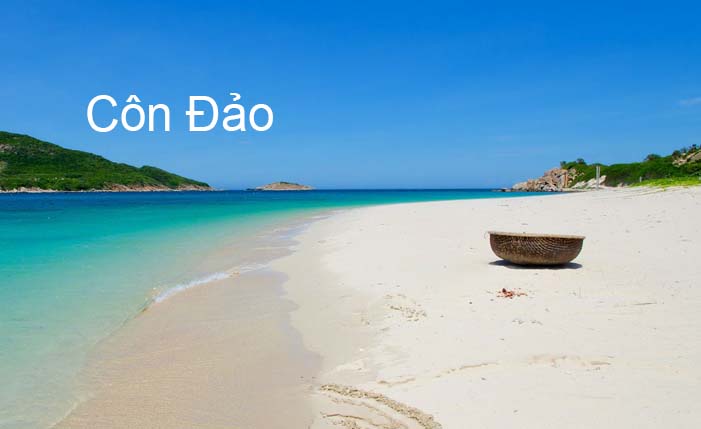
Very few Vietnamese dared talk about this prison without emotion. It is all about an archipelago of 14 small islands located at 180km from Vũng Tàu (ex Cap Saint Jacques) and accessible after 12 hours by boat. By the end of 13th century, Marco Polo noted that island Côn Sơn, the greatest of all 14 islands was uninhabited. The Poulo Condor archipelago was the object of secular dispute between the Vietnamese, Khmers and Malays. It was discovered one beautiful morning, 28 November 1861, by the lieutenant of the French Royal Navy of Napoleon III, Lespes Sebastien Nicolas Joachim. It became thus a French possession during colonial time and stood out among famous prisons.

But Nguyễn An Ninh remained the only one capable of wiping out all stormy discussions between protagonists. To relax in jail, Ninh composed many poems but the most famous remains the following found in his pocket at his interment by his prison inmates:

Sống và chết

Sống mà vô dụng sống làm chi
Sống chẳng lương tâm, sống ích gì
Sống trái đạo người, người thêm tủi
Sống quên ơn nước , nước càng khi
Sống tai như điếc, lòng đâm thẹn
Sống mắt dường đui dạ thấy kỳ
Sống sao nên phải cho nên sống
Sống để muôn đời, sử tạc ghi…
….. ….
Chết được dựng hình tên chẳng mục
Chết đưa vào sử chữ không phai.
Chết đó, rõ ràng danh sống mãi
Chết đây, chỉ chết cái hình hài
Chết vì Tổ Quốc, đời khen ngợi
Chết cho hậu thế, đẹp tương lai

Living and Dying

Living useless is not worth living
Living without a conscience is living useless
Living counter to humanism is pitiable
Living forgetting one’s country is despicable.
Living as if deaf is shameful
Living as if blind is embarrassing
Living the way one should would one live
Living as such that history engraves memory

Dying statue erected in one’s name undecayed
Dying legacy entering history unfaded
Dying that way is like living for ever
Dying as such is only physical dying
Dying for one’s country is praised at all time
Dying for posterity is a beautiful dying

His death could have gone unnoticed had there not been the check of prison guard Rognon who by coincidence verified the bag containing the bodies of prisoners dead the day before ( 14 August 1943 ) and scheduled to be sent to the morgue. Taken by pity and admiration he always had for Nguyễn An Ninh, he decided to alert Mr. Tisseyre, the director of the prison and asked him for permission to bury Nguyễn An Ninh in a coffin. But he did not know that Nguyễn An Ninh was liquidated on order of Tisseyre with a shot of arsenic. That was why Tisseyre, embarrassed by that suggestion, did not hesitate to remind Rognon that he was beginning to be interested in businesses that have nothing to do with him. Alerted by the death of her friend Nguyen An Ninh she had known at the time when she was a young student at the Sorbonne, the wife of the director of the electric company at Poulo Condor, Mme Charlotte Printanière insisted at length with Tisseyre that Nguyễn An Ninh be buried with dignity. Facing Tisseyre’s inhuman treatment, she was compelled to to tell him with irritation:

A person like him deserves being respected when it comes to a Vietnamese patriot. You would lose nothing if you bury him the way it should be. Besides, you will be appreciated for your your generosity. For what reasons do you continue to stop showing your admiration toward this true revolutionary? Who dare say in the future you will always be the winner? »

In spite of this remark, Tisseyre remained impassible. He left the body of Nguyen An Ninh in a pitiful condition with his clothes in tatters. He was buried the next day at Hàng Keo by his prison inmates. As for Mme Charlotte Printaniere, she was recalled to Saigon a few days later and was forbidden to return to the island. Her remark became a prophecy a few years later. Tisseyre was imprisoned in his turn by the Japanese army and was sentenced to 20 years in prison by General De Gaulle ‘s court martial for having surrendered without conditions to the Japanese Army.

By means of Tisseyre, the colonial authorities succeeded in killing Nguyễn An Ninh. But they forgot the phrase that Nguyễn An Ninh had recalled well in his poem « Living and Dying« . Dying here is just the physical death of the body. Actually, Ninh has gone but there are many other Ninhs who came to take his place and the torch of the struggle. Since the beginning of time, history has taught us that it is always possible to eliminate all the instigators of revolts but it is impossible to eradicate their ideas, especially those having to do with the defense of a just and legitimate cause.

Nguyễn An Ninh is not only the person having a notable influence on the intellectuals of South Vietnam in the 1920’s and 1940’s but also a person capable of waking up a generation. It was the opinion of historian Daniel Hémery in his work « Saigon 1925-1945 » published in 1972 in Paris.

Nguyễn An Ninh was not only a Vietnamese patriot but also a valiant militant revolutionary who fought for the Country and the People to the last breath of his life. It was the terms used by Phạm văn Ðồng to pay homage to Nguyễn An Ninh in the Liberated Saigon newspaper issue 14 August 1993, no. 571. When he was alive Ngô Ðình Diệm, the ex-president of the Republic of Vietnam, did not even forget what Nguyen An Ninh had done to the country by giving to Admiral Courbet street near the Bến Thành central market the name Nguyễn An Ninh and restoring his tomb in Poulo Condor island.

It is no surprise to see Nguyễn An Ninh succeed in receiving still after so many decades unanimous approvals from all Vietnamese political tendencies. He has always been considered by his compatriots as a Vietnamese intellectual in his service to his country. He had the possibility to become rich with his degree at that time, to put himself on the side of the strongest in the difficult moments of the Vietnam history but he preferred to choose another way, the one to share the misfortune with his people and to engage a political combat in the pursuit of freedom.

How many Vietnamese politicians still have this ideal like Nguyễn An Ninh on this land of legends?

Nguyễn An Ninh (Version française)


Vietnamese version

English version

Sống sao không thẹn với đời
Chết sao để tránh ngàn lời mĩa mai
Sống vỉ thế hệ tương lai
Chết vì đất nước tù đày không than

Hommage à Nguyễn An Ninh à travers mes quatre vers en Six-Huit

Comment faut-il vivre pour n’éprouver aucune honte avec cette vie?
Comment faut-il mourir pour ne pas recevoir des milliers de blâmes?
Vivre pour les futures générations
Mourir pour la patrie sans se plaindre un jour dans la prison.

Devant le refus catégorique de Nguyễn An Ninh de se repentir et devant la situation alarmante provoquée par le débarquement imminent de l’armée japonaise en Indochine en 1943, son geôlier, le directeur du bagne de Poulo Condor, Mr Tisseyre décida d’éliminer ce prisonnier encombrant, malade et potentiellement dangereux à ses yeux car les Japonais pourraient s’en servir plus tard comme un pion sur l’échiquier indochinois.

Nguyễn  An Ninh, depuis son retour au Viêt-Nam, devint non seulement. au fil des années, l’idole de la jeunesse vietnamienne mais aussi l’un des leaders les plus écoutés et les plus respectés auprès des intellectuels vietnamiens en Cochinchine. Même durant son emprisonnement au bagne de Poulo Condor, il fut le seul à recevoir l’estime de tous les prisonniers politiques que ce soit communistes, nationalistes, trotskistes ou autres etc. et à ramener la paix en cas de débats houleux ou d’altercations.

Comment un jeune homme comme Nguyễn An Ninh arriva-t-il à devenir la bête noire des autorités coloniales? Pourtant il n’avait pas l’intention de recourir au début à la violence comme les nationalistes de Nguyễn Thái Học ou les communistes. Il ne vivait que de sa plume avec le journal intitulé « La Cloche Fêlée » dont le directeur était son ami de longue date, un Français de nom Eugène Dejean de la Bâtie. Il avait le tort d’oser revendiquer à cor et à cri pour ses compatriotes la liberté d’expression et les droits élémentaires dont il avait bénéficié pleinement durant ses années d’études à la Sorbonne à Paris et qui faisaient défaut jusqu’alors au Viêt-Nam par ses critiques acerbes et sans ménagement et ses analyses succinctes dans son journal. Il ne cachait pas non plus la sympathie qu’il avait eue toujours pour le leader Phan Chu Trinh, un ami de longue date de son père Nguyễn An Khương. Il était aussi l’auteur de la traduction en vietnamien de l’ouvrage « Le contrat social » de Jean Jacques Rousseau. Par le biais des séminaires et des débats publiques, il réussit à provoquer une prise de conscience collective de tous les jeunes intellectuels vietnamiens des années 1920-1940 qui étaient jusque-là endormis au Sud-Vietnam par un semblant de bonheur, de liberté et de justice crée par les autorités coloniales. Ces jeunes intellectuels ne se préoccupaient jusqu’alors que des sujets universellement humains: amour, famille, tristesse des séparations etc.

Bien qu’ils côtoyassent souvent le milieu rural, ils ne se posaient jamais des questions sur tout ce qui touchait de près ou de loin à ce dernier. Ils n’ignoraient rien de la pauvreté périurbaine mais sans jamais y vivre. Bien qu’ils ne fussent pas issus de la bourgeoisie latifundiaire ou des fils des collaborateurs, ils nourrissaient tous leur rêve de devenir fonctionnaires. De son retour au Viêt-Nam en 1922, au lieu d’être rentré dans ce moule traditionnel comme les autres jeunes de son âge, de sa génération, Nguyễn An Ninh, ce jeune homme de 22 ans, à la chevelure bombée, licencié en droit à la Sorbonne, fit le chemin inverse en prônant la méthode du poète indien Tagore. Celui-ci pensa qu’il était possible d’obtenir l’indépendance sans effusion de sang auprès des Anglais par le biais de redressement du niveau intellectuel du peuple indien.  C’était pour cela qu’il n’hésita pas à donner avec l’aide de quelques amis une série de débats sur les thèmes tels que  » Une culture pour les Annamites », « L’idéal de la jeunesse Annamite » etc… , ce qui provoqua dès lors des remous visibles dans un havre de paix établi par le gouverneur de la Cochinchine, Mr Cognacq. Il fut l’instigateur de plusieurs pétitions réclamant non seulement la liberté d’expression mais aussi la liberté d’enseignement et la liberté de presse pour les autochtones.

C’était un souci non négligeable pour ce gouverneur car à travers ses discours toniques, Nguyễn An Ninh arriva à mobiliser et à électriser la jeunesse intellectuelle du Sud Viet-Nam, à semer un doute auprès des intellectuels vietnamiens ayant une confiance totale jusque là dans le système d’enseignement français en Indochine. Cognacq fut obligé de réagir car chaque discours animé par Nguyễn An Ninh donna l’occasion de mobiliser de plus en plus des gens. Cognacq n’hésita pas à lui rappeler plusieurs fois qu’il y avait encore de la place au bagne de Poulo Condor pour les gens récalcitrants comme lui. Par contre, il pourrait accéder à un poste important dans l’administration coloniale s’il renonçait à cette aventure suicidaire. Malgré ce rappel empreint de menaces, Nguyễn An Ninh continua à persévérer dans cet engagement politique, ce qui obligea les autorités coloniales de l’emprisonner à maintes reprises. Son premier internement fut écourté grâce à l’intervention énergique de plusieurs personnalités françaises de cette époque, en particulier celle de Romain Rolland, prix Nobel de la littérature en 1915 auprès des autorités coloniales.

Dès lors, Nguyễn An Ninh devint non seulement un habitué de la prison mais un homme à abattre pour les autorités coloniales. Ayant pris conscience de l’impossibilité de réclamer auprès des autorités coloniales les droits élémentaires par des voies pacifiques, il ne tarda pas à s’engager secrètement dans une lutte armée. Il devint ainsi le leader du parti « Espoirs de la Jeunesse ( Ðảng Thanh Niên Cao Vọng ) » ayant réussi à avoir plus de 7000 adhérents durant son existence et ayant pour but de redistribuer la terre aux pauvres paysans en 1927.

Sa renommée lui permit de se lier d’amitié avec les jeunes dirigeants des autres mouvements politiques, en particulier avec le trotskiste Tạ Thu Thâu, le journaliste Hồ Hữu Tường, le jeune avocat Trịnh Ðịnh Thảo, la jeune communiste Nguyễn Thị Minh Khai etc.

Il était contacté à maintes reprises par les communistes et par les nationalistes de Nguyên Thái Học pour lui demander de rejoindre leur mouvement mais il prit le prétexte d’être surveillé étroitement par les autorités coloniales pour refuser avec courtoisie leur proposition. Plus proche des communistes dans les idées et la lutte, il sut montrer pourtant sa différence. Il ne cacha jamais qu’il avait toujours en lui les idées de Jean Jacques Rousseau et de Diderot. Il aima à être au dessus de toutes les mêlées et des rivalités politiques et se considéra avant tout comme un intellectuel vietnamien au service de la nation.

Profitant de la confusion politique provoquée en France par la dissolution du parti communiste français par le président Edouard Daladier (25 Septembre 1939) et du manque de soutien que Nguyễn An Ninh avait eu jusque-là auprès des intellectuels français, les autorités coloniales ne tardèrent pas à mettre la main sur Nguyễn An Ninh et l’envoyer expéditivement au bagne de Poulo Condor en le taxant d’être le fauteur de troubles et l’instigateur des révoltes paysannes.

Très peu de vietnamiens osaient parler de ce bagne sans émoi. Il s’agit bien d’un archipel de 14 îlots situé à 180 km au large, accessible depuis Vũng Tàu (ex Cap Saint Jacques) en douze heures de bateau. Lors de son passage à la fin du XIIIe siècle, Marco Polo nota que l’île de Côn Son, la plus grande des 14 îles était inhabitée. L’archipel de Poulo Condor fut l’objet de litiges séculaires entre les Vietnamiens, les Khmers et les Malais. Il fut découvert un beau matin, le 28 Novembre 1861, par le lieutenant de la marine royale française de Napoléon III, Lespes Sébastien Nicolas Joachim. Il devint ainsi français durant l’époque coloniale et se distingua par ses célèbres pénitenciers. C’était un passage obligé pour ceux qui osaient parler de la politique sur cette terre des légendes durant la période coloniale. On trouva non seulement parmi les pensionnaires du bagne des communistes célèbres comme Phạm Văn Ðồng, Lê Duẫn,Tôn Ðức Thắng, Nguyễn Văn Tạo, mais aussi des nationalistes, des trotkistes et des partisans du « Grand Viêt-Nam ( Ðại Việt ) « ..

Mais Nguyễn An Ninh resta le seul leader capable d’annihiler toutes les discussions houleuses entre ces protagonistes. Pour se détendre dans la cellule, Ninh composa beaucoup de poèmes mais le plus célèbre restait le suivant trouvé dans sa poche au moment de son enterrement par ses compagnons de prison:

Sống và chết

Sống mà vô dụng sống làm chi
Sống chẳng lương tâm, sống ích gì
Sống trái đạo người, người thêm tủi
Sống quên ơn nước , nước càng khi
Sống tai như điếc, lòng đâm thẹn
Sống mắt dường đui dạ thấy kỳ
Sống sao nên phải cho nên sống
Sống để muôn đời, sử tạc ghi…
….. ….
Chết được dựng hình tên chẳng mục
Chết đưa vào sử chữ không phai.
Chết đó, rõ ràng danh sống mãi
Chết đây, chỉ chết cái hình hài
Chết vì Tổ Quốc, đời khen ngợi
Chết cho hậu thế, đẹp tương lai

Vivre et Mourir

Vivre inutile, ce n’est plus la peine de vivre
Vivre sans conscience, ce n’est plus utile de vivre
Vivre immoral, on se sent plus pitoyable
Vivre sans patrie, on se sent plus méprisable

Vivre sourd aux cris d’injustice, on se sent éprouver de la honte intérieure
Vivre en aveugle, on se sent très gêné
Vivre comment pour se montrer digne de vivre
Vivre comment pour être mémorisé par l’histoire

Mourir c’est avoir une statue érigée et un nom qui ne se décompose pas avec le temps
Mourir c’est laisser dans l’histoire des lettres indélébiles.
Mourir de cette manière c’est faire vivre éternellement le nom
Mourir ici, c’est laisser mourir seulement son corps
Mourir pour la Patrie, c’est mériter de recevoir des louanges pour toujours
Mourir pour la postérité, c’est vouloir rendre radieux l’avenir.

Sa mort pourrait être inaperçue s’il n’y avait pas le contrôle du gardien de prison Rognon. Celui-ci vérifia par hasard le sac contenant les corps des prisonniers décédés la veille (14 Aout 1943) et prévu pour la descente dans la morgue. Saisi par la pitié et par l’admiration qu’il avait eue toujours pour Nguyễn An Ninh, il décida d’alerter Mr Tisseyre, le directeur du bagne et demanda à ce dernier de pouvoir enterrer Nguyễn An Ninh avec un cercueil. Mais il ne savait pas que Nguyễn An Ninh fut liquidé sur l’ordre de Tisseyre avec une piqûre d’arsenic. C’était pourquoi Tisseyre, gêné par cette suggestion, n’hésita pas à rappeler à Rognon qu’il commença à s’intéresser à des affaires qui ne le concernaient pas. Alertée par la mort de son ami Nguyễn An Ninh qu’elle avait connu à l’époque où elle avait été encore une jeune étudiante à la Sorbonne, la femme du directeur de la compagnie d’électricité à Poulo Condor, Mme Charlotte Printannière insista longuement auprès de Tisseyre pour que Nguyễn An Ninh fût enterré avec dignité. Face au traitement inhumain de Tisseyre, elle fut obligée de lui dire avec énervement:

Une personne comme lui mérite d’être respectée lorsqu’il s’agit d’un Vietnamien patriote. Vous ne perdez rien si vous l’enterrez comme il faut. Par contre, vous serez apprécié pour votre générosité. Pour quelle raison continuez-vous à nous empêcher de montrer notre admiration envers ce révolutionnaire authentique? Qui ose dire dans l’avenir que vous serez toujours le vainqueur?

Malgré cette remarque, Tisseyre resta impassible. Il laissa le corps de Nguyễn An Ninh dans un état lamentable avec ses vêtements en lambeaux. Il fut enterré le lendemain à Hàng Keo par ses compagnons de prison. Quant à Mme Charlotte Printanière, elle fut rappelée quelques jours plus tard à Saigon et fut interdite de séjour dans l’île. Sa remarque devint une prophétie quelques années plus tard. Tisseyre fut emprisonné à son tour par l’armée japonaise et fut condamné à 20 ans de prison par le tribunal militaire du Général De Gaulle pour sa lâcheté de capituler sans conditions devant l’armée japonaise.

Par le biais de Tisseyre, les autorités coloniales réussirent à tuer Nguyễn An Ninh. Mais ils oublièrent la phrase que Nguyễn An Ninh avait bien rappelée dans son poème « Vivre et Mourir ». Mourir ici, c’est laisser mourir seulement son corps. Effectivement, Ninh était parti pour toujours mais il y avait d’autres Ninh qui venaient prendre sa place et le flambeau de la lutte.

Depuis la nuit des temps, l’histoire nous avait appris qu’on pouvait éliminer toujours les instigateurs des révoltes mais il était impossible d’extirper leurs idées, en particulier celles ayant trait à la défense d’une cause juste et légitime.

Nguyễn An Ninh était non seulement la personne ayant une influence notable sur les intellectuels du Sud-Vietnam dans les années 1920-1940 mais aussi la personne capable de réveiller une génération. C’était le jugement de l’historien Daniel Héméry dans son ouvrage « Saigon 1925-1945 » paru en 1972 à Paris.

Nguyễn An Ninh était non seulement un Vietnamien patriote mais un militant révolutionnaire vaillant qui s’était battu pour la Patrie et pour le Peuple jusqu’au dernier souffle de sa vie. Ce sont les termes employés par Phạm Văn Ðồng pour rendre hommage à Nguyễn An Ninh dans le journal Saigon libéré paru le 14 Aout 1993 et portant le numéro 571. De son vivant, Ngô Ðình Diệm, l’ex-président de la République du Viêt-Nam, n’oublia pas non plus ce que Nguyễn An Ninh avait fait pour la nation en donnant à la rue d’Amiral Courbet qui est proche du marché central Bến Thành le nom Nguyễn An Ninh et en rénovant sa tombe à l’île Poulo-Condor.

Rien n’est étonnant de voir Nguyễn An Ninh réussir à recevoir encore après tant de décennies les approbations unanimes de toutes les tendances politiques vietnamiennes. Il est considéré toujours par ses compatriotes comme un intellectuel vietnamien au service de la nation. Il eut la possibilité de s’enrichir à cette époque avec son diplôme, de se ranger du côté des plus forts dans les moments difficiles de l’histoire du Viêtnam mais il préféra choisir une autre voie, celle de partager avec son peuple les malheurs et d’engager un combat politique courageux en quête de la liberté.

Combien d’hommes politiques vietnamiens ont-ils encore cet idéal?

Le tombeau de l’empereur patriote Hàm Nghi (Ngôi Mộ của vua Hàm Nghi)


Hàm Nghi

Version anglaise
Version française
Galerie des photos

Từ lâu cứ mang hoài bão được một lần đến viếng thăm và đốt nhan kính cẩn trước mộ của vua Hàm Nghi nhất là mộ của ông được an táng ở làng Thonac thuộc vùng hành chánh Aquitaine, khu vực Dordogne, tỉnh Sarlat-la-Canéda, huyện Montignac (Pháp Quốc).
Cuối tuần của tháng năm năm 2017, tôi được đến nơi nầy cùng con cháu nhưng lòng ngổn ngang, bùi ngùi khi tìm thấy lại mộ của ông. Không ngờ ngôi mộ nầy đã trải qua bao năm tháng rêu phong vẫn phủ đầy, không có đựợc như hình mình trông thấy ở trên internet. Cảm thấy  xót xa cho một vị vua anh hùng của đất nước bị lưu đày lúc 18 tuổi bởi thực dân Pháp và chết ờ Alger. Trở về Paris rất buồn bã và bận bịu chuyện nhà cho đến những năm tháng tháng gần đây mới tải hình lên trang nhà hình ảnh lầu đài De Losse mà đươc công chúa Như Mây, trưởng nữ của vua Hàm Nghi mua lại vào ngày 6/8/1930, với giá 450.000 quan. Sau nầy, vì không còn khả năng tài chánh, công chúa Như Mây bán lại cho một người Pháp (1972) rồi lại qua tay một người khác nữa rồi đến ngưới Anh sau cùng vào năm 1999. Nay được nhà nước Pháp xếp hạng lầu đài nầy là di tích văn hoá lịch sử từ năm 1932. Chính nhờ vậy mà hài cốt cua vua được cải táng mang về Pháp ở làng Thonac khi Algérie được độc lập vào năm 1965 và được chôn ở nơi nầy cùng vợ con và bà quản gia.

Nhắc đến vua Hàm Nghi, thì  không thể nào không nhắc lại tiểu sử của vua.  Ông là em trai của vua Kiến Phúc tên là Ưng Lịch được đặt lên ngôi bởi hai quan phụ đại thần nhiếp chính Nguyễn văn Tường và Tôn Thất Thuyết vào năm 1884 lúc ông được 13 tuổi. Các quan đại thần nầy đã từng giết 3 vua trong thời gian ngắn 1 năm Dục Đức, Hiệp Hoà và Kiến Phúc, nghĩ rằng có thể định hướng dễ dàng vua Hàm Nghi  trong công cuộc chống Pháp nhất là với tuổi tác của ngài. Sau cuộc tấn công thất bại ở Mang Cá, nơi mà quân đội Pháp của thống soái De Courcy đóng, vua Hàm Nghi buộc lòng trốn ra ngoài kinh thành và lánh nạn ở Quảng Trị cùng Tôn Thất Thuyết và  Nguyễn văn Tường.  Nhưng vì một lý do nào không được rõ, Nguyễn văn Tường quay đầu  trở về kinh thành. Nhưng qua bốn câu thơ mà ông  để lại truơc tình thế khó khăn nầy thì Tường có ý nói rằng sở dĩ ông không đi theo Thuyết và vua Hàm Nghi vì muốn ở lại để duy trì xã tắc. Vì vua hay vì nước đằng nào đáng khinh hay đáng trọng?

Xe giá ngàn trùng lẫy dặm xanh
Lòng tôi riêng luyến chốn lan đình
Phải chăng phó mặc ngàn  sau luận
Vua, nước đôi đường hỏi trọng khinh?

Sau đó ông nhờ giáo sĩ Caspar để xin yết kiến thống soái De Courcy. Ông còn  khẳng định rằng ông không có tham gia vào cuộc đai chiến ở Mang Cá. Nhưng De Courcy giã vờ tin ông nói thực và còn dùng ông để chiêu dụ vua Hàm Nghi trở về kinh thành. Nhưng sau hai tháng ông không làm tròn nhiệm vụ thì ông bị De Courcy đày ông ra Côn Đảo rồi đi Tahiti khi ông bị bệnh và chết ở Papeete. Còn Tôn Thất Thuyết cùng các con Tôn Thất Đạm và Tôn Thất Thiệp tiếp tục phò tá vua Hàm Nghi trong công cuộc kháng chiến chống Pháp suốt 4 năm trời ròng rã. Ông cuối cùng trốn sang Trung Quốc mong sự giúp đỡ của triều đình nhà Thanh và chết ở nơi nầy vào năm 1913. 

Vua Hàm Nghi đã hai lần xuống chiếu Cần vương, kêu gọi các sĩ phu dân làng nổi đậy từ Bắc đến Nam để đòi độc lập. Các chiếu nầy làm cho lòng dân  phiến động. Ở mọi nơi sự hưởng ứng không hê suy giảm  cũng như ở Hà Tĩnh với Phan Đinh Phùng, Đinh Nho Hạnh, ở Bình Đình thì có Lê Trung Đình, ở Thanh Thủy thì có Đề Đốc Lê Trực, ở  Quảng Bình có Nguyễn Phạm Tuân  vân vân …Tên của Hàm Nghi trở thành vô tình ngọn cờ độc lập dân tộc. Còn ông thì cuộc đấu trânh vẫn còn dù chính quyền thực dân Pháp đã đặt lên ngôi  sau đó vua Đồng Khánh với sự đồng ý của bà thái hậu Từ Dũ, mẹ của vua Tự Đức. Bởi vậy muốn dập tắt các cuộc nổi loạn ở mọi nơi thì phải bắt cho được vua Hàm Nghi vì Hàm Nghi là linh hồn còn các quân phiến loạn Cần vương là thân thể. Nếu linh hồn mất thì thân thể cũng phải tiêu tan tự nhiên. Giữa ông và quân Cần vương, Tôn Thất Đạm là người môi giới.  Ít người có dịp được gần gũi  và biết mặt của vua Hàm Nghi  lắm vì vua Hàm Nghi lúc nào cũng có sự bảo vệ chặt chẽ  của hai đứa con của Tôn Thất Thuyết  (Tôn Thất Đạm và Tôn Thất Thiệp) ở bên cạnh cùng đám quân người Mường của Trương Quang Ngọc, một chủ tể người Mường trên sông Nai tỉnh Quảng Bình.  Ông sống rất kham khổ trong thời gian đấu tranh ở trong rừng.

Cho đến khi bị bắt bởi quân Pháp nhờ sư phản bội của Trương Quang Ngọc, ông không bao giờ nhìn nhận ông là vua Hàm Nghi vì đối với ông đây là cái nhục không thể tưởng.  Ông giã vờ không biết các quan chi cả khiến làm chính quyền  thực dân Pháp cũng không biết có đúng người hay không? Chính vì thế họ dùng kế đưa sĩ phu Nguyễn Thuận. Ông nầy dàn dụa nước mắt qùy lạy vua và rung rẩy làm rớt cây gậy.  Lúc đó vua Hàm Nghi đở ông đứng dậy và quỳ trước mặt ông: « Xin đừng, kính thầy« . Ngay lúc đó, ngài nhận ra ngài đã sai lầm khi làm ra điều đó bởi vì Nguyễn Thuận là gia sư của ngài khi ngài còn nhỏ. Ngài không bao giờ hối hận vì cử chỉ này  cả. Đối với ngài, sự tôn trọng gia sư  phải được xem trọng  trước mọi chuyện khác. Nhờ sự công nhận này, chính quyền thực dân đã chắc chắn bắt được vua Hàm Nghi. Sau đó vua bị  lưu đày  năm 18 tuổi sang Algeria. Vua không bao giờ thấy lại Việt Nam. Ngay cả thi thể của vua cũng không được đưa về Việt Nam cho đến ngày hôm nay trước sự từ chối của gia đình mặc dầu có sự đề nghị của chính phủ Vietnam vào năm 2002 nhưng được chôn cất tại làng Thonac ở Sarlat (Dordogne, Pháp) cùng gia đình. Trong thời gian lưu vong ở Alger, ông đã từ bỏ tất cả  mục tiêu chính trị từ năm 1904, ngày mà ông kết hôn với một người phụ nữ Pháp. Đây là những gì cháu gái của ông, Amandine Dabat tiết lộ trong tác phẩm của cô có tựa đề là  Hàm Nghi, hoàng đế lưu vong và nghệ sĩ ở Alger, Nhà xuất bản Đại học Sorbonne, xuất bản ngày 28 tháng 11 năm 2019. Ông tìm được nguồn an ủi trong một niềm đam mê khác, một cách sống khác thông qua nghệ thuật. Ông hay thường gần kề giới nghệ thuật và trí thức trong thời đại của ông  như Marius Reynaud, Auguste Rodin, Judith Gautier vân vân….

Nhờ đó, ông trở thành học trò  của họa sĩ Marius Reynaud và nhà điêu khắc tài hoa Auguste Rodin và cho phép ông vượt qua nỗi đau buồn bất diệt của một vị hoàng đế yêu nước bị lưu đày xa quê hương cho đến khi qua đời.

Château De Losse

Dordogne

Empereur patriote Hàm Nghi

Depuis longtemps, je nourris l’espoir de pouvoir visiter un jour le tombeau de l’empereur exilé Hàm Nghi lorsque je sais qu’il était enterré dans la commune Thonac située dans le département de la Dordogne de la région Nouvelle-Aquitaine. À la fin de la semaine du mois Mai de l’année 2017, j’eus l’occasion d’être dans ce coin avec mes enfants mais j’étais complètement déboussolé et triste quand je trouvai son caveau. Celui-ci continue à être ravagé par la mousse et ne ressemble pas à la photo trouvée  sur internet. Nous sommes tous abasourdis et révoltés face à  l’absence de respect envers Hàm Nghi, un jeune empereur exilé à 18 ans par les colonialistes français et mort à Alger. . De retour à Paris, étant attristé par cette histoire, je n’ai pas assez de temps non plus pour mettre sur mon site les photos de Thonac, en particulier celles du château De Losse dont le propriétaire n’est autre que la fille aînée de l’empereur Hàm Nghi, la princesse Như Mây. Celle-ci a acheté le château en 1930 avec la somme de 450000 francs. À cause du problème financier, elle l’a revendu à un Français puis celui-ci l’a cédé plus tard à la famille anglaise en 1999. Aujourd’hui, ce château est classé monument historique depuis 1932. C’est pour cette raison que les restes de  l’empereur Hàm Nghi furent ramenés en France à Thonac lors de l’indépendance de l’Algérie en 1965 et y furent ré-enterrés avec sa famille (son épouse, sa fille aînée Như Mây, son fils unique Minh Đức et sa ménagère). 

Empereur Hàm Nghi

En évoquant le roi Hàm Nghi, on ne peut pas oublier de rappeler sa biographie. Connu sous le nom de Ưng Lịch, il était le petit frère du roi Kiến Phúc. Il  fut mis sur le trône par deux régents Nguyễn văn Tường et Tôn Thất Thuyết  en 1884 lorsqu’il avait 13 ans.  Ayant tué moins d’un an trois rois successifs Dục Đức, Hiệp Hoà et Kiến Phúc, ceux-ci  pensaient qu’avec le jeune âge de Hàm Nghi  ils pourraient orienter facilement sa gouvernance dans une politique destinée à chasser les Français hors du Vietnam. Après l’échec de l’assaut des Vietnamiens contre la garnison française du général  De Courcy à Mang Cá,  le roi Hàm Nghi fut obligé de quitter la citadelle de Huế et se réfugia à Quảng Tri dans le centre du Vietnam. Il fut accompagné par Tôn Thất Thuyết et Nguyễn Văn Tường. Pour une raison inconnue, ce dernier retourna à la citadelle de Huế. Il tenta de donner plus tard son explication à travers son poème dans lequel il reconnut qu’il ne suivit plus Hàm Nghi dans la résistance car pour lui il était préférable de  servir l’état au lieu d’engager la résistance. Pour le roi ou pour l’état vietnamien, le choix était difficile. Il laissa à la génération future de le juger.

Xe giá ngàn trùng lẫy dặm xanh
Lòng tôi riêng luyến chốn lan đình
Phải chăng phó mặc ngàn  sau luận
Vua, nước đôi đường hỏi trọng khinh?

La charrette parcourt des milliers de kilomètres à travers de vastes champs verdoyants.
Mon cœur seul aspire au pavillon des orchidées.
Serait-ce le destin de laisser cela au jugement de l’avenir ?
Le roi et le pays se trouvent à la croisée des chemins, s’interrogeant sur la valeur et le mépris.

Il demanda au prêtre Caspar de contacter De Courcy pour avoir une audience et tenta de convaincre ce dernier qu’il ne participa pas au  lancement de cet  assaut avorté. Faisant semblant d’y croire, De Courcy lui proposa d’écrire des missives  pour exhorter Hàm Nghi et ses partisans à retourner à la citadelle de Huế   et lui fixa un ultimatum de deux mois.  Suite à son échec de convaincre Hàm Nghi et Tôn Thất Thuyết, il fut déporté d’abord à l’île Poulo Condor puis à Tahiti pour être soigné à cause de sa maladie et mourut enfin à Papetee. Quant à Tôn Thất Thuyết, il continua à accompagner Hàm Nghi dans la lutte contre les Français avec ses enfants Tôn Thất Đạm et Tôn Thất Thiệp durant les 4 années de résistance. Il finit par partir finalement en Chine pour demander de l’aide des Qing et y mourut en exil en 1913.

Le roi Hàm Nghi  demanda deux fois à toutes les forces vives de la nation, en particulier aux lettrés de se soulever contre les autorités coloniales en son nom par le mouvement baptisé « Cần Vương » (ou Aide au roi) du Nord jusqu’au sud pour réclamer l’indépendance. Ce mouvement commença à trouver un écho favorable auprès du peuple. L’ampleur de ce mouvement ne diminua pas et  fut visible partout comme à Hà Tịnh avec Phan Đinh Phùng, Đinh Nho Hạnh, à Bình Định avec Lê Trung Đình, à Thanh Thủy avec l’amiral Lê Trực, à Quảng Bình avec Nguyễn Phạm Tuân  etc. Le nom du roi Hàm Nghi devint par hasard le porte-drapeau de l’indépendance nationale. Malgré la mise en place de Đồng Khánh sur le trône par les autorités coloniales françaises avec l’approbation de la reine-mère Từ Dũ (mère de l’empereur Tự Đức), le mouvement d’insurrection continua à perdurer encore  tant que le roi Hàm Nghi était encore en vie. Pour éteindre partout l’insurrection, il fallait capturer Hàm Nghi car il représentait  l’âme du peuple tandis que les rebelles faisaient partie du corps de ce peuple. Une fois l’âme du peuple éliminée, le corps disparût d’une manière évidente. Entre Ham Nghi et les rébelles du mouvement Cần Vương, il y avait toujours un intermédiaire qui n’était autre que Tôn Thất Đạm, le fils de Tôn Thất Thuyết. Peu de gens avaient le droit de rapprocher Hàm Nghi  qui était protégé constamment par Tôn Thất Thiệp et quelques gardes du corps Mường de Trương Quang Ngọc. Ce dernier était réputé comme un seigneur local Mường vivant sur les rives du fleuve Nai à Quảng Bình.  Hàm Nghi mena une vie difficile et misérable dans la forêt durant la période de résistance. 

À cause de la trahison de Trương Quang Ngọc, il fut capturé en novembre 1888 et ramené à la citadelle de Huế. Silencieux, il réfuta catégoriquement qu’il était le roi Hàm Nghi car pour lui c’était une honte indescriptible. Il continua à rester non seulement impassible mais muet aussi sur son identité devant les interrogatoires incessants de ses geôliers français. Plusieurs mandarins furent envoyés sur place pour identifier si le jeune captif en question était bien le roi Hàm Nghi ou non mais aucun n’arriva à émouvoir ce dernier sauf le vieux lettré Nguyễn Thuận. En voyant le roi qui continuait à faire ce simulacre, celui-ci, les larmes aux yeux, se prosterna devant lui et tremblota en laissant tomber sa canne. Face à l’apparition subite de ce lettré, le roi oublia le rôle qu’il avait joué jusqu’alors  contre ses geôliers, releva ce dernier et s’agenouilla devant lui: « Je vous prie, mon maître ». A ce moment, il se rendit compte qu’il commit un erreur en reconnaissant celui-ci car Nguyễn Thuận fut son précepteur quand il était encore jeune. Il ne regretta jamais ce geste car pour lui, le respect envers son maître passa avant toute autre considération.

Grâce à cette reconnaissance, les autorités coloniales furent sûres de capturer bien le roi Hàm Nghi, ce qui leur permit de pacifier le Vietnam avec la disparition du mouvement « Cần Vương » quelques années plus tard. Il fut déporté ensuite en Algérie à l’âge de 18 ans. Il ne revit plus le Vietnam pour toujours. Même ses restes ne sont pas ramenés encore aujourd’hui au Vietnam à cause du refus de sa famille  mais ils furent re- enterrés au village Thonac à Sarlat (Dordogne, France) lors de la déclaration d’indépendance d’Algérie en 1965 avec sa famille. Durant son exil à Alger, il abandonna tout objectif politique à partir de 1904, date de son mariage avec une Française. C’est ce qu’a révélé sa nièce Amandine Dabat dans son ouvrage intitulé « Hàm Nghi, empereur en exil et artiste à Alger« , Sorbonne Université Presses, paru 28 Novembre 2019. Il trouva son soulagement dans une autre passion, une autre manière de vivre à travers l’art. On le vit côtoyer les milieux artistiques et intellectuels de son époque (Marius Reynaud, Auguste Rodin, Judith Gautier etc.). Grâce à cette fréquentation,

il devint l’élève du peintre orientaliste Marius Raynaud et du sculpteur célèbre Auguste Rodin, ce qui lui permit de surmonter  la douleur sempiternelle et la tristesse d’un jeune empereur patriote exilé loin de son pays natal jusqu’à sa mort. 

Référence bibliographique 

Vua Hàm Nghi. Phan Trần Chúc Nhà xuất bản Thuận Hóa 1995.

Ham Nghi – Empereur en exil, artiste à Alger.  Amandine Dabat, Sorbonne Université Presses, Novembre 2019

[Return DYNASTY]