Temple Quán Thánh (Đền Quán Thánh, Hànội)


Đền Quán Thánh

English version
French_version
Liste des photos

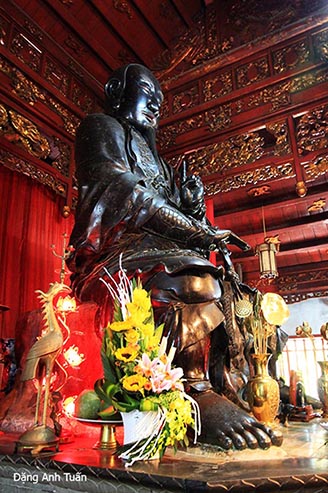
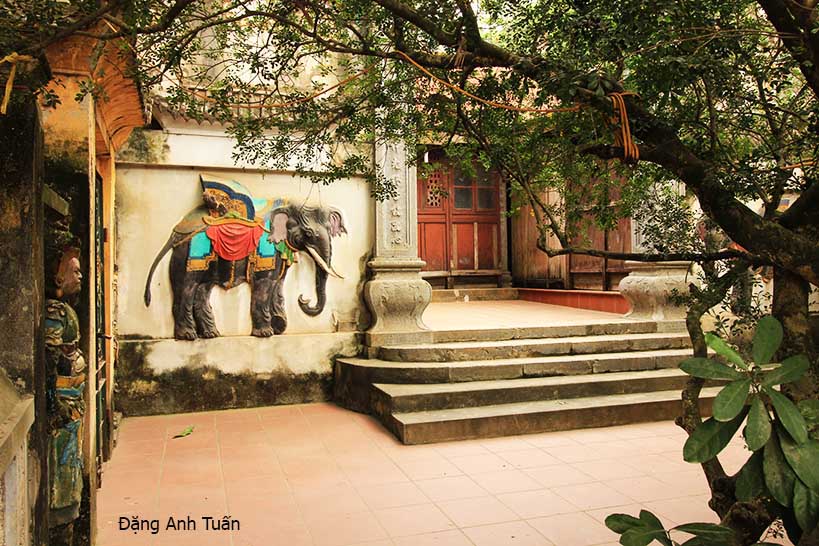
Không cách xa Hồ Tây bao nhiêu, đền Quán Thánh là một điểm tham quan không thể thiếu sót  khi đến Hànội. Đền nầy là nơi để thờ một vị thần của Đạo Giáo tên là Huyền Thiên Trấn Vũ được xem ở Á Châu là hoàng để ở phương Bắc ngự trị trên các  loài  động vật ở dưới nước.  Theo cách bố trí tinh vi của phong thủy, đền nầy được dựng lên cùng ba đền khác hợp thành Thăng Long tứ trấn, để trấn giữ bốn cửa ngỏ của Hà thành chống ngọai bang và ma qủy, mỗi đền một phương ( Đền Bạch Mã Hàng Buồm phương đông, đền Voi Phục phương tây, đền Kim liên phương nam và đền  Quán Thánh phương bắc). Theo lời nói dân gian, đền nầy đã được dựng lên năm 1010 dưới triều đại Lý Thái Tổ. Lúc đầu tượng tạc bằng gỗ. Đã bao lần sửa chữa dưới đời  nhà Trần nhưng chỉ có lần duới triề u của vua Lê Hy Tông năm 1677, sự phục hồi nó mới đáng kể đó là sự thay thế tựợng gỗ bằng đồng đen và gác chuông.

Tượng thần to tác nầy  nặng có 4 tấn và cao gần 4 thước được đặt trên bục đá một thước bề cao. Có một khuôn mặt hình vuông, ngồi chững chạc, chân không  với một bộ áo đạo sĩ. Tượng cầm trong  tay phải có cây  gươm có rắn quấn và chống lên lưng một con rùa và tay trái thì bắt quyết (hay ấn). Màu đen được chọn cho pho tượng vì màu nầy trong ngũ hành là màu tượng trưng cho nước và phương bắc. Phải nói đây là một tác phẩm kỳ diệu của những người dân  đúc đồng của làng Ngũ Xã dưới sự hướng dẩn của Vũ Công Chấn, để lại cho chúng ta  đã có gần 4 thế kỷ rồi. Đền  nầy không những là một trong những đền thuộc đạo giáo còn tìm thấy ở Hànôi mà nó còn là nơi lý tưởng để dành riêng cho những ai muốn tìm sự yên tịnh và thư thản ở Hà Thành náo nhiệt nầy.

Le temple Quán Thánh

Étant situé  non loin du lac de l’Ouest (Hồ Tây), Quán Thánh  est l’un des sites incontournables de Hànội.  Ce temple  sacré est réservé au culte d’un dieu taoïste de nom Huyền Thiên Trấn Vũ considéré en Asie comme l’empereur du Nord (Bei Di (ou Bắc Đẩu en vietnamien))  régnant sur le monde aquatique. Selon l’aménagement judicieux de Feng Shui (Phong Thủy), il est édifié  avec les trois  autres temples dans le but de protéger la capitale Thăng Long contre les envahisseurs étrangers et  les mauvais esprits, chacun dans une direction bien précise (Temple  Bạch Mã  à l’est,  temple Voi Phục (Thủ  Lệ ) à l’ouest, Kim Liên au Sud et Quán Thánh au nord de Hànội). Selon l’on-dit, ce temple fut érigé en 1010 sous le règne de Lý Thái Tổ.

La statue était   en bois au début de l’installation. En dépit des rénovations successives   sous la dynastie des Trần, c’était  seulement en 1677 sous le règne du roi Lê Hy Tông que la restauration fut significative avec l’installation et le remplacement de la statue en bronze noir ainsi que le clocher du temple. 

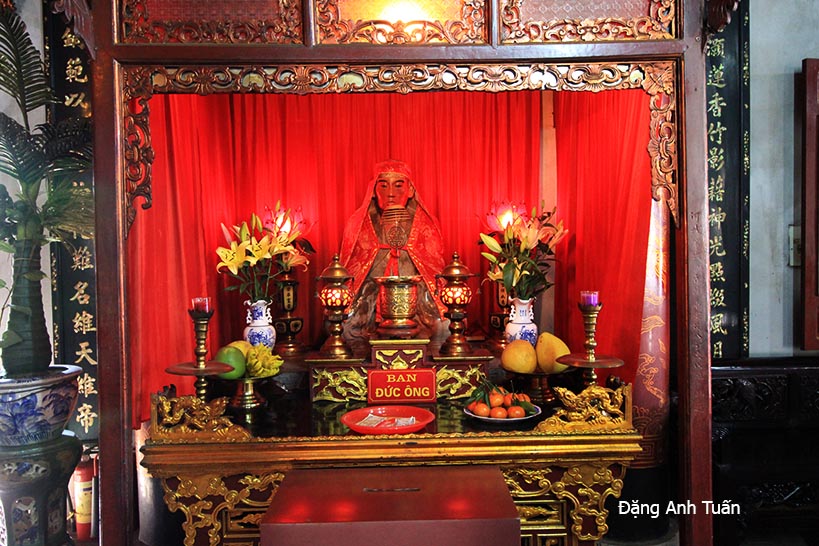
L’autel de Vũ Công Chấn

 Cette statue colossale de  4 tonnes et haute à  peu près de 4 mètres a été posée   sur une estrade en marbre  d’un mètre de hauteur. En position assise avec un visage carré et  ses pieds nus, elle a une tenue traditionnelle taoïste.  Elle tient dans sa main droite une épée pointée  sur le dos d’une tortue et décorée superbement   par la présence   d’un serpent  enroulé tandis que dans sa main gauche, une mudra taoïste, un geste rituel   codifié  est visible  en guise d’exorcisme (bắt ấn).  Associée  à la direction du  Nord et à l’eau, la couleur doit être  noire selon la théorie des 5 éléments (Ngũ hành).  C’est l’explication trouvée dans le choix de la couleur  réservée pour  la statue taoïste. 

La finesse des détails et la taille imposante de cette statue réalisée il y a presque 4 siècles témoignent  incontestablement de l’exploit prodigieux  et du savoir faire des métallurgistes paysans du village Ngũ Xã de cette époque supervisés par Vũ Công Chấn.

Ce temple est non seulement  l’un des derniers temples taoïstes trouvés dans la capitale mais  aussi l’endroit idéal pour ceux qui aiment retrouver la sérénité et le calme dans une ville aussi animée et  bruyante comme Hanoï.

Galerie des photos


Village antique Cừ Đà ( Old village Cự Đà)

Village antique Cừ Đà

 
Version française
Version anglaise
Galerie des photos

Làng cổ Cừ Đà

Được biết làng cổ Cự Đà qua báo chí nên cũng thừa lúc nhàn rỗi ở Hànội lúc cuối năm 2016, tụi nầy lấy quyết định đi tham quan một lần, biết đâu nó còn nét độc đáo  như làng cổ Đường Lâm vã lại nó không xa chi cho mấy Hànôi. Làng nầy nó cách xa thủ đô 20 cây số nếu  tính tử trung tâm nhưng đi đến đó chỉ có hai cách mà thội

  • -một là đi theo hướng chùa Hương để đến làng Khúc Thủy trước khi đến làng Cự Đà (cách nầy thì đi lòng vòng tốn thì giờ dù đi ô tô)
  • còn cách còn lại là tuy ngắn thì giờ (45 phút) nhưng  đi qua chợ Hà Đông đến đường Lê Lợi rồi đi thẳng theo đường liên làng qua làng Đa Sĩ. Tới đây phải đi bộ qua  cái cầu sắt thì tới đầu làng Cự Đà, ít nhất cũng có hai cây số đi bộ.  Tụi nầy  không có lựa chọn chi cả vì em tài  xế không biết nên chọn cách thứ nhì.

Cũng may trởi tuy u ám nhưng không mưa nhiều nên đi bộ cũng tạm được. Vào làng Cự Đà, cảm giác đầu tiên như thời gian nơi nầy đang dừng lại. Không có tiếng kèn, tiếng xe, tiếng ồn ào của làng xóm  như ở Hànôi. Các ngôi  nhà nó rất cũ kỹ, có cái 3 gian, có cái 5 gian, vách tường bị hư hõng rất nhiều. Nơi nầy còn thấy những ngôi nhà hai tầng mang phong cách Pháp được xây cất thời Pháp thuộc. Đúng là một làng cổ kính  ở vùng Bắc Bộ vì còn tìm thấy  được  cổng làng, mái đình, chùa, các cây cổ thụ vân vân ….Nghe kể lại có một thời làng nầy rất được sung túc vì nó nằm bên bờ sông Nhuệ, thuyển bè thường đến giao thương dễ dàng . Các doanh nhân ở Hànôi  đổ xô về đây, chen đua  cất nhà để cuối tuần đựợc an nghĩ. Nay sông Nhuệ màu nước nó đen thối ô nhiểm quá chừng không thua chi kênh Nhiêu  Lộc khiến khi đi qua cẩu sắt  phải bịt mũi lại. Lòng thấy nặng trĩu, tự hỏi ngưòi dân ở đây sao không bệnh họan được. Âu cũng vì nghèo nàn, vi sinh nhai  hằng ngày trong  cuộc sống lam lũ với nghề làm miến, làm tương, dân số càng đông khiến  làng nầy nó đang xuống cấp trầm trọng trước sự áp lực đô thị hóa.

 Từ 500 nhà cổ một thời nay chỉ còn vài chục nhà mà thôi. Dù biết trân trọng cái nét đẹp của làng cổ , người  dân ở đây vì thiếu đất , thiếu phương tiện tài chánh để sùng tu nên họ đành bó tay đôi khi còn  phá vở trần nhà để có chổ phơi miến, đôi khi xây cất lại theo phong cách hiện nay.  Có thể rồi đây  chi cần vài năm nửa thôi làng cổ Cự Đà sẻ không còn như ngày hôm nay được tham quan. 

En apprenant par les médias vietnamiens l’existence d’un village antique Cự Đà, nous sommes décidés d’aller le visiter lors de notre séjour  à Hanội à la fin de l’année 2016. Ce village n’est pas trop loin de la capitale. Il faut compter   une vingtaine de kilomètres si on commence à partir  du centre de Hanội. Deux voies d’accès sont possibles:

  • soit en prenant la route nationale   dans la direction de la pagode des Parfums (Chùa Hương) pour atteindre d’abord  le village Khúc Thủy puis celui de   Cự Đà.
  • soit en prenant la route traversant le marché Hà Đông dans la direction du  village Đa Sĩ. C’est ici qu’il faut entamer la marche à pied (2 kilomètres)  par l’emprunt d’un pont ferroviaire réservé uniquement pour les trains et les motos. C’est  la voie la plus rapide car on ne perd que 45 minutes en auto. Mais c’est aussi la voie d’accès préférée par le jeune chauffeur de la voiture. Heureusement, en dépit du temps maussade, la pluie n’est pas au rendez-vous, ce qui nous permet de marcher de façon convenable.

En entrant dans ce village, on a l’impression que le temps s’arrête.  Contrairement à ce qui est arrivé fréquemment à Hànội, on n’entend aucun klaxon, aucun bruit du moteur ou du village. De vieilles maisons sont rencontrées le long de notre marche. Certaines ont 3 travées, d’autres 5 travées. Leurs murs en brique sont  fortement détériorées. C’est ici qu’on trouve aussi des maisons à deux étages construites à l’époque coloniale dans le style franco-vietnamien. C’est vraiment  un village antique  et typique du Tonkin car on y trouve non seulement son portique mais aussi la toiture imposante de sa maison communale, sa pagode, ses banians centenaires etc…Selon la rumeur, ce village fut florissant à une certaine époque car il est situé au bord du fleuve de nom Nhuệ, ce qui facilite l’échange commercial avec la voie fluviale. Les commerçants plus ou moins aisés de Hànội ne tardaient pas à s’y installer et se rivalisaient à construire des maisons de campagne pour y passer leur fin de semaine. Aujourd’hui, le fleuve Nhuệ est tellement pollué qu’il dégage une odeur nauséabonde et a une coloration noire comme le canal Nhiêu Lộc (Saigon), ce qui nous oblige de nous boucher le nez lors de notre passage sur le pont ferroviaire. Comment les gens peuvent-ils vivre sans être malades? C’est ce profond ressentiment que j’éprouve durant cette visite.

Outre la pauvreté et la dureté de la vie journalière,  les gens de ce village ne vivent que de leur métier: fabrication des  nouilles transparentes et la sauce de soja.

Etant  connu comme  un village de métier, Cự Đà  continue à perdre son charme antique  face à l’urbanisation inquiétante et à la démographie galopante. De 500 vieilles maisons recensées au début du XXème  siècle, il n’en  reste qu’une vingtaine.  Par manque d’espace vital et de moyens financiers  dans la rénovation, certains propriétaires sont obligés d’enlever la toiture de leurs maisons pour l’exposition de leurs nouilles au soleil ou de rebâtir  leurs maisons dans le style moderne. C’est peut-être dans quelques années à venir que Cự Đà n’a plus d’attraits touristiques qu’il  garde encore aujourd’hui  lors de notre visite.

English version

Learning from the Vietnamese media about the existence of an ancient village called Cự Đà, we decided to visit it during our stay in Hanoi at the end of 2016. This village is not too far from the capital. It is about twenty kilometers if you start from the center of Hanoi. Two access routes are possible:

Either by taking the national road in the direction of the Perfume Pagoda (Chùa Hương) to first reach the village of Khúc Thủy and then Cự Đà.
Or by taking the road passing through the Hà Đông market towards the village of Đa Sĩ. This is where you have to start walking (2 kilometers) by crossing a railway bridge reserved only for trains and motorcycles. This is the fastest route as it only takes 45 minutes by car. But it is also the preferred access route by the young car driver. Fortunately, despite the gloomy weather, there was no rain, which allowed us to walk comfortably.

Upon entering this village, one gets the impression that time stands still. Unlike what often happens in Hanoi, there is no sound of horns, engines, or village noise. Old houses are encountered along our walk. Some have 3 bays, others 5 bays. Their brick walls are heavily deteriorated. It is here that you also find two-story houses built during the colonial era in the Franco-Vietnamese style. It is truly an ancient and typical village of Tonkin because it has not only its gateway but also the imposing roof of its communal house, its pagoda, its century-old banyan trees, etc.

According to rumor, this village was prosperous at one time because it is located on the banks of the river named Nhuệ, which facilitates commercial exchange via the waterway. The more or less wealthy merchants of Hanoi soon settled there and competed to build country houses to spend their weekends. Today, the Nhuệ river is so polluted that it emits a nauseating odor and has a black coloration like the Nhiêu Lộc canal (Saigon), which forces us to hold our noses when crossing the railway bridge. How can people live without getting sick? This is the deep resentment I feel during this visit.

Besides poverty and the harshness of daily life, the people of this village live solely from their trade: making transparent noodles and soy sauce.

Known as a craft village, Cự Đà continues to lose its ancient charm in the face of worrying urbanization and rapid population growth. From 500 old houses recorded at the beginning of the 20th century, only about twenty remain. Due to a lack of living space and financial means for renovation, some owners are forced to remove the roofs of their houses to expose their noodles to the sun or to rebuild their houses in a modern style. It may be in the coming years that Cự Đà will no longer have the tourist attractions it still retains today during our visit.

Galerie des photos

[RETURN]

Maison communale Kim Ngân (Đình Kim Ngân, Hànội)

Version française
Version anglaise
Liste des photos

Đình Kim Ngân


Đình Kim Ngân này được xây dựng vào đầu thế kỷ 16 bởi Thượng thư Nội vụ của vua Lê Thánh Tông, Lưu Xuân Tín. Ông vốn là người tỉnh Hải Dương, nổi tiếng với nghề nấu chảy vàng thỏi. Vào thời điểm đó, ông đã đưa một số lượng lớn người dân trong làng của mình đến Hà Nội làm thợ kim hoàn cho nhà vua. Họ đã xây dựng ngôi đình này mang tên Kim Ngân khi họ định cư tại đây. Sau nhiều năm bị bỏ hoang, nó chỉ được trùng tu vào năm 2004 nhờ sự giúp đỡ của các chuyên gia người Pháp từ thành phố Toulouse. Ngày nay, nó không chỉ là nơi thường xuyên diễn ra tất cả các buổi biểu diễn âm nhạc truyền thống (ví dụ như Ca Trù) mà còn là nơi tôn kính tổ tiên của nghề thủ công Hiền Viên.

Cette maison communale Kim Ngân fut édifiée au début du XVIème siècle par le ministre de l’intérieur du roi Lê Thánh Tông, Lưu Xuân Tín. Celui-ci était originaire de la province Hải Dương, connue pour sa spécialité dans la fonte des lingots d’or. Il fit venir à cette époque un grand nombre de gens de son village pour travailler en tant qu’orfèvres à Hànoï pour le compte du roi. Ces derniers y ont construit lors de leur installation cette maison communale de nom Kim Ngân. Etant laissée à l’abandon depuis plusieurs années, elle fut restaurée seulement en 2004 grâce au concours des experts français de la ville de Toulouse. Désormais c’est non seulement l’endroit où ont lieu fréquemment tous les spectacles de musique traditionnelle (Ca Trù par exemple) mais aussi le lieu de vénération de l’ancêtre des métiers Hiên Viên.

This communal house was erected under the reign of king Lê Thánh Tông by the Minister of the Interior, Lưu Xuân Tín. This one was from Hải Dương province known for its speciality in casting into ingots. He invited at this time a large number of people in  his village for working as  silversmiths on the behalf of the king. During the installation, the latter have built à Hàng Bạc this communal house named « Kim Ngân (or silver). Being neglected for many years, it was restored in 2004 by French experts of Toulouse city. Henceforth, it is only the place where tradional music concerts take place frequently but also the space of veneration of Hiên Viên, the ancestor of crafts.
 

Communal House Kim Ngân

(Hàng Bạc)

[Return HANOI]


Ancienne maison Mã Mây (Hànội)

Version française
Version anglaise
Liste des photos

Nhà cổ Mã Mây

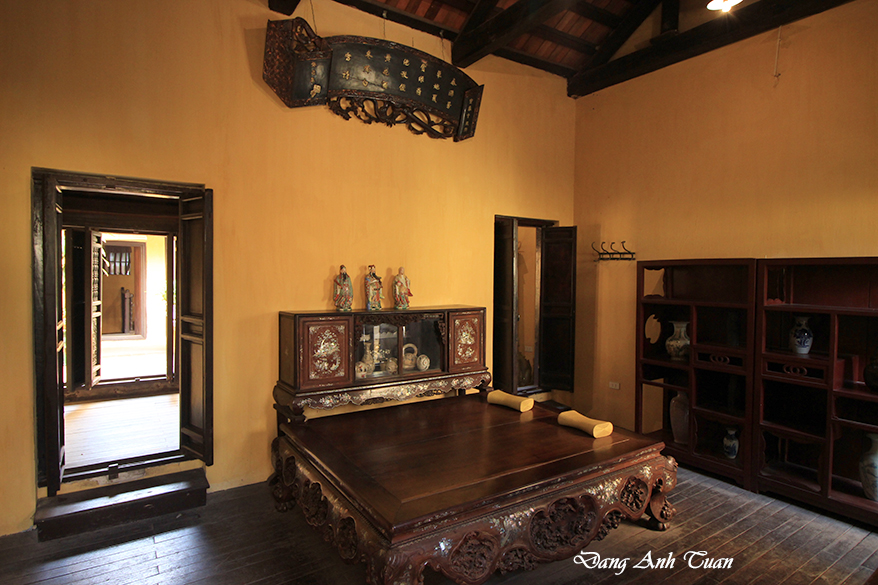
Ngôi nhà nầy được xây cất vào cuối thế kỷ 19 và được thay đổi nhiều chủ nhà mà phần đông họ là những người buôn bán. Ngôi nhà nầy được sùng tu lại gần đây  trong chương trình hợp tác giữa thành phố Hànội với thành phố Pháp Toulouse. Tại sao có tên Mã Mây ? Vì trước đó phố (hay đường) Mã Mây  ở đoạn đầu phố  là Hàng  Mây chuyên môn bán đồ tre và cuối phố thì Hàng Bạc bán vàng mã. Phố nầy thời Pháp thuộc rất sầm uất và buôn bán nên qui tụ nơi nầy rất nhiều thương gia nay trở thành một trong những phố có nhiều du khách ngoại quốc. Nhà cổ Mã Mây được xây cất theo dạng hình ống, rất hẹp chiều ngang và có chiều dài và đa năng sử dụng. Mặt trước là cửa hàng phiá trong có sân tiếp đến là nhà hậu và sau cùng là nhà bếp và khu vệ sinh.  Trên tầng 2 là gian thờ ông bà tổ tiên  và phòng ngủ. Ngôi nhà nầy là mẫu nhà truyền thống mà được công nhận từ năm 2004 bởi bộ văn hoá Việtnam.

Tọa lạc ở  số 87 Mã Mây – Hàng Buồm – Hoàn Kiếm – Hà Nội

Version française

Cette vieille maison Mã Mây a été construite à la fin du 19 ème  siècle et changée plusieurs fois de propriétaires, en particulier des commerçants. Elle a été rénovée  dans le cadre de coopération entre les villes de Hanoï et de Toulouse (France). Pourquoi a-t-elle ce nom Mã Mây? Cette maison se trouvait dans une rue dont l’une des extrémités était la rue Hàng Mây destinée à vendre des articles en bambou et en rotin et l’autre extrémité, la rue Hàng Bạc où on ne trouvait que les objets votifs.  À l’époque coloniale, cette rue fut tellement animée et commerciale si bien qu’elle devint en quelques années un lieu de rassemblement de commerçants. Aujourd’hui, la rue Mã Mây est l’une des rues les plus fréquentées par les touristes étrangers. Cette vieille maison a été construite sous forme tubulaire. La largeur de la maison est très limitée par rapport à sa longueur. Elle a plusieurs fonctions d’usage. Pour répondre à cette exigence, il y a un ordre très précis dans la répartition :

  • Pièce principale-cour-pièce postérieure-cuisine et toilette.
  • Au deuxième étage, la pièce donnant sur la rue est dédiée au culte des ancêtres tandis que l’autre pièce sert de dortoir.

Cette maison fut reconnue comme  le modèle de la maison traditionnelle par le ministère de la culture  en 2004.

Adresse: n° 87 Mã Mây – Hàng Buồm – Hoàn Kiếm – Hà Nội.

Version anglaise

This old Mã Mây house was built at the end of the 19th century and has changed owners several times, particularly merchants. It was renovated as part of a cooperation between the cities of Hanoi and Toulouse (France). Why does it have the name Mã Mây? This house was located on a street whose one end was Hàng Mây street, intended for selling bamboo and rattan items, and the other end was Hàng Bạc street, where only votive objects were found. During the colonial era, this street was so lively and commercial that it became a gathering place for merchants within a few years. Today, Mã Mây street is one of the busiest streets frequented by foreign tourists. This old house was built in a tubular form. The width of the house is very limited compared to its length. It has several functional uses. To meet this requirement, there is a very precise order in the layout:

  • Main room – courtyard – back room – kitchen and toilet.
  • On the second floor, the room facing the street is dedicated to ancestor worship, while the other room serves as a dormitory.
    This house was recognized as a model of traditional houses by the Ministry of Culture in 2004.

Address: No. 87 Mã Mây – Hàng Buồm – Hoàn Kiếm – Hà Nội.

Nhà cổ Mã Mây

[RETURN]

Bãi Đá Sông Hồng (Parc floral Hànội)


Bãi đá sông Hồng (Parc floral)

Version vietnamienne

Version anglaise

Etant connu sous le nom de « Bãi Đá sông Hồng« , ce parc floral est situé sur la rue Âu Cơ (Hànội). C’est l’endroit idéal fréquenté par la jeunesse vietnamienne, en particulier les jeunes mariés pour immortaliser leur union et leur amour.

Được biết dưới cái tên « Bãi Đá sông Hồng », công viên nầy nằm ở trên đường Âu Cơ (Hànội). Nó là nơi được các giới trẻ yêu chuộng và nhất là với  đôi vợ chồng mới cưới thường  đến  đây để lưu niệm những  hình ảnh. 


English version

Being known under the name « Bãi Đá sông Hồng », this flower national park is located on the street Âu Cơ (Hànôi). It is the ideal place very frequently visited by the Vietnamese youth and in particular, the married for immortalizing  union and  love.

[RETURN]

Venice of the East (Vọng Các)


  Venice of the East

French version

Vietnamese version

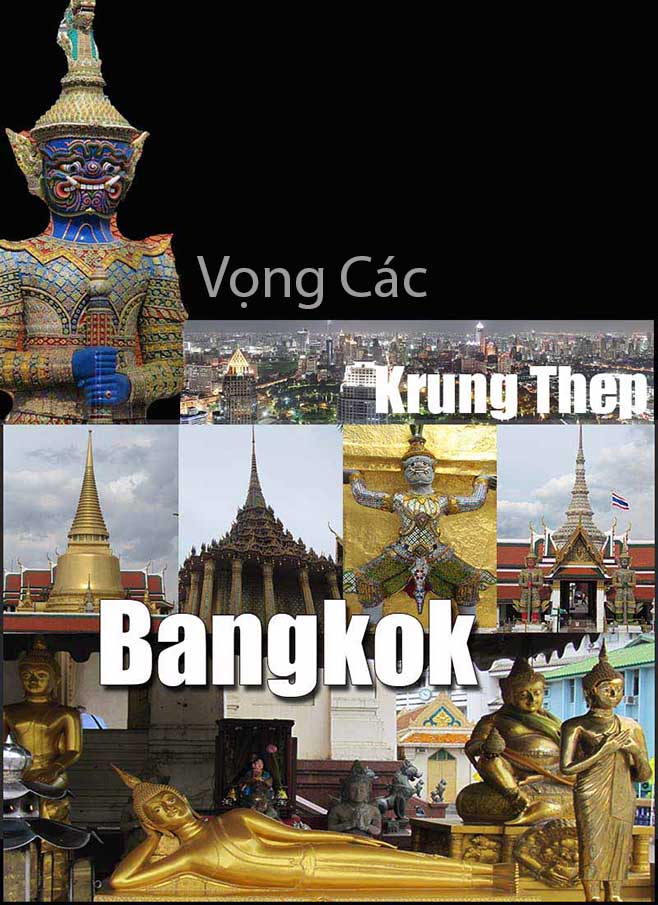
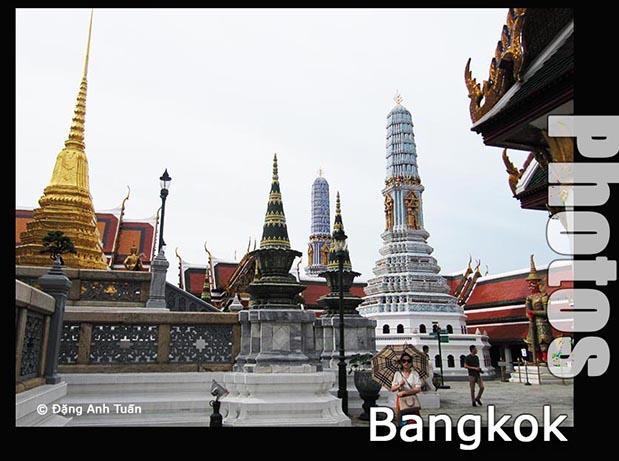
Situated in the Menam delta, the Bangkok capital that we nickname « Venice of the East« ,  is known in the Guiness des Records as the city having the longest name in the world. It is in around thirty kilometres of the sea and it is characterized by countless canals (khlongs). One tries to fill them to make streets for bringing a solution to the problem of motor traffic.This one suffocates frequently the capital and it is responsible for the daily pollution. Its official population amounts to 8,2 million inhabitants in 2010. By coming to Bangkok, no tourist forgets to visit the royal palace the chapel of which contains the Emerald Buddha, the palladium of Thailand and  Wat Traimit pagoda with a 5,5 ton Golden Buddha (in the Chinese district).

Vong_cac

[Return THAÏLANDE]

Venise de l’Orient (Vọng Các)

English version
Vietnamese version

Située dans le delta de la Ménam, la capitale Bangkok que l’on surnomme « la Venise de l’Orient » est connue dans le Guiness des Records comme la ville ayant le nom le plus long au monde. Elle est à une trentaine de kilomètres de la mer et elle est caractérisée par d’innombrables canaux (des khlongs). On tente de les combler pour faire des rues dans le but d’apporter une solution au problème de la circulation automobile. Celle-ci asphyxie fréquemment la capitale et elle est responsable de la pollution journalière. Sa population officielle s’élève en 2010 à 8,2 millions d’habitants. En venant à Bangkok, aucun touriste n’oublie de visiter le palais royal dont la chapelle renferme le Bouddha d’émeraude, le palladium de la Thaïlande et la pagode Wat Traimit avec le Bouddha d’or de 5,5 tonnes (dans le quartier chinois).

Vong_cac

[Return THAÏLANDE]

Thailand (Thái Lan)

French version

The emergence of the Thai people is only strengthened since the XIVth century. Nevertheless it is a very ancient people of Southern China. It is a member of the Austro-Asiatic group (Chủng Nam Á) (or Baiyue or Bách Việt in Vietnamese). It is this group French archaeologist Bernard Groslier often indicated under the name of « Thai-Vietnamese group ».

Repulsed by the Tsin of Shi Huang Di, the Thai people try to resist again and again. For Vietnamese writer Bình Nguyên Lôc, the subjects of Shu and Ba (Ba Thục) kingdoms annexed very early by the Tsin in the Szechuan (Tứ Xuyên) (1), were the Proto-Thai (or Tày). According to this writer, they belonged to the Austroasiatic group of branch Âu (or Ngu in language mường or Ngê U in Chinese mandarin (quan thoại)) to which the Thai and the Tày were attached.

For him as for other Vietnamese researchers Trần Ngọc Thêm, Nguyễn Đình Khoa, Hà Văn Tấn etc .., the Austro-Asiatic group contains 4 different subgroups: subgroup Môn-Khmer, subgroup Việt Mường (branch Lạc), subgroup Tày-Thái (branch Âu) and subgroup Mèo-Dao to which it is necessary to add the subgroup Cham, Raglai, Êdê to define the Indonesian race (or Proto-Malay) (2) (Chủng cổ Mã Lai).

The contribution of the Thai people in the foundation of the Ậu Lạc kingdom of Thục Phán (An Dương Vương) is no longer in doubt after the latter managed to eliminate last king Hùng of the Văn Lang kingdom because the name « Âu Lạc » (or Ngeou Lo) evoke obviously the union of two ethnic groups Yue of branch Âu (Proto-Thai) and branch Lạc (Proto-Viet ). Furthermore, Thục Phán originating from the royal family of Shu (Thục), an Yue of Thai branch, which shows at such a point the union and the common fate of these two ethnic groups in front of the Chinese expansion.

It is what is has been reported in Chinese historical writings ( as Kiao -tcheou wai-yu ki or Kouang-tcheou ki) but it has been refuted by some Vietnamese historians because the Shu kingdom was too far the Văn Lang kingdom. This latter has been annexed very early ( more than a half century before the foundation of the Văn Lang kingdom) by the Tsin. But according to Bình Nguyên Lộc writer, in the compagny of his trusted friends, Thục Phán having lost his homeland, was forced to seek refuge at this time in the country having the same ethnic affinity, that is to say Si Ngeou (Tây Âu) located beside the Văng Lang kingdom of the Vietnamese. Furthermore, the Chinese have no interest in falsifying history by reporting that the ruler of the Âu Lạc kingdom was the Shu prince. For this latter and his trusted friends, the requests for asylum need a certain time, which explains at least a half century in this exodus before the foundation of his Âu Lạc kingdom. Moreover, he was at the head of an army of 30.000 soldiers. It is impossible for him to assure all logistical aspects and render his army invisible during the exodus by crossing through Yunan mountainous regions administered by others ethnic ennemies or people close to the Chinese. It is likely that he needed what is necessary before his conquest with Si Ngeou people (or Proto-Thaïs). Despite the legend of the Vietnamese magic crossbow, An Dương Vương (Ngan-yang wang) was a historical personage. The discovery of his capital archeological remains (Cổ Loa, huyện Đông An, Hànội ) does not question the existence of this kingdom established about three centuries before Jesus Christ. This one was later annexed by Zhao To (Triệu Đà), founder of the Nan Yue kingdom.


A long common history with the Vietnamese.

The Lạc Long Quân-Âu Cơ myth insinuate so skilfully the union and the separation of two Yue ethnic groups, one being of Lạc branch (the Proto-Vietnamese) coming down to the plains by the pursuit of water courses and rivers, the other (the Proto-Thaïs) taking refuge in mountainous areas. There are the Mường in this exodus. Being close to the Vietnamese at the linguistic level, the Mường have managed to keep their ancestral customs because they were sent away and protected in high mountains. They had a social organization similar to that of the Tày and the Thaïs.

Located in Kouang Tong (Quãng Đông) and Kouang Si (Quãng Tây) provinces, the Si Ngeou (Tây Âu) kingdom is none other than the land of the Proto-Thaïs (Thai ancestors). It is here that Shu prince Thục Phán took refuge before the Văn Lang kingdom conquest. It should also be remembered that Chinese emperor Shi Houang Di had to mobilize at this time more than 500.000 soldiers for the Si Ngeou kingdom conquest after having successfully defeated the Chu kingdom (Sỡ Quốc) army with 600.000 soldiers. You have to think that in addition to the implacable resistance of its warriors, the Si Ngeou kingdom should be very large and densely populated for the commitment of the substantial military force from Shi Houang Di (Tần Thủy Hoàng).

Despite the premature death of Si Ngeou king named Yi-Hiu-Song (Dịch Hu Tống),the resistance led by the Yue of Thai branch or (Si Ngeou)(Tây Âu) succeeded in obtaining a few expected results in Southern Kouang Si with the death of general T’ou Tsiu (Uất Đồ Thư) leading a Chinese army of 500.000 men, which has been mentioned in Master Houa-nan annals (or Houai–nan –tseu in Chinese or Hoài Nam Tử in Vietnamese) written by Liu An (Lưu An), grandson of Kao-Tsou emperor (or Liu Bang), founder of Han dynasty between 164 and 173 before our era. Si Ngeou was known for the courage of its formidable warriors. This corresponds exactly to the temperament of the Thai living in the past, described by French writer and photographer Alfred Raquez:(3)

Being belligerent and adventure racer, the old-time Thai were almost constantly at war with their neighbours and often saw their successfull excursions. After each victorious campaign, the prisoners were taken with them and deported in a part of Siam territory as far away as possible from their countries of origin.

After the disappearance of this kingdom and that of Âu Lạc, the Proto-Thaï remaining in Vietnam at this time under the bosom of Zhao To (a former general of Tsin dynasty who later became the first emperor of Nan Yue kingdom) had their descendants forming properly today the ethnic minority Tày of Vietnam. Other Proto-Thaï fled to Yunnan where they united at the eighth century in Nanzhao kingdom (Nam Chiếu) then Dali (Đại Lý) where buddhism of Greater Vehicle began to take root. Unfortunaly, their attempt was in vain. Shu, Ba, Si Ngeou, Âu Lạc (5), Nan Zhao, Dali countries are part of the list of kingdoms annexed one after the other by the Chinese during their exodus. In these countries submitted, the Proto-Thaïs presence was very important. In front of the Chinese continous pressure and the Himalaya inexorable barrier, the Proto-Thaï had to get back in the Indochinese peninsular (4) by penetrating slowly like a fan in Laos, northwest region of Vietnam (Tây Bắc), northern Thailand and Upper Burma.

According to Thai historical inscriptions found in Vietnam, there are three important waves of migration initiated by the Thai of Yunnan in northwest of Vietnam during the 9th and 11th centuries. This corresponds exactly to the period where Nanzhao was annexed by Dali destroyed, in turn, three centuries later by Kubilai Khan Mongols in China. During this penetration, the Proto-Thaïs were separated into groups: the Thaï of Vietnam, the Thaï in Burma (or Shans), the Thaï in Laos (or Ai Lao in Vietnamese) and the Thaï in Northern Thailand. Each of these groups began to adopt the religion of these host countries. The Thaï of Vietnam do not have the same religion as those of other territories. They continue to keep animism (vạn vật hữu linh) or totemism.

This is not the case of the Thaï living in Northern Thailand, Upper Burma, Laos which were occupied at this time by Indianized and Buddhist theravàda Môn-Khmer kingdoms (Angkorian empire, Môn Dvaravati, Haripunchai, Lavo kingdoms etc …) after the dislocation of Indianized Funan kingdom. The Môn had a key rôle in the transmission of Theravadà Buddhism from Sinhalese tradition for Thai newcomers.


(1): Pays des pandas. C’est aussi ici qu’on a découvert la culture de Ba-Shu célèbre pour ses masques zoomorphes de Sanxingdui et pour le mystère des signes sur les armures. C’est aussi le royaume de Shu-Han (Thục Hán) de Liu Bei (Lưu Bị) à l’époque des Trois Royaumes.(Tam Quốc)

(2) Race de l’Asie du Sud-Est préhistorique.

(3): Comment s’est peuplé le Siam, ce qu’est aujourd’hui sa population. Alfred Raquez, (publié en 1903 dans le Bulletin du Comité de l’Asie Française). In: Aséanie 1, 1998. pp. 161-181.

(4) Indochina in wider sense. This is not French Indochina.

(5) The Âu Lạc kingdom of An Dương Vương was annexed by Chinese General Zhao To (Triệu Đà) who later became the founder of Nanyue kingdom. This one will be in turn under the control of Han dynasty, half a century later.


Bibliography

Photos de Venise de l’Orient (Vọng Các)


Bangkok

[Return THAÏLANDE]

Angkor Vat (Đế Thiên Đế Thích)


Jewel of Khmer Art

angkor_vat

French version

Vietnamese version
picture-591

 
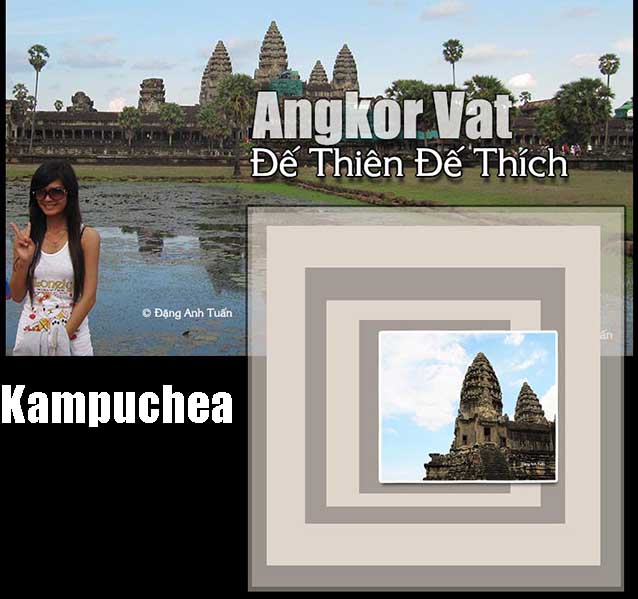
It is the largest and the most sublime temple-mountain of all Khmer temples. It was built during the reign of Sûryavarman II in the first half of the XIIth century. It was considered as capital of the Khmer empire having in its center the temple of state dedicated to Vishnu. It is here that the towers are raised in quincunx. Two major characteristics of the Khmer architecture are found there: pyramids or temples-mountains symbolizing the Mount Meru (house of Gods) and the galleries which were built the one above the other. Many people considers it as the eighth wonder of the world. Other temple mountains can be visited: Bakeng, Takeo, Baphûon, Prè Rup, Bakong and Ak Yum.