Năm Ngọ nói chuyện ngựa

Parlons ensemble de Cheval

en cette année du Cheval de feu

Version française
Version anglaise
Galerie des photos

Ngựa là loại động vật mà không biết từ lúc nào bị loài người chinh phục được, nuôi dưởng và thuần hóa nó khiến nó trở thành từ đó một gia súc có lợi trong mọi cộng tác xê dịch, vận tải và chiến chinh. Nó là con vật không chỉ có sức mạnh phi thường, dẻo dai mà còn lại rất trung thành với chủ khiến nó  đựợc xem một vũ khí lợi hại trong binh mã. Những chiến công hiển hách ở đất nước ta đều có sự tham gia của ngựa. Bởi vậy vua chúa ta hay thường tri ân ngày xưa bằng cách tạc hình ngựa voi bằng đồng bằng đá cùng các quan văn quan  võ với quân sĩ để minh chứng những thời oanh liệt của dân tộc ta chống ngọai xâm. Người với ngựa như hình với bóng trong thời chinh chíến, chia sẻ gian truân cùng chung số phận. Không chỉ nữ sĩ  Đoàn Thị Điểm đã nhắc lại sự việc nầy trong « Chinh Phụ Ngâm»:

Hơi gió lạnh người rầu mặt dạn
Dòng nước sâu ngựa nản chân bon
Ôm yên gối trống đã chồn
Nằm vùng cát trắng, ngủ cồn rêu xanh

Còn Thái Thượng Hoàng Trần Thánh Tông bùi ngùi khi trở về kinh thành sau chiến thắng giặc Nguyên Mông và thấy những con ngựa đá, chân còn dính bùn ở trước ngọ môn,  phải thốt lên trong lễ hiến phu hai câu thơ như sau:

Xã  tắc hai phen bon ngựa đá
Non sông thiên cổ vững âu vàng.

Trong truyền thuyết nước ta có hai lần nhắc đến con ngựa. Lần đầu ở  trong truyền thánh Gióng tức là Phù Đổng Thiên Vương. Dưới thời ngự trị của vua Hùng Vương thứ VI thì có giặc Ân-Thương  ở  bên Tàu rất hùng mạnh xâm chiếm nước ta. Vua buộc lòng sai người đi rao khắp nơi để kiếm người tài năng ra giúp nước diệt giặc.  Lúc bấy giờ ở làng Phù Đổng tỉnh Bắc Ninh có một đứa  trẻ  còn nằm nôi, nghe sứ giả đi mộ khắp dân gian xem có ai phá được giặc thì ban cho tước lộc. Bé dậy hỏi mẹ, mẹ mới bảo rõ ràng như vậy. Thánh Gióng mới nói: « Thế thì mẹ đem nhiều cơm đến đây cho con ăn » theo lời kể trong Việt Điện U Linh. Ngài mới ăn vài chén cơm.

Mấy tháng sau ngài cao lớn lên, rồi tự ra ứng mộ. Sứ giả thấy lạ mới đem ngài về kinh sư. Theo lời thỉnh cầu của ngài, vua  mới cho người đúc một con ngựa sắt và một chiếc roi dài cũng bằng sắt. Sau khi ăn mấy nong cơm mới thổi xong, ngài mới vươn vai một cái thì ngài cao lớn hơn 10 thước rồi ngài nhảy lên lưng ngựa, cầm côn sắt mà hét lớn « Ta là thiên tướng đấy »  rồi phi thẳng ra chiến trường. Ở nơi nầy, ngài thì hoa côn, ngựa thì phun lửa, giết vô số quân địch khiến nỗi làm côn gãy và buộc lòng nhổ tre mà đánh tiếp khiến quân Ân tẩu tán khắp nơi. Sau đó ngài phóng ngựa lên núi Sốc Sơn rồi biến mất. Vua Hùng nhớ ơn mới truyền lập đền thờ ở làng Phù Đổng thuộc huyện Gia Lâm ngoài thành Hà Nội. Năm nào cũng có lễ hội để tưởng nhớ ngài cả vào ngày mùng 8 tháng 4.

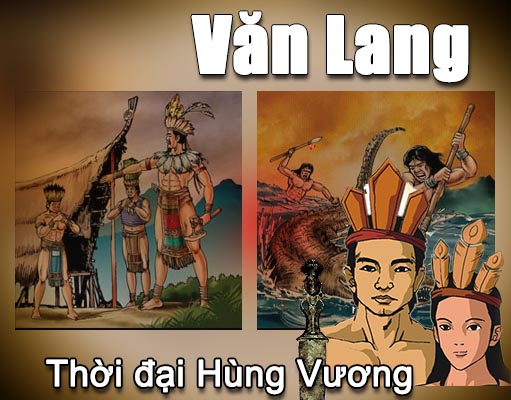
Chúng ta nên nhớ lại  nước ta rất rộng lớn lúc bấy giờ tên là Văn Lang  được  giáp  tới Nam Hải  (Quảng Đông) ở phiá đông, phía tây với  Ba Thục (hay Tứ Xuyên), ở phía bắc thì tới Ðộng Ðình hồ (Hồ Nam) và phía nam với vương quốc Hồ Tôn tức là Chiêm Thành (Chămpa). Dân tộc ta là nhóm dân Bách Việt còn sống thời đó ở vùng sông Dương Tử bên Tàu.

Trong Kinh Dịch được dịch bởi giáo sư  Bùi Văn Nguyên thì tác giả có nói đến một cuộc viễn chinh quân sự được thực hiện trong vòng ba năm bởi vua hiếu chiến của nhà Ân-Thương tên là  Vũ Định (Wu Ding)  ở  vùng Ðộng Ðình Hồ  (Kinh Châu) chống lại các dân du mục, thường được gọi là  « Qủi ». Dù biết là truyền thuyết nhưng với các cuộc khai quật gần đây, các cuộc thí nghiệm ADN, thì truyền thuyết nầy không phải chuyện hoang đường mà nó nói lên có sự xung đột giữa dân tộc ta với nhà Ân. Bởi vậy nước Văn Lang không có thiết lập bất kỳ mối quan hệ thương mại nào ở thời đó với nhà Ân-Thương cả.

Lần thứ nhì, ngựa được nhắc đến trong truyên Sơn Tinh Thủy Tinh. Trong truyền thuyết nầy, vua Hùng vương thứ 18 có một người con gái là Mị Nương, sắc đẹp lạ thường. Khi đến tuổi lấy chồng, tiếng tăm của nàng lại càng vang lên ở khắp bốn phương. Nhà vua quyết định chọn cho nàng một người chồng tài giỏi. Lúc đó có hai chàng trai, thông minh và tuấn tú, tình cờ đến cùng một lúc và xin cầu  hôn  Mị Nương. Một người được gọi là Sơn Tinh, chúa của các vùng núi non cao và các rừng sâu, còn người kia là Thủy Tinh, chúa các của các sông nòi và biển cả thăm thẳm.

Băn khoăn, vua cha không biết phải chọn người nào vì cả hai đều có tài năng vô song và quyền lực vô hạn nên mới bày ra thữ thách như sau: một trăm đĩa xôi, một con voi chín ngà, một con gà trống chín cựa, một con ngựa chín hồng mao. Người nào đem đến trước  với sính lễ nầy được làm chồng của Mị Nương.

Ngày hôm sau, lúc rạng đông, Sơn Tinh đến trước với đầy đủ lễ vật và đưa người đẹp lên núi. Vừa hoang mang vừa tức giận, Thủy Tinh lao tới, dâng cao lên mực nước, quyết định vào núi bắt cóc Mị Nương. Sơn Tinh nâng núi cao hơn nữa. Thủy Tinh trổ tài năng của mình, đánh đuổi gió bão, sấm chớp làm rung chuyển cả núi rừng. Sơn Tinh giữ núi một cách vững vàng. Thủy Tinh nhờ đến thủy binh mà xông lên theo dòng nước, xông pha toàn lực. Sơn Tinh dùng các lưới sắt, cắt  đường tiếp tế,  lăn đá lấp hồn và đè bẹp  các thủy quái trôi dạt vào bờ. Chuyện nầy được kể lại trong Lĩnh Nam Chích Quái của Trần Thế Pháp dưới tên là Truyện núi Tản Viên. Cứ hàng năm cở tháng bảy tháng tám dân ở vùng chân núi nầy hay thường bị gió to nước lớn làm ruộng đồng bị thiệt hại. 

Trong sính lễ có một con ngựa chín hồng mao. Vậy nó phải là con ngựa phi thường, nó phải như thế nào mới được chọn trong sính lễ.  Cho đến giờ  thì  người xưa có nhắc đến  Ngựa Hạc (lông trắng toát), Ngựa Kim (lông trắng), Ngựa Hởi (lông trắng, bốn chân đen), Ngựa Hồng (lông màu nâu –hồng), Ngựa Tía (lông màu đỏ thắm) vân vân  vậy con ngựa chín hồng mao tức là phải có chín cái lông màu hồng, nó  phải có nên mới có ghi chú trong truyền thuyết nhưng chắc chắn nó phải hiếm hoi như ngựa hãn huyết ((mồ hôi đỏ như máu) (Hãn huyết bảo mã)) mà  được mang về  Trường An  bởi Trương Kiên vào năm -114 trước Công nguyên. Kích thước, tốc độ và sức mạnh của các con ngựa nầy  làm hài lòng vua Hán Vũ Đế vô cùng. Ngài không ngần ngại đặt cho những con ngựa này  với cái tên là « thiên mã » (tianma) (thiên mã). (thiên mã= ngựa trời). Chính vì con ngựa nầy mà Hán Vũ Đế  buộc lòng phải tổ chức cuộc thám hiểm quân sự tốn hao quá mức không chỉ về trang bị và ngựa mà còn nhân mạng nửa  để có một kết quả không đáng với khoảng ba mươi con  thiên mã và ba nghìn con ngựa giống và ngựa cái bình thường. Nói đúng ra Hán Vũ Đế  cảm thấy bị sĩ nhục trước  sự từ chối cung cấp các con ngựa  nầy để đổi lấy quà tặng của nước Đại Uyên (Daiyuan), một tiểu vương quốc  nằm ở trong thung lũng Ferghana. Con ngựa thiên mã nầy nó trở thành biểu tượng quyền lực của Hán Vũ Đế và cũng nhờ đó mới có sự ra đời của con đường tơ lụa.

Tuy là truyền thuyết nhưng chuyện Sơn Tinh Thủy Tinh cũng nói lên một phần nào lũ lụt triên miên mà dân tộc ta phải cam chịu lúc còn cư trú ở hạ  lưu sông Dương Tử (văn hóa Lương Chử) và cho đến ngày nay  ở đất nước ta.

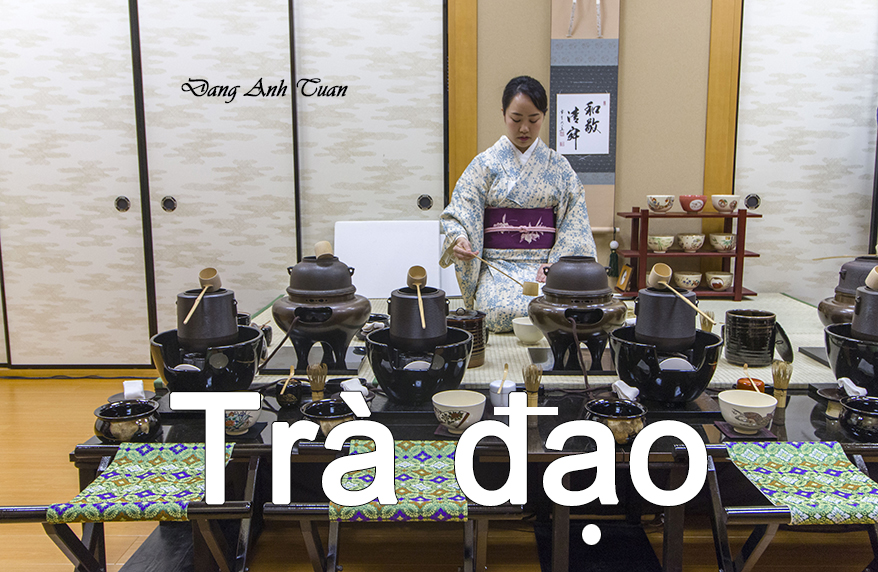
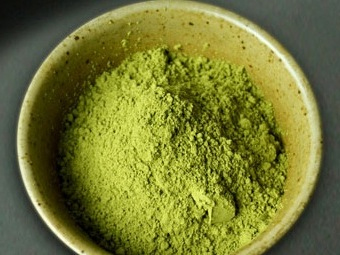
Nói đến ngựa chúng ta cũng không quên nhắc đến « Trảm Mã Trà ». Đây là một loại trà đước chế biến từ búp trà lên men trong bao tử ngựa khiến nó  có hương vị đặc biệt và làm giảm  đi độ chát. Cách chế biến nầy  được xuất phát từ núi Vu Sơn ở  Tứ Xuyên. Để lấy được trà này, người ta  phải bỏ đói ngựa vài ngày trước. Khi đến chân núi Vu Sơn thì ngựa được người thả ra. Bị bỏ đói gặp được rừng trà xanh non thì  ngựa vội vã ăn cho tới khi no bụng. Sau đó, con ngựa bị lùa ra khe suối gần  núi. Suối ở đây  hay th ường  có lá trà rụng xuống khiến lá bị  nát mủn nên nước suối  có màu đen và được gọi là suối Ô Long. Ngựa uống nước suối xong xuôi thì được đưa trở về nơi xuất phát. Lá trà trong bụng ngựa đã ngấm đều với nước suối Ô Long và lên men sau khoảng một ngày đường đi. Lúc nầy  con ngựa mới bị giết để lấy trà trong bao tử mà làm thành một loại trà độc đáo dành bán cho giới qúi tộc. Cách chế biến nầy cũng không thua chi cách chế biến gan ngỗng ở Pháp quốc nhưng cách biến chế nầy có phần cầu kỳ và kinh dị đấy.

Ai có đến Hà Nội  thì sẽ có  dịp đến viếng thăm đền Bạch Mã. Nó tọa lạc ngày nay ở phố Hàng Buồm. Đây là một trong tứ trấn của thành Thăng Long xưa: Đền Quán Thánh (trấn giữ phía Bắc kinh thành), Đền Kim Liên (trấn giữ phía Nam kinh thành),  Đền Voi Phục (trấn giữ phía Tây kinh thành)  và Đền Bạch Mã ((trấn giữ phía Đông). Nó được xây dựng từ thế kỷ 9 để thờ thần Long Đỗ (Rốn Rồng). Khi vua Lý Thái Tổ dởi đô từ Hoa Lư về Thăng Long thì ngài  có ý đắp thành cho vững chắc nhưng lúc nào thành cũng bị sụp nên vua sai người  đi cầu khẩn thần Long Đỗ  ở đền thì thấy một  con ngựa trắng ở trong đền đi ra. Nhờ  theo vết chân của ngựa, vua mới xây được  thành  vững  chắc.  Vua Lý Thái Tổ mới  phong thần làm thành hoàng của kinh thành Thăng Long.

Trong sách chữ Hán lại có câu: « Hồ Mã tê Bắc phong; Việt điểu sào Nam chi » có nghĩa là: Ngựa đất Hồ vào miền Trung nguyên thấy gió bắc thổi thì hí lên còn chim đất Việt vào miền Trung nguyên vẫn làm tổ ở cành phía Nam. Theo truyền thuyết thì ngoài lễ  sính vật như vàng ngọc châu báu, voi, tê giác,  Hùng Vương còn  biếu  cho vua Tàu một con bạch trĩ.  Con nầy  đựợc  nuôi trong vườn thượng uyển. Lúc nào nó cũng kiếm đậu ở các cành cây hướng về phía nam.  Bởi vậy mới có thành ngữ  « Chim Việt đậu cành Nam » để ám chỉ  người Việt dù ở nơi nào đi nữa lúc nào cũng nhớ quê hương và nước non. Còn con ngựa Hồ, đây là một phẩm cống mà Hán Vũ Đế  nhận được từ nước Hồ nằm phía bắc Trung Hoa. Nó cứ buồn rầu không ăn uống chi cả chỉ khi có gió bắc thì nó hí lên một cách thảm thiết.

Như ta được biết ngựa rất trung thành với chủ nhân cũng như chó. Bởi vậy ở Việt Nam nơi nào có chùa của người Hoa thì có thờ  Quan Vũ, một vị tướng nổi tiếng thời Tam Quốc thì bên cạnh ông luôn luôn có một con ngựa đựợc tạc tượng tên lả Xích Thố. Con ngựa nầy theo ông lập nhiều chiến công. Đến khi  Quan Vũ bị giết, con ngựa Xich Thố  này bỏ ăn rồi chết theo. Từ nay ngựa Xích Thố trong văn hóa dân gian lại gắn liền với hình tượng nhân vật Quan Vũ (Quan Công). 

Mỗi năm được tượng trưng bởi một con vật trong Âm lịch nước ta. Như vây năm 2026  là năm con ngựa (hay Ngọ) được chọn trong 12 con vật. Theo thuật số  thì có 4 con vật  xung khắc với nhau  trong các năm tuổi như đã quy đinh trong câu: « Tý Ngọ Mẹo  Dậu tứ hành xung ». Như vậy ai mà tuổi ngọ năm nay  là cái tuổi  đang nhiều vận hạn  mà còn xung khắc với các năm Mẹo, Dậu và Tý.

Ở Việt Nam nhất là ở trong Nam hay thường dung chữ «ngựa » để ám chỉ các phụ nữ  hư thân mất nết hay dữ tợn, lúc nào cũng lồng lên như ngựa thượng tứ. Ngựa nầy xuất phát từ cửa Thượng Tứ ở Huế, nơi có cái trại nuôi ngựa của hoàng gia.  Ngựa nuôi ở đây là loại ngựa chiến, rất dữ tợn, lúc nào rừng rực nhất là với mùa hứng tình lồng lộn ưa hí. Bởi vậy mới có sự kết hợp giữa từ đĩ của miền Bắc và từ ngựa Thượng Tứ ở miền Trung để rồi trở thành từ đó cái thói quen, lối chưởi của  người miền Nam đế  nói lên sự khinh miệt đối với các phụ nữ mất nết na thùy mị và đoan trang.

Version française

Le cheval est un animal dont on ne sait pas depuis quand il a été conquis, élevé et domestiqué par l’homme, ce qui en a fait depuis lors un bétail utile dans tous les types de déplacement, de transport et de guerre. C’est un animal non seulement fort et résistant, mais aussi très fidèle à son maître, ce qui en fait une arme redoutable dans la cavalerie. De nombreuses victoires glorieuses de notre pays ont été remportées grâce aux chevaux. C’est pourquoi nos rois ont souvent rendu hommage au passé en sculptant des chevaux et des éléphants en bronze ou en pierre ainsi que des mandarins et des soldats civils et militaires, pour commémorer les périodes glorieuses de la résistance de notre nation contre les envahisseurs étrangers. 

L’homme et le cheval sont inséparables en temps de guerre, partageant les difficultés et le même destin. La poétesse Đoàn Thị Điểm a rappelé cet événement dans « Chinh Phụ Ngâm (La complainte de la femme d’un guerrier) » comme suit:

Le souffle du vent froid  froisse le visage impassible
Dans l’eau profonde, le cheval découragé peine à s’avancer.
S’appuyant sur un coussin vide avec la selle posée dessus, il a été épuisé.
Couché  sur les dunes de sable blanc, il dort au milieu de monticules verdoyants et moussus.

Étant de  retour dans la capitale après sa victoire contre  les envahisseurs mongols et voyant les chevaux de pierre aux sabots couverts de boue devant la porte Ngọ Môn, l’empereur émérite Trần Thánh Tông s’exclama dans les deux vers suivants lors de la cérémonie d’offrande :

La nation a été ballottée deux fois par des chevaux de pierre,
Les montagnes et les rivières resteront inébranlables pour l’éternité.

Dans les légendes vietnamiennes, les chevaux sont mentionnés à deux reprises. La première fois, c’est dans la légende de Saint Gióng, également connu sous le nom de Phù Đổng Thiên Vương. Sous le règne du roi Hùng Vương VI, les puissants envahisseurs Yin-Shang venus de Chine déferlèrent sur leterritoire vietnamien. Le roi fut contraint d’envoyer des messagers à travers le pays afin de recruter des personnes talentueuses capables d’aider la nation à repousser les envahisseurs. À cette époque, dans le village de Phù Đổng de la province de Bắc Ninh, un bébé, encore dans son berceau, entendit les messagers parcourir le pays, recrutant des hommes pour voir si quelqu’un pourrait vaincre les envahisseurs, et leur promettant titres et récompenses. Le bébé se réveilla et interrogea sa mère, qui lui expliqua la situation. 

Selon le récit du Việt Điển U Linh, saint Gióng dit : « Mère, apporte-moi du riz en abondance. » Il n’en mangea que quelques bols. Quelques mois plus tard, il grandit et se porta volontaire pour la guerre. Surpris, le messager le conduisit à la capitale. À sa demande, le roi fit forger un cheval de fer et un long fouet. Après avoir mangé plusieurs paniers de riz fraîchement cuit, il  s’étira et grandit jusqu’à atteindre plus de dix mètres. Puis il sauta alors sur le dos du cheval. En s’emparant du fouet, il cria : « Je suis un général céleste ! » et il galopa droit vers le champ de bataille.

Là, il brandit son fouet et il tua ainsi d’innombrables soldats ennemis  avec son cheval crachant du feu,. Son bâton se brisa,  ce qui l’obligea à déraciner des bambous pour poursuivre le combat et  il dispersa l’armée Yin dans toutes les directions. Puis, il lança le cheval vers le mont Sóc Sơn et il disparut. En se souvenant de sa bravoure, le roi Hùng ordonna la construction d’un temple dans le village de Phù Đổng, district de Gia Lâm, près de Hanoï. Chaque année, un festival est organisé en son honneur le huitième jour du quatrième mois lunaire.

Nous devons nous rappeler que notre pays était très vaste à cette époque, appelé Văn Lang, bordé à l’est par la mer du Sud (Guangdong), à l’ouest par Ba Thục (ou Sichuan), au nord par le lac Dongting (Hunan) et au sud par le royaume de Hồ Tôn, c’est-à-dire Chiêm Thành (Chămpa). Notre peuple appartenait au groupe ethnique Bai Yue, encore vivant à cette époque dans la région du fleuve Yangtsé en Chine.

Dans le Livre des Mutations traduit par le professeur Bùi Văn Nguyên, l’auteur parle d’une expédition militaire menée pendant trois ans par le roi belliqueux de la dynastie Yin-Shang nommé Wu Ding dans la région du lac Dongting (Jingzhou) contre des peuples nomades, souvent appelés « Qủi ». Bien que ce soit une légende, grâce aux récentes fouilles archéologiques et aux tests ADN, cette légende n’est pas une fable mais témoigne d’un conflit entre notre peuple et la dynastie Yin. C’est pourquoi le royaume de Văn Lang n’a établi aucune relation commerciale avec la dynastie Yin-Shang à cette époque.
La deuxième fois, le cheval est mentionné dans la légende de Sơn Tinh et Thủy Tinh. Dans cette légende, le 18ème roi Hùng a une fille nommée Mị Nương, d’une beauté exceptionnelle. À l’âge de se marier, sa renommée s’étend dans toutes les directions. Le roi décide de lui choisir un mari talentueux. À ce moment-là, deux jeunes hommes, intelligents et beaux, arrivent par hasard en même temps et demandent la main de Mị Nương. L’un est appelé Sơn Tinh, seigneur des montagnes et des forêts profondes, et l’autre est Thủy Tinh, seigneur des rivières et des vastes océans.

Après trois jours et trois nuits,  Thủy Tinh  battu davantage chaque jour, fut obligé de retirer ses troupes et ramener les flots. Pour assurer sa tranquillité Sơn Tinh opéra le miracle d’élever les deux montagnes des époux au plus haut dans l’endroit  des demeures des Dieux. Plus tard, le peuple les appellera Montagne du Monsieur et Montagne de la Dame, au pied desquelles un temple fut dédié à Sơn Tinh et à Mị Nương. Cette légende a été rapportée dans l’ouvrage intitulé   » Lĩnh Nam Chích Quái (ou les contes étranges à Lĩnh Nam) » de Trần Thế Pháp sous  le nom du titre « Histoire de la montagne Tản Viên ». Tous les ans vers le mois de juillet ou Août, les habitants vivant au pied de cette montagne ont l’habitude de subir le vent puissant et violent et la grande inondation provoquant ainsi des dégâts importants au niveau de la récolte. 

Dans la dot, il y avait un cheval aux neuf crins roses. Il devait donc être un cheval exceptionnel, il fallait qu’il soit ainsi pour être choisi dans la dot. Jusqu’à présent, les anciens ont mentionné le Cheval Grue (robe et crinière toute blanche), le Cheval Or (robe blanche), le Cheval Hởi (robe blanche, quatre pattes noires), le Cheval Rose (robe de couleur brun-rose), le Cheval Pourpre (robe de couleur rouge vif), etc. Ainsi, le cheval aux neuf crins roses signifie qu’il doit posséder neuf crins de couleur rose. Il devait en avoir ainsi pour être signalé  dans la légende, mais il est certain qu’il devait être rare comme le cheval suant du sang (Hãn huyết bảo mã) que  Zhang Qian ramena à Chang An en l’an 114 avant J.-C. La taille, la vitesse et la force de ces chevaux contentèrent énormément l’empereur Han Wudi. Il n’hésita pas à donner à ces chevaux le nom de « tianma » (cheval céleste). (tianma = cheval du ciel). C’est à cause de ce cheval que l’empereur Han Wudi fut contraint d’organiser une expédition militaire extrêmement coûteuse, non seulement en équipement et en chevaux, mais aussi en vies humaines, pour un résultat qui ne valait pas la peine, avec environ trente chevaux célestes et trois mille chevaux reproducteurs et juments ordinaires. En réalité, l’empereur Han Wudi se sentit humilié par le refus de fournir ces chevaux en échange de cadeaux du royaume de Daiyuan, un petit royaume situé dans la vallée de Ferghana. Ce cheval céleste devint un symbole de pouvoir pour l’empereur Han Wudi et c’est grâce à lui que la route de la soie vit le jour.

En parlant des chevaux, nous ne pouvons pas oublier de mentionner le « Trảm Mã Trà (décapiter le cheval pour l’obtention du thé) ». C’est un type de thé fabriqué à partir de bourgeons de thé fermentés dans l’estomac d’un cheval, ce qui lui confère une saveur particulière  réduisant ainsi l’astringence. Cette méthode de préparation provient de la  montagne Wushan (Vũ Sơn) dans le Sichuan. Pour obtenir ce thé, on doit affamer le cheval durant quelques jours au préalable. Arrivés au pied de la montagne Wushan, le cheval est relâché par les hommes. Affamé, il se précipite pour manger les jeunes feuilles de thé vert jusqu’à  ce qu’il soit rassasié. Ensuite, le cheval est conduit vers un ruisseau près de la montagne. Ce ruisseau contient souvent des feuilles de thé tombées qui se désagrègent et donnent à l’eau une couleur noire. Ce ruisseau est  connu sous le nom  » Ô Long« . Après avoir bu cette eau, le cheval est ramené à son point de départ. Les feuilles de thé dans l’estomac du cheval ont absorbé l’eau du ruisseau Ô Long et ont fermenté pendant environ une journée de voyage. C’est alors que le cheval est abattu pour récupérer le thé dans son estomac. Ce thé est transformé en un thé unique destiné à la vente aux nobles. Cette méthode de préparation n’est pas moins raffinée que celle du foie gras en France, mais elle est quelque peu complexe et macabre.

Quiconque visite Hanoï aura l’occasion de découvrir le temple Bạch Mã (Cheval Blanc), situé aujourd’hui à la rue Hàng Buồm (Rue des voiles). Il fait partie des quatre temples gardiens de l’ancienne citadelle de Thăng Long: le temple Quan Thánh (gardien du nord de la citadelle), le temple Kim Liên (gardien du sud), le temple Voi Phục (gardien de l’Ouest) et le temple Bạch Mã (gardien de l’Est). Il fut construit au IXème siècle en l’honneur du génie  Long Đỗ (Nom du Dragon).

Lors du transfert de la capitale de Hoa Lư à Thăng Long, le roi Lý Thái Tổ souhaita y bâtir une citadelle imprenable mais celle-ci s’effondrait sans cesse. Il envoya alors des hommes d’aller  prier le génie Long Đỗ au temple. Ils y virent l’apparition  d’un cheval blanc. En suivant ses empreintes laissées par cet équidé dans sa marche, ils réussirent à édifier solidement la citadelle. Lý Thái Tổ conféra désormais  à ce génie le titre de dieu tutélaire de Thăng Long.

Dans les livres en caractères chinois, il y a une phrase : « Hồ Mã tê Bắc phong ; Việt điểu sào Nam chi » qui signifie : Le cheval du pays des Hồ, arrivé dans la plaine centrale, hennit quand il sent le vent du nord  tandis que l’oiseau du pays  des Vietnamiens se trouvant dans la même plaine, fait toujours son nid sur la branche du sud. Selon la légende, en plus des offrandes comme l’or, les bijoux précieux, les éléphants et les rhinocéros, le roi Hùng a également offert au roi chinois un faisan blanc. Ce dernier était élevé dans un jardin impérial. Il cherchait toujours à se percher sur les branches orientées vers le sud. C’est ainsi qu’est née l’expression « L’oiseau des Vietnamiens se perche sur la branche du sud »  faisant référence au fait que les Vietnamiens  où qu’ils soient, n’oublient jamais leur pays natal et leur patrie. Quant au cheval des Hồ, il s’agit bien  d’un tribut que l’empereur Han Wudi a reçu du royaume des Hồ, situé au nord de la Chine. Cet équidé triste, ne mangeait rien, et ne hennissait que d’une manière lamentable lorsqu’il y avait le souffle du vent venant du nord.

Comme chacun sait, le cheval est aussi fidèle à son  propriétaire comme le chien. C’est pourquoi, au Vietnam, à proximité de chaque temple chinois, se dresse toujours une statue de Guan Yu, le célèbre général de l’époque des Trois Royaumes. Son cheval nommé Xích Thố, l’accompagna dans de nombreuses victoires. À la mort de Guan Yu, le cheval Xích Thố cessa de s’alimenter et mourut avec lui. Dès lors, dans le folklore, le cheval Xích Thố  fut associé à l’image de Guan Yu (Guan Gong).

Dans le calendrier lunaire vietnamien, chaque année est symbolisée par un animal. Ainsi, 2026 est l’année du Cheval (ou Ngọ), choisie parmi les douze animaux. Selon la numérologie, quatre animaux sont en conflit au cours des années zodiacales, comme l’indique le proverbe : « Tý, Ngọ, Mẹo, Dậu sont  les quatre animaux antagonistes (Rat, Cheval, Chat, Coq). » Par conséquent, les personnes nées sous  l’année du Cheval connaissent de nombreux malheurs et sont également en conflit avec les années des animaux Mẹo (Chat), Dậu (Coq) et (Rat).

Au Vietnam, surtout dans le sud, on utilise souvent le mot « cheval » pour désigner les femmes débauchées, sans morale ou méchantes, toujours en colère comme un cheval de Thượng Tứ. Ce cheval vient de la porte Thượng Tứ à Huế, où se trouvait un lieu d’élevage de chevaux de la royauté. Ceux-ci sont des chevaux de guerre, très féroces, toujours les plus excités surtout pendant la saison des amours où ils hennissent bruyamment. C’est pourquoi il y a une combinaison entre le mot « prostituée » du Nord et le mot « cheval de Thượng Tứ » du Centre, qui est devenue ainsi cette habitude, cette manière d’insulter des gens du Sud pour exprimer leur mépris envers les femmes sans morale.

Version anglaise

The horse is an animal whose conquest, breeding, and domestication by man are of unknown antiquity, which has since made it a useful beast for all kinds of travel, transport, and war. It is an animal not only strong and hardy, but also very loyal to its master, which makes it a formidable weapon in the cavalry. Many of our country’s glorious victories were won thanks to horses. That is why our kings often paid tribute to the past by sculpting horses and elephants in bronze or stone as well as mandarins and civil and military soldiers, to commemorate the glorious periods of our nation’s resistance against foreign invaders.

Man and horse are inseparable in wartime, sharing hardships and the same fate. The poet Đoàn Thị Điểm recalled this event in “Chinh Phụ Ngâm (The Lament of the Soldier’s Wife)” as follows:

The breath of the cold wind wrinkles the impassive face
In the deep water, the discouraged horse struggles to move forward.
Leaning on an empty cushion with the saddle placed on it, it is exhausted.
Lying on the white sand dunes, it sleeps amid verdant, mossy mounds.

Back in the capital after his victory against the Mongol invaders and seeing the stone horses with mud-covered hooves in front of the Ngọ Môn gate, the retired emperor Trần Thánh Tông exclaimed the following two lines during the offering ceremony:

The nation has been tossed twice by stone horses,
The mountains and rivers will remain unshakable for eternity.

In Vietnamese legends, horses are mentioned twice. The first time is in the legend of Saint Gióng, also known as Phù Đổng Thiên Vương. During the reign of King Hùng Vương VI, the powerful Yin-Shang invaders from China swept over Vietnamese territory. The king was forced to send messengers throughout the country to recruit talented people capable of helping the nation repel the invaders. At that time, in the village of Phù Đổng in Bắc Ninh province, a baby, still in his cradle, heard the messengers traveling the country, recruiting men to see if anyone could defeat the invaders, and promising them titles and rewards. The baby woke and questioned his mother, who explained the situation to him.

According to the account in Việt Điển U Linh, Saint Gióng said: « Mother, bring me abundant rice. » He ate only a few bowls. A few months later, he grew up and volunteered for the war. Surprised, the messenger took him to the capital. At his request, the king had an iron horse and a long whip forged. After eating several baskets of freshly cooked rice, he stretched and grew until he reached more than ten meters. Then he jumped onto the horse’s back. Seizing the whip, he cried, « I am a celestial general! » and he galloped straight toward the battlefield.

There, he brandished his whip and thus killed countless enemy soldiers with his horse spitting fire. His staff broke, which forced him to uproot bamboos to continue the fight and he scattered the Yin army in all directions. Then, he sent the horse toward Sóc Sơn Mountain and disappeared. In remembrance of his bravery, King Hùng ordered the construction of a temple in the village of Phù Đổng, Gia Lâm district, near Hanoi. Each year, a festival is held in his honor on the eighth day of the fourth lunar month.

We must remember that our country was very vast at that time, called Văn Lang, bordered on the east by the South Sea (Guangdong), on the west by Ba Thục (or Sichuan), to the north by Dongting Lake (Hunan) and to the south by the kingdom of Hồ Tôn, that is Chiêm Thành (Chămpa). Our people belonged to the Bai Yue ethnic group, still living at that time in the Yangtze River region of China.

In the Book of Changes translated by Professor Bùi Văn Nguyên, the author speaks of a military expedition lasting three years led by the warlike king of the Yin-Shang dynasty named Wu Ding in the Dongting Lake (Jingzhou) region against nomadic peoples, often called « Qủi« . Although it is a legend, thanks to recent archaeological excavations and DNA tests, this legend is not a fable but attests to a conflict between our people and the Yin dynasty. That is why the kingdom of Văn Lang established no commercial relations with the Yin-Shang dynasty at that time.

The second time, the horse is mentioned in the legend of Sơn Tinh and Thủy Tinh. In this legend, the 18th King Hùng has a daughter named Mị Nương, of exceptional beauty. At marriageable age, her renown spreads in all directions. The king decides to choose a talented husband for her. At that moment, two young men, intelligent and handsome, happen to arrive at the same time and ask for Mị Nương’s hand. One is called Sơn Tinh, lord of the mountains and deep forests, and the other is Thủy Tinh, lord of the rivers and vast oceans.

After three days and three nights, Thủy Tinh, beaten more each day, was forced to withdraw his troops and bring back the floods. To ensure his peace, Sơn Tinh performed the miracle of raising the two husband-and-wife mountains to the highest place among the abodes of the Gods. Later, the people would call them the Mister Mountain and the Miss Mountain, at the foot of which a temple was dedicated to Sơn Tinh and Mị Nương. This legend was recorded in the work entitled « Lĩnh Nam Chích Quái (or the strange tales of Lĩnh Nam) » by Trần Thế Pháp under the title « The Story of Tản Viên Mountain« . Every year around July or August, the inhabitants living at the foot of this mountain are accustomed to enduring powerful and violent winds and great flooding, thus causing significant damage to the crops.

In the dowry, there was a horse with nine pink manes. It therefore had to be an exceptional horse; it had to be like that to be chosen as part of the dowry. To this day, the elders have mentioned the Crane Horse (coat and mane all white), the Gold Horse (white coat), the Hởi Horse (white coat, four black legs), the Pink Horse (brown-pink colored coat), the Purple Horse (bright red colored coat), etc. Thus, the horse with nine pink manes means that it must have nine manes of pink color.

He must have been such to be noted in legend, but it is certain that he must have been rare like the blood-sweating horse (Hãn huyết bảo mã) that Zhang Qian brought back to Chang’an in 114 BC. The size, speed and strength of these horses greatly pleased Emperor Han Wudi. He did not hesitate to give these horses the name « tianma » (heavenly horse). (tianma = horse of the sky). It was because of this horse that Emperor Han Wudi was forced to organize an extremely costly military expedition, not only in equipment and horses, but also in human lives, for a result that was not worth it, with about thirty heavenly horses and three thousand breeding stallions and ordinary mares. In reality, Emperor Han Wudi felt humiliated by the refusal to provide these horses in exchange for gifts from the kingdom of Dayuan, a small kingdom located in the Ferghana valley. This heavenly horse became a symbol of power for Emperor Han Wudi and it is thanks to it that the Silk Road came into being.

Speaking of horses, we cannot forget to mention « Trảm Mã Trà (decapitate the horse to obtain the tea). » It is a type of tea made from tea buds fermented in the stomach of a horse, which gives it a particular flavor that reduces astringency. This preparation method comes from Wushan (Vũ Sơn) mountain in Sichuan. To obtain this tea, the horse must be starved for a few days beforehand. Upon reaching the foot of Wushan mountain, the horse is released by the men. Hungry, it rushes to eat the young green tea leaves until it is full. Then the horse is led to a stream near the mountain. This stream often contains fallen tea leaves that break down and give the water a black color. This stream is known as « Ô Long. » After drinking this water, the horse is returned to its starting point. The tea leaves in the horse’s stomach have absorbed the water from the Ô Long stream and fermented during about a day’s travel. It is then that the horse is slaughtered to retrieve the tea from its stomach. This tea is processed into a unique tea intended for sale to nobles. This preparation method is no less refined than foie gras in France, but it is somewhat complex and macabre.

Anyone who visits Hanoi will have the opportunity to discover the Bạch Mã (White Horse) Temple, now located on Hàng Buồm Street (Sail Street). It is one of the four guardian temples of the former citadel of Thăng Long: the Quan Thánh Temple (guardian of the north of the citadel), the Kim Liên Temple (guardian of the south), the Voi Phục Temple (guardian of the west) and the Bạch Mã Temple (guardian of the east). It was built in the 9th century in honor of the spirit Long Đỗ (Dragon’s Name).

When the capital was moved from Hoa Lư to Thăng Long, King Lý Thái Tổ wished to build an impregnable citadel but it kept collapsing. He then sent men to pray to the spirit Long Đỗ at the temple. They saw the appearance of a white horse. By following the footprints left by this animal as it walked, they succeeded in solidly erecting the citadel. Lý Thái Tổ thereafter conferred on this spirit the title of tutelary deity of Thăng Long.

In books written in Chinese characters, there is a sentence: « Hồ Mã tê Bắc phong; Việt điểu sào Nam chi » which means: The horse of the land of Hồ, arriving on the central plain, neighs when it feels the north wind, while the bird of the land of the Vietnamese, being on the same plain, always builds its nest on the southern branch. According to legend, in addition to offerings such as gold, precious jewels, elephants and rhinoceroses, King Hùng also gave the Chinese king a white pheasant. The latter was raised in an imperial garden. It always sought to perch on branches facing south. Thus was born the expression « The bird of the Vietnamese perches on the southern branch » referring to the fact that the Vietnamese, wherever they are, never forget their native land and homeland. As for the horse of the Hồ, it was indeed a tribute that Emperor Han Wudi received from the kingdom of Hồ, located north of China. This sorrowful steed ate nothing, and only neighed in a lamentable way when there was the breath of wind coming from the north.

As everyone knows, the horse is as loyal to its owner as the dog. That is why, in Vietnam, near every Chinese temple, there is always a statue of Guan Yu, the famous general from the Three Kingdoms era. His horse named Xích Thố accompanied him in many victories. At Guan Yu’s death, the horse Xích Thố stopped eating and died with him. Since then, in folklore, the horse Xích Thố has been associated with the image of Guan Yu (Guan Gong).

In the Vietnamese lunar calendar, each year is symbolized by an animal. Thus, 2026 is the Year of the Horse (or Ngọ), chosen among the twelve animals. According to numerology, four animals are in conflict during the zodiac years, as the proverb indicates: « Tý, Ngọ, Mẹo, Dậu are the four antagonistic animals (Rat, Horse, Cat, Rooster). » Therefore, people born in the Year of the Horse experience many misfortunes and are also in conflict with the years of the animals Mẹo (Cat), Dậu (Rooster) and Tý (Rat).

In Vietnam, especially in the South, the word « horse » is often used to refer to dissolute, immoral, or mean women, always angry like a Thượng Tứ horse. This horse comes from the Thượng Tứ gate in Huế, where there was a royal horse breeding farm. These are war horses, very fierce, always the most excited especially during the mating season when they neigh loudly. That is why there is a combination between the word « prostitute » from the North and the word « Thượng Tứ horse » from the Central region, which has thus become this habit, this way of insulting people from the South to express their contempt for immoral women.
Galerie des photos

No Images found.

[Return TET BÍNH NGỌ]

Tết Bính Ngọ (version vietnamienne)

Tết Nguyên Đán (17 Février 2026)

Version française
Version anglaise
Galerie des photos

Nguyên nghĩa của chữ “Tết” chính là “tiết” mà tiết có trong tự điển Hán Việt thì có nghĩa đốt hay khúc tre, còn mở rộng nghĩa là một phiến đoạn thời gian trong năm. Như vậy là một khoảng thời gian nhất định trong năm. Ở Việtnam có nhiều Tết lắm như Tết Trung Thu, Tết Thanh Minh, Tết Đoan Ngọ vân vân… mà Tết quan trọng nhất là Tết Nguyên Đán  (節元旦) hay là Tết Cả trong văn hoá của người dân Việt.

Đây là cũng là thời gian mà người nông dân để ruộng đồng nghỉ ngơi với sự mong muốn sẽ có được một mùa thu hoạch tốt hơn năm sau nhờ sự phục hồi của tạo hóa. Đây là lý do tại sao trong một trong những bài ca dao nổi tiếng của Việt Nam, chúng ta tìm thấy những vần thơ  sau đây:

Một năm là mười hai kỳ
Em ngồi em tính có gì chẳng ra
Tháng giêng ăn Tết ở nhà
Tháng hai rỗi rãi quay ra nuôi tầm

Đó cũng là ngày lễ của tình bạn bè nhưng trên hết là ngày lễ cúng bái tổ tiên và các thần tài. Theo các nhà sử học, việc tổ chức lễ hội này có từ thời nhà Hán đô hộ (tức là thế kỷ thứ nhất của thời đại Thiên chúa giáo). Công việc chuẩn bị cho ngày lễ này rất tỉ mỉ và cần trước nhiều ngày. Bảy ngày trước Tết có lễ tiễn đưa  Táo quân  (ông Táo).  Ông trở lại trần gian vào đêm  ba mươi Tết  tháng mười hai âm lịch. Trong làng, trước mỗi ngôi nhà được dựng một  cây nêu cao đến vài thước.

Trên cây nêu được thấy các lễ vật, các vàng mã và các bài vị bằng đất sét nung (hay khánh) phát tiếng động khi có gió rung. Đây là một truyền thống Phật giáo có lâu đời để ngăn chặn sự xâm nhập của tà ma vào nhà. Ở làng quê ta cũng được thấy không khí lễ hội rộn ràng với những công việc chuẩn bị đón Tết.

Theo nhà văn Phạm Huỳnh, Tết là việc làm lễ theo nghi thức  tôn nghiêm, tôn vinh gia đạo và sùng bái tổ tiên. Cũng chính vào dịp này, cả nhà từ đứa bé nhỏ  nhất đến người lớn tuổi quây quần bên nồi hấp bánh chưng.  Đây cũng là dịp cả  nhà đông đủ đoàn tụ lại dưới tầm mắt của ông bà tổ tiên qua các bài vị được phát hiện ở trên bàn thờ được lau chùi một cách  cẩn thận và trang trí rất phong phú.

Vào đêm giao thừa, người chủ gia đình thắp nhang trên bàn thờ để mời các ông bà tổ tiên về ăn Tết với các con cháu. Đây cũng là dịp để người chủ gia đình truyền lại  các truyền thống thờ cúng tổ tiên lại cho các con cháu và truyền dạy các nghi thức  cúng bái. Tất cả mọi người, từ đứa bé đến người lớn tuổi, lần lượt cúi đầu trước bàn thờ, mỗi người đều có một ý nghĩ sâu sắc đối với người đã khuất và cầu xin họ giúp đỡ để có được những  ước nguyện mong muốn. Chúng ta không chỉ tìm thấy trong những ngày Tết, trên bàn thờ, tất cả các cao lương mỹ vị, các hoa quả được lựa chọn cẩn thận, các bánh đặc biệt là bánh chưng và các tách trà hoặc nước mà còn có cả những cành đào (ở miền Bắc) hay  những cành mai (ở miền Nam) đầy hoa nở. Các cành này được chọn để các hoa nở đúng lúc giữa những ngày Tết.

Các lễ vật mà các con cháu mang đến cúng tổ tiên cũng được bày trên bàn thờ để tiện cho họ mang về thế giới bên kia mà dùng. Tết không chỉ là lễ của các người còn sống mà còn là lễ của các người qua đời. Cũng chính trong ba ngày đầu tiên của Tết, những người qua đời nầy tham gia tích cực vào cuộc sống của gia đình và các con cháu của họ. Họ được  được mời dự một ngày hai lần ở hai bữa ăn cơm chính. Cuối ngày thứ ba, họ quay trở về thế giới bên kia và tiếp tục mở rộng các lợi ích bảo vệ cho con cháu.

Tết còn là thời khắc làm sống lại một truyền thống văn hóa lâu đời. Một số học giả của thời hiện đại (hoặc các ông đồ) được  thấy xuất hiện ở các nơi công cộng. Họ sẵn sàng phục vụ viết bằng mực Tàu với những nét chữ đẹp đẽ như rồng bay phượng múa trên giấy đỏ trải dài trên vỉa hè bằng sở trường của mình, những câu đối cho ai muốn có được, giữa những người khác qua đường để họ có thể  trang trí trước nhà. Những câu đối như vầy thường được thấy ở trước cổng nhà hay ở các cột của các đền chùa:

Thịt mỡ dưa hành câu đối đỏ
Cây nêu tràng pháo bánh chưng xanh.
Hay là
Thiên tăng  tuế nguyệt nhân tăng thọ
Xuân mãn càn khôn, phúc mãn đường.
Hay là
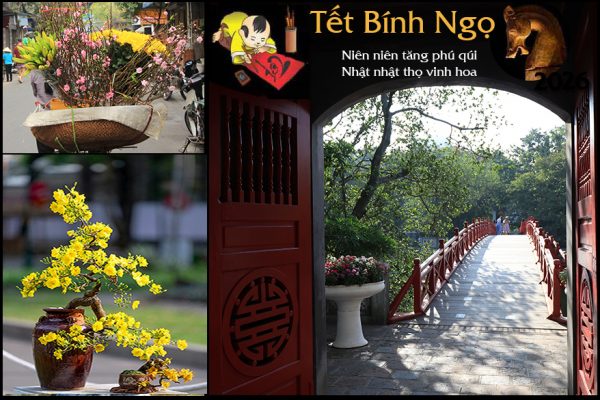
Niên niên tăng phú quí
Nhật nhật thọ vinh hoa.

Tết còn là lễ  của các thiếu nhi. Các em bé xúng xính trong những bộ quần áo đẹp đẽ và cùng nhau đốt pháo vui vẽ trên các đường phố. Chúng còn nhận được từ người lớn một phong bì đỏ trong đó có chứa một tờ tiền giấy hoặc một đồng xu may mắn quanh năm cho chúng. Còn các người lớn, họ đi viếng chùa và cố đoán trước tương lai của mình qua cách xin xăm gieo quẻ. Đây cũng là cơ hội để tôn trọng những quy tắc cơ bản mà người Việt Nam nào cũng cần phải biết: cấm nói tục chửi thề, tránh mọi cuộc cãi vã, không dùng chổi quét nhà, tránh đến nhà ai đó vào ngày đầu năm vân vân…. Đây cũng là dịp để xem Múa Lân hay múa Rồng. Con linh vật này đầu được trang trí đẹp mắt và thân thể của nó được nâng lên bởi một số vũ công uốn lượn theo nhịp điệu của âm thanh của các tiếng trống.  Nó luôn luôn đi cùng với một vũ công bụng phệ, vui cười hay vẫy quạt và mặc áo choàng màu vàng nghệ (Ông Địa). Đây là cuộc khiêu chiến giữa người và động vật, giữa Thiện và Ác, luôn luôn kết thúc bằng chiến thắng của con người trên động vật.

Lễ hội đón Tết thông thường  kéo dài cả tuần, thậm chí cả tháng ở một số làng quê. Nhưng vì cuộc sống khó khăn nên thông lệ hôm nay chỉ nghỉ làm việc trong ba ngày đầu năm.

Trong tử vi Việt Nam, các  cung hoàng đạo có được 12 cung và được tượng trưng bởi mười hai con giáp sau đây: Tý, Sửu, Dần, Mẹo, Thìn, Tị, Ngọ, Mùi, Thân, Dậu, Tuất, Hợi. Các con giáp nầy được nối tiếp nhau theo một thứ tự rất chính xác. Không giống như chiêm tinh học phương Tây, các cung hoàng đạo không được xác định bởi tháng sinh mà là năm sinh.

Mỗi người có một cung hoàng đạo được tượng trưng bởi sự kết hợp của một con giáp trong mười hai con giáp của thập nhị địa chi  tức là 12 nhánh của Đất và một hành trong ngũ hành: Thủy, Hỏa, Mộc, Kim, Thổ chẳng hạn Bính Ngọ là  năm nay. Hỏa được chọn tên trong thập thiên can kết nối thành  từng đôi từ Âm Dương và ngũ hành: Giáp, Ất, Bính, Đinh, Mậu, Kỷ, Canh, Tân, Nhâm, Qúy: [Giáp, Ất] = Mộc, [Bính, Đinh] = Hỏa, [Mậu, Kỹ ] = Thổ, [Canh, Tân] = Kim, [Nhâm, Qúy] = Thủy. Như vậy Bính thuộc về hành Hỏa.
Đây là lý do tại sao năm nay là năm Tết Bính Ngọ. Nó chỉ được  có lại sau sáu mươi năm (tức là 1906, 1966, 2026, 2086 vân vân …). Trong biên niên sử của chúng ta, có hai cái Tết mà người dân Việt vẫn nhớ lâu: đó là cái Tết mà vua Quang Trung tái chiếm thủ đô Hà Nội vào năm 1788 chống lại quân Thanh và Tết Mậu Thân năm 1968 ở miền Nam Việt Nam.

Đối với mỗi người dân Việt, Tết  là một khoảng thời gian vô cùng hạnh phúc nhất là Tết còn được trở lại mỗi năm và cho phép  mỗi người  dân Việt được sống vài ngày trong sự mừng rỡ hân hoan  và thỏa mãn bất chấp những nổi thăng trầm trong cuộc sống. Dù nghèo, cũng mong muốn có được một cuộc sống tươi sáng để đón một cái Tết như nhà thơ nổi tiếng Trần Tế Xương trong bài thơ có tựa đề: Tết đến (*)

Anh em đừng nghĩ Tết tôi nghèo,
Tiền bạc trong kho chưa lãnh tiêu,
Rượu cúc nhắm đến hàng biếng quảy,
Trà sen muốn hỏi giá còn kiêu,
Bánh đường sắp gói e nồm chảy,
Giò lụa toan làm sợ nắng thiu,
Thôi thế thì thôi đành Tết khác,
Anh em đừng nghĩ Tết tôi nghèo

Những tập tục thường thấy trước hay lúc Tết về:


Galerie des photos

Tet_nouvel_an

Temple royal des Trần (Phủ Thiên Trường)


Version française

Phủ Thiên Trường

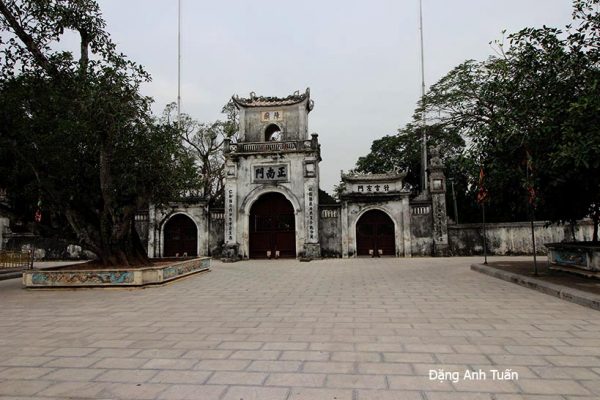
Đây là một quần thể kiến trúc và lịch sử dành để thờ các vua nhà Trần và các quan có công phù tá. Nằm trên quốc lộ số 10 trong tỉnh Nam Định, đền nầy được xây cất lại năm 1695 trên nền thái miếu cũ được gọi là phủ Thiên Trường mà quân xâm lược nhà Minh phá hủy vào thế kỷ 15.  Cũng ở nơi nầy mà phát tích vương triều nhà Trần.  Các vua nhà Trần tạm về nơi nầy để lánh nạn trong thời gian chống giặc Nguyên Mông của Hốt Tất Liệt.

Temple royal  des Trần

C’est un  ensemble architectural et historique remarquable  dédié au culte des  rois de la dynastie des Trần  et de leurs  célèbres  serviteurs.  Situé à la route nationale n°10 dans la province de Nam Định, il fut reconstruit en 1695 sur l’emplacement de l’ancien temple royal  connu sous le nom « Phủ Thiên Trường »  détruit complètement par les envahisseurs chinois (les Ming) au XVème siècle. C’est ici qu’est née la dynastie des Trần. Les rois des Trần  y trouvaient refuge durant la guerre contre les Mongols de Kubilai Khan

Galerie des photos

[Retour Hanoi et ses sites historiques]

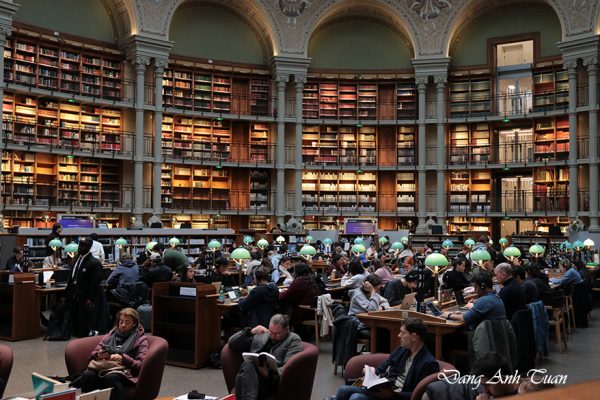
Bibliothèque nationale de France Richelieu

Bibliothèque nationale de France Richelieu (Paris)

Thư viện  quốc gia Pháp Richelieu (Paris).

Version vietnamienne
Version anglaise
Galerie des photos

Une brève histoire d’un long projet
L’idée de construire la Salle Ovale a commencé en 1897, lorsque l’architecte Jean-Louis Pascal l’a conçue comme un nouvel espace de lecture pour les périodiques. Les progrès furent tellement lents. À cause des guerres, des problèmes financiers et des changements de direction, cette construction a pris du retard pour terminer seulement  son achèvement en 1932 lorsque Alfred Recoura  a repris les plans. Elle a été officiellement inaugurée en 1936 par le président Albert Lebrun.
Au fil des années, la salle a changé de rôle: de l’hébergement de documents de référence à l’accueil de l’Institut National d’Histoire de l’Art (INHA). Après une rénovation majeure, elle a rouvert en 2022 en reprenant sa mission initiale: une salle de lecture publique pour tous.

Một lịch sử ngắn gọn của một dự án dài

Ý tưởng về việc xây dựng phòng Bầu dục được bắt đầu vào năm 1897, khi kiến trúc sư Jean-Louis Pascal thiết kế nó như một không gian đọc mới dành cho các tạp chí định kỳ. Tiến trình nầy  rất chậm. Chiến tranh, các vấn đề tài chính và thay đổi lãnh đạo đã làm trì hoãn việc hoàn thành nó cho đến năm 1932, khi ông  Alfred Recoura tiếp nhận lại các bản thiết kế. Phòng nầy được chính thức khánh thành vào năm 1936 bởi Tổng thống Albert Lebrun.

Theo thời gian, phòng đã thay đổi vai trò : từ việc lưu trữ các tài liệu tham khảo sang tiếp nhận Viện Lịch sử Nghệ thuật Quốc gia (INHA). Sau một đợt cải tạo trọng đại, thư viện đã mở cửa trở lại vào năm 2022 và trở về sứ mệnh ban đầu: một phòng đọc công cộng dành cho tất cả mọi người.

A Brief History of a Long Project

The idea of building the Oval Room began in 1897, when architect Jean-Louis Pascal designed it as a new reading space for periodicals. The progress was very slow. War, financial issues, and changes in leadership delayed its completion until 1932, when Alfred Recoura took over the designs. The room was officially inaugurated in 1936 by President Albert Lebrun.

Over time, the room’s role changed: from storing reference materials to housing the National Institute of Art History (INHA). After a major renovation, the library reopened in 2022 and returned to its original mission: a public reading room for everyone.

Pictures gallery

[Return PARIS et ses sites]

Lion dog (Con nghê)


Version vietnamienne
Version française
Galerie des photos

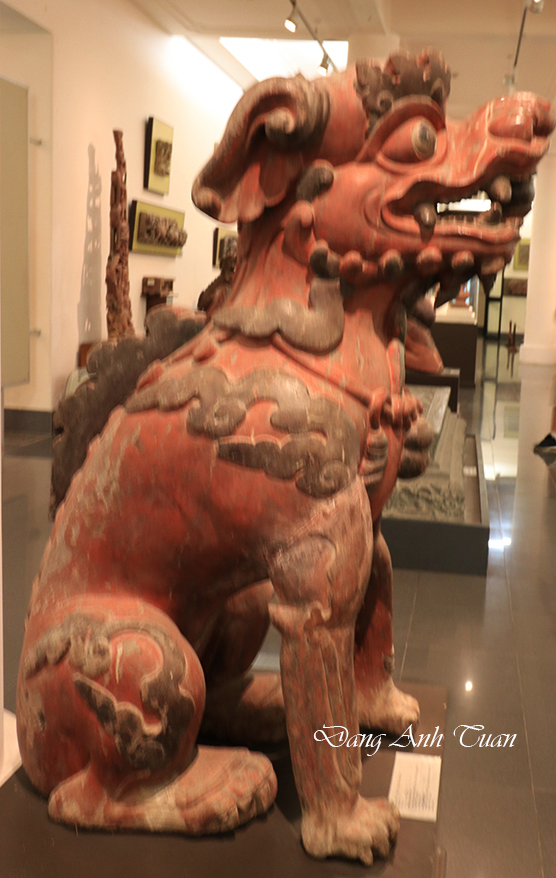
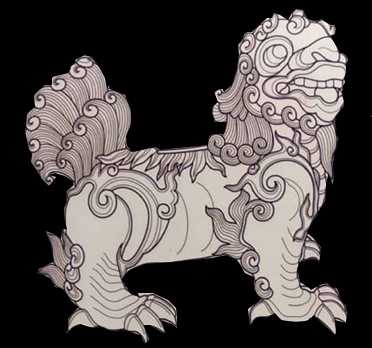
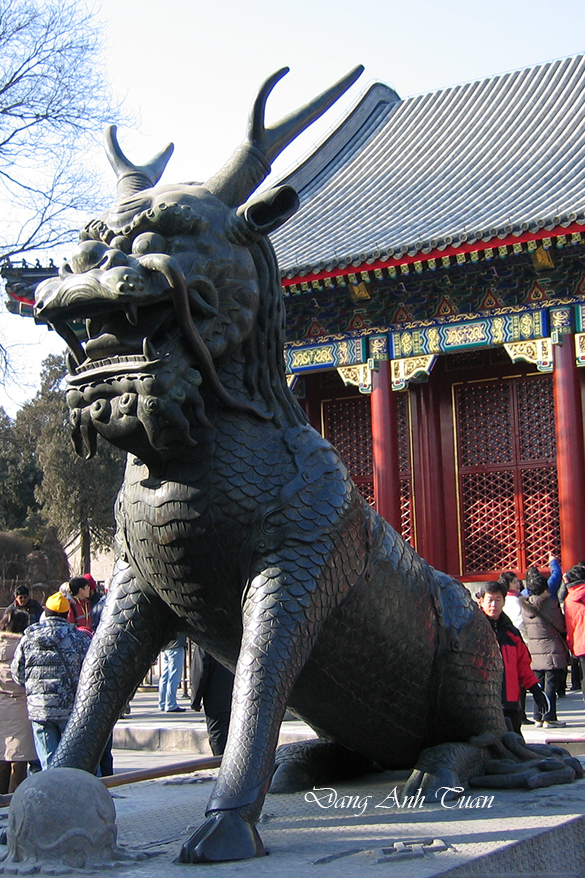
In Vietnamese culture, we are accustomed to confusing the animal « nghê (or lion-dog) » with the qilin (kỳ lân)(*). The « lion-dog » does not actually exist in nature, but it is also not a sacred animal borrowed from other cultures. It is a purely Vietnamese creature dating back to ancient times. The nghê has certain traits of the qilin. The main characteristic that distinguishes the nghê from the qilin lies in the toes: the nghê is armed with claws, while the qilin has hooves. Additionally, the nghê has the body of a dog to conform to the identity and culture of the Vietnamese people. In biological dictionaries, there is no animal named « nghê » or « lion-dog, » but only the lion exists. Before the Han (or Chinese) domination, its existence is not detected. Its formation took place within Vietnamese culture starting from the Han domination period, at the end of the Đồng Sơn period and at the time when the Lý dynasty succeeded in gaining full independence. It was during this period that it appeared in architectural construction projects such as the imperial citadel of Thăng Long, the Dâu and Phật Tích pagodas, communal houses, etc. It is an imaginary creature that has never had a precise appearance or form like a tiger or a lion.

That is why there is variation in the modification of the form of this creature. It is a four-legged animal, hornless, with a slender body, which gives it a resemblance to a guard dog. Its particular characteristic is « guarding and protection. » We are accustomed to saying « the phoenix dances and the lion-dog guards » in a proverb. In the Vietnamese dictionary, « chầu » is used to mean « waiting for orders » and « watching. » This creature possesses the « sacred » element intended to ward off and neutralize evil spirits. That is why the lion-dog (or nghê) is visible everywhere in Vietnamese folklore, from the royal court and pagodas to the village entrance, tombs, and house roofs.

According to fine arts specialist Trần Hậu Yên Thế, this creature has a physiognomy, an idyllic appearance that facilitates the first impression, a familiar characteristic, thus revealing its loyalty like a dog with a short tail.

Historian Lê Văn Lan informs us that at the time of creating the mascot, one must initially be inspired by a real animal. This is how the lion-dog is created from the guard dog, just as the dragon is from the crocodile. Everywhere, in every place, the lion-dog must appear with a particular meaning. The nghê located in the cemetery is different from the one found at the entrance of the communal house.

At the top of the roof of the latter (Đinh Bảng for example), the lion-dog, analogous to a phoenix belonging to the animals of the heavens, watches below the movement of the visitor with the purpose of protecting or punishing them depending on their behavior during the visit. However, on the tops of the two columns at the entrance of the Mông Phụ communal house (Đường Lâm), there are two nghê, each with a joyful and welcoming appearance. As for the crouching nghê in front of the tomb, it appears both compassionate and merciful. This in no way manifests the ferocity and power often found in the Chinese lion. The lamp base in the shape of a crouching « lion-dog » found among the late Đông Sơn culture artifacts functions to radiate a light intended to repel and destroy evil spirits. In front of the village entrance, its presence brings protection to the entire village.

According to fine arts specialist Trần Hậu Yên Thế, during the Lê Trung Hưng period (1428-1788), the « lion-dog » was still present near royal tombs. However, the « nghê » no longer exists in most royal tombs under the Nguyễn dynasty but is replaced by the qilin.

But in everyday life, the lion-dog is always visible in the architectural network of hundreds of villages in the North. Until now, statues of the « lion-dog » in a guarding position continue to be made. The lion-dog appears in various forms. It is very well adapted to the landscape of the place where it is present and reflects the spirit of the Vietnamese people. Depending on each period of history, it presents itself in different and distinctive ways, but the basis of its characteristics continues to carry the Vietnamese folkloric element.


(*) Qilin is the word designating the pair of Feng Shui animals where Qi is the male and Lin is the female.

Pictures Gallery

con_nghe

  [Return RELIGION]

Bibliography:

Đinh Hồng Hải: Những biểu tượng đặc trưng trong văn hóa truyền thống Việt Nam.  Tập 3. Các con vật linh. Editions Nhà Xuất Bản thế giới. Hànội 2016
Trần Hậu Yên Thế, Nguyễn Đưc Hoà, Hồ Hữu Long: Phác họa Nghê. Nhà Xuất Bản thế giới.

The tomb of the patriotic emperor Hàm Nghi


Version française
Version vietnamienne
Galerie des photos

For a long time, I have hoped to one day visit the tomb of the exiled Emperor Hàm Nghi when I knew that he was buried in the commune of Thonac, located in the Dordogne department of the Nouvelle-Aquitaine region. At the end of the week in May 2017, I had the opportunity to be in that area with my children, but I was completely disoriented and saddened when I found his vault. It continues to be ravaged by moss and does not resemble the photo found on the internet. We are all stunned and outraged by the lack of respect towards Hàm Nghi, a young emperor exiled at 18 by the French colonialists and who died in Algiers. Back in Paris, saddened by this story, I also did not have enough time to post the photos of Thonac on my site, especially those of the Château de Losse, whose owner is none other than the eldest daughter of Emperor Hàm Nghi, Princess Như Mây. She bought the castle in 1930 for the sum of 450,000 francs. Due to financial problems, she sold it to a Frenchman, who later transferred it to an English family in 1999. Today, this castle has been classified as a historic monument since 1932. For this reason, the remains of Emperor Hàm Nghi were brought back to France to Thonac during Algeria’s independence in 1965 and were reburied there with his family (his wife, his eldest daughter Như Mây, his only son Minh Đức, and his housekeeper)

When mentioning King Hàm Nghi, one cannot forget to recall his biography. Known as Ưng Lịch, he was the younger brother of King Kiến Phúc. He was placed on the throne by two regents, Nguyễn Văn Tường and Tôn Thất Thuyết, in 1884 when he was 13 years old. Having killed three successive kings—Dục Đức, Hiệp Hoà, and Kiến Phúc—in less than a year, they thought that with Hàm Nghi’s young age, they could easily guide his governance toward a policy aimed at driving the French out of Vietnam. After the failure of the Vietnamese assault against the French garrison of General De Courcy at Mang Cá, King Hàm Nghi was forced to leave the citadel of Huế and took refuge in Quảng Trị in central Vietnam. He was accompanied by Tôn Thất Thuyết and Nguyễn Văn Tường. For an unknown reason, the latter returned to the citadel of Huế. He later tried to explain through his poem in which he acknowledged that he no longer followed Hàm Nghi in the resistance because, for him, it was preferable to serve the state rather than engage in resistance. For the king or for the Vietnamese state, the choice was difficult. He left it to future generations to judge.

Xe giá ngàn trùng lẫy dặm xanh
Lòng tôi riêng luyến chốn lan đình
Phải chăng phó mặc ngàn  sau luận
Vua, nước đôi đường hỏi trọng khinh?

The carriage travels thousands of leagues through the vast green,
My heart alone longs for the place of the orchid pavilion.
Is it perhaps to entrust the judgment to thousands of years hence,
The king and the country, two paths questioning honor and disgrace?

He asked Father Caspar to contact De Courcy to arrange an audience and tried to convince him that he did not participate in the launch of the aborted assault. Pretending to believe him, De Courcy suggested that he write letters urging Hàm Nghi and his supporters to return to the citadel of Huế and set him an ultimatum of two months. After failing to convince Hàm Nghi and Tôn Thất Thuyết, he was first deported to Poulo Condor Island, then to Tahiti to receive treatment for his illness, and finally died in Papeete. As for Tôn Thất Thuyết, he continued to accompany Hàm Nghi in the fight against the French with his children Tôn Thất Đạm and Tôn Thất Thiệp during the four years of resistance. He eventually left for China to seek help from the Qing and died there in exile in 1913.

King Hàm Nghi twice called upon all the vital forces of the nation, especially the scholars, to rise up against the colonial authorities in his name through the movement called « Cần Vương » (Aid to the King) from the North to the South to demand independence. This movement began to find a favorable response among the people. The scale of this movement did not diminish and was visible everywhere, such as in Hà Tĩnh with Phan Đinh Phùng, Đinh Nho Hạnh, in Bình Định with Lê Trung Đình, in Thanh Thủy with Admiral Lê Trực, in Quảng Bình with Nguyễn Phạm Tuân, etc. The name of King Hàm Nghi accidentally became the banner of national independence. Despite the installation of Đồng Khánh on the throne by the French colonial authorities with the approval of the Queen Mother Từ Dũ (mother of Emperor Tự Đức), the insurrection movement continued to endure as long as King Hàm Nghi was still alive. To extinguish the insurrection everywhere, it was necessary to capture Hàm Nghi because he represented the soul of the people while the rebels were part of the body of this people. Once the soul of the people was eliminated, the body disappeared in an obvious way. Between Hàm Nghi and the rebels of the Cần Vương movement, there was always an intermediary who was none other than Tôn Thất Đạm, the son of Tôn Thất Thuyết. Few people had the right to approach Hàm Nghi, who was constantly protected by Tôn Thất Thiệp and a few Muong bodyguards of Trương Quang Ngọc.The latter was known as a local Mường lord living on the banks of the Nai River in Quảng Bình. Hàm Nghi led a difficult and miserable life in the forest during the resistance period.

Because of the betrayal of Trương Quang Ngọc, he was captured in November 1888 and taken back to the citadel of Huế. Silent, he categorically denied being King Hàm Nghi because for him it was an indescribable shame. He continued to remain not only impassive but also mute about his identity in the face of his French captors’ incessant interrogations. Several mandarins were sent to the site to identify whether the young captive in question was indeed King Hàm Nghi or not, but none managed to move him except the old scholar Nguyễn Thuận. Seeing the king who continued to play this charade, he, with tears in his eyes, prostrated himself before him and trembled as he dropped his cane. Faced with the sudden appearance of this scholar, the king forgot the role he had played until then against his captors, helped him up, and knelt before him: « I beg you, my master. » At that moment, he realized he had made a mistake in recognizing him because Nguyễn Thuận had been his tutor when he was still young. He never regretted this gesture because for him, respect for his master came before any other consideration.

Thanks to this recognition, the colonial authorities were certain to capture King Hàm Nghi, which allowed them to pacify Vietnam with the disappearance of the « Cần Vương » movement a few years later. He was then deported to Algeria at the age of 18. He never saw Vietnam again. Even his remains have not been brought back to Vietnam to this day due to his family’s refusal, but they were reburied in the village of Thonac in Sarlat (Dordogne, France) during Algeria’s declaration of independence in 1965 along with his family. During his exile in Algiers, he abandoned all political objectives from 1904, the year of his marriage to a French woman. This was revealed by his niece Amandine Dabat in her work titled « Hàm Nghi, Emperor in Exile and Artist in Algiers, » Sorbonne University Press, published on November 28, 2019. He found solace in another passion, another way of living through art. He was seen mingling with the artistic and intellectual circles of his time (Marius Reynaud, Auguste Rodin, Judith Gautier, etc.). Thanks to this association,

he became a student of the orientalist painter Marius Reynaud and the famous sculptor Auguste Rodin, which allowed him to overcome the eternal pain and sadness of a young patriotic emperor exiled far from his homeland until his death.

Château De Losse

[Return DYNASTY]

Référence bibliographique  

Vua Hàm Nghi. Phan Trần Chúc Nhà xuất bản Thuận Hóa 1995.

Ham Nghi – Empereur en exil, artiste à Alger.  Amandine Dabat, Sorbonne Université Presses, Novembre 2019 


Emperor Tự Đức (Version anglaise)


tuduc

Hồng Nhậm

(1847-1883)

A great tribute to the poet-emperor Tự Đức through my four verses in Six-Eight:

Ngậm ngùi thương xót phận mình
Làm vua chẳng có quang vinh chút gì
Thực dân chiếm đất ở lì
Trẩm đây buồn tủi, sử thì kết oan

I painfully pity my fate
« Being king » does not deserve enough glory
The colonialists confiscated the land to stay there
I am plunged into sadness and humiliation while history has condemned me.

Version vietnamienne
Version française
Galerie des photos

Being the fourth emperor of the Nguyễn dynasty, Tự Ðức was known by the name Hồng Nhậm when he was still a young prince. He was the youngest son of Emperor Thiệu Trị. The latter decided to change his mind at the last minute in his royal will by designating him as the deserving successor instead of the crown prince Hồng Bào, his brother, on the pretext of debauchery. His enthronement was greatly disturbed by the fainting of his brother Hồng Bào before the Court, followed by the imprisonment of the latter, later accused of collusion with Catholic priests and Europeans in view of a coup d’état. Hồng Bào was shortly thereafter eliminated in prison, which later raised some criticisms directed at the emperor by his subordinates through their poems. He was reproached for lacking the magnanimity that King Cao Pi (Tào Phi) had reserved for his brother Cao Tseu (Tào Thực), a great poet also ousted from power during the Three Kingdoms period in China. This was the case of the mandarin Nguyễn Hàm Ninh. One fine day, Tự Ðức, who had accidentally bitten his tongue with his teeth at lunchtime, decided to choose as a poetry subject the theme « the injury caused by teeth » and asked his subordinates to compose poems focused on this theme. Nguyễn Hàm Ninh took advantage of this suggestion to promptly address him with his following four-line epic poem:

Ta ra đời trước chú chưa sinh
Chú phận làm em, ta phận anh
Ngọt bùi sao chẩng cùng san sẽ
Mà nỡ đau thương cô’t nhục tình?

I was born before your birth
You are my little brother, I am your big brother
Why don’t you share happiness with me instead of tearing each other apart so miserably?

Nguyễn Hàm Ninh was thus rewarded for his extraordinary talent with several taels of gold, but at the same time, he received a blow with a stick for each verse composed because each verse was meaningful and profound. Tự Ðức was a great poet of his time. That is why he had an undeniable preference for all the great poets of his era. They were appreciated at their true value even at times when his authority and self-esteem could be insulted by harsh and bitter criticism from independent and strong-willed people like Cao Bá Quát. The latter did not cease to ridicule him many times in front of the mandarins, but he did not hesitate to shower him with praise when Cao Bá Quát managed to aesthetically return his antithetical statement while relying on the calling statement proposed by Tự Ðức through a clever play on words. Taking advantage of Cao Bá Quát’s presence, Tự Ðức spontaneously issued the calling statement:

Nhất bào song sinh, nan vi huynh, nan vi đệ
Một bọc sinh đôi, khó làm anh, khó làm em

There is only one embryo for two human lives. It is difficult to be the older brother but it is also difficult to be the younger brother.

To remind Cao Bá Quát that they were twin brothers (him and his brother Cao Bá Ðạt) who were hard to distinguish.

Cao Bá Quát immediately made the following statement in response:

Thiên tài thất ngộ, hữu thị quân, hữu thị thần
Nghìn năm gập một, có vua ấy, có tôi ấy.

There is only one time in a thousand years. There is the good king but there is also the good servant.

To remind Tự Ðức that a good king is always served by a good servant. Despite this, Tự Ðức was not entirely satisfied because he also knew that it was an intelligent and subtle allusion to the Vietnamese proverb (vỏ quýt dày, móng tay nhọn) (or in French, « à bon chat, bon rat« ).

Not only do we find the same number of words in both the calling statement and the called statement, but also the same position for each repeated word. Once again, Cao Bá Quát was not very happy to see the following two antithetical verses composed by Tự Ðức hanging at the entrance of the Cần Chánh palace:

Tử năng thừa phụ nghiệp
Thần khả báo quân ân.

The capable son inherits the father’s profession
The worthy subject is always grateful to the benevolent king.

He was surprised and asked him the reason for his dissatisfaction. Cao Bá Quát said to him:

The word « Tử » (or son in French) cannot be placed before the word « phụ » (or father in French). Similarly, the word « Thần » (or subject in French) cannot precede the word « quân » (or king in French). This no longer conforms to our hierarchical order.
Tự Ðức asked him to correct this mistake. Without hesitation, Cao Bá Quát instantly recited the following two verses:

Quân ân, thần khả báo
Phụ nghiệp, tử năng thừa

For the king’s benefits, the deserving subject is grateful.
For the father’s trade, the capable son inherits.

Despite his romantic nature and delicate temperament, Tự Ðức was the emperor who knew very little serenity and tranquility during his reign. He had to face not only the development of Western capitalism but also internal troubles due to the eviction of his elder brother Hồng Bào, the Locust War led by Cao Bá Quát later, etc. The loss of the six provinces of Nam Bộ continuously haunted him and plunged him painfully into everlasting sadness because he was the first emperor of the Nguyễn dynasty to bear the heavy responsibility of letting a part of Vietnamese territory slip into the hands of foreigners, particularly the one from which his mother originated.

Tự Đức stele
tuduc_stele

The absence of an heir prince due to his sterility caused by smallpox he contracted when he was young, the suicide of the scholar Phan Thanh Giản, governor of the western provinces of Nam Bộ, saddened him and forced him to often seek refuge in his beautiful red wooden pavilions Du Khiêm and Xung Khiêm, which have now become favorite places for foreign and Vietnamese tourists. It was here that he composed poems, the most famous remaining the love poem titled « Khóc Bằng Phi (Tears for My Concubine) » and immortalized by the following two verses:

Ðập cổ kính ra, tìm lấy bóng
Xếp tàn y lại để dành hơi

I break the old mirror to search for your shadow
I fold your worn clothes to keep your warmth.

Being a pious child, Tự Ðức reigned under the shadow of his mother, Empress Từ Dũ. He took into consideration everything the queen mother had suggested to him. One fine day, while watching the Chinese dramatic theatrical masterpiece titled « Conquest of the West » (Ðường Chinh Tây), the queen mother was shocked by the scene where the heroine Phàn Lê Huê killed her father. To please his mother, Tự Ðức was forced to ask the mandarin in charge of entertainment to completely modify the content of the scene to no longer show this infamous tragedy contrary to the Confucian spirit. The rehabilitation of the mandarin Phạm Phú Thứ in the role of academician responsible for consultation books was not unrelated to the reprimand Tự Ðức had received from the queen mother. This mandarin dared to ask Tự Ðức to correct his laziness because since his accession to the throne, he had abolished grand audiences and gave no follow-up to submitted petitions. Despite his crime of lèse-majesté, Phạm Phú Thứ was not dismissed but rejoined the Court assembly and became a great mandarin under his reign. Due to the influence of the Confucian mandarin clan, Tự Ðức could not initiate reforms in time despite the warning and the pathetic memorandum of the patriotic scholar Nguyễn Trường Tộ.

He did not know how to take advantage of favorable opportunities to bring Vietnam onto the path of modernity, but instead sank deeper into isolation, sadness, and loneliness since the annexation of the six provinces of Nam Bộ by the French colonial authorities.

To try to bring Tự Ðức back to good spirits, the queen mother promised to reward whoever succeeded in making the emperor laugh. He liked to often go to the theater to relax. One fine day, taking advantage of his presence at the royal theater, the leader of the theatrical group named Vung suddenly appeared before Tự Ðức, who was smoking, and said to him:

May you allow me, Lord, to share a puff of your cigarette?
His spontaneous gesture stunned everyone because it was known that he had committed a crime of lèse-majesté. Tự Ðức also laughed at that moment. But he recovered himself and said to him:

You really have audacity.
and pardoned his offense.

Vung was later rewarded by the queen mother.

It is regrettable to attribute to Tự Ðức the image of a despotic emperor responsible for the dismemberment of Vietnam by the colonial authorities. The fate of his country and his people had long been sealed when his grandfather, Emperor Minh Mạng, and his father Thiệu Trị had chosen a policy of persecution against Catholics and foreign missionaries, which allowed the French authorities to justify their intervention and annexation. The French colonial policy had long been set in motion.

Through these anecdotes, we know that Tự Ðức was a tolerant and pious emperor, a man of heart and a great poet of his time. The destiny of his country forced him to become emperor against his will, to kill his elder brother when he became the privileged collaborator of foreigners. Could anyone have done better than him? This is the question one asks when putting oneself in his place. The answer is not found over the years, but one thing is known.

He could not remain indifferent to the events that were cruelly falling upon him and his people. He also could not recover from the deep pain of seeing in the history of Vietnam the fall of the Empire for which he was blamed as responsible.

Galerie des photos

[Return DYNASTIE]


Hồng Bàng period (Văn Lang civilization):Part 2


Version française
Version vietnamienne
Galerie des photos

Also noted is the significant event highlighted by the Chinese historian Trịnh Tiều in his work Thông Chí: In southern China, during the reign of King Nghiêu (2253 BC), there was an emissary from a tribe named Việt Thường who offered the king, as a token of allegiance, an old turtle that lived for over 1000 years and measured 3 meters in length. On its back were inscriptions bearing characters shaped like tadpoles (văn Khoa Ðẩu), which allowed the interpretation of all the changes of Heaven and nature. King Nghiêu decided to name them Qui Lịch (or turtle calendar). This form of writing was recently found on a stone that is part of the cultural relics of the Sapa-Lào Cai region in northern Vietnam.

The Vietnamese historian Trần Trọng Kim raised this issue in his work titled Viet Nam sử lược (A Brief History of Vietnam).

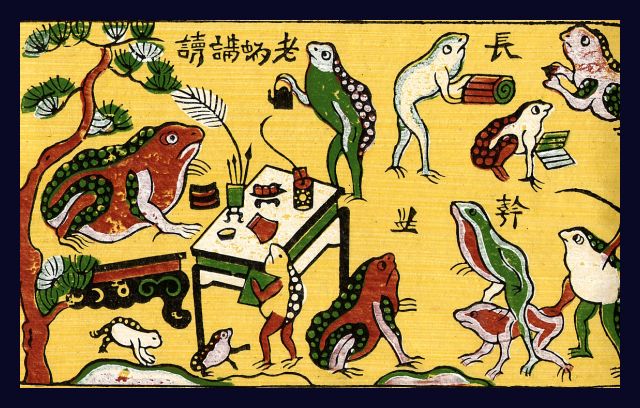
Many clues have been found in favor of the interpretation of a single tribe, a single people. It cannot be denied that there is an undeniable link between the tadpole-shaped writing and the toad found either on the bronze drums of Ðồng Sơn or on the popular Vietnamese prints of Ðông Hồ, the most famous of which remains the print « Thầy Ðồ Cóc » (or The Toad Master). On the latter, the following phrase is found: Lão oa độc giảng (The old toad holds the monopoly on teaching). Although it appeared only 400 years ago, it cleverly reflected the perpetual thought of the era of the Hùng kings (Hùng Vương). It is not by chance that the toad is attributed the role of master, but rather to highlight the importance of the representation and meaning of this image. The toad was the bearer of a civilization whose tadpole-shaped writing was used by the Lạc Việt tribe during the time of the Hùng Vương because it was the father of the tadpole. Similarly, through the print « Chú bé ôm con cóc » (or the boy hugging the toad), the original thought of the Lạc Việt people was revealed. The child’s respect for the toad, or rather its master (Tôn Sư trọng đạo), was a concept already existing during the time of the Hùng Vương. Could one conclude that there was a correlation with what was later found in the Confucian spirit with the phrase Tiên học lễ, hậu học văn (First learn manners, then learn knowledge)?

In Vietnam, the turtle is not only a symbol of longevity but also of the transmission of spiritual values in Vietnamese tradition. Its representation can be found everywhere, especially in common places such as communal houses, pagodas, and temples. It is used in the Temple of Literature (Văn Miếu) to support steles praising the merits of national exam laureates.

The crane on the back of the turtle

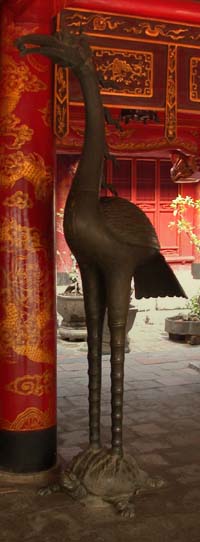
On the other hand, in temples and communal houses, it is always seen carrying a crane on its back. There is an undeniable resemblance between this crane and the long-beaked wading bird found on the bronze drums of Ðồng Sơn. The image of the crane on the turtle’s back probably reflects the continuity of all religious beliefs derived from the Văn Lang civilization over time. The omnipresence of the turtle in the history and culture of the Vietnamese is neither the result of long Chinese domination nor chance, but it must be due to the fact that the kingdom of Văn Lang was located in a region populated by large turtles. It is only in the southern basin of the Yangtze River (Sông Dương Tữ) that this species of large turtles, now endangered, can be found. This was reported by the Vietnamese author Nguyễn Hiến Lê in his work entitled « Sử Trung Quốc » (History of China) (Văn Hoá Publisher, 1996).

It is unlikely that one day archaeological remains proving the existence of this kingdom will be found, like those already discovered from the Shang dynasty. But nothing invalidates this historical truth because, besides the facts mentioned above, there is even intangible proof of a very ancient civilization in this kingdom, often called « the Văn Lang civilization, » whose foundation was found in the theory of Yin and Yang and the five elements (Thuyết Âm Dương Ngũ Hành). This was demonstrated through the sticky rice cake « Bánh Chưng Bánh dầy, » which was exclusively unique to the Vietnamese people since the period of the Hùng Vương kings. One might question the origin of this theory, which has so far been attributed to the Chinese. It was known that according to the Historical Records of Sima Qian (Sử Ký Tư Mã Thiên), Trâu Diễn (Tseou Yen, a philosopher from the state of Qi (Tề Quốc) (350-270 BC)) during the Warring States period (thời Chiến Quốc), was the first Chinese to highlight the relationship between the theory of Yin and Yang and that of the five elements (wu xing).

Âm Dương
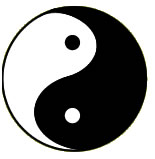
The first was mentioned in the book Zhouyi (Chu Dịch) by the son of King Wen (1), Chu Công Ðán (the Duke of Zhou), while the second was found by Yu the Great (Ðại Vũ) of the Xia dynasty (Hạ). There is practically a gap of 1000 years between these two theories. The concept of the five elements was quickly integrated into the theory of yin and yang to provide an explanation of the tao, which is the origin of all things. Despite the success encountered in a large number of fields of application (astrology, geomancy, traditional medicine), it is difficult to give a coherent justification regarding the date of publication of these theories because the notion of Taiji (thái cực) (the supreme limit), from which the two main elements were born (yin and yang), was introduced only at the time of Confucius (500 years B.C.). Taiji has been the subject of meditation by philosophers from all backgrounds since the philosopher of the Song era and the founder of neo-Confucianism, Zhou Dunyi (Chu Ðôn Di), gave this concept a new definition in his bestseller: « Treatise on the Taiji Diagram » (Thái Cực đồ thuyết):

Vô cực mà là thái cực, Thái cực động sinh Dương, động đến cực điểm thì tĩnh, tĩnh sinh Âm, tĩnh đến cực đỉnh thì lại động. Một động một tĩnh làm căn bản cho nhau…

From Wuji (Limitless) to Taiji (Supreme Limit). The supreme limit, once in motion, generates yang, and at the limit of movement is rest; this, in turn, generates yin, and at the limit of rest is the return to movement. Movement and rest, each takes root in the other.

For the Chinese, there is a sequence in the beginning of the universe:

Thái cực sinh lưỡng nghi là Âm Dương, Âm Dương sinh Bát Quái

From Taiji come Heaven and Earth, a Yin and a Yang that give birth to the eight trigrams.

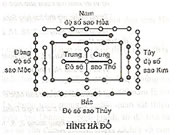
Hà Đồ (River Diagram)
The inconsistency is so visible in the chronological order of these theories because Fu Xi (1) was attributed with the invention of the eight trigrams around 3500 BC, whereas the notion of Yin and Yang was introduced during the Zhou era (1200 BC). Relying on recent archaeological discoveries, particularly the discovery of the silk manuscripts at Mawangdui (1973), today’s Chinese specialists propose unimaginable statements: The hexagrams precede the trigrams, etc., which proves that the chronological order of these theories is subject to constant revision according to new situations. This leads us to find, in this confusion, another explanation, another approach, another hypothesis according to which the theory of Yin-Yang and the five elements was appropriated by another civilization. That would be that of Văn Lang. Confusion continues to be ingrained in the reader’s mind with the famous River Plan and the Luo Script (Hà Ðồ Lạc Thư).

The Luo Script was supposed to be found before the appearance of the River Plan. This highlights the contradiction found in the chronological order of these discoveries. Some Chinese had the opportunity to question the traditional history established until then in Confucian orthodoxy by the Chinese dynasties. This is the case of Ouyang Xiu (1007-1072), who saw in this famous plan the work of man. He refuted the « Mandate of Heaven » in his work entitled « Questions of a Child on the Yi King (Yi tongzi wen) » (Zhongguo shudian, Beijing 1986). He preferred the version of human invention.

Can the truthfulness of the Chinese legend be granted when it is known that there was also a complete inconsistency in the chronological order of the discovery of these famous River Plan and Luo Script?

Fou Xi (Phục Hi) (3500 BC) first discovered the River Plan (Hà Ðồ) during an excursion on the Yellow River. He saw a dragon horse (long mã) emerge from the water carrying this plan on its back. It was attributed to You the Great (Đại Vũ) (2205 BC) the discovery of the Luo Script found on the back of the turtle. Yet it is thanks to the Luo Script and its explanation (Lạc Thư cửu tinh đồ) that one manages to establish and correctly interpret the stellar diagram based on the North Star (Bắc Ðẩu) and found on this famous River Plan according to the principle of Yin and Yang and the 5 elements.

The famous word « Luo » (Lạc) found in the text of the Great Commentary of Confucius:

Thị cố thiên sinh thần vật, thánh nhân tắc chi, thiên địa hóa thánh nhân hiệu chi; thiên tượng, hiện cát hung, thánh nhân tượng chi. Hà xuất đồ, Lạc xuất thư, thánh nhân tắc chi.

Cho nên trời sinh ra thần vật, thánh nhân áp dụng theo; trời đất biến hoá, thánh nhân bắt chước; trời bày ra hình tượng. Hiện ra sự tốt xấu, thánh nhân phỏng theo ý tượng. Bức đồ hiện ra sông Hoàng Hà, hình chữ hiện ở sông Lạc, thánh nhân áp dụng .

Therefore, Heaven gives birth to divine things, the Sages apply them; Heaven and Earth transform and change, the Sages imitate them; Heaven displays images. Manifesting good and bad, the Sages follow the symbolic meaning. The map shows the Yellow River, the character appears on the Luo River, the Sages apply them.

Heaven gives birth to divine things, the Sages take them as criteria. Heaven and Earth undergo changes and transformations, the Sages reproduce them. In Heaven hang images manifesting fortune and misfortune, the Sages imitate them. From the Yellow River comes the Map, from the Luo River comes the Script, the Sages take them as models.

continues to be interpreted up to today as the name of the Luo River, a tributary of the Yellow River that crosses and nourishes central China. These famous River Plan and Luo Script are still seen as the beginnings of Chinese civilization. From drawings and figures to trigrammatic signs, from trigrammatic signs to linguistic signs, one thinks of the progress of Chinese civilization in the Yi King without believing that it could have been the model borrowed by the Sage from another civilization. Yet if Luo is associated with the word Yue, it refers to the Lạc Việt tribe (Luo Yue) from which the Vietnamese descend. Is this a pure coincidence or the name used by the Sages Yu the Great or Confucius to refer to the Văn Lang civilization? Lạc Thư indeed designates the writing of the Luo tribe, Lạc tướng its generals, Lạc điền its territory, Lạc hầu its marquises, etc.

It is wonderful to observe that the theory of Yin-Yang and the five elements finds its perfect cohesion and functioning in the glutinous rice cake, an intangible proof of the Văn Lang civilization. Apart from the water needed to cook the cake, its composition includes the four essential elements (meat, yellow beans, glutinous rice, bamboo or pandan leaves). The generating cycle (Ngũ hành tương sinh) of the five elements is clearly visible in the making of this cake. Inside the cake, there is a piece of red-colored pork (Fire) surrounded by a kind of dough made from yellow beans (Earth). All of this is wrapped in white glutinous rice (Metal) to be cooked with boiling water (Water) before acquiring a green coloration on its surface thanks to the pandan leaves (Wood).

The two geometric shapes, a square and a circle that this cake takes, correspond well to Yin (Âm) and Yang (Dương). Since the Yang breath reflects fullness and purity, it is attributed the shape of a circle. As for Yin, this breath contains impurity and limitation. That is why it is given the shape of a square. A slight difference is notable in the definition of Yin-Yang between the Chinese and the Vietnamese. For the latter, Yin tends to be in motion (động).

Generating cycle

Fire->Earth->Metal->Water->Wood->Fire

Mutual generation of the five elements

That is why only the presence of the 5 elements is found in Yin, represented by the square-shaped rice cake (Bánh chưng). This is not the case for the round-shaped cake symbolizing Yang, which tends to carry the character of « stillness » (tĩnh). This is probably the reason why, up to today, the law of Yin-Yang and the five elements has not made significant progress in its development and why its applications continue to carry a mystical and confusing character in public opinion due to the error introduced in the definition of Yin-Yang by the Chinese.

Temples of the Hùng Kings

HUNG_VUONG

It is customary to say « Mẹ tròn, con vuôn » in Vietnamese to wish the mother and her child good health at the time of birth. This expression is used as a polite phrase if one does not know that it was handed down by our ancestors to draw our attention to the creative nature of the Universe. From the latter were born Yin and Yang, which are not only in opposition but also in interaction and correlation. The complementarity and inseparability of these two poles are the basis for the satisfactory development of nature. The typically Vietnamese game « Chơi ô ăn quan » also demonstrates the perfect functioning of the Yin-Yang theory and the five elements. The game stops when no tokens are found in the two extreme semicircles corresponding to the two poles Yin and Yang.

Ancestor altar

No Vietnamese hides their emotion when they see the sticky rice cake on their ancestors’ altar during the Tết festival. For them, this dish, which may appear unattractive and lacks a delicious taste, has a special meaning. It testifies not only to the respect and affection that Vietnamese people like to maintain towards their ancestors but also to the imprint of a 5,000-year-old civilization.

This sticky rice cake is the undeniable proof of the perfect functioning of Yin and Yang and the five elements. It is the only intact legacy that the Vietnamese have managed to receive from their ancestors amidst the whirlwinds of history. It cannot rival the masterpieces of other civilizations like the Great Wall of China or the pharaohs’ pyramids made with sweat and blood. It is the living symbol of a civilization that has bequeathed humanity knowledge of immeasurable value, which continues to be used in many fields of application (astronomy, geomancy, medicine, astrology, etc.).

[Return CIVILISATION]

Hồng Bàng period (Văn Lang civilization)


 Hồng Bàng period

Version française
Vietnamese version

The Vietnamese often say: drinking water reminds us of its source (Uống nước nhớ nguồn). It is not surprising to see them continue to celebrate in great pomp on the 10th day of the third lunar month each year the commemorative day of the Hùng kings of the Hồng Bàng dynasty, the founding fathers of the Vietnamese nation. To this day, no archaeological remains have been found to confirm the existence of this dynasty except for the ruins of the Cổ Loa citadel (Shell City) dating from the reign of King An Dương Vương, the temple built in honor of these Hùng kings in Phong Châu, as well as the jade blades (Nha chương) in Phú Thọ province.

Many clues do not disprove this existence if one refers to the legends reported from this mythical era and the Annals of Vietnam and China. Chinese domination (3rd century BC – 939 AD) was not unrelated to the greatest influence on the development of Vietnamese civilization. Everything belonging to the Vietnamese became Chinese and vice versa during this period. There was a policy of assimilation deliberately imposed by the Chinese. This did not leave the Vietnamese the possibility to maintain their culture, inheriting a civilization 5,000 years old called the « Văn Lang civilization, » without resorting to oral traditions (proverbs, folk poems, or legends).

The use of mythical allusion is the surest way to allow posterity to trace its origin by providing a large number of useful clues despite the systematic destruction of their culture and the relentless repression by the Chinese against the Yue (or the Vietnamese). According to researcher Paul Pozner, Vietnamese historiography is based on a very long and continuous historical tradition. This is represented by an oral historical tradition lasting several centuries of the first millennium BCE in the form of historical legends in the temples of ancestor worship (1).

The two verses found in the following popular song (ca dao):

Trăm năm bia đá thì mòn
Ngàn năm bia miệng vẫn còn trơ trơ

With a hundred years, the stone stele continues to deteriorate
With a thousand years, the words of the people continue to remain in force

testify to the practice consciously carried out by the Vietnamese with the aim of preserving what they inherited from the Văn Lang civilization.

This one bears the name of a kingdom bordered at that time to the north by Nam Hải (Nanhai), to the west by the kingdom of Ba Thuc (Tứ Xuyên or Sichuan in French), to the north by the territory of the Ðộng Ðình lake (Hu Nan) (Hồ Nam), and to the south by the kingdom of Hồ Tôn (Champa). This kingdom was located in the Yangtze River basin (Sông Dương Tử) and was under the authority of a Hùng king. He had been elected for his courage and values. He divided his kingdom into districts entrusted to his brothers known as « Lạc hầu » (marquises). His male children held the title of Quan lang and his daughters that of Mỵ nương. His people were known as Lạc Việt. His men had the custom of tattooing their bodies. This « barbaric » practice, often revealed in Chinese annals, was, according to Vietnamese texts, intended to protect men from attacks by water dragons (con thuồng luồng).

This may be the reason why the Chinese often referred to them as Qủi (demons). A loincloth and topknot constituted the usual costume of this people, to which bronze ornaments were added. The Lạc Việt blackened their teeth with lacquer, chewed betel, and manually pounded rice. As farmers, they practiced rice cultivation in flooded fields.

Is the kingdom of Văn Lang a pure invention fueled by the Vietnamese to maintain a myth, or a real kingdom that existed and disappeared in the whirlwinds of history?

According to Vietnamese myth, the land of these Proto-Vietnamians was bounded to the north during the time of the Hùng Vương (the first dynasty of the Vietnamese, 2879 BC) by Dongting Lake (Động Đình Hồ), located in the territory of the Chu kingdom (Sở Quốc). Part of their territory returned to the latter during the Warring States period (thời Chiến Quốc). Their descendants living in this attached part probably became subjects of the Chu kingdom. There was obviously a relationship, an intimate link between this kingdom and the Proto-Vietnamians. This is a hypothesis recently suggested and advanced by a Vietnamese writer, Nguyên Nguyên(2). According to him, it is not uncommon in ancient texts for ideograms to be replaced by other ideograms with the same phonetics. This is the case with the title Kinh Dương Vương taken by the father of the ancestor of the Vietnamese, Lôc Tục. Writing it this way in Chinese, one can easily see the names of two cities: Kinh Châu (Jīngzhōu)(3) and Dương Châu (Yángzhōu)(4), where respectively the Yue ethnic groups of the Thai branch and the Lạc branch lived. There was a translation of an intention to intelligently evoke by the narrator the settlement and fusion of the Yue ethnic groups of the Thai branch (Si Ngeou) and the Lạc branch (Ngeou-lo) coming from migrations from these cities during the conquests and annexations of Chu. On the other hand, the ideogram (thái dương) is translated as light, solemn.

It is used in order to avoid its use as a family name. By using these words, it allows the translation of Kinh Dương Vương as the solemn King Kinh. But there is also a word Kinh   synonymous with the word Lac (), a nickname for the Viet. In short, Kinh Dương Vương can be translated as the Solemn Viet King. As for the title An Dương Vương taken by the king of Âu Viêt, the author does not doubt his explanation: it is indeed the pacification of the Yue country of the Lac branch (trị an xứ Dương) by a son of the Yue of the Thái branch.
This can only support the thesis of Edouard Chavannes (5) and Léonard Aurousseau (5): the Proto-Vietnamese and the subjects of the Chu kingdom have the same ancestors. Moreover, there is a remarkable coincidence found in the clan name Mị (咩) (the bleating of a sheep) borne by the kings of Chu and that of the Vietnamese kings. Based on the Historical Memoirs (Che-Ki) of Sseu-Ma Tsien (Sima Qian) translated by E. Chavannes (6), it is known that the king of the Chu principality comes from the southern barbarians (or Bai Yue): Hiong-K’iu (Hùng Cừ) said: I am a barbarian and I do not take part in the posthumous titles and names of the kingdoms of the Middle.

American linguists Mei Tsulin (6) and Norman Jerry have identified a number of loanwords from the Austro-Asiatic language of the Yue in Chinese texts from the Han period.
This is the case with the Chinese word jiang (giang in Vietnamese or river in French) or the word nu (ná in Vietnamese or crossbow in French). They demonstrated the strong probability of the presence of the Austro-Asiatic language in southern China and concluded that there had been contact between the Chinese language and the Austro-Asiatic language in the territory of the ancient kingdom of Chu between 1000 and 500 years before Christ. This geographical argument was never seriously considered in the past by some Vietnamese historians because, for them, this dynasty belonged rather to the mythical period. Moreover, according to Chinese sources, the territory of the ancestors of the Vietnamese (Kiao-tche (Giao Chỉ) and Kieou-tchen (Cửu Chân)) was confined to present-day Tonkin, which made them reluctant to accept without explanation or justification the territorial extent of the Hồng Bàng dynasty up to Dongting Lake. They did not see in the narration of this myth the will of the ancestors of the Vietnamese to show their origin, to display their belonging to the Bai Yue group, and their unwavering resistance against the formidable conquerors who were the Chinese.

In the Chinese annals, it was reported that during the Spring and Autumn period (Xuân Thu), King Gou Jian (Câu Tiễn) of the Yue (Wu Yue) was interested in an alliance he wished to form with the kingdom of Văn Lang in order to maintain supremacy over the other powerful principalities in the region. It is likely that this kingdom of Văn Lang was a neighboring country to that of Gou Jian’s Yue.

He found no interest in forming this alliance if the Văn Lang kingdom was geographically confined to present-day Vietnam. The recent discovery of King Goujian of Yue’s sword (reigned 496-465 BC) in tomb no. 1 of Wanshan (Jianling) (Hubei) helps to better define the boundaries of the Văn Lang kingdom. It would probably be located in the Qui Châu (or GuiZhou) region. However, Henri Maspero challenged this hypothesis in his work titled « The Kingdom of Văn Lang » (BEFEO, vol. XVIII, no. 3).

He attributed to Vietnamese historians the error of confusing the Văn Lang kingdom with that of Ye Lang (or Dạ Lang in Vietnamese), whose name may have been incorrectly transmitted by Chinese historians to their Vietnamese colleagues during the Tang dynasty (nhà Đường). This is not entirely accurate because, in Vietnamese legends, particularly in that of « Phù Ðổng Thiên Vương (or the Celestial Lord of Phù Ðổng village), » it is evident that the Văn Lang kingdom was in armed conflict with the Yin-Shang (Ân-Thương) dynasty during the reign of King Hùng VI and that it was larger than the Ye Lang kingdom found at the time of China’s unification by Qin Shi Huang Di.
 
In the Annals of Viet Nam, the long reign of the Hùng kings (from 2879 to 258 BC) is mentioned. The discovery of bronze objects in Ningxiang (Hu Nan) in the 1960s eliminated any doubt about the existence of centers of civilization contemporary with the Shang, which were ignored by texts in southern China. This is the case, for example, with the Sanxingdui culture (Sichuan) (Di chỉ Tam Tinh Đôi). The bronze wine vessel decorated with anthropomorphic faces clearly testifies to contact established by the Shang with Melanesian-type peoples, as these faces show round human faces with a flat nose. The casting of this bronze used in the making of this vessel requires the incorporation of tin, which northern China did not possess at that time.

Could there have been real contact, an armed conflict between the Shang and the kingdom of Văn Lang if we stick to the legend of the celestial lord of Phù Ðổng? Could we grant truthfulness to a fact reported by a Vietnamese legend? Many Western historians have always seen the Đông Sơn civilization period as the beginning of the formation of the Vietnamese nation (500-700 BC). This is also the shared opinion found in the anonymous historical work « Việt Sử Lược. »

Under the reign of King Zhuang Wang (Trang Vương) of the Zhou (696-691 BC), there was in the Gia Ninh district a strange figure who succeeded in dominating all the tribes with his magic, taking the title Hùng Vương and establishing his capital at Phong Châu. Through hereditary succession, this allowed his lineage to maintain power with 18 kings, all bearing the name Hùng.

On the other hand, in other Vietnamese historical works, a long period of reign was attributed to the Hồng Bàng dynasty (from 2879 to 258 BC) lasting 2622 years. It seems inconceivable if we stick to the number 18, the number of kings during this period, because that would mean each Hùng Vương king reigned on average 150 years. We can only find a satisfactory answer if we accept the hypothesis established by Trần Huy Bá in his presentation published in the journal Nguồn Sáng no 23 on the day of commemoration of the Hùng Vương kings (Ngày giỗ Tổ Hùng Vương) (1998). For him, there is a misinterpretation of the word đời found in the phrase « 18 đời Hùng Vương. » The word « Ðời » should be replaced by the word Thời meaning « period. » (7)

With this hypothesis, there are therefore 18 reign periods, each corresponding to a branch that can be composed of one or several kings in the genealogical tree of the Hồng Bàng dynasty. This argument is reinforced by the fact that King Hùng Vương was elected for his courage and merits, referring to the Vietnamese tradition of choosing men of value for the supreme position. This was reported in the famous legend of the sticky rice cake (Bánh chưng bánh dầy). Thus, the word đời can be justified by the word branch (or chi).

We are led to provide a more coherent explanation for the number 2622 with the following 18 branches found in the work « Văn hoá tâm linh – đất tổ Hùng Vương » by the author Hồng Tử Uyên:

Chi Càn Kinh Dương Vương húy Lộc Túc   
Chi Khảm Lạc Long Quân húy Sùng Lãm
Chi Cấn Hùng Quốc Vương húy Hùng Lân
Chi Chấn Hùng Hoa Vương húy Bửu Lang
Chi Tốn Hùng Hy Vương húy Bảo Lang
Chi Ly Hùng Hồn Vương húy Long Tiên Lang
Chi Khôn Hùng Chiêu Vương húy Quốc Lang
Chi Ðoài Hùng Vĩ Vương húy Vân Lang
Chi Giáp Hùng Ðịnh Vương húy Chân Nhân Lang
………….. manquant dans  le document historique …
Chi Bính Hùng Trinh Vương húy Hưng Ðức Lang
Chi Ðinh Hùng Vũ Vương húy Ðức Hiền Lang
Chi Mậu Hùng Việt Vương húy Tuấn Lang
Chi Kỷ Hùng Anh Vương húy Viên Lang
Chi Canh Hùng Triệu Vương húy Cảnh Chiêu Lang
Chi Tân Hùng Tạo Vương húy Ðức Quân Lang
Chi Nhâm Hùng Nghị Vương húy Bảo Quang Lang
Chi Qúy Hùng Duệ Vương


This also allows us to trace the storyline in the armed conflict between the kingdom of Văn Lang and the Shang through the legend of « Phù Ðổng Thiên Vương. » If this conflict took place, it could only have been at the beginning of the Shang dynasty’s reign for several reasons:

1) No Chinese or Vietnamese historical document mentions trade relations between the kingdom of Văn Lang and the Shang. However, contact was noted later between the Zhou dynasty and King Hùng Vương. A silver pheasant (chim trĩ trắng) was even offered by the latter to the king of Zhou according to the work Linh Nam Chích Quái.

2) The Shang dynasty only reigned from 1766 to 1122 BC. There would be approximately a 300-year discrepancy if one attempted to calculate the arithmetic mean of 18 reign periods of the Hùng kings: (2622 / 18) and multiply it by 12 to roughly give a date at the end of the reign of the sixth Hùng branch (Hùng Vương VI), adding 258, the year of the annexation of the Văn Lang kingdom by King An Dương Vương. This would bring us roughly to the year 2006, the end of the reign of the sixth Hùng branch (Hùng Vương VI). It can be deduced that if there was a conflict, it should be at the beginning of the advent of the Shang dynasty. This discrepancy is not entirely unjustified since there has been little historical precision so far beyond the reign of King Chu Lệ Vương (Zhou LiWang) (850 BC).

[Reading more Part 2)]


Japanese way of tea

Trà đạo

Vietnamese version
French version

Before talking about the Japanese tea ceremony (or chanoyu), it is desirable to mention the origin of tea. Was tea discovered by the Chinese? Probably not, because no wild tea trees are found in China. However, this primitive plant of the same family as the Chinese one (Camellia Sinensis) was found in the northeastern region of India (Assam). Then it was later detected in the wild in the border regions of China such as Tibet, Burma, Sichuan, Yunnan, Vietnam, etc. It is interesting to recall that Sichuan was the kingdom of Shu and Yunnan that of Dian, having a very intimate link with the Lo Yue tribe (the ancestors of today’s Vietnamese). Later, these regions Sichuan and Yunnan as well as Vietnam were conquered and annexed by the Chinese during the Qin and Han dynasties. One is led to conclude that the tea tree is not a product of the Chinese, but they had the merit of domesticating this tea tree so that it would have its full delicious aroma. At first, tea was used by the Chinese as a medicine but it was not adopted in any case as a beverage. Its spread to a large number of users took place during the Tang dynasty (starting from 618).

Tea later became a classic beverage widespread in Chinese society with the appearance of the book titled « The Classic of Tea » by Lu Yu (733-804), intended to teach the Chinese how to prepare tea. It is Lu Yu himself who specified in his book: « The tea plant is a precious plant found in southern China. »

The sage Confucius had the opportunity to speak about the Bai Yue people in the « Analects » to his disciples: The Bai Yue people living south of the Yangtze River have a lifestyle, language, traditions, customs, and specific food. They dedicate themselves to rice cultivation and differ from us who are accustomed to cultivating millet and wheat. They drink water from a kind of plant gathered in the forest known as « tea. » It is interesting to recall that from the Qin-Han era onwards, there existed an imperial institution composed of local scholars (the fanshi) considered magicians specialized in star rites and government recipes. Their role was to collect, each within their own territory, ritual procedures, beliefs, local medicines, systems of representations, cosmologies, myths, legends as well as local products and submit them to political authority.

It could either retain them or not and incorporate them in the form of regulations with the aim of increasing imperial power within an ethnologically very diverse nation and providing the emperor with the means for his divine vocation. This is why there were baseless Chinese legends about the tea plant, one involving Bodhidharma, the legendary founder of Chinese Zen religion, and the other involving Shen Nong, the divine Chinese farmer. To resist sleepiness during his meditation, the former cut off his eyelids and threw them to the ground. From this piece of flesh, the very first tea plant of humanity immediately sprang forth. It is certain that Zen monks were the first to use tea to resist sleep and maintain a relaxed and serene mind during their meditation. As for Shen Nong, it was by chance that while resting under the shade of a shrub (tea plant), some of its leaves fell into his bowl of hot water. From that day, he knew how to prepare tea (around 3000 BCE) in his very ancient work « Bencao Jing » dedicated to Chinese medicine. However, this book was written during the Han dynasty (25 – 225 CE). Moreover, it is known that he was buried in Changsha in the Bai Yue region. Was he really of Chinese origin? It would have been impossible for him to travel at that time if he were.

He was obviously part of the Bai Yue because his name, although written in Chinese characters, still retains a structure coming from the Yue (normally, Nong Shen should be written in Chinese characters). The Chinese place great importance on the quality of tea.
Tencha

They consider tea preparation as an art. That is why they are interested not only in selecting the highest quality teas but also in the accessories necessary for preparation (teapots, spring water, filtered or potable water, etc.) in order to achieve a specific, delicious, and light taste. As for the Japanese, tea preparation is considered a ritual because they learned about tea and its preparation from Zen monks. They elevate tea preparation as « an art of Zen living » while more or less maintaining Shinto influence. With the four fundamental principles of the way of tea: Harmony (wa), Respect (Kei), Purity (Sei), Tranquility (Jaku), the guest has the opportunity to fully free themselves while maintaining a harmonious sharing not only with nature, the accessories used in tea preparation, the place of the ceremony but also with the host and other guests. Upon crossing the threshold of the ceremony room measuring 4 tatami mats, the guest can speak more easily to anyone (who could be a monk, a noble, or even a deity) without distinguishing social class, in an egalitarian spirit.

The guest recognizes the quiddity of life, in particular the truth of their own person through respect towards everyone and everything (such as the instruments of chanoyu). Their self-love is no longer present within them, but only a kind of feeling of consideration or respect towards others remains. Their state of mind will be serene when their five senses are no longer sullied. This is the case when they contemplate a painting (kakemono) in the alcove of the room (tokonoma) or flowers in a pot (ikebana) with their eyes. They smell the pleasant aromatic scent through their nose. They hear the sound caused by water heated on a charcoal brazier. They handle the chanoyu instruments (tea scoop, chasen, tea bowl (chawan), etc.) in an orderly manner and moisten their mouth with sips of tea. Thus, all their five senses become pure. Tranquility (jaku) is the result that the tea drinker finds at the end of these three fundamental principles mentioned above, once their state of mind has found complete refuge in serenity now, whether they live amidst the crowd or not. Tranquility is interpreted as a virtue that transcends the cycle of life. It allows them to live and contemplate life in an ordinary world where their presence is no longer necessary.

The guest realizes that the way of tea is not so simple because it involves many rules to be able to drink good tea or not, but it is also an effective means of bringing tranquility to the mind to allow one to reach inner illumination in meditation.

Sen no Rikyu


For the tea master Sen no Rikyu, who had the merit of establishing the protocols for preparing tea, the way of drinking tea is very simple: boil water, then make the tea and drink it in the correct manner.

The way of tea is a sequence of events organized in a scrupulous and careful manner. This ceremony has a maximum of 4 guests and one host. They must walk through the garden of the place where the ceremony takes place. They must perform purification (wash their hands, rinse their mouth) before entering a modest cubic room usually located at the corner of the garden through a very low door. All guests must lower their heads to enter with respect and humility. In the past, to cross the threshold of this door, the samurai had to leave his sword outside the door before meeting the host. It is here that all guests can admire the interior of the room as well as the instruments for tea preparation. They can follow the protocol phases of tea preparation.

Each event carries such a particular significance that the guest recognizes at every important moment of the ceremony. It can be said that the way of tea brings harmony between the host and their guests and shortens not only the distance separating man from the sky but also that between the guests. This is why in the world of samurai, there is the following proverb: « Once, a meeting » (Ichigo, ichie) because no encounter is the same. This allows us to be like the samurai of old, in the present moment to savor and slow down each instant with our loved ones and friends.

[Return JAPON]