Being Caodaïst (Tôi là người Cao Đài)


French version
Vietnamese version
Pictures gallery

We, the Caodaïsts, we must know to perfect ourselves. It is not essential for us to fast and call upon Buddha by prayers or to enter a pagoda in order to be able to attain perfection. We have the possibility of attaining it if we always have in us the three following qualities: Love, Wisdom and Will.

At birth, we already had kindness. This is why, our Ancestors were accustomed to saying:

Nhân chi sơ, tính bản thiện. Mankind is naturally good at birth.

But because of the hazards of life, the unjustified competitions and the immoderate desires which continue to monopolize us sempiternally, we thus became dishonest people, perfidious, egoistic, which makes us lose the kindness that we acquired at birth. All the Wise ones of Antiquity had had these three qualities evoked above.

To have an idea on what the individual has or not in terms of kindness, it is enough for us to observe his behavior towards his close relations. It is by this observation that we are able to know him, which had said the Chinese philosopher Jou Mencius.

Love is a quality necessary to the perfection but it cannot be complete because we need wisdom to distinguish truth from falsehood, right from wrong, good from evil. There are plenty of generous people who, in spite of their gifts offered to the construction of the pagodas in a considerable way, continue to be entangled in an inauspicious behavior because they do not manage to distinguish right from wrong. It happens that they may be badly considered sometimes compared to those who never have the occasion to take part in this generous contribution.

In Vietnam, the Lý dynasty was famous for its irreproachable enthusiasm towards Buddhism by the bias of a great number of constructions of pagodas. That unrelentingly led the people to misery because of the too high taxes and ineluctably caused the popular discontent which was the principal cause of its fall.

Whatever his educational level, man always has in him Wisdom because when we act badly or not, we will know it thanks to our own conscience. For example, when one tries to lie, one feels ashamed towards oneself although the person to whom one lied does not know it. It is the wisdom which helps us make this distinction. The French philosopher Blaise Pascal had the occasion to stress that man is a thinking reed.

To continue to lie or act badly or not, we need Will. It is easy to evoke this quality but it appears difficult for us to have it because we are obliged to go sometimes against our own interests or to be losers at times also. Sometimes it happens to us not to have a safe life. I refer to some Chinese or Vietnamese historical facts with an aim of enabling us to be together to reflect and respectfully admire the people whom I regard as knowing how to perfect themselves because they had the three qualities evoked above. They became famous characters in the history of China and Vietnam.

Initially, it was the case of Zhuge Liang ( or Gia Cát Lượng in Vietnamese). He was at the same time Prime Minister and adviser to Liu Bei, the last survivor of the Han dynasty ( Lưu Hoài Ðức ) in China. The Barbarians coming from the steppes of the North of China and directed by Manh Hoạch often liked to raid the territory of his kingdom. Zhuge Liang managed to capture Manh Hoạch 7 times but this latter was released immediately on the order of Zhuge Liang at each capture. He was very generous. He was equipped with an extraordinary wisdom because he found that it was necessary to convince Manh Hoach by the means of love and feelings. If Manh Hoạch had been killed, there would be probably another Manh Hoạch. That obliged him to frequently assemble punitive expeditions and did not allow him to have the free hand to restore the Han dynasty and to bring back peace and happiness to its citizens.

It was why he continued to release impassively Manh Hoach at the time of each capture. He had an incommensurable will because he knew that to prevent Manh Hoach from betraying later, he was to waste much time, to forget the personal interests and to give himself many concerns with his rather advanced age. It would be less tiring for him if he decided to kill Manh Hoach because he was not obliged to assemble up to 7 times the punitive expedition. At the time of the last capture, when he was about to usually release Manh Hoach, this latter started to cry and to surrender definitively. Zhuge Liang had these three qualities evoked above. Although he is not a monk, we can affirm that with the three qualities found in him ( Love, Wisdom and Will ), he knew how to perfect himself and he was already regarded as a Wise one at the time of the Three Kingdoms.

In Vietnam, there are also kings whom we can regard as the Wise ones. It is the case of king Lý Thánh Tôn which had these 3 qualities quoted above. This is why he was known in the history of Vietnam as an intelligent king, distinguished, charitable and valiant. The revolt of the king of Champa, Chế Cũ obliged him to assemble a punitive expedition while leaving regency to his concubine Ỷ Lan. Faced with the determination of Chế Cũ, he was not able to capture him after several months of expedition. Disappointed, he was obliged to return to the country. On his return, he learned that his people did not cease praising the talent of his concubine Ỷ Lan in the art of governing the country. He felt ashamed and decided to return to the front. When he succeeded to capture Chế Cũ, he could have killed this one to alleviate his anger but he preferred to let him return to his country.

It was why Viet-Nam knew a period of peace, prosperity and happiness. He was very charitable because he let the one who had humiliated him in front of his people leave. He lost much time in order to be able to capture him. Are we capable of acting as he did if we were in his place? One fine day, during one period when the winter was hard, he addressed his mandarins in the following terms:

By dressing myself in this manner, I continue to be stiff with cold. How do people manage to resist this rigorous cold especially the poor when it is known that they do not have enough money to feed themselves?. It is necessary to give them as of now additional food and clothes.

Another time, while holding company with his daughter, the princess Ðông Thiên, at the time of an audience, he turned to his mandarins in saying to them:

I have a deep love for my people as that which I always have for my daughter. Unfortunately, the people is so little informed that it does not cease to make mistakes. It is for that that I have so much pity for it. I kindly request you to decrease the punishments and the pains inflicted.

His wisdom was incommensurable. To conquer Champa, he knew that it was necessary to convince and calm Chế Cũ although he was humiliated and upset to compare what he had undergone to what his concubine had done, a woman coming from a rural environment, Y? Lan for his people during his absence. He could kill Chế Cũ to alleviate his anger and to wash this momentary insult. But he was a courageous man who could put the interests of his people before his personal interests. He was really the person having the three evoked qualities.

 
Whatever the situation we are in, we, Caodaïsts, we must try to improve ourselves. That sometimes happened to me to want to continue this step. It is necessary to recognize that it is not easy to concretize it. I do not hide either that I had also the daily difficulties but I feel relieved enormously when I succeeded in concretizing it a little. I am delighted because I realize that I start to improve myself even if that appears negligible.

img_9502

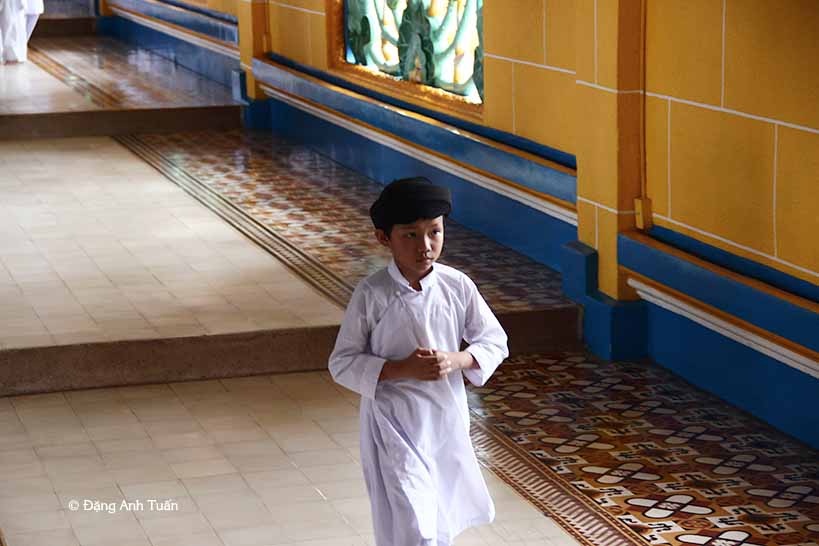
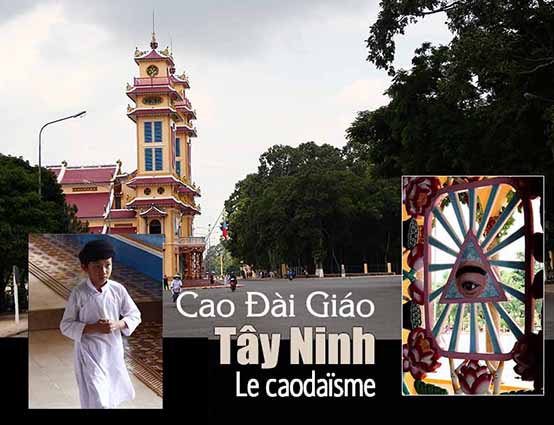
A young Caodaïst

That reminds me of the sentence that Ung Giả Vi wrote in the Conversations of Wise Confucius:

Nhân viên hồ tai! Ngã dục nhân, Tư Nhân chi hỷ!
Nhân có xa đâu! Ta muốn nhân thì nhân đến vậy!

The virtue is not far! One will be able to have it if one really wants it.

that enables me to be convinced that GOOD or EVIL exists well in each one of us. I understand that it is not necessary to go to the pagoda or the church to be able to improve oneself. I am able to do it if I do not forget what God in the bible of the Caodaïsts said that I had the occasion to read:

If you want to be a true Caodaïst, it is necessary that you have Love and the moral principle. It is absolutely necessary for you to improve yourself.

You merit to thus wear this white tunic, symbol of purity. You feel more than ever proud to be a Caodaïst.

Pictures Gallery

Être Caodaïste (Tôi là người Cao Đài)


Version vietnamienne
Version anglaise
Galerie des photos

Nous, les Caodaïstes, nous devons savoir nous perfectionner. Il n’est pas indispensable pour nous de jeûner et d’invoquer Bouddha par des prières ou d’être cloîtrés dans la pagode afin de pouvoir être à la perfection. Nous avons la possibilité de le faire si nous avons toujours en nous les trois qualités suivantes: l’Amour, la Sagesse et la Volonté. À la naissance, nous avons eu déjà la bonté. C’est pourquoi, nos Aïeux ont eu l’habitude de dire:

Nhân chi sơ, tính bản thiện. Le genre humain est naturellement bon à la naissance.

Mais à cause des aléas de la vie, des rivalités injustifiées et des désirs immodérés qui continuent à nous accaparer sempiternellement, nous sommes devenus ainsi des gens malhonnêtes, perfides, égoïstes, ce qui nous fait perdre la bonté que nous avons acquise à la naissance. Tous les Sages de l’Antiquité avaient eu ces trois qualités évoquées ci-dessus.

Pour avoir l’idée sur ce que l’individu possède en termes de bonté ou non, il nous suffit d’observer sa conduite envers ses proches. C’est par cette observation que nous arrivons à le connaître, ce qu’avait dit le philosophe chinois  Jou Mencius.

L’Amour est une qualité nécessaire à la perfection mais elle ne peut pas être parfaite car nous avons besoin de la sagesse pour distinguer le vrai du faux, la raison du tort , le bien du mal. Il n’ y a pas mal des gens généreux qui, malgré leurs dons offerts à la construction des pagodes d’une manière non négligeable, continuent à être empêtrés dans un comportement néfaste car ils n’arrivent pas à discerner la raison du tort. Il leur arrive d’être mal considérés quelquefois par rapport à ceux qui n’ont jamais l’occasion de participer à cette contribution généreuse.

Au Vietnam, la dynastie des Lý était réputée pour sa ferveur irréprochable envers le bouddhisme par le biais d’un grand nombre de constructions de pagodes. Cela conduisit inexorablement le peuple à la misère à cause des impôts trop élevés et provoqua inéluctablement le mécontentement populaire qui était la cause principale de sa chute.

Quel que soit son niveau d’instruction, l’homme a toujours en lui la Sagesse car quand nous agissons mal ou non , nous le saurons grâce à notre propre conscience. Par exemple, quand on essaie de mentir, on se sent honteux envers soi-même bien que la personne à qui on a menti ne le sache pas. C’est la sagesse qui nous aide à faire cette distinction. Le philosophe français Blaise Pascal a eu l’occasion de souligner que l’homme est un roseau pensant.

Pour continuer à mentir ou à agir mal ou non, nous avons besoin de la Volonté. Il est facile d’évoquer cette qualité mais il nous parait difficile de la posséder car nous sommes obligés d’aller quelquefois à l’encontre de nos propres intérêts ou d’être perdants des fois aussi. Il nous arrive quelquefois de ne pas avoir la vie sauve. Je me réfère à quelques faits historiques chinois ou vietnamiens dans le but de nous permettre d’être ensemble à réfléchir et à admirer respectueusement les personnes considérées  comme  celles sachant se perfectionner car elles ont eu les trois qualités évoquées ci-dessus. Elles deviennent des personnages célèbres dans l’histoire de la Chine et du Vietnam.

D’abord, c’était le cas de Zhuge Liang (ou Gia Cát Lượng en vietnamien). Il fut à la fois premier ministre et conseiller de Liu Bei, le dernier survivant de la dynastie des Han (Lưu Hoài Ðức) en Chine. Les Barbares venant des steppes du Nord de la Chine et dirigés par Manh Hoạch aimaient à faire souvent des razzias sur le territoire de son royaume. Zhuge Liang arriva à capturer Manh Hoạch 7 fois mais ce dernier fut libéré immédiatement sur l’ordre de Zhuge Liang à chaque capture. Il était très généreux. Il était doté d’une sagesse extraordinaire car il trouva qu’il était nécessaire de convaincre Manh Hoạch par le biais de l’amour et des sentiments. Si Manh Hoạch avait été tué, il y aurait probablement un autre Manh Hoạch. Cela l’obligea à monter fréquemment des expéditions punitives et ne lui permit pas d’avoir les  mains libres pour restaurer la dynastie des Han et ramener la paix et le bonheur à ses citoyens.

C’était pourquoi il continua à libérer impassiblement Manh Hoạch lors de chaque capture. Il avait une volonté incommensurable car il savait que pour empêcher Manh Hoach de trahir plus tard, il devait perdre beaucoup de temps, laisser tomber les intérêts personnels et se donner beaucoup de soucis avec son âge assez élevé. Ce serait moins fatigant pour lui s’il décidait de tuer Manh Hoạch car il n’était pas obligé de monter jusqu’à 7 fois l’expédition punitive. Lors de la dernière capture, lorsqu’il était sur le point de libérer habituellement Manh Hoạch, ce dernier commença à pleurer et à se rendre définitivement. Zhuge Liang a eu ces trois qualités évoquées ci-dessus. Bien qu’il ne soit pas religieux, nous pouvons affirmer qu’avec les trois qualités trouvées en lui ( l’Amour, la Sagesse et la Volonté ), il a su se perfectionner et il était considéré déjà comme un Sage à l’époque des Trois Royaumes.

Au Vietnam, il y a aussi des rois que nous pouvons considérer comme des Sages. C’est le cas du roi Lý Thánh Tôn qui a eu ces 3 qualités citées ci-dessus. C’est pourquoi il a été connu dans l’histoire du Vietnam comme un roi intelligent, distingué, charitable et vaillant. La révolte du roi du Champa, Chế Cũ l’obligea à monter une expédition punitive tout en laissant à sa concubine Ỷ Lan la régence. Face à la détermination de Chế Cũ, il n’arriva pas à le capturer après plusieurs mois d’expédition. Déçu, il fut obligé de rentrer au pays. Sur le chemin de retour, il apprit que son peuple ne cessait pas de vanter le talent de sa concubine Ỷ Lan dans l’art de gouverner le pays. Il se sentit honteux et décida de revenir au front. Lorsqu’il réussît de capturer Chế Cũ, il aurait pu tuer celui-ci pour apaiser sa colère mais il préféra le laisser rentrer dans son pays.

C’était pourquoi le Vietnam connut une période de paix, de prospérité et de bonheur. Il était très charitable car il laissa partir celui qui l’avait humilié devant son peuple. Il perdit beaucoup de temps pour arriver à le capturer. Sommes-nous capables de le faire comme lui si nous étions à sa place? Un beau jour, durant une période où l’hiver était rude, il s’adressa à ses mandarins dans les termes suivants :

En m’habillant de cette manière, je continue à être transi de froid. Comment arrivent-ils les gens à résister à ce froid rigoureux surtout les pauvres lorsqu’on sait qu’ils n’ont pas assez d’argent pour se nourrir?. Il faut leur donner dès maintenant de la nourriture et des habits supplémentaires.

Une autre fois, en tenant compagnie à sa fille, la princesse Ðông Thiên, lors d’une audience, il se tourna vers ses mandarins en leur disant :

J’ai un amour profond pour mon peuple comme celui que j’ai toujours pour ma fille. Malheureusement, le peuple est si peu instruit qu’il ne cesse pas de commettre des fautes. C’est pour cela que j’en ai tellement pitié. Je vous demande de bien vouloir diminuer les châtiments et les peines infligés.

Sa sagesse était incommensurable. Pour conquérir le Champa, il sut qu’il fallait convaincre et calmer Chế Cũ bien qu’il fût humilié et vexé de comparer ce qu’il avait subi par rapport à ce qu’avait fait sa concubine, une femme issue d’un milieu rural, Ỷ Lan pour son peuple durant son absence. Il pourrait tuer Chê’ Cũ pour apaiser sa colère et laver cet outrage passager. Mais c’était un homme courageux qui savait mettre les intérêts de son peuple devant ses intérêts personnels. C’était bien la personne ayant les trois qualités évoquées.

Quelle que soit la situation où nous sommes, nous, les Caodaïstes, nous devons essayer de nous perfectionner. Cela m’est arrivé de vouloir poursuivre cette démarche. Il faut reconnaître que ce n’est pas facile de la concrétiser. Je ne cache pas non plus que j’ai eu aussi les difficultés journalières mais je me sens soulagé énormément quand j’ai réussi à la concrétiser un peu. J’en suis ravi car je me rends compte que je commence à me perfectionner un peu même si cela parait infime.

Un jeune caodaïste 

img_9502

Cela me rappelle la phrase que Ung Giả Vi a écrite dans les Entretiens du Sage Confucius:

Nhân viên hồ tai! Ngã dục nhân, Tư Nhân chi hỷ!
Nhân có xa đâu! Ta muốn nhân thì nhân đến vậy!
La vertu n’est pas loin! On pourra l’avoir si on la veut vraiment.

ce qui me permet d’être convaincu que le BIEN ou le MAL existe bien en chacun de nous. Vous pouvez  le choisir à votre guise. Je comprends qu’il n’est pas nécessaire d’aller à la pagode ou à l’église pour pouvoir se perfectionner. Je suis capable de le faire si je n’oublie pas ce qu’a dit Maître (Thầy) ( Dieu ) dans la bible des Caodaïstes que j’ai eu l’occasion de lire:

Si tu veux être un vrai Caodaïste, il faut que tu aies l’Amour et le principe moral. Il est absolument nécessaire pour toi de te perfectionner.

Tu mérites de porter ainsi cette tunique blanche, symbole de la pureté. Tu te sens fier plus que jamais d’être un Caodaïste.

Galerie des photos

[Return RELIGION]

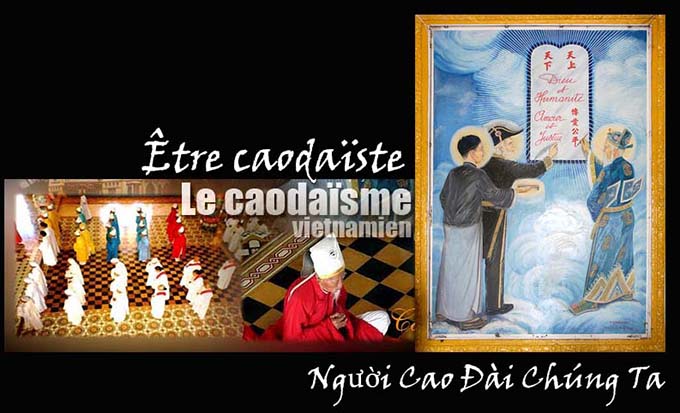
The Caodaïsm ( Cao Đài Giáo)

 
titre_caodai
French version
Vietnamese version
Galerie des photos

Caodaism is the third important religion in Vietnam after Buddhism and Christianity. Cao means « High » and Ðài means « Palace« . Cao Đài is the supreme palace where reigns God. Caodaism is a religion which encompasses, combines and is in harmony with several elements from other principal religions: Buddhism, Confucianism, Catholicism, Hinduism, Islam, Judaism and Taoism while taking into account Vietnamese traditions. The Holy Seat is located at Tây Ninh, 90km northwest of Saigon. The number of its followers amounts to 7 million in Vietnam and 30,000 abroad, in particular in Asia, Australia, Canada, Europe and the United States.

One finds in the history of this religion three important episodes of revelations. The first and second took place in 6th century before our era. During the first manifestation, God appeared under the three forms of Jewish leader in the Middle East, Buddha in India and Fou-Hi symbolizing the cult of humanity in China. During the second manifestation, Buddhism reappeared in the form of Sakiamuni, Confucianism in that of Confucius, Christianity in that of Jesus-Christ, Taoism in that of Lao-Tseu and Islam in that of MohammedAs for the third manifestation, God has decided to reveal himself. This third manifestation based on Buddhism is often called « Ðại  Ðạo Tam Kỳ Phổ Ðộ« . All the religions that have preceded the revelation of Caodaism are only the different forms of the same reality in different manner according to the period,  habits and traditions,  places of revelations with the view to educating the humanity and leading it on the path of good  according to the God guide.

Pictures gallery


The philosophy and profession of faith found in  Caodaism are of a disconcerting simplicity, closer to morals than to mystical transcendence.

  • Respect of the cult of ancestors.
  • Practice of meditation.
  • Practice of vegetarism.
  • Suppression of violence.
  • Respect of all religious forms.
  • Searching for liberation from reincarnation cycle.
  •  
    Respect of the following five prohibitions:

  • Kill no lives
  • Be not dishonest
  • Drink no alcohol
  • Commit no adultery
  • Use no offensive words
  • Pray at least once a day and practice a vegetarian diet at least 10 days per month. The service is held at the Holy Seat of Tay Ninh everyday and takes place at precise hours:

    6:00 am, 12:00 PM (noon), 6:00 PM and 12:00 AM (midnight)
    [Return RELIGION]

    Being woman in Vietnam

    French version

    etre_femme

    Being woman in Vietnam

    Vietnam is a country where Confucianism exerts its considerable influence on political life as well as on society. Becoming a state philosophy under the Han dynasty, Confucianism was employed on several occasions as a single model of the state organization and of the Vietnamese society.

    This Confucian influence is not foreign to traditional conditions imposed on the Vietnamese woman. She is subjected to the rule of the following three submissions: Tam Tòng

    Tại gia tòng phụ, xuất giá tòng phu, phu tử tòng tử

    • submission to the father before her marriage
    • submission to the husband during her marriage
    • submission to the elder son when widowed

    This rule was reminded in « Family Instructions » (Gia Huấn Ca) by Nguyễn Trãi, the advisor of king Lê Lợi at the beginning of 15th century, and under the Nguyen dynasty. The Gia Long code which was in force in 19th century, was the most retrograde and rigorous that Vietnam has ever known.

    In spite of that, the Vietnamese woman had a dominating role to play in the Vietnamese family and society. This is found through songs, poems, tales, and lullabies. There, the Vietnamese woman is described not only as a tender, submissive, and virtuous but also a hard working person endowed with an incommensurable patience.

    The Trưng Trắc Trưng Nhị sisters are heroines as much quoted and venerated as the heroes Quang Trung, Hưng Ðạo Vương Trần Quốc Tuấn etc…They are also the first women who fought side by side with the men in the struggle for independence. The most illustrious case remains the example of Nguyễn Thị Giang. Faithful to the Vietnamese tradition, she committed suicide in 1930 after the execution of her husband, the nationalist leader Nguyễn Thái Học.

    The Vietnamese woman is viewed as a perfect model to defend the motherland and national honor. One finds it in the story « Hòn Vọng Phu  » ( Waiting Rock ). It is the story of a woman petrified at the top of a hill, her child in her arms, looking out for the return of her husband who had left for the frontiers in the defense of the country. This model woman is found at several points all over the Vietnamese territory (Cao Bằng, Ninh Hoà etc….)

    One also finds this model woman in the story « Thiếu Phụ Nam Xương » (« The Woman of Nam Xương » or  » The Contempt » ). It is the story of a woman who committed suicide because of an erroneous judgment her husband had on her fidelity. A man is allowed to have weaknesses but not a woman. She must be a perfect model. That constitutes for so many years a lot of stirs and discussions. Some women tried to break that Confucian yoke. It was the case of poetess Hồ Xuân Hương who criticized taboos while composing sensual poems at the end of 18th century. She has always been affirmed from the literary point of view as a free woman. Her verses are always filled with erotic evocations.

    One finds this vehement dispute by a woman of a Confucian society through the following poem that describes the cake Bánh Trôi Nước ( a white and round cake, having a sweetened core, immersed in a caramelized juice ) :

    Thân em vừa trắng lại vừa tròn
    Bẩy nỗi ba chìm với nước non
    Rắn nát mặc dầu tay trẻ nặng
    Mà em vẫn giử tấm lòng son

    My body is white, my shape is round,
    I float and sink with water and mound.
    My contour depends on the hand that kneads
    But I always keep my heart pure and sound.

    Hồ Xuân Hương referred to a woman who at that time, in spite of her tainted body and difficulties of life, continued to keep her heart pure and faithful. She was also the only one who dared approach her rights as a woman and talk shamelessly about carnal love. She succeeded in not being censored through her unequaled skill by proceeding with allusions and metaphors. To talk about eroticism, she used a soothing description of landscape and objects, things the most believed in a feudal society.

    There was even an anecdote about her told by the poet Xuân Diệu himself:

    It rained one day. The road became slippery. Hồ Xuân Hương fell suddenly. She spread herself all out on her body, her arms raised behind her head, her legs pulled apart. The boys laughed. She improvised a distich immediately:

    Giơ tay với thử trời cao thấp
    Xoạc cẳng đo xem đất vắn dài

    I raise my arm to measure the vastness of the sky
    I pull my legs apart to have that of the ground.

    It was also the case of the favorite Ỷ Lan of king Lý Thánh Tôn. She took advantage of the campaign conducted by her husband against Champa to assure a brilliant regency. She undertook at that time many social measures to help the poor and women in particular. Only in 1907 for the first time were classes opened for girls in a private school. The feminist movement started to be launched.

    Nowadays when the law recognizes equality of the sexes in all economic, political and social domains, there exists in fact this inequality. It is no longer a question of legality but a question of mentality. It continues to be omnipresent especially in rural environment.

    Peasant (Nông dân)

    Version française
    Version vietnamienne
     
    paysan

    As Vietnam is a country where Confucianism exerts considerable influence on society, the Vietnamese peasant always takes the second rank on the social scale compared to a scholar. Even in the majority of folk songs, an undeniable preference is noted for the learned men. The dream of having a learned man as husband is always an obsession for a Vietnamese girl in the old days.

    Chẳng tham ruộng cả ao liền
    Tham vì cái bút cái ghiên anh đồ.

    I neither need immense rice fields nor whole ponds
    I only like the scholar’s brush and his ink stone.

    However, thank to the farmer’s labor and sweat, Vietnam has currently become the third largest rice exporter after the United States and Thailand. Also thanks to his sacrifice, Vietnam territory has grown from Lạng Sơn to the Point of Cà Mau.

    It is the farmer that took possession from 16th century, of the territory filled with water and sunshine that is our Cochinchina during the Descent toward the South. It is also him that took up arms to defend the motherland when invaded. That is why he is often called peasant-soldier. It is also him that first revolted against the aristocracy and gave the brothers Tay Son the opportunity to grasp the power in 1770 in central Vietnam.

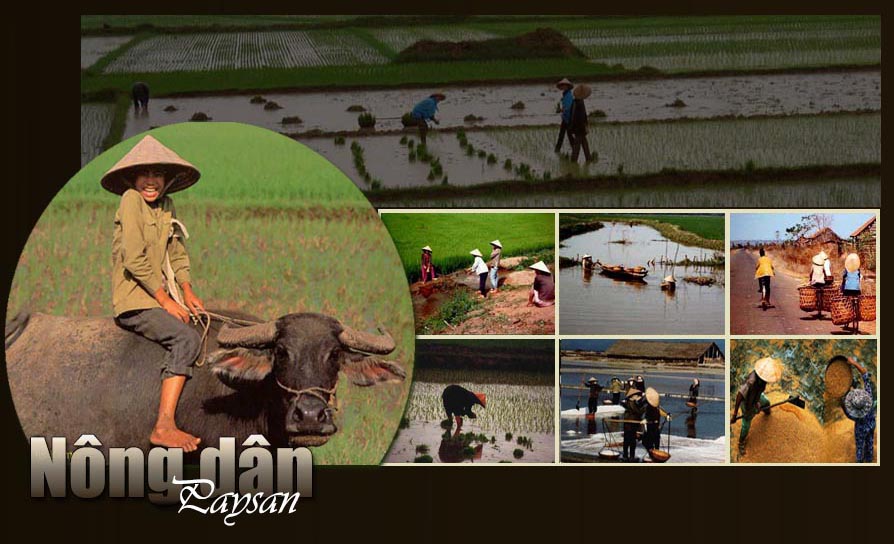
    It is also him that works the landscape of the two deltas with no cultivable piece of land is left unexploited. Everyday in the fields of these deltas are seen male and female peasants leaning under their conical hats, feet and hands in the clay, continuing to pull out rice seedlings from nursery beds or replant them in the paddy. His existence is a continual struggle. He loves his land more, and his precious cereal gives him so much anxiety and annoyance. He never stops resisting bravely the forces of nature: drought, flood, typhoon etc… He is always obsessed with overcoming the water. To work the soil, to thwart calamities, to prevent food shortage.

    That supposes his perfect mastering of hydraulic art: dike building, canal digging, breach filling, rampart elevating etc. It is the water that shapes his thick identity. He becomes more patient, more obstinate, more hard working and more methodical. For him, work is a supreme virtue, a value in itself. In the North, the peasant is poorer. He dresses in a more austere way and behaves with more reserve. Even on his face, the cheeks are more protrude, the features are marked. In the South, the peasant is more open, less reserved, craftier, and more outgoing. In spite of these differences, there is one thing in common between the peasant of the North and that of the South: realism.

    Pictures gallery

    The down-to-earth overrides sentimentality. His sharp observation of reality gives rise to an often wild humor towards other classes, in particular monks, sorcerers, quacks, aristocrats, etc. This humor is found in Ca Dao ( or proverbs ).

    Thẩy địa, thầy bói, thầy đồng,
    Nghe ba thầy ấy thì lông không còn.

    The geomancer, the fortune teller, the soothsayer,
    Listening to them and you will lose your shirt.

    Also in folk songs are found his joy of life, his simplicity, his righteousness, his economy. It is in these watery checkerboards filled with mud, and meticulously and economically gardened that appears the centennial rooting of the peasant tied to his labor, which makes him a diligent and obstinate combatant.

    For a Vietnamese peasant, his field, his soil are symbolized by this constant mixture of land and water. It is still by these words đất nước that he indicates his motherland. His attachment to this land is so deep that one can say only in one sentence:

    His destiny is that of Vietnam.


    Being Vietnamese (Tôi là người Vietnam)

    French version

    Vietnamese version

    Being Vietnamese 

    According to the archaeological sources we have today, the Vietnamese are descendants of the Thai-Vietnamese group. Some historians keep on seeing in these Vietnamese, not only Mongol immigrants coming from southern China (the Yue) and resettling in the Red River delta in the course of the centuries that preceded our era, but also carriers of the Chinese civilization that swept away on their passage by a demographic push, all the brilliant civilizations known up until then on the Indochinese peninsula (those of Ðồng Sơn, and later of Champa).

    Others think that the Vietnameses are the result of fusion between several people in contact in the basin of the Red River among which it is necessary to quote Hmongs, the Chinese, the Thais and Dongsonese. While basing themself on their legend of water melon taking place at the time of Hung kings and testifying to the coming of strangers of a different race who might have brought the seeds to Vietnam by the maritime way ( 3rd century B.C ) and on the archaeological excavations confirming the existence of the Nan Yue kingdom, the Vietnameses are convinced that they resulted from Yue but with an Indonesian background probably via by the intermediary of the Dongsonese because Ðình (communal house) heightened on piles and where resides the most vivid expression of the Vietnamese soul, resembles indisputably the houses prefigured on the bronze drums of Ðồng Sơn. This conviction seems conclusive because one finds also other astonishing resemblances among Vietnameses as well as Indonesian tribes: chews bétel, tattooing and tooth lacquering.

    Apart from some Frenchmen like Henri Oger who was able to discover in the Vietnamese society a millennial civilization rich in traditions and customs, one continues to be open to a hallucinating confusion in considering that the Vietnamese civilization is a tracing of the Chinese civilization. One continues to reproach the Vietnameses for not having a civilization so worthy, intense and rich as the ones found in other peoples in Indochina (Khmer and Cham civilizations) through their temples of Angkor and Mỹ Sơn. It is a regrettable ignorance because to known the richness of the Vietnamese civilization, one needs to be more interested in its history, its literature than its art. 

    How can one have a fantastic and original art when one is always in a perpetual struggle with a so rude and pitiless nature and when Tonkin is of no exceptional wealth not to include the systematic assimilation by the Chinese during their thousand-year domination. In spite of that, the Vietnamese succeeded in showing several times their techniques, know-how and imagination that allowed them to give to some Vietnamese productions (ceramics in particular) an almost admirable rank among the provincial arts of the Chinese world.

    In order to preserve the traditions and to perpetuate their culture, the Vietnamese owe their safety to their sempiternal struggle. Thanks to their religious beliefs and their quasi hostile environment at the beginning, they possess a considerable power of resistance to moral and physical sufferings that became with the passing years one of their main forces for overcoming all external aggressions.

    Also thanks to their labor, tenacity, and sacrifices in human lives, they were successful in holding in check the caprices and wrath of the Red River, in keeping the Chinese outside Tonkin on several rounds and in the 17th century going through the barrier which is made up then impenetrable the Anamitic cordillera in their march towards the South. The Chams were the first victims this secular confrontation, followed by the Khmers.

    One can reproach the Vietnamese for being pitiless towards the other peoples but it should not be forgotten that the Vietnameses have struggled inexorably since the creation of their nation for their survival and the preservation of their traditions. The Vietnameses have been at a much disadvantage for a long time by the geographical proximity of China. It was to block the passage of Kubilai Khan‘s Mongols in the conquest of Champa that the Vietnamese suffered twice their invasions in 1257 and 1287. It was to find a passage towards the Middle Empire that the French thought to succeed in their first try by the Mekong then by the Red River that allowed a link to Yunnan that Doudard de Lagree‘s mission followed by Francis Garnier’s were sent to Indochina. This permitted the French to be more particularly interested in Tonkin and intervene militarily a few years later. It was also to counter China after the Korean war that the Vietnamese were implicated by force for decades in the East-West confrontation. It was to thwart the China policy in Cambodia that the Vietnamese received a lesson of correction in February 1980 by Chinese troops’ lightning invasion at the frontier of Lạng Sơn for a month.

    For those who know the history of Vietnam well, being Vietnamese is not to be so peaceful and so cool even if a Vietnamese wants to be in that way. Kneaded of the brown silt of the Tonkinese delta where he comes from, involving in the perpetual struggle with the acrimony of the Red River, undertaking a  long march toward the South through a succession of intermittent wars, and suffering a long Chinese assimilation and domination, not to include a century of French colonization and a few dozens of years that compelled him to become a target of the East-West confrontation and a victim of the cold war, the Vietnamese never lets himself discouraged by these titanic hardships. 

    On the contrary, he becomes more hardened, more perseverant, more tough, more persuaded in his political convictions and more capable of resisting valiantly those affronts. His profound and intimate attachment to his native land and his traditions makes him become uncompromising in the struggle, which makes of him a pitiless and formidable conqueror for some, a legitimate defender of freedom and national independence for others.

    Whatever happens, he found himself proud of taking over from his parents to valiantly defend the ancestors’ soil and his people’s survival and to be worthy of the Son of the Dragon and the nephew of the Fairy.  « Dyeing for one’s country » is not strange either to his temperament or his traditions. But it is the lot the most beautiful and worthy of desire that many Vietnamese such as Trần Bình Trọng, Nguyễn Thái Học, Phó Ðức Chính, Nguyễn Trung Trực,Trần Cao Vân, Nguyễn An Ninh etc. have accepted to get with bravery on that land of legends

    Being Vietnamese

    is being capable of resisting above all any assimilation and foreign ideology and being proud of having in his veins the blood of the Dragon.

    Red river delta (Đồng bằng sông Hồng)


    delta_rouge

    French version
    Vietnamese version
    Picture gallery

    Contrary to the Mekong Delta, the Red River Delta contains many historical vestiges. It is the cradle of the Vietnamese nation. Found here, near Thanh Hoá in the Mã River valley is the presence of an civilization in the millenium before Christ at the Bronze Age called Dongsonian Age. Also started with the Bronze Age, the mystical periods of Vietnam’s history. The first legendary dynasty, that of Hồng Bàng, would have reigned until 3rd century B.C. From this delta has begun at the beginning of10th century the Nam Tiến Movement (or the Descent toward the South) started by General Lê Hoàn and finished in 18th century by the kings Nguyễn.

    To dominate and control its water and its vagaries, the Vietnamese people had to build and consolidate dikes ceaselessly. These dikes existed for a thousand years and broke sixteen times during the past twenty-five years. It is because of the Red river that the Vietnamese people has been haunted with the domination and control of water. Since the beginning of our era, the Vietnamese people have been compelled to organize, perform, and maintain water amnagement works. This has brought to the Vietnamese the virtue of being more patient, more obstinate, keener, hard working and methodical in dike construction, canal digging, embankment building and breach filling. In this delta is found a sophisticated network of drainage canals and high dikes that only a centralized state on water control such as Vietnam knows how to realize.

    It is itself that witnessed several decisive battles of the Vietnamese people against their invaders. It is thanks to its complicity that General Trần Hưng Ðạo defeated the Mongol army by planting on its bed pikes that broke the Mongol ships in 1288 at the mouth of the Bạch Ðằng river, renewing the tactics used by General Ngô Quyền against the Chinese in 938 (a victory that put an end to the thousand-year Chinese domination ). It is also witness of the Yên Bái uprising led by nationalist leader Nguyễn Thái Học in 1930. Its destiny is that of the Vietnamese people. It is it that gives the capital of Vietnam the last name Hànội (Hà means river, Nội means inside, interior).

    Hà-Nội means « On this side of the river ». This city was founded by king Lý Thái Tổ (Lý Công Uẩn) in year 1010 at the neighborhood of Ðại La that geomancers believed to be favorably sheltered from the waters of the Red river. It is also called Thăng Long (City of Ascending Dragon) because, in his dream, Lý Thái Tổ saw a golden dragon flying from that locality.

    Vietnam’s history is linked closely with this Red River (or Sông Hồng ). It is itself that forged the Viet soul. It is itself that has petrified the thick identity of the Vietnamese people. At the same time, It is the enemy, the friend and the actor of the Vietnamese people.

    It is it that saw Hanoï  growing with its thirty-six business streets and lakes. Writer Thạch Lam of the « Tự Lực Văn Ðoàn » writing club talked about It in his novel « Hà Nội 36 phố phường« . It is it that gave birth to the French construction of the Paul Doumer (now Cầu Long Biên) bridge 1680 meters (approx. one mile ) long at Hà Nôi.

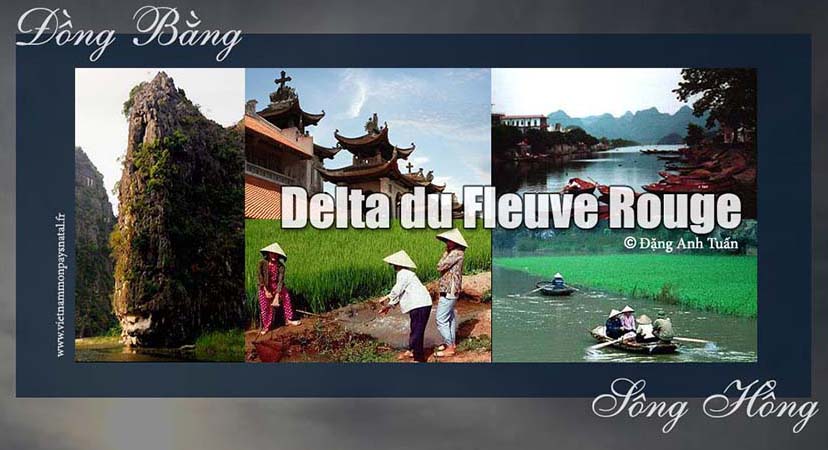
    Thanks to its silt rich in iron, and with its irrigation, the delta is so fertile that it is possible to have one more harvest in November. It is it that shapes the landscape of the delta. Every day are seen women leaning under their conical hats, feet and hands in the clay, children coming from school surveying the dikes, motionless buffaloes in their mud baths under a sun that is sometimes overwhelming. It is it that often floods the plain of Hoa Lư, the old capital of Vietnam until 11th century.

    The Red River is the second largest river of Vietnam after Mekong. It descends from Yunnan, a mountainous region south of China. It is known as the « six-head river » that enters Vietnam definitively at Lao Cai. It curves on more than 1000km ( over 600 miles ) before dying in the somptuous bay of Hạ Long. This one is the eighth wonder of the world. It counts more than three thousand isles, islets, and reefs. One finds rocks of varied forms. Some are tiny, others are of important dimmension bearing picturesque names such as isle of the Wonder, isle of the Surprise, the Marionettes, the Monkeys, the Toad etc…

    The Ha Long bay has become for the past few years the site most visited by foreign tourists when they landed in Vietnam. Mini-cruises by junk make it possible to visit it. It is in this bay, according to the legend, that a dragon would have descended to tame the sea currents. That is why the Vietnamese called it Hạ Long (or the site of the Descending Dragon).

    Impressed by the splendor and beauty of this bay that he visited by junk in 1468, king Lê Thánh Tôn left some unforgettable verses in witness of his emotion:

    Muôn ngọn núi nổi trên như biển ngọc
    La liệt như những sao sa, những quần cờ, chênh vênh màu xanh biếc …

    High summits are drawn up as a crowd in the sea like many jewels
    Bluish tops are dispersed like the falling stars and the pieces in the chessboard of waves.
    Fish and salt, abundant like sand, offer a rapid gain to people

    Pictures gallery


    Being young in Vietnam (Thời thiếu niên)

    etrejeune

    Version française

    Version vietnamienne

     
    In spite of the war which devastated this country for so many years, the Vietnamese young people continue to crave for life. That amazes enormously those who do not know Vietnam. In this country,  » Being Young » concerns always boldness because the living conditions are extremely hard and nature is also extremely rude and pitiless, in particular for those who live in the North and on the Central highlands. It is necessary to know how to resist bravely the forces of nature but it is also necessary to learn how to live with wild creatures, tricking them and fighting them.

    One also starts to work very young in Vietnam. From their youth in rural areas, boys tend buffaloes, make them feed on small floodbanks while girls help in the household chores. Very young, from six or seven years old, they know how to cook rice, carry their little brothers, feed the pigs and ducks, carry drinking water to the familiar animals or taking part in family artisanal work. During the years when the war was at its height, young people were also assigned to dig trenches along the small floodbanks to throw themselves in when airplanes approached, live in undergrounds and tunnels to escape the bombings. Girls have twice as much work as boys. It was they who were the first being proposed and sold like slaves or concubines for a few kilos of rice when one could not manage any more to feed a family of several children in the years 30’s and 40’s. Ngô Tất Tố, in his novel  » When The Lamp Dies Out « , appeared in 1930, reminds us this reality. To pay a corrupt official, a country-woman had to sell her daughter for one piastre.

    Nowadays, even this practice is prohibited, one nevertheless notes a great number of young female prostitutes on the streets of big cities. There, in spite of free education, many of young people must work on little jobs such as selling cigarettes or newspapers, collecting plastic bags etc. to provide for the subsistence of their families. The living conditions are also distressing. Many young people coming from families afflicted by poverty and war continue to always crawl in tangles of badly erected huts that are dark and terribly dirty. There would be 67000 slums in Saigon at the end of 1994. It is the number maintained by the authorities and published by the press. One still finds the scenes described by novelist Khái Hưng in his work entitled « The Gutters » ( Ðầu Ðường Xó Chợ ) » with pavements and drains encumbered permanently with vegetable peelings, sheets of banana tree leaves and scraps of rags in the poor districts of the big cities.

    Facing the indifference of society, novelist Duyên Anh did not hesitate to denounce the indigence of these young people in his novels, among which the most known remains the best-seller « The Hill of The Phantoms« . Inspired by this novel, movie maker Rachid Bouchareb recalled the history of the « Amerasians » who pay the price of the madness of the adults and the war in his film « Dust of Life » in 1994.

    In spite of the deficiencies of life, one likes to be young in this country because, if there are no mountains of toys and gifts which submerge our children in the west as Christmas approaches, there are on the other hand popular games, unforgettable memories of childhood. In the countryside, one could go fishing in rice fields and placing hoop nets in the streams to catch shrimps and small fish. One could hunt butterflies and dragonflies with traps made with the stems of bamboo. One could climb trees to seek bird’s nests. Hunting the crickets remained the preferred game of the majority of Vietnamese young people.

    While walking in group, ears wide opened for the song of the crickets, eyes scanning the least recesses, one tried to locate the burrows from where came out the song. It is one’s habit to make the insect leave its hole by flooding it with water or dejection, then to lock it up in a matchbox, to make it sing by exciting it with a small feather or to make it drink a little rice alcohol for excitement at the time of cricket fights.

    In the cities, one played soccer with bare feet in the middle of the street, the goal posts consisted of stacked clothing. The matches were often stopped by the passage of bicycles. One also played shuttle cock game (Đá  Cầu) in the street. The flying object the size of a table tennis ball was made with a fabric end wrapping around a zinc coin. Born in the war, Vietnamese young people did not scorn war games. One manufactured oneself rifles out of cardboard or wood, one fought with swords made of tree branches. One could also fly kites. 
    This childhood, this youth, all the Vietnamese had it, even novelist Marguerite Duras

    She did not hesistate to point out her Indochinese childhood in her novel « The places« : My brother and I did not spend whole days in the trees but in the woods and on the rivers, on what is called the racs (rạch), these small streams that go down towards the sea. We never put on our shoes, we lived half naked, we bathed in the river.

    In this country where the war devastated so much and where thirteen million tons of bombs and sixty million liters of defoliants were poured, being young in the years 60-75 was already a favor of destiny. The young people of Vietnam today no longer know the fear and the hatred of their elders but they continue to have an uncertain future. In spite of that, in their look, there is always a gleam of intense life, a glimmer of hope. It is what is often called  » the magic of Vietnamese childhood and youth « .

    It is necessary to be young in this country to have such an attachment, an impression always poignant.

    ijeune

    Communal house (Đình Làng : Part 4)


    dinh_cham

    Communal house 

    Version vietnamienne
    Version française

    Decoration art in the communal houses

    Thanks to the communal house (đình), we discover that the village life is intimately introduced in the decoration art. This one tries to liberate itself not only from classic conventional models encountered until then but also Confucian straitjacket that Vietnam has known in the feudal system. That is what we see in wooden carvings which take up all free spaces encountered inside the đình (from roof frame to columns).

    All imperfections of the construction are hidden with address thanks to the technique of embellishment. In each carved piece, the motif whether it is animal, character, flower etc. is unique and cannot be found anywhere else even if it is the same theme. By contrast, one discovers in these sculptures the coexistence through centuries of two cultures, one being national and scholarly and the other popular. One finds not only in the first all motifs relating to four hieratic animals (Rồng, Lân, Rùa, Phượng) (Dragon, Unicorn, Tortoise, Phoenix), four noble plants, fairies, animals (tigers, elephants etc.) but also fantasy, imagination, innovation from peasant-sculptor despite his strict obedience to etablished standards.

    In the popular sculptures, the master craftsman who is, above all, a peasant, let himself be guided by his personal inspirations, his sincere emotions, his frustrations, his spontaneity and his sentiments in the realization of his work with realism and humor. He succeeds in escaping the censoring custom by a unusual aptitude in the description of bawdy scenes through his work of art: a naked young girl taking a bath in the lotus pond or sitting with low-necked dress on a a dragon head (đình Phụ Lão, Bắc Giang), a young man groping the body of a woman under the watchful eye of his partner (đình Hưng Lộc), a mandarin disturbing a girl who is obliged to hide her body with the lotus sheet in her bath (đình Ðệ Tam Ðông, Nam Ðịnh) etc.

    He dares to denounce the wrongdoings of corrupt mandarins. That is what one sees in the carved piece of the communal house Liên Hiệp. These are taboos and frustrating redtapes encountered every day in the Vietnamese confucian society. Everything found in this popular sculpture largely reflects artist’s freedom of expression, common aspirations and social life of village. The paradox is visible because the communal house is both the garden of Confucian order which is well established in Vietnamese family and social structure and the place where the peasant can find again his freedom of expression and denounce the Confucian straightjacket. By its sculptures and its architecture, the communal house constitutes an inestimable jewel for Vietnamese people. One has the habit of saying in Vietnamese: làng nước (Village Nation) because Vietnamese nation is constituted over centuries by the dissemination of villages whose communal house (Đình) is both spiritual, administrative, social and cultural centre. As a consequence, the communal house (Đình) is not only the soul of village but also that of Vietnamese nation.

    [RETURN]

    Communal house (Đình Làng: Part 3)

    dinhlang03

    Đình Làng (Part 3)

    Armature ( Cấu tạo vì kèo )

    Version vietnamienne

    Version française

    In addition to the ceremonies scheduled in the year in honor of the tutelary genius, villagers attach great importance to anniversaries of his birth and death. But there are also other occasional sacrifices caused often by a marriage, an appointment, a promotion or a old or siver wedding (khao lão). This allows you to give rise to feasts in the village and allows you to celebrate in large pump the cult in the tutelary genius. The latter may be a man or a woman. It is easy to identify this genius at the time of the procession. For the genius-man, there is always the presence of a horse in red (ngựa hồng) or white ( ngựa bạch) laquered wood. This one is of natural size and mounted on a wooden rectangular plate fitted with castors. The latter is richly harnessed and it is supposed to bring the genius soul. In the case where the genius is a woman, this horse is replaced by the palanquin in red hemp (võng đào) suspended from the beam having the ends carved with dragon head and based on two easels in the form of three crossed sticks.

    Mái cong làng Ðình Bảng 

    dinhlang02

    For the duration of the feast, one sacrifices to the tutelary genius with solemnity by moving its char ( kiệu) accompanied by a large number of culte objects, parade weapons, dais (tán) and pennants (cờ), from the communal house (đình) to the his place of residence (nghè) (1) or from the village to another allied village in the case where these ones are united by the cult of the same genius and by organizing multiple entertainment: fighting of cocks, buffaloes and birds, chess games with human pawns, flat hand wrestling etc.

    There is also a important rite which recalls the significant characteristics of genius life. Known as the « hèm » in Vietnamese and kept secret, it is always celebrated during the night for geniuses who have not done an honorable act (genius thief, genius with fists, wast collector genius etc … ).. By contrast, it is celebrated in the great day for the geniuses with a quality or an act of bravery. One avoids to pronounce also the name of the genius during the rite by modifying the pronunciation or by substituting a synonym. This is the case of genius Linh Lang for example. We are obliged to tell « khoai dây » instead « khoai lang » (potatoes), « thầy lương » for « thầy lang » (doctor) etc. This singular rite is one of the essential features of communal cults. The negligence of this rite could jeopardize the prosperity of the village.

    Its construction is always operated according to a well-defined layout plan identifiable by some Chinese characters Nhất, Nhị, Tam, Ðinh, Công, Vương etc.  A communal house (đình) who stands alone with a rectangular main building (đại đình) evokes the character « Nhất ». This is the case of « đình » Tây Ðằng.By contrast, we are led to recognize the character Nhị by adding to the main building a second building (tiền tế) (or building reserved for sacrifices). This one is parallel to the first building and preceding it in the new layout. This is the case of the communal house Liên Hiệp. It is rare to find the character Tam in the construction of communal house. In a general way, the « đình » is frequently encountered in the shape of the character Công.

    The posterior building Hậu Cung is connected to the main building by a small corridor or a small court (Ống muống) . This is the case of the communal house Đình Bảng, Mộng Phụ. For the character Vương, it is sufficient to connect three buildings (Hậu Cung, Đại Đình, Tiền Tế) with two corridors (Ống muống). It is in this last building « Tiền Tế » where the official ceremony for tutelary genius is performed by notables wearing a blue suit during the feast days. READING MORE

    Palanquin in red hemp (Đình Cổ Loa)              


    (1) ghè: Place of residence of the genius often located at the entrance of the village. At the time of the feast, invited the genius is invited to join the communal house « đình ». It is brought back to its « ghè » when the feast is terminated.

    Bibliographie:

    Le Ðình, maison communale du Viêt Nam.
    Hà Văn Tấn, Nguyễn Văn Kự,
    Editions Thế Giới, 2001