Being student (Đạo nghĩa làm người học trò)

French version

In memory of my teachers,

the Brothers of Jean Baptiste de la Salle.
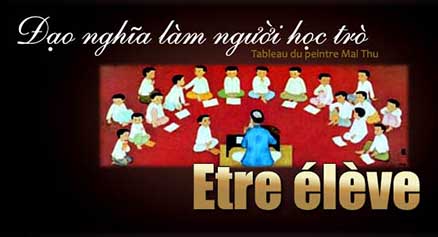
 
etre_eleve

Being student in Vietnam

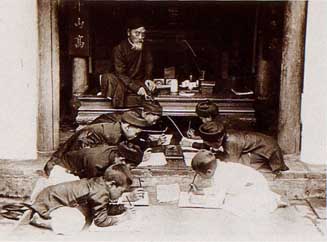
No Vietnamese can remain impassible when it comes to recall the years of study spent at school with their teacher. The image of their school keeps on being intimately carved in their memories. That is the way composer Phạm Trọng Cầu felt in his song Trường Làng Tôi ( My village school ). How could they forget what has contributed in giving them their education, teaching them, and putting them on the road of apprenticeship in life? For them, one word taught by or one day of study with their teacher is enough to justify the obligation toward him.

Trường Làng Tôi ( My village school )

That is why it was repeated time and again when they were young that

Nhất nhật vi sư
Bán tự vi sư

Học một ngày cũng thầy
Học nữa chữ cũng thầy

The one who teaches us for one day or even half a word is worth being our teacher. Without the teacher, they cannot become who they are today. They owe him part of their life, their success and above all their education because it is him that gave them not only knowledge but also taught him the wisdom and apprenticeship of life. The following famous remark : Không thầy đố mầy làm nên ( Without the teacher you cannot succeed ) continues to occupy their mind and justify their behavior, their deep feelings toward their teacher. They give him such a crucial role that they do not hesitate to use the word « teacher » ( or Thầy in Vietnamese ). Thầy is sometimes used to address the father because it is he that gave them the first lesson in education. That is why the teacher remains the second person to be respected in the unchanging following Confucian trilogy: Quân, Sư, Phụ.

Whichever their age, position and level of education, they continue to remain the little pupil, the young disciple of their teacher.

They are not willing to neglect their respect toward their teacher even in moments the most perilous in their life. This was shown by emperor Hàm Nghi toward his teacher before the colonial authorities who were not able to identify Hàm Nghi physically when he was captured. The only person who could identify him was his teacher; therefore the latter was brought by force before the young Hàm Nghi. For the respect of his old teacher, he could not let him kneel down. He was obliged to prevent his teacher from executing this gesture. Because of this inopportune attitude, he was thus identified by the colonial authorities. He preferred to die instead of making an irreparable mistake toward the one who had taught him not only dignity and courage but also the duty toward his people and country. It was also the case of emperor Duy Tân with is tutor Eberhard in charge of supervising and reporting all his activities to the colonial authorities. Instead of being hated, he became one of the people that Duy Tân continued to respect during his reigning years. It was a habit to say in Vietnamese:

Kính thầy mới được làm thầy.
We should respect our teacher before becoming a teacher later.

It is in this Confucian spirit that young Vietnamese students were raised. They always try to listen to their teacher. They sometimes adopt an ambiguous attitude so as not to vex or bother their teacher even though when they are not entirely in agreement with him. It is the respect that emperor Gia Long knew how to maintain toward his tutor and spiritual guide, the bishop of Adran, His Highness Pigneau de Behaine during his reigning years. Age is not a factor in the behavior of a student toward his teacher who in several occasions was younger than him. It is shocking and moving to see sometimes an old student crossing arms in front of a young teacher but that never contradicts the intimate sentiments, the profound and sincere attachment he continues to keep for his teacher the way he does for his mother and his country. He knows what his teacher expects from him. He tries to keep up with this expectation, which sometimes puts him in a delicate and aberrant situation where he is himself in competition with his teacher.

It was the case of Phạm Duy Tri with his teacher Nguyễn Khắc Kínhduring a royal examination that took place in 1562 under the Mac dynasty. Issue of a very poor family and orphan of father at very early age, he was raised by his mother who did not hesitate to offer the teacher the only buffalo she possessed in order for the latter known for his years of experience in teaching in the village, to accept her son as his disciple. Moved by this mother’s sacrifice, teacher Nguyễn Khắc Kính agreed to take him as his student. A few years later, thanks to his assiduity and intelligence, he ended usentiments the latter always reserved for him, he did not want his student, because of the respect he had toward him, to be penalized and wop in surpassing his teacher, which the latter saw during the provincial and general exams where he was himself a candidate. Knowing perfectly well his student’s state of mind and his profound uld not put all his weights and ardor in the royal examination. For that, he told his student:

If you do not want to be brilliant in that exam, I would understand your behavior, your feelings. But you have to remember that this examination is reserved for the one who deserves to be chosen to serve the country. You must take into account the interest of the nation before any personal considerations. You should not betray your ideals and your country.

He reminded him the sentence that any school teacher would repeat to his student:

Bất nhượng ư sư
Không nên nhường thầy.

Do not concede to your teacher what you deserve.

Moved by the advice, Phạm Duy Tri nodded his head and kept what his teacher had told him. He passed the royal exam and acquired the title of Trạng Nguyên ( 1st doctor ). As for his teacher, he was classified second and received the title of Bảng Nhãn ( or 2nd doctor ).

The feelings that a Vietnamese has for his teacher never fade with the time, which was shown by lord Nguyễn Phúc Nguyên toward his spiritual teacher and counselor Ðào Duy Từ. To thank him, lord Nguyễn Phúc Nguyên did not hesitate to grant him a vibrant homage by giving to one of his fortifications located in central Vietnam the name « Lũy Thầy » (fortification of the Teacher ). This fortification was built to counter the Trinh from the north. Thanks to this naming, he was successful in giving gratitude a wide range through history and the entire nation. Today the fortification is still known by this name.

On the other hand those feelings become as the time goes by a kind of cement that link a Vietnamese a little more to his school, his village and his native country. They are also a gift of affection and respect that Vietnamese love to give their teacher in the Confucian spirit.
Angkor Vat (Đế Thiên Đế Thích)


Jewel of Khmer Art

angkor_vat

French version

Vietnamese version
picture-591

 
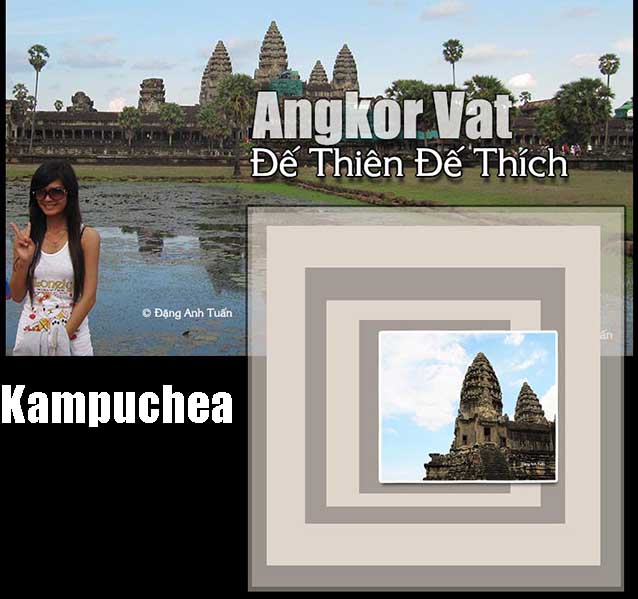
It is the largest and the most sublime temple-mountain of all Khmer temples. It was built during the reign of Sûryavarman II in the first half of the XIIth century. It was considered as capital of the Khmer empire having in its center the temple of state dedicated to Vishnu. It is here that the towers are raised in quincunx. Two major characteristics of the Khmer architecture are found there: pyramids or temples-mountains symbolizing the Mount Meru (house of Gods) and the galleries which were built the one above the other. Many people considers it as the eighth wonder of the world. Other temple mountains can be visited: Bakeng, Takeo, Baphûon, Prè Rup, Bakong and Ak Yum.

Bayon temple (Angkor Thom)

 bayon

French version

Vietnamese version

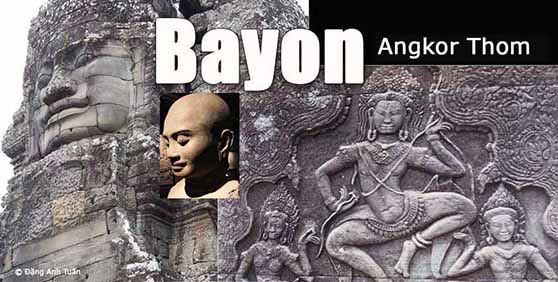
Bayon is the central temple of the old city Angkor Thom, capital of Khmer sovereigns at the beginning of the XIIIth century. It is the last one of temples-mountains built by king Jayavarman VII, restorer of royal power of the Khmer Angkor kingdom after the invasion of the Cham. Its decoration of a exceptional wealth is at the apogee of Mahayana Buddhist art.

This king dedicates this monument to Buddha he spreads the doctrine of which with his face towers. There are over 37 harmonious towers around a big central tower, the sanctuary. But we think that they could be more numerous, perhaps 54 towers with 216 faces according to French Paul Mus.

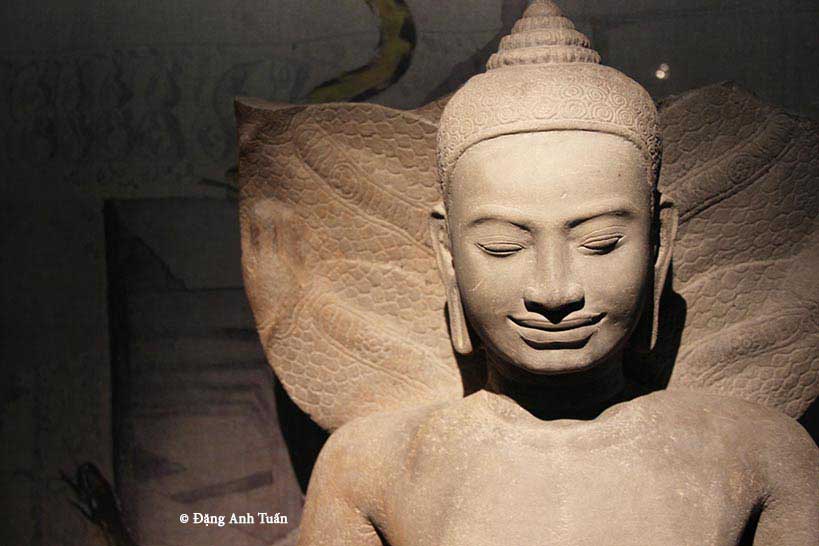
King Buddha at Guimet museum  

img_5645
These towers are built by putting stony blocks piled on top of the other without any cement. The sculpture will be made after the completion of placement of these rocky blocks.

What mechanical strength did they have, the Cambodians in the past, to raise the enormous stony blocks until higher parts of the building after having extracted them from the distant mountains, having polished and sculptured them? It is this question which haunted frequently Henri Mouhot during the discovery of Angkor ruins. We find on four sides of each tower, gigantic faces in the enigmatic smile, each one of them turned respectively to one of the four cardinal points.

The visitor has the impression to be followed by their glaucous look. For Pierre Loti, Bayon was the heaviest stony mountain the men dared to undertake since the pyramids of Memphis.

[ngg_images source= »galleries » container_ids= »123″ display_type= »photocrati-nextgen_basic_thumbnails » override_thumbnail_settings= »1″ thumbnail_width= »180″ thumbnail_height= »100″ thumbnail_crop= »1″ images_per_page= »30″ number_of_columns= »4″ ajax_pagination= »0″ show_all_in_lightbox= »0″ use_imagebrowser_effect= »0″ show_slideshow_link= »0″ slideshow_link_text= »[Montrer sous forme de diaporama] » template= »/homepages/5/d276592279/htdocs/clickandbuilds/vietnamquehuongtoi/wp-content/plugins/nextgen-gallery/products/photocrati_nextgen/modules/ngglegacy/view/gallery-caption.php » order_by= »pid » order_direction= »ASC » returns= »included » maximum_entity_count= »500″]img_5621
In his work entitled « Travel in the kingdoms of Siam, Cambodia, Laos and other central parts of Indochina « , the discoverer of the Angkor ruins, Henri Mouhot, left his impression: In spite of the disappearance of the gold and colors which almost totally removed from the building, there are only stones there. But these ones proclaim loudly the genius, the strength and the patience, the talent, the wealth and the power of the Cambodians in the past.

We discovered recently during a excavation realized in 1933, in the broken remains of a big stony statue 3,60 m in height, the representation of Jayavarman VII in king Buddha. The builder of the Bayon, is seated, legs tucked on the coiled body of the naga. Since then, we attributed this face with the mystic smile found on the sides of the Bayon towers to that of Jayavarman VII.
 

Banteay Srei (The jewel of Khmer art)

French version
banteay_srei

Banteay Srei: the jewel of Khmer art

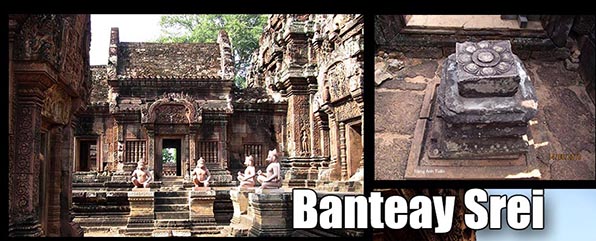
Located 20 km northeast of Angkor and almost at the foot of the mount Phnom Kulên, this temple was built in the Xth century in pink sandstone and in laterite under the reign of Jayavarman V. It is the work of certain Brahman Yajnavaraha, adviser of king Rajendravarman then guru of Jayavarman V. Besides the variety of stoneware (preferred material of the Khmers) in the warm tones of pink, the quality and the beauty of this temple are found in the exceptional delicacy of sculptures and the freshness of its sophisticated decorations. Depending on the period of sunshine, this temple changes colour through the day.

It was discovered by the French people in 1914. It became famous in 1923 when French writer André Malraux was arrested for the dissimulation of 4 apsaras. One gives to this temple a recent appelation naming  » citadel of the women  » in reference to the delicacy of the sculptured decorations which could have been made only by women or for its small size compared with the other temples. The restoration was made by Henri Marchal between 1931 and 1936 in a remarkable way by using the technique of the anastylose adopted by the Dutch people.

[ngg_images source= »galleries » container_ids= »210″ display_type= »photocrati-nextgen_basic_thumbnails » override_thumbnail_settings= »1″ thumbnail_width= »160″ thumbnail_height= »80″ thumbnail_crop= »1″ images_per_page= »30″ number_of_columns= »5″ ajax_pagination= »0″ show_all_in_lightbox= »0″ use_imagebrowser_effect= »0″ show_slideshow_link= »0″ slideshow_link_text= »[Montrer sous forme de diaporama] » template= »/homepages/5/d276592279/htdocs/clickandbuilds/vietnamquehuongtoi/wp-content/plugins/nextgen-gallery/products/photocrati_nextgen/modules/ngglegacy/view/gallery-caption.php » order_by= »pid » order_direction= »ASC » returns= »included » maximum_entity_count= »500″]


Sampan (Con Đò)

Vietnamese version
French version

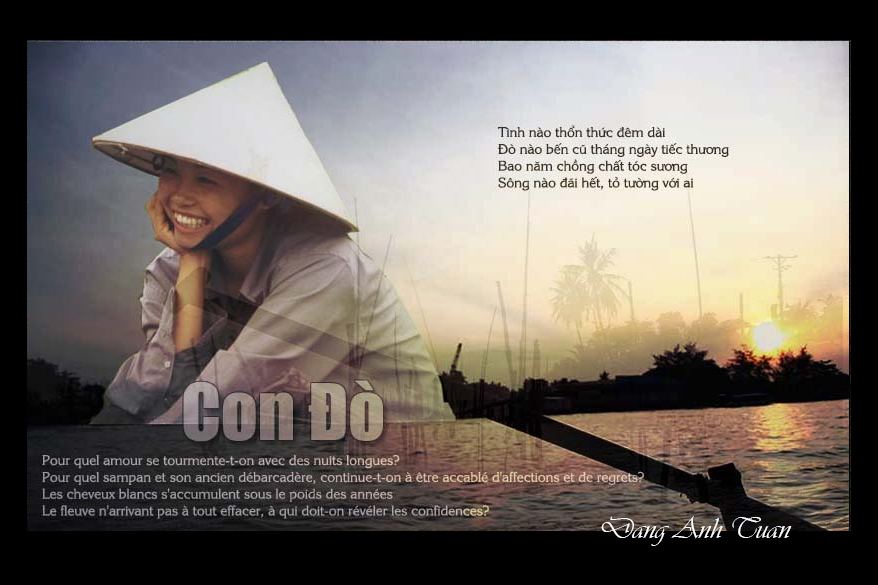
As Vietnam is a water country, it is not surprising to see the proliferation and large variety of boats used by the Vietnamese in their transport by water: from the lightest and smallest to the largest ones found until then only in the neighbouring countries like China or Indonesia. One finds in the construction of these vietnamese boats a notable foreign influence, chinese in the North and indonesian or even western indian in the South of Vietnam. This influence is more perceptible in the Center of Vietnam that has been occupied until the XIIIth century by the Vikings of Asia, the Chàms whose civilization has disappeared in the wirlwind of history by the secular march of the>Vietnamese towards the South.

In spite of that, the Vietnamese showing an acute sense of observation and of living experience due to the incessant coming and going of typhoons on the vietnamese coast, know to harmoniously combine the data of these different foreign techniques to construct boats often more handy than the chinese, malayan or indian models, as has noticed P. Paris in his work entitled « Search of relationship to four Indochise boats, BIIEH, 1946 ».

Because of the harshness of nature and of the quasi permanent fight against their chinese neighbors, the Vietnamese centered their efforts in the conquest of the rice plains. Locked up in the isolationism adopted by the Far East and comforted by the quasi permanent presence of the foreign boats in their ports ( Faifo, Tourane, Saigon etc), the Vietnamese do not see any interest to privilege the maritime transport although they are regarded as the most skilful sailors of the Far East. The Chinese recognized their superiority on water. A high chinese mandarin, Bao Chi, noted this in his confidential report submitted to the emperor of Song. The majority of the Vietnamese victories against the chinese neighbors took place on water. The Vietnamese are accustomed to using boats as means of transport for food or troops, as the abbot Prévost revealed in his  » History of the Voyages  » from 1751 while relying upon the description of Samuel Baron published in 1732.

The Vietnamese navy knew its apogee only in the first half of the XIXth century. It is the period when the emperor Gia Long assisted by his French lieutenants Jean-Baptiste Chaigneau ( Nguyễn Văn Thắng ), Philippe Vannier ( Nguyễn Văn Chấn ) etc. succeeds in defeating the army of Tây Sơn at Qui Nhơn with his royal navy made up of a hundred or so large galleys of 50 to 70 oars with guns and stone drains and of three european style vessels ( the Phoenix ( tàu Phụng ), the Eagle and the Flying Dragon ( tàu Long ). These last ones were built with such skill and remained no more than three months on the building site, as has noted father Lelabousse in his report dated at Nha Trang, the 24th of April 1800.

To request his investiture with the chinese emperor, in 1802, Gia Long sent the great poet Trinh Hoài Ðức (1), the first vietnamese delegate to travel by sea to Peking. Unfortunately, this apogee was only of short duration because his successors, surrounded by confuciasnist mandarins and entangled in the obscurantism, continued to adopt a policy of exacerbated isolationism in spite of the memorandum of the modernistic scholar Nguyễn Trường Tộ, which made it possible for the french navy to succeed in dropping anchor a few decades later in the vietnamese waters after having sunk in the port of Tourane ( Danang ) the first five armored junks of the vietnamese fleet on April 15, 1847.

Although the Vietnamese neglect the maritime transport, paradoxically they do not haggle the means of manufacturing a large variety of boats to facilitate their daily displacement because Vietnam has, in addition to the second mangrove of the world (the forest U – Minh 1000km2) after that of Brazil in the peninsula of Cà Mau, thousands of small rivers, affluents and distributaries, streams and rivers (Red River, Mekong River ).

Moreover, the vietnamese road network is quasi non-existent. The vietnamese boats are divided into two categories: those manufactured with bamboo plates coated in lacquer (thuyền nan) and those carved from tree trunks or made with wooden plates ( thuyền gỗ). With regard to the first category, if the boat is of a small size, it is often called in Vietnamese (thuyền câu). It is a small boat where only one person can be placed. If the light boat is of a round shape, it is called  » thuyền thúng  » and is frequently used by the fishermen of the Center of Vietnam.

This tight round basket existed in the Xth century. Dương Vân Nga, a girl from Hoa Lư, was known at that time to excel in the art of rowing with this floating basket. But on the day of competition, Ðinh Bộ Lĩnh, the leader of a rival band of boys, succeeded in immobilizing her floating basket by perforating it with the means of a pole.

This victory enabled him to win not only the admiration but also the love of Duong Vân Nga. This floating basket allowed the fast transport of the troops through the marshes and the rivers and ensured the couple Dương Vân Nga and Đinh Bô. Lĩnh the victory over the Chinese a few years later. As for the second category, the basic constitution is made with wood. There is a multitude of different boats but the most known and the most used by the Vietnamese is the sampan or the boat with three boards (Thuyền tam bản). It is that which is employed to cross the streams or the rivers. The majority of the people who advance the sampans are young girls.

This is why there are many stories of love born of these boats. One continues to tell them, in particular the story of emperor Thành Thái with the oarswoman. If a Vietnamese man was used to crossing the river in his youth, this could probably incite in him intense regrets, memories and emotions when he has the occasion to return to the river bank to take the vat. He feels more or less distressed when he learns that the oarswoman, the girl whom he continues to pity the fate and whom he is not far from falling in love with is no longer there. Probably, she is now the mother of a family or she has joined another world but she is no longer there to welcome him with her charming and ingenuous smile. He is not long to recall that he no longer has the occasion to hear her refrain, or to see the sides of her worn tunic flying in the wind of the river during the crossing. It is in this unusual context that he feels an indescribable affliction. He regrets missing so many occasions to find his dock, his river, his native land and to leave for too long in the lapse of memory the eternal charm of the sampan, that of a Viet-Nam bygone .

The film director Ðặng Nhật Minh, most known currently in Vietnam, does not hesitate to show the opposite case, the discrete love of the young boatwoman living on the River of the Perfumes, to the foreign and vietnamese public through his film.

The girl from the river ( Cô gái trên sông ) 1987

It is the story of its heroine Nguyệt who, to the peril of her life, does not hesitate to save a wounded young man known for his subversive activities by the south vietnamese police during the war. She tries to hide him in her sampan. Once peace is returned, this young man becomes an important communist cadre. The girl tries to find him because she continues to harbor deep feelings for this man. Unfortunately, she feels afflicted and betrayed because this man pretends not to know her and does not like to recollect the troubling periods of his life… She tries to remake her life with her former lover Sơn whom she rejected a few years earlier and who had the occasion to spend a few years in the reeducation camp for having the offence of being enlisted in the south vietnamese army.

In spite of the few things in their constitution, the boats, in particular, the sampans (đò ngang ) continue to charm the Vietnamese. They do not hésitate to integrate them not only in their everyday life but also in the songs and the poems. The songs  » Con Thuyền Không Bến  » ( The sampan without dock ) from the composer Ðặng Thế Phong and Ðò Chiều ( the sampan of the Evening ) from Trúc Phương going back to several decades and several generations continue to be appreciated and show at such point the profound attachment of all the Vietnamese to their rudimentary boats.

As for the poems describing them, there is only the Vietnamese having the occasion to take the vat who manages to appreciate the finesse and the beauty found in the verses because one perhaps rediscovers through these poems a fragment of one’s life so animated and so closely hidden in one’s memory with more emotions and sadness than joy and happiness. By reading the following verses,

Trăm năm đã lỗi hẹn hò
Cây đa bến cũ con đò khác đưa

Our rendezvous did not take place a long time ago
The banian and the dock are always the same but the sampan has changed owner.

The reader could realize that he is also caught up as so many other Vietnamese by memories that he thinks of erasing from his memory with the passing of the years. He cannot continue to sadden himself as that could be made when one was young and in love through the two following verses:

Tương tư thuyền nhớ’ sông dài
Tương tư là có hai người nhớ’ nhau

It is no longer worth seeing each other again
It is best to leave definitively when one loves intensely

But one should have the courage to forget when the sampan is no longer there as that was said in the following four verses:

Vô duyên đã lỗi hẹn hò
Mong làm chi nữa con đò sang sông
Thôi đành chẳng gặp là xong
Nhớ thương bền chặt bền lòng ra đi

One misses the chance to be at the rendezvous
One no longer hopes when the sampan has already left
It is no longer worth seeing each other again
It is best to leave definitively when one loves intensely

What becomes of her at this moment? Is she dead or happy? Does she deserve the life she leads? Is she like the young boatwoman, sister Tham who saved many people from drowning and who died drowning without anybody rescuing her in the story « Chảy đi sông ơi ( Run, my river, 1988 )  » of the talented writer Nguyễn Huy Thiệp? Is she like the young boatwoman Duyên who continues to hum a lullaby for her child:

Nước chảy đôi giòng …
…Con sông Thương …nước chảy đôi giòng …

One can go up or descend the current… of the river Love…
one can go up or descend the current..

and never asking questions about the life that was layed out for her just like the river that follows its course to the sea in the short story  » Nước Chảy Ðôi giòng ( At counter-current, 1932 ) from Nhất Linh?. These are the questions that the reader overcomed by memories continues to ask intimately. It is also the deep sadness, the poignant pain of the one who no longer has the occasion to find the freshness of his youth through the sampan and its dock which he was accustomed to take at a distant time. He had thought that with time this could erase all the memories as the water of the river evoked in the song with a strange sadness which sister Thắm likes to sing on the bank in the story  » Chảy đi sông ơi ( Run, my river, 1988 )  » from Nguyễn Huy Thiệp:

Chảy đi sông ơi
Băn khoăn làm gì ?
Rồi sông đãi hết
Anh hùng còn chi ? …

Run my river
Why be tormented?
The river erases all
Even memories of the heroes…

Chuyện Tình Buồn ( The story of sad love ) of Phạm Duy


(1) Author of two works Bắc sứ Thi Tập ( Collection of poems written during a mission in China ) and Cấn Trai Thi Tập ( Collection of poems from Cấn Trai ).


Hammock (Cái võng)


Vietnamese version

French version

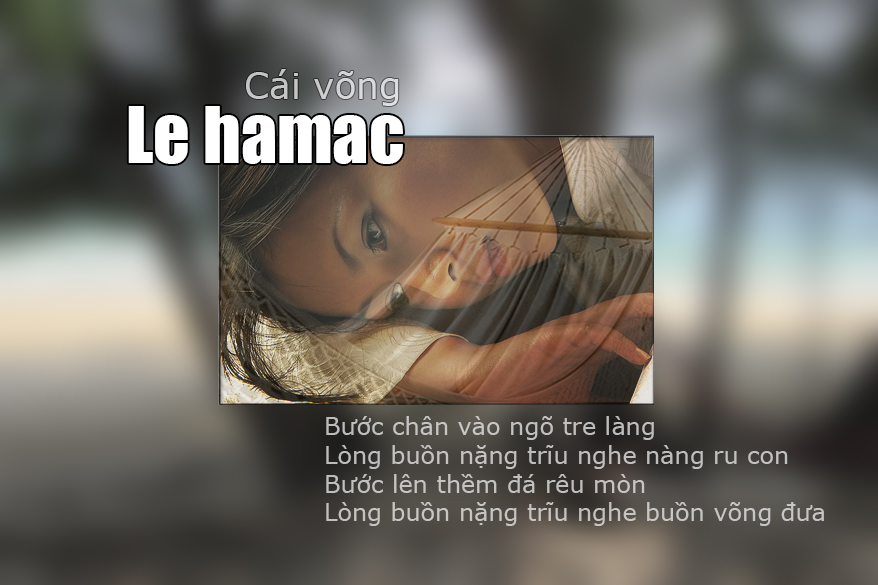
The hammock is an instrument very familiar to the Vietnamese. For many generations, one was used to hearing its resonant creaking with a regular cadence from the South to the North of Vietnam. This strident sound blended with the crying of the little children and lullabies becomes a tune of music eternally rooted in the Vietnamese soul. Poor or rich, each Vietnamese possesses at least one hammock. It is not only the cradle of the little Vietnamese children but also their swing. 

It is used by adults for relaxing. It is also a resting bed for people of old age. It is the only instrument that no Vietnamese could do without. It is a habit to say that in Vietnam one has grown up with the sound of the hammock ( lớn lên trong tiếng võng ) and will grow old in the lullabies ( già trong lời ru ) because the latter are sung tirelessly by the mothers or grand-mothers to pamper their children or grandchildren.

The lullabies stay the same but this time they are sung by a young mother who by a curious coincidence may be the girl he had known at the time he was an adolescent, or an old ferry crossing. It is sure there will be in this case the same resentment felt by a person returning to his or her native village after so many years of absence, proven in this following lullaby:

Bước chân vào ngõ tre làng
Lòng buồn nặng trĩu nghe nàng ru con
Bước lên thềm đá rêu mòn
Lòng buồn nặng trĩu nghe buồn võng đưa

One feels sad, setting foot on the village entrance
Hearing the nursery rhyme lulling her baby in cadence,
One feels sad, stepping on the worn and mossy rock
Hearing the melancholic creaking sound of the hammock.

One cannot stay insensitive when one is the issue of the Mekong delta when listening to the following lullaby:

Ầu ơ .. Bao giờ Chợ Quán hết vôi,
Thủ Thiêm hết giặc em thôi đưa đò,
Bắp non mà nướng lửa lò
Ðố ai ve được con đò Thủ Thiêm.

Âu ơ .. When the Chợ Quán market is out of lime,
The Thủ Thiêm region is out of war, I will stop being a ferrywoman.
Young and tender corn baked in oven,
I bet anyone who could court me, the boat of Thủ Thiêm.

This has without a doubt, made us relive the time of our youth, a time when we were still carefree, we would like very much flirting the girls even the ferrywoman.

 
Even the hammock is simply made of jute or fabrics, the sound provoked by its back and forth motion continue to anchor itself softly in the intimacy of our conscience and in our spiritual lifestyle and become as the years go by, the most talked about in the Vietnamese popular songs.

Ðố ai nằm võng không đưa,
Ru con không hát, đò đưa không chèo

Let’s bet who is sleeping on a hammoc without swinging,
Lulling a child to sleep without saying nursery rhyme, conducting a sampan without rowing.

In the old days, the hammock was also used to transport women or mandarins who did not know how to ride on horseback. The hammock is held up by a big bamboo resting on the shoulder of two men who trotted along with a rhythmical look. To shelter from the sun, a sedge matt is placed astride the bamboo. This assembly is often known as palanquin. This one has to follow certain protocols when it comes to a palanquin used by mandarins. According to their rank, the line that accompanied the palanquin was more or less important. One or several persons preceding the official palanquin bore arms (sabres, sticks etc…). By the sides of the palanquin walked the porters of parasols, betel nut box, spittoon, water pipe etc… This palanquin was replaced only at the appearance of the rickshaw in 1884 in Hànội.
The hammock was also the dream of most of Vietnamese young girls to be married to a mandarin as in our tradition, the young bride was riding in a palanquin preceded by her husband on horseback. ( Ngựa anh đi trước, võng nàng theo sau ).
In the West, one has the Eye of Cain to symbolize the torture of moral conscience. In Vietnam, to talk about this torture, one refers often to the creaking of the hammock of  » Con Tấm » (or Vietnamese Cinderella ) because this creaking brings back the thought the wandering soul of Tấm, victim of a plot hatched by her half-sister Cám and her step mother, trying to take revenge on Cám. The moment this one lay down on the hammock, its creaking became so deafening and menacing that Cam had the feeling her sister Tam’s wandering soul substituted for the hammock.

Nowadays, in the cities, well-to-do people replace the hammock with a bed for their little children. But it is certain that the bed, despite its comfort and attractiveness, cannot be recognizable as a familiar instrument, own and intimate of the Vietnamese people because its use is very limited and it lacks another part, the creaking that comes along with melancholic lullabies to become an eternal and irreplaceable tune of music.

In spite of its rudimentary constitution, the hammock continues to give rhythm to the Vietnamese life and witness as the years go by,the intimacy and cultural specificity of the Vietnamese people.

Being scholar (Sĩ Phu)

mandarin

Vietnamese version
French version

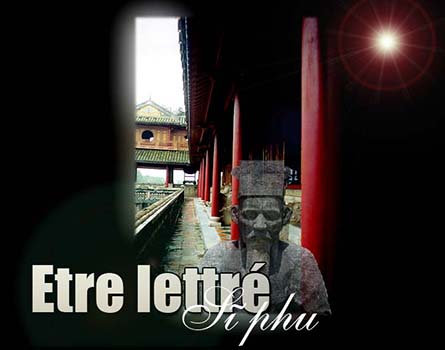
Young or old, a scholar (Sĩ) is always well considered in the Vietnamese society. Much regard is given to him as well as the first place in social hierarchy before the farmer (Nông), the craftman ( Công ), and the merchant ( Thương ). That’s why the latter does not cease to ridicule him in folk songs.

Ai ơi chớ lấy học trò
Dài lưng tốn vải ăn no lại nằm

Never marry a student, His long back costs a lot of fabrics
Once full, he just keeps lying downischol

Equipped with intellectual kowledge, the learned man does not let himself be upset by these remarks and tries to reply with a snicker:

Hay nằm đã có võng đào
Dài lưng đã có, áo trào nhà vua
Hay ăn đã có thóc kho
Việc gì mà chẳng ăn no lại nằm

Lying down, here is the luxury hammock
My long back, this is the gown granted by the King
Eat until full, there is plenty of rice in the warehouse
I don’t have to worry, just eat until full, then lie down and rest

This consideration dated back from the time when Confucianism was implemented as the single model structure of the society. The recruitment of the learned man as a mandarin was essentially based on the literary contests which took place every three years at the great temple of Confucius or the Temple of Literature (Văn Miếu). This temple was built by King Lý Thánh Tôn in 1070 and was changed to The College of the Nation’s Children (Quốc Tự Giám) in 1076. From 1484, the name of the scholar who passed the mandarinal contests was inscribed on a stele including his date of birth and his works. This practice of inscription on the stele was stopped only in 1778. Therefore, the dream of passing the mandarinal contests became an obsession for the majority of the learned men. Some of them passed their tests with an astonishing ease such as Nguyễn Bỉnh Khiêm, Chu văn An and Lê Quí Ðôn. Others failed several times as was the case of the learned man Trân Tế Xương whose poems always convey a caustic irony. His everlasting failure has influenced his works enormously. Besides litterary knowledge, the passing candidate or future mandarin must possess all the concepts of mandate of Heaven, filial piety, loyalty to the king (Nghĩa tôi ) and all the values that provide a cohesion to the confucian vision. Armed with these concepts, the learned man will try to accomplish his mission not only until the end of his days but also to the detriment of his life.

It was the case of the poet laureate Nguyễn Du who prefered retiring to serving the new regime after the fall of the Lê dynasty. It was also the case of the learned man Phan Thanh Giản who decided to take his own life with poison while advising his children to farm the land and not to accept any position during the French occupation of Cochinchina in 1867. As for the learned man Nguyễn Ðình Chiễu, author of the popular poem Lục Vân Tiên and one of the noblest figures of scholars, he never stopped giving moral support to the resistance during the colonial time.

Pictures gallery


In his Confucian vision, the scholar tried to maintain at any costs and strictly apply these principles unless the king becomes no longer worthy of the obedience owed to him. In this case, the learned man being keen on justice, may overthrow the king because the latter has been dispossessed of the mandate of Heaven. It was the case of Cao Bá Quát who participated in the famous Locust uprising ( Giặc Châu Chấu ) in the name of the Le family against king Tự Ðức, and who was captured and executed by the latter in 1854.

Although the Scholar was one of the cornerstones of a society upon which rested so many Vietnamese dynasties to govern the country and the legitimate defender of moral values particularly the five human relations ( Ngũ Luân ), i.e. between the King and his subordinates, the Father and his son, the Husband and his wife, the Brother and his younger siblings, and the Friend and his friend), which enables us to have a social cohesion and a national identity through centuries, He is however the factor of inertia and cultural isolationism which proved to be mortal for the Nguyễn’s Empire since 1840.

While continuing to underestimate the foreign power and by maintaining his conservatism, the Scholar was incapable of adapting to modernizational reforms advocated by the modernistic learned man Nguyễn Trường Tộ. Thus, He became the major obstacle to reforms that Vietnam needed in facing the ambitions of the foreign powers. This compelled Him to disappear at the same time with the Empire during the French conquest.

The Scholar formed part of a population of 40,000 learned men, approximately 20,000 of whom were holders of ranks in 1880. The last learned man known for his patriotism and reformism was Phan Chu Trinh. This one was in favor of reforms and insisted on the priority of total progress of society, of the diffusion of the modern knowledge on simple political independence.

His banishment to Poulo Condor and especially his death in 1926 has brought an end to the dream of all Vietnamese to find an independent Vietnam with a policy of non-violence and gradual decolonization that he advocated and defended with enthusiasm and conviction for so many years.

He tried to reveal his state of mind in his poem entitledphanchutrinh

The candle

He wants the flame to shed light to the bottom of darkness
Because his heart is burned with anxiety of lighting
But the half-opened door lets in the north wind
In the ending night, with whom to share his tears?

Phan Chu Trinh

It was the tears of the last great Vietnamese learned man. But it is also a cry of despair of a great Vietnamese patriot facing the destiny of his country.

cierge
[Return TRADITIONS]

Lotus (Hoa Sen)

lotus

  French version
 Vietnamese version

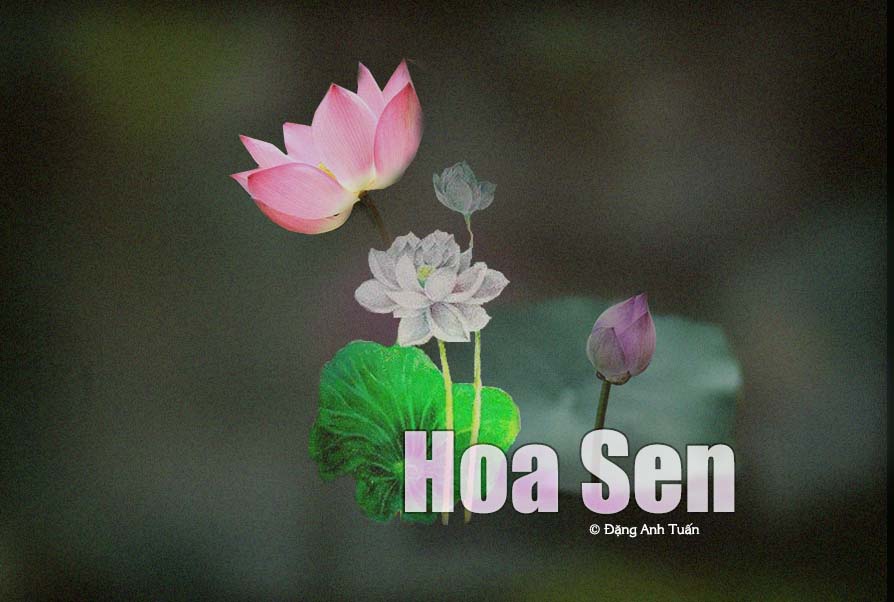
No aquatic plant causes the admiration of the Vietnamese as much as the lotus. In addition to its buddhist emblem, the lotus is synonymous to purity, beauty and serenity. The lotus differs from the other aquatic plants not only by the grace of its flower both simple and distinguished  but also by the richness of the traditions which accompany it in Asia, in particular in Vietnam. In this country, it forms part of the four noble plants (Tứ Qúi ): mai (plum tree), liên (lotus), cúc (chrysanthemum), trúc (bamboo) used in the representation of the four seasons (Tứ Thì).


In the Vietnamese art, the landscape is often built according to an ancient immutable diagram (Cổ Ðiển). This one determines the elements, in particular the characters to be put in the scene. One often finds an artistic symbiosis, an insoluble association of plant and animal in the small vietnamese paintings. This is why the lotus is always associated with a duck (Liên Áp). It is rare to find it associated with another animal unless the artist does not respect traditional conventions. The lotus is known in vietnamese with its flower under the  name « Hoa Sen or Liên Hoa « . It is part of the Nymphaeceae family and known under the scientific name of Nelumbo Nucifera or Nelumbium Speciosum. It is found everywhere in Vietnam (ponds, pools, parks, rivers etc.). It is also present in the pagodas and temples for the purpose of calming the fervors of the bonzes and to allow the visitor to feel carried furtively into nothingness thanks to the light scent released by its flowers. It develops easily and adapts to all surroundings. It contributes to the thriving of the aquatic life by purifying all dirty and muddy water that it colonizes, which makes it the symbol of a man of confucius quality (junzi). This latter, no matter where he lives, continues to remain faithful to himself, to maintain his purity in the middle of corruption. He does not let himself be contaminated by the vices of society as the lotus manages to destroy all the stench of its environment thanks to its flagrant flowers.

It is for that reason that in the Vietnamese poetry there is a poem dedicated to the man of confucian quality through the image of the lotus:

Chung quanh cành trắng, giữa chen nhị vàng
Nhị vàng cành trắng lá xanh,
Gần bùn mà chẳng hôi tanh mùi bùn

What can be more beautiful than the lotus in the pond?
Green leaves, white flowers, yellow stamen
Gold stamen, white flowers, green leaves
Though close to the stinking mud, it does not smell its odor.

To evoke the quality of this man or the lotus, one often says in vietnamese: Cư trần bất nhiễm trần (or in English Live in the society without being contaminated by its vices.)

The lotus has other qualities which enable it to belong to the chinese and vietnamese noble plants. It is what has inspired a Chinese Zen Buddhist sect known under the name  » Pháp Hoa Tông  » at the period of Tang to give birth to the doctrine  » Diệu Pháp Liên Hoa Tông « .  This one was  based only on the worship of life in relying upon the quality of the lotus. One found at that time in this sect the bonze poets Phong Cang and Thập Ðắc as famous as Lý Thái Bạch (Li Tai Bai) (1) , Bạch Cư Dị ( Bai Juji )(2). This sect whose pagoda was in Hàn Sơn in the neighborhoods of the city Cô Tô cultivated only the lotus in its ponds. It thought that one could find peace in the heart and free oneself from reincarnation and the fires of concupiscence while depending on this doctrine which borrowed from the lotus the character:

  • carefree (Vô ưu). Its scent allows the one who has the occasion to sniff it to find peace and serenity. According to the Forefathers, it is an antiaphrodisiac plant like lettuce.
  • -adaptable (Tùy thuận). It can grow everywhere even on an arid soil.
  • odoriferous (Cư trần bất nhiễm trần ). It does not let itself influenced by the stench of the environment where it grows but it continues to release its scent according to the intensity of light.
  • specific to the level of reproduction.(Vô cấu ). It has a mechanism which is unique to itself for the vegetative multiplication. There is no formation of gametes. Its flower is exceptional by its size, by the hard and waxy consistency of its petals and by its perfume whose intensity varies during the day. A lotus flower only lives four days. The Japanese describe this blossoming in the following way: the first day, the flower has the shape of a bottle of saké, the second day that of a cup of saké, the third day that of a soup bowl and the fourth day, that of a saucer. Gradually, its fruit is formed and resembles a reversed cone or rather the head of a watering can. Its higher plane face is supplied with a score of cells containing seeds. It is detached from its stalk at maturity and its higher face disaggregates in contact with water with the passing days. That makes it possible to release and convey seeds far from the place of flowering. Its seeds heavier than water stick fast in the mud and take root.

That makes it possible for the young buds  to sprout as they already carry seeds at the time of their formation. This is why the Vietnamese say the following about the lotus: Nhân quả đồng hành to mean that the seed is made at the same time as the fruit. Buddha (3) was accustomed to using the lotus to name the person who has succeeded in freeing himself completely from concupiscence because the latter is the source of all human sufferings (duhkha) and of successive reincarnations.

The lotus is often visible in the vietnamese art, in particular in buddhist architecture. The motif that identifies the lotus in the decoration always has eight petals indicating the eight cardinal points and reproduces the mandala, geometrical and symbolic representation of the Buddhist Universe.

In the Vietnamese pharmacopea, the lotus seeds are used in the treatment of diarrhea, dysentery, erotic dreams. These seeds are considered sleeping pills when they are eaten raw and in great quantity. The consumer can fall asleep rapidly if he absorbs the green germ found in the middle of the seed. Formerly, the young vietnamese boys were accustomed to offering lotus flowers to declare their feelings to their beloved. One also finds candied lotus seeds and tea aromatized with lotus in all the traditional festivals of Vietnam, in particular that of Tết without forgetting to note for the epicurians in the art of vietnamese cooking that there is a delicious dish, the lotus salad.

The land of legends as is our Vietnam was plunged into war, injustice and corruption. Any Vietnamese in love with peace, justice and freedom always cherishes the hope to see that one day his country find serenity, splendor and dignity in the image of purity of this aquatic plant.

Its grace was evoked by the king poet Lê Thánh Tôn in his poem Hoa Sen at the time when Vietnam was at the height of its glory and radiance:

Nỏn nà sắc nước nhờ duyên nước
Ngào ngạt hương thơm nức dặm Trời ..

The lotus flower is of a beautiful whiteness and perspicacious thanks to the contribution of water
Its penetrating fragrance is spread into the sky.

[Return FLEURS DU MONDE]


(1) Li Bai, one of the famous chinese poets of the time of the emperor of Tang Xuanzong. ( 701-762).
(2) The great chinese poet of the time of Tang (772-846)
(3) Siddhârta Gautama ( Cồ Ðàm Tất Ðạt Ða ).


Flowers in the Vietnamese culture

French version
Vietnamese versionimg_6909


In their cultural tradition, the Vietnamese attach a great importance to flowers. One notes their marked preference for the names of the flowers in the choice of the feminine first names . There is even an anecdote on the first name that great king Lý Thánh Tôn of the dynasty of Lý has chosen for his imperial concubine Ỷ Lan known later under the name Linh Nhân Hoàng Hậu. One day, on his way back to the capital, the king was greeted by jubilant villagers. He realized that there was a young country girl of extraordinary beauty who kept looking timidly at him while leaning against a magnolia. Desirous of knowing her, he made her come in front of him. Taken by her beauty and intelligence, the king asked her to marry him and gave her the name « Ỷ Lan » (Ỷ Lan means leaning against a magnolia). She was known later in the history of Vietnam as one of the greatest queens to take up several social projects for disinherited and women.

Những loại hoa được yêu trong nền văn hóa Việt Nam

To immortalize the affliction they continue to bear for their daughter-in-law, from then on, they forbade their close relations and subjects to use the word Hoa not only in the choice of given names but also in the naming of public buildings. Because of that prohibition, the Ðông Hoa market in Hue became the central market Ðông Ba. The province Thanh Hoá was from then on called Thanh Hoa. The bridge stretching across the Thi Nghe river in Saigon changed its name to Cầu Bông from the name Hoa Bắc. However « Hoa » is the word the most used in Nguyễn Du‘s Kim Vân Kiều, the masterpiece of Vietnamese literature. Without counting the name of the flowers evoked, one can come up with an inventory of at least 130 verses containing the word « Hoa ». Moreover, this word appears in a great number of terms having the connotation of flower in the Vietnamese literature.

Hoa diện, mặt hoa : blossoming face ( To have a beautiful face )
Hoa chúc: Flower of the torch ( the lamp in the nuptial room)
Hoa niên: Flower of Age ( youth )
Hoa tay: To have the pulp of the fingers in the form of a flower ( To be very adroit )
Số đào hoa: To be born under the peach flower star ( To be liked by women )
Ngừơi tài hoa: Man of talent to the image of a flower ( To be talented and distinguished)
Hoa tai : Flower of the ear ( Earring )
Hoa đèn: Flower of the lamp ( coal of the wick of an oil lamp)
Hoa khôi: Flower of first rank (To be the most beautiful girl, also attributed to the plum flower or that of a lotus )
Hoa đá: Stone flower ( Coral )
Hoa vương: Queen of flowers ( Peony)

Concerning the stone flower, there is an anecdote recalling the episode when Vietnam was troubled by ceaseless internal wars between the two ruling families, the Trinh and the Nguyễn. It was one of the practical jokes of a mandarin named Trạng Quỳnh serving lord Trinh Cương and frequently known under the pseudonym Cống Quỳnh or Trạng Quỳnh. Lord Trịnh Cương was very greedy. He only thought of living in opulence and debauchery. That was why Cống Quỳnh tried to bring him back to reason and wisdom. He told him that he knew how to prepare a very delicious little dish called Hoa đá (Stone flower).

Lord Trinh Cương asked him to prepare it. But he told the lord that he must wait for at least two days to be able to taste that dish because he had to simmer it during that time. Lord Trinh Cương accepted this proposal. Back home, he ordered his servants to go to the store and get edible algaes and simmer them in water. Famished by this long wait, the lord Trinh recognized that the dish prepared by Cống Quỳnh was delicious even though it only contained vegetables after having tasted it.

One found some classical famous novels bearing the name of flowers. It is the case of Nhị Ðộ Mai (Twice blossoming plum tree) and Hoa Tiên (Flowery Loose Sheets). The first one was written in Nôm with two thousand eight hundred twenty Six-Eight verses and adapted from a Chinese work. It is the story about king fidelity, filial piety, loyalty, gratitude and love. As for the second novel, it was composed by the learned Nguyễn Huy Tự.This novel comprises more than eight hundred verses written in Six-Eight feet (lục bát). It is the first Vietnamese romantic poem and still remaining within the Confucian thought.

Despite a great variety of flower species found on this land of legends, the Vietnamese do not hide their preference to certain plants. They do not hesitate to classify some in the category of noble plants. Among those, one can quote:

Mai(Plum)
Lan (Magnolia)
Cúc (Chrysanthemum)
Sen (Lotus)
Mẫu đơn (Peony)
Hoa hồng (Rose)

These plants or their flowers have each one a particular and ethical signification and the Vietnamese tradition. The plum tree ( mai ) is the symbol of a superior man. It succeeds in resisting the cold and bad weather and continues to bloom in February, which allows it to symbolize the Spring in the representation of the four seasons (Tứ Thì). At the occasion of Têt, for a Vietnamese, there is never a lack on the altar of some branches of plum trees (or cherry) in bloom that are selected so that the flowers hatch during the festival. The plum flower is very much adored by learned and intellectual Vietnamese. An independent man of character like Cao Bá Quát who did not bow to mandarinal servitude had to admit to only bending his head before the plum flower during his lifetime.

Nhất sinh đê thủ bái hoa mai
Suốt đời chỉ cúi đầu trước hoa mai

All my life, I curve only my head in front of the flower of plum tree.

Another learned man Ðào Tấn, the father of stage productions of the Bình Ðịnh region in Central Vietnam, also nourished the hope to die one day near plum trees. That is why, while living, he chose (Mộng Mai) (Dream of Plum Flowers) as his pseudonym and had the occasion to reveal his state of heart in the two verses found in one of his poems:

Núi mai rồi giữ xương Mai nhé
Uớc mộng hồn ta là đóa Mai

It is the mountain of the plum trees where will be buried my skeleton of plum tree.
I continue to dream that my soul would be the flower of plum tree.

It was not an utopia for him because at his death (July 1907), he was buried at mount Huynh Mai, not too far from a plum garden which is a few kilometers away. Contrary to the Chinese, they are the plum and lotus flowers which are more appreciated than the peony. That’s why they are called Hoa Khôi (Flowers of first rank)
One has a preference for the plum tree because the lotus is rather reserved to Buddhism although it is also the symbol of a man of Confucian quality (junzi). It was the plant chosen by the learned Mạc Ðỉnh Chi to reveal his extraordinary talent and genius when king Trần Anh Tôn hesitated to appoint him « First Doctor » finding him too ugly at the time of diploma delivery. To convince the king, he compared himself to a lotus in a jade well by composing in front of the king the poem entitled «  Ngọc Liên Tỉnh Phú » (Lotus in a a jade well).

Giống quý ấy ta đây có sẳn
Tay áo nầy ta chứa đã lâu
Phải đâu đào, lý thô màu
Phải đâu mai, trúc dãi dầu tuyết sương
Cũng không phải tăng phường câu kỷ
Cũng không là Lạc Thủy mẫu đan
Cũng không là cúc, là lan
Chính là sen ở giếng vàng đầu non

That precious species I already possess
In this coat sleeve I kept it for a long time
It is neither peach nor cherry whose color is gross
It is neither plum tree nor bamboo exposed to snow and dew
It is even not berry whose scent is to be avoided
It is not the peony from Lac Thủy(1)
It is neither chrysanthemum nor magnolia
But it is the lotus in the golden well on top of the mountain.

Mạc Ðỉnh Chi had the occasion to compose a funeral oration in honor of disappearance of a Mongol princess when he was sent to China as the Ambassador of Vietnam. That day, before the imperial court, one gave him a sheet of paper on which there were four lines, each one began with a single word « one » (một ). It was up to him to compose a poem by completing the lines to render a great homage in memory of that princess. Imperturbable, he succeeded in doing it with the surprise and admiration of all the Mongol imperial court by designating the princess like a flower:

Lò hồng môt giọt tuyết
Vườn thượng uyển môt cành hoa
Cung quảng hàn (2) một vầng nguyệt
Than ôi! Mây tan! Tuyết tiêu!
Hoa tàn! Trăng khuyết !

One cluster of clouds in the blue sky
One flake of snow on the rose beam
One flower in the imperial garden
One lunar disk in the Moon palace
Alas! Cloud disappears! Snow melts!
The flower wilts! The moon is incomplete !

As for the chrysanthemum, it is not only the monopoly of the Autumn but also the symbol of serenity and the indifference of people to honors and glory. Analogous to the flower of plum tree, the magnolia is the symbol of feminine beauty. It often designates a young girl in poetical compositions. Although the peony is seen as a noble flower, it does not have a significant range than it continues to have in China. Probably because of the Chinese influence, one continues to keep that custom. The peony is often evoked in Vietnamese ornamental art or in legends (The story of the mandarin Từ Thức and the fairy Giáng Hương for example).

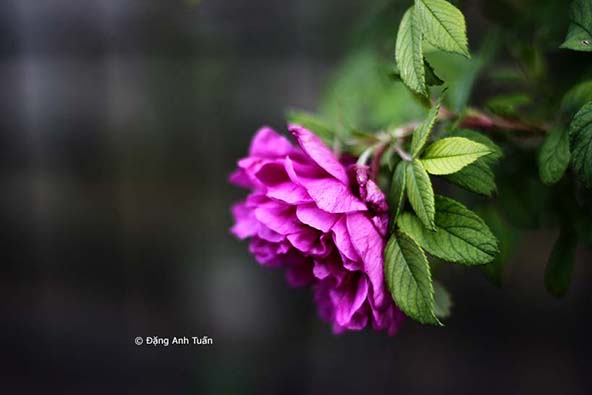
As for the rose, it is the symbol of love and affection. To understand the value and the range of significance that the Vietnamese give to this flower, we should read the novel « Bông Hô`ng Cài A’o ( A rose pinned on the coat ) » of the Vietnamese zen monk Thi’ch Nhâ’t Hạnh. He attempts to remind us through his narration that everyone of us has a unique mother that we neglect to think of because of the ups and downs in life. We often forget that if everyone of us still has a mother today, that is because God has left an invaluable treasure with us. We still have the chance to be able to love her and show her our affection. For that, we can continue to pin a rose on our coats because we alone still have that immense, intimate and indescribable joy that lots of people no longer had long time ago.

Not long ago on this land of legends, one could not see white myrtle flowers (Hoa Sim) laid by young girls on the tomb of their lovers who had fallen valiantly in the defense of their ideal and fatherland. They did not have the chance to see peace coming back some day. They did not have the occasion to pin a rose on their coats even when their mothers were still alive. It is for these valiant people that all the Vietnamese want to offer a rose for the love they have always had for this land. They want to show them their sincere affection and profound gratitude. Without the bravery, sacrifice, and the nobility of soul of these people, Vietnam would not have been able to retain its independence, its cultural identity, its millennial traditions.

[Return  FLEURS DU MONDE]


(1) Lạc Thủy: a river known in China.
(2) Cung quảng hàn : the  mythical  Chinese palace  found on the moon.
(3): An anecdote on the chrysanthemum of Luoyang  with  Wu Ze Tian empress ( Võ Tắc Thiên) of  Tang dynasty.
 

Văn Lang kingdom (Văn Lang)

French version
Vietnamese version

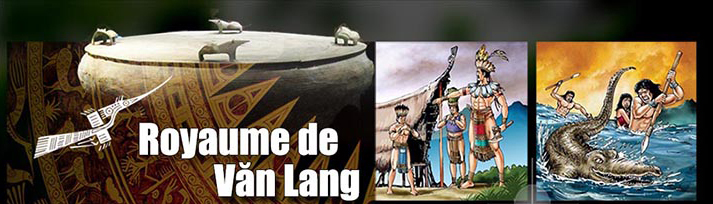
 In fact, Văn Lang referres the semi-legendary epoch of the eighteen Hùng kings or Lạc Vương (2879-257 B.C.) or 2622 years. It was the legend and the myth of the Dragon and the Immortal of whom Vietnamese are issue. This kingdom was located in the Yang Tse river basin (Sông Dương Tử) and was placed under the authority of a Hùng king . This one had been elected for his courage and his values. He had divided his kingdom into districts entrusted to his brothers known under the name « Lạc hầu » ( marquis ). His male children have the title of Quan Lang and his daughters that of Mỵ nương. His people was known under the name « Lạc Việt« . His men had a habit of tattooing their body. This « barbarian » practice, often revealed in the Chinese annals, was intended to protect men from the attacks of  water dragons (con thuồng luồng) if one believes the Vietnamese texts. It is perhaps the reason why the Chinese often designated them under the name « Qủi (daemons) ».

Loincloth and chignon constituted the usual costume of these people to which were added bronze ornaments. The Lac Viet lacquered their teeth in black, chewed betel nuts and crushed rice with their hand. The farmers practiced the cultivation of rice in flooded field. They lived in plains and coastal areas while,  in the mountainous areas of the current Việt Bắc and on part of the territory of the current Chinese province of Kuang Si,  lived the Tây Âu,  ancestors of the ethnic groups Tày, Nùng and Choang currently disseminated in the North Vietnam and in the South of China. At that epoch, the Vietnamese people lived on fishing and cultivation. They already knew how to use tree bark to make clothes, prepare rice alcohol, practice slash and burn agriculture, eat ordinary rice or sweet rice, live in houses on stilts to avoid wild animals etc… Many Vietnamese popular tales (the story of the Sweet Rice Cake, that of the Betel Quid and that of the Mountain and River Gods etc.) came  from these customs.

There is a part of reality in the history of this kingdom. The ruines of the Cổ Loa citadel (Spiral citadel) located  about 18km in the district Đồng Ánh from  Hànội and the temples of Hùng kings testifies to these indisputable vestiges with historians viewpoint.


HUNG_VUONG