Con đường tơ lụa (Route de la soie)

Con đường tơ lụa

Version française
Version anglaise
Galerie des photos

Chính Trung Quốc là nước  đầu  tiên  biết nuôi loại bướm  tằm Bombyx mori để sản xuất lụa đã có 5000 năm.  Dù bản thân loại chất liệu nầy bị phân hủy với thời gian nhưng các di vật liên quan  đến việc sản xuất  như khung cửi, kim và con thoi giữ sợi vẫn còn. Những mảnh lụa được tìm thấy tại một di chỉ văn hóa Lương Chử ở Thiên Sơn Dương, Hồ Châu, Chiết Giang, có niên đại từ năm 2700 TCN. Những mảnh khác được tìm thấy từ các lăng mộ hoàng gia thời nhà Thương (khoảng 1600–1046 TCN). Nguồn gốc của tơ lụa cổ xưa đến từ một truyền thuyết Trung Hoa kể rằng hoàng hậu Tây Lăng Thị, người vợ trẻ của vua Hiên Viên hoàng đế đã bắt được một cái kén rơi vào tách trà của mình và tháo nó ra để lấy được một sợi tơ cực kỳ mịn. Truyền thuyết nầy nhầm có ý thêu dệt việc sản xuất tơ lụa  đặc biệt ở những vùng lân cận sông Hoàng Hà và Dương Tử.  Các nhà sử học xác định rằng tơ lụa được phát hiện vào khoảng 2.000 hoặc 3.000 năm trước Công nguyên tại Trung Quốc.

Bướm  tằm Bombyx mori phải trải qua 4 giai đoạn trong quá trình này như sau: từ trứng (ovule) đến thành sâu bướm (larve) rồi sau đó thành nhộng (pupe)  trước khi thành bướm (imago). Quá trình này có thể mất đi từ 40 đến 60 ngày. Con bướm này mới nở  có màu trắng nhạt và đầy lông nếu là con cái thì nó đã  có  chứa đầy trứng. Nó tiết ra các pheromone để thu hút các con bướm đực để giao phối. Lúc nó còn nhộng thì nó tìm nơi  thích hợp để làm kén nhả tơ ra từ miệng của nó. Một sợi tơ nó có thể dài  đến 1000 mét và rộng có 30 micron. Nó sẽ bọc sợi tơi  bằng một loại chất keo gọi là sericin để nó làm cứng tổ kén có hình bầu dục.  Người ta ước tính muốn sản xuất một  kílô lụa thì cần đến 220 kilô lá dâu. Lá nầy phải sạch, khô và không được nóng quá.

Lụa là một sản phẩm mà Trung Quốc độc quyền đã có 5000 năm. Trung Quốc dùng nó  làm món quà cho kẻ thù Hung Nô mà cũng là món quà qúi giá được trao đổi về  sau trong giới qúy tộc trên thế giới. Cũng như ngọc bích được khắc thành những hình mang tính biểu tượng, lụa được dệt  hay thêu các hoa văn mang những ý nghĩa nhất định. Hung Nô là một dân tộc du mục hùng mạnh ở phía bắc Trung Quốc thời nhà Tần và Hán. Chính vì sợ họ mà dưới thời Chiến Quốc  các nước chư hầu như Yên, Triệu và Tần bắt đầu xây dựng tường thành riêng lẻ để bảo vệ mình khỏi sự xâm lược của họ. Sử ký Trung Hoa gọi họ là Man di. Họ không có thành trì hay chỗ ở nhất định. Vì thế họ không có canh tác nào cả. Họ sống cướp bóc gia súc, bắt người làm nô lệ rồi biến mất trở về thảo nguyên khiến làm người Hán khó mà đột kích phản công lại họ. Trước sự ranh mảnh nầy, người Hán buộc lòng phải  đổi chiến lược  mang tính cách ngoại giao mà họ tin rằng với thời gian sẻ đem lại chiến thắng cho họ nên họ chấp nhận hệ thống triều cống với 4 bốn nguyên tắc sau đây:

1°) Một công chúa Trung Quốc sẽ kết hôn với thiền vu, người thủ lỉnh của người Hung Nô.

2°) Vạn lý Trường Thành là ranh giới giữa hai bên, không có quyền vượt qua Trường Thành nếu không có phép.

3°) Hai bên được xem như hai nước anh em và bình  đẳng.

4°) Việc trao đổi hàng hoá trong đó có tơ lụa về phiá nhà Hán và phiá Hung Nô thì có lạc đà, ngựa, lừa và vàng bạc bằng cách dựng các khu chợ ở gần Vạn Lý Trường Thành. Nhưng với thời gian nguời Hung Nô càng ngày càng đòi thêm khiến  người Hán tin rằng sẽ làm suy yếu nền kinh tế của người Hung Nô và họ sẽ được những gì mà họ không thành công qua chiến tranh. Chính nguời Hung Nô cũng nhận thức được sự kiện nầy khiến làm họ mất đi nhuệ khí chiến đấu nhất là với chiến lược «năm miếng mồi  cám dỗ» (nhà cửa, âm nhạc, phụ nữ, kho lẫm và quần áo đẹp). Họ cũng như người Hán nhất là trong tầng lớp ưu tú bắt đầu sử dụng lụa làm y phục, ga giường và dùng nó  vào nghi thức an táng như ở nghĩa trang  Noin-Ula, một di chỉ có hơn 2000 ngôi mộ của quý tộc Hung Nô và có vô số những tấm lụa damas qúi giá mà một phần lớn đến từ hệ thống triều cống. Chính lụa cũng làm Thiền Vu củng cố địa vị của mình, phân định giai cấp qua màu sắc và chất lượng. Nhờ  lụa chúng ta  mới có thể nhận thấy ra  rõ ràng  điạ vị của người sử dụng. Các hoàng đế Trung Hoa chỉ dùng màu vàng như màu lòng đỏ trứng gà, một màu mất rất nhiều công sức để thêu dệt nhất là theo luật lệ của triều đình. Bởi vậy hoàng cung mới có các xưởng dệt và nhuộm riêng tư và hoàng hậu đương triều là người cai quản và trách nhiệm  bộ phận nuôi tầm. Khi hoàng đế Kim Chương Tông  (Jin Zhangzong) lên ngôi vào  năm 1190 thi ngài đã thuê 1200 thợ dệt để sản xuất loại lụa damas. (1)

Hung Nô vẫn là một mối quan tâm lớn đối với các hoàng đế ở Trung Hoa nhất là với Hán Vũ Đế  mặc dù chính sách triều cống  được những người tiền nhiệm của ngài  áp dụng cho đến lúc đó. Đây là một kiểu liên hôn chính trị được Lâu Kính đề nghị với Hán Cao Tổ (Lưu Bang).  Sự không phục tùng và xấc xược của  Hung Nô vẫn tiếp tục làm bẽ mặt nhà Hán. Để đánh bại một kẻ thù vô hình như Hung Nô, Hán Vũ Đế có nghĩa vụ tổ chức lại quân đội của mình và làm cho nó phù hợp hơn để di chuyễn mà mục tiêu chính là đánh bật kẻ thù và cướp gia súc  của địch  ở giữa nơi họ cấm trại qua  các cuộc tấn công nhanh chóng bằng một số ít kỵ mã cũng như thói điều hành của Hung Nô. Vì vậy, việc sử dụng chiến xa bị loại bỏ trong các cuộc giao tranh quân sự. Sau đó, còn phải bỏ thoái của quan chức thường hay mặc lễ phục truyền thống để dùng ưu tiên quần dài  tránh đi sự cản trở trong việc cưỡi ngựa với tư thế ngồi xổm mà những người bình thường hay dùng. Chiến thuật này làm choáng váng quân Hung Nô, nhưng nó không thể làm chúng khuất phục được. 

Đây là lý do tại sao Hán Vũ Đế  phải lựa chọn các biện pháp khác bao gồm việc cải thiện mạng lưới đường xá không chỉ nó là xương sống của hệ thống kinh tế mà còn là chìa khóa thành công trong việc vận chuyển quân lính và tiếp tế. Trên các con đường của người Hán hiện nay đều có các trạm thư, chuồng ngựa, nhà trọ cho quan chức, ký túc xá cho du khách bình thường và thậm chí  có cả nhà giam cho tù nhân. Mạng lưới đường bộ do đó qua nhiều thế kỷ trở thành yếu tố then chốt của sự bành trướng quân sự và là công cụ hữu hiệu cho sự thâm nhập văn hóa của người Hán. Nó được xem ngang hàng với mạng lưới đường bộ của người La Mã.

Dọc theo biên giới phía bắc của vùng Cam Túc (Gansu), mạng lưới đường bộ này cũng cần phải bố trí lại  với một số đồn trú, xung quanh có các tháp canh mà một số có độ cao đến  18 thước dùng để theo dõi sự di chuyển của quân Hung Nô và báo hiệu bằng tín hiệu khói, bảo vệ những người sử dụng đường bộ và có các hành động phòng thủ phối hợp với bộ tham mưu. Chiến thắng của nhà Hán còn phụ thuộc vào các yếu tố khác quan trọng cũng như mạng lưới đường bộ này. Cung cấp lương thực cho các đơn vị đồn trú thường là một thách thức hàng ngày chưa kể đến những khó khăn lớn mà quân lính của Hán Vũ Đế gặp khi truy đuổi quân Hung Nô ở ngoài biên giới đến những vùng không xác định được. Điều này đòi hỏi sự tham gia của một số lượng lớn  về ngựa và kiến thức về địa hình rồi tất cả  cũng dần dần được cải thiện bằng cách vẽ lại các  bản đồ để xác định vị trí các điểm nước cũng như sự hợp tác của người dân địa phương.

Đôi khi điều cần thiết là phải nhanh chóng phục hồi kỵ binh trong trường hợp bị tổn thất đáng kể. Chúng ta có thể nói đến chiến dịch Ferghana chống lại Dayuan (Đại Uyển) vào năm 104 TCN. Trong số 60.000 binh lính giao chiến và 3000 con ngựa, tướng của Hán Vũ Đế, Li Guan Li (Lý Quảng Lợi) đã trở về với 10.000 binh lính và 1000 con ngựa. Vì vậy, triều đình nhà Hán đã phải khuyến khích người dân chăn nuôi ngựa, định giá một con ngựa giống với mức giá tiêu chuẩn khá cao, và xúc tiến đến việc đưa các giống ngựa mới từ các vùng đất phương Tây. Việc phục hồi nhanh chóng của kỵ binh rất cần thiết trong các cuộc viễn chinh xa. Không còn xa lạ với số lượng trang trại nuôi giống ngựa không ngừng tăng lên và việc cải thiện thức ăn gia súc bằng cách trồng cỏ linh lăng (Chi linh lăng) mà hạt giống được Zhuang Qian (Trương Khiên) mang về trong chuyến thám hiểm ở Trung Á.

Nhờ đó Trương Khiên đã phát hiện ra ở thung lũng Ferghana (Uzbekistan ngày nay) có những con ngựa  tốt, ngựa hãn huyết (đổ mồ hôi  đỏ như máu) và mang về vào năm 114 trước Công nguyên (TCN) một số mẫu vật được cung cấp bởi  người Wusun (Ô-Tôn), đồng minh của Hán Vũ Đế ở Trung Á. Kích thước, tốc độ và sức mạnh của các con ngựa nầy  làm hài lòng Hán Vũ Đế vô cùng. Nhưng thành tích của các con ngựa nầy  vẫn được cho là kém hiệu quả hơn  các con ngựa của  người Đại Uyên (Ferghana). Nhờ có móng guốc cứng hơn, những con ngựa Đại Uyên có thể  đi đến một nghìn li mỗi ngày. Mong muốn có được những con ngựa này, Hán Vũ Đế  tổ chức một cuộc thám hiểm quân sự chống lại người Đại Uyên. Họ đã sai lầm từ khước cung cấp các con ngựa nầy để đổi lấy quà tặng. Ngài không ngần ngại đặt cho những con ngựa này sau này với cái tên là « thiên mã » (tianma) (thiên mã= ngựa trời).

Những con ngựa nầy trở thành biểu tượng của quyền lực và uy tín vì Hán Vũ Đế cảm thấy bị sĩ nhục và bẽ mặt trước sự từ chối của một  tiểu vương quốc nằm ở trong thung lũng Ferghana. Chi phí dành cho cuộc thám hiểm quân sự rất quá mức không chỉ về trang bị và ngựa mà còn nhân mạng nửa  để có một kết quả không đáng  với khoảng ba mươi con  thiên mã và ba nghìn con ngựa giống và ngựa cái bình thường. Tuy nhiên, quân đội của Hán Vũ Đế  được lựa chọn khéo léo, chủ yếu là những người lính chuyên nghiệp và phạm nhân thực sự cũng như kỵ binh do các chỉ huy của các vùng biên giới cung cấp. Những người lính nhập ngũ này phải có sức bền bỉ về thể chất đáng kể để thực hiện những cuộc hành quân nhiều ngày và tiếp quản một thành phố.

Theo nhà sử học Tư Mã Thiên, không phải cái chết ở chiến trường hay thiếu lương thực là nguyên nhân dẫn đến những tổn thất đáng kể này mà chỉ là nỗi khát khao và sự ám ảnh của các tướng lĩnh muốn giành chiến thắng trong cuộc chiến bằng mọi giá vì mạng sống của họ còn phụ thuộc vào chiến thắng hay thất bại của các tác chiến này. Phần thưởng và hình phạt nghiêm khắc hoặc thậm chí án tử hình là một trong những giải thưởng mà Hán Vũ Đế sẽ dành cho họ mà họ không hề cho là ảo tưởng khi họ trở về Trung Hoa. Các tướng lĩnh uy quyền buộc phải tự sát hoặc đầu hàng kẻ thù (Lý Quảng, Lý Lăng, Lý Quang Lợi  vân vân..). Chiến dịch của Ferghana đã hoàn thành chỉ trong vòng một năm (từ mùa xuân năm 102  đến mùa xuân năm 101 TCN).

Sự ra  đời của con đường tơ lụa

Từ đây, sau chiến dịch Ferghana, tất cả các vương quốc  nằm trên con đường mà quân Hán đi ngang qua (sau này được gọi là « Con đường tơ lụa » ) đã chấp nhận thành chư hầu của Trung Hoa, ngoại trừ người Hung Nô. Để chống lại  những người nầy, Hán Vũ Đế  cố gắng tìm kiếm liên minh với kẻ thù của quân Hung Nô, đấy là người Đại Nguyệt Chi (Yuezhi) bằng cách cử một phái đoàn do Trương Khiên dẫn đầu đến Trung Á vào năm -139. Cuối cùng, Trương Khiên không thành công trong việc hoàn thành nhiệm vụ của mình vì ông ta đã bị quân Hung Nô giam giữ trong 10 năm trước khi trốn thoát để khám phá được Ferghana (Đại Uyển, Uzbékistan), Sogdiana  (vùng Samarkand), Bactriane (Turkmenistan) và phía bắc  Á Phú Hãn (Afghanistan ngày nay). Tuy nhiên, khi trở về Trung Hoa vào năm -126 trước Công nguyên, ông đã báo cáo với Hán Vũ Đế. Điều này cho phép Vũ Đế khám phá các quốc gia mà Trương Khiên đã đến tham quan và  nhắc lại cho Vũ Đế  biết có khả năng gia nhập vương quốc Shendu (Ấn Độ) từ nước Thục (Tứ Xuyên)  mà còn có một đế chế  hùng cường xa xôi có tên là  Daquin (Đế chế La Mã). Thay vi có được đồng minh chống lại Hung Nô, người ta lại có thể thấy giờ đây tìm ra được các đối tác thương mại quan tâm đến các sản phẩm của Trung Hoa như lụa, đồ sơn mài, công cụ bằng sắt vân vân… để đổi lấy ngọc, ngựa và lông thú. Vì thế con đường tơ lụa mới ra đời và trở thành sợi dây liên kết giữa Đông và Tây.

 Chỉ đến năm 115 TCN, Trương Khiên lại được Vũ Đế ủy thác dẫn một phái đoàn ngoại giao đến các vùng ở phía tây. Lần này, ông ấy cố gắng mang về không chỉ nhiều loại thực vật và sản phẩm tự nhiên (cỏ linh lăng, rượu vang, nho, quả hạch, quả lựu, đậu, len, thảm vân vân..) mà còn có cả những người chăn nuôi ngựa, người nước Ô-Tôn (Wusun nay ở Tân Cương). Bị ấn tượng bởi sự tráng lệ và giàu có của triều đình nhà Hán, người Wu Sun đồng ý tham gia trong cuộc liên minh  sau nầy do Hán Vũ Đế  đề xuất và mặc nhiên công nhận quyền bá chủ  của Trung Hoa.

Liên minh này được tiếp  theo sau đó với sự cống hiến một  cô công chúa Trung Hoa tên là Lưu Tế Quân cho nhà vua Côn Mạc của nước Wu Sun (Ô-Tôn). Vua nầy có cơ hội báo cáo hai lần cho Hán Vũ Đế về ý định hung hăng thù địch của quân Hung Nô qua cuộc liên minh nầy. Theo phong tục của Tây Vực, vị vua mới phải lấy tất cả những thê thiếp của vị vua cũ. Bởi vậy Tế Quân phải lấy Sầm Tâu, cháu nội của vua Côn Mạc khi ông nầy từ chức và dù Tế Quân không chịu nhưng với  Vũ Đế chi bảo Tế Quân nàng  đành phải chịu vì nàng là con cờ chính trị. Tế Quân  tuyệt mệnh về sau, không để lại một lời trăn trối nào cả với 30 năm thất vọng  từ thất vọng lấy ông vua già đầu tóc bạc phơ Côn Mạc rồi đến thất vọng khác phài lấy Sâm Tâu một đưá trẻ chưa đầy 15 tuổi. Nhờ nàng và công chúa Giải Ưu, người thay thế nàng về làm vợ Sầm Tâu  thì chẳng bao lâu sau nhà Hán liên minh với Ô -Tôn tiêu diệt uy lực Hung Nô và khiến Hung Nô từ thù địch trở thành chư hầu thần phục của Trung Hoa. Vuơng quốc Ô Tôn trở thành từ nay căn cứ chính trị để Trung Hoa bành trướng thế lực ở vùng Trung Á (Đại Uyển (Fergana), Khương Cư (Sogdiana), Đại Hạ (Irak), An Tức (Parthia, Iran), Sa-xa (Yarland), Lâu Lan (Lopnor)). Chính nhờ đó mới có sự giao lưu thương mại, văn hóa và chính trị giữa Đông và Tây mà Ô-Tôn trở thành trạm quan hệ nếu không nói là trục giao liên thương mại giữa hai nền văn hóa Đông và Tây. Nếu không có sự bền bỉ của Trương Khiên, sự tham vọng bành trướng thế lực của Hán Vũ Đế và sự hy sinh cao cả của Lưu Tế Quân thì chưa biết bao giờ mới có sự tiếp cận giữa Đông và Trung Á. Rồi sau đó  tuyến đường  tiếp tục từ An Tức(Ba Tư) đến thành phố Antioche (Thổ Nhi Kỳ ngày nay) trước khi đển thế giới Địa Trung Hải.

Dài có được 7000 cây số, con đường tơ lụa trở thành một trong những tuyến đường quang trọng nhất về thương mại nhất ở thời kỳ cổ đại và Trung Cổ. Có thể nói đây là sự khởi đầu của toàn cầu hóa thương mại.

Lụa không những là hàng duy nhất mà các thương nhân buôn bán vận chuyển dễ dàng  để  đi qua các bãi  sa mạc như Gobi và các dãy núi trên lưng những đoàn lạc đà lắc lư mà nó còn là một sản phẩm có giá trị cao đến từ Trung Hoa. Các lạc đà của vùng Bactriane  được chọn vì chúng đối phó hoàn hảo với những cơn bão cuốn theo những đám mây cát nghẹt thở  và chúng có khả năng đoán trước sự nguy hiểm bằng cách đứng chụm lại gần nhau và gầm gừ. Nhờ đó các lữ khách sẽ dùng nỉ bọc kính mũi và miệng lại. Lụa được xuất khẩu ra ngoài nước  theo con đường tơ lụa này dưới triều đại nhà Tây Hán khoảng 140-134 TCN. Thời đó ai bị bắt quả tang buôn lậu tằm  dưới dạng trứng hay dạng kén hoặc chỉ buôn lậu hạt hay cây dâu tằm non cũng có thể bị xử tử. Bất chấp nỗ lực bảo tồn của hoàng đế Trung Hoa, việc nuôi tằm cuối cùng  cũng được biết  lan rộng ra ngoài Trung Quốc, đầu tiên là Ấn Độ và Nhật Bản, sau đó đến  Đế chế Ba Tư, và cuối cùng là phương Tây vào thế kỷ thứ 6. Hiện tượng này đã được nhà sử học Procopius mô tả vào thế kỷ thứ 6.

Dựa sự mô tả của nhà văn Lucain về  nữ  hoàng Cléopâtre trong chiếc áo choàng bằng lụa khiếm nhã  kiểu sixdo  để lộ bộ ngực trắng nõn  nà của bà thì người Ai Cập  cũng đã biết đến lụa của Trung Hoa từ thế kỷ 1 TCN. Còn  người ở vùng Tây Á có truyền thống mua lụa trơn cùa Trung Hoa để thêu hoặc tháo ra dệt lại thành loại lụa damas đặc biệt nhưng cũng không bao lâu sau họ thu thập kiến thức và tập quán nuôi tầm. Còn ở Byzance, dưới triều đại của  hoàng đế Justinien Đệ Nhất có  hai nhà tu sĩ  của đạo Phương Đông  đã mang theo trứng giun tơ lụa từ Trung Hoa  về thủ đô  bằng cách giấu trong hai gậy  rỗng ruột. Còn ở Ba Tư thì là quê hương của các dâu tằm đen  nên người ở đây rất lão luyện trong việc nuôi tằm nên đạt đựợc sản lượng hàng năm rất  trọng đại dù tơ lụa làm ở nơi nầy kém mịn hơn lụa của Trung Hoa. Còn La Mã thì thì thời đó còn dùng quần áo bằng vải lanh và len. Với cuộc sống xa hoa, tầng lớp lãnh đạo La Mã bắt đầu biết đến các vải lụa tơ tằm của Hàng Châu  nhờ các thương gia Hy Lạp, Do Thái và  Syrie. Lụa trở thành từ nay một xa xí phẩm  và  được cực kỳ phổ biến nhất là nó vừa mềm mại và  mát mẻ cho mùa hè và ấm áp cho mùa đông  dù giá của nó quá cao. Bởi vậy nó bị các sắc lệnh của hoàng gia ban hành để kiểm soát giá cả của nó  trong  lúc đó ở Trường An trong vuờn Thượng Uyển thì  đã có trái nho giống ở Địa Trung Hải mà được gọi « mã nhủ » trên bàn ăn của Hán Vũ Đế.

Nhờ con đường tơ lụa mà hai đế chế nhà Hán và La Mã  được biết đến nhau. Đến một trăm năm sau Công Nguyên, đế chế nhà Hán có thể sánh ngang hàng  với đế chế  La Mã. Nền kinh tế của Trung Hoa  chủ yếu dựa vào nông dân trong khi nền kinh tế của La Mã dựa trên chế độ nô  lệ. Từ đó về sau có rất nhiều tuyến đường thương mại khác tựa như con đường tơ lụa nầy nhưng chúng  không chỉ vận chuyển hàng hóa và các mặt hàng quý giá mà còn dùng để trao đổi trí tuệ và văn hóa ở các thành phố mà các thương nhân cùng đoàn súc vật  đã được ghé qua và cũng là những  nơi để lại cho họ những ấn tượng sâu sắc  khó phai mờ  như con đường hành hương  cũa thầy Huyền Trang hay con đường của vị thương gia huyền thoại Ý Marco Polo.

Các tuyến đường nầy  không bất biến với thời gian: chúng phồn thịnh một lúc rồi sau đó  suy tàn rồi lại được tái lập lại một cách tương ứng với nhu cầu cũng như sự bất ổn trên toàn khu vực. Chúng là những con đường bộ nhộn nhịp người qua lại tỏa ra khắp ở lục điạ  Á – Âu như rễ cây. Có lẽ di sản cổ xưa nhất của các con đường tơ lụa là vai trò của chúng trong việc kết nối các nền văn hóa và dân tộc, đồng thời tạo điều kiện thuận lợi cho giao thương. Trên thực tế, các thương nhân phải học ngôn ngữ và phong tục của các quốc gia họ đi qua để giao thương thành công.Tương tác gữa các nền văn hóa là một yếu tố quan trọng giao dịch vật chất. Các thương nhân nầy phần đông là người Khương Cư (Sogdiens).Theo sự nhận xét của sử gia Pháp Tristan Gaston-Breton thì nhờ có các tuyến đường đi bộ nầy mà Phương Tây mới phát hiện ra được chiếc la bàn, thuốc súng, tiền giấy và các tôn giáo như Phật Giáo, Thiên Chúa giáo, Do Thái Giáo, Hồi Giáo mới được du nhập vào Trung Hoa.

 Chính vì vậy vào giữa thế kỷ 19, nhà địa chất người Đức, nam tước Ferdinand von Richthofen, đã đặt tên cho mạng lưới của các tuyến đường thương mại và liên lạc này là « Die Seidenstrasse » (Mạng lưới của các con đường tơ lụa).Thuật ngữ này, được sử dụng ở dạng số nhiều, tiếp tục khơi gợi  sự tưởng tượng bởi sự bí ẩn đầy gợi cảm của nó.

(1) Thủ đô của nước Syrie hiện nay

Version française 

La Chine est le premier pays à cultiver le ver à soie Bombyx mori pour la production de la soie, il y a environ 5 000 ans. Bien que la matière elle-même se soit dégradée au fil du temps, des objets liés à sa production, tels que des métiers à tisser, des aiguilles et des navettes retenant les fils continuent à exister. Des morceaux de soie ont été découverts sur un site de la culture Liangzhu à Tianshanyang, Huzhou, dans le Zhejiang, datant de 2 700 av. J.-C. D’autres morceaux ont été retrouvés dans des tombes royales de la dynastie des Shang (vers 1600-1046 av. J.-C.). L’origine de la soie ancienne provient d’une légende chinoise racontant que l’impératrice  Xi Ling-shi, jeune épouse de l’empereur, Xuanyuan  aurait récupéré un cocon tombé dans sa tasse de thé et l’aurait  dévidé pour en extraire un fil extrêmement fin. Cette légende est destinée à embellir la fabrication de la soie, notamment dans les régions riveraines des fleuves Jaune et Yangtze. Les historiens précisent que la soie a été découverte vers 2 000 ou 3 000 av. J.-C. en Chine.

Le cycle biologique du ver à soie Bombyx mori se déroule en quatre étapes: de l’ovule  à la larve, puis à la pupe avant de devenir l’imago. Ce processus peut prendre de 40 à 60 jours. Le papillon nouvellement éclos est de couleur blanc pâle et bien poilu et il a déjà plein d’œufs s’il s’agit d’une femelle. Il sécrète des phéromones pour attirer les mâles dans le but de s’accoupler. Étant encore chrysalide, il cherche un endroit propice à la fabrication d’un cocon et  c’est avec sa bouche qu’il tisse le  fil pouvant mesurer jusqu’à 1 000 mètres de long et 30 microns de large. Il enduit le fil de soie d’une colle appelée séricine pour rendre plus résistant le cocon ayant la forme ovale. On estime qu’il faut 220 kilogrammes de feuilles de mûrier pour produire un kilogramme de soie. Ces feuilles doivent être propres, sèches et pas trop chaudes.

La soie était un produit dont la Chine a eu le monopole durant 5 000 ans. Elle était offerte en cadeau à ses ennemis, les Xiongnu, et constituait également un précieux présent échangé plus tard entre les nobles du monde entier. Analogue au  jade  sculpté  des figures ayant le caractère  symbolique, la soie était tissée ou brodée de motifs porteurs de significations. Les Xiongnu étaient un puissant peuple nomade vivant au nord de la Chine sous les dynasties Qin et Han. C’est par crainte de  leur razzia que, pendant la période des Royaumes combattants, les états vassaux  Yan, Zhao et Qin commençaient à construire leurs propres remparts pour se protéger de leur invasion.  Dans Les livres d’histoire chinois on les appelait  « Barbares » (Man di). Ils n’avaient ni forteresse ni résidence fixe. Par conséquent, ils ne cultivaient rien du tout. Ils vivaient de pillages de bétail et de capture d’esclaves, puis ils disparaissaient dans la steppe. Cela rendait  difficiles ainsi les contre-attaques chinoises. Face à cette ruse, les Han étaient  contraints d’adopter  la  stratégie diplomatique ayant pour but de leur assurer plus tard la victoire. Ils acceptaient  ainsi  le système tributaire basé  sur les quatre principes suivants:

1°) Une princesse chinoise allait épouser le Chanyu, le chef des Xiongnu.
2°) La Grande Muraille constituait la frontière entre les deux camps.  Aucun  n’avait pas  le droit de la franchir sans autorisation.
3°) Les deux camps étaient considérés comme deux pays frères et égaux.
4°) L’échange de marchandises comprenant notamment la soie du côté des  Han et de chameaux, chevaux, ânes, or et argent du côté des Xiongnu, s’effectuait par l’établissement de marchés tout  près de la Grande Muraille. Mais au fil du temps, les Xiongnu les exigeaient de plus en plus. Cela faisait croire aux Han qu’ils réussissaient à affaiblir l’économie des Xiongnu et qu’ils avaient ce qu’ils n’avaient pas réussi à obtenir par la guerre. Les Xiongnu eux-mêmes étaient conscients que ce fait  leur faisait perdre la combativité, notamment grâce à la stratégie des « cinq tentations » (maisons, musique, femmes, greniers et beaux vêtements).

À l’instar des Han, ils commençaient à utiliser la soie, notamment parmi l’élite, pour l’habillement, la literie et les rituels funéraires, comme au cimetière de  Noin-ûla, un site comptant plus de 2 000 tombes de nobles Xiongnu et d’innombrables soies damassées précieuses, dont une grande partie provenait du système de tribut. C’est la soie qui permettait au Chan Yu de consolider sa position et  de se  distinguer dans  la hiérarchie  par la couleur et la qualité. Grâce à la soie, on pouvait clairement reconnaître le statut du propriétaire. Les empereurs chinois n’utilisaient que du jaune d’œuf, une couleur dont la broderie demandait beaucoup d’efforts, surtout selon les règles impériales. Le palais impérial possédait donc ses propres ateliers privés de tissage et de teinture et l’impératrice régnante était responsable du département de la culture de la soie. Lorsque l’empereur Jin Zhangzong monta sur le trône en 1190, il engagea 1 200 tisserands pour produire de la soie damassée. (1)

Les Xiongnu demeuraient une préoccupation majeure pour les empereurs de Chine, en particulier pour l’empereur Han Wu Di, malgré le lourd tribut adopté jusqu’alors par ses prédécesseurs. Il s’agissait d’une forme de mariage politique proposé par le conseiller Lou Jing (Lâu Kính) à l’empereur Gao Zou des Han (Liu Bang). L’insubordination et l’insolence des Xiongnu continuaient à embarrasser les Han. Afin de vaincre un ennemi invisible comme les Xiongnu, l’empereur Han Wu Di était obligé de réorganiser son armée et de la rendre plus mobile. Son objectif principal était de déloger l’ennemi et de piller son bétail au cœur de ses campements grâce à des attaques rapides menées par un petit nombre de cavaliers  à la manière des Xiongnu. Ainsi, l’utilisation des chars était supprimée lors des combats militaires. Plus tard, les militaires devaient renoncer à porter aussi des robes de cérémonie traditionnelles  au profit du pantalon, ce qui leur  permettait d’éviter la gêne provoquée par la posture accroupie que les roturiers avaient l’habitude de prendre. Cette tactique stupéfiait les Xiongnu, mais elle  ne parvenait  pas à les soumettre.

C’était la raison pour laquelle  l’empereur Han Wu Di devait opter d’autres mesures, notamment  dans l’amélioration du réseau routier.  Cela constituait non seulement l’épine dorsale du système économique, mais aussi la clé du succès du transport des troupes et du ravitaillement. Désormais, les routes des Han comportaient des relais de poste, des écuries, des auberges pour les fonctionnaires, des dortoirs pour les voyageurs ordinaires et même des prisons pour les prisonniers. Le réseau routier devenait ainsi, au fil des siècles, un élément clé de l’expansion militaire et un outil efficace de pénétration culturelle des Han. Il était considéré comme comparable à celui des Romains.

Situé le long de la frontière nord de  Gansu, ce réseau routier nécessitait également un réaménagement, avec la présence de plusieurs garnisons entourées de tours de guet dont  certaines atteignaient 18 mètres de haut et étaient utilisées pour surveiller les mouvements des Xiongnu et les signaler par des signaux de fumée. Cela  permettait de protéger  les usagers de la route et coordonner les actions défensives avec l’état-major. La victoire des Han dépendait d’autres facteurs importants comme c’était le cas de ce réseau routier. Le ravitaillement des garnisons était souvent un défi quotidien, sans parler des grandes difficultés rencontrées par les soldats des Han Wu Di dans la poursuite des Xiongnu au-delà des frontières surtout dans des régions inconnues. Cela nécessitait la participation de nombreux chevaux. La connaissance approfondie du terrain s’avérait nécessaire  avec des compétences progressivement améliorées par le retraçage des cartes géographiques  pour la localisation des points d’eau et la coopération des populations locales.

Parfois, il était nécessaire de reconstituer rapidement la cavalerie en cas de pertes importantes. On peut citer la campagne de Ferghana contre Da Yuan en 104 av. J.-C. : sur les 60 000 soldats engagés et les 3 000 chevaux, le général de l’empereur Han Wu Di, Li Guan Li, revint seulement avec 10 000 soldats et 1 000 chevaux. La cour des Han dut donc encourager l’élevage, fixer un prix standard assez élevé pour un étalon et promouvoir l’introduction de nouvelles races de chevaux en provenance des pays occidentaux. La reconstitution rapide de la cavalerie était essentielle pour les expéditions lointaines. Il n’était donc pas étonnant de voir le nombre des centres  d’élevage de chevaux en augmentation constante et l’alimentation du bétail en nette amélioration par la culture de la luzerne, dont les graines avaient été ramenées par Zhuang Qian  lors de son expédition en Asie centrale.

Grâce à cela, Zhang Qian découvrit ainsi dans la vallée de Ferghana (actuel Ouzbékistan) de beaux chevaux qui suaient avec du sang rouge et ramena  en 114 av. J.-C. des spécimens fournis par les Wu Sun, les alliés de l’empereur  Han Wu Di en Asie centrale. La taille, la vitesse et la force de ces chevaux plaisaient beaucoup à l’empereur Han Wu Di. Mais les performances de ces chevaux étaient encore considérées moins performantes que celles des chevaux des Da Yuan (Ferghana). Grâce à leurs sabots plus durs, ces derniers  pouvaient parcourir jusqu’à mille li par jour. Désireux de les acquérir, l’empereur Ha Wu Di organisa une expédition militaire contre le peuple Da Yuan. Ceux-ci refusèrent par erreur de les lui fournir en échange de cadeaux. Il n’hésita pas à les baptiser plus tard « chevaux célestes ». Ces chevaux devinrent un symbole de puissance et de prestige, car l’empereur Wu de Han se sentait humilié par le rejet d’un petit royaume situé dans la vallée de Ferghana. Le coût de l’expédition militaire était excessif, non seulement en équipement et en chevaux, mais aussi en vies humaines, pour un résultat qui ne valait pas avec  les trente chevaux célestes  et les trois mille étalons et juments ordinaires. Cependant, l’armée de l’empereur Wu de Han était savamment sélectionnée, composée principalement de soldats professionnels et de véritables condamnés, ainsi que des cavaliers  fournis par les commandants des régions frontalières. Ces soldats conscrits devaient avoir une endurance physique considérable pour entreprendre des marches de plusieurs jours et prendre le contrôle d’une ville.

Selon l’historien Sima Qian, ce ne sont pas la mort sur le champ de bataille ou le manque de nourriture qui ont causé ces pertes importantes, mais seulement le désir et l’obsession des généraux de gagner la guerre à tout prix car leur vie dépendait de la victoire ou de l’échec de ces opérations. Récompenses et punitions sévères voire condamnations à mort faisaient partie des lots que Wu Di leur réservera sans aucune illusion dès leur retour en Chine. Des généraux valeureux étaient obligés de se suicider ou se rendre à l’ennemi (Li Quan, Li Ling, Li Guan Li etc.). La campagne de Ferghana était bouclée seulement en un an (Printemps de l’année 102 -Printemps de l’année 101 av. J.C.).

 Naissance de la Route de la Soie

Après la campagne de Ferghana, tous les royaumes situés le long de la route empruntée par l’armée Han (connue plus tard sous le nom de « Route de la Soie ») acceptèrent de devenir désormais  les vassaux de la Chine, à l’exception des Xiongnu. Pour contrer ces derniers, l’empereur  Han Wu Di tenta de s’allier aux ennemis des Xiongnu, les Yuezhi, en envoyant une délégation menée par Zhang Qian en Asie centrale en l’an -139 av. J.C.. Finalement, Zhang Qian échoua dans sa mission : il fut retenu captif par les Xiongnu durant  dix ans avant de s’échapper pour explorer Ferghana (Ouzbékistan), la Sogdiane (région de Samarcande), la Bactriane (Turkménistan) et le nord de l’Afghanistan). Cependant, lorsqu’il retourna en Chine en -126 av. J.-C., il fit son rapport à l’empereur Han Wu Di. Cela permit à  ce dernier d’explorer les pays que Zhang Qian avait visités et de lui  rappeler qu’il y avait une possibilité de rejoindre le royaume de Shendu (Inde) depuis la province de Sichuan et aussi un puissant empire lointain appelé Daquin (Empire romain). Au lieu de gagner des alliés contre les Xiongnu, on pouvait désormais trouver des partenaires commerciaux intéressés par les produits chinois tels que la soie, la laque, les outils en fer etc. en échange de jade, de chevaux et de fourrures. Ainsi naquit la nouvelle Route de la Soie qui devint le lien entre l’Orient et l’Occident.

Ce n’est qu’en l’an 115 av. J.C. que Zhang Qian fut chargé de nouveau par l’empereur Han Wu Di de diriger une mission diplomatique dans les régions occidentales. Cette fois, il réussit à ramener non seulement une variété de plantes et de produits naturels (luzerne, vin, raisin, noix, grenades, haricots, laine, tapis, etc.), mais aussi des éleveurs de chevaux, les Wūsūn  (les gens vivant dans l’actuel Xinjiang). Impressionnés par la splendeur et la richesse de la cour des Han, les Wūsūn acceptèrent de participer à l’alliance proposée par l’empereur Han Wu Di et reconnurent tacitement la suzeraineté chinoise.

Cette alliance fut suivie par l’offrande d’une princesse chinoise nommée Liu Jijun (Lưu Tế Quân) au roi  Kunmo (Côn Mạc) des Wūsūn. Ce dernier  eut l’occasion d’informer ainsi l’empereur Wu Di à deux reprises, des intentions agressives et hostiles de l’armée Xiongnu. Selon la coutume des régions occidentales, le nouveau roi devait prendre toutes les concubines de l’ancien roi. Liu Jijun dut donc épouser Sam Tau, le petit-fils du roi Kunmo lors de sa démission. Malgré le refus de Liu Jijun,  sur ordre de l’empereur Wu Di, elle dut l’accepter finalement  car elle n’était qu’un pion politique. Liu Jijun mourut plus tard sans laisser le  dernier mot avec trente années de désillusion: d’abord la déception d’épouser le vieux roi Kun Mo aux cheveux blancs puis celle de prendre ensuite Sam Tau comme mari, un enfant de moins de 15 ans. Grâce à  elle et à la princesse Jieyou (Giai Ưu), qui la remplaça  plus tard comme épouse de Sam Tau, la dynastie des Han s’allia bientôt au royaume des Wūsūn  pour anéantir la puissance des Xiongnu  et faire d’eux des vassaux de la Chine. Le royaume des  Wūsūn devint désormais la base politique de la Chine pour étendre sa puissance en Asie centrale (Ferghana, Sogdiane, Irak), Iran, Yarland, Lopnor). C’est grâce à cela que les échanges commerciaux, culturels et politiques entre l’Orient et l’Occident se sont développés et Wūsūn est devenu ainsi  un point de liaison, voire un axe commercial, entre les deux cultures. Sans la persévérance de Zhang Qian, l’ambition d’étendre le pouvoir de Han Wu Di et le noble sacrifice de Liu Jijun, on ne sait pas quand il y aura un rapprochement entre l’Est et l’Asie centrale. Puis l’itinéraire  se poursuit ensuite d’Anxi (Parthe, Iran) à Antioche (aujourd’hui en Turquie) avant d’atteindre le monde méditerranéen.

Longue de 7 000 kilomètres, la Route de la Soie devient l’une des routes commerciales les plus importantes de l’Antiquité et du Moyen Âge. On peut dire que c’est le début de la mondialisation des échanges.

La soie était non seulement la seule marchandise que les commerçants pouvaient transporter facilement à travers les déserts comme le Gobi et les montagnes à bord de convois de chameaux, mais c’était aussi un produit très prisé en provenance de Chine. Les chameaux de Bactriane étaient choisis car ils résistaient parfaitement aux tempêtes accompagnées d’épais nuages de sable et ils pouvaient anticiper le danger en se tenant tout près les uns des autres et en grognant. Les voyageurs se couvraient alors le nez et la bouche avec le feutre. La soie était exportée à l’étranger le long de cette route de la soie sous la dynastie des Han occidentaux, vers 140-134 av. J.-C. La soie était exportée à l’étranger le long de cette Route de la Soie sous la dynastie des Han occidentaux, entre 140 et 134 av. J.-C. environ. À cette époque, quiconque était surpris en train de faire de la contrebande des vers à soie sous forme d’œufs ou de cocons, ou même simplement des graines ou des jeunes mûriers, pouvait être exécuté. Malgré les efforts des empereurs chinois pour  préserver la sériciculture, celle-ci  finit par se répandre au-delà de la Chine, d’abord en Inde et au Japon, puis dans l’Empire perse, et enfin en Occident au VIème  siècle. Ce phénomène fut décrit par l’historien Procope au VIème  siècle.

En s’appuyant sur la description de la reine Cléopâtre portant une robe de soie impudique qui dévoilait sa poitrine  d’une belle bancheur  par l’écrivain Lucan, on sait que les Égyptiens connurent la soie chinoise depuis le 1er siècle avant J.-C. Les peuples d’Asie occidentale avaient la tradition d’acheter la soie chinoise unie pour la broder ou la défaire pour la retisser en une soie damassée spéciale mais ils ne tardèrent pas à acquérir  entre-temps le savoir-faire et la pratique de la culture des vers à soie. À Byzance, sous le règne de l’empereur Justinien Ier, deux moines d’Orient rapportèrent des œufs de vers à soie de la Chine à la capitale en les cachant dans deux cannes  évidées. Quant à la Perse, patrie du mûrier noir, ses habitants étaient très expérimentés dans l’élevage du ver à soie. Cela  leur permettait d’avoir une production annuelle considérable, bien que leur soie produite  fût moins fine que celle de la Chine. Quant à Rome, on utilisa encore à cette époque des vêtements en lin et en laine. Avec une vie luxueuse, la classe dirigeante romaine commença à connaître les tissus de soie de Hangzhou grâce aux marchands grecs, juifs et syriens. La soie devint un produit de luxe extrêmement populaire, notamment pour sa douceur et sa fraîcheur en été et sa chaleur en hiver, malgré son prix exorbitant. Des décrets royaux furent donc promulgués pour en contrôler les prix. À cette époque, à Chang An, dans le jardin impérial, on a trouvé déjà des raisins méditerranéens appelés « mã nhủ » sur la table de l’empereur Han Wu Di.

La Route de la Soie a permis aux empires chinois et romain de se rencontrer.  Cent ans après Jésus-Christ, l’Empire des Han était sur le même pied d’égalité avec l’Empire romain. L’économie chinoise était basée en grande partie sur l’agriculture, tandis que l’économie romaine reposait sur l’esclavage. Depuis, de nombreuses autres routes commerciales ont suivi la Route de la Soie. Elles ont non seulement transporté des marchandises et des objets précieux, mais elles ont également servi de lieu d’échanges intellectuels et culturels dans les villes où  les marchands et leurs caravanes ont eu l’occasion de s’arrêter en leur laissant de fortes impressions comme le chemin de pèlerinage du moine chinois Xuánzàng ou celui du légendaire marchand italien Marco Polo.

Ces itinéraires n’étaient pas impérissables: ils  prospéraient  pendant un  certain temps, puis ils  étaient en déclin et ils étaient rétablis en fonction des besoins et de  l’instabilité de la région. C’étaient des voies terrestres très fréquentées qui s’étendaient à travers l’Eurasie comme les racines d’un arbre. L’héritage le plus ancien des Routes de la Soie était peut-être leur rôle de lien entre les cultures et les peuples et celui de facilitation du commerce. En effet, les commerçants devaient apprendre les langues et les coutumes des pays traversés pour réussir leurs échanges commerciaux. L’interaction interculturelle était un facteur important dans les transactions matérielles. Ces marchands étaient principalement des Sogdiens. Selon l’historien français Tristan Gaston-Breton, c’est grâce à ces itinéraires de marche que l’Occident a découvert la boussole, la poudre à canon, le papier-monnaie et que des religions comme le bouddhisme, le christianisme, le judaïsme et l’islam ont été introduites en Chine.

C’est pourquoi, au milieu du XIXème  siècle, le géologue allemand, le baron Ferdinand von Richthofen, baptisa ce réseau de voies commerciales et de communication « Die Seidenstrasse » (Le Réseau des Routes de la Soie). Ce terme, utilisé au pluriel, continue de susciter l’imagination par son mystère évocateur.

Version anglaise

China was the first country to cultivate the Bombyx mori silkworm for silk production, around 5,000 years ago. Although the material itself has deteriorated over time, objects related to its production, such as looms, needles, and shuttles for holding threads, still exist. Pieces of silk have been discovered at a Liangzhu culture site in Tianshanyang, Huzhou, Zhejiang, dating back to 2,700 BC. Other pieces have been found in royal tombs from the Shang dynasty (around 1600-1046 BC). The origin of ancient silk comes from a Chinese legend that tells how Empress Xi Ling-shi, the young wife of Emperor Xuanyuan, picked up a cocoon that had fallen into her teacup and unraveled it to extract an extremely fine thread. This legend is intended to embellish the manufacture of silk, particularly in the regions bordering the Yellow and Yangtze rivers. Historians specify that silk was discovered around 2000 or 3000 BC in China.

The life cycle of the silkworm Bombyx mori consists of four stages: from egg to larva, then to pupa, before becoming an imago. This process can take 40 to 60 days. The newly hatched moth is pale white and very hairy, and if it is a female, it already has a full set of eggs. It secretes pheromones to attract males for mating. While still in the chrysalis stage, it looks for a suitable place to spin a cocoon and uses its mouth to weave a thread that can measure up to 1,000 meters long and 30 microns wide. It coats the silk thread with a glue called sericin to make the oval-shaped cocoon more resistant. It is estimated that 220 kilograms of mulberry leaves are needed to produce one kilogram of silk. These leaves must be clean, dry, and not too hot.

Silk was a product over which China had a monopoly for 5,000 years. It was given as a gift to its enemies, the Xiongnu, and was also a precious gift exchanged later between nobles around the world. Similar to jade carved into figures with symbolic meaning, silk was woven or embroidered with patterns that carried meaning. The Xiongnu were a powerful nomadic people living north of China during the Qin and Han dynasties. It was out of fear of their raids that, during the Warring States period, the vassal states of Yan, Zhao, and Qin began to build their own ramparts to protect themselves from invasion. In Chinese history books, they were called “Barbarians” (Man di). They had no fortresses or fixed residences. As a result, they did not cultivate anything at all. They lived by pillaging livestock and capturing slaves, then disappearing into the steppe. This made Chinese counterattacks difficult. Faced with this cunning, the Han were forced to adopt a diplomatic strategy aimed at securing victory later on. They thus accepted the tributary system based on the following four principles:

1) A Chinese princess was to marry the Chanyu, the leader of the Xiongnu.
2) The Great Wall formed the border between the two camps. Neither side was allowed to cross it without permission.
3) The two sides were considered two equal brother countries.
4) The exchange of goods, including silk on the Han side and camels, horses, donkeys, gold, and silver on the Xiongnu side, took place through markets established close to the Great Wall. But over time, the Xiongnu demanded more and more. This led the Han to believe that they were succeeding in weakening the Xiongnu economy and that they had achieved what they had failed to achieve through war. The Xiongnu themselves were aware that this was causing them to lose their fighting spirit, particularly due to the strategy of the “five temptations” (houses, music, women, granaries, and fine clothing).

Like the Han, they began to use silk, especially among the elite, for clothing, bedding, and funeral rituals, as seen at the Noin-ûla cemetery, a site with more than 2,000 tombs of Xiongnu nobles and countless pieces of precious damask silk, much of which came from the tribute system. It was silk that allowed the Chan Yu to consolidate his position and distinguish himself in the hierarchy through color and quality. Thanks to silk, the status of the owner could be clearly recognized. Chinese emperors used only egg yolk yellow, a color that required a great deal of effort to embroider, especially according to imperial rules. The imperial palace therefore had its own private weaving and dyeing workshops, and the reigning empress was responsible for the silk cultivation department. When Emperor Jin Zhangzong ascended the throne in 1190, he hired 1,200 weavers to produce damask silk. (1)

The Xiongnu remained a major concern for the emperors of China, particularly for Emperor Han Wu Di, despite the heavy tribute paid by his predecessors. It was a form of political marriage proposed by the advisor Lou Jing (Lâu Kính) to Emperor Gao Zou of the Han (Liu Bang). The insubordination and insolence of the Xiongnu continued to embarrass the Han. In order to defeat an invisible enemy such as the Xiongnu, Emperor Han Wu Di was forced to reorganize his army and make it more mobile. His main objective was to dislodge the enemy and plunder their livestock in the heart of their camps through rapid attacks carried out by a small number of horsemen in the manner of the Xiongnu. Thus, the use of chariots was eliminated during military combat. Later, the military had to give up wearing traditional ceremonial robes in favor of pants, which allowed them to avoid the discomfort caused by the crouching posture that commoners were accustomed to. This tactic stunned the Xiongnu, but it failed to subdue them.

This was why Emperor Han Wu Di had to take other measures, particularly to improve the road network. This was not only the backbone of the economic system, but also the key to the successful transport of troops and supplies. From then on, the Han roads featured post stations, stables, inns for officials, dormitories for ordinary travelers, and even prisons for prisoners. Over the centuries, the road network became a key element in military expansion and an effective tool for the cultural penetration of the Han. It was considered comparable to that of the Romans.

Located along the northern border of Gansu, this road network also needed to be redesigned, with several garrisons surrounded by watchtowers, some of which were 18 meters high and used to monitor the movements of the Xiongnu and report them by smoke signals. This protected road users and coordinated defensive actions with the general staff. The Han victory depended on other important factors, such as this road network. Supplying the garrisons was often a daily challenge, not to mention the great difficulties encountered by Han Wu Di’s soldiers in pursuing the Xiongnu beyond the borders, especially in unfamiliar regions. This required the use of many horses. In-depth knowledge of the terrain was necessary, with skills gradually improved by retracing maps to locate water sources and cooperating with local populations.

Sometimes it was necessary to quickly rebuild the cavalry in the event of heavy losses. One example is the Ferghana campaign against Da Yuan in 104 BC: of the 60,000 soldiers and 3,000 horses deployed, the general of Emperor Han Wu Di, Li Guan Li, returned with only 10,000 soldiers and 1,000 horses. The Han court therefore had to encourage breeding, set a fairly high standard price for stallions, and promote the introduction of new breeds of horses from Western countries. The rapid rebuilding of the cavalry was essential for distant expeditions. It was therefore not surprising to see the number of horse breeding centers constantly increasing and the feeding of livestock greatly improved by the cultivation of alfalfa, the seeds of which had been brought back by Zhuang Qian during his expedition to Central Asia.

Thanks to this, Zhang Qian discovered beautiful horses that sweated red blood in the Ferghana Valley (now Uzbekistan) and brought back specimens in 114 BC provided by the Wu Sun, allies of Emperor Han Wu Di in Central Asia. The size, speed, and strength of these horses greatly pleased Emperor Han Wu Di. However, the performance of these horses was still considered inferior to that of the Da Yuan (Ferghana) horses. Thanks to their harder hooves, the latter could travel up to a thousand li per day. Eager to acquire them, Emperor Ha Wu Di organized a military expedition against the Da Yuan people. They mistakenly refused to provide them in exchange for gifts. He did not hesitate to later name them “celestial horses.” These horses became a symbol of power and prestige, as Emperor Wu of Han felt humiliated by the rejection of a small kingdom located in the Ferghana Valley. The cost of the military expedition was excessive, not only in terms of equipment and horses, but also in terms of human lives, for a result that was not worth the thirty heavenly horses and three thousand ordinary stallions and mares. However, Emperor Wu of Han’s army was carefully selected, consisting mainly of professional soldiers and actual convicts, as well as horsemen provided by the commanders of the border regions. These conscripted soldiers had to have considerable physical endurance to undertake marches lasting several days and take control of a city.

According to historian Sima Qian, it was not death on the battlefield or lack of food that caused these heavy losses, but only the generals’ desire and obsession to win the war at all costs, as their lives depended on the success or failure of these operations. Severe rewards and punishments, even death sentences, were part of the fate that Wu Di had in store for them upon their return to China. Valiant generals were forced to commit suicide or surrender to the enemy (Li Quan, Li Ling, Li Guan Li, etc.). The Ferghana campaign was completed in just one year (spring of 102 BC to spring of 101 BC).

Birth of the Silk Road

After the Ferghana campaign, all the kingdoms along the route taken by the Han army (later known as the “Silk Road”) agreed to become vassals of China, with the exception of the Xiongnu. To counter the Xiongnu, Emperor Han Wu Di attempted to ally himself with their enemies, the Yuezhi, by sending a delegation led by Zhang Qian to Central Asia in 139 BC. Ultimately, Zhang Qian failed in his mission: he was held captive by the Xiongnu for ten years before escaping to explore Ferghana (Uzbekistan), Sogdiana (the Samarkand region), Bactria (Turkmenistan), and northern Afghanistan. However, when he returned to China in 126 BC, he reported to Emperor Han Wu Di. This allowed the latter to explore the countries Zhang Qian had visited and reminded him that it was possible to reach the kingdom of Shendu (India) from Sichuan province, as well as a powerful distant empire called Daqin (the Roman Empire). Instead of gaining allies against the Xiongnu, it was now possible to find trading partners interested in Chinese products such as silk, lacquer, iron tools, etc. in exchange for jade, horses, and furs. Thus was born the new Silk Road, which became the link between East and West.

It was not until 115 BC that Zhang Qian was again commissioned by Emperor Han Wu Di to lead a diplomatic mission to the western regions. This time, he succeeded in bringing back not only a variety of plants and natural products (alfalfa, wine, grapes, nuts, pomegranates, beans, wool, carpets, etc.), but also horse breeders, the Wūsūn (the people living in present-day Xinjiang). Impressed by the splendor and wealth of the Han court, the Wūsūn agreed to participate in the alliance proposed by Emperor Han Wu Di and tacitly recognized Chinese suzerainty.

This alliance was followed by the offering of a Chinese princess named Liu Jijun (Lưu Tế Quân) to King Kunmo (Côn Mạc) of the Wūsūn. The latter thus had the opportunity to inform Emperor Wu Di twice of the aggressive and hostile intentions of the Xiongnu army. According to the custom of the western regions, the new king had to take all the concubines of the former king. Liu Jijun therefore had to marry Sam Tau, the grandson of King Kunmo, when he resigned. Despite Liu Jijun’s refusal, on the orders of Emperor Wu Di, she finally had to accept because she was only a political pawn. Liu Jijun later died without having the last word, after thirty years of disillusionment: first the disappointment of marrying the old, white-haired King Kun Mo, then that of taking Sam Tau, a child under the age of 15, as her husband. Thanks to her and Princess Jieyou (Giai Ưu), who later replaced her as Sam Tau’s wife, the Han dynasty soon allied itself with the kingdom of Wūsūn to destroy the power of the Xiongnu and make them vassals of China. The kingdom of the Wūsūn thus became China’s political base for extending its power into Central Asia (Ferghana, Sogdiana, Iraq), Iran, Yarland, and Lopnor. It was thanks to this that commercial, cultural, and political exchanges between the East and the West developed, and Wūsūn thus became a link, even a commercial hub, between the two cultures. Without Zhang Qian’s perseverance, Han Wu Di’s ambition to expand his power, and Liu Jijun’s noble sacrifice, it is unclear when the East and Central Asia would have come together. The route then continued from Anxi (Parthia, Iran) to Antioch (now in Turkey) before reaching the Mediterranean world.

Stretching 7,000 kilometers, the Silk Road became one of the most important trade routes of Antiquity and the Middle Ages. It can be said that this marked the beginning of the globalization of trade.

Silk was not only the only commodity that traders could easily transport across deserts such as the Gobi and mountains on camel caravans, but it was also a highly prized product from China. Bactrian camels were chosen because they were highly resistant to storms accompanied by thick clouds of sand and could anticipate danger by staying close together and grunting. Travelers would then cover their noses and mouths with felt. Silk was exported abroad along this Silk Road during the Western Han Dynasty, around 140-134 BC. Silk was exported abroad along this Silk Road during the Western Han Dynasty, between approximately 140 and 134 BC. At that time, anyone caught smuggling silkworms in the form of eggs or cocoons, or even just seeds or young mulberry trees, could be executed. Despite the efforts of Chinese emperors to preserve sericulture, it eventually spread beyond China, first to India and Japan, then to the Persian Empire, and finally to the West in the 6th century. This phenomenon was described by the historian Procopius in the 6th century.

Based on the description by the writer Lucan of Queen Cleopatra wearing an immodest silk dress that revealed her breasts with beautiful white skin, we know that the Egyptians were familiar with Chinese silk as early as the 1st century BC. The peoples of Western Asia had a tradition of buying plain Chinese silk to embroider or unravel it and reweave it into a special damask silk, but they soon acquired the knowledge and practice of silkworm cultivation. In Byzantium, during the reign of Emperor Justinian I, two monks from the East brought silkworm eggs from China to the capital, hiding them in two hollowed-out canes. As for Persia, home of the black mulberry tree, its inhabitants were very experienced in silkworm breeding. This enabled them to achieve considerable annual production, although the silk they produced was less fine than that of China. As for Rome, linen and wool clothing was still in use at that time. Living a life of luxury, the Roman ruling class began to discover the silk fabrics of Hangzhou thanks to Greek, Jewish, and Syrian merchants. Silk became an extremely popular luxury item, particularly for its softness and coolness in summer and warmth in winter, despite its exorbitant price. Royal decrees were therefore issued to control prices. At that time, in Chang An, in the imperial garden, Mediterranean grapes called “mã nhủ” were already found on the table of Emperor Han Wu Di.

The Silk Road enabled the Chinese and Roman empires to meet. One hundred years after Jesus Christ, the Han Empire was on equal footing with the Roman Empire. The Chinese economy was largely based on agriculture, while the Roman economy was based on slavery. Since then, many other trade routes have followed the Silk Road. They not only transported goods and precious objects, but also served as a place for intellectual and cultural exchange in the cities where merchants and their caravans had the opportunity to stop, leaving them with strong impressions, such as the pilgrimage of the Chinese monk Xuánzàng or that of the legendary Italian merchant Marco Polo.

These routes were not permanent: they prospered for a certain period of time, then declined and were reestablished according to the needs and instability of the region. They were busy land routes that stretched across Eurasia like the roots of a tree. Perhaps the most enduring legacy of the Silk Roads was their role in connecting cultures and peoples and facilitating trade. Indeed, merchants had to learn the languages and customs of the countries they traveled through in order to trade successfully. Intercultural interaction was an important factor in material transactions. These merchants were mainly Sogdians. According to French historian Tristan Gaston-Breton, it was thanks to these overland routes that the West discovered the compass, gunpowder, and paper money, and that religions such as Buddhism, Christianity, Judaism, and Islam were introduced to China.

That is why, in the mid-19th century, German geologist Baron Ferdinand von Richthofen named this network of trade and communication routes “Die Seidenstrasse” (The Silk Road Network). This term, used in the plural, continues to capture the imagination with its evocative mystery.

Bibliographie

Kassia ST Clair:  Đời Sợi dệt hình hài thế giới.Người Dịch Nguyên Chính NXB Thanh Niên Năm XB 2024
Huỳnh Văn Lang: Các công chúa sứ giả.2004
Cécile Beurdeley: Sur les routes de la soie. Le grand voyage des objets d’art. 1985 Office du Livre. Fribourg, Suisse.

Galerie des photos

Menton (Côte d’azur)


Thành phố Menton (Côte d’Azur)

Version française
Version anglaise
Galerie des photos

Được gọi là ngọc trai của nước Pháp,  Menton là một thành phố nằm trên bờ biển Địa Trung Hải ở phía đông nam nước Pháp. Nơi đây nổi tiếng với những bãi biển tuyệt đẹp. Nằm trên sườn đồi, khu phố cổ thời trung cổ của thành phố là nơi tọa lạc của vương cung thánh đường Michel-Archange với tháp chuông  có từ thế kỷ 18 và nhà nguyện trắng Penitents với mặt tiền được trang trí lộng lẫy. Nhờ di sản kiến ​​trúc và thực vật, điều này mang lại cho Menton nhãn  hiệu « Thành phố nghệ thuật và lịch sử » vào năm 1991.

Version française

Étant connue comme la perle de la France, Menton  est une ville située sur la rive méditerranéenne (Côte d’Azur), dans le sud-est de la France. Elle est réputée pour ses plages. Située sur les pentes de la colline, sa vieille ville médiévale abrite la basilique Saint-Michel Archange avec son clocher du XVIIIème  siècle, et la chapelle des Pénitents blancs à la façade superbement  décorée. Grâce à son patrimoine architectural et botanique, cela lui donne le label « Ville d’Art et d’Histoire » en 1991.

Version anglaise

Known as the pearl of France, Menton is a town located on the Mediterranean coast (French Riviera), in the southeast of France. It is renowned for its beaches. Situated on the slopes of the hill, its medieval old town houses the Basilica of Saint Michael the Archangel with its 18th-century bell tower, and the Chapel of the White Penitents with its beautifully decorated facade. Thanks to its architectural and botanical heritage, it was awarded the label « City of Art and History » in 1991.

Galerie des photos

[Return VILLES DE FRANCE]

Le palmier à sucre

Le palmier à sucre (Cây Thốt Nốt)

Version vietnamienne
Version anglaise
Galerie des photos

Analogue au cocotier caractérisant le paysage agraire des régions côtières et deltaïques du Viet Nam, le palmier à sucre est visible surtout  dans les régions frontalières du Vietnam avec le Cambodge. Cet arbre joue un rôle important dans l’économie de la province d’An Giang, en particulier dans ses districts Tịnh Biên et Tri Tôn  et fournit la moitié du sucre consommée par la population locale. Il est appelé sous le nom de « thnot »  par les Khmers qui en ont fait leur arbre national tandis que nous le nommons « cây thốt nốt ». Le palmier à sucre est sans doute originaire du royaume du sud de l’Inde. C’est pour cela  qu’au moment des échanges commerciaux de ce dernier avec  les royaumes indianisés de l’Asie du Sud Est (Thaïlande, Birmanie, Laos, Cambodge, Champa) que s’est développée la culture du Borassus (nom scientifique donné à ce palmier à sucre). Faisant partie de la famille des palmiers, le Borassus apprécie beaucoup  les sols fertiles des diguettes où les couches d’humus nées de l’amoncellement de la boue  et des mauvaises herbes favorisent sa croissance  et il peut vivre jusqu’à 150 ans. Son tronc peut atteindre jusqu’à 35 mètres mais la hauteur moyenne des individus varie entre 18 et 35 m, ce qui lui donne une allure filiforme à l’âge adulte. Par contre son tronc est renflé à la base (1m au maximum pour le diamètre).

La surface du tronc est rugueuse et de couleur gris cendré. On peut récolter le jus du palmier lorsque ses spécimens sont  âgés de plus de 15 ans et ils ont une hauteur de 9 à 10m. C’est le moment préféré des paysans grimpeurs: l’arbre est facile à exploiter. Au-delà de 80 ans, il est risqué de continuer la récolte car l’arbre devient trop haut, les risques  de chute devenant plus fréquents. L’adolescence du palmier à sucre est donc relativement longue, mais lorsqu’il atteint l’âge adulte il peut être exploité pendant cent à cent vingt cinq ans. On a constaté que seule la hauteur de l’arbre limite la durée réelle de cette exploitation. Par contre les grimpeurs expérimentés continuent rarement leur métier au-delà de 40 ans car au-delà  des  maux particuliers liés à leur profession  comme les rhumatismes du genou, il y a le risque d’être handicapé facilement lorsqu’on n’est plus habitué à grimper sur le palmier avec adresse. Pour récolter la sève du palmier à sucre, la réalisation doit avoir lieu uniquement à la saison sèche (de décembre à fin mai). On peut le faire 2 fois par jour, le matin et le soir. Chaque arbre peut fournir jusqu’à 600 litres de sève en une saison, ce qui représente 90 kilos de sucre après transformation.

La sève doit être  extraite  des fleurs blanches ou jaunes se trouvant au sommet de l’arbre, leur  période de floraison étant toujours au printemps et en été. Pour y arriver, le paysan grimpeur doit recourir à une échelle en bambou.  Puis il doit faire une incision dans la tige de la fleur mâle  ou femelle à l’aide d’un couteau spécifique pour faire sortir la sève qu’il recueille au moyen des tubes en bambou. Puis il doit la transformer en sucre  dans les deux heures qui suivent la collecte s’il ne veut pas nuire à sa qualité à cause de la fermentation qui peut être ralentie avec  des tanins de bois. Normalement, le jus du palmier à sucre a une couleur blanchâtre, un goût sucré, gras, légèrement fermenté  et aigre. En prenant le jus du palmier à sucre pour la première fois, beaucoup de gens pensent qu’il n’est pas vraiment  pur à cause du léger goût de fermentation. Ce processus de transformation continue à empirer  au fil de la journée si  les conditions de conservation ne sont pas  bonnes.  C’est pourquoi il est obligé de la transformer immédiatement en sirop. Pour cela, le jus doit être  filtré et cuit durant trois heures  dans un vaste chaudron  avant d’être battu d’une manière  ininterrompue avec un outil en bois traditionnel pour concrétiser la cristallisation. Il sera ensuite tamisé ensuite dans le but d’obtenir une texture cristalline.

Le rônier est une plante à multiple usages. On peut se servir de son  sucre transformé  dans la préparation des plats  destinés aux diabétiques car son indice glycémique est moins élevé que celui des autres sucres.  Son jus est considéré comme une boisson agréable à prendre  car il a un goût acidulé et il devient après quelques heures de fermentation un vin à la saveur fumée. Ses fruits peuvent être consommés frais. Les marchands ambulants  vietnamiens d’origine khmère ont l’habitude de proposer au marché des  gâteaux au palmier à sucre connus sous le nom « akao». La région des Sept Montagnes (Thất Sơn, An Giang) est depuis longtemps réputée  pour ses vastes forêts de palmiers rôniers, une espèce d’arbre étrange qui ne produit des fruits qu’après 15 ans d’existence. Pour les habitants d’ici, le palmier rônier est non seulement une image familière, mais aussi la principale source de revenus pour  de nombreuses familles vietnamiennes. Le palmier rônier est associé au travail pénible et dangereux des grimpeurs. Dès l’aube, les habitants d’ici grimpent sur les imposants palmiers rôniers au risque de leur vie pour extraire  de la  sève  dans la fabrication du sucre et pour cueillir des fruits à vendre  dont la couleur est verte lorsqu’ils sont jeunes et deviennent noirs à maturité.

Nous savons aussi que ce travail est réservé aux pauvres. En faisant le va-et-vient plusieurs fois par jour sur le palmier rônier, le grimpeur  pourra perdre sa vie s’il n’y prend garde. On constate que notre pays a tellement des gens pauvres. Étant un touriste de passage dans cette région, je suis satisfait de pouvoir boire un verre de jus de palmier à sucre  au bord de la route mais en apprenant  en même temps le travail  que le paysan grimpeur accepte de prendre tous les jours au risque de sa vie, cela me fait beaucoup de peine.
Version vietnamienne

Tương tự như cây dừa đặc trưng cho cảnh quan nông nghiệp của vùng ven biển và đồng bằng châu thổ của Việt Nam, cây thốt nốt được nhìn thấy ở các vùng biên giới của Việt Nam với Cao Miên. Cây này giữ vai trò quan trọng trong nền kinh tế của tỉnh An Giang, đặc biệt là ở các huyện Tịnh Biên và Tri Tôn, và cung cấp một nửa số lượng đường tiêu thụ của người dân địa phương. Người Khơ Me gọi nó là « thnot », họ đã biến nó thành cây tiêu biểu quốc gia của họ, trong khi chúng ta gọi nó là « cây thót nốt ».

Cây thốt nốt  có lẽ có nguồn gốc từ vương quốc miền Nam Ấn Độ. Đây là lý do tại sao, vào thời điểm giao thương của vương quốc này với các vương quốc Ấn Độ hóa ở Đông Nam Á (Thái Lan, Miến Điện, Lào, Chân Lạp, Chiêm Thành), việc trồng Borassus (tên khoa học được đặt cho cây cọ đường này) đã được phát triển. Là một phần của họ cọ, Borassus rất thích sống ở đất màu mỡ của các con đê nơi mà  các lớp mùn được tạo ra do sự tích tụ của bùn và cỏ dại nên tạo ra điều kiện cho sự phát triển của nó và nó có thể sống tới 150 năm. Thân cây có thể cao tới 35 mét nhưng chiều cao trung bình của từng cá thể thay đổi  từ 18 đến 35 mét, khiến cây có vẻ ngoài mảnh khảnh khi trưởng thành. Mặt khác, thân cây phình to ở gốc (đường kính tối đa là 1 mét). Bề mặt thân cây thô và có màu xám tro. Nhựa cây cọ có thể được thu hoạch khi mẫu vật của nó hơn 15 năm tuổi và cao từ 9 đến 10 mét.

Đây là thời điểm được nông dân leo cây ưa thích: cây dễ khai thác. Sau 80 năm, việc tiếp tục khai thác sẽ có nhiều sự  rủi ro vì cây đã quá cao và nguy cơ  việc cây  đổ rất  thường xuyên hơn. Do đó, thời kỳ thiếu niên của cây thốt nốt tương đối dài, nhưng khi đạt đến độ tuổi trưởng thành, nó có thể được khai thác từ 100 đến 125 năm. Người ta thấy rằng chỉ có chiều cao của cây mới giới hạn thời gian khai thác thật  sự này. Mặt khác, những người leo cây có kinh nghiệm hiếm khi tiếp tục nghề nghiệp của mình sau 40 tuổi vì ngoài những căn bệnh cụ thể liên quan đến nghề nghiệp như thấp khớp ở đầu gối, họ còn có nguy cơ dễ bị tàn tật khi không còn quen với việc leo cây một cách khéo léo.

Để thu hoạch nhựa (nước ép)  cây thốt nốt, quá trình này chỉ được thực hiện vào mùa khô (từ tháng 12 đến cuối tháng 5). Có thể thực hiện hai lần một ngày, vào buổi sáng và buổi tối. Mỗi cây có thể cung cấp tới 600 lít nhựa cây trong một mùa, tương đương với 90 kí lô  đường sau khi chế biến. Nhựa cây (nước ép)  phải được chiết xuất từ ​​những bông hoa màu trắng hoặc vàng nhạt  nằm ở ngọn cây, thời kỳ ra hoa của chúng luôn là vào mùa xuân và mùa hè. Để đạt được điều này, người nông dân leo cây phải sử dụng thang tre. Sau đó, anh ta phải rạch một đường trên thân hoa đực hoặc hoa cái bằng một con dao chuyên dụng để lấy nhựa cây, sau đó anh ta thu thập nhựa cây (nước ép)  qua các ống tre. Sau đó, anh ta phải chuyển hóa nó thành đường trong vòng hai giờ sau khi thu hoạch nếu không muốn làm hỏng đi chất lượng của nó do quá trình lên men, có thể  chậm lại nhờ dùng tannin gỗ. Thông thường, nước ép thốt nốt có màu trắng, vị ngọt, béo, lên men nhẹ và chua. Khi uống nước thốt nốt lần đầu tiên, nhiều người nghĩ rằng nó không thực sự tinh khiết vì có vị lên men nhẹ. Quá trình chuyển hóa này tiếp tục xấu đi trong ngày nếu điều kiện bảo quản không được tốt. Đó là lý do tại sao anh ta buộc lòng phải biến  đổi nó ngay thành xi-rô. Để làm được điều này, nước thốt nốt  phải được lọc và nấu ba giờ trong một cái vạc lớn trước khi được đánh liên tục sau đó bằng một dụng cụ bằng gỗ truyền thống để đạt được sự kết tinh. Sau đó, nó sẽ được sàng lọc  để có được kết cấu tinh thể.

Cây thốt nốt là một loại cây đa dụng. Đường chế biến của nó có thể được sử dụng để chế biến các món ăn dành cho người  bị tiểu đường vì chỉ số đường huyết của nó thấp hơn các loại đường khác. Nước ép của nó được coi là một thức uống dễ chịu vì nó có vị chua và sau vài giờ lên men, nó trở thành một loại rượu khói. Quả của nó có thể ăn tươi. Những người bán hàng rong người Việt gốc Khơ Me  thường bán bánh thốt nốt được gọi là « akao » ở chợ.

Vùng Thất Sơn (An Giang) từ lâu đã nổi tiếng với những cánh rừng thốt nốt bạt ngàn, một loài cây lạ chỉ có quả sau 15 năm. Đối với người dân địa phương, thốt nốt không chỉ là cảnh tượng quen thuộc mà còn là nguồn thu nhập chính của nhiều gia đình Việt Nam. Cây thốt nốt gắn liền với công việc leo trèo gian khổ và nguy hiểm của những người leo cây. Từ sáng sớm, người dân địa phương bất chấp nguy hiểm trèo lên những cây thốt nốt cao chót vót để lấy nhựa làm đường và hái quả để bán, quả của nó có màu xanh khi còn non và chuyển sang màu đen khi chín. Chúng ta cũng biết rằng công việc này dành riêng cho  những người nghèo khổ. Nếu không cẩn thận, người leo cây có thể mất mạng  như chơi nếu đi qua đi lại nhiều lần trong ngày trên cây thốt nốt. Chúng ta thấy rằng đất nước chúng ta còn có rất nhiều người nghèo. Là một du khách đi qua vùng này,  mình rất  thích thú khi được uống một cốc nước thốt nốt bên lề đường, nhưng đồng thời cũng biết được công việc mà người nông dân leo cây đồng ý đảm nhận mỗi ngày với nguy cơ mất mạng, điều đó khiến  mình cảm thấy buồn không ít.

Version anglaise

Similar to the coconut tree characterizing the agricultural landscape of the coastal and delta regions of Vietnam, the sugar palm is mainly seen in the border regions of Vietnam with Cambodia. This tree plays an important role in the economy of An Giang province, especially in its districts Tịnh Biên and Tri Tôn, and provides half of the sugar consumed by the local population. It is called « thnot » by the Khmers, who have made it their national tree, while we call it « cây thốt nốt. » The sugar palm is undoubtedly native to the southern kingdom of India. This is why, during the commercial exchanges of the latter with the Indianized kingdoms of Southeast Asia (Thailand, Burma, Laos, Cambodia, Champa), the cultivation of Borassus (the scientific name given to this sugar palm) developed. Belonging to the palm family, Borassus greatly appreciates the fertile soils of the dikes where layers of humus formed from the accumulation of mud and weeds favor its growth, and it can live up to 150 years. Its trunk can reach up to 35 meters, but the average height of individuals varies between 18 and 35 meters, giving it a slender appearance in adulthood. However, its trunk is swollen at the base (up to 1 meter in diameter).

The surface of the trunk is rough and ash gray in color. The juice of the palm tree can be harvested when the specimens are over 15 years old and have a height of 9 to 10 meters. This is the favorite time for the climbing farmers: the tree is easy to exploit. Beyond 80 years, it is risky to continue harvesting because the tree becomes too tall, and the risk of falling becomes more frequent. The adolescence of the sugar palm is therefore relatively long, but when it reaches adulthood, it can be exploited for one hundred to one hundred and twenty-five years. It has been observed that only the height of the tree limits the actual duration of this exploitation. However, experienced climbers rarely continue their profession beyond 40 years because, in addition to specific ailments related to their profession such as knee rheumatism, there is the risk of becoming easily disabled when one is no longer accustomed to climbing the palm tree skillfully. To harvest the sap of the sugar palm, the operation must take place only during the dry season (from December to the end of May). It can be done twice a day, in the morning and in the evening. Each tree can provide up to 600 liters of sap in one season, which represents 90 kilograms of sugar after processing.

The sap must be extracted from the white or yellow flowers found at the top of the tree, their blooming period always being in spring and summer. To do this, the climbing farmer must use a bamboo ladder. Then he must make an incision in the stem of the male or female flower using a specific knife to let the sap flow out, which he collects using bamboo tubes. He must then transform it into sugar within two hours after collection if he does not want to harm its quality due to fermentation, which can be slowed down with wood tannins. Normally, the sugar palm juice has a whitish color, a sweet, rich, slightly fermented, and sour taste. When tasting sugar palm juice for the first time, many people think it is not really pure because of the slight fermentation taste. This transformation process continues to worsen throughout the day if the storage conditions are not good. That is why it must be immediately transformed into syrup. For this, the juice must be filtered and cooked for three hours in a large cauldron before being continuously stirred with a traditional wooden tool to facilitate crystallization. It will then be sifted to obtain a crystalline texture.

The rônier is a plant with multiple uses. Its processed sugar can be used in the preparation of dishes intended for diabetics because its glycemic index is lower than that of other sugars. Its juice is considered a pleasant drink to consume because it has a tangy taste and, after a few hours of fermentation, it becomes a wine with a smoky flavor. Its fruits can be eaten fresh. Vietnamese street vendors of Khmer origin are accustomed to offering sugar palm cakes known as « akao » at the market. The Seven Mountains region (Thất Sơn, An Giang) has long been renowned for its vast forests of rônier palms, a strange species of tree that only produces fruit after 15 years of existence. For the local inhabitants, the rônier palm is not only a familiar image but also the main source of income for many Vietnamese families. The rônier palm is associated with the hard and dangerous work of climbers. At dawn, the locals climb the towering rônier palms at the risk of their lives to extract sap for sugar production and to pick fruits to sell, which are green when young and turn black when mature.

We also know that this work is reserved for the poor. By going back and forth several times a day on the sugar palm, the climber could lose his life if he is not careful. It is evident that our country has so many poor people. As a tourist passing through this region, I am happy to be able to drink a glass of sugar palm juice by the roadside, but at the same time learning about the work that the climbing farmer accepts to do every day at the risk of his life makes me very sad.

Galerie des photos

[Return Fleurs du Monde]

Củ Chi (Tây Ninh)


Water bus Saïgon ( Du thuyền trên sông Bạch Đằng)

Version française
English version
Galerie des photos

Dù rất mệt hai ngày liên tiếp khi đến Saïgon, mình rất thích trải nghiệm đi xe bus hôm nay trên sông Saịgon. Đây là một dịch vụ giải trí mới mẻ để mình chiêm ngưỡng các kiến trúc đồ sộ của thành phố Saigon dưới  sông với góc nhìn hoàn toàn khác lạ và cũng có dịp để mình tìm ra những góc chụp mới mẽ. Một thưở nào xa xôi, Saigon là hòn ngọc Viễn Đông, nay nó trưởng thành siêu đô thị với  sự  biến  đổi đáng  kể. Với xe bus trên sông Saigon, bạn có thể dừng chân lại ở các bến tàu như sau: Bạch Đằng, Thủ Thiêm, Bình An, Thanh Đa, Bình Chánh và Linh Đông và bạn có thể  tìm được  những nơi giải trí và các quán ăn. Một trải nghiệm đáng nhớ cho mình với một tô bún riêu.

French version

Malgré la fatigue que j’ai eue successivement durant mes deux premiers jours à Saigon, je suis content de faire l’expérience de prendre aujourd’hui  le bateau-bus sur le fleuve de Saigon.  C’est un nouveau service de divertissement pour permettre au visiteur de découvrir les grandes constructions architecturales de la ville de Saigon visibles d’une manière totalement différente sur l’eau et c’est aussi une occasion pour moi de chercher  les nouveaux angles de prises de vue pour les photos. Étant connue à une époque lointaine  la perle de l’Extrême-Orient, Saïgon devient aujourd’hui la mégapole avec tant de changements notables. En prenant le bateau-bus sur le fleuve Saigon, on peut s’arrêter aux quais suivants : Bạch Đằng, Thủ Thiêm, Bình An, Thanh Đa, Bình Chánh và Linh Đông et on peut y trouver des endroits de distraction et des restaurants. Une expérience mémorable pour moi avec un bol de soupe de vermicelles de riz au crabe.

Galerie des photos


English version

Despite the fatigue I had during my first two days in Saigon, I am happy to experience taking the water bus on the Saigon River today. It is a new entertainment service to allow visitors to discover the great architectural constructions of the city of Saigon visible in a completely different way on the water and it is also an opportunity for me to look for new angles of shots for photos. Known in a distant time as the pearl of the Far East, Saigon today becomes the megacity with so many notable changes. By taking the water bus on the Saigon River, you can stop at the following wharves: Bạch Đằng, Thủ Thiêm, Bình An, Thanh Đa, Bình Chánh và Linh Đông and you can find places of entertainment and restaurants there. A memorable experience for me was a bowl of crab rice vermicelli soup.

[Retour SAIGON]


Forbidden Purple City (Huế)


Version française

Version vietnamienne

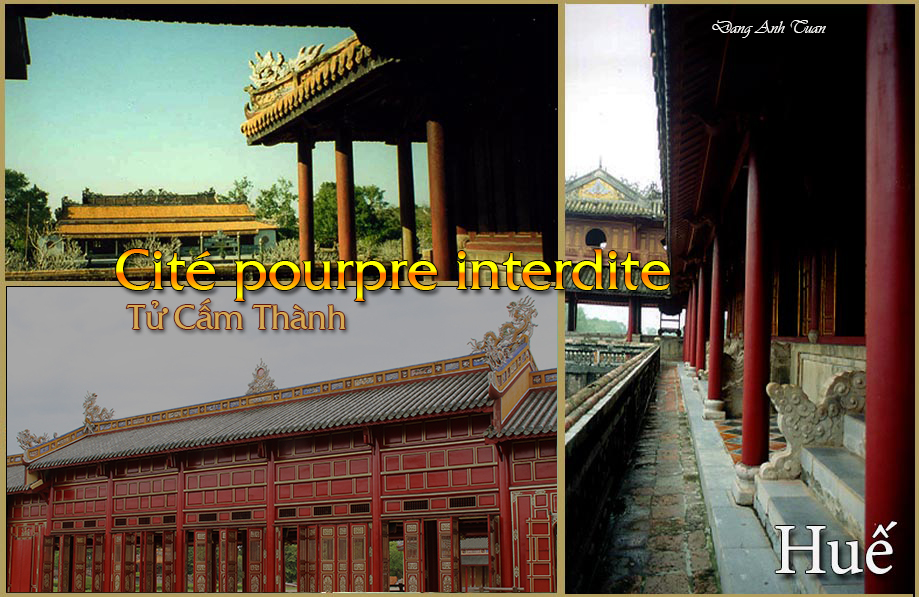
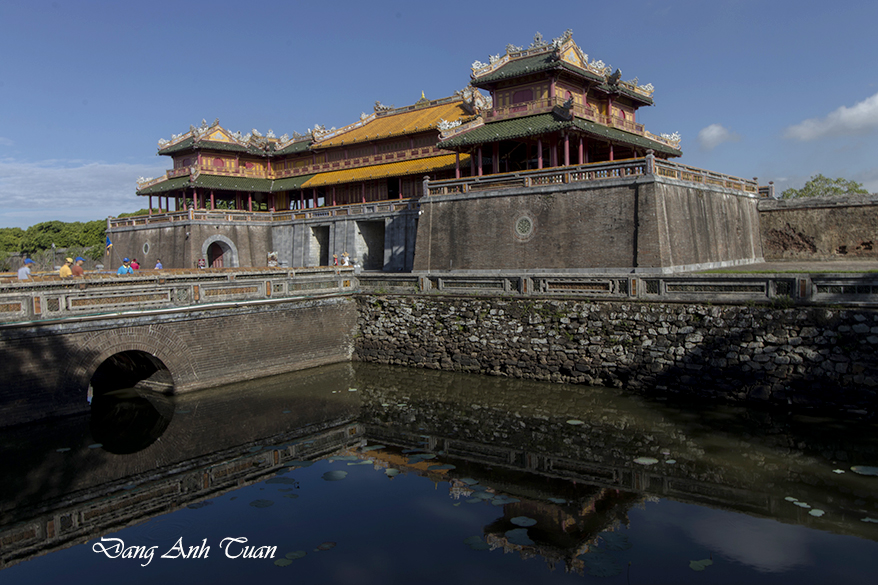
The Forbidden Purple City of Hue is protected by a 4-meter-high brick wall. This wall is further reinforced by the installation of a water-filled moat system, thus encircling the city. Each gate leading into the city is preceded by one or more bridges, but the Meridian Gate remains the main entrance, once reserved for the king. Today, it is the main entrance for visitors.

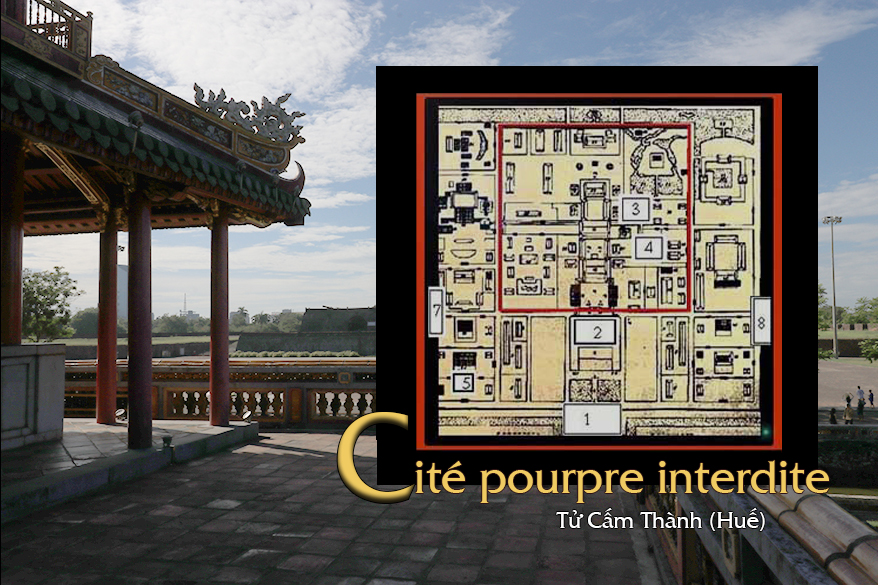
It is a powerful masonry structure pierced by five passages and topped by an elegant two-story wooden structure, the Five Phoenix Belvedere (Lầu Ngũ Phụng). To the east and west of the citadel are the Chương Đức Gate (7) and the Hiển Nhơn Gate (8), which are very well decorated and each pierced by three passages. The Hiển Nhơn Gate was completely restored in 1977.

World cultural Heritage of Viet Nam

Once you pass through the Meridian Gate, you see the sumptuous Palace of Supreme Harmony or Throne Palace, which can be reached by crossing the Esplanade of Great Salutations (Sân Ðại Triều Nghi). It was in this palace that the emperor, seated on the throne in a prestigious symbolic position, received the greeting of all the dignitaries of the empire. They were lined up hierarchically on the esplanade for major ceremonies. It is also the only building that has remained relatively intact after so many years of war. Behind this palace is the private residence of the king and his family.


  • 1 Gate of the Midday (Ngọ Môn)
  • 2 Palace of the Supreme Harmony. ( Điễn Thái Hòa)
  • 3 Belvedere of the Lecture or Pavilion of the Archives (Thái Bình Ngự Lâm Thư Lâu)
  • 4 Royal Theatre (Duyệt Thị Đường)
  • 5 Splendour Pavilion (Hiên Lâm Các)
  • 7 Gate of the Vertu (Chương Đức Môn)
  • 8 Gate of the Humanity (Hiển Nhơn Môn)

Từ bao giờ có khu 36 phố phường ở Hà Nội?

Từ bao giờ có khu 36 phố phường ở Hà Nội?
Depuis quand il y a le quartier des 36 rues et corporations  à Hanoï?

Version française 
Version anglaise
Galerie des photos

Thăng Long được xuất phát từ làng Long Đỗ. Từ thế kỷ  thứ năm, vua Lý Nam Đế đã xây ở  đây « mộc thành» của nước Vạn Xuân. Nhà Đường, sau khi xâm chiếm nước ta lấy nơi nầy làm trị sở trên đất Long Đỗ và đổi tên nó ra Tống Bình.

Lý Công Uẩn dưới sự giúp đở của sư Vạn Hạnh nhận ra tiềm năng của vùng đất nầy vì nó là điểm giao nhau của các trục đường bộ và đường sông trong việc vận chuyễn hàng hóa. Vã lại nó còn  đáp ứng cho việc cân bằng  giữa các yếu tố  nước và đất hay là giữa dòng khí tốt (Rồng xanh) và dòng khí xấu (hổ trắng)   trong phong thủy mà được tướng nhà Đường Cao Biền  du nhập vào nước ta. Tục truyền Cao Biền dùng bùa phép yểm trấn thành Đại La nhưng nhờ thần Bạch Mã  trợ  giúp mà Lý Thái Tổ thành công trong  việc xây thành Thăng Long trên nền móng cũ của  thành Đại La. Đền thờ Bạch Mã vẫn  còn ngày nay ở phố Buồm (Rue des voiles). Vì vậy vào mùa thu 1010, Lý Công Uẩn mới ra quyết định dời đô từ Hoa Lư về vùng đất « Rồng cuộn, hổ ngồi ». Ngài muốn chọn một nơi để phát triển kinh tế  cho vận nước được lâu dài và tính kế lâu dài  cho con cháu được  muôn vạn thế hệ và muôn vật được phồn thịnh và phong phú.

Từ đó, ngài cần lập các công xưởng thủ công để sản xuất các hàng hóa mà triều đình cần dùng và tiêu thụ.  Không những các thợ thụ công giỏi đua nhau đến Thăng Long làm việc mà luôn cả các nông dân ở thôn quê vùng sông Hồng  lúc nhàn rỗi  cũng tham gia sản xuất các sản phẩm hàng thủ công bán cho các con buôn mà những người này họ mang về kinh thành bán lại để kiếm lời. Lúc đầu họ tụ hợp ở các phiên chợ  của bốn chợ lớn tại các cửa  ô kinh thành. Nhưng về sau vì các xưởng sản xuất của triều đình không thể cung ứng đủ nên khiến một số thương nhân dần dần tập trung tại khu phố  ở cửa Đông vì ở đây địa thế của chợ nầy rất thuận lợi cho việc chuyên chở hàng hóa bằng thuyền từ nông thôn ra kinh thành qua sông Hồng, Tô Lịch và các kênh. Phía trước mặt chợ  thời đó là đền Bạch Mã. Còn bên phải là sông Tô Lịch và thưở đó có cái cầu bắc ngang sông hiện nay đó là phố Hàng Đường. Bởi vậy ở thế kỉ 14 mới  có thành ngữ  « Kẻ Chợ » (những người của chợ) để nói đến khu phố tấp nập này. Chính  nơi nầy được gọi về sau là  khu 36 phố phường để bán các sản phẩm  thủ  công mà các làng nghề  xung quanh và ở nông thôn cung cấp. Các cửa hàng đều là những  nhà chòi dùng để làm cơ xưởng hay để buôn bán dọc theo phố (hay đường).

Tựa như các nhà ở đồng quê, các cửa hàng nầy được dựng lên bằng gỗ, tre, mái rơm và tường trét bùn. Nhà nào cũng có chum nước để ở trên mái  khi có hỏa họan  thì kéo đổ xuống mái. Quá sợ hỏa hoạn, người dân lập đền Hỏa Thần (nay nó nằm ở Hàng Điếu) để ngày rằm cầu xin thần lửa đừng gây cháy.  Kẻ Chợ dần dần thoát khỏi sự phụ thuộc vào kinh thành từ thế 17 dưới sự ngự trị của các chúa Trịnh nhờ có một  loạt nghị quyết như giảm thuế, thống nhất hệ thống tiền bạc và xây dựng nhiều công trình đô thị lớn dẫn đến sự phát triển đáng kể. Các thủ công nhà buôn từ các làng nghề đổ xô về cư ngụ lâu dài ở thành phố và các nhà con buôn nước ngoài  thì bắt đầu lập chi nhánh tại kinh thành khiến làm nền kinh tế nó rất sôi động hơn. Nhờ đó mà kinh thành trở nên trung tâm buôn bán lớn nhất của miền bắc Việt Nam.

Các thợ  thủ công và các thương nhân cùng một làng quê gốc tập hợp thành các phương hội rồi cùng nhau  chuyên sản xuất hay  bán ở phường. Để kiếm hàng cần mua thì chỉ cần đến phường mà trước lối cổng vào thì có một tấm bảng ghi rõ chất  lượng và loại hàng được bán.Thời kỳ này chữ phố cũng chưa được dùng. Theo nhà văn Nguyễn Ngọc Tiến thì chữ phố vẫn được dùng với nghĩa là bến sông. Bởi vậy mới có câu « Gác mái ngư ông về viễn phố » (nhớ về bến xa)  trong bài thơ « Chiều hôm nhớ nhà » của bà Huyện Thanh Quan.Theo nhà sử học Pháp Philippe Papin, thì chữ phố được sử dụng vào năm 1851 ở huyện Thọ Xuyên và Vĩnh Thuân nên mới có chức trưởng phố  trong  quyến sách mang tựa đề là  « Lịch sử Hà Nội ». Còn trong sách Đại Nam nhất thống chí thì có chép như sau: Hà Nội là kinh đô xưa, nguyên trước có 36 phố phường …. Còn trong cuốn « Chuyến đi thăm Bắc Kỳ năm Ất Hợi  (1876) của học giả Trương Vĩnh Ký thì ông có kể ra 21 phố gồm có: Hàng Buồm, phố nầy cũng là phố Khách Trú có nhiều tiệm thuốc bắc, nhiều hàng cao lâu, Hàng Quảng Đông (Hàng Ngang hiện nay) nơi nầy cũng toàn  người khách trú ở, Hàng Mã thì gắn liền với nghề sản xuất, buôn bán đồ giấy, đồ vàng mã cúng lễ, ma chay vân vân… Như vậy chữ phố có thể ra đời từ đầu thời vua Tự Đức.

Các thợ kim hoàn xuất phát từ làng Châu Khê thì định cư ở phố Hàng Bạc. Còn thợ tiện gỗ đến từ làng Nhị Kê thì ở phố Tô Tịch vân vân…Họ luôn luôn giữ liên lạc với ngôi làng gốc của họ ở nông thôn trong việc tuyển nhân công, cung ứng nguyên liệu, ghi tên vào gia phả của làng, tham gia mỗi năm và các ngày hội của làng.


Các làng ở nông thôn trở thành các nơi cung cấp không những cho làng phố  đô thị các sản phẩm đạt trình độ kỹ thuật cao mà còn luôn cả nông phẩm cho kinh thành. Có thể nói các làng ở nông thôn và các làng phố ở kinh thành phụ thuộc lẫn nhau. Chính nhờ thế tình thần đoàn kết giữa các làng phố đô thị và các làng ở nông thôn càng chặt chẽ hơn nữa. Mỗi làng phố  đô thị được xây dựng dọc theo phố hay một đoạn của phố và lệ thuộc một hay nhiều làng cùng làm một nghề thủ công. Thời đó đăc điểm của làng phố là ở mỗi đầu của làng phố là có cổng ra vào. Các cổng nầy đều đóng lại lúc về đêm. Mỗi làng phố còn có một  bộ máy hành chánh riêng biệt cũng như có một trưởng phố, một  ngôi đình riêng tư nhầm để thờ các ông tổ của nghề hay là  các thần hoàng của các làng gốc ở nông thôn.  Dưới thời Pháp thuộc, để tránh hỏa hoạn thì chính quyền Pháp mới ra chỉ thị xây dựng lại thành phố qua  các công trình kiến trúc  kiên cố với các  ngôi nhà  hình ống mà  chúng ta được thấy ngày nay ở phố cổ Hà Nội mà họ còn  lấp đi nhiều ao hồ như hồ Hàng Đào, hồ Mã Cảnh, hồ Hàng Chuối, hồ Liên Trì vân vân…  Năm 1894, Pháp lấp đọan đầu sông Tô Lịch để xây chợ Đồng Xuân. Họ lại phá tường thành Hà Nội và các cửa thành. Nay chĩ còn duy nhất Ô Quan Chưởng hay (Ô cửa Đông) còn khúc sông Tô Lịch dưới chân thành cũng bị lấp đi.  Giờ  đây nhiều phố  chỉ còn tên mà thôi như phố Hàng Bè chớ cát bồi đưa sông ra xa nên bè mảng không còn vào được sát chân đê nữa. Như vậy đâu  còn bè mà cũng không còn chợ cái bè trên đê nữa. 

Còn các nhà hình ống nầy mang đậm phong cách phương tây nhất là mặt tiền với ban công, lô gia, hiên nhà vân vân. Còn vật liệu xây dựng thì gồm có xi măng, cốt thép, bê tông, kính vân vân … Tuy nhiên theo sử gia Pháp Philippe Papin thì các nhà ống ở Hànội là ảnh hưởng của cộng đồng người Hoa. Luận chứng nầy  không hẳn là sai nếu có  dịp đến tham quan các nhà cổ  của  người Hoa ở  Hội  An.  Nhưng theo nhà văn Nguyễn Ngọc Tiến thì  dưới thời vua Minh Mạng,  đánh thuế  cửa hàng không  căn cứ  nhà đó  buôn to hay nhỏ  hay chiều sâu mà chỉ  đo mặt tiền.  Mặt tiền rộng đóng thuế  cao, hẹp thì  thuế  ít. Vì vậy mặt tiền rộng hay thường chia ra nhiều cửa hàng. Đôi khi con trai lập gia đình và không có điều kiện mua chỗ buộc cha mẹ phải nhường một phần cửa hàng nên mới có  sự  hình thành nhà ống.  Các nhà ống tuy mặt tiền rất eo hẹp nhưng có  thể có chiều dài lên đến 60 thước. Loại nhà nầy thường có ba phần: phiá trước dùng để buôn bán hay cơ xưởng  còn ở  giữa  hay thường  có  cái sân, nơi có một nhà nhỏ xây vòm cuống giống một cái lò cao 1,8 thước để chứa các đồ  qúi giá  phòng khi cháy chớ nếu không mất trắng tay và phần cuối thì để ở.

Trong quyển sách  được mang tên là « Miêu tả về vương quốc Bắc Kỳ », ông Samuel Baron, một thương gia người Anh có nhắc đến phố cổ qua một số tài liệu hình ảnh và những gì ông  mô tả  thật thú vị. Tuy rằng nhỏ hẹp so với diện tích của Việt Nam, khu phố cổ Hà Nội nó là minh chứng tiêu biểu của  nền văn hóa thương mại và đô thị của người dân Việt qua nhiều thế kỷ. Đây là một kiểu mẫu mà cần thiết phải biết tường tận để hiểu rõ  được cái cấu trúc truyền thống của đô thị trong thế giới làng mạc của người  dân Việt.


Version française

Thăng Long était issue  du village de Long Đỗ. Dès le Vème siècle, le roi  Lý Nam Đế construisit ici la « citadelle en bois » du royaume de Vạn Xuân. Après avoir envahi notre pays, la dynastie des Tang a pris cet endroit comme le quartier général de son armée sur les terres de  Long Đỗ et a changé son nom en Tống Binh. Lý Công Uẩn aidé par le  moine Van Hanh, a  trouvé l’énorme  potentiel de cet endroit  car il était à  l’intersection des routes et des voies fluviales pour faciliter le transport de marchandises. De plus, il a  répondu  également à l’équilibre et l’harmonie  entre les éléments Eau et Terre ou bien  entre le souffle  bienfaisant  (Dragon vert) et le souffle malfaisant (Tigre blanc) dans la géomancie  introduite dans notre pays par le général Tang Gao Pian. La légende racontait  qu’il  se servit des sortilèges pour protéger la citadelle de Đại La, mais grâce à l’aide  apportée par le génie  « métamorphosé en Cheval Blanc », Lý Thái Tổ réussit à édifier  la citadelle de Thăng Long sur les anciennes fondations de la citadelle de Đại La. Le temple dédié au culte du Cheval Blanc  existe encore aujourd’hui  dans la rue des voiles (Phố Buồm). C’était pourquoi à l’automne 1010, Lý Thái Tổ vint de décider le transfert de la capitale, de Hoa Lư à la région où le dragon s’enroulait et le tigre était assis. Il voulait choisir un endroit pour développer l’économie à long terme et prévoir un avenir radieux avec prospérité et abondance pour dix mille  générations futures. 

Il dut créer  dès lors des usines artisanales pour produire les marchandises dont la cour royale avait besoin pour la consommation.  Il y avait non seulement des artisans talentueux  se précipitant à  travailler à Thăng Long, mais aussi des agriculteurs vivant dans les campagnes de la région du fleuve Rouge. Ces derniers,  durant leur temps libre, ont également participé à la production de produits artisanaux destinés à être vendus aux intermédiaires  qui les ont ramenés dans la capitale pour les revendre dans le but de gagner de l’argent. Dans un premier temps, ils s’étaient rassemblés aux quatre grands marchés se trouvant tout près des  portes de la capitale. Mais comme les usines royales ne pouvaient pas approvisionner suffisamment les  produits, ils  s’étaient  progressivement regroupés  dans le quartier de la Porte Est car le terrain d’ici  était très propice au transport fluvial des marchandises  de la campagne vers la capitale en passant par le fleuve Rouge jusqu’à Tô Lich et les canaux.

À cette époque, devant le marché se trouvait le temple du Cheval Blanc (Bạch Mã). Sur sa droite il y avait la rivière Tô Lich et  un pont, le tout devenant aujourd’hui la rue  du sucre (Hàng Đường). C’était  pourquoi au 14ème siècle l’expression « Kẻ Chợ »  (ou les gens du marché) était employé  pour désigner ce quartier animé. C’était cet endroit qui devenait  plus tard  le  quartier de 36 rues et corporations  destiné à vendre tous les produits artisanaux fournis par les villages artisanaux et ruraux  aux alentours.  Les magasins  étaient entièrement  des huttes utilisées comme des ateliers de fabrication  ou des lieux pour faire du commerce tout le long de la rue.

Analogues à des maisons de campagne, ces magasins étaient  construits en bois et en bambou, avec des toits de paille et des murs enduits de boue. Chaque maison possédait  une jarre d’eau sur le toit qui, en cas d’incendie, pouvait  être renversée  sur le toit pour éteindre le feu. Étant effrayés par le feu, les gens ont décidé de construire  un temple  destiné au génie du feu (situé aujourd’hui dans la rue des pipes) pour lui demander de ne pas provoquer d’incendie tout le 15ème  jour du mois lunaire.  Kẻ  Chợ s’’était  progressivement échappé de la dépendance de la capitale depuis le XVIIème siècle sous le règne des seigneurs Trinh grâce à une série de résolutions telles que la réduction des impôts, l’unification du système monétaire et la réalisation de nombreux  projets urbains conduisant à un développement important. Les artisans  commerçants  des villages artisanaux affluèrent vers la capitale pour y vivre de manière permanente et les commerçants étrangers commencèrent à ouvrir aussi des succursales dans la capitale, ce qui rendait  l’économie plus dynamique. Grâce à cela, la capitale était  devenue ainsi  le plus grand centre commercial dans le  nord du Vietnam.

Les artisans et les commerçants d’un même village se regroupaient en corporations et se spécialisaient ensemble dans la production ou la vente dans le quartier. Pour trouver les produits dont vous avez besoin,  il vous suffit de vous rendre au quartier dont le portail d’entrée porte un panneau indiquant clairement la qualité et le type de produits vendus. Durant cette période, le mot rue n’était pas utilisé. Selon l’écrivain Nguyễn Ngoc Tiến, le mot rue était encore employé  pour désigner le quai fluvial. C’est pourquoi il y a la phrase « En déposant la rame, le pêcheur  se dépêche de retourner à la rive lointaine » dans le poème «L’après-midi  teinté de nostalgie» de Mme Huyện Thanh Quan. Selon l’historien français Philippe Papin, le mot « rue » était utilisé en 1851 dans les districts de Thọ Xuyên et Vĩnh Thuận. C’est pour cela que  le poste du chef de la rue est apparu  dans son  livre intitulé « Histoire de Hanoi ».

Dans le livre intitulé  Đai Nam Nhất Thống Chí (Géographie du Viet Nam), il est écrit ainsi: Hanoï était l’ancienne capitale, elle comptait à l’origine 36 rues etc. Dans le livre « Un voyage au Tonkin de  l’année du cochon en bois (1876) » de l’érudit Trương Vĩnh Ký, il a répertorié 21 rues dont: Hàng Buồm (Rue des voiles). Cette rue étant aussi la rue des immigrants chinois  avec de nombreux magasins de médecine traditionnelle et des restaurants chinois , Hàng Quảng Đông  c’était la rue des Cantonnais à l’époque française (rue Hang Ngang d’aujourd’hui), Hàng Mã  (Rue du cuivre à l’époque française) était  associée à la production et au commerce de papiers votifs, des objets de funérailles, etc. Le mot rue pourrait donc être né dès le début du règne du roi Tự Đức.

Les bijoutiers venus du village de Châu Khê s’étaient installés dans la rue des changeurs (Hàng Bạc). Quant aux tourneurs sur bois du village de Nhi Kê, ils habitaient dans la rue Tô Tịch et ainsi de suite… Ils gardaient toujours le contact avec leur village d’origine à la campagne en recrutant des ouvriers, en fournissant du matériel, en inscrivant leurs noms dans la généalogie du village et en participant chaque année aux fêtes villageoises.

Les villages ruraux étaient  devenus ainsi  des lieux qui approvisionnaient non seulement les villages urbains en produits de haute technologie mais aussi en produits agricoles pour la capitale. On peut dire que les villages de la campagne et les villages de la capitale dépendaient les uns des autres. Grâce à  cette interdépendance, l’esprit de solidarité entre les villages urbains et les villages ruraux était encore plus serré. Chaque village urbain était construit le long d’une rue ou d’un tronçon de rue et dépendait d’un ou plusieurs villages exerçant le même métier.

A cette époque, la particularité du village résidait sur le fait qu’à chaque extrémité du village il y avait toujours un portail d’entrée qui était fermé durant la nuit. Chaque village disposait  également d’un appareil administratif distinct ayant un chef de village, une maison communale dédiée  au culte des ancêtres du métier ou  des génies du village dont les gens étaient issus. 

Durant la période coloniale française, afin d’éviter les incendies, le gouvernement français prit la décision de réorganiser la ville au moyen des travaux architecturaux avec des maisons tubulaires que l’on voit aujourd’hui dans la vieille ville de Hanoï, mais il fit disparaître également  de nombreux étangs et lacs comme le lac Hàng Đào, lac Mã Cảnh, lac Hàng Chuối, lac Liên Trì  etc. pour construire les maisons et les bâtiments publics. En 1894, les Français ont asséché la partie supérieure de la rivière Tô Lich pour construire le marché de  Đồng Xuân. Ils ont de nouveau détruit les murs de la citadelle de Hanoi et ses portes. Il ne restait désormais que la porte Quan Chưởng  (porte  de l’Est) et la rivière Tô Lich en contrebas de la citadelle a également été comblée de sable et d’alluvions. À présent, de nombreuses rues n’ont plus que leur nom, comme la rue Hàng Bè (rue des radeaux), car le sable a repoussé la rivière plus loin, de sorte que les radeaux ne peuvent plus s’approcher du pied de la digue. Donc il n’y a plus de radeau. Alors  il n’y a non plus de marché des radeaux sur la digue.

Quant aux maisons tubulaires, on les voit mettre en valeur le style occidental, notamment leur  façade avec balcon, loggia, porche etc. Les matériaux de construction comprennent le ciment, les barres d’armature, le béton, le verre etc. Cependant, selon l’historien français Philippe Papin, les maisons tubulaires de Hanoï sont influencées par la communauté chinoise. Cet argument n’est pas forcément faux si on a l’occasion de visiter les anciennes maisons des Chinois à Hội An. Mais selon l’écrivain Nguyễn Ngoc Tiến, sous le règne du  roi Minh Mang, l’impôt sur les magasins n’était pas basé sur la taille ou la profondeur du magasin, mais uniquement sur la façade. Le propriétaire d’un magasin  ayant une façade relativement large doit payer une taxe plus élevée par rapport à celui possédant une  petite façade. On a intérêt de diviser  la grande façade en plusieurs petites façades donc en plusieurs boutiques. Parfois, un fils  qui se marie et n’a pas les moyens d’acheter un nouveau logement est obligé de demander à ses parents de céder une partie de leur boutique, ce qui donne naissance à la création des maisons tubulaires. Bien que celles-ci aient des façades très étroites, elles peuvent avoir une longueur allant jusqu’à 60 mètres.

Ce type de maison comporte généralement trois parties: le devant avec sa façade est réservé au commerce ou à l’atelier tandis qu’au milieu se trouve généralement  une  petite cour où on édifie  une petite maison avec un dôme  ressemblant à un four de 1,8 mètre de haut pour garder des objets de valeur en cas d’incendie  et le derrière  du magasin est destiné à l’habitation.

Dans son livre intitulé « Une description du royaume de Tonkin », le commerçant anglais Samuel Baron en a parlé avec ses illustrations et ses descriptions intéressantes. 
Malgré sa taille insignifiante par rapport à celle du Vietnam, le vieux quartier de Hanoï témoigne incontestablement de la culture commerciale et urbaine des Vietnamiens au fil de plusieurs siècles. C’est un modèle dont on a besoin pour connaître d’une manière approfondie la structure traditionnelle de la « ville » dans le monde rural des Vietnamiens.

English version

Thăng Long originated from the village of Long Đỗ. As early as the 5th century, King Lý Nam Đế built here the « wooden citadel » of the kingdom of Vạn Xuân. After invading our country, the Tang dynasty took this place as the headquarters of their army on the lands of Long Đỗ and renamed it Tống Binh. Lý Công Uẩn, aided by the monk Van Hanh, discovered the enormous potential of this place because it was at the intersection of roads and waterways, facilitating the transport of goods. Moreover, it also met the balance and harmony between the elements of Water and Earth, or between the beneficial breath (Green Dragon) and the harmful breath (White Tiger) in geomancy introduced to our country by General Tang Gao Pian. Legend has it that he used spells to protect the Đại La citadel, but thanks to the help provided by the spirit « transformed into the White Horse, » Lý Thái Tổ succeeded in building the Thăng Long citadel on the old foundations of the Đại La citadel. The temple dedicated to the worship of the White Horse still exists today on Sail Street (Phố Buồm). That is why, in the autumn of 1010, Lý Thái Tổ decided to transfer the capital from Hoa Lư to the region where the dragon curled and the tiger sat. He wanted to choose a place to develop the economy long-term and foresee a bright future with prosperity and abundance for ten thousand future generations.

He then had to create artisanal factories to produce the goods that the royal court needed for consumption. There were not only talented artisans rushing to work in Thăng Long, but also farmers living in the countryside of the Red River region. The latter, during their free time, also participated in the production of handicrafts intended to be sold to intermediaries who brought them back to the capital to resell in order to make money. At first, they gathered at the four main markets located near the gates of the capital. But since the royal factories could not supply enough products, they gradually regrouped in the East Gate neighborhood because the land there was very suitable for the river transport of goods from the countryside to the capital via the Red River to Tô Lich and the canals.

At that time, in front of the market was the White Horse Temple (Bạch Mã). To its right was the Tô Lich river and a bridge, all of which today is Sugar Street (Hàng Đường). That is why in the 14th century the expression « Kẻ Chợ » (or the market people) was used to designate this lively neighborhood.It was this place that later became the district of 36 streets and guilds, intended to sell all the handcrafted products supplied by the nearby artisanal and rural villages. The shops were entirely huts used as workshops or places for trade along the street.

Similar to country houses, these shops were built of wood and bamboo, with thatched roofs and mud-plastered walls. Each house had a water jar on the roof which, in case of fire, could be overturned onto the roof to extinguish the flames. Being afraid of fire, people decided to build a temple dedicated to the fire spirit (located today on Pipe Street) to ask it not to cause any fires on the 15th day of the lunar month. Kẻ Chợ gradually escaped dependence on the capital since the 17th century under the reign of the Trinh lords thanks to a series of resolutions such as tax reduction, monetary system unification, and the completion of many urban projects leading to significant development. Artisanal merchants from the craft villages flocked to the capital to live there permanently, and foreign traders also began opening branches in the capital, making the economy more dynamic. Thanks to this, the capital had thus become the largest commercial center in northern Vietnam.

Artisans and merchants from the same village would group together into guilds and specialize collectively in production or sales within the neighborhood. To find the products you need, you just have to go to the neighborhood whose entrance gate bears a sign clearly indicating the quality and type of products sold. During this period, the word « street » was not used. According to the writer Nguyễn Ngọc Tiến, the word « street » was still used to refer to the river quay. That is why there is the phrase « Upon laying down the oar, the fisherman hurries back to the distant shore » in the poem « Afternoon tinged with nostalgia » by Mrs. Huyện Thanh Quan. According to the French historian Philippe Papin, the word « street » was used in 1851 in the districts of Thọ Xuyên and Vĩnh Thuận. That is why the position of street chief appeared in his book entitled « History of Hanoi. »

In the book entitled Đai Nam Nhất Thống Chí (Geography of Vietnam), it is written as follows: Hanoi was the ancient capital, originally comprising 36 streets, etc. In the book « A Journey to Tonkin in the Year of the Wooden Pig (1876) » by the scholar Trương Vĩnh Ký, he listed 21 streets including: Hàng Buồm (Sail Street). This street was also the street of Chinese immigrants with many traditional medicine shops and Chinese restaurants. Hàng Quảng Đông was the street of the Cantonese during the French era (today’s Hang Ngang street). Hàng Mã (Copper Street during the French era) was associated with the production and trade of votive papers, funeral objects, etc. The word « street » could therefore have originated at the beginning of King Tự Đức‘s reign.

Jewelers from the village of Châu Khê had settled in the money changers’ street (Hàng Bạc). As for the woodturners from the village of Nhi Kê, they lived on Tô Tịch street, and so on… They always maintained contact with their native village in the countryside by recruiting workers, supplying materials, registering their names in the village genealogy, and participating each year in village festivals.

The rural villages thus became places that supplied not only the urban villages with high-tech products but also agricultural products for the capital. It can be said that the countryside villages and the capital’s villages depended on each other. Thanks to this interdependence, the spirit of solidarity between urban and rural villages was even stronger. Each urban village was built along a street or a section of a street and depended on one or more villages practicing the same trade. At that time, the uniqueness of the village lay in the fact that at each end of the village there was always an entrance gate that was closed at night. Each village also had a distinct administrative body with a village chief, a communal house dedicated to the worship of the ancestors of the trade or the village spirits from which the people originated.

During the French colonial period, to prevent fires, the French government decided to reorganize the city through architectural works with tubular houses that can still be seen today in the old town of Hanoi. However, they also caused the disappearance of many ponds and lakes such as Hang Dao Lake, Ma Canh Lake, Hang Chuoi Lake, Lien Tri Lake, etc., to build houses and public buildings. In 1894, the French drained the upper part of the To Lich River to build the Dong Xuan Market. They again destroyed the walls of the Hanoi citadel and its gates. Only the Quan Chuong Gate (the East Gate) remained, and the To Lich River below the citadel was also filled with sand and sediment. Now, many streets exist only in name, such as Hang Bè Street (Raft Street), because the sand pushed the river further away, so rafts can no longer approach the foot of the embankment. Therefore, there are no more rafts. Consequently, there is no longer a raft market on the embankment.

As for the tube houses, they are seen to highlight the Western style, particularly their façade with balcony, loggia, porch, etc. The construction materials include cement, reinforcing bars, concrete, glass, etc. However, according to the French historian Philippe Papin, the tube houses of Hanoi are influenced by the Chinese community. This argument is not necessarily false if one has the opportunity to visit the old Chinese houses in Hội An. But according to the writer Nguyễn Ngoc Tiến, under the reign of King Minh Mang, the tax on shops was not based on the size or depth of the shop, but only on the façade. The owner of a shop with a relatively wide façade had to pay a higher tax compared to one with a small façade. It was advantageous to divide the large façade into several small façades, thus into several shops. Sometimes, a son who got married and could not afford to buy a new home was forced to ask his parents to give up part of their shop, which led to the creation of tube houses. Although these have very narrow façades, they can be up to 60 meters long.

This type of house generally consists of three parts: the front with its facade is reserved for commerce or the workshop, while in the middle there is usually a small courtyard where a small house with a dome resembling a 1.8-meter-high oven is built to keep valuables safe in case of fire, and the back of the shop is intended for living quarters.

In his book titled « A Description of the Kingdom of Tonkin, » the English merchant Samuel Baron spoke about it with his illustrations and interesting descriptions. Despite its insignificant size compared to that of Vietnam, the old quarter of Hanoi unquestionably bears witness to the commercial and urban culture of the Vietnamese over several centuries. It is a model needed to gain a deep understanding of the traditional structure of the « city » in the rural world of the Vietnamese.

Galerie des photos

VILLAGE_URBAIN

[Return HANOÏ]

Bibliographie:

Nguyễn Bá  Chính : Hà Nôi Chỉ Nam. Guide de Hanoï. Nhà xuất  bản Nhã Nam, Hà Nội.
Philippe Papin : Histoire de Hanoï. Editeur Fayard.
Hữu Ngọc: Hà Nội của tôi. Nhà xuất bản Văn Học.
Nguyễn Ngọc Tiến: Làng Làng Phố Phố Hà Nội. Nhà xuất bản hội nhà văn.

Đình Minh Hương Gia Thạnh (Chợ Lớn, Saigon)

Temple Minh Hương Gia Thạnh 

Version française
Version anglaise
Galerie des photos

Tọa lạc ở số 380 đường Trần Hưng Đạọ (Saïgon) , đình Minh Hương Gia Thạnh được công nhận là di tích kiến trúc nghệ thuật bởi bộ Văn Hóa.  Đình nầy được coi xem là có lâu đời nhất  ờ vùng Saïgon-Chợ lớn do người Minh Hương xây dựng từ năm 1789. Người Minh Hương là những Việt gốc Hoa mà tổ phụ của họ là người Hoa, thần dân của nhà Minh sang định cư ở Đàng Trong sau khi nhà Minh bị  sụp đổ, được chúa Nguyễn Phúc Tần cho phép hai vị tổng binh cựu thần của nhà Minh Dương Ngạn Địch và Trần Thượng Xuyên cư trú  ở miền nam tức là vùng đất của Chân Lạp cùng với 3000 binh sĩ và gia đình vào năm Kỷ Mùi (1679).  Dương Ngạn Địch  vào khai thác vùng Mỹ Tho còn Trần Thượng Xuyên thì vào khai khẩn vùng Biên Hoà (Cù Lao Phố), một vùng đất trù phú. Người ngoại quốc thường tới lui buôn bán ở nơi nầy. Trong thời kỳ chiến tranh giữa nhà Tây Sơn và Nguyễn Ánh, thì tất cả người Minh Hương đều đứng về phía chúa Nguyễn nên nhà Tây Sơn  tàn phá nhà  cửa của họ  vào năm 1776. Họ buộc lòng phải  lánh nạn  về  ở vùng đất Đề Ngạn xưa tức là Chợ  Lớn ngày nay. Đến năm kỷ dậu (1789)  dưới thời  Lê Mẫn Hoàng Đế  thì con cháu nhà Minh có quyền lập ra Minh Hương xã. Ban đầu chữ « hương » dùng chữ có nghĩa là « hương hỏa » (香火), đến năm 1827 đổi sang chữcó  nghĩa là « làng ». Như vậy Minh Hương có thể hiểu là « làng của người Hoa, thần dân của nhà Minh. Bởi vậy chúng ta cũng thường gọi họ là khách trú. Lúc đầu làng Minh Hương không có ranh định biên giới như các làng khác vì họ ở khắp mọi nơi của vùng đất mới. Người Minh Hương khỏi đi lính và khỏi đi làm xâu.  Nếu họ phạm phép  thì Minh Hương xã phân xử. Mặc dầu có đặc quyền như vậy, Minh Hương xã rất nghiêm ngặt trừng trị và  lo lắng  dạy dỗ con cháu họ. Bởi vậy họ sống rất hoà đồng với người dân Việt khiến  mới có câu ca dao như sau:

Gỏi chi ngon bằng gỏi tôm càng
Đố ai lịch sự bằng làng Minh Hương.

Chính vua Tự Đức đã có sắc tặng cho làng Minh Hương  bốn chữ: Thiện Tục Khả Phong (Phong tục tốt đẹp cần giữ lưu truyền), khắc vô một tấm biển, nay treo trước căn giữa Chánh điện của đình. Theo giáo sư Lâm Vĩnh Thế  thì năm 1865, Thống Đốc Nam Kỳ lúc bấy giờ là Đô Đốc De La Grandière ban hành quyết định chấm dứt quy chế làng của Minh Hương Xã, viện lý do là Sài Gòn và Chợ Lớn là châu thành tức là  thủ phủ của tỉnh, làng Minh Hương không còn có lý do tồn  tại nữa.  Đình Minh Hương Gia Thạnh không phải là nhà làng nữa mà trở thành từ đó nhà hương hỏa chung của tất cả hội viên, của tất cả công dân Việt Nam gốc Hoa có hơn hai trăm năm nay vì họ nói tiếng Việt, mặc quốc phục  trong các dịp tế lễ, cho con cái học trường Việt và hành xử hoàn toàn như là một công dân Việt Nam. Trịnh Hoài ĐứcNgô Nhân Tịnh, hai người Minh Hương làm quan đến chức thượng thư.

Đình được xây cất  theo kiểu nhà năm gian. Mái đình lợp ngói ống, trang trí hình lưỡng long tranh châu, cá hóa long, tượng ông Nhật bà Nguyệt, phù điêu trích từ các tuồng tích Trung Quốc. Trên cột và các đà ngang treo nhiều hoành phi, câu đối, phần lớn được làm từ đầu và giữa thế kỷ 19. Tại đình vẫn còn lưu giữ  nhiều cổ vật quý giá nhất là  đình có giá trị về nghệ thuật thư pháp, nghệ thuật chạm khắc gỗ mang phong cách Việt nam. Nhờ sự giải thích của chị Vân,một thành viên của ban tri sự quản lý  đình hôm đến tham quan, mình  được chị giải thích  biết nhiều  về  các cổ  vật trưng bày  của đình. Thật thú vị và  cũng tiện đây có một lời cám ơn chị qua bài viết nầy.

Située au numéro 380 rue Tran Hung Dao (Saïgon), la Maison communale Minh Huong Gia Thanh est reconnue comme un monument architectural et artistique par le ministère de la Culture. Cette maison communale est considérée comme la plus ancienne de la région de Saïgon-Cholon, construite par les partisans de la dynastie des Ming  (ou Minh Hương) en 1789.

Les Minh Hương sont des Vietnamiens d’origine chinoise dont les ancêtres étaient des Chinois, sujets de la dynastie Ming qui s’étaient  réfugiés dans le sud après la chute de la dynastie Ming en Chine. Le seigneur Nguyễn Phúc Tần permit aux deux anciens généraux de la dynastie Ming, Dương Ngạn Địch et Trần Thượng Xuyên, de  trouver refuge dans le sud du Vietnam, l’ancien territoire du Chen La avec 3 000 soldats et leurs familles en l’année de la Chèvre (1679). Dương Ngạn Địch était allé exploiter la région de Mỹ Tho et  Trần Thượng Xuyên la région de Biên Hoà (Cù Lao Phố), un territoire riche et peuplé. Les étrangers le fréquentaient souvent pour y faire  des affaires. Durant la confrontation armée entre les Paysans de l’Ouest (Tây Sơn)  et Nguyễn Ánh, tous les Minh Hương s’étaient rangés du côté de ce dernier. Furieux, les Tây Sơn pillèrent leurs maisons en 1776. Les Minh Hương  étaient  obligés de se réfugier dans la région de Đề Ngạn (Cholon d’aujourd’hui). En 1789, sous le règne de l’empereur Lê Mẫn, les Minh Hương  obtinrent  le droit de fonder leur propre village.

Le mot « Hương » était initialement  écrit avec le pictogrammepour évoquer le culte des ancêtres (香火), mais il était remplacé ensuite  par le pictogramme  en 1827 pour signifier le village. Minh Hương  pouvait être compris ainsi comme  le village des sujets de la dynastie Ming. C’était pour cela on était habitué à les appeler « les résidents étrangers».

Au début, le village des Minh Hương n’était pas délimité par des frontières  comme les autres villages  grâce à leur possibilité de s’installer partout sur le nouveau territoire. Les Minh Hương  étaient exemptés du service militaire et ils n’étaient pas forcés de travailler gratuitement pour l’état. En cas de la violation de la  loi, ils seront punis par leur propre village. En dépit des privilèges qu’ils ont eus, les Minh Hương ne cessaient pas de respecter les lois avec sévérité et ils étaient toujours soucieux d’aider leurs enfants dans l’éducation. C’était pourquoi ils vivaient en harmonie avec les Vietnamiens, ce qui donnait naissance  à  la chanson populaire suivante :

Gỏi chi ngon bằng gỏi tôm càng
Đố ai lịch sự bằng làng Minh Hương.

Quelle salade peut-on trouver  aussi délicieuse comme celle de crevettes ?
Y a t-il quiconque plus poli que le village des Minh Hương ?

L’empereur Tự Đức  lui-même signa pour le  village des Minh Hương un décret comportant  quatre mots suivants: Thiện Tục Khả Phong (Les bonnes coutumes doivent être gardées et transmises), gravés sur une pancarte, désormais accrochée devant la salle principale de la maison communale. Selon le professeur Lâm Vĩnh Thế, en 1865, le gouverneur de la Cochinchine de l’époque, l’amiral De La Grandière, décida de mettre  fin au statut de la création du  village de Minh Hương Xã en prenant prétexte que Saigon-Cholon était la capitale de la province.  Le village des Minh Hương n’avait plus de raison d’exister. Mais il  était devenu dès lors la maison communale  dédiée au culte des ancêtres  pour tous ses membres et pour tous les citoyens vietnamiens d’origine chinoise depuis plus deux siècles car ils parlaient le vietnamien,  ils portaient des vêtements nationaux lors des cérémonies, ils envoyaient leurs enfants dans les écoles vietnamiennes et se comportaient entièrement  comme des citoyens vietnamiens. Trinh Hoài Đức  et Ngô Nhân Tịnh issus des  Minh Hương  étaient au poste de ministre.

La maison communale a été construite dans le style d’une maison à cinq compartiments. Son toit est recouvert de tuiles tubulaires, décoré d’un couple de dragons se disputant la perle enflammée, de poissons se transformant en dragons,  de génies de mariage et des tableaux en relief extraits des opéras chinois. Sur les colonnes et les poutres horizontales sont suspendus de nombreux panneaux horizontaux et des sentences parallèles dont la plupart ont été réalisés au début et au milieu du XIXème siècle.

La maison communale conserve encore de nombreuses antiquités, les plus précieuses étant l’art de la calligraphie et de la sculpture sur bois dans le  style vietnamien.  Grâce aux explications de Mme Vân, membre du comité de gestion  de cette association,  j’ai  beaucoup d’informations à savoir   sur les antiquités exposées.  Pour moi, c’est  très intéressant et  aussi  une opportunité  de lui rappeler ma gratitude à travers cet article.

Version anglaise

Located at number 380 Tran Hung Dao Street (Saigon), the Minh Huong Gia Thanh communal house is recognized as an architectural and artistic monument by the Ministry of Culture. This communal house is considered the oldest in the Saigon-Cholon region, built by supporters of the Ming dynasty (or Minh Hương) in 1789.

The Minh Hương are Vietnamese of Chinese origin whose ancestors were Chinese subjects of the Ming dynasty who took refuge in the south after the fall of the Ming dynasty in China. Lord Nguyễn Phúc Tần allowed two former generals of the Ming dynasty, Dương Ngạn Địch and Trần Thượng Xuyên, to find refuge in southern Vietnam, the former Chen La territory, with 3,000 soldiers and their families in the Year of the Goat (1679). Dương Ngạn Địch went to exploit the Mỹ Tho region, and Trần Thượng Xuyên the Biên Hoà region (Cù Lao Phố), a rich and populated territory. Foreigners often frequented it to conduct business. During the armed confrontation between the Tây Sơn peasants and Nguyễn Ánh, all the Minh Hương sided with the latter. Furious, the Tây Sơn pillaged their homes in 1776. The Minh Hương were forced to take refuge in the Đề Ngạn region (today’s Cholon). In 1789, under the reign of Emperor Lê Mẫn, the Minh Hương obtained the right to found their own village.

The word « Hương » was originally written with the pictogram to evoke the ancestor worship (香火), but it was later replaced by the pictogram in 1827 to signify the village. Minh Hương could thus be understood as the village of subjects of the Ming dynasty. That is why they were accustomed to being called « the foreign residents. »

At first, the Minh Hương village was not delimited by borders like other villages due to their ability to settle anywhere in the new territory. The Minh Hương were exempt from military service and were not forced to work for the state without pay. In case of law violations, they would be punished by their own village. Despite the privileges they had, the Minh Hương continuously respected the laws strictly and were always concerned with helping their children in education. That is why they lived in harmony with the Vietnamese, which gave rise to the following popular song:

Gỏi chi ngon bằng gỏi tôm càng
Đố ai lịch sự bằng làng Minh Hương.

What salad can be found as delicious as the shrimp salad?
Is there anyone more polite than the Minh Hương village?

Emperor Tự Đức himself signed a decree for the Minh Hương village containing the following four words: Thiện Tục Khả Phong (Good customs must be preserved and passed on), engraved on a plaque now hung in front of the main hall of the communal house. According to Professor Lâm Vĩnh Thế, in 1865, the governor of Cochinchina at the time, Admiral De La Grandière, decided to end the status of the creation of Minh Hương Xã village, using the pretext that Saigon-Cholon was the provincial capital. The Minh Hương village no longer had a reason to exist. But it then became the communal house dedicated to the ancestor worship for all its members and for all Vietnamese citizens of Chinese origin for more than two centuries because they spoke Vietnamese, wore national clothing during ceremonies, sent their children to Vietnamese schools, and behaved entirely like Vietnamese citizens. Trịnh Hoài Đức and Ngô Nhân Tịnh, who came from Minh Hương, held ministerial positions.

The communal house was built in the style of a five-compartment house. Its roof is covered with tubular tiles, decorated with a pair of dragons disputing the flaming pearl, fish transforming into dragons, marriage spirits, and relief panels taken from Chinese operas. On the columns and horizontal beams hang numerous horizontal panels and parallel sentences, most of which were made in the early and mid-19th century.

The communal house still preserves many antiques, the most precious being the art of calligraphy and wood carving in the Vietnamese style. Thanks to the explanations of Mrs. Vân, a member of the management committee of this association, I gained a lot of information about the antiques on display. For me, it is very interesting and also an opportunity to express my gratitude to her through this article.

Galerie des photos

GIA THANH

[Retour CHOLON ]

[Retour SAIGON]


Cascade Pa Sỹ (Măng Đen, Kon Tum)


Thác Pa Sỹ

Version française

Theo tiếng dân tộc Rơ Mâm, thác nầy  có nghĩa là 3 nguồn suối lớn nhất ở Măng Đen chụm lại thành một dòng nước nên được gọi là Pau Suh Thác được đọc chệch bởi dân  bản xứ nên  nên trở  thành Pa Sỹ. Đến đây phải ăn cơm lam gà nướng , rết ngon tuyệt vời. 

Selon la langue de l’ethnie Rơ Mâm, cette cascade signifie le point de rencontre  des trois plus grandes sources de M ăng Đen se rejoignant dans un cours d’eau. C’est pour cela qu’elle est appelée Pau Suh qui devient au fil des années Pa S ỹ à cause de la mauvaise prononciation des gens locaux. En venant ici, il faut manger du riz gluant dans un tronçon de bois avec le poulet grillé. C’est extrêmement délicieux.

Le lever du soleil ( Bình minh ở vịnh Lan Hạ)

LHB

[Return LAN HA]