Buffalo (Con trâu)


Version française
Galerie des photos

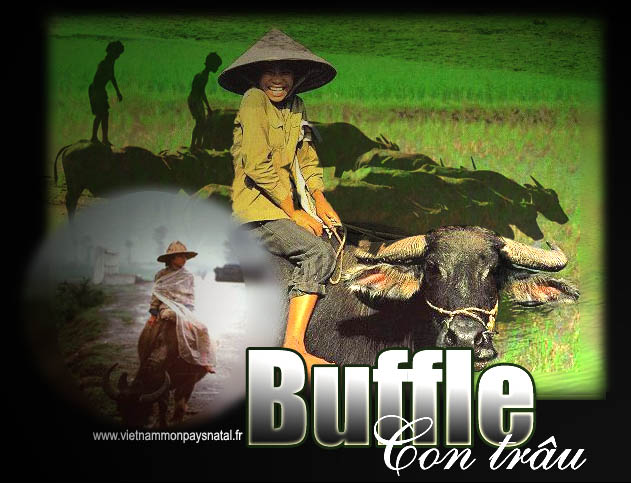
As Vietnam is an agricultural country, the buffalo is always regarded as a familiar animal for the Vietnamese people, in particular the peasants. The image of the buffalo is closely tied to the rural landscape of Vietnam. Like many other countries in the world, Vietnam has legends among which there is one concerning the buffalo.

Once upon a time, to help the Vietnamese peasants, God was assigned an angel to descend in Viet-Nam with two bags, one filled with cereal seeds to feed people and the other with grass seeds for the cattle. The angel was advised to sow the cereals seeds first, and grass seeds next. Being so absent minded, he forgot the recommendation by doing the opposite: grass seeds first, and cereal seeds next. That is why Viet-Nam was covered with so much grass and forests that the peasants had to make a complaint which echoed to Heaven. Furious, God condemned the angel to exile by turning him into a buffalo and sent him to Viet-Nam. That is why the buffalo was compelled to spend all day long munching grass and pulling the plough to pay for his errors.

The buffalo is a very useful animal in agricultural countries, in particular Vietnam where farming technologies are not very developed. In certain countries, if the dog is the best friend of man, then in Vietnam the buffalo is an inseparable companion of the farmer. Without this animal, the latter will be deprived of everything because it is the buffalo that helps the peasant to till the land everyday, to cart the burdens, to replace him in tiring and ungrateful tasks. This ruminant is also the animal that mountain and highland dwellers sacrifice when it comes to asking God for blessing harvest.

The buffalo is the Vietnamese peasants’ benefactor. This is why it is generally quoted in folk songs and proverbs. It is one of enriching subjects in the Vietnamese poetry. For the peasant, the buffalo forms part of his heritage. That is why the saying:

Ruộng sâu, trâu nái

The deep rice field, the standard buffalo

indicates a well to do person in the village.

Tậu trâu, lấy vợ, làm nhà
Trong ba việc đo’ trong là khó thay.

Purchasing a buffalo, looking for a wife, and building a home
Among these three jobs, none of them seems to be easy.

As it is the case of fish farming, the breeding of buffaloes is a mean to get rich quick. That is why it is customary to quote in folk songs the following words:

Muốn giàu thì nuôi trâu cái,
Muốn lụn bại thì nuôi bồ câu.

Want to become rich, buy female buffaloes.
Want to be in debts, breed pigeons.

To designate the buffalo, we usually use the word “ngưu (牛)” but this turns out to be incorrect. According to Vietnamese researcher Lại Nguyên Ân, This is a mistake that we should know about. The buffalo lives only in tropical regions. The buffalo is not found in northern China. It seems that this mammal only existed in Kouang Tong and Kouang Si when the Bai Yue territory was annexed by the Han. In ancient Chinese texts written by the Northern Chinese, the word “ngưu” is used to refer to an ox. As for the buffalo, in the Chinese dictionary it is referred to as “thủy ngưu (水牛)” because it is an ox that can swim well in water. That’s a fact worth knowing.

Trâu ơi ta bảo trâu này
Trâu ra ngoài ruộng trâu cày với ta.
Cầy cấy vốn nghiệp nông gia
Ta đây trâu đấy ai mà quản công.

O my buffalo, listen to what I tell you
You go to the rice field and plough with me;
Ploughing and transplanting is a ploughman’s trade
Here I am, here you are, who of us pities his pain.

or

Trên đồng cạn dưới đồng sâu,
Chồng bừa vợ cấy con trâu đi cày.

In the high and low rice fields,
The husband harrows, the wife transplants, the buffalo ploughs.

In the morning, the buffalo can be seen early in the rice field. In the evening, it is brought back to the hamlet by the herdsman after a hard day’s work. Vietnamese have occasion to recall the picture of rustic life in the countryside described by the famous poetess Huyện Thanh Quan (the sub-prefect of Thanh Quan (or Thái Bình of today)) in her poem entitled “Twilight Landscape (Cảnh chiều hôm)”:

Chiều trời bảng lảng bóng hoàng hôn
Tiếng ốc xa đưa lẫn trống đồn.
Gác mái ngư ông về viễn phố,
Gỏ sừng mục tử lại cô thôn……

Evening brings back the shadows of twilight under a pale sky;
The sound of the watchmen’s trumpets can be heard in the distance, answering the tam-tam of the guard post;
The old fisherman lays down his oar to return to his distant station;
The young herdsman beats his buffalo’s horns to return to his lonely hamlet….

In the history of Viet Nam, there are two illustrious characters who took on the role of herdsmen when they were young. Because of poverty, they were forced to spend their days herding buffalo despite being well educated. The first was Đinh Bộ Lĩnh. He had the merit of subduing the rebellions of the twelve local lords and unifying the country. He thus became the first emperor of an independent Vietnam after a thousand years of Chinese domination. The second was Đao Duy Từ. At one time, he fled to the south (Đàng Trong) to look after a herd of buffalo belonging to a wealthy man in the Tùng Châu region. Knowing that Đao Duy Từ was no ordinary character, this wealthy man recommended him to Trần Đức Hoà, the eminent advisor to Lord Nguyễn Phúc Nguyên. Finding in him the qualities of an educated and talented man, Trần Đức Hoà gave him his daughter in marriage and introduced him to the Nguyễn lord, Nguyễn Phúc Nguyên (or bonze lord). It was on his recommendation that the latter succeeded in building two fortresses “Trường Dục” and “Định Bắc Trường thành” along the river Nhật Lê we’re accustomed to calling “the Master’s fortress” at Đồng Hới (Quảng Bình) to withstand assaults from the armies of Lord Trịnh. He was the deserving mandarin of the Nguyễn dynasty and was still regarded by lord Nguyễn Phúc Nguyên as his “Venerated Master”.

In short, one finds through the image of the buffalo most of the image of Viet-Nam, our country. For the overseas Vietnamese, to find the buffalo is to find Vietnam. This animal, along with the bamboo, is one of the representative symbols of Viet-Nam.

The buffalo reflects at the same time the tender way of life and the unshakable resistance of the Vietnamese people.

Pictures gallery

[Return RELIGION]

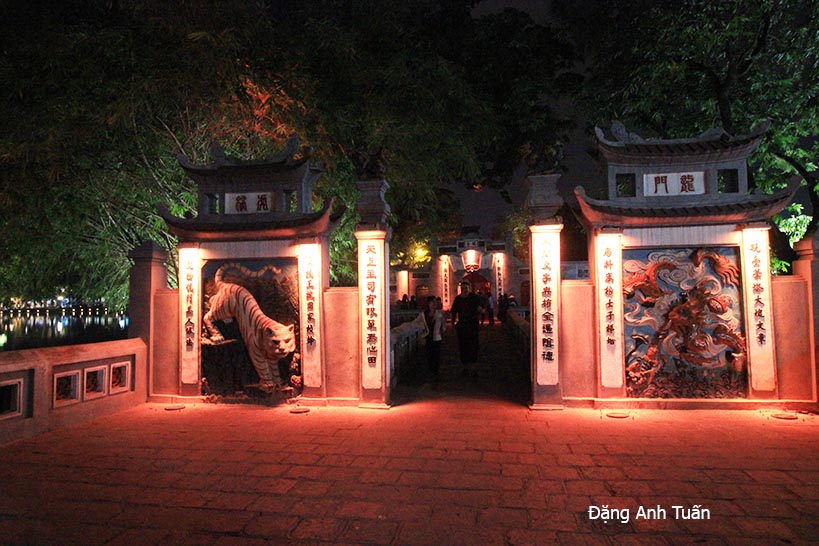
Temple Ngọc Sơn au fil de la nuit (Về đêm)


Le temple Ngọc Sơn au fil de la nuit.

Au cœur du vieux quartier Hồ Hoàn kiếm

Giữa khu phố cổ Hồ Hoàn Kiếm

Gươm rớt khí thiên ngời tựa nước
Văn hoà trời đất thọ tây non
Reflétant l’âme sacrée de la nation, l’épée miroite comme les ondes de la rive
En accord avec le Ciel et la Terre, les lettres perdurent avec l’âge des montagnes.

Gallery with ID 15 doesn't exist.

Tử Cấm Thành Bắc Kinh: phần 3

Version française

English version

[Tử Cấm Thành Bắc Kinh: phần 3]

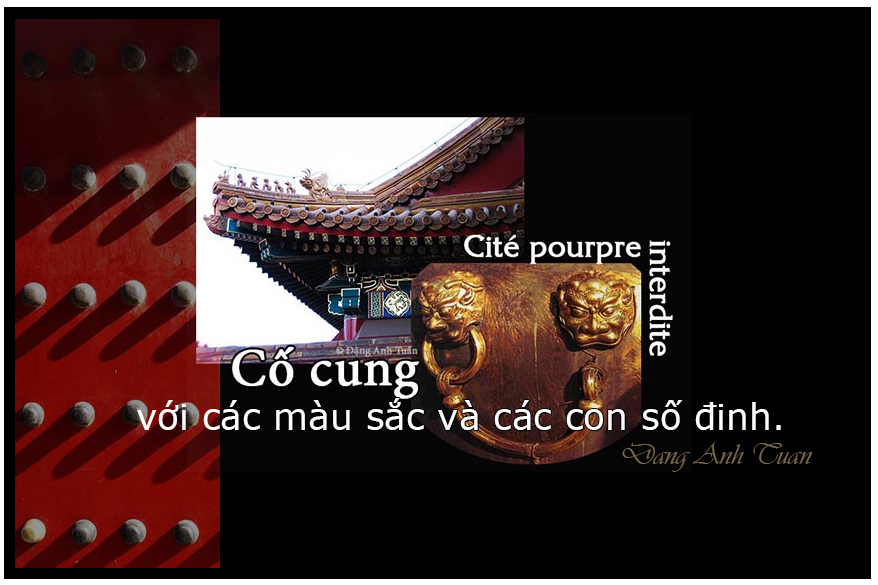
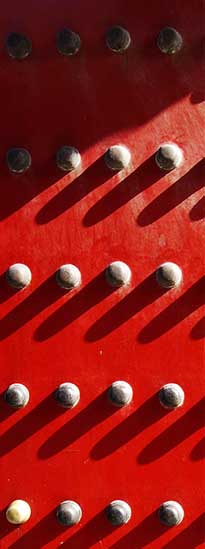
Đóng đinh trên các cửa, truyền thống nầy đã có từ lâu có từ thời nhà Tùy Đường (581-907). Riêng về cố cung thì trên bốn cửa chính  thì  đều có đóng đinh nhưng ngoài việc nầy,  chỉ có ngọ môn thì có thêm năm cổng còn các cửa khác thì chỉ có ba cổng.

Trừ cửa Đông Hoa Môn có 8 hàng ngang 9 hàng dọc đinh màu vàng ( 8*9=72)  với con số chẵn (số Dương tức là con số nguyên chia cho 2 và bội số của 3), tất cả cửa khác  đều có  9 hàng ngang và 9 hàng dọc  tức là 9*9=81, nghĩa là với con số Âm (số lẻ). Người Hoa hay dùng số Dương còn người Việt thì đối lại thì trọng con số lẻ (số Âm). Qua việc dùng đinh đống cửa, ngoài chức năng cấu tạo và  trang trí, người ta còn nhận thấy  nó còn  thể hiện khía cạnh trang nghiêm và uy nghi của một chế độ phong kiến của thời đó.

Đinh cửa

Có rất nhiều câu hỏi về sự chọn lựa số Dương trên cửa phía Đông (hay là Đông Hoa Môn). Đây là một nghi vấn mà các sử gia chưa tìm được câu trả lời. Có người nghĩ rằng lúc an táng Gia Khánh ĐếĐạo Quang Đế thì phải  mượn cửa nầy để đem đi chôn. Vì thế cửa nầy thường được gọi là Qủi Môn. Có thể đây là sự giải thích hợp tình hợp lý vì với số Âm người qua đời mới về được với Âm Phủ. Số lượng đinh đóng trên các cửa được cố định tùy theo chức vụ giai cấp của chủ nhân trong chế độ phong kiến.

Vì thiên tử là con của Thiên Đế (Trời) nên   số lượng phòng  trong cố cung  phải ít hơn số gian nhà mà Trời có trên thiên đình (10.000).  Con số nầy là con số Dương và là con số mang tính cách vô tận ở Trung Hoa.  Theo cuộc điều tra vào năm 1973 thì  có ở cố cung tất cả 8704 phòng (con số Dương).

Riêng về màu vàng, trong Âm Dương Ngũ Hành, thì màu nầy thường được gán với hành  Thổ (hay đất)  được tọa lạc ở trung tâm  trong việc quản lý vạn vật và giám sát  bốn phương. Vì là màu của mặt trời ở giữa trưa, màu nầy rực rỡ chỉ thuộc về hoàng đế vì nó biểu hiệu  sự kính trọng và che chở của thiên đế. Có tục lệ không được dùng một số màu ở thời kỳ phong kiến: màu đỏ, màu vàng, màu xanh da trời.

img_3307

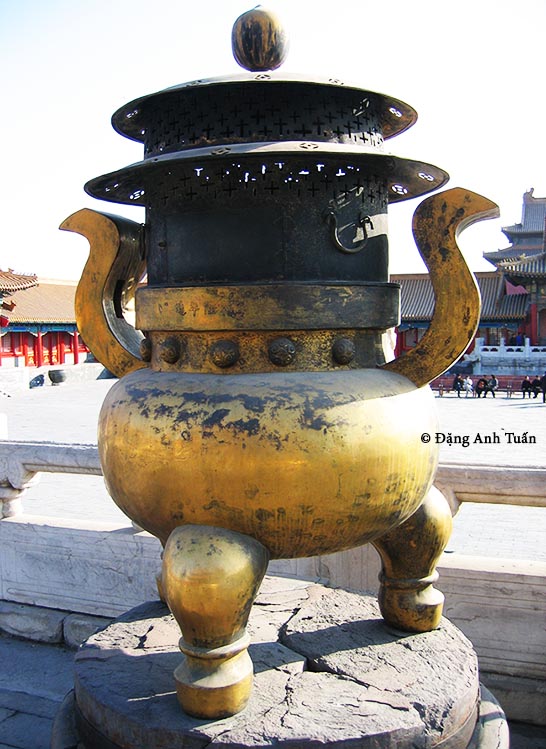
Lư hương

Ngược lại dân chúng được dùng: màu đen, màu trắng và màu xám. Bởi vậy không có chi ngạc nhiên khi thấy lại sự trọng dụng hai màu nổi bật nầy: màu đỏ tía và màu vàng  trong việc xây cất cung đình ở cố cung. Các vách tường thì màu đỏ tím còn các ngói  lưu ly  của cung đình thì màu vàng. Nhưng cũng có ngọai lệ đều có liên quan đến thuyết Âm Dương Ngũ Hành.  Đó là cung Wenyuan, nơi  có  thư viện Hoàng gia. Nơi nầy có mái nhà màu đen. Lửa là một vấn đề lo ngại ở cố cung. Đã bao lần lửa đựợc phát giác ở cố cung. Lần chót có lửa là lúc hoàng đế Quang Tự sắp thành hôn  còn một tháng với cô em họ Long Dụ. Đây là điềm báo không tốt cho cuộc hôn nhân. Dựa lấy cớ nầy, thái hậu Từ Hy hành quyết lập tức hai thái giám phụ trách trong việc bố trí các lồng đèn.  Bởi vậy màu đen tượng trưng nước,  được dùng ở cung Wenyuan trong việc phòng tránh hỏa họan và để bảo vệ các bộ sách ở thư viện. Có những gian nhà ở gần Đông Hoa Môn thì có mái nhà sơn màu xanh vì đây là nơi  ở của các hoàng tử.  Đấy cũng là màu xanh mà được gán cho phương đông trong ngũ hành.

[Trở về trang Tử Cấm Thành ( Bắc Kinh)]

[Trở về trang Trung Quốc]

Les bronzes de Sanxingdui (Part 2)

Version vietnamienne (2ème partie)

English version (Part 2) 


D’autres traits caractéristiques trouvés à Sanxingdui n’ont pas d’équivalent dans l’art des Shang. C’est le cas de la décoration végétale illustrée par le martelage des feuilles en or ou en cuivre et par la forme d’arbres ou de boutons de fleurs. Une autre source d’inspiration majeure se retrouve dans le thème de l’oiseau. Qu’il s’agisse d’hommes ou d’animaux, l’artiste de Sanxingdui réussit à leur donner avec agilité non seulement une stylisation assez poussée mais aussi des formes d’expression très naturalistes. Ce n’est le cas de l’art des Shang où l’artiste tend à transformer l’aspect ou la forme de l’animal par une stylisation assez excessive, loin de la réalité


Repères chronologiques


Vers 1900-1500: culture d’Erlitou. Début de l’âge du bronze en Chine. Période des Xia? (Nhà Hạ)

Vers 1500-1300: phase Erligang de la dynastie des Shang (Nhà Thương)

Vers 1300-1050: phase Anyang de la dynastie des Shang (Nhà Ân)

Vers 1200 av. J.C: Fosses n°1 et n°2 de Sanxingdui. Sichuan

Vers 1200-1000 av. J.C: phase d’occupation du site de Jinsha, Chengdu, Sichuan.

Vers 1050-256 av. J.C.: dynastie des Zhou (Nhà Châu).

316 av. J.C.: conquête du Sichuan par les armées de la principauté de Qin (Nhà Tần).


Trouvailles archéologiques de la dynastie des Shang

[ngg_images source= »galleries » container_ids= »279″ display_type= »photocrati-nextgen_basic_thumbnails » override_thumbnail_settings= »1″ thumbnail_width= »180″ thumbnail_height= »200″ thumbnail_crop= »1″ images_per_page= »30″ number_of_columns= »4″ ajax_pagination= »0″ show_all_in_lightbox= »0″ use_imagebrowser_effect= »0″ show_slideshow_link= »0″ slideshow_link_text= »[Montrer sous forme de diaporama] » template= »/homepages/5/d276592279/htdocs/clickandbuilds/vietnamquehuongtoi/wp-content/plugins/nextgen-gallery/products/photocrati_nextgen/modules/ngglegacy/view/gallery.php » order_by= »pid » order_direction= »ASC » returns= »included » maximum_entity_count= »500″]

 Musée Cernusci

Lors de la fouille des fosses n°1 et n°2, on s’aperçoit que malgré la période contemporaine des Shang, la tradition de Sanxingdui diffère complètement de celle de ces derniers car elle présente plusieurs traits spécifiques et originaux. D’abord les élites de Sanxingdui n’ont pas utilisé les vases zun de la même manière que les Shang. Elles s’en ont servi pour stocker certains biens de prestige et de valeur comme les cauris marins, une sorte de monnaie d’échange en raison de leur rareté.                 

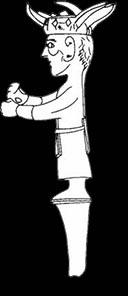
C’est ce qu’on a découvert grâce à la statue d’un personnage portant une vase zun trouvée dans la fosse n°2. Ce n’est pas le cas des Shang dont les vases zun aux formes diverses possèdent chacune un rôle très précis afin d’honorer le culte de leurs ancêtres: servir et boire du vin, présenter les mets, cuire les offrandes de viande etc. Puis la représentation de la figure humaine fait partie de l’art de Sanxingdui. Le nombre de têtes et de masques est impressionnant et ne peut pas passer inaperçu pour les visiteurs et les archéologues lors de la première découverte de cet art. Par contre, dans l’art des Shang, l’homme n’est pratiquement pas représenté.

Contrairement aux bronziers des Shang qui étaient connus pour la fabrication des vases rituels dont certaines pouvaient atteindre 1 mètre de hauteur, ceux de Sanxingdui ont préféré les sculptures souvent audacieuses à la demande des élites locales. Ils ont été obligés d’adapter les techniques importées et de créer de nouveaux procédés, en particulier la soudure pour leurs propres réalisations.

En examinant les objets trouvés dans les fosses de Sanxingdui, les archéologues ont été amenés à la conclusion que les traditions de Sichuan et d’Anyang s’opposent nettement dans leurs pratiques sacrificielles respectives. Contrairement aux dirigeants d’Anyang honorant seulement le culte des ancêtres, les élites de Sanxingdui vénéraient à la fois les ancêtres et le soleil. Le fait de découvrir plus tard à Jinsha considéré par les archéologues comme le site assumant la continuité de la culture de Sanxingdui, le regroupement de quatre oiseaux entourant le soleil sur un ornement en or ou la statue debout en bronze ayant sa coiffe en forme du soleil, atteste incontestablement le culte du soleil. Celui-ci était une pratique très courante dans les anciennes civilisations du monde.

Selon le chercheur chinois Shi Jingsong, toutes les trouvailles de la fosse n°2 peuvent se répartir en deux groupes: le premier ayant trait à des objets dont les motifs sont similaires à ceux trouvés sur les récipients en bronze dans la plaine centrale des Shang, le second identifié par des figurines ou par des motifs décoratifs relatant le soleil. Pour lui, il n’y a aucun doute sur le partage du pouvoir entre le roi et le prêtre et la coexistence des temples religieux et ancestraux dans la civilisation de Sanxingdui.

Il s’agit probablement d’un royaume civilisé investi de pouvoirs théocratiques, ce qui permet de supposer un système religieux et social à échelons multiples à travers ses vestiges découverts.

[Retour]

[Return MUSEUM]

English version (2nd part)

Other characteristic features found in Sanxingdui have no equivalent in Shang art. This is the case of plant decoration illustrated by the hammering of leaves in gold or copper and by the shape of trees or flower buds. Another major source of inspiration is found in the theme of the bird. Whether it is humans or animals, the artist of Sanxingdui succeeds in giving them with agility not only a fairly advanced stylization but also very naturalistic forms of expression. This is not the case in Shang art where the artist tends to transform the appearance or form of the animal by a rather excessive stylization, far from reality.

During the excavation of Pits 1 and 2, it was discovered that, despite the contemporary period of the Shang, the Sanxingdui tradition differs completely from that of the Shang, as it presents several specific and original features. First, the elites of Sanxingdui did not use zun vessels in the same way as the Shang. They used them to store certain prestigious and valuable goods, such as sea cowries, a kind of currency due to their rarity.
This was discovered thanks to the statue of a figure carrying a zun vessel found in Pit 2. This is not the case for the Shang, whose zun vessels of various shapes each had a very specific role to honor the cult of their ancestors: serving and drinking wine, presenting food, cooking meat offerings, etc. Moreover, the representation of the human figure is part of the art of Sanxingdui. The number of heads and masks is impressive and cannot go unnoticed by visitors and archaeologists when this art is first discovered. On the other hand, in Shang art, humans are practically not represented.

Unlike Shang bronze workers, who were known for crafting ritual vessels, some of which could reach a height of one meter, those of Sanxingdui preferred the often bold sculptures requested by local elites. They were forced to adapt imported techniques and develop new processes, particularly welding, for their own creations.

By examining the objects found in the Sanxingdui pits, archaeologists concluded that the traditions of Sichuan and Anyang contrasted sharply in their respective sacrificial practices. Unlike the Anyang rulers, who honored only ancestor worship, the Sanxingdui elites venerated both ancestors and the sun. The later discovery at Jinsha, considered by archaeologists to be the site that represents the continuity of the Sanxingdui culture, of the grouping of four birds surrounding the sun on a gold ornament, or of the standing bronze statue with its headdress in the shape of the sun, undeniably attests to sun worship. This was a very common practice in the ancient civilizations of the world.

According to Chinese researcher Shi Jingsong, all the finds from Pit No. 2 can be divided into two groups: the first relating to objects whose motifs are similar to those found on bronze vessels in the central plain of the Shang, the second identified by figurines or decorative motifs depicting the sun. For him, there is no doubt about the sharing of power between king and priest and the coexistence of religious and ancestral temples in the Sanxingdui civilization. It was probably a civilized kingdom invested with theocratic powers, which allows us to suppose a multi-level religious and social system through its discovered remains.

Chronological benchmarks

Around 1900-1500: Erlitou culture. Beginning of the Bronze Age in China. Xia period? (Nhà Hạ)

Around 1500-1300: Erligang phase of the Shang dynasty (Nhà Thương)

Around 1300-1050: Anyang phase of the Shang dynasty (Nhà Ân)

Around 1200 BC. B.C.: Pits No. 1 and No. 2 of Sanxingdui. Sichuan

Around 1200-1000 BC. J.C: occupation phase of the site of Jinsha, Chengdu, Sichuan.

Around 1050-256 BC. BC: Zhou dynasty (Nhà Châu).

316 BC 1500 BC: conquest of Sichuan by the armies of the principality of Qin (Nhà Tần).

Références bibliographiques

Les bronzes du Sichuan. Chine

Connaissance des Arts

Alain Thote.

Paris Juillet 2017

[Return]

[Return MUSEUM]

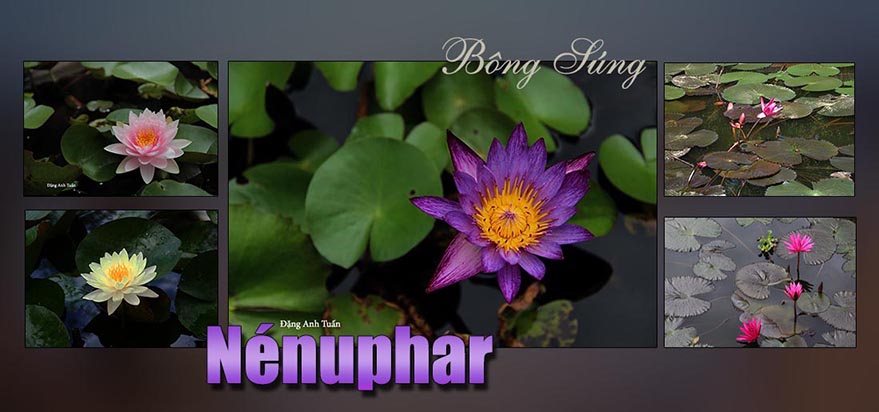
Bông Súng (Nénuphar)


Dans le jardin de Claude Monet (Givenchy)

Version française
Version anglaise
Galerie des photos

Được xem là biểu tương sự  tinh khiết và yên tĩnh, cây bông súng thường  mọc hoang dã trong bùn. Ở nam bộ Vietnam,  người ta thường ăn mắm kho với bông súng hay  dùng nó để làm món  gỏi  tuyệt vời. Để  bảo vệ một cách hữu hiệu các bộ phận  tựa như nhụy và nhị,  cây bông súng có  được một cơ chế  hóa lý rất tinh vi khi  trời về đêm lạnh rét hay  có độ ẩm cao.  Nhờ có nước  lan tràn vào  các không bào và  có sự biến  đổi của ánh sáng  và nhiệt độ khiến có sự thay đổi ở nơi có  tập trung nhiều ion canxi của các tế bào và dẩn đến việc tạo ra áp suất trên các mặt trong và ngoài của các tràng hoa.  Vì vậy các cánh hoa hay bị méo mó  nhưng không vì thế mà  bị hư hỏng. Chiều  tối lại,  cây bông súng dựng đứng lên các cánh hoa để che chở các bộ phận sinh sản bằng cách làm phòng ra các tế bào của nó. (sự trương nước) Còn sáng lại nó buông lơi  xuống các cánh hoa và làm co lại các tế bào  (sự co lại gọi  là plasmolyse) bằng cách làm bốc hơi nước và giảm đi áp xuất trên các vách tế bào. Tùy thuộc  dáng vóc mà hoa súng có nhiều cánh hoa hay không để nó có thể  dễ dàng đóng khép và bảo trợ  các bộ phận sinh sản.  Đối với các nhà nghiên cứu khoa học, đây không những là chuyện  thăng bằng mà còn là một phát minh tuyệt vời được  tìm thấy  ở các thực vật trước khi con người khám phá ra được các máy bơm nước và cái kích.

Galerie des photos

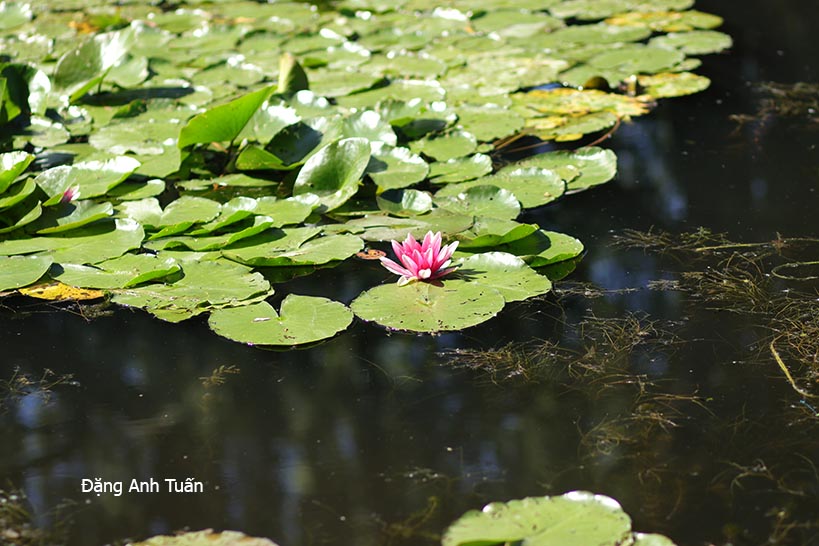
Etant le symbole de paix et de pureté, le nénuphar est habitué à pousser sauvagement dans la boue. Au Vietnam, on s’en sert dans le Sud soit pour accompagner la soupe aux poissons (mắm kho) soit pour faire une salade  délicieuse. Le nénuphar possède un mécanisme physique et chimique  très ingénieux permettant de protéger ses organes reproductifs  (étamines, pistils) contre le froid et l’humidité nocturne. Grâce à la pénétration de l’eau dans les vacuoles et aux variations de la lumière et de la température modifiant ainsi la concentration en ions calcium des cellules,  cela provoque la pression sur les faces interne et externe de ses corolles et facilite  la déformation de ses  pétales  sans que ces derniers soient abîmés.  Le soir, le nénuphar  redresse  ses pétales pour protéger ses appareils reproducteurs  par le gonflement de ses cellules (turgescence)   tandis que le matin il les fait retomber  par le dégonflement de ces  mêmes cellules  (plasmolyse) en diminuant la pression sur leurs parois cellulaires  et en perdant de l’eau par évaporation. En fonction de la taille, la fleur du nénuphar doit avoir un certain nombre de pétales  afin de mieux  se refermer et protéger ses organes reproductifs.  Pour les chercheurs, c’est non seulement une affaire d’équilibre mais aussi une invention géniale chez les plantes avant la découverte des pompes hydrauliques  et des vérins par les hommes. 

Galerie des photos

Lis d’eau

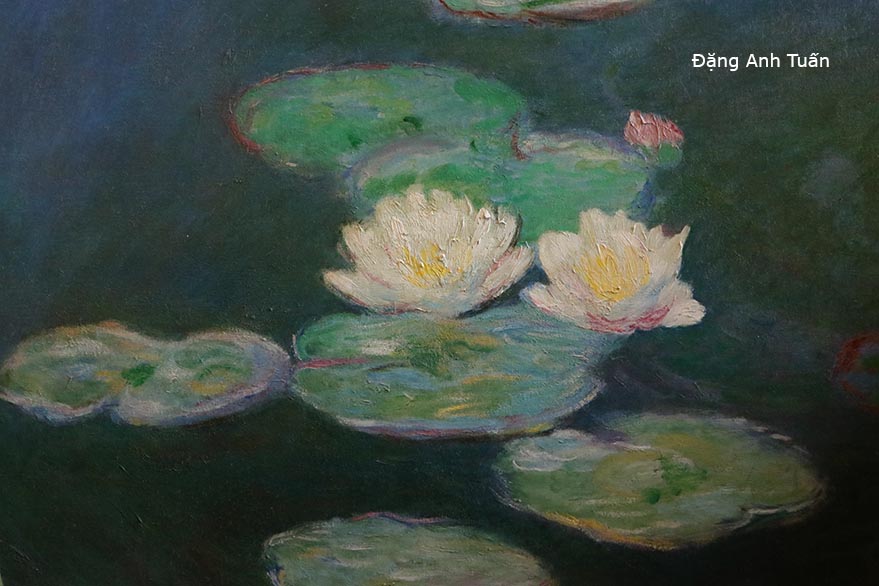
Tableau nénuphar de Monet

Version anglaise

Being the symbol of  peace and purity, the water lily is accustomed to grown savagely in the mud. In Vietnam, it is used either by accompagnying the fish soup in the South region or by making a delicious salad. The water lily has a chemical and physical mechanism very ingeniuos allowing to protect its reproductive organs (stamen, pistil)  against the cold and  night humidity. Thanks the water penetration in vacuoles and  variations in light and temperature, thereby altering  calcium ion concentration in cells, it causes  the pressure on the internal and external faces of its corollas  and facilitates  the deformation of its petals without  the latter being damaged. At night, the water lily adjustes its petals for protecting its  reproductive system by the swelling of its cells (turgor) while in the morning, its petals fall down by the  deflation of these same cells thanks to the  pressure reduction applied on their cell walls (plasmolysis)  and the loss of water by evaporation.

Depending on size, the flower of water lily must have a certain  number of petals for being closed again and protecting its reproductive organs. For scientists, it is not only the balancing act but also an ingenious invention in plants before the discovery of hydraulic pumps and cylinders by men.


[Return FLEURS DU MONDE]

Một thoáng trở về với Luông Phạ Băng (Luang Pra Bang)

Một thoáng trở về với Luông Phạ Băng

Version française

Version anglaise

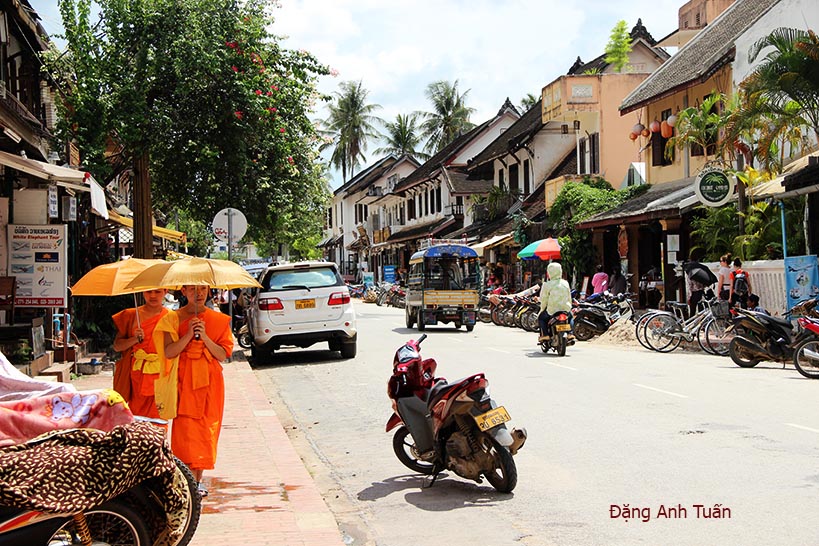
Từ thế kỷ 14 đến 1946, Luông Pra Băng hay Mường Luông là kinh đô của một vương quốc đuợc mang tên là Lan Xang hay là vuơng quốc triệu voi. Luang Pra Bang được UNESCO công nhận là một di sản thế giới (văn hóa). Nằm bên cạnh sông huyèn thoại  Cửu Long, Luông Phạ Băng cách xa Viên Chăn (Vientiane) 425 cây số về phía Bắc. 

Depuis le 14ème siècle jusqu’à l’année 1946, Luong Pra Bang fut la capitale du royaume de Lan Xang (ou royaume du million d’éléphants). Luang Pra Bang est reconnue par UNESCO comme le patrimoine culturel de l’humanité. Longeant le  fleuve mythique Mékong, elle est  située à 425 km de  la capitale Vientiane  dans la direction nord.

From the 14th century until the year 1946, Luang Prabang was the capital of the kingdom of Lan Xang (or the kingdom of a million elephants). Luang Prabang is recognized by UNESCO as a cultural heritage of humanity. Bordering the mythical Mekong River, it is located 425 km north of the capital Vientiane.

[Back to Luang Pra Bang]

Nguyễn An Ninh (Version anglaise)

Version vietnamienne
Version française

Sống sao không thẹn với đời
Chết sao để tránh ngàn lời mĩa mai
Sống vỉ thế hệ tương lai
Chết vì đất nước tù đày không than
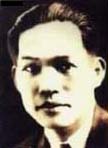
A great homage to Nguyễn An Ninh

through my  Six-Eight verses:

To live in such a way one has no shame of living
To die in such a way to avoid thousands of ironies
Is to live for future generations
And to die for one’s country without complaining days in imprisonment.

Facing Nguyễn An Ninh’s flat refusal to repent and the alarming situation caused by the imminent landing of the Japanese army in Indochina in 1943, his jailer, the warden of the Poulo Condor prison, Mr. Tisseyre decided to eliminate this burdensome prisoner who was sick and potentially dangerous in his view because the Japanese could later use him as a pawn on the Indochina chessboard.

Nguyễn An Ninh since his coming back to Vietnam, became not only, as time went by, an idol for the Vietnamese youth but also one of the most respected leaders among Vietnamese intellectuals in Cochinchina. Even during his imprisonment in Poulo Condor, he was the only one to have received the esteem of all political prisoners no matter they are communists, nationalists, Trotskists or other etc.  and to have brought peace in case of stormy debates or virulent altercations between prisoners.

How come a young man like Nguyễn An Ninh arrived at becoming a « bête noire  » of the colonial authorities? However at the beginning he did not have intention to resort to violence like the Nguyễn Thái Học nationalists or the Vietnamese communists. He supported himself with his pen and the newspaper « La cloche fêlée » whose director was a longtime friend of his, a French of the name Eugene de Jean de la Bâtie. He made a mistake to have dared demand with fanfare for his compatriots the freedom of expression and fundamental rights which he had fully enjoyed during his years of study at the Sorbonne in Paris, and which were lacking then in Vietnam, by using his caustic and careless critics, and succinct analyses in his newspaper. He did not even conceal his sympathy that his has always had for the leader Phan Chu Trinh, a friend of his father Nguyễn An Khương. He was the translator of Jean Jacques Rousseau‘s « Social Contract ». By means of seminars and public debates, he succeeded in provoking a collective awareness among Vietnamese intellectuals of the 1920’s and 1940’s who up until then were asleep in a seemingly happiness, freedom and justice created by the colonial authorities.

Those young intellectuals only bothered with universally human subjects such as love, family, sadness of separation etc… Although they are often alongside with the rural area, they never asked any questions about what was going on there. Not that they ignore the poverty outside urban areas but they never lived there. Even though they were not issue of large estate bourgeoisie or sons of collaborators, they nourished the dream of becoming government officials.
From his return to Vietnam in 1922, instead of going into this traditional mould like others of his age, his generation, Nguyen An Ninh, this young man of 22 years of age, with rounded hairdo, law graduate from the Sorbonne, made his way in the opposite direction by advocating the method of the Indian poet Tagore. The latter thought it would be possible to obtain independence without bloodshed from the British by means of straightening up to the intellectual level of the Indian people. That was why with the help of some of his friends he did not hesitate to launch a series of debates on themes such as  » A culture for the Annamites », « The ideal of the Annamite youth » etc…, which provoked from then on visible swirls in a harbor of peace established by the Governor of Cochinchina, Mr. Cognacq.

He was the instigators of several petitions claiming not only freedom of expression but also freedom of education and freedom of the press for the natives. It was a significant worry for this governor because through his tonic speeches, Nguyễn An Ninh arrived at mobilizing and electrifying the intellectual youth of South Vietnam, casting doubts among the Vietnamese intellectuals having at the time total confidence in the French education system in Indochina. Cognacq was compelled to react because each speech animated by Nguyễn An Ninh provided the occasion to mobilize more and more people. Cognacq did not hesitate to remind him several times that there was always room at the prison of Poulo Condor for recalcitrant people like him. On the other hand, he would have access to an important post in the colonial administration if he gave up this suicidal adventure.

Despite this reminder full of threat, Nguyen An Ninh continued persevering in this political involvement, which compelled the colonial authorities to imprison him several times. His first incarceration was shortened thanks to the strong intervention of many French personalities of that time, especially that of Romain Rolland, Nobel Price winner in literature in 1915, before the colonial authorities. From then on, Nguyễn An Ninh became not only a regular visitor of the prison but a man to bring down for the colonial authorities. Having been aware of the impossibility of claiming before the colonial authorities the fundamental rights by peaceful means, he soon undertook secretly the armed struggle. He became thus the leader of the party « Hope of the Youth ( Ðảng Thanh Niên Cao Vọng ) being successful in having more than 7000 adherents during its existence and aiming at redistributing land to poor peasants in 1927.

His renown allowed him to make friend with the leaders of other political movements, especially with trotskist Tạ Thu Thâu, journalist Hồ Hữu Tường, young attorney Trịnh Ðình Thảo, communist Nguyễn Thị Minh Khai etc. He was contacted several times by the communists and the Nguyen Thai Hoc nationalists and asked to join their movements but he took the pretext of being closely watched by the colonial authorities to refuse their proposals with courtesy. Closer to the communists in his ideas and struggle, he knew however how to make a difference. He never concealed that he had in himself the ideas of Jean Jacques Rousseau and Diderot. He loved to be above the melees and political rivalries and considered himself above all a Vietnamese intellectual serving his country.

Taking advantage of the political confusion taking place in France by the dissolution of the French communist party by president Edouard Daladier ( 25 September 1939 ) and of the lack of support from the French intellectuals that Nguyễn An Ninh had up until then, it did not take the colonial authorities long to put their hand on Nguyễn An Ninh and expeditiously sent him to the Poulo Condor prison by charging him with being the troublemaker and instigator of peasant revolts.
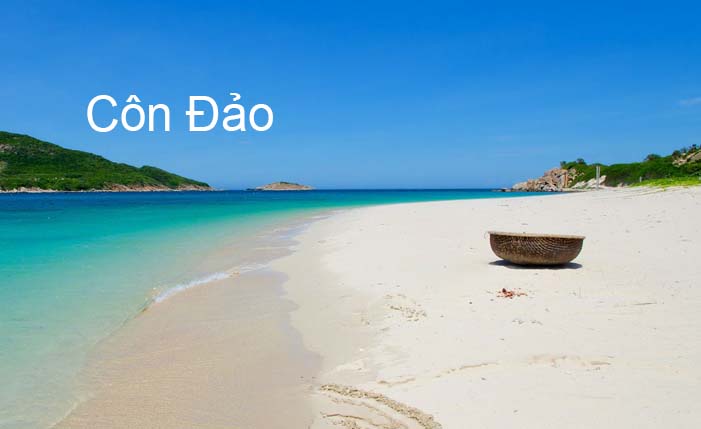
Very few Vietnamese dared talk about this prison without emotion. It is all about an archipelago of 14 small islands located at 180km from Vũng Tàu (ex Cap Saint Jacques) and accessible after 12 hours by boat. By the end of 13th century, Marco Polo noted that island Côn Sơn, the greatest of all 14 islands was uninhabited. The Poulo Condor archipelago was the object of secular dispute between the Vietnamese, Khmers and Malays. It was discovered one beautiful morning, 28 November 1861, by the lieutenant of the French Royal Navy of Napoleon III, Lespes Sebastien Nicolas Joachim. It became thus a French possession during colonial time and stood out among famous prisons.

But Nguyễn An Ninh remained the only one capable of wiping out all stormy discussions between protagonists. To relax in jail, Ninh composed many poems but the most famous remains the following found in his pocket at his interment by his prison inmates:

Sống và chết

Sống mà vô dụng sống làm chi
Sống chẳng lương tâm, sống ích gì
Sống trái đạo người, người thêm tủi
Sống quên ơn nước , nước càng khi
Sống tai như điếc, lòng đâm thẹn
Sống mắt dường đui dạ thấy kỳ
Sống sao nên phải cho nên sống
Sống để muôn đời, sử tạc ghi…
….. ….
Chết được dựng hình tên chẳng mục
Chết đưa vào sử chữ không phai.
Chết đó, rõ ràng danh sống mãi
Chết đây, chỉ chết cái hình hài
Chết vì Tổ Quốc, đời khen ngợi
Chết cho hậu thế, đẹp tương lai

Living and Dying

Living useless is not worth living
Living without a conscience is living useless
Living counter to humanism is pitiable
Living forgetting one’s country is despicable.
Living as if deaf is shameful
Living as if blind is embarrassing
Living the way one should would one live
Living as such that history engraves memory

Dying statue erected in one’s name undecayed
Dying legacy entering history unfaded
Dying that way is like living for ever
Dying as such is only physical dying
Dying for one’s country is praised at all time
Dying for posterity is a beautiful dying

His death could have gone unnoticed had there not been the check of prison guard Rognon who by coincidence verified the bag containing the bodies of prisoners dead the day before ( 14 August 1943 ) and scheduled to be sent to the morgue. Taken by pity and admiration he always had for Nguyễn An Ninh, he decided to alert Mr. Tisseyre, the director of the prison and asked him for permission to bury Nguyễn An Ninh in a coffin. But he did not know that Nguyễn An Ninh was liquidated on order of Tisseyre with a shot of arsenic. That was why Tisseyre, embarrassed by that suggestion, did not hesitate to remind Rognon that he was beginning to be interested in businesses that have nothing to do with him. Alerted by the death of her friend Nguyen An Ninh she had known at the time when she was a young student at the Sorbonne, the wife of the director of the electric company at Poulo Condor, Mme Charlotte Printanière insisted at length with Tisseyre that Nguyễn An Ninh be buried with dignity. Facing Tisseyre’s inhuman treatment, she was compelled to to tell him with irritation:

A person like him deserves being respected when it comes to a Vietnamese patriot. You would lose nothing if you bury him the way it should be. Besides, you will be appreciated for your your generosity. For what reasons do you continue to stop showing your admiration toward this true revolutionary? Who dare say in the future you will always be the winner? »

In spite of this remark, Tisseyre remained impassible. He left the body of Nguyen An Ninh in a pitiful condition with his clothes in tatters. He was buried the next day at Hàng Keo by his prison inmates. As for Mme Charlotte Printaniere, she was recalled to Saigon a few days later and was forbidden to return to the island. Her remark became a prophecy a few years later. Tisseyre was imprisoned in his turn by the Japanese army and was sentenced to 20 years in prison by General De Gaulle ‘s court martial for having surrendered without conditions to the Japanese Army.

By means of Tisseyre, the colonial authorities succeeded in killing Nguyễn An Ninh. But they forgot the phrase that Nguyễn An Ninh had recalled well in his poem « Living and Dying« . Dying here is just the physical death of the body. Actually, Ninh has gone but there are many other Ninhs who came to take his place and the torch of the struggle. Since the beginning of time, history has taught us that it is always possible to eliminate all the instigators of revolts but it is impossible to eradicate their ideas, especially those having to do with the defense of a just and legitimate cause.

Nguyễn An Ninh is not only the person having a notable influence on the intellectuals of South Vietnam in the 1920’s and 1940’s but also a person capable of waking up a generation. It was the opinion of historian Daniel Hémery in his work « Saigon 1925-1945 » published in 1972 in Paris.

Nguyễn An Ninh was not only a Vietnamese patriot but also a valiant militant revolutionary who fought for the Country and the People to the last breath of his life. It was the terms used by Phạm văn Ðồng to pay homage to Nguyễn An Ninh in the Liberated Saigon newspaper issue 14 August 1993, no. 571. When he was alive Ngô Ðình Diệm, the ex-president of the Republic of Vietnam, did not even forget what Nguyen An Ninh had done to the country by giving to Admiral Courbet street near the Bến Thành central market the name Nguyễn An Ninh and restoring his tomb in Poulo Condor island.

It is no surprise to see Nguyễn An Ninh succeed in receiving still after so many decades unanimous approvals from all Vietnamese political tendencies. He has always been considered by his compatriots as a Vietnamese intellectual in his service to his country. He had the possibility to become rich with his degree at that time, to put himself on the side of the strongest in the difficult moments of the Vietnam history but he preferred to choose another way, the one to share the misfortune with his people and to engage a political combat in the pursuit of freedom.

How many Vietnamese politicians still have this ideal like Nguyễn An Ninh on this land of legends?

Nguyễn An Ninh (Version française)


Vietnamese version

English version

Sống sao không thẹn với đời
Chết sao để tránh ngàn lời mĩa mai
Sống vỉ thế hệ tương lai
Chết vì đất nước tù đày không than

Hommage à Nguyễn An Ninh à travers mes quatre vers en Six-Huit

Comment faut-il vivre pour n’éprouver aucune honte avec cette vie?
Comment faut-il mourir pour ne pas recevoir des milliers de blâmes?
Vivre pour les futures générations
Mourir pour la patrie sans se plaindre un jour dans la prison.

Devant le refus catégorique de Nguyễn An Ninh de se repentir et devant la situation alarmante provoquée par le débarquement imminent de l’armée japonaise en Indochine en 1943, son geôlier, le directeur du bagne de Poulo Condor, Mr Tisseyre décida d’éliminer ce prisonnier encombrant, malade et potentiellement dangereux à ses yeux car les Japonais pourraient s’en servir plus tard comme un pion sur l’échiquier indochinois.
Nguyễn  An Ninh, depuis son retour au Viêt-Nam, devint non seulement. au fil des années, l’idole de la jeunesse vietnamienne mais aussi l’un des leaders les plus écoutés et les plus respectés auprès des intellectuels vietnamiens en Cochinchine. Même durant son emprisonnement au bagne de Poulo Condor, il fut le seul à recevoir l’estime de tous les prisonniers politiques que ce soit communistes, nationalistes, trotskistes ou autres etc. et à ramener la paix en cas de débats houleux ou d’altercations.

Comment un jeune homme comme Nguyễn An Ninh arriva-t-il à devenir la bête noire des autorités coloniales? Pourtant il n’avait pas l’intention de recourir au début à la violence comme les nationalistes de Nguyễn Thái Học ou les communistes. Il ne vivait que de sa plume avec le journal intitulé « La Cloche Fêlée » dont le directeur était son ami de longue date, un Français de nom Eugène Dejean de la Bâtie. Il avait le tort d’oser revendiquer à cor et à cri pour ses compatriotes la liberté d’expression et les droits élémentaires dont il avait bénéficié pleinement durant ses années d’études à la Sorbonne à Paris et qui faisaient défaut jusqu’alors au Viêt-Nam par ses critiques acerbes et sans ménagement et ses analyses succinctes dans son journal. Il ne cachait pas non plus la sympathie qu’il avait eue toujours pour le leader Phan Chu Trinh, un ami de longue date de son père Nguyễn An Khương. Il était aussi l’auteur de la traduction en vietnamien de l’ouvrage « Le contrat social » de Jean Jacques Rousseau. Par le biais des séminaires et des débats publiques, il réussit à provoquer une prise de conscience collective de tous les jeunes intellectuels vietnamiens des années 1920-1940 qui étaient jusque-là endormis au Sud-Vietnam par un semblant de bonheur, de liberté et de justice crée par les autorités coloniales. Ces jeunes intellectuels ne se préoccupaient jusqu’alors que des sujets universellement humains: amour, famille, tristesse des séparations etc.

Bien qu’ils côtoyassent souvent le milieu rural, ils ne se posaient jamais des questions sur tout ce qui touchait de près ou de loin à ce dernier. Ils n’ignoraient rien de la pauvreté périurbaine mais sans jamais y vivre. Bien qu’ils ne fussent pas issus de la bourgeoisie latifundiaire ou des fils des collaborateurs, ils nourrissaient tous leur rêve de devenir fonctionnaires. De son retour au Viêt-Nam en 1922, au lieu d’être rentré dans ce moule traditionnel comme les autres jeunes de son âge, de sa génération, Nguyễn An Ninh, ce jeune homme de 22 ans, à la chevelure bombée, licencié en droit à la Sorbonne, fit le chemin inverse en prônant la méthode du poète indien Tagore. Celui-ci pensa qu’il était possible d’obtenir l’indépendance sans effusion de sang auprès des Anglais par le biais de redressement du niveau intellectuel du peuple indien.  C’était pour cela qu’il n’hésita pas à donner avec l’aide de quelques amis une série de débats sur les thèmes tels que  » Une culture pour les Annamites », « L’idéal de la jeunesse Annamite » etc… , ce qui provoqua dès lors des remous visibles dans un havre de paix établi par le gouverneur de la Cochinchine, Mr Cognacq. Il fut l’instigateur de plusieurs pétitions réclamant non seulement la liberté d’expression mais aussi la liberté d’enseignement et la liberté de presse pour les autochtones.

C’était un souci non négligeable pour ce gouverneur car à travers ses discours toniques, Nguyễn An Ninh arriva à mobiliser et à électriser la jeunesse intellectuelle du Sud Viet-Nam, à semer un doute auprès des intellectuels vietnamiens ayant une confiance totale jusque là dans le système d’enseignement français en Indochine. Cognacq fut obligé de réagir car chaque discours animé par Nguyễn An Ninh donna l’occasion de mobiliser de plus en plus des gens. Cognacq n’hésita pas à lui rappeler plusieurs fois qu’il y avait encore de la place au bagne de Poulo Condor pour les gens récalcitrants comme lui. Par contre, il pourrait accéder à un poste important dans l’administration coloniale s’il renonçait à cette aventure suicidaire. Malgré ce rappel empreint de menaces, Nguyễn An Ninh continua à persévérer dans cet engagement politique, ce qui obligea les autorités coloniales de l’emprisonner à maintes reprises. Son premier internement fut écourté grâce à l’intervention énergique de plusieurs personnalités françaises de cette époque, en particulier celle de Romain Rolland, prix Nobel de la littérature en 1915 auprès des autorités coloniales.

Dès lors, Nguyễn An Ninh devint non seulement un habitué de la prison mais un homme à abattre pour les autorités coloniales. Ayant pris conscience de l’impossibilité de réclamer auprès des autorités coloniales les droits élémentaires par des voies pacifiques, il ne tarda pas à s’engager secrètement dans une lutte armée. Il devint ainsi le leader du parti « Espoirs de la Jeunesse ( Ðảng Thanh Niên Cao Vọng ) » ayant réussi à avoir plus de 7000 adhérents durant son existence et ayant pour but de redistribuer la terre aux pauvres paysans en 1927.

Sa renommée lui permit de se lier d’amitié avec les jeunes dirigeants des autres mouvements politiques, en particulier avec le trotskiste Tạ Thu Thâu, le journaliste Hồ Hữu Tường, le jeune avocat Trịnh Ðịnh Thảo, la jeune communiste Nguyễn Thị Minh Khai etc.

Il était contacté à maintes reprises par les communistes et par les nationalistes de Nguyên Thái Học pour lui demander de rejoindre leur mouvement mais il prit le prétexte d’être surveillé étroitement par les autorités coloniales pour refuser avec courtoisie leur proposition. Plus proche des communistes dans les idées et la lutte, il sut montrer pourtant sa différence. Il ne cacha jamais qu’il avait toujours en lui les idées de Jean Jacques Rousseau et de Diderot. Il aima à être au dessus de toutes les mêlées et des rivalités politiques et se considéra avant tout comme un intellectuel vietnamien au service de la nation.

Profitant de la confusion politique provoquée en France par la dissolution du parti communiste français par le président Edouard Daladier (25 Septembre 1939) et du manque de soutien que Nguyễn An Ninh avait eu jusque-là auprès des intellectuels français, les autorités coloniales ne tardèrent pas à mettre la main sur Nguyễn An Ninh et l’envoyer expéditivement au bagne de Poulo Condor en le taxant d’être le fauteur de troubles et l’instigateur des révoltes paysannes.

Très peu de vietnamiens osaient parler de ce bagne sans émoi. Il s’agit bien d’un archipel de 14 îlots situé à 180 km au large, accessible depuis Vũng Tàu (ex Cap Saint Jacques) en douze heures de bateau. Lors de son passage à la fin du XIIIe siècle, Marco Polo nota que l’île de Côn Son, la plus grande des 14 îles était inhabitée. L’archipel de Poulo Condor fut l’objet de litiges séculaires entre les Vietnamiens, les Khmers et les Malais. Il fut découvert un beau matin, le 28 Novembre 1861, par le lieutenant de la marine royale française de Napoléon III, Lespes Sébastien Nicolas Joachim. Il devint ainsi français durant l’époque coloniale et se distingua par ses célèbres pénitenciers. C’était un passage obligé pour ceux qui osaient parler de la politique sur cette terre des légendes durant la période coloniale. On trouva non seulement parmi les pensionnaires du bagne des communistes célèbres comme Phạm Văn Ðồng, Lê Duẫn,Tôn Ðức Thắng, Nguyễn Văn Tạo, mais aussi des nationalistes, des trotkistes et des partisans du « Grand Viêt-Nam ( Ðại Việt ) « ..

Mais Nguyễn An Ninh resta le seul leader capable d’annihiler toutes les discussions houleuses entre ces protagonistes. Pour se détendre dans la cellule, Ninh composa beaucoup de poèmes mais le plus célèbre restait le suivant trouvé dans sa poche au moment de son enterrement par ses compagnons de prison:

Sống và chết

Sống mà vô dụng sống làm chi
Sống chẳng lương tâm, sống ích gì
Sống trái đạo người, người thêm tủi
Sống quên ơn nước , nước càng khi
Sống tai như điếc, lòng đâm thẹn
Sống mắt dường đui dạ thấy kỳ
Sống sao nên phải cho nên sống
Sống để muôn đời, sử tạc ghi…
….. ….
Chết được dựng hình tên chẳng mục
Chết đưa vào sử chữ không phai.
Chết đó, rõ ràng danh sống mãi
Chết đây, chỉ chết cái hình hài
Chết vì Tổ Quốc, đời khen ngợi
Chết cho hậu thế, đẹp tương lai

Vivre et Mourir

Vivre inutile, ce n’est plus la peine de vivre
Vivre sans conscience, ce n’est plus utile de vivre
Vivre immoral, on se sent plus pitoyable
Vivre sans patrie, on se sent plus méprisable

Vivre sourd aux cris d’injustice, on se sent éprouver de la honte intérieure
Vivre en aveugle, on se sent très gêné
Vivre comment pour se montrer digne de vivre
Vivre comment pour être mémorisé par l’histoire

Mourir c’est avoir une statue érigée et un nom qui ne se décompose pas avec le temps
Mourir c’est laisser dans l’histoire des lettres indélébiles.
Mourir de cette manière c’est faire vivre éternellement le nom
Mourir ici, c’est laisser mourir seulement son corps
Mourir pour la Patrie, c’est mériter de recevoir des louanges pour toujours
Mourir pour la postérité, c’est vouloir rendre radieux l’avenir.

Sa mort pourrait être inaperçue s’il n’y avait pas le contrôle du gardien de prison Rognon. Celui-ci vérifia par hasard le sac contenant les corps des prisonniers décédés la veille (14 Aout 1943) et prévu pour la descente dans la morgue. Saisi par la pitié et par l’admiration qu’il avait eue toujours pour Nguyễn An Ninh, il décida d’alerter Mr Tisseyre, le directeur du bagne et demanda à ce dernier de pouvoir enterrer Nguyễn An Ninh avec un cercueil. Mais il ne savait pas que Nguyễn An Ninh fut liquidé sur l’ordre de Tisseyre avec une piqûre d’arsenic. C’était pourquoi Tisseyre, gêné par cette suggestion, n’hésita pas à rappeler à Rognon qu’il commença à s’intéresser à des affaires qui ne le concernaient pas. Alertée par la mort de son ami Nguyễn An Ninh qu’elle avait connu à l’époque où elle avait été encore une jeune étudiante à la Sorbonne, la femme du directeur de la compagnie d’électricité à Poulo Condor, Mme Charlotte Printannière insista longuement auprès de Tisseyre pour que Nguyễn An Ninh fût enterré avec dignité. Face au traitement inhumain de Tisseyre, elle fut obligée de lui dire avec énervement:

Une personne comme lui mérite d’être respectée lorsqu’il s’agit d’un Vietnamien patriote. Vous ne perdez rien si vous l’enterrez comme il faut. Par contre, vous serez apprécié pour votre générosité. Pour quelle raison continuez-vous à nous empêcher de montrer notre admiration envers ce révolutionnaire authentique? Qui ose dire dans l’avenir que vous serez toujours le vainqueur?

Malgré cette remarque, Tisseyre resta impassible. Il laissa le corps de Nguyễn An Ninh dans un état lamentable avec ses vêtements en lambeaux. Il fut enterré le lendemain à Hàng Keo par ses compagnons de prison. Quant à Mme Charlotte Printanière, elle fut rappelée quelques jours plus tard à Saigon et fut interdite de séjour dans l’île. Sa remarque devint une prophétie quelques années plus tard. Tisseyre fut emprisonné à son tour par l’armée japonaise et fut condamné à 20 ans de prison par le tribunal militaire du Général De Gaulle pour sa lâcheté de capituler sans conditions devant l’armée japonaise.

Par le biais de Tisseyre, les autorités coloniales réussirent à tuer Nguyễn An Ninh. Mais ils oublièrent la phrase que Nguyễn An Ninh avait bien rappelée dans son poème « Vivre et Mourir ». Mourir ici, c’est laisser mourir seulement son corps. Effectivement, Ninh était parti pour toujours mais il y avait d’autres Ninh qui venaient prendre sa place et le flambeau de la lutte.

Depuis la nuit des temps, l’histoire nous avait appris qu’on pouvait éliminer toujours les instigateurs des révoltes mais il était impossible d’extirper leurs idées, en particulier celles ayant trait à la défense d’une cause juste et légitime.

Nguyễn An Ninh était non seulement la personne ayant une influence notable sur les intellectuels du Sud-Vietnam dans les années 1920-1940 mais aussi la personne capable de réveiller une génération. C’était le jugement de l’historien Daniel Héméry dans son ouvrage « Saigon 1925-1945 » paru en 1972 à Paris.

Nguyễn An Ninh était non seulement un Vietnamien patriote mais un militant révolutionnaire vaillant qui s’était battu pour la Patrie et pour le Peuple jusqu’au dernier souffle de sa vie. Ce sont les termes employés par Phạm Văn Ðồng pour rendre hommage à Nguyễn An Ninh dans le journal Saigon libéré paru le 14 Aout 1993 et portant le numéro 571. De son vivant, Ngô Ðình Diệm, l’ex-président de la République du Viêt-Nam, n’oublia pas non plus ce que Nguyễn An Ninh avait fait pour la nation en donnant à la rue d’Amiral Courbet qui est proche du marché central Bến Thành le nom Nguyễn An Ninh et en rénovant sa tombe à l’île Poulo-Condor.

Rien n’est étonnant de voir Nguyễn An Ninh réussir à recevoir encore après tant de décennies les approbations unanimes de toutes les tendances politiques vietnamiennes. Il est considéré toujours par ses compatriotes comme un intellectuel vietnamien au service de la nation. Il eut la possibilité de s’enrichir à cette époque avec son diplôme, de se ranger du côté des plus forts dans les moments difficiles de l’histoire du Viêtnam mais il préféra choisir une autre voie, celle de partager avec son peuple les malheurs et d’engager un combat politique courageux en quête de la liberté.

Combien d’hommes politiques vietnamiens ont-ils encore cet idéal?

Fête des mères ( Lễ Mẹ)


A l’occasion de la fête des mères,  je voudrais dédicacer cette page  pour  tous ceux qui ont la chance d’avoir encore une mère, de lui montrer l’affection et de lui dire un GRAND MERCI. Vous pouvez  agrafer une rose sur votre  veste pour témoigner de la reconnaissance mais aussi de la joie immense d’avoir ce trésor inestimable, ce qu’a suggéré le moine zhen Thích Nhất Hạnh dans son best-seller  » Bông Hồng cài áo » ( une rose agrafée sur la veste) .

C’est aussi ce sentiment qu’a ressenti  feu compositeur Trịnh Công Sơn : Si j’avais un bouquet de roses d’une valeur inestimable, j’aimerais bien l’offrir à ma mère. Malheureusement elle n’était plus là pour le recevoir.

Il n’y a que la rose qui peut symboliser l’affection indescriptible que tout Vietnamien aime réserver soigneusement à sa mère, à celle qui lui a donné la vie mais aussi l’amour de ce pays.

Malgré son niveau d’instruction assez peu élevé, le paysan vietnamien arrive à décrire l’amour maternel d’une manière juste et simple à travers le proverbe suivant :

Mẹ già như chuối ba hương
Như xôi nếp một, như đường mía lau

Ma mère ressemble à une banane parfumée,
Elle est comme du riz gluant cuit à la vapeur ou du sucre provenant de la canne à sucre.

Quand on a l’occasion de goûter une banane « ba hương », on découvre non seulement son saveur mais aussi son parfum et sa substance sucrée. C’est ce que ressent le paysan dans l’amour que sa mère continue à lui donner.

Le suc de cet amour le laisse toujours insatiable. De plus le paysan le trouve exquis comme du riz gluant et mielleux comme du sucre provenant de la canne à sucre.

Mother’s Day


On the occasion of the Mother’s Day, I would like to dedicate this page to those who are lucky to have again a mother. They can continue to pin a rose on their coats with the intention of showing not only the gratitude but also the immense joy to have an priceless  treasure, what has suggested the Vietnamese zen monk Thích Nhất Hạnh in the novel Bông hồng cài áo (A rose pinned on the coat)

It is also this feeling which late talented composer Trinh Công Son felt:

If I had a pink bunch of a priceless value, I would like to offer it to my mother. Unfortunately she was not there to receive it.

There is only the pink which can symbolize the indescribable affection that any Vietnamese likes to reserve to his mother carefully, to the one who   gave him the life but also the love of this country.

In spite of his educational level rather relatively low, the Vietnamese peasant manages to describe the maternal love in a way right and simple through the following proverb:

Mẹ già như chuối ba hương
Như xôi nếp một, như đường mía lau

My mother resembles a scented banana,
She is as sticky rice cooked with the vapor or sugar coming from the   sugarcane.

When one has the occasion to taste a banana “Ba hương”, one discovers not only his savor but also his perfume and his sweetened substance. It is what the peasant feels in the love that his mother continues to give him.

The juice of this love make  him always insatiable. In addition, the peasant finds it exquisite as glutinous rice and sweeter as sugar coming from the   sugarcane.


Trần Miếu (Nam Định)

Version française


Phủ Thiên Trường

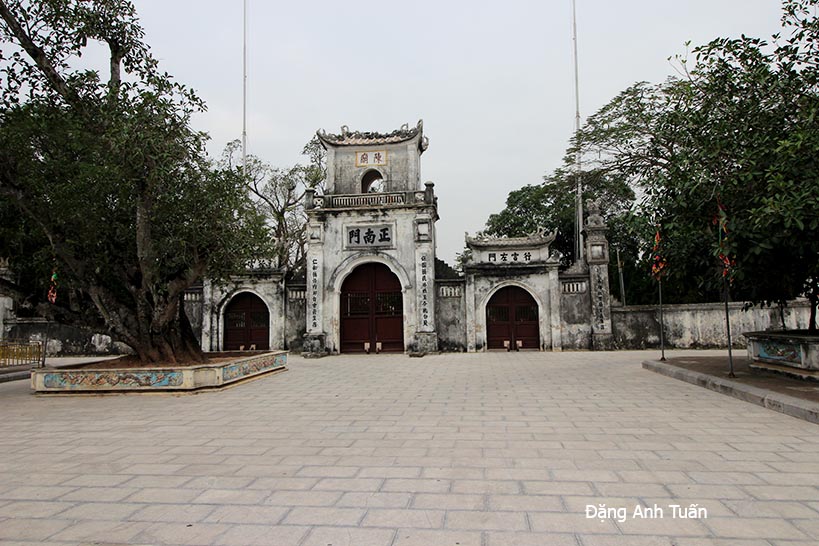
Đây là một quần thể kiến trúc và lịch sữ dành để thờ các vua nhà Trần và các quan có công phù tá. Nằm trên quốc lộ số 10 trong tỉnh Nam Định, đền nầy được xây cất lại năm 1695 trên nền thái miếu cũ được gọi là phủ Thiên Trường mà quân xâm lược nhà Minh phá hủy vào thế kỷ 15.  Cũng ở nơi nầy mà phát tích vương triều nhà Trần.  Các vua nhà Trần tạm về nơi nầy để lánh nạn trong thời gian chống giặc Nguyên Mông của Hốt Tất Liệt.


Temple royal  des Trần

C’est un  ensemble architectural et historique remarquable  dédié au culte des  rois de la dynastie des Trần  et de leurs  célèbres  serviteurs.  Situé à la route nationale n°10 dans la province de Nam Định, il fut reconstruit en 1695 sur l’emplacement de l’ancien temple royal  connu sous le nom « phủ Thiên Trường »  détruit complètement par les envahisseurs chinois (les Ming) au XVème siècle. C’est ici qu’est née la dynastie des Trần. Les rois des Trần  y trouvaient refuge durant la guerre contre les Mongols de Kubilai Khan. 

It is a remakable architectural and historic complex dedicated to the cult of the kings and their famous mandarins from the  Trần dynasty. Located on the national road n°10 in the Nam Định province, it was rebuilt on the site of the former royal temple known under the name « Phủ Thiên Đường » . This one was completely destroyed by  chinese invaders, the Ming in the 15th century.  It is here that was born the Trần dynasty.   The Trần dynasty kings took refuge here during the war against the Mongols of Kubilai Khan.