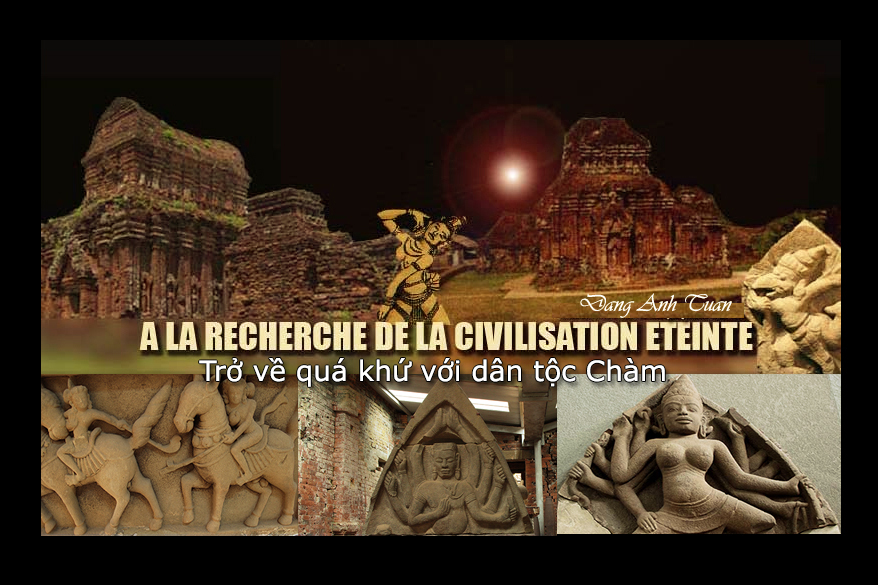
À la recherche de la civilisation éteinte


Back to the past with the Cham people

Version vietnamienne

English version

En s’appuyant sur des documents historiques chinois et vietnamiens, les deux chercheurs français Gaston Maspéro et George Coedès ont essayé de reconstituer la chronologie chame. Malgré d’importantes lacunes, la mention des Chams a été évoquée à l’époque où les habitants de la province de Tượng Lâm (Rinan) s’étaient soulevés contre la domination chinoise en 192 après J.C. pour fonder un état indépendant dont le territoire s’étendait du Quảng Bình jusqu’au Phan Rang. Cet état était réparti en quatre zones: Amaravati (de Quảng Bình à Quảng Nam), Vijaya (de Quảng Ngãi à Phú Yên), Kauthara (Khánh Hoà) et Panduranga (Phan Rang). Deux clans, celui du Nord (ou le clan des Narikelavamsa) (clan Dừa en vietnamien) et celui du Sud ( ou le clan des Kramukavamsa ) (clan Cau en vietnamien) qui par moments guerroyèrent, prirent les rênes du pouvoir par alternance. En fonction de leurs offrandes retrouvées, (noix de coco au Nord et noix d’arec au Sud), ils étaient appelés comme les mangeurs de coco au Nord et ceux d’arec au Sud. Ce pays dont la capitale était sans doute à Trà Kiệu (près de Ðà Nẵng) fut connu durant six siècles sous le nom de Lin Yi (Lâm Ấp) puis à partir de 758 sous celui de Houan Xang (Hoàn Vương). Le nom de Champa (Chiêm Thành ) provenant de la transcription sino-vietnamienne Champapura (cité des Chàms) fut cité pour la première fois en 875. 


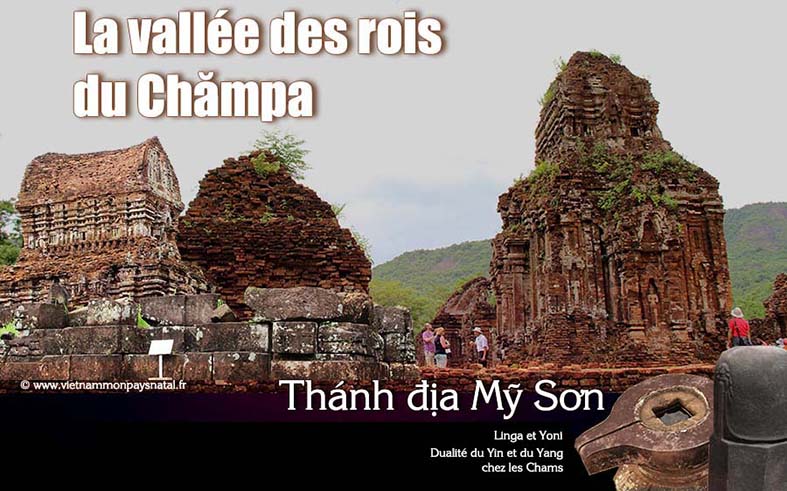
C’était avec ce nom que ce royaume était mentionné maintes fois dans les conflits avec le Vietnam jusqu’à son annexion sous la dynastie des Lê avec le roi Lê Thánh Tôn. Au début de son existence, ce royaume connut une période de prospérité. On vit la construction d’un grand nombre de temples et de sanctuaires dont le premier était celui du site de Mỹ Sơn (Belle Montagne) dédié au culte du linga du dieu roi Civa Bhadresvara par le grand souverain Bhadravarman, c’est ce qu’on a découvert dans les inscriptions écrites en sanskrit. Les fouilles récentes à Mỹ Sơn ont apporté la preuve que Mỹ Sơn n’était pas seulement un lieu de culte mais aussi la nécropole des rois Chàm après l’incinération. On dénombra deux grands ports où le commerce était très florissant: Ðại Chiêm dans la région de Hội An (Faifo) et Thị Nại (Bình Ðịnh)(Sri Bonei). 

Du IV au Vème siècle, ce royaume fut en conflit acharné avec les Chinois qui avaient annexé le Vietnam au nord du Col de Ðèo Ngang. Sa capitale Trà Kiệu connue sous le nom de Simhapura (cité du Lion) et située à 50km au sud-ouest de Ðà Nẵng, fut mise à sac vers 446. Le général chinois Tan Hezhi (Ðàn Hoà Chi) ramena  lors de cette expédition des statues en or pour une valeur totale de cent mille taëls d’or (environ 3600 kg).

La prospérité de cette capitale ne fut plus mise en doute à la suite des découvertes d’un grand nombre d’objets en or finement travaillés pendant les années 80. La description détaillée de cette ville fut déjà mentionnée dans un ouvrage d’histoire chinois Shu Jing Zhu (Thủy Kinh Chú) du VIIème siècle après J. C. Elle a été confirmée par les fouilles en 1927-1928 sous la direction de l’archéologue français J. Y. Claèys de l’École française d’Extrême-Orient.

Du VIème au VIIIème siècle, ce royaume retrouva un essor économique et artistique par le biais des relations très développées avec l’Inde et le Tchenla (Chân Lạp) au Sud. On nota ainsi une introduction importante des objets étrangers dans l’art du Chămpa. Au VIIIème siècle, les Chams furent attaqués sans cesse par les Javanais. Ces derniers détruisirent en 774 le temple de Pô Nagar (Nha Trang) construit en bois par un roi légendaire Vichitrasagara.

Ce sanctuaire fut reconstruit à nouveau cette fois en brique par le roi Satyavarman Içvaraloka en 784. D’après ce qu’on a recueilli dans les inscriptions chames, avant le VIIème siècle, les temples et les tours étaient en bois mais ils ont été incendiés au cours des guerres. C’est seulement au VIIème siècle qu’on vit apparaître les temples et les tours en briques et en grès.

Dès sa montée sur le trône en 854, Indravarman II changea le nom de la capitale de Simhapura dans la région de Trà Kiệu en Indrapura (cité du Dieu de la foudre). Il fit édifier une cité sainte du bouddhisme à Ðồng Dương à 20km au sud de Trà Kiệu et rétablit de bonnes relations avec la Chine.

Au début du Xème siècle, sous le règne du roi Indravarman III, le royaume du Champa commença à tisser des relations étroites avec Java. Rien n’est étonnant de voir l’art cham en contact avec l’art javanais pour tout le siècle.

Par contre, il était en conflit sempiternel au nord avec un nouveau pays, le Ðại Cồ Việt qui vint d’être libéré de la domination chinoise à la fin du Xème siècle et au Sud avec les Khmers. Ceux-ci n’hésitèrent pas à saccager le sanctuaire Po Nagar de Nha Trang vers 950 et dérobèrent la statue d’or qui y avait été installée en 918 par le roi Indravarman II. Les Chams engagèrent des guerres sans merci contre les Khmers durant plus d’un siècle (1112-1220). On nota aussi leurs premiers accrochages sérieux avec le Ðại Cồ Việt en 979. Leur capitale fut pillée en 982 par ce dernier. (l’expédition du grand roi vietnamien Lê Ðại Hành). Face à la pression de celui-ci, le roi Yang Sra Vijaya dut transférer sa capitale dans la région de Vijaya (Bỉnh Ðịnh). Cette nouvelle capitale allait durer jusqu’en 1471 avant d’être transférée à la région de Panduranga (Ninh Thuận).

À cause des dissensions internes et de la guerre de cent ans avec les Khmers, les Chams ne réussirent pas à stopper au fil des siècles la marche du Sud entamée par les Vietnamiens. Ils durent un dernier sursaut à Binasuor(*) (Chế Bồng Nga) qui battit les Vietnamiens à maintes reprises en pillant leur capitale Thăng Long en 1371 et en 1377 et en faisant fuir leur roi Trần Nghệ Tôn et son premier ministre Hồ Qúi Ly. A cause de la trahison de l’un de ses proches, les Vietnamiens réussirent à tuer Binasuor. Cela mit fin à la suprématie des Chams. Ceux-ci devaient céder le terrain aux conquérants vietnamiens et étaient refoulés un peu plus chaque jour dans le Sud. Par la politique d’assimilation, ils étaient obligés d’être disséminés un peu partout dans le centre du Vietnam et dans l’ouest du Sud Vietnam, au Cambodge et en Malaisie.


(*) Certains historiens contestent le nom Binasuor donné à Chế Bồng Nga. (nom mentionné par les Vietnamiens dans leurs documents historiques).

Trở về quá khứ với dân tộc Chàm

Căn cứ vào các tài liệu lịch sử Trung Quốc và Việt Nam, hai nhà nghiên cứu người Pháp Gaston Maspéro và George Coedès đã cố gắng dựng lại niên đại của người dân chàm. Mặc dù có những khoảng trống quan trọng, người ta vẫn thường nhắc đến người dân Chàm vào thời điểm mà cư dân của tỉnh Tượng Lâm (Rinan)  vùng lên chống lại sự đô hộ của Trung Quốc vào năm 192 sau Công nguyên để thành lập một quốc gia độc lập có lãnh thổ trải dài từ Quảng Bình đến Phan Rang. Quốc gia này được chia ra thành bốn vùng: Amaravati (từ Quảng Bình đến Quảng Nam), Vijaya (từ Quảng Ngãi đến Phú Yên), Kauthara (Khánh Hoà) và Panduranga (Phan Rang). Hai thị tộc, một ở miền Bắc (hay tộc Narikelavamsa) (tộc Dừa trong tiếng Việt) và một ở miền Nam (hay tộc Kramukavamsa) (tộc Cau trong tiếng Việt)  có những lúc  giao chiến khốc liệt và luân phiên nhau nắm quyền hành.

Tuỳ theo các lễ vật cúng được tìm thấy (các trái dừa ở miền Bắc và các quả cau ở miền Nam), họ được gọi là  những người ăn dừa ở miền Bắc và những người ăn cau ở miền Nam. Không còn sự nghi ngờ gì nào nữa, đất nước này có một kinh đô ở Trà Kiệu (gần Ðà Nẵng), được biết đến trong sáu thế kỷ liên tục với tên Lâm Ấp và sau đó từ năm 758 được mang tên là Hoàn Vương. Còn tên Chiêm Thành, nó xuất phát từ phiên âm Hán Việt của từ Champapura (thành phố của người  dân Chàm) được nhắc đến lần đầu tiên vào năm 875. Chính nhờ cái tên gọi này, vương quốc mới được nói đến nhiều lần trong các cuộc xung đột với Việt Nam cho đến sự sáp nhập  dưới triều đại nhà Lê với vua Lê Thánh Tôn.

Lúc ban đầu vương quốc này đã trải qua một thời kỳ cực thịnh. Được tìm thấy có rất nhiều  ngôi đền thờ  mà công trình đầu tiên là  thánh địa  Mỹ Sơn ( hay Núi Đẹp) dành để thờ linga của  thần Civa Bhadresvara bởi vua vĩ đại Bhadravarma. Đây là những gì  đã được phát hiện trên các bia ký viết bằng tiếng Phạn. Những cuộc khai quật gần đây ở Mỹ Sơn đã cung cấp bằng chứng cho thấy rằng Mỹ Sơn không chỉ là nơi thờ tự mà còn là tử địa của các vị vua Chàm sau khi hỏa táng. Có hai thương cảng lớn mà  mâu dịch  rất được thịnh vượng: Ðại Chiêm ở vùng Hội An (Faifo) và Thị Nại (Bình Ðịnh) (Sri Bonei).

Từ thế kỷ 4 đến thế kỷ 5, vương quốc này có  cuộc xung đột kịch liệt với Trung Quốc khi nước nầy đã thôn tính Việt Nam ở phía bắc Đèo Ngang. Kinh đô Trà Kiệu được biết đến dưới tên Simhapura (thành phố Sư tử) và nằm cách Ðà Nẵng  50 cây số về phía tây nam, bị cướp phá vào khoảng năm 446. Tướng quân Trung Hoa  tên là Ðàn Hoà Chi đã mang về nước   những tượng vàng trong cuộc viễn chinh này trị giá tổng công là một trăm nghìn lượng vàng (tương đương 3600 kí lô). Sự thịnh vượng của thủ đô này không còn là  nghi vấn nữa sau khi phát hiện ra một số lượng lớn các đồ vật bằng vàng được chế tạo một cách tinh xảo trong những năm 1980. Sự mô tả chi tiết về thành phố này đã được đề cập trong một cuốn sách lịch sử Trung Quốc Thủy Kính Chủ (Shu Jing Zhu) từ thế kỷ thứ 7 sau Công nguyên và đã được xác nhận bởi các cuộc khai quật vào những năm 1927-1928 dưới sự chỉ đạo của nhà khảo cổ học người Pháp J.Y. Claèys của Trường Viễn Đông Pháp.

Từ thế kỷ 6 đến thế kỷ 8, vương quốc này có được sự tăng trưởng  kinh tế và nghệ thuật thông qua các quan hệ  phát triển với Ấn Độ và Chân Lạp ở phía Nam. Do đó, có một sự gia nhập  quan trọng của các vật thể ngoại lai trong nghệ thuật Chămpa. Vào thế kỷ thứ 8, người Chăm liên tục bị người Chà Và (Java) tấn công. Sau khi bị phá hủy vào năm 774, đền thờ Pô Nagar ở Nha Trang được xây dựng lại bằng gỗ bởi một vị vua huyền thoại Vichitrasagara.

Thánh địa này được vua Satyavarman Içvaraloka xây dựng lại lần này bằng gạch vào năm 784. Theo những gì chúng ta tìm thấy trên các bia ký của người Chăm, trước thế kỷ thứ 7, các ngôi đền và các tháp đều được làm bằng gỗ nhưng chúng đã bị đốt cháy trong các cuộc chiến tranh. Chỉ đến thế kỷ thứ 7, các ngôi đền và các tháp bằng gạch và đá sa thạch mới thấy xuất hiện.

Khi lên ngôi vào năm 854, Indravarman II đã đổi tên thủ đô Simhapura ở vùng Trà Kiệu thành Indrapura (Thành phố của Thần Sét). Ông đã xây dựng một thánh địa Phật giáo tại Ðồng Dương, cách Trà Kiệu 20 c ây số về phía nam và thiết lập lại mối quan hệ tốt đẹp với Trung Quốc.

Vào đầu thế kỷ thứ 10, dưới triều đại của vua Indravarman III, vương quốc Champa bắt đầu thiết lập quan hệ thân thiết với Java. Không có gì ngạc nhiên khi thấy nghệ thuật Chăm tiếp cận với nghệ thuật Java trong suốt  cả thế kỷ.

Mặt khác, ở phía bắc có một cuộc xung đột  triền miên với một quốc gia mới, nước Ðại Cồ Việt vừa được giải phóng ra khỏi ách thống trị của Trung Quốc vào cuối thế kỷ thứ 10 và ở phía nam với những người Khơ Me. Những người nầy không ngần ngại cướp phá đền thờ Po Nagar ở Nha Trang vào khoảng năm 950 và lấy trộm bức tượng vàng được đặt ở đây vào năm 918 bởi vua Indravarman II. Người Chăm đã tiến hành các cuộc chiến tranh tàn khốc chống lại người Khơ Me có hơn một thế kỷ (1112-1220). Chúng ta cũng ghi nhận cuộc đụng độ nghiêm trọng đầu tiên của họ với Đại Cồ Việt vào năm 979. Kinh đô của họ bị cướp phá vào năm 982 bởi người dân nước nầy (cuộc viễn chinh của vua vĩ đại Lê Ðại Hành). Trước sức ép của người dân Việt, vua Yang Sra Vijaya phải dời đô về vùng Vijaya (Bình Ðịnh). Thủ đô mới này được tồn tại đến năm 1471 trước khi được chuyển đến vùng Ninh Thuận (Panduranga).

Vì những bất đồng ở trong nội bộ và cuộc chiến tranh hơn một trăm năm với người Khơ Me, người Chăm đã không thành công trong việc ngăn chặn  được  Nam Tiến của người  dân Việt  qua nhiều thế kỷ. Họ có được một nổ lực  lần cuối  với Chế Bồng Nga (*), người  anh hùng Chàm đã đánh bại  người dân Việt nhiều lần bằng cách cướp bóc kinh đô Thăng Long vào năm 1371 và năm 1377 và làm vua Trần Nghệ Tôn và tể tướng Hồ Qúi Ly phải bỏ trốn kinh thành. Do sự phản bội của một trong những người thân tín của mình, người Việt đã tìm cách giết được Chế Bồng Nga. Việc này kết thúc sự ưu thế của người dân Chàm. Từ  đó những người này phải nhường  bước trước những người viễn chinh Việt và bị đẩy lùi mỗi ngày một ít ở miền Nam. Bằng chính sách đồng hóa, họ buộc lòng  phải ở rải rác từ đây khắp cả miền trung Việt Nam, miền tây Nam Bộ, Cao Miên và Mã Lai.


(*) Một số sử gia tranh cãi về cái tên Binasuor gán cho Chế Bồng Nga. (Tên nầy  được người Việt Nam nhắc đến trong các tài liệu lịch sử của họ).

English version

Back to the past with the Cham people

Relying on Chinese and Vietnamese historical documents, the two French researchers Gaston Maspéro and George Coedès tried to reconstruct the Cham chronology. Despite significant gaps, the mention of the Chams was made at the time when the inhabitants of the province of Tượng Lâm (Rinan) rose up against Chinese domination in 192 AD to found an independent state whose territory extended from Quảng Bình to Phan Rang. This state was divided into four zones: Amaravati (from Quảng Bình to Quảng Nam), Vijaya (from Quảng Ngãi to Phú Yên), Kauthara (Khánh Hòa), and Panduranga (Phan Rang). Two clans, the Northern clan (or the Narikelavamsa clan) (Dừa clan in Vietnamese) and the Southern clan (or the Kramukavamsa clan) (Cau clan in Vietnamese), who at times waged war, took turns holding power. Based on their offerings found (coconuts in the North and areca nuts in the South), they were called the coconut eaters in the North and the areca eaters in the South. This country, whose capital was probably at Trà Kiệu (near Ðà Nẵng), was known for six centuries under the name Lin Yi (Lâm Ấp) and then from 758 under that of Houan Xang (Hoàn Vương). The name Champa (Chiêm Thành), coming from the Sino-Vietnamese transcription Champapura (city of the Chams), was mentioned for the first time in 875.

It was with this name that this kingdom was mentioned many times in conflicts with Vietnam until its annexation under the Lê dynasty with King Lê Thánh Tôn. At the beginning of its existence, this kingdom experienced a period of prosperity. A large number of temples and shrines were built, the first being the site of Mỹ Sơn (Beautiful Mountain) dedicated to the worship of the linga of the god-king Shiva Bhadresvara by the great sovereign Bhadravarman, as discovered in inscriptions written in Sanskrit. Recent excavations at Mỹ Sơn have provided evidence that Mỹ Sơn was not only a place of worship but also the necropolis of the Champa kings after cremation. Two major ports were counted where trade was very flourishing: Ðại Chiêm in the Hội An (Faifo) region and Thị Nại (Bình Ðịnh) (Sri Bonei).

From the 4th to the 5th century, this kingdom was in fierce conflict with the Chinese who had annexed Vietnam north of the Ðèo Ngang Pass. Its capital Trà Kiệu, known as Simhapura (Lion City) and located 50 km southwest of Ðà Nẵng, was sacked around 446. The Chinese general Tan Hezhi (Ðàn Hoà Chi) brought back during this expedition gold statues worth a total of one hundred thousand taels of gold (approximately 3600 kg).

From the 6th to the 8th century, this kingdom experienced an economic and artistic resurgence through highly developed relations with India and Chenla (Chân Lạp) to the south. There was thus a significant introduction of foreign objects into Cham art. In the 8th century, the Chams were constantly attacked by the Javanese. In 774, the latter destroyed the Pô Nagar temple (Nha Trang), which had been built of wood by the legendary king Vichitrasagara.

This sanctuary was rebuilt, this time in brick, by King Satyavarman Içvaraloka in 784. According to what has been gathered from Cham inscriptions, before the 7th century, temples and towers were made of wood but were burned down during wars. It was only in the 7th century that temples and towers made of brick and sandstone appeared.

Upon ascending the throne in 854, Indravarman II changed the name of the capital from Simhapura in the Trà Kiệu region to Indrapura (City of the God of Thunder). He built a sacred Buddhist city at Ðồng Dương, 20 km south of Trà Kiệu, and restored good relations with China.

At the beginning of the 10th century, under the reign of King Indravarman III, the kingdom of Champa began to forge close relations with Java. It is not surprising to see Cham art in contact with Javanese art throughout the century.

However, it was in perpetual conflict in the north with a new country, Đại Cồ Việt, which had just been freed from Chinese domination at the end of the 10th century, and in the south with the Khmers. The latter did not hesitate to sack the Po Nagar sanctuary in Nha Trang around 950 and stole the golden statue that had been installed there in 918 by King Indravarman II. The Chams waged merciless wars against the Khmers for more than a century (1112-1220). Their first serious clashes with Đại Cồ Việt were also noted in 979. Their capital was pillaged in 982 by the latter (the expedition of the great Vietnamese king Lê Đại Hành). Facing pressure from him, King Yang Sra Vijaya had to transfer his capital to the Vijaya region (Bình Định). This new capital lasted until 1471 before being moved to the Panduranga region (Ninh Thuận).

Because of internal dissensions and the Hundred Years’ War with the Khmers, the Chams were unable to stop, over the centuries, the southward advance initiated by the Vietnamese. They made a last stand under Binasuor(*) (Chế Bồng Nga), who defeated the Vietnamese many times by pillaging their capital Thăng Long in 1371 and 1377 and forcing their king Trần Nghệ Tôn and his prime minister Hồ Qúi Ly to flee. Because of the betrayal of one of his close associates, the Vietnamese managed to kill Binasuor. This ended the supremacy of the Chams. They had to yield ground to the Vietnamese conquerors and were pushed back a little more each day to the south. Through assimilation policies, they were forced to be scattered throughout central Vietnam, the western part of southern Vietnam, Cambodia, and Malaysia.


(*) Some historians dispute the name Binasuor given to Chế Bồng Nga. (name mentioned by the Vietnamese in their historical documents).
[Return to CHAMPA]


Musée de la sculpture chame (Đà Nẵng)

English version
Version française
Galerie des photos

phatmau_tara

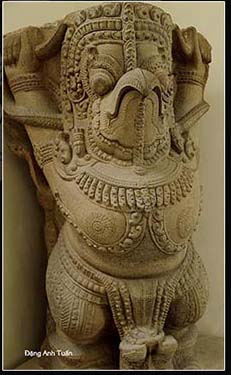
Trước khi trở thành ngày nay bảo tàng điêu khắc Chămpa, nơi nầy được biết đến từ thời xa xưa với tên gọi vườn điêu khắc. Chính tại đây, bắt đầu có sự thu thập và bảo quản một phần lớn, dưới sự bảo trợ của kiến ​​trúc sư khảo cổ học Henri Parmentier và các thành viên của Trường Viễn Đông Pháp (EFEO) vào cuối thế kỷ 19,  tất cả các bảo vật qua những các cuộc khai quật khảo cổ học ở miền Trung (từ dãy núi Hoành Sơn, Quãng Bình ở phía bắc đến Bình Thuân (Phan Thiết) ở phía nam), nơi có một vương quốc cổ Đông Dương được biết đến vào đầu thế kỷ thứ 2 với tên gọi Lâm Ấp rồi đến tên Hoàn Vương và cuối cùng là tên Chiêm Thành cho đến khi bị Việt Nam sáp nhập vào năm 1471. Mở cửa cho công chúng vào năm 1919, bảo tàng viện này ban đầu lấy tên của người sáng lập là « Musée Henri Parmentier » và có đến 190 bảo phẩm trong đó có cả bệ nổi tiếng của địa danh Phật giáo Đồng Dương.

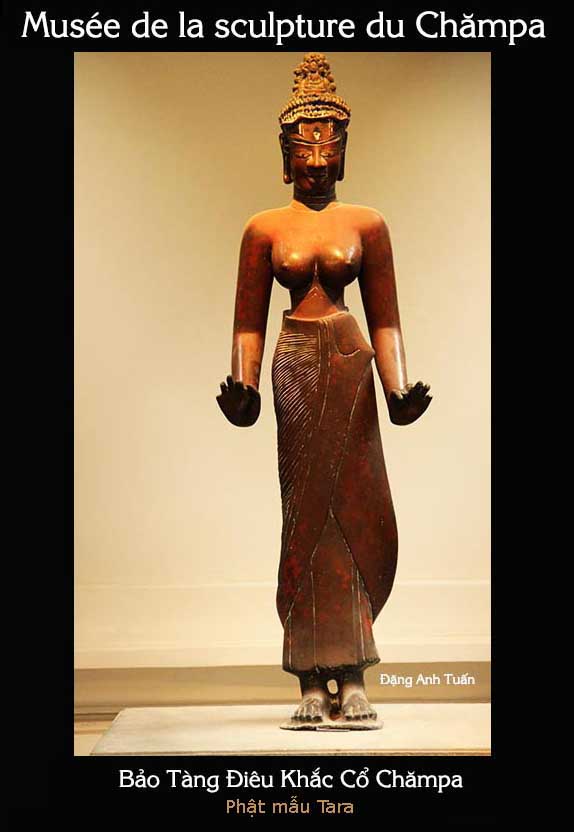
Sau đó, bảo tàng đã không ngừng phát triển kể từ năm 1975 để đạt đến diện tích ngày nay là 2.000 m² trên tổng số hơn 6.600 m² và đã có được vào năm 1978 một  kiệt tác nghệ thuật bằng đồng vĩ đại, bức tượng Laksmindra-Lokesvara (Quan Âm chuẩn đề) thường được gọi là Phật mẫu Tara. Qua nhiều thập kỷ, nơi nầy đã trở thành bảo tàng duy nhất ở trên thế giới về lĩnh vực nghệ thuật Chămpa và  cho phép khách du lịch cũng biết được niên đại của lịch sử của vương quốc  Chămpa vì tất cả các phong cách điêu khắc đều có hiện diện qua các bảo vật đến từ các đia danh Mỹ Sơn, Đồng Dương, Trà Kiệu  và Pô Nagar (Nha Trang). Đối với nhà nghiên cứu người Pháp Jean Boisselier, điêu khắc Chămpa luôn gắn liền với lịch sử. Dù có sự tiến triển ở trong phong cách điêu khắc  qua dòng lịch sữ, Chămpa vẫn tiếp tục giữ các tạo vật thần linh và các sinh vật  trong một chủ đề không thay đổi. Đây là một bảo tàng không thể bỏ qua nếu du khách có dịp ghé thăm Đà Nẵng.

  • Style de Mỹ Sơn E1 (Phong cách E1)
  • Style de Mỹ Sơn E1 (Phong cách E1)
  • Style de Chính Lộ (Phong cách Chính Lộ )
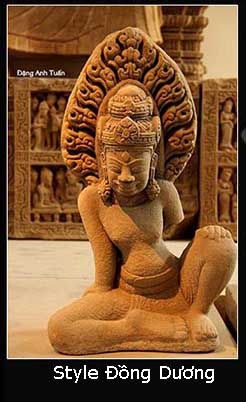
  • Style de Đồng Dương ( Phong cách Đồng Dương)
  • Style de Tháp Mắm (Phong cách Tháp Mắm)     

Version anglaise

Before becoming today the Champa Sculpture Museum, it was known in a distant time as the Sculpture Garden. It was here that, largely under the guidance of the archaeologist and architect Henri Parmentier and members of the French School of the Far East (EFEO) at the end of the 19th century, all the artifacts found during archaeological excavations in the central regions (from the Annamite Cordillera Hoành Sơn, Quảng Bình in the north to Bình Thuận (Phan Thiết) in the south) were gathered and preserved. This area was once home to an ancient Indochinese kingdom known at the beginning of the 2nd century as Linyi, then Huanwang, and finally Champa until its annexation by Vietnam in 1471. Opened to the public in 1919, this museum initially took the name of its founder, « Musée Henri Parmentier, » and housed 190 artifacts, among which was the famous pedestal from the Đồng Dương Buddhist site. Since 1975, the museum has continuously expanded to reach today an area of 2,000 m² out of a total of more than 6,600 m² and acquired in 1978 the great masterpiece of bronze art, the statue of Laksmindra-Lokesvara (Quan Âm chuẩn đề), often known as Tara.

style_thapmam

Style de Tháp Mắm

Over the decades, it has become the only museum in the world dedicated to Champa art. It also allows tourists to understand the chronology of Champa history, as all styles are present through artifacts from the famous sites of Mỹ Sơn, Đồng Dương, Trà Kiệu, and Pô Nagar (Nha Trang). According to the French researcher Jean Boisselier, Cham sculpture is always closely linked to history. Despite the evolution of styles throughout its history, Cham sculpture continues to maintain the same divine and animal creatures within a consistent theme. It is a museum not to be missed if you have the opportunity to visit Đà Nẵng.

  • My Son E1 Style (E1 Style):liveliness in ornamentation, finesse in details.
  • Khương Mỹ Style: softness in faces, harmony and symmetry.
  • Chính Lộ Style (Chính Lộ Style):the beauty of adornments, the half-smile, the enhancement of feminine beauty (developed breasts, swaying hips, etc.)
  • Đồng Dương Style (Đồng Dương Style):the typical facial appearance (prominent eyebrows, thick lips with the corners.
  • Tháp Mắm Style (Tháp Mắm Style): an art pushed to its limits with unreality and extravagance.

Version française

Avant de devenir  aujourd’hui le musée de la sculpture du Champa, il était connu  à une époque lointaine sous le nom du jardin de la sculpture. C’était ici qu’on commença à rassembler et à conserver en grande partie, sous l’égide de l’archéologue architecte  Henri Parmentier  et des membres de l’Ecole Française de l’Extrême Orient (EFEO) à la fin du 19ème siècle  toutes les artefacts  trouvés d’un  lors des fouilles archéologiques  dans les régions du centre (de la cordillère anamitique  Hoành Sơn, Quãng Bình au nord jusqu’à Bình Thuận (Phan Thiết) au sud) où  exista un ancien royaume d’Indochine  connu au début du  IIème siècle sous le nom de Linyi puis Huanwang et enfin Champa jusqu’à  son annexion  par le Vietnam en 1471. Ouvert au public en 1919, ce musée prit dans un premier temps le nom de son fondateur « Musée Henri Parmentier » et abrita 190 artefacts parmi lesquels figurait le piédestal célèbre  du site bouddhique Đồng Dương.  Puis le musée  ne cessa pas de s’agrandir depuis 1975  pour atteindre aujourd’hui une surface de 2.000 m² sur un total de plus de 6.600 m² et d’acquérir en l’an 1978 le grand chef d’œuvre de l’art du bronze, la statue de Laksmindra-Lokesvara (Quan Âm chuẩn đề) connue souvent sous le nom de Tara.

Il  devient au fil des décennies le musée unique au monde dans le domaine de l’art du Champa. Il permet au touriste de connaître également la chronologie de l’histoire du Champa car tous les styles sont présents à travers des artefacts venant des sites célèbres Mỹ Sơn, Đồng  Dương, Trà Kiệu et Pô Nagar (Nha Trang). Pour le chercheur français Jean Boisselier, la sculpture chame est toujours en liaison étroite avec l’histoire. Malgré l’évolution des styles au fil de son histoire, la sculpture chame continue à garder les mêmes créatures divines et animales dans une thématique constante. C’est un musée à ne  pas manquer si on a l’occasion de visiter Đà Nẵng.

  • Style de Mỹ Sơn E1: vivacité dans l’ornementation, finesse dans les détails…style_dongduong
  • Style de Khương Mỹ: la douceur dans les visages, l’harmonie et la symétrie…
  • Style de Trà kiệu: la beauté des parures, le demi-sourire, la mise en valeur de la beauté féminine ( seins développés, déhanchement etc.)
  • Style de Đồng Dương: l’apparence faciale typique ( sourcils proéminents, lèvres épaisses avec les commissures.
  • Style de Tháp Mắm: un art poussé à ses limites avec irréalisme et extravagance.

 Galerie des photos

[Return MUSEUM]

[Return CHAMPA]


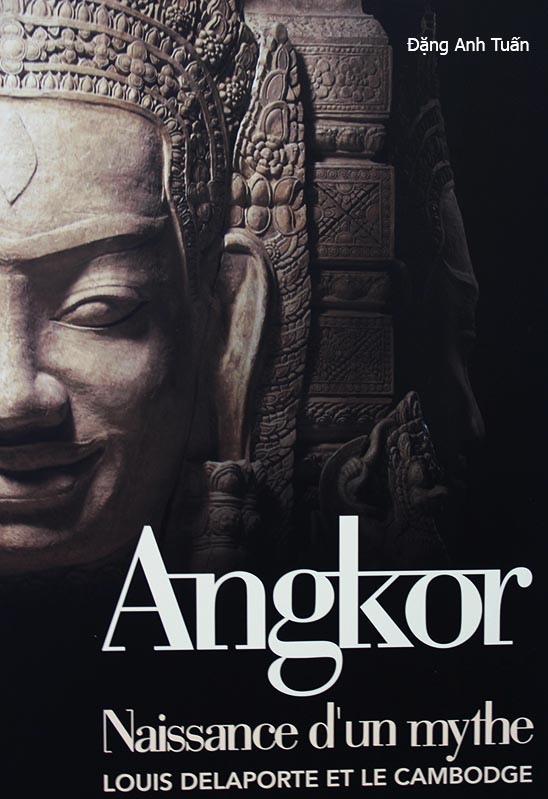
Louis Delaporte et le Cambodge: Angkor. Naissance d’un mythe.

Version vietnamienne
Version  anglaise
Galerie des photos

Un voyage virtuel à la découverte d’Angkor


Choisi pour ses talents de dessinateur, Louis Delaporte fait partie de l’expédition dirigée par Doudard de Lagrée et Francis Garnier chargés de vérifier la navigabilité du fleuve Mékong (1866). Contrairement aux autres membres de l’exploration, Louis Delaporte s’intéresse seulement à la sculpture khmère lorsqu’il découvre Angkor et ses ruines. Il en rapportera maintes documents originaux (dessins aquarelles, plans, moulages, sculptures originales etc.) que le musée Guimet tente de réunir aujourd’hui pour honorer la mémoire d’un savant habité par l’esprit ouvert et curieux en un temps où le mépris envers les peuples colonisés est de règle.


Chosen for his drawing talents, Louis Delaporte was part of the expedition led by Doudard de Lagrée and Francis Garnier tasked with assessing the navigability of the Mekong River (1866). Unlike the other members of the exploration, Louis Delaporte was only interested in Khmer sculpture when he discovered Angkor and its ruins. He brought back many original documents (watercolor drawings, plans, molds, original sculptures, etc.) that the Guimet Museum is now trying to gather to honor the memory of a scholar driven by an open and curious spirit at a time when contempt for colonized peoples was the norm.


Nhờ tài năng họa sỹ, Louis Delaporte được tháp tùng phái đoàn thám hiểm sông Cửu Long do Doudard de LagréeFrancis Garnier lãnh đạo nhằm  mục đích để đánh giá sự giao thông của con sông vào năm 1866. Khác hẳn với mọi người trong phái đoàn, Louis Delaporte chỉ chú ý đến  nghệ thuật điêu khắc của người Cao Miên khi ông khám phá Angkor và các di tích hư hỏng.  Ông mang về Pháp rất nhiều tài liệu nguyên bản ( các bức tranh màu nước, các bản vẽ, các vật đúc khuôn, các tác phẩm điêu khắc vân vân ….)  mà bảo tàng Guimet ở Paris cố gắng thu thập lại để tưởng nhớ và tôn vinh một nhà bác học đã có ở thời đó một tâm trí cởi mở và hiếu kỳ, một thời mà các dân ở các nước bị xâm chiếm thường bi khinh khi. Có một thời , các bảo vật nầy được giữ ở tu viện Saint Riquier (Somme), nay có dịp để bảo tàng viện Guimet trưng bày các bảo vật nầy. Hiện nay , các bảo vật nầy được xem như là một nguồn tài liệu bổ sung và ngoài lệ nhất là với tình trạng hư hỏng hiện nay của Angkor.

Exposition du 16 Octobre 2013-13 Janvier 2014

Cliquez pour voir les photos correspondantes

Retirés des caves de l’abbaye de Saint Riquier (Somme), ces moulages effectués lors de différentes missions de Louis Delaporte sont exposés actuellement au musée Guimet. Vu l’état actuel de la détérioration du site actuel Angkor, ils apparaissent comme une source de documentation complémentaire et exceptionnelle.

Removed from the cellars of the Abbey of Saint Riquier (Somme), these casts made during various missions of Louis Delaporte are currently exhibited at the Guimet Museum. Given the current state of deterioration of the Angkor site, they appear as an additional and exceptional source of documentation.

Được khai quật từ hầm rượu của Tu viện Saint Riquier (Somme), những bản đúc này được thực hiện trong các sứ mệnh khác nhau của Louis Delaporte hiện đang được trưng bày tại Bảo tàng Guimet. Xét đến tình trạng xuống cấp hiện tại của khu di tích Angkor, chúng dường như là một nguồn tư liệu bổ sung và đặc biệt.

Trở về thời đại vàng son của Angkor

[Return MUSEUM]

[Return Empire Khmer]

Bayon (Angkor Thom)


bayon

English version
French version
Galerie des photos

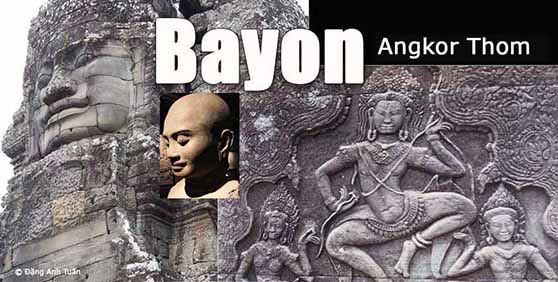
Bayon là ngôi đền trung tâm của thành phố cổ Angkor Thom, kinh đô của các vị vua Khơ Me vào đầu thế kỷ 13. Đây là ngôi đền-núi cuối cùng được xây dựng bởi vua Jayavarman VII, người khôi phục quyền lực hoàng gia của vương quốc Khmer Angkor sau cuộc xâm lược của người Chăm. Kiến trúc trang trí đặc biệt phong phú của Bayon đạt đến đỉnh cao của nghệ thuật Phật giáo Đại thừa. Vị vua này đã dành riêng tượng đài này cho Đức Phật, người đã truyền bá giáo lý của Ngài bằng các tháp mặt. Có hơn 37 tháp hài hòa xung quanh một tháp trung tâm lớn, chính là thánh địa. Nhưng theo Paul Mus, người ta cho rằng có thể có nhiều hơn, có lẽ là 54 tháp với 216 mặt.

 Những tòa tháp này được xây dựng bằng cách xếp chồng các khối đá lên nhau mà không cần xi măng. Việc chạm khắc sẽ được thực hiện sau khi các khối đá được đặt vào đúng vị trí. Người Cao Miên cổ đại đã dùng sức mạnh cơ học nào để nâng những khối đá khổng lồ lên đến phần cao nhất của tòa nhà sau khi khai thác chúng từ những ngọn núi xa xôi, đánh bóng và điêu khắc chúng? Đây là câu hỏi thường ám ảnh Henri Mouhot trong quá trình khám phá tàn tích Angkor. 

Ở bốn mặt của mỗi tòa tháp, người ta thấy những khuôn mặt khổng lồ với nụ cười bí ẩn, mỗi khuôn mặt hướng về một trong bốn phương chính. Du khách có cảm giác như đang bị theo dõi bởi ánh mắt nham hiểm của chúng. Đối với Pierre Loti, Bayon là ngọn núi đá nặng nhất mà con người dám xây dựng kể từ kim tự tháp Memphis
img_5621
Trong tác phẩm « Hành trình đến các Vương quốc Xiêm, Campuchia, Lào và các vùng Trung Đông Dương », Henri Mouhot, người phát hiện ra tàn tích Angkor, đã để lại ấn tượng sâu sắc: Mặc dù vàng bạc và các loại màu sắc gần như đã biến mất hoàn toàn khỏi công trình, nhưng chỉ còn lại những viên đá. Nhưng chúng minh chứng cho thiên tài, sức mạnh và sự kiên nhẫn, tài năng, sự giàu có và quyền lực của người Cao Miên ngày xưa. 

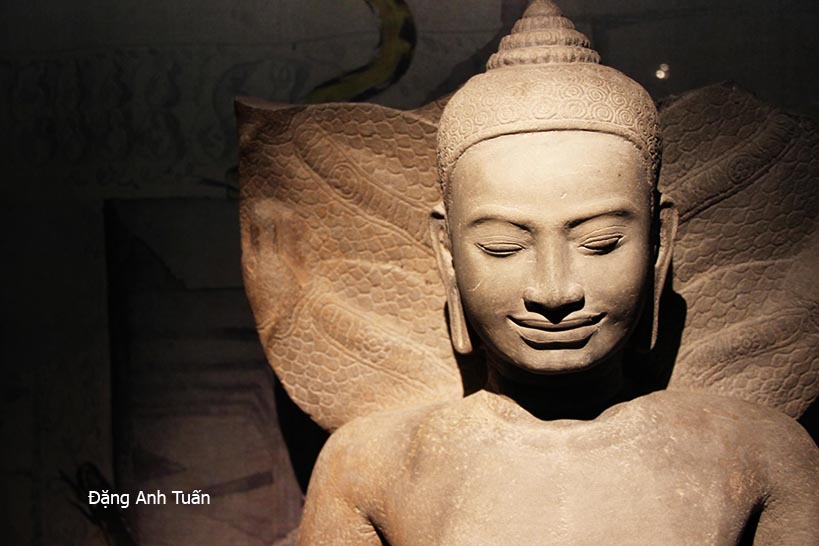
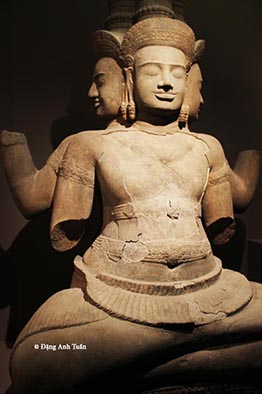
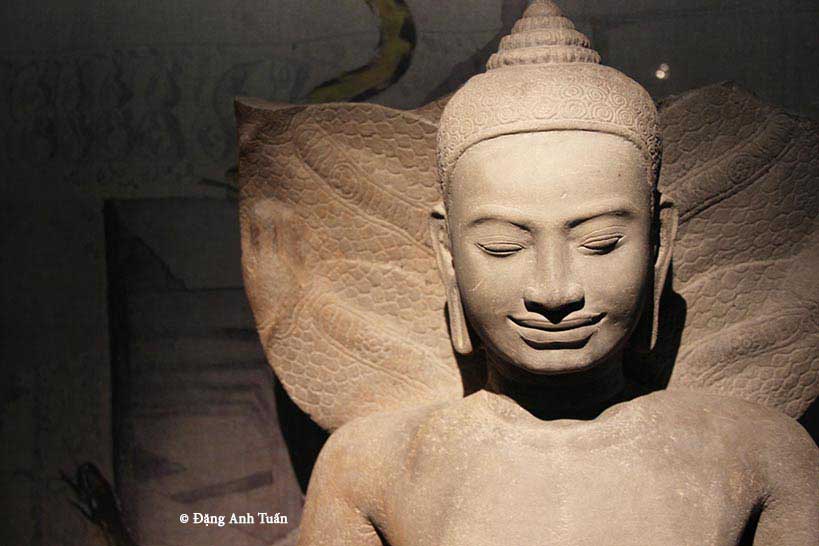
Một cuộc khai quật gần đây vào năm 1933 đã phát hiện ra hình ảnh vua Jayavarman VII dưới dạng một vị Phật trong phần còn lại của một bức tượng đá lớn cao 3,60 mét. Người xây dựng Bayon đang ngồi, hai chân gập lại trên thân hình cuộn tròn của thần rắn. Kể từ đó, khuôn mặt này, nụ cười huyền bí trên các tòa tháp Bayon, được cho là của vua Jayavarman VII. 

Bayon est le temple central de l’ancienne ville d’Angkor Thom, capitale des souverains khmers au début du XIIIème siècle. C’est le dernier des temple-montagnes bâtis par le roi Jayavarman VII, restaurateur de puissance royale du royaume khmer d’Angkor après l’invasion des Chams. Sa décoration d’une richesse exceptionnelle est à l’apogée de l’art bouddhique mahayana. Ce roi dédie ce monument à Bouddha dont il diffuse la doctrine avec ses tours à visages. Il y a plus que 37 tours harmonieuses autour d’une grande tour centrale, le sanctuaire. mais on pense qu’elles pourraient être plus nombreuses, peut être 54 tours avec 216 visages selon Paul Mus. 

Bouddha roi au musée Guimet

img_5645

Ces tours sont construites par la pose des blocs de pierre empilés les uns sur les autres sans aucun ciment. La sculpture sera faite après l’achèvement de la mise en place de ces blocs rocheux. Quelle force mécanique ont- ils eu, les Cambodgiens d’autrefois, pour soulever les blocs de pierre énormes jusqu’aux parties les plus élevées de l’édifice après les avoir extrait des montagnes éloignées, les avoir polis et sculptés? C’est cette question qui a hanté fréquemment Henri Mouhot lors de la découverte des ruines d’Angkor.

On trouve sur les quatre faces de chaque tour des visages gigantesques au sourire énigmatique, chacun d’eux tourné respectivement vers l’un des quatre points cardinaux. Le visiteur a l’impression d’être suivi par leur regard glauque. Pour Pierre Loti, Bayon était la plus pesante montagne de pierres que les hommes ont osé entreprendre depuis les pyramides de Memphis.

Dans son ouvrage intitulé  » Voyage dans les royaumes de Siam, de Cambodge, de Laos et autres parties centrales de l’Indochine », Henri Mouhot, le découvreur des ruines d’Angkor, a laissé son impression: Malgré la disparition de l’or et des couleurs qui ont presque totalement disparu de l’édifice, il n’y reste que des pierres. Mais celles-ci proclament haut le génie, la force et la patience, le talent, la richesse et la puissance des Cambodgiens d’autrefois.

On a découvert récemment lors d’une fouille réalisée en 1933, dans les restes brisés d’une grande statue de pierre de 3,60 m de hauteur, la représentation de Jayavarman VII en bouddha roi. Le bâtisseur du Bayon est assis, les jambes repliées sur le corps lové du naga. Depuis lors, on a attribué ce visage au sourire mystique trouvé sur les faces des tours de Bayon à celui de Jayavarman VII.

Galerie des photos de Bayon

[Return Empire khmer]

Angkor Vat (Đế Thiên Đế Thích)

Angkor Vat: joyau de l’architecture khmère

angkor_vat

English version

French version
picture-591

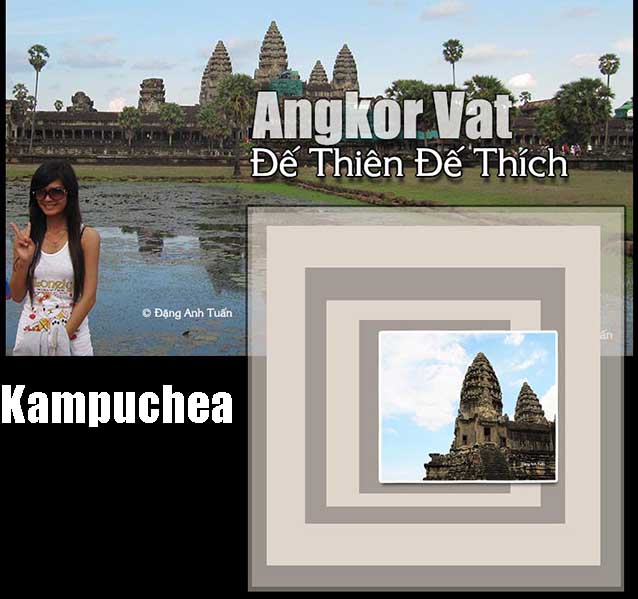
Angkor Wat là ngọn núi đền thờ Khơ Me lớn và hùng vĩ nhất. Nó được xây dựng dưới triều đại của vua Suryavarman II vào nửa đầu thế kỷ 12. Nơi đây được coi là kinh đô của Đế chế Khmer, với đền thờ quốc gia dành riêng cho thần Vishnu ở trung tâm.

Chính tại đây, các tòa tháp  được dựng lên theo cách ngũ hợp. Hai đặc điểm chính của kiến ​​trúc Khmer được ghi nhận ở đây: các kim tự tháp hay núi đền thờ tượng trưng cho Núi Meru (nơi ở của các vị thần) và các hành lang được xây dựng chồng lên nhau. Nhiều người coi đây là kỳ quan thứ tám của thế giới. Các ngọn núi đền thờ khác có thể tham quan: Bakeng, Takeo, Baphuon, Pre Rup, BakongAk Yum.

Angkor Vat est le temple-montagne le plus grand et le plus sublime de tous les temples khmers. Il fut construit durant le règne de Sûryavarman II dans la première moitié du XIIème siècle. Il a été considéré comme capitale de l’empire khmer ayant en son centre le temple d’état dédié à Vishnu. C’est ici que sont dressées les tours en quinconce. Deux caractéristiques majeures de l’architecture khmère y sont relevées: les pyramides ou temples-montagnes symbolisant le mont Méru (demeure des Dieux) et les galeries qui ont été construites l’une au dessus de l’autre. Beaucoup de gens le considèrent comme la huitième merveille du monde. D’autres temples-montagnes peuvent êtres visités: Bakeng, Takeo, Baphuon, Prè Rup, Bakong et Ak Yum.

[Return Empire khmer]

Hội An et ses yeux du dragon

Version vietnamienne

Version anglaise

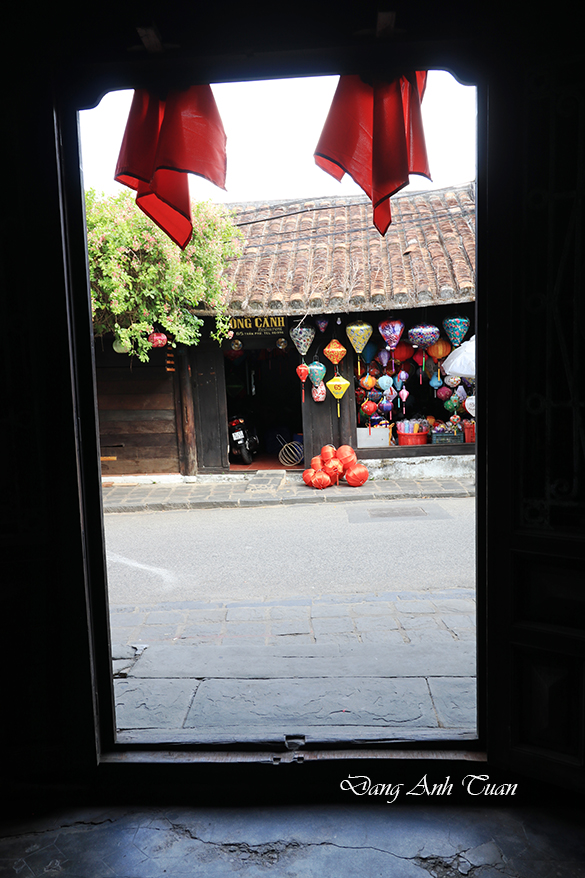
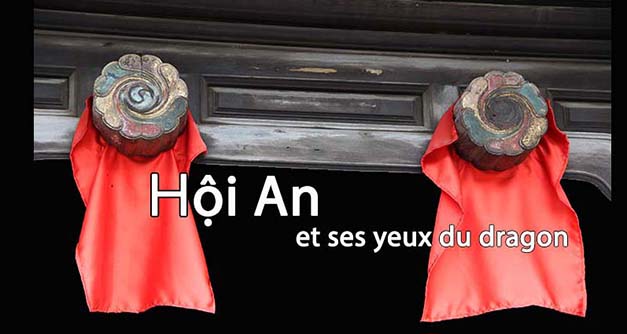
Une autre caractéristique importante de la maison traditionnelle de Hội An est la présence d’une paire des « yeux du dragon » en bois accrochés souvent au-dessus de sa porte d’entrée. Parfois on les retrouve à l’intérieur de la maison. On recense au moins une douzaine de modèles ayant chacun une forme différente: un rond, un octogone  etc… mais le modèle le plus commun trouvé reste le chrysanthème à huit pétales correspondant aux 8 caractères trouvés dans le Yi King (Kinh Dịch) et ayant à son centre le symbole du Yin et du Yang (Âm Dương). Ces yeux du dragon sont aussi un détail important que l’architecte polonais Kazimierz Kwiatkowsky (Kazik) ne laissa pas s’échapper au moment où il avait eu l’occasion d’examiner l’architecture de Hội An, en particulier celle de ses maisons traditionnelles. Certains spécialistes trouvent dans ces yeux l’incarnation de l’âme de la ville Hội An tandis que d’autres attribuent à cette paire l’allégorie de la culture et de la tradition orientale. Selon l’écrivain Hữu Ngọc, les chercheurs ont trouvé leur origine à partir des clous en bois dont on est habitué à voir la fixation dans les linteaux des portes d’accès aux temples bouddhistes dans le Sud de la Chine.

Personne ne conteste cette explication relative à leur origine mais on est amené à penser que cette paire d’yeux revêt plutôt une signification très spéciale, un caractère spirituel ou religieux que le propriétaire de la maison aimerait lier à son destin lors de son installation. Pour ce dernier, ces yeux ont la faculté d’entendre les réflexions de chaque membre au sein de la famille et de capter aussi tout ce qui s’est passé autour de la maison et au cœur même de sa propre vie. Il faut se rappeler qu’avant d’être sinisés, les gens de la région du Sud de la Chine faisaient partie du groupe Bai Yue (Cent Yue). Analogues aux Vietnamiens, ils étaient animistes car ils croyaient qu’il existait une force vitale, une âme animant tous les êtres naturels ou non (y compris les objets). (Vạn vật hữu linh). Ce culte perdurait depuis la nuit des temps. Ces yeux du dragon sont en quelque sorte ceux du génie protecteur de la maison.

On retrouve le même culte chez d’autres peuples: dvàrapàla (gardien de la porte) (Hộ pháp) chez les Cham. Les Vietnamiens n’échappent pas non plus à ce culte ainsi que les Thaïlandais et les Cambodgiens. C’est le cas des génies du bien et du mal qu’on trouve souvent à l’entrée de la pagode. On est habitué à voir aussi sur la proue des barques vietnamiennes ces deux yeux censés de se prémunir contre les esprits malfaisants lors de la navigation maritime. Etant utilisée pour protéger les gens contre la pluie et la chaleur, la maison traditionnelle semble être toujours un objet inanimé. Pourtant, en lui offrant ces deux yeux du dragon, le propriétaire réussit à la rendre vivante et à lui donner une âme. Les Vietnamiens ont l’habitude de dire « Đội mắt là cửa sổ của tâm hồn (Les yeux sont la fenêtre de l’âme) ». Puisque elle a une âme, elle ne montre plus son indifférence mais elle devient ainsi plus affective si bien que le visiteur ne peut pas rester insensible à l’atmosphère chaleureuse et à l’hospitalité que le propriétaire aimerait lui réserver lors de sa visite. C’est à travers ces yeux du dragon qu’on découvre le talent inouï de celui qui a pris l’initiative de les créer. Cela permet aux maisons traditionnelles de Hội An d’être imprégnées désormais d’un charme architectural indémodable qu’on ne trouve pas dans le Sud de la Chine ni ailleurs.

Hội An với đôi mắt rồng

hoian_et_ses_yeux_du_dragon

Một đặc điểm quan trọng khác của ngôi nhà truyền thống ở Hội An là sự hiện diện của một đôi “mắt rồng” bằng gỗ thường được treo phía trên trước cửa nhà. Đôi khi chúng ta tìm thấy chúng ở trong nhà. Có ít nhất một chục mô hình, mỗi mô hình có hình dạng khác nhau: hình tròn, hình bát giác vân vân…. Nhưng mô hình  được phổ biến nhất  tìm thấy vẫn là hoa cúc với tám cánh hoa tương ứng với 8  chữ được tìm thấy trong Kinh Dịch và ở trung tâm của nó là biểu tượng của Âm Dương. Đôi mắt rồng này cũng là một chi tiết quan trọng mà kiến ​​trúc sư người Ba Lan Kazimierz Kwiatkowsky (hay Kazik) đã không để bỏ sót khi ông có dịp khảo sát đến kiến ​​trúc của Hội An, đặc biệt là những ngôi nhà truyền thống ở đây. Một số chuyên gia cho rằng đôi mắt này là hiện thân linh hồn của thành phố Hội An trong khi những người khác lại cho rằng cặp mắt này là ngụ ngôn về văn hóa và truyền thống phương Đông. Theo nhà văn Hữu Ngọc, các nhà nghiên cứu đã tìm ra được nguồn gốc của chúng từ những chiếc đinh bằng gỗ được thấy đóng vào các lanh tô các cửa ra vào của các ngôi chùa Phật giáo ở miền nam Trung Quốc.

Không ai chối cãi sự giải thích này có liên quan đến nguồn gốc của chúng nhưng chúng ta nghĩ rằng đôi mắt này có một ý nghĩa  đặc biệt, mang một tính chất tâm linh hoặc tôn giáo mà  người chủ  nhân ngôi nhà  muốn liên kết chúng với số phận của họ  khi lúc mới vào ở ngôi nhà. Đối với chủ nhân, đôi mắt này có khả năng nghe thấu  những suy tưởng của mỗi thành viên ở trong gia đình và cũng có thể nắm thông hiểu  mọi việc đã xảy ra ở xung quanh ngôi nhà và luôn cả trong cuộc sống của họ. Cần nên nhớ lại trước khi bị Hán hóa, người dân ở khu vực phía nam Trung Quốc thuộc về nhóm Bách Việt. Tương tự như người dân Việt, họ là những người theo thuyết vật linh vì họ tin rằng có một sinh lực  quan trọng, một linh hồn làm sinh động mọi sinh vật, tự nhiên hay không (kể cả vật thể). (Vạn vật hữu linh). Sự tôn thờ này đã kéo dài từ buổi ban sơ. Đôi mắt rồng nầy nó là phần nào  đôi mắt của thần bảo vệ ngôi nhà.

Chúng ta nhận thấy có sự sùng bái tương tự ở các dân tộc khác: dvàrapàla (người gác cổng) (Hộ pháp) của người Chàm. Người Việt Nam tựa như người Thái và người Cao Miên không tránh khỏi việc sùng bái nầy. Đây là trường hợp của những vị thần thiện và ác thường được thấy ở lối vào của chùa. Chúng ta cũng thường nhìn thấy hai con mắt này trên những mũi tàu hay thuyền của người dân Việt dùng để chống lại tà ma trong việc hàng hải.

Được sử dụng để che mưa chống nắng, ngôi nhà truyền thống dường  xem như  là một vật vô tri vô giác. Tuy nhiên, bằng cách cung cấp cho ngôi nhà đôi mắt rồng này, chủ nhân  đã làm cho ngôi nhà nầy sống lại và cho nó có được một linh hồn. Người Việt Nam thường nói « Đội mắt là cửa sổ của tâm hồn« . Từ khi có linh hồn, ngôi nhà không còn tỏ ra hờ hững mà trở nên dễ xúc động hơn khiến du khách không thể vô cảm trước bầu không khí ấm áp và lòng hiếu khách mà chủ nhân dành cho người khách trong chuyến viếng thăm của họ. Chính qua đôi mắt rồng nầy, chúng ta  mới phát hiện được tài năng đáng kinh ngạc của người đã có óc sáng kiến ​​tạo ra chúng. Điều này cho phép các ngôi nhà truyền thống của Hội An có được một nét duyên dáng kiến ​​trúc vượt thời gian mà không thể tìm thấy ở miền nam Trung Quốc hay ở các nơi khác.

English version

Another important feature of the traditional Hội An house is the presence of a pair of wooden « dragon eyes » often hung above its entrance door. Sometimes they are found inside the house. At least twenty models have been recorded, each with a different shape: a circle, an octagon, etc., but the most common one found remains the chrysanthemum with eight petals corresponding to the 8 characters found in the Yi King (Kinh Dịch) and having at its center the symbol of Yin and Yang (Âm Dương). These dragon eyes are also an important detail that the Polish architect Kazimierz Kwiatkowsky (Kazik) did not overlook when he had the opportunity to examine the architecture of Hội An, particularly that of its traditional houses. Some specialists see in these eyes the embodiment of the soul of the city of Hội An, while others attribute to this pair the allegory of Eastern culture and tradition. According to the writer Hữu Ngọc, researchers have traced their origin to wooden nails commonly seen fixing the lintels of entrance doors to Buddhist temples in southern China. No one disputes this explanation regarding their origin, but one is led to think that this pair of eyes rather carries a very special meaning, a spiritual or religious character that the owner would like to link to their destiny upon settling in.

For the latter, these eyes have the ability to hear the thoughts of each family member and also to capture everything that has happened around the house and at the very heart of their own life. It should be remembered that before being sinicized, the people of the southern region of China were part of the Bai Yue group (Hundred Yue). Similar to the Vietnamese, they were animists because they believed in a vital force, a soul animating all natural or non-natural beings (including objects). (Vạn vật hữu linh). This cult has lasted since time immemorial. These dragon eyes are in a way those of the protective spirit of the house.

The same cult is found among other peoples: dvàrapàla (guardian of the gate) (Hộ pháp) among the Cham. The Vietnamese are no exception to this cult, as well as the Thais and the Cambodians. This is the case with the spirits of good and evil often found at the entrance of the pagoda. It is also common to see on the prow of Vietnamese boats these two eyes meant to protect against evil spirits during maritime navigation. Being used to protect people from rain and heat, the traditional house seems always to be an inanimate object. Yet, by giving it these two dragon eyes, the owner succeeds in bringing it to life and giving it a soul. The Vietnamese have the habit of saying « Đôi mắt là cửa sổ của tâm hồn (The eyes are the window of the soul). » Since it has a soul, it no longer shows indifference but becomes more affectionate so that the visitor cannot remain indifferent to the warm atmosphere and hospitality that the owner would like to offer during the visit. It is through these dragon eyes that one discovers the extraordinary talent of the one who took the initiative to create them. This allows the traditional houses of Hội An to be imbued with an timeless architectural charm that is not found in southern China or elsewhere.

[Return HOI AN]

Hôi An sommaire (Première partie)

hoian_summary

Version vietnamienne

English version

Première partie (Phần đầu)

Hội An a changé plusieurs fois de nom durant son histoire. Le nom « Hội An » suggère qu’à travers les mots (Hội= « Association ») et (An= »en paix ») cette ville devrait être un endroit où on pouvait se réunir en paix. Avant d’être sous le giron des seigneurs Nguyễn, Hội An se trouvait dans une région très développée du royaume du Champa du II ème  au XIVème siècle. D’après la topographie, elle était au carrefour des fleuves venant du Nord (Cổ Cò, Vĩnh Điền) et du Sud (Trường Giang) que les bateaux de petite et moyenne taille avaient l’habitude d’emprunter fréquemment à cette époque pour atteindre la mer de l’Est à l’estuaire Cửa Đại (le Grand Estuaire). Elle était en quelque sorte le nœud de circulation favorisé par la nature et par la proximité des trois grands marais Trà Quế, Trà Nhiêu et Thi Lai, de l’ilôt Poulo-Cham ou Pulluciampelle (Cù Lao Chàm) et des estuaires Cửa Đại et Cửa Hàn. Selon certains historiens, la région Hội An servait du lieu d’approvisionnement des cités chames sacrées situées en amont: Mỹ Sơn et Trà Kiệu (Simhapura). Hội An était connue sous le nom de Lâm Ấp Phố. Son estuaire était désigné toujours comme celui du Grand Chămpa. (Cửa Đại Chiêm). En tout cas, elle jouait un rôle important en matière économique durant la période chame.

Les récentes fouilles archéologiques entamées par les chercheurs vietnamiens sur les anciens lieux d’habitation et sur les tombes antiques dans la zone de Hội An (Hậu Xá 1, Hậu Xá 2 (le long de rivière de Hội An), An Bằng, Thành Chiêm (commune Cẩm Hà), Xuân Lâm (Cẩm Phô) ont permis de réveler que cette agglomération fut autrefois une zone économique importante durant la période culturelle de Sa Huỳnh tardif car outre les cercueils en forme de jarre, on y a découvert des objets de fer datant de la dynastie des Han, des outils de travail et des bijoux qui sont autant de témoignages de l’existence d’un commerce florissant. Son nom a été cité maintes fois par les marchands chinois du temps où celle-ci relevait encore du Champa, ces derniers venant s’approvisionner du sel, d’or et de cannelle, marchandises de première nécessité en Chine.

Puis Hội An prospéra sous le nom de Hai Phố (Deux petits villages) au moment où le seigneur Nguyễn Hoàng du royaume Đại Việt installa son fils Nguyễn Phúc Nguyên (Seigneur Sãi) en tant que gouverneur de Quảng Nam en 1570. C’est la période brillante où Hội An connut un essor fulgurant dû en grande partie à la politique d’ouverture et d’immigration appropriée et clairvoyante menée par les seigneurs Nguyễn. Ceux-ci surent profiter de l’interdiction imposée par la Chine des Ming aux bateaux japonais, d’accoster sur ses côtes, pour les faire venir à Hội An où l’embargo chinois était moins efficace, du fait de la contrebande qui régnait en maître dans les provinces orientales de la Chine: Kouang Si, Fou Kien, Tsao Tcheou, Hainan. Dans le but d’accroître le commerce et les échanges avec les navires commerçants chinois, et encourager les grands bateaux de commerce japonais à se rendre en Asie du Sud Est (Thaïlande, Malaisie, Quảng Nam), le shogun Toyotomi mit en place un régime appelé « Permis à sceau royal » (le Shuinsen)(Châu Ấn Thuyền), une sorte d’autorisation tamponnée en rouge. Ces échanges, saisonniers et temporaires dans les premiers temps, se déroulaient habituellement sur des jonques ou sur le lieu de mouillage et de stationnement des bateaux de commerce, autour de la région de Trà Nhiêu. Cette pratique n’arrangea cependant pas certains marchands étrangers.

Tributaires de la période des moussons, du volume d’échange de marchandises vendues ou collectées et des saisons favorables à la navigation, ces derniers étaient contraints d’élire domicile à Hôi An et d’y rester plus longtemps que prévu, soit pour procéder à la réparation de leurs bateaux, soit pour saisir les opportunités d’acheter les marchandises et de les stocker, soit dans l’attente d’un moment favorable pour repartir en mer et éviter les tempêtes. C’est dans ce contexte que la ville Hội An fut fondée. Elle connut un développement galopant grâce aux facilités administratives octroyées aux étrangers par les seigneurs Nguyễn. Toute forme de résidence fut admise. C’est aussi à cette époque que Hội An accueillit les bateaux européens (portugais, hollandais, anglais et français), dont la venue favorisa non seulement l’établissement des comptoirs européens, mais aussi l’arrivée de missionnaires catholiques étrangers, parmi lesquels figurait le célèbre jésuite français Alexandre de Rhodes. Débarqué à Hội An en 1625, celui-ci commença à apprendre le vietnamien. Tellement doué au point de maîtriser rapidement la langue vietnamienne, il fut chargé, plus tard, de mettre au point la première transcription phonétique et romanisée de la langue vietnamienne, le Quốc ngữ (écriture nationale) (4). On ignore cependant si celui-ci eût le temps d’achever son œuvre à Hội An, car il n’y séjourna que trois années.

Par contre, on sait qu’il fut interdit de séjour à Quảng Nam en 1645 et que la parution de son dictionnaire vietnamo-portugais-latin eut lieu cinq ans après son expulsion. C’est sous le règne du seigneur Nguyễn Phúc Nguyên (Chúa Sãi) que furent créés, à Hội An, les quartiers communautaires (japonais, chinois, hollandais etc.). Chaque communauté avait son quartier où les habitants pouvaient vivre selon les us et coutumes de leur pays. L’administration de chaque quartier était assumée par un délégué des autorités locales. Hội An devenait ainsi l’un des ports commerciaux et centre économique de la Cochinchine, mais aussi, de l’Asie du Sud Est. La prospérité de Hội An ne faisait  pas de doute. Dans sa compilation intitulée « Phủ Biên Tạp Lục » (Chroniques diverses de la frontière pacifiée), l’érudit vietnamien Lê Qúi Đôn en faisait état. Il y rapportait, notamment, les propos d’un commerçant chinois: « Les bateaux rentrant de Sơn Nam (1) (du Nord) ne ramènent que des cũ nâu (ignames sauvages ou Dioscorea cirrhosa) (2) et ceux de Thuận Hóa du poivre. Par contre, si on vient à Hội An, on peut  y trouver tout». Le chercheur Trần Kinh Hoà, connu pour ses recherches sur Hội An, attribue à Nguyễn Phúc Nguyên le mérite d’avoir fondé Hội An. Il s’appuie, en cela, sur un passage du rapport du jésuite missionnaire Christoforo Borri sur les religions (en séjour à Nam Hà de 1618 à 1621). Le navigateur anglais William Adams relate également l’existence d’un quartier japonais en 1617.

Dans le passé, on pensait que ce quartier japonais était circonscrit au seul périmètre géographique de l’actuelle rue Trần Phú. Mais les dernières fouilles archéologiques ont mis à jour un grand nombre d’objets de céramique datant du 17è siècle (Chine, Japon et Vietnam) exhumés au- delà du pont-pagode japonais, dans la zone délimitée par le côté est  de la rue Nguyễn Thị Minh Khai et le côté sud de la rue Phan Chu Trinh. Les résultats de ces fouilles permettent de se faire une idée plus précise aujourd’hui de la délimitation de ce quartier japonais, qui semble plus étendu qu’on ne l’imaginait au départ. Le temple Jomyo de Nagoya, au Japon, possède encore aujourd’hui une fresque picturale (Giao Chỉ Mậu Dịch Hải Đồ) datant de 1640, qui fait le récit du départ et de l’arrivée d’un bateau japonais (le Shuinsen) de Nagasaki à Hội An, après une navigation d’une quarantaine de jours en mer. Cette fresque picturale fut commandée à cette époque par la grande famille de commerçants japonais Chaya présente à Hội An durant la période 1615-1624. La communauté nippone commença à croître en même temps que l’agglomération d’Hội An. Les seigneurs Nguyễn favorisèrent le développement économique avec le Japon.

Outre l’argent, denrée très recherchée des Vietnamiens pour le développement de leur économie, le Japon put leur fournir de nombreux armements perfectionnés destinés à faire du Sud du Vietnam (Đàng Trong) un lieu de refuge sécurisé, à l’abri des attaques des Trịnh, sur le versant de la chaîne Hoành Sơn.  On ne connaît pas avec exactitude la raison principale de ce rapprochement, mais on estime qu’au début du 17ème siècle, le nombre de Japonais vivant à Hội An était assez important pour permettre au seigneur Nguyễn de les recruter et former une unité de combat installée à l’estuaire Đại Chiêm, renommée pour ses talents et sa méthode de combat, sa loyauté et sa fidélité, à l’image des samouraïs japonais.

Un Japonais, du nom de Shutaro, qui réussit à gagner l’estime et l’affection du seigneur Nguyễn Phước Nguyên fut adopté par ce dernier et autorisé à prendre non seulement son nom de famille Nguyen, ainsi que son prénom, Đại Lương, mais aussi le titre de noblesse Hiển Hùng. Devenu, plus tard, le beau-fils du seigneur Nguyễn, il fut chargé de la gestion de Hội An. Il est probable que le pont-pagode japonais fut construit durant la période où Shutaro administrait cette ville. Mais à la suite d’une circulaire du Bakufu (Mạc Phủ Nhật) interdisant à ses concitoyens de partir à l’étranger, Shutaro dut rentrer subitement au Japon en même temps que sa femme, la princesse Nguyễn Thị Ngọc Hoa, dont le prénom japonais était Anio.

Suite à l’interdiction de pratiquer la religion catholique au Japon et à la persécution, par le seigneur Nguyễn Phúc Tần (Chúa Hiền), des catholiques japonais et chinois en 1664-1665 qui s’ensuivit, la communauté nippone commença à décliner rapidement à Hội An. Selon le commerçant britannique Thomas Bowyer, il ne restait plus, en 1695, que 4 ou 5 familles japonaises face à la communauté chinoise constituée d’environ 100 familles chinoises [BAVH, 1920,7ème année, n°2, p 200]. Au cours de son voyage dans la seigneurie des Nguyễn au cours de la même année, le célèbre bonze chinois Thích Đại Sán, dans son journal intitulé « Hải ngọai ký sự (Journal de voyage d’Outre-Mer »,1696) ne fait mention que d’un pont japonais terminant une rue chinoise (3) « bordée sans discontinuer de boutiques » et « longeant le fleuve », sans nullement évoquer la présence des Japonais. En dépit du retrait des Japonais à Hội An et de la politique d’isolationnisme menée au Japon, par le shogunat des Tokugawa, le commerce entre le Japon et le Vietnam ne prit pas fin pour autant. Celui-ci continua à fonctionner indirectement par l’intermédiaire des bateaux marchands chinois et hollandais, comme l’attestent les objets de céramique japonaise et vietnamienne datant du 17ème siècle retrouvés dans les sites de reliques vietnamiens, et ceux de Nagasaki, Sakai, Kyoto, qui sont la preuve irréfutable d’une continuité dans les échanges commerciaux entre ces deux pays. Aujourd’hui, aucun vestige architectural japonais sous forme de maisons et de pagodes ne subsiste à Hội An excepté le célèbre pont-pagode en bois qu’on est habitué à surnommer « le pont japonais » et quelques tombeaux éparpillés dans la région de Cẩm Châu.

  Lire_la_suite (Tiếp theo)

Version vietnamienne

Hội An sơ lược

Hôi An đã bao lần thay đổi tên trong lich sử. Qua hai chữ «Hội» và «An», tên nầy gợi ý cho chúng ta nghĩ đến một thành phố mà mọi người thích tựu hợp và sống an lành. Trước khi đựơc các chúa Nguyễn cai quảng, vùng đất nầy thuộc về vương quốc Chămpa và được phát triển từ thế kỷ thứ 2 đến thế kỷ 14. Theo địa hình, nó còn là ngã ba của các con sông đến từ phiá Bắc (Cổ Cò, Vĩnh Điện) và từ phía nam (Trường Giang) mà các thuyền bè nhỏ và trung bình thường hay lấy thời đó để ra biển Đông qua Cửa Đại. Nó còn được xem như là cái nút giao thông mà thiên nhiên ưu đãi vì nó ở gần các khu đầm lầy Trà Quế, Trà Nhiêu, Thị Lai và Cù lao Chàm.Theo các nhà sử gia, Hội An còn là nơi cung cấp lương thực, vật liệu cho các thành phố chàm nằm ở thượng lưu như Mỹ Sơn và Trà Kiệu. Hội An còn được biết dưới cái tên là “Lâm Ấp Phố” mà cửa sông thì vẫn được gọi là “cửa Đại Chiêm” vì Hội An giữ một vai trò rất quan trọng trên phương diện kinh tế trong thời kỳ Hội An còn thuộc về vương quốc Champa.

Chính vì vậy Hội An được bao lần nhắc đến bởi các thương gia Trung Hoa vì họ đến đây để mua muối, vàng, quế, các vật liệu cần thiết. Hội An lấy tên “Hai Phố” sau khi Nguyễn Hoàng bổ nhiệm Nguyễn Phúc Nguyên (chúa Sãi) làm tổng trấn ở Quảng Nam vào năm 1570. Chính trong thời kỳ nầy Hội An được phát triển mạnh mẽ nhờ có chính sách cởi mở, nhập cư thích hợp và sáng suốt của các chúa Nguyễn nhất là biết lợi dụng việc nghiêm cấm của triều đại Minh không cho các thuyền bè Nhật được cập bến các bờ biển Trung Hoa. Vì vậy Hội An trở thành nơi mà cấm vận không có hiệu quả chi cho mấy nhờ có buôn lậu thịnh hành ở các vùng nằm ở phiá đông của Trung Hoa như Hải Nam, Phước Kiến, Quảng Tây vân vân … Để tăng trưởng trao đổi hàng hoá với các thuyền bè người Hoa ở vùng Đông Nam Á (Thái Lan, Mã Lai, Quảng Nam), shogun Toyotomi cấp giấy phép thông hành có dấu triện đỏ (shuinjô) cho các thuyền bè Nhật có quyền mậu dịch, thường được gọi là Châu Ấn thuyền. Lúc đầu, các cuộc trao đổi hàng hóa thường ở trên thuyền hay là ở nơi mà các thuyền có thể cập bến, thông thường ở vùng Trà Nhiêu. Nhưng về sau, vì số lượng hàng hóa càng nhiều, gặp lúc mùa mưa hay là cần sửa chửa cần thiết khiến các thuyền cần phải đậu lại lâu dài ở Hội An hơn dự đoán để chờ những lúc thời tiết thuận lợi mà ra khơi quay về. Trong bối cảnh nầy, mới có sự thành hình của Hội An. Chính nhờ sự dễ dãi và mạnh dạn cho phép “Hoa di ngoại tộc” định cư mà Hội An trở thành nơi qui tụ dân tứ xứ, có cả các thuyền bè của châu Âu (Hoà Lan, Anh, Pháp và Bồ Đào Nha) cùng các tu sĩ công giáo trong đó có cha Đắc Lộ (Alexandre de Rhodes), một nguời đóng góp một phần quan trọng vào việc hình thành chữ quốc ngữ Việt Nam.

Dưới thời kỳ cai trị của chúa Sãi (Nguyễn Phúc Nguyên), Hội An rất được thịnh vượng và sầm uất với nhiều khu phố (Nhật, Trung Hoa, Hoà Lan vân vân….) Mỗi cộng đồng có một khu phố riêng tư với các tập quán của mình và có được một người đại biểu của chính quyền phụ trách. Hội An trở thành thời đó là một trong những hải cảng thương mại và trung tâm kinh tế của xứ Đàng Trong và Đông Nam Á. Trong cuốn Phủ biên tạp lục (1776), nhà học giả Lê Quí Đôn có miêu tả như sau: Thuyền từ Sơn Nam (Đàng Ngoài) về chỉ mua được một thứ củ nâu, thuyền từ Thuận Hóa (Phú Xuân) về cũng chỉ có một thứ là hồ tiêu. Còn từ Quảng Nam (Hội An) thì hàng hóa không thứ gì không có. Được nổi tiếng qua các công trình khảo cứu về Hội An, nhà nghiên cứu Trần Kinh Hoà nhận định rằng chúa Nguyễn Phúc Nguyên là người có công trạng thành lập Hôi An. Ông dựa trên một đọan viết trong tờ báo cáo của tu sĩ jésuite Christoforo Borri về các tôn giáo thời gian ông ở Nam Hà từ 1618 đến 1621. Nhà hàng hải người Anh William Adams có nhắc đến khu của người Nhật vào năm 1617. Trong quá khứ, ai cũng nghĩ rằng khu phố Nhật chỉ nằm vỏn vẹn ở chu vi của đường Trần Phú hiện nay. Nhưng với các khai quật khảo cổ gần đây, người ta tìm thấy một số hiện vật bằng gốm được xác định từ thế kỷ 17 (Trung Hoa, Nhật và Vietnam) thì nó nằm vượt qua khỏi chùa cầu trong khu vực giới hạn bởi phiá đông của đường Nguyễn Thị Minh khai và phiá nam của đường Phan Chu Trinh. Chính nhờ vậy người ta mới ấn định được phạm vi của khu Nhật ở Hội An, nó có phần rộng hơn dự kiến. Đền Jomyo ở Nagoya còn giữ cho đến hôm nay một bức tranh vẽ (Giao Chỉ Mậu Dịch Hải Đồ) từ 1640 kể lại cuộc hành trình của một châu ấn thuyền Nhật từ Nagasaki đến Hội An sau 40 ngày đi trên biển. Bích họa nầy được đặt làm ở thời đó bởi một gia đình Nhật Chaya có mặt ở Hội An từ năm 1615 đến 1624. Số người Nhật định cư bất đầu tăng lên cùng lúc với Hội An. Ngoài bạc ra, một thương phẩm mà người dân Việt rất cần trong việc phát triển kinh tế, Nhật Bản còn cung cấp vũ khí tối tân để biến Đàng Trong thành nơi nương náu an toàn để tránh các cuộc tấn công của chúa Trịnh qua sườn đồi của dãy Hoành Sơn. Không ai biết rỏ lý do của sự giao hảo thân thiện nầy nhưng có một điều là đầu thế kỷ thứ 17 số dân di cư người Nhật rất quan trọng cho đến đổi chúa Nguyễn chiêu mộ một đạo binh người Nhật chiếm đóng ở Cửa Đại vì họ nổi tiếng rất trung thực và giỏi về phương thức chiến đấu như các võ sĩ Nhật.

Có một người Nhật tên Shutaro được chúa Sãi yêu mến nhận làm con nuôi, gọi ông là Đại Lương và phong cho ông một huy hiệu qúi tộc Hiến Hùng. Sau nầy Đại Luơng không những là con rể của chúa Sãi mà còn là người quản lý Hội An. Rất có thể trong thời gian nầy mà chùa cầu được xây cất. Nhưng sau đó vì thông lệnh của Mạc Phủ (Bakufu) cấm người dân Nhật xuất ngoại, Shutaro buộc lòng cấp tốc trở về Nhật cùng vợ tức là công chúa Nguyễn Thị Ngọc Hoa mà tên Nhật là Anio. Sau việc cấm truyền bá đạo công giáo ở Nhật và chính sách ngược đãi của Nguyễn Phúc Tần (chúa Hiền) với các người công giáo Nhật và Hoa từ 1664 đến 1665, cộng đồng người Nhật ở Hội An bất đầu giảm dần. Theo thương gia người Anh Thomas Bowyer, chỉ còn ở Hội An 4 hay 5 gia đình vào 1695 so với cộng đồng người Hoa có khoảng chừng 100 gia đình. (BAVH 1920, năm thứ 7, số 2, trang 200). Cùng năm đó trong thời gian hành trình ở vùng đất chúa Nguyễn, một nhà sư nổi tiếng Thích Đại Sán có nhắc đến trong nhật ký của ông “Hải ngoại ký sự” cái cầu của người Nhật đuợc kết thúc với một con đường của người Hoa tràn đầy các tiệm buôn bán và dọc theo bờ sông mà chẳng nói chi về sự hiện diện của người Nhật. Mặc dầu có sự rút lui của người Nhật với chính sách biệt lập của Mạc phủ Tokugawa ở Nhật Bản, mậu dịch giữa chúa Nguyễn và Nhật Bản vẫn tiếp tục và không có bị gián đoạn nhờ các tàu Trung Hoa và Hòa Lan làm trung gian gián tiếp. Cụ thể còn tìm thấy các hiện vật bằng gốm của Nhật và Vietnam ở thế kỷ thứ 17 ở các nơi thánh tích của Vietnam và Nagasaki, Sakai, Kyoto của Nhật Bản. Ngày nay, không còn thấy dấu tích kiến trúc nào của người Nhật ngoài chùa cầu và vài mộ rải rác ở vùng Cẩm Châu. 

 Lire_la_suite (Tiếp theo)

English version

Hoi An Summary

First part (Phần đầu)

Hội An has changed its name several times throughout its history. The name « Hội An » suggests that through the words (Hội = « Association ») and (An = « peaceful »), this city should be a place where people could gather in peace. Before coming under the rule of the Nguyễn lords, Hội An was located in a highly developed region of the Champa kingdom from the 2nd to the 14th century. According to the topography, it was at the crossroads of rivers coming from the North (Cổ Cò, Vĩnh Điền) and the South (Trường Giang), which small and medium-sized boats frequently used at that time to reach the East Sea at the Cửa Đại estuary (the Great Estuary). It was, in a way, a traffic hub favored by nature and by the proximity of the three large marshes Trà Quế, Trà Nhiêu, and Thi Lai, the islet Poulo-Cham or Pulluciampelle (Cù Lao Chàm), and the estuaries Cửa Đại and Cửa Hàn. According to some historians, the Hội An region served as a supply point for the sacred Cham cities located upstream: Mỹ Sơn and Trà Kiệu (Simhapura). Hội An was known as Lâm Ấp Phố. Its estuary was always referred to as that of Greater Champa (Cửa Đại Chiêm). In any case, it played an important economic role during the Cham period.

Recent archaeological excavations undertaken by Vietnamese researchers at ancient habitation sites and antique tombs in the Hội An area (Hậu Xá 1, Hậu Xá 2 (along the Hội An river), An Bằng, Thành Chiêm (Cẩm Hà commune), Xuân Lâm (Cẩm Phô)) have revealed that this settlement was once an important economic zone during the late Sa Huỳnh cultural period. In addition to jar-shaped coffins, iron objects dating from the Han dynasty, working tools, and jewelry were discovered, all of which testify to the existence of a flourishing trade. Its name was mentioned many times by Chinese merchants when it was still part of Champa; these merchants came to procure salt, gold, and cinnamon, essential goods in China.

Then Hội An prospered under the name Hai Phố (Two small villages) at the time when Lord Nguyễn Hoàng of the Đại Việt kingdom installed his son Nguyễn Phúc Nguyên (Lord Sãi) as governor of Quảng Nam in 1570. This was a brilliant period when Hội An experienced a rapid boom largely due to the open and farsighted immigration policy carried out by the Nguyễn lords. They took advantage of the ban imposed by Ming China on Japanese ships from docking on its coasts, bringing them to Hội An where the Chinese embargo was less effective due to the smuggling that prevailed in the eastern provinces of China: Kouang Si, Fou Kien, Tsao Tcheou, Hainan. In order to increase trade and exchanges with Chinese merchant ships, and encourage large Japanese trading ships to come to Southeast Asia (Thailand, Malaysia, Quảng Nam), the shogun Toyotomi established a system called the « Royal Seal Permit » (the Shuinsen) (Châu Ấn Thuyền), a kind of authorization stamped in red. These exchanges, seasonal and temporary at first, usually took place on junks or at the anchorage and mooring sites of merchant ships around the Trà Nhiêu region. However, this practice did not please some foreign merchants.

Dependent on the monsoon season, the volume of traded goods sold or collected, and the seasons favorable for navigation, these traders were forced to settle in Hội An and stay longer than expected, either to repair their boats, seize opportunities to buy and store goods, or wait for a favorable moment to set sail again and avoid storms. It was in this context that the city of Hội An was founded. It experienced rapid development thanks to the administrative facilities granted to foreigners by the Nguyễn lords. All forms of residence were allowed. It was also during this period that Hội An welcomed European ships (Portuguese, Dutch, English, and French), whose arrival not only promoted the establishment of European trading posts but also the arrival of foreign Catholic missionaries, among whom was the famous French Jesuit Alexandre de Rhodes. Landing in Hội An in 1625, he began to learn Vietnamese. So talented that he quickly mastered the Vietnamese language, he was later tasked with developing the first phonetic and romanized transcription of the Vietnamese language, the Quốc ngữ (national script). However, it is unknown whether he had time to complete his work in Hội An, as he only stayed there for three years.

However, it is known that he was banned from residing in Quảng Nam in 1645 and that the publication of his Vietnamese-Portuguese-Latin dictionary took place five years after his expulsion. It was under the reign of Lord Nguyễn Phúc Nguyên (Chúa Sãi) that community quarters (Japanese, Chinese, Dutch, etc.) were created in Hội An. Each community had its own quarter where the inhabitants could live according to the customs and traditions of their country. The administration of each quarter was managed by a delegate of the local authorities. Hội An thus became one of the commercial ports and economic centers of Cochinchina, but also of Southeast Asia. The prosperity of Hội An was beyond doubt. In his compilation entitled « Phủ Biên Tạp Lục » (Miscellaneous Chronicles of the Pacified Frontier), the Vietnamese scholar Lê Qúi Đôn mentioned it. He notably reported the words of a Chinese merchant: « The boats returning from Sơn Nam (1) (the North) bring back only cũ nâu (wild yams or Dioscorea cirrhosa) (2) and those from Thuận Hóa bring pepper. However, if one comes to Hội An, one can find everything there. » The researcher Trần Kinh Hoà, known for his studies on Hội An, credits Nguyễn Phúc Nguyên with founding Hội An. He bases this on a passage from the report of the Jesuit missionary Christoforo Borri on religions (who stayed in Nam Hà from 1618 to 1621). The English navigator William Adams also mentions the existence of a Japanese quarter in 1617.

In the past, it was believed that this Japanese quarter was confined solely to the geographical perimeter of the current Trần Phú street. But recent archaeological excavations have uncovered a large number of ceramic objects dating from the 17th century (China, Japan, and Vietnam) unearthed beyond the Japanese pagoda bridge, in the area bounded by the east side of Nguyễn Thị Minh Khai street and the south side of Phan Chu Trinh street. The results of these excavations now allow for a more precise understanding of the boundaries of this Japanese quarter, which appears to be more extensive than initially imagined. The Jomyo temple in Nagoya, Japan, still possesses a pictorial fresco (Giao Chỉ Mậu Dịch Hải Đồ) dating from 1640, which narrates the departure and arrival of a Japanese ship (the Shuinsen) from Nagasaki to Hội An, after about forty days of sailing at sea. This pictorial fresco was commissioned at that time by the prominent Japanese merchant family Chaya, present in Hội An during the period 1615-1624. The Japanese community began to grow alongside the development of the Hội An settlement. The Nguyễn lords encouraged economic development with Japan.

Besides money, a highly sought-after commodity by the Vietnamese for the development of their economy, Japan was able to provide them with numerous advanced weapons intended to make South Vietnam (Đàng Trong) a secure refuge, protected from attacks by the Trịnh, on the Hoành Sơn mountain range side. The exact main reason for this alliance is not known, but it is believed that at the beginning of the 17th century, the number of Japanese living in Hội An was significant enough to allow the Nguyễn lord to recruit and train a combat unit stationed at the Đại Chiêm estuary, renowned for its skills and combat methods, loyalty, and fidelity, much like Japanese samurai.

A Japanese man named Shutaro, who succeeded in gaining the esteem and affection of Lord Nguyễn Phước Nguyên, was adopted by him and authorized not only to take his family name Nguyễn and the given name Đại Lương but also the noble title Hiển Hùng. Later becoming the lord Nguyễn’s son-in-law, he was entrusted with the management of Hội An. It is likely that the Japanese covered bridge was built during the period when Shutaro administered this city. However, following a circular from the Bakufu (Japanese Shogunate) prohibiting its citizens from traveling abroad, Shutaro had to abruptly return to Japan along with his wife, Princess Nguyễn Thị Ngọc Hoa, whose Japanese name was Anio.

Following the ban on practicing the Catholic religion in Japan and the persecution by Lord Nguyễn Phúc Tần (Chúa Hiền) of Japanese and Chinese Catholics in 1664-1665 that ensued, the Japanese community began to rapidly decline in Hội An. According to the British merchant Thomas Bowyer, by 1695, only 4 or 5 Japanese families remained compared to the Chinese community consisting of about 100 Chinese families [BAVH, 1920, 7th year, no. 2, p. 200]. During his journey through the Nguyễn lordship in the same year, the famous Chinese monk Thích Đại Sán, in his journal entitled « Hải ngọai ký sự (Overseas Travel Journal, 1696), » only mentions a Japanese bridge ending a Chinese street (3) « lined continuously with shops » and « running along the river, » without any mention of the presence of Japanese people. Despite the withdrawal of the Japanese in Hội An and the isolationist policy carried out in Japan by the Tokugawa shogunate, trade between Japan and Vietnam did not end. It continued to operate indirectly through Chinese and Dutch merchant ships, as evidenced by Japanese and Vietnamese ceramic objects dating from the 17th century found at Vietnamese relic sites, and those from Nagasaki, Sakai, Kyoto, which are irrefutable proof of continuity in commercial exchanges between these two countries.

Today, no Japanese architectural remains in the form of houses and pagodas survive in Hội An except for the famous wooden bridge-pagoda commonly referred to as « the Japanese bridge » and a few tombs scattered in the Cẩm Châu area.

 Reading more (Tiếp theo)


BAVH: Bulletin des Amis du Vieux Huế

(1) Sơn Nam: la région du Nord englobant les provinces Nam Định et Thái Bình actuelles.
(2) très utilisés pour les teintures et les tannages des toiles et des filets de pêche au nord du Vietnam.
(3): Rue Trần Phú actuelle.
(4): Alexandre de Rhodes est l’auteur du Dictionarium Annamiticum Lusitanum et Latinum, dictionnaire trilingue vietnamien-portugais-latin édité à Rome en 1651 par la Congrégation pour l’évangélisation des peuples.

Hội An sommaire (3ème partie)

Version vietnamienne
Version anglaise
Troisième partie

Le paysage de la ville de Hội An commença à changer profondément vers le milieu du XVIIème siècle avec le départ forcé des Japonais et l’arrivée des Chinois. Le nom de la ville Hội An connu jusqu’alors sous le nom « Hai Phố (Deux villages) » n’avait  plus la raison d’être avec la régression du quartier japonais. On donnait désormais à Hội An le nom traditionnel « Phố » (village ou rue) ou Hải Phố (village au bord de la mer) ou Hoa Phố (le village des Chinois). C’est probablement l’un de ces noms que les premiers missionnaires occidentaux ont traduit phonétiquement en Faifo. Mais sur la carte de Pieter Goos dessinée en 1666, on s’aperçoit qu’il y a un nom alternatif « Fayfoo » pour Hội An tandis que sur la carte d’Alexandre de Rhodes se trouve le mot « Haifo ». En tout cas, c’est le mot Faifo employé désormais par les Occidentaux pour désigner la ville Hội An. Le quartier japonais semble disparaître du paysage de la ville de Hội An car dans tous les récits tardifs des voyageurs étrangers (y compris celui du bonze libertin chinois Thích Đại Sán), on ne trouve aucun mot évoquant la présence japonaise.

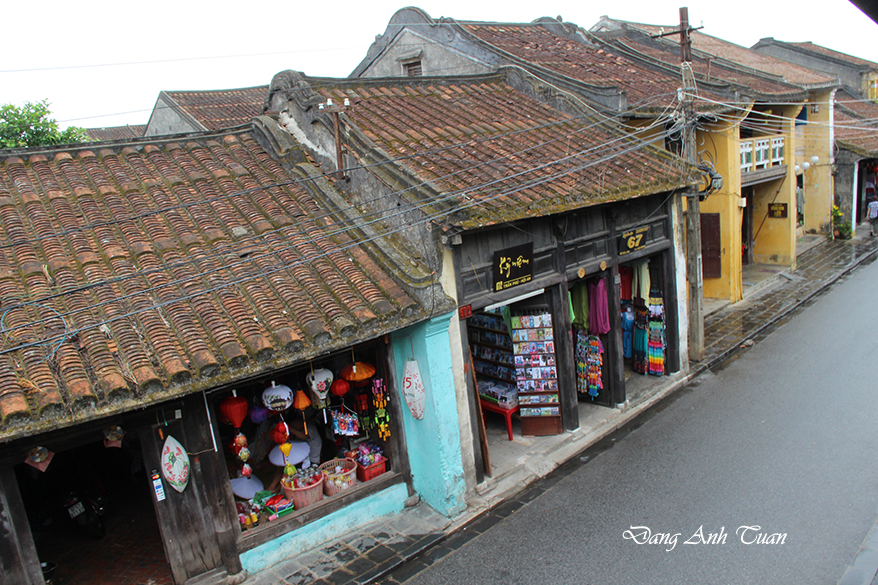
Malgré cela, à travers l’adage des Hoianais, on sait qu’il existe au début de la fondation de Hội An deux quartiers, l’un japonais et l’autre chinois. Ce proverbe nous indique avec précision la délimitation de la ville : Thựơng chùa cầu, Hạ Âm Bổn. (En amont le pont-pagode, en aval le temple Âm Bổn). Le pont-pagode est situé à l’extrémité ouest de la ville tandis qu’à l’autre extrémité est se trouve le temple Âm Bổn du siège de la congrégation Triều Châu, dédié au grand général pacificateur de la mer, Ma Yuan (Mã Viện). C’est sur cet espace réduit qu’ont été construites les premières maisons traditionnelles chinoises sans étage, avec ou sans grenier (la rue Trần Phú actuelle). Mais aucune maison n’a réussi à résister aux dégradations et aux intempéries de la nature (pluie, inondation etc…) au fil des années. Grâce aux registres cadastraux anciens, on sait que la plus ancienne maison de la ville Hội An datant de 1738 est située actuellement au numéro3 de la rue Nguyễn Thi Minh Khai. La plupart des maisons traditionnelles visibles aujourd’hui à Hội An ont été ré-construites plusieurs fois sur les mêmes emplacements.

À côté de ce type de maison traditionnelle sans étage, on relève un autre type de modèle de maison chinoise très répandu dans la première moitié du XIXème siècle. C’est la maison avec étage dont la façade est en bois ou en brique. Étant de la même culture, ces émigrés chinois n’avaient aucun conflit religieux ou sérieux avec les Vietnamiens depuis leur installation. Par contre, cela leur permet de s’intégrer plus facilement dans la société vietnamienne et de devenir, grâce aux mariages mixtes, des Vietnamiens à part entière au renouvellement de quelques générations. Selon l’auteur Nguyễn Thiệu Lâu [BAVH, La formation et l’évolution du village Minh Hương(Faifo), 1941, Tome 4], la ville de Hội An était au début de son existence un « Minh Hương xã« , une commune habitée par une colonie chinoise. Grâce aux circonstances favorables dues au dot et aux dons des bienfaiteurs et bienfaitrices chinoises (1) et au colmatage de la berge du fleuve Thu Bồn, elle s’était agrandie progressivement pour devenir au fil des siècles un village de métis sino-vietnamien où ces émigrés chinois finissaient par être assimilés à la population locale.

Quant aux Hollandais, ils ne restaient pas inactifs car ils connaissaient très tôt Hội An. Leur Compagnie néerlandaise des Indes Orientales (*) établit au début de 1636 un comptoir à Hội An. Celui-ci cessa ses activités en 1641, l’année où l’exécution d’un voleur vietnamien par cette compagnie provoqua la colère du gouverneur Nguyễn Phước Tần. Celui-ci n’hésita pas prendre des mesures énergiques en brûlant toutes leurs marchandises saisies et en jetant à la mer tout le reste. De plus sept marchands hollandais furent exterminés lors de cet incident. La réaction hollandaise ne tarda pas à venir avec une confrontation armée quelques mois plus tard. Celle-ci dura de 1642 à 1643. Nguyễn Phúc Tần en sortit victorieux en détruisant la flotte hollandaise. L’amiral hollandais Peter Bach se donna la mort sur son bateau. C’est un exploit extraordinaire de combat naval entre les Occidentaux et le royaume du Sud des seigneurs Nguyễn car ces derniers réussirent à défaire pour la première fois la flotte européenne sur leur sol. Mais cela n’émoussa pas l’intention des Occidentaux de revenir plus tard au Vietnam dans le but de chercher des points d’appui militaire facilitant l’accès à la Chine et au commerce convoité depuis les débuts de l’époque moderne.

Entre-temps, Hội An connut à la fin du XVIIIème siècle des troubles provoqués par les révoltes paysannes, en particulier celle menée par les trois frères de Tây Sơn ( Nguyễn Nhạc, Nguyễn Lữ et Nguyễn Huệ) à Bình Định dans le centre du Vietnam. C’est la période où Hội An fut ravagée par l’invasion de l’armée nordiste des Trinh profitant du contexte troublant pour chasser les Nguyễn et combattre les Tây Sơn (Paysans de l’Ouest). En 1778, un commerçant britannique de nom Chapman, de passage à Hội An, fit la description suivante: Malgré l’aménagement réussi des quartiers avec des maisons en brique, il ne restait que des ruines. Malgré cela, Hội An reprit ses activités commerciales qui étaient loin d’être florissantes comme au début de sa fondation car la plupart des Chinois résidant à Hội An préférèrent de la quitter et de s’installer à Saïgon (Cholon). Celle-ci était en quelque sorte le bras allongé de Hội An. Puis vint un siècle plus tard le début de l’intervention militaire française prenant prétexte de la protection des missionnaires persécutés au Vietnam sous le règne de l’empereur Tự Đức (1858). C’était le début de la colonisation française au Vietnam.

À l’époque coloniale, Hội An continua à garder le nom de Faifo. Mais elle commença à prendre un autre visage, celui d’une ville européenne. Outre l’infrastructure moderne (équipement en eau, éclairage, canaux d’évacuation etc…), on y trouva la construction de nouveaux bâtiments publics dans le but de satisfaire les besoins de l’administration coloniale (l’hôtel de ville, le palais de justice, l’église etc…) et des maisons individuelles destinées à apporter le confort et bien-être aux fonctionnaires expatriés. Grâce à cet aménagement urbain, Hội An devint désormais une ville cosmopolite. Malgré cela, selon l’écrivain vietnamien Hữu Ngọc, Hội An fut délaissée très vite par les Français à cause de l’alluvion qui rendit difficile la navigation des bateaux sur le fleuve Thu Bồn. Ceux-ci préférèrent Tourane (ou Đà Nẵng) au détriment de Hội An vers la dernière moitié du XIXème siècle. Hội An tomba ainsi dans l’oubli car elle ne fut plus un centre économique et politique. Elle fut heureusement épargnée durant la guerre du Vietnam. C’est pour cette raison qu’elle peut conserver intact un grand nombre de vestiges architecturaux de grande valeur qui font aujourd’hui le bonheur des touristes vietnamiens et étrangers.

Une large part de son attrait réside sur le fait de nous laisser revivre le fil de son histoire à travers le temps.

Version vietnamienne

Phần III

Cảnh quan Hội An bắt đầu thay đổi sâu sắc vào khoảng giữa thế kỷ 17 khi người Nhật Bản buộc phải rời đi và người Trung Quốc đến đây. Hội An không còn ý nghĩa Hai Phố vì phố Nhật không còn nửa. Từ đó, chỉ gọi Hội An là Hải Phố có nghĩa là Phố ở biển hay là Hoa Phố (phố của người Hoa). Có lẽ một trong hai tên nầy mà các cha cố đạo Âu Châu phát âm ra không rỏ mà thành Faifo. Tên nầy được giữ đến thời kỳ Pháp thuộc. Nhưng trên bản đồ của Pieter Goos vẽ năm 1666, chúng ta thấy Hội An có một tên gọi khác là « Fayfoo« , trong khi trên bản đồ của Alexander xứ Rhodes lại thấy chữ « Haifo« . Dù sao đi nữa, đó chính là chữ « Faifo » mà người phương Tây ngày nay dùng để chỉ Hội An. Khu phố Nhật Bản dường như biến mất khỏi cảnh quan Hội An bởi vì trong tất cả những ghi chép sau này của du khách nước ngoài (bao gồm cả nhà sư Trung Hoa phóng túng Thích Đại Sán), chúng ta không tìm thấy từ nào gợi lên sự hiện diện của người Nhật.

Mặc dù vậy, qua câu tục ngữ Hội An, chúng ta biết rằng khi Hội An mới thành lập, có hai quận, một của người Nhật và một của người Hoa. Câu tục ngữ này chỉ chính xác ranh giới của thành phố: Thượng chùa cầu, Hạ Âm Bổn. (Thượng nguồn cầu chùa, hạ nguồn chùa Âm Bổn). Cầu chùa nằm ở đầu phía tây của thành phố trong khi ở đầu phía đông còn lại là chùa Âm Bổn của trụ sở giáo đoàn Triều Châu, thờ vị tướng vĩ đại trấn an biển cả, Mã Viện. Chính trên không gian nhỏ bé này, những ngôi nhà truyền thống đầu tiên của người Hoa không có sàn, có hoặc không có gác xép (ngày nay là đường Trần Phú) đã được xây dựng. Nhưng không ngôi nhà nào có thể chịu được sự xuống cấp và thời tiết xấu của thiên nhiên (mưa, lũ lụt, v.v.) qua nhiều năm. Nhờ các hồ sơ địa chính cũ, chúng ta biết rằng ngôi nhà cổ nhất ở Thành phố Hội An, có niên đại từ năm 1738, hiện tọa lạc tại số 3 đường Nguyễn Thị Minh Khai. Hầu hết các ngôi nhà truyền thống hiện còn thấy ở Hội An đều đã được xây dựng lại nhiều lần trên cùng một địa điểm.

Bên cạnh kiểu nhà một tầng truyền thống này, còn có một kiểu nhà Trung Hoa khác rất phổ biến vào nửa đầu thế kỷ 19. Đây là kiểu nhà hai tầng với mặt tiền bằng gỗ hoặc gạch. Cùng chung một nền văn hóa, những người Hoa di cư này không có xung đột tôn giáo hay xung đột nghiêm trọng nào với người Việt Nam kể từ khi định cư. Mặt khác, điều này cho phép họ hòa nhập dễ dàng hơn vào xã hội Việt Nam và, nhờ hôn nhân khác chủng tộc, trở thành người Việt Nam chính thức sau vài thế hệ. Theo tác giả Nguyễn Thiệu Lâu [BAVH, Sự hình thành và phát triển của làng Minh Hương (Faifo), 1941, Tập 4], thành phố Hội An ban đầu là một « Minh Hương xã« , một xã có người Hoa sinh sống. Nhờ hoàn cảnh thuận lợi do của hồi môn và tiền quyên góp của các nhà hảo tâm người Hoa (1) và việc lấp bờ sông Thu Bồn, dần dần qua nhiều thế kỷ, nơi đây trở thành một ngôi làng có dòng máu lai Hoa-Việt, nơi những người Hoa di cư này đã hòa nhập vào dân cư địa phương.

Về phần người Hà Lan, họ không hề thụ động vì họ đã biết đến Hội An từ rất sớm. Công ty Đông Ấn Hà Lan (*) của họ đã thành lập một trạm buôn bán tại Hội An vào đầu năm 1636. Trạm này ngừng hoạt động vào năm 1641, năm mà việc công ty này hành quyết một tên trộm người Việt Nam đã khiến thống đốc Nguyễn Phước Tần tức giận. Ông không ngần ngại thực hiện các biện pháp mạnh mẽ bằng cách đốt cháy tất cả hàng hóa bị tịch thu và ném mọi thứ khác xuống biển. Ngoài ra, bảy thương gia Hà Lan đã bị tiêu diệt trong sự việc này. Phản ứng của người Hà Lan không lâu sau đó với một cuộc đối đầu vũ trang diễn ra vài tháng sau đó. Điều này kéo dài từ năm 1642 đến năm 1643. Nguyễn Phúc Tần đã giành chiến thắng bằng cách tiêu diệt hạm đội Hà Lan. Đô đốc người Hà Lan Peter Bach đã tự sát trên tàu của mình. Đây là một chiến công hải chiến phi thường giữa người phương Tây và vương quốc phía nam của các chúa Nguyễn, vì sau này đã thành công trong việc đánh bại hạm đội châu Âu trên lãnh thổ của họ lần đầu tiên. Nhưng điều này không làm giảm ý định quay trở lại Việt Nam sau này của người phương Tây để tìm kiếm chỗ đứng quân sự nhằm tạo điều kiện tiếp cận Trung Quốc và hoạt động thương mại mà họ đã thèm muốn từ đầu thời kỳ hiện đại.

Trong khi đó, Hội An đã trải qua tình trạng bất ổn vào cuối thế kỷ 18 do các cuộc khởi nghĩa nông dân gây ra, đặc biệt là cuộc khởi nghĩa do ba anh em nhà Tây Sơn (Nguyễn Nhạc, Nguyễn Lữ Nguyễn Huệ) lãnh đạo ở Bình Định, miền Trung Việt Nam. Đây là thời kỳ Hội An bị tàn phá bởi cuộc xâm lược của quân đội Trịnh ở miền Bắc, lợi dụng bối cảnh bất ổn để đánh đuổi nhà Nguyễn và chống lại Tây Sơn (Nông dân miền Tây). Năm 1778, một thương nhân người Anh tên là Chapman, đi qua Hội An, đã mô tả như sau: Mặc dù các khu phố có nhà gạch đã phát triển thành công, nhưng chỉ còn lại những tàn tích. Mặc dù vậy, Hội An đã tiếp tục các hoạt động thương mại, vốn không hề thịnh vượng như lúc mới thành lập, vì hầu hết người Hoa sống ở Hội An thích rời khỏi đây và định cư ở Sài Gòn (Chợ Lớn). Theo một số cách, đây là cánh tay nối dài của Hội An. Sau đó, một thế kỷ sau, bắt đầu có sự can thiệp quân sự của Pháp với lý do bảo vệ các nhà truyền giáo bị đàn áp ở Việt Nam dưới thời vua Tự Đức (1858). Đây là sự khởi đầu của quá trình thực dân hóa Việt Nam của Pháp.

Trong thời kỳ thuộc địa, Hội An vẫn giữ tên Faifo. Nhưng nó bắt đầu mang một diện mạo khác, mang dáng dấp của một thành phố châu Âu. Bên cạnh cơ sở hạ tầng hiện đại (cấp nước, chiếu sáng, kênh thoát nước, v.v.), các công trình công cộng mới được xây dựng để đáp ứng nhu cầu của chính quyền thuộc địa (tòa thị chính, tòa án, nhà thờ vân vân) và nhà ở riêng lẻ được xây dựng để mang lại sự thoải mái và tiện nghi cho các quan chức xa xứ. Nhờ sự phát triển đô thị này, Hội An đã trở thành một thành phố quốc tế. Tuy nhiên, theo nhà văn Việt Nam Hữu Ngọc, người Pháp đã nhanh chóng bỏ rơi Hội An do phù sa khiến tàu thuyền khó di chuyển trên sông Thu Bồn. Họ ưa chuộng Tourane (hay Đà Nẵng) hơn là Hội An vào nửa cuối thế kỷ 19. Do đó, Hội An đã rơi vào quên lãng vì không còn là một trung tâm kinh tế và chính trị. May mắn thay, nó đã được bảo tồn trong Chiến tranh Việt Nam. Đây là lý do tại sao nơi đây có thể bảo tồn nguyên vẹn một số lượng lớn di tích kiến ​​trúc có giá trị lớn mà ngày nay làm say mê du khách Việt Nam và nước ngoài.

Một phần lớn sức hấp dẫn của nó nằm ở chỗ cho phép chúng ta sống lại mạch truyện của nó theo thời gian.

English version

Three part

The landscape of the city of Hội An began to change profoundly around the mid-17th century with the forced departure of the Japanese and the arrival of the Chinese. The name of the city Hội An, until then known as « Hai Phố (Two villages), » no longer made sense with the decline of the Japanese quarter. Hội An was now given the traditional name « Phố » (village or street) or Hải Phố (village by the sea) or Hoa Phố (the village of the Chinese). It is probably one of these names that the first Western missionaries phonetically translated as Faifo. But on the map by Pieter Goos drawn in 1666, one notices an alternative name « Fayfoo » for Hội An, while on Alexandre de Rhodes’s map, the word « Haifo » appears. In any case, it is the word Faifo now used by Westerners to designate the city of Hội An. The Japanese quarter seems to disappear from the landscape of the city of Hội An because in all later accounts of foreign travelers (including that of the libertine Chinese monk Thích Đại Sán), there is no mention of the Japanese presence.

Despite this, through the saying of the Hoianese, it is known that at the beginning of Hội An’s foundation there were two neighborhoods, one Japanese and the other Chinese. This proverb precisely indicates the boundaries of the city: Thượng chùa cầu, Hạ Âm Bổn. (Upstream the bridge-pagoda, downstream the Âm Bổn temple). The bridge-pagoda is located at the western end of the city while at the other eastern end is the Âm Bổn temple of the Triều Châu congregation, dedicated to the great general and pacifier of the sea, Ma Yuan (Mã Viện). It is in this small area that the first traditional Chinese houses without floors, with or without attics (the current Trần Phú street), were built. But no house has managed to withstand the damage and the harshness of nature (rain, flooding, etc.) over the years. Thanks to old cadastral records, it is known that the oldest house in Hội An, dating from 1738, is currently located at number 3 Nguyễn Thi Minh Khai street. Most of the traditional houses visible today in Hội An have been rebuilt several times on the same sites.

Next to this type of traditional single-story house, there is another type of Chinese house model that was very common in the first half of the 19th century. It is the house with an upper floor, whose facade is made of wood or brick. Being of the same culture, these Chinese emigrants had no religious or serious conflicts with the Vietnamese since their settlement. On the other hand, this allowed them to integrate more easily into Vietnamese society and, thanks to mixed marriages, to become full-fledged Vietnamese over the renewal of a few generations. According to the author Nguyễn Thiệu Lâu [BAVH, The formation and evolution of the Minh Hương village (Faifo), 1941, Volume 4], the city of Hội An was at the beginning of its existence a « Minh Hương xã, » a commune inhabited by a Chinese colony. Thanks to favorable circumstances due to dowries and donations from Chinese benefactors and benefactresses (1) and the filling in of the Thu Bồn riverbank, it gradually expanded over the centuries to become a Sino-Vietnamese mixed village where these Chinese emigrants eventually became assimilated into the local population.

As for the Dutch, they did not remain inactive because they knew Hội An very early on. Their Dutch East India Company (*) established a trading post in Hội An at the beginning of 1636. This post ceased its activities in 1641, the year when the execution of a Vietnamese thief by this company provoked the anger of Governor Nguyễn Phước Tần. He did not hesitate to take strong measures by burning all their seized goods and throwing the rest into the sea. Moreover, seven Dutch merchants were killed during this incident. The Dutch reaction was not long in coming, with an armed confrontation a few months later. This lasted from 1642 to 1643. Nguyễn Phúc Tần emerged victorious by destroying the Dutch fleet. The Dutch admiral Peter Bach took his own life on his ship. This was an extraordinary naval combat feat between the Westerners and the southern kingdom of the Nguyễn lords, as the latter succeeded in defeating the European fleet on their soil for the first time. But this did not dampen the Westerners’ intention to return later to Vietnam with the aim of seeking military footholds that would facilitate access to China and trade coveted since the beginning of the modern era.

Meanwhile, Hội An experienced troubles at the end of the 18th century caused by peasant revolts, particularly the one led by the three Tây Sơn brothers (Nguyễn Nhạc, Nguyễn Lữ, and Nguyễn Huệ) in Bình Định in central Vietnam. This was the period when Hội An was devastated by the invasion of the northern Trịnh army, taking advantage of the turbulent context to drive out the Nguyễn and fight the Tây Sơn (Western Peasants). In 1778, a British merchant named Chapman, passing through Hội An, made the following description: Despite the successful arrangement of the quarters with brick houses, only ruins remained. Despite this, Hội An resumed its commercial activities, which were far from flourishing as at the beginning of its founding because most of the Chinese residing in Hội An preferred to leave and settle in Saigon (Cholon). The latter was, in a way, the extended arm of Hội An. Then, a century later came the beginning of French military intervention, taking the pretext of protecting persecuted missionaries in Vietnam under the reign of Emperor Tự Đức (1858). This was the beginning of French colonization in Vietnam.

During the colonial era, Hội An continued to keep the name Faifo. But it began to take on another face, that of a European city. In addition to modern infrastructure (water supply, lighting, drainage canals, etc.), new public buildings were constructed to meet the needs of the colonial administration (the town hall, the courthouse, the church, etc.) and individual houses intended to provide comfort and well-being to expatriate officials. Thanks to this urban development, Hội An became a cosmopolitan city. Despite this, according to the Vietnamese writer Hữu Ngọc, Hội An was quickly abandoned by the French due to the alluvium that made navigation difficult for boats on the Thu Bồn River. They preferred Tourane (or Đà Nẵng) over Hội An in the latter half of the 19th century. Hội An thus fell into oblivion as it was no longer an economic and political center. Fortunately, it was spared during the Vietnam War. This is why it can preserve intact a large number of architectural relics of great value, which today delight Vietnamese and foreign tourists.

Much of its appeal lies in the fact that it allows us to relive the thread of its history through time.


(*) VOC: Compagnie néerlandaise des Indes Orientales. Vereenigde Oost-Indische Compagnie.

(1): Ce sont les premiers fondateurs de l’enclave Minh Hương Xã chinoise. Parmi eux, il y a les dix vieillards (Thập Lão), la bienfaitrice Mme Lành, le bonze Lương Huệ Đường. Ces personnes ont le droit d’avoir un autel en leur honneur dans les sièges des congrégations chinoises.

 Đây là những người đầu tiên sáng lập ra cộng đồng Minh Hương Xã của người Hoa. Trong số đó có Thập Lão, thí chủ bà Lành, và sư Lương Huệ Đường. Những người này được quyền có bàn thờ để tưởng nhớ tại các giáo xứ của người Hoa

[Back to Hoi AN]

Empereur Tự Đức (Version française)


tuduc

Hồng Nhậm

(1847-1883)

Un grand hommage à l’empereur poète Tự Ðức à travers mes quatre vers en Six-huit:

Ngậm ngùi thương xót phận mình
Làm vua chẳng có quang vinh chút gì
Thực dân chiếm đất ở lì
Trẩm đây buồn tủi, sử thì kết oan

Je m’apitoie douloureusement sur mon sort
« Etre roi » ne mérite pas assez la gloire
Les colonialistes ont confisqué la terre pour y rester
Moi, je suis plongé dans la tristesse et l’humiliation tandis que l’histoire m’a condamné.

Version vietnamienne
Version anglaise
Galerie des photos

Etant le quatrième empereur de la dynastie des Nguyễn, Tự Ðức fut connu sous le nom Hồng Nhậm quand il était encore un jeune prince. C’était le fils cadet de l’empereur Thiệu Trị. Ce dernier décida de changer d’avis à la dernière minute dans son testament royal en le désignant comme le successeur méritant à la place du prince héritier Hồng Bào, son frère, sous prétexte de débauche. Son intronisation fut très perturbée par l’évanouissement de son frère Hồng Bào devant la Cour et suivie par l’emprisonnement de ce dernier taxé de connivence plus tard avec les prêtres catholiques et les Européens en vue d’un coup d’état. Hồng Bào fut peu après éliminé  dans la prison, ce qui souleva certaines critiques faites plus tard à l’empereur par ses subordonnés par le biais de leurs poèmes. On lui reprocha de manquer de la magnanimité que le roi Cao Pi (Tào Phi) avait réservée à son frère Cao Tseu (Tào Thực), un grand poète évincé aussi du pouvoir à l’époque des Trois Royaumes en Chine. C’était le cas du mandarin Nguyễn Hàm Ninh. Un beau jour, Tự Ðức qui se blessa involontairement la langue avec ses dents au moment du déjeuner, décida de choisir comme sujet de poésie le thème « la blessure par les dents » et demanda à ses subordonnés de composer des poèmes axés sur ce thème. Nguyễn Hàm Ninh profita de cette suggestion pour lui adresser promptement son poème épique de quatre vers suivants :

Ta ra đời trước chú chưa sinh
Chú phận làm em, ta phận anh
Ngọt bùi sao chẩng cùng san sẽ
Mà nỡ đau thương cô’t nhục tình?

Je suis né avant votre naissance
Vous êtes mon petit-frère, je suis votre grand frère
Pourquoi ne partagez-vous pas le bonheur avec moi au lieu de nous entre-déchirer lamentablement ainsi?

Nguyễn Hàm Ninh fut ainsi récompensé pour son talent inouï avec plusieurs taëls d’or mais il reçut en même temps pour chaque vers composé un coup de bâton car chaque vers était significatif et profond. Tự Ðức fut un grand poète de son temps. C’était pourquoi il avait une préférence incontestable à l’égard de tous les grands poètes de son époque. Ceux-ci étaient appréciés à leur juste valeur même à des moments où son autorité et son amour-propre pouvaient être bafoués par des critiques virulentes et acerbes provenant des gens de caractère et indépendants comme Cao Bá Quát. Ce dernier ne cessa pas de le ridiculiser maintes fois devant les mandarins mais il n’hésita pas à le combler d’éloges lorsque Cao Bá Quát réussît à lui rendre esthétiquement son énoncé antithétique tout en s’appuyant sur l’énoncé appelant proposé par Tự Ðức par l’intermédiaire d’un jeu savant de mots. Profitant de la présence de Cao Bá Quát, Tu Duc émit spontanément l’énoncé appelant:

Nhất bào song sinh, nan vi huynh, nan vi đệ
Một bọc sinh đôi, khó làm anh, khó làm em

Il y a un seul embryon pour deux vies humaines. Il est difficle d’être le grand frère mais il l’est aussi d’être le petit frère.

pour rappeler à Cao Bá Quát qu’ils étaient deux frères jumeaux (lui et son frère Cao Bá Ðạt) qu’il était difficile de discerner.

Cao Bá Quát fit sur le champ l’énoncé répondant:

Thiên tài thất ngộ, hữu thị quân, hữu thị thần
Nghìn năm gập một, có vua ấy, có tôi ấy.

Il y a une seule fois pour mille ans. Il existe le bon roi mais il existe aussi le bon serviteur.

pour rappeler à Tự Ðức qu’un bon roi était servi toujours par un bon serviteur. Malgré cela, Tự Ðức ne fut pas satisfait entièrement car il savait aussi qu’il fit allusion d’une manière intelligente et subtile au proverbe vietnamien (vỏ quýt dày, móng tay nhọn)(ou en français à bon chat, à bon rat).

On trouve non seulement dans l’énoncé appelant comme dans l’énoncé appelé le même nombre de mots mais aussi la même position pour chaque mot répété. Une autre fois, Cao Bá Quát ne fut pas très content de voir accrochés à l’entrée du palais Cần Chánh les deux vers antithétiques suivants composés par Tự Ðức:

Tử năng thừa phụ nghiệp
Thần khả báo quân ân.

Le fils capable hérite du métier de son père
Le sujet méritant est reconnaissant toujours envers le roi bienfaiteur.

Celui-ci fut étonné et lui demanda la raison de son mécontentement. Cao Bá Quát lui dit:

Le mot « Tử » (ou fils en français) ne peut être placé devant le mot « phụ » (ou père en français). De même, le mot « Thần » (ou sujet en français) ne peut pas devancer le mot « quân » (ou roi en français). Cela n’est plus conforme à notre ordre hiérarchique.
Tu Duc lui demanda de rectifier cette erreur. Sans hésitation, Cao Bá Quát lit instantanément les deux vers suivants:

Quân ân, thần khả báo
Phụ nghiệp, tử năng thừa

Pour les bienfaits du roi, le sujet méritant en est reconnaissant
Pour le métier du père, le fils capable en hérite.

Malgré sa nature romantique et son tempérament maladif, Tự Ðức était l’empereur qui connut très peu la sérénité et la tranquillité durant son règne. Il devait faire face non seulement au développement du capitalisme occidental mais aussi aux troubles internes dus à l’éviction de son frère aîné Hồng Bào, la guerre des Sauterelles menée par Cao Bá Quát plus tard etc.). La perte des six provinces de Nam Bộ ne cessa pas de le hanter et le plonger douloureusement dans une tristesse sempiternelle car il était le premier empereur de la dynastie des Nguyễn à avoir la lourde responsabilité de laisser s’échapper une partie du territoire vietnamien aux mains des étrangers, en particulier celle dont sa mère était issue.

tuduc_stele

L’absence d’un prince héritier due à sa stérilité provoquée par la variole qu’il avait contractée quand il était jeune, le suicide du lettré Phan Thanh Giản, gouverneur des provinces occidentales de Nam Bộ l’ont attristé et l’ont obligé à chercher refuge souvent dans ses jolis pavillons en bois rouge Du Khiêm et Xung Khiêm qui deviennent aujourd’hui des lieux de prédilection pour les touristes étrangers et vietnamiens. C’était ici qu’il composa des poèmes dont le plus célèbre restait le poème d’amour intitulé « Khóc Bằng Phi (Les larmes à ma concubine) » et immortalisé par les deux vers suivants:

Ðập cổ kính ra, tìm lấy bóng
Xếp tàn y lại để dành hơi
Je brise l’ancien miroir pour chercher ton ombre
Je plie tes  habits usés pour garder ta chaleur.

Etant un enfant pieux, Tự Ðức régna sous l’ombre de sa mère, l’impératrice Từ Dũ. Il prit en considération tout ce que la reine-mère lui avait suggéré. Un beau jour, en regardant le chef d’œuvre théâtral dramatique chinois intitulé « Conquête de l’Ouest » (Ðường Chinh Tây), la reine-mère fut choquée par la scène où l’héroïne Phàn Lê Huê avait tué son père. Pour plaire à sa mère, Tự Ðức fut obligé de demander au mandarin chargé des divertissements de modifier intégralement le contenu de la scène pour ne plus voir cette tragédie infâme et contraire à l’esprit confucéen. La réhabilitation du mandarin Phạm Phú Thứ dans la fonction d’académicien chargé de livres de consultation n’était pas étrangère à la réprimande que Tự Ðức avait reçue de la part de la reine-mère. Ce mandarin osa demander à Tự Ðức de se corriger de sa paresse car ce dernier supprima depuis son avènement au trône, les grandes audiences et ne donna aucune suite aux requêtes soumises. Malgré son crime de lèse-majesté, Phạm Phu Thứ ne fut pas congédié mais il réintégra l’assemblée de la Cour et devint un grand mandarin sous son règne. A cause de l’emprise du clan des mandarins confucianistes, Tự Ðức ne put pas entamer les réformes à temps en dépit de la mise en garde et du mémorandum pathétique du lettré patriote Nguyễn Trường Tộ. Il ne sut pas profiter des occasions favorables pour amener le Viêt-Nam sur le chemin de modernité mais il s’enfonça un peu plus dans l’isolement, dans la tristesse et dans la solitude depuis l’annexion des six provinces de Nam Bộ par les autorités coloniales françaises.

Pour tenter de ramener Tự Ðức à la bonne humeur, la reine-mère promit de récompenser celui qui réussît à faire rire l’empereur. Celui-ci aimait aller voir souvent le théâtre pour se détendre. Un beau jour, profitant de sa présence au théâtre royal, le chef de groupe théâtral de nom Vung se présenta subitement devant  Tự Ðức qui était en train de fumer et lui dit:

Pouvez-vous me permettre, Seigneur, de partager avec vous une bouffée de cigarette?
Son geste spontané abasourdit tout le monde car on savait qu’il avait commis un crime de lèse-majesté. Tự Ðức rigola aussi sur le coup. Mais il se ressaisit en lui disant:

Tu as vraiment de l’audace.
et pardonna son offense.

Vung fut récompensé plus tard par la reine-mère.
Il est regrettable d’attribuer à Tự Ðức l’image d’un empereur despotique et responsable du démembrement du Viêt-Nam par les autorités coloniales. Le sort de son pays ainsi que celui de son peuple fut scellé depuis longtemps au moment où son grand-père, l’empereur Minh Mạng et son père Thiệu Trị avaient opté pour une politique de persécution envers les catholiques et les missionnaires étrangers, ce qui permit aux autorités françaises de justifier leur intervention et leur annexion. La politique coloniale française était déjà mise en marche depuis longtemps.

Par le biais de ces anecdotes, on sait que Tự Ðức était un empereur tolérant et pieux, un homme de cœur et un grand poète de son temps. Le destin de son pays l’a forcé à devenir empereur malgré lui, à tuer son frère aîné lorsque celui-ci devenait le collaborateur privilégié des étrangers. Peut-on faire mieux que lui? C’est la question qu’on se demande si on se met à sa place. On ne trouve point la réponse au fil des années mais on sait une chose.

Il ne pouvait pas rester indifférent devant les événements qui s’abattaient cruellement sur lui et sur son peuple. Il ne se relevait pas non plus de la douleur profonde de voir dans l’histoire du Viêtnam la chute de l’Empire dont il était taxé d’être le responsable.

Galerie des photos

[Return DYNASTIE]

Sanctuaire Mỹ Sơn (Thánh địa Mỹ Sơn)


English version

Vietnamese version

Les habitants de l’ancien Champa ont incarné leur âme dans la terre et dans la pierre et ont su tirer parti de la nature pour en faire un Mỹ Sơn splendide, mystérieux et grandiose. C’est un vrai musée architectural, sculptural et artistique du monde de valeur inestimable qu’il est difficile de comprendre entièrement.

(Feu architecte Kasimierz Kwakowski )

Les édifices en brique et les statues en grès sont la clé de voûte de l’art cham. Contrairement aux Khmers, les Chams continuèrent à bâtir les édifices en briques  malgré leur maîtrise parfaite du grès dans les décorations et les  statues.
L’architecture chame  est d’inspiration indienne. Les ouvrages sont constitués essentiellement d’un temple principal ( ou kalan en langue chàm ) et des tours et des dépendances, le tout englobé dans une enceinte.  La sculpture sur brique reste un art particulier et original des Chams qu’on trouve rarement chez d’autres peuples de l’Asie du Sud Est.

Mỹ Sơn pourrait être comparée à Angkor (Cambodge), Pagan (Birmanie), Borobudur (Indonésie) et Ayutthaya (Thái Lan). Mỹ Sơn se trouve dans une vallée localisée approximativement 10 km à l’ouest de Trà Kiệu.  Ce lieu a été connu comme la capitale du royaume du Champa (Linyi)  aux alentours de  l’an 605  jusqu’en 757 avec le nom Simhapura et situé à 37 km au sud de la ville de Đà Nẵng.


[ngg_images source= »galleries » container_ids= »86″ exclusions= »964″ display_type= »photocrati-nextgen_basic_thumbnails » override_thumbnail_settings= »1″ thumbnail_width= »180″ thumbnail_height= »100″ thumbnail_crop= »1″ images_per_page= »30″ number_of_columns= »5″ ajax_pagination= »0″ show_all_in_lightbox= »0″ use_imagebrowser_effect= »0″ show_slideshow_link= »0″ slideshow_link_text= »[Montrer sous forme de diaporama] » template= »/homepages/5/d276592279/htdocs/clickandbuilds/vietnamquehuongtoi/wp-content/plugins/nextgen-gallery/products/photocrati_nextgen/modules/ngglegacy/view/gallery.php » order_by= »pid » order_direction= »ASC » returns= »included » maximum_entity_count= »500″]


Version vietnamienne

Người Chàm cổ đã gởi tâm linh vào đất, đá và đã biết dựa vào thiên nhiên để làm nên một Mỹ Sơn tráng lệ, thâm nghiêm và hùng vĩ. Đây là một bảo tàng kiến trúc điêu khắc nghệ thuật vô giá của nhân lọai  mà còn lâu chúng ta mới hiểu biết  đựơc hết.

Cố kiến trúc sư Kasimierz Kwakowski

Những tháp bằng gạch và những tượng điêu khắc bằng đá là  chìa khoá then chốt trong nghệ thuật chàm. Ngựợc lại với dân tộc Khmer, người Chàm vẫn tiếp tục xây dựng các tháp bằng gạch dù họ hoàn toàn biết sử dụng sa thạch trong việc trang trí và chạm tượng. Kiến trúc chàm lấy nguồn cảm hứng từ Ấn Độ.  Các tác phẩm thường thấy có một ngôi đền chính (hay kalan theo ngôn ngữ Chămpa) , các tháp và các nhà phụ, tất cả đều năm bên trong của một vòng đai . Nghệ thuật  điêu  khắc trên gạch vẫn là một mỹ thuật đôc đáo và riêng biệt của người Chămpa mà ít ai tìm thấy ở nơi các dân tộc khác ở Đông Nam Á.

Thánh địa Mỹ Sơn có thể so sánh với Đế Thiên Đế Thích  (Cao Miên), Pagan (Miến Điện), Borobudur (Nam Dương) và Ayutthaya (Thái Lan). Mỹ Sơn nằm trong một thung lũng cách xa khoảng chừng 10 cây số phía tây của Trà Kiệu. Nơi nầy đã từng là kinh đô  của vương quốc  Lâm Ấp từ khoảng năm 605 đến năm 757, với tên gọi là Simhapura và cách xa về phía nam của thành phố Đà Nẵng  37 km cây số.


Un grand hommage à la civilisation du Champa disparue dans les tourbillons de l’histoire


[Return to CHAMPA]