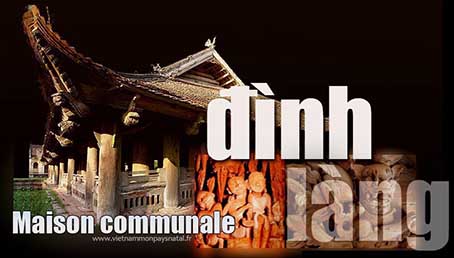
Communal house ( Đình Làng: Part 2)


dinhvn

Đình Làng: Part 2


Version vietnamienne

Version française

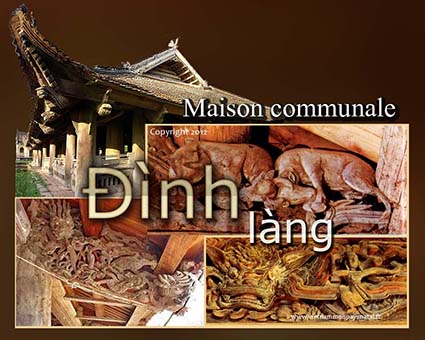
We are accustomed to say: Cầu Nam, Chùa Bắc, Ðình Ðoài with the aim of evoking the celebrity of three specific regions concerning the Vietnamese traditional architecture. Ðình Ðoài thus insinuates the region Ðoài (Hà Ðông, Sơn Tây) where there is a large number of famous communal houses. (Tây Ðằng, Mông Phụ , Chu Quyến etc. .. ). It is in this region near the mountain and forests that the precious and resistant hardwood is found essentially  for  the construction of đình.

The word « đình » has its origin in the Chinese ideogram ting. Despite this, the « đình » in the Vietnamese architecture does not correspond to the Chinese description of the ting. The latter is employed over time to designate a isolated house for cultural joys (thưởng ngoạn văn hóa) or a rest home (đình trạm) for a traveller or a mandarin in mission or a temple for the cult of the rampart genius at the time of the Han (Chinese).

In this meaning, there is the same type of ting in Viet Nam with the đình Trấn Ba within the temple Ngọc Sơn (Hànội) or Thủy Ðình ( Ðình on water) in front of the pagoda Thầy (Chùa Thầy) (Hà Tây). Based on the origin of the word Ðình, some specialists do not hesitate to think that the cult of the Chinese « ting » has inspired the Vietnamese « đình ». For Vietnamese writer and journalist Hữu Ngọc, the wall genius have been replaced by the village tutelary genius to adapt oneself to Vietnamese taste. But there are several reasons not allowing to reinforce this hypothesis.

Firstly, the Vietnamese đình which is due to its strength in an ingenious system of columns, tenons and mortices, is built on stilts (without poured foundation). This technique allows to facilitate sometimes its movement or its re-orientation in case its initial installation does not provide prosperity and happiness to the village after several decades of exploitation.This type of construction reminds us that, for some researchers, in particular French researcher Georges Coedes, the Vietnamese « đình » was undoubtedly influenced by Indonesian architectural style.
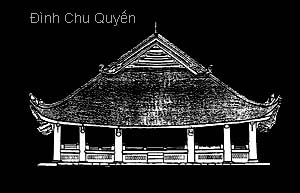
chu_quyen1

It does not call into question what one have already discovered on Vietnamese bronze drums with the house on stilts and a curved roof. (Ngọc Lữ ). We know very well that the Dongsonian (the ancestors of the Vietnamese ) were established along the coast of North Vietnam (1 millennium before J. C. ). They were considered as « Indonesian » (or Austroasians (Nam Á in Vietnamese), the Bai Yue.

According to Vietnamese researcher Trịnh Cao Tường, specialised in the study of communal houses (đình), the architecture of Vietnamese communal house on stilts testifies to the echo of the Dongsonian mind continuing to perpetuate itself yet in the daily life of the Vietnamese people. In addition, this building type is similar to sacred common building roong (nhà rồng) that one is accustomed to find among the Austroasiatic populations, in particular highland ethnic peoples (Central Highlands of Vietnam).

Analogous to the Vietnamese communal house, the building rôong cumulates a large number of social functions: board room of village committee, accommodation center for casual visitors, rallying point of all villagers etc. ..Some Vietnamese « đinh » are fitted with wooden floors serving as headquarters for meeting or sofa bed for notables and villagers. This is not the case of Chinese « ting ».

Đình Bảng (Bắc Ninh)

In the XVIII century, there are almost 11800 villages in Vietnam. This means that there are communal houses as much as villages. As the Vietnamese have the habit of saying: the water that we drink recalls the source (Uống nước nhớ nguồn), there is always within themselves a recognition, a gratitude for those who have done a great service for them and their country.

That is why nothing is surprising to see a large number of historical figures (national and local heroes) or legendary characters (Mountain genius Tan Viên for example) and benefactors considered to be part of geniuses of communal houses. Those who have done stirring deeds are not forgotten either. In addition, among these ministering geniuses, there are also the children, beggars and thieves. These ones die a violent death with a sacred hour, which gives them the supernatural powers to protect villagers against evils and misfortunes. Thanks to these communal gods, the village found not only tranquillity and prosperity but also rule, justice and morality. They are in some way the personification of this supreme authority which derives its full strength in the village itself.

Depending on their role more or less filled, they can receive royal patent (sắc phong) who grant them the grades of « genius of higher rank (or Thượng đẳng thần) » or « genius of the average rank (or Trung đẳng thần) » or the « genius of lower rank (Hạ đằng thần) « . This institution allows the king to demote those of them failing to fulfill their mission by sowing disorder in the village or letting the villagers perish. Being kept with care and jealousy in the Hậu Cung (or interior palace) these royal patents are the indescribable pride of the whole village. If the latter has not his tutelary genius, it is forced to borrow the tutelary genius of another village or to replace it by the soil genius (thổ thần). In the case where the villages are united by a common cult for the same tutelary genius, they must come to an agreement so that the feast day is fixed at a date agreed in each village and everyone can participate by sending a delegation during the procession.

Unlike the temples built and maintained at public expense, the communal houses are charged to villagers because it is in fact a local worship. The wealth found in the decoration of communal houses and their dimensions depend both on the financial prosperity and the generosity of the villagers. One found in every village, some parcels of land called rice-fields of the rites (or tế điền) or rice paddies of geniuses (ruộng thần từ) whose exploitation is used to maintain the communal house and the area of which may reach several tens of mẩu (or 0.36 ha) in some villages before 1945. It is the local hierarchical authorities who are responsible for the administration of communal house and village as « a small court ». The rules, customs and traditions are applied with severity and they are more respected than the king’s authority. Women are not allowed in the đình. That is why we have a habit of saying in Vietnamese « Phép vua thua lệ làng » (the king’s authority yields to the village custom).
[READING MORE]

Communal house (Đình Làng: Part 1)

dinhlang

Một mảnh hồn của đất nước

Part 1

Version française

Đình Làng

These are two words that it is difficult to separate in the spirit of the Vietnamese because everywhere there is a Vietnamese village, there is also somewhere a communal house, a « đình ». This one, always covered with tiles, is a wooden colossal building on stilts. Unlike the pagoda which closes itself off, the « đình » has neither doors nor wall and communicates directly with the outside world. Its imposing wide roof cannot go undetected with its super elevated edges ( đầu đao ). Its location is the subject of meticulous studies of geomancy. Its construction is carried out in most cases on a fairly high terrain considered as a sacred space and it is oriented so as to have access to a water piece (lake, river , wells) with the aim of gathering the peak of well-being. (Tụ thủy, tụ linh, tụ phúc).

This is the case of the đình Tây Ðằng with a water piece filled with lotus in front of its porch in summer or the đình Ðồng Kỵ ( Từ Sơn, Bắc Ninh) erected in front of a river or that of Lệ Mật (Gia Lâm, Hànội) with a wide well. The Vietnamese communal house is often built within a green surroundings with the centuries-old banyan trees, frangipani, palm trees etc. ..

We cannot define better its role than that which has been summarily written by French Paul-Giran in his book entitled: Magie et Religion annamites, pp 334-335, 1912:

The đình where lives the genius protector of each village (thành hoàng) is the centre of the community’s collective life. It is here that there are the meetings of village notables allowing them to address the administration and justice issues. It is also here that one can see  religious ceremonies and  acts that are the life of the Vietnamese society.

We can say that it is somehow the town hall of a city today. But it is better considered that the latter because it is the strong emotional bond with the entire community of the village.  Through it, the Vietnamese can regain not only his roots but also the aspirations and shared memories of the village where he was born and he grew up. His deep attachment to his village, in particular his « đình »,  is not breaking the expression of his feelings that we usually find in  popular songs:

Qua đình ngả nón trông đình
Ðình bao nhiêu ngói thương mình bấy nhiêu….

Passing by, she doffs her hat towards the communal house
The đình possess many tiled roof as much as she loves you…

or

Trúc xinh trúc mọc đầu đình
Em xinh em đứng một mình cũng xinh
……………………………
Bao giờ rau diếp làm đình
Gỗ lim ăn ghém thì mình lấy ta ….

The beautiful bamboo grows at the entrance of the communal house
You are nice, my sweetheart even if you are alone
……………………………………….
Whenever lettuce can be used to build a communal house 
and wood « lim » comestible, we could be married …

The image of the communal house is intimately rooted in the heart of the Vietnamese. The đình is the symbol of their identity. Already, in the XII century, under Lý dynasty, an edict stated that on all the Vietnamese territory, each village must build its own đình. This one followed the Vietnamese during their advancement to the south from the XIth to the XVIIIth century. Firstly, it was implemented in the center of Vietnam through   Thanh Hóa and Nghệ An provinces under Lê dynasty and then  Thuận Hóa and Quảng Nam provinces under Mạc dynasty and finally in the Mekong delta at the point of Cà Mau with Nguyễn lords. Its construction evolved to adapt not only to new climate, new lands acquired and new materials available found on local site but also traditions and regional customs throughout entire course over thousands of kilometers during the four centuries of expansion. Except the Central Highlands, cradle of the ancestral culture of ethnic minorities, the « đình » succeeds to distinguish itself in diversity with a style and a own architecture for each district within each region.

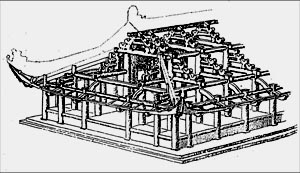
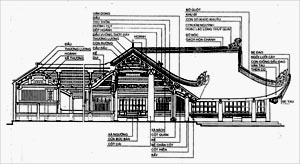
Built a few centuries earlier, the « đình » in the North remains the reference for the majority of Vietnamese because it is chosen not for its aesthetic character but rather for its original character. It is the authentic symbol of  rural life of the Vietnamese people over the centuries. It has been erected the first by Vietnamese village culture in the Red River delta. The đình in the north is not only an assembly of columns, main rafters and all sorts of components joined by mortises and tenons on stone foundation but it is also a wooden frame on which is based the roof reinforced by its own weight. One of the characteristics of Vietnamese communal house is found in the role of the columns  used to sustain the roof. Its look is very imposing thanks to these large main columns.

        Communal house  Ðình Bảng ( Tiên Sơn, Bắc Ninh )

dinhvn_1dinhvn_2

This is the case of đình Yên Đông destroyed by fire (Quảng Ninh) and main columns of which reach 105 cm in diameter. This impression is often illustrated by the expression that one has the habit of saying in Vietnamese: to như cột đình (colossal as the column of the đình ). That is what one see in the famous « Ðình Bảng » with its 60 wooden columns (gỗ lim) and its large roof completed by the edges elevated in the form of lotus petals. 

[READING MORE] 

 
Đình Mông Phụ (Sơn Tây)

Marriage (Hôn nhân)


mariage

Hôn Nhân

Version française

More than the eternal world law, it first appears that marriage in Vietnam is an alliance of families aiming at perpetuating not only the race but also the Vietnamese customs, especially the cult of ancestors.

Moreover, Vietnamese people, imbued with Taoist spirit, consider that youth has only a limited time like that of a bamboo shoot. Therefore people had the habit of marrying early in the old days in Vietnam.

Similar to the Ming Code in China, the Lê Code provided the minimal age of marriage at 13 for girls and 16 for boys. That is why in a Vietnamese proverb, it is said:

Gái thập tam, nam thập lục 
ou in English 
Girls at thirteen, boys at sixteen 

that Vietnamese society allows for marriage. It is always done in accordance with the Confucian tradition. It is always preceded by negotiations led by matchmakers and followed by exchange of astrological data if first contacts proved to be convincing. 

This, in a general manner would lead to the promise of marriage which should be kept under penalty of fines imposed by local mandarins in the old days. The engagement ceremony is also an occasion to confirm the definite commitment to marriage.

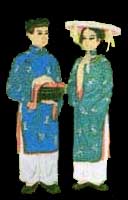
As for the latter, it occurs following a ceremonial standard to include the arrival of the future wife in palanquin, her discovery by the fiance, a ritual ceremony of offering before the altar of ancestors, then before the spouses’ parents, the holding of hands and the exchange of oath.

However, the same word is not used to refer to the marriage of a princess or an ordinary girl. « Hạ Giá » is used when it comes to the marriage of a princess because the king gives his daughter’s hand to someone less powerful than he, and of lower ranking. ( Hạ means « below » and Giá means « Marry »). For marriages between normal people, Xuất Giá is used because Xuất means « exit ». In the old days, rarely did the spouses know each other before getting married. 

The marriage was considered an arrangement between parents aiming at honoring a debt or contracting an alliance. It reflects also the Confucian state of mind not to be in favor of the predominance of the individual over family and society. The marriage of princess Huyền Trân to the Champa king Chế Mẫn ( Jaya Simhavarman III ) illustrated well this state of mind.

For territorial ambitions, it was difficult for king Trần Anh Tôn to ignore the promise made by his father, king Trần Nhân Tôn to give the hand of his sister to the king of Champa although he was aware of her love to general Trần Khắc Chung. An anonymous author at the time did not hesitate to denounce it in his Tang style, seven-foot poems entitled Vương Tường, comparing princess Vương Tường ( or Wang Zhaojun in Chinese ), a concubine of the Han emperor, Yuandi ( Hán Nguyên Ðế )(48-33 B.C.) destined to the king of Xiongnu ( shanyu Huhanxie ) in the goal of restoring peace with the barbarians coming from the steppes North of China.

In spite of that, there is in the annals of marriages the case of general Trần Quốc Tuấn where love triumphed over reason and the will of the parents although he was known as a very convinced confucianist. When he was young, he fell in love with princess Thiên Thành, king Trần Thái Tôn’s sister who did not even hide her admiration for this talented general.

But it was forbidden for him to materialize his intention because his father, An Sinh Vương Trần Liễu opposed that union, having been forced by the machiavellian prime minister Trần Thủ Ðộ. at that time to yield his concubine, princess of the Ly, Thuận Thiên to his brother, king Trần Thái Tôn in the goal of perpetuate the dynasty. One day having learned that the king has granted the hand of his sister Thien Thanh to the son of Nhân Ðạo Vương, he was stunned and so sad that he did not know what to do although at that time he was known to be the best strategist in the struggle against the Mongols. 
Seeing him distraught, one of his aides known to be the most cunning suggested he seize the fiancee by surprise on the wedding day. Thanks to this extraordinary boldness, he succeeded in materializing his love, obtaining the king’s pardon and conquering the esteem of his entourage, in particular that of his father because the latter found in him not only a man of genius but also a son worthy and capable of cleansing the shame of the family. Marriage is sometimes the source of worry for those who assume a responsibility or a political role on this land of legends.

It is the case of emperor Duy Tân. Obsessed by his father emperor Thành Thái’s deposition and exile by the colonial authorities, Duy Tân since his coming up to the throne at age 7, has relentlessly nourished the intention of reopening the whole question the Patenôtre Treaty and reestablishing Vietnam’s sovereignty and independence by all means including force. He never thought of getting married as long as the country is under foreign occupation.

This has caused a lot of worry and anxiety for his mother, queen Nguyễn Thị Ðịnh. She saw in her son the immaturity and lack of authority toward his people because Duy Tan did not have any descendants. She hurriedly presented to the emperor a list of 25 young noble girls chosen

and provided by the mandarins. But facing Duy Tan’s disinterest and impassibility, she was furious and ordered him to look for a concubine within a short time. Being a pious son, he knew he could no longer delay the deadline and ignore his mother’s insistence. He replied with an impassible tone:

Up to now I have refused your list because I have long been in love with another girl one year older than I. This one, I am going to see her in ten days at the Cửa Tùng beach. 
Puzzled, the queen mother decided to join him during his walk at the Cửa Tùng beach. Duy Tan spent the whole day searching in the sand. In the evening, the queen mother decided to ask:

Don’t you find it ridiculous to look for your darling in the sand?

Duy Tân tried to provide an explanation with modesty:

I am never that nutty. All I told you is true. If we cannot find gold in the sand, we can find it in the capital Huế.

From then on the queen mother began to grasp the hint Duy Tân had evoked. It has something to do with the daughter of his teacher named Mai Thị Vàng. ( Vàng means gold in English ).

Intrigued by her son’s choice, the queen mother asked him one more time:

For what reason do you choose her?

Duy Tân replied with conviction:

Her father Mai Khắc Ðôn has taught me to read, to love the country, to avoid sycophants and to make use of loyal servants. I infer he would teach his daughter the same thing, wouldn’t he, mother?

By this marriage, emperor Duy Tân has shown us he knew how to be up to his mother’s expectation in showing his gratitude to his teacher, the man who has taught him love this country and in choosing a wife having the same conviction and ideal as he and not becoming a hindrance to his political fight.

It is also for the love of Vietnam and for the same fight that nationalist leader Nguyễn Thái Học and his party comrade Nguyễn Thị Giang vowed to each other to become husband and wife at the altar of ancestors just before their uprising in Yên Bái. They promised to get married later, once their plan It is also for the love of Vietnam and for the same fight that nationalist leader Nguyễn Thái Học and his party comrade Nguyễn Thị Giang vowed to each other to become husband and wife at the altar of ancestors just before their uprising in Yên Bái. They promised to get married later, once their plan is realized. To show her determination and to seal their fate, Nguyễn Thị Giang asked her husband for a revolver. It was with this weapon that she killed herself after having known of the failure of the uprising and the death sentence of her husband and his compatriots by the colonial authorities. 

For several Vietnamese generations, she has become on that date, like her husband, « nhân » ( nhân means Người or an exemplary human being in English ) because Nguyễn Thái Học had the habit of telling his comrades before his death:

Không thành công thì thành nhân.

One becomes exemplary human being without being successful.


Nowadays marriage is not as precocious as before, even in the rural areas. This deferment helps protect the mother against the effects of teen age pregnancy and limit births. Marriage is no more the result of the will of parents or the alliance of families. On the other hand it no longer bears a symbolical value, a particular meaning because the newly weds often know each other before marriage in most cases. It no longer reflects the sacrifice asked of young weds to perpetuate the cult of ancestors and the race. It is first and foremost the consecration of love and the pledge for better or for worse ( duyên nợ in Vietnamese) to all eternity.


Conical hat (Nón lá)


 Conical hat

Version française

Version vietnamienne

To date, there are no historical documents that clearly specify the period of creation of the conical hat. However, only its primitive form (feather hat) has been seen engraved on artifacts of the Đồng Sơn culture (such as the Ngoc Lũ bronze drum or the Đào Thịnh bronze situla) between 2500 and 3000 BC.

Since ancient times, for living and protecting themselves from the sun and rain in a tropical climate, our ancestors thought of using materials easily found in nature such as the leaves of certain plants (pandan, coconut palm, buông, hồ, cối) and straw and succeeded in inventing the conical hat. The latter has since become an essential element in the daily life of the Vietnamese. It is seen everywhere in all corners of the country. It becomes inseparable from the peasant, from the dike to the rice field or from the shore to the river. Sometimes it’s used as a fan to relax under the scorching sun. It’s often seen following street vendors through the city streets. It has long become a distinctive symbol of Vietnamese culture. It adds a touch of elegance to Vietnamese women, whether worn with a tunic or a jacket with wide sleeves.

According to historical sources, the first person to mention the Vietnamese conical hat was Zhou Qunfei (Chu Khu Phi) of the Southern Song Dynasty in the book: Linh Ngoai Dai Dap (嶺外代答序) written about the customs of our Lý Dynasty in 1178. The people of Giao Chi wore conical hats [the original text is 螺笠 le loa lap, a conical shell-shaped hat].

Later, based on the book Zhou Qunfei, the Yuan Dynasty historian Ma Duanlin (Mã Đoan Lâm) described it in “Văn hiến thông khảo” in 1307 as follows: the hat being spiral-shaped, its shape resembles that of snails… made in a very meticulous manner from thin strips of bamboo. […]. The earliest image of Vietnamese conical hats is found in the painting « Trúc Lâm đại sĩ xuất sơn đồ (The Painting of the Zhen Monk King Trần Nhân Tôn) » illustrated by the monk-drawer Trần Giám Như. This one depicting the return of the Zhen Monk King to royal life in 1363. In this painting, two men are seen wearing hats of different shapes. The first person was wearing a wide-brimmed hat with the protruding part in the middle. The other was also wearing a wide-brimmed hat very pointed.  At that time, hats were intended for many different categories of people, from the rich to the poor or from officials to servants. During the Trần Dynasty, the village of Ma Lôi (present-day Hải Dương) produced conical hats. At first, Ma Lôi hats were popular and known only to the common people, but later, the Trần king found them so beautiful. He soon made improvements to these hats for use by concubines in the royal palace. From then on, these hats were known as nón thượng. The Ma Lôi hat was later used in the national navy commanded by General Trần Khánh Dư to differentiate it from the one worn by soldiers coming from the North.


Through the painting above “Trúc Lâm đại sĩ xuất sơn đồ” by Trần Giám Như, we can firstly identify the social status of each person wearing the hat. Then secondly the hat has undergone a long journey of transformation over many centuries with many different models,  each inspired by the local culture  (such as the Ba Tầm or Quai Thao hat in northern Vietnam, the Huế hat, the Bình Định hat, the Quảng Nam hat, etc.) so that today the conical hat has become a familiar and simple object of all classes of society, an inseparable companion of the Vietnamese people. Being known not only in everyday life, the image of the conical hat is also exhibited at fashion shows and has become a source of inspiration for fashion houses today. It is also a souvenir that foreign tourists often like to buy when returning to their country.

By wearing a Vietnamese tunic with a conical hat, Miss Isabelle Menin
honors the beauty of traditional culture at the Miss Grand International 2023 (Viet Nam) 

The vietnamese dress (Áo dài)

aodai


Version française

Version vietnamienne

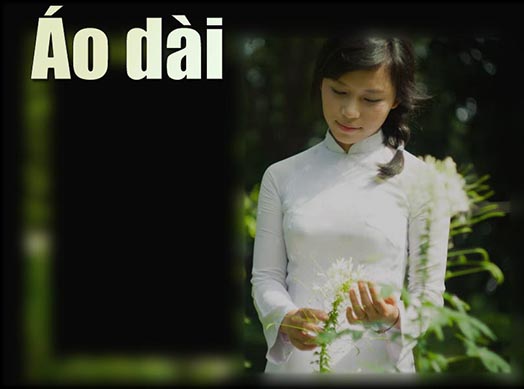
Áo dài is always considered a symbol of traditional Vietnam. A foreign tourist who lands in Vietnam has the opportunity to see a woman dressed in her áo dài. It is about a close-fitting long tunic in light fabric, open on the sides from the waist down, worn over a large pants. It will be surely of speechless admiration facing this incarnate elegance. It is not the clothe that provokes this admiration but rather the relation between the woman, her dress and her culture. However the a’o dài has only a short history. It just dated from 18th century.Impressed by the elegance of the Manchurian costumes under the reign of the Qing, a Vietnamese lord of the name Nguyễn Võ Vương established the wearing of a Vietnamese national dress inspired by the Chinese model. It should wait one century before this dress is adopted in the popular strata of the Vietnamese society, in particular during the reign of emperor Minh Mạng.

Some selectioned dress

This dress becomes nowadays the national symbol with more and more varied models in colors as well as in decorative patterns. Most Vietnamese wear it.

 Tunic museum (Bảo tàng viện áo dài)

[Return TRADITIONS]

The cult of ancestors (Thờ cúng tổ tiên)


The cult of ancestors

Version française

Version vietnamienne

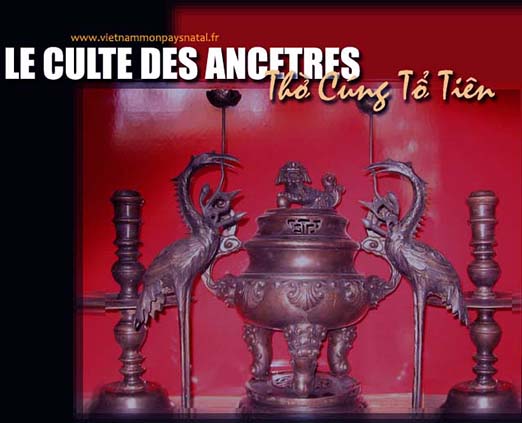
In Vietnam, filial piety is one of the fundamental notions in the Vietnamese family which is ruled by the cult of ancestors. The latter provide good advice and only help living descendant if they are respected and honored in particular if their tombs are well maintained.In most of Vietnamese homes one finds on the little family altar wooden tablets, each for an deceased ancestor, down to the fifth generation. One finds on each tablet the inscription of the name of the deceased and also the possessed titles acquired during his active live. Generally speaking, these inscriptions were written in Chinese characters.

In each Vietnamese family, it is the eldest son who is in charge of maintaining the family altar. It is possible that the oldest person in the eldest branch of the family has this responsibility when it comes to a « big family ». No importance concerning sex is imposed on the responsible person. A daughter may assume this responsibility as well as a man.

The cult of ancestors is especially put in honor at the festival of Tết, the Vietnamese New Year. One takes this occasion to offer to the deceased not only a meal but also incense and fake money bills that will be burned

during Tết.

Photo gallery

[Return New Year Bính Ngọ]

Buffalo (Con trâu)


Version française
Galerie des photos

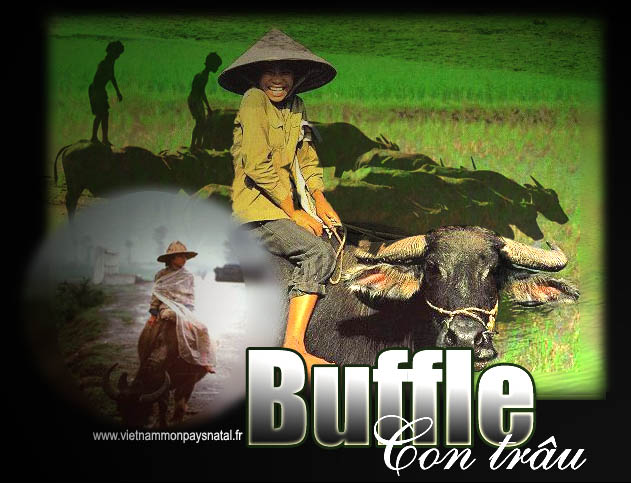
As Vietnam is an agricultural country, the buffalo is always regarded as a familiar animal for the Vietnamese people, in particular the peasants. The image of the buffalo is closely tied to the rural landscape of Vietnam. Like many other countries in the world, Vietnam has legends among which there is one concerning the buffalo.

Once upon a time, to help the Vietnamese peasants, God was assigned an angel to descend in Viet-Nam with two bags, one filled with cereal seeds to feed people and the other with grass seeds for the cattle. The angel was advised to sow the cereals seeds first, and grass seeds next. Being so absent minded, he forgot the recommendation by doing the opposite: grass seeds first, and cereal seeds next. That is why Viet-Nam was covered with so much grass and forests that the peasants had to make a complaint which echoed to Heaven. Furious, God condemned the angel to exile by turning him into a buffalo and sent him to Viet-Nam. That is why the buffalo was compelled to spend all day long munching grass and pulling the plough to pay for his errors.

The buffalo is a very useful animal in agricultural countries, in particular Vietnam where farming technologies are not very developed. In certain countries, if the dog is the best friend of man, then in Vietnam the buffalo is an inseparable companion of the farmer. Without this animal, the latter will be deprived of everything because it is the buffalo that helps the peasant to till the land everyday, to cart the burdens, to replace him in tiring and ungrateful tasks. This ruminant is also the animal that mountain and highland dwellers sacrifice when it comes to asking God for blessing harvest.

The buffalo is the Vietnamese peasants’ benefactor. This is why it is generally quoted in folk songs and proverbs. It is one of enriching subjects in the Vietnamese poetry. For the peasant, the buffalo forms part of his heritage. That is why the saying:

Ruộng sâu, trâu nái

The deep rice field, the standard buffalo

indicates a well to do person in the village.

Tậu trâu, lấy vợ, làm nhà
Trong ba việc đo’ trong là khó thay.

Purchasing a buffalo, looking for a wife, and building a home
Among these three jobs, none of them seems to be easy.

As it is the case of fish farming, the breeding of buffaloes is a mean to get rich quick. That is why it is customary to quote in folk songs the following words:

Muốn giàu thì nuôi trâu cái,
Muốn lụn bại thì nuôi bồ câu.

Want to become rich, buy female buffaloes.
Want to be in debts, breed pigeons.

To designate the buffalo, we usually use the word “ngưu (牛)” but this turns out to be incorrect. According to Vietnamese researcher Lại Nguyên Ân, This is a mistake that we should know about. The buffalo lives only in tropical regions. The buffalo is not found in northern China. It seems that this mammal only existed in Kouang Tong and Kouang Si when the Bai Yue territory was annexed by the Han. In ancient Chinese texts written by the Northern Chinese, the word “ngưu” is used to refer to an ox. As for the buffalo, in the Chinese dictionary it is referred to as “thủy ngưu (水牛)” because it is an ox that can swim well in water. That’s a fact worth knowing.

Trâu ơi ta bảo trâu này
Trâu ra ngoài ruộng trâu cày với ta.
Cầy cấy vốn nghiệp nông gia
Ta đây trâu đấy ai mà quản công.

O my buffalo, listen to what I tell you
You go to the rice field and plough with me;
Ploughing and transplanting is a ploughman’s trade
Here I am, here you are, who of us pities his pain.

or

Trên đồng cạn dưới đồng sâu,
Chồng bừa vợ cấy con trâu đi cày.

In the high and low rice fields,
The husband harrows, the wife transplants, the buffalo ploughs.

In the morning, the buffalo can be seen early in the rice field. In the evening, it is brought back to the hamlet by the herdsman after a hard day’s work. Vietnamese have occasion to recall the picture of rustic life in the countryside described by the famous poetess Huyện Thanh Quan (the sub-prefect of Thanh Quan (or Thái Bình of today)) in her poem entitled “Twilight Landscape (Cảnh chiều hôm)”:

Chiều trời bảng lảng bóng hoàng hôn
Tiếng ốc xa đưa lẫn trống đồn.
Gác mái ngư ông về viễn phố,
Gỏ sừng mục tử lại cô thôn……

Evening brings back the shadows of twilight under a pale sky;
The sound of the watchmen’s trumpets can be heard in the distance, answering the tam-tam of the guard post;
The old fisherman lays down his oar to return to his distant station;
The young herdsman beats his buffalo’s horns to return to his lonely hamlet….

In the history of Viet Nam, there are two illustrious characters who took on the role of herdsmen when they were young. Because of poverty, they were forced to spend their days herding buffalo despite being well educated. The first was Đinh Bộ Lĩnh. He had the merit of subduing the rebellions of the twelve local lords and unifying the country. He thus became the first emperor of an independent Vietnam after a thousand years of Chinese domination. The second was Đao Duy Từ. At one time, he fled to the south (Đàng Trong) to look after a herd of buffalo belonging to a wealthy man in the Tùng Châu region. Knowing that Đao Duy Từ was no ordinary character, this wealthy man recommended him to Trần Đức Hoà, the eminent advisor to Lord Nguyễn Phúc Nguyên. Finding in him the qualities of an educated and talented man, Trần Đức Hoà gave him his daughter in marriage and introduced him to the Nguyễn lord, Nguyễn Phúc Nguyên (or bonze lord). It was on his recommendation that the latter succeeded in building two fortresses “Trường Dục” and “Định Bắc Trường thành” along the river Nhật Lê we’re accustomed to calling “the Master’s fortress” at Đồng Hới (Quảng Bình) to withstand assaults from the armies of Lord Trịnh. He was the deserving mandarin of the Nguyễn dynasty and was still regarded by lord Nguyễn Phúc Nguyên as his “Venerated Master”.

In short, one finds through the image of the buffalo most of the image of Viet-Nam, our country. For the overseas Vietnamese, to find the buffalo is to find Vietnam. This animal, along with the bamboo, is one of the representative symbols of Viet-Nam.

The buffalo reflects at the same time the tender way of life and the unshakable resistance of the Vietnamese people.

Pictures gallery

[Return RELIGION]

The dragon (Con Rồng)

Version française
Version vietnamienne

img_2250


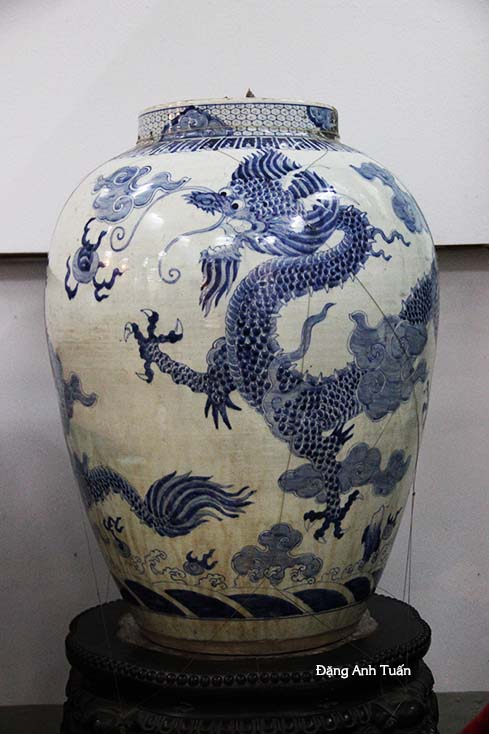
There are neither Vietnamese tales nor legends without this fabulous and mythical animal that is commonly called Con Rồng or more literary Con Long (or the Dragon in English). It makes part of the four animals with supernatural power (Tứ Linh) and occupies the top place. It is frequently used in Vietnamese art. It is not only seen in pagodas, but also on the ridges of roofs, the beams of frames, furnitures, the pieces of dishes and fabrics. It is also the emblematic animal traditionally chosen by the emperor for his clothes.

All Vietnamese firmly believe they are descendents of the Dragon king Lạc Long Quân coming from the Waters and of the fairy Âu Cơ of terrestrial origins. From this union, the fairy laid one hundred eggs that gave birth to one hundred robust sons. Later, at the separation of the couple, fifty of them followed their father Dragon toward the lower coastal regions and founded the first Vietnamese nation named Văn Lang while the other fifty followed their terrestrial mother toward the high plains to give birth later to an ethnic microcosm the most complex in the world ( about fifty groups ). Although this version of the Seven Tribes of Israel is unbridled and poetic, it nevertheless allows the Vietnamese and other minority groups to live together somewhat peacefully in this country of the form of the dragon, and to unite as a sole person to overcome foreign aggressors in difficult moments of their history.

According to a Vietnamese legend, it was thanks to the return of a benefactor dragon that barbarous hordes coming from the North were routed. Its fire spitting tongues on contact with the sea turned into a multitude of small islands and reefs with extravagant forms. That is why this bay is known in Vietnamese as « Hạ Long » or ( Descending Dragon ). It becomes thus the eighth marvel of the world and a natural site the most visited by foreign tourists when they land in Vietnam.

Hạ Long Bay

The dragon is also the symbol of the King. That is why its feet must have five claws. If one sees a dragon with five claws on a furniture, a box or a china, this object is meant for the service of the emperor. Otherwise the dragon generally has only four claws.
It is also the symbol of the husband, the fiance and more generally the man. As for the woman, she is represented by the phenix. That is why when we want to make allusion to a marriage, we often associate a dragon with a phenix on a piece of embroidery or a sculpted panel. It is also this association that poets evoke in their poems to talk about marital happiness and shared joy.

The dragon is seen everywhere even in the Mekong delta. This river born in the foothills of the Himalayas ( Tibet ) divides into nine branches or nine dragons to throw itself in the golf of Cochinchina ( or Nam Bộ ). That is why this region is called Cửu Long ( or Nine Dragons in English).

If this marine monster is rebutted by the majority of the peoples, it is on the contrary, a part of the Vietnamese daily life. It is assigned to keep an watchful eye, at the imperial city of Huế, on the tombs of the Nguyễn emperors with all its body made of multicolored ceramic pieces. Golden, it coils around the carmine lacquered pillars of imperial palaces. It is one of the twelve astrological signs of the lunar calendar. It becomes not only the embroided silk clothes for tourists but also a front part sign with gaudy colors on the junks of the Hạ Long bay.


In the cradle of legends that is our Vietnam, we have the feeling of being better protected by this marine monster because we are convinced that  we are the descendents of king Dragon.

[Return RELIGION]


Tử Cấm Thành Bắc Kinh: phần 2 (Cité interdite Pékin)

Version française

English version

[Tử Cấm Thành: Phần 2]

Cung Càn Thanh  đã bao lần là nơi  chứng kiến các âm mưu, các cuộc ám sát hay phản trắc dưới hai triều đại Minh Thanh. Hơn nữa, sau ngai vàng,  trên tấm bình phong, luôn luôn có treo một bức hoành   mà   hoàng đế Thuận Trị đề tự như sau: Quang minh chính đại. Còn thấy luôn cả lời bình luận  tôn vinh của người kế vị của ông , đó là hoàng đế Khang Hi. Đây là một kết cấu   tuyệt  vời , vượt qua cổ kim, còn  rạng rỡ và vĩnh cửu đáng làm tấm  gương học tập  cho hậu thế. Nhưng khốn  nổi sau  bức hoành nầy có bao nhiêu chuyện xung đột tiềm tàng,   tranh dành quyền hành ở trong  cung.

Trong thời gian 500 năm ngự trị của hai triều đại Minh  Thanh,  có nhiều biến cố đã xảy ra ở trong cung nầy. Trước hết là chuyện của hoàng đế Gia Tĩnh nhà Minh (1507-1567)  nổi tiếng hoang dâm và tàn ác không tả xiết được , súyt nửa bị chết ngạt bởi các cung nữ trong cung.  Lợi dụng ông ngủ say và rửa hận bởi cử chỉ hoang tưởng của ông, các cung nữ toa rập dùng dây  thừng thắt cổ ông trên long sàng.  Nhưng vì bị tố giác bởi một cung nữ trong nhóm với hoàng hậu nên hoàng đế được cứu sống. Các cung nữ đều bị hành quyết  tức khắc  luôn cả bà vương phi sùng ái của hoàng đế.

Rồi sau đó hoàng đế Thái Xương của nhà Minh (1582-1620) được biết dưới tên Chu Thường Lạc  chết đột ngột sau một tháng đăng cơ.  Người ta nghi ông  lạm dụng tình dục hay  bị  đầu độc.   Khiến làm triều đình lâm vào cuộc tranh giành quyền lực .   Vụ nầy được biết duới tên là Án Hồng Hoàn vì trước khi chết đột ngột,  hoàng đế có uống thuốc. Sau cùng hoàng đế áp chót của nhà Minh, con của Minh Quang Tông, Chu Do Hiệu  (1605-1628)  được biết với  niên hiệu  Thiên Hỷ (Tianqi) để  vuớng víu vào vụ Án Di Cung. Lợi dùng tuổ i nhỏ của hoàng đế, một vương phi của cha ông (vua Vạn Lịch),  Lý Tuyên Thi cố tình  thống chế Chu Do Hiệu . Bà cố  tình  ở lại Cung Càn Thanh và yêu cầu hoàng đế phong bà làm thái hậu để bà  có thể  điều hành triều chính.  Trước đòi hỏi và phản đối  mạnh mẽ của các quần thần, vua Thiên Hỷ ( Chu Do Hiệu) hạ chiếu bắt bà rời khỏi cung  và sống ở cung khác bị cháy vài tuần sau. Cuối cùng bà không bị chết  cùng cô con gái. Qua việc nầy , ai cũng nhận thấy có sự nhúng tay của hoàng đế tuy rằng có sự phản đối ở nơi ông.  Các sử gia thường tập hộp lại ba án trên đây dưới cái tên là  Vãn Minh Tam Án.

Dưới triều nhà Thanh,  có hai biến cố quan trọng. Mặc dầu Khang Hi được xem là một ông vua vĩ đại trong lịch sử Trung Hoa nhưng ông cũng gặp khó khăn trong việc lập thái tử nối ngôi vì có cuộc đấu tranh giành hoàng vị giữa các con của ông. Lúc đầu , ông phong cho Yinreng làm thái tử lúc mới hai tuổi sau đó Khang Hy đổi ý và chọn hoàng tử thứ 14 Dẫn Trinh làm ngưởi thừa kế.  Ông thầm kín  cất giấu  sau lưng bức hoành có bốn chữ  Quang minh chính đại môt cái hộp trong đó có di chiếu  « Truyền vị thập tứ tử  »  có nghĩa nhường ngôi lại cho thế tử thứ 14 vì Dẫn Trinh là hoàng tử được ông yêu chuộng.   Theo  truyền thuyết nói rằng,  khi Khang Hy đau nặng  thì Dẫn Trinh lúc đó đang viễn chinh ở vùng Tân Cương (Xinjiang) thì hoàng tử  Dẫn Chân ( Yingzheng ) lợi dụng thời cơ để lấy cái hộp và sửa chữa « Truyền vị thập tứ tử »  thành  » Truyền vị dư tứ tử  » bằng cách bỏ chữ « thập ». Nhờ vậy Ung Chính trở thành hoàng đế. Theo  bàn luận của người đời, Dẫn Chân còn chạy trốn ra vườn xem bệnh tình của Khang Hy mà trước đó ông có cho Khang Hy uống một bát  canh sâm. Theo các sử gia, Ung Chính có phần  trách nhiệm  trong cái chết đột ngột của Khang Hy  và vẫn tiếp tục là môt nghi vấn, một câu chuyện bàn tán của người đời. 

Vừa lên ngôi dưới tên là Ung Chính, ông  liền diệt trừ hay lưu đày tất cả những người  có tiềm năng chống đối .  Sau khi đăng quang, để tránh việc thừa kế mà ông là người  thông hiểu và gian nan  trong cuộc tranh giành quyền lực,  ông  mới thiết lập một phương pháp khéo léo bằng viết chiếu chỉ người thừa kế sau nầy thành hai bản, một bản niêm phong để trong hôp  cất sau bức hoành « Quang Minh chính đại » còn một bản ông mang trong người.  Khi ông lâm chung thì  có thể kiếm di chiếu ở trong hộp và  so sánh với bản ông có trong người thì sẻ nhận ra được người kế thừa hoàng vị .  Như vậy không có sự phản kháng nào cả. Phương pháp lập thái tử vẫn có tác dụng đến đời vua Hàm Phong nhưng vì Hàm Phong chỉ có một đứa con duy nhất  Đồng Trị với Từ Hy hoàng hậu nên phương pháp nầy hết còn hiệu lực. Để củng cố chức vụ nhiếp  chính, Từ Hy thái hậu ủy bỏ phương pháp nầy bằng cách tấn phong lần lượt  những  » hoàng đế con  nít » đó là Quang Tự và Phố Nghi.

[Tử  Cắm Thành (Bắc Kinh): Phân 3]


Chronologie des Han occidentaux ( Niên đại nhà Tây Hán, VF)

Chronologie des Han occidentaux

Version vietnamienne

Version anglaise


  • 202 av. J.C.: Liu Bang se proclame empereur. (Gaozu)
  • 195 av. J.C.: Mort de Gaozu.
  • 198-188 av. J.C. : règne de Huidi. (Hán Huệ Đế)
  • 188-180 av. J.C.: régence de Lu Hou (Lữ Hậu)
  • 180-157 av. J.C.: règne de Wendi. (Hán Văn Đế)
  • 157-141 av. J.C.: règne de Jindi. (Hán Cảnh Đế)
  • 154 av. J.C.: rébellion des Sept Royaumes.
  • 141-87 av. J.C. : règne de Wudi. (Hán Vũ Đế)
  • 87-74 av. J.C.: règne de Zhaodi. (Hán Chiêu Đế)
  • 80-68 av. J.C.: régence du général Huo Guang
  • 74 av. J.C.: règne de 27 jours de Liu He, empereur destitué.
  • 74-48 av. J.C.: règne de Xuandi. (Hán Tuyên  Đế) 
  • 48-33 av. J.C.: règne de Yuandi. (Hán Nguyên Đế) 
  • 33-7 av. J.C.: règne de Chengdi (Hán Thành Đế) 
  • 7-1 av. J.C.: règne de Aidi. (Hán Ai Đế)
  •  1 av.J.C.-5 après .J.C. : règne du jeune empereur Pingdi, empoisonné par Wang Mang. (Hậu Phế Đế)

 Une fois au pouvoir, Wang Mang (Vương Mãng) entama une série de réformes monétaires (3 fois en 9, 10 et 14 après .J.C.) et économiques du pays. Les classes les plus touchées étaient les nobles et les commerçants car à chaque changement de la monnaie, les pièces anciennes étaient échangées pour les neuves à un taux moins avantageux, ce qui incita les gens à fabriquer des fausses pièces au lieu de perdre leur valeur au change. Le faux-monnayage était sévèrement puni. Par contre, les paysans n’étaient pas touchés par cette réforme car ils vendaient leurs céréales en faible quantité pour l’achat des denrées nécessaires sur le marché et ils n’avaient aucun souci concernant le numéraire. Dès lors, Wang Mang s’attira la haine des nobles et des commerçants riches mais selon le sinologue suédois H. Bielenstein, au moment de la mise en place des réformes économiques, la véritable cause de sa chute était la série de calamités naturelles (sécheresse, inondation, sauterelles ) entraînant d’abord la famine, puis le banditisme, la révolte et enfin la guerre civile. L’inondation provoqua une vaste immigration des populations vivant dans les zones sinistrées.

Ce désastre amena les réfugiés affamés à se regrouper en bandes pillant les régions qu’ils traversaient et à se soulever contre les troupes gouvernementales censées de les réprimer. Connues sous le nom de Sourcils Rouges (Xích Mi) du fait qu’elles se teignaient en rouge les sourcils, ces hordes ne tardèrent à obtenir la première victoire en l’an 22 et commencèrent à envahir les autres régions de l’ouest. Entre-temps, il y avait des révoltes menées par l’aristocratie Han mais elles avaient toutes été étouffées et matées sévèrement car elles manquaient le soutien populaire. Il faut attendre treize années de guerre civile pour que le clan Liu retrouva confiance en Liu Xiu (ou Lưu Tú), un personnage talentueux et magnanime connu plus tard sous le nom Guangwu (Hán Quang Vũ Đế) pour restaurer l’empire et la dynastie des Han. 

C’est le début de la période des Han orientaux. (Đông Hán). Lors de son avènement au pouvoir, il ne cessa pas d’agir en faveur des pauvres et des esclaves. Contrairement à Wudi, il pratiqua la politique de non-intervention dans les pays vassaux. Pourtant c’est lui qui envoya plus tard Ma Yuan (Mã Viên) pour mater la révolte des sœurs Trưng Trắc Trưng Nhị dans le territoire des Yue. Il était considéré comme l’un des grands empereurs de la dynastie des Han avec Wudi par les historiens. 

Lors des fouilles archéologiques, on sait que les fils des Han furent en avance sur les Romains dans plusieurs domaines à cette époque. Ils furent les premiers à inventer un produit permettant de véhiculer leur pensée et leur savoir. Ils l’appelaient souvent sous le nom « zhi » ou (giấy ou papier en français). En 105 de notre ère, un eunuque de nom Cai Lun (Thái Luân) de la cour impériale observant la façon dont les guêpes se servaient pour mastiquer les fibres de bois dans la construction de leur nid cartonné, eût l’idée de les imiter et inventa ainsi le papier qui sera présenté plus tard à l’empereur Hedi (Hán Hòa Đế) de la dynastie des Han orientaux. (Đông Hán). L’archéologie a contredit récemment cette version car on a retrouvé des fragments de papiers issus des fibres végétales nettement antérieurs à l’époque de Cai Lun, certains datant du règne de Wudi et d’autres exhumés des tombes de la fin des Han occidentaux et du début des Han orientaux. Il est très fréquent de relever les incohérences chronologiques que les Chinois ont voulu introduire délibérément dans leur histoire traditionnelle établie jusque-là par les dynasties, en particulier celle des Qin et de Han, dans l’orthodoxie confucéenne et dans la période de conquête et d’annexion de nouveaux territoires si on continue à avoir un esprit cartésien.

Les démiurges chinois tels que Fuxi (Phục Hi) , Nuwa (Nữ Oa), Pangu (Bàn Cổ), Shennong (Thần Nông) ont été empruntés aux populations méridionales. C’est le cas du grand érudit chinois Ruey Yih-Fu qui voit en Fuxi et Nuwa un trait culturel spécifique des Nan Man (Man Di) (Barbares du Sud) ou celui de Le Blanc, le traducteur de Huainanzi (Hoài Nam Tử). Pour ce dernier, le cycle de Fuxi-Nuwa est une tradition du royaume de Chu (Sỡ Quốc). Les fils des Han introduisaient même dans leur littérature un mythe de création Pangu recueilli chez les ancêtres de Yao (Baptandier). L’archéologue chinois Yan Wenming décrit cela comme le produit unique d’une multiplicité d’origines ou il faut être comme le sinologue célèbre Chang Kwang-Chih pour parler d’un phénomène au sein d’une sphère d’interaction culturelle.  Lire la suite