Peasant (Nông dân)

Version française
Version vietnamienne
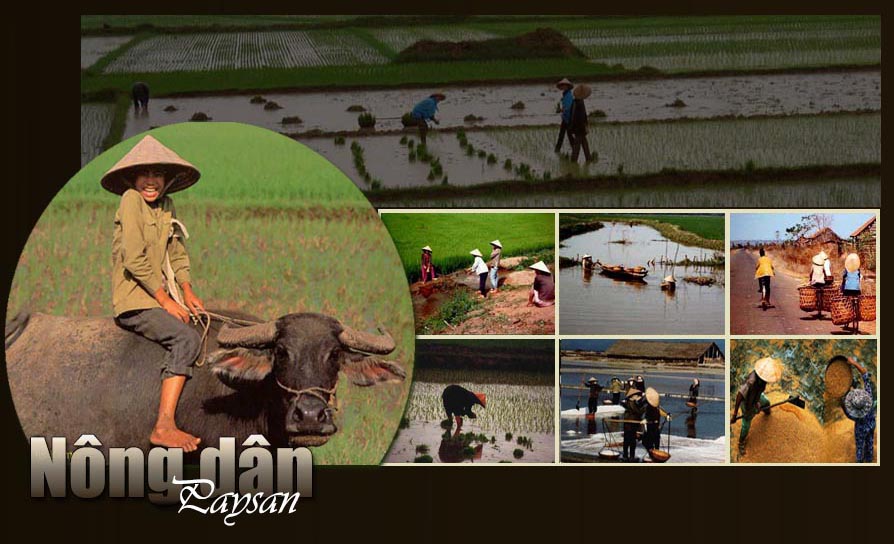
 
paysan

As Vietnam is a country where Confucianism exerts considerable influence on society, the Vietnamese peasant always takes the second rank on the social scale compared to a scholar. Even in the majority of folk songs, an undeniable preference is noted for the learned men. The dream of having a learned man as husband is always an obsession for a Vietnamese girl in the old days.

Chẳng tham ruộng cả ao liền
Tham vì cái bút cái ghiên anh đồ.

I neither need immense rice fields nor whole ponds
I only like the scholar’s brush and his ink stone.

However, thank to the farmer’s labor and sweat, Vietnam has currently become the third largest rice exporter after the United States and Thailand. Also thanks to his sacrifice, Vietnam territory has grown from Lạng Sơn to the Point of Cà Mau.

It is the farmer that took possession from 16th century, of the territory filled with water and sunshine that is our Cochinchina during the Descent toward the South. It is also him that took up arms to defend the motherland when invaded. That is why he is often called peasant-soldier. It is also him that first revolted against the aristocracy and gave the brothers Tay Son the opportunity to grasp the power in 1770 in central Vietnam.

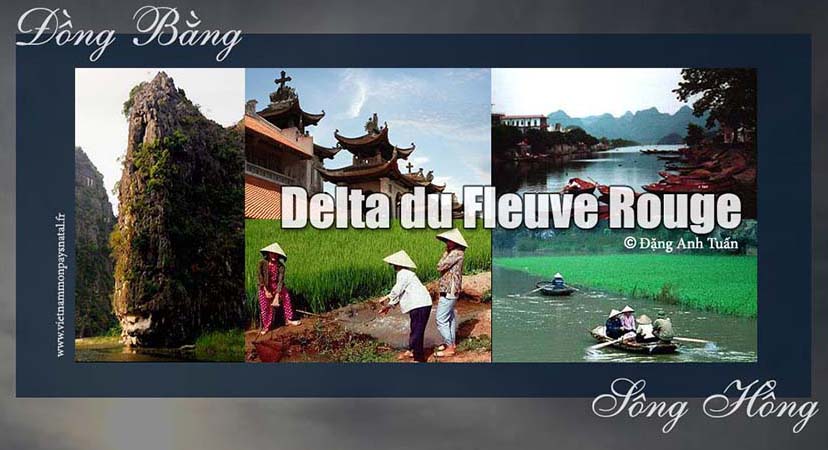
It is also him that works the landscape of the two deltas with no cultivable piece of land is left unexploited. Everyday in the fields of these deltas are seen male and female peasants leaning under their conical hats, feet and hands in the clay, continuing to pull out rice seedlings from nursery beds or replant them in the paddy. His existence is a continual struggle. He loves his land more, and his precious cereal gives him so much anxiety and annoyance. He never stops resisting bravely the forces of nature: drought, flood, typhoon etc… He is always obsessed with overcoming the water. To work the soil, to thwart calamities, to prevent food shortage.

That supposes his perfect mastering of hydraulic art: dike building, canal digging, breach filling, rampart elevating etc. It is the water that shapes his thick identity. He becomes more patient, more obstinate, more hard working and more methodical. For him, work is a supreme virtue, a value in itself. In the North, the peasant is poorer. He dresses in a more austere way and behaves with more reserve. Even on his face, the cheeks are more protrude, the features are marked. In the South, the peasant is more open, less reserved, craftier, and more outgoing. In spite of these differences, there is one thing in common between the peasant of the North and that of the South: realism.

Pictures gallery

The down-to-earth overrides sentimentality. His sharp observation of reality gives rise to an often wild humor towards other classes, in particular monks, sorcerers, quacks, aristocrats, etc. This humor is found in Ca Dao ( or proverbs ).

Thẩy địa, thầy bói, thầy đồng,
Nghe ba thầy ấy thì lông không còn.

The geomancer, the fortune teller, the soothsayer,
Listening to them and you will lose your shirt.

Also in folk songs are found his joy of life, his simplicity, his righteousness, his economy. It is in these watery checkerboards filled with mud, and meticulously and economically gardened that appears the centennial rooting of the peasant tied to his labor, which makes him a diligent and obstinate combatant.

For a Vietnamese peasant, his field, his soil are symbolized by this constant mixture of land and water. It is still by these words đất nước that he indicates his motherland. His attachment to this land is so deep that one can say only in one sentence:

His destiny is that of Vietnam.
 

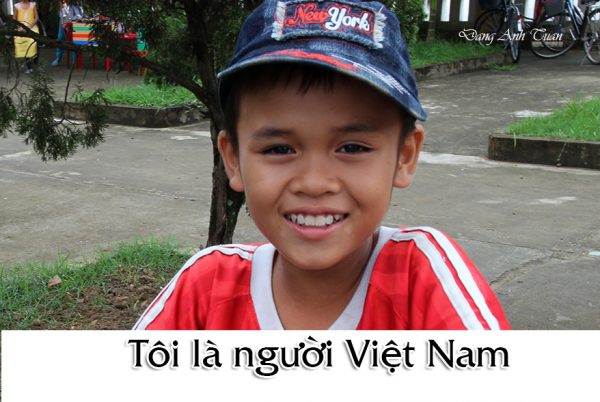
Being Vietnamese (Tôi là người Vietnam)


French version
Vietnamese version

Being Vietnamese 

According to the archaeological sources we have today, the Vietnamese are descendants of the Thai-Vietnamese group. Some historians keep on seeing in these Vietnamese, not only Mongol immigrants coming from southern China (the Yue) and resettling in the Red River delta in the course of the centuries that preceded our era, but also carriers of the Chinese civilization that swept away on their passage by a demographic push, all the brilliant civilizations known up until then on the Indochinese peninsula (those of Ðồng Sơn, and later of Champa).

Others think that the Vietnameses are the result of fusion between several people in contact in the basin of the Red River among which it is necessary to quote Hmongs, the Chinese, the Thais and Dongsonese. While basing themself on their legend of water melon taking place at the time of Hung kings and testifying to the coming of strangers of a different race who might have brought the seeds to Vietnam by the maritime way ( 3rd century B.C ) and on the archaeological excavations confirming the existence of the Nan Yue kingdom, the Vietnameses are convinced that they resulted from Yue but with an Indonesian background probably via by the intermediary of the Dongsonese because Ðình (communal house) heightened on piles and where resides the most vivid expression of the Vietnamese soul, resembles indisputably the houses prefigured on the bronze drums of Ðồng Sơn. This conviction seems conclusive because one finds also other astonishing resemblances among Vietnameses as well as Indonesian tribes: chews bétel, tattooing and tooth lacquering.

Apart from some Frenchmen like Henri Oger who was able to discover in the Vietnamese society a millennial civilization rich in traditions and customs, one continues to be open to a hallucinating confusion in considering that the Vietnamese civilization is a tracing of the Chinese civilization. One continues to reproach the Vietnameses for not having a civilization so worthy, intense and rich as the ones found in other peoples in Indochina (Khmer and Cham civilizations) through their temples of Angkor and Mỹ Sơn. It is a regrettable ignorance because to known the richness of the Vietnamese civilization, one needs to be more interested in its history, its literature than its art. 

How can one have a fantastic and original art when one is always in a perpetual struggle with a so rude and pitiless nature and when Tonkin is of no exceptional wealth not to include the systematic assimilation by the Chinese during their thousand-year domination. In spite of that, the Vietnamese succeeded in showing several times their techniques, know-how and imagination that allowed them to give to some Vietnamese productions (ceramics in particular) an almost admirable rank among the provincial arts of the Chinese world.

In order to preserve the traditions and to perpetuate their culture, the Vietnamese owe their safety to their sempiternal struggle. Thanks to their religious beliefs and their quasi hostile environment at the beginning, they possess a considerable power of resistance to moral and physical sufferings that became with the passing years one of their main forces for overcoming all external aggressions.

Also thanks to their labor, tenacity, and sacrifices in human lives, they were successful in holding in check the caprices and wrath of the Red River, in keeping the Chinese outside Tonkin on several rounds and in the 17th century going through the barrier which is made up then impenetrable the Anamitic cordillera in their march towards the South. The Chams were the first victims this secular confrontation, followed by the Khmers.

One can reproach the Vietnamese for being pitiless towards the other peoples but it should not be forgotten that the Vietnameses have struggled inexorably since the creation of their nation for their survival and the preservation of their traditions. The Vietnameses have been at a much disadvantage for a long time by the geographical proximity of China. It was to block the passage of Kubilai Khan‘s Mongols in the conquest of Champa that the Vietnamese suffered twice their invasions in 1257 and 1287. It was to find a passage towards the Middle Empire that the French thought to succeed in their first try by the Mekong then by the Red River that allowed a link to Yunnan that Doudard de Lagree‘s mission followed by Francis Garnier’s were sent to Indochina. This permitted the French to be more particularly interested in Tonkin and intervene militarily a few years later. It was also to counter China after the Korean war that the Vietnamese were implicated by force for decades in the East-West confrontation. It was to thwart the China policy in Cambodia that the Vietnamese received a lesson of correction in February 1980 by Chinese troops’ lightning invasion at the frontier of Lạng Sơn for a month.

For those who know the history of Vietnam well, being Vietnamese is not to be so peaceful and so cool even if a Vietnamese wants to be in that way. Kneaded of the brown silt of the Tonkinese delta where he comes from, involving in the perpetual struggle with the acrimony of the Red River, undertaking a  long march toward the South through a succession of intermittent wars, and suffering a long Chinese assimilation and domination, not to include a century of French colonization and a few dozens of years that compelled him to become a target of the East-West confrontation and a victim of the cold war, the Vietnamese never lets himself discouraged by these titanic hardships. 

On the contrary, he becomes more hardened, more perseverant, more tough, more persuaded in his political convictions and more capable of resisting valiantly those affronts. His profound and intimate attachment to his native land and his traditions makes him become uncompromising in the struggle, which makes of him a pitiless and formidable conqueror for some, a legitimate defender of freedom and national independence for others.

Whatever happens, he found himself proud of taking over from his parents to valiantly defend the ancestors’ soil and his people’s survival and to be worthy of the Son of the Dragon and the nephew of the Fairy.  « Dyeing for one’s country » is not strange either to his temperament or his traditions. But it is the lot the most beautiful and worthy of desire that many Vietnamese such as Trần Bình Trọng, Nguyễn Thái Học, Phó Ðức Chính, Nguyễn Trung Trực,Trần Cao Vân, Nguyễn An Ninh etc. have accepted to get with bravery on that land of legends.


Being Vietnamese

is being capable of resisting above all any assimilation and foreign ideology and being proud of having in his veins the blood of the Dragon.

Mekong delta river (Đồng Bằng Cửu Long)


Version française

Cửu Long nơi có chín rồng
Có sông nhiều cá có đồng lúa xanh
Thưở xưa là đất tranh giành
Người Nam nhắc đến không đành lìa xa

The Mekong delta is the former territory of the kingdom Founan (Phù Nam). The Mekong delta’s natives are  the mixing of several Vietnamese, Khmer, Cham and Chinese peoples. A fifth of the population lives in this delta. The least hectare, the least cultivable parcel of the delta are exploited by peasants consisted of Vietnamese of Khmer origin, Chinese,Chàm, and Vietnamese. That is why a multitude of religions is found there: Buddhism, Catholicism, Caodaism, Islam, and Hoà Hảo. Irrigated and sprinkled by the Mekong River, this delta produced itself alone one-half of the rice of the country, which allows Vietnam to become the third largest exporter of rice in the world.

The Mekong delta is currently divided into  12 provinces: Long An, Tiền Giang, Bến Tre, Ðồng Tháp, An Giang, Kiên Giang,  Vĩnh Long, Trà Vinh, Hậu Giang, Sóc Trăng, Bạc Liêu  and Cà Mau.

Đồng Bằng Cửu Long

Before becoming an integral part of Vietnam, this delta belonged to the Khmer people. The first Vietnamese colonists appeared only at the beginning of the 16th century on this territory that was until then just a marshy area infested with crocodiles and filled with mangroves. It is only in 17th century that this territory became Vietnamese under the scepter of the lords Nguyễn. It was also the arena of violent clashes between the Tay Son’s armies and the Nguyen’s partisans supported by the mercenaries recruited by Pigneau de Béhaine at the end of 18th century.

One finds in this delta a labyrinth of channels and rivers that add up to 4,000 kilometers, which is equivalent to the length of the Mekong river itself. This river is born out of the snows from Tibet in the province of Qing Hai, flows for more than 4,500 km before reaching the delta and crosses six countries: China, Burma, Thailand, Laos, Kampuchea, and Vietnam. It divides itself at the capital of Kampuchea, Phnom-Penh into two branches, Mekong and Bassac that enter Vietnam separately. In Vietnam, its upper course is divided into four arms at Vĩnh Long to throw itself into the East Sea. (Biển Đông).

The great lake Tonlé Sap, located at the center of Kampuchea is not only a natural fish tank but also a natural regulator of the water flow making it possible to prevent the flood of the delta. In summer, because of monsoon rain, the level of Mekong is higher compared to that of the lake to which it is connected by a channel. The lake fills itself, passing from 3,000 square kilometers in season of low waters to more than 10,000 square kilometers at the end of the monsoon. The lake begins to reverse its water into the delta by the time the rain ends. The Mekong delta does not need big water management works or dikes to protect itself from swelling, which proves to be essential for the delta of the North. Thanks to the irrigation of Mekong, the delta is so fertile. Gardens, fields, rice plantations and orchards are seen everywhere.

These orchards are in fact small plots of land irrigated by channels connected to each other by bamboo bridges often called Cầu Khỉ (Monkey Bridges). When referring to the delta, the term « cò bay thẳng cánh«  is often used. This means the delta is so vast that the cranes can extend their wings as they fly over. 

It is in this delta, at Sadec, that Marguerite Duras’ mother ran the girls’ school. A young Chinese of good family lived there too. He will become the hero in « The Lover « . This novel has made Marguerite Duras a superstar of the French literature overnight allowing her to win the Prix de Goncourt in 1984 and ensure the sale of one million three hundred thousand copies in paperback in Midnight Editions and one million copies in hardcover at France-Loisirs.

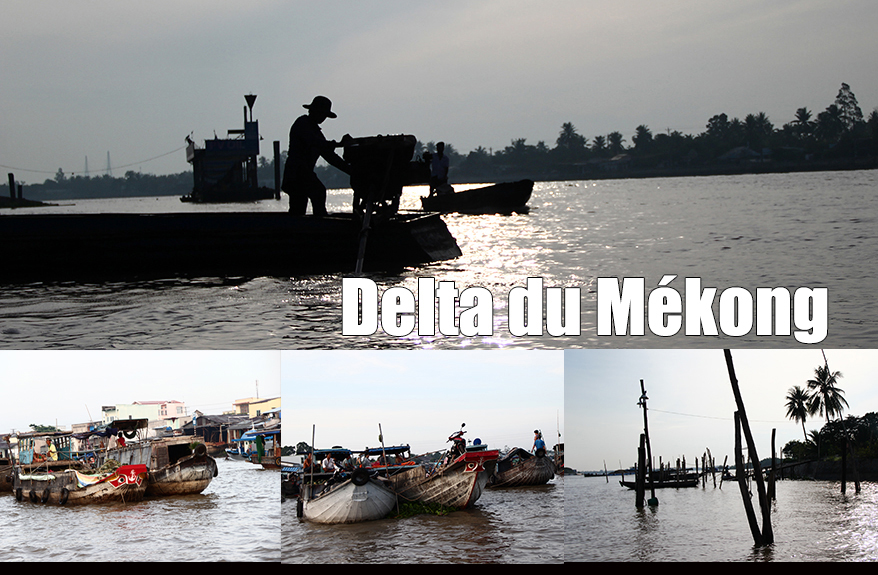
It is also in this delta that are seen every morning, hundreds of sampans converging toward the famous floating market of Phùng Hiêp at the crossroad of seven channels in the direction of Cần Thơ to Sóc Trăng, or toward lesser known markets such as Cái Răng and Phong Ðiền. Also seen are merchants with conic hats trailing their mountains of fruits, legions of ducks, chickens and pigs to the market on their small boats, or other rudimentary means of transportation (bicycles, rickshaws). It is thanks to the orchards of the delta that one finds a great number of fruits: sapotilles, ramboutans, caramboles, corrosoles etc… at the markets of Saigon. It can be said that the delta feeds Saigon and a greater part of Vietnam. In the northeast of the peninsula lies the Plain of Reed ( Ðồng Tháp Mười ) which was a Việt Cộng refuge yesterday and which becomes the Asian Camargue today.

In spite of its lack of archaeological richness, the delta continues to play a vital role economically for Vietnam. It becomes thus the object of greed and confrontation for so many years. It was French Cochinchina at one recent time. Even Hồ Chí Minh, when alive, has agreed to its importance by burying his father at Sadec. There are folks whose names remain anchored in the memory of the Vietnamese people. Phan Thanh Giản, Võ Tánh, Nguyễn Trung Trực, Hùynh Phú Sổ, are among these folks and are issue of this corner.


Without the delta, Vietnam is never free and independent….. 
It is the granary of Vietnam.


Forbidden city of Huế (Tử Cấm Thành)

Version française

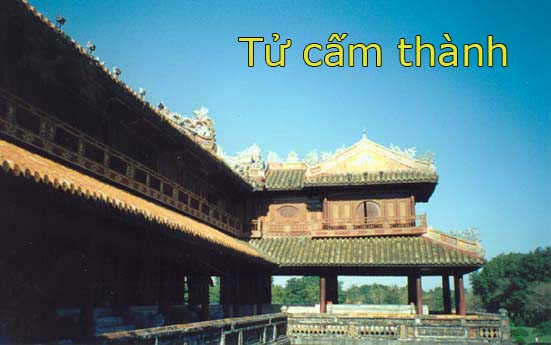
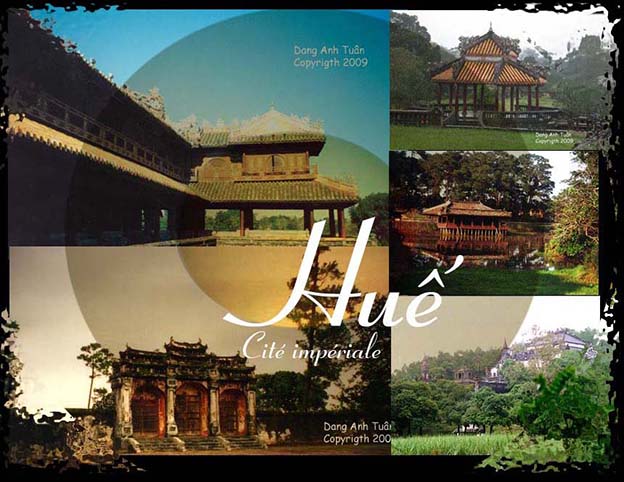
The forbidden city   is encircled by a 4-metre high  brick wall with a classic coating. This wall also is  surrounded by a ditch filled with water. Each door preceded by one or several bridges gives access on each side. The Ngọ Môn Gate is the main entrance and it is reserved for the King.

It is a powerful  masonry  foundation drilled with five passages and surmonted by an elegant wooden structure with two levels, the Belvedere of five Phoenixes (Lầu Ngủ Phụng). In the East and West of the Citadel, one finds respectively  the gates  of humanity and virtue which are highly decorated and pierced each by  three passages. The gate of humanity has been completely  restored in 1977.

World cultural heritage of Vietnam

Once we have gone precisely through the Ngo Môn Gate, we see appearing on the main axis the sumptuous palace of Supreme Harmony or  Throne palace that can be reached through the Esplanade of the Great Salvation (Sân Ðại Triều Nghi). It is in this Palace that the emperor, seated in a prominent symbolic position, received the salvation of all dignitaries of the empire  hierarchically aligned  on the esplanade at the time of great ceremonies. It is also the only building kept after so many years of war. Behind this palace, it is the imperial residence.

© Đặng Anh Tuấn

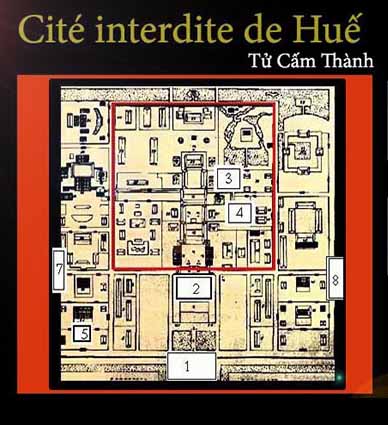
schema_noithanh1


  • 1 Noon gate (Ngọ Môn)
  • 2 Throne palace (Điện Thái Hoà)
  • 3 Archives pavilion  ( Thái Bình Ngự Lâm Thư Lâu)
  • 4  Royal theatre ( Duyệt Thị Đường)
  • 5 Pavilion of  Splendor (Hiến Lâm Các)
  • 7 Gate of virtue (Hiền Đức Môn)
  • 8 Gate of humanity (Hiển Nhơn Môn)

Pictures gallery


Huế city (English version)


titre_hue 

Version française

For the majority of Vietnamese, Huế always remains the intellectual and artistic foyer of Vietnam. It always looks like a sleeping princess. It knows how to keep its charm and grace that it has had since the Champa occupation with its citadel, the Perfume river and above all the famous Thiên Mụ ( or The Celeste Lady ) pagoda . The cruel beauty of its women wearing the white tunic ( áo dài ) accompanied by a conical hat (or nón bài thơ) , the fineness of its poetry, the union of its parks and pagodas with varnished tiles, the culture of its madarinal court make it more charming, noble, and majestuous.

One remembers Hue through the follwing two famous popular verses:

Gió đưa cành trúc là đà
Tiếng chuông Thiên  Mụ, canh gà Thọ-Xương

While the wind smootly moves the bamboo branches 
One hears the Thiên Mụ bell, and the Thọ-Xương rooster’s song

Before becoming the imperial capital of the Nguyễn, it was first the strong place of Chinese Jenan’s command of emperorQin ShiHuangDi in 3rd century B.C., then it was gradually integrated in the kingdoms of Lin Yi and Champa since 284 of our era. Then it was the object of greed of the Chinese and the Vietnamese when the latter  gained their independence. It was partially controlled by the Vietnamese in 1306. This control was only wholly when Hue became a dowry from king Chế Mẫn of Champa to the Vietnamese in exchange of his marriage with princess Huyền Trân.

Cố Đô Huế

It was the imperial capital of a reunified Vietnam from 1802 to 1945 and knew no less than 13 emperors of the Nguyễn dynasty, of whom the founder was Nguyễn Ánh known under the name of  » Gia Long ». On the left bank of the Perfume river, in the middle of the city center, three surroundding walls circumscribe the imperial city and protect the forbidden purple city whose orientation was set in relationship with four cardinal points by geomancers of the court. As an admirer of the Ming dynasty, emperor  Gia Long did not hesitate to give Huế a striking resemblance of the Forbidden City of Peking.

Pictures gallery

The royal tombs were built  at the exit of the city, along the river. Hue was the target of several conquests, French first in 1885, Japanese next in 1945 and then French in 1946. It was the witness of deadly combats during the Mậu Thân Tết offensive in 1968. Many times, it was also the actor of nationalist resistance in colonial time and during the last five decades.

Despite its aristocratic appearance, Huế knows how to conserve in difficult time the history of Vietnam that is to say the Vietnamese soul.

Red river delta (Đồng bằng sông Hồng)


delta_rouge

French version
Vietnamese version
Picture gallery

Contrary to the Mekong Delta, the Red River Delta contains many historical vestiges. It is the cradle of the Vietnamese nation. Found here, near Thanh Hoá in the Mã River valley is the presence of an civilization in the millenium before Christ at the Bronze Age called Dongsonian Age. Also started with the Bronze Age, the mystical periods of Vietnam’s history. The first legendary dynasty, that of Hồng Bàng, would have reigned until 3rd century B.C. From this delta has begun at the beginning of10th century the Nam Tiến Movement (or the Descent toward the South) started by General Lê Hoàn and finished in 18th century by the kings Nguyễn.

To dominate and control its water and its vagaries, the Vietnamese people had to build and consolidate dikes ceaselessly. These dikes existed for a thousand years and broke sixteen times during the past twenty-five years. It is because of the Red river that the Vietnamese people has been haunted with the domination and control of water. Since the beginning of our era, the Vietnamese people have been compelled to organize, perform, and maintain water amnagement works. This has brought to the Vietnamese the virtue of being more patient, more obstinate, keener, hard working and methodical in dike construction, canal digging, embankment building and breach filling. In this delta is found a sophisticated network of drainage canals and high dikes that only a centralized state on water control such as Vietnam knows how to realize.

It is itself that witnessed several decisive battles of the Vietnamese people against their invaders. It is thanks to its complicity that General Trần Hưng Ðạo defeated the Mongol army by planting on its bed pikes that broke the Mongol ships in 1288 at the mouth of the Bạch Ðằng river, renewing the tactics used by General Ngô Quyền against the Chinese in 938 (a victory that put an end to the thousand-year Chinese domination ). It is also witness of the Yên Bái uprising led by nationalist leader Nguyễn Thái Học in 1930. Its destiny is that of the Vietnamese people. It is it that gives the capital of Vietnam the last name Hànội (Hà means river, Nội means inside, interior).

Hà-Nội means « On this side of the river ». This city was founded by king Lý Thái Tổ (Lý Công Uẩn) in year 1010 at the neighborhood of Ðại La that geomancers believed to be favorably sheltered from the waters of the Red river. It is also called Thăng Long (City of Ascending Dragon) because, in his dream, Lý Thái Tổ saw a golden dragon flying from that locality.

Vietnam’s history is linked closely with this Red River (or Sông Hồng ). It is itself that forged the Viet soul. It is itself that has petrified the thick identity of the Vietnamese people. At the same time, It is the enemy, the friend and the actor of the Vietnamese people.

It is it that saw Hanoï  growing with its thirty-six business streets and lakes. Writer Thạch Lam of the « Tự Lực Văn Ðoàn » writing club talked about It in his novel « Hà Nội 36 phố phường« . It is it that gave birth to the French construction of the Paul Doumer (now Cầu Long Biên) bridge 1680 meters (approx. one mile ) long at Hà Nôi.

Thanks to its silt rich in iron, and with its irrigation, the delta is so fertile that it is possible to have one more harvest in November. It is it that shapes the landscape of the delta. Every day are seen women leaning under their conical hats, feet and hands in the clay, children coming from school surveying the dikes, motionless buffaloes in their mud baths under a sun that is sometimes overwhelming. It is it that often floods the plain of Hoa Lư, the old capital of Vietnam until 11th century.

The Red River is the second largest river of Vietnam after Mekong. It descends from Yunnan, a mountainous region south of China. It is known as the « six-head river » that enters Vietnam definitively at Lao Cai. It curves on more than 1000km ( over 600 miles ) before dying in the somptuous bay of Hạ Long. This one is the eighth wonder of the world. It counts more than three thousand isles, islets, and reefs. One finds rocks of varied forms. Some are tiny, others are of important dimmension bearing picturesque names such as isle of the Wonder, isle of the Surprise, the Marionettes, the Monkeys, the Toad etc…

The Ha Long bay has become for the past few years the site most visited by foreign tourists when they landed in Vietnam. Mini-cruises by junk make it possible to visit it. It is in this bay, according to the legend, that a dragon would have descended to tame the sea currents. That is why the Vietnamese called it Hạ Long (or the site of the Descending Dragon).

Impressed by the splendor and beauty of this bay that he visited by junk in 1468, king Lê Thánh Tôn left some unforgettable verses in witness of his emotion:

Muôn ngọn núi nổi trên như biển ngọc
La liệt như những sao sa, những quần cờ, chênh vênh màu xanh biếc …

High summits are drawn up as a crowd in the sea like many jewels
Bluish tops are dispersed like the falling stars and the pieces in the chessboard of waves.
Fish and salt, abundant like sand, offer a rapid gain to people

Pictures gallery


Capital Hanoï (Vietnam)


Version française

Vietnamese version

Thăng Long muôn thưở 

As indicated by its name Hà Nội means « The city on this side of the river » (Hà means river, Nội means inside). Contrary to other cities in Vietnam, Hanoï has a long agitated history. Its destiny is that of the Vietnamese people. It experienced a long period of disgrace when Nguyễn Ánh arrived at founding the Nguyen dynasty in 1802 after 20 years of fighting the Tây Sơn and decided to transfer the capital to Huế (or Phú Xuân). It witnessed several decisive battles in the reclaim of independence, in particular the Đống Đa battle run by Emperor Quang Trung in 1789. Thanks to the blitzkrieg upon Chinese troops of Qing, and to Quang Trung’s scheme to choose the date of the Vietnamese new year to surprise the Chinese enemy, Hanoï was thus liberated as well as Vietnam. It was also chosen by Hồ Chí Minh to proclaim Vietnam’s independence on September 2, 1945 at Ba Đình Square.

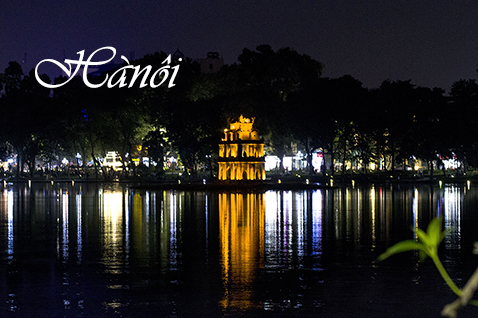
It was also on one of its lakes under the name of Hồ Gươm where Lê Lợi, future king Lê Thái Tổ, after his victory over the Ming, according to a Vietnamese legend, returned his magic sword to a golden tortoise which gave him this sword during a walk. Thanks to this sword, Lê Lợi succeeded in chasing Chinese troops of Ming out of Viet Nam after 10 years of fighting a guerilla warfare. That is why the lake is known as « Lake of Returned Sword » (or Hồ Hoàn Kiếm).

It was also at Hanoï that the unique one-pillar pagoda (Chùa Một Cột) was erected in 1049 by king Lý Thái Tông on a strong wooden pillar in the style of ancient temples of ancestors. According to legend, the king afflicted by not having a descendant, saw in his dream Quan Âm, the Goddess of Compassion. Sitting on a lotus flower, she gave him a son. Shortly after that, a young country girl that he made favorite, gave him an heir. In witness of his gratitude, he had this pagoda erected in the middle of a pond of lotus flowers.

Because of its proximity to the Red river, every year Hà Nội is victim of floodings caused by the cresting of this river and by violent monsoon rain and typhoons.

In spite of that, Hà Nội continues to remain the capital of a unified Vietnam. No one dares to contest the political and cultural heritage it has left to the Vietnamese people. It represents not only for the majority of Vietnamese the symbol of national unity but also the pride of a people of peasants who know how to valiantly resist the changes of nature and the ambitions of invaders.

Hànội vắng những cơn mưa

Saxophoniste Quyền Văn Minh

Pictures gallery


Thăng Long muôn thưở

Before becoming the capital city of Việt-Nam, Hà Nội was the seat of the Chinese administration in 607 and bore the name of « Tống Bình« . In 866, this seat was surrounded by the wall of Ðại La whose some vestiges still exist. It was chosen by the founder of the Lý dynasty, king Lý’ Công Uẩn, in 1010 as a new capital of Vietnam at the place of Hoa Lư.

According to legend, in his dream the king saw a golden dragon flying over that locality. That is why Hà Nội was called at that time « Thăng Long » (ascending dragon)« .

This site was deemed favorable in comparison with other sites because it is located between « hà » and « sơn », waters and mountains, in the middle of rice paddies and protected from flooding by dikes. In 15th century, Hà Nội took the name of Ðông Kinh. Then it retook the name of Thăng Long until the transfer of the royal residence to Huế. Next, it took the name of Thành Tích then Bắc Thành before becoming Hà Nội only in 1931. It became the capital of North Viet-Nam after the Geneva Accord in 1954 and since the events of 1975, the capital of reunified Viet-Nam.

Hà Nội covers 913km2. Its interior (or nội thành 40km2) is divided into four urban districts (or Quận): Quận Hoàn Kiếm, Quận Hai Bà Trưng, Quận Ðống Ða, and Quận Ba Ðình. It also includes six suburban districts (or Huyện) and several villages located within its limits.

One finds the soul of Hà Nội through its old city. Poetess Bà Huyện Thanh Quan, a poetess of 19th century evoked it in one of her works. What retains the most in that old city are the 36 streets that are often known as Hàng (or merchendise in English). There, each cratfsman makes his specialty object and each street was baptized following the craft that was practiced there: street of Silk, street of Drums, street of Potteries etc. Novelist Thạch Lam talked about it in his novel « Hà Nội, 36 Phố Phường ». Hà Nội is also the Vietnamese city which keeps more colonial traits compared to other cities. It can be said that it is the conformed copy of a French town in the structure of Arcachon, with its governor’s palace, opera house, post office and park. The bridge Long Biên (or Paul Doumer) recalls not only the first work of art of French builders on the Red river in 1902 but also the traces of American bombings during the Vietnam War.

In spite of that, Hanoï, from the past few years begins to change its face and look. Constructions have been multiplied at such a rhythm that there is not one square meter unoccupied. It tries to catch up with its late economy and to fill in the incoming vacuum left by the return of Hong Kong to China.

[RETURN]

Being young in Vietnam (Thời thiếu niên)

etrejeune

Version française

Version vietnamienne

 
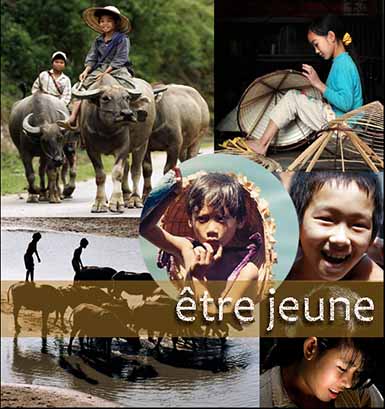
In spite of the war which devastated this country for so many years, the Vietnamese young people continue to crave for life. That amazes enormously those who do not know Vietnam. In this country,  » Being Young » concerns always boldness because the living conditions are extremely hard and nature is also extremely rude and pitiless, in particular for those who live in the North and on the Central highlands. It is necessary to know how to resist bravely the forces of nature but it is also necessary to learn how to live with wild creatures, tricking them and fighting them.

One also starts to work very young in Vietnam. From their youth in rural areas, boys tend buffaloes, make them feed on small floodbanks while girls help in the household chores. Very young, from six or seven years old, they know how to cook rice, carry their little brothers, feed the pigs and ducks, carry drinking water to the familiar animals or taking part in family artisanal work. During the years when the war was at its height, young people were also assigned to dig trenches along the small floodbanks to throw themselves in when airplanes approached, live in undergrounds and tunnels to escape the bombings. Girls have twice as much work as boys. It was they who were the first being proposed and sold like slaves or concubines for a few kilos of rice when one could not manage any more to feed a family of several children in the years 30’s and 40’s. Ngô Tất Tố, in his novel  » When The Lamp Dies Out « , appeared in 1930, reminds us this reality. To pay a corrupt official, a country-woman had to sell her daughter for one piastre.

Nowadays, even this practice is prohibited, one nevertheless notes a great number of young female prostitutes on the streets of big cities. There, in spite of free education, many of young people must work on little jobs such as selling cigarettes or newspapers, collecting plastic bags etc. to provide for the subsistence of their families. The living conditions are also distressing. Many young people coming from families afflicted by poverty and war continue to always crawl in tangles of badly erected huts that are dark and terribly dirty. There would be 67000 slums in Saigon at the end of 1994. It is the number maintained by the authorities and published by the press. One still finds the scenes described by novelist Khái Hưng in his work entitled « The Gutters » ( Ðầu Ðường Xó Chợ ) » with pavements and drains encumbered permanently with vegetable peelings, sheets of banana tree leaves and scraps of rags in the poor districts of the big cities.

Facing the indifference of society, novelist Duyên Anh did not hesitate to denounce the indigence of these young people in his novels, among which the most known remains the best-seller « The Hill of The Phantoms« . Inspired by this novel, movie maker Rachid Bouchareb recalled the history of the « Amerasians » who pay the price of the madness of the adults and the war in his film « Dust of Life » in 1994.

In spite of the deficiencies of life, one likes to be young in this country because, if there are no mountains of toys and gifts which submerge our children in the west as Christmas approaches, there are on the other hand popular games, unforgettable memories of childhood. In the countryside, one could go fishing in rice fields and placing hoop nets in the streams to catch shrimps and small fish. One could hunt butterflies and dragonflies with traps made with the stems of bamboo. One could climb trees to seek bird’s nests. Hunting the crickets remained the preferred game of the majority of Vietnamese young people.

While walking in group, ears wide opened for the song of the crickets, eyes scanning the least recesses, one tried to locate the burrows from where came out the song. It is one’s habit to make the insect leave its hole by flooding it with water or dejection, then to lock it up in a matchbox, to make it sing by exciting it with a small feather or to make it drink a little rice alcohol for excitement at the time of cricket fights.

In the cities, one played soccer with bare feet in the middle of the street, the goal posts consisted of stacked clothing. The matches were often stopped by the passage of bicycles. One also played shuttle cock game (Đá  Cầu) in the street. The flying object the size of a table tennis ball was made with a fabric end wrapping around a zinc coin. Born in the war, Vietnamese young people did not scorn war games. One manufactured oneself rifles out of cardboard or wood, one fought with swords made of tree branches. One could also fly kites. 
This childhood, this youth, all the Vietnamese had it, even novelist Marguerite Duras. 

She did not hesistate to point out her Indochinese childhood in her novel « The places« : My brother and I did not spend whole days in the trees but in the woods and on the rivers, on what is called the racs (rạch), these small streams that go down towards the sea. We never put on our shoes, we lived half naked, we bathed in the river.

In this country where the war devastated so much and where thirteen million tons of bombs and sixty million liters of defoliants were poured, being young in the years 60-75 was already a favor of destiny. The young people of Vietnam today no longer know the fear and the hatred of their elders but they continue to have an uncertain future. In spite of that, in their look, there is always a gleam of intense life, a glimmer of hope. It is what is often called  » the magic of Vietnamese childhood and youth « .

It is necessary to be young in this country to have such an attachment, an impression always poignant.

ijeune

Communal house (Đình Làng : Part 4)


dinh_cham

Communal house 

Version vietnamienne
Version française

Decoration art in the communal houses

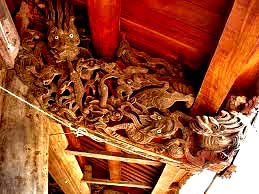
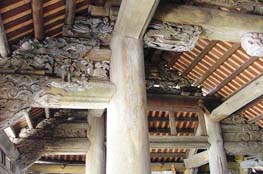
Thanks to the communal house (đình), we discover that the village life is intimately introduced in the decoration art. This one tries to liberate itself not only from classic conventional models encountered until then but also Confucian straitjacket that Vietnam has known in the feudal system. That is what we see in wooden carvings which take up all free spaces encountered inside the đình (from roof frame to columns).

All imperfections of the construction are hidden with address thanks to the technique of embellishment. In each carved piece, the motif whether it is animal, character, flower etc. is unique and cannot be found anywhere else even if it is the same theme. By contrast, one discovers in these sculptures the coexistence through centuries of two cultures, one being national and scholarly and the other popular. One finds not only in the first all motifs relating to four hieratic animals (Rồng, Lân, Rùa, Phượng) (Dragon, Unicorn, Tortoise, Phoenix), four noble plants, fairies, animals (tigers, elephants etc.) but also fantasy, imagination, innovation from peasant-sculptor despite his strict obedience to etablished standards.

In the popular sculptures, the master craftsman who is, above all, a peasant, let himself be guided by his personal inspirations, his sincere emotions, his frustrations, his spontaneity and his sentiments in the realization of his work with realism and humor. He succeeds in escaping the censoring custom by a unusual aptitude in the description of bawdy scenes through his work of art: a naked young girl taking a bath in the lotus pond or sitting with low-necked dress on a a dragon head (đình Phụ Lão, Bắc Giang), a young man groping the body of a woman under the watchful eye of his partner (đình Hưng Lộc), a mandarin disturbing a girl who is obliged to hide her body with the lotus sheet in her bath (đình Ðệ Tam Ðông, Nam Ðịnh) etc.

He dares to denounce the wrongdoings of corrupt mandarins. That is what one sees in the carved piece of the communal house Liên Hiệp. These are taboos and frustrating redtapes encountered every day in the Vietnamese confucian society. Everything found in this popular sculpture largely reflects artist’s freedom of expression, common aspirations and social life of village. The paradox is visible because the communal house is both the garden of Confucian order which is well established in Vietnamese family and social structure and the place where the peasant can find again his freedom of expression and denounce the Confucian straightjacket. By its sculptures and its architecture, the communal house constitutes an inestimable jewel for Vietnamese people. One has the habit of saying in Vietnamese: làng nước (Village Nation) because Vietnamese nation is constituted over centuries by the dissemination of villages whose communal house (Đình) is both spiritual, administrative, social and cultural centre. As a consequence, the communal house (Đình) is not only the soul of village but also that of Vietnamese nation.

[RETURN]

Communal house (Đình Làng: Part 3)

dinhlang03

Đình Làng (Part 3)

Armature ( Cấu tạo vì kèo )

Version vietnamienne

Version française

In addition to the ceremonies scheduled in the year in honor of the tutelary genius, villagers attach great importance to anniversaries of his birth and death. But there are also other occasional sacrifices caused often by a marriage, an appointment, a promotion or a old or siver wedding (khao lão). This allows you to give rise to feasts in the village and allows you to celebrate in large pump the cult in the tutelary genius. The latter may be a man or a woman. It is easy to identify this genius at the time of the procession. For the genius-man, there is always the presence of a horse in red (ngựa hồng) or white ( ngựa bạch) laquered wood. This one is of natural size and mounted on a wooden rectangular plate fitted with castors. The latter is richly harnessed and it is supposed to bring the genius soul. In the case where the genius is a woman, this horse is replaced by the palanquin in red hemp (võng đào) suspended from the beam having the ends carved with dragon head and based on two easels in the form of three crossed sticks.

Mái cong làng Ðình Bảng 

dinhlang02

For the duration of the feast, one sacrifices to the tutelary genius with solemnity by moving its char ( kiệu) accompanied by a large number of culte objects, parade weapons, dais (tán) and pennants (cờ), from the communal house (đình) to the his place of residence (nghè) (1) or from the village to another allied village in the case where these ones are united by the cult of the same genius and by organizing multiple entertainment: fighting of cocks, buffaloes and birds, chess games with human pawns, flat hand wrestling etc.

There is also a important rite which recalls the significant characteristics of genius life. Known as the « hèm » in Vietnamese and kept secret, it is always celebrated during the night for geniuses who have not done an honorable act (genius thief, genius with fists, wast collector genius etc … ).. By contrast, it is celebrated in the great day for the geniuses with a quality or an act of bravery. One avoids to pronounce also the name of the genius during the rite by modifying the pronunciation or by substituting a synonym. This is the case of genius Linh Lang for example. We are obliged to tell « khoai dây » instead « khoai lang » (potatoes), « thầy lương » for « thầy lang » (doctor) etc. This singular rite is one of the essential features of communal cults. The negligence of this rite could jeopardize the prosperity of the village.

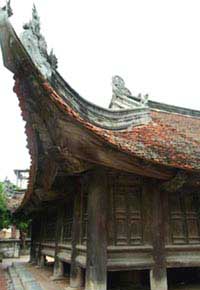
Its construction is always operated according to a well-defined layout plan identifiable by some Chinese characters Nhất, Nhị, Tam, Ðinh, Công, Vương etc.  A communal house (đình) who stands alone with a rectangular main building (đại đình) evokes the character « Nhất ». This is the case of « đình » Tây Ðằng.By contrast, we are led to recognize the character Nhị by adding to the main building a second building (tiền tế) (or building reserved for sacrifices). This one is parallel to the first building and preceding it in the new layout. This is the case of the communal house Liên Hiệp. It is rare to find the character Tam in the construction of communal house. In a general way, the « đình » is frequently encountered in the shape of the character Công.

The posterior building Hậu Cung is connected to the main building by a small corridor or a small court (Ống muống) . This is the case of the communal house Đình Bảng, Mộng Phụ. For the character Vương, it is sufficient to connect three buildings (Hậu Cung, Đại Đình, Tiền Tế) with two corridors (Ống muống). It is in this last building « Tiền Tế » where the official ceremony for tutelary genius is performed by notables wearing a blue suit during the feast days. READING MORE

Palanquin in red hemp (Đình Cổ Loa)              


(1) ghè: Place of residence of the genius often located at the entrance of the village. At the time of the feast, invited the genius is invited to join the communal house « đình ». It is brought back to its « ghè » when the feast is terminated.

Bibliographie:

Le Ðình, maison communale du Viêt Nam.
Hà Văn Tấn, Nguyễn Văn Kự,
Editions Thế Giới, 2001