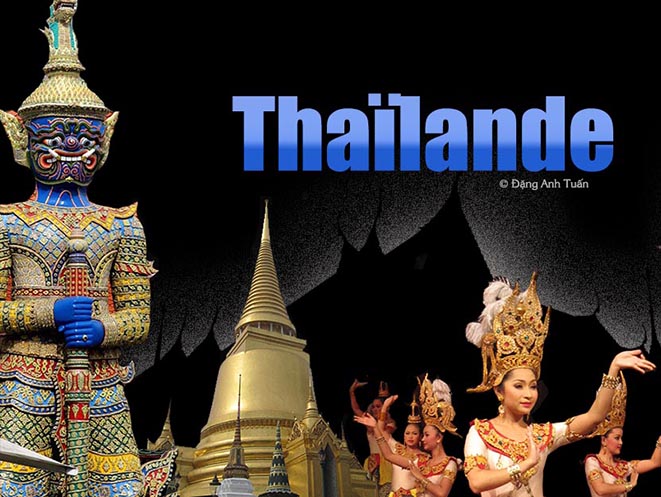
Thaïlande (English version)


Version française
Version vietnamienne
Galerie des photos

The emergence of the Thai only became firmly established in the 14th century. Yet they are an ancient people of southern China. They are part of the Austro-Asiatic group (Chủng Nam Á) (or Baiyue or Bách Việt in Vietnamese). It is this group that the French archaeologist Bernard Groslier often referred to as the « Thai-Vietnamese group.

Repulsed by the Tsin of Shi Huang Di, the Thai tried to resist many times. For the Vietnamese writer Bình Nguyên Lôc, the subjects of the Shu and Ba kingdoms (Ba Thục) annexed very early by the Tsin in Sichuan (Tứ Xuyên)(1) were the proto-Thais (or Tay). According to this writer, they belonged to the Austro-Asiatic group of the Âu branch (or Ngu in Mường language or Ngê U in Mandarin Chinese (quan thoại)) to which the Thai and the Tày were attached.

For him, as for other Vietnamese researchers Trần Ngọc Thêm, Nguyễn Đình Khoa, Hà Văn Tấn etc., the Austro-Asiatic group includes 4 distinct subgroups: Môn-Khmer subgroup, Việt Mường subgroup (Lạc branch), Tày-Thái subgroup (Âu branch) and Mèo-Dao subgroup to which must be added the Austronesian subgroup (Chàm, Raglai, Êdê etc.) to define the Indonesian (or proto-Malay) race (2) (Chủng cổ Mã Lai).

The Thai contribution to the founding of the Au Lac Kingdom of the Viet of Thục Phán (An Dương Vương) is no longer in doubt after the latter succeeded in eliminating the last Hùng king of the Văn Lang kingdom because the name « Au Lac » (or Ngeou Lo) obviously evokes the union of two Yue ethnic groups of the Au branch (Proto-Thai) and the Lac branch (Proto-Viet). Moreover, Thục Phán was a Yue of the Au branch, which shows to such an extent the union and the common historical mission of these two ethnic groups in the face of Chinese expansion. According to Đào Duy Anh, Thục Phán was a prince of the Shu kingdom.This is what was reported in Chinese historical writings (Kiao-tcheou wai-yu ki or Kouang-tcheou ki), but it was categorically refuted by some Vietnamese historians because the Shu kingdom was located too far at that time, from the Văn Lang kingdom. It was annexed very early (more than half a century before the foundation of the Âu Lạc kingdom) by the Tsin. But for the Vietnamese writer Bình Nguyên Lôc, Thục Phán having lost his homeland, had to take refuge very young in the company of his faithful at that time in a country having the same ethnic affinity (culture, language) as him, namely the Si Ngeou kingdom (Tây Âu) located next to the Văn Lang kingdom of the Vietnamese. Furthermore, the Chinese have no interest in falsifying history by reporting that it was a prince of Shu ruling the kingdom of Âu Lạc. The asylum of the latter and his followers in the kingdom of Si Ngeou must have taken some time, which explains at least half a century in this exodus before the foundation of his kingdom Âu Lạc. This hypothesis does not seem very convincing because there was a 3000 km walk. In addition, he was at the head of an army of 30,000 soldiers. It is impossible for him to ensure logistics and make his army invisible during the exodus by crossing mountainous areas of Yunnan administered by other ethnic groups who were enemies or loyal to the Chinese. It is likely that he had to find from the Si Ngeou (or the Proto-Thais) everything (armament and military personnel, provisions) that he needed before his conquest.

There is recently another hypothesis that seems more coherent. Thục Phán was the leader of a tribe allied to the Si Ngeou confederation and the son of Thục Chế, king of a Nam Cương kingdom located in the Cao Bằng region and not far from Kouang Si in today’s China. There is a total concordance between everything reported in the legend of the magic crossbow of the Vietnamese and the rites found in the tradition of the Tày (Proto-Thai). This is the case of the golden turtle or the white rooster, each having an important symbolic meaning. An Dương Vương (Ngan-yang wang) was a historical figure. The discovery of the remains of its capital (Cổ Loa, huyện Đông An, Hànội) no longer casts doubt on the existence of this kingdom established around three centuries BC. It was later annexed by Zhao To (Triệu Đà), founder of the kingdom of Nan Yue.

Lac Long Quan-Au Cơ myth cleverly insinuates the union and separation of two Yue ethnic groups: one of the Lac branch (the Proto-Vietnamese) descending into the fertile plains following the streams and rivers, and the other of the Au branch (the Proto-Thai) taking refuge in the mountainous regions. The Muong were among the members of this exodus. Linguistically close to the Vietnamese, the Muong managed to preserve their ancestral customs because they were pushed back and protected in the mountains. They had a social organization similar to that of the Tày and the Thai. Located in the provinces of Kouang Tong (Quãng Đông) and Kouang Si (Quãng Tây), the kingdom of Si Ngeou (Tây Âu) is none other than the country of the proto-Thais (the ancestors of the Thais). It is here that Thục Phán took refuge before the conquest of the Văn Lang kingdom. It should also be remembered that the Chinese emperor Shi Houang Di had to mobilize at that time more than 500,000 soldiers in the conquest of the kingdom of Si Ngeou after having succeeded in defeating the army of the kingdom of Chu (or Sỡ) with 600,000 men. We must think that in addition to the implacable resistance of its warriors, the kingdom of Si Ngeou would have to be of a significant size and populated enough for Shi Houang Di (Tần Thủy Hoàng) to engage a significant military force.

Despite the premature death of a Si Ngeou king named Yi-Hiu-Song (Dịch Hu Tống), the resistance led by the Thai or (Si Ngeou)(Tây Âu) branch of the Yue managed to achieve some expected successes in the southern Kouang Si region with the death of a general T’ou Tsiu (Uất Đồ Thu) at the head of a Chinese army of 500,000 men, which was recorded in the annals of Master Houa-nan (or Houai–nan–tseu in Chinese or Hoài Nam Tử in Vietnamese) written by Liu An (Lưu An), grandson of Emperor Kao-Tsou (or Liu Bang), founder of the Han Dynasty between 164 and 173 BCE.

Si Ngeou was known for the valor of his formidable warriors. This corresponds exactly to the temperament of the Thais of yesteryear described by the French writer and photographer Alfred Raquez:(3)


Being warlike and adventurous, the  Siamese of yesteryear were almost continually at war with their neighbors and often saw their expeditions crowned with success. After each successful campaign, they took prisoners with them and settled them in a part of the territory of Siam, as far as possible from their country of origin.


After the disappearance of Si Ngeou and Âu Lạc, the proto-Thais who remained in Vietnam at that time under the rule of Zhao To (a former Chinese general of the Tsin who later became the first emperor of the kingdom of Nanyue) had their descendants forming today the Thai ethnic minority of Vietnam. The other proto-Thais fled to Yunnan where they united in the 8th century with the kingdom of Nanzhao (Nam Chiếu) and then with that of Dali (Đại Lý) where the Buddhism of the Great Vehicle (Phật Giáo Đại Thừa) began to take root. Unfortunately, their attempt was in vain. The Shu, Ba, Si Ngeou, Âu Lạc (5), Nan Zhao, Dali countries were part of the long list of countries annexed one after the other by the Chinese during their exodus. In these subjugated countries, the presence of the Proto-Thais was quite significant. Faced with this relentless Chinese pressure and the inexorable barrier of the Himalayas, the Proto-Thais were forced to descend into the Indochinese peninsula (4) by slowly infiltrating in a fan-like manner into Laos, the North-West of Vietnam (Tây Bắc), the north of Thailand and upper Burma.

According to historical Thai inscriptions found in Vietnam, there were three major waves of migration initiated by the Thais from Yunnan into Northwest Vietnam during the 9th to 11th centuries. This corresponds exactly to the period when the kingdom of Nanzhao was annexed by the kingdom of Dali, which in turn was destroyed three centuries later by the Mongols of Kublai Khan in China. During this infiltration, the proto-Thais divided into several groups: the Thais of Vietnam, the Thais in Burma (or Shans), the Thais in Laos (or Ai Lao), and the Thais in northern Thailand. Each of these groups began to adopt the religion of their host countries. The Thais of Vietnam did not have the same religion as those in other territories. They continued to maintain animism (vạn vật hữu linh) or totemism.

This is not the case for the Thais living in northern Thailand, Upper Burma, and Laos. These areas were occupied at that time by Indianized Mon-Khmer kingdoms and Theravada Buddhist kingdoms (Angkorian empire, Mon Dvaravati kingdoms, Haripunchai, Lavo, etc.) after the disintegration of the Indianized Founan (Phù Nam) kingdom. The Mons played an important role in transmitting Theravada Buddhism from the Sinhalese tradition to the newly arrived Thais.

It can be said that to the two main components of the Thai religion (worship of geniuses (Phra) and spirits (Phi) and Theravada Buddhism) is added Hinduism. The latter played a very important role in Southeast Asia before Theravada Buddhism succeeded in establishing itself and embracing Burma, Thailand, Laos, and Cambodia.

There are as many geniuses as malevolent spirits in the Thai pantheon. This animist belief is not incompatible with Theravada Buddhism because the Thais place protective deities (the phra) at an intermediate level between humans and Hindu gods closely linked to Theravada Buddhism. They are, in a way, servants of the Buddha. Buddhism tolerates local rites. That is why one often finds a small temple carefully maintained and dedicated to Brahma with four faces (Thần Bốn Mặt) around important Thai buildings, in order to allow this deity to ward off malevolent spirits and protect these places. Other deities have not gone unnoticed in public places (pagodas, airports, royal palace, etc.).

Having arrived late in these host countries, the Thais initially had to take on all the « ungrateful » jobs. Because their skin was dark, the Khmers called them by the name Syàma (Xiêm La), a Sanskrit word meaning « tanned. » It is under this name that they were mentioned around 1050 in one of the Cham inscriptions of Po Nagar (Nha Trang) as prisoners of war during the confrontation between the Chams and the Khmers of the Angkorian empire. They also appeared as daring scouts, mercenaries of the Angkorian empire’s army, whose presence was reported in one of the bas-reliefs of Angkor Wat. According to the French archaeologist Bernard Groslier, they were merely unruly hill people, without writing or religion. They had no chance of even shaking the border posts of the Khmer empire and the Mon kingdoms of Dvaravati culture.

This is not the case for the Vietnamese who began to challenge Champa at the same time because, according to Bernard Groslier, the latter already constituted a nation remarkably equipped by Chinese civilization during the long domination, and could engage in the struggle on equal terms with the Chams. The Thais had to wait at least two centuries to assimilate the lessons of their masters before being able to replace and subsequently surpass them. Coming from the north and in frequent contact with the Dvaravati culture, they quickly converted to Theravāda Buddhism (or the Little Vehicle) or (Phật Giáo Nguyên Thủy in Vietnamese) but continued to maintain their social structure organized into powerful feudal chiefdoms (or mường).

For the Thais, Thailand is still considered the great and powerful chiefdom (Mueang of the free Thais or Mường của các người Thái tự do). Even paradise is organized into chiefdoms administered by deities (or the Devata). This is what has been reported by the Thais of Vietnam. This aligns with Alfred Raquez‘s observation on the common practice of the Siamese in grouping their prisoners into chiefdoms:

The Siamese did not scatter their prisoners throughout the kingdom. On the contrary, they kept them grouped together, forming khong at the head of which they placed chiefs of the same origin or naïkhong. These, supreme magistrates, handled all the affairs of the community and were almost the only ones in direct contact with the country’s authorities.

The chieftaincy is at the base of the social, religious, and political organization of the Thais. The chieftaincies are considered small (mường nhỏ) or large (mường lớn) depending on their size and importance. This corresponds respectively to what we have in France with the district or the province. But there is always a central chieftaincy (mường luông) towards which the other chieftaincies converge. This is what we observe in the organization of Thai chieftaincies in Vietnam. Each chieftaincy is led by a chief or a lord from the local aristocracy who also has an important religious role. He is responsible for maintaining the cult of the spirit of the land. That is why he has precedence over the villagers. They owe him not only armed service in case of war but also corvée labor. Each chieftaincy has its own customs. Its administrative and military organization resembles that of the Mongols, which allows distinguishing the nobles and warriors from the rest (the petty kings and serf peasants). Each has his rank or status in a system called sakdina (sakdi meaning power and na meaning rice field). Suppose each peasant owns 25 rai (an amount of land equivalent to 1600 m2 or rẫy in Vietnamese). A boss with a grade of 400 in sakdina can have 16 peasants under his command because 16 = 400/25. As for a noble or a lord, he can have 400 people under his command if his grade rises to 10,000 in the sakdina system. (400 = 10,000/25). In short, depending on his rank, he can have a certain number of people for the system of civil and military duties.

Each chiefdom is made up of several hamlets (or thôn in Vietnamese), each managed by a council of notables and having 40 or 50 houses except for some that can reach up to 100 houses. Similar to the Vietnamese, the Thais generally establish their hamlet and their chiefdom in alluvial plains (such as that of the Chao Praya) and in regions with significant waterways conducive to flooded rice cultivation, transportation, and the interconnection of roads to facilitate exchange with other Thai chiefdoms.

Galerie des photos

Bangkok

Taking advantage of the exhaustion of the Angkorian empire due to incessant wars against its neighbors (Champa, Vietnam) and the gigantic construction works of the temples (Bayon, Angkor Thom, Ta Prohm, Angkor Wat, etc.) of Jayavarman VII, the death of the latter, and the Mongol invasion against Indochina (the Khmer empire in 1283, Champa (1283-1285), Đại Việt (or Vietnam) of the Trần (1257-1288)) and against the kingdom of Pagan (Burma), the Thais began to establish their political power both in Thailand and in Burma.

In Thailand, on the northern edge of the Menam basin, two Thai princes named Po Khun Bangklanghao and Po Khun Phameung succeeded in freeing Sukhothai from the control of the Mon and the Khmers in 1239. Po Khun Bangklanghao thus became the first king of the independent Thai kingdom of Sukhothai, whose name means « the dawn of happiness. » But it was rather his son Rama Khamheng who had the great task of expanding the Thai kingdom by conquering not only northern Malaysia up to Ligor (or Nakhon Si Thammarat) but also Khmer possessions near Luang Prabang (Laos). At the same time, in northern Thailand, after the annexation of Haripunjaya in 1292, another allied Thai prince named Mengrai founded his kingdom Lannathai (kingdom of a million rice fields) by making Chiang Mai the capital. Rama Khamheng and Mengrai, two Thai princes, now shared dominion, one in the center and the other in the north of Thailand. Other small Thai kingdoms were created in Phayao and in Xiang Dong Xiang Thong (Luang Prabang) in Laos. In Burma, the kingdom of Pagan failed to resist the Mongol invasion. The Thais of Burma (or the Shan) took advantage of this opportunity to break the kingdom into several Shan states.

(1):  Land of pandas. It is also here that the Ba-Shu culture was discovered, famous for its zoomorphic masks of Sanxingdui and for the mystery of the signs on the armor. It is also the Shu-Han kingdom (Thục Hán) of Liu Bei (Lưu Bị) during the Three Kingdoms period. (Tam Quốc)

(2): Race of prehistoric Southeast Asia.

(3): Comment s’est peuplé le Siam, ce qu’est aujourd’hui sa population. Alfred Raquez, (publié en 1903 dans le Bulletin du Comité de l’Asie Française). In: Aséanie 1, 1998. pp. 161-181.

(4):  Indochina in the broad sense. It is not French Indochina.
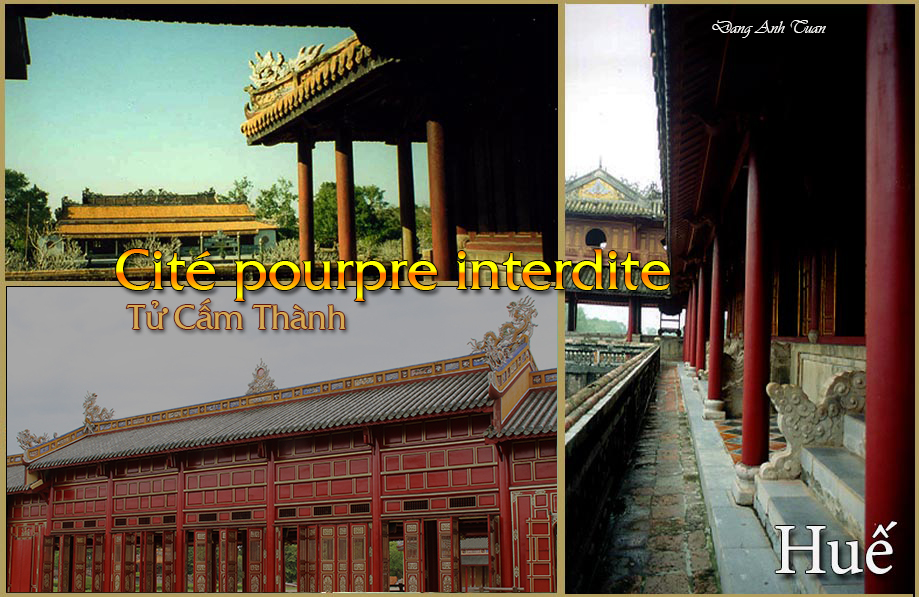


Forbidden Purple City (Huế)


Version française

Version vietnamienne

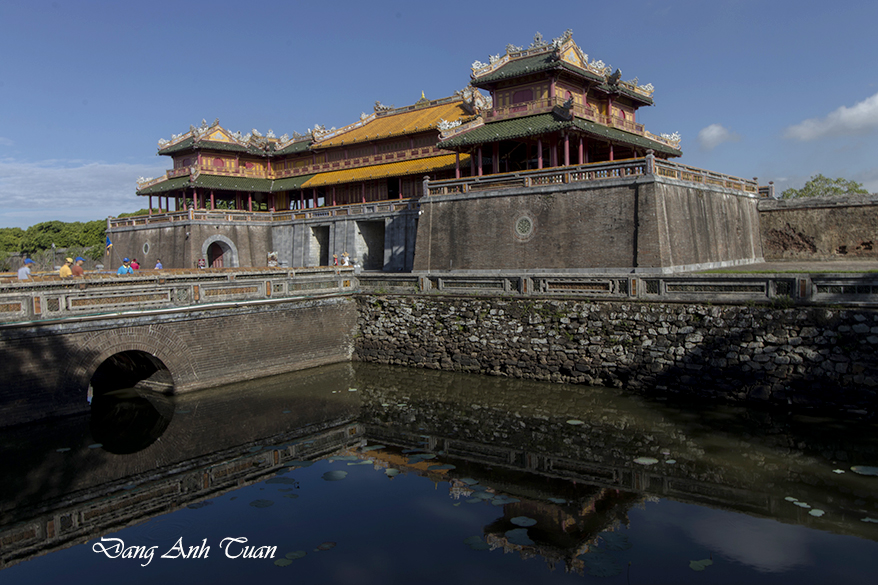
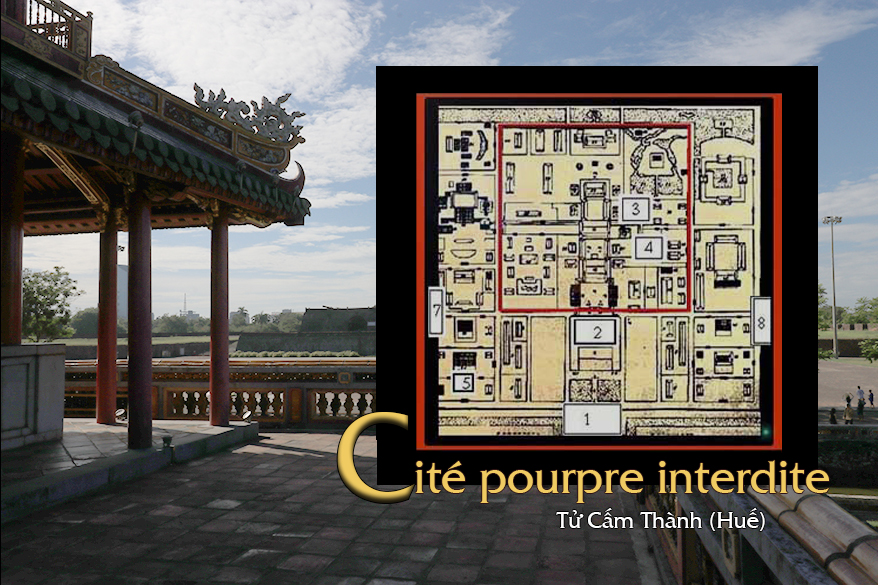
The Forbidden Purple City of Hue is protected by a 4-meter-high brick wall. This wall is further reinforced by the installation of a water-filled moat system, thus encircling the city. Each gate leading into the city is preceded by one or more bridges, but the Meridian Gate remains the main entrance, once reserved for the king. Today, it is the main entrance for visitors.

It is a powerful masonry structure pierced by five passages and topped by an elegant two-story wooden structure, the Five Phoenix Belvedere (Lầu Ngũ Phụng). To the east and west of the citadel are the Chương Đức Gate (7) and the Hiển Nhơn Gate (8), which are very well decorated and each pierced by three passages. The Hiển Nhơn Gate was completely restored in 1977.

World cultural Heritage of Viet Nam

Once you pass through the Meridian Gate, you see the sumptuous Palace of Supreme Harmony or Throne Palace, which can be reached by crossing the Esplanade of Great Salutations (Sân Ðại Triều Nghi). It was in this palace that the emperor, seated on the throne in a prestigious symbolic position, received the greeting of all the dignitaries of the empire. They were lined up hierarchically on the esplanade for major ceremonies. It is also the only building that has remained relatively intact after so many years of war. Behind this palace is the private residence of the king and his family.


  • 1 Gate of the Midday (Ngọ Môn)
  • 2 Palace of the Supreme Harmony. ( Điễn Thái Hòa)
  • 3 Belvedere of the Lecture or Pavilion of the Archives (Thái Bình Ngự Lâm Thư Lâu)
  • 4 Royal Theatre (Duyệt Thị Đường)
  • 5 Splendour Pavilion (Hiên Lâm Các)
  • 7 Gate of the Vertu (Chương Đức Môn)
  • 8 Gate of the Humanity (Hiển Nhơn Môn)

Nỗi buồn chiến tranh (Chagrins de la guerre)

Tình gia thất nào ai chẳng co’
Kià lão thân khuê-phụ nhớ ‘thương
Mẹ già phơ phất mái sương
Con thơ  nhỏ  dại còn dương phù  trì

Chinh Phụ Ngâm

 chagrin_de_guerre

Version française

Nhắc đến Việt Nam, người ta không ngừng nghĩ về cuộc chiến, những vết thương lòng  và  các thuyền nhân. Không ai có thể thờ ơ  khi biết rằng có đến 13 triệu tấn bom (265 kg bình quân đầu người) và sáu mươi triệu lít chất tẩy  lá đã được thả xuống  suốt thời kỳ chiến tranh. Có khoảng 4 triệu thường dân Việt Nam thiệt mạng hoặc bị thương, 450000 chiến binh tử vong, 800.000 chiến binh bị thương  chưa kể đến 58.183 lính Mỹ tử vong hay mất tích và  313 613 người Mỹ bị thương. Cuộc chiến này đã chia rẽ vào thời điểm đó không những dư luận quốc tế mà luôn cả dư luận ở Việt Nam. Nó vẫn mãi còn in sâu trong tâm trí của người Mỹ cho đến ngày nay. Trái lại, người Việt Nam khó mà có thể biện minh cho cuộc chiến này khi yêu chuộng công lý, tự do và độc lập. Mỗi người trong chúng ta đều tràn  đầy  tiếc nuối, mâu thuẫn và bối rối vì chúng ta biết rõ nguyên nhân và hậu quả  của cuộc chiến này.


Độc lập và tự do không bao giờ đi cùng nhau trên con đường đi đến hòa bình. Chúng ta tiếp tục ước mơ có một ngày nào đó có đựợc cả hai trên mảnh đất gian khổ này mà chúng ta không ngừng uốn nắn và thấm đẫm nó với mồ hôi và nước mắt từ bao nhiêu thế hệ.


Chúng ta tiếp tục van xin Thượng Đế, đổ lỗi cho người ngoại quốc mà không muốn nhận ra lỗi lầm của mình, không dám soi gương và không muốn nuôi dưỡng niềm hy vọng của cả một dân tộc. Trong quá khứ, chúng ta đã đánh mất quá nhiều cơ hội hòa giải, đưa Việt Nam ra thoát khỏi sự nghèo đói và đưa nước ta trở lại trên con đường thịnh vượng vào buổi bình minh của thế kỷ 21. Đã đến lúc không nên lặp lại những sai lầm mà các bậc tiền bối của chúng ta đã mắc phải trong nhiều năm qua, nên chôn vùi mối hận thù cá nhân vì lợi ích quốc gia và đối xử một cách cao thượng với tất cả những người không có cùng quan điểm chính trị. Rõ ràng là chúng ta không làm điều đó một cách dễ dàng nhưng cũng đỡ đớn đau hơn những gì mà biết bao gia đình Việt Nam phải gánh chịu trong cuộc chiến này, điều mà chúng ta thường gọi là “nỗi buồn chiến tranh”.

Năm 1945, tại vùng đồng bằng sông Cửu Long, một thiếu niên tên Hoàng, xuất thân từ một gia đình địa chủ, sống bí mật ở một vùng ngoại ô cách Cần Thơ không xa cùng với người tình trẻ tên Hương. Họ có được hai người con, một bé trai tên Thành 3 tuổi và một bé gái tên Mai một tuổi. Đáng tiếc, cuộc hôn nhân này chỉ tồn tại trong thời gian ngắn vì bị người thân của họ phát hiện. Họ lên án mạnh mẽ cô vì thật xấu hổ cho gia đình khi biết cô gái trẻ này không ai khác chính là em họ xa của Hoàng. Quá xấu hổ và hối hận, Hoàng quyết định từ bỏ gia đình và nhập ngũ vào quân đội Việt Minh với hy vọng tìm được sự giải thoát trên chiến trường chống lại quân Pháp. Nhờ lòng dũng cảm và chiến công quân sự, vài năm sau Hoàng trở thành lãnh đạo quan trọng của Đảng Cộng sản Việt Nam ở vùng Minh Hải (Cà Mau), miền Nam Việt Nam.

Năm 1954, sau Hiệp định Genève, Hoàng được tập kết  ra miền Bắc Việt Nam chờ cuộc bầu cử dân chủ mới ở miền Nam Việt Nam. Thật không may, vì chiến tranh lạnh và sự đối đầu Đông/  Tây khiến  các cuộc bầu cử đã không bao giờ diễn ra. Việt Nam sau đó trở thành nơi đối đầu và bị chia  thành hai nước cộng hòa, một nước thân cận với khối Xô Viết và nước kia là Việt Nam Cộng hòa. Sau vài năm du học ở Mạc Tư Khoa, Hoàng trở về Hà Nội, vài năm sau và  trở thành kỹ cao cấp  có trách nhiệm,chuyên trong lĩnh vực chế tạo pháo hạng nặng và bảo trì các khẩu đội phòng không DCA trong chiến tranh Mỹ-Việt. Trong thời gian đó, Hoàng tái hôn và bị tử vong  vào một buổi sáng đẹp trời trong hầm trú ẩn  lúc máy bay Mỹ-Miền Nam Việt Nam oanh tạc ở vùng Vinh năm 1964. Hoàng  được truy tặng danh hiệu và được  xem coi là anh hùng dân tộc (hay liệt sỹ).

Về phần Hương, nàng  tiếp tục nuôi hai con ở miền Nam trong khi chờ lúc chồng về. Khoảng hai mươi năm sau, cậu con trai Thành của Hương đã trở thành một trong những phi công trẻ xuất sắc của miền Nam Việt Nam sau ba năm học tập và huấn luyện tại một căn cứ quân sự ở Hoa Kỳ (Houston, Texas). Thành đã thực hiện một số phi vụ  ở miền Bắc Việt Nam và nhiều lần tham gia các cu ộc  ném bom ở vùng Thanh Hóa và Vinh. Liệu một trong những quả bom  vô tình đánh rơi có thể giết chết cha Thành, người mà Thành luôn luôn  muốn gặp lại một ngày khi hòa bình trở lại với  đất nước này? Hai tháng trước khi Sài Gòn thất thủ năm 1975, vào tháng 2, Thành nhận được lệnh bí mật cùng gia đình rời Việt Nam để di cư sang Hoa Kỳ. Cuối cùng,Thành thích ở lại Việt Nam hơn vì mẹ anh vẫn nuôi hy vọng tìm thấy cha mình đang sống ở miền Bắc Việt Nam và gặp lại gia đình đoàn tụ sau bao nhiêu năm đau khổ và chia ly. Thật không may, Hương không bao giờ tìm thấy được chồng mình còn sống. Nàng được biết chồng nàng  đã bị bom Mỹ giết chết và như một phần thưởng, nàng đã nhận được danh hiệu “vợ anh hùng” (hay vợ của liệt Sỹ).

Ngược lại, vì ba năm được huấn luyện ở Hoa Kỳ và hoạt động quân sự nên Thành, con trai Hoàng, bị đưa vào trại cải tạo ở Lạng Sơn, miền Bắc Việt Nam. Thành  phải mất 8 năm để  phục hổi  chức năng. Trong thời gian anh bị giam giữ, mẹ anh, Hương  cứ sáu tháng lại phải đi một chặng đường dài để gặp anh và không ngừng khóc trong những lần đoàn tụ này. Anh ta chỉ thấy mẹ bị mất thị lực và trông tình trạng đáng thương khi anh được thả về. Anh  chưa bao giờ có cơ hội phục vụ mẹ đựợc lâu vì anh  được phép rời Việt Nam định cư lâu dài tại Hoa Kỳ vào năm 1994. Có lẽ, anh sẽ không bao giờ gặp lại mẹ mình nữa năm nay đã 85 tuổi, bởi việc trở về Việt Nam lúc này sẽ là một điều không mơ tưởng.

Câu chuyện của  gia đình này bị hủy hoại  và  khổ đau  bởi cuộc chiến  không chỉ là câu chuyện của đại đa số người Việt Nam mà còn là câu chuyện của một dân tộc tiếp tục xoa dịu  vết thương sâu đậm qua ngày tháng cho cái giá độc lập và tự do.


Griefs of war (Nỗi buồn chiến tranh)

 
Tình gia thất nào ai chẳng co’
Kià lão thân khuê-phụ nhớ ‘thương
Mẹ già phơ phất mái sương
Con thơ  nhỏ  dại còn dương phù  trì

Chinh Phụ Ngâm

Familial sentiments, who does not feel them?
Your old parents, your young wife remember you with love
Your mother, under the weight of age, sees her white hair floating like the rime
Your young baby in his tender innocence, needs your protection.

Complaint of the warrior’s wife

chagrin_de_guerre

Griefs of war

Version française

Speaking of Vietnam, people will not stop thinking of the war, its wounds and its boat people. No one could be indifferent when it is known that 13 million tons of bombs ( 300 pounds per person ) and 45 million gallons of defoliant were dumped over during the war. There were about 4 million Vietnamese civilians killed or injured, 450,000 Vietnamese combatants dead, 800,000 combatants wounded not included 58,183 Americans dead or missing in action and 313,613 wounded on the American side. That war divided at that time not only world opinion but also that of the Vietnamese. It continued to engrave on the mind of Americans up until now. On the other hand, it is hard for a Vietnamese to justify that war when one is in love with justice, freedom and independence. There is in each one of us full of regrets, contradictions and embarrassment because we know quite well the causes of that war and its consequences.

Independence and freedom never come together on the road of peace. We continue to dream of having them together some day on that such an arduous land that we never stop shaping it with sweat and tears for so many generations. We keep on imploring God, attribute fault to foreigners without wanting to recognize our own errors, without daring to look to ourselves in the mirror and without wanting to nurture the whole people’s hope. We have lost too many occasions in the past to be reconciled with each other, to bring Vietnam out of poverty and to bring it back to the road of prosperity at the dawn of the 21st century. It is time not to start over the same mistakes that our elders have made for so many years, to bury our personal hard feelings for the national interest and to magnanimously treat all those who do not share our political convictions. To do it is evidently not easy but it is less painful than what so may Vietnamese families have suffered during that war, which we often called  » the griefs of war ».

In 1945, in the Mekong delta, a young man named Hoàng, issue of a landed family, lived in hiding with his young lover Hương at a suburb not far from Cần Thơ.. They had two children, a boy named Thành, 3 years old and a girl named Mai, one year old. Unfortunately, this conjugal union was short lived because it was uncovered by their kins.

They strongly condemned it because it was a shame to the family when it was known that the young woman was no other than Hoàng’s niece. Caught by shame and taken by remorse, Hoàng decided to abandon his family and enrolled in the Việt-Minh army hoping to find relief on the battle fields against the French army. Thanks to his courage and military exploits, he became a few years later an important person in charge in the Vietnamese communist party in the Minh Hải region ( Cà Mau ) in South Vietnam.

In 1954, after the Geneva Accord, he was repatriated to North Vietnam waiting for the new democratic election in South Vietnam. Unfortunately, because of the cold war and the East-West confrontation, the election never took place. Vietnam then became the place of confrontation and was divided in two republics, one close to the Soviet bloc and the other the Republic of Vietnam. After a few years of higher education in Moscow, Hoàng returned to Ha Noi and a few years later became the engineer in charge, specialized in the field of making heavy artillery and maintaining anti-aircraft battery DCA during the American Vietnamese war. In the meantime, he remarried and was killed in a beautiful morning in his bunker during a bombardment by South Vietnamese and American aircraft in the region of Vinh in 1964. He was posthumously decorated and considered national hero ( liệt-sĩ ) since then.

As for his young wife, she continued to raise her two children in South Vietnam waiting for the return of her husband. Her son Thành became some twenty years later one of the brilliant aviators of South Vietnam after having spent three years training in the United States ( Houston, Texas ). He flew several missions over North Vietnam and participated in several rounds of bombardment of Thanh Hóa and Vinh regions. Could one of the bombs he dropped have by accident killed his father, a person he would always like to see again some day when peace would return in this country?

Two months before the fall of  Saïgon in 1975, in the course of the month of February, Thành received the order to discreetly leave the country with his family to resettle in the United States. He finally preferred to stay in Vietnam because his mother always fostered the hope of finding his father alive in North Vietnam and seeing again a reunified family after so many years of sufferings and separation. Unfortunately, she never found her husband alive. She knew he was killed by American bombs and as a reward, she received the title of « spouse of a hero » ( or vợ của liệt sỹ  ). On the other hand, because of his three years of training in the United States and his military activities, Thành, her son, was sent to a reeducation camp located at Lạng Sơn in North Vietnam. He had to spend eight years of reeducation. During his confinement, his mother had to take a long trip every six months to see him and did not stop crying during these reunions. On his release, he only found her to be in a lamentable state with her eyes almost blind. But he never had the chance to serve her any longer because he had to leave Vietnam to resettle in the United States in 1994. Probably he would never see his mother again who is now 75 years old because returning to Vietnam would have been for the moment, an utopia.

The story of this family torn and ruined by that war is not only the story lived by the vast majority of Vietnamese but also that of a people continuing to heal its deep wounds, as the years go by, for the price of independence and freedom.


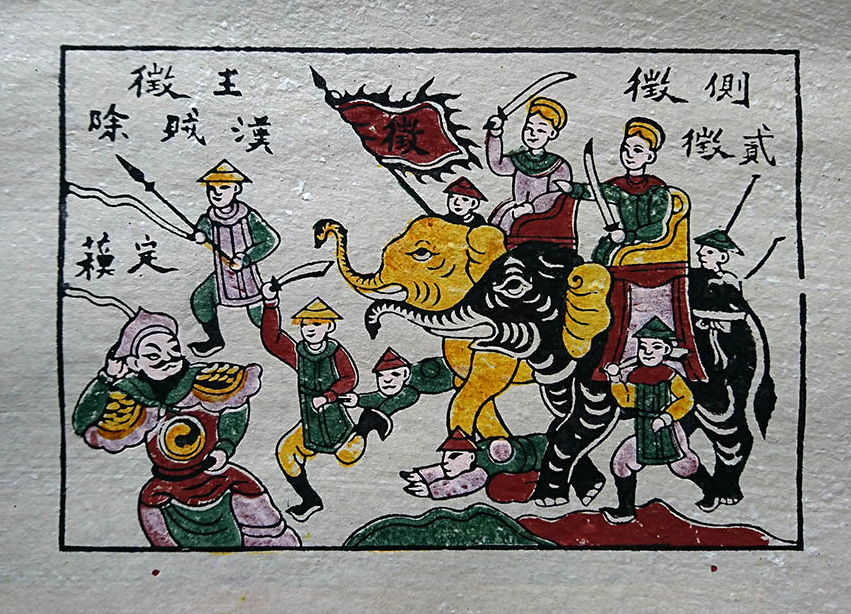
Two sisters Trưng (Trưng Trắc Trưng Nhị)

Hai bà Trưng (40-43)

Vietnamese  version

French version

In the territories conquered by the Han, particularly in southern China, Sinicization continued in full swing. This is why revolts first broke out in the Kingdom of Dian (86, 83 BC, 40 to 45 AD). They were severely suppressed. These uprisings were largely due to the abuses of Han officials and the behavior of Chinese settlers, who seized fertile land and drove the local populations back into remote corners of their territory. Moreover, the latter were forced to adopt the language, customs, and religious beliefs of the Han.

In 40 AD, a serious rebellion broke out in Jiaozhou Province (or Giao Chau in Vietnamese), which at that time included part of the territory of Kwang Si (Quang Tay) and Kwang Tong (Quang Dong). It was led by the daughters of a local prefect, Trưng Trắc (Zheng Cè) the elder and Trưng Nhị (Zheng Èr) her younger. As the husband of the elder Shi Suo (Thi Sách) opposed the Chinese assimilation policy brutally carried out by the Chinese proconsul Tô Định (Su Ding), the latter did not hesitate to execute him to make an example against the Yue insurgents, especially the Vietnamese.

This exemplary execution revolted the Trưng sisters and immediately triggered the insurrection movement in the Yue territories. The two Trưng sisters succeeded in capturing 65 citadels there in a very short period of time. They succeeded in liberating approximately 1.5 million Yue from the yoke of the Han. This is in accordance with the liberation of 65 liberated citadels including, from Lưỡng Việt (Kouang Tong, Kouang Si today) to Mũi nậy (Phú Yên): Hai Nan (Nam Hải), Yu-Lin (Uất Lâm), Ts’ang-wou (Thương Ngô), Giao Chỉ (Jiaozhi), Kieou-tchen (Cửu Chân) và Jenan (Nhật Nam).

This is probably the territory of the ancient Van Lang kingdom during the Hồng Bàng period. This is why popular support was so strong and swift at that time and today there are at least 200 sites where the veneration of the Trung sisters is still visible with their altars. (account of Dr. Trần Đại Sỹ during his visit to southern China during the years 1979-1989). They proclaimed themselves queens over the conquered territories and established themselves in Meiling (or Mê Linh). They managed to reign for three years. In the year 41, they were defeated by General Ma Yuan (Mã Viện, Phục Ba Tướng Quân) (Tamer of the waves) because their army was disparate and likely to be annihilated and dispersed according to the historian Trần Trọng Kim (page 31 in his work entitled « History of Vietnam (Việt Nam sử lược »)). They preferred to commit suicide instead of surrendering by throwing themselves into the Hát River.

They thus became the symbol of the resistance of the Vietnamese. They continue to be venerated today not only in Vietnam but also in certain parts of the Yue territories of China (Kouang Si and Kouang Tong). Ma Yuan began to implement a policy of terror and forced sinicization by placing Chinese trusted men at all levels of the administration and by imposing Chinese as the official language throughout the territory of the Vietnamese.

During the Chinese rule, only a very limited number of bronze drums remained because the Han tried to destroy them, as these bronze drums symbolized the power of the local lords. It was through these instruments that these leaders could summon and mobilize all their subjects living in their territory to participate in the war. It was Ma Yuan who wanted to destroy the Viet morale and the ardor to fight the enemy. According to the Book of Later Han (Hậu Hán Thư), the people of Jiaozhi were so excited and showed their ardor in battle that since then, they had to hide their bronze drums to avoid the systematic destruction imposed by the Han.

When we mention the name of Ma Yuan, we are reminded of the story of his bronze column. According to a number of ancient writings, there are six Chinese characters engraved on this bronze column: “Đồng trụ triệt, Giao chỉ diệt (The destroyed column, the vanished Jiaozhi). Therefore, according to rumor, the Vietnamese tried to consolidate this bronze column at that time and made it become a mound with a piece of stone deposited by each of them as they passed by. This column was made from the bronze collected during the systematic destruction of bronze drums belonging to the Đồng Sơn civilization that the French archaeologist Louis Pajot discovered in 1924 in Đồng Sơn (Thanh Hoá) during his archaeological excavations.

Does Ma Yuan’s bronze column really exist or is it just an oral rumor? We are used to finding in Chinese history the act of building, during the victory of territorial conquest, the column to demarcate the border like the Tang generals Hà Lý Trinh, Trương Chu and Mã Tống. The bronze column should surely exist because the last insolent Ming emperor Zhu Youjian did not hesitate to allude to this bronze column of Ma Yuan to humiliate the Vietnamese ambassador Giang Văn Minh in his main verse: Đồng trụ chí kim đài dĩ lục (The bronze column continues to turn green because of the moss that accumulates over the years). But he was annoyed and furious, immediately killing Giang Van Minh because of his replying verse showing greatness of soul and courage: Ðằng giang tự cổ huyết do hồng (the Bạch Đằng River continues to turn red because of the blood of the invaders).

According to The geographical work of the Qing Dynasty (Đại Thanh nhất thống chí ), this column was built at that time in the Phân Mao mountain of the Cổ Sâm cave distant from Khảm Châu about 3 kilometers in the west direction. It is here that we find a kind of perennial grass which orients itself in the North-South directions according to the climate. This is the second Chinese domination lasting from 43 AD until the rebellion of Lý Bôn. The latter seized the auspicious opportunity in the year 544 AD to found the former Lý dynasty in the year 544.


Exile (Boat people)


exilVersion française
Version vietnamienne

Exile is sometimes a far crueler torment than death for  people with a lively, sensitive character. The novelist Staël is right to say so. Exile is only the last resort contemplated by the Vietnamese when he can no longer live freely to the best of his knowledge, or when he feels frustrated or powerless, like the retired general of the talented novelist Nguyễn Huy Thiệp, in a country wrested from foreign powers after so many years of effort and sacrifice, only to fall into dreary self-colonization.

Exile is not only the beginning of a new life, it’s also the beginning of a new hope. Sometimes, it’s the surest way to escape all threat and suspicion. Such is the case of Duke Nguyễn Hoàng. The latter, who within a few years would emerge victorious from several dazzling battles against the Mạc, became a cause for concern for his brother-in-law Trịnh Kiểm towards the end of 1554. To monopolize power, the latter did not hesitate to eliminate Nguyễn Uông, Nguyễn Hoàng’s brother.

Faced with this malicious intent, Nguyễn Hoàng, worried and distraught, was forced to secretly send an emissary to the illustrious scholar of the time, Nguyễn Bỉnh Khiêm, our Vietnamese Nostradamus, to seek his advice. Arriving at his place of retreat Bạch Vân am, the emissary laid a hundred gold taëls before the scholar and begged him for advice. But the scholar continued to remain impassive. Only towards the end of the interview did he stand up with his cane and head for the garden. Then, gazing admiringly at a decorative miniature artificial mountain made of a dozen tangled pebbles, on which a few ants were still climbing, he began to say:

Hoành sơn nhất đái vạn đại dung thân
Một dãy Hoành Sơn có thể dung thân được ở đó.

The refuge can be found on the side of the Annamite Cordillera.

The emissary told Nguyễn Hoàng what the scholar Nguyễn Bỉnh Khiêm had said. Seized by this brilliant idea, he pretended to be struck by madness and asked his sister, Ngọc Bảo, Trịnh Kiểm‘s favorite, to intervene with the latter so that he could be sent at once as governor of the Thuận Hóa- Quảng Nam province, known as the most unhealthy and dangerous corner, inhabited by barbarians and infested with wild beasts. But it was also here that Mạc troops continued to wage war. Machiavellian Trịnh Kiểm accepted this request without hesitation, for he seized the opportunity not only to liquidate Nguyễn Hoàng through the Mạc, but also to establish his legitimacy against the followers of his deceased father-in-law, general Nguyễn Kim. Thanks to this stratagem, Nguyễn Hoàng managed to save his family and later founded the dynasty of nine Nguyễn lords in the South, enabling one of his descendants by name Nguyễn Ánh (or Gia Long) to begin the long march south and later found the Nguyễn dynasty.

Similarly, Nguyễn Ánh had to spend several years in exile in Bangkok (Thailand) before being able to reclaim the throne. Exile is not always Eldorado, as Vietnamese still believe, but it is sometimes the beginning of a perilous adventure and a never-ending nightmare. More than 200,000 Vietnamese boat people perished in this adventure at the mercy of the East Sea and Thai pirates during the first years after the fall of Saigon (1975). Others who managed to escape alive continued to be kept as prisoners in camps in Thailand, Malaysia or Indonesia during the 90s. Exile is also the beginning of a long banishment, the end of a national upsurge and a lived experience.
hamnghi
Such was the case of King Hàm Nghi. After three years of struggle in the mountainous regions of Quảng Bình, he was captured alive on November 1, 1888 following the betrayal of a Mường Trương Quang Ngọc chief. Despite his capture, he continued to fuel doubts among the colonial authorities, for they found in front of them a young boy aged 18, of average height, so slender in his gait and so cultured above all, which contradicts the fact that according to rumors, Hàm Nghi was a vulgar and coarse character placed on the throne by the regent Tôn Thất Thuyết.   
 
No sign of weakness or fatigue appeared on his face, despite three years of tracking, misery and hunger in these mountainous regions. He continued to remain not only impassive, but also mute about his identity in the face of incessant interrogation by his jailers. Several mandarins were sent to identify whether the young captive in question was indeed King Hàm Nghi or not, but none succeeded in moving the latter except the old scholar Nguyễn Thuận.

On seeing the king continuing to perform this mockery, the latter, with tears in his eyes, prostrated himself before him, dropping his cane. Faced with the sudden appearance of this scholar, the king forgot the role he had played against his jailers, raised the latter up and knelt before him: “I beg you, my master”. At that moment, he realized that he had made a mistake in recognizing the latter, for Nguyễn Thuận had been his tutor when he was still young. He never regretted this gesture, because for him, respect for his master came before any other consideration. Thanks to this recognition, the colonial authorities were sure to capture King Hàm Nghi, enabling them to pacify Vietnam. King Hàm Nghi was deported to Algeria at the age of 18. He never saw Vietnam again. Even his body was not brought back to Vietnam, but buried in Sarlat (Dordogne, France).

The attachment of every Vietnamese to his native land is so deep that it’s impossible for him not to think of returning one day to Vietnam and dying there.

Exile is only a transitory period in one’s life but never an end in itself.

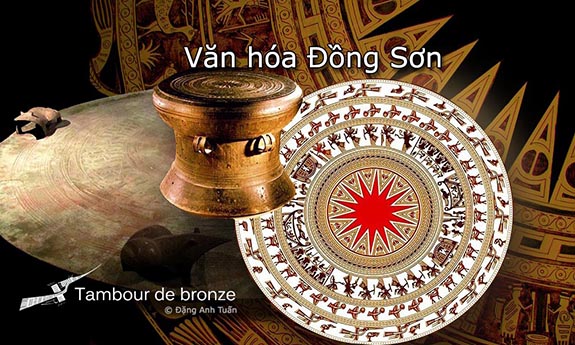
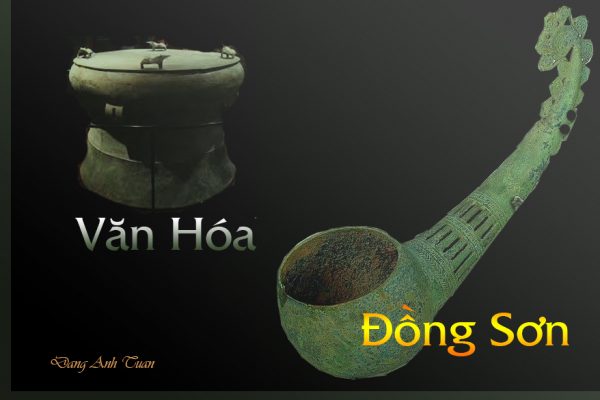
Dong Son culture (Văn hóa Đồng Sơn)

 
vanhoa_dongson
Version vietnamienne
Version française

In the early 20th century, archaeologists from the Ecole française d’Extrême-Orient (Louis Pajot, Olov Jansen) discovered a large number of Bronze Age artefacts in the Mã valley, notably in the village of Ðồng Sơn.

Among these finds are musical instruments, in particular drums. These are decorated with figurative motifs depicting stylized animals and scenes from daily life. But the most remarkable of these drums remains that of Ngọc Lũ. This is a cylinder 63 cm high and 79 cm in diameter. It was purchased by EFEO at the 1902 exhibition and auction in Hanoi for the price of 550 piasters at the time. It is arguably the finest drum ever found in Asia. On its upper side are motifs mixed with various ritual subjects: herds of deer, waterfowl, houses on stilts etc. The Austrian archaeologist Heine-Geldern was the first to propose the name Đồng Sơn for this culture. Since then, the culture has been known as the Ðồng Sơn or Dongsonian culture.   According to researchers Louis Bezacier and Nguyễn Phúc Long, the art of Đồng Sơn represents only the final phase of a long evolution of bronze metallurgy from the Gò Bông (late Phùng Nguyên) , Đồng Dậu and Gò Mun eras and corresponds to the period when it reached perfection and acquired prestige and influence in Southeast Asia and the Pacific.

According to researcher Hà Văn Tấn, the culture of Đồng Sơn has its roots among the proto-Dongsonian cultures discovered, which gradually enable it to have remarkable creations.  The art of Đồng Sơn emerged on the basis of Neolithic industry, as the first bronze objects can be found alongside carved stone instruments and pottery with a still Neolithic character. To look for the origins of the Dongsonian in the north or west of Vietnam, as several researchers have done, is to put forward a hypothesis that has no scientific basis. Dongsonian art is also in contact with the art of the Warring Kingdoms (Houai-style daggers from the Wu-Yue kingdom).  The ancient bronzes found in Vietnam are totally different from those of the Shang and Chu dynasties in China, both in the creation of charming forms and in decoration and alloying.  We can say without hesitation that this is a purely local production with very little influence from Chinese bronzes.

Đồng Sơn culture

(500 B.C. – 43 A.C.)

dongsonien

No Images found.


Thanks to the discoveries of bronze ploughing implements (ploughshares) found at Vạn Thắng and Sơn Tây reported by Vietnamese researchers in their book entitled “Les premiers vestiges de l’Âge de bronze au Vietnam p 110-113, Hànội 1963)(1), the Proto-Vietnamese already knew how to plough their rice fields. This invalidates the old Chinese thesis that the Proto-Vietnamese didn’t know how to plough before the Han conquest. They had to learn from the governors Si Kouang (Tích Quan) and Ren Yan (Nhâm Diên) how to grow rice and how to live and dress (Livre des Han postérieurs). One of the characteristics of Dongsonian bronze lies in the subtle blend of copper, tin and lead elements, depending on the type of tool produced (battle axe, crossbow trigger, spear point, ploughshare, hoe, dagger, etc.). According to Vietnamese researcher Nguyễn Phúc Long, ancient bronze drums found in North Vietnam have a much higher lead content than those from archaic China, in the order of 27.8% for the former versus 0.55% for the latter.

Beauty and skill are not lacking either in the decoration of the various objects found with the creatures living in the rice fields (toad, pelican, turtle, buffalo etc.). For some time now, despite the proximity of a multi-cultural country like China, there has been unanimous agreement on the singularity of this age-old culture, which originated with the rice-growing peasants, whose feet were buried in the mud of the flooded fields and who were close to nature. It is contemporary with the Sa Huỳnh and Đồng Nai cultures of central and southern Vietnam today.

[RETURN]

Đình Minh Hương Gia Thạnh (Chợ Lớn, Saigon)

Temple Minh Hương Gia Thạnh 

Version française
Version anglaise
Galerie des photos

Tọa lạc ở số 380 đường Trần Hưng Đạọ (Saïgon) , đình Minh Hương Gia Thạnh được công nhận là di tích kiến trúc nghệ thuật bởi bộ Văn Hóa.  Đình nầy được coi xem là có lâu đời nhất  ờ vùng Saïgon-Chợ lớn do người Minh Hương xây dựng từ năm 1789. Người Minh Hương là những Việt gốc Hoa mà tổ phụ của họ là người Hoa, thần dân của nhà Minh sang định cư ở Đàng Trong sau khi nhà Minh bị  sụp đổ, được chúa Nguyễn Phúc Tần cho phép hai vị tổng binh cựu thần của nhà Minh Dương Ngạn Địch và Trần Thượng Xuyên cư trú  ở miền nam tức là vùng đất của Chân Lạp cùng với 3000 binh sĩ và gia đình vào năm Kỷ Mùi (1679).  Dương Ngạn Địch  vào khai thác vùng Mỹ Tho còn Trần Thượng Xuyên thì vào khai khẩn vùng Biên Hoà (Cù Lao Phố), một vùng đất trù phú. Người ngoại quốc thường tới lui buôn bán ở nơi nầy. Trong thời kỳ chiến tranh giữa nhà Tây Sơn và Nguyễn Ánh, thì tất cả người Minh Hương đều đứng về phía chúa Nguyễn nên nhà Tây Sơn  tàn phá nhà  cửa của họ  vào năm 1776. Họ buộc lòng phải  lánh nạn  về  ở vùng đất Đề Ngạn xưa tức là Chợ  Lớn ngày nay. Đến năm kỷ dậu (1789)  dưới thời  Lê Mẫn Hoàng Đế  thì con cháu nhà Minh có quyền lập ra Minh Hương xã. Ban đầu chữ « hương » dùng chữ có nghĩa là « hương hỏa » (香火), đến năm 1827 đổi sang chữcó  nghĩa là « làng ». Như vậy Minh Hương có thể hiểu là « làng của người Hoa, thần dân của nhà Minh. Bởi vậy chúng ta cũng thường gọi họ là khách trú. Lúc đầu làng Minh Hương không có ranh định biên giới như các làng khác vì họ ở khắp mọi nơi của vùng đất mới. Người Minh Hương khỏi đi lính và khỏi đi làm xâu.  Nếu họ phạm phép  thì Minh Hương xã phân xử. Mặc dầu có đặc quyền như vậy, Minh Hương xã rất nghiêm ngặt trừng trị và  lo lắng  dạy dỗ con cháu họ. Bởi vậy họ sống rất hoà đồng với người dân Việt khiến  mới có câu ca dao như sau:

Gỏi chi ngon bằng gỏi tôm càng
Đố ai lịch sự bằng làng Minh Hương.

Chính vua Tự Đức đã có sắc tặng cho làng Minh Hương  bốn chữ: Thiện Tục Khả Phong (Phong tục tốt đẹp cần giữ lưu truyền), khắc vô một tấm biển, nay treo trước căn giữa Chánh điện của đình. Theo giáo sư Lâm Vĩnh Thế  thì năm 1865, Thống Đốc Nam Kỳ lúc bấy giờ là Đô Đốc De La Grandière ban hành quyết định chấm dứt quy chế làng của Minh Hương Xã, viện lý do là Sài Gòn và Chợ Lớn là châu thành tức là  thủ phủ của tỉnh, làng Minh Hương không còn có lý do tồn  tại nữa.  Đình Minh Hương Gia Thạnh không phải là nhà làng nữa mà trở thành từ đó nhà hương hỏa chung của tất cả hội viên, của tất cả công dân Việt Nam gốc Hoa có hơn hai trăm năm nay vì họ nói tiếng Việt, mặc quốc phục  trong các dịp tế lễ, cho con cái học trường Việt và hành xử hoàn toàn như là một công dân Việt Nam. Trịnh Hoài ĐứcNgô Nhân Tịnh, hai người Minh Hương làm quan đến chức thượng thư.

Đình được xây cất  theo kiểu nhà năm gian. Mái đình lợp ngói ống, trang trí hình lưỡng long tranh châu, cá hóa long, tượng ông Nhật bà Nguyệt, phù điêu trích từ các tuồng tích Trung Quốc. Trên cột và các đà ngang treo nhiều hoành phi, câu đối, phần lớn được làm từ đầu và giữa thế kỷ 19. Tại đình vẫn còn lưu giữ  nhiều cổ vật quý giá nhất là  đình có giá trị về nghệ thuật thư pháp, nghệ thuật chạm khắc gỗ mang phong cách Việt nam. Nhờ sự giải thích của chị Vân,một thành viên của ban tri sự quản lý  đình hôm đến tham quan, mình  được chị giải thích  biết nhiều  về  các cổ  vật trưng bày  của đình. Thật thú vị và  cũng tiện đây có một lời cám ơn chị qua bài viết nầy.

Située au numéro 380 rue Tran Hung Dao (Saïgon), la Maison communale Minh Huong Gia Thanh est reconnue comme un monument architectural et artistique par le ministère de la Culture. Cette maison communale est considérée comme la plus ancienne de la région de Saïgon-Cholon, construite par les partisans de la dynastie des Ming  (ou Minh Hương) en 1789.

Les Minh Hương sont des Vietnamiens d’origine chinoise dont les ancêtres étaient des Chinois, sujets de la dynastie Ming qui s’étaient  réfugiés dans le sud après la chute de la dynastie Ming en Chine. Le seigneur Nguyễn Phúc Tần permit aux deux anciens généraux de la dynastie Ming, Dương Ngạn Địch et Trần Thượng Xuyên, de  trouver refuge dans le sud du Vietnam, l’ancien territoire du Chen La avec 3 000 soldats et leurs familles en l’année de la Chèvre (1679). Dương Ngạn Địch était allé exploiter la région de Mỹ Tho et  Trần Thượng Xuyên la région de Biên Hoà (Cù Lao Phố), un territoire riche et peuplé. Les étrangers le fréquentaient souvent pour y faire  des affaires. Durant la confrontation armée entre les Paysans de l’Ouest (Tây Sơn)  et Nguyễn Ánh, tous les Minh Hương s’étaient rangés du côté de ce dernier. Furieux, les Tây Sơn pillèrent leurs maisons en 1776. Les Minh Hương  étaient  obligés de se réfugier dans la région de Đề Ngạn (Cholon d’aujourd’hui). En 1789, sous le règne de l’empereur Lê Mẫn, les Minh Hương  obtinrent  le droit de fonder leur propre village.

Le mot « Hương » était initialement  écrit avec le pictogrammepour évoquer le culte des ancêtres (香火), mais il était remplacé ensuite  par le pictogramme  en 1827 pour signifier le village. Minh Hương  pouvait être compris ainsi comme  le village des sujets de la dynastie Ming. C’était pour cela on était habitué à les appeler « les résidents étrangers».

Au début, le village des Minh Hương n’était pas délimité par des frontières  comme les autres villages  grâce à leur possibilité de s’installer partout sur le nouveau territoire. Les Minh Hương  étaient exemptés du service militaire et ils n’étaient pas forcés de travailler gratuitement pour l’état. En cas de la violation de la  loi, ils seront punis par leur propre village. En dépit des privilèges qu’ils ont eus, les Minh Hương ne cessaient pas de respecter les lois avec sévérité et ils étaient toujours soucieux d’aider leurs enfants dans l’éducation. C’était pourquoi ils vivaient en harmonie avec les Vietnamiens, ce qui donnait naissance  à  la chanson populaire suivante :

Gỏi chi ngon bằng gỏi tôm càng
Đố ai lịch sự bằng làng Minh Hương.

Quelle salade peut-on trouver  aussi délicieuse comme celle de crevettes ?
Y a t-il quiconque plus poli que le village des Minh Hương ?

L’empereur Tự Đức  lui-même signa pour le  village des Minh Hương un décret comportant  quatre mots suivants: Thiện Tục Khả Phong (Les bonnes coutumes doivent être gardées et transmises), gravés sur une pancarte, désormais accrochée devant la salle principale de la maison communale. Selon le professeur Lâm Vĩnh Thế, en 1865, le gouverneur de la Cochinchine de l’époque, l’amiral De La Grandière, décida de mettre  fin au statut de la création du  village de Minh Hương Xã en prenant prétexte que Saigon-Cholon était la capitale de la province.  Le village des Minh Hương n’avait plus de raison d’exister. Mais il  était devenu dès lors la maison communale  dédiée au culte des ancêtres  pour tous ses membres et pour tous les citoyens vietnamiens d’origine chinoise depuis plus deux siècles car ils parlaient le vietnamien,  ils portaient des vêtements nationaux lors des cérémonies, ils envoyaient leurs enfants dans les écoles vietnamiennes et se comportaient entièrement  comme des citoyens vietnamiens. Trinh Hoài Đức  et Ngô Nhân Tịnh issus des  Minh Hương  étaient au poste de ministre.

La maison communale a été construite dans le style d’une maison à cinq compartiments. Son toit est recouvert de tuiles tubulaires, décoré d’un couple de dragons se disputant la perle enflammée, de poissons se transformant en dragons,  de génies de mariage et des tableaux en relief extraits des opéras chinois. Sur les colonnes et les poutres horizontales sont suspendus de nombreux panneaux horizontaux et des sentences parallèles dont la plupart ont été réalisés au début et au milieu du XIXème siècle.

La maison communale conserve encore de nombreuses antiquités, les plus précieuses étant l’art de la calligraphie et de la sculpture sur bois dans le  style vietnamien.  Grâce aux explications de Mme Vân, membre du comité de gestion  de cette association,  j’ai  beaucoup d’informations à savoir   sur les antiquités exposées.  Pour moi, c’est  très intéressant et  aussi  une opportunité  de lui rappeler ma gratitude à travers cet article.

Version anglaise

Located at number 380 Tran Hung Dao Street (Saigon), the Minh Huong Gia Thanh communal house is recognized as an architectural and artistic monument by the Ministry of Culture. This communal house is considered the oldest in the Saigon-Cholon region, built by supporters of the Ming dynasty (or Minh Hương) in 1789.

The Minh Hương are Vietnamese of Chinese origin whose ancestors were Chinese subjects of the Ming dynasty who took refuge in the south after the fall of the Ming dynasty in China. Lord Nguyễn Phúc Tần allowed two former generals of the Ming dynasty, Dương Ngạn Địch and Trần Thượng Xuyên, to find refuge in southern Vietnam, the former Chen La territory, with 3,000 soldiers and their families in the Year of the Goat (1679). Dương Ngạn Địch went to exploit the Mỹ Tho region, and Trần Thượng Xuyên the Biên Hoà region (Cù Lao Phố), a rich and populated territory. Foreigners often frequented it to conduct business. During the armed confrontation between the Tây Sơn peasants and Nguyễn Ánh, all the Minh Hương sided with the latter. Furious, the Tây Sơn pillaged their homes in 1776. The Minh Hương were forced to take refuge in the Đề Ngạn region (today’s Cholon). In 1789, under the reign of Emperor Lê Mẫn, the Minh Hương obtained the right to found their own village.

The word « Hương » was originally written with the pictogram to evoke the ancestor worship (香火), but it was later replaced by the pictogram in 1827 to signify the village. Minh Hương could thus be understood as the village of subjects of the Ming dynasty. That is why they were accustomed to being called « the foreign residents. »

At first, the Minh Hương village was not delimited by borders like other villages due to their ability to settle anywhere in the new territory. The Minh Hương were exempt from military service and were not forced to work for the state without pay. In case of law violations, they would be punished by their own village. Despite the privileges they had, the Minh Hương continuously respected the laws strictly and were always concerned with helping their children in education. That is why they lived in harmony with the Vietnamese, which gave rise to the following popular song:

Gỏi chi ngon bằng gỏi tôm càng
Đố ai lịch sự bằng làng Minh Hương.

What salad can be found as delicious as the shrimp salad?
Is there anyone more polite than the Minh Hương village?

Emperor Tự Đức himself signed a decree for the Minh Hương village containing the following four words: Thiện Tục Khả Phong (Good customs must be preserved and passed on), engraved on a plaque now hung in front of the main hall of the communal house. According to Professor Lâm Vĩnh Thế, in 1865, the governor of Cochinchina at the time, Admiral De La Grandière, decided to end the status of the creation of Minh Hương Xã village, using the pretext that Saigon-Cholon was the provincial capital. The Minh Hương village no longer had a reason to exist. But it then became the communal house dedicated to the ancestor worship for all its members and for all Vietnamese citizens of Chinese origin for more than two centuries because they spoke Vietnamese, wore national clothing during ceremonies, sent their children to Vietnamese schools, and behaved entirely like Vietnamese citizens. Trịnh Hoài Đức and Ngô Nhân Tịnh, who came from Minh Hương, held ministerial positions.

The communal house was built in the style of a five-compartment house. Its roof is covered with tubular tiles, decorated with a pair of dragons disputing the flaming pearl, fish transforming into dragons, marriage spirits, and relief panels taken from Chinese operas. On the columns and horizontal beams hang numerous horizontal panels and parallel sentences, most of which were made in the early and mid-19th century.

The communal house still preserves many antiques, the most precious being the art of calligraphy and wood carving in the Vietnamese style. Thanks to the explanations of Mrs. Vân, a member of the management committee of this association, I gained a lot of information about the antiques on display. For me, it is very interesting and also an opportunity to express my gratitude to her through this article.

Galerie des photos

GIA THANH

[Retour CHOLON ]

[Retour SAIGON]


Dynastie des Tang (Đại Đường)

Version française
English version
Galerie des photos

Người Trung Hoa  tự hào luôn luôn là con cháu  của nhà Hán. Tuy nhiên, thời đại hoàng kim của văn minh Trung Hoa không phải là thời kỳ của  nhà Hán mà chính là thời nhà Đường được  kéo dài  ba thế kỷ sau đó (618-907). Nhờ có nguồn  tài liệu  phong phú và  việc phát giác  ra các minh khí, các vật thu nhỏ nghi lễ được đặt trong các ngôi mộ của giới thượng lưu thời đó, chúng ta biết được  thời kỳ nhà Đường là một thời kỳ có những tiến bộ đáng kể về khoa học và kỹ thuật (thuốc súng, bản in khắc gỗ, kỹ thuật cơ khí, y học, bản đồ, vân vân..). Đây  là một triều đại rất cởi mở với thế giới  bên ngoài bằng cách có chính sách khoan dung chưa từng có đối với các nền văn hóa khác và  các tôn giáo nước ngoài như Giáo hội Phương Đông hay Cảnh Giáo,  đạo thờ lửa , một tôn giáo đa thần đến từ Ba Tư, Phật giáo đang phát triển  nhanh chóng vân vân.

Cũng dưới thời ngự trị  của hoàng đế sáng lập nhà Đường, Đường Thái Tôn (Lỳ Thế Dân)  nhà sư  Huyền Trang mới bắt đầu  cuộc hành hương vào năm 629 mà được gọi là « Tây du Ký » bằng cách  tự nguyện đi một  mình suốt  17 năm từ thủ đô  Trường An theo  lời yêu cầu của hoàng đế hầu mang về  các kinh điển  từ nước Thiên Trúc. Đây cũng là thời kỳ nghệ thuật và văn  học  phát triển đến đỉnh cao với các nhà thơ Đỗ Phủ, Lý Bạch, Bạch Cư Dị, họa sĩ Vương Duy vân vân  và quyền tự do tương đối khả quan  cho  giới phụ nữ. Họ có thể xuất sắc  trong nghệ thuật, đặc biệt là âm nhạc và thi ca, và đôi khi họ có thể có  một địa vị cao hơn trong xã hội. Đây là trường hợp của hoàng hậu Võ Tắc Thiên (Võ Hậu). Phụ nữ thời đó có thể mặc trang phục ít gò bó hơn với áo dài  rộng Hanfu (Hán phục)

Cũng dưới  triều đại này, con đường tơ lụa đã phát triển nhanh chóng cho nhiều mục đích kinh tế, chính trị và tôn giáo bằng cách  áp dụng chính sách hôn nhân chiến lược, các cuộc chinh phục quân sự và viẽc  sử dụng  tơ lụa nhầm  củng cố liên minh, mua chuộc  và chia rẽ các cư dân du mục và bành trướng đế chế  về phía Tây. Nhờ có sự thiết lập này, triều đại nhà Đường đã thành công trong việc thiết lập các mối quan hệ thương mại và văn hóa trên con đường tơ lụa. Đây là con đường mà hai nhà sư của đạo Phương Đông  đã mang theo trứng giun tơ lụa từ Trung Quốc về Byzance bằng cách giấu trong hai gậy bằng tre. Cuối cùng, đây cũng là thời kỳ Việt Nam ta nằm dưới sự đô hộ của nhà Đường sau khi bị sáp nhập trước đó bởi nhà Tùy với tướng Lưu Phương.

Dưới triều đại nhà Đường, Trường An  là một  thành phố quốc tế lớn nhất thế giới vào thời điểm đó. Nó còn  được mệnh danh là « thành phố một triệu dân »  trong  các tài liệu của Trung Hoa. Được biết đến với cái tên « Bình An vĩnh cửu » , nó là thành phố đông dân nhất thế giới trước BaghdadByzance. Tuy nhiên, theo bản ghi chép điều tra dân số năm 742 trong sách Tân Đường Thư,  Trường An  và các vùng lân cận có đến 362.921 gia đình với dân số là 1960188 người trong khi ước tính có hơn 50 triệu người Trung Hoa  sống vào thời điểm đó trên một lãnh thổ từ Biển Đông Trung Quốc đến Trung Á, từ sa mạc Gobi ở phía bắc và vượt qua dãy núi Nanglin (Lĩnh Nam) ở phía nam, nơi có xứ An Nam. Với diện tích gần 87 km2, Trường An không chỉ là một trung tâm quyền lực chính trị và kinh tế mà còn là một  chỗ bình an với những con đường rộng rãi,  các cung điện  xinh đẹp, các đền  Phật giáo, các khu vườn tư nhân và  các chợ rộng lớn. Các đại lộ và các đường xá  được sắp xếp theo một hệ thống hình chữ nhật gồm 114 khối nhà  được  vách tường bao xung quanh riêng lẻ và được bảo vệ chung tất cả  bởi  một bức tường  khác  nằm ở bên ngoài.

Mỗi buổi sáng, sau khi tiếng trống đầu tiên vang lên, người dân từ khắp nơi đế chế cũng như các  thương nhân nước ngoài bị thu hút bởi công việc buôn bán  thủ đô bắt đầu  đi vào thành và lo chuyện kinh doanh. Còn đêm lại, chỉ có thể đi từ con đường lớn nầy  đến con đường khác nếu có giấy phép.  Tất cả các loại hàng hóa, từ đồ nội thất đến các loại gia vị (nghệ của Ba Tư, ớt của Ấn Độ, vân vân) đều  được tìm thấy  ở hai chợ lớn của thành phố, một chợ  nằm ở phía đông và một chợ ở phía tây. Triều đình  quy định kiểm soát giá cả và chất lượng hàng tuần. Sự phát hiện ra một số ngôi mộ của người  Sogdian (Thổ)  ở thủ đô  càng làm rõ  thêm  tại sao  các yếu tố của văn hóa nước ngoài có thể   xâm nhập vào xã hội Trung Quốc ở Trường  An và ngược lại. Thậm chí  còn có cả một khu phố  dành cho người nước ngoài.

Quân lính  của nhà Đường có rất nhiều đơn vị người Thổ cổ  được gọi là Tujue (tiếng Thổ Nhĩ Kỳ nguyên thủy). Nhờ  chính sách tuyển dụng này và kinh nghiệm chiến trường  của các sĩ quan Thổ,  nhà Đường thành công mở rộng đế chế của mình về phía tây. Đó là việc  chinh phục các vương quốc ốc đảo Karakhoja, bởi nhà Đường với tướng Sogdian A Sử Na Xã Nhĩ (Ashina Sheer) vào  năm 648 ở tỉnh Tân Cương ngày nay. Ông được Hoàng đế  Đường Cao Tông  bổ nhiệm làm  Hữu vệ đại tướng quân. Ông qua đời vào năm 655 và được chôn cất bên cạnh Đường Thái Tông (Lý Thế Dân). Ông được đổi tên thụy là  Nguyên (Yuan (元)) sau khi ông qua đời.

Trường An đóng  giữ một vai trò quan trọng trong giao dịch thương mại ở trên con đường tơ lụa với các khu vực xa xôi như Thiên Trúc (Ấn Độ), Trung Đông và châu Âu. Mạng lưới đô thị và kiến trúc tôn giáo của nó (Tháp Đại Nhạn nơi lưu giữ những áng kinh Phật cổ  được dịch bởi  Đường Tăng Huyền Trang) và cung điện (Đại Minh Cung, nơi ở của các hoàng đế nhà Đường) là bằng chứng cho thấy sự  hiểu biết kỹ thuật trong việc coi trọng sự hài hòa và môi trường  và mang lại ảnh hưởng đáng kể về sau  trong việc thiết kế các thủ đô của các  vương quốc  Silla ở Hàn Quốc và Heian ở Japon. Trường  An vẫn là một phần quan trọng trong di sản lịch sử và văn hóa của Trung Quốc.

Dưới triều đại của Hoàng đế Đường Thái Tôn, các thương gia và các người đi buôn  có thể đi lại ở khắp đế chế mà không sợ bị cướp giựt. Các nhà tù  thì trống rỗng và người dân không cảm nhận áy náy phải khóa cửa nhà.  Mùa màng  bội thu: chỉ cần 3 hoặc 4 xu ( qian ) mua được  10 lít gạo. Đây không chỉ là giai đoạn thời kỳ thịnh vượng mà Trung Quốc có được   cho đến thời đại của Hoàng đế Huyền Tông trước cuộc nổi dậy của tướng Sogdian An Lộc  Sơn (An Lu Shan) vào năm 755 mà nó còn là mô hình cai trị thường được nhắc đến trong lịch sử Trung Quốc

Version française

Les Chinois sont fiers d’être toujours les fils des Han.  Pourtant l’âge d’or de la civilisation chinoise n’est pas la période  des Han mais plutôt celle des Tang qui perdure trois siècles plus tard (618-907). Grâce à l’abondance de documentation et la découverte des figurines minqi, des objets rituels déposés dans les tombes des élites de l’époque, on sait que la période des Tang est une période durant laquelle les progrès sont  significatifs en matière des sciences et techniques ( poudre à canon, xylographie, génie mécanique, médecine,  cartographie,  etc.). C’est une dynastie ouverte sur le monde en acceptant la tolérance sans précédent à l’égard des cultures et des religions étrangères (l’église nestorienne, le zoroastrisme, une religion polythéiste venue de Perse,  bouddhisme en plein essor  etc.).

C’est  aussi sous le règne de l’empereur fondateur Tang Tai Zong (Đường Thái Tôn hay Lý Thế Dân) que  le  moine bouddhiste Xuan Zang (Huyền Trang) entama en l’an 629  le pèlerinage sacré   connu sous le nom de «  Pérégrinations vers l’Ouest (Tây Du Ký) » en partant  seul  de la capitale Chang An durant 17 ans,  à la demande  de l’empereur pour ramener les écritures sacrées de l’Inde. C’est aussi la période où l’épanouissement des arts et des lettres était à son comble avec les poètes Du Fu (Đỗ Phủ),  Li Bai (Lý Bạch), Bai Juji (Bạch Cư Dị) , le peintre Wang Wei (Vương Duy) etc.  et celle de la liberté relative pour les femmes. Celles-ci pouvaient exceller dans les arts, en particulier dans la musique et  la poésie.   Elles  pouvaient avoir parfois un statut  plus élevé dans la société. C’est le cas  de l’impératrice Wu Zetian (Võ Tắc Thiên). Les femmes pouvaient porter des vêtements moins contraignants avec la robe ample Hanfu (Hán phục). 

C’est aussi sous cette dynastie que la Route de la Soie connut un grand essor pour de nombreuses fins  à la fois économiques, politiques  et religieuses par la mise en place de la politique de mariage stratégique, les conquêtes militaires et la soie dans le but de consolider les alliances, de soudoyer  et de diviser les nomades et d’agrandir son empire vers l’Ouest. Grâce à cette mise en place, la dynastie réussit à établir des liens commerciaux et culturels tout le long de la route de la soie. C’est par cette route que deux moines nestoriens  ont  ramené à Byzance  les  œufs de vers à soie  de la Chine, en les cachant dans leurs cannes de bambou. Enfin c’est aussi la période où le Vietnam était sous le giron des Tang après avoir été annexé plus tôt par les Sui avec le général Liu Fang (Lưu Phương). 

Sous la dynastie  des Tang, Chang-An est la plus grande ville cosmopolite au monde à cette époque.  Elle  est surnommée « ville d’un million d’habitants » dans les archives chinoises.  Connue sous le nom « Paix Eternelle », elle est la ville la plus densément peuplée du monde devant Bagdad et Byzance. Mais d’après l’enregistrement du recensement en l’an 742 dans le Nouveau Livre des Tang (Tân Đường Thư), Chang ’An et ses environs ont eu 362 921 familles comptant 1960188 personnes tandis qu’on estime plus de 50 millions d’habitants   vivant à cette époque en Chine  sur un territoire allant de la mer de Chine orientale à l’Asie centrale, du désert de Gobi au nord  et au-delà des montagnes Nanglin (Lĩnh Nam) dans le sud où se trouve l’Annam. D’une surface intérieure de presque 87km2, la capitale cosmopolite Chang ’An était non seulement un centre de pouvoir politique et économique  mais  aussi  un havre de paix  doté de larges avenues, de magnifiques palais, de temples bouddhistes, de jardins  privés et de vastes marchés. Ses larges avenues et ses rues étaient disposées selon un damier rectangulaire de 114 blocs de maisons  individuellement murés et  protégés tous par la même muraille externe.

Chaque matin, dès l’annonce de l’ouverture de sa  porte principale par les premiers coups des tambours, les gens venant de tous les coins de l’empire ainsi que  de nombreux marchands  étrangers  attirés par l’important commerce de la capitale  commençaient  à y entrer et à vaquer à leurs affaires. La nuit, on ne pouvait circuler d’un artère qu’à un autre à condition d’avoir un laissez-passer. On y trouvait toutes sortes de marchandises, des meubles jusqu’aux épices (safran de Perse, poivre d’Inde etc.)  dans les deux grands marchés de la ville, l’un à l’est et l’autre à l’ouest. La cour impériale  réglementait le contrôle des prix et de la qualité des produits par semaine. La découverte d’un certain nombre de tombes sogdiennes dans la capitale  a permis de mieux comprendre comment des éléments de la culture étrangère se sont infiltrés dans la société chinoise de Chang’ An et vice-versa. Même on y trouvait un quartier étranger.

L’armée des Tang comptait  beaucoup d’importants contingents de soldats turcs appelés sous le nom Tujue (proto turc). Grâce à cette politique de recrutement et de l’expérience de la steppe que  les officiers turcs ont eue, cela permettait à la dynastie des Tang d’agrandir son empire vers l’Ouest. C’était la conquête des  royaumes-oasis de Karakhoja, par les Tang avec le  général sogdien Ashina She’er  (A Sử Na Xã Nhĩ) en 648 dans l’actuelle province du Xinjiang.  Il était  nommé général de la garde de droite par l’empereur  Tang Gaozong (Đường Cao Tông) . Il mourut en 655 et fut enterré aux côtés de l’empereur  Taizong (Đường Thái Tông). Il fut renommé Yuan () à titre posthume.

Chang An jouait un rôle clé dans l’échange commercial sur la Route de la Soie avec les régions aussi lointaines comme l’Inde, le Moyen Orient et l’Europe. Son maillage urbain et son architecture religieuse (la grande pagode de l’Oie abritant les textes sacrés  rapportés par le moine  Xuan Zang) et palatiale (Palais de la Grande Clarté (Daming Gong  ou la résidence des empereurs) témoignent du savoir-faire technique dans le respect de l’harmonie et de l’environnement et apportent  plus tard une influence non négligeable dans l’aménagement des capitales des Silla en Corée et des Heian au Japon. Chang An  reste une  partie importante dans l’héritage  historique et culturel de la Chine. Sous le règne de l’empereur Tai Zong (Đường Thái Tôn), les commerçants et les marchands pouvaient circuler librement dans tout l’empire sans avoir peur des bandits. Les prisons étaient vides et les gens ne ressentaient pas le besoin de fermer la porte de leurs maisons. Les récoltes étaient abondantes: il suffit d’avoir 3 ou 4 qian pour l’achat de 10 litres de riz. C’est non seulement  la période de prospérité  que la Chine a connue jusqu’au règne de l’empereur Xuan Zong avant la révolte du général sogdien  An Lu Shan (An Lộc Sơn) en 755 mais aussi le bon modèle de gouvernance  souvent évoqué dans l’histoire de la Chine.

Pagode de l’Oie (Tháp Đại Nhạn)


Musée des arts asiatiques Guimet

Dynastie_Tang

[Return MUSEUM]

Palais Kiến Trung (Điện Kiến Trung)

Điện  Kiến Trung

Version française
Version anglaise
Galerie des photos

Nằm ở điểm cực bắc của trục thần đạo xuyên qua trung tâm Tử Cấm thành, Điện Kiến trung là một  công trình kiến trúc được vua Khải Định  cho xây vào năm 1921-1923. Đây cũng là điện đầu tiên  có sự  phối hợp  phong cách Âu châu gồm có kiến trúc Pháp, kiến trúc Phục hưng của Ý  Đại Lợi cùng  với kiến trúc cổ truyền Việt Nam. Mặt tiền của điện thì  được  trang trí  một cách cầu kỳ với các hoa văn, các họa tiết  với   các mảnh gốm sứ nhiều màu, mang đậm bản sắc của cung đình triều Nguyễn. Tòa điện này được hoàn thành chỉ trong vòng 2 năm, từ 1921 đến 1923 với  sự cố vấn của một số kiến trúc sư, kỹ sư người Pháp và Bộ Công, trên nền cũ mà trước đó là có  hai công trình kiến trúc khác, đó là Minh Viễn Lâu (1827) và Du Cửu Lâu (1913) và nhầm để đáp ứng theo  thị  hiếu thẩm mỹ thời bấy giờ. Theo Trung tâm Bảo tồn di tích Cố đô Huế, điện nầy được lấy tên là Kiến Trung  với chữ Kiến  mang ý nghĩa là dựng  lên và  Trung thì có hàm ý là không sai lệch, ngay thẳng. Điện nầy được xem là nơi ăn ở của  hai nhà vua cuối cùng của triều đại Nhà Nguyễn: Khải Định Bảo Đại.  Chính ở nơi nầy vua Khải Định băng hà vào ngày 6 tháng 11 ,1925. Dưới thời vua Bảo Đại  thì điện được tu sửa toà điện, tân trang  các tiện nghi theo thể cách Tây Phương  trong đó có cả buồng tắm. Cũng tại điện nầy  hoàng hậu Nam Phương hạ sinh Thái Tử  Bảo Long (4-1-1936). Với những năm chiến tranh Việt Nam,  điện  cùng các công trình khác ở Tử Cấm Thành bị tàn phá nên chỉ còn nền mà thôi. Từ năm 2013, Trung tâm Bảo tồn di tích cố đô Huế đã khởi động dự án phục hồi điện Kiến Trung. Dự án này đã được thực hiện từ  tháng 2 năm 2019 với tổng kinh phí hơn 123 tỉ đồng và  hoàn tất vào tháng 8 năm 2023. Nay điện Kiến Trung trở thành một nơi ưa thích nhất của du khách khi đến tham quan  Tử Cấm Thành.

Version française

Situé à l’extrémité nord de l’axe sacré traversant le centre de la Cité Interdite pourpre, le  palais Kiến  Trung est une œuvre architecturale édifiée par le roi Khải Định en 1921-1923. C’est aussi le premier bâtiment où il y a la combinaison  entre le  style européen  comportant à la fois l’architecture française et  l’architecture de la Renaissance italienne et celui de l’architecture traditionnelle vietnamienne. La façade de ce palais est richement décorée de motifs et de fragments de céramique colorés, portant ainsi l’empreinte de l’identité de la cour royale de la dynastie des Nguyễn.  Sur les conseils de plusieurs architectes et ingénieurs français et du ministère des Travaux publics, ce palais répondant au goût esthétique de l’époque fut  achevé seulement en deux  ans, de 1921 à 1923 sur l’ancien emplacement où ont eu lieu précédemment  deux autres œuvres architecturales connues successivement sous les noms de Minh Viễn Lâu (1827) et Du Cửu Lâu (1913). D’après le Centre de conservation des monuments de Huế, il a été connu sous le nom de  Kiến Trung  (Kiến   » érigé  » et Trung « droit, pas de déformation »). Ce palais était considéré comme le lieu de résidence des deux derniers rois de la dynastie des Nguyễn: Khải Định et Bảo Đại. C’était ici que le roi Khai Dinh fut  décédé le 6 novembre 1925.Sous le règne du roi Bảo Đại, le palais et  son intérieur ont été rénovés selon le style occidental, y comprise la salle de bain. C’était également dans ce palais que la reine Nam Phương donna naissance au prince héritier Bảo Long (4 janvier 1936). Durant la guerre au Vietnam, ce palais était  entièrement détruit ainsi que d’autres résidences de la cité interdite. Depuis 2013, le Centre de conservation des monuments de Huế a commencé à lancer  le projet de restauration du palais Kiến Trung. Ce projet fut mis en œuvre depuis février 2019  et achevé en août 2023 avec un coût total de plus de 123 milliards de đồng.

Aujourd’hui, le palais Kiến  Trung est devenu l’endroit préféré de tous les  touristes lors de la visite de la Cité pourpre interdite

Le palais Kiền Trung est visible à travers le long

couloir Trường Lang (Điện Kiến Trung được nhìn thấy qua Trường Lang)

Galerie des photos

[Retour HUE]