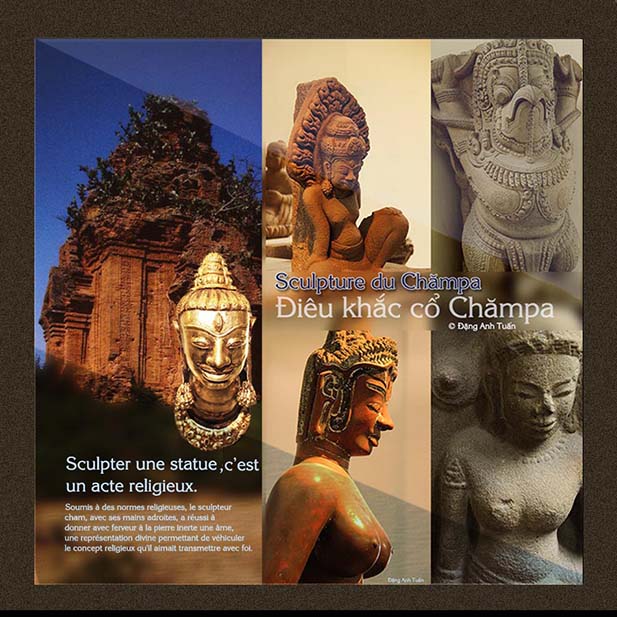
Sculpture du Champa (VA, Part:1)


dieu_khac_champa

Version française
Version vietnamienne
Part 1

Until today, the exact ethnic origin of the Chams is not known. Some believe that they came from continental Asia and were pushed back along with other populations living in southern China (the Bai Yue) by the Chinese, while others (ethnologists, anthropologists, and linguists) highlighted their island origin through their research work.


Carving a statue is a religious act.


For the latter, the Chams were probably populations from the South Seas (the countries of the archipelagos or those of the Malay Peninsula). Cham oral traditions mentioning connections linking, in legendary times, Champa and Java support this latter hypothesis.
Nicknamed the Vikings of Southeast Asia, the Chams lived along the coasts of central and southern present-day Vietnam. Their main activities were essentially based on trade. They were in contact very early with China and territories as far away as the Malay Peninsula, possibly the coasts of South India.

Being dedicated to religious purposes, Cham sculpture was thus not immune to political repercussions and influences from outside, particularly those from India, Cambodia, and Java. These became the main forces of creation, development, and evolution of styles in their art. According to the French researcher Jean Boisselier, Cham sculpture was closely linked to history. Significant changes were noted in the development of Cham sculpture, especially statuary, with historical events, changes of dynasties, or the relations that Champa had with its neighbors (Vietnam or Cambodia). According to the Vietnamese researcher Ngô Văn Doanh, whenever there was a significant external impact, a new style in Cham sculpture soon appeared.

To illustrate this, it is enough to cite an example: in the 11th-12th centuries, the intensification of violent contacts especially with Vietnam and Cambodia, and the emergence of new concepts related to the foundations of royal power can explain the originality and richness found in the style of Tháp Mắm.

Hình ảnh điêu khắc cổ Chămpa

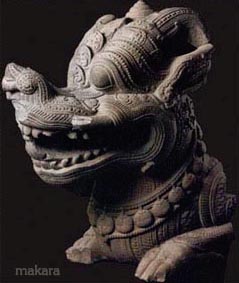
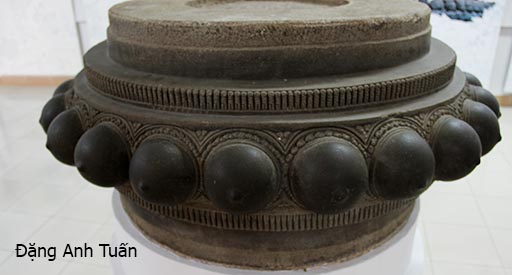
Being the expression of the Indian pantheon (Brahmanist but especially Shaivist and Buddhist), Cham sculpture rather resorts to the local interpretation of concepts and norms coming from outside with elegance than to servile imitation. It is above all a support for meditation and a proof of devotion. Sculpting a statue is a religious act. Subject to religious norms, the Cham sculptor, with his skillful hands, succeeded in fervently giving the inert stone a soul, a divine representation allowing the conveyance of the religious concept he wished to transmit with faith. Cham sculpture is peaceful. No scenes of horror are depicted. There are only somewhat fanciful animal creatures (lions, dragons, birds, elephants, etc.). No violent or indecent forms are found in the deities. Despite the evolution of styles over history, Cham sculpture continues to maintain the same divine and animal creatures within a constant theme.

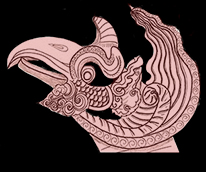
Makara
Cham art has succeeded in maintaining its specificity, its own facial expression, and its particular beauty without it being said that it is a servile copy of external models, thus preserving its uniqueness in Hindu sculpture found in India and Southeast Asia. Despite the lack of animation and realism, Cham works were mostly carved from sandstone and much more rarely from terracotta and other alloys (gold, silver, bronze, etc.).

Generally modest in size, they depict religious beliefs and worldviews. They cannot leave us indifferent because they always give us a strong strange impression. This is one of the characteristics of the beauty of Cham art. In Cham sculpture, one finds free-standing sculptures (round-bosses), high reliefs, and low reliefs. A free-standing sculpture is one that can be viewed from all sides to see the sculptor’s work. A high relief is a sculpture with a very prominent relief that does not detach from the background. As for the low relief, it is a sculpture with slight projection on a uniform background. In Cham sculpture, there is a tendency to emphasize the roundness of creatures in the reliefs. Few scenes are depicted in this sculpture. There is a noted lack of connection or coherence in the assembly when otherwise.


The creatures found in Cham sculpture tend to always emerge brilliantly from the space surrounding them. They have something monumental about them. Even when they are grouped together in the works of Mỹ Sơn, Trà Kiệu depicting the daily life of the Chams, they give us the impression that each one remains independent from the others.

One can say that the Cham sculptor focuses solely on the creature he wants to show and deify without ever thinking about excessively unrealistic details and imperfections (such as the too-large hand or the overly bent arm of the dancer from Trà Kiệu, for example) and without closely imitating the original Indian models, which gives this Cham sculpture the « monumental » character not found in other sculptures. This is another particularity found in this Cham sculpture.

The works are not numerous but they testify to a beautiful plastic quality and the expression of various religions. It is difficult to attribute them to a single style. On the other hand, some traits close to the tradition of Indian art from Amaravati can be noted. It was only in the second half of the 7th century, under the reign of King Prakasadharma Vikrantavarman I, that Cham sculpture began to take shape and reveal its originality.

[Sculpture of Champa (Part 2)]
[ Sculpture of Champa (Part 3)]

Palais Kiến Trung (VA)

Kiến Trung Palace


Version vietnamienne
Version française

Located at the northern end of the sacred axis crossing the center of the Purple Forbidden City, the Kiến Trung Palace is an architectural work built by King Khải Định between 1921 and 1923. It is also the first building where there is a combination of European style, including both French architecture and Italian Renaissance architecture, and traditional Vietnamese architecture. The facade of this palace is richly decorated with colorful ceramic motifs and fragments, thus bearing the imprint of the identity of the royal court of the Nguyễn dynasty. On the advice of several French architects and engineers and the Ministry of Public Works, this palace, responding to the aesthetic taste of the time, was completed in just two years, from 1921 to 1923, on the former site where two other architectural works previously known successively as Minh Viễn Lâu (1827) and Du Cửu Lâu (1913) had stood. According to the Hue Monuments Conservation Center, it has been known as Kiến Trung (Kiến « erected » and Trung « straight, no deformation« ).

This palace was considered the residence of the last two kings of the Nguyễn dynasty: Khải Định and Bảo Đại. It was here that King Khai Dinh passed away on November 6, 1925. During the reign of King Bảo Đại, the palace and its interior were renovated in a Western style, including the bathroom. It was also in this palace that Queen Nam Phương gave birth to the crown prince Bảo Long (January 4, 1936). During the Vietnam War, this palace was completely destroyed along with other residences of the Forbidden City. Since 2013, the Huế Monuments Conservation Center has begun launching the restoration project of the Kiến Trung palace. This project was implemented from February 2019 and completed in August 2023 with a total cost of more than 123 billion đồng.

Today, the Kiến Trung palace has become the favorite place for all tourists when visiting the Forbidden Purple City.

Kiến Trung Palace is visible through the long

Trường Lang Corridor

[Return HUE]

The Temple of Literature (Văn Miếu)


Temple of littérature 

One of the jewels in the heart of Hanoi

 (Một bảo vật giữa lòng thủ đô)

Version française

Hiền tài là nguyên khí của quốc gia.
Nguyên khí thịnh thì thế nước mạnh.
Nguyên khí suy thì nước yếu

Talent is the life source of a nation.
A gushing source is the strength of a country.
A drying source weakens it.

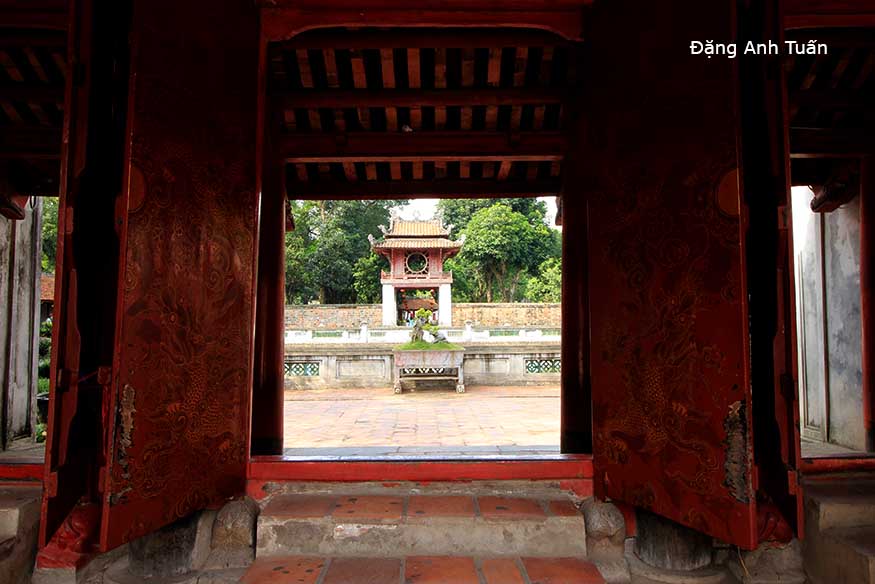
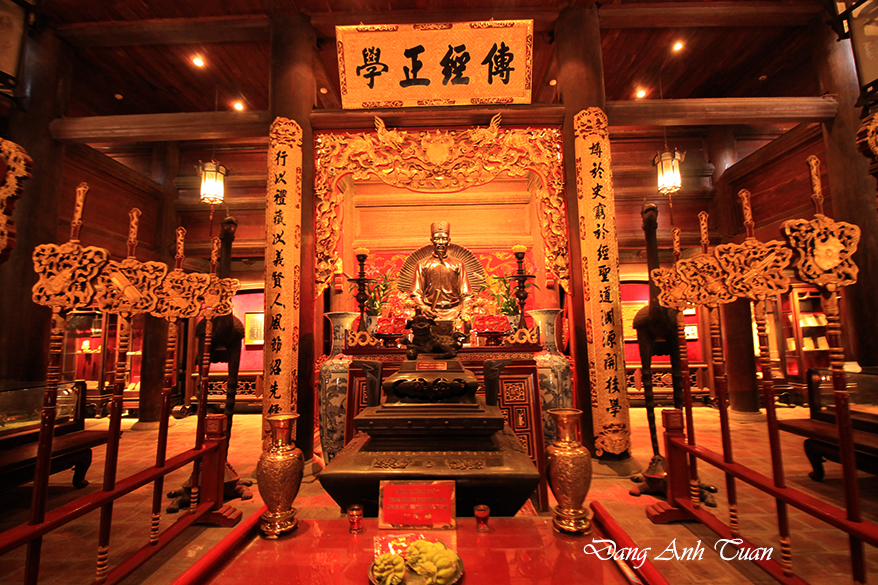
The first National University of Vietnam, Quốc Tử Giám, celebrated its 940th anniversary in 2016. It can boast of having preceded by a good century the ancient and prestigious Western universities of Bologna, Oxford, and Paris. Built six years after the Văn Miếu, the Temple of Literature dedicated to Confucius, within the same enclosure, it is among the monuments of the capital that have survived ten centuries of turmoil, civil wars, and foreign invasions. It is contemporary with the Trấn Quốc, Một Cột, and Kim Lien pagodas. The imposing and well-preserved architectural complex in the heart of Hanoi contains very old parts that bear the color of time and the values of a past as rich as it is little known.

Consolidation of the Vietnamese nation

It was in 1076 that the College of the Sons of the Nation, Quốc Tử Giám, was created by King Lý Nhân Tông, of the great Later Lý dynasty. Since the reconquest of independence in 939, the task facing the Vietnamese sovereigns was immense and arduous. The previous dynasties of Ngô, Ðinh, and Earlier Lê had exhausted themselves in internal divisions and wars of conquest at the beginning of the victorious march southward. At the beginning of the 11th century, Vietnam, then renamed Đại Việt, was a nation of original ancient culture in a young state.

Inside still poorly established borders in the South, it remained necessary to strengthen national unity and to overcome the rivalries of great families that threatened to tear the country apart. Outside, it was necessary to maintain good vassal relations with the powerful Chinese neighbor. The Lý showed themselves capable of meeting these challenges. The construction of dikes to address the flooding of the Red River allowed the population to settle and favored the growth of agriculture.

The buying and selling of land were regulated, which led to the emergence of a class of small landowners alongside the great feudal lords. Crafts developed (weaving, goldsmithing, pottery, porcelain), and consequently, trade. On the advice of competent Confucian administrators, the Lý managed to establish a strong centralized government and were able to give legitimacy to the ruling elite. Inspired by the Chinese administrative model, King Lý Nhân Tông organized in 1075 the first examination to recruit mandarins who would exercise power. The following year, he added to the Văn Miếu a higher school to train senior officials, the Quốc Tử Giám. The educational institution, in this tolerant country, existed peacefully right next to the place of worship. Combining a temple dedicated to Confucius and a place of learning into a single complex, this construction is a unique work that highlights the originality of Vietnam compared to China.

Rise of a National Culture

During almost ten centuries of Chinese colonization, the Vietnamese had preserved their cultural originality and assimilated a large part of Chinese culture. The College of the Sons of the Nation therefore spread Confucian humanities: Confucian classics, philosophy, literature, history, and politics. Brilliant candidates memorized the Four Books of Confucianism, but also the history of Vietnam and China. They also studied the rules of poetic composition, learning to prepare all sorts of documents: royal edicts, speeches, mission reports, analyses, essays. The language in use was certainly Chinese or hán; however, the Vietnamese very early on, probably from the 12th century, used a special iconographic script, nôm, to transcribe the popular national language, kinh.

Under Chinese rule, the Vietnamese had learned just what was necessary to become good servants. Until the tenth century, there is no trace of Vietnamese literature. Only legends may have crystallized the collective memory, prevented from freely expressing itself under the pressure of the occupier. The nôm script, derived from Chinese ideographic writing, represented a national and popular reaction to foreign cultural domination. « The soul of a people lives in its language, » said Goethe.

This is an obvious fact in Vietnam. The language transcribed in nôm experienced vigorous growth whenever the national and popular movement gained momentum. After the great Nguyễn Trãi in the 14th century wrote his poems in nôm, the demotic script gained its nobility and no scholar disdained writing in nôm. Another great Vietnamese figure, Nguyễn Huệ, carried out a true revolution by imposing nôm as the official language in administration and mandarin examinations during his reign at the end of the 18th century.

The royal examinations gave a decisive boost to education throughout the country. The National University became for a long time the keystone of the educational system. Schools were established to prepare candidates for the mandarin examinations.

Alongside the large feudal estates existed a well-organized system of rural communes. In many of them, there was a private school alongside public schools, both at the national, provincial, and local levels. The teachers were educated men who had failed the exams, or holders of a baccalaureate, a license, and doctoral laureates who did not want to become mandarins or who were disillusioned with politics. The prestige of knowledge, the respect for teachers and talent had spread over the centuries even into the poorest peasantry.

Which mother did not dream of seeing her sons one day take the difficult exams? The popular saying was deeply ingrained in people’s minds: « Without a teacher, I challenge you to achieve anything. » Literature and public service were not separate in the traditional Vietnamese educational system. Poets contributed to the economic life of their country. Among the most brilliant statesmen and strategists, many were poets. The most famous among them, revered as heroes by the entire population, were:

Trần Hưng Đạo (1213-1300), who triumphed over the Mongols by defeating Kublai Khan
Nguyễn Trãi (1380–1442), a great poet and statesman who ended a new Chinese occupation by the Ming.
Nguyễn Du, a diplomat under the Lê dynasty, who with his verse novel, the Kiều, brought the nôm script to perfection. The latter two are listed by UNESCO in the Pantheon of the Men of Culture of Humanity.
The obstacle-filled journey of a candidate for the royal exams.

Initially, the national exams were held irregularly, depending on the needs of the imperial administration. From 1434 until 1919, the date of the last session, they took place every three years.

When King Lê Thần Tông redefined the rules in the 14th century, the examination took place in two successive levels: regional, then national, each in four phases that could last several months in total. It was necessary to successfully pass each stage in order to qualify for the next. The final test was held at the imperial palace before the king, who personally examined the last group of future doctors.

Some figures provide an eloquent overview of the demands and importance of the royal competitions:

On average, 70,000 to 80,000 candidates competed in the regional competitions.

Between 450 and 6,000 candidates were selected from these to take part in the national exam in Hanoi. They settled for the duration of the tests on the university campus in the city center with their bamboo beds, brushes, and inkwells. In 1777, the National University and the Doctoral Quarter had become an impressive institution comprising 300 classrooms, a huge library, and a publishing house. This vast complex was destroyed by war in 1946. At the end of the final exam at the imperial palace, only 15 candidates were awarded the title of Doctor (tiến sĩ), with an average age of 32. Between 1076 and 1779, the date of the last session held in Thăng Long (Hanoi), 2,313 candidates received the title of Doctor.

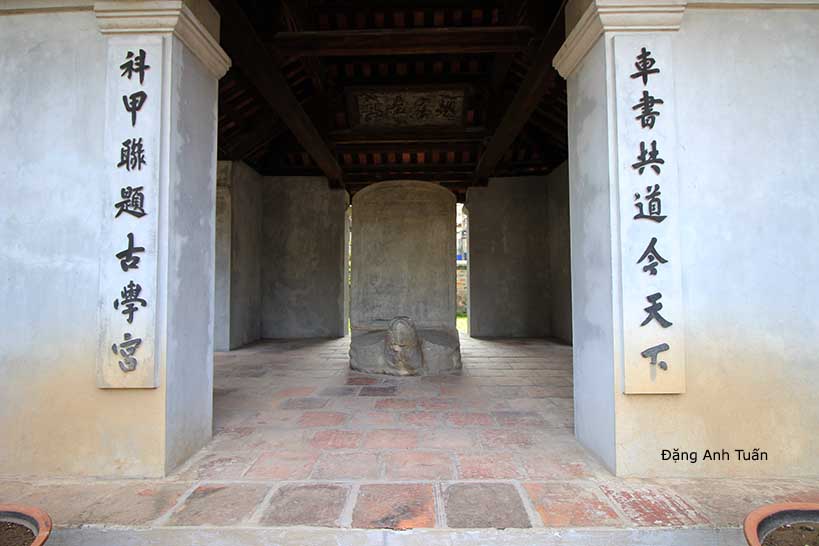
1306 of them have their names and ranks engraved in Chinese characters on the 82 steles (41 on each side) in the third space of the Văn Miếu Quốc Tự Giám in Hanoi. These 82 steles preserve the memory of the laureates admitted between 1442 and 1779. It was King Lê Thánh Tông who took the initiative to pay tribute in this way to the great servants of the country. 116 national exams took place during this period, which means that 34 steles are missing, and the reasons why they were not erected or have disappeared are unknown. From 1802, with the reign of Gia Long, the triennial exams were held in Hué until their abolition in 1919. The Quốc Tự Giám became once again the Văn Miếu, Temple of Literature, but was preserved. The tradition of inscribing the Doctors of the Nation on the honor roll was also maintained.

In the Forbidden City of Hué, on the first floor of the Ngọ Môn Gate, their names are clearly mentioned on a large black marble tablet, along with their village and province of origin. The competency exams were coupled with a formidable physical challenge for those from the provinces. The journey to the capital was fraught with dangers. Coming from a distant province, the future graduates sometimes had to travel up to 300 km or more, bringing with them food, a tent, a narrow bamboo bed, and writing materials.

Along the way, they had to fear both highway bandits and attacks from tigers and snake bites. If they managed to overcome all these obstacles, most of them preferred to stay a few years on site to study, in order to ensure the best chances of success.

Popular imagery often depicted the triumphant return of doctors to their native village, announced by a procession of banners and pennants, palanquins, ceremonial objects, preceded by family and friends. Throughout the journey, drums sounded marking the arrival of the child of the country who brought back, along with the doctoral certificate issued by the king, glory to the entire village. The village was henceforth distinguished as « a land of literature (đất văn chương). »

Then the laureate did not fail to bow before the altar of the ancestors and Confucius, before inviting everyone to a sometimes ruinous banquet. During the second millennium B.C. of Vietnam’s history, the intellectual elite emerging from national competitions produced, alongside brilliant strategists, mathematicians, statesmen, philosophers, men of letters, its share of simple bureaucrats and corrupt mandarins. According to Confucian tradition, no woman had access to official education.

The patients were so numerous that Phú Doãn Hospital (the current German-Vietnamese hospital) was soon overwhelmed. It was set up within the grounds of the Văn Miếu Quốc Tử Giám, whose ramparts served as a barrier against contagion. The disease was brought under control thanks to a vaccine developed by Doctor Yersin and the dedication of the doctors. But the Temple was in such a state that the French authorities decided to transform it into a hospital. They began searching for a new location to build the new building.

Aware that he was attacking the Holy See of Vietnamese culture, the representative of the Governor-General of Indochina, Pasquier, first consulted a prominent scholar, and the latter’s conclusion was unequivocal: « Adverse circumstances have soiled the steles and make the people’s hearts bleed. The Nguyễn, by transferring the capital to Huế, respected the integrity of the Temple. If you want to move it, the population will revolt. » A few days later, the French Government allocated a sum of 20,000 piastres to restore the Temple to its original state.
At other times in its troubled history, the population of Hanoi had shown its attachment to this monument, a symbol of its intellectual curiosity, passion for study, and creativity, notably during the fratricidal wars between the Trịnh and the Nguyễn. Nevertheless, in its current state, the Temple of Literature occupies a smaller space than at its peak.

Toàn cảnh nội văn từ
Thử địa vi thủ, thiên thu cần tạo thương lưu phương

Overview of the literary content
Trying the geographical hand, a thousand years need to create a lasting fragrance

Of all the temples dedicated to literature, this one is the high place;
the scent of culture lingers there beyond millennia.

The Temple of Literature (Văn Miếu)

Chu Văn An

Ông tổ của các nhà nho nước Việt

Erection of the laureates’ steles

[RETURN]

Angkorian empire (Chenla)

Đế Chế Angkor 

Version française
Version vietnamienne
Galerie des photos

At a time when the kingdom of Funan was weakening, a vassal principality of this kingdom, which Chinese historians often referred to as Chenla (Chân Lạp) in their annals, attempted to forge its destiny in the middle Mekong basin near the archaeological site of Vat Phu in the Champassak province (present-day Laos). This is the only name we have to this day. No Sanskrit or Khmer word corresponds to the ancient sound Tsien lap. The existence of this kingdom dates back to the end of the 6th century. Similar to the kings of Funan, those of Chenla also have a dynastic legend: a solar-origin Brahmin priest named Kambu Svayambhuva received from the god Shiva himself a nymph of lunar origin in marriage, the beautiful Mera.

From this union of K(ambu) and Merâ, a line of sovereigns was born, that is, the descendants of Kambujadesha, meaning « land of the descendants of Kambu, » intended to explain the name of the Khmers. This word Kambujadesha, abbreviated as Kambuja, was first discovered in 817 in an inscription of Po Nagar in Champa (or present-day Nha Trang, Vietnam).

During the French colonial period, this name Kambuja was Francized as « Cambodge. » As for the word Chenla, it appeared in the history of the Sui (589-619), where the sending of an embassy from this country was mentioned in 616-617. Located southwest of Lin Yi (future Champa) and a vassal state of Funan, the kingdom of Chenla (Chân Lạp) (future Cambodia), having become powerful, did not hesitate to seize the latter and subjugate it. This fact was reported not only in the New History of the Tang (618-907) by the Chinese historian Ouyang Xiu but also in an unpublished inscription from Sambor-Prei Kuk, which praised the king of Chenla, Içanavarman I, son of King Mahendravarman, for having expanded his parents’ territory with his grand exploits. This monarch established his capital at Sambor-Prei Kuk, renamed Ishanapura.

The fragmentation of Chenla into small states was witnessed again. It was only in 654 that Jayavarman I, a great-grandson of Içanavarman I, succeeded in reunifying his ancestor’s country and established his capital near Angkor. Upon his death, Chenla again broke up into numerous principalities, and soon the principality of Shambupura (today Sambor on the Mekong) managed to impose its authority. Its king, Jayavarman II, settled in Rolûos and proclaimed himself king of the entire Kambuja in 802. Then the settlement and religious sites of the Óc Eo plain began to be abandoned as the center of gravity of the new political formation from the North moved away from the coast to gradually approach the site of the future capital of the Khmer empire, Angkor.

According to researcher J. Népote, the Khmers coming from the North through Laos appear like Germanic tribes in relation to the Roman Empire, attempting to establish a unified kingdom inland known as Chenla. They saw no interest in maintaining the technique of floating rice cultivation because they lived far from the coast. They tried to combine their own mastery of water retention with the contributions of Indian hydraulic science (the baray) to develop, through multiple trials, an irrigation system better adapted to the ecology of the hinterland and to the local varieties of irrigated rice.

It is reported that in Chinese annals, Chenla was divided into a « Land Chenla » and a « Water Chenla » at the beginning of the 8th century. The former was established in the old territories of Chenla, expanded according to its military successes, from the Dangrek range to the middle Mekong valley and westward to Burinam, now part of the Thai province of Korat, while the latter corresponded to a multitude of fiefs of former Funan and was subject to the royal authority of the island of Java (Indonesia). Then, through a stele of Sdok Kak Thom dating from 1052 and found 25 km from Sisophon, we learn that Jayavarman II was crowned king in 802 after freeing his country from the tutelage of Java, and his country regained its unity under the name Chenla.

The latter soon gave way to the birth of the Angkorian empire at the beginning of the 9th century. It first experienced its peak and glory with King Suryavarman II, whom historians have often compared to the Sun King Louis XIV of France. Of a warlike temperament, he did not hesitate to first ally with the Chams to attack the kingdom of Đại Việt under the reign of King Lý Thần Tôn in 1128, but he was repelled in the Nghệ An region. He then tried to maintain his grip on Champa by placing his brother-in-law Harideva as ruler over the capital Vijaya (present-day Bình Định in Vietnam).

But this attempt ended in a crushing failure against one of the greatest Cham kings, Jaya Harivarman I, who recaptured Vijaya in 1149. Yet Chinese chroniclers spoke of him with great deference. Beyond the frenzy of his territorial conquests, Suryavarman II had a large number of splendid monuments built, among which was the famous site of Angkor Wat. According to the Italian researcher Maria Albanese from the I.I.A.O institute, it seems possible that Suryavarman II died following a disastrous military expedition into Vietnamese territory in 1150.

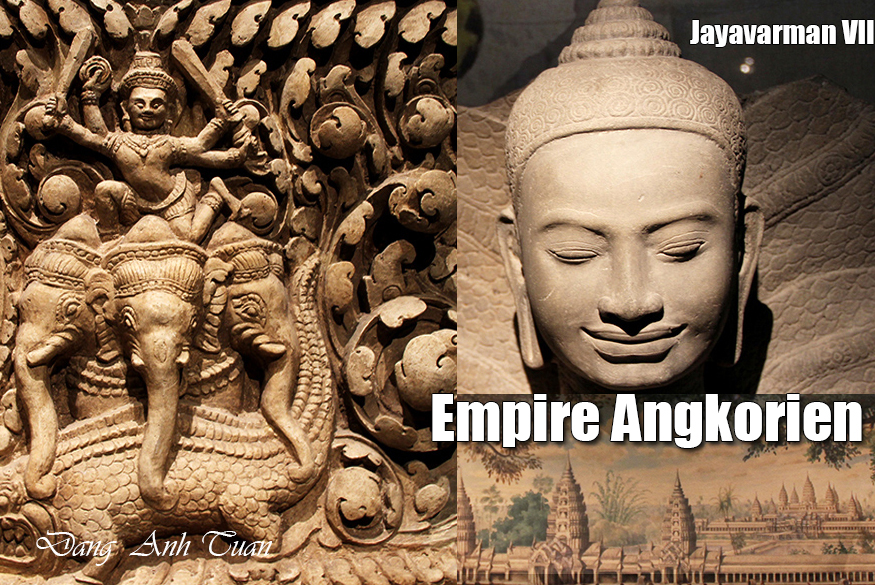
Then the empire of the Khmer kings expanded under Jayavarman VII, one of the fascinating personalities in universal history. During his reign, he managed to push back the limits of his empire by annexing Champa, Lower Burma, Thailand, and Laos. Georges Coedès, former director of the French School of the Far East (EFEO), painted for us a striking portrait of this great king, that of a pharaoh who can boast of having moved so much stone (Angkor Thom, Ta-Prohm, Bantay-Kdei, etc.).
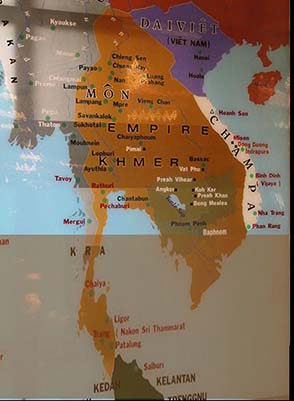
Map of the empire

carte_empire_khmer

But after his death, due to the gigantic enterprises and incessant wars against his neighbors (Chams, Vietnamese, and Thais), the Angkorian empire began to experience a rapid decline caused by the multiple capture and sacking of its capital Angkor by the Thais (1353, 1393, and 1431). They were unified by Ramadhipathi to found the kingdom of Ayutthaya.

Faced with the assaults of the Thais, the Khmers had to abandon their capital Angkor and retreat to the geographic heart of their country, the Four Arms of the Mekong (Phnom Penh), with the last king of the Khmer empire and the first king of Cambodia, Ponhea Yat. This strategic and economic retreat is only one of the hypotheses suggested by researchers to hasten the decline of Angkor. But according to recent discoveries reported by National Geographic in its issue 118 of July 2009, the collapse of Angkor is largely due to climatic disasters that managed to destroy the most complex and ingenious hydraulic system, a jewel of Khmer civilization. The imperial city of Angkor had to face severe successive droughts from 1362 to 1392 and from 1415 to 1440, thanks to the analysis of growth rings found in certain long-lived cypresses such as teak or Siam wood.

When the hydraulic system began to malfunction, showing signs of weakness, the power of the Angkorian empire did the same. This is why, being the first to realize the importance of this system, the archaeologist Bernard Philippe Groslier of the French School of the Far East (EFEO) did not hesitate to describe Angkor as a « hydraulic city » when publishing his work in 1979. Designed to support religious rituals and ensure a constant water supply for rice cultivation, the gigantic barays (or water reservoirs) were drained in the event of successive major droughts. This could have dealt a fatal blow to this already faltering empire, weakened by internal divisions and successive Thai invasions, as Angkor was home to no less than 750,000 inhabitants over an area of about 1000 km². This brings to mind the period experienced by the Maya cities of Mexico and Central America, which succumbed to overpopulation and environmental degradation linked to three successive droughts in the 9th century. This disaster also brutally reminds us of the limits of human ingenuity, which can be easily overcome at any time by the forces of nature. Man cannot conquer nature under any circumstances but must become one with nature to live in harmony with it.

Bibliographie.

Thierry Zéphir: L’empire des rois khmers;  Découvertes Gallimard. 1997
Claude Jacques, Michael Freeman : Angkor, cité khmère. Book Guides
Bernard Philippe Groslier: Indochine. Editions Albin Michel 1961
National Geographic: Angkor . Pourquoi la grande cité médiévale du monde s’est effondrée? N° 118.  Juillet 2009
Maria Albanese: Angkor. gloire et splendeur de l’empire khmer. Editions White Star 
Georges Coedès: Cổ sử các quốc gia Ấn Độ Hóa ở Viễn Đông.  Editions Thế Giới. 2011
Chu Đạt Quan: Chân Lạp phong thổ ký. Editions Thế Giới . 2011


Mausolée Tu Duc (Version vietnamienne)


Khiêm Lăng (謙陵)

Version française

English version

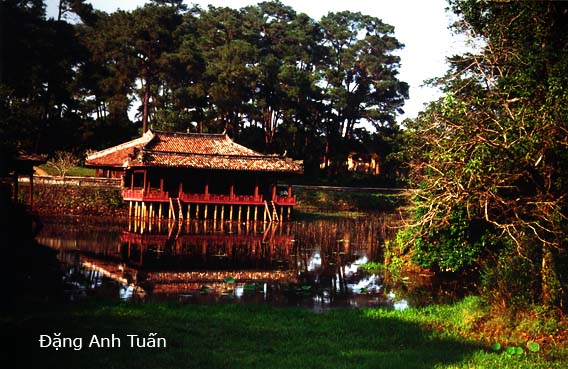
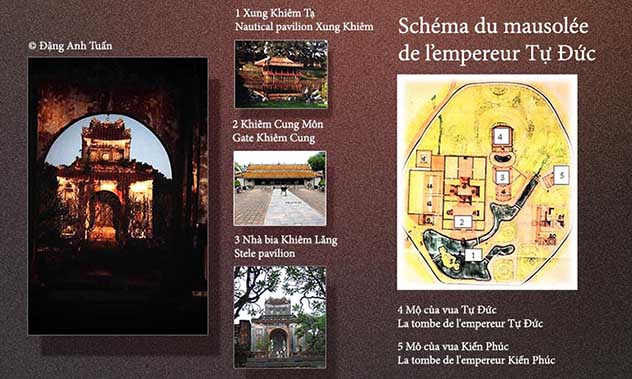
Không giống như các lăng mộ hoàng gia khác của triều Nguyễn, lăng mộ của vua Tự Đức chủ yếu là nơi ẩn náu trong thời gian trị vì của ngài. Đây là lý do tại sao nó không chỉ chứa một cung điện sau này được chuyển đổi thành nơi thờ cúng sau khi ngài qua đời, mà còn có một nhà hát và hai gian nhỏ bằng gỗ đỏ xinh xắn (Du Khiêm Xung Khiêm) nơi ngài thích ngồi để thư giãn và sáng tác thơ. Lăng mộ này, được xây dựng từ năm 1864 đến năm 1867 bởi ba nghìn binh lính và công nhân, có khoảng năm mươi tòa nhà được bao quanh bởi một bức tường đá và gạch dài 1.500 mét bao phủ diện tích 12 ha. Tự Đức lên ngôi vua vào thời điểm ông phải đối mặt không chỉ với sự phát triển của chủ nghĩa tư bản phương Tây mà còn cả tình trạng bất ổn nội bộ (Chiến tranh châu chấu do nhà thơ Cao Bá Quát lãnh đạo, việc anh trai ông là Hồng Bàng bị lật đổ vào thời điểm ông lên ngôi, vân vân). Để có thể nương tựa, ngài không ngần ngại ra lệnh xây dựng lăng mộ làm nơi nghỉ ngơi trong suốt cuộc đời và là nơi ở cho cuộc sống vĩnh hằng sau này của ngài.

Galerie des photos du mausolée Tự Đức

Trong lăng mộ này, đình Hoa Khiêm là công trình chính nơi vua làm việc, đình Lương Khiêm là nơi vua ở và ngủ. Hai ngôi mộ khác cũng nằm trong khuôn viên lăng mộ. Đó là mộ của hoàng hậu Lê Thiện Anh, vợ vua, và một trong ba người con nuôi của vua, vua Kiến Phúc.

Kiến trúc của lăng mộ này không chỉ phản ánh bản chất lãng mạn của nhà thơ-hoàng đế Tư Đức mà còn phản ánh sự tự do vốn còn  thấy thiếu trong các lăng mộ khác cho đến ngày nay. Không có gì ngạc nhiên khi lăng mộ này đã trở thành điểm đến yêu thích của hầu hết du khách nước ngoài và Việt Nam.

lang_tu_duc


Imperial Citadel of Thang Long (Hanoï)


thang_long

Vietnamese version
Version française
Pictures gallery

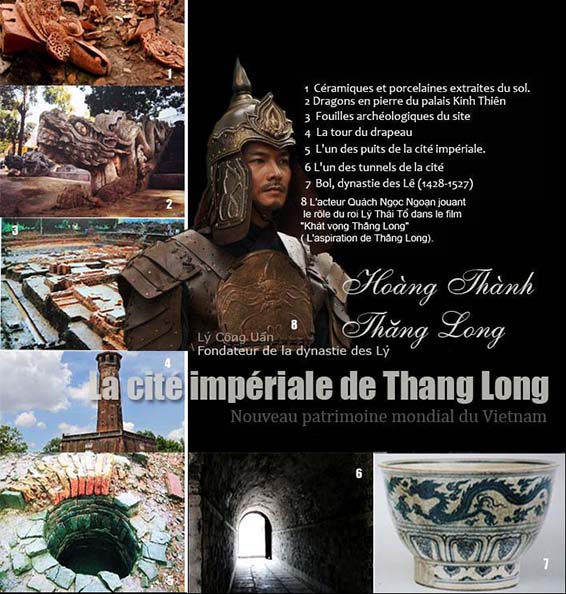
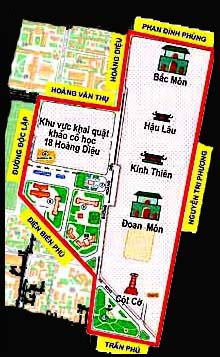
Due to historical events, the imperial city of Thăng Long seems to fade over time in the collective memory of the Vietnamese, with its remnants hidden within the land of the ancient city of Hanoi. Vietnamese archaeologists had difficulty locating its site despite a series of archaeological excavations initiated at Quần Ngựa and in the geographical area of the Hồ Chí Minh mausoleum, etc., since 1970. It was only in 1998 that they succeeded in locating, in the geographical areas near Hậu Lâu adjacent to Hoàng Diệu street and Bắc Môn (the North Gate from the Nguyễn period), bases of stone pillars and columns with lotus motifs as well as other manufactured objects from the later Lê period. In 2000, they were allowed to carry out another excavation inside Ðoan Môn (the only gate of the forbidden city), which led to the discovery of the royal road (ngự đạo) from the Trần period. With other archaeological excavations undertaken from December 2002 until 2004 near No. 18 Hoàng Diệu street, other remnants dating back to the pre-Thăng Long era (before the 11th century) were found.

Thanks to the picks of Vietnamese archaeologists, the imperial city of Thăng Long is beginning to reveal its secrets and politics, administration, and culture over nearly thirteen centuries (under the successive dynasties of Lý, Trần, and later Lê). The architectural ruins (foundations, pillar bases, sections of royal brick roads, water drainage systems, wells, etc.) exposed in the imperial city of Thăng Long undoubtedly testify to the architectural complexity of the palaces of that era, whose existence has been confirmed by the discovery and presence of several types of high-quality ceramics with aesthetically sophisticated motifs, including ceramics from the Lê period bearing Chinese characters meaning Quan (official) or Kính (respectful) and motifs of five-clawed dragons and phoenixes.
Imperial city map

map_thang_long

These ceramics were reserved exclusively for kings and queens. Thanks to the archaeological excavation, the following conclusion was reached: the architectural remains from the Lý-Trần-Lê periods found had been stacked on the layer from the Chinese Zong Pinh-Đai La period (Tống Bình-Đai La) (7th-9th century).

This observation does not call into question the importance given until now to the Royal Edict (Chiếu dời đô) that the founder Lý Công Uẩn of the Lý dynasty, later known as Lý Thái Tổ, promulgated in the spring of 1010 (Canh Tuất) regarding the transfer of the capital. After eliminating the Vietnamese king Lê Long Ðĩnh of the earlier Lê dynasty (Tiền Lê), Lý Thái Tổ realized that after a few years of reign, Hoa Lư, the capital of Vietnam built in a mountainous region, was too difficult to access. It was impossible to ensure prosperity there and to secure the destiny of Vietnam (tính kế cho con cháu muôn vạn đời). The capital had to be transferred to Ðại La, the former capital of the proconsul of the Chinese Tang dynasty, Kao Pien (Cao Biền), during the period of Chinese domination.

Hoàng thành Thăng Long

This city could protect the population from floods and inundations with its fairly high and well-exposed terrain, but it was also a location corresponding to the favorable orientation of mountains and rivers and to the position of the coiled dragon and the sitting tiger. To avoid awakening popular unrest, he did not hesitate to resort to the credulity of his people, as would later be done by the advisor to the hero Lê Lợi, Nguyễn Trãi, in the liberation struggle against the Ming. He spread a rumor that he had seen a golden dragon emerge from Ðại La and fly into the sky in his dream.

That is why Đại La was called Thăng Long (The Rising Dragon). Like other kings, he could have imposed his will on his people by decree, but he preferred to submit to the will of Heaven and the aspirations of the people, deliberately using their superstition to accomplish a great work for an independent Vietnam. His reign was known as « Thuận Thiên » (Following the Will of Heaven).


Orphaned, raised in a pagoda, and educated from a young age by the learned monk Vạn Hạnh, growing up in his shadow, he soon became a great king of Vietnam because he was imbued with Buddhist thought during his reign. In him, one finds not only wisdom, dialogue, insight, and tolerance but also the undeniable will to contribute to the strengthening of the Vietnamese nation (a highly centralized administrative system, a fairly flexible tax regime, Buddhism accepted as the state religion, priority given to education, etc.). It was under him that Vietnam was recognized for the first time as the kingdom of Annam. The authors of the work « The Complete Historical Records of Đại Việt » (Ðại Việt Sử Ký toàn thư) continually praised the years of Lý Công Uẩn’s reign. His dynasty was later described by the Vietnamese historian Ngô Thì Sĩ as a dynasty of clemency (Triều Lý nhân Ái).
leaves

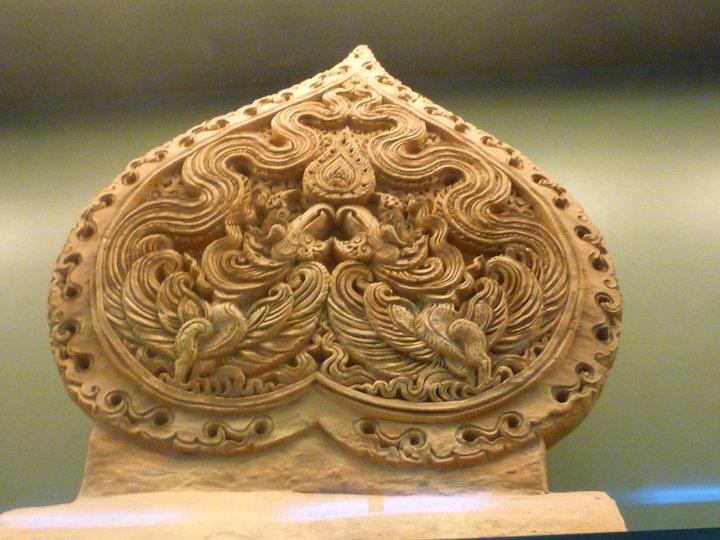
Decorative sheet attached to the tile

Thanks to Việt Sử lược (The Brief History of the Vietnamese State in the 14th Century), we know that in the plan of the imperial city of Thăng Long built in 1010 by King Lý Thái Tổ, there was in the middle of this city the Càn Nguyên palace, later called Thiên An and finally renamed Kinh Thiên (Audience Hall) by King Lê Thái Tổ. Around this palace, to the east, there was the Tập Hiền palace and the Phi Long gate; to the west, the Giảng Vũ palace and the Ðan Phượng gate; to the south, the Cao Ðiện palace and the Long Trì veranda with its corridors on both sides; and to the north, the Long An and Long Thụy palaces, not forgetting to mention to the west and east of these the Nhật Quang and Nguyệt Minh palaces. Additionally, there were the Hưng Thiên pagoda and the Sao Ngũ Phượng tower. In 1011, the Thái Thanh palace, the Vạn Tuế pagoda, and the Trần Phúc Buddhist library were constructed. (Việt Sử lược, translated and annotated by Trần Quốc Vượng pp 70-71).

Based on the plan of the imperial city from the Lê period, Vietnamese archaeologists have delineated this city as follows: the north around Phan Ðình Phùng street, the south located at Trần Phú street, the west beyond Ông Ích Khiêm street, and the east around Thuốc Bắc street. The area of this site is estimated to be about 140 hectares during the Lê period. However, it would be slightly smaller under the Lý and Trần dynasties. On the other hand, the Hanoi citadel does not exceed 100 hectares under the Nguyễn dynasty.

During archaeological excavations, several architectural materials decorated with extremely varied themes are found. The decorative motifs include lotuses, chrysanthemums, or heads of mythical animals with rough and fierce features during the Đại La period (7th – 9th century). Then, under the period of the Đinh and Early Lê dynasties (Tiền Lê), there are lotuses and pairs of mandarin ducks, and finally, under the Lý dynasty, through dragons, phoenixes, leaves, and flowers, the art of decoration reaches the peak of beauty and perfection. Despite maintaining the basic elements of decoration from the Lý dynasty, this art tends to regain its simplicity and solidity under the Trần dynasty. As for the Later Lê period, there is a significant change in the simplicity of tile and brick decoration, along with a batch of new themes added compared to the periods of the Lý and Trần dynasties.

The remains and manufactured objects found in the imperial city of Thăng Long undeniably bear witness to a national culture and local originality because, besides the dragon of the Lý dynasty with its well-decorated crest not found in Chinese dragon motifs, one can discover the roofs of buildings from the Lý-Trần period covered with tiles adorned either with decorative leaves or with figurines of dragons or phoenixes that are not commonly seen in the royal palaces of neighboring countries. It can be said without hesitation that this site is part of a cultural heritage of invaluable worth for Vietnam, particularly for the city of Hanoi.

Listed as a World Cultural Heritage site, the imperial city of Thăng Long has become today a must-visit site when one has the opportunity to visit the capital, Hanoi.


Photos gallery of imperial city  Thăng Long


[Return PATRIMOINES]


Bibliographic references:

Hoàng Thành Thăng Long.
Thăng Long imperial citadel.
Nhà Xuất Bản Thông Tin
Hànội 2006
The Culturel Information Publishing House
 

Naissance de l’Indochine (Sự ra đời Đông Dương)

Naissance de l’Indochine.
Apports de l’Inde et de la Chine. 

Version française
Version anglaise

Thuật ngữ Đông Dương lần đầu tiên được nhà địa lý người Pháp-Đan Mạch Conrad Malte-Brun (1775-1826) sử dụng trong tác phẩm « Précis de la Géographie Universelle » xuất bản tại Paris năm 1810. Đây cũng là cách thức mà nhà địa lý Pháp dùng để nói đến  ảnh hưởng của hai nền văn hóa quan trọng Ấn Độ và Trung Quốc đối với các dân tộc và quốc gia ở lục địa Đông Nam Á (Miến Điện, Cao Miên, Lào, một phần Mã Lai, Tân Gia Ba, Thái lan và Vietnam). Dựa trên dữ liệu khảo cổ học, chúng ta đã thấy rằng từ thế kỷ thứ 1 sau Công nguyên, người Ấn Độ đã bắt đầu dùng thuyền  đi dọc theo bờ biển Đông Nam Á đến quần đảo Sunda.

Nguyên nhân của các cuộc phiêu lưu trên biển nầy có một phần  không ít  từ việc truyền giáo của Phật giáo bởi vì  những người Ấn Độ nầy phần đông là cư dân thủy thủ ở vùng Amaravati, những người sùng bái Đức Phật Dipankara, người bảo vệ họ tránh khỏi những nguy hiểm của biển cả mà cũng có thể đến từ việc giao thương nhất là viên hoa tiêu người Hy Lạp Hippale đã phát hiện ra sự luân định kỳ của gió mùa vào khoảng giữa thế  kỹ thứ 1 sau Công Nguyên khiến có sự tăng trưởng kỳ diệu các  thương mại đường biển giữa Ấn Độ và các cảng biển thuộc Hồng Hải, cửa ngõ của phương Tây. Thời đó, hoàng đế Auguste của thành phố La Mã xa hoa muốn có  vàng  và những sản phẩm ở Ấn Độ như trầm hương, quế, hạt tiêu, đinh hương, bạch đậu khấu, sừng tê giác và ngà voi. Ấn Độ thời đó có liên hệ thương mai trực tiếp với Trung Ðông và gián tiếp với các nước vùng Ðịa Trung Hải như Ðế quốc La Mã. 

Nhưng tiếc thay những sản phẩm nầy trở thành khan hiếm ở lục địa Ấn Độ buộc  cư dân ở đây phải đi tìm những sản phẩm này từ xa và bằng mọi giá. Khi đến gần những bờ biển xa lạ của Đông Nam Á và sau đó họ phải tiến sâu trên đất liền  qua thảm thực vật ngột ngạt để họ có thể đến được gặp những cư dân đầu tiên sống trên vùng cao nguyên. Họ cần phải thuyết phục những người nầy để được có những vật phẩm mà họ cần mua với sự  thương lượng giá cả  một cách công bằng. Tất cả những điều này họ phải  mất nhiều năm.

 Họ buộc lòng phải thành lập các trạm giao dịch thực sự nhất là các chuyến đi biển về phía Đông của họ cũng cần được điều chỉnh theo gió mùa. Có những lúc họ phải chờ có đủ những sản phẩm hàng hóa hiếm có trước khi quay về Ấn Độ nên có thể mất cả năm nhất là phải đợi lúc thời tiết thuận tiện. Còn các thực phẩm mà họ cần dùng không thể vận chuyển trong những khoang tàu buộc lòng họ phải  nghĩ cách  bố trí các cánh đồng lúa ngập nước trên đất màu mỡ ở các đồng bằng châu thổ nơi họ đổ bộ để mua các sản phẩm hiếm có và nơi họ có thể dễ dàng canh tác nhất là họ rất sành sỏi trong kỹ thuật thoát nước và tưới tiêu (như ở  Phù Nam). Như vậy họ có thể quay về khi thu hoạch được thực hiện và các khoang tàu được chứa đầy.

Chính nhờ vậy mà tư tưởng Ấn Độ đã được đưa đến để bồi đắp toàn bờ biển phía nam của Đông Dương; từ đồng bằng ven biển An Nam đến đồng bằng Mã Lai và từ đồng Ménam đến đồng bằng sông Mê Kông. Cũng nhờ đó người dân miền Nam Đông Dương đã học được tất cả các yếu tố của một nền văn minh cao hơn: viết ngôn ngữ của họ bằng nhờ bảng chữ cái Ấn Độ, nó vẫn còn tồn tại cho đến ngày hôm nay ở các nước  Miến Điện, Thái Lan, Cao Miên và Ai Lao và dùng một dụng cụ vô song để suy nghĩ, đó là tiếng Phạn giống như  vai trò dùng tiếng La Tinh ở Châu Âu vào thời Trung Cổ. Các văn bản thiêng liêng, các sử thi của Ấn Độ  được đánh giá cao đến mức được du nhập vào mỗi quốc gia.

Ta còn chưa kể đến hiệu quả của các kỹ thuật khai thác đất đai và sản xuất thủ công và thiên văn học có khả năng tính toán lịch chính xác hơn bất kỳ các lịch nào mà ta biết đến, theo nhà khảo cổ Pháp Bernard Philippe Groslier. Chính Ấn Độ đã truyền bá không những hệ thống chính trị tập trung xung quanh nhà vua và tín ngưỡng tôn giáo mà luôn cả nghệ thuật.  

Các quốc gia này chưa bao giờ  tự  giam hảm mình trong một khuôn mẫu đóng kín và bất biến. Đông Nam Á sẽ được hình thành theo trường phái Bà La Môn thậm chí còn nhiều hơn theo mô hình Phật giáo. Trong những thế kỷ đầu của thời đại chúng ta, ở các quốc gia Ấn Độ Hóa, đồ đồng chỉ là những bản sao đơn giản và thuần túy của các tượng Phật Ấn Độ. Sau đó, giữa thế kỷ thứ  4 và thế kỷ thứ  5, các đồ đồng cho chúng ta thấy có sự tiến hóa và cách diễn giải riêng biệt, có thể xem đây là  các tác phẩm địa phương nhưng  vẫn còn chịu ảnh hưởng rõ ràng của Ấn Độ nhất là các trường phái phía bắc, điều này cũng rất bình thường nhất là có sự ưu việt của nền văn hóa Gupta ở thời kỳ này. Nổi tiếng nhất là bức tượng Phật bằng đồng tráng lệ được tìm thấy ở Đồng Dương,  miền trung Việt Nam và được lưu giữ tại Bảo tàng Quốc gia Sàigon ngày nay. Chúng ta cũng có thể trích dẫn những tượng được tạc giống nhau như vậy ở Thái Lan tại Korat và Nakon Pathom  (nền văn minh Môn Dvaravati).

Nhưng sau đó vào thế kỷ thứ 6 khi có những biến động chính trị và các cuộc xâm lăng man rợ cắt đứt con đường tơ lụa và gia vị khiến  người Ấn Độ không còn mạo hiểm phiêu lưu trên biển. Họ cũng không còn nhớ đến  sự tồn tại của các trạm giao dịch cũ của họ và trong các  văn bản của họ, sử thi thương mại  cũng được nhắc đến một cách qua loa. Sự xâm nhập và thẩm thấu của người Ấn Độ  hình như lúc nào cũng mang tính chất hoà bình và nhờ đó các cư dân sống ở bờ biển phía nam mới thoái khỏi sự cô lập và được hình thành dựa trên văn hóa của người Ân Độ mà tạo ra được  các  nền văn minh mới và độc đáo như nền văn minh Óc Eo, Angkor Wat hay Chămpa. Người Ấ Độ không hề đi kèm theo phương thức chinh phục và thôn tính như người Trung Hoa với Việt Nam ở Đông Dương. 

Qua truyền thuyết, nước ta khởi đầu có tên là Xích Qủy, một liên bang của người Bách Việt dưới quyền cai trị của Kinh Dương Vương Lộc Tục, cha của Lạc Long Quân ở phía nam sông Dương Tử (văn hóa Lương ChữThạch Gia Hà)  rồi sau đó có tên là Văn Lang của các vua Hùng đóng đô ở Phong Châu, có đất đai rộng lớn giáp ranh bắc đến hồ Động Đình, nam giáp nước Hồ Tôn (Chiêm Thành), đông giáp biển Nam Hải, tây nước Ba Thục (Tứ Xuyên). Nước Văn Lang bị thôn tính về sau bởi An Dương Vương, Thục Phán, người Tày ở Cao Bằng và trở thành sau đó vương quốc Âu Lạc đóng đô ở  Cổ Loa huyện Đông An, Hà Nội khoảng chừng 3 thế kỷ trước Công Nguyên. Rồi Âu Lạc bị thôn tín về sau bởi Triệu Đà, một tướng lãnh của nhà Tần (Trung Hoa) và người sáng lập ra nước Nam Việt. Mặc dầu có các cuộc nổi dậy của hai Bà Trưng năm 39-43  SCN (sau Công Nguyên), Bà Triệu  năm 225-248 SCN và Lý Bổn (Lý Nam Đế) năm 544 SCN, nước ta (Tonkin)  vẫn tiếp tục dưới ách thống trị của Trung Hoa cho đến  năm 938.

Người Hoa  cố tình hủy diệt các trống đồng của người Việt để có thể đồng hóa được người dân Việt. Sự Hán hóa do đó lan truyền bằng  cách hành động gương mẫu mà cũng bằng  cách dùng vũ lực ense et aratro: bằng kiếm và lưỡi cày giống như cách người La Mã khuất phục châu Âu. Đất nước ta (Giao Chỉ)  được tổ chức theo mẫu hình Trung Quốc: tỉnh, quận, phủ tạo thành khuôn khổ hành chính, nơi có quyền lực và thậm chí cả quyền lực cao nhất được giao phó cho người bản xứ nhưng được thực thi theo luật lệ Trung Quốc và tất cả đều tùy thuộc ở hoàng đế, người có thẩm quyền tối cao. Tiếng Hán trở thành ngôn ngữ chính thức và được sử dùng từ nay ở khắp  đất nước.

 Việt Nam tuy là một tỉnh lị của Trung Hoa vào thời đó (từ -111 đế n 938) nhưng Việt Nam vẫn còn là một trạm tiếp nối thật sự giữa Trung Hoa và Ấn Độ. Việt Nam được tiếp thu rất sớm Phật pháp từ đầu thế kỷ thứ nhất của kỷ nguyên Tây lịch vì Việt Nam nằm ở bên cạnh các nước như Phù Nam và Chiêm Thành thường thông dùng chữ Phạn của các kinh Phật và còn đươc các thương gia Ấn Độ ở lại để nghĩ, cung cấp và trao đổi hàng hóa. Chính vì vậy Phật giáo ở Giao Châu do từ Ấn Độ truyền sang trực tiếp chớ không phải đến từ Trung Hoa.

Nói tóm lại, việc Hán Hóa nhằm để mở rộng đế chế Trung Hoa chớ có bao giờ người Hoa nghĩ rằng việc Hán Hóa  Việt Nam sẽ gieo mầm cho sự tiến hóa tiếp theo của toàn cả Đông Dương. Người Hoa  muốn tạo con người Việt theo hình ảnh của họ  nhưng họ đâu ngờ  họ  biến  người dân Việt thành một dân tộc kiên trì, sẳn sàng chờ đợi thời điểm thích hơp để dành lại độc lâp nhất là họ đến từ văn hóa rực rỡ Lương Chữ và Thạch Gia Hà và thông thạo binh pháp của Tôn Tử cũng như người Hoa. 

Được xem như những người báo hiệu của nền văn hóa Trung Hoa, người dân Việt chinh phục về sau  bán đảo, đồng hóa và sau đó tiêu diệt các  nước Ấn Độ hóa (Chân Lạp, Chiêm Thành) một cách triệt để giống như cách họ đã bị  thôn tính  bởi  người Trung Hoa lúc ban đầu.

Bởi vậy ta thường nghe câu nói của các nhà khảo cổ về bán đảo Đông Dương như sau: Trung Quốc thống trị và đồng hóa, Ấn Độ gieo mầm của những bông hoa nhân văn phong phú. Đông Dương đã có thể hưởng lợi từ những bài học của những bậc thầy vô song Trung Quốc và Ấn Độ, mỗi nước để lại cho bán đảo một hệ thống chính trị và một dấu ấn riêng  biệt và khó phai mờ theo dòng lịch sử.

Từ đó bán đảo mới có tên là Đông Dương do nhà địa lý người Pháp-Đan Mạch Conrad Malte-Brun đề xướng nhưng đọc giả đừng có  nhầm lẫn với Đông Dương thuộc Pháp.(Indochine Française)

Version française

Le terme « Indochine » a été utilisé pour la première fois par le géographe franco-danois Conrad Malte-Brun (1775-1826) dans son œuvre intitulé « Précis de la Géographie Universelle », publié à Paris en 1810. C’est également ainsi que le géographe français désignait l’influence de deux cultures importantes, l’Inde et la Chine, sur les peuples et les nations de l’Asie du Sud-Est continentale (Birmanie, Cambodge, Laos, une partie de la Malaisie, Singapour,  Thaïlande et Vietnam). Les données archéologiques montrent qu’à partir du Ier siècle de notre ère, les Indiens ont commencé à utiliser des bateaux pour longer les côtes de l’Asie du Sud-Est jusqu’aux îles de la Sonde.

La cause de ces aventures maritimes n’était pas seulement due à la prédication du bouddhisme, car ces Indiens étaient pour la plupart des marins de la région d’Amaravati, dévots du Bouddha Dipankara, qui les protégeait des dangers de la mer, mais aussi au commerce, en particulier au navigateur grec Hippale, qui découvrit la rotation périodique des moussons vers le milieu du premier siècle après J.-C., ce qui conduisit à la croissance miraculeuse du commerce maritime entre l’Inde et les ports de la mer Rouge, porte d’entrée de l’Occident.

À cette époque, l’empereur Auguste de la luxueuse cité romaine, souhaitait s’approvisionner en or et en produits d’Inde, tels que le bois d’aigle, la cannelle, le poivre, le clou de girofle, la cardamome, la corne de rhinocéros et l’ivoire. L’Inde entretenait alors des relations commerciales directes avec le Moyen-Orient et indirectes avec les pays méditerranéens, comme l’Empire romain.

Malheureusement, ces produits se raréfièrent dans le sous-continent indien, obligeant ainsi les habitants de ce pays à les rechercher de loin et à tout prix. Lorsqu’ils approchèrent des rivages étranges de l’Asie du Sud-Est, ils durent s’enfoncer dans les terres à travers une végétation étouffante pour atteindre les premiers habitants des hautes terres. Il leur fallut convaincre ces derniers de leur fournir les articles dont ils avaient besoin et négocier des prix équitables. Tout cela leur prit de nombreuses années.

Ils furent contraints d’établir de véritables comptoirs commerciaux, d’autant plus que leurs voyages maritimes vers l’Est devaient être modulés en fonction des moussons. Il leur fallait parfois attendre l’arrivée de denrées rares avant de rentrer en Inde, ce qui pouvait prendre une année entière, surtout si le temps était favorable. Quant à la nourriture dont ils avaient besoin, impossible à transporter dans les cales des navires, ils furent contraints de penser à mettre en place des rizières inondées sur les terres fertiles des deltas où ils débarquaient pour acheter des denrées rares et où ils pouvaient les cultiver plus facilement, car ils maîtrisaient parfaitement les techniques de drainage et d’irrigation (comme au Funan). De cette façon, ils pouvaient rentrer lorsque la récolte était terminée et que les cales étaient bien remplies.

C’était ainsi que les idées indiennes ont été introduites et ont fertilisé toute la côte sud de l’Indochine, des plaines côtières d’Annam à celles de la Malaisie, du delta du Ménam à celui du Mékong. C’est aussi par ce biais que les peuples du sud de l’Indochine ont appris tous les éléments d’une civilisation supérieure: ils ont écrit leur langue grâce à l’alphabet indien, qui existe encore aujourd’hui en Birmanie, en Thaïlande, au Cambodge et au Laos, et ils ont utilisé un instrument incomparable à penser, le sanscrit, similaire au rôle du latin en Europe moyenâgeuse. Les textes sacrés, les épopées de l’Inde, étaient si prisés qu’ils ont été introduits dans chaque pays.

On oublie de parler de l’efficacité des techniques d’aménagement du territoire, de l’artisanat et de l’astronomie, permettant de calculer les calendriers avec une précision inégalée, selon l’archéologue français Bernard Philippe Groslier. C’est aussi l’Inde qui a propagé non seulement un système politique centré autour du roi et des croyances religieuses, mais aussi les arts.

Ces nations ne se sont jamais cantonnées à un modèle fermé et immuable. L’Asie du Sud-Est sera davantage façonnée par l’école brahmanique que par le modèle bouddhiste. Aux premiers siècles de notre ère, dans les pays indianisés, les bronzes étaient de simples et pures copies des images du Bouddha indien.

Puis, entre le IVe et le Ve siècle, les bronzes témoignent d’une évolution et d’une interprétation distinctes. On peut les considérer comme des œuvres locales, mais toujours clairement influencées par l’Inde, notamment par les écoles du Nord, ce qui est d’ailleurs tout à fait normal compte tenu de la prédominance de la culture Gupta à cette époque. Le plus célèbre est le magnifique Bouddha en bronze découvert à Đồng Dương au centre du Vietnam, et conservé aujourd’hui au Musée national de Saïgon. On peut également citer des sculptures similaires en Thaïlande, à Korat et Nakon Pathom (civilisation Môn Dvaravati).

Mais au VIe siècle, lorsque les bouleversements politiques et les invasions barbares coupèrent les routes de la soie et des épices, les Indiens cessèrent de s’aventurer en mer. Ils oublièrent également l’existence de leurs anciens comptoirs commerciaux et, dans leurs écrits, l’épopée du commerce fut également évoquée d’une manière sommaire. La pénétration et l’influence des Indiens semblèrent toujours pacifiques, ce qui permit aux habitants de la côte sud de sortir de l’isolement et de créer ainsi des civilisations nouvelles et uniques comme Oc Eo, Angkor Vat ou Champa en se formant à partir de leur culture. Ils n’ont pas suivi la méthode de conquête et d’annexion comme les Chinois avec le Vietnam en Indochine.

Selon la légende, notre pays s’appelait à l’origine Xích Qủy (Pays des démons rouges), une fédération des Bai Yue sous le règne de Kinh Dương Vương (ou Lộc Tục) , père de Lạc Long Quân au sud du fleuve Yangtze (cultures de Lianzhou et Shijiahé). Puis il fut nommé d’abord Văn Lang des rois Hùng avec la capitale se trouvant à Phong Châu et ayant un grand territoire bordé au nord par le lac Dong Dinh, au sud par le pays Hồ Tôn (Champa), à l’est par la mer de Chine méridionale et à l’ouest par le royaume Ba Thục (Sichuan). Il fut annexé ensuite par An Dương Vuong, de nom Thục Phán issu des  minorités Tày à Cao Bằng et devint plus tard le royaume Âu Lạc dont la capitale se trouvait à Cổ Loa, dans le district de Đồng An, Hanoï vers 3 siècles avant J.C.

Ce dernier fut ensuite annexé par Zhao To (Triệu Đà), un général de la dynastie des Qin (Chine) et fondateur du royaume Nan Yue. Malgré les soulèvements des deux sœurs Trưng (39-43 apr. J.-C.),  Dame Triệu (225-248 apr. J.-C.) et de Lý Bổn (ou  roi Lý Nam Đế) en 544 apr. J.-C., notre pays (le Tonkin) resta sous domination chinoise jusqu’en 938.

Les Chinois détruisirent délibérément tous les tambours de bronze vietnamiens afin d’assimiler le peuple vietnamien. La sinisation s’étendit ainsi par l’exemple autant que par la force, ense et aratro : par le glaive et le soc de charrue, exactement de la même façon que les Romains soumirent l’Europe. Notre pays (Jiaozhi) était organisé selon le modèle chinois : provinces, districts et préfectures formaient le cadre administratif, où le pouvoir, et même le plus haut, était confié aux autochtones, mais il s’exerçait selon la loi chinoise et dépendait entièrement de l’empereur représentant l’autorité suprême. Le chinois devint la langue officielle et fut désormais utilisé dans tout le pays.

Bien que le Vietnam fût le protectorat chinois (de -111 à -938), il était pourtant le véritable relais entre la Chine et l’Inde. L’implantation du bouddhisme fut très tôt dans ce pays au début de l’ère chrétienne car le Vietnam était non seulement à côté des pays se servant de sanskrit pour les textes bouddhiques comme le Founan (Phù Nam) et le Champa mais aussi le point de passage obligatoire pour les commerçants indiens. Ceux-ci avaient besoin de se reposer, approvisionner la nourriture et échanger les marchandises.

En somme, la sinisation visait à agrandir l’empire chinois, mais les Chinois n’ont jamais pensé que la sinisation du Vietnam allait semer les graines de l’évolution future de l’Indochine tout entière. Les Chinois voulaient créer le peuple vietnamien à leur image, mais ils ne s’attendaient pas à ce qu’ils transformaient, les Vietnamiens en un peuple opiniâtre, prêt à attendre le moment propice pour recouvrer son indépendance, d’autant plus qu’ils étaient issus de la brillante culture de Liangzhu et qu’ils connaissaient parfaitement l’art de guerre de Sun Tzu comme eux.

Étant considérés comme les fourriers de la culture chinoise, les Vietnamiens vont gagner la péninsule, assimiler puis détruire les pays indianisés (Chenla, Champa) aussi radicalement qu’ils avaient été eux-mêmes conquis par les Chinois en premier lieu.

C’est pourquoi les archéologues sont habitués à faire la remarque suivante à propos de la péninsule indochinoise: la Chine a dominé et assimilé, l’Inde a semé les germes des plus riches floraisons humanistes. L’Indochine a pu bénéficier des leçons des maîtres incomparables de la Chine et de l’Inde, qui ont laissé chacun, un système politique et une empreinte distincte et indélébile au fil des siècles.


Dès lors, la péninsule fut nommée Indochine par le géographe franco-danois Conrad Malte-Brun, mais les lecteurs ne doivent pas la confondre avec l’Indochine française.

English version

The term “Indochina” was first used by the Franco-Danish geographer Conrad Malte-Brun (1775-1826) in his work entitled “Précis de la Géographie Universelle” (Summary of Universal Geography), published in Paris in 1810. This is also how the French geographer referred to the influence of two important cultures, India and China, on the peoples and nations of mainland Southeast Asia (Burma, Cambodia, Laos, a part of Malaysia, Singapore, Thailand, and Vietnam). Archaeological data show that from the 1st century AD, Indians began to use boats to sail along the coasts of Southeast Asia to the Sunda Islands.

The cause of these maritime ventures was not only due to the preaching of Buddhism, as these Indians were mostly sailors from the Amaravati region, devotees of the Buddha Dipankara, who protected them from the dangers of the sea, but also to trade, particularly to the Greek navigator Hippalus, who discovered the periodic rotation of the monsoons around the middle of the first century AD, which led to the miraculous growth of maritime trade between India and the ports of the Red Sea, the gateway to the West.

At that time, Emperor Augustus of the luxurious Roman city wished to procure gold and products from India, such as eaglewood, cinnamon, pepper, clove, cardamom, rhinoceros horn, and ivory. India then maintained direct trade relations with the Middle East and indirect ones with Mediterranean countries, such as the Roman Empire. Unfortunately, these products became scarce in the Indian subcontinent, forcing the inhabitants of this country to seek them from afar and at any cost. When they approached the strange shores of Southeast Asia, they had to venture inland through dense vegetation to reach the first inhabitants of the highlands. They had to convince the latter to supply them with the items they needed and negotiate fair prices. All this took them many years.

They were forced to establish genuine trading posts, especially since their maritime voyages to the East had to be adjusted according to the monsoons. Sometimes they had to wait for the arrival of rare goods before returning to India, which could take an entire year, particularly if the weather was favorable. As for the food they needed, which was impossible to transport in the ship’s holds, they were compelled to consider setting up flooded rice paddies on the fertile lands of the deltas where they landed to buy rare goods and where they could cultivate them more easily, as they had mastered drainage and irrigation techniques perfectly (as in Funan). In this way, they could return when the harvest was finished and the holds were well filled.

This is how Indian ideas were introduced and fertilized the entire southern coast of Indochina, from the coastal plains of Annam to those of Malaysia, from the Menam delta to that of the Mekong. It is also through this channel that the peoples of southern Indochina learned all the elements of a superior civilization: they wrote their language using the Indian alphabet, which still exists today in Burma, Thailand, Cambodia, and Laos, and they used an incomparable instrument for thinking, Sanskrit, similar to the role of Latin used in medieval Europe. The sacred texts, the epics of India, were so prized that they were introduced into every country.

We forget to talk about the effectiveness of land management techniques, craftsmanship, and astronomy, which allowed calendars to be calculated with unparalleled precision, according to the French archaeologist Bernard Philippe Groslier. It is also India that spread not only a political system centered around the king and religious beliefs but also the arts.

These nations never confined themselves to a closed and immutable model. Southeast Asia would be shaped more by the Brahmanical school than by the Buddhist model. In the early centuries of our era, in the Indianized countries, the bronzes were simple and pure copies of Indian Buddha statues.

Then, between the 4th and 5th centuries, the bronzes show an evolution and a distinct interpretation. They can be considered local works, but still clearly influenced by India, particularly by the Northern schools, which is quite normal given the predominance of Gupta culture at that time. The most famous is the magnificent bronze Buddha discovered in Đồng Dương in central Vietnam, now preserved at the National Museum of Saigon. Similar sculptures can also be found in Thailand, in Korat and Nakon Pathom (Mon Dvaravati civilization).

But in the 6th century, when political upheavals and barbarian invasions cut off the silk and spice routes, the Indians stopped venturing out to sea. They also forgot the existence of their ancient trading posts, and in their writings, the epic of commerce was only mentioned in a summary manner. The penetration and influence of the Indians always seemed peaceful, which allowed the inhabitants of the southern coast to come out of isolation and thus create new and unique civilizations such as Oc Eo, Angkor Wat, or Champa, forming from Indian culture. The Indians did not follow the method of conquest and annexation like the Chinese did with Vietnam in Indochina.

According to legend, our country was originally called Xích Qủy (Land of the Red Demons), a federation of the Bai Yue under the reign of Kinh Dương Vương (or Lộc Tục), father of Lạc Long Quân, south of the Yangtze River (Lianzhou and Shijiahé cultures). Then it was first named Văn Lang under the Hùng kings, with the capital located at Phong Châu and a large territory bordered to the north by Dong Dinh Lake, to the south by the Hồ Tôn country (Champa), to the east by the South China Sea, and to the west by the Ba Thục kingdom (Sichuan). It was later annexed by An Dương Vương, named Thục Phán from the Tày people in Cao Bằng, and later became the Âu Lạc kingdom with its capital at Cổ Loa, in the Đồng An district, Hanoi, around the 3rd century BC.

The latter was then annexed by Zhao To (Triệu Đà), a general of the Qin dynasty (China) and founder of the Nanyue kingdom. Despite the uprisings of the Trưng sisters (39-43 AD), Dame Triệu (225-248 AD), and Lý Bổn (or Lý Nam Đế) in 544 AD, our country (Tonkin) remained under Chinese domination until 938.

The Chinese deliberately destroyed all Vietnamese bronze drums in order to assimilate the Vietnamese people. Sinicization thus spread both by example and by force, ense et aratro: by the sword and the plowshare, exactly in the same way the Romans subdued Europe. Our country (Jiaozhi) was organized according to the Chinese model: provinces, districts, and prefectures formed the administrative framework, where power, even the highest, was entrusted to the locals, but it was exercised according to Chinese law and depended entirely on the emperor representing the supreme authority. Chinese became the official language and was henceforth used throughout the country.

Although Vietnam was a Chinese protectorate (from 111 BC to 938 AD), it was nonetheless the true link between China and India. Buddhism was established very early in this country at the beginning of the Christian era because Vietnam was not only adjacent to the countries using Sanskrit for Buddhist texts such as Funan (Phù Nam) and Champa but also the mandatory passage point for Indian merchants. They needed to rest, supply food, and exchange goods.

In short, sinicization aimed to expand the Chinese empire, but the Chinese never thought that the sinicization of Vietnam would sow the seeds of the future evolution of the entire Indochina. The Chinese wanted to create the Vietnamese people in their own image, but they did not expect that they would transform the Vietnamese into a stubborn people, ready to wait for the right moment to regain their independence, especially since they came from the brilliant Liangzhu culture and were as well versed in Sun Tzu‘s art of war as they were.

Being considered as the suppliers of Chinese culture, the Vietnamese would enter the peninsula, assimilate, and then destroy the Indianized countries (Chenla, Champa) as radically as they themselves had first been conquered by the Chinese.

This is why archaeologists are accustomed to making the following observation about the Indochinese peninsula: China dominated and assimilated, India sowed the seeds of the richest humanistic flourishing. Indochina was able to benefit from the lessons of the incomparable masters of China and India, each of whom left behind a  political system and  a distinct and indelible imprint over the centuries.

From then on, the peninsula was named Indochina by the Franco-Danish geographer Conrad Malte-Brun, but readers should not confuse it with French Indochina.

 Bibiographie:

Georges Cœdès : Cổ sử các quốc gia Ấn Độ Hóa ở Viễn Đông. Nhà Xuất Bản Thế Giới 2011
Bernard Groslier : Indochine. Carrefour des Arts. Editions Albin Michel 1960.

 

La chauve-souris dans l’art de Huế ( Dơi trong mỹ thuật cung đình Huế)

La chauve-souris dans l’art de Huế

The bat in Hue art

Version française
Version anglaise
Galerie des photos

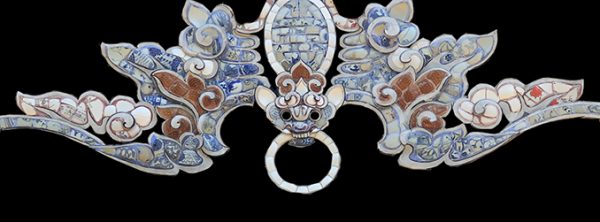
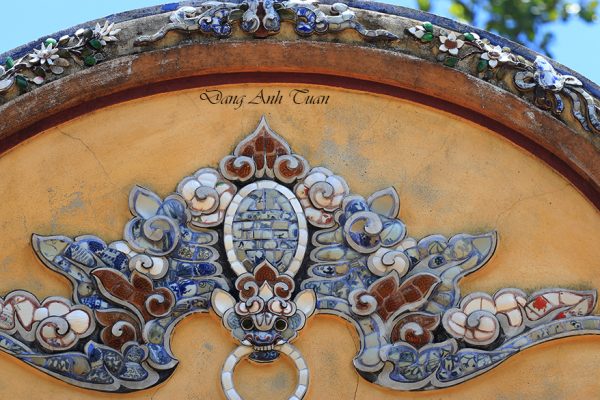
Được biết đến với tên khoa học (Chiroptera), dơi là một loài động vật có nhau thai được đặc đứng  sau các loài gặm nhấm. Đối với người phương Tây, sở thích của dơi  sống trong bóng tối và ban đêm  được xem  là một điềm xấu. Nó còn thuộc các thú vật của Satan mà  Giáo hội chỉ định. Chúng ta thường thấy nó dang rộng hai cánh với  khuôn mặt nhăn nhó trên đỉnh nhà thờ như một người bảo vệ có chức năng xua đuổi tà ma. Đôi khi nó được coi là một con chuột biết bay (thiên thử hay chuột nhà trời) hoặc một con én bay trong đêm (chim nhạn bay đêm, phi thử). Dơi là loài động vật thường được coi là loài vật có tính xảo quyệt và tinh quái trong các truyền thuyết phương Đông.

Trong  tiếng Hán Việt dơi tên là ‘bức(), được  đọc gần giống chữ ‘phúc’ (), từ đó người ta dùng hình ảnh con vật này để chỉ ‘phúc đức’. Khi minh họa bằng hình 5 con dơi thì có hàm ý chỉ ngũ phúc: (1) Phú  nghĩa là giàu, (2) khang ninh 安寧 là yên lành, mạnh khỏe (3) Thọ  là sống lâu (4) hảo đức 好德 là có đức tốt (5) khảo chung mạng 考終命 là hưởng trọn tuổi trời.

Theo  cố cả Léopold Cadière, trong nghệ thuật  Huế, chúng ta thường thấy sự kết hợp của nhiều họa tiết theo nhiều cách khác nhau. Đôi khi chỉ là một sự kết hợp đơn giản: con dơi ẩn núp trong góc sẽ lướt đôi cánh qua những đường cong uốn lượn hồi văn, hoặc những biểu tượng của sự trường thọ và hạnh phúc sẽ được áp dụng cho một cành mận, một bông hoa mẫu đơn vân vân . Những sự kết hợp này không phải do ngẫu nhiên hay ý thích của nghệ sĩ. Thậm chí đối với một số chủ đề nhất định, còn có một quy tắc rất nghiêm ngặt, những liên kết gần như không thể tách rời.

Đây là trường hợp của hình ảnh con dơi với các họa tiết thường có lối chơi chữ. Thường nhất là với chữ ‘phúc’ nhưng cũng có khi đi với chữ ‘khánh’ ( có nghĩa là ‘chúc mừng’) thay cho lời cầu chúc phúc. Khánh lại có thêm âm là ‘khương’ có nghĩa là phúc. Âm khánh lại có chữ viết là , chỉ một món nhạc khí quý trong cung đình, thế là có họa tiết con dơi ngậm chiếc khánh có hai quả tua; hình này có tên ‘phúc khánh’ với ý chúc mừng hưởng phúc an lạc và thịnh vượng.Thay cho khánh ngọc hay chữ thọ, con thấy hình con dơi ngậm một giõ hoa. Giõ hoa là một món trong ‘bát bửu’ nên hàm chỉ sự vui hưởng hạnh phúc (hình CLXXXIV).

Về mặt trang trí con dơi hay có kèm theo hai quả tua, gọi là họa tiết ‘dơi tua’, nhưng hình như hai quả tua đó chẳng mang một ý nghĩa sâu xa nào ngoài sự trang trí. (hình CLXXXI, …) Dơi có thể được biến cách từ lá, họi là lá hóa phúc, từ hoa mai gọi là mai hóa phúc, từ sen gọi là liên hóa phúc, từ quả gọi là quả hóa phúc; nhưng chủ yếu là từ hình hồi văn có tô điểm thêm hia lá gọi là hồi văn hóa phúc. Tùy theo ngẫu hứng người nghệ sĩ còn cho con dơi đi chung với rồng. Một vài chỗ thấy dơi xuất hiện ngay giữa tấm chi tiết của đồ gỗ, nhưng thường thì nằm ở các góc và giang cánh rất trang nhã.

Theo nhà nghiên cứu Nguyễn Hữu Thông,  dơi được xem là mẫu hình được sử dụng nhiều nhất trong mỹ thuật Huế. Nhiều đến mức cảm nhận thấy có sự lạm dụng (tr. 144).

 Nhưng nhờ cấu trúc thân hình với đôi cánh rộng, điều nầy cho phép nó nêu bật vẻ đẹp cân đối mẫu mực và tạo ra nên một hình mẫu hoàn hảo về mặt thiết kế và sống động trong mỹ thuật  Huế.

Étant connu sous le nom scientifique (Chiroptera), la chauve-souris est un animal placentaire  placé derrière les rongeurs. Pour les Occidentaux,  sa préférence de vivre dans les ténèbres et  la nuit est perçue comme un mauvais présage.  Elle fait partie du bestiaire satanique  désigné par l’Eglise. On est habitué à la voir étendre ses deux ailes et son visage grimaçant  au sommet des églises comme le gardien ayant pour fonction de repousser le Mal. Parfois on la considère comme un rat volant (thiên thử hay chuột nhà trời) ou  une hirondelle volant dans la nuit (chim nhạn bay đêm, phi thử). La chauve-souris est l’animal fréquemment considéré dans les légendes orientales comme l’animal ayant le caractère rusé et espiègle.

Étant un nom sino-annamite ‘bức’ (蝠) et se prononçant de la même manière que le mot  ‘phúc’ (), on est convenu à prendre la figure de l’animal pour exprimer le bonheur. C’est pourquoi  la chauve-souris joue un grand rôle dans l’art vietnamien, surtout  dans l’art de Huế car elle est le symbole de bonheur.  On a l’habitude de grouper ensemble cinq chauve-souris (ngũ phúc) pour faire allusion à un bonheur parfait: (1) Phú 富, richesse ; (2) khang ninh 安寧 là yên lành, la paix et la santé ; (3) Thọ 壽 là sống lâu, une longue vie ; (4) hảo đức 好德 là có đức tốt, l’amour de la vertu ;  (5) khảo chung mạng 考終命 là hưởng trọn tuổi trời, une mort naturelle  à un âge avancé.

Selon le prêtre missionnaire Léopold Cadière, dans l’art de Huế, on voit souvent l’association de plusieurs motifs se produire de façons diverses. Tantôt il y a une simple association: la chauve-souris, tapie dans un angle, glissera ses ailes à travers les méandres de la grecque, ou bien les caractères de la longévité et du bonheur  seront appliqués  sur une branche de prunier, sur une fleur de pivoine etc. Ces associations ne sont pas livrées au hasard ou au caprice de l’artiste. Il y a même pour certains sujets, un code très sévère, des alliances quasi indissolubles.

C’est le cas de l’image de la chauve-souris avec un jeu de mots multiple suivant. Au mot phúc « bonheur » est souvent associé  dans le langage ou en littérature, le mot khánh qui a un sens analogue « bonheur et félicitations  résultant d’une faveur reçue » Le mot khánh, à son tour, est également la prononciation du caractère , désignant  un lithophone dans la cour royale. Il s’agit bien de la représentation d’une chauve-souris tenant dans sa gueule un lithophone agrémenté de deux glands.  Ce dessin se lira « phúc khánh », ce qui signifie « bonheur et félicité ».

Au lieu du tam-tam en pierre ou du caractère de la longévité, la chauve-souris tient parfois suspendue à sa bouche une corbeille de fleurs. C’est un des « huit joyaux » ; nous l’avons vu, symbole de jouissances et de bonheur.

Au point de vue décoratif, la chauve-souris est souvent munie de deux longs glands, dơi tua qui n’ont, semble-t-il, aucun sens figuré. Elle peut se transformer en feuille, lá hóa phúc; en fleurs de pruniers, mai hóa phúc; en nénuphar, sen hóa phúc; en fruit  quả hóa phúc; mais surtout en grecque, avec ou sans feuilles,  hồi văn hóa phúc. La fantaisie de l’artiste se donne libre carrière avec elle, autant qu’avec le dragon.  Elle coupe parfois le centre d’un panneau, mais le plus souvent, elle se tapit dans les encoignures, que ses ailes garnissent avec élégance.

Selon le chercheur Nguyễn Hữu Thông, la chauve-souris est considérée comme le modèle le plus employé dans l’art de Huế. On a l’impression d’en abuser. (p144).

Mais grâce à la structure corporelle de la chauve-souris avec de larges ailes, cela lui permet de révéler la beauté de l’équilibre  exemplaire et créer un modèle parfait dans la conception et vivace dans l’art de Huế.


Known by its scientific name (Chiroptera), the bat is a placental animal  ranked behind rodents. For Westerners, its preference for living in darkness and  at night is seen as a bad omen.  It is part of the satanic bestiary  designated by the Church. We are used to seeing them spread their wings and grimace at the top of churches as guardians whose job is to ward off evil. Sometimes they are considered flying rats (thiên thử hay chuột nhà trời) or swallows flying in the night (chim nhạn bay đêm, phi thử). The bat is frequently considered in Eastern legends to be an animal with a cunning and mischievous character.

Being a Sino-Annamite name ‘bức’ (蝠) and pronounced in the same way as the word ‘phúc’ (福), it was agreed to use the figure of the animal to express happiness. This is why the bat plays an important role in Vietnamese art, especially in the art of Huế, as it is a symbol of happiness. It is customary to group five bats (ngũ phúc) together to allude to perfect happiness: (1) Phú 富, wealth; (2) khang ninh 安寧 là yên lành, peace and health; (3) Thọ là sống lâu, long life; (4) hảo đức 好德 là có đức tốt, love of virtue; (5) khảo chung mạng 考終命 là hưởng trọn tuổi trời, a natural death at an advanced age.

According to missionary priest Léopold Cadière, in Huế art, we often see several motifs combined in various ways. Sometimes there is a simple combination: a bat, lurking in a corner, will slide its wings through the meanders of a Greek key pattern, or the characters for longevity and happiness will be applied to a plum branch, a peony flower, etc. These combinations are not left to chance or the whim of the artist. For certain subjects, there is even a very strict code, with almost indissoluble alliances.

This is the case with the image of the bat, which has multiple puns associated with it. The word phúc, meaning “happiness,” is often associated in language and literature with the word khánh , which has a similar meaning: “happiness and congratulations resulting from a favor received.” .“ The word khánh, in turn, is also the pronunciation of the character , referring to a lithophone in the royal court. It is indeed a representation of a bat holding a lithophone decorated with two tassels in its mouth. This drawing can be read as ”phúc khánh,“ which means ”happiness and bliss. »

Instead of the stone tam-tam or the character of longevity, the bat sometimes holds a basket of flowers in its mouth. This is one of the “eight jewels”; as we have seen, it is a symbol of pleasure and happiness.

From a decorative point of view, the bat is often depicted with two long tassels, dơi tua, which seem to have no figurative meaning. It can be transformed into a leaf, lá hóa phúc; into plum blossoms, mai hóa phúc; into a water lily, sen hóa phúc; into fruit, quả hóa phúc; but above all into a Greek key, with or without leaves, hồi văn hóa phúc. The artist’s imagination runs wild with it, as much as with the dragon. It sometimes cuts through the center of a panel, but more often than not, it lurks in the corners, which its wings elegantly adorn.

According to researcher Nguyễn Hữu Thông, the bat is considered the most commonly used motif in Huế art. It seems to be overused. (p144).

But thanks to the bat’s body structure with large wings, it allows him to reveal the beauty of exemplary balance and create a perfect model in design that is enduring in Huế art.


Galerie des photos

Bibliographie:

Léopold Cadière: L’Art à Huế. Nouvelle édition Association des Amis du Vieux Huế.

Nguyễn Hữu Thông: Mỹ Thuật Huế. Nhìn từ góc độ ý nghĩa và biểu tượng trang trí.
                               Nhà Xuất Bản Thế Giới

[Return Art de Huế]

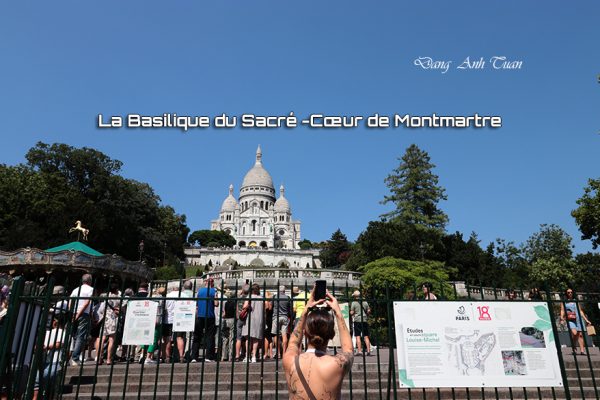
La basilique du Sacré-Cœur de Montmartre


Version française
Version anglaise
Galerie des photos


Được xây dựng từ năm 1875 bởi kiến trúc sư Paul Abadie và kết thúc vào năm 1891, trên đỉnh đồi Montmartre, thể hiện lòng sùng kính đối với  Thánh Tâm Chúa Giêsu và cũng là một lời ước  nguyện   sau khi hoàng đế Napoléon III bại trận ở Sedan vào tháng 9 năm 1870.  Ông Paul Abadie lấy nguồn cảm hứng từ nhà thờ Hagia Sophia ở Constantinople (Thổ Nhi Kỳ)  và San Marco ở Venise (Ý Đại Lợi) mà tạo ra một nhà thờ độc đáo với mái vòm trắng tinh tuyệt vời nhất là nó có phong cách kiến trúc của Roman và Byzantine.  Muốn đến đây, chúng ta có thể đi bằng cáp kéo  hay là đi bộ phải leo 300 bậc thang tương ứng chiều cao của một toà nhà mười tầng lấu. Nơi nầy được chọn vì chúng ta có thể nhìn toàn cảnh thành phố Paris.  Ngoài ra không xa  khu nhà thờ có một  quảng trường (Place du tertre) dành cho các họa sỹ vẽ chân dung  và tranh biếm họa  cho du khách. Nơi nầy lúc nào cũng náo nhiệt  mà cũng là nơi mà du khách đến Paris không thể bỏ qua được.

Édifiée en 1875 par l’architecte Paul Abadie et achevée en 1891, au sommet de la butte Montmartre, la basilique   symbolise non seulement la dévotion au Sacré-Cœur de Jésus mais aussi  un vœu sincère après la défaite militaire de l’empereur Napoléon III à Sedan en 1870. En trouvant son inspiration  dans  l’église  Sainte-Sophie de Constantinople  (Turquie) et  la basilique Saint Marc de Venise (Italie), Paul Abadie a réussi à construire  une église unique, dotée d’un magnifique dôme blanc, dans un style architectural  à la fois roman  et byzantin. Pour pouvoir atteindre cette église, il faut prendre le funiculaire ou marcher à pied avec 300 pas d’escalier à grimper, ce qui correspond à un bâtiment de 10 étages. C’est ici qu’on peut voir la vue panoramique de Paris. Non loin de l’église, la place du Tertre  permettant  aux artistes de réaliser des portraits et des caricatures pour les touristes est toujours animée.  Ce lieu devient un site incontournable pour les touristes étrangers lors de leur passage à Paris.

Built in 1875 by architect Paul Abadie and completed in 1891, atop Montmartre hill, the basilica   symbolizes not only devotion to the Sacred Heart of Jesus but also  a sincere vow made after Emperor Napoleon III‘s military defeat at Sedan in 1870. By finding inspiration in the Hagia Sophia in Constantinople (Turkey) and St. Mark’s Basilica in Venice (Italy), Paul Abadie succeeded in building a unique church with a magnificent white dome in an architectural style that is both Romanesque and Byzantine. To reach this church, you have to take the funicular or walk up 300 steps,  equivalent to that of a 10-storey building. It is here that you can enjoy a panoramic view of Paris. Not far from the church, the Place du Tertre, where artists paint portraits and caricatures for tourists, is always bustling with activity. This place has become a must-see for foreign tourists visiting Paris.

Galerie des photos

SACRE-COEUR

[Return PARIS et ses sites]

Les photos superbes en boir et blanc de Jean Marie Duchange (Bộ hình qúi giá trắng đen)

 sur les Hauts plateaux

dans les années 50