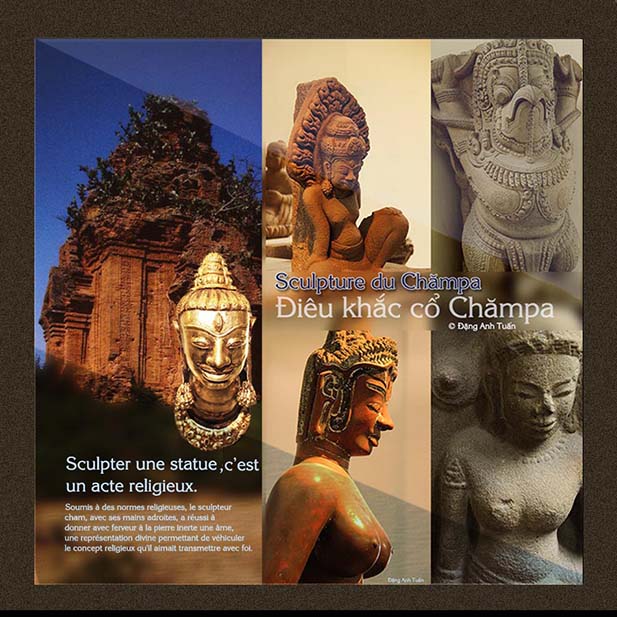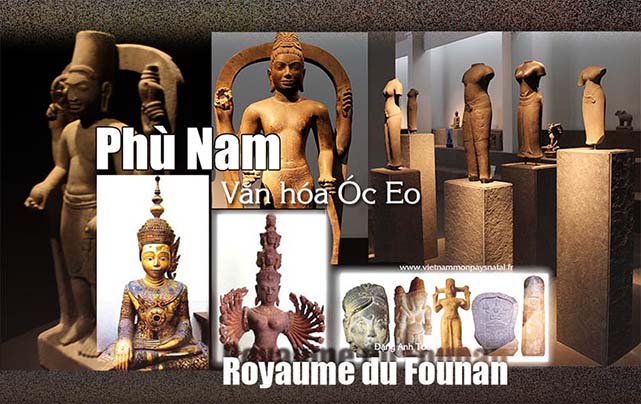
Champa sculpture ( Điêu khắc cổ Champa): Part 1

dieu_khac_champa
Version française
Version vietnamienne

Until today, the exact ethnic origin of the Chams is not known. Some believe that they came from continental Asia and were pushed back along with other populations living in southern China (the Bai Yue) by the Chinese, while others (ethnologists, anthropologists, and linguists) highlighted their island origin through their research work.


Carving a statue is a religious act.


For the latter, the Chams were probably populations from the South Seas (the countries of the archipelagos or those of the Malay Peninsula). Cham oral traditions mentioning connections linking, in legendary times, Champa and Java support this latter hypothesis.
Nicknamed the Vikings of Southeast Asia, the Chams lived along the coasts of central and southern present-day Vietnam. Their main activities were essentially based on trade. They were in contact very early with China and territories as far away as the Malay Peninsula, possibly the coasts of South India.

Being dedicated to religious purposes, Cham sculpture was thus not immune to political repercussions and influences from outside, particularly those from India, Cambodia, and Java. These became the main forces of creation, development, and evolution of styles in their art. According to the French researcher Jean Boisselier, Cham sculpture was closely linked to history. Significant changes were noted in the development of Cham sculpture, especially statuary, with historical events, changes of dynasties, or the relations that Champa had with its neighbors (Vietnam or Cambodia). According to the Vietnamese researcher Ngô Văn Doanh, whenever there was a significant external impact, a new style in Cham sculpture soon appeared.

To illustrate this, it is enough to cite an example: in the 11th-12th centuries, the intensification of violent contacts especially with Vietnam and Cambodia, and the emergence of new concepts related to the foundations of royal power can explain the originality and richness found in the style of Tháp Mắm.

Pictures gallery


Being the expression of the Indian pantheon (Brahmanist but especially Shaivist and Buddhist), Cham sculpture rather resorts to the local interpretation of concepts and norms coming from outside with elegance than to servile imitation. It is above all a support for meditation and a proof of devotion. Sculpting a statue is a religious act. Subject to religious norms, the Cham sculptor, with his skillful hands, succeeded in fervently giving the inert stone a soul, a divine representation allowing the conveyance of the religious concept he wished to transmit with faith. Cham sculpture is peaceful. No scenes of horror are depicted. There are only somewhat fanciful animal creatures (lions, dragons, birds, elephants, etc.). No violent or indecent forms are found in the deities. Despite the evolution of styles over history, Cham sculpture continues to maintain the same divine and animal creatures within a constant theme.


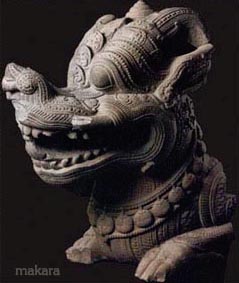
Makara

Cham art has succeeded in maintaining its specificity, its own facial expression, and its particular beauty without it being said that it is a servile copy of external models, thus preserving its uniqueness in Hindu sculpture found in India and Southeast Asia. Despite the lack of animation and realism, Cham works were mostly carved from sandstone and much more rarely from terracotta and other alloys (gold, silver, bronze, etc.).

Generally modest in size, they depict religious beliefs and worldviews. They cannot leave us indifferent because they always give us a strong strange impression. This is one of the characteristics of the beauty of Cham art.

In Cham sculpture, one finds free-standing sculptures (round-bosses), high reliefs, and low reliefs. A free-standing sculpture is one that can be viewed from all sides to see the sculptor’s work. A high relief is a sculpture with a very prominent relief that does not detach from the background. As for the low relief, it is a sculpture with slight projection on a uniform background. In Cham sculpture, there is a tendency to emphasize the roundness of creatures in the reliefs. Few scenes are depicted in this sculpture. There is a noted lack of connection or coherence in the assembly when otherwise.

The creatures found in Cham sculpture tend to always emerge brilliantly from the space surrounding them. They have something monumental about them. Even when they are grouped together in the works of Mỹ Sơn, Trà Kiệu depicting the daily life of the Chams, they give us the impression that each one remains independent from the others.

One can say that the Cham sculptor focuses solely on the creature he wants to show and deify without ever thinking about excessively unrealistic details and imperfections (such as the too-large hand or the overly bent arm of the dancer from Trà Kiệu, for example) and without closely imitating the original Indian models, which gives this Cham sculpture the « monumental » character not found in other sculptures. This is another particularity found in this Cham sculpture.

The works are not numerous but they testify to a beautiful plastic quality and the expression of various religions. It is difficult to attribute them to a single style. On the other hand, some traits close to the tradition of Indian art from Amaravati can be noted. It was only in the second half of the 7th century, under the reign of King Prakasadharma Vikrantavarman I, that Cham sculpture began to take shape and reveal its originality. [Reading more]


Joyaux de la Nation (Bảo vật Quốc Gia)

English version

French version

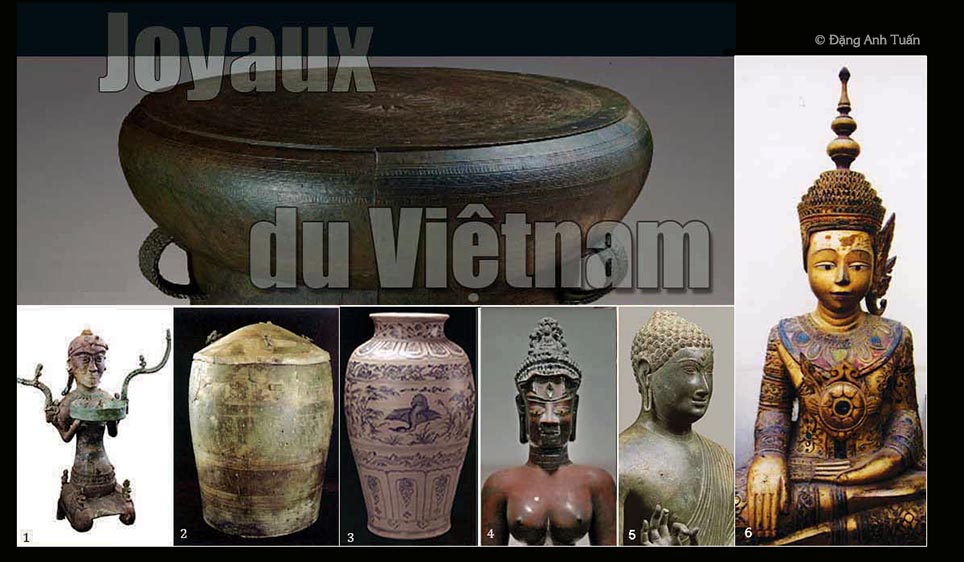
Là mảnh đất của các nền văn minh, Việt Nam sau một thế kỷ khai quật khảo cổ do các nhà khảo cổ người Pháp rồi người Việt tiến hành, đã phát hiện ra rất nhiều hiện vật, trong đó có những hiện vật nổi bật bởi vẻ đẹp vô giá và sự độc đáo hiếm có. Một số mẫu vật trở thành những viên ngọc quý của quốc gia và đại diện cho một trong ba nền văn minh được phát hiện tại Việt Nam. Chúng ta có thể chiêm ngưỡng chúng tại các bảo tàng lịch sử Việt Nam (Hà Nội, Đà Nẵng, Sài Gòn, An Giang). Trong số các hiện vật khai quật được, có thể kể đến trống đồng Ngọc Lũ nổi tiếng, biểu tượng của nền văn hóa Đông Sơn. Tiếp theo là:

1°) Đèn đứng của mộ số 3 tại Lạch Trương, Đồng Sơn, bằng đồng, cao 0,33m. Bảo tàng lịch sử Hà Nội.

2°) Bình đựng nước Đào Thịnh ở Yên Bái, văn hóa Đông Sơn, bằng đồng, cao 81cm. Bảo tàng lịch sử Hà Nội. Chiếc bình này gợi nhắc đến tín ngưỡng thờ phồn thực (Văn hóa phồn thực).

3°) Bình gốm trang trí cảnh quan vẽ màu xanh trắng lấy từ xác tàu đắm ở đảo Cù Lao Chàm (Quảng Nam). Qua hình ảnh thiên nga trên bình, ta thấy được nét tâm hồn Việt Nam. Bảo tàng lịch sử Hà Nội.

4°) Tượng Bồ tát Tara (văn hóa Chăm), bằng đồng khảm vàng, bạc và đá quý bán quý. Cao 1,15m. Phong cách Đông Dương (giữa thế kỷ IX). Bảo tàng Đà Nẵng.

5°) Tượng Phật, Đồng Dương, Quảng Nam (thế kỷ VIII-IX). Đồng thau Cao: 119cm, Rộng: 38cm. Tượng đồng này, đúc bằng phương pháp đúc mất sáp, được tìm thấy gần như nguyên vẹn khi phát hiện. Phong cách của nó vẫn còn bí ẩn. Bảo tàng Lịch sử (Saïgon).

6°) Tượng Phật ngồi trong tư thế chạm đất chứng minh (bắt ấn địa xúc) (bhūmisparśa-mudrā). Văn hóa Óc Eo. Bảo tàng An Giang.

Etant la terre des civilisations, le Vietnam recèle au bout d’un siècle de fouilles archéologiques entamées d’abord par les archéologues français puis par ceux du Vietnam, un grand nombre de trouvailles dont certaines se distinguent par leur beauté incommensurable et par leur originalité exceptionnelle. Certains spécimens deviennent les joyaux de la nation et représentent l’une des trois civilisations découvertes au Vietnam. On peut les admirer dans les musées de l’histoire du Vietnam (Hanoï, Đà Nẵng, Saïgon, An Giang). Parmi ces objets exhumés, on peut citer le célèbre tambour de bronze Ngọc Lũ, symbole de la civilisation dongsonienne. Il est suivi ensuite par

1°) Le lampadaire de la tombe n°3 de Lạch Trương, Đồng Sơn, Bronze, Hauteur: 0,33m. Musée de l’histoire de Hànội

2°) La situle Đào Thịnh de Yên Bái, Đồng Sơn, Bronze, Hauteur: 81cm. Musée de l’histoire de  Hanoï. Cette situle évoque le culte de la fertilité. (Văn hóa phồn thực)

3°) Le vase en céramique (gốm) à décor de paysage peint en couleur « bleu et blanc » provenant de l’épave de l’île Cù Lao Chàm (Quảng Nam). On y trouve à travers le motif du cygne les traits de l’âme vietnamienne. Musée de l’histoire de Hànội.

4°) La statue de la bodhisattva Tara (culture chame), bronze incrusté d’or, d’argent et de pierres semi-précieuses. Hauteur: 1,15m. Style Đông Dương (Milieu du du IXème siècle). Musée de Đà Nẵng.

5°) Statue de bouddha, Đồng Dương, Quảng Nam (VIIIème-IXème siècle) . Bronze H:119cm, L:38cm. Cette statue en bronze, fondue à cire perdue a été retrouvée presque intacte au moment de sa découverte. Son style reste énigmatique. Musée de l’histoire (Saigon).

 6°) La statue du Bouddha assis dans la position de la prise de la terre à témoin (bắt ấn địa xúc) (bhūmisparśa-mudrā). Civilisation Óc Eo. Musée de An Giang.

Galerie des photos

Bảo vật Quốc Gia

English version

During a century of archaeological excavations initially started  by French archaeologists and then by those of Vietnam, the land of civizilations Vietnam holds   a large number of archeological finds, some of which are distinguished by their incommensurable beauty and their  exceptional originality. Some specimens become the jewels of the nation and represent one of the three civilizations discovered in Vietnam. One can admire them in the history museums of Vietnam (Hanoï, Đà Nẵng, Sàigon, An Giang). Among these objects exhumed, one can cite the famous bronze drum Ngọc Lũ, symbol of Đồng Sơn civilization. It is followed by

1°) The floor lamp found in the tomb n°3 of Lạch Trương, Đồng Sơn, Bronze, Heigth: 0,33m. Museum of Hanoï

2°) The situla Đào Thịnh of Yên Bái, Đồng Sơn, Bronze, Heigth: 81cm. Museum of Hanoï. This situla evoke the cult of fertility. (Văn hóa phồn thực)

3°) The ceramic vase (gốm) with an attractive decoration of landscape painted in color « blue and white » . It was retrieved from the wreck of Cù Lao Chàm island (Quảng Nam). Thanks to the  swan motif, one discovers the traits of Vietnamese soul. History museum of Hanoï.

4°) The statue of  Tara bodhisattva (Cham culture), in bronze overlaid with or, silver and semi-precious stones. Heigth: 1,15m. Đông Dương style (Middle of 9th century). Museum of Đà Nẵng.

5°) Buddha statue, Đồng Dương, Quảng Nam (8th-9th century) . Bronze H:119cm, L:38cm. This bronze statue in molten wax was found almost intact at the discovery  time. Its style remains enigmatic. History museum of Saigon.

6°) The statue of Buddha making the mudra of taking the earth as witness with the right hand (bắt ấn địa xúc) (bhūmisparśa-mudrā) . Óc Eo civilization. Museum of An Giang.

[RETURN]

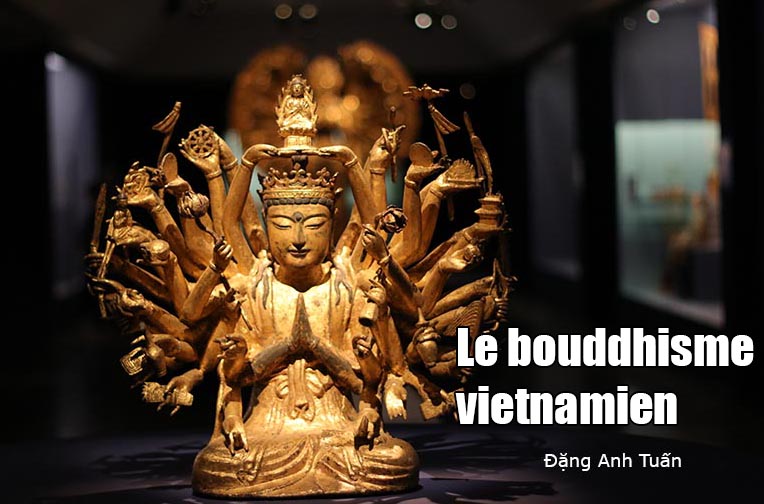
Vietnamese buddhism (Phật giáo Vietnam)

French version

Vietnamese version

The exact date of the introduction of Buddhism to Vietnam is not known. According to the Vietnamese scholar Phan Lạc Tuyên, Indian monks came to Vietnam at the beginning of the Christian era based on the story of Chu Đồng Tử, who was initiated into Buddhism during his encounter with an Indian monk. This was also the period of the Three Kingdoms (Tam Quốc) when Vietnam was a Chinese province called Jiaozhi (Giao Châu) under the governance of Shi Xie (Sĩ Nhiếp). At that time, Vietnam belonged to the kingdom of Wu (Đông Ngô) led by Sun Quan (Tôn Quyền), whose mother, a fervent disciple, brought monks from Luy Lâu to Jianye (the capital of the kingdom of Wu), which corresponds to the current city of Nanjing (Nam Kinh), to ask them to preach and comment on Buddhist sutras.

The Buddhist center Luy Lâu became so prestigious and important that it soon attracted many famous Indian or foreign monks such as Ksudra (Khâu Đà Là), Mahajivaca (Ma Ha Kỳ Vực), Kang-Sen-Houci (Khương Tăng Hội), Dan Tian (Đàm Thiên). Being the senior monk of the Sui dynasty, the latter, upon his return to China, had the opportunity to report to Emperor Sui Wendi (Tùy Văn Đế) on the development of Vietnamese Buddhism: the province of Giao Châu had adopted Buddhism before us because, in addition to the construction of 20 pagodas, it had more than 500 monks and 15 collections of translated sutras.

This undeniably proves that Buddhism was flourishing at that time in Vietnam. It is important to recall that in the Chinese annals, there is mention of the pillaging by the Chinese army under General Lieou Fang (Lưu Phương) of the Sui dynasty (nhà Tùy). This general devastated the capital of Champa, Điển Xung (Kandapurpura), under the reign of King Sambhuvarman (Phạm Phạn Chí in Vietnamese) and took with him 1,350 Buddhist texts compiled in 564 volumes. Champa very early on promoted the establishment of Buddhism, as it was already mentioned by the famous monk Yijing (Nghĩa Tịnh) upon his return from his maritime journey in the Insulinde as one of the Southeast Asian countries that held the Buddha’s doctrine in high esteem at the end of the 7th century under the reign of Wu Ze Tian (Vũ Tắc Thiên) of the Tang dynasty (Nhà Đường).

Although Vietnam was a Chinese protectorate (from 111 BC to 931 AD), it was nevertheless the true relay between China and India. The establishment of Buddhism was very early in this country at the beginning of the Christian era because Vietnam was not only next to countries using Sanskrit for Buddhist texts such as Founan (Phù Nam) and Champa but also the mandatory passage point for Indian merchants. They needed to rest, replenish food supplies, and exchange goods (silk, spices, eaglewood, cinnamon, pepper, ivory, etc.).

At that time, India had established trade relations directly with the Middle East and indirectly with Mediterranean countries such as the Roman Empire. Mahayana Buddhism flourished in India with the centers of Amaravati and Nagarjunakonda in the coastal region of southeastern India (Andhra Pradesh). This encouraged Indian monks to accompany sailors along the coasts of Malaysia, Funan, and Vietnam with the intention of spreading the faith. That is why it can be said that Vietnamese Buddhism came directly from India with Indian monks, but in no way was it brought by the Chinese.

Vietnamese Buddhism, whose current is Mahayana, takes more into account collective salvation than individual salvation, whereas Theravada Buddhism considers salvation as the result of efforts made by the individual to achieve enlightenment and become a bodhisattva. At the beginning of its establishment, Buddhism encountered no resistance from the Vietnamese because it easily accepted their traditional paganism. It only had some simple and modest religious activities such as the veneration of the Buddha, offerings, acts of mercy, etc. Buddha was none other than Quán Thế Âm (Avalokitesvara) and Nhiên Đăng (Dipankara) because these figures protected sailors during sea voyages. The first Vietnamese Buddhist legends, Thích Quang Phật and Man Nương Phật Mẫu, also appeared at this time with the arrival of the monk Ksudra, also known as Kalacarya (the Black Master), in Vietnam.

It is through these legends that Man Nương, upon her death, became an object of worship under the name « Mother Buddha or Phật Mẫu » by the Vietnamese. These legends thus testify to the ease of integrating popular beliefs into Buddhism. Furthermore, this religion, imported early on, was under Indian influence which, according to researcher Hà Văn Tấn, lasted until the 5th century.

The Chinese governor Sĩ Nhiếp (177-266) was often accompanied in the city by religious figures coming from India (người Hồ) or Central Asia (Trung Á) on each outing. The number of foreign monks was so significant that Giao Châu became a few years later the center for translating sutras, among which was the famous Saddharmasamadhi sutra (Pháp Hoa Tam Muội) translated by the monk Chi Cương Lương Tiếp (Kalasivi) in the course of the 3rd century.

It is also important to note that in a short period of six years (542-547), King Lý Nam Đế (Lý Bí) of the early Lý dynasty succeeded in freeing Vietnam from Chinese domination and ordered the construction of the Khai Quốc pagoda (Foundation of the Nation), which today is the famous Trấn Quốc pagoda in Hanoi. According to the Zen monk Thích Nhất Hạnh, it was mistakenly believed in the past that the Indian monk Vinitaruci introduced Vietnamese dhyana Buddhism (Thiền) at the end of the 6th century. During his stay in Lũy Lâu in the year 580, he resided in the Pháp Vân monastery belonging to the dhyana school. It was also at this time that the dhyana monk Quán Duyên was teaching dhyana there. Other Vietnamese monks had gone to China to teach dhyana before the arrival of the famous monk Bodhidharma, recognized as the patriarch of the Chinese dhyana school and the patriarch of Kungfu.From now on, it is known that it was the monk Kang-Sen-Houci of Sogdian origin (Khương Tăng Hội), instead of Vinitaruci (Ti Ni Lưu Đà Chi), who deserves the credit for introducing dhyana Buddhism to Vietnam.

Vietnamese Buddhism began to flourish and reach its golden age when Vietnam succeeded in regaining independence under General Ngô Quyền. Under the Đinh, Early Lê, Lý, and Trần dynasties, Buddhism was recognized as the state religion.

[Buddhism under the Đinh, Tiền Lê, Lý, and Trần dynasties]

[Return RELIGION]

Funan kingdom (Vương quốc Phù Nam)

founan

Funan kingdom

Vietnamese version
French version

Until the dawn of the 20th century, the information was received about this old Hinduized kingdom in some Chinese texts. It was mentioned during the Three Warring States period of Chinese history (Tam Quốc )(220-265) in Chinese writings since the establisment of diplomatic relations between  the Wu state (Đông Ngô) and foreign countries. In this report, it is noted that the governor of Guandong and Tonkin provinces, Lu-Tai sent representatives (congshi) in the south of his kingdom. The kings, beyond the borders of his kingdom (Funan, LinYi (future Chămpa) and Tang Ming (country identified in the northern Tchenla at the time of Tang dynasty) sent each other an ambassador to pay him their tribute. Then Funan was also quoted in the dynastic annals from the Tsin dynasty (nhà Tấn) until the Tang dynasty (Nhà Ðường).

Even the name of Funan is the phonetic transcription of the old khmer word bhnam (mountain) in Chinese characters. It still gives rise to reservations and reluctances in the interpretation of Funan by « mountain » for some experts. These one find the justification of the name « Funan » in the best sense of « hillock » because, until quite recently, in the ethnographical studies [Martin 1991; Porée-Maspero 1962-69] , the Khmer were used to practising ceremonies around the artificial hillocks. Being affected by this custom that they did not know, the Chinese have made reference to this mode of practice for designating this kingdom. Thanks to archaeological excavations which took place in 1944 at Óc Eo with French Louis Malleret in An Giang province located into the south of present-day Vietnam, the existence and prosperity of this Indianised kingdom have not been in doubt. The results of these excavations had been written in his doctoral thesis, then published in an entitled work « Archaeology of the Mekong delta » representing 6 volumes.

This allows to confirm the Chinese informations and to make them a little more precise in the confinement and localization of this kingdom. Because of the abundance of  tin archaeological finds, French archaeologist Louis Malleret did not hesitate to borrow the name Óc Eo for designating this tin civilization. We begin to have now a deep light on this kingdom as well as its external relations during the resumption of excavations undertaken both by Vietnamese teams (Đào Linh Côn, Võ Sĩ Khải, Lê Xuân Diêm) and French-Vietnamese team led by Pierre-Yves Manguin between 1998 and 2002 in An Giang, Ðồng Tháp and Long An provinces where a large number of sites of Óc Eo culture are located.

We know that Óc Eo was a major port of this kingdom and was a transit hub in trade exhanges between the Malaysian peninsula and India on one hand and between the Mekong and China on other one. As the boats of the region could not cover long distances and had to follow the coast, Óc Eo thus became a mandatory stop and a important strategic step during the 7 centuries of blooming and prosperity for Funan kingdom.
Óc Eo civilization

No Images found.

Pictures gallery 

This one occupied a quadrangle included between the gulf of Thailand and Transbassac (western plains of Mekong delta or miền tây in Vietnamese) in the South of Vietnam. It was bounded in the northwest by the Cambodian border and in the southeast by Trà Vinh and Sóc Trăng cities. Aerial photos taken by the French people in the 1920s revealed that Funan was a maritime empire (or a thalassocracy).

The Chinese authors tell us that immense city states, encircled by successive lines of earthen ramparts and ditches formely filled by crocodiles, were divided into districts by the ramification of canals and arteries. We can imagine houses and stores on piles, bordered by ships as in Venice or in the Hanseatic cities. We discover in this surprising network constituted by stars of rectilinear canals arranged according to the northeast / southwest frame (from Bassac towards the sea) and all communicating with each other, its important role for evacuating Bassac floodwaters towards the sea. This allows to wash the soil with alum, repulse headways of brackish water during Bassac floods, favor the floating rice, ensure especially the provisioning inside the kingdom by cargoes of coastal navigation coming from China, Malaysia, India and even from Mediterranean circumference.

The discovery of gold coins bearing Antonin le Pieux (in 152 A.D.) or Marc Aurèle‘s effigies and low-reliefs carvings of Persian kings testifies to the important role of this kingdom in trade exchanges at the beginning of the Christian era. There is even a grand canal allowing to connect the port city Óc Eo on one hand with the sea and on the other hand with the Mekong and the ancient city of Angkor Borei, located 90 km upstream in the Cambodian territory. This one would be presumably the capital of Funan in its decline.

For French archaeologist Georges Coedès, there is no question that the Angkor Borei site corresponds exactly to that of Na-fou-na, described in Chinese texts as the city where kings of Funan wildrew after their eviction from the ancient capital of Funan, Tö-mu, identified as the city Vyàdhapura located in the Bà Phnom region of the Cambodian territory by Georges Coedès [BEFEO, XXVIII, p. 127]. The wealth of this archeological site and the variety of archeological remains originating from it, confirm his affirmation.

Thanks to archeological finds that have been recovered during all series of excavations on the complex of Óc Eo sites, we can say that this kingdom knew three important periods during its existence:

The first period which extends from the 1st to about 3th century, distinguishes itself by terra-cottas (ceramic potteries, bricks, tiles), glassware (pearls and necklaces), silverware (rings, earrings), stones sculptures (seals, signet rings, cabochons), copper, iron, bronze and especially tin objects.

We attend the first human activity on hillocks in the Óc Eo plain and on low slopes of Ba Thê mountain. The habitat is on piles and wood. The common jar grave in the South-East Asia is still practised. The process of the Indianisation is not yet started by the absence of statuaries and religious relics. But there is, all the same, a regular contact between this kingdom and India.

The commercial exchange is strengthened by local alliances and Indian teachers arrival. These one, retained longer for their stays in this kingdom because of the season of monsoons, continued to practise their religions (Brahmanism, Buddhism). They began to make emulators among the natives and to help the latter in the implementation of a hydraulic network allowing to drain the flooded plain, until now, hostile and to make it « useful » for the habitat, cultivation and development of their kingdom. The Indians were known to realize advisedly the works of agricultural hydraulics and cultivation. It is what we have seen in the country of the Tamils during the Pallava period for example.

The floating rice cultivation is attested by the traces of use of this graminaceous plant as degreasing agent for pottery. For French researcher of CNRS, J.N. Népote, specialist of the Indo-Chinese peninsula, Funan kingdom received most of its revenues from the agricultural sector in the technique of floating rice.

It was not necessary to cultivate the soil nor to sow and even less to plant rice seedlings in this time when the coastal fringe of Funan was an flooded zone of polders. The rice grew alone at the same time as the water level, this one being able to reach three metres in height. The rice was later harvested by boats. For the floating rice, the only constraint to be required was the distribution and regulation of floods by the digging of canals in order to be better able to manage the irrigation water and facilitate the means of communication.

The second period of the Funan history (4th- 7th centuries) is marked by the discovery of a large number of Vishnouist and Buddhist religious monuments on the hillocks of Oc Eo plain and on the slopes of Mount Ba Thê. The emblematic figures of the Indian pantheon (Shiva, Vishnu, Brahma, Nanin, Ganesha and Buddha) were exposed. It is also the period when the piled wooden housing moves from hillocks towards flooded plain and low slopes of Ba Thê mountain.

The indianisation of the kingdom was underway when we saw around 357 an Indian of Chinese name Tchou Tchan-t’an, being perhaps of Scythian origin and Kanishka descent, to reign in Funan kingdom [Founan: Paul Pelliot, p 269], which could explain the success of the Surya cult and its iconography in the Funan art. Another Brahman of Chinese name (Kiao-Tchen-Jou) (or Kaundinga-Jayavarma) will succeed him and will reign in Funan kingdom between 478 and 514. It is the period quite known thanks to local inscriptions in sanskrit.

Even the myth of the kingdom’s foundation comes from India: a Brahman named Kaundinya, guided by a dream, get a magic bow in a temple and navigates towards these banks where he manages to beat the girl named Soma of the native sovereign presented as Naga king (a fabulous snake) then he marries her to govern this country. We can say that during this period, the Funan kingdom knew its peak and maintained close relations with China.

The magnitude of its trade was indisputable by the discovery of a large number of objects other than that of India found on Funan banks: fragments of bronze mirrors dating from the Han anterior period, Buddhist bronze statuettes attributed to Wei dynasty, a group of purely Roman objects, statuettes of Hellenistic style in particular a bronze representation of Poseidon. These objects were probably exchanged for goods because Funan people only knew the barter. For the purchase of valuable products, they used golden and silver ingots, pearls and perfumes. They were known as excellent jewelers. The gold was finely worked with numerous Brahmanic symbols. Jewels (golden earrings with the delicate clasp, admirable golden filigrees, glass pearls, intaglios etc.) exposed in the museums of Đồng Tháp, Long An and An Giang testifies not only of their know-how and their talent but also the admiration of the Chinese in their narratives during their contact with Funan people.

The last period corresponds to the decline and end of Funan kingdom. A important change was indicated during period tcheng-kouan (627-649) to Funan kingdom in the Chinese annals. The kingdom of Tchen-la (Chân Lập) (future Cambodia) situated in the southwest of Lin Yi ( future Champa) and country vassal of Funan took over the latter and subjugated it. This fact was not only reported in the new history of Tang (618-907) of Chinese historian Ouyang Xiu but also on a new inscription of Sambor-Prei Kuk in which king of Tchen La, Içanavarman was congratulated for having increased the territory of his parents. One thus bear witness to the abandonment of habitat and religious sites in the plain Óc Eo because the centre of gravity of the new political formation coming from the North leaves the coast to gradually approach the site of the future capital of Khmer empire, Angkor.

For French researcher J. Népote, the Khmers come from the North by Laos appear as Germanic bands against the Roman empire, try to establish inside lands a unitarian kingdom under the name of Chen La. They have no interest to keep the technique of the floating rice because they live far from the coast. They try to combine their own mastery of water storage with the contributions of Indian hydraulic science (barays) to finalize through multiple experimentations an irrigation better adjusted to the hinterland ecology and local varieties of irrigated rice.

In spite of the recent discoveries confirming the existence of this kingdom, many questions have remained unanswered. We do not know who were the indigenous people populating this kingdom. One thing is for sure: they were not Vietnamese who had arrived only in the Mekong delta in the 17th century. Were they ancestors of the Khmers? Some had this conviction when Louis Malleret began excavations in the 1940s because the toponymy of the region was totally Khmer. At the time of Funan, it was yet not clear what this is. However, thanks to the study of osseous remains of Cent-Rues (in the peninsula of Cà Mau), we are dealing with a population very close to Indonesians (or Austro-Asiatic ) (Nam Á).

A Mon-Khmer contribution in the North of this kingdom can be possible to give to Funan the juxtaposition and the fusion of two strata which are not far away from each other before becoming the race of Funan people. In this hypothesis frequently accepted, the Funan people were the proto-Khmers or the cousins of the Khmers. The absorption of a city of Malaysian peninsula (known under the name Dunsun in the Chinese sources reporting this fact ) in the 3th century by Funan in an area where the Mon-Khmer influence is undeniable, is one of the determining elements in favour of this hypothesis.

In what conditions did Óc Eo disappear? Nevertheless Óc Eo played an economic role in commercial exchanges during seven first ones centuries of the Christian era. The archaeologists continue to look for the causes of the disappearance of this port city: flood, fire, deluge, epidemic etc. …

Is the Funan kingdom a state unified with a strong central power or is it a federation of centers of urbanized and sufficiently autonomous political power on the Indo-Chinese peninsula as on the Malaysian peninsula so that we qualify them as city-states?

P.Y.Manguin has already raised this question during a colloquium organized by Copenhagen Polis centers on the city-states of the coastal South-East Asia in December, 1998. Where is its capital if the central power is strongly emphasized many times by the Chinese in their texts? Angkor Borei, Bà Phnom are they really the former capitals of this kingdom like that has been identified by French Georges Coèdes?

For the moment, what has been found does not bring answers but it only redoubles the envy and desire of archaeologists to find them in the coming years because they know that they have the feeling of dealing with brilliant civilization of the Mekong delta.


Bibliography references

Georges Coedès: Quelques précisions sur la fin du Founan, BEFEO Tome 43, 1943, pp1-8
Bernard Philippe Groslier: Indochine, Editions Albin Michel, Paris 
Lê Xuân Diêm, Ðào Linh Côn,Võ Sĩ Khai: Văn Hoá Oc eo , những khám phá mới (La culture de Óc Eo: Quelques découvertes récentes) , Hànôi: Viện Khoa Học Xã Hội, Hô Chí Minh Ville,1995 
Manguin,P.Y: Les Cités-Etats de l’Asie du Sud-Est Côtière. De l’ancienneté et la permanence des formes urbaines. 
Nepote J., Guillaume X.: Vietnam, Guides Olizane 
Pierre Rossion: le delta du Mékong, berceau de l’art khmer, Archeologia, 2005, no422, pp. 56-65.

The Hmong (English version)

dantoc_hmong

French version
Vietnamese  version

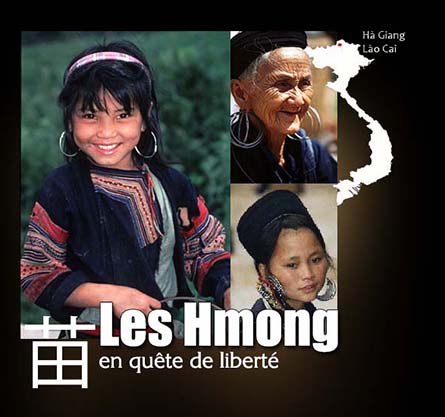
The Hmong are divided into local  sub-groups: the Green Hmong, the Red Hmong, the variegated Hmong, the Black Hmong and the Na Mieo.

The Hmong (The Miao or Miêu in vietnamese) actually  living in Vietnam are  descendants of emigrants from South China. Around the end of 18th century and the beginning of 19th century, the Hmong emigrated to Indochina peninsula (Laos, Vietnam and Thaïland)  and settled  away from plains already occupied by  majority ethnic group  in mountainous areas of Hà Giang and Lào Cai provinces.

Their migration story was closely related to the insubordination to the Chinese culture and the policy of asssimilation practiced by northerners. According to mythic tales passed down from generation to generation, their ancestors lived in snow and  ice covered regions where the night lasted almost 6 months. That is why, being accustomed to living in tropical regions and not having the opportunity to see the snow, the Hmong use terms such as « nước cứng » (or solid water) and « cát trắng mịnh » (or fine white sand) to designate respectively the ice and the snow. According to historians, their origin would be in Siberia (Tây Bá Lợi Á) and in vast plateaus of Mongolia. Some Caucasian proeminent traits are detected among the Hmong today. Others preferably opt for Tibet because shamanic rituals.  One has speculations more than certainties about the accuracy of the Hmong geographic origin. In the Chinese writings, the Hmong were designated under the Miao name including initially all the  ethnic peoples non han living in South West China. Today,  this name is reserved to the population group specifically identified and distinct gathering together the Hmong living in Indochina peninsula and  the Miao ethnic minority populations  (The Hmong, the Hmou, the Qoxiong and the Hmau)  closely related at the linguistic and cultural level in China.

Originally related to the drawing of  rice field (Điền) above which is added the pictogram Thảo” (cỏ) (herb)(key 140), the Chinese character Miao (or Miêu in vietnamese) clearly shows the way that the Chinese adopt  to call  the people knowing  the rice cultivation with their language. Being initially rice farmers, the Miao  had  the sedentary lifestyle in plains. As the Miao were chased by successive waves of the Chinese who dispossessed them of their  arable land and their rice field, they were forced to become highlanders  and stayed until today. Being rushed to high altitudes in inaccessible and hostile mountain areas, they were forced to adapt themselves to each environment where they looked  for an agricultural model allowing them to practice the rice cultivation (rice terraces). In spite of that, the Chinese had the habit of traiting them as the barbarians. The Chinese have gone as far as making a distinction between the shu Miao ( or the  cooked Hmong) and the sheng Miao (the uncooked Hmong), that means the assimilated  Hmong  and the  diehard Hmong  on the margins of Chinese civilization.  They  had the task of transforming these sheng Miao into shu Miao.  Myths and facts are not miss to enrich the history of the Miao (or the Hmong).  The latter is punctuated by endless conflicts with the Chinese since time immemorial. This long history of resistance to oppression gives them a particular reputation: they cannot be assimilated and very belligerent.

A people in search of freedom

femmes_hmong

The Miao ( or the Hmong ) lived together with Hsia(1) tribes since prehistoric times in the middle of Yellow River  Basin (Honan or Hà Nam in vietnamese).  Being associated with Chi You ( Suy Vưu ), they engaged the first confrontation leading to failure with the death of the latter at Zhuolu (Trác Lộc) in Heibei province (Hồ Bắc) (approximatively 2690 before J.C.).They were  henceforth  repelled by Yellow emperor Huang Yuan (Hiên Viên) and Yu the Great (Ðại Vũ) in the Bai Yue territory at  the Yang Tsé Basin River. Other conflicts were evoked with Miao groups in Chinese historical writings  of Shan and Zhou dynasties (1121 – 256 before J.C.). In the middle course of Yang Tsé River (Dương Tữ Giang), they exercised  significant influence over the political and social life of the Chu kingdom (Sỡ Quốc). The latter was considered as one of three principalities fighting among themselves for supremacy  during the Warring States period (Thời Chiến Quốc)In addition to the soul recalling, we noted the close ties between the  Chu culture and the Miao on the various cultural  traits (lifestyle, habitat, language etc…)(2). They constituted probably the force majeure in the Chu population with the Luo Yue (the Proto-Vietnamese) and the ancestors of Thaï today (The Si Ngeou or Tây Âu).  This force majeure became the first bulwark of Yue and Miao tribes in the committed fight against the Chinese.
img_8504

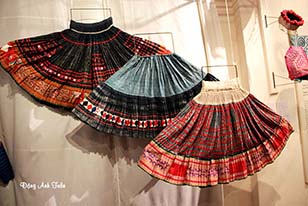
Being in hemp, silk or cotton, the  Hmong pleated skirt whose decoration is own to every group, requires more than 20 meters for the length of the fabric. The method of pleating is one of the characteristics of Hmong women skirt.

Les Hmong

No Images found.

The  Hmong 

After the disappearance of this kingdom, the Miao continuated to be repelled in Guizhou (Quí Châu), Sichuan and Yunnan mountains.  Other military conflicts had emerged with Miao groups in the era of the first dynasty of the Han (140 – 87  before  J.C.) and during Five Dynasties (140 – 87 before  J.C.).  The Miao name was forgotten temporarily in Chinese writings until the establishment of Chinese suzerainty on these provinces by the Yuan ( or the Mongols of China). Then it was regularly mentionned again under the Ming dynasty. Because the Chinese strong demographic growth  ( from 100 millions to 450 millions between  13th and 18th centuries), the Chinese of the Ming dynasty continued to deprive the Hmong of their plateaus and their rice fields, which caused simultaneously the exodus and the fight engaged by the Hmong in the defense of their land. Some Hmong took up arms.  Other preferred to seek refuge in Indochina pensula, in particular in Vietnam by three  successive waves of which the most important was maked by  the  Taiping mystical insurrection   known under the name of Tai Ping Tian Guo (Thái Bình Thiên Quốc)  against the Qing  (from  1840 to 1868). The Hmong thus became a minority ethnic group of Vietnam since three centuries.


(1): There is the ancient name given to the Chinese.
(2): First  symposium on the history of  Chu kingdom (Jingzhu, Hubei, december 1981).

[Retour Viet et 54 minorités ethniques]


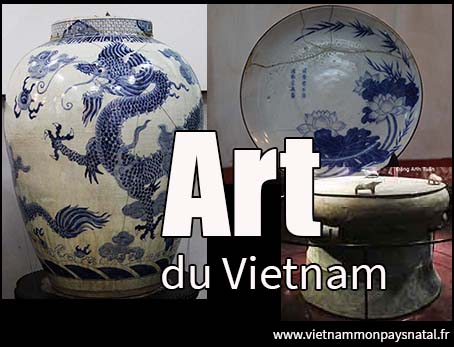
Art vietnamien (Nghệ thuật)

 Photos 


Dương Vân Nga (English version)


French version
Vietnamese version
Pictures gallery

One speaks rarely of Dương Vân Nga in the history of Vietnam. Her name is not as often cited as that of the sisters Trưng Trắc Trưng Nhị or that of Triệu Ẩu. However she was an outstanding woman, the great queen of the first two dynasties Ðinh and Tiền Lê ( anterior Lê ) of Vietnam. Her life and works can be summed up in the following four verses which have been transmitted by oral tradition to our days and left on the wall of Am Tien monastery by a mysterious monk exactly 1000 years now, at his encounter with Dương Vân Nga:

Hai vai gồng gánh hai vua
Hai triều hoàng hậu, tu chùa Am Tiên
Theo chồng đánh Tống bình Chiêm
Có công với nước, vô duyên với đời

On her two shoulders two kings were carried
Queen of two reigns, she retired in Am Tien monastery.
Accompanying her spouse, she had beaten the Song and pacified the Cham
Service she rendered to her country, yet bad luck she got in her life.

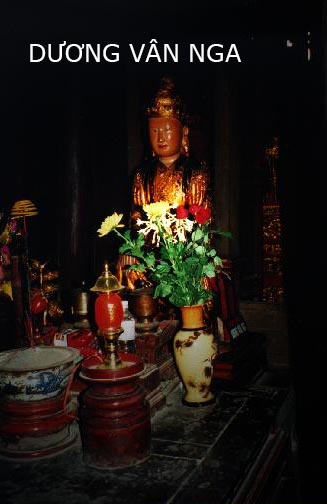
Among the ten queens of these two dynasties, she was the only one to be allowed a statue bearing her effigy. During its restoration and transfer in the temple dedicated to King Lê Ðại Hành at the beginning of the Hậu Lê dynasty the statue oozed strangely, perhaps due to it being exposed suddenly to the sun after having been put in a humid place. At that time, it was said that this phenomenon was attributed to atrocious sufferings life has reserved to Dương Vân Nga during her lifetime.

Dương Vân Nga

Her real name was Dương Thị. Vân Nga was the name attributed to her by combining the first word of the name of the region of her father Vân Long and that of her mother Nga Mỹ. She was issue of a very poor background. At her very young age she had to collect wood in the forest and fish in the river to provide to the subsistence of her family in a mountainous and uneven region which is our Hoa Lư. Early morning in the forest, late evening in the river, she became without delay a young hard working, energetic and trouble shooting girl.

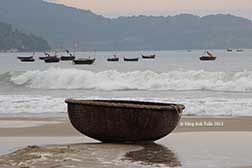
She had an innate sense of organization that allowed her to become in the following years the leader of a band of young girls in the area. She arrived at coping with a rival band constituted mainly of young boys led by the buffalo tender Ðinh Bộ Lĩnh by completely disperse his herd of buffaloes by using firecrackers and by her perfect mastery of round floating baskets that helped rapid transport of her troops across swamps and streams. But Ðinh Bộ Linh finally had the last word thanks to his scheme of recourse to poles and light craft of bamboo mat to pierce and immobilize all the round floating baskets of Dương Vân Nga. From then on Ðinh Bộ Lĩnh not only conquered Duong Van Nga’s admiration but also her love. That is why nowadays to evoke conjugal union and predestined love of a couple, it is often referred to the following popular expression: Bamboo mat craft crush round floating baskets ( Thuyền tre đè thuyền thúng )

Thuyền thúng

Thanks to their association, they arrived at gathering under their banner all the young of Hoa Lu and eliminating without delay their opponents in the conquest of power. Thus Ðinh Bộ Lĩnh became the first king of the Ðinh dynasty often known as Ðinh Tiên Hoàng. He was very authoritarian. He used ranks and appointments to buy loyalty of his subordinates. He also used force and cruel and unimaginable punishments to punish his adversaries and those who dared criticize him.

Despite Dương Vân Nga’s advice, he remained unruffled and made several enemies to himself even in his family. Instead of appointing his eldest son Ðinh Liễn, the one who had helped him for several years in his fights for the unification of the country, he chose his youngest son Ðinh Hạng Lang as his crown prince. This provoked Ðinh Liễn’s jealousy and incited him to assassinate his younger brother. Dương Vân Nga was at first witness of the fratricidal fight among her children, then the death of her husband, king Ðinh Tiên Hoàng assassinated by Ðỗ Thích a crank who, after a dream, thought the kingdom should belong to him and the eldest son Ðinh Liễn killed by the rebel troops.

She soon had the pains and sufferings of her daughter, princess Phật Kim, deserted by her husband Ngô Nhật Khánh who, being one of the sons of Ngô Quyền, took refuge in Champa and requested this country to launch a maritime attack against his own land Vietnam in the goal of reconquest of power. Because of the age of her son Ðinh Toàn ( 6 years old ), she had to assume the regency with Lê Hoàn, a generalissimo, head of Vietnamese territories.

But she soon faced the armed resistance of her assassinated husband’s partisans who wanted to eliminate Lê Hoàn at any cost and also the imminent threat of the Song as well as Champa’s. She was placed in front of a dilemma that appeared to be difficult for a woman to overcome alone when she lived in a Confucian era and when Vietnam was just liberated from Chinese domination for about a dozen years. She had the courage to take a decision which appeared doubtful at that time and heavy of harmful consequences for the Dinh dynasty in yielding the throne to Le Hoan and associating with the latter in managing the Ðại Cồ Việt ( ancient Vietnam ).

Pictures gallery of Hoa Lư


This permitted Lê Hoàn to have a massive adhesion of a great part of population and restore not only the confidence but also the unity of the whole people. He thus succeeded in putting down the rebellion, wiping out the Song on the Bạch Ðằng river, starting the Nam Tiến movement ( or descent toward the South ) and restoring peace all over the country. One should place oneself in this troubling political context that Dương Vân Nga experienced in order to see that it was an act well thought out and courageous from the part of a woman who, trained up until then to be submissive to a Confucian yoke, dared accept the dishonor and scorn to assure that our country would not pass under Chinese domination and that Vietnam would not prolong in political chaos.

Her combat appeared to be more arduous than that of the Trưng Trắc Trưng Nhị sisters because it is the matter of not only a struggle against the invaders, but also her own interests, her personal sentiments for the love of this country.
During the reign of Lê Ðại Hành ( or Lê Hoàn ), she ceaselessly advised the latter to practice a politics of magnanimity towards his adversaries, to ban cruel punishments established by Ðinh Tiên Hoàng and to call on talented monks ( Khuông Việt, Ngô Chấn Lưu, Hồng Hiến, Vạn Hạnh ) to the management of the country. Being a warrior by nature, bearing the name of Great Expedition ( Ðại Hành ), he continued to enlarge Vietnam by leading not only a maritime expedition that destroyed the Cham capital Indrapura in presently Central Vietnam in 982 and killed the Cham king Bề Mi Thuế ( Paramec Varavarman ) but also a politics of pacification all over the place in the ethnic minority territories. It was in one of these battles that the last son of Dương Vân Nga and Ðinh Tiên Hoàng, Ðinh Toàn, died assassinated at the place of Lê Hoàn by the Mán. This death was followed by the suicide of her daughter, princess Phật Kim and the death by illness of her son Long Thâu that she had with Lê Ðại Hành. She was taken up by the disappearance of her entourage without complain. She preferred to live her last days in Am Tiên monastery and burry the personal sufferings of a woman facing her destiny.

Is it fair for a patriotic woman like Dương Vân Nga overwhelmed by destiny, not to be cheered and cited like the Trưng Trắc Trưng Nhị sisters in the history of our Vietnam? Is there anything to do with a deliberate omission because of a sacrilege committed by Dương Vân Nga for having married and served two kings in a feudal Confucian society which is ours? One cannot erase the truth of history especially these details, said the Chinese historian Si Ma Qian.

It is time to give back to Dương Vân Nga her notoriety and her place she deserved long time ago in our history pages and make known to future generations the courageous and full of wisdom decision. This one, even though it seemed doubtful and immoral for a Confucian society, was made in the moment where the situation exacted more than ever the cohesion and unity of the whole people facing foreign invasion, but also a man of valor and talent that was our great king Lê Ðại Hành. Without him, the Nam Tiến movement would not have taken place.

Dương Vân Nga-Lê Hoàn (Version française)

Vietnamese version
English version
Galerie des photos

On parle rarement de Dương Vân Nga dans l’histoire du Vietnam. Son nom est moins cité que celui des deux sœurs Trưng Trắc et Trưng Nhị ou Triệu Ẩu. Pourtant c’est une femme hors du commun, la grande reine de deux premières dynasties Ðinh et Lê antérieurs du Vietnam. Sa vie, son œuvre, on peut les résumer à travers les quatre vers suivants  transmis par tradition orale jusqu’à nos jours et  laissés par un moine mystérieux sur le mur du monastère Am Tiên, il y a eu exactement 1000 ans, lors de sa rencontre avec Dương Vân Nga:

Hai vai gồng gánh hai vua
Hai triều hoàng hậu, tu chùa Am Tiên
Theo chồng đánh Tống bình Chiêm
Có công với nước, vô duyên với đời

J’étais née pour épauler les deux rois
Étant la reine de deux dynasties, je me retirais à la fin de ma vie  dans le monastère Am Tiên.
En accompagnant mon époux,  je me battais contre les Song et je pacifiais le Champa
J’avais la gloire dans le pays et la malchance dans la vie.

Parmi les dix reines de ces deux dynasties, elle était la seule à être autorisée à avoir une effigie statuaire. Celle-ci, lors de la restauration et du transfert dans le temple dédié au roi Lê Ðại Hành au début de la dynastie des Lê postérieurs (Hậu Lê) suinta étrangement, probablement par le fait qu’elle avait été exposée subitement au soleil et placée depuis longtemps dans un endroit humide. On attribua, selon l’on-dit, ce phénomène, à cette époque, aux souffrances atroces que la vie avait réservées à Dương Vân Nga, lors de son vivant.

Dương Vân  Nga

Son vrai nom était Dương Thị. Vân Nga était le nom qu’on lui a attribué en associant le premier mot du nom de la région de son père Vân Long et celui de sa mère Nga Mỹ. Pour certains historiens, elle était la fille de Dương Tam Kha, le beau-frère du généralissime Ngô Quyền.  (déjà signalé dans l’article de  Đinh Bộ Lĩnh).  Elle était issue d’un milieu très pauvre. Dès son jeune âge,  elle était obligée de chercher du bois dans la forêt et de se procurer des poissons dans la rivière pour pourvoir à la subsistance de sa famille dans une région montagneuse et accidentée. De bonne heure, le matin dans la forêt, très tard le soir dans la rivière, elle ne tardait pas à devenir une jeune fille.

Thuyền thúng

Elle avait un sens d’organisation inné lui permettant de devenir quelques années plus tard le meneur d’une bande de jeunes filles de sa région. Elle arrivait à tenir tête à une bande rivale constituée essentiellement de jeunes garçons et dirigée par le  jeune bouvier  courageux et intelligent  Ðinh Bộ Lĩnh en désorganisant complètement les troupeaux de buffles de ce dernier par le crépitement  des feux de bois sec   et par la  maîtrise parfaite des paniers ronds flottants, ce qui permettait  de faciliter le transport rapide des troupes à travers les marécages et les cours d’eau. Mais Ðinh Bô. Lĩnh avait quand même le dernier mot grâce à son stratagème de recourir à  des embarcations légères en natte de bambou et à  des perches pour percer et immobiliser enfin tous les paniers ronds flottants de Dương Vân Nga. Dès lors, Ðinh Bộ Lĩnh conquit non seulement l’admiration de Dương Vân Nga mais aussi son amour. C’est pourquoi pour évoquer, de nos jours, l’union conjugale et la dette originelle d’un couple, on se réfère souvent à l’expression populaire suivante: « Les embarcations en natte de bambou écrasent les paniers ronds flottants (Thuyền tre đè thuyền thúng)».

Galerie des photos de Hoa Lư 


Grâce à leur association, ils arrivèrent à réunir sous leur bannière, tous les jeunes de Hoa Lư et ne tardèrent pas à éliminer leurs concurrents dans la conquête du pouvoir. Ðinh Bộ Lĩnh devint ainsi le premier roi de la dynastie des Ðinh connu souvent sous le nom de Ðinh Tiên Hoàng. Il était  très autoritaire. Il se servait des grades et des appointements pour acheter la fidélité de ses subordonnés mais aussi de la force et des châtiments cruels et inimaginables pour punir ses adversaires et ceux qui osaient le critiquer. 

Malgré les conseils de Dương Vân Nga, il continuait à rester imperturbable et se faisait de nombreux ennemis même dans sa famille. Au lieu de nommer son fils aîné, Ðinh Liễn, celui qui l’avait aidé depuis tant d’années dans ses combats pour l’unification du pays, il choisit comme prince héritier son plus jeune fils Ðinh Hạng Lang. Cela provoqua  la jalousie de Ðinh Liễn et incita  à ce dernier à assassiner son petit frère. Dương Vân Nga était d’abord témoin de la lutte fratricide de ses enfants, puis de la mort de son mari Ðinh Tiên Hoàng  et de son fils aîné  Đinh Liễn assassinés par un illuminé Ðỗ Thích qui, après un rêve, crut que le royaume devait lui appartenir.  Cet assassin fut pourchassé durant trois jours avant d’être découvert caché sous le toit d’un bâtiment et condamné à mort ensuite par son premier ministre Nguyễn Bặc. Cette hypothèse n’est pas très convaincante aujourd’hui. Certains historiens comme Phan Duy Kha, Lã Duy Lan, Đinh Công Vĩ ou Lê Văn Siêu  trouvent dans l’assassinat de Đinh Tiên Hoàng et de son fils la main de son généralissime Lê Hoàn avec la complicité de Dương Vân Nga. L’ambition de l’assassin est un peu démesurée et excessive dans la mesure où Đổ Thích ne détient  aucune armée comme Lê Hoàn. Il est le seul personnage à assister à cette tuerie car il est  l’eunuque de l’empereur. Dans le récit historique, il n’y a pas d’autres complices. Il y a le doute dans cette logique. Dương Vân Nga ne tardait  pas à voir les douleurs et les souffrances de sa fille, la princesse Phất Kim délaissée par son mari Ngô Nhật Khánh, qui, étant l’un douze seigneurs locaux soumis et issu de la famille de  Ngô Quyền, se réfugia au Champa et demanda à ce pays de monter une expédition  militaire  contre son propre pays, le Viêt-Nam dans le but de reconquérir le pouvoir convoité. 

Pourquoi  Ngô Xuân Khánh demande t-il de l’aide au Champa contre son propre pays? Pourquoi la Chine des Song prend-t-elle le prétexte pour justifier son intervention au Vietnam?

Il faut rappeler que Đinh Tiên Hoàn réussit à unifier le pays à cette époque car il adopta une politique basée essentiellement sur une combinaison de souplesse et d’alliance  vis à vis des forces rebelles issues de la famille du généralissime Ngô Quyền afin d’avoir l’adhésion du peuple vietnamien dans la conquête  et la légalité du pouvoir mis en place. C’est pourquoi  il consentit à donner sa fille  Phất Kim en mariage à Ngô Xuân Khánh et de prendre la mère et la sœur de ce dernier comme épouse pour lui et son fils aîné Đinh Liễn.  C’est avec la mère de Ngô Xuân Khánh qu’il avait un fils cadet  nommé Đinh Hạng Lang. Pour tenter de plaire à Ngô Xuân Khánh et à sa mère, il choisit Đinh Hạng Lang comme prince héritier à la place de  son fils aîné Đinh Liễn. Cette erreur fatale provoqua la colère de Đinh Liễn et incita ce dernier à  commettre le meurtre de  son jeune frère Đinh Hạng Lang.  Au lieu de condamner à mort  Đinh Liễn, Đinh Tiên Hoàng lui accorda  le pardon. Cela enleva à Ngô Xuân Khánh tout espoir d’usurper un jour  le pouvoir à l’image de Wang Mang (Vương Mãng) à l’époque des Han car il pensait à aider son jeune  demi-frère à gouverner le pays  lors la disparition de Đinh Tiên Hoàng.  C’est pourquoi il décida de  demander l’intervention du Champa pour reprendre le trône convoité. Quant à la Chine, elle trouva une occasion inespérée de reconquérir An Nam car jusqu’alors la Chine des Song reconnut seulement la succession légale en la personne de Đinh Liễn en lui accordant le titre « Nam Việt vương (roi du Sud) ».

A cause du jeune âge de son fils (6 ans) Ðinh Toàn,  Dương Vân Nga devait assumer la régence avec Lê Hoàn, généralissime, chef des territoires vietnamiens.  Elle se heurta aussitôt à la résistance armée des partisans de son mari assassiné qui voulaient éliminer à tout prix Lê Hoàn. Elle dut  faire face non seulement à la menace et l’invasion imminente des Song mais aussi à celle du Champa. Elle était placée devant un dilemme difficile pour une femme de surmonter seule lorsqu’elle vit à l’époque confucianiste et  le Vietnam fut libéré à peine d’une dizaine d’années de la domination chinoise. Elle avait besoin d’être protégée ainsi que son fils Đinh Toàn. Elle avait le courage de prendre une décision  douteuse à cette époque et lourde de conséquences néfastes pour la dynastie des Ðinh en cédant le trône de son fils à Lê Hoàn et en s’associant à ce dernier dans la gestion du Ðại Cồ Việt (ancien Viêt-Nam ). Cela permit à Lê Hoàn d’avoir à cette époque  l’adhésion massive d’une grande partie de la population et de restaurer non seulement la confiance mais aussi l’unité de tout un peuple. Il réussit ainsi à mater la rébellion menée par les anciens compagnons de Đinh Tiên Hoàng (Nguyễn Bặc, Đinh Điền), à anéantir les Song sur le fleuve Bach Ðằng, à entamer le mouvement « Nam Tiến (ou la marche vers le Sud) » et à restaurer la paix sur tout le pays. Il faut se placer dans ce contexte politique troublant qu’a connu Dương Vân Nga pour constater que c’est un acte bien réfléchi et courageux de la part d’une femme exceptionnelle, qui, formée jusque là pour être soumise à un carcan confucianiste, ose accepter le déshonneur et le mépris pour s’assurer que notre pays ne repasserait pas sous la domination chinoise et que le Viêt Nam ne se replongerait pas dans le chaos politique.

Son combat parait plus ardu que celui des sœurs Trưng Trắc et Trưng Nhị car il ne s’agit pas non seulement d’une lutte contre les envahisseurs mais aussi contre ses propres intérêts et ses sentiments personnels.

Durant le règne de Lê Ðại Hành (ou Lê Hoàn), elle ne cessa pas de conseiller à ce dernier de pratiquer une politique de magnanimité envers ses adversaires, à supprimer les châtiments cruels établis par Ðinh Tiên Hoàn et à faire appel à des moines talentueux (Khuông Việt Ngô Chấn Lưu, Hồng Hiến, Vạn Hạnh ) dans la gestion du pays. Étant guerrier de sa nature, portant le nom signifiant Grande Expédition (Ðại Hành), il continua à agrandir le Viêt-Nam en menant non seulement une expédition maritime qui détruisit la capitale chame Indrapura dans le centre du Viêt-Nam actuel en l’an 982 et qui tua le roi du Champa Bề Mi Thuế (Paramec Varavarman) mais aussi une politique de pacification de tous azimuts dans les territoires des minorités ethniques. C’est dans l’un de ces derniers que le dernier fils de Dương Văn Nga et Ðinh Tiên Hoàng, Ðinh Toàn mourut assassiné à la place de Lê Hoàn, par les Mán. Cette mort fut suivie par le suicide de sa fille, la princesse Phất Kim et par le décès de maladie de son fils Long Thâu qu’elle avait eu avec Lê Ðại Hành. Elle fut accablée par la disparition successive de son entourage sans broncher. Elle préféra passer les derniers jours de sa vie dans le monastère Am Tiên et y enfouir les douleurs personnelles d’une femme seule face à son destin.

Est-il juste pour une femme patriote comme Dương Vân Nga accablée par le destin, de ne pas avoir le mérite d’être chérie et citée comme les sœurs Trưng Trắc et Trưng Nhị dans l’histoire de notre Vietnam? S’agit-il d’une omission voulue délibérément à cause d’un sacrilège commis par Dương Vân Nga d’épouser et servir deux rois dans la société féodale et confucéenne qu’est la nôtre? On ne peut pas gommer la vérité de l’histoire en particulier ses détails, ce qu’avait dit l’historien chinois Si Ma Qian.

Il est temps de redonner à Dương Vân Nga la justice  et la place qu’elle mérite depuis si longtemps dans notre page d’histoire et faire connaître aux générations futures cette décision courageuse et empreinte de sagesse. Celle-ci, bien qu’elle paraisse douteuse et immorale pour la société confucéenne, est prise à un  moment où la situation politique exige plus que jamais la cohésion et l’unité de tout un peuple face à l’invasion étrangère et aussi un homme de valeur et de talent qu’est notre grand roi Lê Ðại Hành. Sans celui-ci, le mouvement Nam Tiến ne serait jamais engagé.

Bibliographie

Phan Duy Kha, Lã Duy Lan, Đinh Công Vĩ, Nhìn lại lịch sử, Nhà xuất bản Văn hóa thông tin, 2003.
« Việt Nam văn minh sử » – Lê Văn Siêu, Nhà xuất bản VHTT, 2004.
Hoàng Công Khanh: Hoàng hậu hai triều Dương Vân Nga. Nhà xuất bản văn học 12-1996

Being Vietnamese (Tôi là người Vietnam)

French version

Vietnamese version

Being Vietnamese 

According to the archaeological sources we have today, the Vietnamese are descendants of the Thai-Vietnamese group. Some historians keep on seeing in these Vietnamese, not only Mongol immigrants coming from southern China (the Yue) and resettling in the Red River delta in the course of the centuries that preceded our era, but also carriers of the Chinese civilization that swept away on their passage by a demographic push, all the brilliant civilizations known up until then on the Indochinese peninsula (those of Ðồng Sơn, and later of Champa).

Others think that the Vietnameses are the result of fusion between several people in contact in the basin of the Red River among which it is necessary to quote Hmongs, the Chinese, the Thais and Dongsonese. While basing themself on their legend of water melon taking place at the time of Hung kings and testifying to the coming of strangers of a different race who might have brought the seeds to Vietnam by the maritime way ( 3rd century B.C ) and on the archaeological excavations confirming the existence of the Nan Yue kingdom, the Vietnameses are convinced that they resulted from Yue but with an Indonesian background probably via by the intermediary of the Dongsonese because Ðình (communal house) heightened on piles and where resides the most vivid expression of the Vietnamese soul, resembles indisputably the houses prefigured on the bronze drums of Ðồng Sơn. This conviction seems conclusive because one finds also other astonishing resemblances among Vietnameses as well as Indonesian tribes: chews bétel, tattooing and tooth lacquering.

Apart from some Frenchmen like Henri Oger who was able to discover in the Vietnamese society a millennial civilization rich in traditions and customs, one continues to be open to a hallucinating confusion in considering that the Vietnamese civilization is a tracing of the Chinese civilization. One continues to reproach the Vietnameses for not having a civilization so worthy, intense and rich as the ones found in other peoples in Indochina (Khmer and Cham civilizations) through their temples of Angkor and Mỹ Sơn. It is a regrettable ignorance because to known the richness of the Vietnamese civilization, one needs to be more interested in its history, its literature than its art. 

How can one have a fantastic and original art when one is always in a perpetual struggle with a so rude and pitiless nature and when Tonkin is of no exceptional wealth not to include the systematic assimilation by the Chinese during their thousand-year domination. In spite of that, the Vietnamese succeeded in showing several times their techniques, know-how and imagination that allowed them to give to some Vietnamese productions (ceramics in particular) an almost admirable rank among the provincial arts of the Chinese world.

In order to preserve the traditions and to perpetuate their culture, the Vietnamese owe their safety to their sempiternal struggle. Thanks to their religious beliefs and their quasi hostile environment at the beginning, they possess a considerable power of resistance to moral and physical sufferings that became with the passing years one of their main forces for overcoming all external aggressions.

Also thanks to their labor, tenacity, and sacrifices in human lives, they were successful in holding in check the caprices and wrath of the Red River, in keeping the Chinese outside Tonkin on several rounds and in the 17th century going through the barrier which is made up then impenetrable the Anamitic cordillera in their march towards the South. The Chams were the first victims this secular confrontation, followed by the Khmers.

One can reproach the Vietnamese for being pitiless towards the other peoples but it should not be forgotten that the Vietnameses have struggled inexorably since the creation of their nation for their survival and the preservation of their traditions. The Vietnameses have been at a much disadvantage for a long time by the geographical proximity of China. It was to block the passage of Kubilai Khan‘s Mongols in the conquest of Champa that the Vietnamese suffered twice their invasions in 1257 and 1287. It was to find a passage towards the Middle Empire that the French thought to succeed in their first try by the Mekong then by the Red River that allowed a link to Yunnan that Doudard de Lagree‘s mission followed by Francis Garnier’s were sent to Indochina. This permitted the French to be more particularly interested in Tonkin and intervene militarily a few years later. It was also to counter China after the Korean war that the Vietnamese were implicated by force for decades in the East-West confrontation. It was to thwart the China policy in Cambodia that the Vietnamese received a lesson of correction in February 1980 by Chinese troops’ lightning invasion at the frontier of Lạng Sơn for a month.

For those who know the history of Vietnam well, being Vietnamese is not to be so peaceful and so cool even if a Vietnamese wants to be in that way. Kneaded of the brown silt of the Tonkinese delta where he comes from, involving in the perpetual struggle with the acrimony of the Red River, undertaking a  long march toward the South through a succession of intermittent wars, and suffering a long Chinese assimilation and domination, not to include a century of French colonization and a few dozens of years that compelled him to become a target of the East-West confrontation and a victim of the cold war, the Vietnamese never lets himself discouraged by these titanic hardships. 

On the contrary, he becomes more hardened, more perseverant, more tough, more persuaded in his political convictions and more capable of resisting valiantly those affronts. His profound and intimate attachment to his native land and his traditions makes him become uncompromising in the struggle, which makes of him a pitiless and formidable conqueror for some, a legitimate defender of freedom and national independence for others.

Whatever happens, he found himself proud of taking over from his parents to valiantly defend the ancestors’ soil and his people’s survival and to be worthy of the Son of the Dragon and the nephew of the Fairy.  « Dyeing for one’s country » is not strange either to his temperament or his traditions. But it is the lot the most beautiful and worthy of desire that many Vietnamese such as Trần Bình Trọng, Nguyễn Thái Học, Phó Ðức Chính, Nguyễn Trung Trực,Trần Cao Vân, Nguyễn An Ninh etc. have accepted to get with bravery on that land of legends

Being Vietnamese

is being capable of resisting above all any assimilation and foreign ideology and being proud of having in his veins the blood of the Dragon.

Mekong delta river (Đồng Bằng Cửu Long)


Version française

Cửu Long nơi có chín rồng
Có sông nhiều cá có đồng lúa xanh
Thưở xưa là đất tranh giành
Người Nam nhắc đến không đành lìa xa

The Mekong delta is the former territory of the kingdom Founan (Phù Nam). The Mekong delta’s natives are  the mixing of several Vietnamese, Khmer, Cham and Chinese peoples. A fifth of the population lives in this delta. The least hectare, the least cultivable parcel of the delta are exploited by peasants consisted of Vietnamese of Khmer origin, Chinese,Chàm, and Vietnamese. That is why a multitude of religions is found there: Buddhism, Catholicism, Caodaism, Islam, and Hoà Hảo. Irrigated and sprinkled by the Mekong River, this delta produced itself alone one-half of the rice of the country, which allows Vietnam to become the third largest exporter of rice in the world.

The Mekong delta is currently divided into  12 provinces: Long An, Tiền Giang, Bến Tre, Ðồng Tháp, An Giang, Kiên Giang,  Vĩnh Long, Trà Vinh, Hậu Giang, Sóc Trăng, Bạc Liêu  and Cà Mau.

Đồng Bằng Cửu Long

Before becoming an integral part of Vietnam, this delta belonged to the Khmer people. The first Vietnamese colonists appeared only at the beginning of the 16th century on this territory that was until then just a marshy area infested with crocodiles and filled with mangroves. It is only in 17th century that this territory became Vietnamese under the scepter of the lords Nguyễn. It was also the arena of violent clashes between the Tay Son’s armies and the Nguyen’s partisans supported by the mercenaries recruited by Pigneau de Béhaine at the end of 18th century.

One finds in this delta a labyrinth of channels and rivers that add up to 4,000 kilometers, which is equivalent to the length of the Mekong river itself. This river is born out of the snows from Tibet in the province of Qing Hai, flows for more than 4,500 km before reaching the delta and crosses six countries: China, Burma, Thailand, Laos, Kampuchea, and Vietnam. It divides itself at the capital of Kampuchea, Phnom-Penh into two branches, Mekong and Bassac that enter Vietnam separately. In Vietnam, its upper course is divided into four arms at Vĩnh Long to throw itself into the East Sea. (Biển Đông).

The great lake Tonlé Sap, located at the center of Kampuchea is not only a natural fish tank but also a natural regulator of the water flow making it possible to prevent the flood of the delta. In summer, because of monsoon rain, the level of Mekong is higher compared to that of the lake to which it is connected by a channel. The lake fills itself, passing from 3,000 square kilometers in season of low waters to more than 10,000 square kilometers at the end of the monsoon. The lake begins to reverse its water into the delta by the time the rain ends. The Mekong delta does not need big water management works or dikes to protect itself from swelling, which proves to be essential for the delta of the North. Thanks to the irrigation of Mekong, the delta is so fertile. Gardens, fields, rice plantations and orchards are seen everywhere.

These orchards are in fact small plots of land irrigated by channels connected to each other by bamboo bridges often called Cầu Khỉ (Monkey Bridges). When referring to the delta, the term « cò bay thẳng cánh«  is often used. This means the delta is so vast that the cranes can extend their wings as they fly over. 

It is in this delta, at Sadec, that Marguerite Duras’ mother ran the girls’ school. A young Chinese of good family lived there too. He will become the hero in « The Lover « . This novel has made Marguerite Duras a superstar of the French literature overnight allowing her to win the Prix de Goncourt in 1984 and ensure the sale of one million three hundred thousand copies in paperback in Midnight Editions and one million copies in hardcover at France-Loisirs.

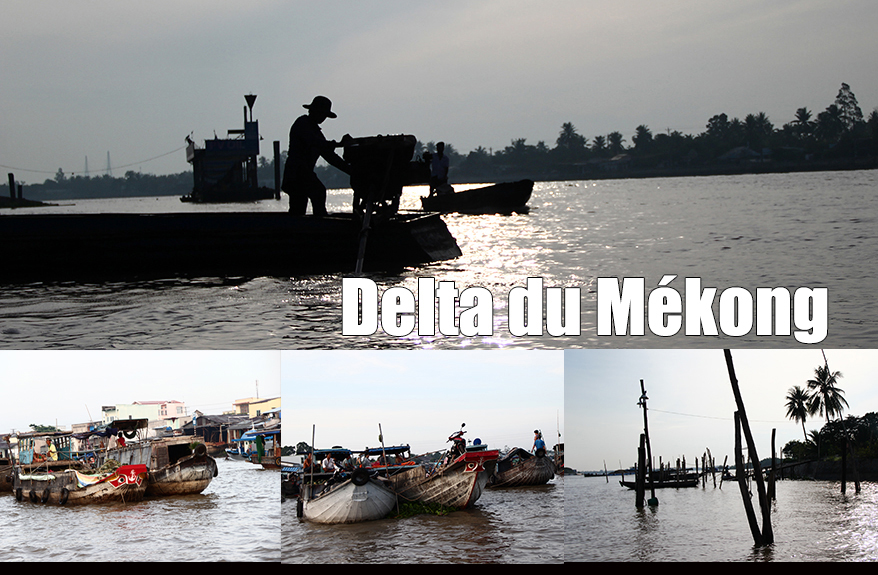
It is also in this delta that are seen every morning, hundreds of sampans converging toward the famous floating market of Phùng Hiêp at the crossroad of seven channels in the direction of Cần Thơ to Sóc Trăng, or toward lesser known markets such as Cái Răng and Phong Ðiền. Also seen are merchants with conic hats trailing their mountains of fruits, legions of ducks, chickens and pigs to the market on their small boats, or other rudimentary means of transportation (bicycles, rickshaws). It is thanks to the orchards of the delta that one finds a great number of fruits: sapotilles, ramboutans, caramboles, corrosoles etc… at the markets of Saigon. It can be said that the delta feeds Saigon and a greater part of Vietnam. In the northeast of the peninsula lies the Plain of Reed ( Ðồng Tháp Mười ) which was a Việt Cộng refuge yesterday and which becomes the Asian Camargue today.

In spite of its lack of archaeological richness, the delta continues to play a vital role economically for Vietnam. It becomes thus the object of greed and confrontation for so many years. It was French Cochinchina at one recent time. Even Hồ Chí Minh, when alive, has agreed to its importance by burying his father at Sadec. There are folks whose names remain anchored in the memory of the Vietnamese people. Phan Thanh Giản, Võ Tánh, Nguyễn Trung Trực, Hùynh Phú Sổ, are among these folks and are issue of this corner.


Without the delta, Vietnam is never free and independent….. 
It is the granary of Vietnam.