Danse du lion ou de la licorne (Múa lân sư)


Version française
Version anglaise

Múa Lân Sư

Nhắc đến Tết không có ai có thể không nhắc đến múa Lân. Đây là môn nghệ thuật múa dân gian được thấy trên đường phố ở Việt Nam. Nó được gọi là múa lân ở trong Nam còn ở ngoài Bắc thì gọi là múa sư (tức là sư tử (hay  wǔshī ). Lân là con linh vật  đứng hàng thứ nhì  trong bốn con vật có sức mạnh siêu phàm hay tứ linh (long, lân, qui, phụng). Trong văn hóa Việt nam, chúng ta thường bị lầm lẫn giữa  con kỳ lân với con ghê. Đặc điểm để phân biệt giữa nghê và lân là ở bộ móng, nghê mang móng vuốt còn kỳ lân mang móng guốc. Thật sự khi gọi kỳ lân, tức là nói đến một cặp: con đực gọi là kỳ và lân là con cái. Múa Lân thường được biểu diễn trong các dịp lễ hội, đặc biệt là Tết Nguyên Đán, Tết Trung Thu hay khánh thành cửa hàng mới vì các loại thú nầy tượng trưng cho thịnh vượng và hạnh phúc. Con lân có cái đầu được trang trí  trông rất đẹp mắt và thân thể của nó được nâng lên bởi một số vũ công uốn lượn theo nhịp điệu âm thanh của các tiếng trống. Nó luôn luôn đi cùng với một vũ công bụng phệ, vui cười hay vẫy quạt, thường đeo mặt nạ  và mặc áo choàng màu vàng nghệ (Ông Địa). Đây là cuộc khiêu chiến giữa người và động vật, giữa Thiện và Ác, luôn luôn kết thúc bằng chiến thắng của con người trên động vật.

Danse de la licorne ou du lion.

En évoquant le Têt, personne n’oublie de mentionner la danse de la licorne ou du lion. C’est un art de la danse folklorique que l’on trouve dans les rues du Vietnam. On l’appelle la danse de la licorne  dans le Sud et la danse du lion dans le Nord (ou wǔshī bính âm). La licorne  occupe la deuxième place parmi les  quatre animaux au pouvoir surnaturel (tứ linh)(long, lân, qui, phụng). Dans la culture vietnamienne, on a l’habitude de confondre la licorne avec le chien-lion (con nghê).  La principale caractéristique permettant de faire la  distinction entre la licorne  et le chien-lion  réside dans les doigts de pied, la licorne étant armée  des sabots et le chien-lion des griffes. Quand on parle de la licorne (Kỳ Lân), on a affaire à un couple d’animaux : kỳ c’est le mâle tandis que Lân est une femelle. La danse de la licorne  est souvent pratiquée lors des fêtes traditionnelles, notamment le Nouvel An lunaire, la fête de la Mi-Automne ou l’inauguration d’un nouveau magasin (ou une boutique) car ces animaux sacrés symbolisent la prospérité et  le bonheur. Cet animal légendaire dont la tête est  décorée magnifiquement et dont tout  le corps est porté par plusieurs danseurs, ondule au rythme des sons des tambourins. Il est toujours accompagné par un autre danseur hilare et ventru agitant son éventail et portant une robe de couleur safran (Ông Ðịa). C’est la danse-combat entre l’homme et l’animal, entre le Bien et le Mal qui se termine toujours par le triomphe de l’homme sur l’animal.

When talking about Tet, no one forgets to mention the unicorn or lion dance. This is a folk dance art found in the streets of Vietnam. It’s called the unicorn dance in the South and the lion dance in the North (or wǔshī bính âm). The unicorn ranks second among the four animals of supernatural power (tứ linh)(long, lân, qui, phụng). In Vietnamese culture, the unicorn is usually confused with the lion-dog (con nghê).  The main distinguishing feature between the unicorn and the lion-dog is the toes, the unicorn being armed with hooves and the lion-dog with claws. When we speak of the unicorn (Kỳ Lân), we’re dealing with a pair of animals: kỳ is the male while Lân is a female. The unicorn dance is often performed at traditional celebrations such as Lunar New Year, Mid-Autumn or the inauguration of a new store , as these sacred animals symbolize prosperity and happiness. This legendary animal, whose head is beautifully decorated and whose whole body is carried by several dancers, undulates to the rhythm of the tambourine sounds. He is always accompanied by another hilarious, pot-bellied dancer waving his fan and wearing a saffron-colored dress (Ông Ðịa). It’s a dance-combat between man and animal, between Good and Evil, which always ends with the triumph of man over the animal.

[Return TRADITIONS]

Quartier piétonnier (Huế)

Khu phố Tây ba lô

Cũng như mọi thành phố, Huế cũng có phố đi bộ  hay thường gọi là khu phố Tây ba lô vì người Âu Châu hay thường cư trú ở nơi nầy trong thời gian viếng thăm cố đô Huế. Cũng có đường mang tên Phạm Ngũ Lão như ở thành phố Saïgon nhưng không có náo nhiệt và đông đảo người chi cho lắm.  Tuy nhiên nó  là nơi mà người du khách có thể tìm kiếm các trò vui chơi và giải trí về đêm giữa lòng cố đô trầm tư và sâu lắng. 

Comme toutes les villes du Vietnam, Huế possède également le quartier des routards européens  car ils y résident fréquemment lors de leur visite dans l’ancienne cité de Huế. C’est étonnant de trouver une rue nommée Phạm Ngũ Lão comme celle de  la ville de Saïgon, mais elle n’est pas assez animée et bondée de gens. Cependant, c’est un endroit où les touristes peuvent trouver des divertissements et peuvent trainer  une vie nocturne au cœur de l’ancienne capitale calme et contemplative.

Like all cities in Vietnam, Huế also has a backpacker district frequented by European travelers during their visit to the ancient city of Huế. It is surprising to find a street named Phạm Ngũ Lão like the one in Saigon, but it is not as lively or crowded. However, it is a place where tourists can find entertainment and enjoy nightlife in the heart of the calm and contemplative former capital.

[Return Huế]

Le pavillon Nhật Thành ( Nhật Thành Lâu)

Nhật Thành Lâu

Version française
Version anglaise
Galerie des photos

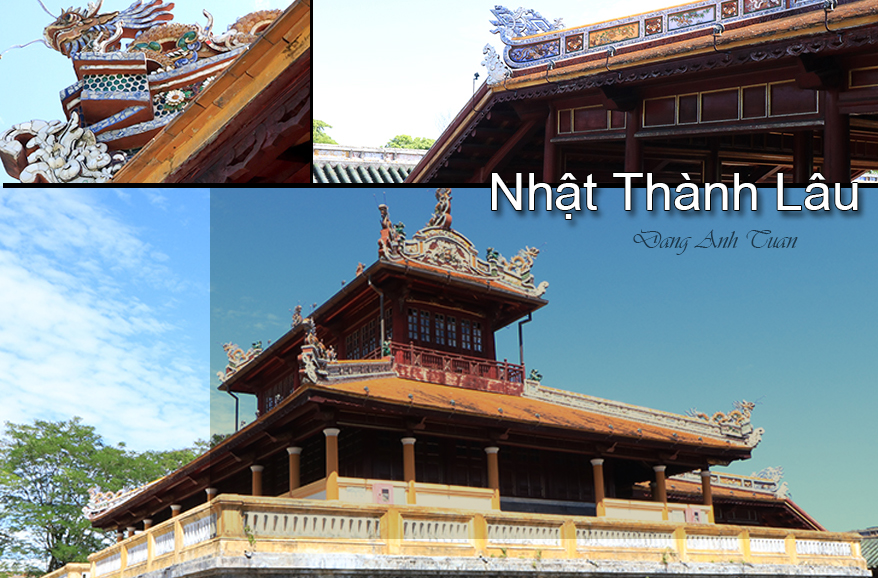
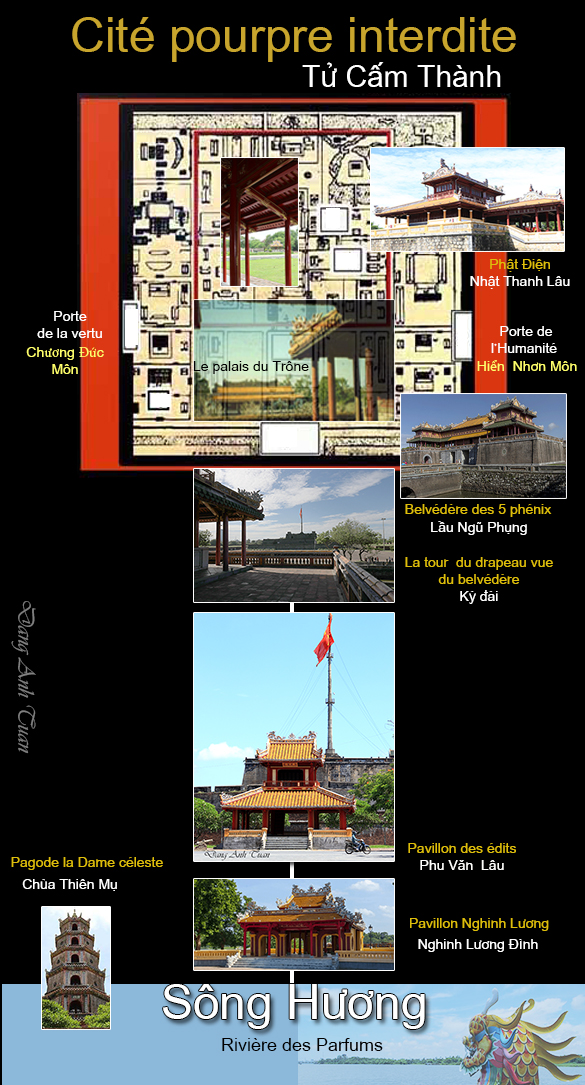
Công trình kiến trúc này được xây dựng vào năm 1841 dưới thời vua Thiệu Trị, lầu gồm có 2 tầng. Nơi nầy là Phật điện của nhà vua trong Tử Cấm Thành hay là kho bạc theo  lời của một tác giả. Không ai biết rõ sự bổ dụng nó trong Tử Cấm Thành. Vào thời kỳ cuối nhà Nguyễn thì nơi nầy mẹ vua Bảo Đại, bà Từ Cung và các bà trong nội cung hay thường lui tới đây để đọc kinh, cầu an và niệm Phật. Lầu Nhật Thành bị tàn phá rất nặng nề trong các năm 1947 và năm 1968 nên  chỉ còn lại phần nền của công trình. Bởi vậy năm 2018, Trung tâm Bảo tồn Di tích Cố đô Huế đã cho phục dựng lại công trình này. Lầu Nhật Thành nằm ở vị trí của Minh Thận Điện thưở xưa, ở phiá đông thì có Càn Thành Điện và phía nam Thái Bình Lâu

Version française

Étant construite en 1841 sous le roi Thiệu Trị, cette œuvre architecturale se composait de 2 étages. Elle  n’avait aucune affectation précise dans la cité pourpre interdite. Selon certains, elle était le lieu de vénération du Bouddha par le roi ou la chambre forte royale selon la remarque d’un auteur dans son article. Vers la fin de la dynastie des Nguyễn, la mère du roi Bảo Đại, la reine Từ Cung et d’autres femmes du palais  y étaient venues souvent  pour lire des sutras, faire des prières ou vénérer Bouddha. Ce pavillon Nhật Thành qui  fut gravement endommagé durant les années  1947 et 1968 ne gardait que sa fondation. En 2018, le Centre de conservation des monuments de Huế décida de le restaurer. Étant situé à l’emplacement de l’ancien palais Minh Thận, Nhật Thành Lâu se retrouve à l’est avec le palais privé du roi, Càn Thanh et au sud avec la bibliothèque royale Thái Bình Lâu.

English version

This architectural work was built in 1841 during the reign of Emperor Thiệu Trị, and the tower has 2 floors. This place was the Buddha hall of the king in the Forbidden Purple City or the treasury according to an author. No one knows clearly its function in the Forbidden Purple City. In the late Nguyễn dynasty, this place was often visited by Emperor Bảo Đại‘s mother, Lady Từ Cung, and the ladies of the inner palace to read sutras, pray for peace, and chant Buddha’s name. Nhật Thành Tower was heavily damaged in the years 1947 and 1968, leaving only the foundation of the structure. Therefore, in 2018, the Hue Monuments Conservation Center restored this building. Nhật Thành Tower is located at the site of the former Minh Thận Hall, with Càn Thành Hall to the east and Thái Bình Pavilion to the south.

Galerie des photos

[Return Hue]


Stèle commémorative (Bia Tưởng Niệm)


Version française
Version anglaise

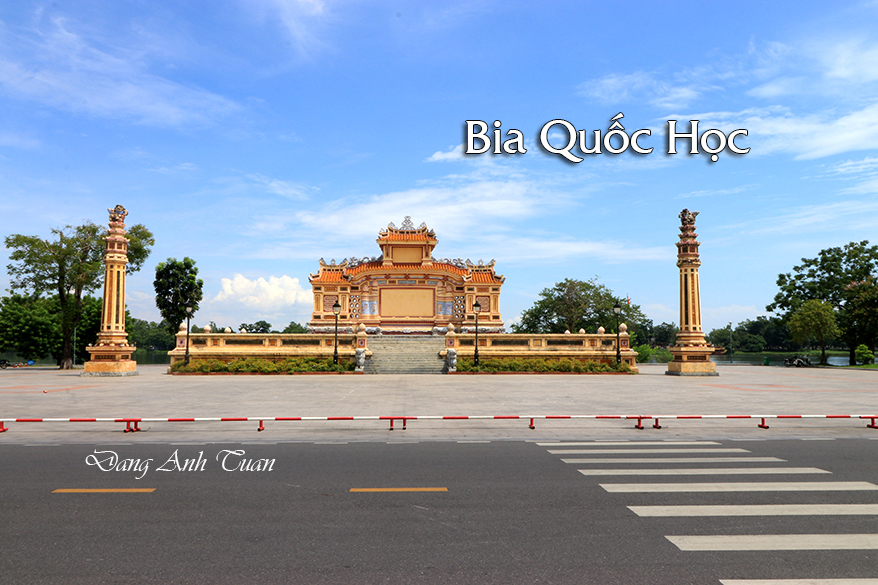
Đựợc gọi là Bia Quốc học, công trình nầy xây cất vào đầu thế kỷ 20 để tưởng niệm những binh sỹ người Pháp và Việt đã hy sinh trong chiến tranh thế giới lần thứ nhất chống Đức. Công trình nầy được chọn theo mẫu thiết kế của họa sỹ xuất sắc trong ngành mỹ thuật đồ họa, Tôn Thất Sa, hậu duệ  của chúa Nguyễn Phúc Chu. Đài được khởi công xây dựng ngày 12 tháng 5 năm 1920 và đã có hơn một trăm năm.  Theo  ông Nguyễn Đình Hoè, đài nầy được dựng theo dáng một bình phong lớn, có mái che, hai tầng và trên nền có bậc thềm. Các hoạ tiết trang trí, kiến trúc, điêu khắc đều mang phong cách kiến trúc của thời Nguyễn. Vì thế nên không bị hũy phá mà còn được sùng tu lại trông rất xinh xắn và hài hoà với quan cảnh hài hoà của sông Hương và trước mặt trường Quốc Học.

Étant appelée maintenant « Bia Quốc Học (Stèle de l’École Nationale)», cette stèle commémorative a été édifiée au début du XXème siècle pour se souvenir des soldats français et vietnamiens morts lors de la Première Guerre mondiale contre l’Allemagne. Ce monument  a été sélectionné selon le modèle proposé par  l’artiste de son temps dans l’industrie des arts graphiques, Tôn Thất Sa, un descendant du seigneur Nguyễn Phúc Chu. Sa construction commença  le 12 mai 1920 et data aujourd’hui plus de cent ans. Selon Mr. Nguyễn Đình Hoè, ce monument a été édifié sous la forme d’un grand paravent doté d’un toit, comportant deux étages  et établi sur une plate-forme avec des marches. Les motifs décoratifs, l’architecture et la sculpture sont tous dans le style architectural de la dynastie des Nguyễn. C’est pour cela qu’il n’a pas été détruit. Par contre, sa rénovation récente est superbe et en harmonie  avec le cadre enchanteur de la rivière des Parfums et en face de l’École Nationale de Huế.

Now called the « Bia Quốc Học (Stele of the National School), » this commemorative stele was erected at the beginning of the 20th century to remember the French and Vietnamese soldiers who died during the First World War against Germany. This monument was selected according to the model proposed by the artist of his time in the graphic arts industry, Tôn Thất Sa, a descendant of the lord Nguyễn Phúc Chu. Its construction began on May 12, 1920, and today it is over a hundred years old. According to Mr. Nguyễn Đình Hoè, this monument was built in the form of a large folding screen with a roof, consisting of two levels and established on a platform with steps. The decorative motifs, architecture, and sculpture are all in the architectural style of the Nguyễn dynasty. That is why it was not destroyed. On the other hand, its recent renovation is superb and in harmony with the enchanting setting of the Perfume River and opposite the National School of Huế.


[Return Huế]

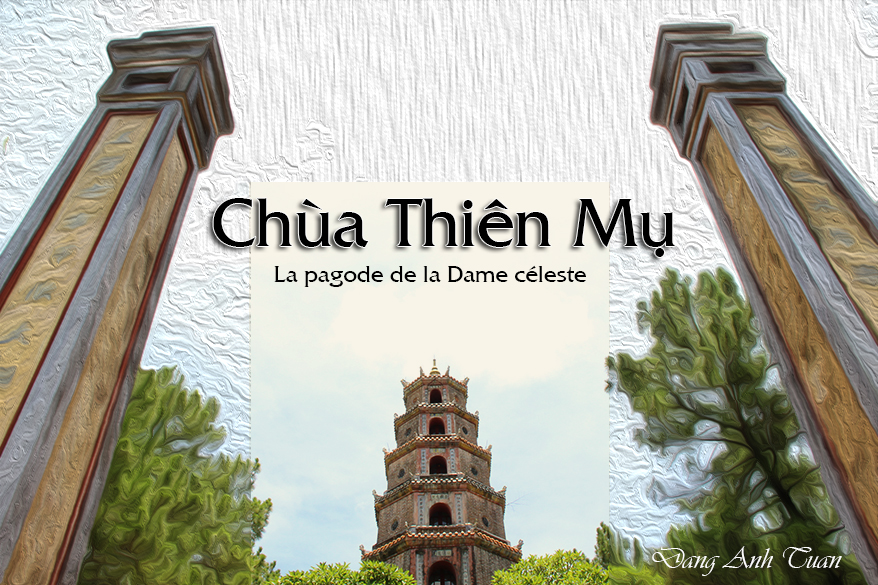
Chùa Thiên Mụ (Pagode de la Dame céleste)


Version française
Version anglaise
Galerie des photos

Trước khi chúa Tiên Nguyễn Hoàng  xây dựng chùa Thiên Mụ hay Linh Mụ vào năm 1601  ở trên đồi Hà Khê  nằm phiá tã ngạn sông Hương  thì chính  ở nơi nầy đã có trước đó  một nền thảo am của những người đến khai khẩn vùng đất nầy lập lên tên là Thiên Mỗ. Chuyện nầy được ghi nhận lại bởi một danh sỹ Dương Văn An đời nhà Mạc có công trạng  viết về núi sông, thành trì, phong tục ở miền Thuận Hoá  (Bình Trị Thiên và Bắc Quảng Nam) trong Ô Châu Cận Lục  vào 1553.  Như vậy  vùng đất nầy thuộc về dân tộc Chàm  vì các di tích thành Lồi của họ được tìm thấy gần đây chỉ cách thành phố  Huế có 4 cây số. Khi Nguyễn Hoàng được  vua Lê  Anh Tông làm Tổng Trấn Tướng Quân kiêm quản cả  Quảng Nam và Thuận Hóa ở Đàng Trong thì ông đã có ý định muốn làm nên nghiệp lớn.  Lúc đầu ông đóng quân ở   (phiá  bắc của Quảng Trị  ngày nay). Có một lần ông đi dò dẫm các vùng lân cận thì ông mới khám phá ra đồi Hà Khê. Ông được nghe dân gian kể là nơi này  có một  bà lão mặc áo đỏ quần lục hay thường xuất hiện  và cũng là nơi mà Cao Biền (Kao Pien)  viên tướng tài nhà Đường (Trung Quốc), làm quan cai trị Việt Nam vào thế kỷ IX. Giỏi thuật số và thông địa lý, ông cho người đào hố ở  phiá sau đồi để  cắt đứt các long mạch và phá linh khí tránh sự xuất hiện của một chân tu đến đây  lập chùa và  làm cho nước Nam hùng mạnh.

Đã có ý đồ làm chúa ở xứ Đàng Trong từ lâu, ông không ngần ngại ra lệnh lấp hố, tụ lại linh khí làm bền vững long mạch và  truyền lệnh xây dựng một ngôi chùa trên nền thảo am của đồi  tên là Thiên Mụ ngoảnh mặt ra sông Hương  để thoả mản ý nguyện trông đợi của dân chúng. Vì sợ quấy rầy bởi  những thần linh  địa phương có khả năng mang lại cho ngườì dân Việt  một cuộc sống tồi tệ trong cuộc Nam Tiến nên họ hay thường sử dụng những nơi có dấu tích  văn hóa Chàm để  chuyển vị các chốn  nầy  vào thế giới tâm linh và làm nơi thờ tự của họ. Họ đang cố gắng thiết lập sự hài hòa giữa sức mạnh siêu nhiên và thời gian ở  các lãnh thổ mà họ đã chinh phục được. Đó là trường hợp thánh địa Pô Nagar nơi mà nữ thần Chăm Uma được người dân Việt giành lại sở hữu và không ngần ngại biến chuyển  truyền thuyết Po Nagar thành truyền thuyết của mình và  được dàn xếp  lại theo cách riêng tư nhưng dù sao họ cũng không xóa bỏ được hết nền tảng của truyền thuyết Chàm. Nữ thần của Chiêm Thành do đó trở thành Thiên Y A Na (hay Thiên Y Thánh Mẫu) của người dân Việt. Sự chiếm đoạt sở hữu  này còn được thấy ở những địa danh khác của Việt Nam trong cuộc Nam Tiến: Bà Đen ở Tây Ninh hay nữ thần Chúa Xứ ở núi Sam (Châu Đốc).

Vì vậy cái thảo am nầy  của người Chàm tên là Thiên Mỗ cũng không ngoài lệ. Nó được dựng cất lại thành một ngôi chùa mang  tên là Thiên Mụ đấy thôi.  Theo nhà nghiên cứu Phan Thuận An thì chúa Nguyễn Kiêm nhận thấy phong cảnh thoát tục hữu tình của ngôi chùa cổ  kính nầy nên cho xây lại ngôi chùa để được  khang trang hơn.  Chùa nầy lúc đầu cũng  sơ sài mà thôi nhưng được nổi  tiếng  từ khi  hoà thượng Thích Đại Sán  (hay Thạch Liêm)  ở Quảng Đông  được chúa  Nguyễn Phước Chu, một người rất sùng đạo Phất,  mời qua để  truyền bá những lời dạy hay giáo lý của Đức Phật tại chùa.  Chúa  còn cho đúc chuông lớn và có làm bài minh khắc trên chuông vào năm 1710.  Chùa nầy còn được trùng tu nhiều lần, lần đầu vào năm 1665 dưới thời chúa Nguyễn Phúc Tần, sau đó bị binh hỏa tàn phá nặng nề dưới thời nhà Tây Sơn (1786-1801) và được tu sửa lại dưới thời ngự trị của vua Gia Long (1815)  và Minh Mạng (1831).  Phải đợi đến năm 1844, năm mà  bà Thuận Thiên Cao Hoàng Hậu, vợ của vua Gia Long thọ  được 80 tuổi thi vua Thiệu Trị cử thống chế Hoàng Văn Hậu xây dựng chùa lại một cách quy mô, có thêm tháp Phương Duyên cao 7 tầng (21 thước)  và đình Hương Nguyện.

Còn dưới thời vua Tự Đức, để tránh động đến Trời vua đổi danh từ Thiên Mụ thành ra Linh Mụ trong thời gian (1862-1869). Năm 1904, với trần bão dữ dội ở Huế, đình Hương Nguyện bị sụp đổ và chỉ được trùng tu lại 3 năm sau dưới thời ngự trị của vua Thành Thái. Chính ngài  nhân dịp  lễ mừng thọ 90 tuổi của bà Từ Dũ, vợ của vua Thiệu Trị, cho bộ Công tu bổ tháp Phước Duyên và dựng bia kỷ niệm. Ngày nay, nhờ sự hài hoà giữa kiến trúc cổ kính của chùa và cảnh sắc nên thơ bên dòng sông Hương, chùa  Thiên Mụ trở thành một danh lam thắng cảnh của đất nước.

Version française

Avant d’entamer la construction de la pagode de la Dame céleste (Thiên Mụ)  par  le premier seigneur Tiên Nguyễn Hoàng de la famille des Nguyễn en 1601 sur la colline Hà Khê  située  sur la rive gauche de la Rivière des Parfums, il y avait déjà à cet endroit  la fondation  d’un pagodon connu sous le nom Thiên Mỗ. Ce dernier  appartenait  aux gens  venus  exploiter cette région. Ce fait  était signalé  par le  célèbre écrivain  Dương Văn An de l’époque de la dynastie des  Mạc, à qui l’on attribue le mérite de décrire les montagnes, les rivières, les citadelles et les coutumes de la région de Thuận Hóa (Bình Trị Thiên  et dans le nord de Quảng Nam) dans son œuvre intitulée Ô Châu Cận Lục (Composition moderne sur le district Ô Châu) en 1553.  Cette région appartenait  ainsi aux gens du Champa  car les reliques de leur citadelle Lồi étaient retrouvées récemment à 4 kilomètres  de la ville de Huế.

Lors de la nomination de  Nguyễn Hoàng en tant que général-administrateur des régions Quảng Nam et Thuận Hóa  dans le pays Đàng Trong (le centre du Vietnam actuel) par le roi Lê Anh Tông, il  a déjà eu l’intention de faire une belle carrière politique. Il s’installa au début avec son armée à  Ái Tử (dans le nord de l’actuel Quảng Tri). Une fois, en explorant les environs, il découvrit la colline de Hà Khê. On le fit connaître dans cet endroit l’histoire d’une vieille dame  venant du Ciel et  portant une chemise rouge et un pantalon vert. Mais ce lieu était aussi l’endroit où le talentueux général de la dynastie Tang Cao Biền  (Kao Pien)  chargé d’administrer le  Vietnam au 9ème siècle et connu pour l’art de la divination et le Feng Shui,  tenta de creuser le fossé derrière de la colline. Cela permit de couper les veines du dragon et détruire toutes les énergies positives pour éviter l’apparition d’un vrai moine venu ici pour construire à l’avenir un temple et rendre le Sud plus puissant.

Ayant eu longtemps l’intention d’être le  seigneur à Đàng Trong, il ordonna  à obturer sans hésitation  le fossé   dans le but de faciliter la concentration des énergies positives et renforcer les veines du dragon et construire sur l’ancien emplacement du pagodon de la colline une pagode orientée vers la Rivière des Parfums. Il  lui donna ainsi  le nom Thiên Mụ (Dame céleste) pour répondre à l’attente et la volonté de la population. Afin d’éviter d’être dérangés par les esprits locaux qui pourraient leur apporter une vie exécrable durant leur marche vers  le Sud (Nam Tiến), les Vietnamiens n’hésitèrent pas à faire usage des vestiges de la culture du Champa pour les transposer dans leur propre univers religieux et les faire devenir leurs propres lieux de culte. Ils tentèrent d’établir une harmonie entre les puissances surnaturelles et temporelles dans les  territoires qu’ils avaient réussi à conquérir. C’est le cas du sanctuaire de Pô Nagar où la déesse du Champa Uma a été appropriée  par les Vietnamiens. Ceux-ci n’hésitèrent pas à assimiler la légende de Po Nagar dans une mythologie arrangée à leur manière sans réussir à effacer le substrat cham du mythe. La déesse du Champa devenait ainsi Thiên Y A Na (Thiên Y Thánh Mẫu) des Vietnamiens. Cette appropriation se renouvelait  à d’autres endroits du Vietnam lors de la marche vers le Sud: la Dame Noire à Tây Ninh ou la déesse Chúa Xứ au mont Sam (Châu Đốc).

C’est pourquoi  le temple cham nommé Thiên Mỗ ne fait pas exception.  Il a été reconstruit pour devenir la pagode nommée Thiên Mụ. Selon le chercheur Phan Thuan An, le seigneur  Nguyễn Kiêm, séduit par le charmant paysage de cette ancienne pagode, ordonna sa reconstruction pour la rendre  plus spacieuse. Cette pagode était très rudimentaire à son début.  Elle  devint  célèbre à partir du moment où le moine Thích Đại Sán (ou Thạch Liêm) venant  de Guangdong, avait  été invité par le seigneur Nguyễn Phước Chu, un grand dévot du bouddhisme, à diffuser les bons enseignements de Bouddha dans cette pagode. Ce seigneur fit couler une grande cloche et fit  graver une inscription sur cette dernière en 1710. Cette pagode fut restaurée à plusieurs reprises, d’abord en 1665 sous le règne du seigneur Nguyễn Phúc Tần. Elle  subit ensuite  de gros dégâts provoqués par l’incendie à la période des Tây Sơn (Paysans de l’Ouest)(1786-1801) et  des remaniements importants sous les règnes des empereurs  Gia Long (1815) et Minh Mang (1831). Puis il faut attendre l’évènement qui eut lieu en 1844. C’est l’année où  l’impératrice mère Thuận Thiên Cao Hoàng Hậu, épouse du roi Gia Long, fêta son anniversaire à 80 ans pour que  roi Thieu Tri chargeât  le maréchal Hoàng Văn Hậu de reconstruire la pagode à grande échelle en y ajoutant la tour Pháp Duyên (7 étages) et le pavillon Hương Nguyện.

Sous le règne du roi Tự Đức, afin d’éviter de déranger le « Ciel »,  le roi a changé son nom de Thiên Mụ en Linh Mụ durant la période (1862-1869). En 1904, à cause de la violente tempête à Huế, le pavillon Hương Nguyện s’effondra  et ne fut restauré que trois ans plus tard sous le règne du roi Thành Thái. C’est lui qui, à l’occasion du 90ème anniversaire de la reine Từ Dũ, épouse du roi Thiệu Trị, demanda au ministère public  de restaurer la tour Phước Duyên et d’ériger une stèle commémorative.

Aujourd’hui, grâce à l’harmonie entre l’architecture ancienne de la pagode et le paysage poétique au bord de la Rivière des Parfums, la pagode Thiên Mụ est devenue un lieu pittoresque du pays.

English version

Before beginning the construction of the pagoda of the Celestial Lady (Thiên Mụ) by the first lord Tiên Nguyễn Hoàng of the Nguyễn family in 1601 on the Hà Khê hill located on the left bank of the Perfume River, there was already at this place the foundation of a pagoda known as Thiên Mỗ. The latter belonged to the people who came to exploit this region. This fact was noted by the famous writer Dương Văn An from the era of the Mạc dynasty, who is credited with describing the mountains, rivers, citadels, and customs of the Thuận Hóa region (Bình Trị Thiên and northern Quảng Nam) in his work titled Ô Châu Cận Lục (Modern Composition on the Ô Châu district) in 1553. This region thus belonged to the people of Champa as the relics of their Lồi citadel were recently found 4 kilometers from the city of Huế.

When Nguyễn Hoàng was appointed as the general-administrator of the Quảng Nam and Thuận Hóa regions in the Đàng Trong country (the central part of present-day Vietnam) by King Lê Anh Tông, he already had the intention of making a successful political career. He initially settled with his army in Ái Tử (in the north of present-day Quảng Tri). Once, while exploring the surroundings, he discovered the Hà Khê hill. In this place, he was told the story of an old lady coming from Heaven, wearing a red shirt and green pants. But this location was also where the talented general of the Tang dynasty, Cao Biền (Kao Pien), who was in charge of administering Vietnam in the 9th century and known for the art of divination and Feng Shui, attempted to dig a moat behind the hill. This was meant to cut the dragon’s veins and destroy all positive energies to prevent the appearance of a true monk who would come here in the future to build a temple and make the South more powerful.

Having long intended to be the lord in Đàng Trong, he ordered without hesitation to fill in the moat in order to facilitate the concentration of positive energies and strengthen the dragon veins, and to build on the former site of the hill pagoda a pagoda oriented towards the Perfume River. He thus gave it the name Thiên Mụ (Celestial Lady) to meet the expectations and will of the population. To avoid being disturbed by local spirits who could bring them a miserable life during their march to the South (Nam Tiến), the Vietnamese did not hesitate to use the remnants of Champa culture to transpose them into their own religious universe and make them their own places of worship. They tried to establish harmony between supernatural and temporal powers in the territories they had managed to conquer. This is the case of the Pô Nagar sanctuary where the Champa goddess Uma was appropriated by the Vietnamese. They did not hesitate to assimilate the legend of Po Nagar into a mythology arranged in their own way without managing to erase the Cham substrate of the myth. The Champa goddess thus became Thiên Y A Na (Thiên Y Thánh Mẫu) of the Vietnamese. This appropriation was renewed in other places in Vietnam during the march to the South: the Black Lady in Tây Ninh or the goddess Chúa Xứ on Sam Mountain (Châu Đốc).

That is why the Cham temple named Thiên Mỗ is no exception. It was rebuilt to become the pagoda named Thiên Mụ. According to researcher Phan Thuan An, Lord Nguyễn Kiêm, captivated by the charming landscape of this ancient pagoda, ordered its reconstruction to make it more spacious. This pagoda was very rudimentary at its beginning. It became famous from the moment the monk Thích Đại Sán (or Thạch Liêm), coming from Guangdong, was invited by Lord Nguyễn Phước Chu, a great devotee of Buddhism, to spread the good teachings of Buddha in this pagoda. This lord had a large bell cast and had an inscription engraved on it in 1710. This pagoda was restored several times, first in 1665 under the reign of Lord Nguyễn Phúc Tần. It then suffered heavy damage caused by fire during the Tây Sơn period (Western Peasants) (1786-1801) and underwent significant renovations under the reigns of Emperors Gia Long (1815) and Minh Mang (1831). Then, one must wait for the event that took place in 1844. That is the year when Empress Mother Thuận Thiên Cao Hoàng Hậu, wife of King Gia Long, celebrated her 80th birthday, leading King Thiệu Trị to charge Marshal Hoàng Văn Hậu with the large-scale reconstruction of the pagoda by adding the Pháp Duyên tower (7 floors) and the Hương Nguyện pavilion.

During the reign of King Tự Đức, in order to avoid disturbing the « Heaven, » the king changed its name from Thiên Mụ to Linh Mụ during the period (1862-1869). In 1904, due to a violent storm in Huế, the Hương Nguyện pavilion collapsed and was only restored three years later under the reign of King Thành Thái. It was he who, on the occasion of the 90th birthday of Queen Từ Dũ, wife of King Thiệu Trị, requested the public ministry to restore the Phước Duyên tower and erect a commemorative stele.

Today, thanks to the harmony between the ancient architecture of the pagoda and the poetic landscape by the Perfume River, the Thiên Mụ pagoda has become a picturesque place in the country.

Galerie des photos

[Return RELIGION]

[Return Huế]
Phu Văn Lâu (Pavillon des Édits)


Version française
Version anglaise
Galerie des photos

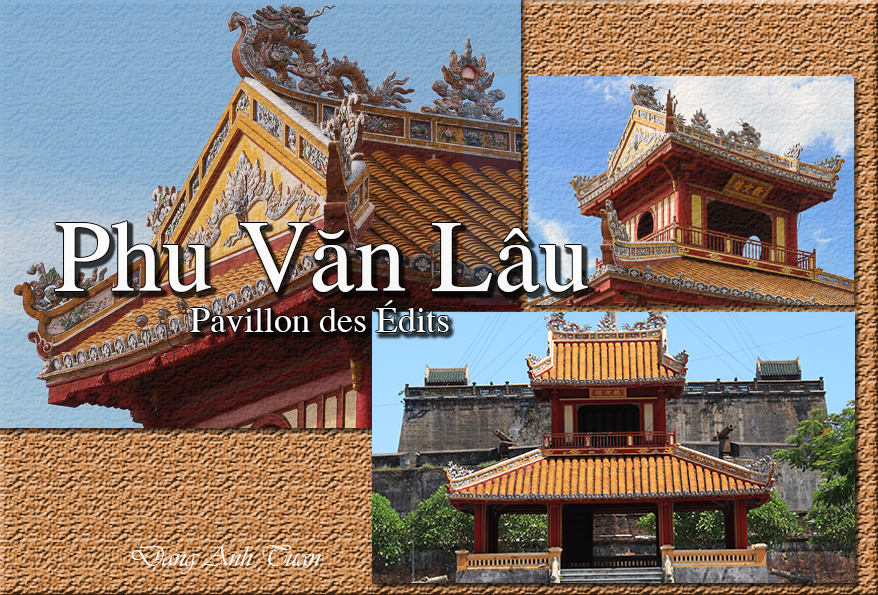
Được tọa lạc trước Kỳ Đài trên trục chính của hoàng thành Huế, quay mặt về phía phía nam (sông Hương), Phu Văn Lâu  là một ngôi lầu nhỏ hai tầng được xây dựng vào năm 1819 dưới thời ngự trị của vua Gia Long. Lầu nầy có chức năng để niêm yết các chiếu chỉ của vua lúc mới ban hành và để công bố tên của các thí sinh được trúng tuyển trong các khoa thi lớn như thi hội và đình. Chính vì lầu có mang tính các long trọng nên mọi người đến đây phải xuống người và phải quỳ lại trước khi đọc chiếu thư của triều đình. Có bia đá trước lầu « Khuynh Cái Hạ Mã » để nhắc nhở mọi người phải xuống ngựa bày tõ lòng kính cẩn. Năm 1829, nơi nầy được vua Minh Mạng dùng để tổ chức cuộc đấu hổ và voi.

Dưới thời vua Thành Thái, sau cơn bão năm Giáp Thìn (1904), Phu Văn Lâu bị phá hủy  trầm trọng và được vua Thành Thái hạ lệnh xây dựng lại như xưa. Phu Văn Lâu là một di tích lịch sử vì đây là nơi mà Trần Cao VânThái Phiên  giả vờ câu cá để gặp vua Duy Tân bàn việc khởi nghĩa chống Pháp. Khi sự việc bị đổ vỡ không thành, hai ông bị tử  hình và vua Duy Tân bị đày qua đảo La Reunion. Bởi vậy ai cũng ngầm ngùi thương xót những nhà yêu nước Việt Nam qua ca dao Huế sau đây nhắc nhở  đến sự việc nầy:

Chiều chiều trước bến Văn Lâu,
Ai ngồi, ai câu, ai sầu, ai thảm?
Ai thương, ai cảm, ai nhớ, ai trông?
Thuyền ai thấp thoáng bên sông,
Nghe câu mái đẩy, chạnh lòng nước non !


Version française

Situé à l’arrière de la tour du mât (Kỳ Đài) sur l’axe principal de la Citadelle Impériale de Huế et en face de la Rivière des Parfums, Phu Van Lau est un pavillon à deux étages construit en 1819 sous le règne de l’empereur  Gia Long. Cet édifice  a pour fonction d’afficher les arrêtés pris par le roi au moment de leur promulgation et d’annoncer les noms des candidats qui ont été sélectionnés aux concours nationaux et provinciaux. Du fait qu’il avait  un caractère solennel, tous ceux qui venaient ici,  devaient descendre de cheval et se mettre à genoux avant de lire l’édit impérial. Il y avait une  stèle de pierre devant le pavillon  « Khuynh Cái Hạ Mã » pour rappeler à chacun de respecter cette modalité.

En 1829, ce lieu fut utilisé par le roi Minh Mang pour organiser un combat de tigres et d’éléphants. Sous le règne du roi Thành Thái, lors de la tempête de l’année Giáp Thin (1904), Phu Van Lau a été sévèrement détruit et  reconstruit comme avant par le roi. Phu Van Lau est un vestige historique car c’est l’endroit où Trần Cao Vân et Thái Phiên ont fait semblant de pêcher pour rencontrer le roi Duy Tân et engager les discussions du soulèvement contre les autorités coloniales françaises. Lorsque le complot avait échoué, ces deux hommes ont été exécutés et le roi Duy Tân a été exilé à La Réunion. C’est pourquoi cela nous remplit de compassion pour les patriotes vietnamiens avec les vers cités ci-dessous dans une chanson populaire de Huế:

Chiều chiều trước bến Văn Lâu,
Ai ngồi, ai câu, ai sầu, ai thảm?
Ai thương, ai cảm, ai nhớ, ai trông?
Thuyền ai thấp thoáng bên sông,
Nghe câu mái đẩy, chạnh lòng nước non !

Le soir devant l’embarcadère Văn Lâu,
Qui est assis, qui pêche, qui est triste, qui est malheureux?
Qui aime, qui ressent, qui se souvient, qui regarde ?
La barque glisse  rapidement sur le fleuve,
En entendant le chant éthéré de la batelière, on éprouve un sentiment de tristesse !

English version

Located at the rear of the mast tower (Kỳ Đài) on the main axis of the Imperial Citadel of Huế and facing the Perfume River, Phu Van Lau is a two-story pavilion built in 1819 during the reign of Emperor Gia Long. This building served the purpose of displaying royal decrees at the time of their promulgation and announcing the names of candidates who had been selected in national and provincial exams. Due to its solemn nature, all who came here had to dismount from their horses and kneel before reading the imperial edict. There was a stone stele in front of the pavilion, « Khuynh Cái Hạ Mã, » to remind everyone to respect this protocol. In 1829, this place was used by King Minh Mang to organize a combat between tigers and elephants.

During the reign of King Thành Thái, in the storm year of Giáp Thin (1904), Phu Van Lau was severely damaged and was rebuilt as before by the king. Phu Van Lau is a historical relic because it is the place where Trần Cao Vân and Thái Phiên pretended to be fishing to meet King Duy Tân and engage in discussions about the uprising against the French colonial authorities. When the plot failed, these two men were executed and King Duy Tân was exiled to Réunion. This is why it fills us with compassion for the Vietnamese patriots, with the verses quoted below in a popular Huế song:

Chiều chiều trước bến Văn Lâu,
Ai ngồi, ai câu, ai sầu, ai thảm?
Ai thương, ai cảm, ai nhớ, ai trông?
Thuyền ai thấp thoáng bên sông,
Nghe câu mái đẩy, chạnh lòng nước non !

In the evening in front of the Văn Lâu dock,
Who is sitting, who is fishing, who is sad, who is unhappy?
Who loves, who feels, who remembers, who watches?
The boat glides quickly on the river.


[Return Hue]

Pont Trường Tiền (Huế)

Version anglaise
Version française
Galerie des photos

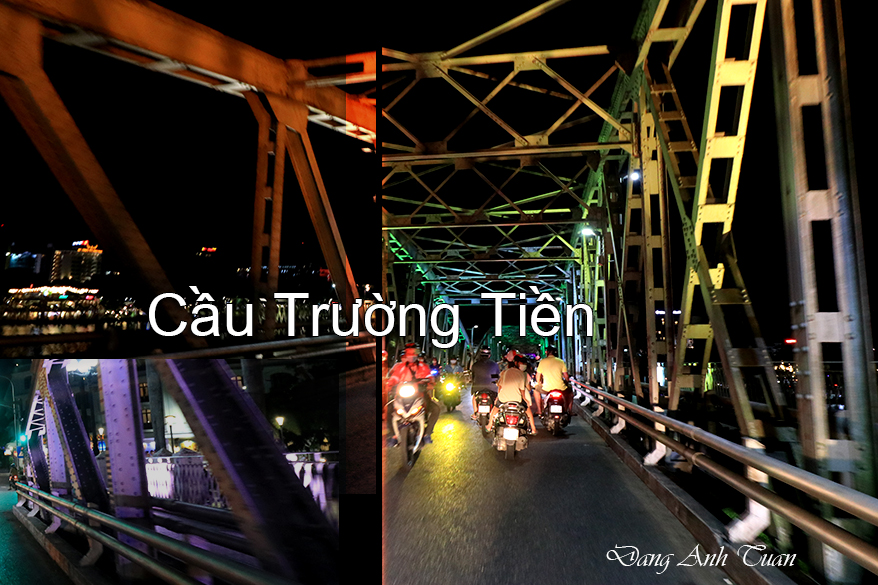
Có tuổi đời nhiều hơn cầu Long Biên ở Hànội, cầu Trường Tiền ở Huế  được Hãng Schneider et Cie et Letellier thiết kế và  khởi công vào tháng 5 năm 1899 và khánh thành vào ngày 18 tháng 12 năm 1900 với sự hiện diện của vua Thành Thái. Người ta ghi nhận được một cuộc chạm trán đầu tiên của ngài với  khâm sứ Alexis Auvergne ở thời điểm khánh thành cái cầu mới bắc qua sông Hương. Tự hào về  kỳ công kỹ thuật và sự vững chắc của cái cầu, Alexis Auvergne không ngần ngại  trả lời với thái độ ngạo  nghễ: Khi nào cầu nầy sụp đổ thì nước ngài sẻ được độc lập. Để cho thấy sự quan trọng mà chính quyền thực dân đã dành cho cái cầu mới này, họ đặt cho nó một cái tên mới là cầu « Thành Thái ». Điều này khiến làm vua Thành Thái  tức giận vô cùng vì ông viện cớ rằng từ nay mọi người có thể giẫm đạp lên đầu ngài qua  cái cầu này. Ngài cấm mọi người  gọi  cầu nầy bằng tên mới và xúi giục họ sử dụng tên cũ « Trường Tiền ». Vài năm sau, trong một cơn bão dữ dội năm thìn (1904), cái cầu nầy bị sập bốn nhịp phía bắc rơi xuống sông.

Thành Thái nhanh chóng nhắc nhở lại câu nói của  Alexis Auvergne với sự hài hước  hóm hỉnh của ông. Alexis Auvergne đỏ mặt xấu hổ và buộc phải lánh trốn trước những lời  nói khó chịu này. Đến năm 1906, sàn cầu mới được đúc lại bằng xi măng. Năm 1938 cầu được nới rộng ra ở hai bên để làm chỗ cho người đi bộ.  Sau khi vua Thành Thái bị truất phế, cầu nầy mới lấy tên Georges Clemenceau, một thủ tướng Pháp có công với trận thế chiến thứ nhất.  Sau khi Pháp mất chủ quyền ở Đông Dương thì cầu lấy tên là Nguyễn Hoàng, một vị chúa Nguyễn đầu tiên được trấn thủ ở đất Thuận Hóa. Bao lần thay đổi, người dân Huế vẫn quen gọi là Trường Tiền hay Tràng Tiền  vì ở gần đó có công trường đúc tiền của nhà nước. Cầu nầy thật sự có 6 nhịp 12 vài cầu chớ không phải 6 vài cầu 12 nhịp như ca dao đã ghi nhận theo sự nhận xét của nhà nghiên cứu Trần Đức Anh Sơn. Bởi lẽ, cầu này có năm trụ ớ giữa, cùng với hai mổ cầu ở hai đầu, chia chiếc cầu ra sáu khoảng không gian bằng nhau (6 nhịp).  Mỗi nhịp có 2 chiếc vài ở hai bên nhầm thay đổi mômen  lực, chuyển từ lực tác động xuống một điểm trên cầu (do người và vật đi qua) thành lực dàn đều trên mặt cầu, tránh sự cộng hưởng lực và nguy hại cho tuổi thọ chiếc cầu.

Dù có rất nhiều cầu bắc ngang sông Hương nhưng cầu Trường Tiền vẫn được người dân Huế ưa thích vì nó  có  nét đẹp riêng tư.  Cái duyên dáng của nó  như chiếc trâm cài trên mái tóc của nàng thơ tên là sông Hương được nhắc đến trong bài viết của Trần Đức Anh Sơn.  Nhìn thoáng  qua từ đằng xa, cầu gồm 6 nhịp dầm thép hình vành lược được thiết kế theo phong cách gô tíc, ở đầu cầu phía bắc thỉ  có chợ Đông Ba còn ở đầu phiá nam thì   có khách sạn  lâu đời Morin (1906). Cầu  Trường Tiền nay là một biểu tượng lịch sử quan trong ở cố đô Huế.

Galerie des photos

No Images found.

Version française

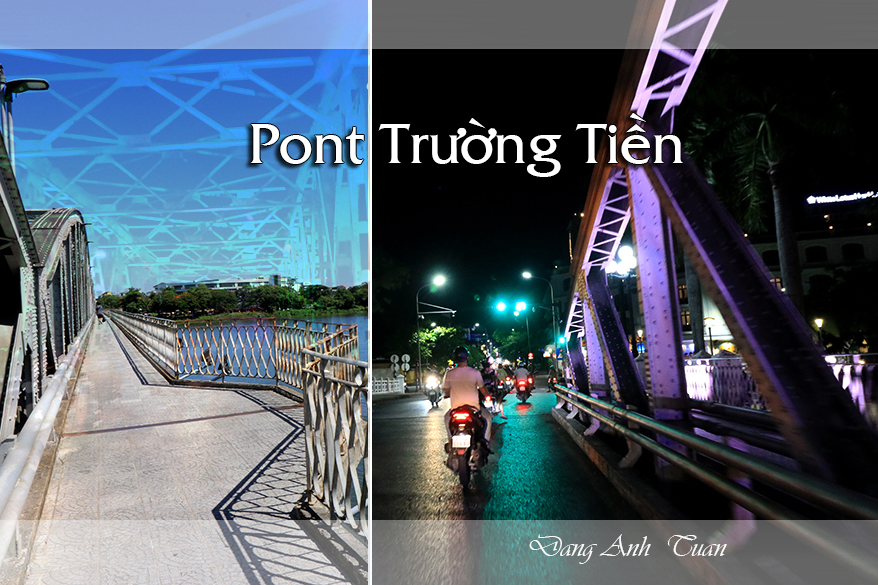
Plus ancien que le pont Long Biên  à Hanoï, le pont Trường Tiền  de Huế fut  conçu par la compagnie Schneider et Letellier en mai 1899.  Celle-ci commença à le construire  en mai 1899 et fêta son inauguration   le 18 décembre 1900 en présence du roi Thành Thái. On nota la première altercation virulente  de ce dernier avec le résident général Alexis Auvergne au moment de l’inauguration du nouveau pont enjambant la Rivière des Parfums. Fier de la prouesse technique et sûr de la solidité du pont, Alexis Auvergne n’hésita pas à dire à Thành Thái avec son  ton arrogant:

Quand vous aurez vu ce pont s’écrouler, votre pays sera indépendant.

Pour montrer l’importance que les autorités coloniales ont donnée à ce nouveau pont, elles lui octroyèrent un nouveau nom « Thành Thái ». Cela rendit l’empereur furieux car en prenant le prétexte que tout le monde put piétiner sur sa tête par le passage de ce pont, il interdît à ses sujets de l’appeler avec le nouveau nom et les incita se servir de l’ancien nom  « »Trường Tiền » .Quelques années plus tard, lors du passage d’une tempête violente (1904), le pont s’écroula  avec ses 4 travées dans l’eau. Thành Thái ne tarda pas à rappeler à Alexis Auvergne ce qu’il lui avait dit avec son humour noir.

Alexis Auvergne rougit de honte et fut obligé de déguerpir devant ces propos gênants. En 1906, le nouveau tablier du pont fut refondu avec du ciment. En 1938, le pont fut élargi des deux côtés pour accueillir les piétons. Après la destitution du roi Thành Thái, ce nouveau pont prit  le nom de Georges Clemenceau, l’ancien premier ministre français ayant rendu des services méritoires à la Première Guerre mondiale.

Après que La France avait perdu la souveraineté  en Indochine, le pont prit le nom de Nguyễn Hoàng,  le premier seigneur des  Nguyễn  chargé  d’être le gouverneur du territoire Thuận Hóa. Malgré la changement de nom en plusieurs fois, les gens de Huế aimaient à l’appeler  encore sous le nom de Trường Tiền ou Tràng Tiền car à  sa proximité se trouvait un atelier de l’état destiné à faire des pièces de monnaie. Ce pont a en fait 6 travées et 12 butées mais non  pas 6 butées et  12 travées comme cela a été dit dans  la chanson populaire  selon la remarque  du  Dr.Trần Đức Anh Sơn.

Du fait que ce pont a cinq piles  au milieu, ainsi que deux culées à ses deux extrémités, il est divisé  en six espaces égaux (6 travées). Chaque travée comporte une butée de chaque côté  ayant le rôle de modifier la poussée  en  rendant  la force d’impact d’un point du pont (causée par le passage de personnes et d’objets) en une force uniformément répartie sur le tablier du pont, ce qui permet d’éviter  la résonance des forces et des dommages pour renforcer la pérennité du pont.

Bien qu’il y ait  de nombreux ponts sur la Rivière des Parfums, le pont Trường Tiền est préféré par les gens de Huế car il se distingue par sa  beauté particulière.  Son charme a été évoqué par le chercheur Trần Đức Anh Sơn comme  celui d’une broche accrochée dans la chevelure d’une jeune fille aimée  nommée  « Sông Hương » (Rivière des Parfums)  En l’observant de loin, on constate que ce pont se compose de 6 travées de poutres en acier en forme de peigne conçues dans un style gothique. À l’extrémité nord du pont se trouve le marché Đông Ba et à son extrémité sud, il y a l’hôtel Morin datant de l’époque coloniale  (1906) . Le pont Trường Tiền devient aujourd’hui  un symbole historique important dans l’ancienne capitale de Huế.

English version

Older than the Long Biên Bridge in Hanoi, the Trường Tiền Bridge in Huế was designed by the Schneider and Letellier company in May 1899. They began construction in May 1899 and celebrated its inauguration on December 18, 1900, in the presence of King Thành Thái. The first heated confrontation between the latter and the Resident-General Alexis Auvergne was noted at the inauguration of the new bridge spanning the Perfume River. Proud of the technical feat and confident in the bridge’s solidity, Alexis Auvergne did not hesitate to say to Thành Thái in an arrogant tone:

When you see this bridge collapse, your country will be independent.

To show the importance the colonial authorities gave to this new bridge, they granted it a new name, « Thành Thái. » This made the emperor furious because, using the pretext that everyone could trample on his head by crossing this bridge, he forbade his subjects from calling it by the new name and encouraged them to use the old name, « Trường Tiền. » A few years later, during a violent storm (1904), the bridge collapsed with its four spans falling into the water. Thành Thái quickly reminded Alexis Auvergne of what he had told him with his dark humor.

Alexis Auvergne blushed with shame and was forced to flee in front of these embarrassing remarks. In 1906, the new deck of the bridge was recast with cement. In 1938, the bridge was widened on both sides to accommodate pedestrians. After the dethronement of King Thành Thái, this new bridge was named Georges Clemenceau, after the former French prime minister who rendered meritorious services during the First World War.

After France lost sovereignty in Indochina, the bridge was named Nguyễn Hoàng, the first lord of the Nguyễn assigned as the governor of the Thuận Hóa territory. Despite the name changes several times, the people of Huế still liked to call it by the name Trường Tiền or Tràng Tiền because nearby there was a state workshop intended for making coins. This bridge actually has 6 spans and 12 abutments, not 6 abutments and 12 spans as stated in the popular song, according to the remark of Dr. Trần Đức Anh Sơn.

Because this bridge has five piers in the middle, as well as two abutments at its two ends, it is divided into six equal spaces (6 spans). Each span has an abutment on each side with the role of modifying the thrust by turning the impact force at a point of the bridge (caused by the passage of people and objects) into a force evenly distributed over the bridge deck, which helps to avoid resonance of forces and damage to reinforce the durability of the bridge.

Although there are many bridges over the Perfume River, the Trường Tiền Bridge is preferred by the people of Huế because it stands out for its particular beauty. Its charm was described by the researcher Trần Đức Anh Sơn as that of a brooch attached to the hair of a beloved young girl named « Sông Hương » (Perfume River). When observed from a distance, it can be seen that this bridge consists of 6 spans of steel beams shaped like a comb, designed in a Gothic style. At the northern end of the bridge is the Đông Ba market, and at its southern end, there is the Morin Hotel dating back to the colonial era (1906). Today, the Trường Tiền Bridge has become an important historical symbol in the ancient capital of Huế.

[Return Huế]

Nghinh Lương Đình (Pavillon de l’embarcadère royale)

Version française
Version anglaise
Galerie des photos

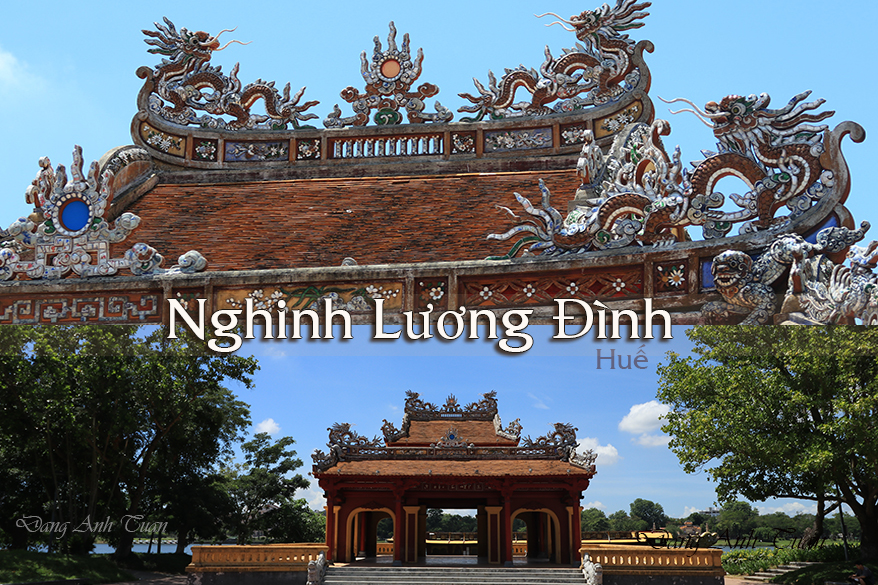
Nghinh Lương đình  được xây dựng ở bờ bắc sông Hương, trước mặt toà Phu Văn Lâu dưới triều vua Tự Đức vào năm 1852 và được trùng tu lại dưới đời vua Thành Thái nhưng bị cơn bão vào năm 1904 nên công trình bị tàn phá nặng nề.  Sau nầy được dưới thời ngự trị của vua Khải Định (1918)  được xây dựng lại và kết nối với bến thuyền liền nhau nhưng vẫn giữ chức năng cũ. Đây là  nơi nghỉ chân và hóng mát của nhà vua trước khi xuống thuyền rồng để du ngoạn trên sông Hương. Công trình nầy được nằm dài  trên trục  chính từ Kỳ Đài truớc cửa Ngọ Môn  đến Phu Vân Lâu và  có một kiến trúc theo kiểu phương đình. Một gian, 4 chái được nối dài ra ở phía trước và phía sau  với nhà vỏ cua   qua máng xối được cấu tạo từ vật liệu kim loại. Bốn mặt của gian chính giữa đều được để trống. Còn ở giữa  bờ nóc của gian chính thì có  lưỡng long chầu nhật .

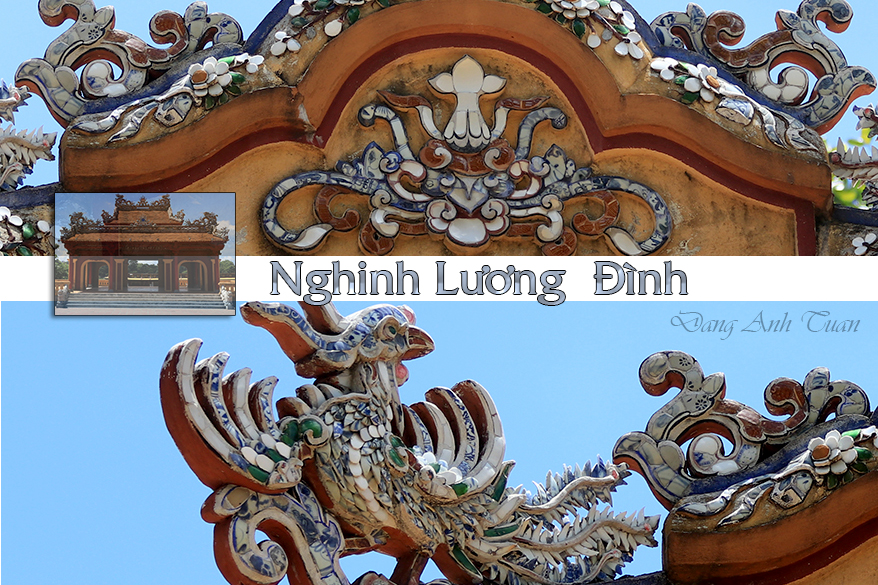
Còn nhà vỏ cua thì ở bờ mái cũng có hình hồi long chầu mặt nguyệt  và ở cuối các bờ quyết  thì trang trí hình chim phượng. Các vì kèo gỗ được chạm trổ  một cách công phu ở trên mặt  với các hình ảnh mang các đề tài  bát bửu như: tù và, quạt vả, phát trần,  lẵng hoa và bầu rượu.  Mái nhà chính lợp ngói ống lưu ly vàng, hai nhà vỏ cua lợp ngói liệt men vàng.  Nghinh Lương đình  được xây dựng trên nền cao khoảng 90 cm cùng bó vỉa bằng gạch vồ và đá thanh.  Nơi phiá bờ sông thì có 13 bậc cấp dẫn xuống một hành lang xây sát mặt nước sông Hương. Nghìn Lương Đình là một trong hai công trình kiến trúc cùng Phu Văn Lâu không có nằm ở trong Đại Nội. Tuy nhiên hai công trình nầy được mọi người ở Việt Nam đều biết đến luôn cả du khách ở nước ngoài  vì hình ảnh của nó được in trên  tờ giấy 50.000 đồng Việt Nam.

Version française

Le pavillon Nghinh Lương a été construit devant Phu Văn Lâu (pavillon des Édits) sur la rive nord de la Rivière des Parfums sous le règne de l’empereur Tự Đức  en 1852. Puis  il  a été restauré à l’époque de l’empereur  Thành Thái . Puis il a subi  des dégâts importants  lors de la tempête  en 1904. Plus tard, sous le règne du roi Khải Đinh (1918), il a été reconstruit presque entièrement et relié à l’embarcadère tout en gardant son ancienne fonction. C’est le lieu de repos et de détente de l’empereur  avant de prendre une excursion en bateau sur la rivière des Parfums. Cet ouvrage architectural est situé sur l’axe principal de la tour du mât (Kỳ Đài) située en face de la porte principale Ngọ Môn jusqu’au pavillon des Édits (Phu Van) et possède une architecture du style de la maison communale. Une grand espace  entouré de 4 appentis, se prolonge en avant et en arrière par des maisons « en coquille de crabe » au moyen des gouttières de drainage en matériau métallique. L’espace central ne possède aucune porte  sur ses quatre côtés. Par contre  au milieu de son arête faitière,  on voit apparaître un globe enflammé (foudre)  vers lequel les deux dragons tournent la tête.

Quant à la maison en « coquille de crabe », sur le toit, on retrouve également un couple  de dragons rendant hommage à la lune et l’ornement d’un phénix au bout de ses extrémités. Les fermes de toit en bois sont minutieusement sculptées sur leur façade avec des motifs représentant  la série des huit joyaux: corne, éventail en forme de feuille de figuier, époussette, panier de fleurs et calebasse à vin.

Le toit principal est recouvert de tuiles « Yin et Yang » jaunes et les deux maisons en coquille de crabe ont leurs tuiles vernissées jaunes. Le pavillon  Nghinh Lương a été construit sur une plate-forme d’environ 90 cm de haut avec les dalles de trottoir en pierre « thanh ». Au bord de la rivière, il y a  13 marches facilitant la descente vers un couloir construit près de la surface de l’eau de la Rivière des Parfums. Le pavillon « Nghinh Lương » est l’une des deux œuvres architecturales avec le pavillon  Phu Van, qui ne font pas partie de la Cité pourpre interdite. Pourtant, ces deux joyaux architecturaux sont connus de tous les gens y compris les touristes étrangers  au Vietnam car leur image est imprimée sur le billet de 50 000 VND.

Version anglaise

Nghinh Luong Pavilion was built on the north bank of the Huong River, in front of the Phu Van Lau building during the reign of King Tự Đức in 1852 and was restored under King Thành Thái’s reign. However, it was severely damaged by a storm in 1904. Later, during the reign of King Khải Đinh (1918), it was rebuilt and connected to the adjacent boat dock but still retained its original function. This was the resting and cooling place for the king before boarding the dragon boat to cruise on the Huong River. The structure lies along the main axis from Kỳ Đài in front of Ngo Mon Gate to Phu Van Lau and features a pavilion-style architecture. It has one main hall and four wings extended at the front and back with crab shell-like houses connected through gutters made of metal materials. All four sides of the central hall are left open. In the middle of the ridge of the main hall, there is a motif of two dragons chasing the sun.

As for the crab shell houses, the gable ends also feature dragon motifs facing the moon, and at the ends of the ridge beams, phoenix bird decorations are displayed. The wooden rafters are intricately carved on the surface with images featuring the eight precious symbols such as a conch shell, fan, fly whisk, flower basket, and wine gourd. The main house roof is covered with yellow glazed tube tiles, while the two crab shell houses are covered with yellow glazed flat tiles.

Nghinh Luong Pavilion is built on a platform about 90 cm high, bordered with brick and Thanh stone edging. On the riverbank side, there are 13 steps leading down to a corridor built close to the surface of the Perfume River. Nghinh Luong Pavilion is one of two architectural works, along with Phu Van Lau, that are not located within the Imperial City. However, these two works are well known by people in Vietnam and even foreign tourists because their images are printed on the 50,000 Vietnamese dong banknote.

Galerie des photos

[Return HUE] 

Trường Lang ( Long couloir de la cité impériale de Huế)


Trường lang ở Đại Nội

Version française
English version
Galerie des photos

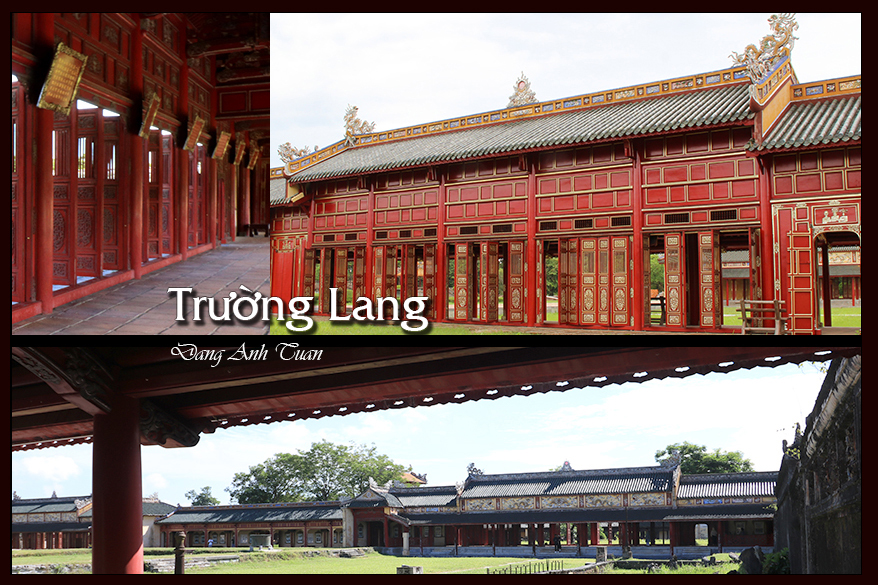
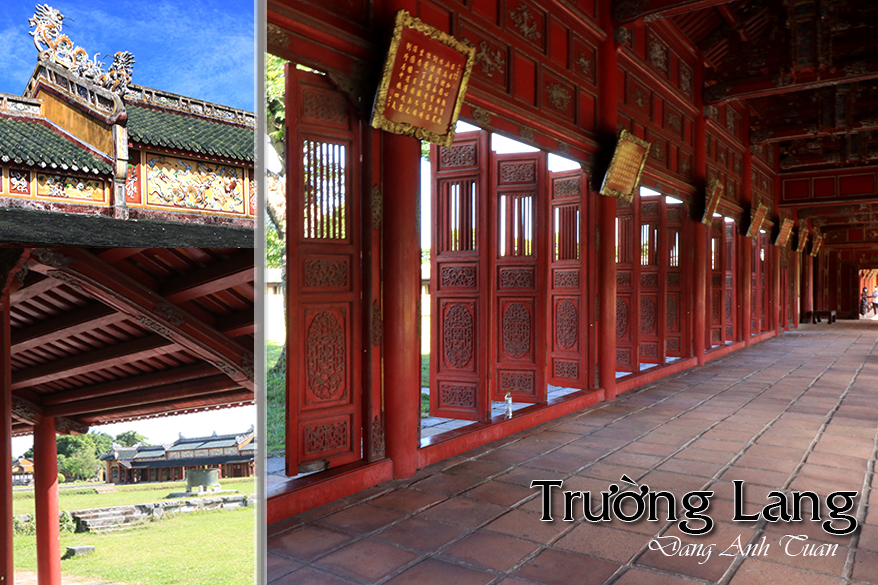
Trong mười năm qua, trung tâm bảo tồn di tích ở Huế đã hồi phục lại trường lang chính với tổng chiều dài chừng 900 mét sau một thời gian bị  phá  hủy một cách trầm trọng chỉ còn nền móng vì chiến tranh thiên tai và nắng mưa.  Không những Trường Lang  có vai trò chính là bảo vệ các lối đi qua lại  và liên kết với các công trình kiến trúc khác ở Tử Cấm Thành mà  nó  còn là một hệ thống  kiến trúc có  mái che rất phong phú đa dạng. Tùy theo vị trí và hình dạng mà nó có tên gọi khác nhau như Trực Lang, Dực Lang và Hồi Lang nhưng Trường lang là tên gọi chung cho các hành lang nầy.  Trường Lang được xây dựng hoàn toàn bằng gổ quý và được bài trí rất cầu kỳ. Hệ thống nầy được phục hồi lại gần đây nhất là Dực lang nằm ở phía bên phải  điện Cần Chánh và  khánh thành vào cuối tháng 4/2016.  Một số bức ảnh của các vị vua nhà Nguyễn, 18 bài thơ của vua Minh Mạng và  hình ảnh tư liệu về kiến ​​trúc của các cung điện được treo dọc theo ở các hành lang nầy.

[Return Huế] 

Version française

Au cours des dix dernières années, le centre de préservation des monuments de Huế a restauré le couloir principal Trường Lang d’une longueur totale d’environ 900 mètres après une période de destruction extrêmement  sévère, ne laissant que les fondations dues aux guerres, aux catastrophes naturelles et au changement climatique. Trường Lang a pour rôle principal de protéger non seulement les passages permettant  d’être en liaison avec d’autres œuvres architecturales de la Cité Interdite, mais c’est aussi un système architectural riche et diversifié doté de toits de protection. En fonction de  l’emplacement géographique du lieu et la forme, il porte différents noms tels que Trực Lang, Dực Lang et Hồi Lang, mais Trường Lang est le nom commun de ces couloirs. Trường Lang est entièrement construit en bois précieux et décoré avec beaucoup de raffinement trouvé dans l’art de Huế. La restauration la plus récente de ce système est Dực Lang située à droite du palais de Cần Chánh et elle a été inaugurée fin avril 2016. Quelques photos des rois de la dynastie des Nguyễn, 18 poèmes du roi Minh Mang et des documents photographiques concernant  l’architecture des palais  sont accrochés tout le long de ces couloirs.

[Return Huế] 

English version

Over the past ten years, the Hue Monument Preservation Center has restored the main corridor Trường Lang, with a total length of about 900 meters, after a period of extremely severe destruction, leaving only the foundations due to wars, natural disasters, and climate change. Trường Lang’s main role is not only to protect the passages that connect to other architectural works of the Forbidden City, but it is also a rich and diverse architectural system equipped with protective roofs.

Depending on the geographical location and shape, it bears different names such as Trực Lang, Dực Lang, and Hồi Lang, but Trường Lang is the common name for these corridors. Trường Lang is entirely built of precious wood and decorated with much refinement found in Hue art. The most recent restoration of this system is Dực Lang, located to the right of the Cần Chánh Palace, and it was inaugurated at the end of April 2016. Some photos of the kings of the Nguyễn dynasty, 18 poems by King Minh Mang, and photographic documents concerning the architecture of the palaces are hung along these corridors.

Galerie des photos

[Return Huế]